
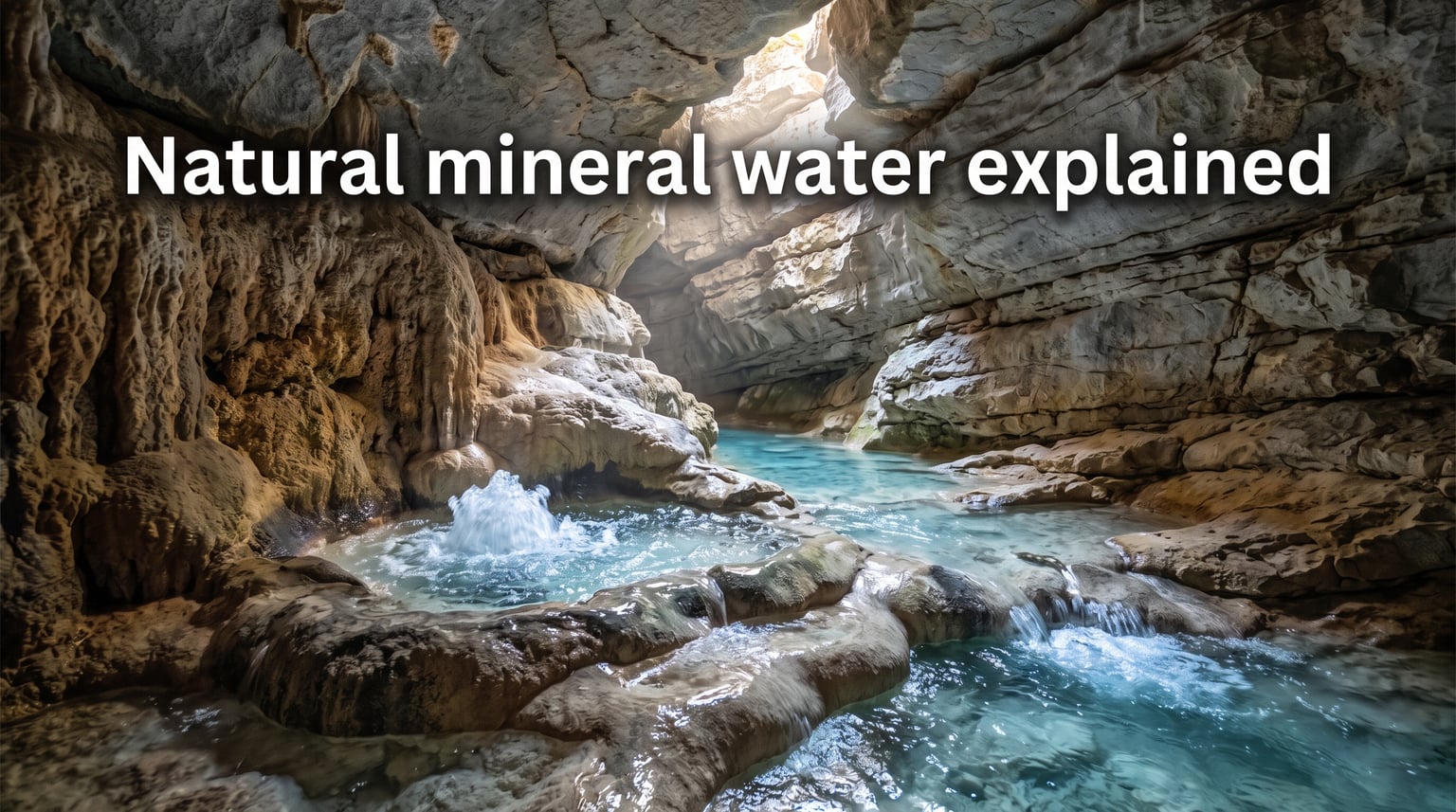
Natural mineral water is bottled water drawn from a protected underground source that carries a stable, consistent mineral composition — calcium, magnesium, bicarbonate, and other trace elements that remain the same from one bottle to the next, year after year.
That definition matters more than most people realise. Walk down the bottled water aisle and you’ll find dozens of labels, but very few of those bottles contain actual natural mineral water in the legal sense of the term. Most are purified tap water, spring water with no mineral guarantees, or “drinking water” with added electrolytes.
We put together this guide to make natural mineral water explained clearly and without confusion — covering what it is, how it forms underground, what the minerals actually do for your body, and how it compares to spring water and tap water. By the end, you’ll know exactly what to look for on a label and why it matters.
Table of Contents
Natural Mineral Water Explained: The Official Definition
Natural mineral water is a legally defined category of bottled water — not a marketing description. That distinction is the starting point for everything else.
Under European Union regulations set out in Council Directive 2009/54/EC, which most countries around the world use as their reference standard, natural mineral water must meet all of the following criteria:
- It must come from a named, identified underground source
- The source must be protected from pollution at the point of origin
- It must have a stable, consistent mineral composition that doesn’t change over time
- It must be bottled directly at the source — bulk transport and bottling elsewhere is not permitted
- It must remain chemically untreated — no disinfection, no fluoridation, no added minerals
That last requirement surprises most people. Natural mineral water is one of the only food products in Europe where chemical treatment is specifically prohibited by law.
The only processes permitted are removing unstable compounds like iron or sulfur (which would discolour the water in the bottle) and adjusting CO2 levels to create still or sparkling versions. Everything else stays exactly as it came from the ground.
The “natural” in the name isn’t marketing language — it’s a legal guarantee that the water has not been altered chemically from the moment it left the aquifer to the moment you open the bottle.
Before any water can be sold as natural mineral water in the EU, its source must receive official recognition from the relevant national authority. That process involves geological surveys, repeated microbiological testing, and chemical analysis to confirm the source meets stability and purity standards. It’s not a label any company can simply choose to print.
In the United States, the FDA defines natural mineral water similarly: it must originate from a physically protected underground water source and contain at least 250 parts per million (ppm) of total dissolved solids (TDS). That TDS floor is the regulatory line that separates it from spring water in American labelling law.
How Natural Mineral Water Gets Its Minerals
The mineralisation process is entirely geological. Nobody adds anything — the rock does all the work.
Rainwater and snowmelt seep into the ground and travel slowly through layers of rock over periods ranging from years to centuries. Depending on the geology of the region, those layers might include limestone, granite, volcanic basalt, dolomite, sandstone, or combinations of several formations.
As the water moves through these rock layers, it dissolves minerals directly from the stone. The contact time, the pressure, and the specific mineral content of the rock all determine what the water picks up along the way.
Different geological formations produce dramatically different mineral profiles. Water moving through limestone acquires high concentrations of calcium and bicarbonate. Volcanic rock regions tend to produce waters with elevated silica. Dolomite contributes both calcium and magnesium in significant amounts.
This is why Gerolsteiner from Germany’s Eifel volcanic region tastes completely different from Evian, which forms slowly in the French Alps through glacial meltwater filtering through glaciofluvial sands. Same planet, entirely different geology, entirely different water.
The underground journey also acts as a natural filter. The rock itself removes microorganisms and particulates — which is exactly why natural mineral water doesn’t need chemical disinfection. The geological protection of the source replaces the treatment that tap water requires.
Once the water surfaces at the extraction point, it travels directly into the bottling facility through a closed pipeline system, never exposed to open air or outside environments. The goal is to preserve the exact mineral composition the geology created, unchanged from aquifer to bottle.
This is also the reason that stable composition is so central to the regulatory definition. The label values for calcium and magnesium should be the same whether you buy that bottle today or two years from now.
What Minerals Are Actually in Natural Mineral Water?
The mineral content varies significantly between brands and sources — there’s no standard formula. What you’ll typically find listed on the label is a breakdown of the following minerals:
Calcium (Ca²⁺) is the most common mineral in bottled waters and the one people associate most strongly with mineral water. It supports bone density, muscle function, and nerve signalling. Waters like Contrex and Vittel from France are particularly high in calcium, with values above 400 mg per litre.
Magnesium (Mg²⁺) plays a role in more than 300 enzymatic processes in the body, including energy metabolism, blood sugar regulation, and muscle relaxation. Many adults don’t get enough from diet alone. Gerolsteiner contains 108 mg/L of magnesium, making it one of the highest-magnesium widely available brands.
Bicarbonate (HCO₃⁻) is often present in the highest concentrations of any mineral in natural water. It acts as a natural pH buffer and can help neutralise excess stomach acid. In sparkling waters, it contributes significantly to the distinctive taste and mouthfeel.
Sodium (Na⁺) is present in varying amounts across different brands. Waters labelled “low sodium” contain under 20 mg/L and are suitable for people managing blood pressure or following sodium-restricted diets. Higher-sodium waters can taste noticeably salty and are sometimes preferred as cocktail mixers.
Potassium (K⁺) is typically present in smaller amounts, but it supports healthy heart rhythm and blood pressure. It’s rarely the primary reason someone chooses a particular water, but it adds to the overall mineral picture.
Sulfate (SO₄²⁻) can produce a mildly bitter or astringent taste at higher concentrations and has a gentle laxative effect in quantity. Waters like Contrex and Vichy Célestins have very high sulfate levels — which is part of why they taste so intensely mineral. If you’ve ever wondered about those pronounced flavours, our article on taste differences in natural mineral waters explains exactly what’s driving them.
Silica (SiO₂) doesn’t appear prominently on most labels, but some waters contain meaningful amounts. It’s associated with skin health and connective tissue support, though research in this area is still developing. We’ve covered this in detail in our piece on silica content in bottled water and whether it’s worth paying attention to.
All of this mineral content is measured collectively as Total Dissolved Solids (TDS), expressed in mg/L or parts per million (ppm). A water under 500 mg/L TDS is considered low-mineral, 500–1500 mg/L is medium, and above 1500 mg/L is high-mineral. The taste difference between Volvic at around 130 mg/L TDS and Apollinaris at over 2,500 mg/L is immediately obvious — they could practically be different drinks.
Health Benefits of Drinking Natural Mineral Water
Natural mineral water isn’t medicine. But the minerals it delivers are the same ones your body needs, and there’s solid research behind several specific benefits.
Bone health. Calcium and magnesium in mineral water both contribute to bone mineral density. Research has shown that calcium from mineral water is absorbed just as efficiently as calcium from dairy products — sometimes more effectively, because it’s already in ionised form and ready for uptake. For postmenopausal women at higher risk of bone density loss, high-calcium mineral water can make a measurable difference to daily calcium intake.
Blood pressure regulation. Magnesium has a well-documented role in lowering blood pressure. Multiple clinical trials have shown that regular consumption of magnesium-rich mineral water — sources providing around 100 mg/L or more — can produce modest but meaningful reductions in both systolic and diastolic blood pressure over four to six weeks. The effect is most pronounced in people who already have low magnesium intake from food.
Heart health. Several studies have looked at mineral water and cardiovascular markers, with generally encouraging results. One trial involving postmenopausal women found that drinking calcium and magnesium-rich mineral water improved lipid profiles — reducing LDL cholesterol and triglycerides compared to low-mineral water over the same period. This doesn’t position mineral water as a treatment for heart disease, but it adds to the broader case for it as a daily choice.
Digestive health and constipation. Sparkling mineral water has specific benefits for digestion that still water doesn’t share. A clinical study found that people with functional constipation who drank sparkling mineral water saw significant improvements compared to those drinking tap water. The carbonic acid from dissolved CO2 and the bicarbonate content appear to be the active factors in stimulating gut motility.
Magnesium supplementation through water. This is likely the most practical benefit for most people reading this in 2026. Magnesium deficiency is widespread — estimates suggest the majority of adults in Western countries don’t reach their recommended daily intake through food alone. A litre of Gerolsteiner delivers around 108 mg of magnesium, roughly 25–30% of an average adult’s daily requirement. Getting a quarter of your magnesium from water without taking a supplement is a straightforward win.
Hydration efficiency. The mineral content of natural mineral water — particularly sodium and bicarbonate — can slightly enhance fluid retention compared to distilled or demineralised water. This makes it a sensible option after exercise, when replacing both fluids and electrolytes matters.
Natural Mineral Water vs Spring Water vs Tap Water
This is the question we see most often in forums and search results, and the confusion is completely understandable because the labelling isn’t always transparent.
Natural mineral water vs spring water. Both types come from underground sources, which is why they’re easy to confuse. The key difference is the level of stability and regulatory scrutiny required. Natural mineral water must have an officially recognised source with a proven, consistent mineral composition. Spring water must come from a source that flows naturally to the surface, but there’s no minimum mineral content requirement and no stability testing mandate — the composition can vary. Spring water can also be treated in ways natural mineral water cannot, including disinfection.
In practice, spring water can be high quality. It just doesn’t carry the same legal guarantees around mineral consistency or source protection.
Natural mineral water vs tap water. Tap water is surface or groundwater treated with chlorine, fluoride, and other approved disinfectants to make it safe for drinking. That treatment is necessary — tap water travels through extensive pipe networks over long distances, with many opportunities for contamination. Natural mineral water bypasses that system entirely: the source protection and natural geological filtration replace the chemical treatment.
The mineral content of tap water also varies enormously depending on where you live, the age of the pipes, and seasonal variations in the source. Natural mineral water offers a consistent, predictable mineral profile that tap water simply cannot match.
Natural mineral water vs purified or distilled water. Purified and distilled water have had virtually all dissolved solids removed. They’re chemically “pure” in the sense of containing almost nothing but H₂O — which also means they deliver no mineral benefit at all. Several bottled waters marketed with vague “enhanced hydration” claims are simply purified tap water with added electrolytes. They are not natural mineral water.
The single clearest test on any label: look for the exact words “natural mineral water” as the product description. Under EU and US labelling law, those specific words have a legal meaning. “Mineral water,” “spring water,” “drinking water,” or “purified water” are all separate categories governed by different standards.
Safety Considerations and Potential Risks
Natural mineral water is safe for the vast majority of healthy adults. A few specific situations are worth being aware of.
Sodium and blood pressure. Most natural mineral waters are low in sodium, but not all. People following a sodium-restricted diet or managing hypertension should check the sodium value on the label before committing to a brand. A water with more than 200 mg/L sodium is generally not recommended for daily use by those with high blood pressure.
Microplastics. Research published in recent years has confirmed the presence of microplastic particles in many bottled waters, including natural mineral water sold in plastic bottles. The health implications of ingesting microplastics are still being studied, but this is a legitimate concern. Choosing natural mineral water in glass bottles eliminates the risk — at higher cost, but with the benefit of taste unaffected by the container.
PFAS contamination. Per- and polyfluoroalkyl substances (PFAS) — sometimes called forever chemicals — have been detected in trace amounts in some bottled water brands, including a few natural mineral waters. This can come from source contamination or from the bottling process itself. Forums we monitor have raised concerns around specific brands for this reason. Choosing brands that publish independent third-party water quality testing gives you the most reliable picture of what’s actually in the bottle.
Mineral overconsumption. For healthy adults drinking one to two litres per day, mineral overconsumption from natural mineral water alone is not a realistic concern. People with kidney conditions or those requiring medically restricted mineral diets should speak with their doctor about appropriate intake, particularly with very high-TDS waters.
Frequently Asked Questions
Is natural mineral water better for you?
Natural mineral water provides bioavailable calcium and magnesium that directly support bone density, heart function, and blood pressure regulation — nutrients a large proportion of adults don’t get enough of through food alone. Whether it’s meaningfully better than your local tap water depends on the mineral quality of that tap water, but natural mineral water offers consistent mineral delivery without chemical treatment or composition variability.
What are the disadvantages of mineral water?
The main disadvantages are the cost (significantly more expensive than tap water over time), the environmental impact of single-use bottles, and microplastic contamination concerns specific to plastic-bottled versions. Some natural mineral waters are also relatively high in sodium, which may not suit people managing blood pressure or following low-sodium diets.
Is it okay to drink natural mineral water every day?
Yes. For most healthy adults, drinking natural mineral water daily is safe and contributes positively to overall mineral intake. The minerals it contains — calcium, magnesium, bicarbonate — are the same ones found in food, and their presence in water does not create a risk of overconsumption at normal drinking quantities. People with kidney disease or medically restricted mineral diets should consult a doctor about appropriate intake levels.
What is the difference between spring water and natural mineral water?
Spring water comes from an underground source that flows naturally to the surface, but it has no legal requirement for a stable or minimum mineral content, and it can be disinfected or treated. Natural mineral water must come from an officially recognised underground source, have a proven stable mineral composition tested over time, and cannot be chemically treated. Every natural mineral water comes from a source similar to a spring, but not every spring water qualifies as natural mineral water.
How does natural mineral water get its minerals?
Rainwater seeps underground and travels through geological rock formations — limestone, granite, volcanic basalt, dolomite — over years or even decades. As the water moves through these layers, it dissolves minerals directly from the rock. By the time it reaches the underground aquifer used for bottling, it carries a mineral profile determined entirely by the local geology, which is why waters from different regions taste so different from one another.
The Bottom Line
Natural mineral water, explained simply, is water from a protected underground source with a stable mineral profile set entirely by geology and guaranteed by law — not by a manufacturer’s formula.
It differs from spring water and tap water in ways that matter: stricter sourcing requirements, no chemical treatment permitted, and mineral content you can check on the label and trust to be consistent. The health benefits from calcium and magnesium are real and supported by research across bone density, blood pressure, heart health, and digestive function.
Read the label carefully, check the TDS value and individual mineral levels for what matters most to you, and consider glass over plastic if microplastics are a concern. The real thing — genuine natural mineral water from a protected underground source — is genuinely what it says on the bottle.