
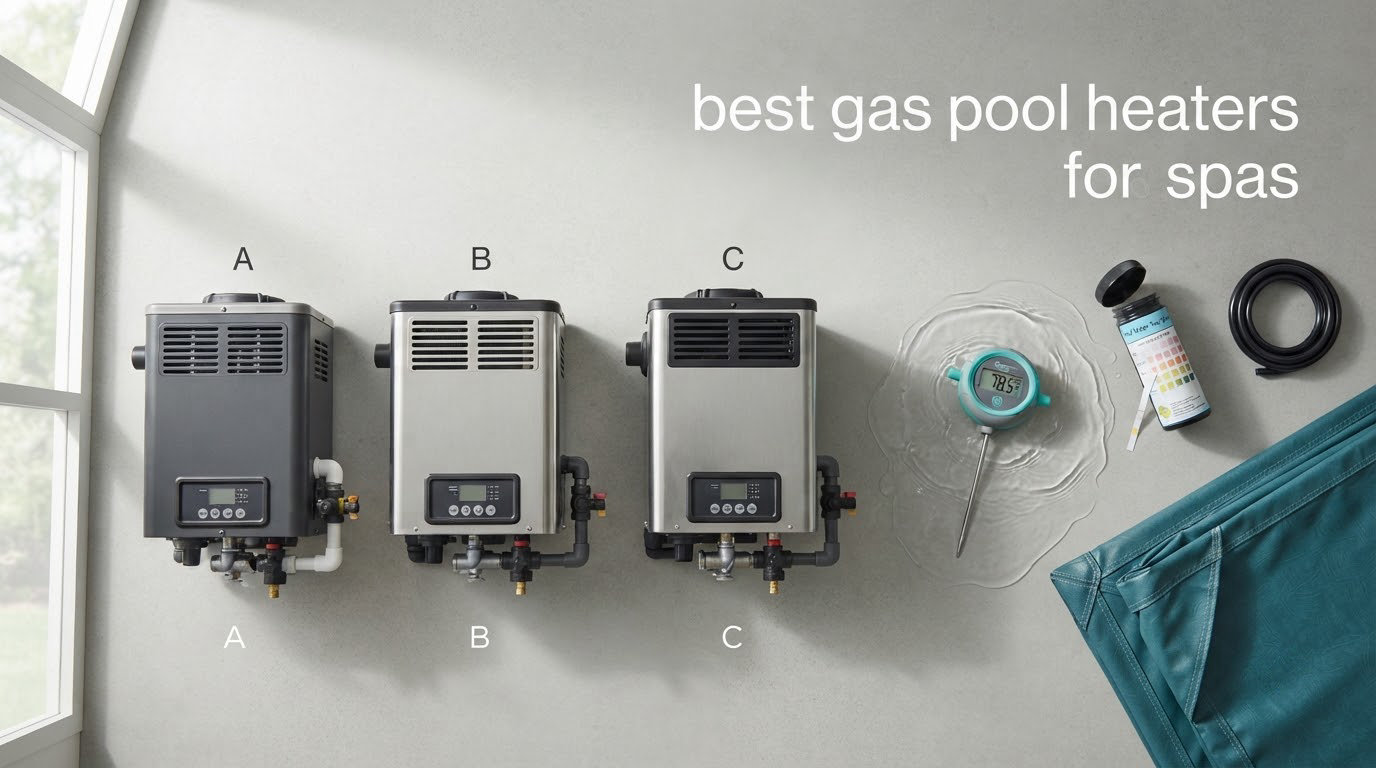
A spa is the one place in the yard where a gas pool heater still wins outright. A heat pump can raise a warm summer pool a few degrees a day, but a gas burner can pull a cold hot tub from tub temperature to soaking temperature in under an hour. That speed is why spas and hot tubs are the last holdouts for gas heating in an era where most new pools go electric.
We put six natural gas pool and spa heaters through the same lens: BTU input against real spa volume, heat exchanger material, ignition type, venting requirements, physical footprint on a crowded equipment pad, and the owner complaints that show up after a second season. The list covers the four brands that dominate this category, Raypak, Pentair, Hayward and Jandy, in the spa-relevant 105,000 BTU to 400,000 BTU band. If you want the wider picture on gas heating for full-size pools, our gas pool heater roundup goes deeper on whole-pool sizing.
One honest note up front. Gas wins on speed and loses on running cost, and it loses on lifespan too. Nothing here is a claim that gas is the cheapest way to hold a spa at temperature. Our overall pool heater guide covers the heat pump and solar side if you are starting from scratch. What follows is for the buyer who wants usable spa water on short notice, in cold weather, without waiting three days for a compressor.
Table of Contents
Top 3 Picks for the Best Gas Pool Heaters for Spas (October 2026)
The three below are the picks we would put on an equipment pad first, based on the balance of rating, owner volume, and how well the unit fits a real spa install rather than a showroom.

Raypak PR106AENC 105K BTU
- 105000 BTU natural gas
- Built for above ground pools and spas
- All-copper fin-tube exchanger
- Polymer headers

Hayward H-Series 200K BTU
- 200000 BTU natural gas
- Spas up to 600 sq ft
- Digital LED self-diagnostic panel
- Low-NOx certified

Raypak P-R156A-EN-C
- Compact 27 x 12 x 27.5 in body
- Digital thermostat with lockable set point
- Automatic water bypass
- Plugs into a standard outlet
All Six Spa Heaters Compared in 2026
Every heater below is natural gas. The differences that actually decide a spa purchase are input rating, exchanger material, ignition method and how the unit is rated for altitude and installation location.
| Product | Specifications | Action |
|---|---|---|
| Raypak PR106AENC 105,000 BTU |
|
Check Latest Price |
| Hayward H-Series W3H200FDN 200,000 BTU |
|
Check Latest Price |
| Raypak P-R156A-EN-C |
|
Check Latest Price |
 Pentair MasterTemp 400 Pentair MasterTemp 400 |
|
Check Latest Price |
 Jandy JXI400N 400,000 BTU Jandy JXI400N 400,000 BTU |
|
Check Latest Price |
 Raypak P-R336A-EN-X 300,000 BTU Raypak P-R336A-EN-X 300,000 BTU |
|
Check Latest Price |
1. Raypak PR106AENC 105,000 BTU – Quiet Heat for Above-Ground Spas
Raypak PR106AENC 105,000 BTU Natural Gas Pool Heater for Above Ground Pool and Spa Elevations 0–4,999 ft (014779)
105000 BTU natural gas
Above ground pools and spas
0-4,999 ft elevation
78.8 pounds
Pros
- Quiet running confirmed by owners
- Straightforward install for a competent DIYer
- All-copper fin-tube exchanger from one piece of extruded copper
- Polymer headers prevent rust stains
- No fan needed to fight drafting
Cons
- Plumbing ports sit close together and need an extra straight pipe
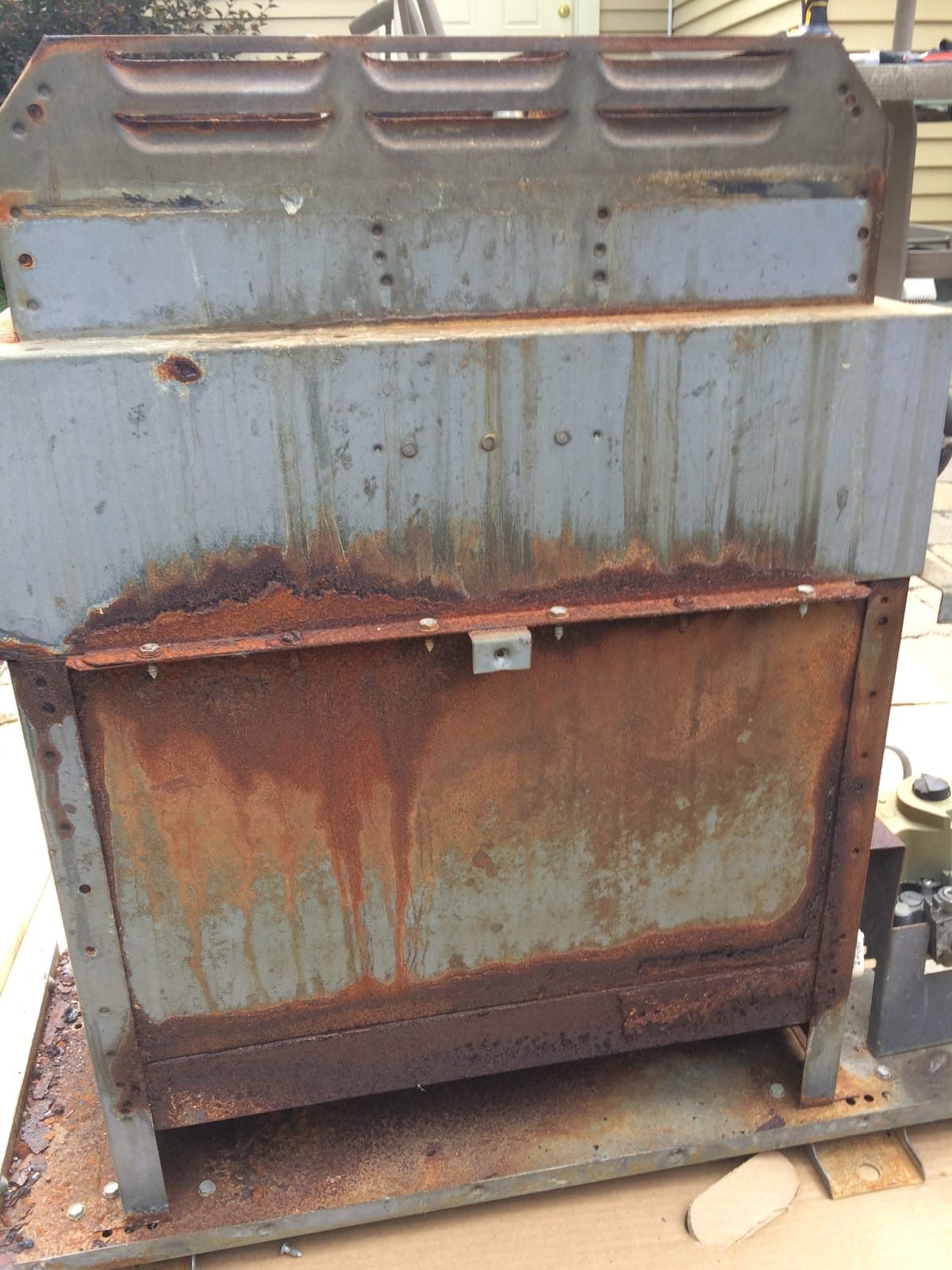
- Some owners report early ignitor failure and internal rust within a year
- Vent collar is 6 in and inlet and outlet are reversed versus older 055 models
This is the model we would put first on a spa list, and the reason is the review volume. Sixty-seven ratings is nearly four times the owner history behind most of the spa-rated heaters in this category, and owners describe the same thing repeatedly: a quiet burner that heats what it is asked to heat without drama.
At 105,000 BTU it is sized for a small volume, which is exactly what a 300 to 500 gallon hot tub is. Owners running it on above-ground pools report using it to push a season forward rather than to heat a whole body of water, and the elevation rating to 4,999 feet means it works in most of the country without derating.
The all-copper fin-tube exchanger is made from a single piece of extruded copper, and the polymer headers are there for a practical reason. Those headers are the parts that would otherwise sweat and drip rust-colored staining into a spa where the water line sits right below the heater. The no-fan, atmospheric design also means no blower to fail and less noise at a time of day when the spa is actually in use.
The retrofit story is where this one gets awkward. Owners replacing an older Raypak 055 report that the water inlet and outlet sit in the opposite arrangement and the vent collar measures 6 in rather than 4 in, so a drop-in swap is not a drop-in swap. Several buyers also had to add a short straight pipe before an elbow because the ports are spaced tightly. Plan the plumbing before the appliance shows up.
Where the PR106AENC makes the most sense
This is the heater for an above-ground pool and portable spa, or a small in-ground spa that nobody needs to heat quickly from stone cold. Because the burner is atmospheric rather than fan-assisted, it keeps running in wind and downdrafts where a fan-assisted unit can be tripped off by a gust, and reviewers mention that reliability across seasons rather than a single impressive first burn.
It is also the easiest of the six to install yourself if you already have a gas line and know what you are doing. The catch is the polarized one-star tail, where buyers describe ignitor failure and internal rust or leaking inside the first year. The rating sits at 4.0, so treat a first-season check of the burner and the cabinet as a five-minute task rather than assuming the unit is sealed for life.
What to check before you order
Confirm your existing gas line can deliver the full 105,000 BTU input at your meter, and confirm the elevation of your site is inside the 0 to 4,999 foot band. Measure the pad space against the 30 x 27 x 16 inch body, and check clearance to the house and any overhang, because atmospheric units still need their flue clearance even though they have no fan.
If a supplier quotes you a 105K unit as a pool heater for a 15,000 gallon pool, that is a sales conversation you should walk away from. At this input it is a small-volume heater, and treating it as a pool heater is exactly the sizing mistake that shortens exchanger life.
2. Hayward H-Series W3H200FDN 200,000 BTU – Fast Warm-Up for Spas and Small Pools
Hayward H-Series Natural Gas Pool Heater for Inground Pools 200,000 BTU
200000 BTU natural gas
Spas up to 600 sq ft
Digital LED control panel
161 pounds
Pros
- Owners report a couple of degrees per hour on a 30 ft round pool
- Heated a 28000 gallon pool from cold to about 90 degrees in a few hours
- Quiet running with low-NOx certification
- Gas and electrical connections can enter from either side
- Replaced a 20-year-old Hayward Millivolt heater for one buyer
Cons
- Needs a dedicated 20 Amp breaker on top of the gas line
- 161 pounds makes professional installation advisable
- A few buyers report units that did not work and slow seller response
This is the highest-rated heater in the group at 4.1 stars across 61 ratings, and the owner reports are unusually specific about what it does. Buyers describe a couple of degrees per hour on a 30 foot round pool, and one reported pulling a 28,000 gallon pool from cold to about 90 degrees in a few hours.
For spa duty that speed is the selling point. At 200,000 BTU the unit is listed for inground pools and spas up to 600 square feet, which covers most hot tubs and many small in-ground spas with room to spare. It also carries the highest altitude-friendly flexibility of the group in practice, since it is not tied to a low-elevation-only rating.
The control panel is a digital LED display with self-diagnostic capability, and the cabinet is designed to reduce circulation pump run time for energy savings. Gas and electrical connections can enter from the right or the left side, which matters more than it sounds when the equipment pad already has a filter and a pump on it.
Two practical catches. It needs its own 20 Amp circuit in addition to the gas line, so your electrical panel has to have a spare, and at 161 pounds it is the heaviest body in this list, which is a strong argument for letting an installer handle the pad work.
Where the H-Series earns its rating
Owners who replaced an older Hayward Millivolt heater with this one describe the swap as straightforward, which is the practical face of the brand reputation question. The built-in 3/4 inch gas connection simplifies the fuel line, and the corrosion protection against unbalanced water chemistry is the feature that matters most if your spa chemistry runs warm and chlorinated.
This is the pick for a combined pool and spa setup where the spa needs genuine on-demand heat and the pool is a secondary body of water. At 200,000 BTU it is big enough to matter for a small pool and still proportionate to a hot tub, which is a balance none of the smaller units achieve.
Where it will frustrate you
If your equipment pad is already packed and access is tight, the 33.3 x 32.8 x 30.6 inch footprint and 161 pound weight are real constraints. The flexible connection sides help, but the lifting does not solve itself, and a failed install on a heavy cabinet is a common and expensive mistake.
The other frustration is service. A small number of buyers report units that did not work at all and sellers who were slow to respond. That is a minority pattern, not a theme, but on an appliance this heavy it is worth confirming with the seller in writing before you accept delivery.
3. Raypak P-R156A-EN-C – Compact Digital Heater With a Lockable Set Point
Raypak 014784 Polymer Headers Digital Control/Electronic Ignition/Natural Gas P-R156A-EN-C Heater
Natural gas with automatic water bypass
Electronic ignition
27 x 12 x 27.5 in body
91.8 pounds
Pros
- Smallest footprint in the group at 27 x 12 x 27.5 in
- Heats a 1000 gallon spa about 1 degree per minute
- Plugs into a standard outlet instead of a fuse box
- Quiet running with roughly 90% efficiency reported by long-term owners
- Extends the season on above-ground saltwater pools
Cons
- Several owners report the rollout switch tripping repeatedly
- Water temperature sensor failure reported in year two
- Raypak warranty language requires a licensed installer
- Replacement parts can be hard to source
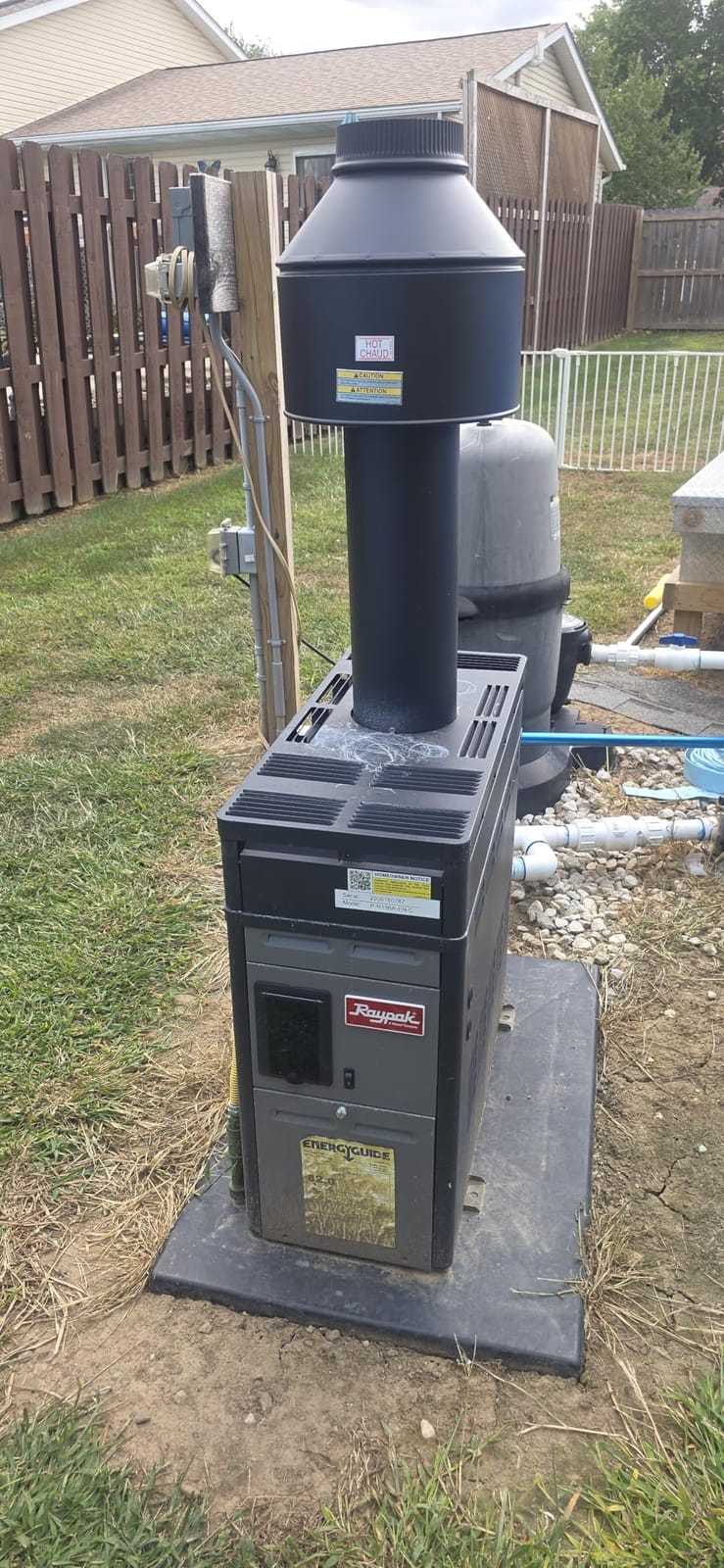
At 27 x 12 x 27.5 inches and 91.8 pounds, this is the easiest of the six to actually fit on a spa equipment pad, and several owners specifically call out that it makes install and DIY repair straightforward. For a cramped pad next to a hot tub where every inch is contested, that footprint is worth more than another 50,000 BTU.
The owner heating numbers are the strongest in the group. Buyers report about 1 degree per minute on a 1,000 gallon spa, taking water from 63 up toward 100 degrees in roughly two and a half hours, and another reports an in-ground spa and jacuzzi going from 70 to 90 degrees in about an hour. Long-term owners also report quiet operation and roughly 90% efficiency, which is at the top of what an atmospheric gas appliance can do.
The control side is genuinely spa-friendly. It has a digital thermostat with a lockable set point, which matters more than it first appears because a 104 degree maximum on a hot tub is a code and safety requirement, and a lock stops a curious guest or a bumped panel from walking past it. The automatic water bypass valve removes one of the classic spa install errors, and the unit plugs into a standard outlet rather than needing a fuse box.
It is also the only heater in this list with documented use on saltwater. One owner extended their season by more than 60 days on an above-ground salt water pool, which is a relevant data point for anyone running a converted spa where corrosion is the leading concern.
The polymer headers match the rest of the Raypak line, keeping rust staining off a spa surface where the water line sits directly under the heater. Electronic ignition means no standing pilot, which is the right choice for a unit that sits through a cold shoulder season and only fires when someone actually wants a soak.
Who should buy the P-R156A-EN-C
Buy it if your spa pad is tight, if you are replacing a heater and want something a competent DIYer can fit without a crane, or if you want on-demand heat in a cold climate for a modest volume. Owners running two-plus seasons report steady satisfaction with the heating performance, which is the metric that matters for a spa.
It is also the pick for a rental or vacation property spa, where the lockable digital set point and automatic water bypass reduce the ways a less careful install can go wrong after you have left.
Where it lets you down
The recurring complaint is the rollout and flame rollout switch tripping repeatedly, sometimes traced back to the motherboard rather than the switch itself. A separate report describes a water temperature sensor failure in year two of service. Neither is a heat exchanger problem, but both are the kind of electronics issue that an independent repair shop may not want to touch.
There is also a warranty tension worth knowing before you buy. Raypak warranty language calls for a licensed installer, which sits awkwardly with a plug-in, gas-line-only setup, and owners report limited repair resources and hard-to-source parts on this model. Confirm the warranty terms for your specific model number before you plan on a self-install.
4. Pentair MasterTemp 400 – Lightest Body and Premix Combustion
MasterTemp 400 High Performance Pool and Spa Heater – Natural Gas
Natural gas premix combustion
65 pounds
36 x 30 x 22.5 in
Certified for indoor and outdoor use
Pros
- Lightest body in the group at 65 pounds
- Premix combustion for fast and efficient warm-ups
- Rust-proof exterior
- Certified for both indoor and outdoor installation
- Rotatable intuitive controls
Cons
- Only 17 ratings leaves little long-term reliability evidence
- One in four ratings is a single star
- No written customer review detail was returned for this listing
Two things separate this one from the rest. It weighs 65 pounds, which is less than half the weight of the Hayward H-Series, and it is certified for indoor as well as outdoor installation, which almost nothing else on this list is. If your spa sits in a sheltered enclosure, that certification is the whole decision.
The combustion side is premix, meaning the gas and air are mixed before entering the burner. That design is the reason Pentair specifies fast, efficient warm-ups, and it is a different mechanical philosophy from the atmospheric burners in the Raypak models. Premix burners run cleaner and tend to hold a stable flame across a wide turndown range.
The exterior is rust-proof, and the operation controls rotate, which sounds minor until you are trying to set a thermostat on a unit that has been screwed into a tight corner. Built-in safety features are listed for system protection, which on a spa appliance is not a marketing line but a requirement.
I want to be straight about the evidence here. This listing carries 17 ratings at a 4.0 average, and the distribution is unusually split, with 76 percent five star and 24 percent single star, with nothing in between. No written customer review text was returned for this listing at all, so the owner detail you get here is thinner than for any other heater on this list.
Where MasterTemp 400 fits
The 65 pound body is the practical headline. On a spa install where two people need to move the appliance onto the pad and a 36 x 30 x 22.5 inch cabinet has to fit between a filter and a pump, weight changes the conversation about whether you need a professional at all.
Premix combustion with a rust-proof exterior is a good pairing for a saltwater spa or a coastal install, and the indoor and outdoor certification opens up room and enclosure placements the atmospheric units cannot legally take.
Where the risk sits
A single-star share of 24 percent on a small sample is a signal to slow down, not a verdict. With 17 ratings there is no way to tell whether the complaints cluster on one fault, and a pool or spa appliance is exactly the category where a failed burner or control board is worth avoiding before season two.
My advice is to buy it for its certification and weight, and to buy it from a seller who will stand behind the first season. Do not buy it on an efficiency claim you cannot verify, and ask directly what the warranty covers on the burner and controls before the unit is on your pad.
5. Jandy JXI400N 400,000 BTU – Smallest Cabinet for Hot Tub Duty
Jandy JXI400N Compact Swimming Pool Spa Hot Tub Natural Gas Heater 400K BTU
400000 BTU natural gas
Compact cabinet for hot tubs
Floor mount outdoor install
Radiant element with convection transfer
Pros
- Compact cabinet frees space on a crowded equipment pad
- Reported to heat about 20% faster than the model it replaces
- Smaller and quieter than comparable predecessors
- Gas
- plumbing and electrical connections described as straightforward
Cons
- Multiple owners report heat exchanger failure within 18 months to 2 years
- Exchanger failure also takes the electronics with it
- Warranty reportedly covers parts but not labor
- Only 10 ratings is very thin for this class of appliance
The JXI400N is a 400,000 BTU natural gas heater for pools, spas and hot tubs, and the reason it shows up on spa lists is the cabinet. Owners replacing an older Jandy report that it leaves noticeably more room on a crowded equipment pad, and that it heats roughly 20 percent faster than the unit it replaced.
That combination, high output in a small body, is unusual. Most heaters at this input rating are physically large, and a spa pad rarely has room to spare. The floor mount outdoor cabinet installation and radiant heating element with convection transfer are conventional, well-understood components, and buyers report the gas, plumbing and electrical connections as straightforward.
Then there is the failure pattern, and it is specific enough to name. Multiple owners report heat exchanger failure within 18 months to two years, and in those reports the electronics go with it. One owner describes buying two heaters in five months with both failing, which tells you the problem is not a random bad part in a single unit.
There is a second layer to that. The Jandy warranty is reported to cover parts but not labor, so an 18-month exchanger failure can leave a buyer facing a replacement cost with the labor on their own. Owners also report that repair or salvage is often impossible once the exchanger is gone.
Where the JXI400N is the right call
If your pad is physically full and you need genuine 400,000 BTU output from a hot tub, the compact cabinet is the argument for it. Owners who get a working unit are enthusiastic about the speed and the size, and there is no question that the output rating is matched to hot tub demand.
It is also a reasonable candidate for a pool and spa combination where the spa is the priority body of water, since the output is sized to bring a small volume to temperature quickly.
Where it is the wrong call
Ten ratings is an extremely thin evidence base for an appliance in this class, and a quarter of the owner feedback describes early exchanger failure. We would not put this at the top of anyone’s spa list when the same output range is available from platforms with a deeper owner record.
The parts-not-labor warranty detail is the deal breaker for most buyers. Ask the seller to confirm the labor position in writing, and confirm who services a Jandy in your area, before this one goes on a shortlist. If the answer is vague, pick a different brand.
6. Raypak P-R336A-EN-X 300,000 BTU – Cupronickel Tubing for Large Spas
Raypak 300k BTU Pool & Spa Heater, Natural Gas, Polymer Header, Cupronickel Tubing, Digital Control, 0-1999 ft. Elevation
300000 BTU natural gas
Cupronickel exchanger tubing
Polymer header and digital control
Rated 0-1999 ft
Pros
- 300000 BTU output covers larger spas than the entry Raypak models
- Cupronickel tubing resists corrosion in pool water environments
- Polymer header construction
- Digital control panel for precise temperature setting
Cons
- Only 8 ratings
- the thinnest review base here
- 14% of ratings are two star and 14% one star
- No written customer reviews were returned for this listing
This is the output tier above the entry Raypak. At 300,000 BTU it covers a large spa or a pool and spa combination where you want one appliance serving both bodies of water, and it is built with cupronickel heat exchanger tubing rather than bare copper for corrosion resistance.
That material choice is the technical reason to look at this model. Cupronickel is a copper and nickel alloy that stands up far better to chlorine and mildly acidic water than plain copper, and combined with the polymer header it is a sensible pairing for a spa, where water chemistry runs warmer and more aggressive than a pool.
The digital control panel gives precise temperature setting, and the elevation rating runs to 1,999 feet. At 33.79 x 33.79 x 37.78 inches and 155 pounds, it is one of the larger and heavier bodies in this group, so pad space and handling are real considerations.
Be aware of what you are buying here. This listing has 8 customer ratings, the thinnest in the group, and no written customer review text was returned for it at all. The rating mix skews strongly positive at 72 percent five star, but it also carries a 14 percent two-star and 14 percent one-star share, and eight ratings is too small a sample to draw a firm conclusion from either direction.
Who should buy the P-R336A-EN-X
Buy it if your spa volume is large, if you are running a pool and spa on one heater, and if water chemistry is a sore point in your household. The cupronickel tubing and polymer header combination is the most corrosion-forward spec pair among the 300,000 BTU heaters in this list.
It also suits owners who plan to keep a heater for a decade, since the parts and service ecosystem around Raypak is the deepest in the category and an independent shop is more likely to be able to work on it.
Where you are buying on thin evidence
Eight ratings is not a reliability record, and with no written review detail available you cannot tell whether the one-star and two-star owners share a fault. A heater at this output rating is a significant purchase, and it deserves better evidence than a rating distribution can give it.
Our suggestion is to buy it for the materials and the output rating, then buy local support with it. Confirm the warranty terms for parts and labor, and confirm that a service technician in your area will work on the model before the appliance is craned onto the pad.
Can I Use a Spa Heater to Heat My Pool?
You can, but a hot-tub gas heater is deliberately undersized for a pool. Spa heaters output 100,000 to 200,000 BTU and heat a small volume fast, while a 15,000 gallon pool needs roughly 3,000,000 BTU-hours to raise 10 degrees.
Heat-up time: a spa reaches temperature in under an hour; a pool run on a spa heater runs for days on end.
BTU math: 300,000 to 400,000 BTU input is what a 10,000 gallon pool needs for a 10 degree rise, not 105,000 BTU.
Cost: running a small burner against a large body of water means paying for continuous gas use to make almost no progress.
The practical version of the answer is that one heater should serve one volume, or two volumes that are close in size. A pool and spa combination works well when the heater is sized for the pool, because the spa then warms quickly off the same loop.
How Big a Gas Heater Does Your Spa Actually Need?
The number that matters is BTU-hours per 1,000 gallons per degree of rise, and the working figure most sizing conversations use is about 3,000 BTU-hours per 1,000 gallons for each degree. A 400 gallon hot tub raised 20 degrees therefore needs roughly 24,000 BTU-hours, which a 100,000 BTU burner delivers in about a quarter of an hour before losses. That is why small heaters feel instant on spas and hopeless on pools.
For a 10,000 gallon pool raised 10 degrees you are looking at roughly 300,000 BTU-hours, which means a 300,000 to 400,000 BTU input heater running for hours. A 300 to 500 gallon spa needs in the 100,000 to 200,000 BTU range for a comfortable heat-up, and the Jandy and the two larger Raypak models on this list exist for the bigger spa and combo end of that.
Here is the mistake that quietly kills heaters. Owners buy the biggest burner available because bigger sounds better, then the heater short-cycles on a 400 gallon tub, cycling on and off so the exchanger never reaches a steady operating temperature. A short-cycled gas heater scales up from mineral deposit and condensation far faster than one that runs steadily.
Two other sizing rules before you order. A gas heater cannot be installed without a properly sized gas line, and moving up from 250,000 BTU to 400,000 BTU on an existing service is the single most common reason installations get delayed. And if your site is above the elevation rating on the appliance, the manufacturer has already told you the answer.
What It Costs to Run a Gas Spa Heater
Gas is the most expensive heater type to run and the fastest to get results from. Dealer comparisons commonly put a gas heater in the range of 150 to 450 dollars a month, a heat pump at 50 to 150, and solar at 30 to 90, though your own utility rate and how often you run the burner decide the real number more than the type does.
The variable that moves the figure most is not the heater, it is the cover. Evaporation is the dominant heat loss from a spa, and an uncovered tub loses far more water temperature to the air than the shell and plumbing lose to the ground. A spa cover roughly halves the gas a spa heater burns for a given temperature, which makes it the most cost-effective purchase on this entire list.
Where gas genuinely earns its money is the shoulder season and the cold snap. If you want a soak at 102 degrees after sitting outside for a week, no heat pump will deliver that in a useful timeframe, and the cost of one hour of gas is small next to the cost of not using the spa at all.
Our reading of the running cost picture is that a gas heater paired with a cover and a low-pH discipline is a defensible long-term ownership choice for a spa, and a poor choice for heating a full pool every day of a long season. Our gas water heater guide covers the residential gas appliance side if you are weighing fuel logistics for the property as a whole.
Installation and Safety Essentials for a Gas Spa Heater
Work on gas, venting, and the safety devices that go with it has to be done by a licensed gas fitter. That is not a hedge, and it is the same standard we would apply to any gas appliance on your property. Here is the list of what actually gets inspected.
F6 pressure-vacuum breaker: a code-required high-temperature safety device that shuts off gas flow when a spa exceeds its set point. Non-negotiable on hot tubs.
Gas line and meter capacity: a 400,000 BTU heater generally wants 1 inch black iron on natural gas, and a 3/4 inch line often cannot supply the full input. Verify the line, the meter, and total household load before you order.
Venting and flue clearance: atmospheric heaters need a draft and proper clearance from the house, overhangs, and openings. Direct-draft and fan-assisted venting are code-determined, not chosen by preference.
Temperature limits: spas run to a 120 degree maximum water temperature with a 104 degree recommended set point, and a lockable control panel is the practical way to keep a guest from walking past it.
Clearance and flow: maintain manufacturer clearance around the cabinet, and confirm pump run time and flow so the exchanger stays hot and the Unitherm governor behaves.
How Long Does a Gas Pool Heater Last?
Expect roughly 8 to 12 years for a gas pool heater with balanced water chemistry. Low pH, high free chlorine, and hard-water scale attack the heat exchanger and can cut that lifespan in half, which is why the same model lives 15 years in a maintained pool and fails at six in a neglected one.
That range is why owner reports matter more than spec sheets, and why the second and third seasons of ownership are the milestone. On forums, owners consistently frame the purchase as a three-way trade-off of price, longevity and economy, and they consistently care more about parts availability and repairability than about efficiency claims. That is the real reason Raypak and Pentair come up most often in reliability conversations.
Ignition style is worth understanding, because owners often assume the older system is the inferior one. A millivolt unit uses a standing pilot and a mechanical thermostat, has the fewest parts, and is the easiest thing for an independent shop to repair. An electronic ignition unit with a digital panel is more precise and quieter at standby, and adds a control board and sensors that can fail. Neither is automatically better; the simpler one is just simpler to fix.
How to Choose a Gas Spa Heater
Start with the three-way trade-off forum owners use. Price is the purchase cost of the appliance and the gas line work it may trigger. Longevity is a function of exchanger material and parts support, not of efficiency claims. Economy is a function of how often you run it and whether you own a cover.
Next, settle fuel. Every heater in this roundup is natural gas, which means an existing gas line and a gas meter with capacity. Propane units are the alternative where a natural gas service does not exist, and propane availability and tank size become the sizing constraint instead of a line size. Do not mix the two in one comparison without checking the fuel decision first.
Then check the warranty in the same breath as the price. What matters is whether parts and labor are both covered, whether the heat exchanger is covered on the same terms as the burner, and whether the manufacturer requires a licensed installer, since a self-installed unit can void coverage. On the models here, warranty language varies more than price does.
Finally, think about the service network. Pentair MasterTemp, Raypak, Hayward H-Series, Jandy JXiQ and Sta-Rite Max-E-Therm are the five names you will see in almost any pool shop, and the practical question is which one a technician in your area already has parts for. That single answer often settles a decision the spec sheet cannot.
Frequently Asked Questions
Can I use a spa heater to heat my pool?
Yes, but a hot-tub gas heater is deliberately undersized for a pool. Spa heaters output 100000-200000 BTU and heat fast, while a 15000 gallon pool needs roughly 3000000 BTU-hours to raise 10 degrees. Running a spa heater on a pool means running it for days, or adding a second full-size unit.
Are Hayward or Raypak pool heaters better?
Both are reliable, and they differ more in support model than in engineering. Raypak has the deepest independent parts network and is the most common owner recommendation on forums, while the Hayward H-Series is available in a smaller 135000 BTU class suited to above-ground pools and portable spas, and carries a digital self-diagnostic panel.
Which natural gas pool heater is the most reliable?
Reliability tracks heat exchanger material and parts availability more than brand name. Cupronickel and titanium exchangers outlast bare copper, and the Pentair MasterTemp line draws consistent positive long-term owner reports, while Raypak leads on repairability with the widest independent service network.
What is the average lifespan of a gas pool heater?
Expect roughly 8 to 12 years for a gas pool heater with balanced water chemistry. Low pH, high free chlorine, and hard-water scale attack the heat exchanger and can cut that in half, and oversizing a heater for a small spa makes it short-cycle and scale faster than a correctly matched burner.
What size gas line do I need for a 400000 BTU pool heater?
A 400000 BTU heater generally needs 1 inch black iron pipe on natural gas, or a properly sized regulator and line for propane. A 3/4 inch line often cannot supply the full input rating. A licensed gas fitter must verify the line, the meter, and the total household load before you order.
Is it cheaper to run a gas or electric pool heater?
Yes. A heat pump typically costs far less per month to run than a gas heater. Gas wins on speed, since it can raise a cold spa to soaking temperature in under an hour, which no heat pump can do. With a spa cover fitted, gas cost falls substantially because heat loss is cut.
The Best Gas Pool Heater for Spas in 2026
For most spa buyers the Raypak PR106AENC is the pick, because 105,000 BTU suits a small spa volume, the owner record behind it is the deepest here, and the polymer headers solve the rust staining that plagues spa installations. If your spa is larger, or shares a loop with a small pool, the Hayward H-Series W3H200FDN adds 200,000 BTU and a digital self-diagnostic panel on the highest rating in the group.
If your equipment pad is tight, the Raypak P-R156A-EN-C is the one to buy, with the smallest body in the set, a lockable digital set point, and an automatic water bypass that removes a common install error. The Pentair MasterTemp 400 belongs on a shortlist only for an indoor or sheltered spa install, where its certification and 65 pound weight are worth the thin review history. We would pass on the Jandy JXI400N and the Raypak P-R336A-EN-X until the exchanger failure reports and the eight-rating evidence base improve.
Whatever you pick, size it to the volume rather than to the largest burner you can buy, buy a cover on the same day, and have a licensed gas fitter verify your line, meter, venting and F6 pressure-vacuum breaker before the appliance is craned into place. Those three habits do more for the life of a gas pool heater for spas than any brand badge does.