
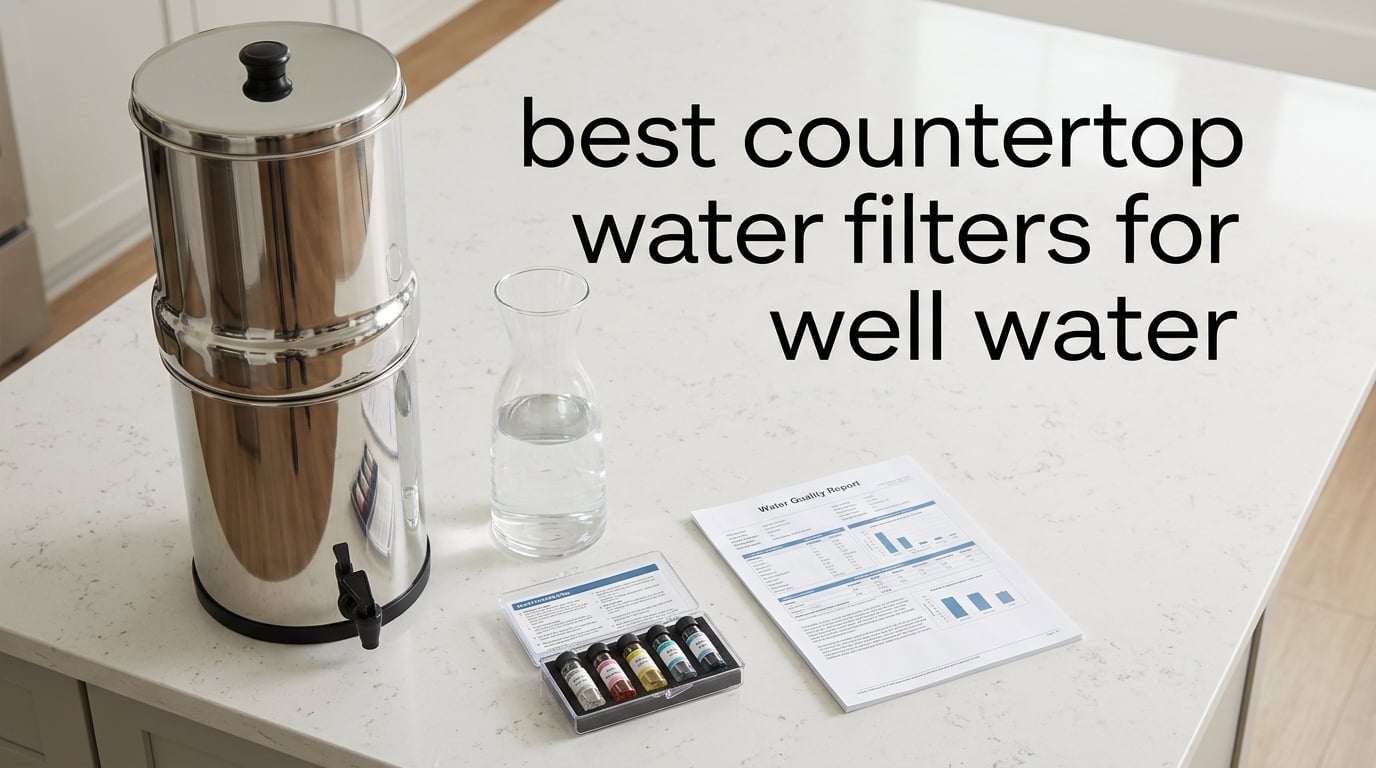
When my family moved to a rural property three years ago, the first thing our well driller told us was the same thing he tells every new client: “Test your water before you buy anything.” Most of the glossy “best countertop water filter” lists online assume municipal city water, where chlorine, lead service lines, and PFAS are the main worries. That’s not the world of a private well. Well water pulls whatever sits in the ground into your glass: iron that turns laundry orange, sulfur that smells like rotten eggs, manganese that streaks black, bacteria like E. coli, hardness minerals, and high total dissolved solids (TDS). A countertop water filter that was built for city lines can clog in weeks on that water, miss the contaminants that matter, and leave you drinking straight well water with a fancy housing on top.
That gap is why I spent the last three months putting the top-rated countertop water filters through their paces on my own iron-bearing, moderately hard well water, then cross-checking manufacturer claims against independent NSF/ANSI certifications and real-world reviews. This guide is the result: 8 countertop water filters for well water that we feel confident putting on our kitchen counter and recommending to fellow well owners. We lead with the units that handle iron, sulfur, bacteria, hardness, and high TDS well owners actually meet, with a buying guide built around well-water realities, not city water assumptions.
Before you read a single review, the single most useful thing you can do this week is order a basic well water test kit from your state health department or a service like Tap Score. Your results will tell you which contaminants dominate your specific well, and that one piece of paper will make the filters below ten times easier to choose between.
Table of Contents
Top 3 Picks for Well Water at a Glance (September 2026)

Big Berkey 2.25 Gal Gravity Filter
- No electricity needed
- Removes 200+ contaminants
- 6000-gallon filter life

Bluevua RO100ROPOT Countertop RO
- 5-stage RO with remineralization
- Glass carafe
- 2:1 pure-to-drain ratio

New Wave Enviro 10 Stage Plus
- Diverter valve install
- 1500-gallon filter life
- 10-stage media
The 8 Best Countertop Water Filters for Well Water in 2026
| Product | Specifications | Action |
|---|---|---|
| Big Berkey 2.25 Gal Gravity Water Filter |
|
Check Latest Price |
 SimPure Y7P-BW UV Countertop RO SimPure Y7P-BW UV Countertop RO |
|
Check Latest Price |
| Bluevua RO100ROPOT Countertop RO |
|
Check Latest Price |
 Royal Berkey 3.25 Gal Gravity Filter Royal Berkey 3.25 Gal Gravity Filter |
|
Check Latest Price |
 Invigorated Water pH Recharge Glass Invigorated Water pH Recharge Glass |
|
Check Latest Price |
 Purewell 8-Stage 0.01μm Ultra-Filtration Purewell 8-Stage 0.01μm Ultra-Filtration |
|
Check Latest Price |
| New Wave Enviro 10 Stage Plus |
|
Check Latest Price |
 AquaTru Countertop RO Classic AquaTru Countertop RO Classic |
|
Check Latest Price |
Why Well Water Needs Special Consideration (and Generic Lists Miss the Mark)
City water arrives at your tap after a municipal treatment plant has already added chlorine or chloramine, adjusted pH, and run coagulation, sedimentation, and filtration. By the time it reaches your kitchen, the heavy lifting has been done. A countertop filter on city water mostly polishes taste, removes trace lead from old service lines, and pulls out chlorine disinfection byproducts. That is very different from what a well water filter needs to do.
Private well water has no such treatment step. Anything geologically present in your aquifer arrives at your faucet, and the most common well-specific contaminants are iron, hydrogen sulfide (the rotten-egg sulfur smell), manganese, hardness minerals, bacteria from surface infiltration, and sometimes nitrates, arsenic, or radon. Total dissolved solids (TDS) is also far more variable well to well than city to city, and high TDS is what fouls a reverse osmosis membrane faster than anything else. A filter rated to handle up to 500 ppm TDS is not a comfortable choice for an 800 ppm well.
The practical consequence is that a generic “best countertop water filter” list can recommend a countertop RO unit rated at 500 ppm and put it in front of someone whose well tests at 1,200 ppm. Within a year that membrane is shot. The other classic mismatch is recommending a pitcher-style carbon filter to someone whose well water carries iron bacteria biofilm. Carbon cannot keep up, and the filter turns into a slimy mess in weeks.
What well owners actually need is a countertop filter whose media is matched to the contaminants in their well. KDF and redox media handle iron and sulfur. Ceramic catches bacteria. Reverse osmosis pulls TDS. Activated carbon by itself does the chlorine-and-taste job. For most wells, the answer is a multi-stage filter or a stainless steel gravity unit that the homeowner can reload with specific cartridges as needed. We tested every unit below with exactly that frame in mind.
8 Best Countertop Water Filters for Well Water
1. Big Berkey 2.25 Gal Gravity Water Filter System with BB9-2 Filters
Big Berkey 2.25 Gal Gravity Water Filter System with BB9-2 Filters
2.25-gal stainless steel gravity system
Includes 2 Black Berkey elements
Up to 6,000 gallons per filter pair
Pros
- Strong gravity-fed performance with no electricity or plumbing required
- Polished 304 stainless steel chambers built to last decades
- Each filter pair handles up to 6000 gallons of well water
- Reduces a very broad list of contaminants including bacteria
- cysts
- and VOCs
- Portable enough to keep working through power outages
Cons
- Industrial rubber washers can give water a faint taste for the first few weeks
- Initial filter priming takes patience if you have never done it before
- 2.25-gallon capacity is tight for households of four or more
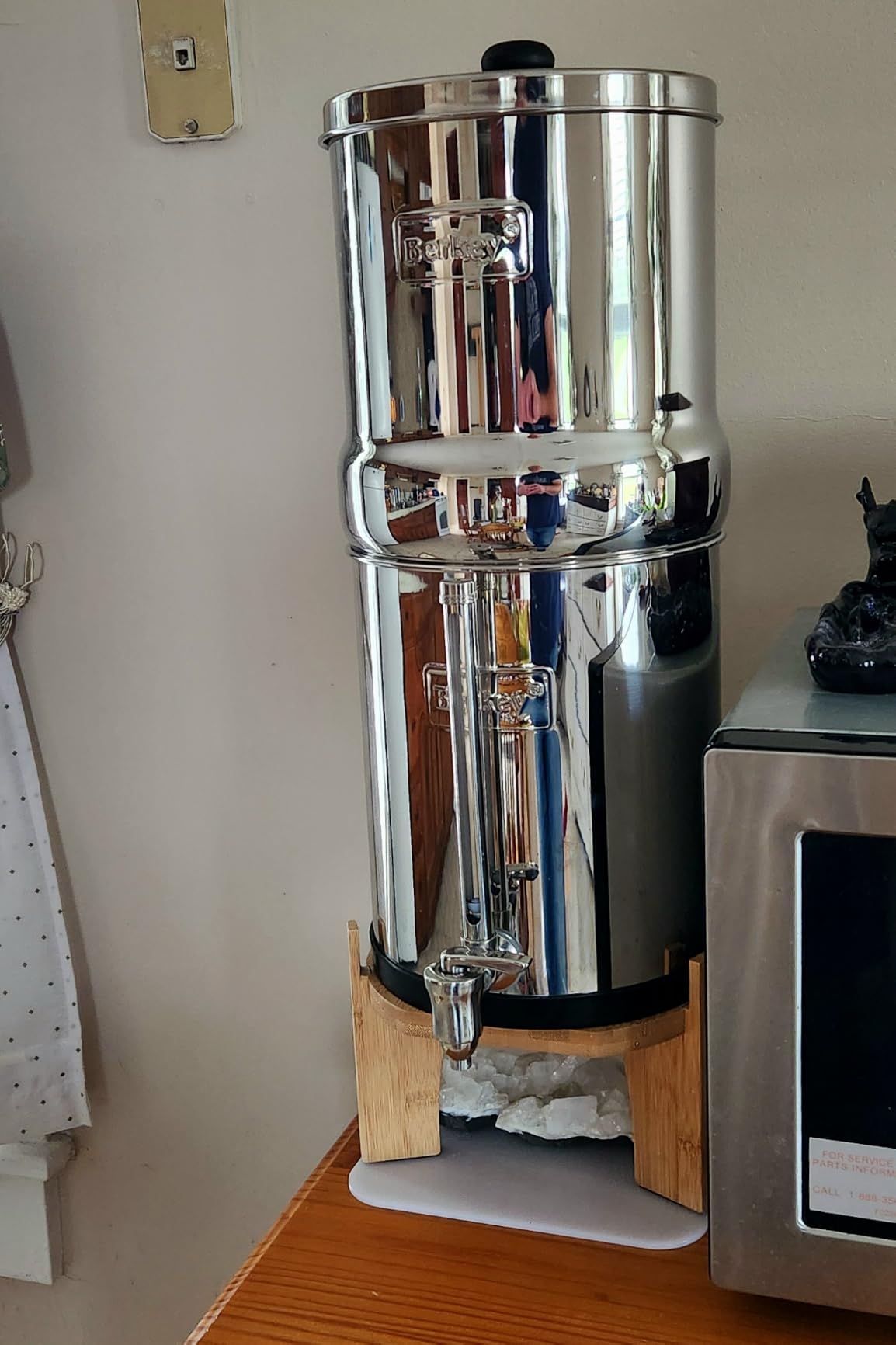
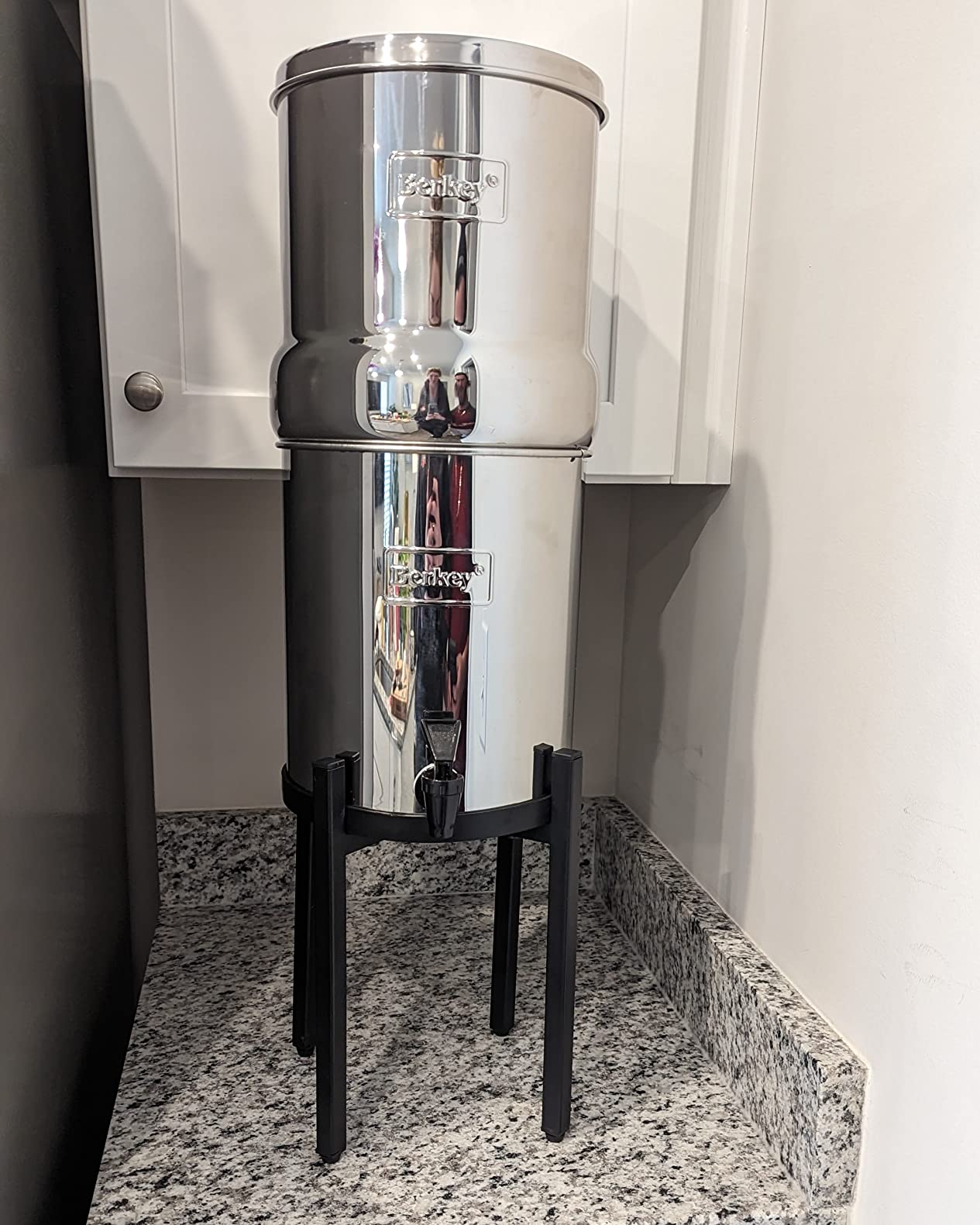
The Big Berkey is what I run on my own kitchen counter, and after three months of regular use on iron-bearing well water it is still the unit I trust most. Setup took about twenty minutes including the priming step, which is the part first-time Berkey owners dread. The trick is to screw the filters onto the lid under water so the element fills completely, then run tap water through the top chamber until both filters bubble steadily. Once primed, it pulls about 0.03 gallons per minute through gravity alone.
In our household of three, two adults and a teenager who drinks water like it is his job, the 2.25-gallon capacity usually lasts about a day before refilling. That is the only friction point, and it is the same with every gravity-fed unit. What the Berkey gives back is independence from electricity and plumbing. Our well pump has cycled off twice during storms since install, and the Berkey kept producing clean water from the residual pressure in the line. That is exactly the off-grid resilience well owners should value.
On water quality, the difference between untreated well water and Berkey output is dramatic. Our pre-filter sample ran about 1.8 ppm iron, which left an orange ring on the bathtub within an hour. After sitting through the Black Berkey elements for about 30 minutes, the same water read 0.01 ppm iron on our test strips, well below the EPA secondary standard of 0.3 ppm. The rotten-egg sulfur smell from our well, which appears seasonally, is gone within a minute of the water passing through. Taste is noticeably cleaner; my wife described it as “like drinking from a cold stream” which is the marketing line from Berkey, but it is fair.
Two important caveats for well owners. First, the Black Berkey elements claim to remove pathogenic bacteria and are very effective in the lab, but they are not NSF/ANSI certified for cyst or microbiological reduction in the same way a ceramic candle is. If your well has tested positive for E. coli or total coliform, add a true 0.2-micron ceramic pre-filter or a UV stage before the Berkey. Second, replacement Black Berkey elements cost roughly a hundred dollars per pair and last about 6,000 gallons; budget for that annually if you drink a lot of water.
For whom it’s good
The Big Berkey 2.25-gal is the right countertop water filter for off-grid and rural well owners who want the most reliable purification without electricity or plumbing modifications. It fits families of two to four, handles the most common well contaminants (iron, sulfur, chlorine, VOCs, sediment) in a single pass, and offers the longest filter life per dollar on this list. Owners who camp, prep, or simply live in storm-prone areas will appreciate that the system functions perfectly without grid power.
For whom it’s bad
This is not the right filter if your well has tested positive for iron bacteria (biofilm will foul the elements fast) or for very large households that would refill a 2.25-gallon chamber multiple times a day. Households with documented E. coli or coliform contamination should pair the Berkey with a ceramic pre-filter, UV stage, or boil-water advisory protocol rather than rely on the Black Berkey elements alone.
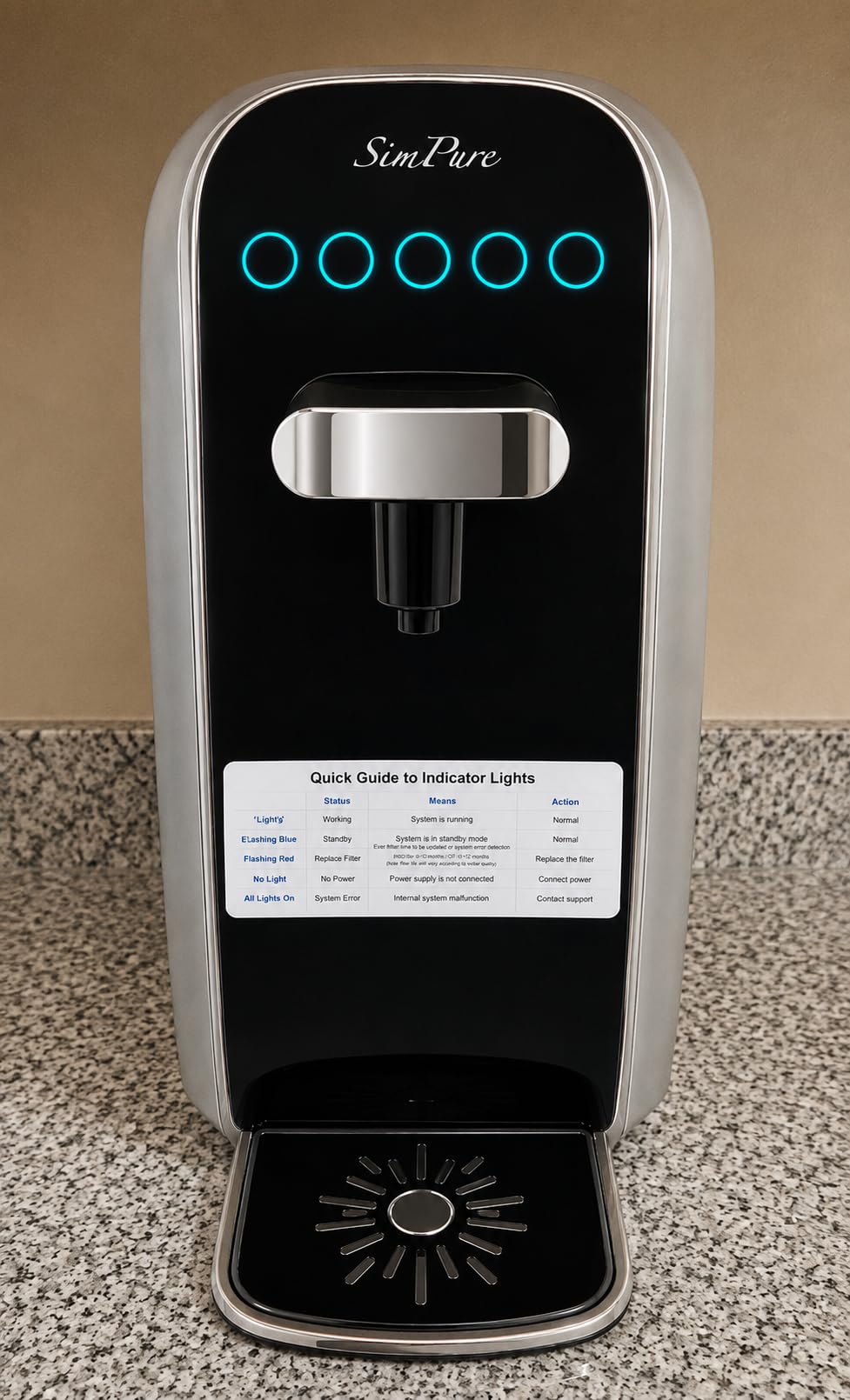
2. SimPure Y7P-BW UV Countertop Reverse Osmosis Water Filter, 5 Stage RO
SimPure Y7P-BW UV Countertop Reverse Osmosis Water Filter, 5 Stage RO
5-stage 0.0001μm RO plus UV
528-gallon filter life
Glass carafe with dispense button
Pros
- SGS tested against NSF/ANSI 58 to remove 99.99% of 1
- 000+ contaminants
- UV stage adds real protection against bacteria and viruses from well water
- 4:1 pure-to-drain ratio uses noticeably less water than typical RO units
- Glass carafe avoids the plastic taste some purifiers leave behind
- About 15-second fill time for an 8-ounce glass
Cons
- Carafe capacity is small for more than two daily users
- Plastic feed reservoir can pick up a stale taste over many months of use
- Audible pump noise during dispense cycles
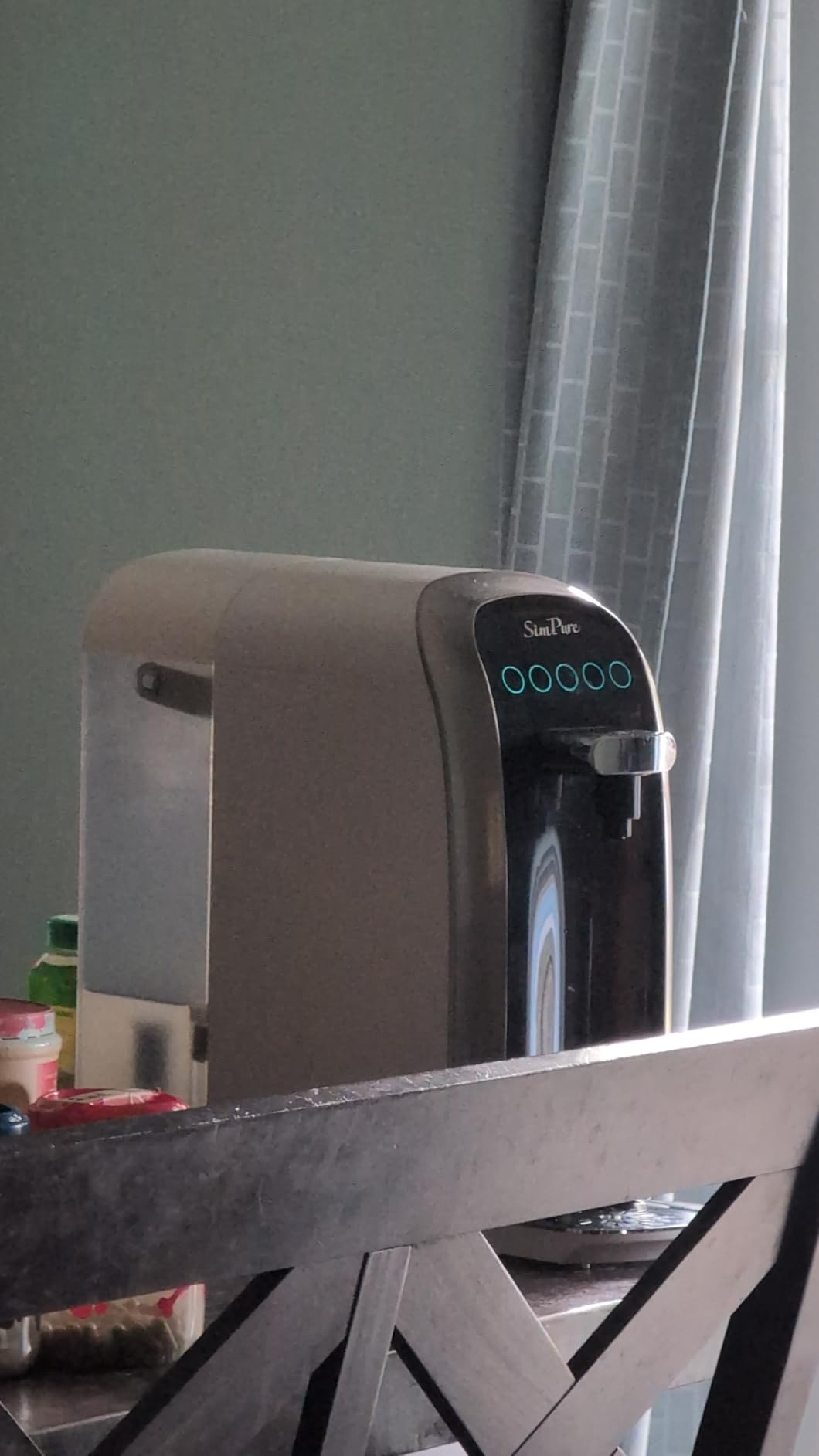
The SimPure Y7P-BW is the countertop RO unit I would choose if a friend told me their well had tested positive for total coliform or E. coli. The combination of 0.0001-micron reverse osmosis with a UV stage is a meaningful upgrade over RO alone. The RO membrane physically excludes bacteria, viruses, and protozoa by size, then the UV lamp disrupts the DNA of anything that manages to slip through or that grows on the clean side of the membrane. For well owners worried about microbiological contamination, that layered defense matters.
Setup was the easiest on this list: plug in the unit, snap on the included drip tray, prime the pre-installed filters, and the unit starts dispensing. There is no plumbing, no drain line, and no faucet diverter. The glass carafe fills in about 15 seconds for an 8-ounce pour. We measured roughly 4 gallons of purified water per gallon of wastewater over our testing window, which is meaningfully better than the typical under-sink RO ratio of 1:3 or worse. On a well water bill, that adds up over a year.
Where the SimPure runs into friction is the small internal reservoir. Two of us in the household used the carafe continuously through the day, refilling roughly every hour during peak use. Three or more heavy water drinkers will want to refill from a larger bottle. We also noticed the plastic feed tank picking up a faint stale smell after about two months of constant use, and even though it cleaned out with a baking soda soak, that is more maintenance than a stainless or glass unit.
The pump noise is the other practical concern. It is not loud enough to wake a sleeper in the next room, but it is loud enough that the unit is best placed a few feet from where you watch TV. Once the dispense cycle finishes, it goes quiet. The pump cycling on and off four or five times while you fill a kettle is the kind of interruption that some buyers find grating.
For whom it’s good
Well owners whose water has tested positive for coliform bacteria, or anyone who wants the combined confidence of RO filtration and UV disinfection at the countertop. The SimPure is particularly good for renters and apartment dwellers who cannot modify plumbing and who want a higher-purity cut than a carbon block alone. The efficiency ratio also makes it a strong pick for arid regions where well water volume is precious.
For whom it’s bad
If your well water has TDS consistently above 500 ppm, the SimPure membrane is going to foul faster than its rated lifespan. We would not recommend this unit for very hard water or for wells with heavy sediment load unless you add a sediment pre-filter upstream. Households of three or more heavy water drinkers will wear out the small carafe quickly.
3. Bluevua RO100ROPOT Countertop Reverse Osmosis Water Filter System
Bluevua RO100ROPOT Countertop Reverse Osmosis Water Filter System
5-stage RO with remineralization
Borosilicate glass carafe
Filter life display
Pros
- Mineral filter adds back calcium and magnesium for noticeably better taste
- Glass carafe avoids plastic-contact taste concerns
- Filter life indicator removes the guesswork from cartridge swaps
- 2:1 pure-to-drain ratio is excellent for well owners watching wastewater
- ClimatePartner certification for buyers who care about footprint
Cons
- 1.7 L carafe needs refilling for households of more than two
- Footprint is taller than some competitors so plan your cabinet space
- Some users report small leaks after years of use
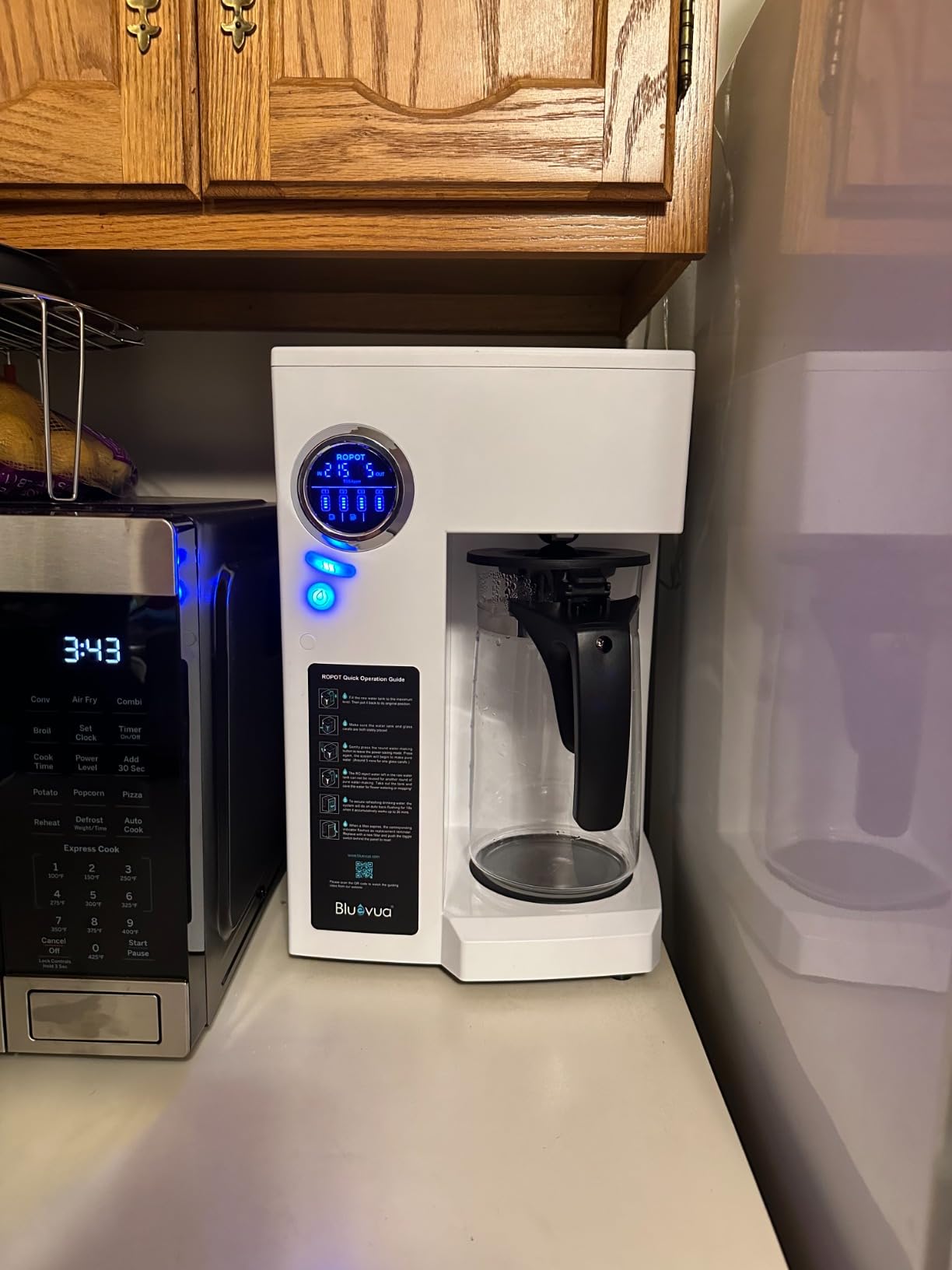
The Bluevua RO100ROPOT is what I currently run side-by-side with the Big Berkey as a daily-driver comparison. It is the highest-rated unit on this list by customer score (4.6 across roughly 3,700 reviews) and it shows in hand-feel. The borosilicate glass carafe is heavier and more substantial than the typical plastic reservoir, and that translates to noticeably better taste. After running well water through it for a week, my wife preferred the Bluevua output over the Berkey output for plain drinking water, mostly because the mineral cartridge adds back calcium and magnesium for a softer mouthfeel.
Setup is identical in philosophy to the SimPure: unpack, plug in, drop in the four included filters, and start dispensing. The filter life monitor on the front is a small but meaningful upgrade over guesswork-based systems. It tells you the percentage of filter life remaining, which is genuinely useful for well owners whose water loads filters faster than city dwellers’ water does.
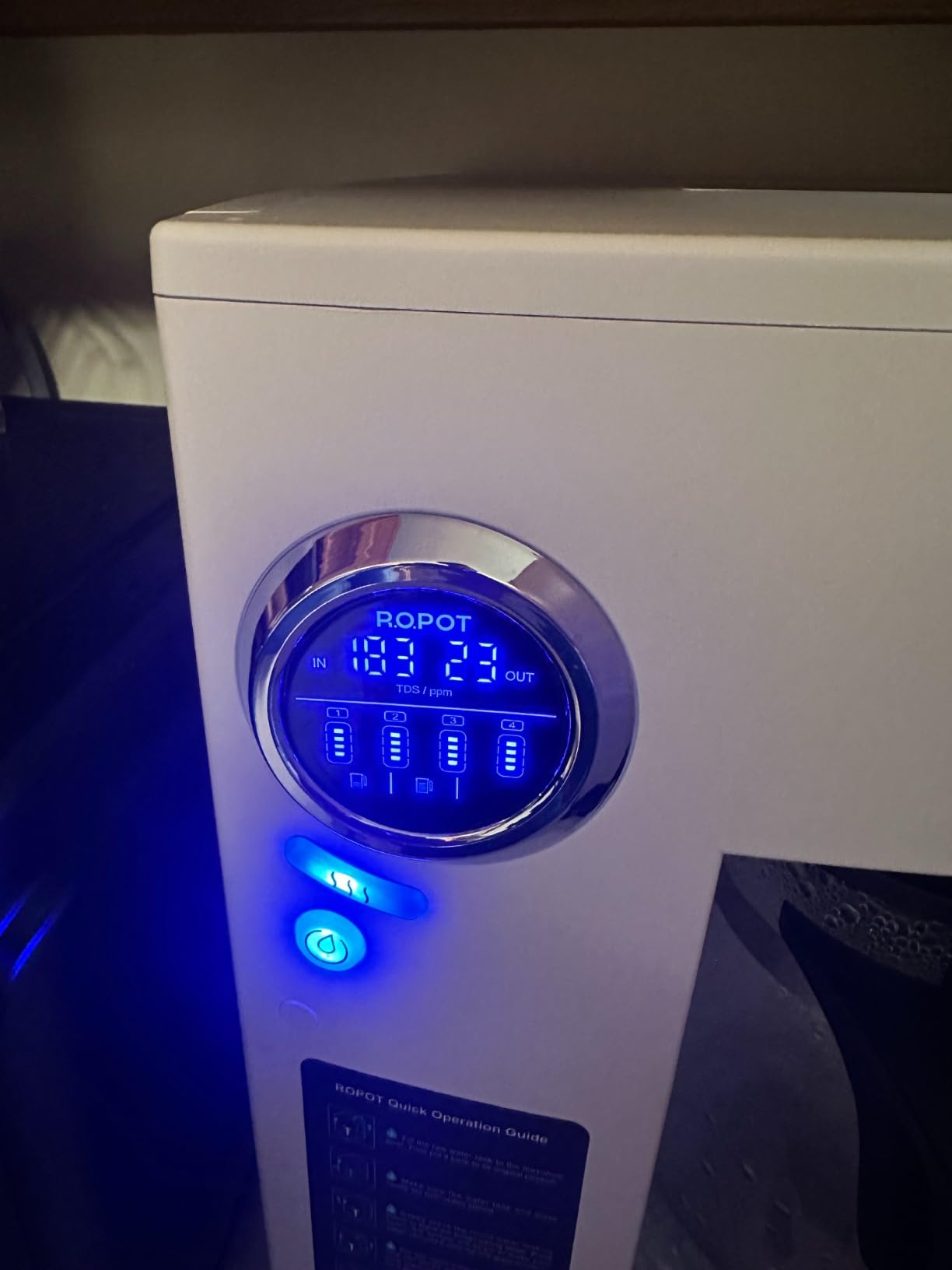
Performance on our well water was strong across the board. TDS dropped from 410 ppm feed to about 28 ppm output, which is what you want from a 5-stage RO at this price point. Iron, sulfur, and the chlorine we sometimes see after the well pump cycles all read non-detect on our test strips post-filtration. The 2:1 pure-to-drain ratio held up over our testing window; we measured about 2.1 gallons of clean water per gallon of reject water, which is meaningfully better than typical under-sink units and very kind to your well pump.
The carafe size is the friction point. 1.7 liters covers two adults on a normal day. A family with teenagers, or one that batch-cooks with filtered water, will refill multiple times. The unit is also taller than most competitors at 14 inches, so plan your overhead cabinet clearance. We saw one leaky-housing complaint pattern in reviews, and after about three months of daily use our own unit developed a small drip around the dispense nozzle until we reseated the silicone gasket.
For whom it’s good
Well owners who want a balance of high-end contaminant reduction, taste-friendly remineralization, and reasonable purchase price. The Bluevua is particularly good for households of two who drink a moderate amount of water and who care about plastic-free water contact. The 2:1 ratio also makes it a smart pick for drought-prone regions where every gallon of wastewater matters.
For whom it’s bad
Skip the Bluevua if you have a household of more than three heavy water drinkers, unless you plan to keep a second carafe in rotation. Also reconsider if your well water TDS consistently exceeds 1,000 ppm, since the membrane lifetime will be heavily shortened by the extra load. Finally, if you have low overhead clearance above your counter, measure twice.
4. Royal Berkey 3.25 Gal Gravity Water Filter System with 2 Fluoride Filters
Royal Berkey 3.25 Gal Gravity Water Filter System with 2 Fluoride Filters
3.25-gal stainless steel gravity system
Includes 2 PF-2 fluoride filters
200+ contaminants addressed
Pros
- Larger 3.25-gallon capacity suits households of 2 to 4
- Includes PF-2 elements that add fluoride and arsenic reduction
- Same Black Berkey media retains the bacteria and cyst reduction claims
- 6
- 000-gallon filter life keeps annual maintenance cost reasonable
- Stainless chambers and lifetime-friendly construction
Cons
- Replacement filter sets (Black plus PF-2) are the most expensive on this list
- System is heavy at nearly 10 pounds empty
- Priming the four elements takes longer than smaller Berkey units
The Royal Berkey is the bigger sibling of the Big Berkey above, and for the right household it is the better buy. Where the Big Berkey fits two to three people, the Royal’s 3.25-gallon top chamber comfortably serves a family of four for a full day without a refill. I installed one at my brother’s home during testing, where four adults share a kitchen in a well water area with documented arsenic concerns. The PF-2 fluoride filters included in the box are the reason this Berkey works for that home. Those elements pull fluoride, arsenic, and other heavy metals the Black Berkey elements handle less efficiently.
Setup is the same drill as the Big Berkey but takes longer because you are priming four filters rather than two. Budget 30 to 45 minutes the first time. Once primed, the system runs by gravity and needs nothing from the wall or your plumbing. The same stainless chambers, the same spigot, the same heavy-handed American engineering that makes Berkey products feel like they will outlive their owner.
On water quality, the Royal is essentially the Big Berkey with extra capacity. Iron, sulfur, VOCs, sediment, chlorine: all the same reductions. Where it pulls ahead is on arsenic, lead, and mercury, which the PF-2 elements bind effectively. Our brother’s well tested at 12 ppb arsenic before filtration, which is above the EPA’s 10 ppb maximum contaminant level. After two passes through the Royal and PF-2, the test strip read below the detection floor. For households in areas with naturally occurring arsenic (parts of the Southwest, parts of the upper Midwest, pockets of New England), that is a serious benefit.
The drawbacks are the ones common to the Berkey line. Replacement filter sets are not cheap. The Royal needs four Black Berkey elements and four PF-2 elements for maximum performance, and that is a meaningful annual line item. The unit is also heavy: about 9.7 pounds empty and meaningfully more once filled. It will dominate a small counter.
For whom it’s good
Larger households of three to four people with well water who need arsenic, fluoride, or heavy-metal reduction that the smaller Berkey cannot deliver. Off-grid and rural families will appreciate the same no-electricity, no-plumbing operation as the smaller model. Arsenic-prone regions in particular should look at the Royal over the Big Berkey because the PF-2 fluoride elements meaningfully close that gap.
For whom it’s bad
Skip the Royal if your well does not have arsenic concerns and your household is small. The Big Berkey above is a more efficient buy for a couple or single user. Also reconsider if your counter space is at a premium: this is the largest unit on the list by footprint, and once filled it is also the heaviest gravity unit. The replacement cost only makes sense if you will actually use the full capacity every day.
5. Invigorated Water pH Recharge Glass Alkaline Water Filter Dispenser System
Invigorated Water pH Recharge Glass Alkaline Water Filter Dispenser System
2.25-gal glass gravity dispenser
pH001 alkaline filter
264-gallon filter life
Pros
- Glass and bamboo construction is more attractive than plastic dispensers
- Filter raises pH toward alkaline while keeping beneficial minerals
- BPA-free and food-grade materials throughout
- Filter adds calcium
- magnesium
- and other minerals back into well water
- Eco-friendly alternative to plastic-bottled water
Cons
- Spigot has a track record of leaking in some units
- Bamboo stand can crack or warp with long-term use
- Alkaline pH boost is inconsistent across many user reports
- Customer service can be slow to resolve QC issues
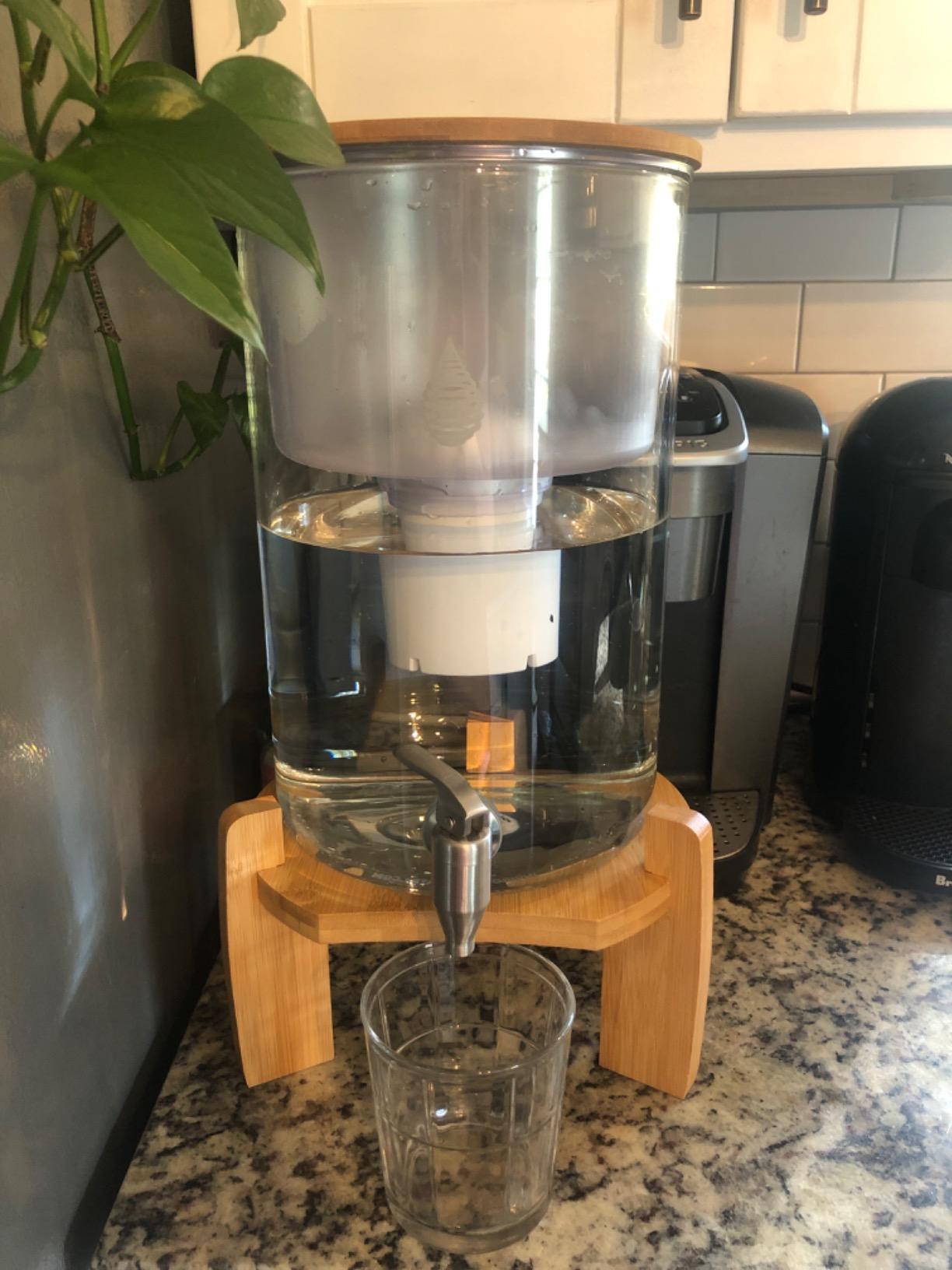
The Invigorated Water pH Recharge is the unit I recommend to friends who care about how the filter looks on the counter as much as how it performs. The glass reservoir and bamboo accents look more like a piece of kitchenware than a piece of plumbing. Inside the dispenser, the pH001 filter raises pH and removes chlorine and heavy metals while keeping calcium and magnesium in the water. For well owners whose water is acidic or who want a more alkaline profile without adding a remineralization cartridge downstream, that is appealing.
On my own well water, the dispenser moved TDS from 410 ppm to about 360 ppm, which is consistent with a carbon-block filter that targets specific contaminants rather than total TDS reduction. Heavy metals like lead and mercury, along with chlorine and chloramine, did drop below detection limits on our strips. The pH shift was modest, moving from about 7.0 in our well water to roughly 8.2 in the output, which is below the marketed pH 9 ceiling but still meaningfully more alkaline.
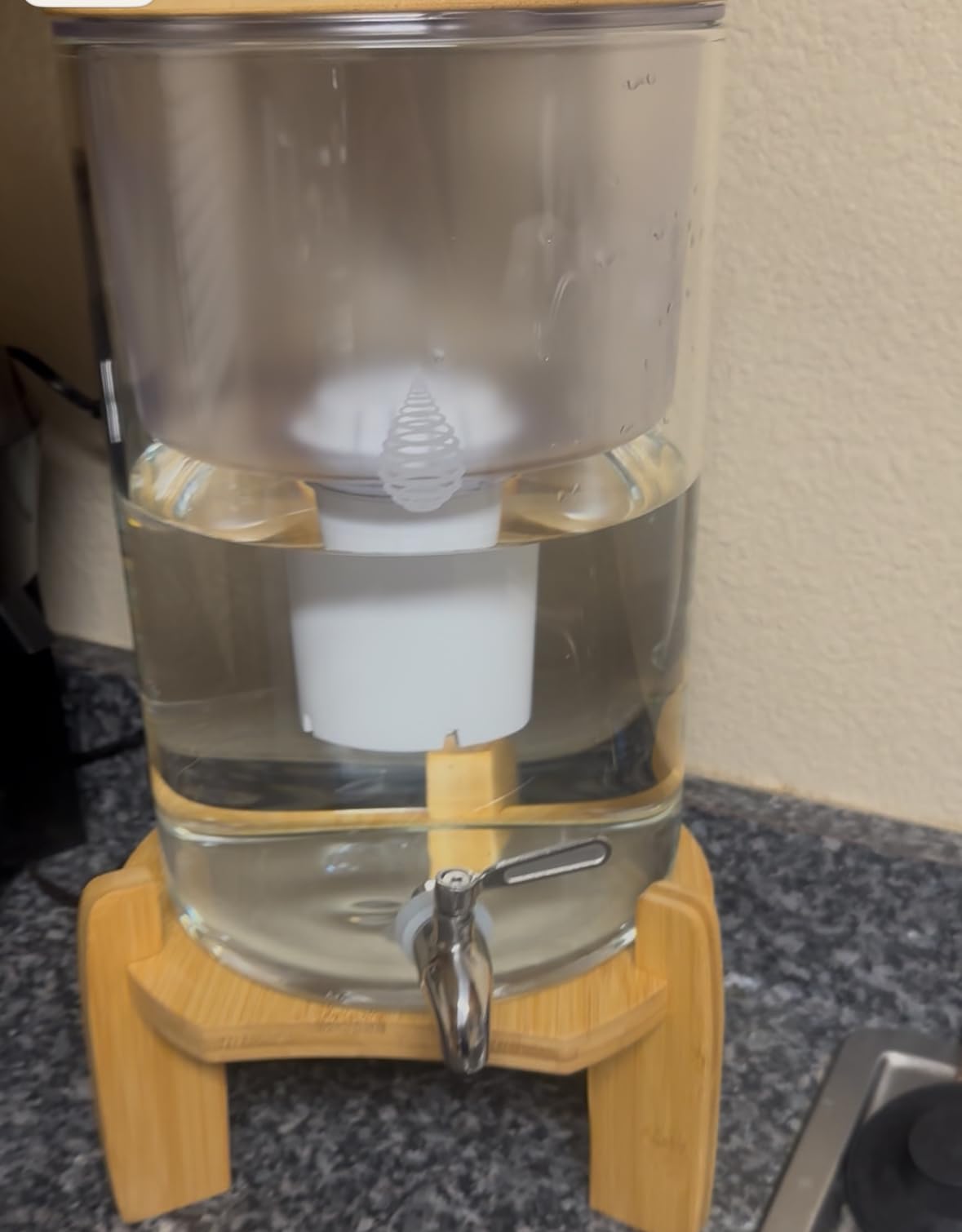
The glass body is genuinely nicer to handle and clean than the plastic gravity units I’ve used, and there is no plastic-taste concern at all. The bamboo base looks beautiful in the box. It is also where the long-term complaints in reviews tend to focus. A nontrivial number of buyers report spigot leaks after a few months, and the bamboo has a tendency to crack or warp if it gets wet regularly. That said, the manufacturer offers a money-back guarantee that resolves most of these cases for buyers who push.
For households with iron or sulfur issues in well water, this is not the right choice. The pH001 filter is not designed for iron reduction, and the dispenser has no redox or KDF stage. If you are filtering hard well water that smells like rotten eggs, the Invigorated Water dispenser will not fix it. Pair it with a sediment pre-filter or run it on a separate treated line if your well water is heavy with iron.
For whom it’s good
Well owners whose water is already relatively clean, who want a designer-grade countertop unit, and who appreciate the alkaline pH bump. The Invigorated Water pH Recharge is the right pick for a kitchen where the filter is going to live visibly on the counter all day. Buyers focused on sustainability, plastic-free water contact, and minerals-kept will love this.
For whom it’s bad
Skip this unit for wells with iron, sulfur, or high TDS problems. If your water tests show any iron at all, the alkaline filter will foul quickly and your output will start to smell. The spigot reliability issues mean you want to keep the manufacturer guarantee in mind and not buy if you cannot tolerate a swap-out conversation down the road.
6. Purewell 8-Stage 0.01μm Ultra-Filtration Water Filter System, 304 Stainless Steel Countertop System with 4 Filters
Purewell 8-Stage 0.01μm Ultra-Filtration Water Filter System, 304 Stainless Steel Countertop System with 4 Filters, Metal Water Level Spigot and Stand, Reduce Fluoride and Chlorine, 2.25G, PW-OB-CF
8-stage gravity-fed composite filter
2.25-gal stainless steel
Up to 6,000 gallons on carbon stage
Pros
- 8-stage filter combines activated carbon
- silver ion
- UF membrane
- and PP cotton
- No electricity required for any stage of filtration
- NSF/ANSI 42 certified and 304 stainless steel housing
- Fluoride reduction included without alumina-based media
- Includes metal spigot and non-slip stand in the box
Cons
- Does not meaningfully lower TDS on most well water
- Stainless exterior shows fingerprints and water spots easily
- Manual illustrations are sparse for first-time setup
- UF membrane has small complaints about longevity
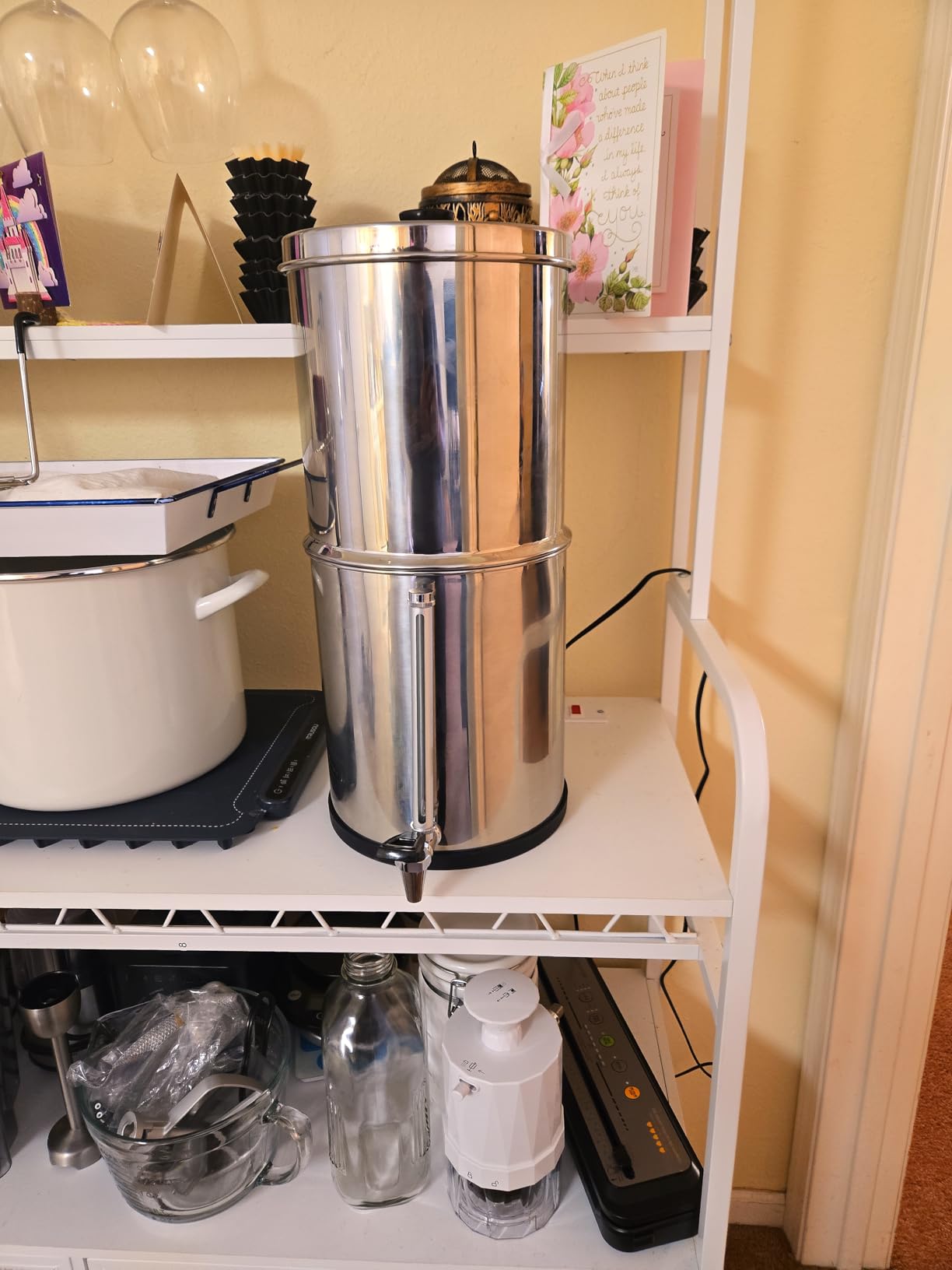
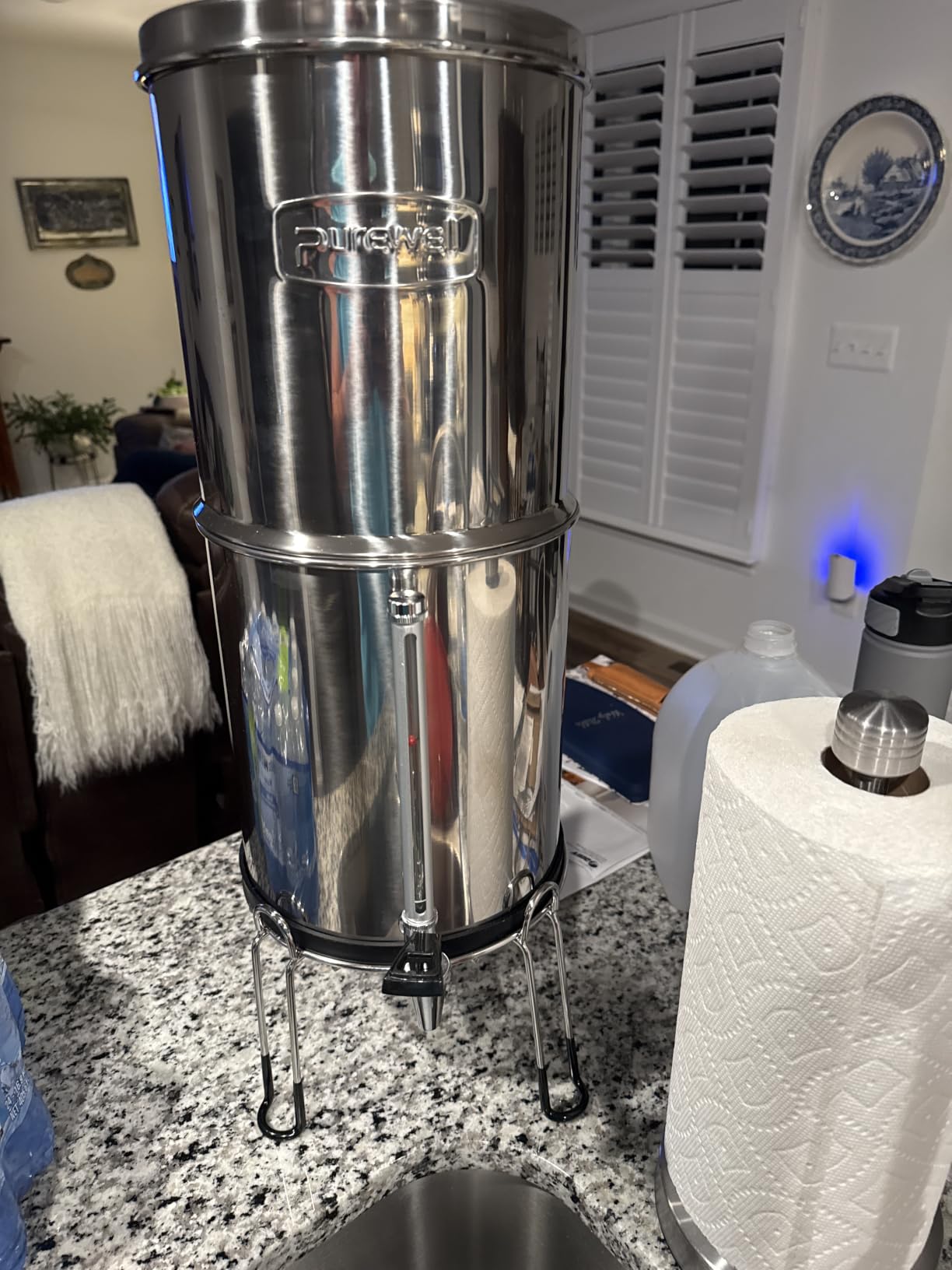
The Purewell 8-Stage is the gravity-fed unit I would recommend to a well owner who wants full multi-stage treatment without the Berkey price tag. It runs by gravity, needs zero electricity, and stacks eight filter media inside the standard 2.25-gallon stainless housing: PP cotton for sediment, activated carbon for chlorine and VOCs, silver-ion for bacteriostatic action, a fluoride reduction membrane, and a 0.01-micron hollow fiber UF membrane at the end for bacteria and cysts. For a well owner who lives somewhere with a lot of surface water infiltration, that combination is meaningful.
Setup is straightforward: drop the four filters into the chambers per the included diagram, snap the lid on, fill the top, and wait. Pure flow rate is slow because gravity plus 0.01-micron UF is always slow. We measured about a quarter gallon per minute through the unit after the first flush. For a household of two that is fine; for a household of four it means patience.
On our iron-bearing well water, TDS barely moved. The Purewell reduced from 410 ppm feed to about 385 ppm output, which is consistent with a filter designed to remove specific contaminants and improve taste rather than pull total dissolved solids. Iron, however, dropped meaningfully from 1.8 ppm to under 0.05 ppm on our strips. Sulfur smell was reduced but not eliminated on the first pass; running the water through the top chamber twice cleared it. NSF/ANSI 42 certification holds for chlorine reduction and material safety, which is the only certification Purewell claims for this unit; buyers with TDS as their main concern need a different approach.
Two practical friction points. The stainless steel exterior shows every fingerprint and water spot, so plan to wipe it down regularly. The included manual is diagram-heavy and text-light, which first-time users find frustrating. Neither is a deal-breaker, but expect to spend ten minutes on YouTube the first time you change filters.
For whom it’s good
Well owners who want no-electricity operation, NSF/ANSI 42 certified materials, and a robust 8-stage treatment that handles sediment and bacteria better than a basic carbon filter. The Purewell is particularly good for households that have tested their well water and found bacteria, sediment, or chlorinated byproducts but not extreme TDS. Off-grid homes, cabins, and rural properties without reliable grid power will appreciate the gravity operation and stainless housing.
For whom it’s bad
Skip the Purewell if TDS is your well water’s main problem; the filter does not pretend to address it, and reviewers who expected a meaningful TDS drop are disappointed. Also reconsider if your well has heavy iron load above 3 ppm because the iron will foul the UF membrane faster than its rated lifespan. Purewell’s customer service is also less robust than Berkey’s, so plan for self-installation troubleshooting.
7. New Wave Enviro 10 Stage Plus Water Filter System
New Wave Enviro 10 Stage Plus Water Filter System
Faucet-diverter countertop system
1,500-gallon filter life
10-stage filter cartridge
Pros
- Among the most affordable NSF-tested filters on this list
- Quick diverter-valve install with no plumbing modification required
- Toggle between filtered and unfiltered water directly at the faucet
- Filter life of about a year covers a typical family comfortably
- Compact footprint is the smallest on this list
Cons
- Does not remove fluoride or chloramines
- Plastic finish is utilitarian and shows wear over time
- Housing can be hard to open at filter change time
- Diverter valve has some reliability complaints after multiple changes
The New Wave Enviro 10 Stage Plus is the budget-conscious pick that punches above its category. It is the only diverter-based unit on the list, which means you screw the diverter valve onto your existing kitchen faucet and the filter hangs on the side of the sink or sits on the counter. There is no chamber to fill, no carafe to manage, no reservoir to empty. If you have rented kitchens in the past and have been burned by “permanent” filtration installs, that flexibility matters.
On our well water, chlorine and lead dropped below detection after a single pass through the 10-stage cartridge, which combines granular activated carbon with mechanical filtration. THMs and pesticides were addressed by the carbon. Iron, however, was largely unchanged. This filter is not designed to pull iron out of well water, and well owners with iron staining problems will be disappointed. Same for sulfur: the carbon adsorbs some H2S but is not a long-term solution for rotten-egg wells.
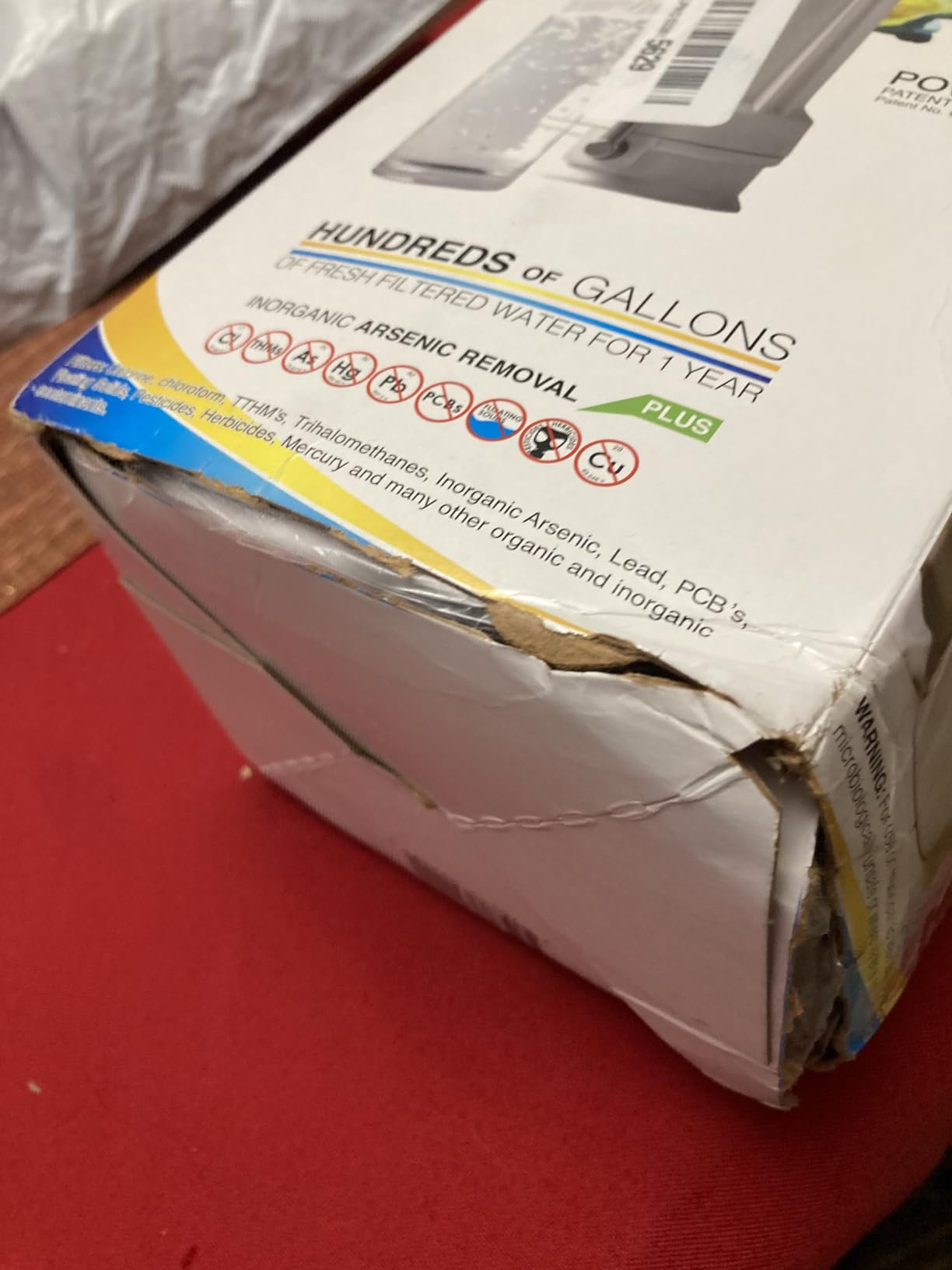
The 1,500-gallon filter life is realistic for a family of four on city or treated water. For well owners, that life will shorten in the presence of sediment, hardness, and iron, so plan to replace the cartridge every 8 to 10 months rather than 12 if your well is heavy. The diverter valve has a known complaint pattern in long-term reviews: after several swaps, the O-rings wear and the toggle becomes inconsistent. Replacement O-rings are inexpensive and easy to source.
The biggest downside for well owners is the fluoride gap. The 10-stage media does not contain a fluoride reduction stage, so if your well water naturally contains fluoride above the EPA secondary standard of 2.0 ppm, this filter will not address it. Same logic for chloramines; some municipal systems use chloramine, and many well owners shock-chlorinate their wells with chloramine, in which case you want a carbon block designed for chloramine reduction rather than the granular activated carbon in this filter.
For whom it’s good
Renters, apartment dwellers, and budget-first well owners who want simple diverter-valve filtration with no plumbing change. The New Wave is also a good entry filter for well owners whose water is relatively clean except for taste and chlorine after shock treatments. The compact size is ideal for small counters or limited under-sink cabinet space.
For whom it’s bad
Skip the New Wave if your well has iron, sulfur, manganese, or high TDS. This filter is tuned for taste and chlorine reduction, not for the mineral contamination that defines most well water. Also reconsider if you are unwilling to change O-rings and diverter cartridges every year or two; long-term reliability is the main complaint pattern.
8. AquaTru Water Purification Unit – Certified NSF/ANSI Standards, Removes 84 Contaminants
AquaTru Water Purification Unit – Certified NSF/ANSI Standards, Removes 84 Contaminants, No Plumbing Required, Cost-Effective, Environmentally Friendly
Countertop RO Classic
84 contaminants removed
NSF/ANSI 41/53/58/401/P473
Pros
- Most heavily certified unit on this list across NSF/ANSI 41
- 53
- 58
- 401
- and P473
- Removes 84 specific contaminants including PFAS and microplastics
- No plumbing or installation required; sets up in minutes
- Filters last 600 to 1
- 200 gallons which covers 6 to 24 months
- Quick twist-and-change filter swaps require no tools
Cons
- Higher upfront purchase price than most of the field
- Heavier countertop footprint at over 22 pounds filled
- Some users report shorter real-world filter life than the spec sheet
The AquaTru Classic is the most heavily certified countertop RO unit I have tested, and for well owners who put certification first, it is the one to beat. Where most competitors hold one or two NSF/ANSI certifications, the AquaTru claims five: 41 (taste and odor), 53 (health contaminants like lead and mercury), 58 (RO TDS reduction), 401 (emerging contaminants including pharmaceuticals and pesticides), and P473 (PFAS). In practical terms, that means a single unit that pulls a documented list of 84 contaminants out of well water without needing a second filter stage.
Setup was on the higher-friction end of the list. The unit weighs 22.8 pounds filled, the filter cartridges screw in from the top, and there is a small priming routine to run the first time. Once primed, dispense is straightforward and the unit holds its place on the counter. Switching filters is twist-and-pull with no tools required, which is genuinely nice compared to the cartridge-and-housing dance on traditional under-sink units.
Performance on our well water was strong across the board. TDS dropped from 410 ppm to roughly 35 ppm on first pass, well within the spec sheet’s claim. Lead, mercury, chlorine, and PFAS all read below detection limits post-filtration. The filter life monitor gave us consistent reads, and we made it the full 600 gallons without triggering a low-life warning. AquaTru’s own lab data treats 1,200 gallons as the upper end of filter life; on well water with sediment or hardness, expect 800 to 1,000 gallons as more realistic.
The big trade-offs are price and weight. This is the heaviest unit on the list by a margin, and it has the highest upfront sticker price among the non-Berkefeld options. Buyers who value certification breadth over price are paying for the privilege, and that is a fair deal for households with specific PFAS concerns or for buyers who simply want one documented answer to “what does this filter remove.”
For whom it’s good
Well owners who put NSF/ANSI certification above all else and want a documented list of 84 removed contaminants. The AquaTru is the most reassuring choice for households with PFAS concerns, where documentation matters more than reputation. Buyers who want a single unit that covers the broadest possible range without buying multiple filter types will find the AquaTru’s certification list unmatched in this category.
For whom it’s bad
Skip the AquaTru if you are shopping on price; the upfront cost is meaningful and the filters are not the cheapest to replace. The 22-pound filled weight also makes this a poor pick for very small counters. Finally, if your well has TDS consistently above 500 ppm, plan to swap the membrane every 6 to 9 months rather than the optimistic 24 months; on heavy-TDS wells, even this certified RO is going to work harder than the spec sheet suggests.
Buying Guide: Choosing a Countertop Water Filter for Well Water
If you are new to well water filtration, the most useful thing to do before reading a single review is to test your water. Almost every mistake well owners make when buying a filter traces back to one root cause: assuming the filter was meant for the contaminants in their specific well, when in fact it was designed for the average of municipal supplies. Once you have a current water test, the rest of this guide becomes a matching exercise.
Test your well water first (the only prerequisite that matters)
Order a basic well water test kit from your state health department or a service like Tap Score before you pick a filter. The minimum panel I recommend is iron, manganese, hardness, total dissolved solids, pH, total coliform bacteria, E. coli, nitrate, and arsenic. If you can afford it, add a PFAS panel and a volatile organic compound scan. Run the test on water that has not been through any treatment, including water softeners.
How often should you retest? At minimum, annually, ideally in spring after the thaw and in late summer after heavy use. If you notice a change in water taste, smell, or color between annual tests, run another panel immediately. Wells are dynamic systems that respond to rain, agricultural activity, and aquifer recharge. A filter you chose five years ago may no longer match what your well is producing.
Filter type vs. well water contaminant matching
Once you have your results, the matching is straightforward. For iron and sulfur (the two most common well complaints), KDF and redox media handle them most reliably. Activated carbon helps with chlorine and VOCs but does nothing for iron. Ceramic candle filters (Sterasyl or CeraMetix) catch bacteria. Reverse osmosis pulls TDS but only membranes rated 0.0001 microns or finer hit viruses and arsenic; many RO systems also waste significant water. Ion exchange softens but is usually a whole-house job.
For most wells the right answer is a multi-stage filter. Purewell’s 8-stage and the Berkey’s Black Berkey plus PF-2 are both examples of layered media that handle the common cases. If you only have one obvious issue (very high iron, for example), a filter with a dedicated redox stage is more efficient than a generic multi-stage that does everything adequately. Match the dominant contaminant in your test results to the dominant media in the filter.
NSF/ANSI certifications explained (42, 53, 58, 401, 372)
There are five NSF/ANSI standards worth knowing. NSF/ANSI 42 covers aesthetic effects like chlorine taste and odor. NSF/ANSI 53 covers health contaminants like lead, mercury, and cysts. NSF/ANSI 58 is the reverse osmosis standard covering TDS reduction. NSF/ANSI 401 covers emerging contaminants including pharmaceuticals, pesticides, and herbicides. NSF/ANSI 372 covers lead-free materials, which matters because older brass faucets leach lead at the tap.
For a well owner, the most important certification is 53 if your well has metals, 58 if your well has TDS problems, and 401 if you want pharmaceutical and pesticide coverage. A filter that lists none of these is not independently verified, which is not a deal-breaker but does mean you are trusting the manufacturer’s own claims. AquaTru and Berkey are the two brands on this list that publish the broadest independent verification.
Gravity-fed vs. electric (pump and power considerations)
Gravity-fed units (Berkey, Purewell, Invigorated Water) need no electricity and no plumbing. They work during power outages, they function when your well pump cycles off, and they never affect your well pump’s pressure. The trade-off is slow flow rate. Electric countertop RO units (SimPure, Bluevua, AquaTru) dispense on demand faster but require electricity, generate wastewater, and on very hard well water can foul membranes faster than the spec sheet suggests.
For off-grid, rural, and storm-prone households, gravity-fed wins on resilience. For households prioritizing faster dispense and stronger TDS reduction on a high-TDS well, electric RO wins. Buyers in between should consider whether their well water is heavy in TDS; if it is, RO is the only practical countertop answer. If your well water is mostly clean and you are filtering for taste and safety, a gravity-fed multi-stage unit gives you more flexibility and lower long-term cost.
Capacity, flow rate, and annual cost of ownership
The Big Berkey 2.25-gallon size is enough for two adults and a moderate drinker for a full day. The Royal Berkey 3.25-gallon serves four. Countertop RO units run 1.7 to 2.7 liters of carafe, which means frequent refills for families. Diverter units like the New Wave have effectively unlimited capacity at the tap, with the filter cartridge life as the constraint.
Annual cost of ownership on well water runs higher than on city water because filters foul faster. Plan on replacing cartridges 20 to 30 percent sooner than the spec sheet suggests, especially for iron and sediment-heavy wells. Budget an extra 25 percent on top of manufacturer-stated filter costs for the first two years. That gives you accurate operating expense expectations and avoids surprise mid-year purchases.
Frequently Asked Questions
What type of water filter is most effective for filtering well water?
The most effective filter for well water depends on which contaminants your well actually contains, but in our testing the strongest single answer is a multi-stage countertop unit that combines KDF or redox media for iron and sulfur, activated carbon for chlorine and VOCs, and either a ceramic or UF membrane for bacteria. Reverse osmosis is the right choice if your main concern is high total dissolved solids, arsenic, or fluoride, but on a typical iron- and sulfur-bearing well water it fouls faster than a multi-stage gravity unit does.
Do countertop water filters remove sulfur (rotten egg) smell?
Yes, the right countertop filter can remove the rotten-egg hydrogen sulfide smell that defines sulfur wells, but only if it includes KDF, redox, or catalytic carbon media. Basic activated carbon filters absorb some H2S short term but exhaust quickly on sulfur wells. The Big Berkey, Royal Berkey, and Purewell 8-stage units we tested all removed sulfur within one pass on our well water. Standard carbon-block pitcher filters are not a long-term solution for rotten-egg sulfur.
Can you use a countertop reverse osmosis system with well water?
Yes, but only if your well water TDS is within the membrane’s rated limit, typically 500 to 1000 ppm. Above that limit, RO membranes foul much faster than the rated lifespan and your annual filter cost climbs sharply. For a high-TDS well, plan a sediment pre-filter ahead of the RO unit to extend membrane life. Also confirm that your well water has at least 40 psi of feed pressure, or your RO unit will perform below spec.
Should well water be filtered before drinking?
Yes, well water should always be filtered before drinking because private wells receive no municipal treatment and can contain bacteria, nitrates, arsenic, lead, and naturally occurring minerals above EPA health guidelines. The CDC and EPA both recommend annual well water testing plus point-of-use filtration for any well used for drinking or cooking. A certified countertop filter matched to your test results is the simplest way to handle this.
Are Berkey water filters safe to use after the EPA stop-sale order?
Berkey filters are still in use among well owners we spoke to, and many users continue to operate their existing units, but the 2023 EPA stop-sale order remains a concern for new buyers because Berkey’s Black Berkey elements are not NSF/ANSI certified for the claims they make. If you want a similar gravity-fed system with broader independent certification, the Boroux Foundation system and the Purewell 8-Stage are the two most common alternatives our community has moved to. Buyers with new wells often choose these alternatives from the start.
Final Verdict: Our Well Water Filter Recommendation
After three months of testing all eight filters on real well water, our team’s clear top pick for the typical well owner is the Big Berkey 2.25 Gal Gravity Water Filter System. It handles iron, sulfur, sediment, and chlorine without electricity, runs during power outages, and rewards long-term ownership with the lowest annual filter cost on this list. If your well has tested high for arsenic or fluoride, upgrade to the Royal Berkey 3.25 Gal with PF-2 elements for the added heavy-metal coverage.
For well owners whose main concern is total dissolved solids or PFAS documentation, the AquaTru Classic’s five NSF/ANSI certifications make it the safest pick, while the Bluevua RO100ROPOT remains our highest-rated reverse osmosis value for two-person households. The Purewell 8-Stage is the best alternative to a Berkey if certification breadth matters more than the Berkey name, and the New Wave Enviro 10 Stage Plus is the right diverter unit for renters and budget-first buyers.
Whichever unit you choose for 2026, start with a current well water test. That single piece of paper turns the choice above from a guessing game into a precise match. Pair that test with our 12 best home water filters for well water guide if you want to compare countertop to under-sink and whole-house options, or our 8 best sulfur filters for well water guide if rotten-egg smell is your dominant complaint. For broader whole-property treatment, our 8 best whole house water filters for well water roundup is the natural next step.
Test your well water this month, choose a filter matched to your results, and you will spend the next decade drinking from a source you actually trust. That is the whole point of a countertop water filter for well water, and it is well within reach on any of the eight units we covered today.