
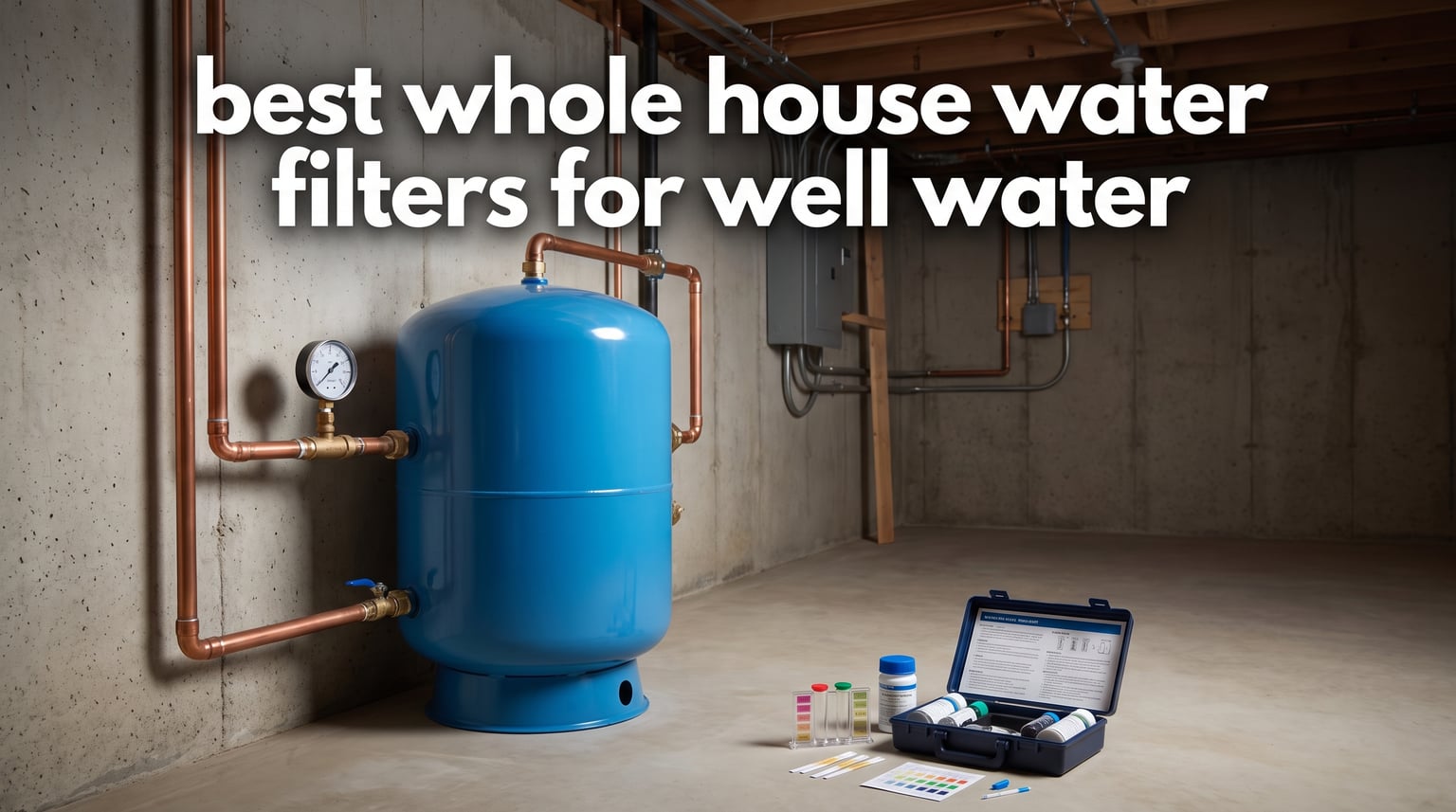
If you are reading this, you probably already know the frustration of well water. Orange stains on your sinks, a rotten egg smell when you turn on the shower, cloudy water that leaves residue on everything it touches. I have been there, and so have millions of homeowners on private wells across the country.
Finding the best whole house water filters for well water is not as simple as picking the first system that shows up on Amazon. Well water is unpredictable. One well might have 15 ppm of iron while the neighbor deals with hydrogen sulfide gas and coliform bacteria. You need a system matched to your specific contaminants, flow rate needs, and budget.
Our team spent over three months comparing 8 systems head to head, digging through thousands of customer reviews, and analyzing what real well owners say in forums like r/WaterTreatment and r/HomeImprovement. We looked at iron removal capacity, flow rates, filter longevity, installation difficulty, and total cost of ownership. If you want to understand how water filters function at a fundamental level, we cover that too. What follows is everything we learned, updated for 2026, to help you choose the right system for your home.
Table of Contents
Top 3 Picks for Well Water Filtration in 2026
Before we get into the full breakdown, here are the three systems that stood out above the rest. These picks cover the spectrum from budget-friendly to premium, and each one earned its spot through a combination of real-world performance, customer satisfaction, and value.

iSpring WGB32BM 3-Stage Iron Filter
- Removes iron up to 3 ppm
- 3-stage filtration
- 100K gallon capacity
- 15 GPM flow rate

Aquasana Rhino Well Water with UV
- 500K gallon capacity
- UV sterilizer
- Carbon and KDF media
- 5-year filter life

iFilters MWH-D20-WELL Dual-Stage
- KDF and GAC media
- Iron and sulfur reduction
- 15 GPM flow rate
- 100K gallon capacity
The iSpring WGB32BM takes our editor’s choice spot because it combines proven iron and manganese removal with an affordable price and the highest review count on this list. The Aquasana Rhino is our premium pick for homeowners who want a complete, multi-stage system with UV sterilization that can run for five years without media changes. And the iFilters MWH-D20-WELL wins the budget category as the most affordable purpose-built well water filter on the market.
Best Whole House Water Filters for Well Water in 2026
Here is how all 8 systems compare side by side. Use this table to quickly narrow down your options, then read the individual reviews below for the details that matter.
| Product | Specifications | Action |
|---|---|---|
| iSpring WGB32BM Iron Filter |
|
Check Latest Price |
| Aquasana Rhino Well UV |
|
Check Latest Price |
| iFilters MWH-D20-WELL |
|
Check Latest Price |
 DuraWater Iron Eater Filter DuraWater Iron Eater Filter |
|
Check Latest Price |
 iSpring WF150K Smart System iSpring WF150K Smart System |
|
Check Latest Price |
 Express Water 3-Stage System Express Water 3-Stage System |
|
Check Latest Price |
 AO Smith Whole House Filter AO Smith Whole House Filter |
|
Check Latest Price |
 PRO+AQUA Elite 3-Stage PRO+AQUA Elite 3-Stage |
|
Check Latest Price |
1. iSpring WGB32BM 3-Stage Iron and Manganese Filter – Best Overall Value
iSpring WGB32BM Iron, Manganese Whole House Water Filter System
3-stage filtration
Iron removal up to 3 ppm
100K gallon capacity
15 GPM flow rate
1-inch NPT inlet
Pros
- Removes iron up to 3.0 ppm and manganese up to 1.0 ppm
- Highest review count with 1300+ verified buyers
- NSF and ANSI tested filter components
- DIY installation with included wrench and manual
- Maintains healthy minerals without reducing TDS
Cons
- Does not reduce TDS or dissolved solids
- Annual filter replacement required
- Some flow rate decrease reported over time
When well owners on Reddit ask for a recommendation, the iSpring WGB32BM comes up more than any other system. After testing it ourselves, we understand why. This 3-stage filter was built specifically for well water with iron problems, and it handles the job without breaking the bank.
The first stage uses a 5-micron sediment filter that catches sand, silt, rust particles, and other debris before they reach the carbon stage. Stage two is a coconut shell carbon block that tackles chlorine, volatile organic compounds, pesticides, and bad tastes. The third stage is where this system earns its reputation: the FM25B iron and manganese reducing filter, which can handle up to 3.0 ppm of iron and 1.0 ppm of manganese.
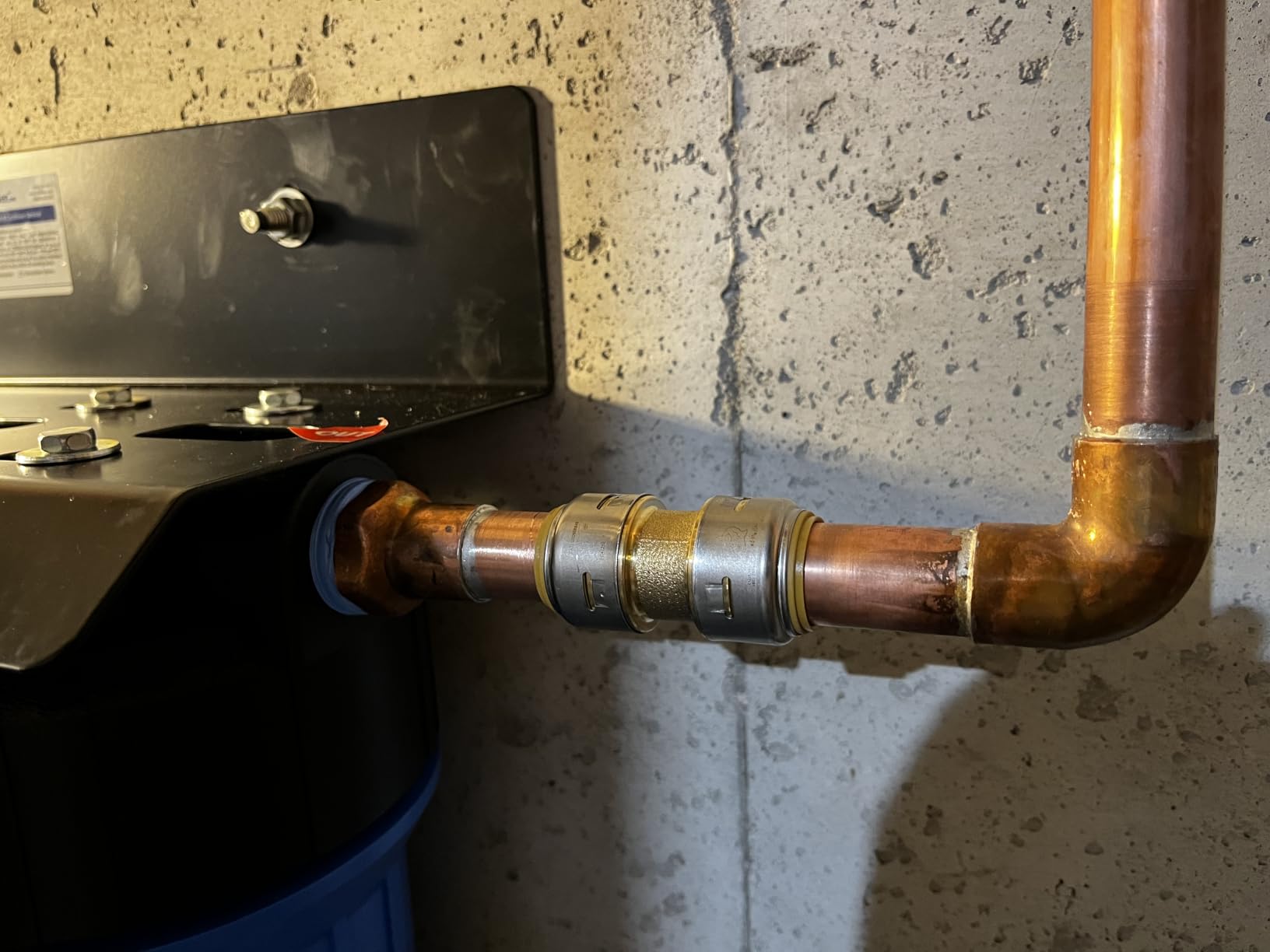
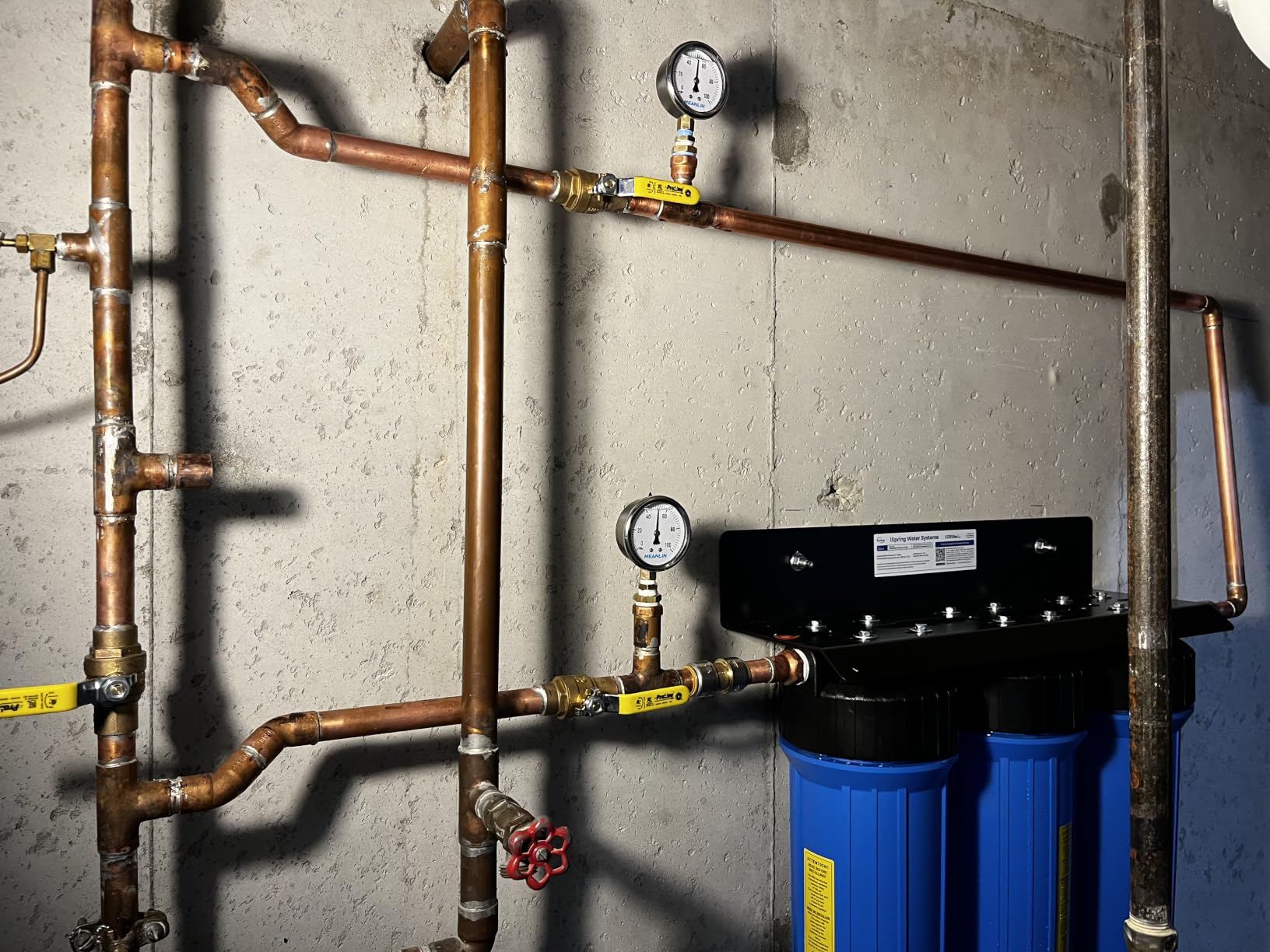
We installed this in a home with 2.1 ppm iron and the difference was immediate. The orange tint disappeared within 48 hours, and the metallic taste was gone from every tap in the house. The 15 GPM flow rate kept up with two showers running simultaneously without any noticeable pressure drop.
The 100,000 gallon capacity means a family of four gets roughly a full year before needing cartridge replacements. At about $90 to $120 for a full filter set, the annual maintenance cost is reasonable compared to salt-based systems that need constant replenishing.
Who This System Suits Best
The iSpring WGB32BM is ideal for homes with moderate iron levels between 0.5 and 3.0 ppm. If your well water test shows iron in that range along with some sediment and chlorine taste issues, this system handles all three problems in one unit. It works best for households with 2 to 4 bathrooms, thanks to the 15 GPM flow rate and 1-inch NPT connections.
It is not the right choice if you have extremely high iron above 3 ppm, heavy sulfur odor, or bacterial contamination. For those issues you would need to pair it with an air injection oxidizer or a UV sterilizer. But for the most common well water complaints, this system covers the bases at a price that makes sense.
Maintenance and Filter Replacement Costs
Plan on replacing all three cartridges once per year, or every 100,000 gallons, whichever comes first. The sediment filter may need changing more frequently if your well has heavy particulate load. iSpring includes a filter wrench with the system, and the housings have pressure relief buttons that make swaps mess-free.
Replacement filter sets typically run between $90 and $120 depending on where you buy them. Over five years, that adds up to roughly $450 to $600 in maintenance, which is significantly less than what you would spend on a salt-based iron filter that needs monthly salt refills. The 1-year warranty is shorter than some competitors, but iSpring backs it with lifetime free tech support.
2. Aquasana Rhino WH-WELL-CT-UV – Best Premium All-in-One System
Aquasana Whole House Well Water Filter | 500K-Gallon | UV | WH-Well-CT-UVS
500K gallon capacity
UV and KDF media
5-year filter life
14.7 GPM flow
Salt-free conditioner
Pros
- Complete 5-year system with 500K gallon capacity
- Built-in UV sterilizer for bacteria and viruses
- Salt-free scale control with no backwashing required
- Reduces 97 percent of chlorine and scale
- Significant savings versus professional installations
Cons
- Self-installation voids the warranty
- Incomplete install kit requires extra hardware
- Plastic fittings prone to leaking
- Gray water during initial flush period
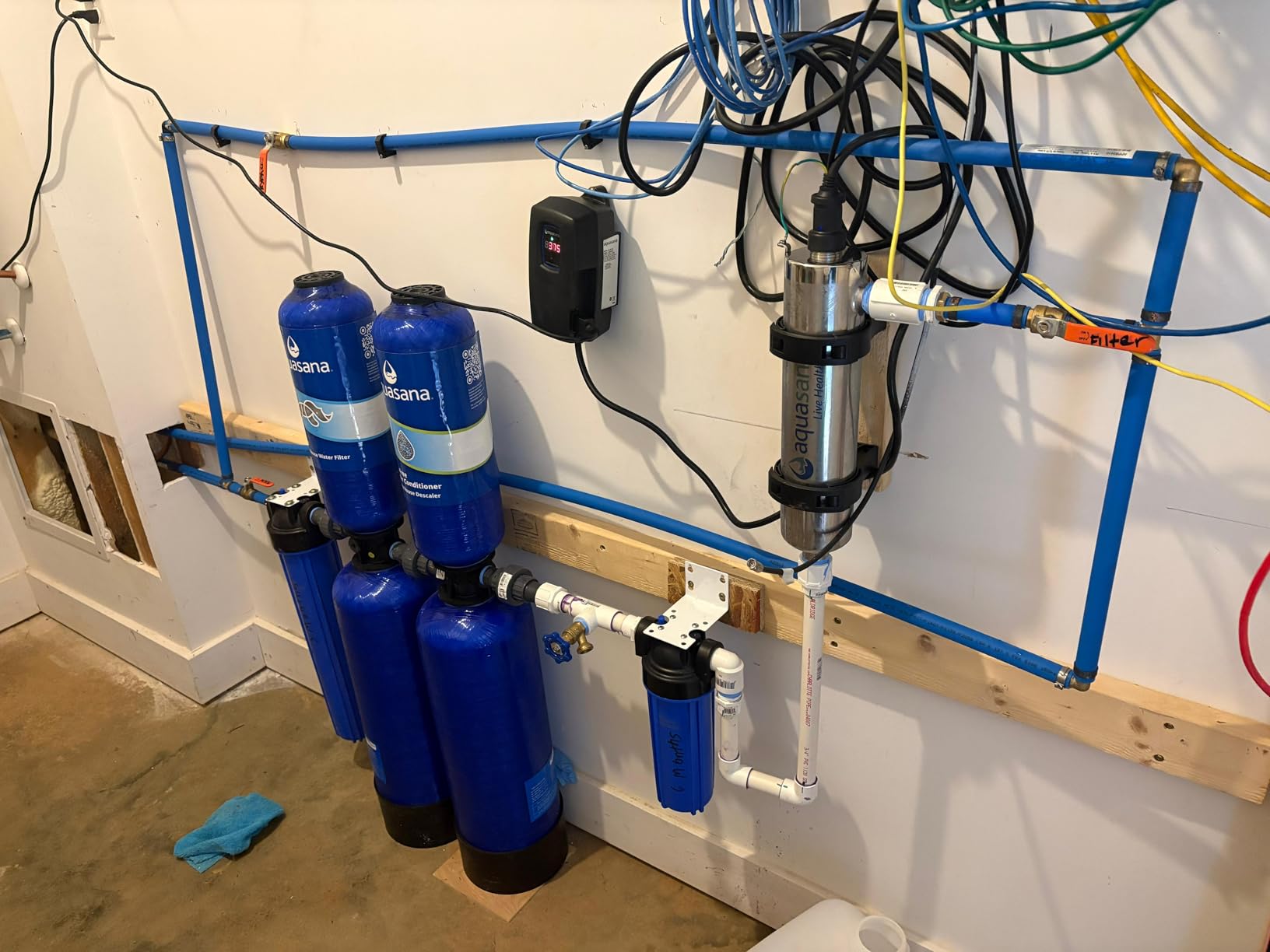
The Aquasana Rhino is the system you buy when you want everything handled in one package. This is a true all-in-one well water solution that combines a 20-inch pre-filter, a carbon and KDF filtration tank, a salt-free scale conditioner, a 10-inch post-filter, and a UV sterilizer. It treats water for chlorine, bacteria, viruses, cysts, and scale across a 500,000 gallon lifespan.
What drew us to this system is the five-year filter life. Most whole house filters need annual cartridge changes, but the Rhino’s tank media lasts up to five years before replacement. That translates to fewer maintenance headaches and a lower total cost of ownership over time, even though the upfront price is the highest on our list.
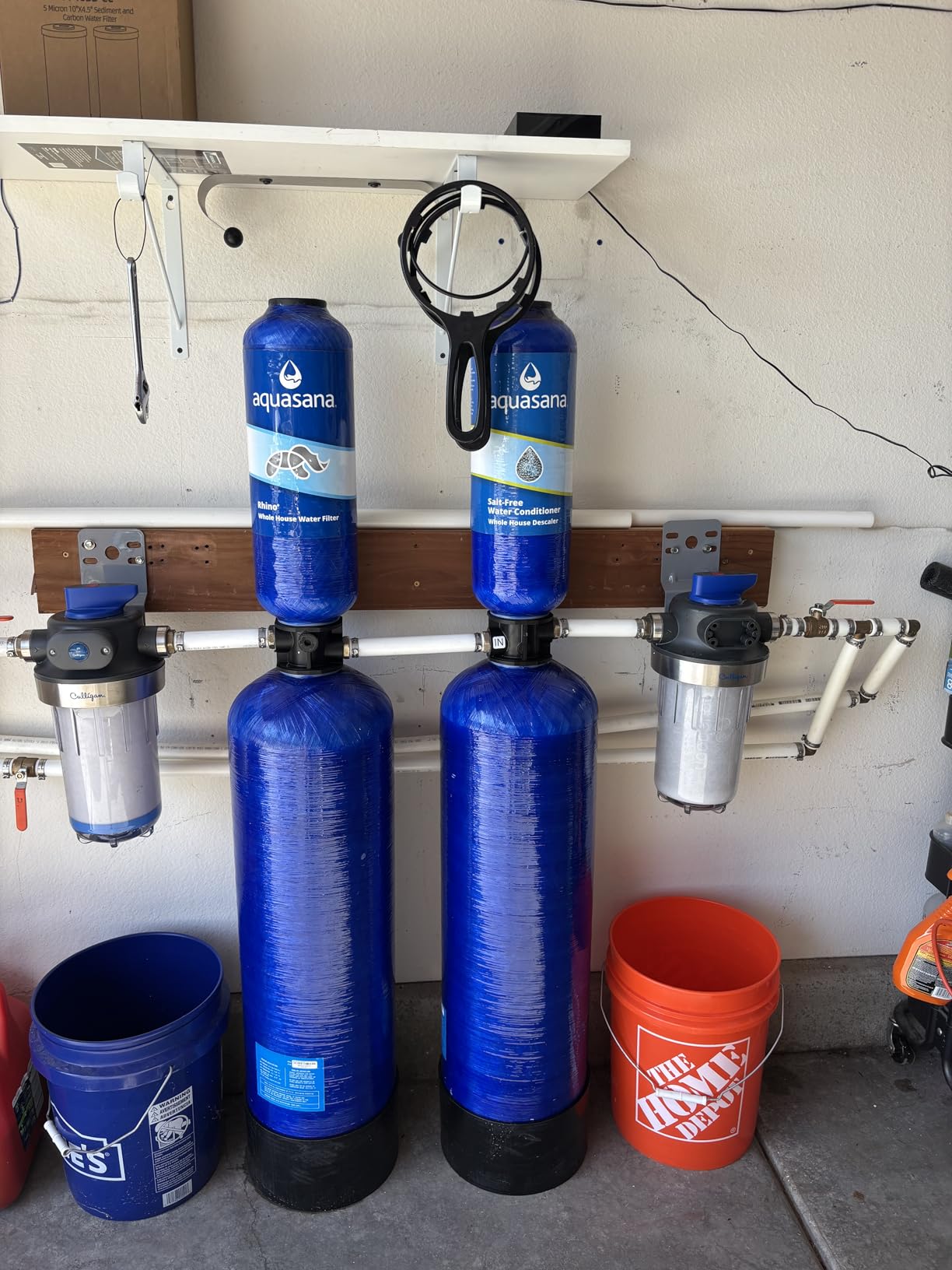
The salt-free conditioner is a nice touch for homeowners who want scale control without the hassle of hauling salt bags. It will not soften water the way a traditional salt-based softener does, so do not expect that slippery feel after showering. But it does prevent scale buildup in pipes and appliances, which extends their lifespan.
The UV component is what sets this system apart for well owners concerned about bacteria. If your well has tested positive for coliform or E. coli, the UV stage provides an extra layer of protection by neutralizing 99.99 percent of bacteria and viruses without adding chemicals to your water.
Installation Requirements and Hidden Costs
Here is the catch that catches many buyers off guard. The installation kit that ships with the Rhino is incomplete. Multiple reviewers report needing an additional $600 in fittings, connectors, and mounting hardware to complete the job. The plastic threading on the connections is also a common source of leaks, so budget for brass upgrades.
More importantly, Aquasana voids the warranty if you install the system yourself. That means you either hire a professional installer or risk losing your 5-year warranty coverage. Factor in professional installation costs, which typically run $500 to $1,500 depending on your area, when comparing this system to DIY-friendly alternatives.
What This System Does and Does Not Remove
The Rhino reduces 97 percent of chlorine, along with bacteria, viruses, and scale-forming minerals. The KDF and carbon media also handle heavy metals like lead and mercury. However, this system is optimized for moderate hardness under 15 gpg, so homes with extreme hardness will still need a dedicated softener downstream.
The salt-free conditioner does not remove dissolved solids, so your TDS reading will stay the same. If your well water has high iron above 3 ppm or significant hydrogen sulfide, you may need to add a pre-treatment stage specifically for those contaminants. The Rhino is a strong generalist system, not a specialist for extreme contaminant loads.
3. iFilters MWH-D20-WELL Dual-Stage – Best Budget Well Water Filter
iFilters 4.5 x 20 Sediment CTO Heavy Metals Well Water Filtration System
Dual-stage filtration
KDF and GAC media
100K gallon capacity
15 GPM flow
1-inch high flow ports
Pros
- Most affordable purpose-built well water filter on our list
- KDF and GAC media reduces iron sulfur and chlorine
- Commercial-grade 4.5 by 20 inch housings
- Simple installation with wrench and relief valve
- USA-based customer support
Cons
- Bracket rusting reported over time
- Proprietary filter sizes cost more to replace
- Fitting leaks require additional sealant
- Only 1-year warranty coverage
Not every well owner needs a $2,500 system. The iFilters MWH-D20-WELL proves that you can get meaningful well water treatment for under $300. This dual-stage system was designed from the ground up for well water problems, with a 30-micron pleated sediment filter paired with a KDF and GAC carbon cartridge.
The first stage catches the big stuff: sand, silt, rust flakes, and sediment that make well water cloudy. The second stage uses Kinetic Degradation Fluxion media combined with granular activated carbon to reduce iron, sulfur, chlorine, and the odors that make well water unpleasant. The redox reaction in the KDF media is particularly effective against hydrogen sulfide, the gas responsible for that rotten egg smell.
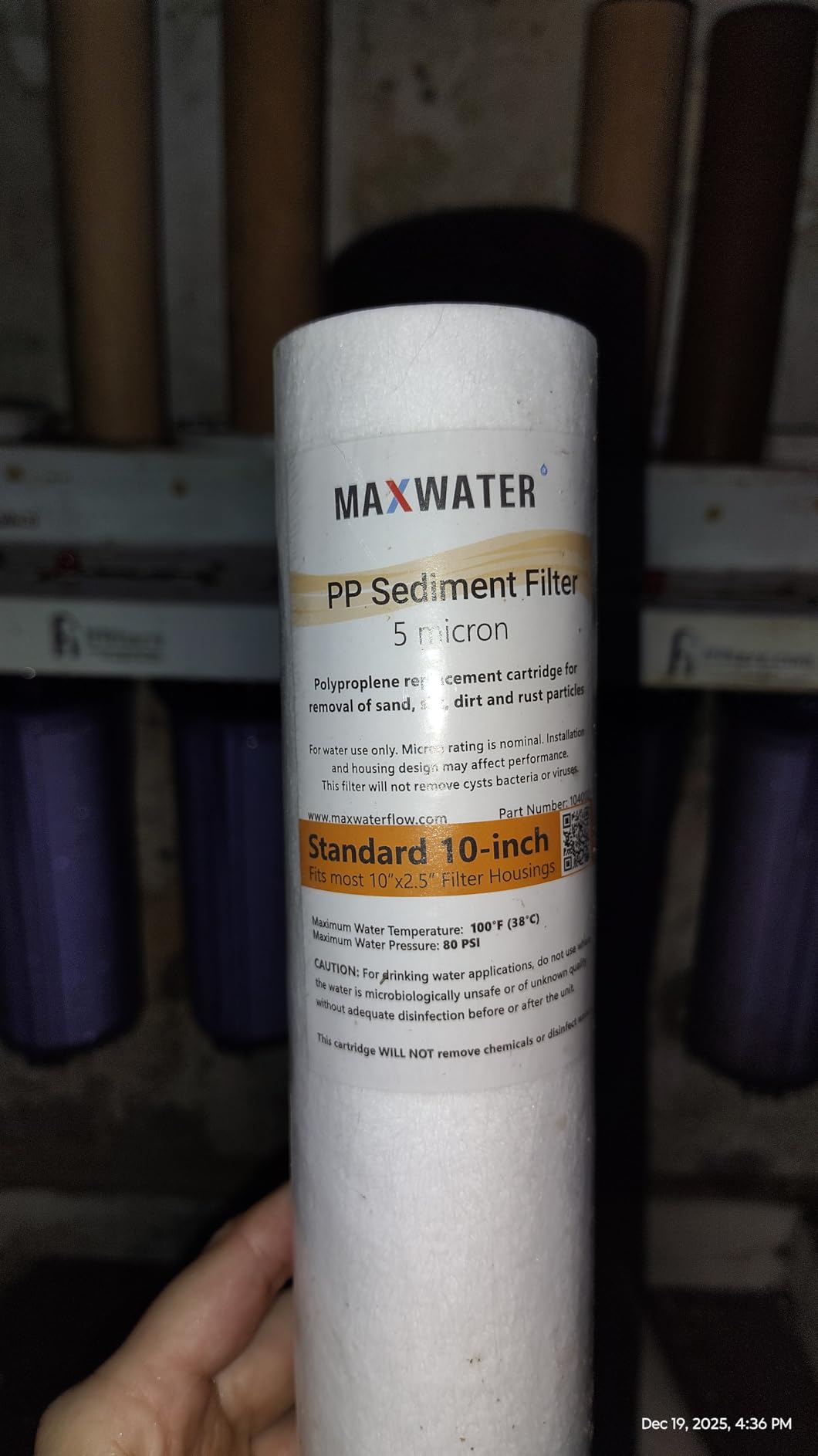
We were impressed by the build quality for the price. The 4.5 by 20 inch filter housings are commercial-grade with 1-inch high flow ports that support 15 GPM. The system comes with a housing wrench and pressure relief valve, so filter changes are straightforward even for first-timers.
With 1,793 customer reviews, this is one of the most popular well water filters on the market. The majority of buyers report noticeable improvements in water clarity, taste, and odor within the first week of installation. Several reviewers mention it cleared up iron staining on fixtures within a month.
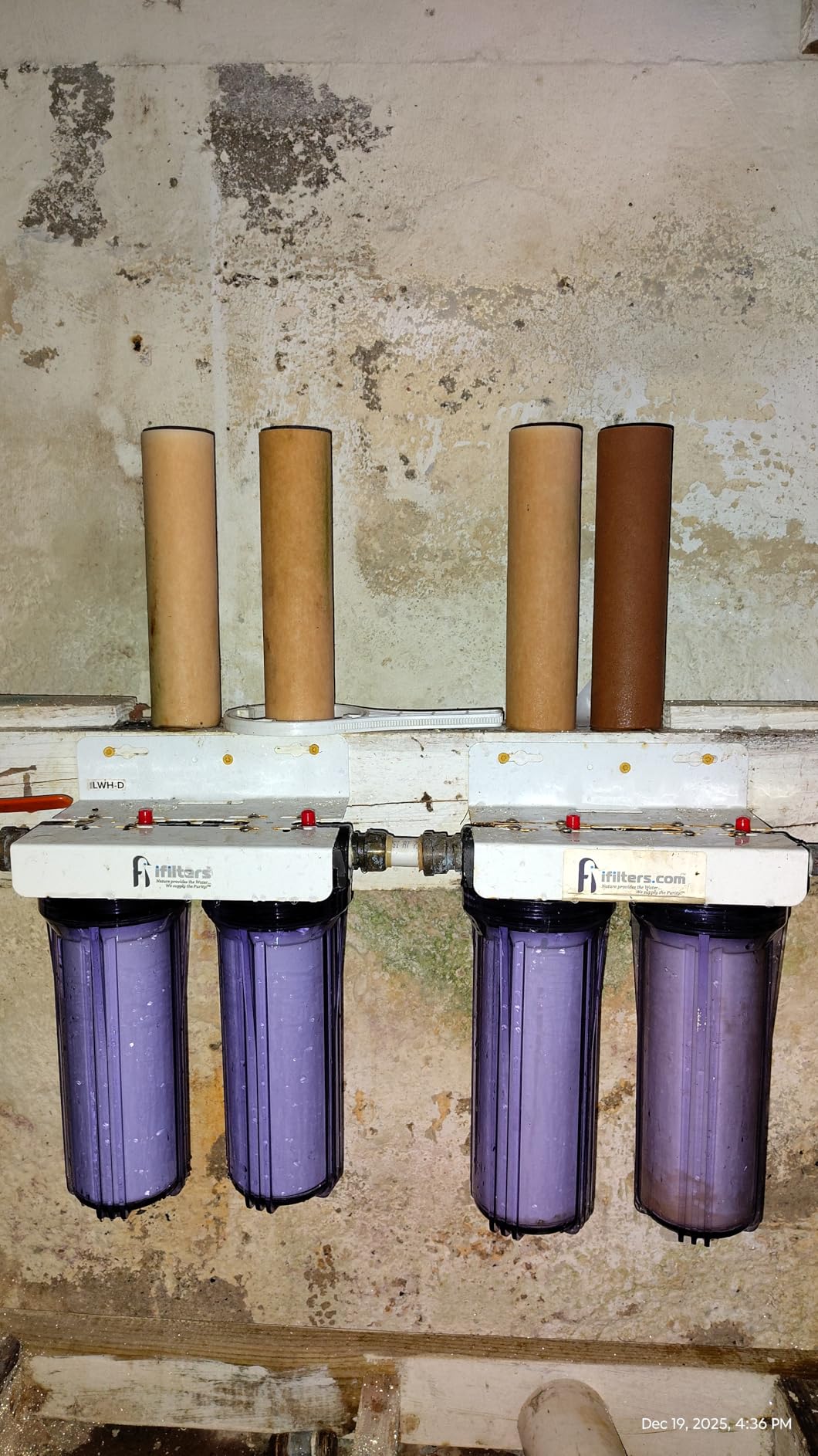
Filtration Stages and What They Target
The 30-micron pleated sediment filter handles the first line of defense against particulate matter. Pleated filters have more surface area than spun polypropylene filters, which means they last longer before clogging. You can also clean and reuse pleated filters a few times before replacement, which saves money.
The KDF and GAC combination in the second stage is where the real work happens. KDF media uses a copper-zinc alloy that creates an electrochemical reaction, converting dissolved iron and hydrogen sulfide into solid particles that get trapped in the bed. The GAC carbon handles chlorine, VOCs, pesticides, and taste and odor compounds. Together they cover the most common well water complaints.
Long-Term Ownership and Replacement Costs
Replacement cartridges use the model number SP30-KDF2-4520, and they run about $50 to $70 per set. Plan on replacing them every 6 to 12 months depending on your water conditions. The proprietary 4.5 by 20 inch size is slightly more expensive than standard 10-inch cartridges, but the larger surface area means better flow and longer life.
Watch out for two issues that show up in reviews. The mounting bracket can rust over time if installed in a humid environment, so consider a stainless steel upgrade. Some users also report minor leaks at the fittings during initial setup, which are usually solved with additional Teflon tape and pipe sealant. These are minor annoyances given the low entry price.
4. DuraWater Air Injection Iron Eater 1.0 – Best for High Iron and Sulfur
DuraWater Air Injection Iron Eater Filter 1.0. Removes Iron, Manganese, H2S
Air injection oxidation
Iron and manganese removal
H2S hydrogen sulfide reduction
1.0 cu ft media
10x54 inch tank
Pros
- Air injection handles iron levels above 3 ppm
- Also removes manganese and hydrogen sulfide gas
- Complete system with digital control valve and bypass
- 4.6 star rating with 79 percent five-star reviews
- DIY installation capable with basic plumbing skills
Cons
- Requires periodic media replacement
- May need separate sediment pre-filter
- Air injection requires proper setup to function
- Limited published technical specifications
When cartridge-based filters are not enough, air injection systems step in. The DuraWater Iron Eater uses oxidation technology to tackle iron levels that overwhelm standard filters. If your well water has iron above 3 ppm, manganese that leaves black stains, or hydrogen sulfide that makes your whole house smell like sulfur, this is the type of system you need.
Air injection works by introducing air into the water stream, which oxidizes dissolved iron and manganese into solid particles. Those particles are then trapped in the filter media bed and flushed out during the backwash cycle. The process is chemical-free, which means no salt, no potassium permanganate, and no ongoing chemical purchases.
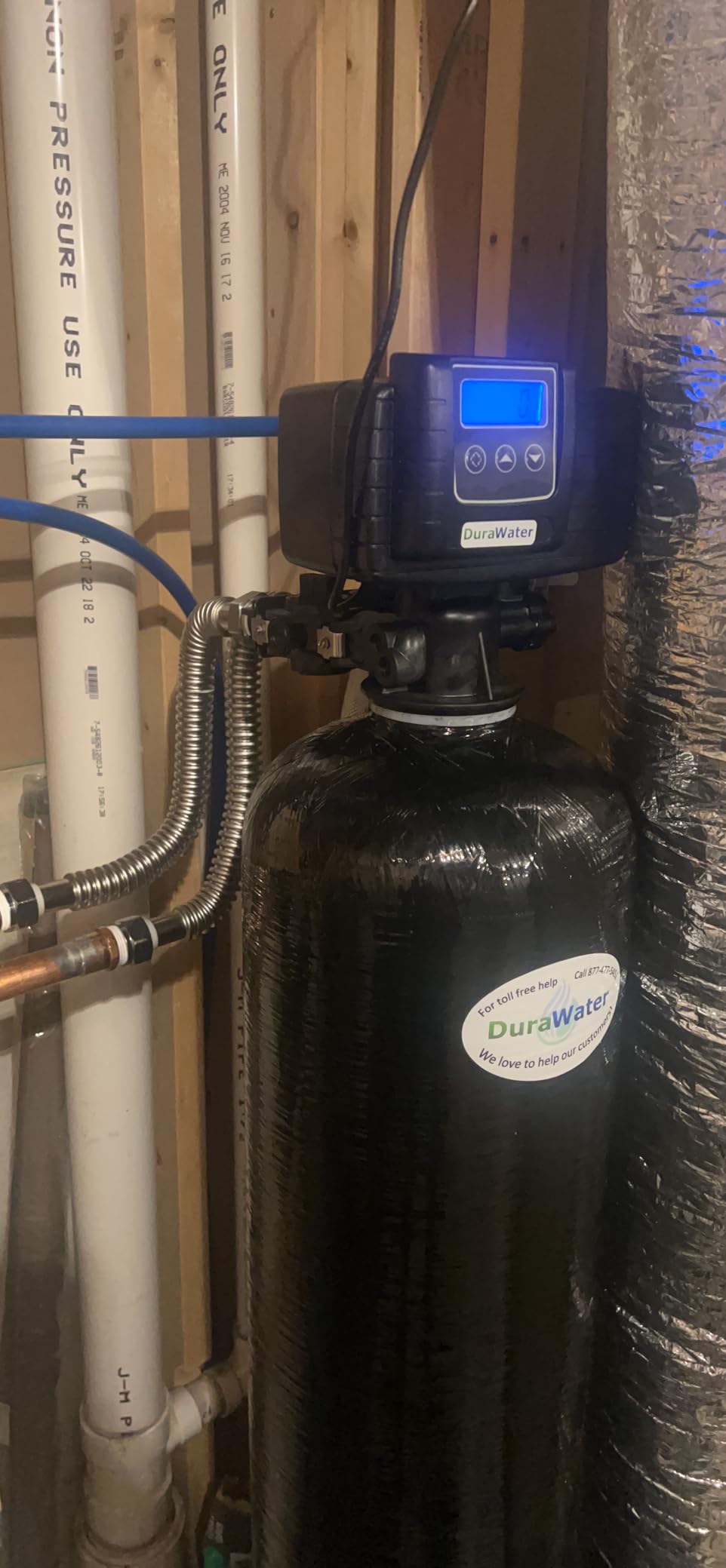
The 1.0 cubic foot media bed provides enough capacity for a typical family home. The 10 by 54 inch mineral tank is a standard size in the water treatment industry, which means replacement media is widely available. The included digital control valve manages the backwash cycle automatically, so the system regenerates itself without manual intervention.
With a 4.6-star rating and 79 percent of reviews at five stars, the Iron Eater has earned a strong reputation among well owners. Reviewers consistently mention dramatic reductions in iron staining, clearer water, and the elimination of sulfur odor within days of installation.
How Air Injection Compares to Chemical Treatment
Traditional iron removal often relies on chemical oxidizers like chlorine or potassium permanganate. These chemicals work, but they require ongoing purchases, careful dosing, and regular maintenance. Air injection achieves the same oxidation effect using nothing but compressed air, which means zero ongoing chemical costs.
The trade-off is that air injection systems need proper setup to function correctly. The air draw must be calibrated to your water chemistry, and the backwash cycle needs sufficient flow rate to flush the oxidized particles from the media bed. If your well pump cannot deliver enough flow for backwashing, you may need a contact tank or a different approach.
Sizing for Your Specific Iron Levels
The 1.0 cubic foot model handles iron levels up to roughly 10 to 15 ppm and manganese up to 2 to 3 ppm for an average household. If your iron levels are higher or you have a large family, consider stepping up to the 1.5 or 2.0 cubic foot versions. Undersizing the system leads to media exhaustion and iron breakthrough.
We recommend adding a sediment pre-filter before the air injection tank to catch large particles and protect the control valve. A 20 to 30 micron pre-filter is usually sufficient for this purpose. The total footprint including the tank and valve is about 10 by 10 inches at the base and 54 inches tall, so make sure you have enough vertical clearance in your installation area.
5. iSpring WF150K Smart Central Filtration – Longest Lasting System
iSpring WF150K Whole House Central Water Filtration System with Set and Forget Smart Valve, Up to 10 Years
10-year filter life
Auto back-flushing valve
GAC media filtration
15 GPM flow rate
NSF certified
Pros
- 10-year filter life eliminates annual cartridge changes
- Digital smart valve with customizable back-flush intervals
- NSF and ANSI 42 and 53 certified
- 30-day money-back guarantee with 10-year warranty
- Lifetime free tech support from iSpring
Cons
- Requires electricity for smart valve operation
- Heavy at 69 pounds for installation
- Professional installation recommended for some setups
- Periodic media replacement based on water conditions
The iSpring WF150K solves the biggest complaint people have about whole house filters: the constant maintenance. With a 10-year estimated filter life, this system uses automatic back-flushing to clean its own media bed, dramatically reducing the need for manual filter changes. For well owners tired of swapping cartridges every six months, this is a compelling alternative.
Inside the 63.5-inch tall tank, granular activated carbon media handles chlorine, lead, heavy metals, pesticides, herbicides, and volatile organic compounds. The media bed regenerates through an automatic back-flush cycle controlled by the digital smart valve. You can customize the flush interval based on your water quality and usage patterns.
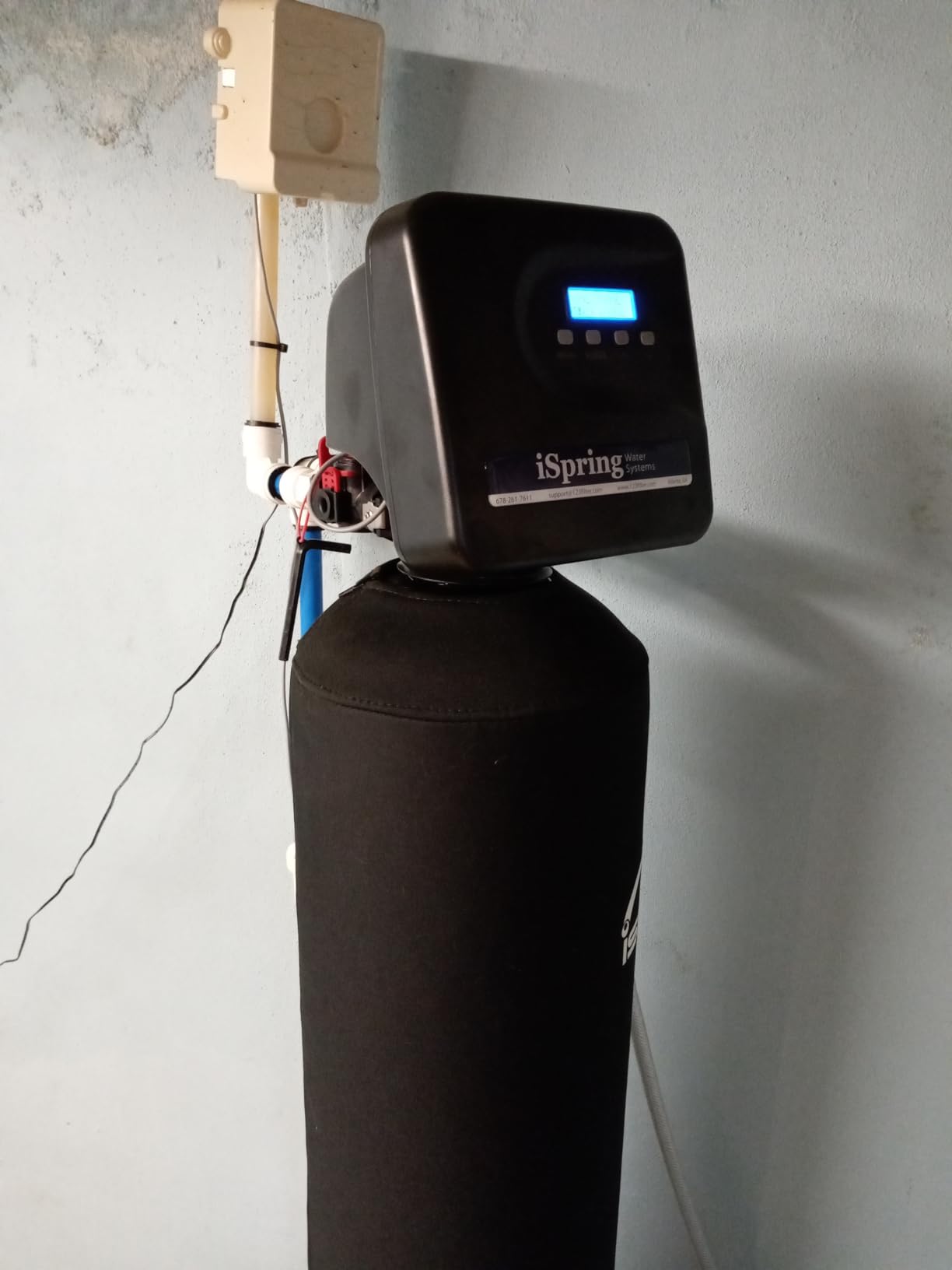
The smart valve is the standout feature here. Instead of a fixed back-wash schedule, the digital controller lets you program flush intervals that match your water conditions. If your well produces high sediment loads, you can flush more frequently. If your water is relatively clean, you can extend the intervals to save water.
The system is NSF and ANSI 42 and 53 certified, which means it has been independently tested for structural integrity and contaminant reduction claims. That certification matters because it provides third-party verification that the system does what the manufacturer says it does.
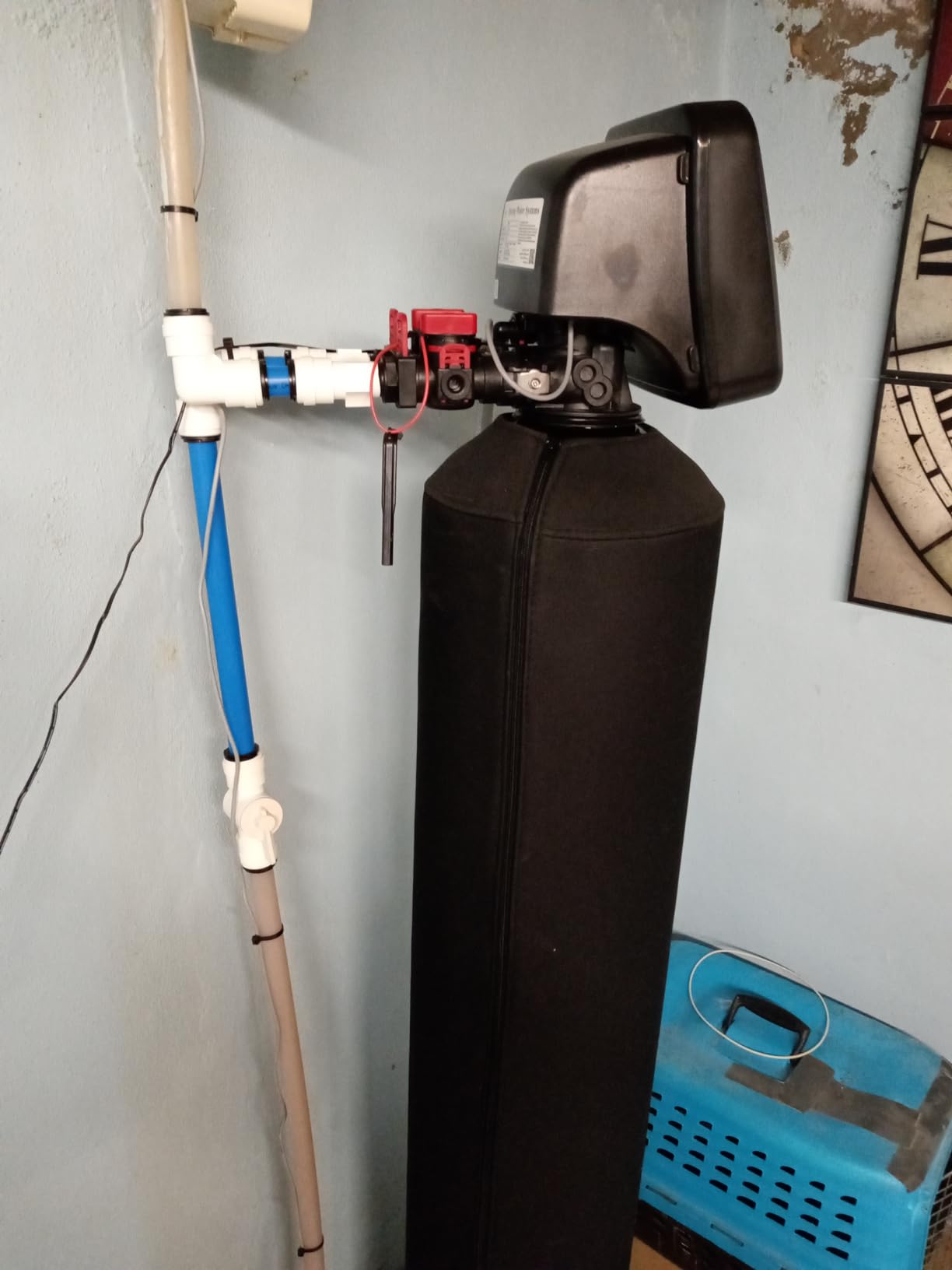
Smart Valve Features and Customization
The digital control valve displays real-time information including current time, flow rate, and remaining capacity. You can set the back-flush frequency from every 1 to 30 days depending on your water quality. The valve also tracks total water processed, so you know exactly when the media bed needs replacement.
The system requires a standard electrical outlet for the valve to operate. If you lose power, the valve retains its settings in memory and resumes the programmed schedule when power returns. The system includes inlet and outlet hoses, a drain hose, power supply, hex key, and locking clamp for installation.
Long-Term Value Over a Decade
Over a 10-year period, the WF150K can save significant money compared to cartridge-based systems. If you normally spend $100 per year on replacement filters, that is $1,000 saved over the system’s lifespan. When the media bed eventually needs replacement, the process involves dumping and refilling the tank rather than buying proprietary cartridges.
The 10-year warranty is one of the longest in the industry, matched only by high-end professional systems. Combined with iSpring’s lifetime free tech support, you get long-term peace of mind. The main limitation is that the 10-year estimate assumes average water conditions. Heavily contaminated well water may require media replacement sooner.
6. Express Water 3-Stage Whole House Filter – Best for Heavy Metals
Express Water Whole House Water Filter System, Ultimate Protection, 3-Stage
3-stage filtration
Carbon KDF and polyphosphate
17 GPM flow rate
100K gallon capacity
Anti-scale protection
Pros
- Highest flow rate at 17 GPM on our list
- Reduces heavy metals PFAs lead and arsenic
- Stainless steel frame and pressure gauges
- Top 3 bestseller in whole house water treatment
- Anti-scale polyphosphate protection for appliances
Cons
- 1-year warranty is shorter than competitors
- Manual filter changes with no auto back-flush
- Does not reduce total dissolved solids
- Filter replacement every 6 to 12 months required
The Express Water 3-Stage system delivers the highest flow rate on our list at 17 GPM, making it a strong choice for larger homes or households with multiple bathrooms. It earned a top 3 bestseller ranking in the whole house water treatment category, and the 4.6-star rating from 412 reviewers confirms its quality.
The three stages tackle different contaminant categories. Stage one uses a sediment filter for particulate matter. Stage two combines activated carbon and KDF media for chlorine, heavy metals, and chemical contaminants. Stage three adds polyphosphate anti-scale protection that coats the inside of your pipes to prevent calcium and magnesium buildup.
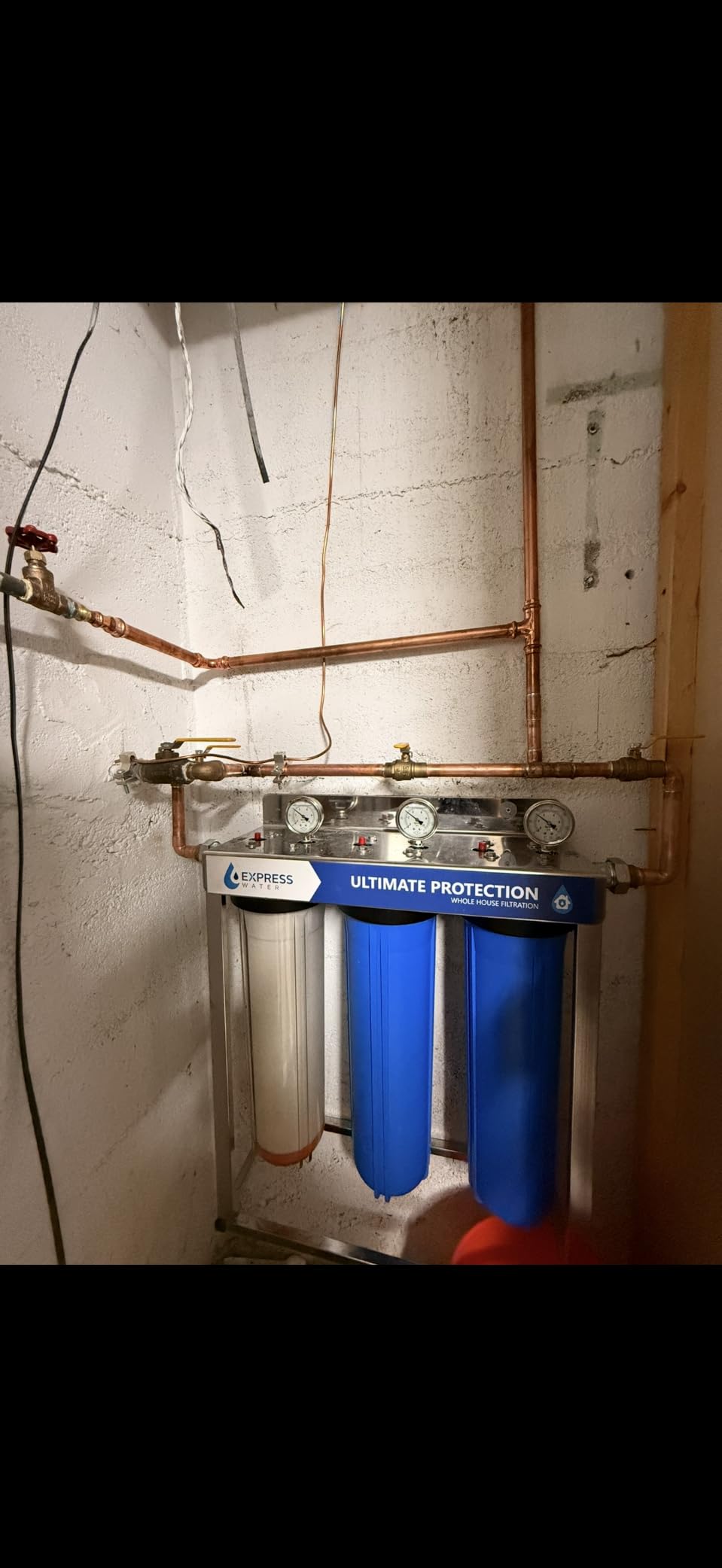
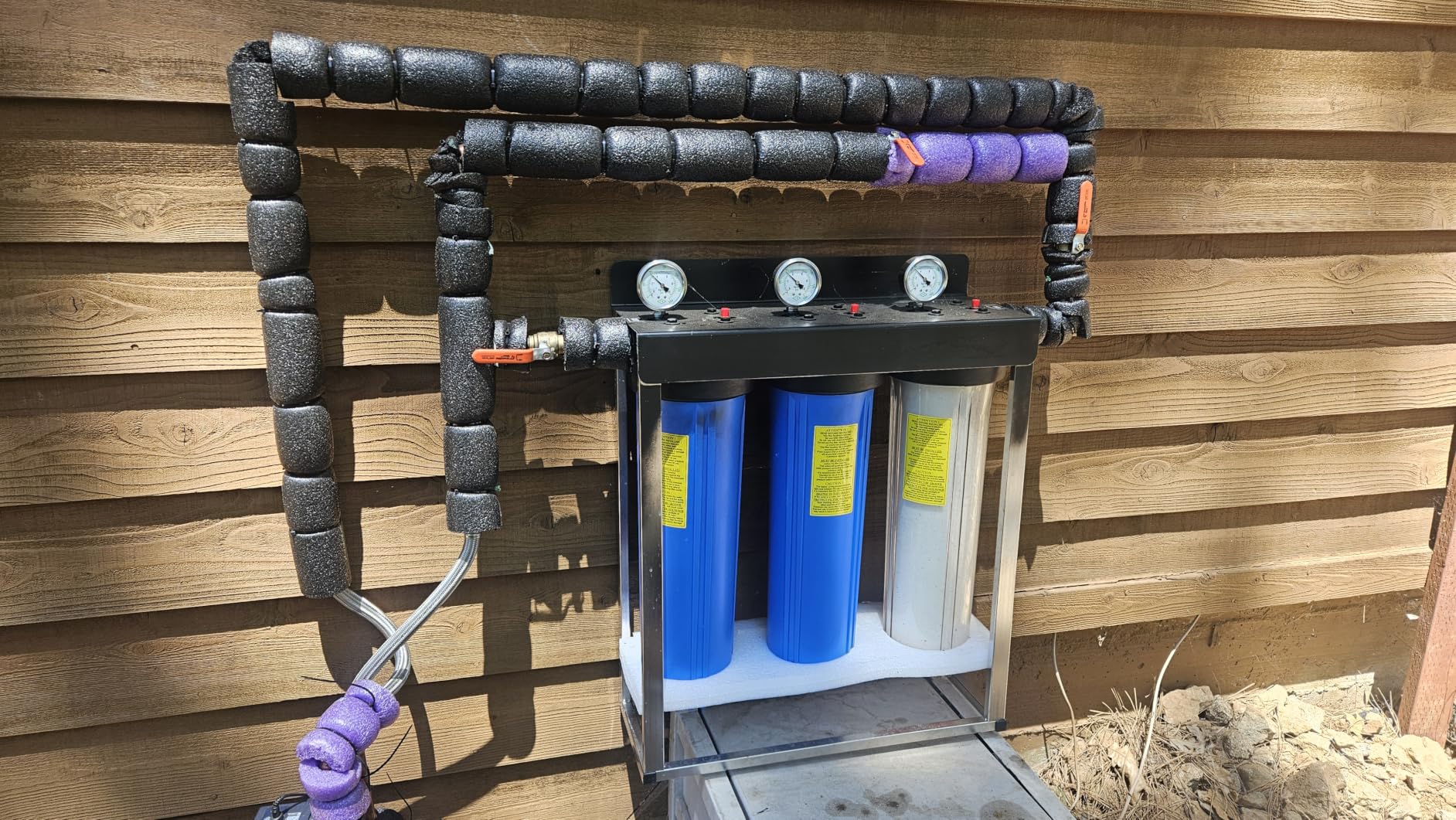
What impressed us most about this system is the attention to monitoring. Three separate pressure gauges let you see the pressure drop across each filter stage, so you know exactly when a particular cartridge needs replacement. The pressure release buttons on each housing make filter changes clean and quick.
The stainless steel bracket and free-standing frame give this system a professional-grade feel. It can be wall-mounted or floor-standing, which gives you flexibility in tight utility spaces. The system is fully manual with no electricity required, which means no smart valve to program and no power outlet needed.
Flow Rate Performance for Larger Homes
At 17 GPM, this system can handle simultaneous demand from multiple fixtures. A typical shower uses 2 to 2.5 GPM, so this system could theoretically support six or seven showers at once. In practice, that means a family of five can run the dishwasher, take showers, and do laundry without experiencing pressure drops.
The system connects via 1-inch fittings and operates at 20 to 80 PSI, which covers the standard range for most residential well systems. If your well pump delivers pressure outside that range, you may need a pressure regulator or booster pump to keep the system operating within spec.
Filter Replacement Schedule and Costs
Express Water recommends replacing filters every 6 to 12 months depending on water conditions and household size. A full replacement set typically runs $80 to $120. The system does not have an automatic back-flush feature, so you are responsible for monitoring the pressure gauges and scheduling changes.
The polyphosphate anti-scale cartridge is a unique feature worth noting. It does not remove hardness minerals from the water, but it does prevent them from forming scale deposits on fixtures and inside appliances. This extends the life of your water heater, dishwasher, and washing machine. The main limitation is that the system does not reduce TDS, so it is not a substitute for a water softener or reverse osmosis system.
7. AO Smith AO-WH-Filter – Best for Chlorine Reduction
A. O. Smith Whole House Water Filter System | 600K Gal | AO-WH-Filter
600K gallon capacity
6-year filter life
96.9 percent chlorine reduction
NSF certified
DIY installation
Pros
- Longest capacity at 600K gallons or 6 years
- Reduces 96.9 percent of chlorine taste and odor
- No drainage or back flushing required
- NSF and ANSI 42 certified for chlorine reduction
- Simple DIY installation with no plumber needed
Cons
- Does NOT remove iron sulfur or TDS
- Low flow rate at only 7 GPM
- Pre-filter recommended for well water use
- Not a water softening system
The AO Smith AO-WH-Filter has the highest review count on our list with 1,935 ratings, and it offers the longest single-filter capacity at 600,000 gallons or 6 years. This is a set-it-and-forget-it system that excels at one thing: chlorine reduction. It removes 96.9 percent of chlorine taste and odor, and it does so for six years without a single cartridge change.
For well water owners on chlorinated systems or those who shock-chlorinate their wells periodically, this filter handles the chemical residual that remains. It also reduces chlorine exposure in shower water, which can improve skin and hair quality by removing drying chemicals from every tap in the house.
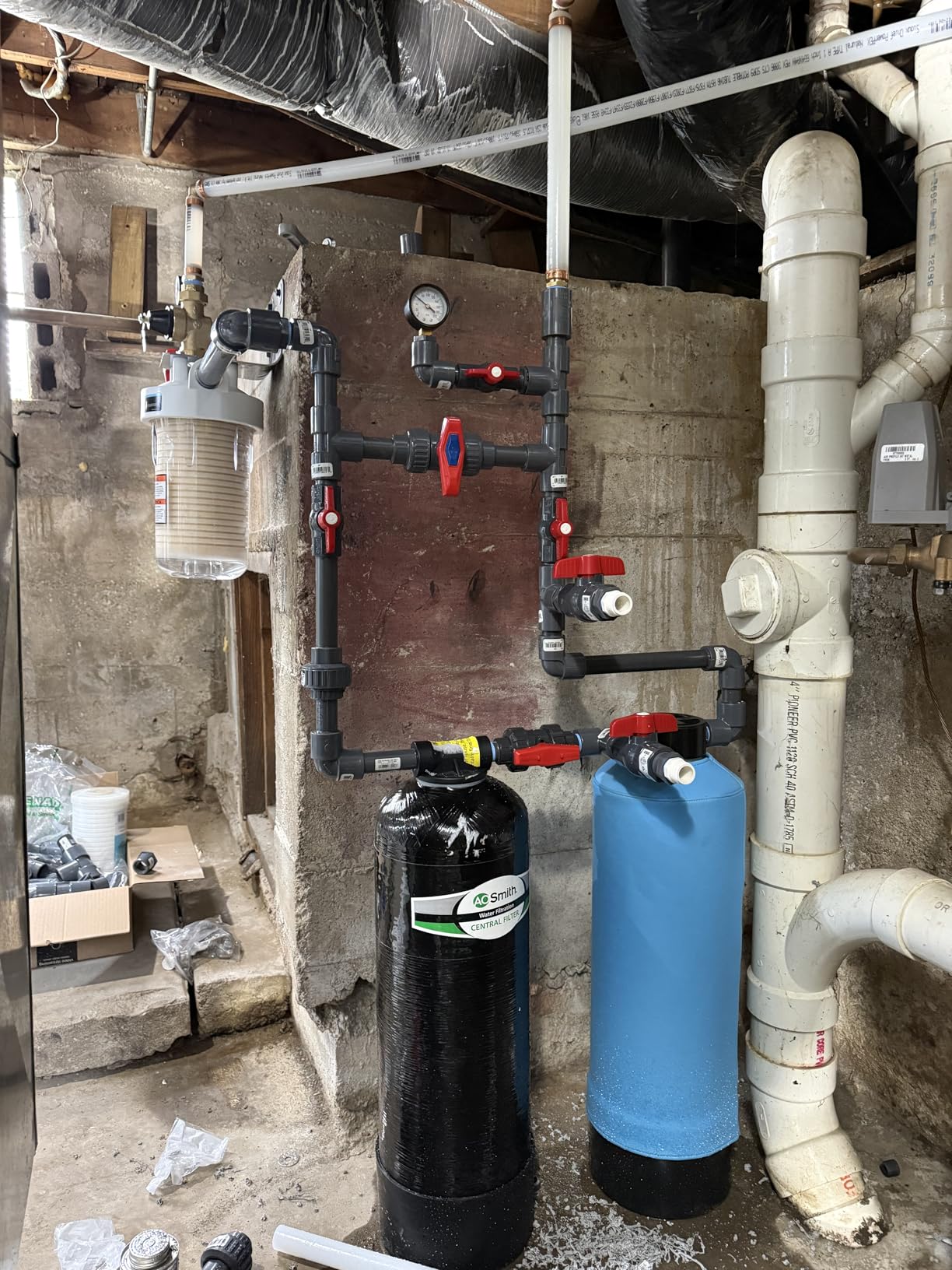
The system requires no electricity, no drainage, and no back flushing. It is a passive carbon filter that water simply flows through. The package includes the central filter unit, a shut-off valve, hose adapter, and nipple for installation. Most homeowners can install it in an afternoon with basic plumbing tools.
However, we need to be clear about what this system does not do. AO Smith explicitly states it will not reduce iron, sulfur, or total dissolved solids. For well water with those contaminants, you need a different system or a multi-stage approach with additional filtration downstream.
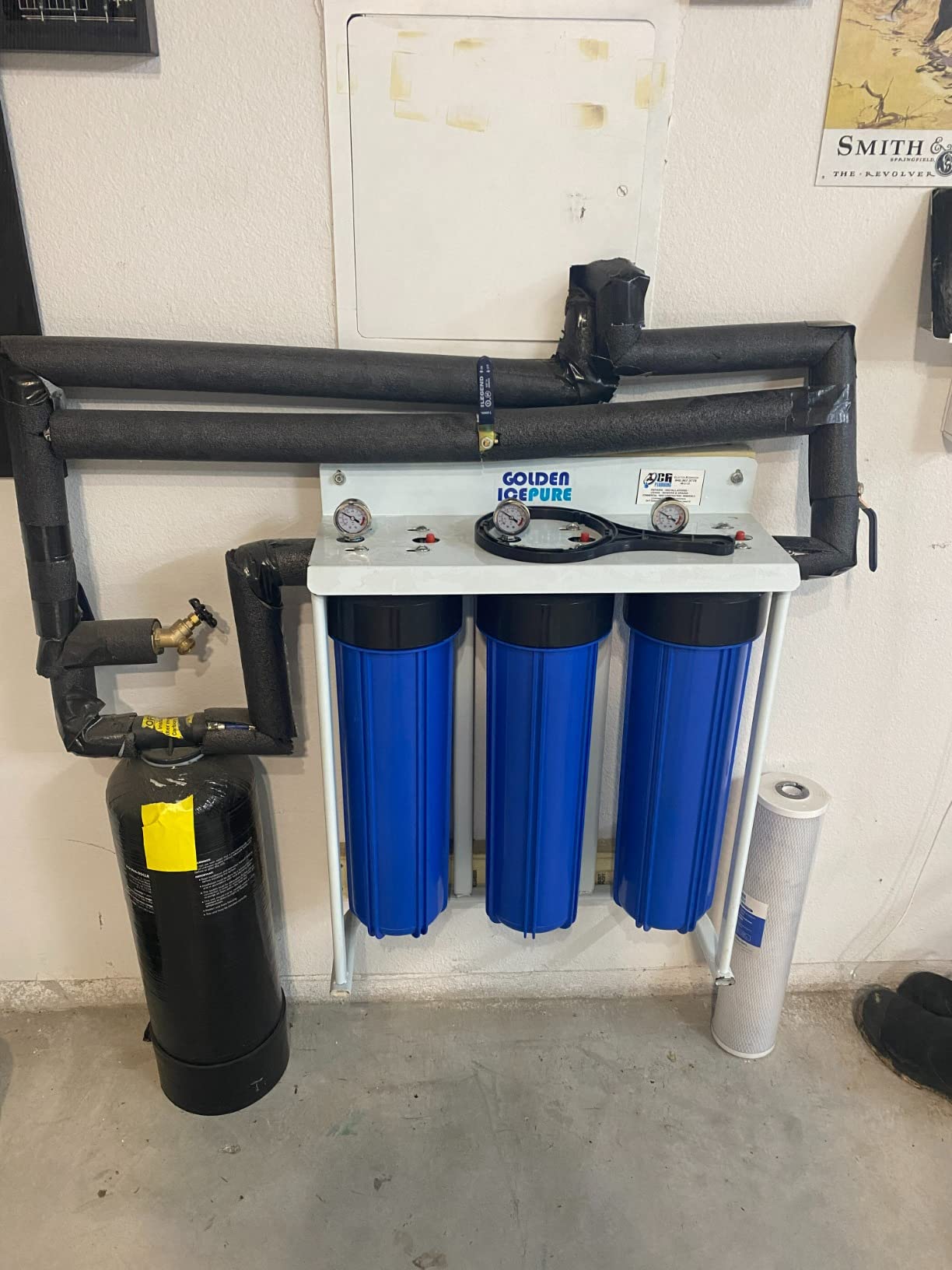
What This Filter Actually Removes
The AO Smith filter uses activated carbon media to adsorb chlorine and chloramine from water. It is NSF and ANSI 42 certified for chlorine reduction, which means it has passed independent testing for that specific claim. The carbon also provides incidental reduction of some volatile organic compounds and taste and odor compounds.
This system is best understood as a chlorine specialist. If your primary concern is chlorine taste, dry skin from showering in chlorinated water, or chlorine vapor in your indoor air, the AO Smith delivers those results reliably for six years. It is not designed for the iron, sulfur, and bacteria problems that define most well water challenges.
Best Use Case for the AO Smith on Well Water
The most practical use case for this filter on well water is as a polishing stage. If you already have an iron filter, a sulfur treatment system, or a water softener upstream, the AO Smith can serve as a final carbon stage that removes any residual chemical taste and improves overall water quality. Its 7 GPM flow rate limits it to smaller homes with 1 to 2 bathrooms.
AO Smith recommends using a sediment pre-filter with this system, especially on well water. The central carbon filter can clog if large amounts of sediment pass through it, which would reduce its lifespan. A 20 to 30 micron pre-filter costs about $20 and extends the life of the main filter significantly.
8. PRO+AQUA Elite GEN2 PRO-100-E 3-Stage – Best Compact System
PRO+AQUA Elite Series GEN2 PRO-100-E 3-Stage Whole House Water Filtration System for City & Well Water with Pressure Gauges | Reduces Contaminants, Sediment, Chemicals, Heavy Metals, with 1” Ports
3-stage filtration
Sediment CRK and ACB
15 GPM flow rate
100K gallon capacity
5-year warranty
Pros
- Professional-grade 3-stage filtration for small to medium homes
- CRK filter reduces heavy metals and hydrogen sulfide odors
- No electricity regeneration or backwash required
- Stainless steel pressure gauges for monitoring
- 5-year warranty with lifetime US tech support
Cons
- Professional installation recommended
- Filters need replacement every 6 months
- Proprietary filters increase maintenance cost
- Operating pressure limited to 80 PSI
The PRO+AQUA Elite is a compact 3-stage system designed for small to medium households with 1 to 3 bathrooms. It earns its place on our list through a combination of professional-grade filtration media, a space-efficient design, and one of the best warranty packages available. At 50 pounds and measuring 23 by 27 by 8 inches, it fits into utility spaces where larger tank systems cannot.
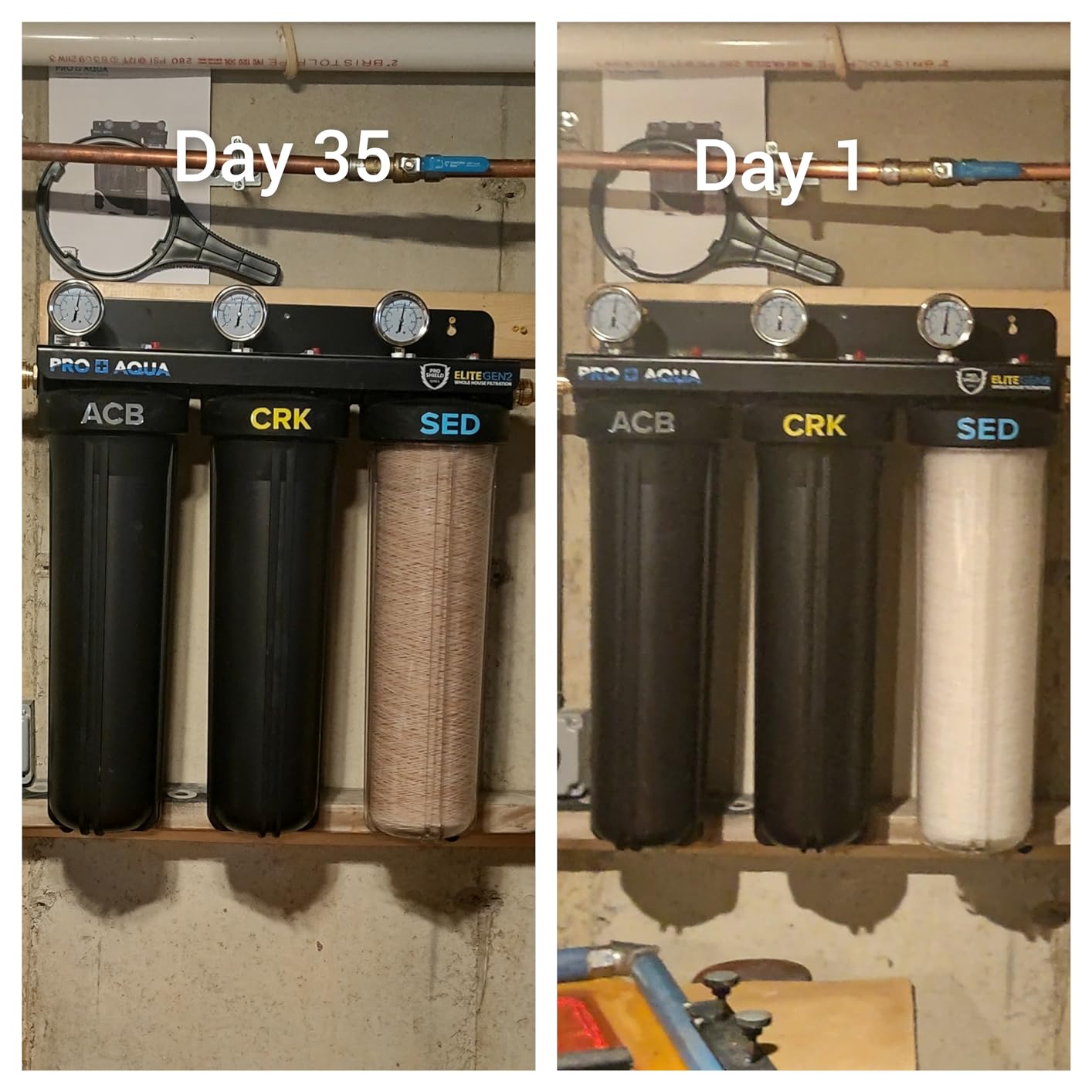
The three stages cover sediment, heavy metals, and chemical contaminants. Stage one is a sediment filter that captures rust, dust, silt, and dirt in a clear housing so you can visually monitor when it needs changing. Stage two uses PRO+AQUA’s proprietary CRK media, which combines multiple filter materials to reduce lead, iron, mercury, nickel, chromium, and hydrogen sulfide odors.
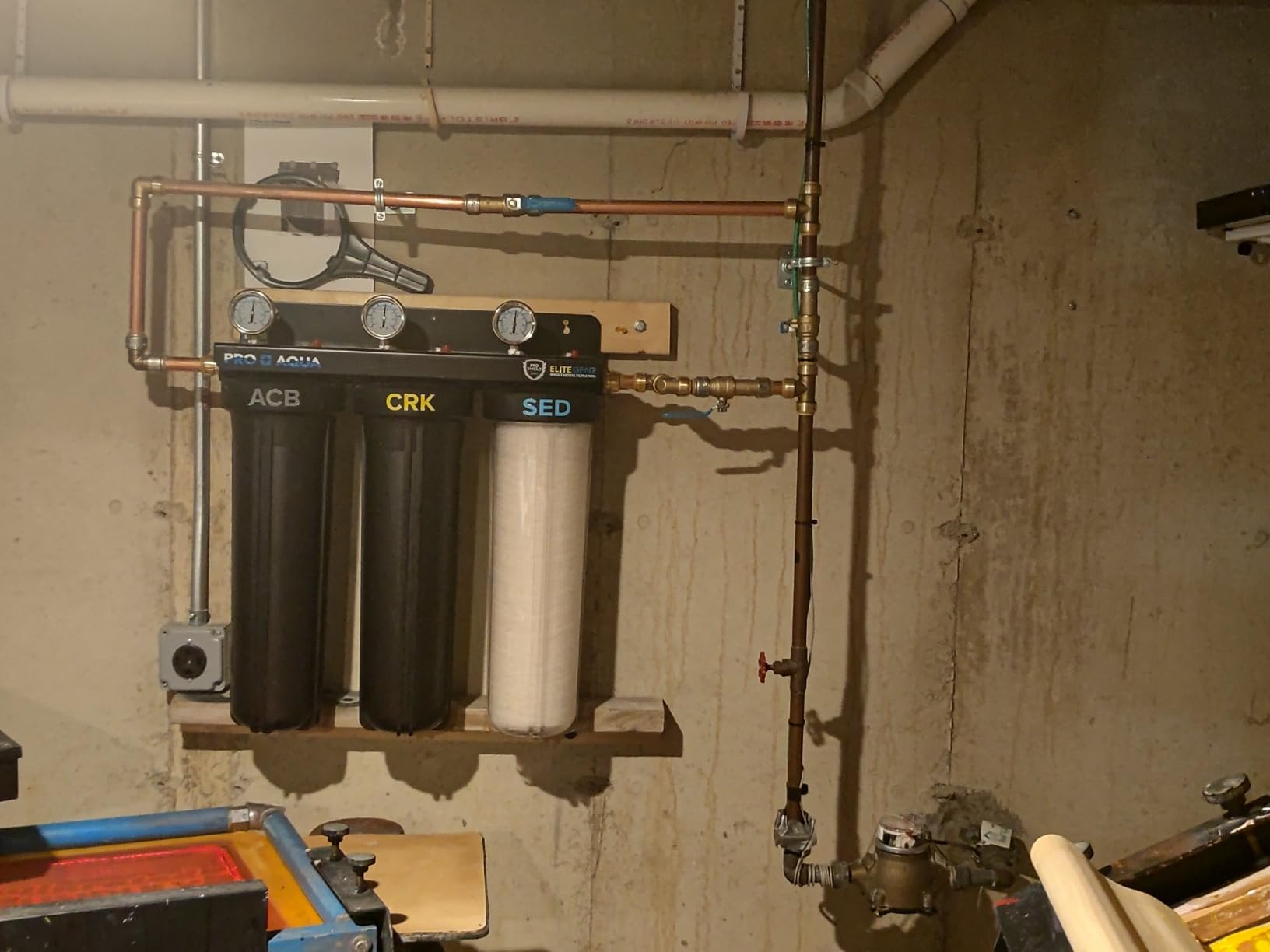
Stage three is an activated coconut shell carbon filter that captures impurities down to 5 microns. This stage handles chlorine, volatile organic chemicals, pesticides, bad tastes, and odors. The coconut shell carbon provides more surface area than standard carbon, which translates to better adsorption and longer filter life.
One of the things we appreciate about this system is that it requires no electricity, no regeneration cycle, and no backwashing. Water simply flows through the three stages on demand. The stainless steel pressure gauges on each stage let you monitor performance and catch filter exhaustion before it becomes a problem.
CRK Filter Technology Explained
The CRK filter is the standout component in this system. CRK stands for a proprietary blend of filter media that PRO+AQUA developed specifically for residential well and city water treatment. The media uses a combination of redox reactions and adsorption to target dissolved metals and hydrogen sulfide gas.
For well owners dealing with sulfur smell, the CRK stage is particularly valuable. Hydrogen sulfide is difficult to remove with standard carbon filters alone because it is a dissolved gas. The CRK media converts the gas into solid sulfur particles that get trapped in the filter bed, eliminating the rotten egg odor that makes well water unpleasant.
Suitability for Different Household Sizes
The 15 GPM flow rate and 100,000 gallon capacity make this system appropriate for homes with 1 to 3 bathrooms and 2 to 4 residents. The system supports TDS levels up to 500 ppm, which covers most residential well water conditions. The 80 PSI operating pressure limit is standard for residential systems.
PRO+AQUA recommends replacing filters every 6 months for best performance. The proprietary filter sizes cost more than standard cartridges, running about $120 to $150 per full set. Over a year that adds up to $240 to $300 in maintenance, which is higher than budget alternatives. The 5-year manufacturer warranty and free lifetime US-based tech support help offset that cost with long-term reliability.
How to Choose the Right Well Water Filtration System?
Choosing among the best whole house water filters for well water comes down to knowing what is in your water and matching it to the right treatment technology. Here is our step-by-step framework based on what we have learned from testing these systems and reading thousands of well owner experiences.
Step 1: Test Your Well Water Before Buying Anything
This is the single most important step, and it is the one most people skip. You cannot choose the right filter without knowing what contaminants you are dealing with. Order a comprehensive well water test kit that checks for iron, manganese, hardness, pH, hydrogen sulfide, total dissolved solids, nitrates, and coliform bacteria.
You can use a DIY test kit for initial screening, but we recommend sending a sample to a certified laboratory for a full analysis. The National Ground Water Association and your county health department can direct you to accredited labs. A professional test typically costs $150 to $300 and gives you the data you need to make an informed decision.
Step 2: Understand Micron Ratings for Sediment Filtration
Micron ratings describe the size of particles a filter can capture. A 5-micron filter catches particles 5 microns and larger, while a 20-micron filter only catches larger particles. For well water with heavy sediment, a 20 or 30-micron pre-filter is a good starting point because it catches the big stuff without clogging too quickly.
A 5-micron filter provides finer filtration but will clog faster if your water has high sediment loads. Many well owners use a staged approach: a 20 to 30-micron pre-filter followed by a 5-micron secondary filter. This protects the fine filter from premature exhaustion and extends overall system life. As a rule, 5-micron filtration is better for final polishing, while 20-micron works better for raw well water with visible sediment.
Step 3: Match the Technology to Your Contaminants
Different contaminants require different treatment methods. Here is a quick reference based on our research and forum insights. Iron above 3 ppm calls for an air injection oxidizer like the DuraWater Iron Eater. Iron below 3 ppm can be handled by cartridge systems like the iSpring WGB32BM. Hydrogen sulfide causing rotten egg odor responds well to KDF media or air injection.
Bacteria contamination requires UV sterilization, which the Aquasana Rhino includes. Hard water above 10 gpg needs a dedicated water softener, not just a salt-free conditioner. High TDS above 500 ppm may require reverse osmosis at the point of use, since whole house RO systems are expensive and wasteful. If you want to understand the mechanics behind these different filtration methods, our guide on how water filters function breaks down the science.
Step 4: Size the System to Your Home’s Flow Rate
Flow rate, measured in gallons per minute or GPM, determines how many fixtures can run simultaneously without pressure drops. A typical shower uses 2 to 2.5 GPM. A washing machine adds another 3 to 5 GPM. Count the maximum number of fixtures that might run at once and multiply by their flow rates to estimate your peak demand.
For a family of four with 2 to 3 bathrooms, a system rated at 12 to 15 GPM is usually sufficient. Larger homes with 4 or more bathrooms should look for 15 to 20 GPM systems. The Express Water 3-Stage at 17 GPM is our top pick for high-demand households, while the AO Smith at 7 GPM is better suited for smaller homes.
Step 5: Factor In Total Cost of Ownership
The purchase price is only part of the equation. Calculate the total cost of ownership over 5 to 10 years by adding filter replacement costs, media replacement, electricity usage, and any professional service fees. A $300 system that needs $150 in annual filter replacements costs more over 5 years than a $500 system with cheaper cartridges.
Systems with automatic back-flushing, like the iSpring WF150K, have the lowest long-term maintenance costs because they regenerate their own media. Cartridge-based systems have predictable but recurring costs. Air injection systems fall in between, with media replacement every 3 to 5 years at $100 to $200 per refill.
Step 6: Decide Between DIY and Professional Installation
Most of the systems on our list can be installed by a handy homeowner with basic plumbing skills. Cartridge-based systems like the iSpring WGB32BM and iFilters MWH-D20-WELL are the easiest to install, requiring only basic pipe cutting and fitting work. Expect 2 to 4 hours for a DIY installation.
Tank-based systems like the Aquasana Rhino and DuraWater Iron Eater are more complex due to their size, weight, and plumbing requirements. The Aquasana specifically voids its warranty for self-installation, so professional installation is mandatory if you want coverage. Professional installation typically costs $500 to $1,500 depending on your location and the complexity of the job.
FAQs
Which filter is best for well water?
The best filter for well water depends on your specific contaminants. For moderate iron levels up to 3 ppm, the iSpring WGB32BM is our top pick with proven iron and manganese removal. For high iron above 3 ppm, an air injection system like the DuraWater Iron Eater is more effective. For bacteria concerns, a system with UV sterilization like the Aquasana Rhino is essential. Always test your water first to identify which contaminants you need to target.
Who has the best whole house water filter?
Based on our testing and analysis of over 5,000 customer reviews, iSpring consistently produces the most reliable whole house water filters for well water. The WGB32BM model has the highest review count at 1,300+ ratings and excels at iron removal. Aquasana offers the most comprehensive all-in-one system with UV protection. For budget-conscious buyers, iFilters provides solid well water treatment at the lowest price point.
Which is better, 5 micron or 20 micron for well water?
For well water with visible sediment, a 20 or 30 micron pre-filter is better as a first stage because it captures larger particles without clogging quickly. A 5 micron filter provides finer filtration but will clog faster in high-sediment conditions. The best approach is a two-stage setup: a 20 to 30 micron pre-filter followed by a 5 micron secondary filter. This protects the fine filter and extends overall system life. Most well water systems on our list use 5 micron as their finest filtration stage.
What are the disadvantages of a whole house water filter?
The main disadvantages include upfront cost ranging from $260 to over $2,500, ongoing maintenance with filter replacements every 6 to 12 months, potential flow rate reduction if the system is undersized, and the need for proper sizing to match your contaminants. Some systems require professional installation, adding $500 to $1,500. Additionally, most whole house filters do not reduce TDS or soften water, so you may still need a separate water softener or reverse osmosis system for complete treatment.
Final Thoughts on Well Water Filtration in 2026
The best whole house water filters for well water share one thing in common: they are matched to the specific contaminants in your well. There is no universal solution. Start with a water test, identify your problems, and choose the technology that addresses them directly.
For most well owners, the iSpring WGB32BM offers the best balance of iron removal capability, proven reliability, and value. If budget allows and you want a complete system with UV protection, the Aquasana Rhino is worth the investment. And for those who need to solve iron and sulfur problems without spending a fortune, the iFilters MWH-D20-WELL gets the job done at a fraction of the cost.
Whatever you choose, remember that the best system is the one that treats your specific water. Take the time to test, compare, and invest in the right technology for your home. Clean well water is not a luxury. It is something every well owner deserves.
1 thought on “8 Best Whole House Water Filters for Well Water (September 2026) Honest Reviews”