
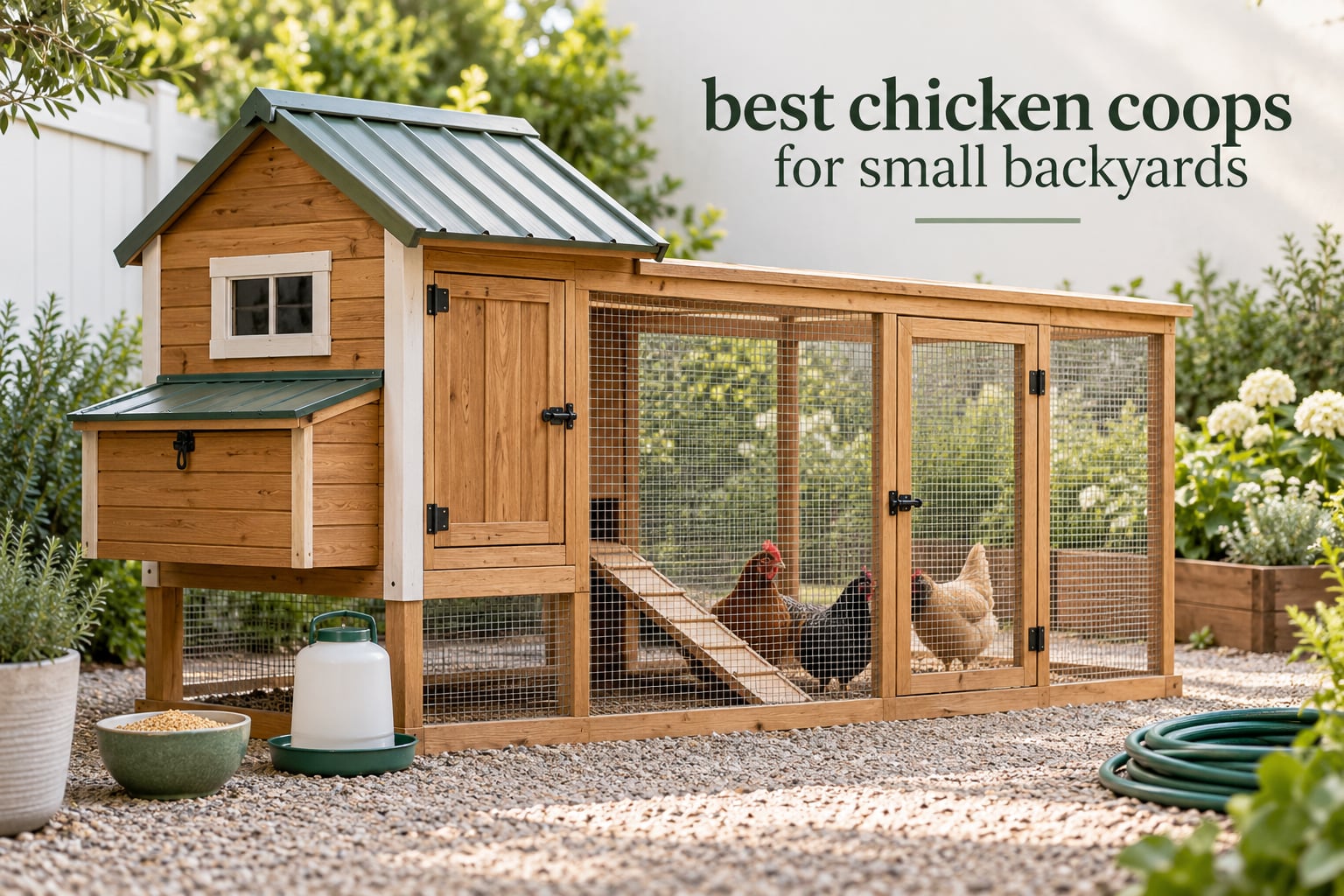
The best chicken coops for small backyards are the ones that tell you their real enclosed floor area, ship a run with actual mesh instead of hexagonal chicken wire, and fit through your gate. Almost everything else on the box is decoration. Most prefabs advertise roughly twice the birds they honestly hold, so a coop labelled for eight is usually comfortable for four.
Here is the whole test in one line: divide the enclosed floor area in square feet by four, and that is your real hen count. A coop with 6.07 sq.ft of enclosed floor works for one or two birds, not four. The run is separate, and you want 8 to 10 sq.ft of run per hen on top of it. Everything below is built on that arithmetic.
We went through ten coops built for tight yards and rated them on the things that actually cause problems later: honest floor space, wall and roof material, mesh type, cleaning access, whether it will fit down a narrow side yard, and whether the latches survive a raccoon. For the wider context of coop buying, our general chicken coop roundup covers the bigger walk-in and stationary builds. This page is the small-yard list. Updated for 2026.
Table of Contents
Top 3 Best Chicken Coops for Small Backyards in 2026


How Much Yard Space a Small Flock Actually Needs
Small yards fail on run space, not coop space. The coop is a rectangle of weather shelter; the run is where your hens actually live for twenty hours a day. Size the run first, then buy a coop that fits beside it.
Using 4 sq.ft of enclosed floor and 8 to 10 sq.ft of run per hen:
2 hens: 8 sq.ft enclosed plus 16 to 20 sq.ft run, so about 24 to 28 sq.ft of yard in total.
3 hens: 12 sq.ft enclosed plus 24 to 30 sq.ft run, roughly 36 to 42 sq.ft total.
4 hens: 16 sq.ft enclosed plus 32 to 40 sq.ft run, about 48 to 56 sq.ft total.
5 hens: 20 sq.ft enclosed plus 40 to 50 sq.ft run, around 60 to 70 sq.ft total.
6 hens: 24 sq.ft enclosed plus 48 to 60 sq.ft run, roughly 72 to 84 sq.ft total.
Leave a two-foot path along the run so you can reach the cleanout door and refill the feeder, and check your local setback rules before you measure anything. Our picks for compact setups are the 10 coops we rated this year, while larger yards suit a walk-in design instead.
If your yard is genuinely tight, a wheeled coop that rotates to fresh grass buys you usable space without a bigger footprint. Two of our picks have wheels and a pull handle built in.
Best Chicken Coops for Small Backyards at a Glance (October 2026)
Real enclosed floor area, not the number on the box. Every figure below comes from the manufacturer listing.
| Product | Specifications | Action |
|---|---|---|
| Petsfit 4-6 Hen Multi-Level Coop |
|
Check Latest Price |
 MEDEHOO 82 inch Mobile Coop MEDEHOO 82 inch Mobile Coop |
|
Check Latest Price |
| Aivituvin AIR31 |
|
Check Latest Price |
| Ketive Cedar Coop |
|
Check Latest Price |
 Aivituvin AIR23 Mobile Aivituvin AIR23 Mobile |
|
Check Latest Price |
 Ketive Small Backyard Coop Ketive Small Backyard Coop |
|
Check Latest Price |
 GUTINNEEN Large Mobile Coop GUTINNEEN Large Mobile Coop |
|
Check Latest Price |
 GOJOOASIS A-Frame Coop GOJOOASIS A-Frame Coop |
|
Check Latest Price |
 Gowoodhut Small Hen House Gowoodhut Small Hen House |
|
Check Latest Price |
 CSQOO Plastic Coop with Run CSQOO Plastic Coop with Run |
|
Check Latest Price |
1. Petsfit Outdoor Coop with Run for 4-6 Chickens – Best Overall for Small Yards
Petsfit Outdoor Chicken Coop with Run for 4-6 Chickens, 3 Nesting Boxes
6.07 sq.ft enclosed
12.56 sq.ft run
71 x 42 x 45 in
Fir frame, PVC roof
Pros
- Most reviews in the group
- space-saving multi-level layout
- 6 ground anchors
- 3 doors plus removable floor panel
- PVC roof resists heat
Cons
- Elevated area is small for the advertised 4-6 hens
- frame may need reinforcing for heavier breeds
- needs two people to reposition
This is the pick we kept coming back to, because it has the largest body of real-world feedback of anything we tested for small yards. Around a thousand owners have run it through a season or more, which tells you more than any spec sheet.
The trick is its multi-level layout. The enclosed sleeping area measures 6.07 sq.ft and the run is 12.56 sq.ft, all inside a 71 by 42 by 45 inch footprint. Two birds are genuinely comfortable. Four small hens or bantams work if you use the run heavily.
Owners consistently praise the three-door cleaning access and the washable floor panel, which matters more than it sounds when you are scooping bedding in the rain. Six heavy-duty ground anchors come in the box, and they matter because foxes and raccoons dig.
The corrugated PVC roof is a quiet winner in hot climates. Reviewers say it resists cracking, warping and heat better than asphalt shingles, and a transparent sliding PVC window adds light without adding a draft. Three nesting boxes with a top-lid collection, two indoor roosting bars and an outdoor perch with a swing round out a well thought out package.
What to check before you buy
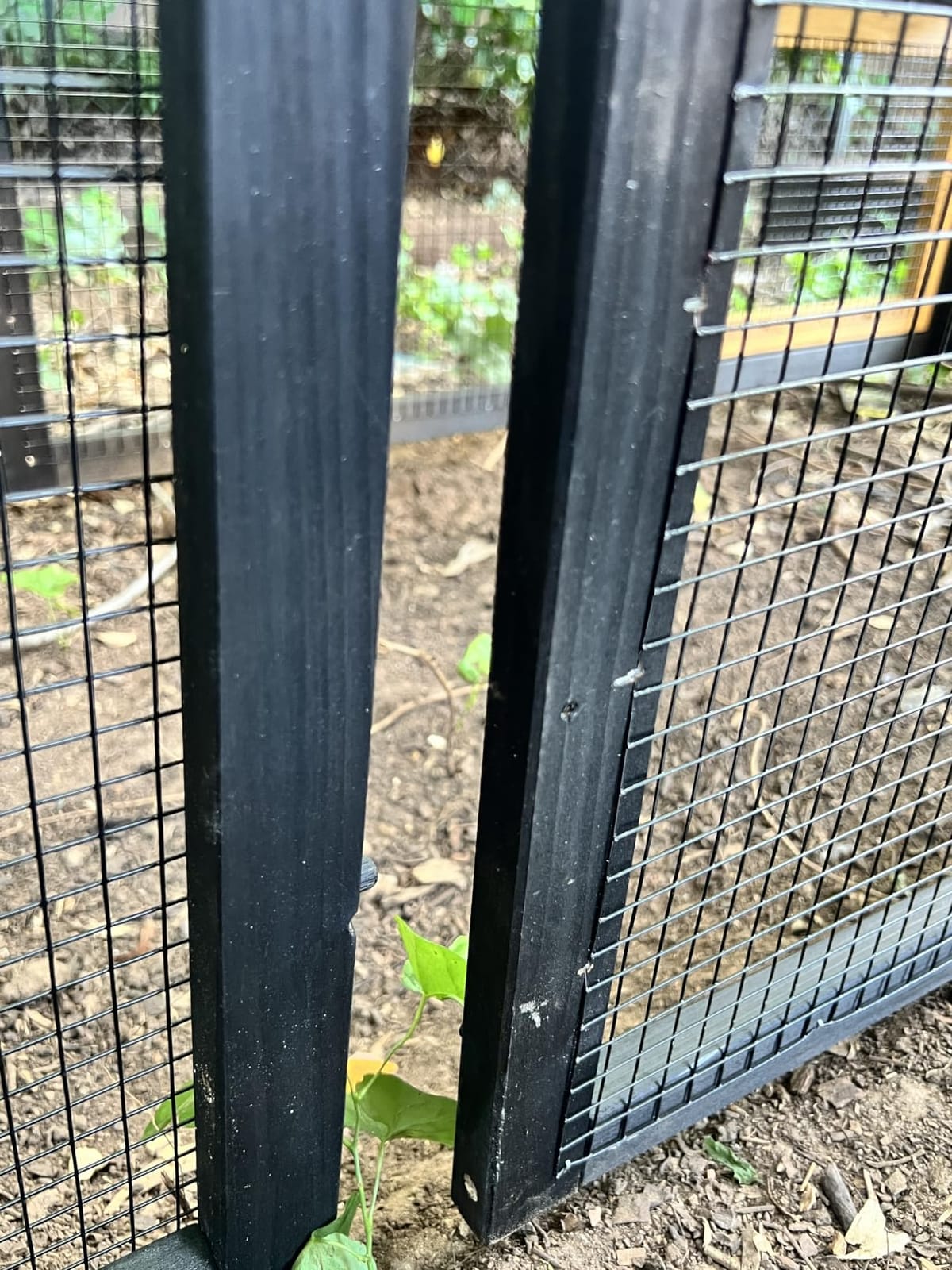
Measure your gate first. At 45 inches deep and 66 pounds when loaded, this is a two-person move. If your access is a narrow side yard, check the width before you commit.
Where it falls short
Some owners find the removable floor panel and door layout awkward to reach, and a minority report the frame needs reinforcing before you add heavier breeds or a larger flock.
2. MEDEHOO 82 inch Mobile Coop – Best for Rotating the Run Across a Small Lot
MEDEHOO Mobile Chicken Coop with Wheels for 4-6 Chickens, Large Outdoor Hen House with Run, Weatherproof Asphalt Roof, Sectionable Nesting Box & Pull-Out Tray, 82.4″ L x 25.8″ W x 44.1″ H – Grey
82.4 x 25.8 x 44.1 in
66 lb
Wheels and pull handle
FSC wood, asphalt roof
Pros
- Very long run for its footprint
- wheels and handle make rotation easy
- five access doors and extra-large trays
- screened windows cut odour
Cons
- Lowest average rating in the group at 3.7
- latches and hardware reported breaking
- not a year-round home for heavier breeds
The long run is the reason to look at this one. At 82.4 inches you get real foraging length inside a 25.8 inch wide frame, which is a sensible trade for a side yard where depth is easier to come by than width.
Two heavy-duty wheels and a pull handle let you move the whole structure to fresh grass across a lawn. For a small lot, that mobility effectively increases the living space your flock gets without a bigger footprint.
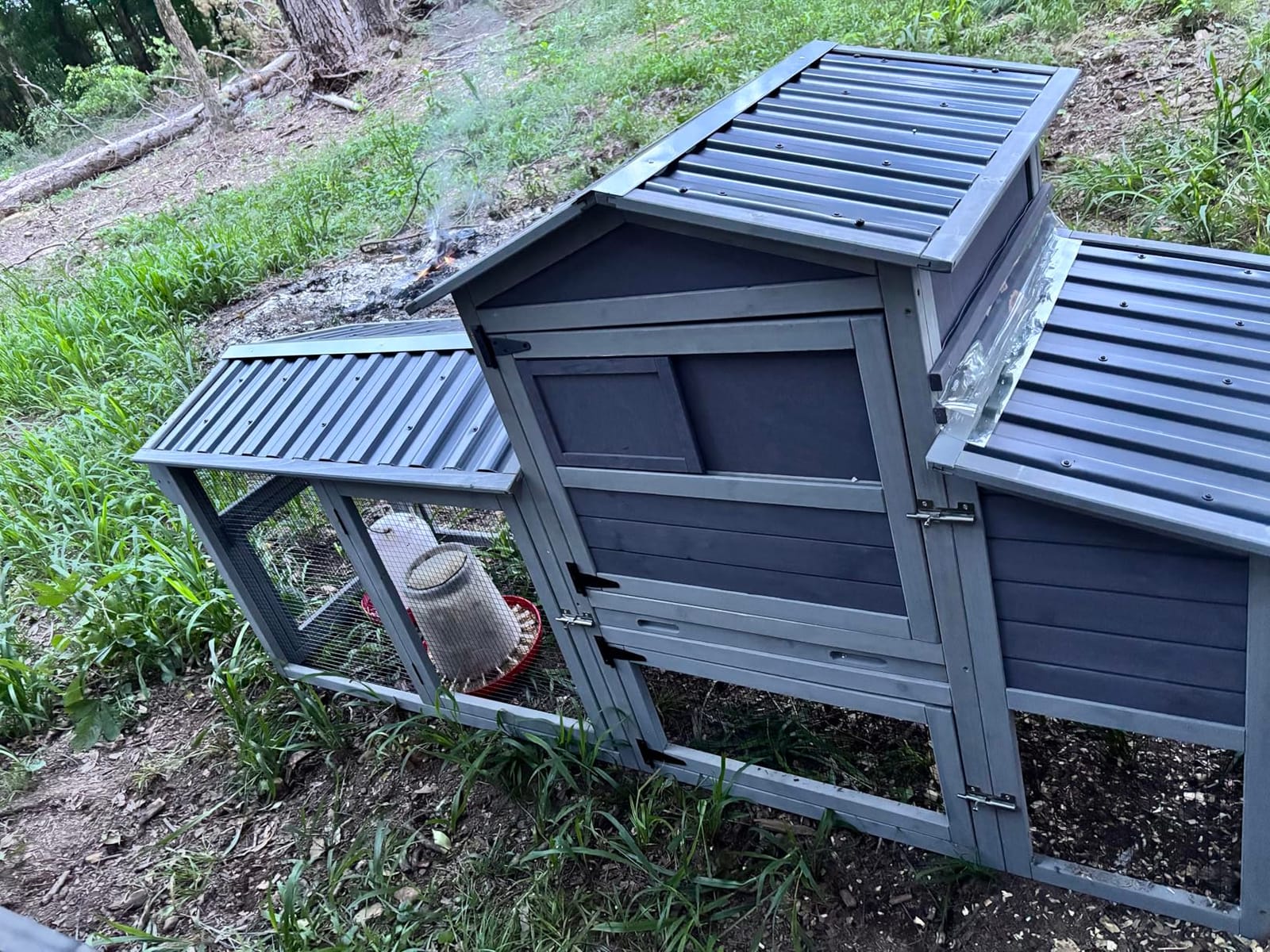
Cleaning is well served by five access doors and extra-large sliding trays, and screened windows help with airflow and odour in a confined run. Two predator-proof nesting boxes have reinforced bottoms and PVC covers over the top of them.
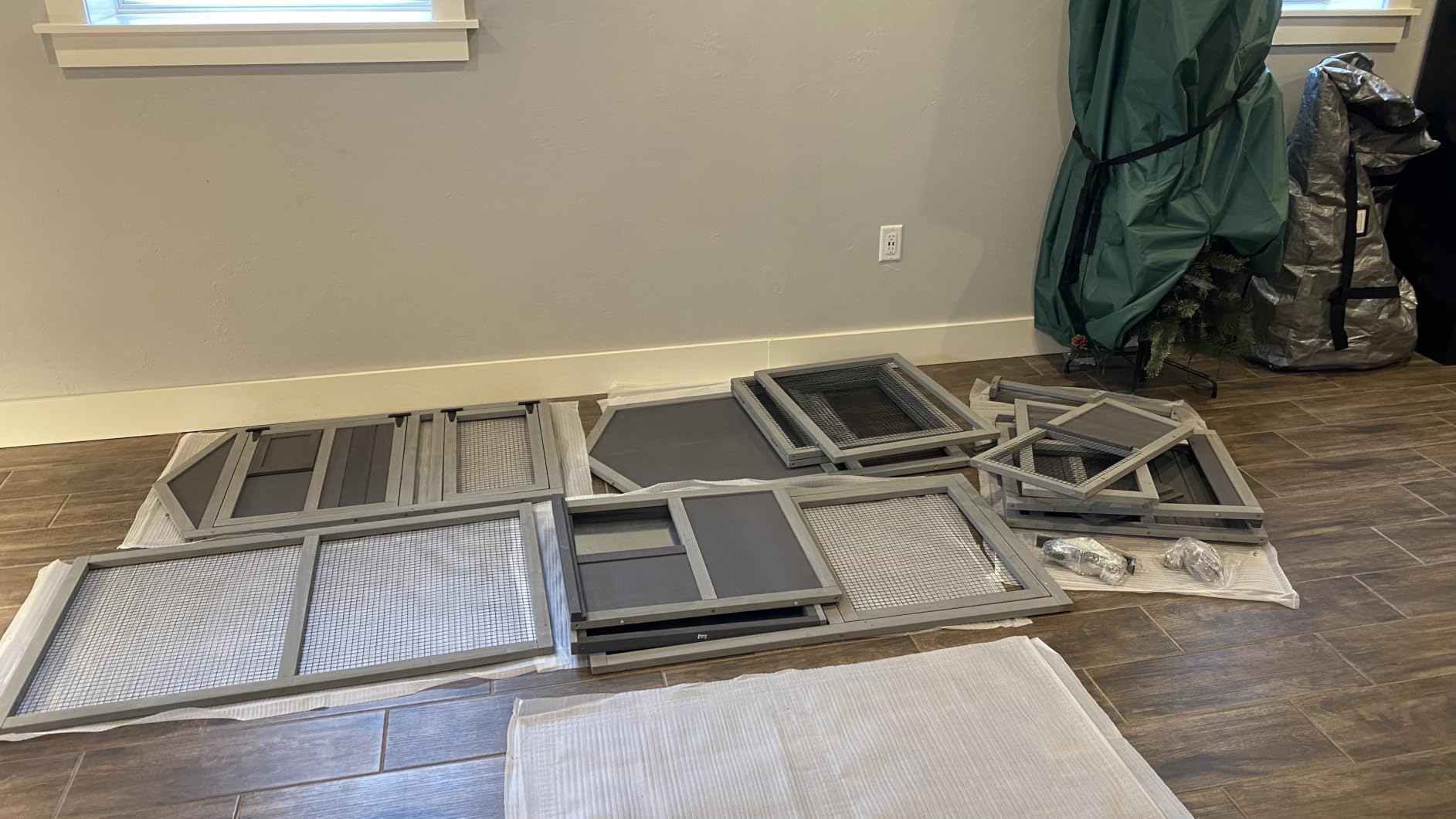
Assembly is listed at roughly 45 minutes with all parts included, on an FSC-certified wood frame. Plan for longer; manufacturers tend to estimate for a prepared workspace and an experienced pair of hands.
What to check before you buy
At 66 pounds with a narrow 25.8 inch width, this turns easily in tight corners but needs two people on slopes. Check the slope of your yard before you plan on regular rotation.
Where it falls short
This is the lowest-rated coop in the group at 3.7, with 15 percent one-star reviews. Owners report assembly hardware, hinges and latches breaking or stripping within weeks, so treat it as a starter or seasonal structure and budget for a latch upgrade.
3. Aivituvin AIR31 – Best Value for a Two to Four Hen Flock
Aivituvin Chicken Coop Hen House, Large Outdoor Wooden Poultry Cage with Ramps, Run, Nesting Box, Removable Tray, Weather-Proof Chicken Cage (Grey, AIR31)
74.9 x 26 x 39.4 in
2-4 chickens
Fir wood, steel wire
Asphalt roof panel
Pros
- Hardware cloth on ground-level panels
- precise well-labelled parts
- multiple builds join end to end
- predator-safe latches
Cons
- Round perches tip over and sit low
- nesting box latches are cheaply made
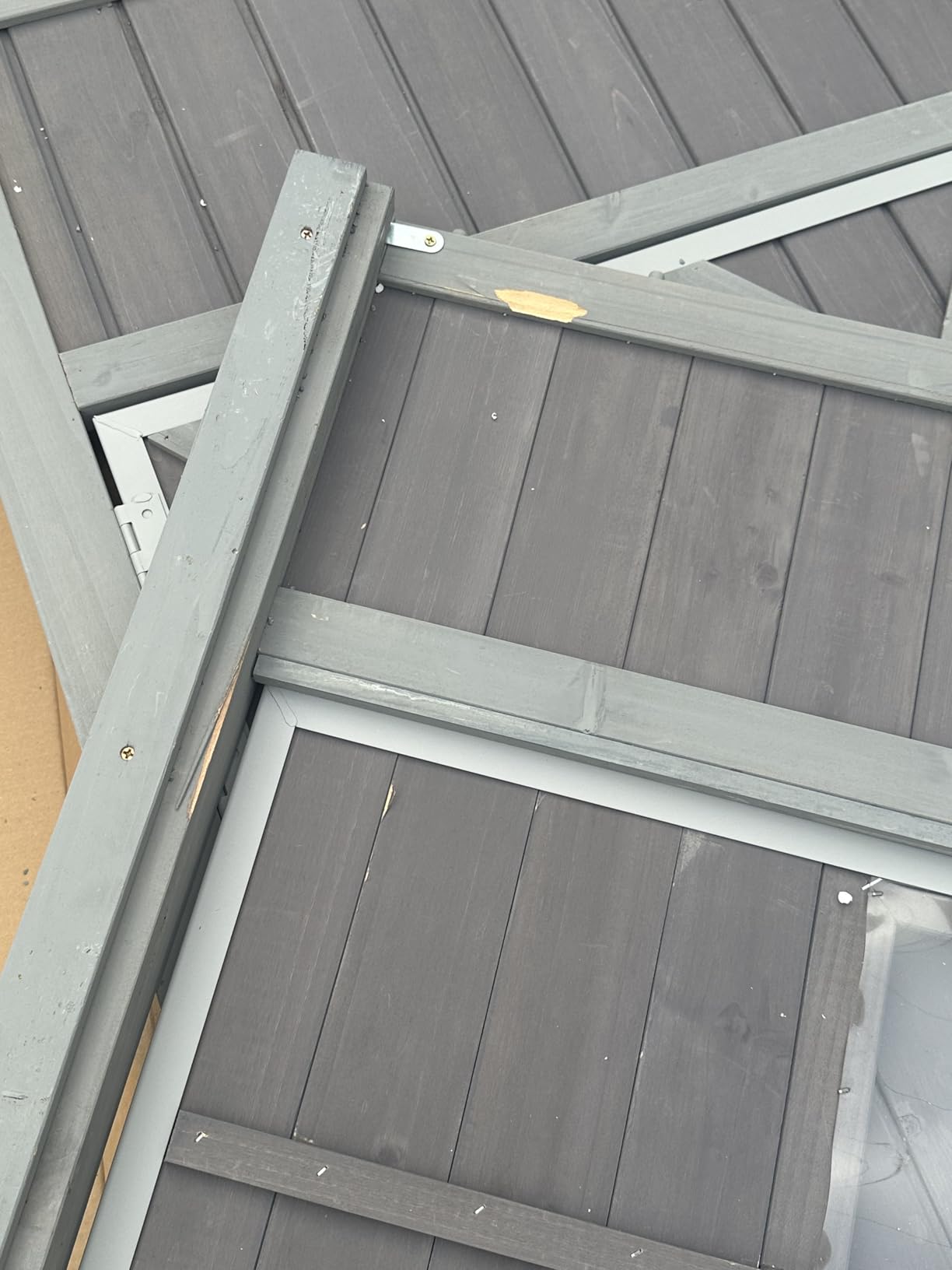
- occasional cracked boards on arrival
Two to four hens is the sweet spot for a small backyard, and this is the coop we would build that flock around. The listing is honest about its capacity, which is rarer than it should be.
The two-level design uses a ramp to reach the upper sleeping area, and hardware cloth is already fitted to the panels closest to the ground, where digging predators work. That single detail puts it ahead of most kits in this price range.
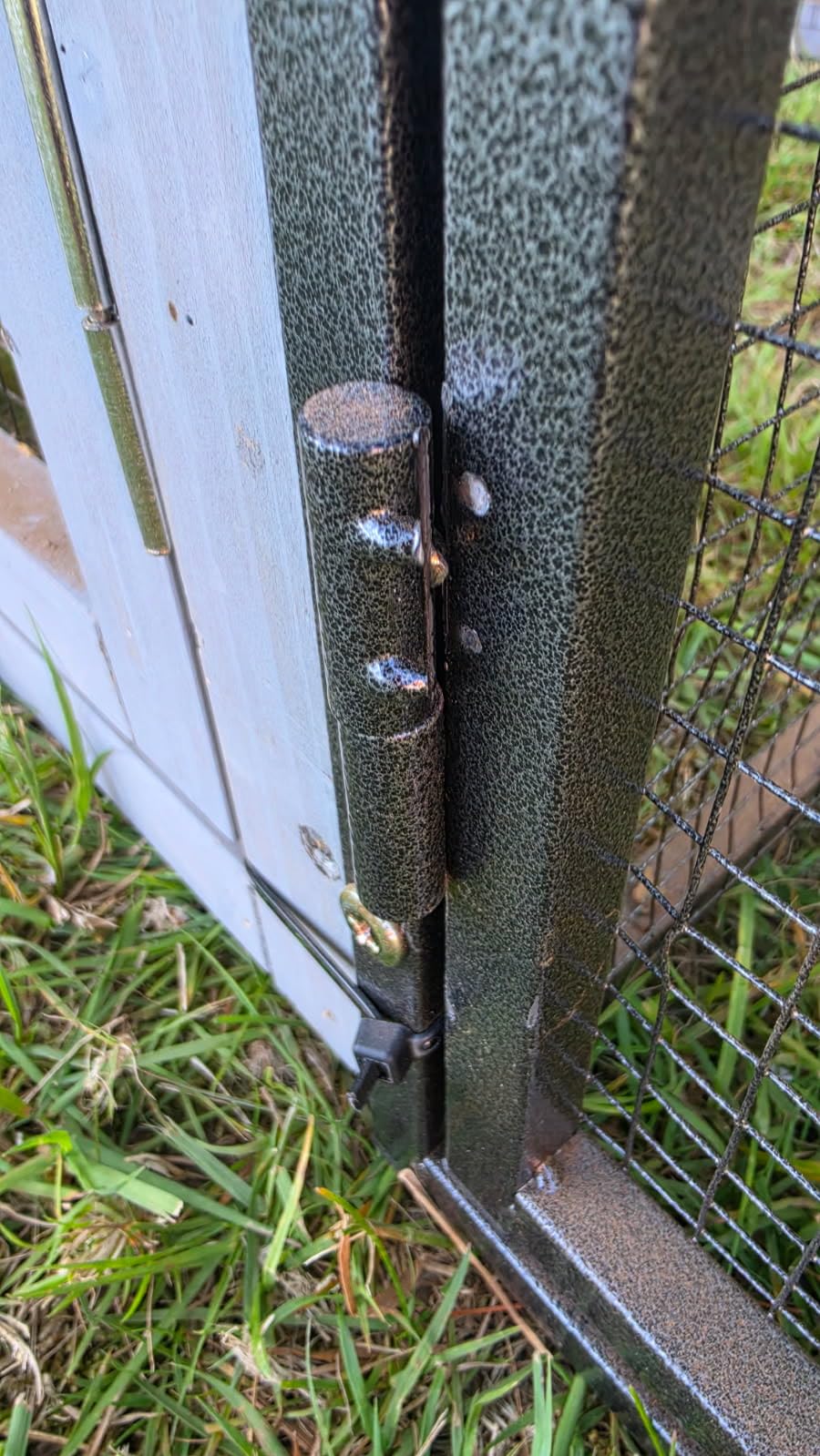
A premium asphalt roof panel limits heat absorption, and a removable bottom sliding tray handles waste without dismantling the front. Four access areas, predator-safe latches and an overhead nest hatch with a removable divider make daily checks quick.
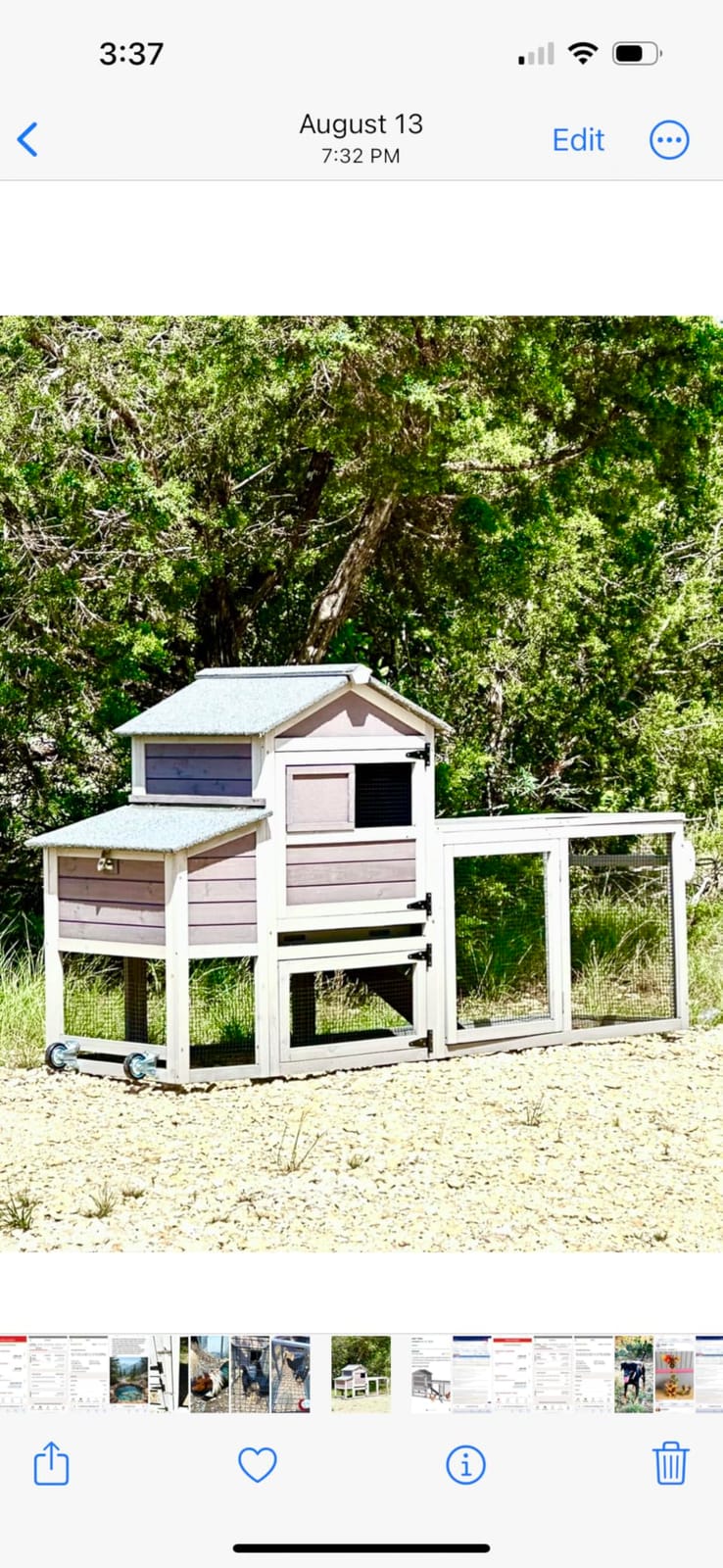
The most useful feature for tight yards is modularity. Reviewers note that several of these coops can be joined end to end to make a longer run, so you can start with four birds and extend next season rather than overbuying on day one.
What to check before you buy
Inspect the round parrot-style perches when the box arrives. They tip easily and sit close to the droppings tray, so many owners replace them with a flat 2×4 in a couple of minutes.
Where it falls short
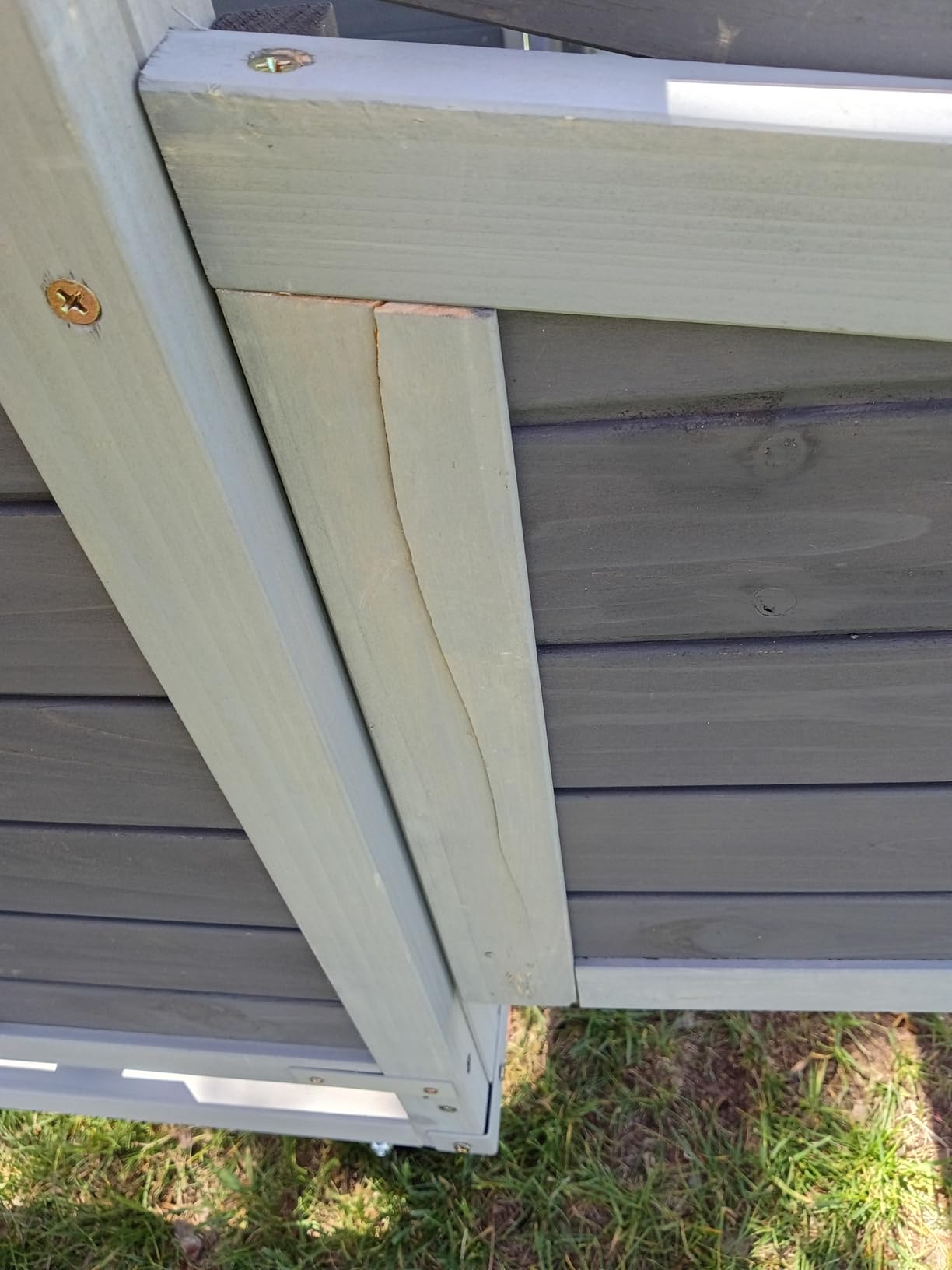
The nesting box latches are the most-cited weak point and can break quickly, and some pieces arrive cracked or scuffed. Add a simple carabiner latch on day one and it stops mattering.
4. Ketive Cedar Coop – Best Raised Cedar Build for Damp Climates
Ketive Large Wooden Chicken Coop with Run and Wheels, Grey
13.54 sq.ft usable
71.3 x 26.1 x 39.4 in
Coated cedar, wire mesh
Sloped asphalt roof
Pros
- Cedar resists weather better than softwood
- 13.54 sq.ft of usable space
- raised house improves airflow
- pre-drilled build in about 45 minutes
Cons
- Only 3.46 sq.ft of enclosed elevated area
- no floor to the base so digging predators get in
- round perches need replacing
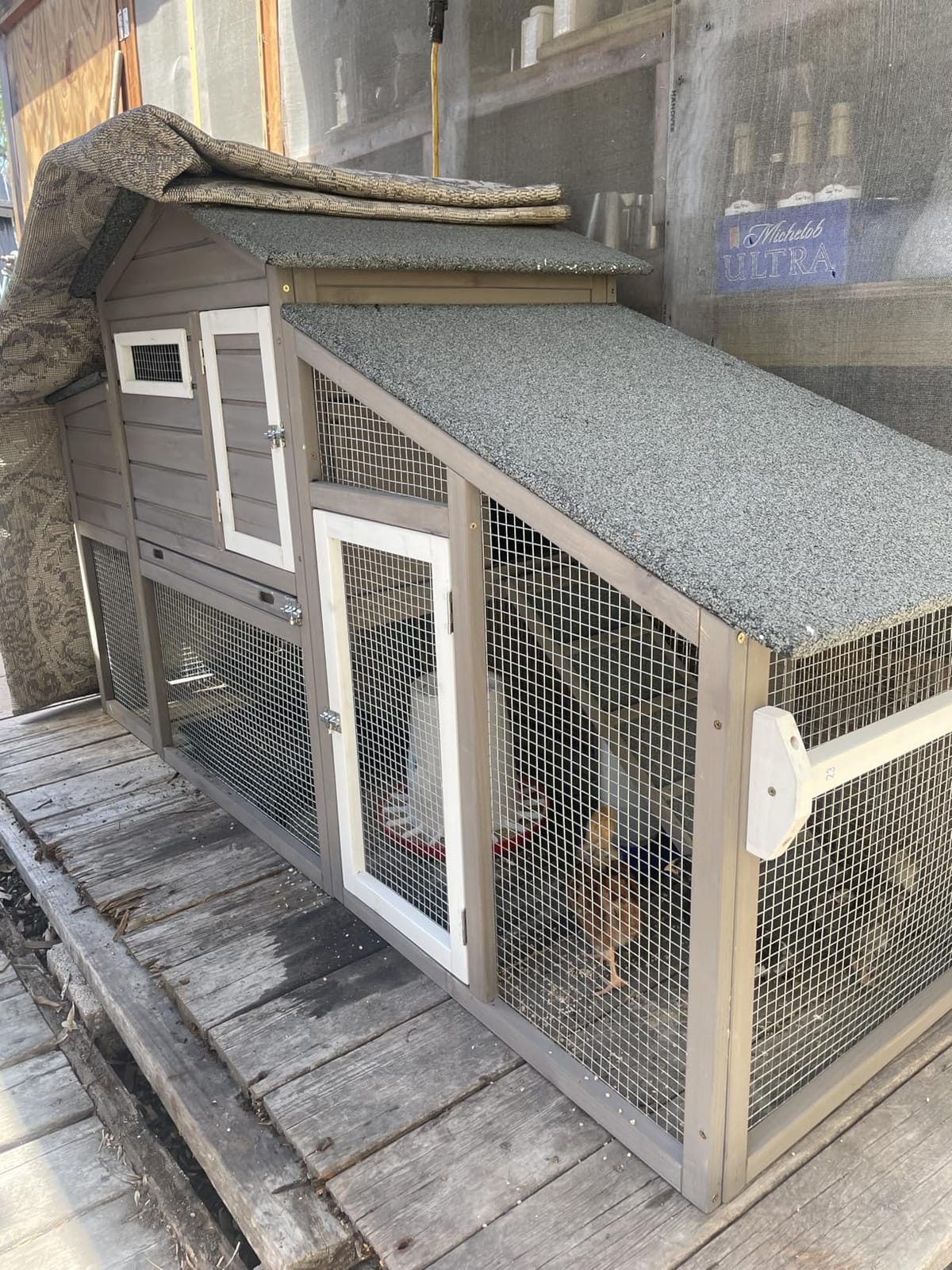
Cedar is the difference between a coop that lasts five wet winters and one that rots from the bottom up, and this is the only cedar build in our group. Coated cedar with galvanized wire mesh holds up better than the pine and softwood used elsewhere.
The usable space totals 13.54 sq.ft, split into a 10.08 sq.ft run and a 3.46 sq.ft elevated area. That means an honest one to two birds, or up to four only if they spend most of the day outside. We would size up for a bigger flock.
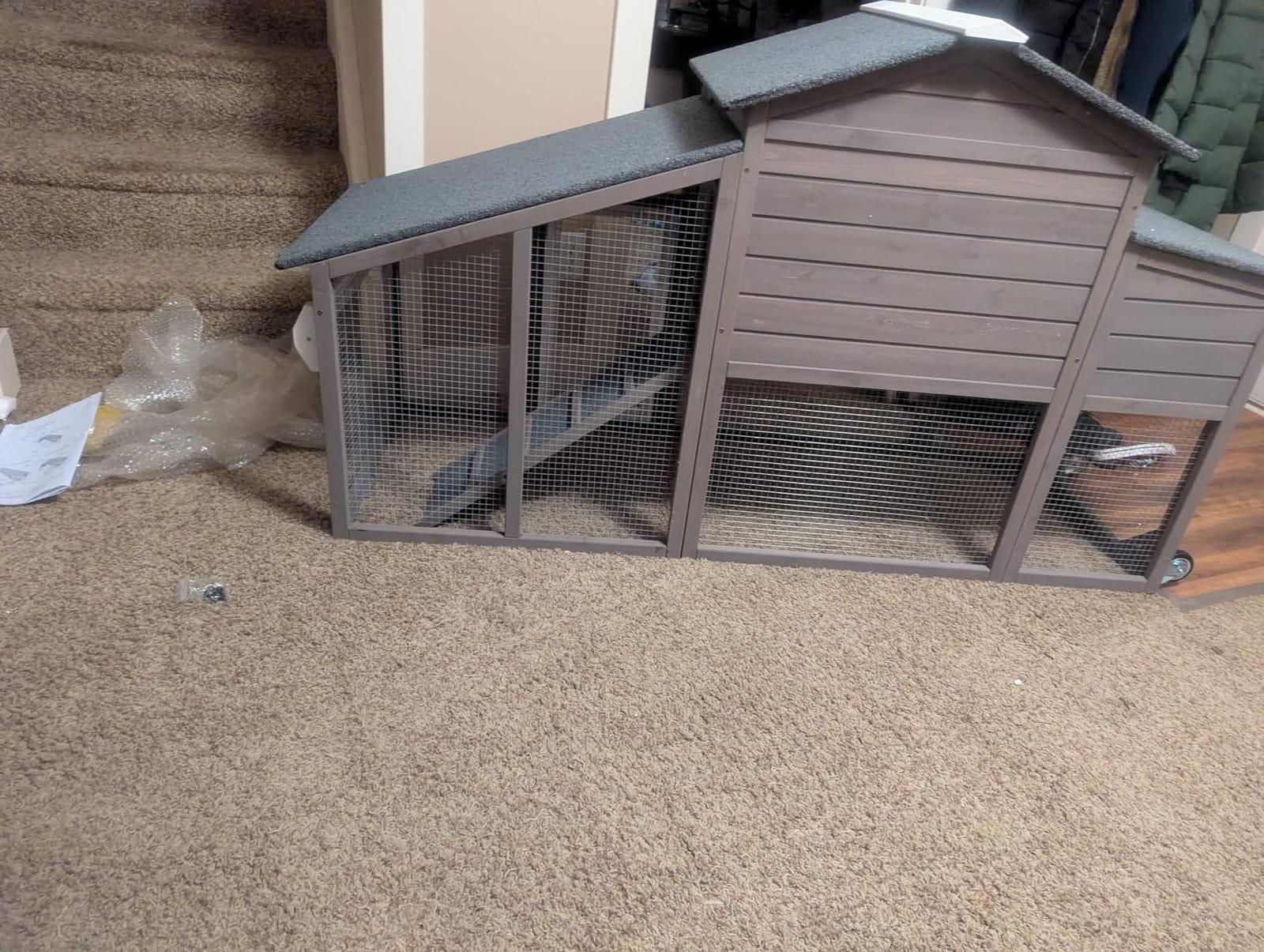
What we like is the raised housing, which lifts the resting area off the ground and lets air move underneath. A sloped asphalt roof sheds water in the direction you want, and the anti-slip ramp and sliding door feed the elevated area cleanly.
It also carries the highest five-star share of any product here with more than 200 reviews, at 67 percent. Parts arrive pre-drilled and two adults should have it together in about 45 minutes.
What to check before you buy
Plan ten minutes to fit a flat 2×4 roosting bar. Chickens perch flat rather than wrapped around a round dowel, and the supplied round perches are the most common upgrade owners make.
Where it falls short
There is no floor to the base, so you should staple hardware cloth underneath to stop digging predators. Add that cost to your first-year budget before choosing it for a predator-heavy area.
5. Aivituvin AIR23 Mobile Coop – Best Quarantine and Grow-Out Pen
Aivituvin Chicken Coop Mobile Hen Coop, Large Poultry Cage with Wheels Outdoor Backyard Chicken House
67.3 x 26 x 39.4 in
61.73 lb
Painted wood, asphalt roof
Built-in wheels and handle
Pros
- Light enough to reposition between spots
- clear instructions
- feed storage under the nest box
- removable sliding tray
Cons
- Not predator-proof without added hardware cloth
- polycarbonate roof panel is fragile
- roost bars sit very low
- small castors struggle on grass
This one earns its place for a job the bigger coops cannot do. At 61.73 pounds with built-in wheels and a side handle, it moves around a yard easily, which makes it a good quarantine pen or a grow-out space for young birds.
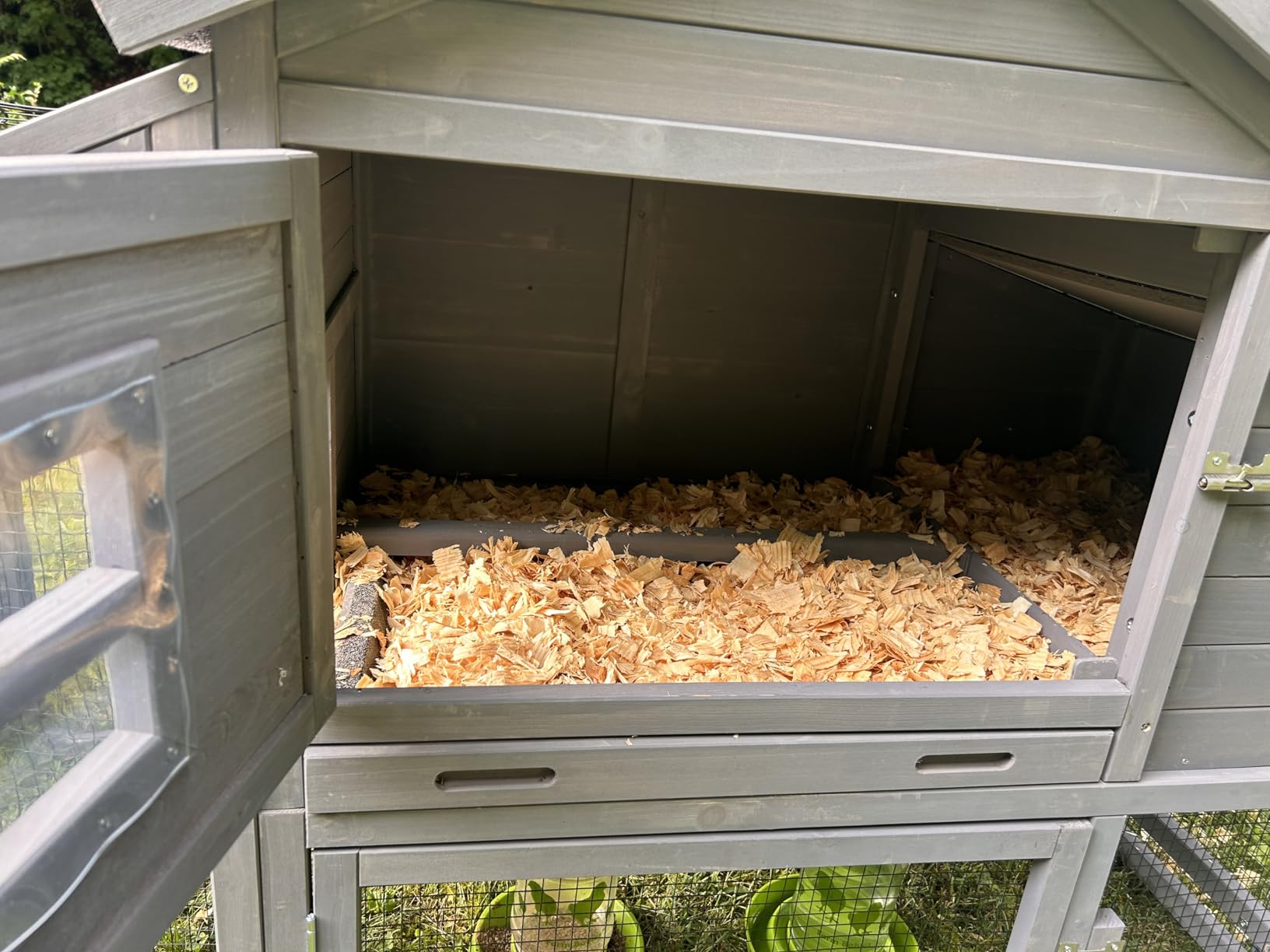
The nesting box, two roosting bars, waterproof asphalt roof and galvanized wire fencing cover the basics well. There is also a separate storage compartment beneath the nesting box that keeps feed out of the run, which is a genuinely useful small-yard feature.
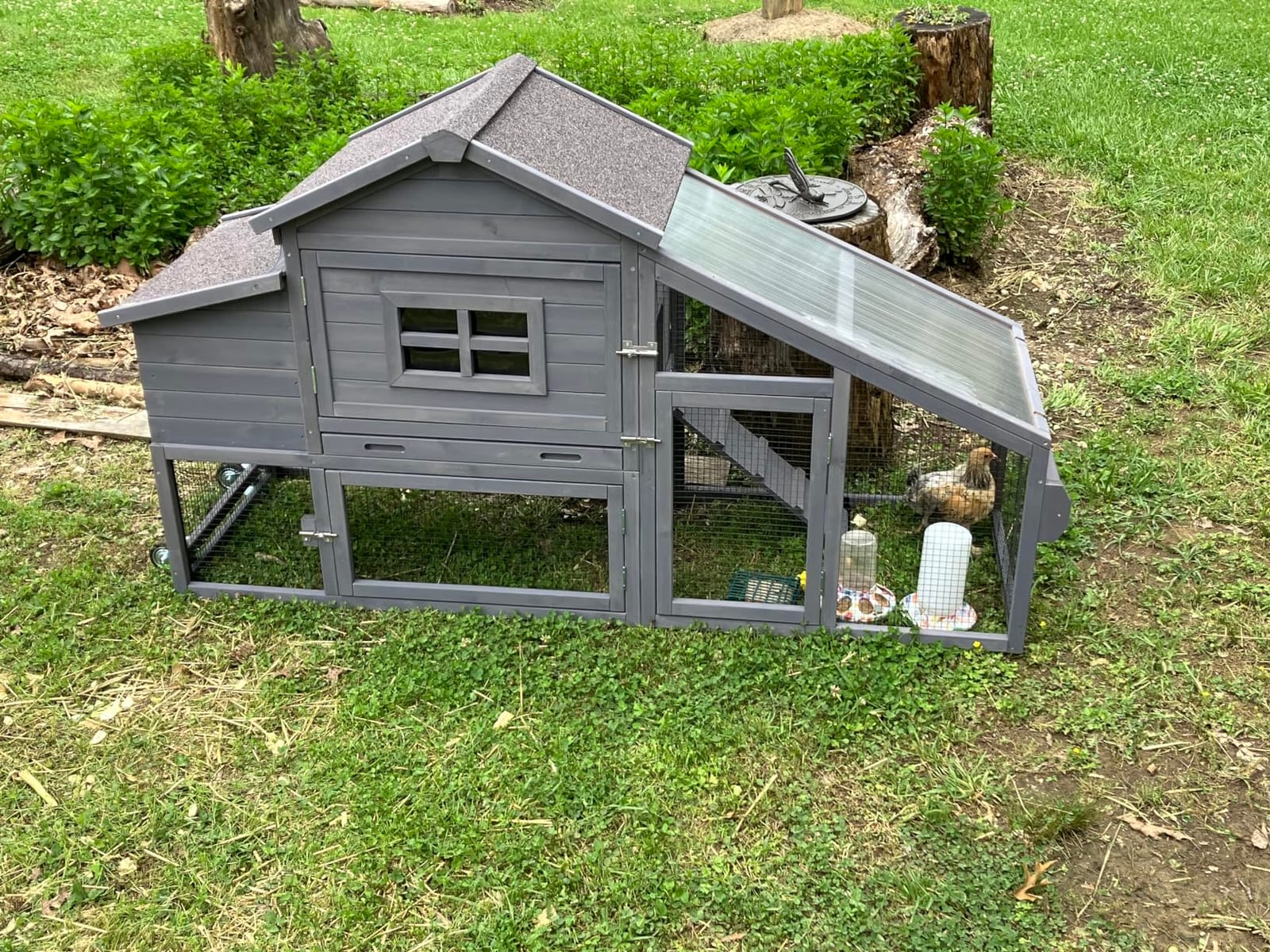
Assembly is listed at roughly 30 to 100 minutes with clear instructions, and the removable sliding tray makes cleaning straightforward. For chicks or a bird recovering from illness, this is the pick.
Just do not treat it as your permanent flock home. It is rated for adult hens only in the loosest sense, and the wire is thin by the standards of this list.
What to check before you buy
If you plan to move it across lawn regularly, test the castors first. Small castors struggle on grass and gravel, and dragging a full 61.73 pounds across a yard will eventually damage the base.
Where it falls short
It is not predator-proof as supplied, and most owners add their own hardware cloth. The polycarbonate roof panel is fragile enough to be popped out by a heavier animal, and the roost bars sit so low that bedding ends up level with them.
6. Ketive Small Backyard Coop – Best for a One or Two Hen Flock
Ketive Chicken Coop Chicken House Outdoor with Removable Trays, Wooden Rabbit Hutch Poultry Cage with Nesting Box, Indoor Hen House Chicken Cage with Ramp for Garden Backyard (36.2″L x 26″W x 38.3″H)
36.2 x 26 x 38.3 in
40.3 lb
Fir wood, rubber feet
Pull-out trays, lockable door
Pros
- Compact 36 inch footprint fits a corner
- pull-out trays and front access simplify cleaning
- raised legs keep bedding dry
- lockable door and metal nest lock
Cons
- Lightweight
- unlikely to last as a permanent all-weather coop
- roost bars sit low for large hens
- occasional glue residue on trays
Sometimes two hens is the whole plan, especially in a first season or a very tight yard. At 36.2 by 26 by 38.3 inches, this coop takes up almost no ground and does the job for one or two birds.
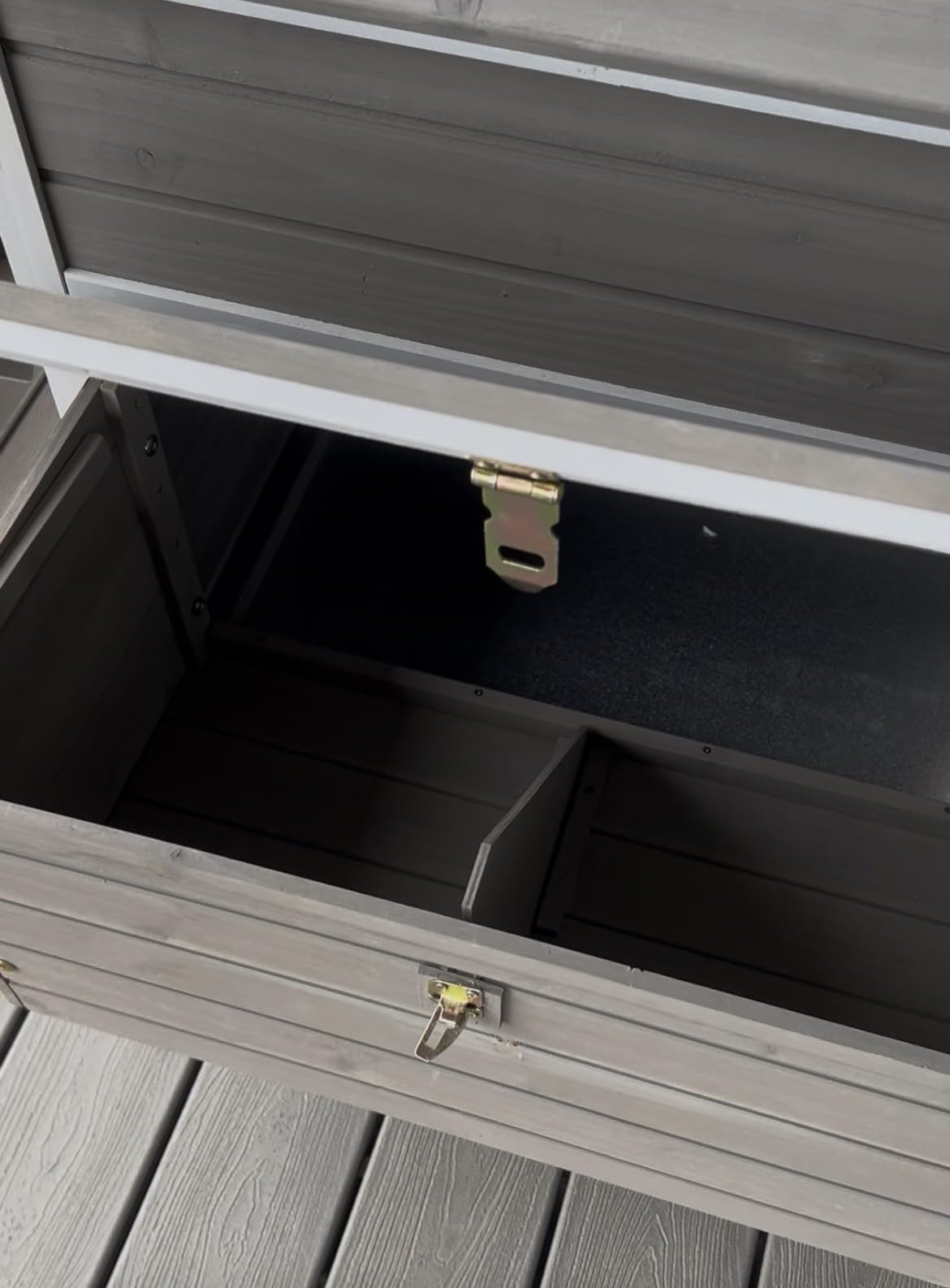
The two-part nesting box has a metal lock on the lid, pull-out trays make cleaning quick, and a ventilation window handles airflow. Legs raised 7.5 inches with waterproof rubber feet keep damp out of the sleeping area, which matters more than keepers expect.
Build time is typically about an hour, and the low roost bars suit bantams, silkies and pullets well. The ramp and lockable door finish a tidy, simple package.
A word of caution on expectations. Reviewers almost universally describe this as an excellent temporary or small-flock coop rather than a permanent one, and we agree. It is 40.3 pounds and light for its size.
What to check before you buy
Confirm your hens are small breeds. The roosting bars sit low, which is comfortable for bantams but cramped for larger hens that need clearance above the tray.
Where it falls short
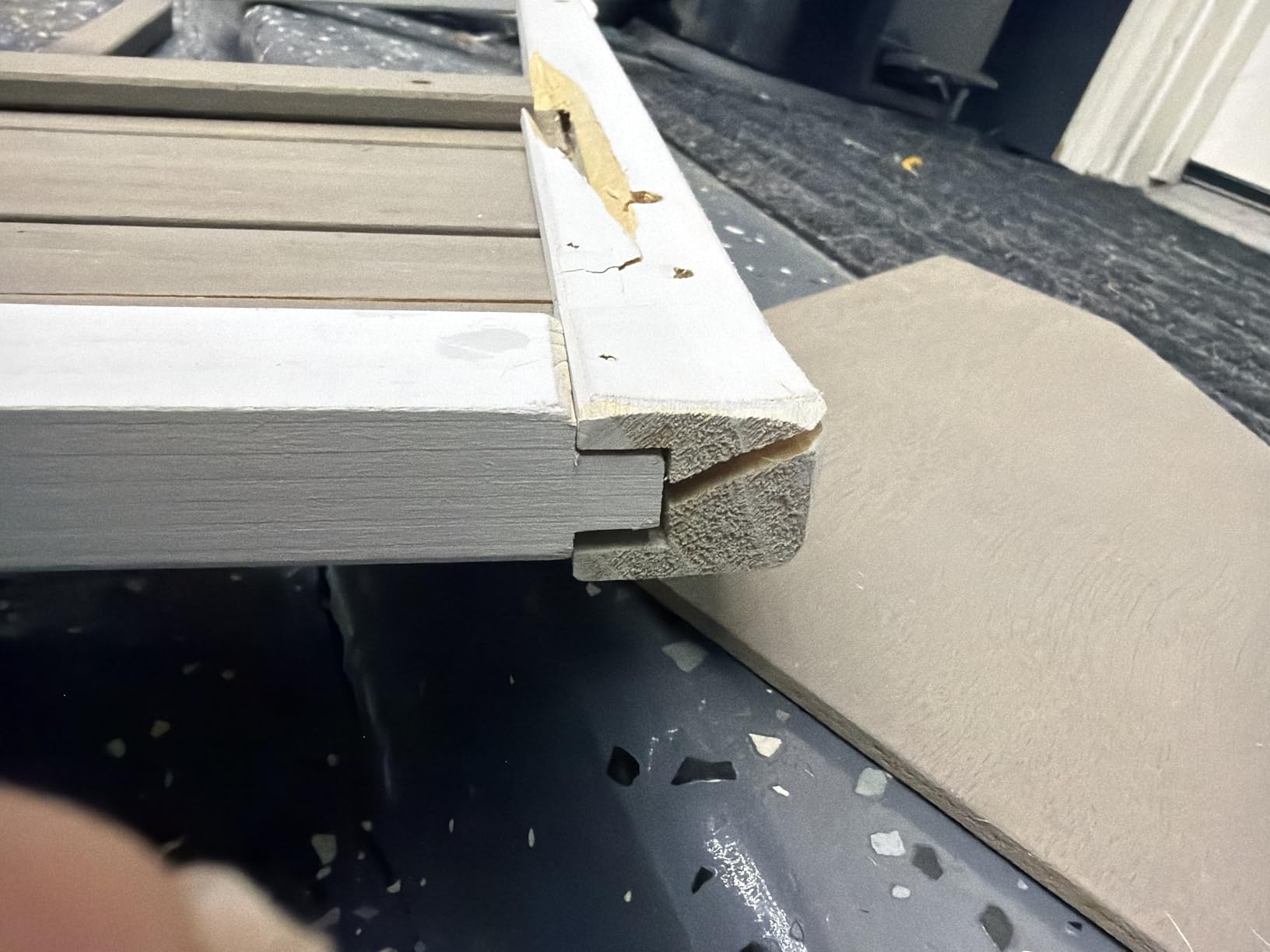
Lightweight construction means it is unlikely to last as a long-term all-weather structure. Some pieces arrive with glue residue on the tray, and the bottom door swings in a direction some owners find inconvenient.
7. GUTINNEEN Large Mobile Coop – Best for Six to Eight Birds
GUTINNEEN Large Chicken Coop on Wheels Mobile Wooden Hen House Weatherproof Duck Poultry Cage 67.3″ L for 6-8 Chickens with 6 Nesting Box
19 sq.ft floor
67.3 x 40 x 49.75 in
63.77 lb
Solid wood, four wheels
Pros
- Largest floor area in the group at 19 sq.ft
- six nesting sections under a lift-up roof
- four access points plus sliding tray
- wheels move the whole unit
Cons
- Biggest footprint in the group
- needs the optional run added separately
- heavy to reposition on uneven ground
If your flock is heading past six birds, this is the pick with the most floor area of the ten we rated. At 19 sq.ft of solid wood construction, the 4 sq.ft per hen rule gives it an honest four birds and a bit of room over that, against a listing claim of 6 to 8.
Two nesting boxes with six sections under an easy-open roof make egg collection fast in the morning. Four access points and a removable sliding tray handle the weekly cleanout, and secure locks are fitted as standard.
Four large wheels let you relocate the unit to fresh grass, which matters in a yard this size. The design also expands with an optional chicken run if your flock grows further next season.
We want to be straight about the trade here. At 67.3 by 40 by 49.75 inches, this is the largest footprint we rated and it asks more of your yard than any other pick on this page.
What to check before you buy
Walk your access route and check the 40 inch width. This is the hardest of the ten to move through a gate, and at 63.77 pounds it needs two people over uneven ground.
Where it falls short
The run is an optional add-on rather than part of the base unit, so budget for that separately. If your yard is genuinely small, a smaller mobile coop is the smarter fit.
8. GOJOOASIS A-Frame Coop – Best for Corners, Quail and Temporary Housing
GOJOOASIS Wooden Chicken Coop Rabbit Hutch for 2 Hens, Wood
47 x 18 x 19.5 in
14.85 lb
Triangular A-frame wood
Wire mesh run cage
Pros
- Under 15 pounds so one person can carry it
- accurate published measurements
- simple screwdriver build
- corner-friendly triangular shape
Cons
- Far too small for two full-grown hens
- no predator protection at all
- build quality varies
- door clasp is hard to open
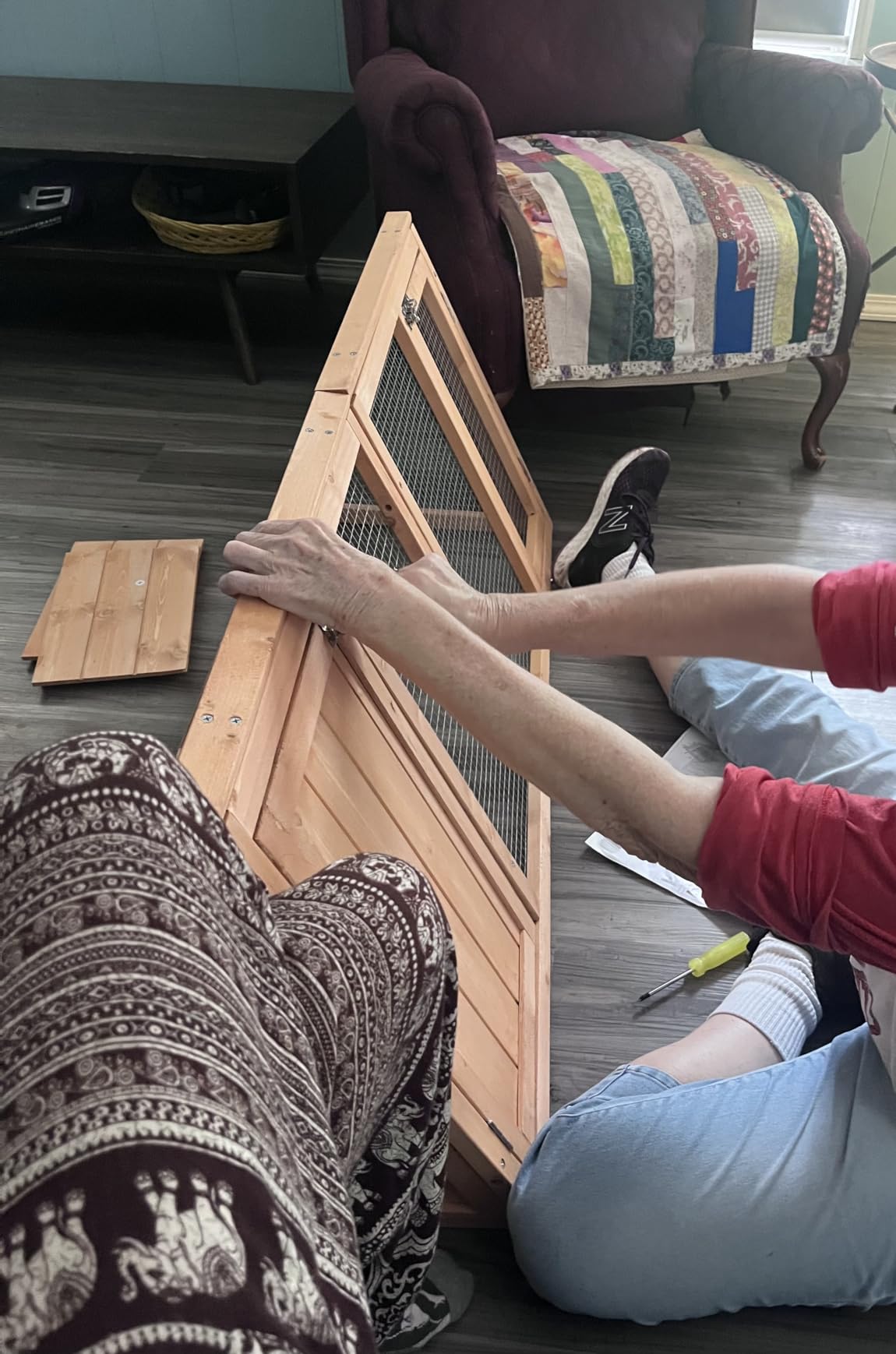
At 14.85 pounds, this is the only coop here one person can lift into a corner without help. The triangular A-frame profile uses floor space efficiently, which is exactly the problem a small backyard presents.
Buyers like that the published measurements are accurate, so you can size it before ordering, and the build is a simple screwdriver job. It also works for rabbits, guinea pigs, quails and hamsters.

For quail, chicks or a short quarantine period, it does its job well. Two entrances and wire doors give airflow and access, and the sleeping area sits inside a small outdoor run cage.
The gap between the listing and the real interior size is the single biggest theme across its reviews. Buyers who wanted a broody hatcher or a quail pen love it.
What to check before you buy
Measure the interior yourself against your birds. Buyers who ordered it for two full-grown hens were disappointed, while buyers who wanted quail were delighted with the same unit.
Where it falls short
There is no predator protection: no wire floor underneath, no internal door between coop and run, and it can be tipped over. Some pieces arrive with loose wire or splitting wood, and the door clasp is difficult to open.
9. Gowoodhut Small Hen House – Best for Indoor Brooding and Isolation
Gowoodhut Chicken Coop Rabbit Hutch with Removable Trays,Raised Floor Hen House with Nesting Box,Wooden Outdoor Poultry Cage Pet House with Ramp Run Hen Cage for Garden Backyard(Grey)
36.2 x 26 x 38.3 in
40.3 lb
Natural fir, slanted roof
Pull-out tray, ramp door
Pros
- Assembles in under 45 minutes
- light enough to move between runs for isolation
- raised floor improves airflow
- pull-out tray cleans fast
Cons
- Roosting perches are thin and narrow
- interior runs smaller than the 1-3 chicken claim
- sturdy but not predator-proof
- occasional glue residue
This is the one we would use inside a shed or a spare room during brooding and chick stages. Portability is the whole point: at 40.3 pounds you can move it to isolate a bird or bring chicks in out of the weather.
Natural fir with a waterproof full-coverage slanted roof keeps rain out, and the 7.5-inch legs give airflow under the floor. The door doubles as an anti-slip ramp, which is a clever use of space on a unit this small.
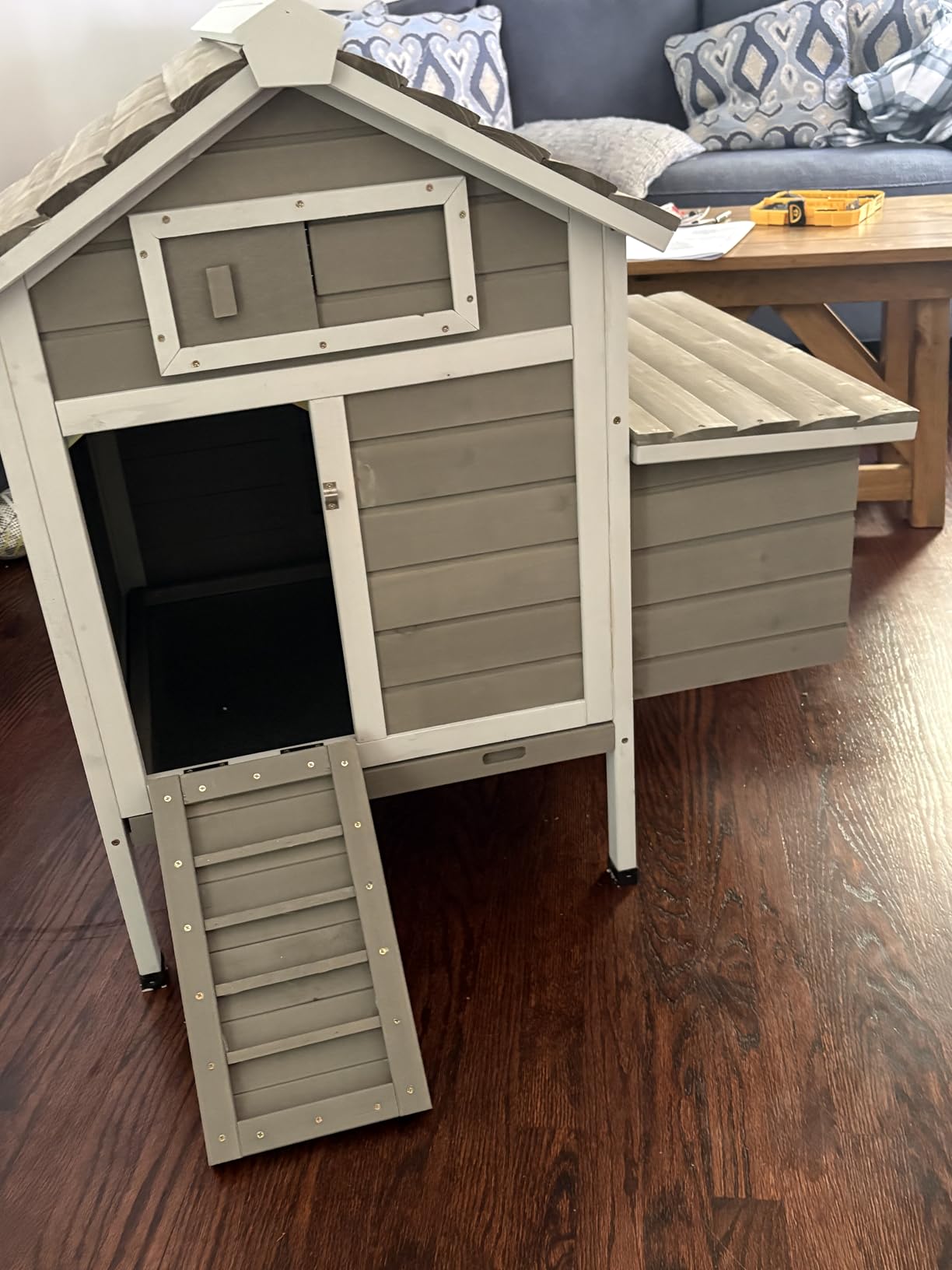
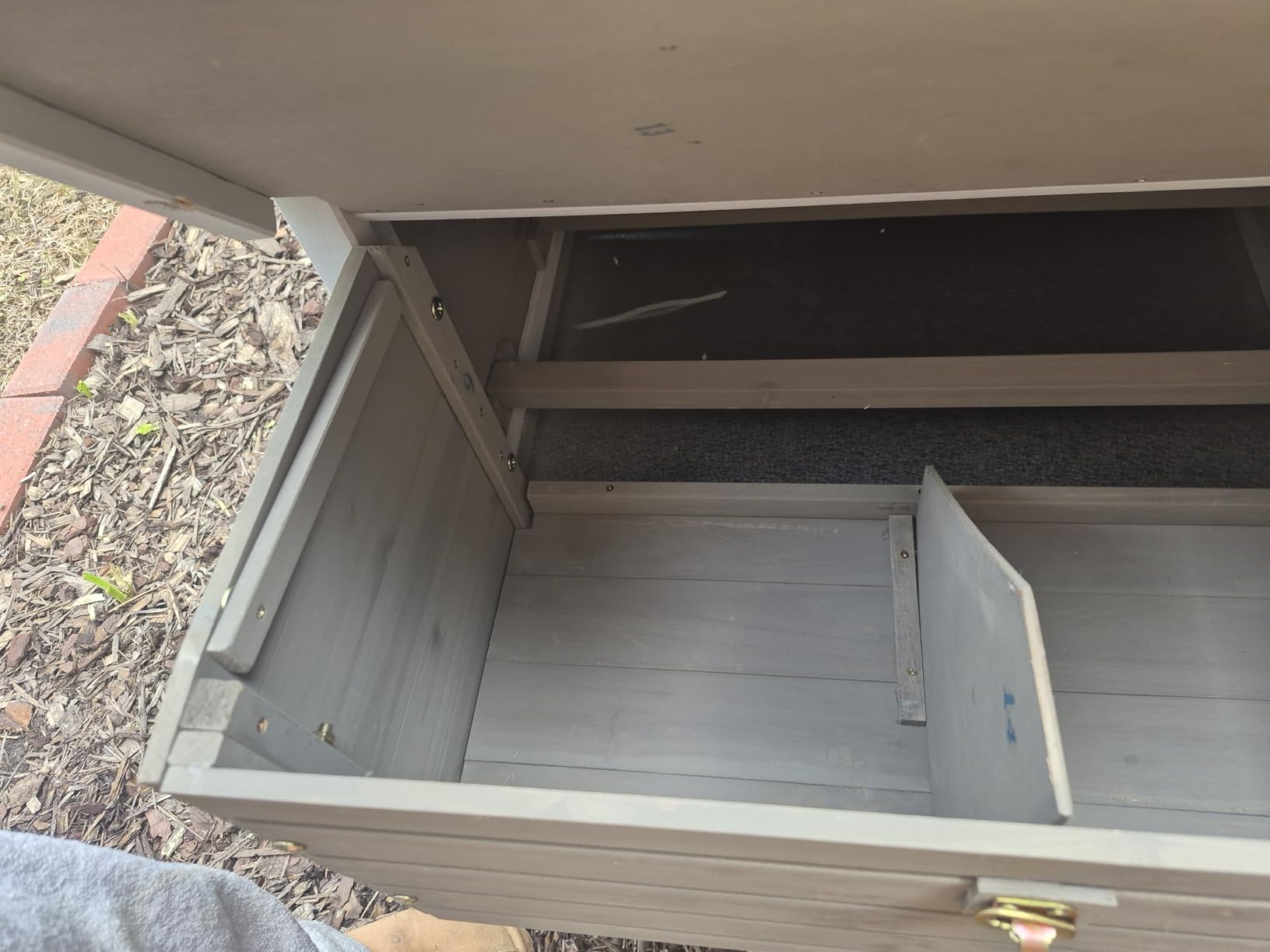
The nesting box has a switchable roof supported by a wooden rod and secured with a metal lock, plus a two-part divider so you can split the space. A sliding wood window with wire mesh handles ventilation and viewing.
Assembly is generally under 45 minutes with pre-cut pieces that fit together cleanly, and the pull-out tray keeps the daily job fast.
What to check before you buy
Look at the roosting perches first. They are thin and narrow, sized closer to chicks than adult hens, and wider flat perches are a five-minute improvement.
Where it falls short
The interior runs smaller than the stated 1 to 3 chicken capacity suggests, and the build is sturdy but not predator-proof. Treat it as an indoor or supervised piece rather than a permanent outdoor home.
10. CSQOO Plastic Coop with Run – Best Wipe-Clean Plastic Build
CSQOO Chicken Coop with Run, Plastic Chicken Coops with Extension, Large
60.6 x 41 x 20.3 in
33.2 lb
HDPE shell, nylon mesh run
Two lockable doors
Pros
- Only plastic coop here
- will not rot or crack like wood
- removable roof lets you hose it out
- two lockable doors and tight mesh
- single-person build
Cons
- Low 20.3 inch overall height means limited headroom inside
- plastic holds less warmth than timber in cold weather
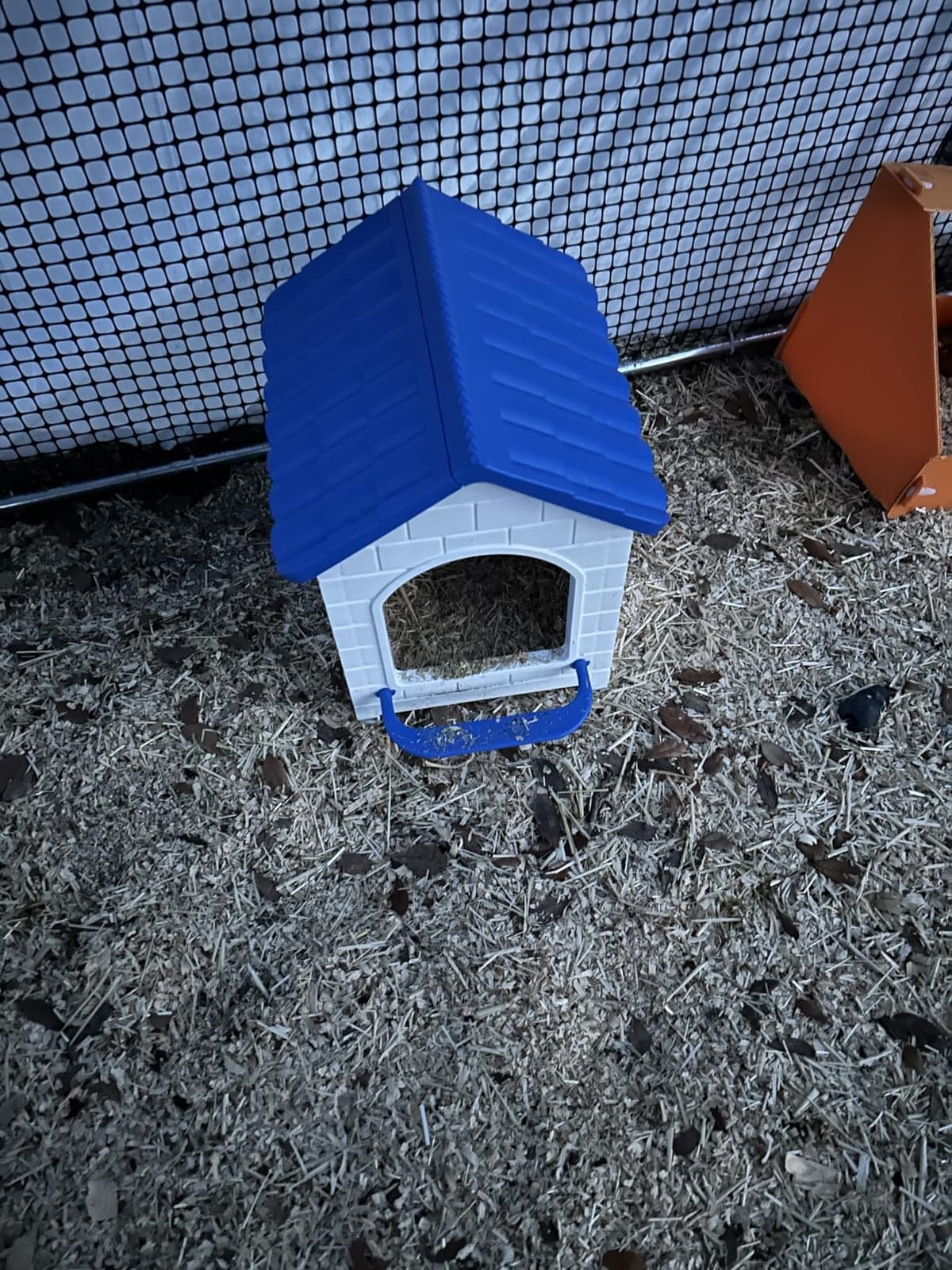
This is the only molded plastic coop in the group, and that single fact changes the maintenance story. High-density polyethylene will not rot, will not swell in damp weather, and does not need sealing every year.
It carries the highest average rating of the ten at 4.3 with 65 percent five-star, though on a smaller base of 83 reviews. We would treat that rating as encouraging rather than settled.
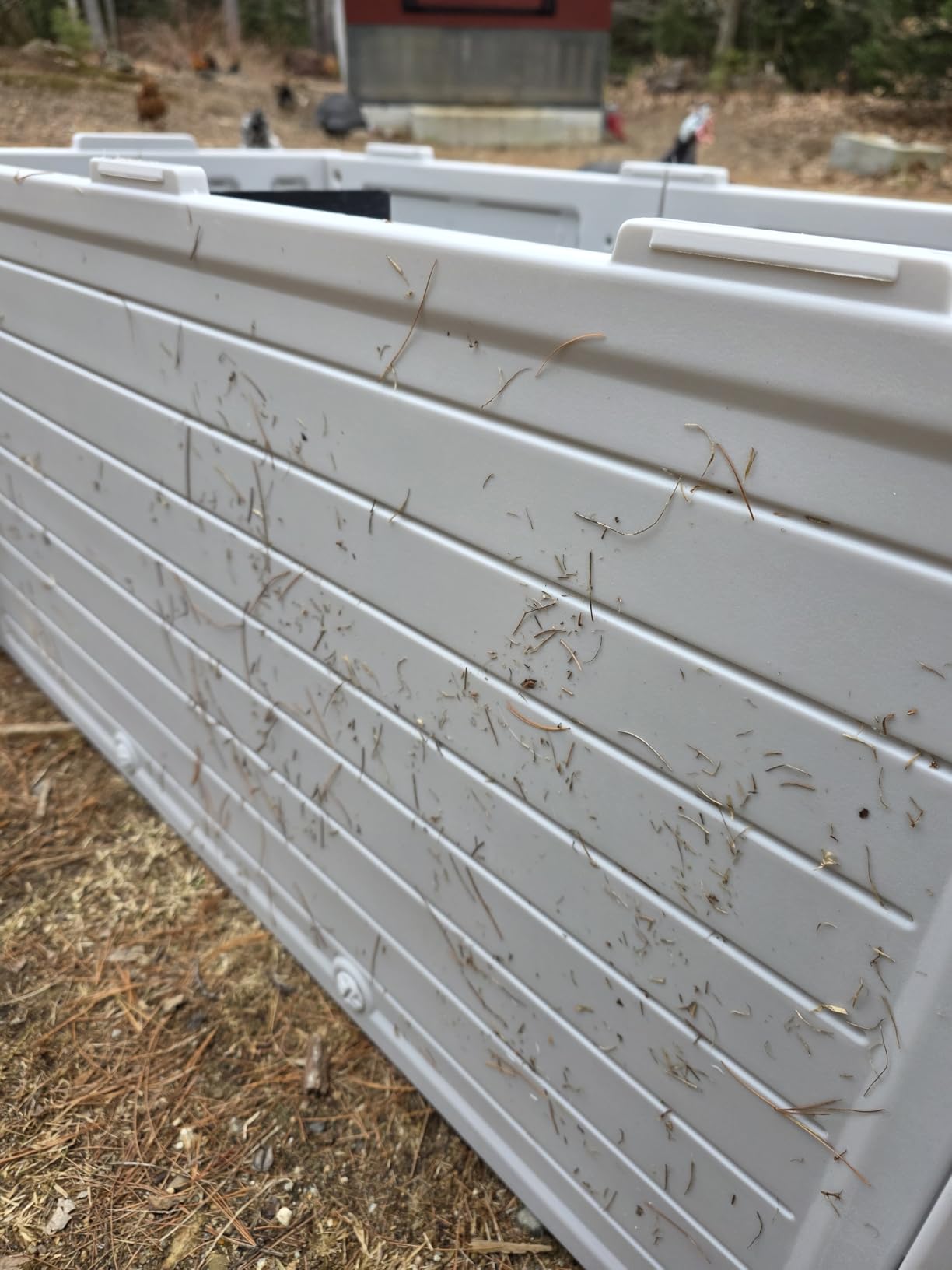
The removable flat roof is the feature owners mention most. Lift it off and hose the whole interior out, and the openable top and side doors in the run make it reachable end to end. For a small yard where you cannot walk around a large structure, that counts.
Two lockable doors and tight mesh keep predators out, and ground L-nails hold the nylon mesh run in place. The plastic nesting box has two holes and its own ventilation for egg collection.
What to check before you buy
Check the height against your hens. At 20.3 inches overall there is limited headroom inside, which is fine for bantams and pullets and tight for large hens on a perch.
Where it falls short
Plastic does not hold warmth the way timber does in cold weather, so add bedding and a sheltered position if you are in a cold climate. At 33.2 pounds it is also the one structure here you can genuinely build and move by yourself.
7 Checks Before You Buy Any Small Backyard Chicken Coop
1. Real enclosed floor space. Find the square footage of the enclosed sleeping area, not the run, and divide by four. If the listing only gives overall dimensions, multiply the house footprint and subtract a third for the nesting box and internal fittings.
2. Half-inch hardware cloth, not chicken wire. Hexagonal chicken wire has a mouth a weasel or a raccoon can work through. Every opening below roost height, including the floor and the base of the run, should be half-inch hardware cloth stapled over the wire rather than replacing it.
3. An apron around the run base. Twelve inches of hardware cloth laid flat on the ground and staked down stops the digging that defeats most coops. Raccoons and foxes are the number one predator problem for backyard flocks.
4. Latches a raccoon cannot open. A spring clip or carabiner on every door and on the nesting box lid costs almost nothing and closes the most common break-in route.
5. Ventilation above roost height. Damp causes more winter trouble than cold. Vents placed high, at or above roost level, let moisture escape without creating a cold draft on roosting birds.
6. Cleaning access from outside. A removable droppings tray, a rear egg door and a low cleanout door save you from crawling in with a scraper. Ask whether you will still enjoy this in year three.
7. A run sized for your hens. Eight to ten square feet per hen, covered if possible. If the run is the weakest part of the package, plan on extending it rather than replacing the coop.
Keepers on r/BackYardChickens and r/poultry repeat two things constantly: that advertised capacity runs roughly double reality, and that a coop without its own run forces a second large purchase anyway. Both show up in our picks through the capacity arithmetic and the hardware cloth notes.
Wood, Plastic or Metal: Which Material Fits Your Yard
Wood dominates this list because it insulates better, takes a paint or sealer, and repairs easily. Cedar and fir, as used in the Ketive and Aivituvin builds, hold up best. Pine is fine if it is sealed and the coop stays dry.
Plastic, as on the CSQOO, wins on lifespan in wet ground and on cleaning speed. The roof lifts off and you hose it out. It loses on warmth in cold climates and on repairability, because a cracked panel is a replacement rather than a patch.
Metal is the third option and none of our picks use it. It is light and indestructible but conducts heat and cold straight through, so it suits hot climates with shaded runs rather than snowy ones.
For an urban or suburban backyard with wet winters, wood with a raised floor is the balance most keepers settle on. For a coastal or very damp yard, plastic earns its place.
Predator-Proofing a Small Coop and Run
The coop is shelter. The run is the defense, and that is where a small-yard setup is most often compromised. Six steps cover most break-ins.
Replace every low opening with half-inch hardware cloth. Do not remove the original wire, staple the cloth over it so both layers fail together rather than separately.
Lay a 12 inch apron of hardware cloth flat around the base of the run and stake it every 12 inches. Digging under the wire defeats nearly every coop sold.
Replace gravity latches with carabiner or spring-clip latches on the pop door, the nest lid and the run access door. Bears and raccoons are the ones to plan for.
Add an internal door from the sleeping area to the run, so your birds are shut in at night rather than spending darkness inside the enclosure. This also lets you leave the birds inside while you work on the run.
Anchor the whole structure with the supplied ground stakes or L-nails. A light coop tips easily, and tipping defeats a sound latch.
If you already own a run, our guide to walk-in coops covers the larger side of the market. For automating the nightly lock-up, an automatic chicken coop door is the single upgrade most small-yard keepers add next.
Zoning, HOA Rules and Keeping Chickens as a Renter
Check your local rules before anything else. Many municipalities set a setback from property lines, cap flock size, and require coop registration, and HOA rules are usually stricter than city rules.
Renters have the shortest path here. The wheeled coops on this list, the MEDEHOO, the Aivituvin AIR23 and the GUTINNEEN, are the practical choice because leaving nothing behind satisfies most lease terms and needs no foundation.
Two more quiet factors in a small yard: rooster restrictions, since crowing is what neighbors actually complain about, and odour, which a removable tray and screened windows largely solve. Our feeder and waterer picks keep spillage down in a tight run.
If your yard is small enough that even a 36 inch footprint feels tight, note that people keep chickens on small yards successfully. The constraint is run space, and a mobile coop solves it.
Frequently Asked Questions
What size coop do I need for 5 chickens?
For 5 hens, plan 20 sq.ft of enclosed sleeping floor and 40 to 50 sq.ft of run, so about 60 to 70 sq.ft of yard in total. Add a two-foot access path along the run. Most prefabs advertised for 5 birds sit closer to 8 sq.ft enclosed, which honestly holds two.
Is a 4×8 coop big enough for 12 chickens?
No. A 4 by 8 ft coop is 32 sq.ft of floor, and at the 4 sq.ft per hen standard that is an honest 8 birds. For 12 chickens you would want about 48 sq.ft enclosed, which means a walk-in style coop rather than anything in this roundup.
How many chickens can go in a 10×10 run?
A 10 by 10 ft run is 100 sq.ft, which at the 8 to 10 sq.ft per hen standard supports 10 chickens comfortably and 12 at the tighter end. The run should be covered where possible, since a covered run counts for more usable space than an open one.
What is the best chicken coop for a beginner?
The Aivituvin AIR31 suits most beginners: two to four hens, clearly labelled parts, hardware cloth already fitted at ground level, and an honest capacity claim. Pair it with half-inch hardware cloth on the run and a carabiner latch, and you have a setup that works on a first season.
What are common chicken coop mistakes?
The five recurring mistakes are buying on advertised capacity instead of real floor area, using hexagonal chicken wire instead of half-inch hardware cloth, sealing a coop so tightly that damp builds up, skipping the buried or staked apron at the base of the run, and having no way to reach the eggs or the trays from outside.
The Small Backyard Chicken Coop Verdict
The Petsfit Outdoor Coop with Run takes our Editor’s Choice for 2026 because it pairs the largest body of owner feedback in the group with the most useful small-yard features: six ground anchors, three cleaning doors, a washable floor panel and a roof that shrugs off heat.
For two to four hens, pick the Aivituvin AIR31. For a wet climate and real durability, the Ketive cedar build is the one that will outlast the others. Match the coop to the space math above rather than to the number on the box, and the best chicken coops for small backyards stop being a compromise.
Our broader small-backyard roundups cover the other half of the problem: fitting the yard you actually have.