
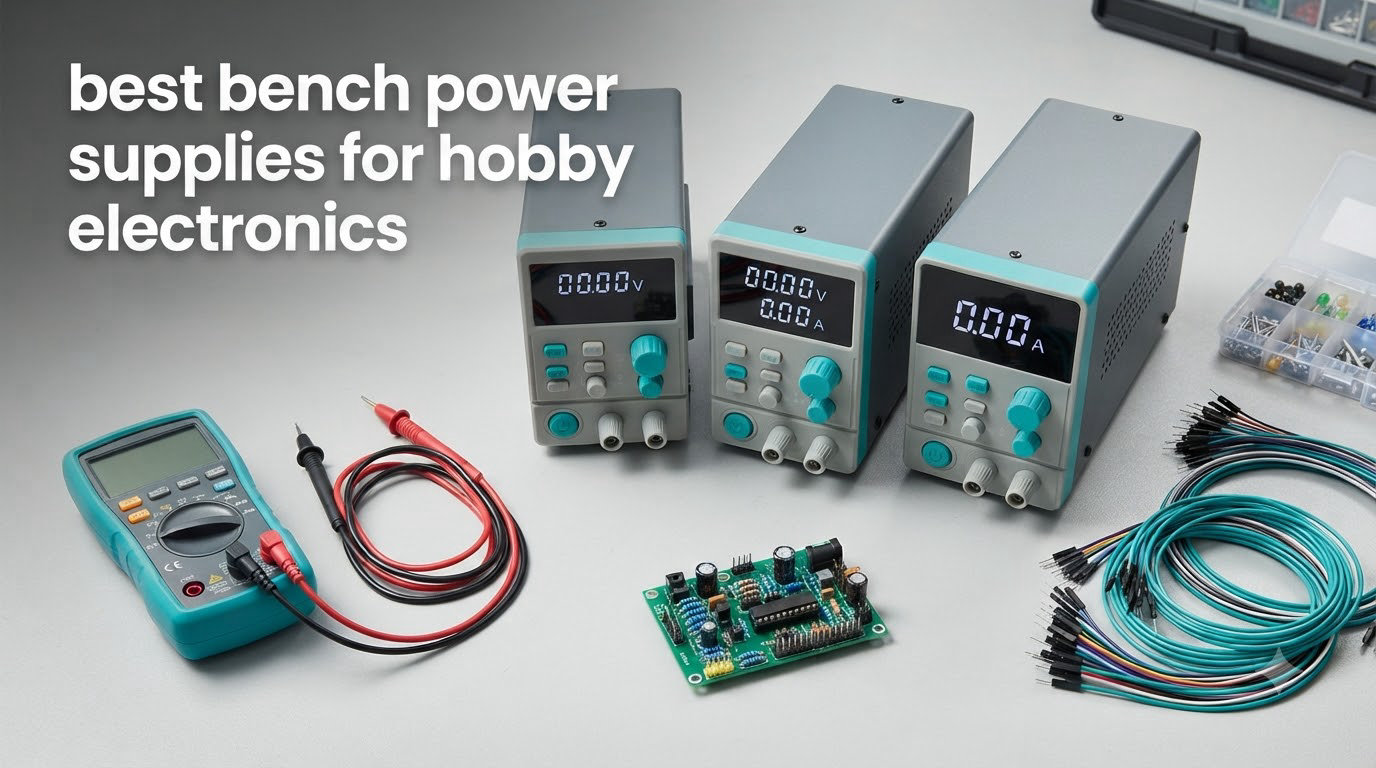
A bench power supply is a mains-powered instrument that turns wall AC into a continuously adjustable, regulated DC output, so you can power a circuit at a voltage you choose while capping the current. It replaces improvised batteries and wall adapters with a source you can dial, watch and trust. For most hobbyists, a 0-30V / 5A or 0-30V / 10A unit covers everything from an Arduino breadboard to a motor or an LED strip, and the picks below cover that range from a compact switching box to a lab-grade linear supply with three isolated rails.
I compared ten of these supplies side by side, and the differences that matter on a real bench are not the ones on the spec sticker. They are how the encoder behaves when you turn it slowly, whether there is a physical output switch, whether the protection circuits are actually implemented, and how much bench space the thing eats. Every pick below covers the same three questions: what it is, who it suits, and who should walk away.
One note before we start. I am not going to quote prices, because they move daily. The buttons in each review take you to the current listing, and the ratings and review counts I quote are the ones shown on the product page at the time of writing. If you want a shortcut to a fixed supply, a USB power supply covers it; for everything else, the mains-powered bench supply below is the right tool.
Table of Contents
Top 3 Bench Power Supplies in 2026
The three below are the picks I would put on my own bench first. The Kungber leads the group on the strength of its review volume and feature balance, the Jesverty SPS-3010V is the best-rated of the lot, and the original Jesverty SPS-3010 remains the easiest first bench supply to live with.

Kungber SPS3010B 30V 10A
- 0-30V 0-10A 300W
- Real-time Ah charging display
- Overcurrent alarm with cutoff
- 18W USB port

Jesverty SPS-3010V 32V 10A
- Coarse and fine encoder knobs
- USB-A and USB-C 20W ports
- Output ON/OFF switch

Jesverty SPS-3010 30V 10A
- 4-digit V/A/W display
- Automatic CV/CC crossover
- Coarse and fine adjustment
- 5V/2A USB port
Best Bench Power Supplies at a Glance in 2026
All ten supplies below output adjustable DC from a single mains-fed box, and all of them support both constant voltage and constant current behaviour. The differences that separate them are topology, current ceiling, channel count, noise and how precisely you can set a value.
| Product | Specifications | Action |
|---|---|---|
| Kungber SPS3010B 30V 10A Switching |
|
Check Latest Price |
| Jesverty SPS-3010 30V 10A Switching |
|
Check Latest Price |
 NANKADF 30V 10A Encoder Supply NANKADF 30V 10A Encoder Supply |
|
Check Latest Price |
 Kiprim DC310S Programmable Supply Kiprim DC310S Programmable Supply |
|
Check Latest Price |
| Jesverty SPS-3010V 32V 10A Switching |
|
Check Latest Price |
 Tekpower TP3005T 30V 5A Linear Tekpower TP3005T 30V 5A Linear |
|
Check Latest Price |
 Hanmatek HM310T Programmable Supply Hanmatek HM310T Programmable Supply |
|
Check Latest Price |
 Siglent SPD3303X-E Triple Output Siglent SPD3303X-E Triple Output |
|
Check Latest Price |
 Korad KD3005D 30V 5A Linear Korad KD3005D 30V 5A Linear |
|
Check Latest Price |
 Wanptek TPS-C3010H 30V 10A Wanptek TPS-C3010H 30V 10A |
|
Check Latest Price |
1. Kungber SPS3010B 30V 10A – Best Overall for Hobby Electronics
DC Power Supply Variable, 30V 10A Adjustable Switching Regulated DC Bench Power Supply with Intelligent Charging Mode, 18W USB Interface, Precision Encoder Knob (Black)
0-30V / 0-10A, 300W
Encoder knob, 4-digit display
18W USB port
Real-time Ah charging meter
Pros
- Compact 2.3 lb body for a 30V 10A supply
- Real-time Ah display with automatic cutoff when a battery is full
- Overcurrent detection alarm that halts output on a short
- Seven safety protections including thermal and grounding
- 18W USB port for quick device charging
Cons
- Entry-level feature set with no programmability or waveform output
- Cooling fan starts above 50 degrees and adds noise under sustained heavy load
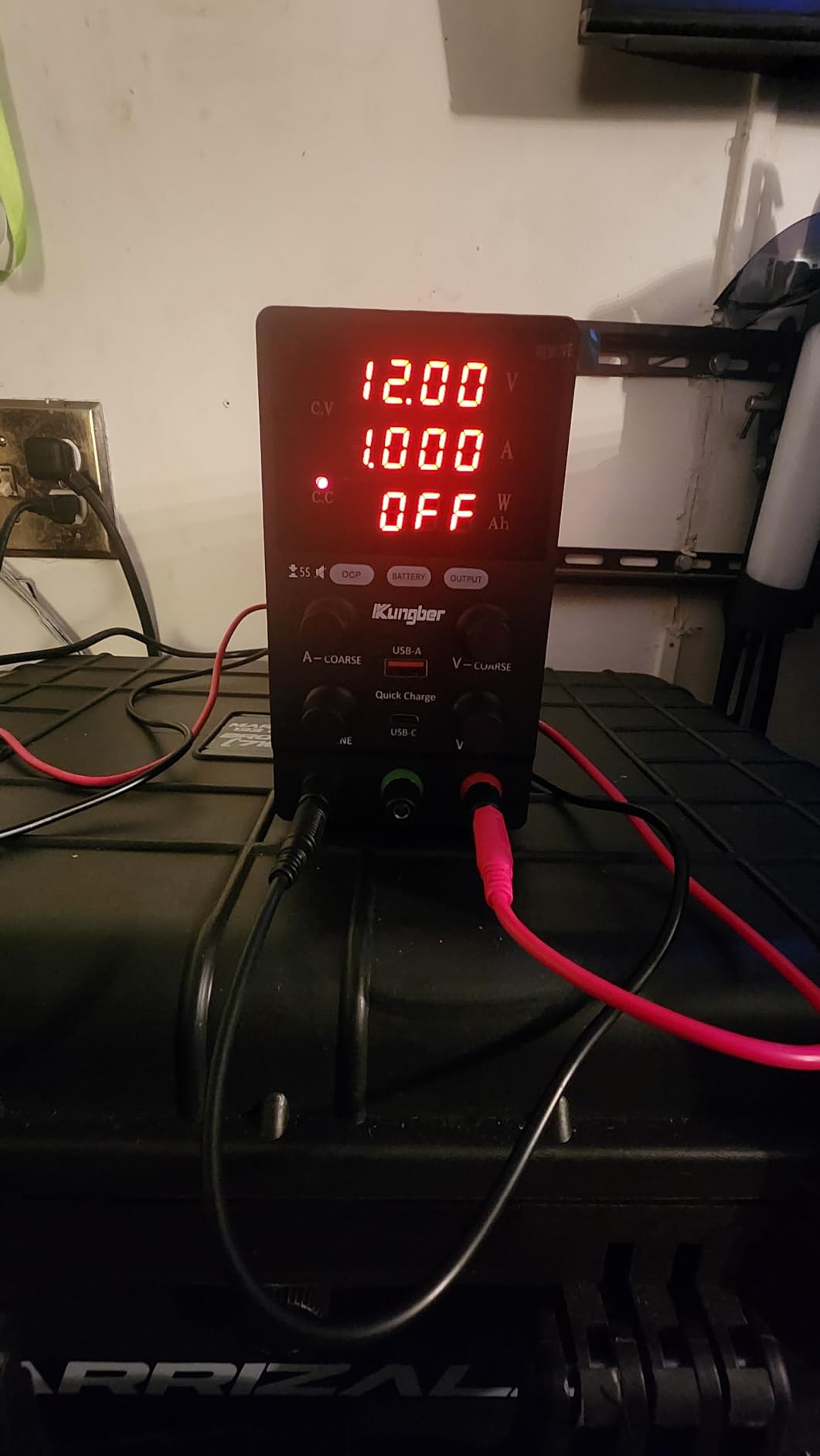
This is the one I keep coming back to. It is a 30V 10A switching supply in a plastic case that weighs under 2.3 pounds, which sounds unremarkable until you compare it with the 12-pound linear units further down this list. On my bench it lives behind the breadboard and does almost everything: 5V for a microcontroller, 12V for a motor, 9V for a relay board, 3.3V logic rails straight off the terminals.
The part that surprised me most is the charging mode. The display tracks accumulated amp-hours while you charge a pack, and it cuts out when the battery reaches full, so you are not babysitting a lead-acid pack with a timer. Owners consistently point to the same three things: the compact size, how precisely the encoder knob sets a value, and the protection set doing its job.

Measured against a good multimeter, the output sits where the display says it should, and the overcurrent alarm fires fast enough to save a board when you clip the wrong pair of leads together. I have watched it trip on a deliberate short and then recover without a power cycle, which is exactly what you want when the mistake was yours.
The compromises are honest ones. There is no preset memory, no PC control and no waveform function, so if your test needs a repeatable power-up ramp this supply will not do it. The fan is the other thing you notice: it comes in above 50 degrees, so under sustained heavy load you will hear it. It is a modest noise floor, not a nuisance, but it is not silent.
Who this supply suits
It suits anyone who needs real current headroom without dedicating a shelf to the supply. A 10A ceiling means you can run a strip of LEDs, a small motor, or a 3D printer bed controller off the same box you use for a 3.3V microcontroller rail, and the 300W power budget covers the lot.
For Arduino and ESP32 work it is more than you need on paper, and that is the point. The Wi-Fi burst current on an ESP32 catches out plenty of weak adapters, and a supply with 10 amps available and a real current limit never leaves you guessing.
Who should skip it
Skip it if your work is noise-sensitive. A switching topology puts ripple on the output, and for preamp and audio-analogue circuits a linear supply such as the Tekpower TP3005T or the Korad KD3005D is the quieter choice.
Skip it too if you need scripted power sequences. There is no PC interface and no memory presets, so repeated tests mean turning the knob and pressing buttons every single time. If that is your workflow, look at the Kiprim DC310S instead.
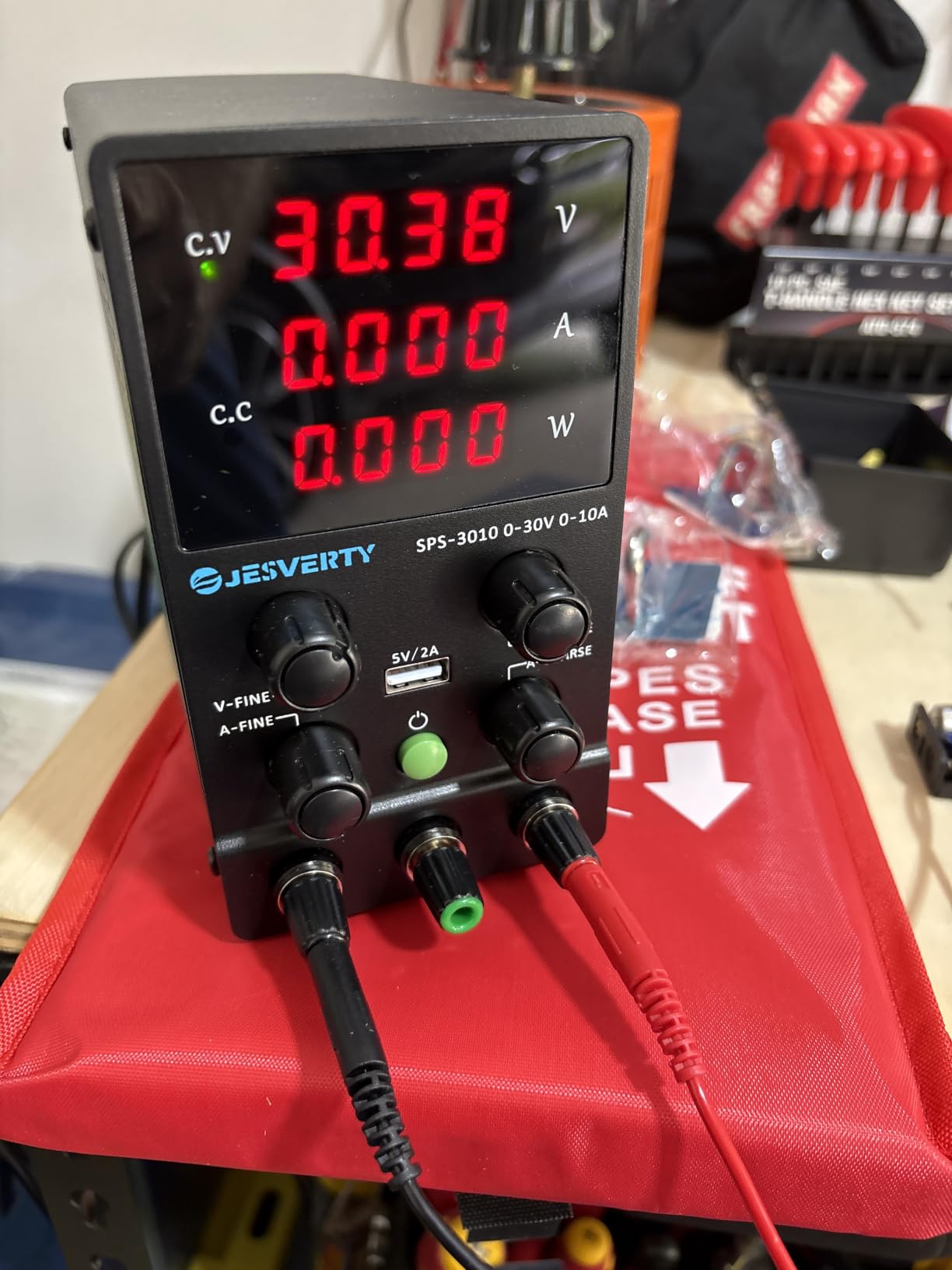
2. Jesverty SPS-3010 30V 10A – Best First Bench Supply
Jesverty DC Power Supply Variable, 0-30V 0-10A Adjustable Switching DC Regulated Bench Power Supply with High Precision 4-Digit LED Display, 5V/2A USB Port, Coarse and Fine Adjustment SPS-3010
0-30V / 0-10A, 300W
4-digit V/A/W display at 0.01V / 0.001A
Coarse and fine adjustment
5V/2A USB port
Pros
- Bright 4-digit display shows V
- A and W at the same time
- Automatic constant-voltage and constant-current crossover
- Compact 7.1 x 3.35 x 6.1 inch body at about 2.5 lb
- 5V/2A USB port for device charging
- Short-circuit
- overload and thermal protection
Cons
- Supplied leads are described by the manufacturer as a give-away and not rated for sustained high current
- AC input voltage is fixed at the factory on this variant and cannot be switched between 115V and 230V
This is the supply I recommend to anyone who tells me they are just starting out. It does the two things a beginner actually needs and nothing more: a bright readout that shows voltage, current and power simultaneously, and an automatic handover between constant voltage and constant current so that a short does not turn into a smoking MOSFET.
Setting values is quick because there are separate coarse and fine controls rather than a single encoder. You set the whole number with one and the decimal places with the other, which is far less fiddly than pressing a digit-select button repeatedly on a smaller display.
Buyers rate it as accurate, compact and reliable, and the temperature-regulated fan stays quiet until the supply is genuinely working hard. At about 2.4 pounds and roughly 7 inches tall it is small enough to sit at the back of a small desk without dominating it.
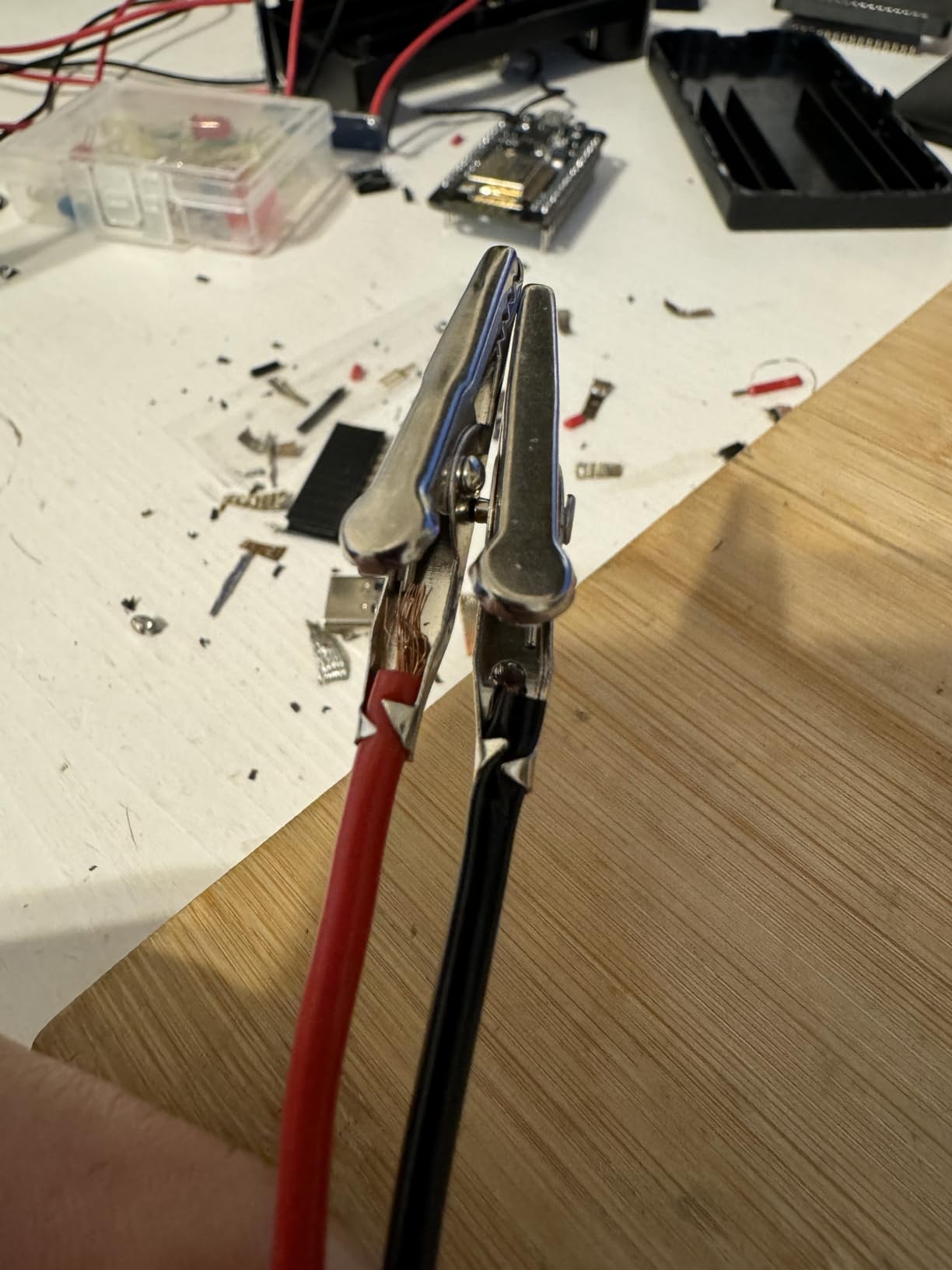
Two things to know before you rely on it. The included leads are thin, and the manufacturer says so; spend a little on proper banana-to-alligator leads before you run sustained high-current loads. And the AC input is fixed at the factory on this version, so check that it suits your mains before you commit.
Who this supply suits
It suits first-time builders who want a simple, readable supply with no menu to learn. There is one screen, two knobs and one output, and it does that job without fuss, which is more than a surprising number of competitors manage.
It is also a strong choice for anyone whose work is genuinely low-current: sensor boards, op-amp circuits, 3.3V and 5V rails, small motor and servo tests. Ten amps is far more than those loads need, and the constant current limit is what protects you when the wiring is wrong.
Who should skip it
Skip it if you are on 230V mains and cannot confirm the input variant. That is not a small detail, and it is the single most common complaint pattern in reviews of fixed-input budget supplies.
Skip it if you need preset recall or PC control. Every time you come back to a test you will re-enter the settings by hand, which is fine once an evening and irritating every evening after.
3. NANKADF 30V 10A Encoder Supply – Best for the Output Enable Workflow
DC Power Supply Variable, Bench Power Supply with Encoder Adjustment Knob, Output Enable/Disable Button, Adjustable Power Supplies with USB Quick-Charge, Short Circuit Alam (30V 10A Black)
30V 10A, 300W
Encoder knob with digit selection
Output enable/disable button
0.01V / 0.001A accuracy
Pros
- Press-to-select encoder makes error-free 0.01V and 0.001A entry
- Output enable button stops accidental power to a load
- Overcurrent protection shuts output and sounds an alarm
- Settings retained after unplugging
- Quiet operation with an 18W fast-charging port
Cons
- Encoder reverts to the third digit after a short delay instead of holding the last digit
- No built-in test lead storage or hangers
- Output ramps down slowly when voltage is lowered or the supply is switched off
The output enable button is the reason this one earns a place on my bench. You set your voltage with the output off, connect the leads with your hands nowhere near a live terminal, then press to energise. Forum threads about safe bench practice keep coming back to that button, and having it on a supply at this level is unusual.
Accuracy is the other story. Reviewers with a decent multimeter report output dead-on below 15V and within 0.005V at higher voltages, which is better than you need for almost any hobby circuit. The encoder works by press-to-select: press to choose a digit, turn to set it, which removes the digit-hunting that spoils some other encoder designs.
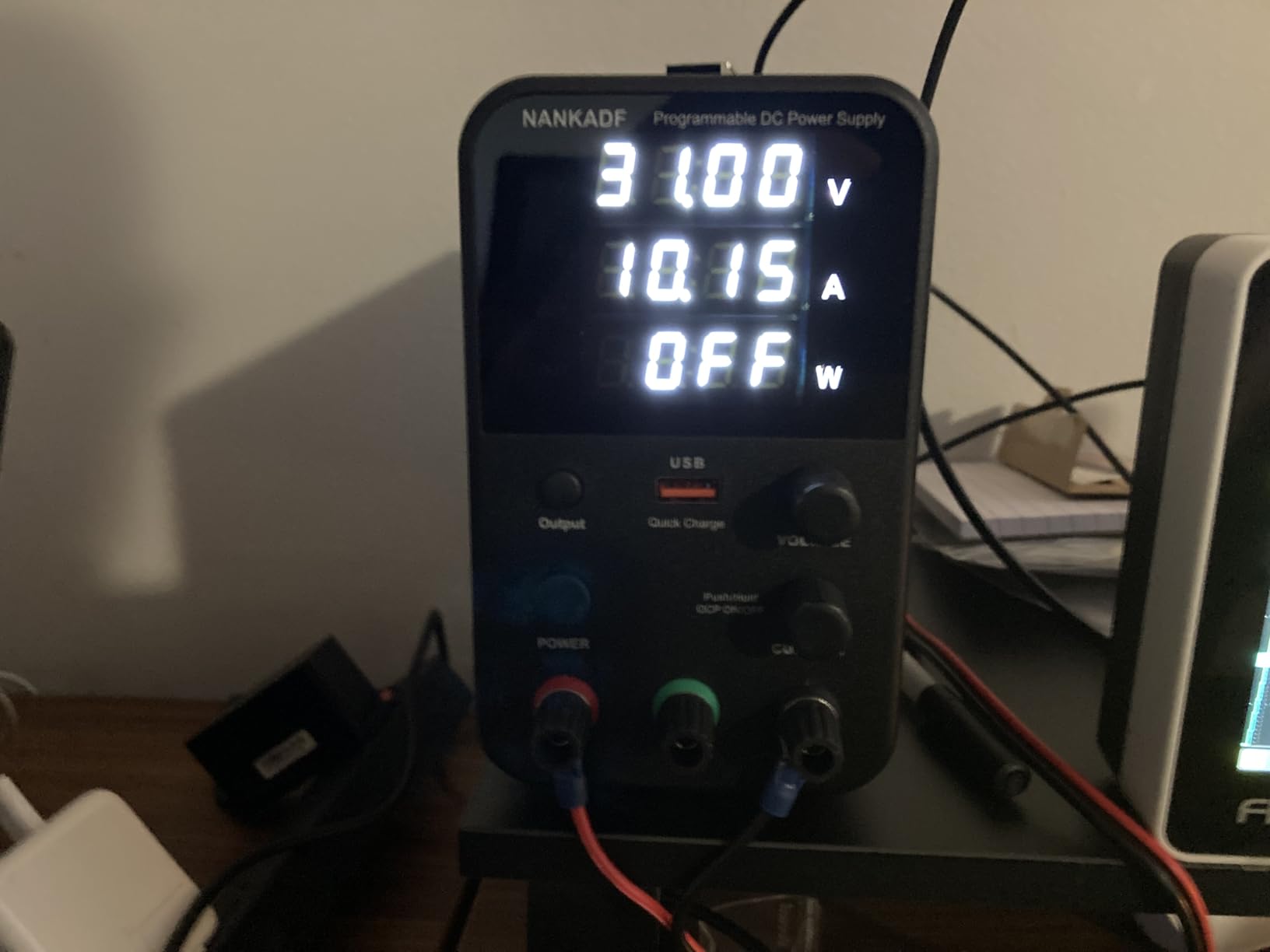
Your settings survive a power cut, and the output then needs manual reactivation, so a brief mains interruption cannot silently re-energise a board under test. That behaviour is a genuine safety property rather than a gimmick, and it is why I keep recommending this unit to beginners who are worried about leaving a supply on overnight.
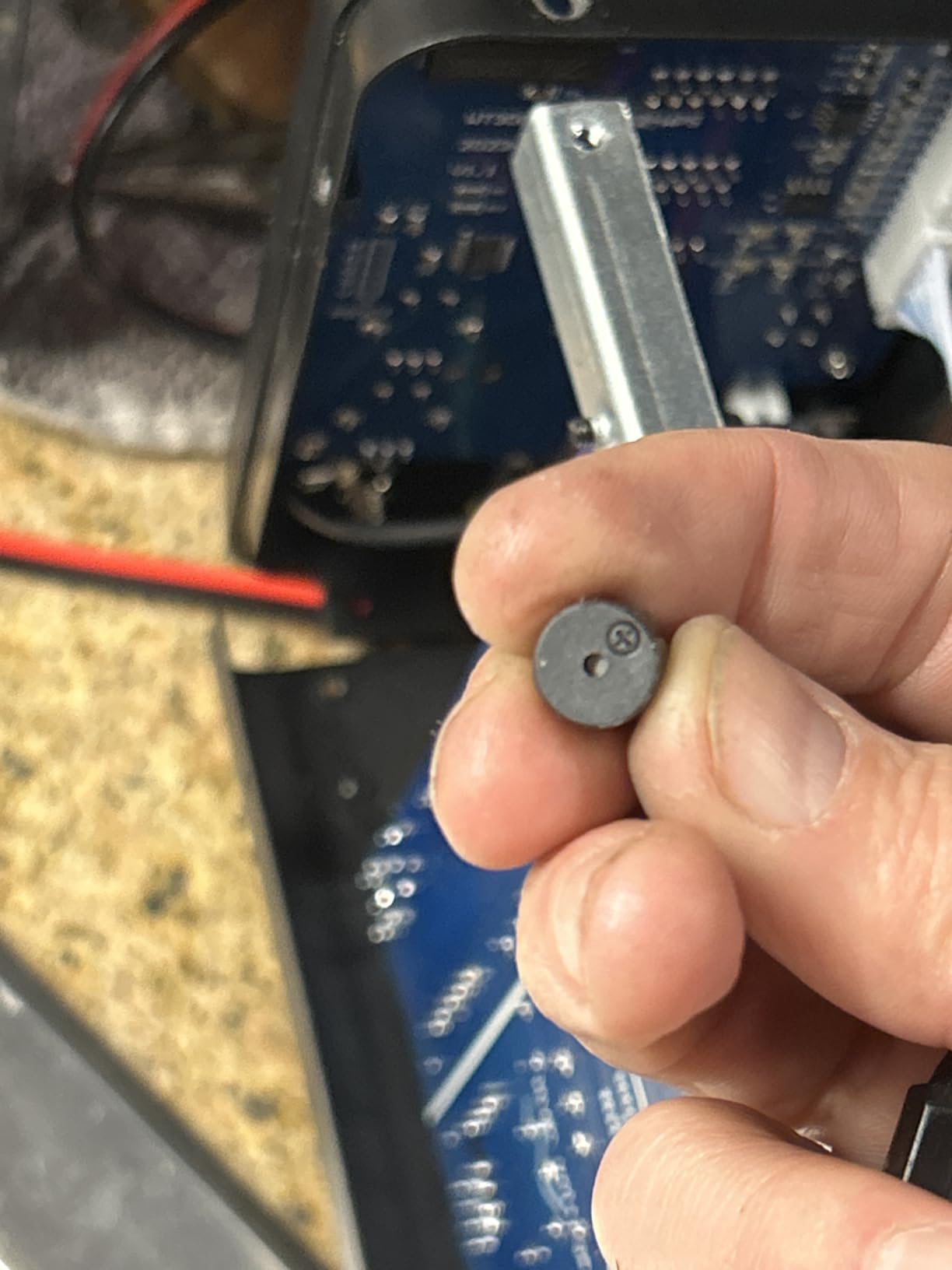
There is one real irritation. After a short pause the encoder selection jumps back to the third digit instead of staying on the one you were editing, so fine adjustment needs a little rhythm to get used to. Output also ramps down slowly when you lower the voltage or switch off, which is safe but means you wait a moment before touching a board.
Who this supply suits
It suits anyone wiring and rewiring live circuits often, which is most PCB repair and breadboard work. The combination of a disabled-by-default output, a retained setting and accurate readout removes three separate ways to accidentally cook something.
It is a good fit for ESP32 and Arduino boards that need a bit more current than a USB port gives, and for 12V and 24V rail work where you want to watch the current draw settle as a load spins up.
Who should skip it
Skip it if you want presets. There are no memory slots here, so a recurring test means re-entering the same numbers every time. The Wanptek TPS-C3010H adds three preset keys for that reason.
Skip it if you need a low-noise analogue source. This is a switching supply and it behaves like one, so a small audio or RF preamp will hear the difference against a linear unit.
4. Kiprim DC310S – Best for PC-Controlled Test Sequences
DC Power Supply, 0-30V 0-10A Adjustable Regulated Power Source, 110V Input, High Precision 4-Digit Display, Multiple Safety Protections, PC Software Control & Dual USB Ports
0-30V / 0-10A, 300W
2.8 inch color LCD
10-point waveform and 4 presets
PC control over USB
Pros
- Large 2.8 inch color LCD with numeric and curve display modes
- Programmable waveform output with ten adjustable points
- PC software control over USB with Modbus support
- Adjustable overvoltage
- overcurrent and overheat thresholds
- Dual USB ports for firmware
- PC control and charging
Cons
- 110V input only on this variant
- so it cannot be used directly on 230V mains
- Higher cost than comparable hobby-class switching supplies
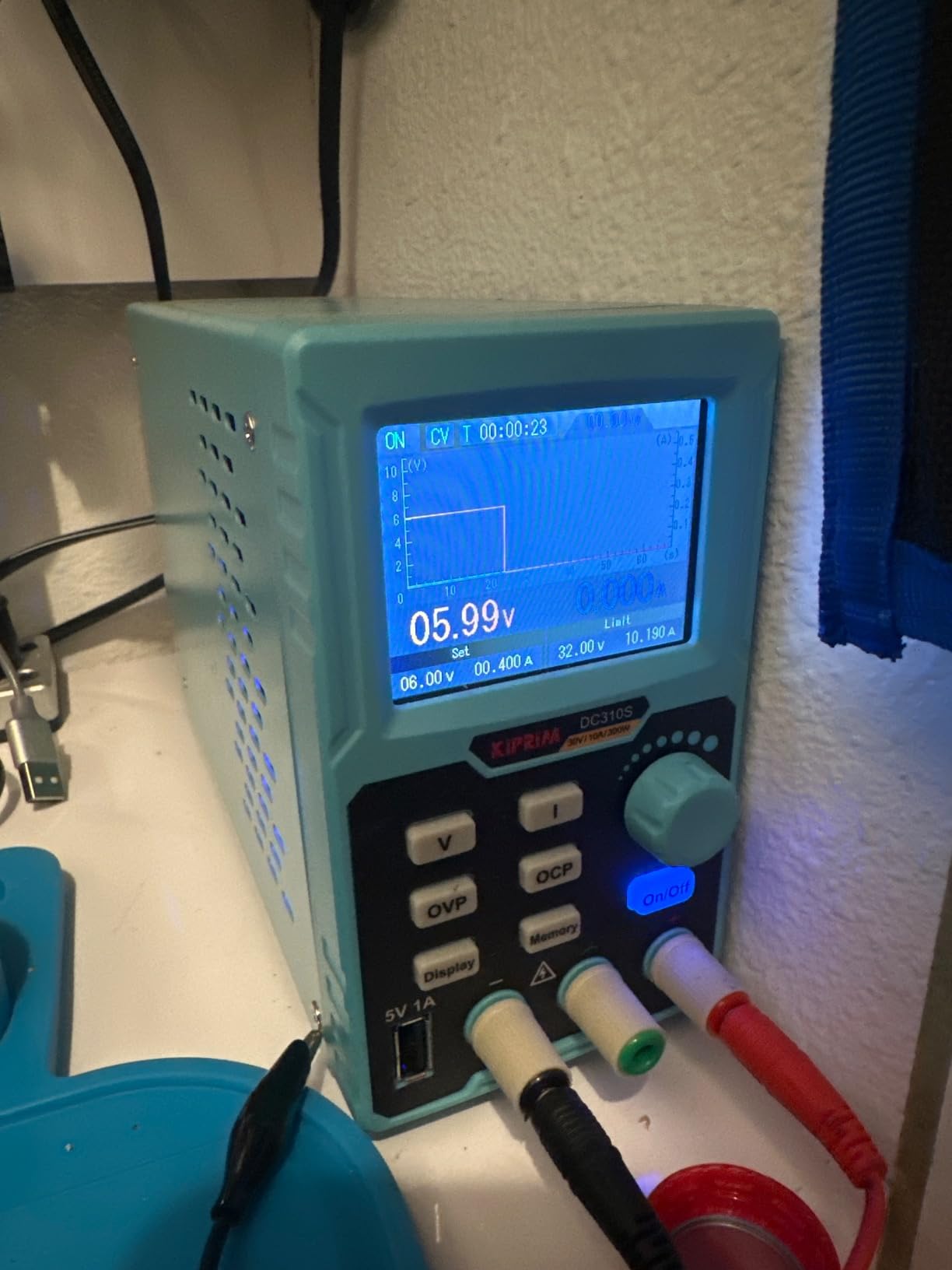
This is the first supply I would consider once your testing needs to be repeatable rather than manual. The 2.8-inch colour screen is the headline, but the real feature is underneath: you can edit a ten-point waveform and have the output follow it, which turns a supply into a simple test fixture.
Buyers who need programmability rate it very highly, and the reason is rarely the screen. It is that the protection thresholds are adjustable rather than fixed, so you decide where over-voltage and over-current protection actually trip instead of accepting whatever the factory chose.
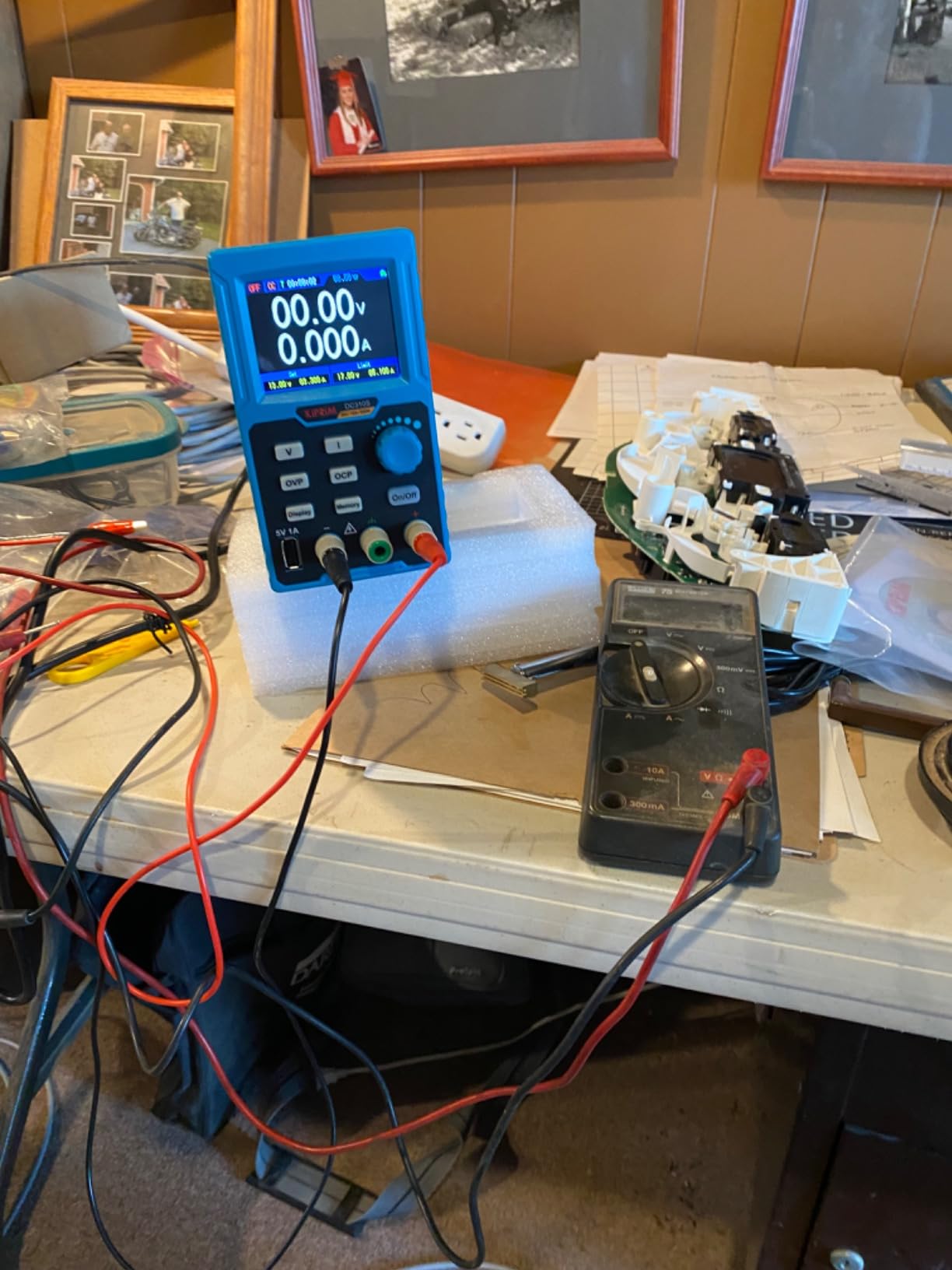
Four memory presets and Modbus control over the rear USB port mean a burn-in run or an automated sweep can be launched from a PC with the supplied software. For soak testing a board overnight, or for stepping a rail through a sequence while logging the response, that removes almost all of the tedium.
Two caveats. This variant is 110V input only, which matters outside North America and Japan. And it sits above the typical hobby price band, so if you only need a knob you are paying for a screen and software you may never open.
Who this supply suits
It suits people who test the same circuit repeatedly and have learned that hand-setting a voltage at 2am is how boards get damaged. Scripted sequences and logging change that, and the curve display shows the load response as it happens.
It is also a good fit for battery and pack work. Adjustable over-temperature cutoff at 85C and a settable over-current limit let you define a safe envelope for a pack you are charging rather than relying on defaults.
Who should skip it
Skip it if you never connect a laptop. The manual controls work fine, but you will be paying for programmability you do not use, and a simpler 30V 10A switching box does the same job with fewer things to learn.
Skip it on 230V mains for this variant. Confirm the input rating before you buy, or look for a model with a switchable input like the Jesverty SPS-3010V or the Korad KD3005D.
5. Jesverty SPS-3010V 32V 10A – Best Rated Budget Unit
Jesverty DC Power Supply Variable, 0-32V 0-10A Switching Bench Power Supply with 20W USB & Type-C Quick-Charge, Encoder Corase & Fine Adjustment Knob, Output Switch, 4-Digit LED Display – SPS-3010V
0-32V / 0-10A, 320W
Coarse and fine encoder knobs
USB-A and USB-C 20W
115V/230V selectable
Pros
- Highest rating in this group at 4.6 stars with 83 percent five-star reviews
- Separate coarse and fine encoder knobs make setting values before and after the decimal quick
- USB-A and USB-C ports both deliver 20W fast charging for Arduino or Raspberry Pi boards
- Output ON/OFF button avoids repeatedly disconnecting loads
- Selectable 115V/230V input removes the mains-voltage guesswork
Cons
- Supplied leads are flagged by the manufacturer as a give-away and unsuited to sustained high current
- Not a linear supply
- so it is unsuitable for noise-sensitive analogue work
This is the upgraded version of the supply in review two, and the upgrades are the right ones. It is the highest-rated product in this roundup at 4.6 stars with 857 reviews, and the changes that matter are a switchable mains input, a proper output switch, and USB-C alongside USB-A.
Setting values is the best experience in the group. One knob handles the digits before the decimal point and the other handles the digits after it, so dialling in 5.00V takes a moment instead of a hunt. There is no digit-selection to press and nothing to mis-hit.
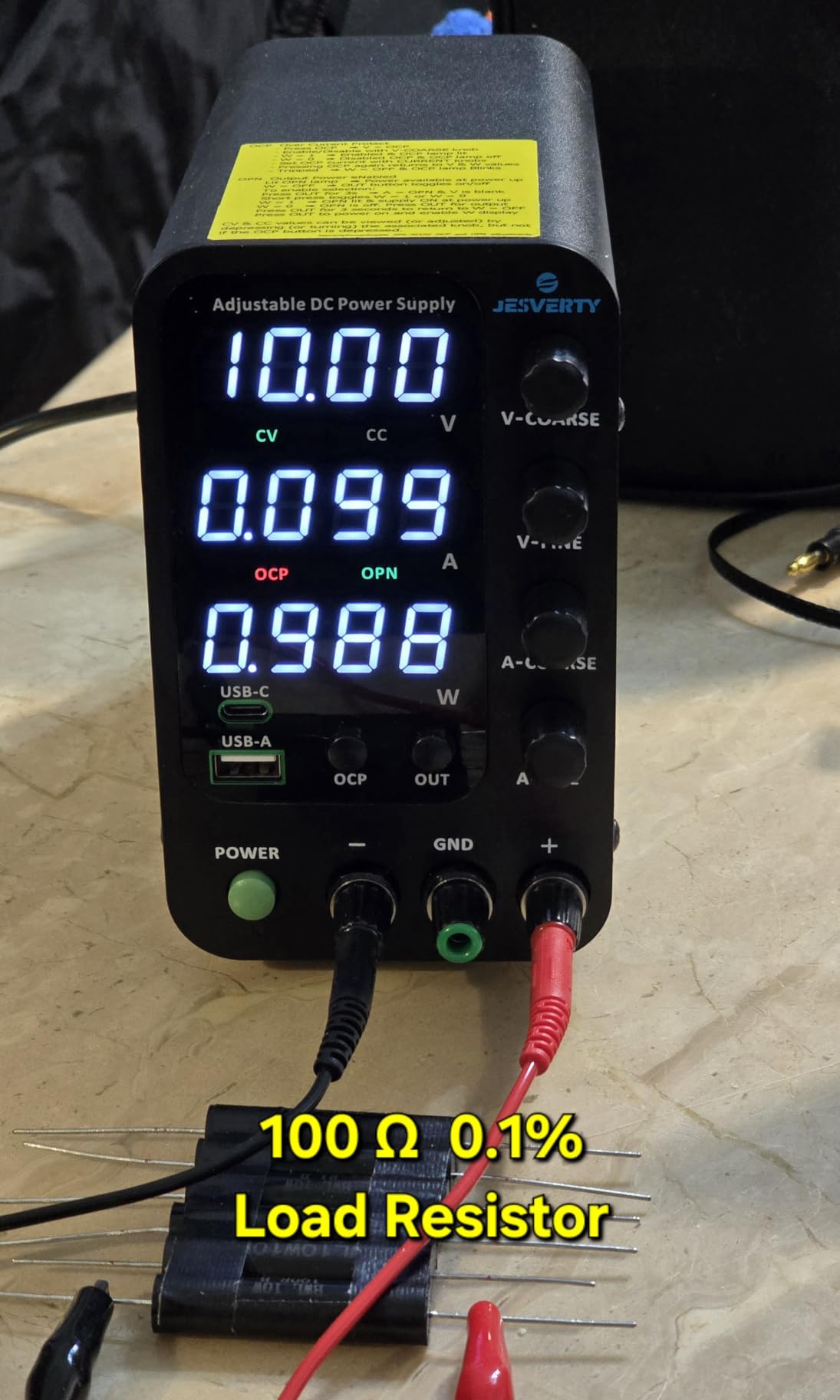
Both charging ports deliver 20W, which is genuinely useful if you are powering an Arduino, a Raspberry Pi or a phone from the same box that powers your circuit under test. It is a small convenience that removes a wall adapter from the bench, and it is the reason this unit edges out its predecessor.
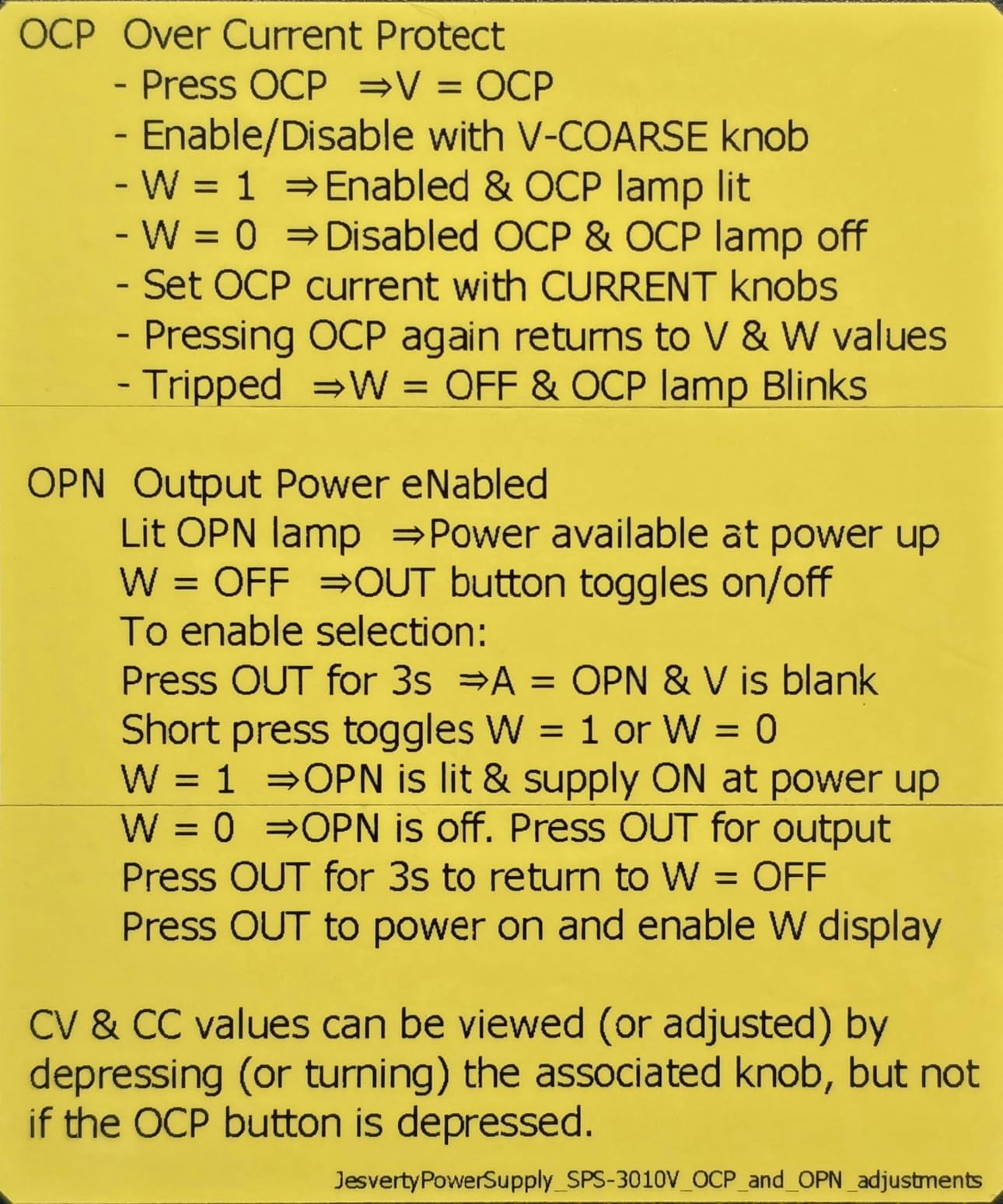
The output button matters more than it sounds. Rewiring a live board repeatedly is how you get an accidental short, and a hardware output switch means the supply goes dead without you having to pull a plug or unplug a lead. Mains input is switchable between 115V and 230V, which removes the single most common regret in this category.
Who this supply suits
It suits anyone who wants the simplest possible control scheme: two knobs, one switch, one readout. There is nothing to learn and nothing hidden, so it works just as well for a first supply as it does for a fifth.
The 32V ceiling gives a little headroom above the usual 30V, and 10 amps is enough for LED strips, small motors and heated loads. For a bench that does microcontroller work all week, it is hard to argue with.
Who should skip it
Skip it if your circuits are analogue. This is a switching supply, and the ripple is normal for the class. Audio, RF and low-level instrumentation work belongs with a linear unit.
Skip it if you need stored presets or PC control, because there is neither. You will re-enter settings each session, which is fine for occasional work and tiring for someone testing the same board every day.
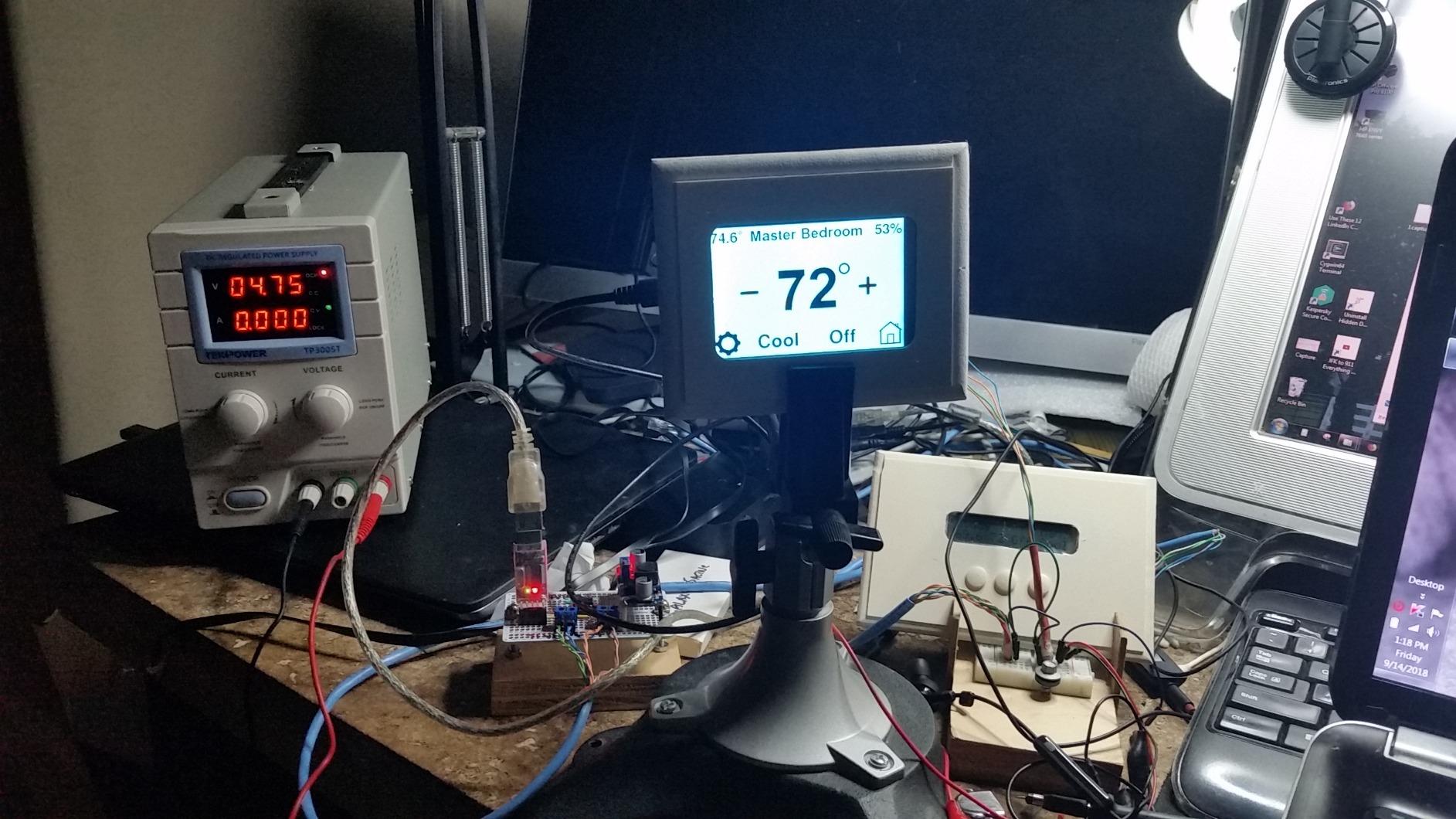
6. Tekpower TP3005T 30V 5A Linear – Best for Low-Noise Analogue Work
Tekpower TP3005T Variable Linear DC Power Supply, 0-30V @ 0-5A with Alligator Test Leads
0-30V / 0-5A, 300W
Linear topology, low output noise
Back-lit LED at 0.1V / 0.01A
Alligator leads included
Pros
- Linear rather than switching topology gives very low output noise for sensitive analogue and audio work
- Simultaneous constant-voltage and constant-current modes
- Metal body construction with a 1-year manufacturer warranty
- Alligator test leads included in the box
- Automatic thermo-sensor fan control
Cons
- Heaviest and bulkiest in the group at 12 lb and 11.7 x 9.7 x 7.9 inches
- Capped at 5A
- half the current of the 30V 10A units here
- Coarser display resolution of 0.1V and 0.01A
- 110V input only
Linear topology is the entire point of this supply. A linear design passes DC through a regulator rather than chopping it, which means almost no switching ripple reaches the output. If you are building audio preamps, low-level sensor circuits or anything where the noise floor matters more than the price, this is the category you need to be in.
It behaves like a proper instrument rather than a computer peripheral. Constant voltage and constant current run simultaneously, the fan is driven by a thermo-sensor rather than a fixed duty cycle, and the metal body is a 1-year-warranted enclosure rather than moulded plastic.
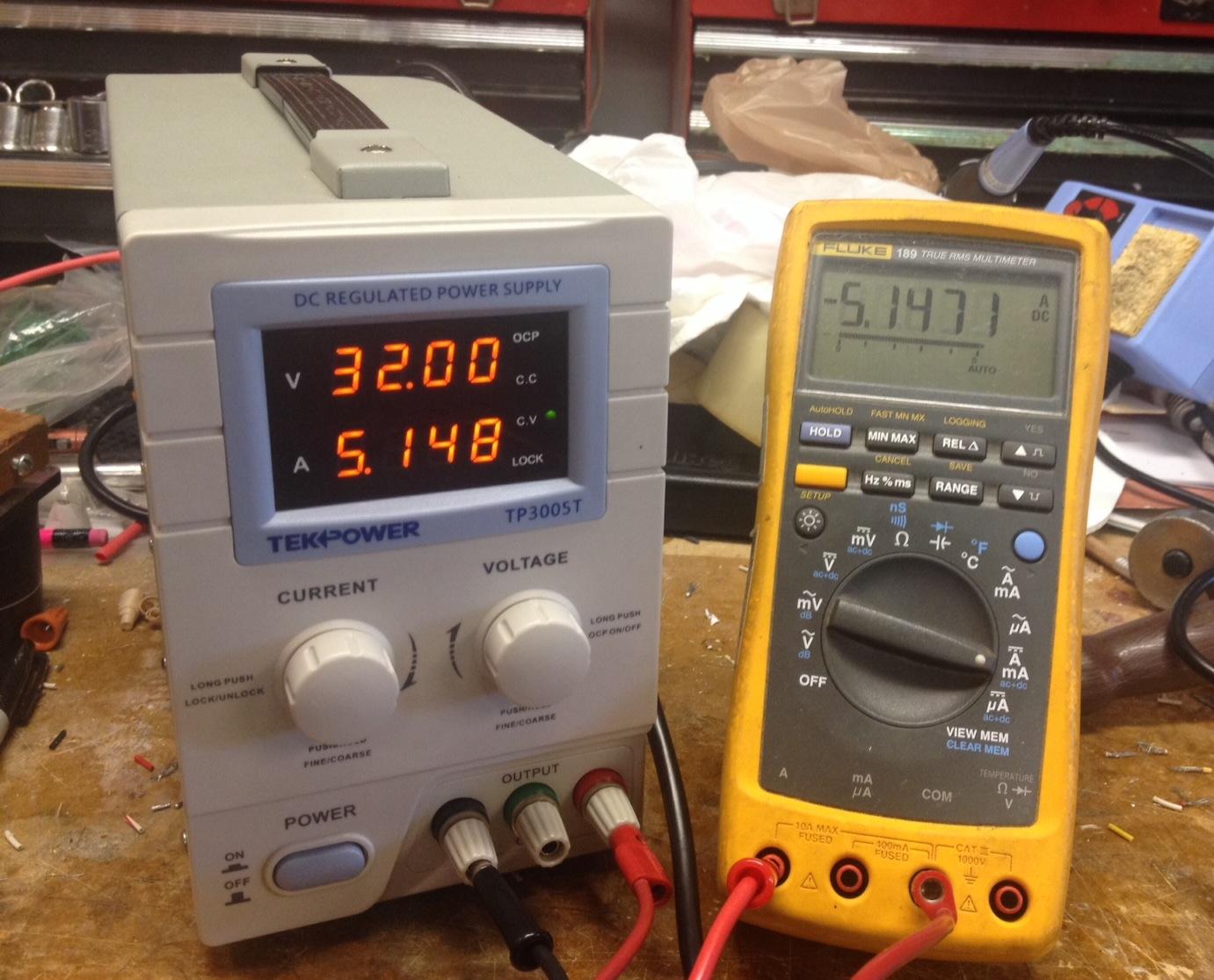
The trade-off is physical and immediate. At 12 pounds and 11.7 by 9.7 by 7.9 inches it is the largest thing in this roundup, and the linear transformer inside is what makes it that way. Plan for a permanent spot on the bench rather than a temporary one.
Five amps is half what the 10A switching units deliver, which is fine for analogue work and wrong for motors and LED arrays. The display resolution of 0.1V and 0.01A is coarser than the 4-digit units here, and the input is fixed at 110V, so check your mains before committing.
Who this supply suits
It suits anyone working on low-level analogue circuits, audio electronics or measurement setups where supply noise would show up in the result. A microphone preamp or a strain-gauge amplifier is exactly the kind of build where a linear supply justifies its size.
It also suits people who simply prefer physical, obvious controls. Two modes, one voltage knob, one current knob, alligator leads in the box, nothing to configure. There is a version of this hobby where simplicity is a feature and software is a distraction.
Who should skip it
Skip it if you need more than 5 amps, or if you want to run a motor, a 3D printer bed heater or a long LED strip. The current ceiling is firm and the unit will simply current-limit.
Skip it if bench space is tight. This is a big box on a small desk, and a compact switching supply would leave you far more room to work.
7. Hanmatek HM310T – Best for Modbus Scripted Power Sequences
Programmable DC Power Supply (0-30 V 0-10 A) HM310T High Precision 4-Digit Voltage Current Power Time Display Variable Switching Digital Power Supply with PC Software and USB Interface
0-30V / 0-10A switching
Modbus over USB with PC software
Six parameter storage groups
V, A, W and time display
Pros
- Only supply here with true sequence programming via Modbus over USB plus bundled PC software and cable
- Displays voltage
- current
- power and elapsed time on a 4-digit readout
- Six groups of quick parameter storage for repeatable test setups
- Five protection functions covering overvoltage
- overcurrent
- overpower
- overheat and short circuit
- One-key output on/off and a keyboard lock to prevent misoperation
Cons
- Lowest rating in the group at 4.1 stars
- with 13 percent one-star reviews indicating real dissatisfaction
- Software-driven programming has a steeper learning curve than a knob-and-preset approach
- Fan noise is noticeable once the 45C threshold is exceeded
Read this section as a description of what the hardware can do, not as an unqualified recommendation. The HM310T is the only supply in this roundup that talks proper sequence programming over USB using a Modbus instruction set, and the bundled software and cable make scripted power profiles genuinely reachable.
The display is unusually informative: voltage, current, power and elapsed time on one 4-digit readout. If you are charging a battery or running a timed soak, seeing the accumulated time and the power being drawn together is more useful than a voltage and current pair alone.
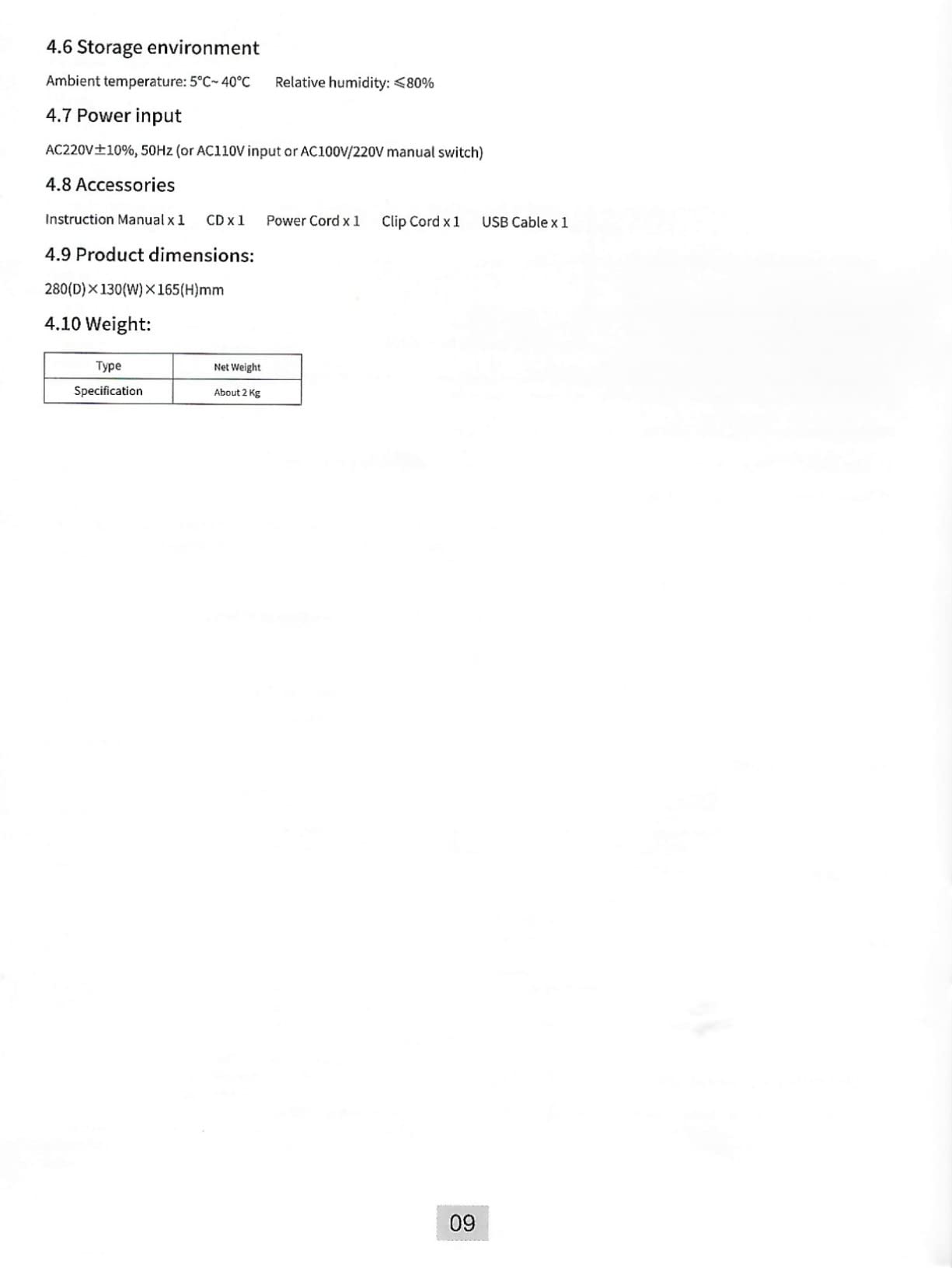
Six groups of parameter storage mean six test profiles you can recall instantly, and five protection functions cover overvoltage, overcurrent, overpower, overheat and short circuit. A keyboard lock stops stray button presses from changing set values mid-run, which is a small feature that matters on a long unattended test.
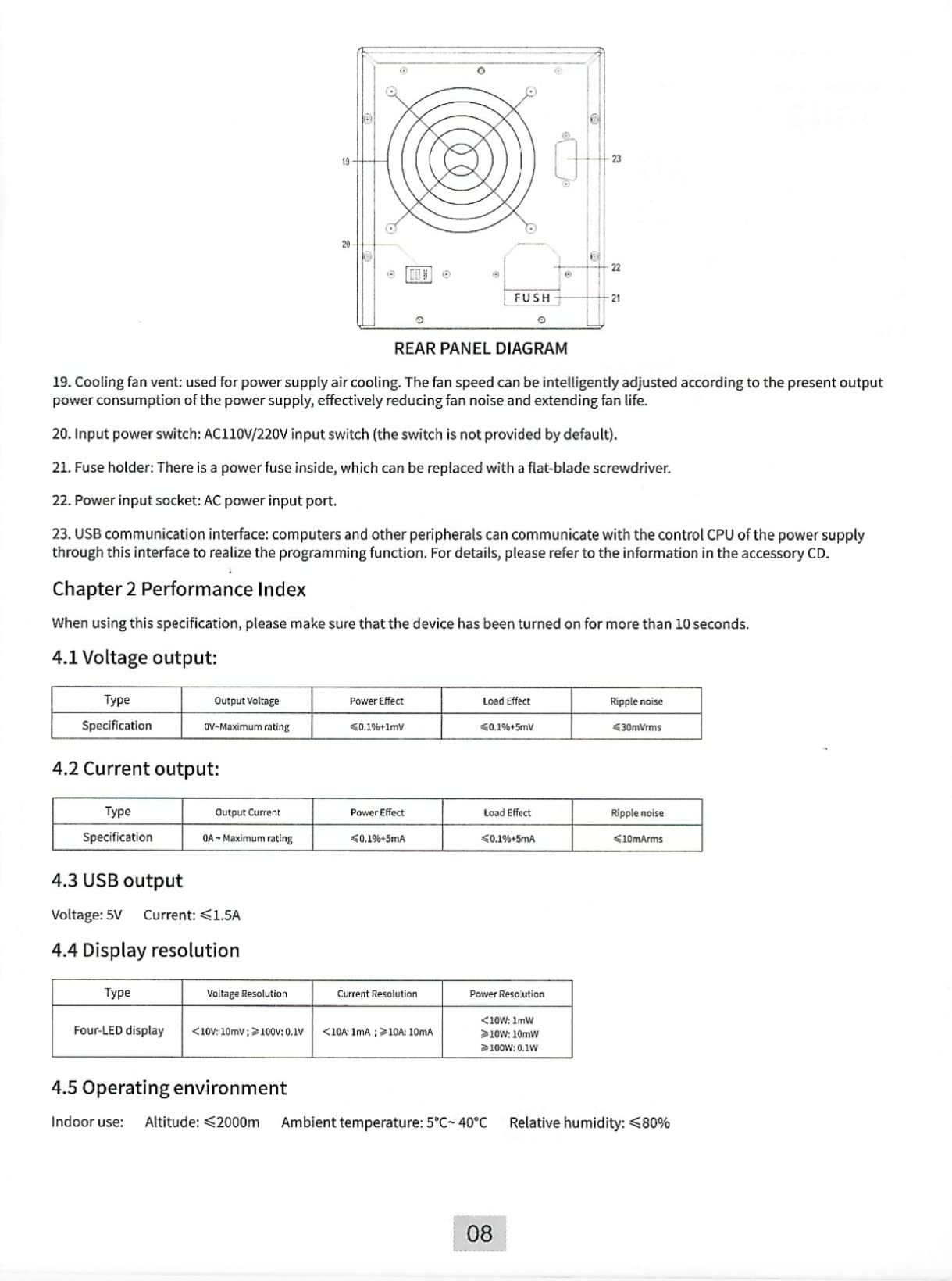
Its rating of 4.1 stars is the lowest here, and 13 percent one-star reviews is a real signal rather than noise. Owners point to a steeper learning curve and to fan noise once the 45 degree threshold is crossed. The input is listed as 240V AC, so this variant suits 230V mains rather than 120V.
Who this supply suits
It suits someone who has already outgrown hand-set values and wants a PC to drive the supply. Battery charge curves, timed ramps and repeated cycling are all within reach once the software is configured, and the six storage groups cover setups that would otherwise need re-entering.
It also suits 230V mains users, which is rarer in this class than it should be. Confirm the input rating matches your supply before you commit, and check the fan noise is acceptable for your room.
Who should skip it
Skip it if you just want a reliable source of power. The programming path is a real learning curve, and the lowest rating in the group suggests a rougher experience than the simpler knob-operated supplies deliver.
Skip it if you are on 120V mains. This variant is listed at 240V AC input, so it is the wrong box for a North American bench.
8. Siglent SPD3303X-E – Best for Three Isolated Rails
Siglent Technologies SPD3303X-E Triple Output Power Supply
Three isolated outputs, 220W total
32V/3.2A x2 plus 5V channel
Series and parallel modes
Linear design, 3-year warranty
Pros
- Three fully isolated and independently controlled outputs for 5V
- 3.3V and 12V rails at once
- Series and parallel modes expand the output to 64V or roughly 6.4A
- Linear supply design delivers low ripple for sensitive analogue circuits
- Timing output function and trending graphs for soak and ramp tests
- 3-year warranty with 100-230V universal input
Cons
- By far the largest and heaviest in the roundup at 17.6 lb
- needing dedicated bench space
- Each of the two main channels is limited to 3.2A
- Total output of 220W is low relative to its physical size
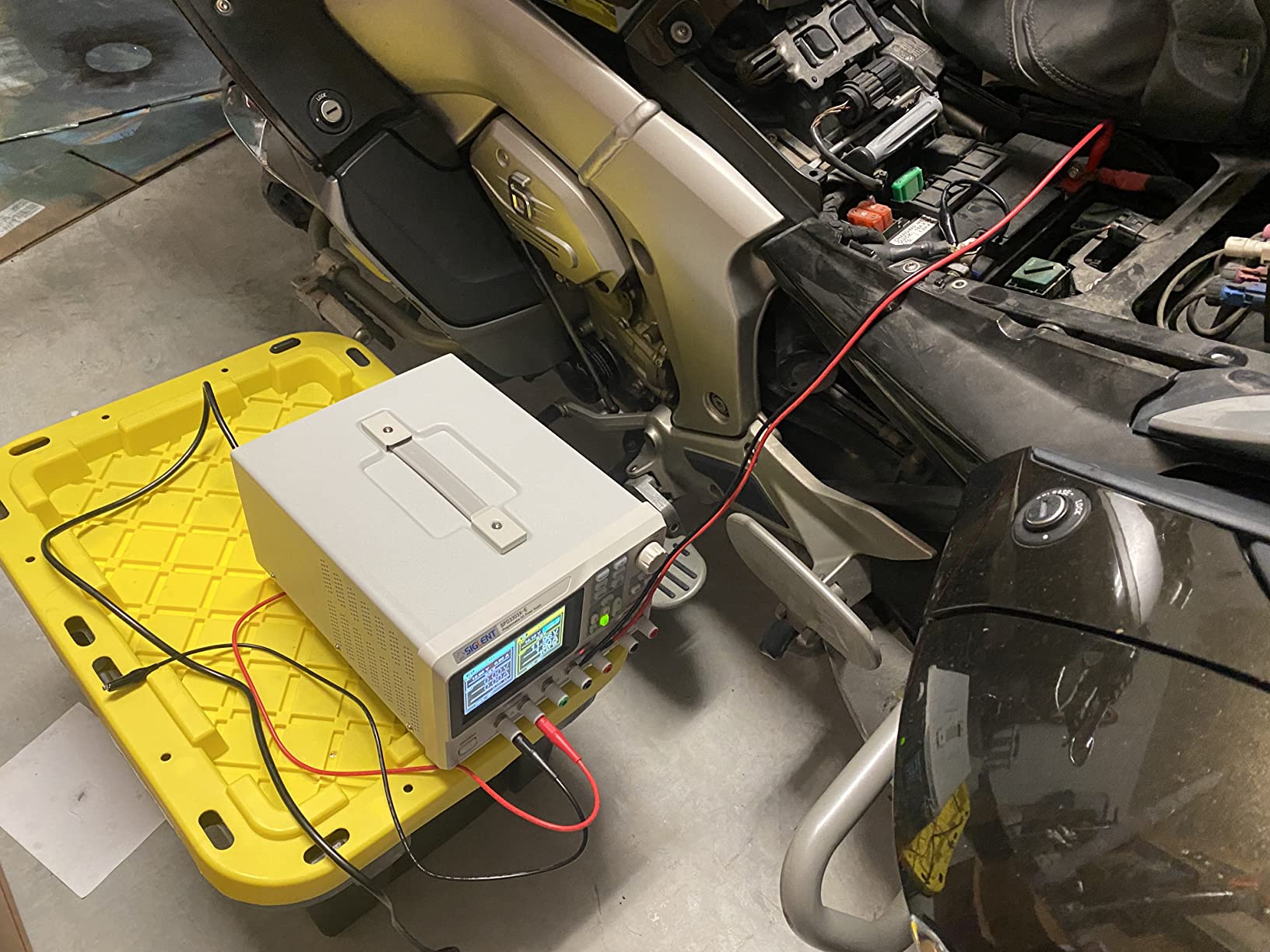
Everything else in this roundup is a single-channel box. This one gives you three isolated, independently controlled outputs: two channels at up to 32V and 3.2A, and a third fixed low-voltage channel covering 2.5V, 3.3V and 5V at 3.2A. That is 5V, 3.3V and 12V live at the same time, which is what a modern embedded board actually wants.
Isolation is the part hobbyists underrate. Because the channels are isolated from each other, powering a logic rail and a motor rail from the same supply does not tie their grounds together, which avoids the ground loops that plague a breadboard fed from one channel.
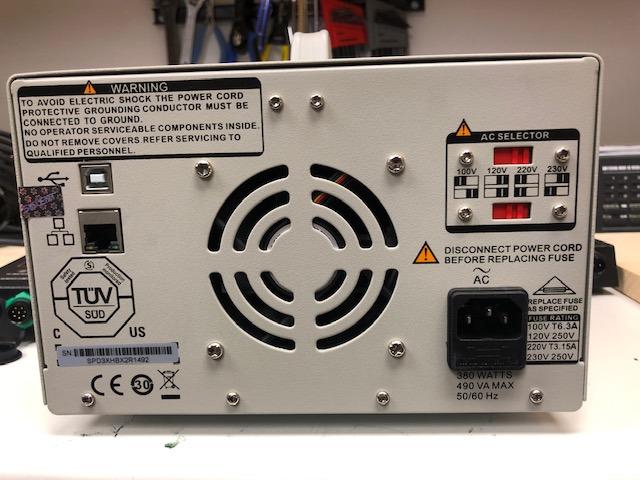
Series and parallel modes widen the envelope further: 64V in series, or roughly 6.4A in parallel for the high-current end. The timing output function and trending graphs handle soak and ramp tests, and the linear design keeps the noise down for analogue work on the same bench.
It is a serious instrument, and that is visible everywhere. It is the biggest and heaviest thing here at 17.6 pounds, it needs its own bench space, and 220W total is modest for the volume. The 3-year warranty and 100-230V universal input are exactly what you would expect at this level.
Who this supply suits
It suits people building or repairing embedded boards that need several rails running at once, especially anything combining a microcontroller with a sensor, a display and a motor. One box replaces three adapters and the tangle that comes with them.
It also suits anyone who will outgrow a single channel. When you need 60V, or more than 3.2A from one rail, series and parallel modes get you there without buying a second supply.
Who should skip it
Skip it if you are powering one small circuit. A single 5V microcontroller does not justify an instrument of this class, and the extra size and weight will dominate a small desk.
Skip it if you need more than about 3.2A on a main channel. That is a hard ceiling per channel, and while parallel mode doubles it, the total power budget is not large for a bench of this size.
9. Korad KD3005D 30V 5A Linear – Best Lab-Grade Linear Unit
KORAD KD3005D – Precision Variable Adjustable 30V, 5A DC Linear Power Supply Digital Regulated Lab Grade…
0-30V / 0-5A, 300W linear
Dual 4-digit LED displays
Switchable 110V/220V input
5 amp test leads included
Pros
- Linear lab-grade topology with low output noise for analogue and precision work
- Dual 4-digit LED displays let voltage and current be read simultaneously
- Automatic mA and A display switching avoids misreading small currents
- Switchable 110V/220V input works on mains worldwide
- Metal chassis
- 9 lb build and 5 amp test leads in the box
Cons
- Large 14 x 10 x 10 inch footprint takes a lot of bench space
- Capped at 5A
- half the current of the 30V 10A switching units here
- Older control style compared with encoder-knob models and no USB charging ports
The Korad KD3005D is the unit a publisher picked as best overall value for hobbyists, and after using it the reason is plain: it is a genuinely linear, lab-grade supply with the control scheme of a laboratory instrument and none of the gimmick.
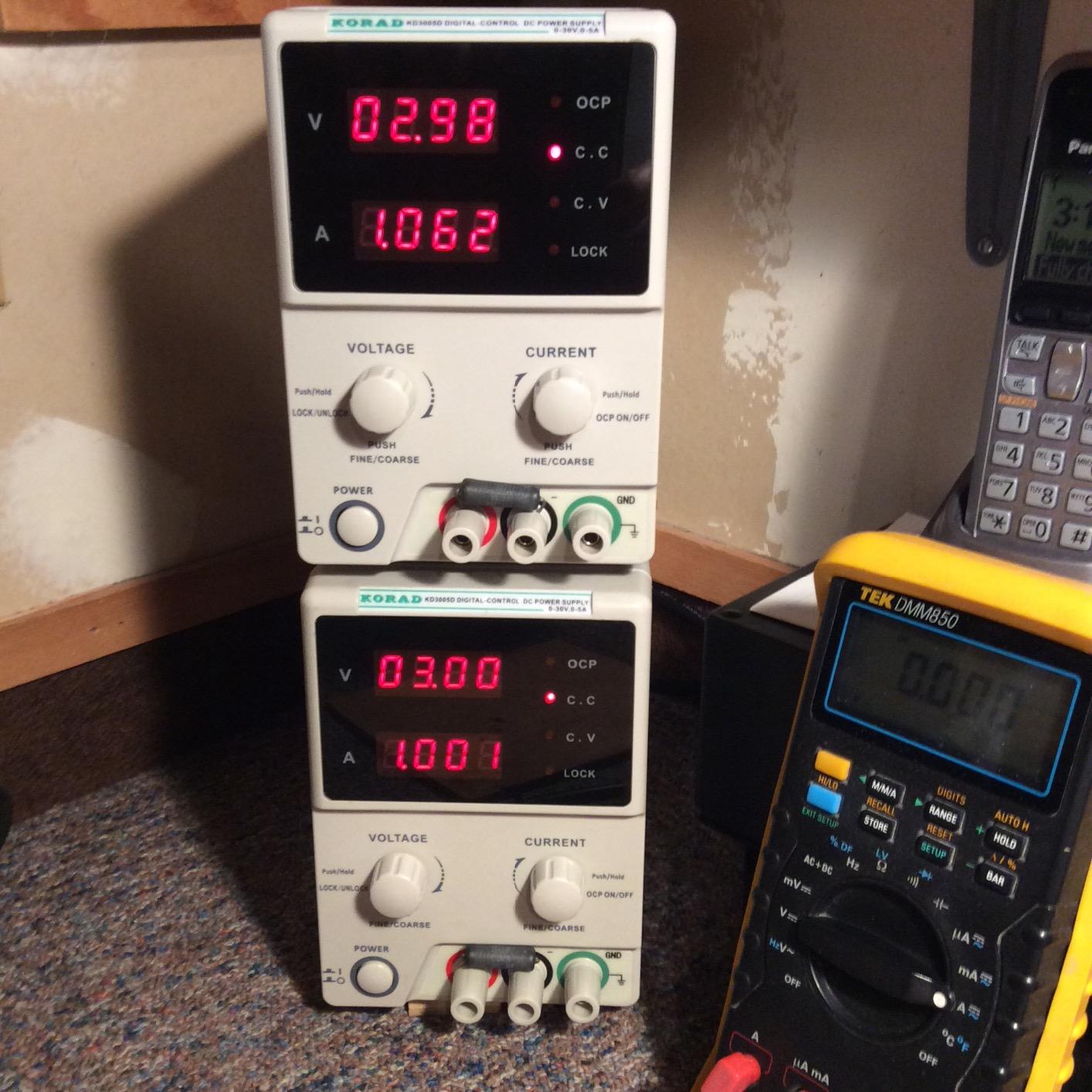
Two 4-digit LED displays show voltage and current at the same time, with no menu and no mode to enter. The display switches between mA and A automatically as the current changes, which removes the single most common misreading on a bench, where a 20mA load looks like it is drawing almost nothing.
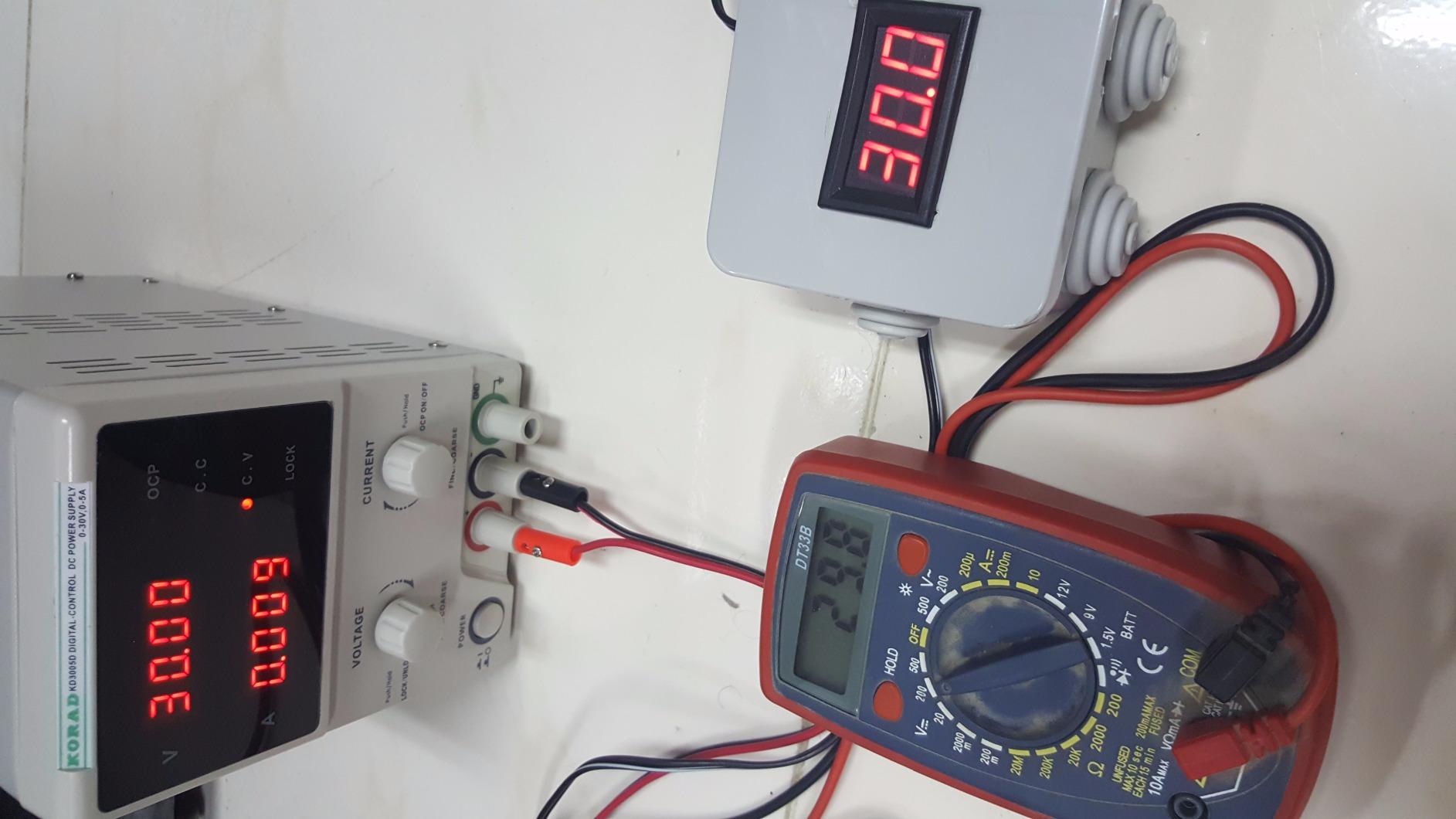
Input is switchable between 110V and 220V, so it works on mains almost anywhere without a transformer, and the protection covers overload, short circuit and over-temperature. Test leads rated at 5 amps are in the box, which is one less thing to buy before the first session.
What it does not have is modern convenience. There are no USB charging ports, no encoder digit entry, and no presets, so you set values the way you have set them on bench instruments for decades. The 14 by 10 by 10 inch metal chassis is substantial and eats a real amount of desk.
Who this supply suits
It suits analogue, precision and reference work where a low-noise linear output matters and where a dual readout is genuinely useful rather than decorative. Sensor excitation and small-signal measurement are the classic cases.
It also suits anyone who plans to work across different countries or on both voltage standards. The switchable input is a practical detail that removes a whole category of frustration.
Who should skip it
Skip it if you need high current. Five amps is half the switching units here, and motors, LED arrays and heater loads will current-limit immediately.
Skip it if bench space is at a premium. Its footprint is roughly twice the volume of the compact switching boxes, and if you are working on a laptop at a small desk that trade is a poor one.
10. Wanptek TPS-C3010H 30V 10A – Best Budget Unit with Memory Presets
WANPTEK DC Bench Power Supply 30V 10A, Regulated Variable Lab Power Supply with Memory Presets, Encoder Knob,OCP Protection, Output Switch, 4-Digit LED, USB Fast Charge and Key Lock for Repair
0-30V / 0-10A, 300W
Three memory presets M1/M2/M3
Output switch, OCP and key lock
115V/230V rear selector
Pros
- Three memory presets let you recall frequently used voltage and current settings instantly
- Encoder knob reverts to 0.1V steps after idling so fine adjustment is quick
- Key lock prevents accidental button presses changing values mid-test
- Output ON/OFF switch avoids arcing when rewiring a live board
- Compact 8.27 x 5.71 x 3.15 inch layout at 2.6 lb and quiet at low loads
Cons
- Keypad beep is loud and the power-on beep cannot be disabled
- Supplied leads are terminal-style rather than banana plugs
- The rear 115V/230V selector must be set correctly before first use or higher voltages will not hold
- Ammeter is reported as slightly imprecise by at least one long-term user
Memory presets are the feature that separates this from every other budget box in this roundup. Three keys store your most-used voltage and current pairs, and recalling a setup takes one press instead of four knob turns. If you test the same board every week, that is the difference between a pleasant bench and a repetitive one.
The encoder here is unusual in a good way: after a pause it falls back to 0.1V steps rather than staying on whichever digit you were last editing, so fine adjustment is quick without hunting. Owners also report quiet operation at low loads and a compact horizontal footprint that suits a small desk.
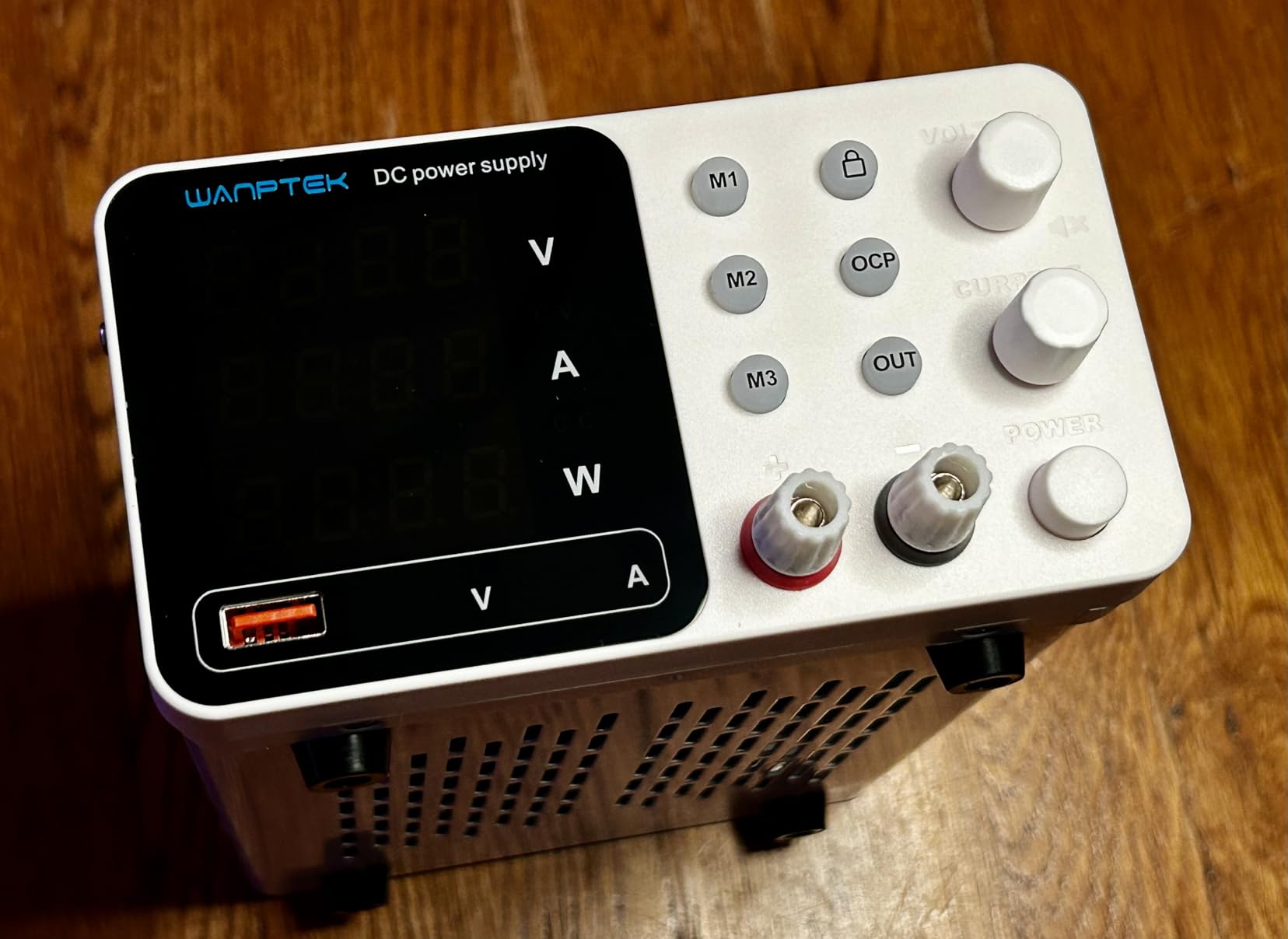
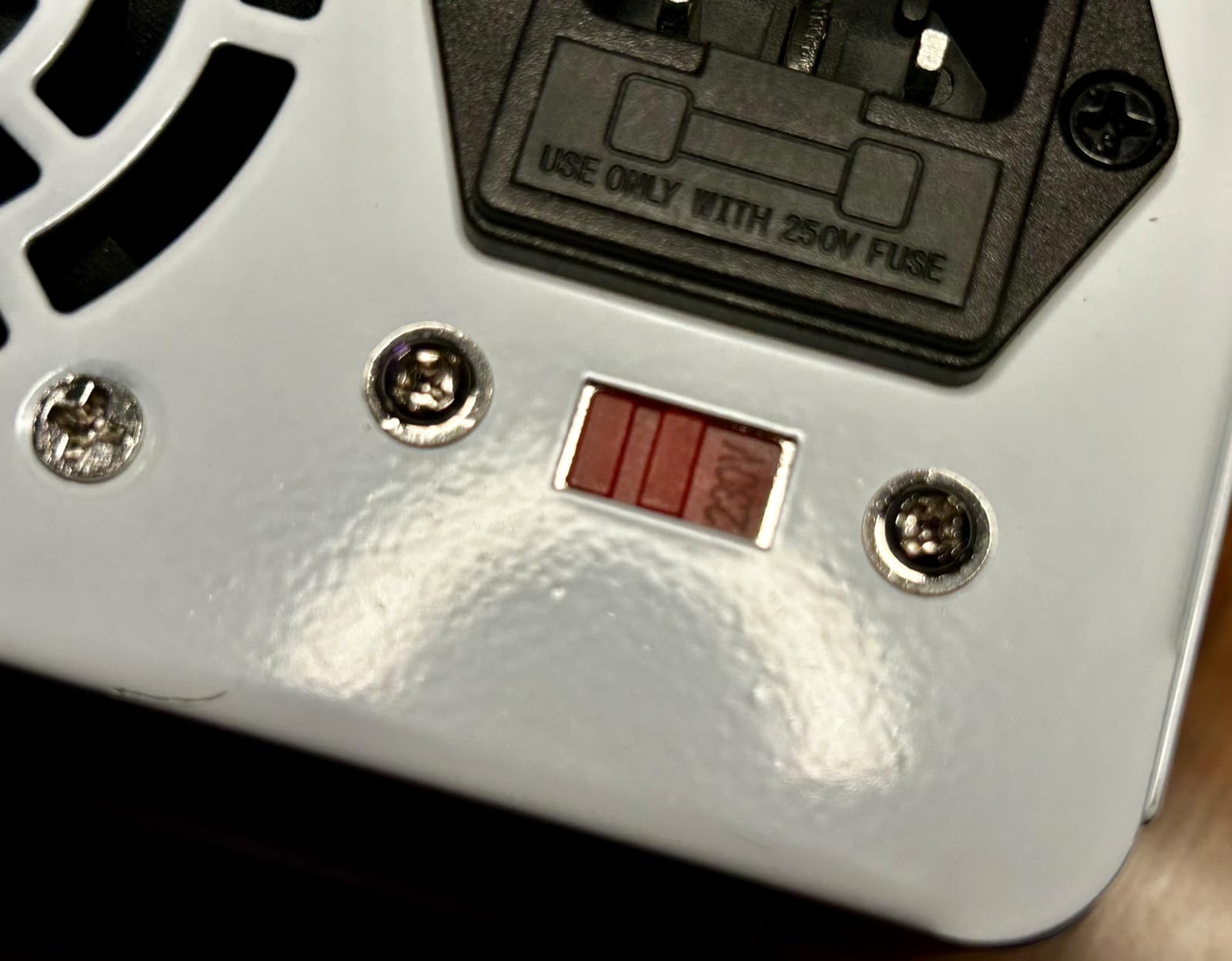
There is an output ON/OFF switch, over-current protection and a one-key lock, and the rear selector handles 115V or 230V input. Buyers report that once the mains selector is set correctly the unit holds voltage accurately, and that the switch avoids arcing when you rewire a live board.
Two caveats, both repeated often enough to matter. The keypad beep is loud and the power-on beep cannot be disabled, which several owners single out. And the mains selector must be set correctly before first use, because the unit will not hold higher voltages while it remains on the wrong setting.
Who this supply suits
It suits hobbyists who keep a small library of test setups: a 5V microcontroller profile, a 12V motor profile, a 3.3V logic profile. Storing those three profiles turns a supply into something you can hand to a friend or a student without a walkthrough.
It also suits small desks. At 2.6 pounds and roughly 8 by 5.7 by 3.2 inches in a horizontal layout, it leaves far more working space than the linear units in this roundup.
Who should skip it
Skip it if sound matters in your room. The beeps are the most repeated complaint, and the power-on one is not configurable, so you live with it every session.
Skip it if you need metering you can trust to a tenth of an amp. At least one long-term owner reports the ammeter as slightly imprecise, so verify critical measurements with a separate meter.
How to Choose a Bench Power Supply in 2026
Most people buying a bench power supply overspend, because they buy a laboratory instrument to power a breadboard. Here is how to avoid that, in the order the decisions actually need making.
1. Work out your voltage and current budget first
Start from your load, not from the supply. List what you intend to run: a 5V microcontroller draws well under an amp, an ESP32 Wi-Fi burst is a few hundred milliamps, a 12V motor can pull several amps, a 3D printer bed heater is tens of amps. Add them, then add headroom.
Wattage is the limit that actually binds, and it is simply voltage times current. A supply rated 30V and 10A gives you 300W, but you do not get 300W at every combination. At 5V you have 10A available; at 30V the same 300W total leaves far less current headroom. If your work lives near 30V, remember that a 30V 5A supply is a 150W supply for anything close to the top of its range.
The hobbyist default is 0-30V at 5A or 10A, and it is the right default for most people. Move to 60V or more only if you are working on higher-voltage circuits, and move to 10A or more only if you are driving motors, heaters or LED arrays.
2. Linear vs switching: which topology do you actually need?
This is the first question forums argue about and the one most roundups answer badly. A switching supply chops the input at a high frequency and filters it, which is efficient, small and cheap. A linear supply passes DC through a regulator, which is quiet, heavy and large.
Choose switching for digital work, motors, LEDs and anything where current matters more than noise. Choose linear for audio, low-level analogue, RF and instrumentation, where supply noise appears directly in your measurements. The two linear units here, the Tekpower TP3005T and the Korad KD3005D, trade bench space for a quieter floor.
A third path is common on enthusiast benches: repurpose an old PC power supply for logic rails because the rails are already there and it costs nothing. It works, but it has no adjustable output, no current limiting worth relying on and a shared ground, so treat it as a supplement rather than a replacement. Our guide to PC power supplies tested and ranked covers what to look for if you go that way.
3. Channels, isolation and how you will connect it
Single-channel supplies cover the majority of hobby work. Multiple channels matter when a board needs 5V, 3.3V and 12V at the same time, and the Siglent SPD3303X-E is the pick here for three isolated outputs. Isolation prevents ground loops between a logic rail and a motor rail, which cause noise that looks like a supply fault.
Think about connections too. Alligator clips are convenient and terrible for sustained high current. Banana plugs with properly gauged leads are the standard for anything above a couple of amps, and two of the budget supplies in this roundup include leads their own manufacturer describes as a give-away.
4. Encoder knob, discrete knobs or analog meters
Encoder interfaces are the modern default and they split into two camps. Press-to-select designs let you set a specific digit and are precise but require a rhythm. Coarse-and-fine designs split the value across two knobs, so the integer part and the decimals are separate controls, which many people find faster.
Discrete voltage and current knobs still exist and are not going away, because you can set a value without looking at the display. Analog meter users on audio boards say the same thing in different words: a simple linear supply with clear meters is easier to use than a programmable switcher. Match the interface to how you work rather than to which one is newer.
5. Protection, output switching and mains voltage
Check that over-current protection is real, because a supply that limits current in constant current mode and one that has a dedicated OCP trip are different things. Over-voltage and over-temperature protection are also worth having, and adjustable thresholds beat fixed ones if you charge batteries.
A front-panel output switch is the cheapest safety feature on the market. It lets you rewire a board with the output dead instead of arcing a live terminal, and a key lock stops a stray button press from changing a set value during a long test. Finally, confirm the AC input rating against your mains. Fixed 110V and fixed 240V variants both exist in this roundup, and getting it wrong is the most common expensive mistake new buyers make.
6. Trusted bench power supply brands, and the used market
Brand reputation is a reasonable proxy for reliability. Siglent, Rigol and Keysight are the names engineers treat as safe defaults, and the Rigol and Keysight lines come up repeatedly in experienced forums. In the hobby tier, HANMATEK is the most frequently recommended default in hobbyist threads, and the Korad line is the one hobby publishers keep naming as best value.
The used market is where the real value hides. Threads on AskElectronics and r/arduino regularly recommend secondhand HP, Agilent and Keysight 363x units, along with Power Designs, Sorensen and TTi models, and the reasoning is consistent: a linear lab supply from the 1990s is still quieter and more accurate than most new budget units. If you go this way, check the fan, look for burnt smell, confirm the output tracks the set value in constant voltage mode, and verify the current limit actually trips.
7. What not to buy
Avoid open-frame supplies with no enclosure, no protection and exposed mains terminals. They are fine inside a project that someone qualified built, and they are not fine on a hobby bench where a mains lead is plugged in next to your breadboard.
Be cautious with the cheapest marketplace listings, where the protection circuits are often aspirational rather than implemented, and be careful with automotive buck converters, which are designed for a 12V car electrical system and have no current limit you should trust. The middle ground of a recognised hobby brand with real protection is where a first supply belongs.
Fitting Out the Rest of the Bench
A reliable supply is only half of a usable bench. If your next purchase is mechanical rather than electrical, our guides to bench vises tested and reviewed, bench grinders for metal and hobby CNC machines cover the clamping, shaping and machining gear that usually comes next, and each one is written for the same reader: someone building a first serious workspace rather than a shopping list.
Frequently Asked Questions
What is a good brand of bench power supply?
HANMATEK is the most commonly recommended first bench supply in hobbyist forums, and the Korad line is frequently named best value by publishers. At the instrument end, Siglent, Rigol and Keysight are treated as safe defaults by working engineers. For a first hobby supply, a 30V 10A unit with real over-current protection and a switchable mains input is what matters more than the badge.
What is the most reliable power supply brand?
Reliability in this category comes down to implemented protection circuitry and warranty support rather than logo. Siglent, Rigol and Keysight back their bench supplies with multi-year warranties and published datasheets, which makes failures traceable. Budget units from unbranded sellers are the gamble, because the over-current and over-voltage circuits are the first thing cut.
Which brand of bench power supply is best on Amazon?
Within what is available through marketplace listings, Siglent and HANMATEK offer the strongest combination of protection features, warranty and review volume. Be careful with unbranded 30V 10A listings, and check the AC input rating before buying, because fixed 110V and 240V variants are common. Replace the supplied leads with properly gauged banana leads before sustained high-current work.
Are Rigol power supplies good?
Yes. Rigol bench supplies are regarded as dependable instrument-grade hardware, and their programmable multi-channel models are a standard reference in electronics teaching and hobby work. They cost more than the hobby class and are worth it when you need programmability, more channels than a single output can provide, and accurate readback.
What is the best benchtop DC power supply?
For most hobbyists a 0-30V, 5A to 10A adjustable DC supply is the best benchtop power supply, because it covers 3.3V logic, 5V microcontrollers, 12V motors and LED strips from one box. The Kungber SPS3010B leads this roundup on features and review volume, the Jesverty SPS-3010V is the best rated, and the Siglent SPD3303X-E is the choice when you need three isolated rails.
The Right Bench Supply for Your Work in 2026
After ten units on the bench, the decision is simpler than it looks. Buy a 0-30V 10A switching supply for almost anything involving microcontrollers, motors or LEDs, and spend a little on a front-panel output switch and real leads. The Kungber SPS3010B is the most complete of that group, the Jesverty SPS-3010V is the best rated and the easiest to set, and the Wanptek TPS-C3010H wins if memory presets matter to you.
Move up to linear only when noise is part of the problem, which means audio, RF and low-level analogue. The Korad KD3005D is the value pick for that, and the Tekpower TP3005T is the alternative if you want alligator leads and simple controls. Go programmable with the Kiprim DC310S when tests need to repeat themselves, and multi-channel with the Siglent SPD3303X-E when several rails need to be live at once.
Whichever you choose, buy one with implemented over-current protection, an output switch and a mains input that matches your supply. Then set the current limit to roughly twice what your circuit normally draws before you connect it, and you have removed most of the ways a hobby bench gets damaged.