
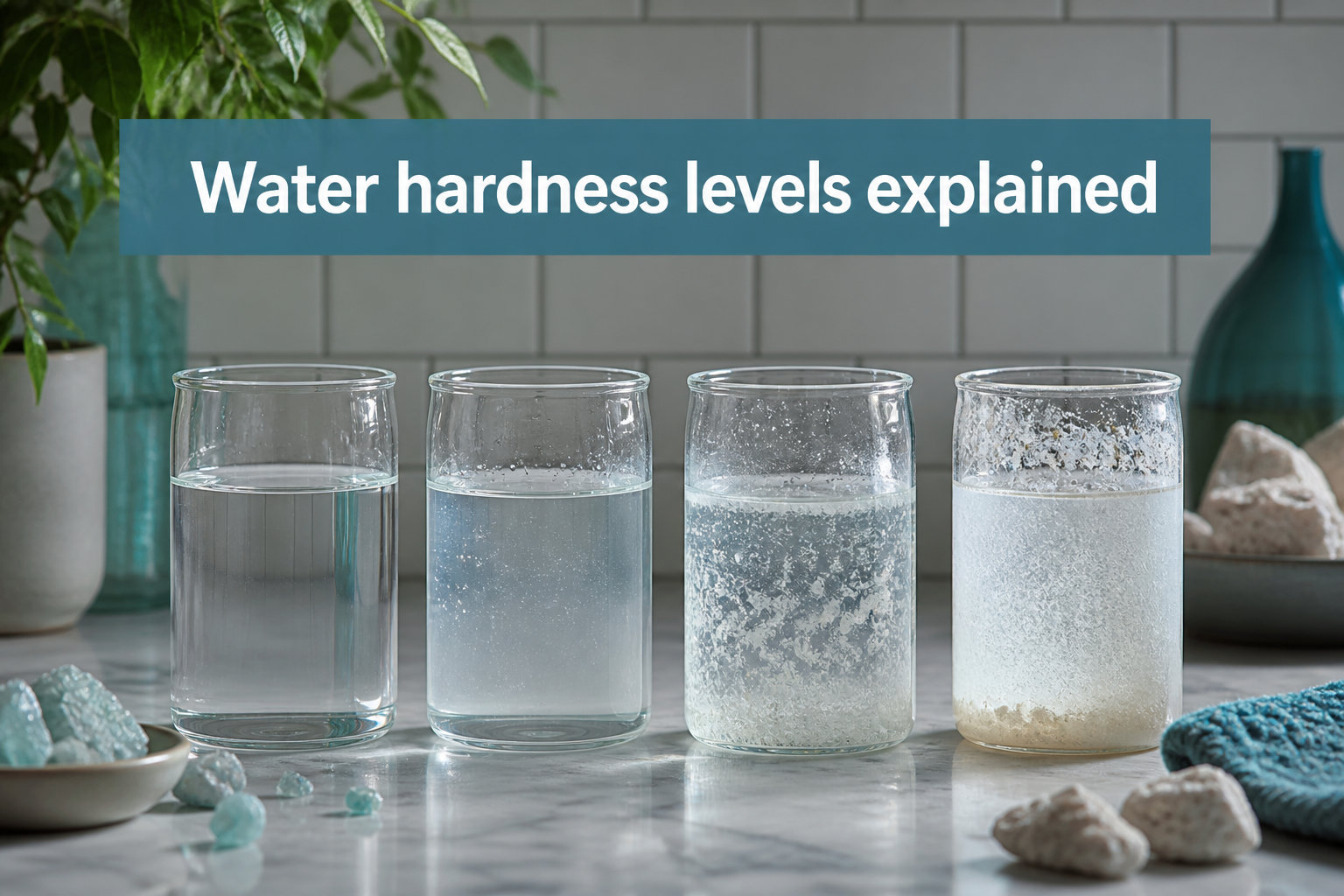
If you’ve ever noticed a chalky white ring around your faucets, a stubborn film on your shower door, or dishes that come out of the dishwasher looking spotty, you’re looking at the fingerprints of water hardness. Our team has spent months researching municipal reports, lab studies, and homeowner experiences to put together this complete guide to water hardness levels for 2026. By the end, you’ll know exactly what those numbers on your water bill mean, where your home falls on the hardness scale, and whether you need to do anything about it.
Table of Contents
What Is Water Hardness and What Causes It
Water hardness is the amount of dissolved calcium and magnesium minerals in your water. The more of these minerals your water picks up as it travels through rock and soil, the harder it becomes.
These minerals come from natural deposits underground. As rainwater seeps through limestone, chalk, and gypsum formations, it dissolves tiny amounts of calcium and magnesium along the way. By the time that water reaches your tap, it carries those minerals with it. Groundwater from wells tends to pick up more minerals than surface water from lakes and reservoirs, which is why well water is often much harder.
The U.S. Geological Survey (USGS) defines hardness by measuring how much calcium carbonate, expressed in milligrams per liter (mg/L) or parts per million (ppm), is dissolved in a sample. That single number drives every classification and recommendation that follows in this guide.
Why Calcium and Magnesium Matter
Calcium and magnesium are the two minerals that make water “hard.” They are also essential nutrients your body needs, which is one reason hard water is generally considered safe to drink. The problem isn’t health; it’s the side effects on your plumbing, appliances, and skin.
When hard water is heated or evaporates, calcium and magnesium don’t disappear with the steam. They stay behind as a hard, white crust called limescale or scale buildup. That same crust forms inside your pipes, water heater, and coffee maker, slowly reducing their efficiency and lifespan.
How Water Hardness Is Measured (GPG and PPM)
Water hardness is measured in two main units: grains per gallon (GPG) and parts per million (PPM), also written as milligrams per liter (mg/L). The two numbers describe the same thing, just on different scales.
One GPG equals 17.14 PPM. To convert GPG into PPM, multiply your GPG number by 17.14. To convert PPM into GPG, divide your PPM number by 17.14. If your water report says 120 mg/L, that’s about 7 GPG, which most guides classify as “hard.”
The reason both units exist comes down to history. PPM and mg/L are the standard scientific measurements used in lab testing and municipal water reports. GPG is the unit used by water softener manufacturers in the U.S. because softeners are sized by “grain capacity.” When you see both numbers on a softener spec sheet, the manufacturer is trying to make life easier for you.
A Quick Conversion Reference
Here’s the math shortcut our team uses when reading water reports:
- 1 GPG = 17.14 PPM (or mg/L)
- 3.5 GPG = 60 PPM (boundary of “moderately hard”)
- 7 GPG = 120 PPM (boundary of “hard”)
- 10.5 GPG = 180 PPM (boundary of “very hard”)
- 25 GPG = 428 PPM (extremely hard, seen in places like Region of Waterloo, Canada)
The Water Hardness Scale Explained
The water hardness scale sorts water into four categories based on its mineral content: soft, moderately hard, hard, and very hard. Most U.S. homes fall somewhere between “moderately hard” and “very hard.”
The standard classification, used by the USGS and adopted by most water-quality guides, looks like this:
| Classification | GPG | PPM (mg/L) | What You’ll Notice |
|---|---|---|---|
| Soft | 0 to 3.5 | 0 to 60 | Soap lathers easily, no mineral spots |
| Moderately Hard | 3.5 to 7 | 61 to 120 | Faint spots on glassware, slight scale buildup |
| Hard | 7 to 10.5 | 121 to 180 | Visible scale on faucets, dry skin after showering |
| Very Hard | Over 10.5 | Over 180 | Heavy scale, soap scum, appliance damage |
To answer the common question “is 20 GPG hard water?” yes, 20 GPG is well into “very hard” territory. At that level, you’ll see serious scale buildup on fixtures within weeks and almost certainly need a water softener to protect your water heater and dishwasher.
For most households, anything under 7 GPG (120 PPM) is considered acceptable for daily use without treatment. If your water is over 10 GPG (171 PPM), treatment becomes more of a practical necessity than an option.
Where Different Regions Fall
Hardness varies dramatically by region. In the U.S., the hardest water tends to flow through the Midwest (parts of Illinois, Indiana, Wisconsin) and the Southwest (Texas, New Mexico, Arizona). Cities like Madison, Wisconsin regularly report hardness levels above 25 GPG. Softer water are common in New England, the Pacific Northwest, and parts of the South.
How Hard Water Affects Your Home
Hard water leaves a trail of problems throughout your house, mostly because of scale buildup. The two appliances that suffer most are the ones that heat water regularly: your water heater and your dishwasher.
Inside a water heater, scale coats the heating element and the bottom of the tank. That insulation forces the heater to work harder and use more energy, shortening its lifespan. A water heater in very hard water can lose up to 25% of its efficiency over five years. We’ve seen tanks in the Midwest fail in under seven years purely from mineral buildup.
Your dishwasher shows the damage differently. Hard water leaves white spots and a chalky film on glasses and plates. The same scale clogs the spray arms and heating element inside the machine. Over time, you end up paying more for detergent and replacements than you would for a softener.
Other Common Household Effects
Beyond appliances, hard water creates these everyday annoyances:
- Soap scum on shower doors and tubs
- Faded, stiff laundry
- Clogged showerheads from mineral deposits
- Slow water flow from scaled-up pipes
- Higher soap and shampoo usage because lather is harder to build
Effects on Skin, Hair, and Health
Hard water leaves your skin feeling dry and your hair brittle because the minerals react with soap to form a thin film that rinses off poorly. That film blocks moisture from getting into your skin and clings to hair strands, making both feel rough.
For most people, hard water is not a health concern. The World Health Organization (WHO) has stated that hard water is generally safe to drink, and the extra calcium and magnesium can actually contribute a small amount to your daily mineral intake. People on sodium-restricted diets should be cautious with softened water because ion-exchange softeners add a small amount of sodium to the water.
If you have eczema or very dry skin, hard water can make symptoms worse. Switching to softer water often improves skin feel within a few weeks, which is something our team heard repeatedly from homeowners in Wisconsin and Texas.
How to Test Your Water Hardness at Home
You have three main options for testing your water hardness at home: test strips, titration kits, and professional lab analysis. Each comes with a different level of accuracy and cost.
Test strips are the cheapest and easiest. You dip a strip into a water sample and compare the color change to a chart on the bottle. They cost around $10 to $20 for a pack and give a decent ballpark reading. The accuracy isn’t lab-grade, but it’s enough to tell whether your water is soft, hard, or very hard.
Drop-count titration kits, like those from Hach, are more accurate. You add a reagent drop by drop to a measured water sample until the color changes. Count the drops and you have your GPG reading. These run $25 to $50 and are the standard for serious DIY testing.
Professional Lab and Municipal Reports
If you want certainty, order a professional lab test through a state-certified water lab. Costs range from $30 to $150 depending on the panel you choose. Your municipal water supplier also publishes an annual Consumer Confidence Report (CCR) with hardness data, though the numbers may not reflect your specific home if you have a private well.
Many homeowners skip the test entirely. As one experienced user on r/HomeImprovement put it, “You don’t need a test to know you have hard water when the showerhead looks like a stalactite after three months.” Visible mineral buildup on fixtures is one of the clearest signs.
Regional Variations and Well Water vs Municipal Water
Well water is almost always harder than municipal water because it spends more time underground picking up minerals. If your home draws from a well in a limestone region, expect readings in the “hard” to “very hard” range.
Municipal water is treated and often blended from multiple sources, which can lower hardness. Some utilities also soften their water at the plant. Your annual CCR will list the actual hardness value, so check there before buying any equipment.
If you live in a known hard-water region like Madison, WI; Phoenix, AZ; or San Antonio, TX, plan your home setup around hardness from day one. A whole-house softener pays for itself faster in these areas than anywhere else.
Frequently Asked Questions About Water Hardness Levels
What is a good water hardness level for a house?
A good water hardness level for most homes is below 7 GPG (120 PPM), which falls in the soft to moderately hard range. Above 10.5 GPG (180 PPM), most homeowners notice scale buildup and start looking at treatment options.
Is 20 GPG hard water?
Yes, 20 GPG is considered very hard water. At this level, you’ll see heavy scale buildup on fixtures, spotty dishes, dry skin, and reduced appliance lifespan. A water softener is strongly recommended.
Is water hardness of 7 bad?
A hardness level of 7 GPG (around 120 PPM) sits right at the boundary between moderately hard and hard. It’s not dangerous, but you may start seeing faint spots on glassware and minor scale on faucets.
How can I increase water hardness?
You can increase water hardness by adding a calcium and magnesium mineral supplement to a reverse osmosis system, crushing and dissolving a small amount of calcium carbonate, or blending in harder well water. Most people prefer to soften water, not harden it.
Is hard water bad for your health?
According to the World Health Organization, hard water is generally safe to drink and can contribute small amounts of beneficial calcium and magnesium. The main concerns with hard water are scale buildup on plumbing and dry skin, not health.
Key Takeaways on Water Hardness Levels
Water hardness levels come down to one thing: how much dissolved calcium and magnesium your water carries. The hardness scale runs from soft (under 3.5 GPG) to very hard (over 10.5 GPG), with most U.S. homes falling in the moderately hard to hard range.
If you remember only three things from this guide, make them these. First, 1 GPG equals 17.14 PPM, so you can convert between the two whenever you read a water report. Second, anything over 7 GPG will start causing visible scale and dry skin. Third, hard water is safe to drink but expensive on your plumbing, so testing your water and treating it when needed will save you money over time.
For 2026, our team’s recommendation is simple. Test your water once with a titration kit, check your number against the scale above, and decide whether your home needs a softener. Most homeowners in hard-water regions see the investment pay back in five to seven years through longer appliance life and lower soap usage.