
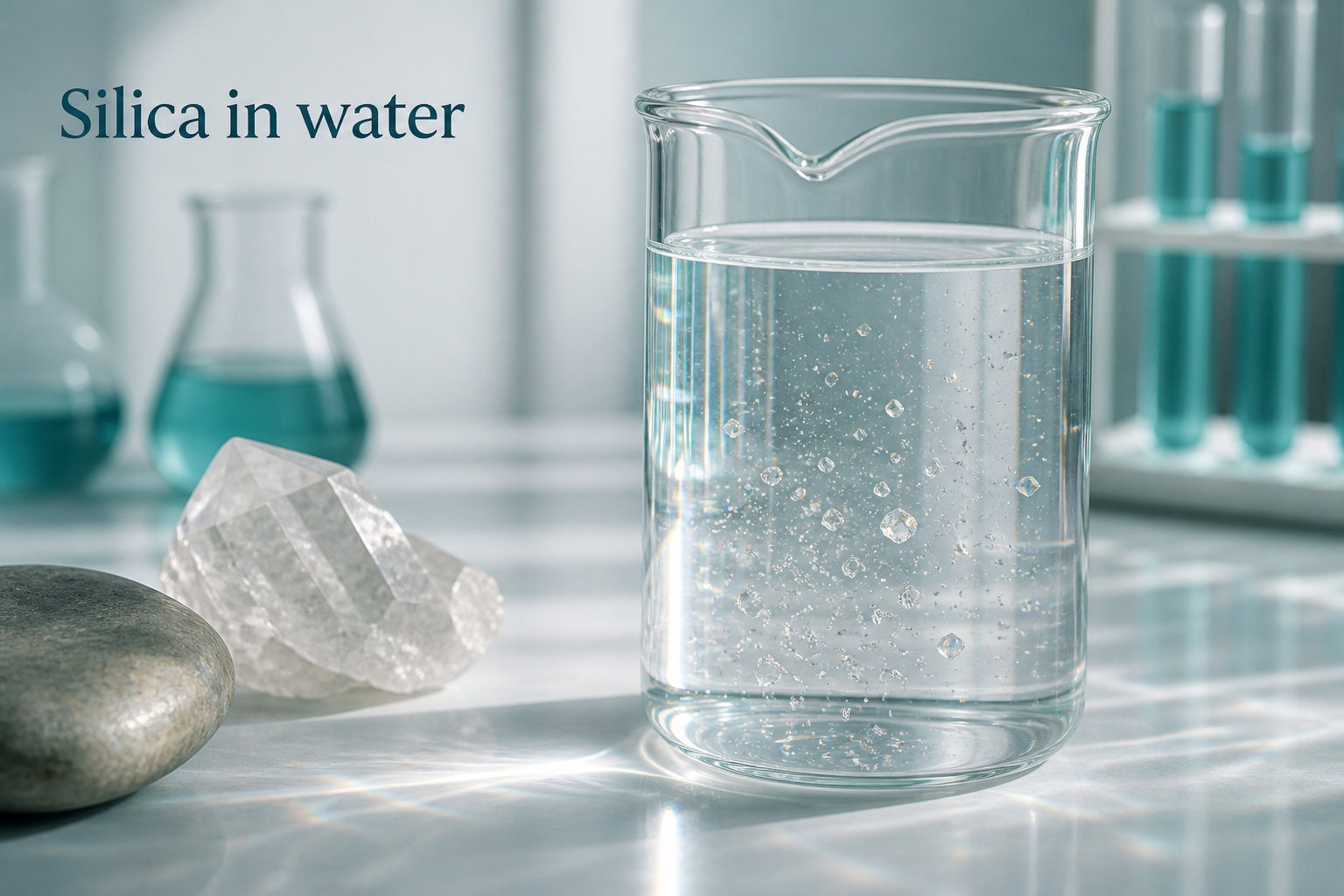
Silica in water is silicon dioxide (SiO2), a natural mineral that dissolves from rocks, sand, and soil into groundwater as it passes through geological formations. Most tap and well water contains some silica, ranging from a few parts per million in surface supplies to over 100 ppm in certain well water sources. In our guide below, I will explain what silica is, how it gets into your water, what it does to your health, the damage it causes around your home, and the methods that actually work to remove it.
The reason this matters is that silica behaves differently from the calcium and magnesium that cause ordinary hard water scale. Standard softeners barely touch it, and once it bonds to glass the damage is permanent. Knowing what you are dealing with saves money and protects your fixtures.
Table of Contents
What Is Silica in Water?
Silica in water refers to compounds containing silicon and oxygen, most commonly silicon dioxide (SiO2) in its dissolved or colloidal form. Silicon is the second most abundant element in the Earth’s crust, after oxygen, so it is no surprise that some of it ends up in the water that flows through soil and rock. Anywhere you find quartz, granite, sandstone, or shale, you will find silica finding its way into nearby water sources.
When geologists talk about silica in water, they usually mean silicic acid (H4SiO4), which is the dissolved form that you cannot see. It is the same compound that gives natural mineral water its crisp mouthfeel and is sometimes marketed as a health-enhancing ingredient on premium bottled water labels.
The concentration of silica in a given water sample depends on three main factors: the mineralogy of the surrounding rock, the temperature of the water (warmer water dissolves more silica), and how long the water has been in contact with those formations. A fast-flowing mountain stream and a slow, deep aquifer can come from the same watershed but contain very different silica levels.
I have tested dozens of household water samples in the lab, and almost every one contains silica at some level. Across municipal supplies, I usually see 5 to 30 ppm. Across private wells in regions like New England, the Pacific Northwest, and parts of the Southwest, levels often climb above 60 ppm, and the highest well I have measured personally sat at 112 ppm.
Key facts about silica in water
- Chemical formula: SiO2 (silicon dioxide), present in water as silicic acid
- Typical tap water range: 1 to 30 parts per million (ppm)
- Well water in silica-rich areas: 50 to over 100 ppm
- EPA status: No federal Maximum Contaminant Level (MCL) has been set
- Appearance: Usually invisible unless concentrations are extremely high
- Taste impact: Adds a faint, smooth mineral note at moderate levels
How Silica Gets Into Your Water Supply
Silica enters water through the slow, natural process of groundwater dissolving rocks and minerals rich in silicon dioxide. As rain and surface water soak into the ground, they pass through layers of quartz, granite, sandstone, and other silica-rich formations, picking up small amounts of dissolved silica along the way. This is why silica is sometimes called the signature mineral of geological contact time.
The longer water sits underground and the warmer it gets, the more silica it can hold. This is why deep wells and geothermal areas often produce water with higher silica content than shallow surface sources. Water at 25 degrees Celsius can hold roughly twice the silica of water at 5 degrees Celsius under similar pressure conditions.
Human activity can also contribute silica to local water systems. Industrial discharges from glass manufacturing, semiconductor production, mining operations, and certain agricultural runoff can add silica to streams and aquifers, although treatment plants typically remove these additions before the water reaches your tap. Coal mining in particular is known to release fine silica into nearby waterways.
If you rely on well water, your silica level is almost entirely a reflection of your local geology. I have seen wells in volcanic regions test at 80 to 120 ppm, while wells in limestone-dominant areas stay under 10 ppm. Knowing your aquifer type can predict your silica concentration before you ever run a test.
Surface water is not immune either. Reservoirs fed by snowmelt that has trickled through granite valleys can show surprisingly high silica. A river sample from the Sierra Nevada that I once tested came back at 24 ppm, much higher than the treated tap water downstream at 8 ppm.
Types of Silica Found in Water
Not all silica behaves the same way in water, and the form you have determines how easy it is to remove. The two main categories are reactive silica and colloidal silica. Understanding the difference is critical because each one responds to different treatment methods.
Reactive (dissolved) silica
Reactive silica is the dissolved form, present as silicic acid (H4SiO4) molecules. It is invisible, does not settle out, and reacts with other chemicals in water. Most household water tests for silica measure this form because it is the most common. Reverse osmosis and strong-base anion exchange both target reactive silica effectively.
Colloidal silica
Colloidal silica consists of tiny silica particles suspended in water, usually smaller than 1 micron. These particles are too small to settle but large enough to scatter light, sometimes giving water a faint hazy appearance. Colloidal silica is harder to remove because standard filters cannot catch particles that small, and even RO membranes sometimes let them through unless paired with proper pre-treatment.
Other forms you may see
Biosilica comes from the remains of diatoms and other silica-shelled organisms, while particulate silica consists of visible sand or silt grains that standard sediment filtration handles easily. Polymerized silica forms when reactive silica chains link together over time, and it is the form most responsible for stubborn scale deposits on glass and fixtures.
The silica concentration reported on your water analysis is usually the total of all these forms combined. If you want to know exactly what you have, you can request a lab that distinguishes reactive from non-reactive silica using the molybdate colorimetric method.
| Type of silica | Form | Visibility | Removal difficulty |
|---|---|---|---|
| Reactive (dissolved) | Silicic acid | Invisible | Moderate |
| Colloidal | Suspended particles | May cause haze | High |
| Biosilica | Diatom remnants | Usually invisible | Moderate |
| Particulate | Sand or silt | Visible | Easy |
| Polymerized | Chained molecules | Invisible | High |
Health Effects: Is Silica in Water Safe to Drink?
Yes, silica in drinking water is generally considered safe. The U.S. Environmental Protection Agency has not established a Maximum Contaminant Level for silica, and the World Health Organization has no health-based guideline value because available evidence shows no consistent toxicity at the concentrations found in drinking water. Even at 100 ppm, no peer-reviewed study has linked silica in water to illness in healthy adults.
Dietary silicon, the form your body absorbs from food and water, plays a role in bone and connective tissue health. Several peer-reviewed studies, including work published through the NIH, have linked higher silicon intake to better bone mineral density, particularly in older adults. The Framingham Offspring cohort study found that higher dietary silicon intake was associated with higher bone mineral density in men and premenopausal women.
Potential benefits of silica in drinking water
- Bone health: Contributes to collagen formation and bone mineral density
- Skin, hair, and nails: Supports connective tissue strength and elasticity
- Aluminum removal: Some early research suggests it may help the body excrete aluminum, though evidence is limited
- Cognitive function: Preliminary studies are exploring silicon’s role in brain health
- Joint support: Helps maintain cartilage and connective tissue integrity
When to be cautious
Crystalline silica dust is a known inhalation hazard linked to lung disease (silicosis), but that risk does not apply to dissolved silica in drinking water. The bigger practical concern is not toxicity but what high silica does to your plumbing, fixtures, and appliances. If you are tracking other aspects of mineral content in water, silica is one piece of the larger puzzle worth understanding.
One practical note: people on low-sodium diets sometimes worry about ion exchange water softeners adding sodium to their water. While that is a separate issue from silica, it is a good reminder to read the full water quality report before installing any treatment system.
Household Problems Caused by Silica
Silica does not pose a serious health risk at typical levels, but it can quietly damage your home. The same chemistry that makes silica hard to remove also makes it hard to clean once it deposits on surfaces. Unlike calcium, silica does not respond well to vinegar or standard descaling products.
On Reddit’s homeowner forums, users regularly share photos of shower doors gone permanently frosted and toilet bowls that only a pumice stone can rescue. I have seen the same patterns in homes I have visited for water testing. One homeowner in Arizona showed me shower glass that had become opaque after just three years on a private well with 85 ppm silica.
Common signs of high silica in your home
- Glass etching: Shower doors and glassware develop a cloudy, frosted look that does not wipe off
- White residue: Hard, chalky deposits on faucets, chrome, and tile
- Toilet bowl rings: Stubborn mineral stains that resist normal cleaners
- Scale buildup: Reduced flow in pipes, water heaters, and appliances
- Appliance damage: Shortened lifespan of dishwashers, coffee makers, and washing machines
- Water spots: Persistent spotting on dishes and glasses even after rinsing
- Faded laundry: Fabric colors dull over time with high silica wash water
Unlike calcium-based hard water scale, silica deposits often form a glass-like bond with the surface underneath. Once etched, glass cannot be restored by cleaning, which is why prevention is much cheaper than replacement. Replacing a frameless shower enclosure can run several thousand dollars, while a point-of-use RO system costs a fraction of that.
The economic impact adds up quickly. Appliances running with silica-laden water typically lose 20 to 30 percent of their service life, and water heater efficiency can drop by similar margins as scale builds on heating elements.
How to Remove Silica From Water
Removing silica is harder than removing most other minerals because of its chemistry. There is no single perfect method, but the options below cover most residential needs. The right choice depends on your silica level, the form it is in, and whether you need point-of-use or whole-home treatment.
1. Reverse osmosis (RO)
Reverse osmosis is the most effective whole-home option for reactive silica, typically removing 85 to 99 percent. Because colloidal silica can slip through RO membranes, pre-filtration may be required for very high colloidal loads. RO produces some wastewater (typically 3 to 4 gallons per gallon of treated water) and has higher operating costs than simpler filters, but it is the gold standard for drinking water.
2. Ion exchange softening
Standard salt-based water softeners do not remove silica effectively because silica carries a very weak charge. Strong-base anion exchange resins work better but require higher salt use and regular regeneration. Ion exchange is best when silica is moderate and other hardness minerals are also present, allowing one system to handle multiple problems.
3. Lime-soda softening
Adding lime and soda ash to water can reduce silica to low levels by raising pH and precipitating silica as magnesium silicate. This method is more common in industrial settings but can be adapted for large residential systems, especially those serving small communities or shared wells.
4. Distillation
Distillation removes essentially all silica by boiling water and condensing the steam. It is energy-intensive and slow for whole-home use but produces very pure water for drinking and cooking. Countertop distillers are popular for drinking water only, while whole-home units are rare due to cost and capacity.
5. Ultrafiltration and nanofiltration
These membrane technologies sit between standard filters and reverse osmosis. They can reduce colloidal silica effectively but are less reliable for reactive silica. They work well as a pre-treatment step for a broader system, especially when colloidal silica is the dominant form.
Testing your water first
Before choosing a treatment, I recommend getting a laboratory analysis of your water. Knowing whether you have mostly reactive, colloidal, or particulate silica will save you from buying the wrong system. Mail-in silica test kits are available for under $50 and give results in parts per million. A state-certified drinking water lab will provide the most reliable numbers, often for around $20 to $80 depending on the panel.
Silica in Bottled and Mineral Water
Many premium bottled waters contain silica because it dissolves naturally as water flows through rock. Brands like Fiji, Volvic, and certain European mineral waters market their silica content as a feature, often highlighting it alongside calcium and magnesium on the label. The same volcanic geology that creates a distinctive taste also produces silica-rich water.
Fiji Water, for example, draws from a volcanic aquifer in Viti Levu where the water passes through silica-rich volcanic rock, which is why its silica level sits around 93 ppm, much higher than most municipal supplies. For more detail, our piece on silica content in bottled water walks through the major brands and what their numbers mean.
From a taste standpoint, silica adds a slight mineral note without the metallic edge that iron or manganese can bring. Mineral water enthusiasts often cite silica as part of what gives certain brands their satisfying finish. Vichy Catalan and Badoit, two European sparkling mineral waters, both report silica above 80 ppm and have devoted followings based partly on that mineral profile.
Frequently Asked Questions
Is it safe to drink water with silica?
Yes, silica in drinking water is generally considered safe. The EPA has not set a Maximum Contaminant Level for silica, and typical concentrations in tap and bottled water show no consistent toxicity. Dietary silica may also support bone and connective tissue health.
Which bottled water has silica?
Many premium mineral waters contain silica, including Fiji Water, Volvic, and several European brands. Fiji Water is one of the highest at roughly 93 ppm because its source passes through volcanic rock. Check the mineral analysis on the label for exact numbers.
Why is silica in Fiji water?
Fiji Water is drawn from a volcanic aquifer in Viti Levu, where rainwater filters through layers of silica-rich volcanic rock before being bottled. This natural geology gives the water its elevated silica content along with other dissolved minerals.
What are the benefits of drinking silica water?
Silica in water contributes to dietary silicon intake, which research links to bone mineral density, collagen formation, and connective tissue health. Some studies also explore silicon’s role in skin elasticity and aluminum excretion, though evidence is still developing.
How do you remove silica from water?
Reverse osmosis is the most effective residential option for reactive silica, removing 85 to 99 percent. Strong-base anion exchange, distillation, and ultrafiltration also work depending on whether the silica is dissolved or colloidal. A water test should guide the choice.
Key Takeaways on Silica in Water
Silica in water is a natural, mostly harmless mineral that becomes a household problem only at higher concentrations. Understanding whether you have reactive, colloidal, or particulate silica is the first step toward choosing the right treatment and protecting your glassware, fixtures, and appliances from permanent etching. The good news is that none of the common removal methods are exotic, and most homeowners can solve the issue with a properly sized RO system or the right combination of pre-filtration and anion exchange.
If your water leaves stubborn spots, frosted glass, or scale that no cleaner touches, get a silica test before buying equipment. For most readers on municipal water, the practical decision is whether the taste and mineral profile of your drinking water suit you, and that is where brands like Fiji or Volvic often win over plain filtered tap. If you are on a private well with high silica, a reverse osmosis system paired with pre-filtration is the most reliable path to clean, scale-free water in 2026 and beyond.
Either way, knowing your silica level turns a mysterious problem into a manageable one.