
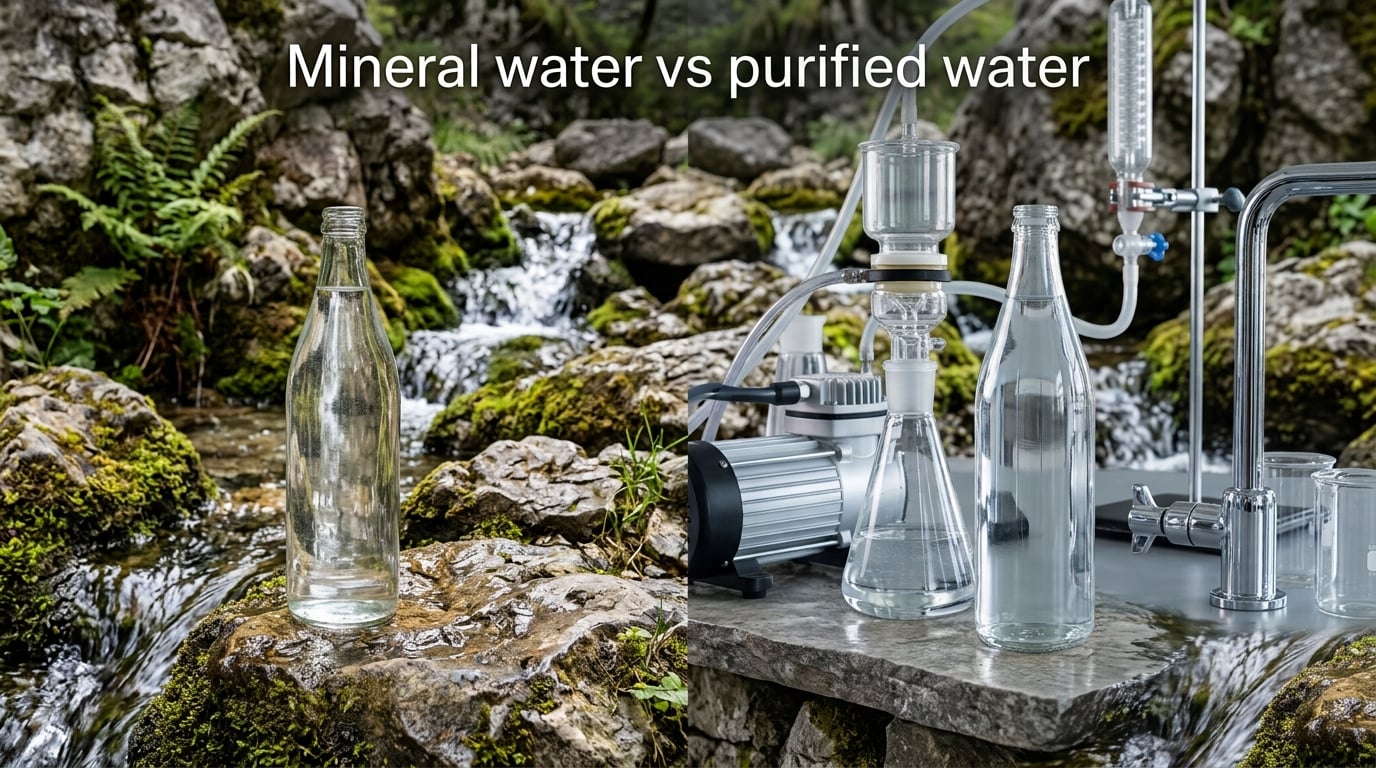
If you’ve ever stood in a grocery store aisle comparing water bottles, you know how confusing the labels can get. Mineral water, purified water, spring water, distilled water — all of them come in bottles, all of them are technically water, and yet they’re fundamentally different products with different origins, mineral compositions, and best uses.
The core difference between mineral water vs purified water comes down to two things: where the water comes from, and what’s left in it by the time you drink it. Mineral water comes from a geologically protected underground source and naturally contains at least 250 parts per million of dissolved minerals. Purified water starts from virtually any source and is then processed until fewer than 10 parts per million of dissolved solids remain.
That gap — 250 ppm versus under 10 ppm — explains almost everything: the taste differences, the health implications, and why one type is recommended for CPAP machines while the other is associated with electrolyte replenishment. In 2026, consumers have more water choices than ever, and understanding what separates these two types is genuinely useful information.
Table of Contents
What Is Mineral Water?
Mineral water is water that flows from a geologically and physically protected underground source. Under FDA regulations, natural mineral water must contain no less than 250 parts per million of total dissolved solids — and those minerals must be naturally present at the point where the water emerges from the source.
That last requirement is the critical one. The minerals cannot be added after the fact. If a manufacturer adds minerals post-processing, the product must be labeled differently and cannot carry the “natural mineral water” designation under standard definitions.
The minerals found in natural mineral water typically include a mix of the following, with concentrations varying significantly by source:
Calcium — supports bone density, nerve function, and muscle contractions; typically ranges from 20 to 400 mg/L depending on the geology of the source
Magnesium — supports muscle recovery, sleep quality, and blood sugar regulation; typically 10 to 200 mg/L
Potassium — helps regulate blood pressure and fluid balance; typically 1 to 50 mg/L in most mineral waters
Sodium — supports fluid balance; varies widely between brands, from under 10 mg/L in low-sodium mineral waters to over 200 mg/L in some high-sodium varieties
Bicarbonate — buffers body acidity, supports digestion and acid-base balance; commonly 100 to 2,000 mg/L in higher-mineral waters
Silica — associated with skin and hair health; typically 10 to 80 mg/L
The specific mineral profile depends entirely on the geology of the source. A spring emerging through limestone will be high in calcium. Water traveling through magnesium-rich dolomite picks up high magnesium. This geological fingerprint is exactly why two mineral water brands can taste dramatically different from each other.
Mineral water acquires those minerals naturally over years or even decades as water percolates down through rock layers before rising to the surface. Some brands like Contrex and Vichy are exceptionally rich in minerals because of the specific geology they pass through — which is exactly why they have such an intense, bold taste. If you want to understand why high-mineral content waters like Contrex and Vichy taste so intensely mineral, the answer lies in the rock formations their sources pass through.
Processing for natural mineral water is minimal by design. Allowable treatments include removing sediment and particulates, adding or removing CO₂ for sparkling or still versions, and sometimes UV treatment or ozonation for microbial safety. What it never includes is any treatment that alters the mineral content — doing so would disqualify the product from the natural mineral water designation.
What Is Purified Water?
Purified water can start from virtually any water source — municipal tap water, groundwater, or surface water. What defines it is the end result: purified water must contain fewer than 10 parts per million of total dissolved solids, as required by FDA and EPA standards.
For perspective, that’s 25 times less mineral content than the minimum required for mineral water. The purification process removes almost everything: minerals, salts, metals, bacteria, viruses, and organic compounds.
Three main methods are used to produce purified water:
Reverse osmosis (RO) forces water at high pressure through a semi-permeable membrane with pores measuring just 0.0001 microns. At that scale, dissolved minerals and the vast majority of contaminants cannot pass through. RO is the most common method for both bottled purified water and home filtration systems, and a well-maintained system removes up to 99% of TDS along with heavy metals, chlorine byproducts, and chemical contaminants.
Distillation heats water to boiling, collects the steam, and condenses it back to liquid in a separate chamber. Because most minerals and contaminants don’t evaporate with the water vapor, the condensed result is highly pure. Distillation also kills any microorganisms present in the original water source, making distilled water effectively sterile.
Deionization (DI) passes water through ion exchange resins that remove positively and negatively charged ions — including calcium, magnesium, and other dissolved minerals. Deionization is often used in combination with reverse osmosis in laboratory and industrial settings that require extremely high purity levels.
Many commercial brands also add UV treatment or ozonation as a final step for microbial safety. Some purified water products re-add trace minerals after purification for taste improvement — if they do, the label will state “minerals added for taste” or “enhanced with minerals.”
One thing worth clarifying: filtered water is not the same as purified water. A Brita pitcher or a refrigerator filter improves taste and reduces some contaminants, but it does not reduce TDS to the under-10 ppm threshold that defines purified water. Understanding how filtration affects mineral content is helpful if you’re comparing your home-filtered tap water to bottled options — the two are in completely different categories.
Mineral Water vs Purified Water: Key Differences at a Glance
Here’s a direct comparison of the most important differences between these two water types:
| Feature | Mineral Water | Purified Water |
|---|---|---|
| Source | Single protected underground spring or aquifer | Any source (tap, groundwater, surface water) |
| TDS (total dissolved solids) | 250 ppm minimum — FDA requirement | Less than 10 ppm — FDA requirement |
| Minerals present | Natural calcium, magnesium, potassium, sodium, bicarbonate, silica | Essentially none — unless re-added for taste |
| Processing | Minimal: sediment removal, optional CO₂ adjustment | Extensive: reverse osmosis, distillation, and/or deionization |
| Taste | Distinctive mineral character, varies by source | Neutral, clean, and flat |
| Best for | Daily hydration, natural mineral intake, athletic electrolytes | CPAP machines, baby formula, medical diets, neutral taste |
| Source transparency | Must name specific source on label | No source disclosure required |
Source and Origin: Where Each Type Comes From
Mineral water must come from a single, named underground source. That source must be geologically protected from surface contamination, meaning the water’s long passage through rock layers does the filtration work naturally before it ever reaches a bottling facility.
This source requirement carries practical significance beyond regulatory compliance. The geological protection that defines mineral water also means it’s typically isolated from agricultural runoff, industrial pollutants, and other surface contaminants that can affect open water sources. The rock acts as a natural multi-year filter, and the result is a product with a consistent mineral profile that doesn’t change significantly from batch to batch.
Purified water has no source requirement at all. Bottled purified water brands frequently start with municipal tap water. The finished product quality depends entirely on the purification process applied — and a well-engineered reverse osmosis system can produce extremely clean water regardless of the starting point.
For consumers who prioritize transparency — knowing where their water originates — mineral water provides that by default. The source name and location must appear on the label. Purified water labels describe the process but are not required to identify where the source water came from.
Mineral Content and Total Dissolved Solids (TDS)
Total dissolved solids is the combined measurement of all dissolved substances in water — minerals, salts, metals, and other compounds. It’s expressed in parts per million or milligrams per liter, and these are numerically equivalent: 100 ppm equals 100 mg/L.
Here’s how TDS values compare across the types of water most commonly found in stores:
Purified water: under 10 ppm
Distilled water: typically 0 to 5 ppm
Spring water: varies widely, usually 50 to 500 ppm
Mineral water: 250+ ppm (FDA minimum)
High-mineral waters such as Contrex, Vichy, and Gerolsteiner: often 1,500 to 2,500 ppm
Average US tap water: 100 to 500 ppm depending on local source
For mineral water, it’s worth looking beyond the TDS number to what’s actually dissolved in it. A water with 300 ppm TDS dominated by sodium offers very different health value than one with 300 ppm split between calcium and magnesium. The detailed mineral analysis — usually printed in small type on the side or back label — tells the full story of what you’re drinking.
Understanding mineral composition in water goes well beyond just calcium and magnesium. Components like silica often appear on label analysis tables but get little attention from consumers. If you’re curious about why silica content in bottled water matters, the mineral breakdown varies significantly between brands and source regions.
Purified water at under 10 ppm contributes essentially zero dietary minerals. If you’re evaluating water types partly based on nutritional contribution, the comparison is clear: purified water offers none, while mineral water offers measurable amounts — but the specific amounts vary dramatically depending on which brand and source you’re choosing.
How Each Type Is Treated
The treatment philosophy for mineral water and purified water runs in almost exactly opposite directions. One preserves as much as possible; the other removes as much as possible.
Mineral water processing is deliberately constrained. Regulations require that the water’s mineral composition remain unchanged from what it was at the source. Allowable treatments include filtration to remove sediment and particulates, CO₂ adjustment for sparkling or still formats, UV sterilization, and ozonation for microbial control. What is explicitly prohibited is any treatment that alters the mineral content — doing so disqualifies the product from natural mineral water status.
Purified water treatment takes the opposite approach, aiming for maximum removal of everything dissolved. Reverse osmosis membranes filter to 0.0001 microns — far smaller than any mineral ion. Distillation relies on the fact that water evaporates but dissolved minerals don’t. Deionization uses the electrical charge of mineral ions to strip them out of the water stream.
These processes are thorough enough that purified water is the required water type for a range of specific applications:
CPAP and BiPAP machines — mineral deposits from tap or mineral water would damage the humidifier chambers over time
Medical equipment sterilization and laboratory experiments requiring zero dissolved contamination
Baby formula preparation, where consistent and minimal mineral content is important
Dialysis machines and hospital equipment
High-end electronics manufacturing, where even trace mineral deposits cause product defects
Some commercial purified water brands choose to add back trace minerals after purification — typically calcium, magnesium, and a small amount of potassium — to improve the flat taste of highly purified water. If they do this, the label discloses it. The product is still legally classified as purified water because the purification step occurred; the mineral addition is an optional final step for consumer preference.
Taste Differences: What to Expect
Mineral water has a more complex and sometimes assertive taste because of its dissolved mineral load. High calcium concentrations create a full, slightly chalky mouthfeel. Elevated magnesium can contribute mild bitterness at high concentrations. Bicarbonate gives a crisp finish with a lightly alkaline quality. High sulfate levels add a dry, faintly astringent note at the back of the palate.
People who grow up in a region with a particular water source often find that other waters taste wrong — that’s the mineral fingerprint effect. Two people from different regions can have radically different opinions on what “water is supposed to taste like,” and both are responding to what their palate considers normal mineral content.
Purified water tastes neutral, clean, and what many people describe as flat. In online forums and community discussions, a consistent descriptor that comes up is “dry” — users note that purified water doesn’t feel as satisfying or quenching as mineral or spring water, even though the actual hydration physics are identical. The absence of dissolved minerals is what creates that flat, dry sensation that some people find off-putting.
For cooking and brewing applications, neutrality is genuinely an advantage. Purified water doesn’t compete with food flavors and works especially well for delicate dishes, broths, or coffee and tea where you want the water to be invisible to the palate. Specialty coffee and espresso enthusiasts tend to be highly specific about water mineral content — most specialty coffee guides recommend water with 150 to 200 ppm TDS for ideal extraction, which falls between purified water and full mineral water territory.
Health Benefits of Mineral Water vs Purified Water
Both types of water support daily hydration equally well — plain water is plain water from the body’s perspective when it comes to cellular hydration. The health differences show up in specific nutritional and safety contexts rather than in basic hydration function.
Mineral water health benefits come from its mineral content:
Calcium contribution: Studies suggest calcium from water is absorbed comparably to calcium from food. For people with limited dairy intake or on plant-based diets, a calcium-rich mineral water at 150+ mg/L can make a meaningful contribution to daily calcium requirements.
Magnesium support: Magnesium deficiency is widespread in Western diets — estimated to affect a significant portion of the adult population. A mineral water with 50+ mg/L magnesium contributes noticeably to daily requirements, supporting muscle function, sleep quality, and cardiovascular health.
Bicarbonate balance: High-bicarbonate mineral waters may help buffer dietary acid loads, particularly beneficial for people eating high-protein or high-acid diets. Some research connects regular bicarbonate-rich water consumption with improved acid-base balance.
Natural electrolytes for athletes: Mineral water provides calcium, magnesium, potassium, and sodium without the added sugars or artificial ingredients found in sports drinks. For moderate activity, it’s a natural electrolyte option worth considering.
Purified water health benefits work differently:
Removes virtually all contaminants including heavy metals like lead and arsenic, chlorine disinfection byproducts, pesticide residues, and pharmaceutical traces that can persist in tap water
Provides a reliable safe option for people with compromised immune systems who need to avoid any microbial risk
Suitable for infants whose bodies are more sensitive to variable mineral concentrations, particularly high sodium or nitrate levels
Appropriate for individuals on medically supervised diets requiring strict control over mineral intake
For healthy adults eating a varied diet, the everyday health difference between mineral water and purified water is real but relatively modest. Dietary mineral intake from food typically outweighs what either water type contributes. The mineral water advantage becomes more meaningful when dietary mineral sources are otherwise limited — on low-dairy diets, very restrictive eating plans, or for people who don’t eat a wide variety of foods.
Kidney Health: What You Need to Know Before Choosing
This topic gets far less coverage than it deserves, because it directly affects a significant number of people who are trying to make smart water choices.
For people with healthy kidneys and no kidney stone history, regular mineral water consumption is safe. The kidneys process and excrete mineral loads from water efficiently, and there’s no established risk from normal mineral water consumption for otherwise healthy individuals.
The situation changes for people with chronic kidney disease (CKD) or a history of kidney stones:
Calcium oxalate kidney stones: High-calcium mineral waters may increase stone formation risk in people who are already prone to calcium oxalate stones. This doesn’t mean everyone with a stone history must avoid mineral water — the relationship is complex and depends on the individual’s stone type and calcium handling — but it’s a conversation worth having with a urologist before choosing high-calcium water.
CKD and mineral accumulation: As kidney function declines, the ability to regulate mineral excretion decreases. Calcium, potassium, and phosphate can accumulate to harmful levels in the bloodstream if intake isn’t controlled. For moderate to advanced CKD, purified water removes the risk of unintended mineral loading from drinking water.
Sodium-restricted diets: Many people with CKD, hypertension, or heart failure are placed on sodium-restricted diets. Some mineral waters contain 100 to 200+ mg/L of sodium, which adds up meaningfully across daily water consumption. Checking the sodium content on the mineral analysis label is important for anyone on a low-sodium protocol.
Dialysis patients and potassium: Dialysis removes excess potassium from the blood, but there are limits to how much can be cleared per session. High-potassium mineral waters can complicate potassium management for people on dialysis.
If you have any kidney-related health condition, check with a nephrologist or renal dietitian before switching to mineral water as your primary drinking water. For CKD patients without specific professional guidance, purified water is typically the recommended default because it removes one variable from an already complicated health picture.
When to Choose Mineral Water and When to Choose Purified Water
Here’s a practical decision guide based on actual use cases rather than marketing claims:
Choose mineral water when:
You want to naturally supplement calcium and magnesium intake without taking additional supplements
You’re on a plant-based, low-dairy, or otherwise mineral-limited diet and want water to contribute to daily mineral goals
You prefer water with a distinctive, complex taste profile over neutral-tasting water
You’re active and want a natural source of electrolytes — calcium, magnesium, potassium, and sodium — from your drinking water
You value source transparency and want to know exactly where your water originates
You’re drinking water with meals and want the mineral content to complement rather than compete with food flavors
Choose purified water when:
You need water for a CPAP or BiPAP machine — mineral deposits from mineral or tap water will damage the humidifier chamber over time
You’re mixing baby formula — infants are sensitive to variable mineral concentrations, and purified water provides consistency
You’re on a sodium-restricted or mineral-restricted diet and need to control intake precisely
You have CKD, a kidney stone history, or another condition where mineral intake needs to be monitored — unless your doctor has cleared mineral water specifically
You prefer neutral-tasting water that doesn’t influence the flavor of coffee, tea, or cooking
Your local tap water quality is poor and you want the highest level of contaminant removal available
For everyday hydration with no specific health needs or taste preferences to guide you, both types work equally well for keeping you hydrated. The decision often comes down to whether you want your water to contribute something measurable — minerals — or to stay as neutral and pure as possible.
Environmental Impact of Mineral Water vs Purified Water
From an environmental standpoint, both types share the same primary problem: single-use plastic packaging. A plastic bottle of mineral water and a plastic bottle of purified water have similar packaging footprints, and neither type is inherently better or worse on that dimension when bought in plastic.
Mineral water sourcing does create one indirect environmental positive. Because brands must protect the geological source from contamination, many mineral water producers maintain significant buffer zones of protected land around their spring areas. Some of the world’s major mineral water sources are associated with meaningful conservation of natural land and aquifer systems — a byproduct of the source protection requirement.
Home RO systems for purified water production have their own environmental tradeoff: wastewater generation. A typical residential reverse osmosis unit produces 2 to 4 gallons of mineral-concentrate waste for every gallon of purified water it outputs. Commercial systems are more efficient, but waste generation is still a factor to account for.
The most environmentally sound choice for either water type is glass or aluminum packaging for bottled options, or transitioning to an at-home purification system if you primarily use purified water. A quality home RO system produces purified water at a fraction of the cost and plastic waste of buying it bottled every week.
How to Read Water Labels
Water labels contain regulated information that most shoppers walk past without reading. Here’s what actually matters when you’re evaluating what’s in the bottle:
Water type designation: “Natural mineral water,” “purified water,” “spring water,” and “drinking water” are all legally regulated terms in the US. They cannot be used interchangeably. If the label says “natural mineral water,” it has to meet the 250 ppm TDS minimum and come from a named underground source.
Source name and location: Required for mineral water, not required for purified water. The presence of a specific named source — such as “Source Cachat, Évian-les-Bains, France” — is a meaningful quality signal and a regulatory requirement, not just marketing.
Mineral analysis table: Usually printed on the side or back panel in small type. Lists mg/L values for calcium, magnesium, sodium, potassium, bicarbonate, sulfate, and sometimes silica. This table is where you see what you’re actually drinking — the TDS number alone doesn’t tell you whether the dissolved solids are beneficial minerals or something less desirable.
TDS value: The total dissolved solids figure in ppm or mg/L gives you a quick read on overall mineral concentration. Under 10 ppm tells you it’s purified. 250 ppm or above meets mineral water minimum. Many mineral waters fall in the 300 to 800 ppm range for everyday drinking, with specialist high-mineral waters going well above 1,000 ppm.
“Minerals added for taste”: On purified water products, this phrase indicates trace minerals were introduced post-purification to improve the flat taste of highly treated water. The product is still legally purified water — the purification step happened, and the re-added minerals are disclosed.
If a bottle says “natural mineral water,” it must contain at least 250 ppm TDS with those minerals naturally present at the source — no exceptions under FDA labeling rules. If it says “water” or “drinking water” without a more specific designation, it meets basic drinking water safety standards but may not qualify as either mineral or purified water under precise regulatory definitions.
Frequently Asked Questions
Which is better, purified water or mineral water?
Neither is universally better — it depends entirely on your situation. Mineral water provides natural calcium, magnesium, and other minerals that can supplement dietary intake, particularly on plant-based or low-dairy diets. Purified water is the better choice for medical equipment, baby formula, sodium-restricted diets, and people with kidney disease. For healthy adults with no specific health or taste requirements, both are equally effective for hydration.
Is mineral water the healthiest water?
Mineral water is among the healthiest options for most people because of its natural mineral content — particularly calcium, magnesium, and bicarbonate — which contribute meaningfully to daily nutritional needs. That said, the healthiest water for any given individual depends on their specific health conditions, dietary needs, and intended use. For people with chronic kidney disease, kidney stones, or sodium-restricted diets, purified water may be the healthier choice.
Who should not drink mineral water?
People who should be cautious with mineral water include those with chronic kidney disease (CKD), a history of recurrent calcium oxalate kidney stones, hypertension on a sodium-restricted diet if the mineral water is high in sodium, and dialysis patients who need to limit potassium intake. Infants should not be given high-mineral water because their systems cannot tolerate variable mineral concentrations. Anyone with a kidney-related condition should consult a nephrologist or renal dietitian before making mineral water their primary drinking water.
Is mineral water good for your kidneys?
For people with healthy kidneys and no stone history, mineral water is generally safe and poses no established kidney risk. For people with chronic kidney disease or a history of kidney stones, the answer depends on the specific mineral content of the water and the individual’s medical situation. High-calcium, high-sodium, or high-potassium mineral waters can be problematic for CKD patients. Always consult a nephrologist before switching to mineral water as your primary hydration source if you have any kidney concerns.
What is the disadvantage of mineral water?
The main disadvantages of mineral water include higher cost compared to purified or tap water, variable mineral content between brands (which makes precise control of mineral intake difficult), potential sodium accumulation for people on sodium-restricted diets, and possible kidney stone risk for susceptible individuals. Some people also find the mineral taste too assertive compared to the neutral character of purified water, particularly for coffee brewing or delicate cooking applications.
What is the healthiest type of water to drink?
For most healthy adults, natural mineral water from a reputable, named source offers the best combination of hydration and natural mineral supplementation. Filtered tap water is also an excellent daily choice in areas with clean, well-maintained municipal supplies. Purified water is the healthiest option for people with specific health conditions requiring low mineral intake, or for particular applications like baby formula preparation and CPAP machines. The healthiest water is ultimately the one that fits your individual health profile, tastes good enough that you’ll drink adequate amounts, and comes from a source you trust.
The Bottom Line on Mineral Water vs Purified Water
Understanding mineral water vs purified water comes down to a fundamental difference in philosophy. Mineral water preserves what geology spent decades building — a natural mineral signature from a protected underground source. Purified water removes what modern water sources contain — stripping dissolved content down to near-zero for maximum purity.
For most healthy adults in 2026, mineral water offers a slight nutritional edge through its natural calcium and magnesium content, making it particularly valuable for people on low-dairy or plant-based diets. For specific applications — CPAP machines, infant formula, CKD management, or sodium-restricted diets — purified water is the clear and medically appropriate choice.
Both types are safe, both are widely available, and both will keep you hydrated. The decision is really about what else you want from your water: natural mineral contribution or absolute purity. Once you know that, the choice is straightforward.