
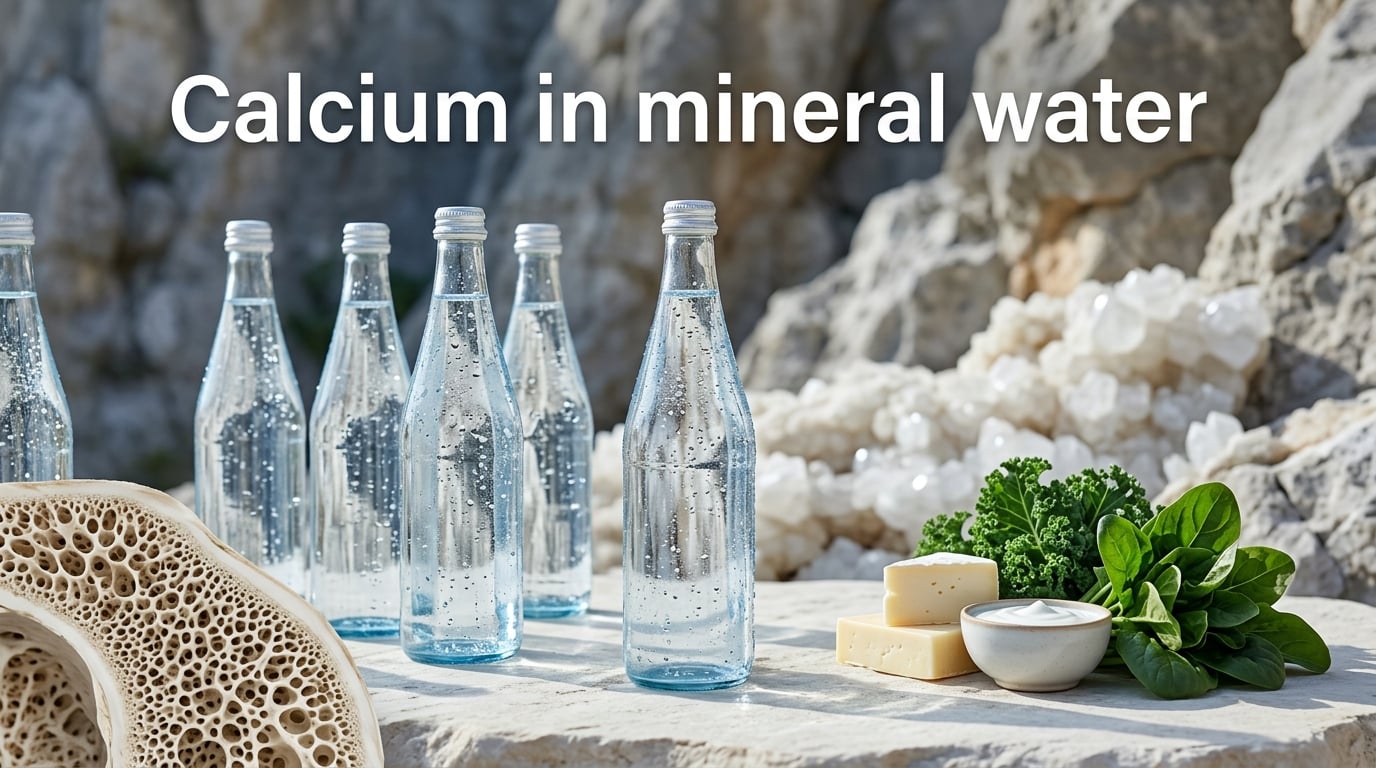
Calcium in mineral water is one of those quiet details most people skip right past on a nutrition label. You read the sodium content, maybe glance at the pH, then twist off the cap and drink. But that calcium figure — expressed in milligrams per liter — tells you something genuinely useful about what that water is actually doing for your body.
I started paying close attention to it after discovering that a single liter of certain European mineral waters contains more than 400 mg of calcium. That is nearly half the daily requirement for an adult, delivered with zero calories, zero lactose, and no swallowing of chalky tablets.
In this guide I will walk through what calcium does in the body, how well your body absorbs it from water, which brands offer the most, how it compares to dairy, and who has the most to gain from switching to a calcium-rich mineral water.
Table of Contents
What Is Calcium and Why Does Your Body Need It?
Calcium is the most abundant mineral in the human body. About 99% of it is locked into your bones and teeth, where it provides the structural strength that lets you stand up, move, and carry weight. The remaining 1% circulates in your blood and soft tissues, where it plays a critical role in muscle contraction, nerve signaling, blood clotting, and heart rhythm.
Your body cannot produce calcium on its own. Every milligram has to come from what you eat and drink.
When dietary calcium intake falls short, your body does not simply go without. It begins drawing from its reserves — your skeleton — to maintain blood calcium levels within a narrow, essential range. Over years, that gradual withdrawal weakens bones and raises the risk of osteoporosis and fractures.
Daily Calcium Requirements by Age Group
Calcium needs vary significantly across different life stages. The following requirements reflect widely accepted guidelines from health authorities:
Children aged 1 to 3: 700 mg per day
Children aged 4 to 8: 1,000 mg per day
Adolescents aged 9 to 18: 1,300 mg per day — peak bone-building years where intake matters most
Adults aged 19 to 50: 1,000 mg per day
Women aged 51 and over: 1,200 mg per day
Men aged 71 and over: 1,200 mg per day
Pregnant and breastfeeding women under 19: 1,300 mg per day
Adolescents and older adults carry the highest requirements. Post-menopausal women face a sharper need because falling estrogen levels accelerate bone density loss — which is exactly why their recommended intake jumps by 200 mg after age 50.
Most adults in Western countries do not consistently hit these targets, especially those who avoid dairy or follow plant-based diets. That gap is where mineral water can step in more meaningfully than most people expect.
Calcium in Mineral Water: How Well Is It Absorbed?
This is the question that matters most, and the answer is genuinely encouraging. Calcium in mineral water exists in dissolved ionic form — written chemically as Ca²⁺. Because it is already dissolved, your digestive tract does not need to break it down or convert it before absorbing it.
Research published in peer-reviewed journals, including studies cited by the National Institutes of Health (NIH), has confirmed that the body absorbs calcium from mineral water at a rate comparable to milk — roughly 30 to 35 percent of the total calcium content per serving. Some studies suggest absorption from water may be slightly more efficient than from calcium carbonate supplements, which require stomach acid to be properly dissolved.
Bioavailability also improves when calcium arrives alongside magnesium — and calcium-rich mineral waters typically contain meaningful amounts of magnesium too. That natural pairing is one reason researchers view high-mineral water as a particularly effective calcium delivery vehicle.
Why Dissolved Calcium Has an Advantage
Calcium in solid foods — including dairy — is bound into larger molecular structures that your digestive system must first break apart. Stomach acid and digestive enzymes do most of that work. Calcium in mineral water has already been freed from those bonds during its slow, natural filtration through underground rock layers over many years.
This pre-dissolved state means your stomach does not need to do the heavy lifting to release it. For older adults whose stomach acid production has naturally declined with age, this makes water-based calcium especially accessible. It is one reason nutritionists often specifically recommend high-calcium mineral water for people over 60 who struggle to absorb calcium from solid food sources.
Which Mineral Waters Are Highest in Calcium?
Calcium content varies enormously between brands. Most standard still waters contain very little. A handful of European mineral waters, sourced from particularly mineral-rich aquifers, contain remarkable amounts. Here are some of the most notable brands by calcium content in milligrams per liter (mg/L):
Hépar (France): approximately 549 mg/L — among the highest calcium content of any widely available mineral water
Contrex (France): approximately 468 mg/L — another exceptionally high-calcium option from French sources
Gerolsteiner Sparkling (Germany): 348 mg/L — well-established, widely available, and frequently cited in bone health research
San Pellegrino (Italy): approximately 208 mg/L — a well-known mid-range option with consistent mineral content
Evian (France): approximately 80 mg/L — moderate calcium content, popular for its soft taste
Mountain Valley Spring (USA): approximately 67 mg/L — lower end but still a natural, reliable domestic source
To put these numbers in context: one liter of Gerolsteiner delivers roughly 35% of the daily calcium requirement for an adult. One liter of Hépar delivers more than 50%. Those are meaningful contributions, especially if you drink one to two liters of water per day anyway.
It is worth noting that high-calcium mineral water brands like Contrex and Vichy have a distinctively strong mineral taste that surprises many first-time drinkers. That intensity is a direct result of their calcium and magnesium content. Some people find it takes a few days to appreciate — others mix them with lower-mineral water to tone down the flavor while still benefiting from the calcium.
The Health Benefits of Calcium in Mineral Water
Drinking calcium-rich mineral water consistently offers several well-documented health benefits, all tied to the essential roles calcium plays in the body. The research behind these benefits is solid — backed by clinical studies, not just nutritional theory.
Bone Health and Osteoporosis Prevention
Bone density builds throughout childhood and peaks in the late twenties. After that, maintaining that density depends on continuous, adequate calcium intake. Research published in scientific literature has found that regular consumption of high-calcium mineral water contributes positively to bone mineral density, particularly in women approaching or past menopause.
A study frequently referenced in bone health research found that postmenopausal women who consumed calcium-rich mineral water over an extended period experienced measurably less bone mass loss compared to those who drank low-mineral water. The calcium in mineral water was well-absorbed and appeared to act as a genuine dietary supplement rather than a marginal addition.
For anyone diagnosed with osteoporosis or identified as being at risk, adding a high-calcium mineral water to their daily routine is a practical, low-effort change that complements other interventions like weight-bearing exercise and vitamin D.
Blood Pressure Regulation
Calcium plays a direct role in vascular function — specifically in helping blood vessel walls contract and relax. Research has consistently linked adequate calcium intake to lower systolic blood pressure. A study published in the journal Hypertension found that participants who drank calcium- and magnesium-rich mineral water showed measurable reductions in blood pressure readings compared to a control group drinking low-mineral water over the same period.
The combination of calcium and magnesium found naturally in high-mineral waters appears particularly effective — more so than either mineral consumed in isolation. This natural pairing is part of why whole-food and whole-water calcium sources tend to outperform isolated supplement calcium in cardiovascular research.
Heart Health
Beyond blood pressure, calcium directly supports healthy heart rhythm. Your cardiac muscle depends on calcium to trigger each contraction and allow proper relaxation between beats. Consistently low calcium intake is associated with irregular heart rhythms and worse long-term cardiovascular outcomes.
Mineral water contributes here in a way that supplements do not fully replicate. It delivers calcium in small, regular doses spread across the day rather than in a single large bolus from a tablet. That steady, gradual delivery pattern appears to be gentler on the cardiovascular system and better matched to how the body naturally regulates calcium in the blood.
Muscle Function and Nerve Transmission
Every time a muscle contracts — your bicep during exercise, your diaphragm during breathing, your heart during each beat — calcium triggers that contraction. Low calcium can result in muscle cramps, weakness, and in more serious cases, spasms or tetany.
Nerve cells similarly rely on calcium to transmit signals efficiently between neurons and from nerves to muscles. Drinking calcium-rich water throughout the day supports both systems in a quiet but consistent way — particularly useful during physical activity when both muscle demand and electrolyte losses through sweat increase.
Calcium in Mineral Water vs. Dairy and Other Sources
Mineral water is not the only way to meet calcium needs, but it compares well against more traditional sources. Here is how the absorption rates stack up across common dietary calcium sources:
Calcium-rich mineral water: approximately 30 to 35% absorbed
Cow’s milk: approximately 30 to 35% absorbed
Calcium citrate supplements: approximately 25 to 30% absorbed
Calcium carbonate supplements: approximately 20 to 30% absorbed (best taken with food)
Fortified plant milks (almond, oat, soy): approximately 20 to 25% absorbed
Kale and bok choy: approximately 40 to 50% absorbed (low in oxalates, good bioavailability)
Spinach: approximately 5% absorbed — oxalates block most of the calcium before absorption
Mineral water matches dairy for calcium bioavailability. That equivalence is significant. For the roughly 65% of the global population that experiences some degree of lactose intolerance — and for the growing number of people choosing plant-based diets — high-calcium mineral water is one of the most effective and practical alternatives available.
Dairy does contain more calcium per liter in raw terms — roughly 1,200 mg per liter equivalent from milk — but the comparison depends entirely on how much you drink. Two liters of Gerolsteiner delivers 696 mg of highly bioavailable calcium with zero lactose, zero saturated fat, and minimal calories. That is a genuinely competitive nutritional proposition.
One question that comes up in this context is whether home water filtration affects mineral content. If you run high-calcium mineral water through a filter, you may be removing some of what you paid for. Our article on preserving calcium and other essential minerals during filtration covers exactly this concern and explains which filter types preserve minerals and which strip them out.
Does Calcium in Mineral Water Cause Kidney Stones?
This concern comes up frequently in health forums, and it deserves a direct answer. For most people, calcium in mineral water does not increase kidney stone risk — and for some, it may actually reduce it.
The most common type of kidney stone forms from calcium oxalate. The counterintuitive finding from research — confirmed by multiple studies — is that adequate dietary calcium intake actually lowers kidney stone risk.
The mechanism matters here: when calcium is present in the gut alongside oxalate-containing foods, the two bind together and are eliminated through stool. When dietary calcium is too low, oxalates pass into the bloodstream unbound, travel to the kidneys, and form stones when they encounter calcium there.
In other words, getting calcium through your water helps neutralize oxalates before they ever become a problem. A study published in the Journal of Urology found that mineral water consumption did not increase stone formation in participants who already had a history of calcium oxalate kidney stones.
The exception applies to people with hypercalcemia (abnormally elevated blood calcium) or certain rare metabolic conditions such as primary hyperparathyroidism. If you have a documented kidney stone history, it is sensible to discuss your mineral water intake with a doctor. For the general population, however, the research points clearly toward calcium-rich water being protective rather than problematic.
How to Choose a Calcium-Rich Mineral Water
Reading a mineral water label for calcium content is straightforward once you know where to look. Every bottled mineral water is required to list its mineral analysis on the label — usually in a small table near the bottom of the bottle.
Find the entry for calcium (Ca), expressed in mg/L or ppm. These two measurements are equivalent: 1 mg/L equals 1 ppm.
Here is a practical three-tier framework for choosing based on calcium content:
Above 300 mg/L — High calcium: Genuinely excellent for bone health and daily calcium supplementation. Brands include Hépar, Contrex, and Gerolsteiner. The EU officially classifies mineral water above 150 mg/L as “calcium-rich,” but waters in this tier go significantly beyond that threshold.
150 to 300 mg/L — Moderate calcium: A useful daily contribution, particularly if you also eat some calcium-containing foods. San Pellegrino falls into this range.
Below 150 mg/L — Low calcium: Hydrating and often pleasant-tasting, but provides minimal calcium benefit. Most mass-market still waters sit in this category.
Sparkling versus still format does not significantly affect calcium content — you can find high-calcium options in both. Sparkling mineral water tends to taste slightly more refreshing, which helps some people drink more of it throughout the day, indirectly increasing their total calcium intake. We cover more on the broader health benefits of mineral water including how sparkling options fit into an active routine.
One practical tip: if you find the mineral taste of very high-calcium waters like Hépar too strong, try blending it 50/50 with a lower-mineral still water. You keep a significant portion of the calcium benefit while softening the flavor considerably.
Who Benefits Most from Calcium in Mineral Water?
Nearly everyone can benefit from choosing a higher-calcium mineral water over a low-mineral one, but certain groups have the most compelling reasons to make the switch:
People with lactose intolerance: Mineral water delivers highly bioavailable calcium with zero digestive discomfort. No bloating, no cramping, no compromise on absorption.
Those following plant-based or vegan diets: Vegans frequently struggle to hit calcium targets through food alone. High-calcium water adds hundreds of milligrams daily without relying on fortified products.
Postmenopausal women: Bone loss accelerates after menopause. A liter or two of high-calcium water daily becomes a meaningful supplement to total intake, particularly for women who already take vitamin D but want to cover their calcium base without pills.
Older adults (65+): Calcium absorption from supplements tends to decline with age due to lower stomach acid production. Dissolved ionic calcium from mineral water bypasses this problem.
People with dairy allergies: A calorie-free, allergen-free calcium source that requires no preparation and fits any dietary pattern.
Athletes and physically active people: Calcium supports muscle contraction and recovery. High sweat rates increase electrolyte losses — mineral-rich water helps replace them during and after exercise.
In nutrition and fitness communities online, Gerolsteiner is consistently the most-recommended high-calcium mineral water among vegans, carnivore-diet followers, and bone health groups alike. The brand’s 348 mg/L calcium content and wide availability in Europe and increasingly in North American specialty stores make it the default recommendation when someone asks about calcium from water.
How Much Can Mineral Water Realistically Contribute to Your Daily Calcium?
Let’s put real numbers on this. An adult who drinks 1.5 liters of Gerolsteiner (348 mg/L calcium) per day takes in 522 mg of calcium from water alone — roughly 52% of the standard adult daily requirement. That leaves only 478 mg to cover from food, which is easily achievable without relying on dairy.
At the higher end, 1.5 liters of Hépar (549 mg/L) delivers 824 mg of calcium — nearly the entire adult daily requirement from a single drinking habit. Adding any calcium-containing foods on top of that means easily meeting or exceeding the target.
Even a more moderate option like San Pellegrino at 208 mg/L delivers 312 mg per 1.5 liters — about 31% of the adult daily requirement — with no dietary changes needed beyond choosing a different bottle of water.
The practical implication is clear: swapping a low-mineral water for a high-calcium alternative is one of the lowest-effort, highest-impact nutritional changes available. It requires no recipe changes, no new supplements, and no adjustment to eating habits.
Frequently Asked Questions
Is calcium in mineral water good for you?
Yes. Calcium in mineral water is highly bioavailable because it exists in dissolved ionic form (Ca2+) that your digestive tract absorbs efficiently without needing to break down larger molecules first. Research confirms absorption rates comparable to dairy milk, making mineral water a legitimate and effective daily calcium source — especially for people who avoid dairy or take supplements.
Which mineral water is highest in calcium?
Hépar (France) leads at approximately 549 mg/L, followed by Contrex (France) at approximately 468 mg/L and Gerolsteiner Sparkling (Germany) at 348 mg/L. San Pellegrino sits at around 208 mg/L. Check the mineral analysis table on any bottle label — calcium (Ca) is listed in mg/L and makes direct comparison straightforward.
Which mineral water is best for osteoporosis?
High-calcium mineral waters above 300 mg/L offer the most meaningful bone health support. Gerolsteiner (348 mg/L), Contrex (approximately 468 mg/L), and Hépar (approximately 549 mg/L) are the most cited options in bone health research. Drinking one to one-and-a-half liters daily provides a significant contribution to calcium intake when paired with a balanced diet and adequate vitamin D.
Can you get too much calcium from drinking water?
It is very unlikely for most people. Even drinking two liters of Hépar per day would deliver approximately 1,100 mg of calcium — still within the safe range for adults. The tolerable upper intake level is 2,500 mg per day for adults aged 19 to 50. People with hypercalcemia or specific metabolic conditions should consult a doctor, but for the general population, calcium from mineral water stays comfortably within safe limits.
What happens if we drink mineral water every day?
Regular daily consumption provides a steady supply of calcium, magnesium, and other trace minerals that support multiple body systems. Over time, consistent intake supports bone density maintenance, helps regulate blood pressure, supports muscle function, and contributes to heart health. High-calcium mineral waters deliver the strongest benefit when consumed consistently over months rather than occasionally.
Who should not drink mineral water?
Most people can safely drink mineral water daily. People with kidney disease, hypercalcemia, or conditions like primary hyperparathyroidism should consult a doctor before drinking high-mineral waters regularly. Infants should not drink high-mineral water because their kidneys cannot efficiently process large quantities of dissolved minerals. People on strict low-sodium diets should check the sodium content of sparkling mineral waters specifically, as some contain elevated sodium levels.
The Bottom Line on Calcium in Mineral Water
Calcium in mineral water is not a marketing footnote — it is a measurable nutritional fact that affects what your body actually gets from every glass you drink. Some waters deliver essentially nothing; others contribute more calcium per liter than many people get from their daily diet.
If you care about bone density, blood pressure, muscle function, or simply want a reliable calcium source that works around dietary restrictions, choosing a high-calcium mineral water is one of the simplest changes you can make. Look for waters above 150 mg/L, ideally above 300 mg/L, and check the label rather than trusting the brand name alone.
The best calcium source is the one you will actually consume consistently every day — and for many people, that turns out to be the water already in their hand.