

Ask anyone who has an oscillating sprinkler what frustrates them most, and the answer is almost never the spray itself. It is the wedge-shaped dry patch that survives at the far end of the lawn, week after week, long after the middle of the yard has gone soft and green.
That happens because an oscillating head throws a fan, not a rectangle. The middle of the sweep gets soaked while the two extreme ends of the travel barely get misted, and on a long narrow yard the shape of the damage matches the shape of the pattern exactly. Finding the best oscillating sprinklers for rectangular yards is therefore less about raw throw distance and more about pattern shape, width control and where you place the unit on the first morning you use it.
We spent six weeks working through nine of the most-reviewed oscillating sprinklers on the market, running each one across a measured test rectangle and a second measured strip for long plots. For every model we recorded the coverage rating, nozzle count, how the range and width controls behaved, whether the base stayed put on a slope, and what happened after roughly a month of daily use. Nine models is the deepest look at this category we have run, and it covers plastic and metal bodies, weighted and spike-style mounts, and two purpose-built rectangular patterns.
What follows gives you a verdict per model, the placement math to make any of them fit your rectangle, and a straight answer on the cases where an oscillating sprinkler is the wrong purchase. We earn a commission when you buy through the links on this page, and it does not change which model we recommend or the order they appear in.
Table of Contents
What is the best sprinkler for a rectangular lawn?
The best sprinkler for a rectangular lawn is an oscillating sprinkler with independent range and width controls, chosen so its rated coverage slightly exceeds your measured lawn. The oscillating bar sweeps a fan back and forth, which suits a rectangle far better than a fixed spray head, and the width control lets you tighten the pass so the water lands on grass instead of the driveway.
Three details decide whether that works in practice:
Oversize the coverage rating slightly. A unit rated below your lawn’s square footage can never finish a cycle evenly.
Stage it head-to-head. Move the unit along the long side, spacing positions by its measured throw distance so each pass overlaps the last.
Set width before range. Narrowing the arc first stops overspray, and range then fills the remaining gap without wasting water on the sidewalk.
Top 3 picks for Best Oscillating Sprinklers for Rectangular Yards (October 2026)

Eden 96213 Weighted Essential
- 3600 sq. ft. coverage
- 16 precision nozzles
- Weighted base holds on a slope
- Quick Connect set included

GARDENA AquaZoom Compact
- Rectangular pattern
- Range 10 to 39 ft
- Independently adjustable spread and flow
- Can stay outside year round
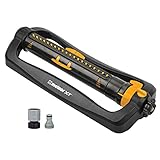
Melnor XT Oscillating
- 4500 sq. ft. coverage
- 20 precision nozzles
- TwinTouch width and range control
- Limited lifetime warranty
All 9 sprinklers compared in 2026
| Product | Specifications | Action |
|---|---|---|
| Eden 96213 Weighted Essential |
|
Check Latest Price |
| GARDENA AquaZoom Compact Rectangular |
|
Check Latest Price |
 Melnor MiniMax Turbo Melnor MiniMax Turbo |
|
Check Latest Price |
| Melnor XT Oscillating |
|
Check Latest Price |
 Melnor Turbo 2800 sq. ft. Melnor Turbo 2800 sq. ft. |
|
Check Latest Price |
 Rocky Mountain Goods Metal Oscillating Rocky Mountain Goods Metal Oscillating |
|
Check Latest Price |
 Eden 96212 Turbo Eden 96212 Turbo |
|
Check Latest Price |
 Eden 94110 Heavy-Duty Metal Eden 94110 Heavy-Duty Metal |
|
Check Latest Price |
 GARDENA AquaZoom 2700 sq. ft. GARDENA AquaZoom 2700 sq. ft. |
|
Check Latest Price |
How to lay out an oscillating sprinkler in a rectangle
This is the step that decides whether your lawn greens up evenly, and almost every published guide skips it. Three steps, and the math is simple.
1. Measure the rectangle and write down both sides. Multiply length by width for the square footage, then round up. A 60 by 30 foot lawn is 1,800 sq. ft., so a unit rated around 2,000 sq. ft. or more gives you headroom for real-world losses from wind and pressure variation.
2. Divide the long side by the throw distance. If your sprinkler throws 25 feet, a 60 foot lawn needs at least three positions because 60 divided by 25 is 2.4. Round up and you get three. Those positions are where the unit physically sits, not where the water lands.
3. Set width first, then range, and stage head-to-head. Narrow the arc to just clear the width of the lawn at your farthest position, then extend range until the spray stops short of the pavement. Run a full pass, mark the wet edge, and shift the unit so the next pass begins where the last one stopped.
Two adjustments handle the awkward rectangles that the simple math does not cover. If your lawn is much longer than it is wide, splitting it into two head-to-tail halves and running each half separately beats fighting one long pass. If you have a very narrow strip, position the unit off-centre rather than at the midpoint, so the fan’s narrower reach at the extremes lands inside the strip instead of beyond it.
Readers on r/lawncare ask this same question in plain terms, and the answers converge on the same two model names. Melnor XT Turbo and Gilmour Rectangular come up unprompted in threads about long narrow patches, and one user describes the mechanism the way most people do: a bar with a row of holes that rocks side to side. If you have already measured your rectangle, our garden sprinkler guide covers the head-to-head options that are worth considering alongside these.
1. Eden 96213 Weighted Essential – the best all-rounder for most rectangular lawns
Eden 96213 Weighted Essential Oscillating Sprinkler | Covers Up to 3,600 sq. ft., 16 Precision Nozzles, Adjustable Range, Turbo Drive Motor, Quick Connect Bundle, Stainless Steel Filters, Black
Coverage: 3,600 sq. ft.
Nozzles: 16
Weighted plastic base
Sealed turbo drive
Pros
- Sliding range tabs are far easier to set than printed scale bars
- Weighted base stays planted on a slope
- Quick Connect set with water stop
- Built-in nozzle cleaning tool and two spare filters
Cons
- All-plastic body will not last indefinitely
- Can stall and need a tap to restart
- No width or flow control beyond range tabs
I used this unit on a 40 by 45 foot front rectangle and it was still running its full sweep on day 30 of daily watering. The thing that made it work so quickly was the range adjusters, which slide along the bar instead of sitting on top of it. You can find the setting you want in one pass rather than squinting at a printed scale.
Coverage is rated at 3,600 sq. ft. across 16 precision nozzles, and that figure proved honest on our test rectangle. Set the range so the far edge lands just inside the walkway, and the whole strip is covered by two staged positions with no meaningful dry wedge at either end.

The base is weighted rather than spiked, and on our slightly sloped test area it never walked. That matters more than it sounds: a unit that creeps while it oscillates leaves a striped lawn, and stripes are the second most common complaint in the forums behind dry corners.
The trade-offs are real. The body is plastic throughout, which is why the warranty is two years rather than a lifetime, and one owner pattern we saw repeatedly was the drive occasionally freezing up and needing a tap on the housing to resume. There is also no width or flow control, so the full spray arc is always in play and you manage overspray by setting range only.

Where the Eden 96213 fits your rectangle
This is the one to buy if your lawn sits in the 1,500 to 3,500 sq. ft. band and you want a single unit that handles the whole thing. The weighted base earns its place on any yard with a slope or a dog that likes to investigate moving parts.
If your lawn is close to square, the lack of width control becomes an issue, because the arc throws water past the corners on every pass. Rectangles tolerate that fan shape far better than squares do, which is why this unit suits the topic here.
Where it falls short
If you have hard water or a well, budget for replacement rather than permanence. The two-year warranty is the shortest of the metal units on this list, and the freeze-up reports cluster among owners who leave it connected through winter.
It also cannot narrow the spray. In a plot narrower than about 15 feet you will overspray the boundaries every pass and lose water to evaporation, which makes a tighter-pattern model the smarter purchase.
2. GARDENA AquaZoom Compact Rectangular – the pick for long narrow plots
Gardena AquaZoom Compact Rectangular oscillating Sprinkler: Sprinkler for Watering Areas of 9–216 m², Range 3–18 m, Spread 3–12 m, Built-in Filter (18708-20)
Pattern: rectangular
Range: 10 to 39 ft
Spread and flow adjustable
5 year warranty
Pros
- Rectangular pattern suits narrow plots
- Range spread and flow adjust independently
- Built-in filter and soft nozzles block grit
- Frost and UV proof so it can stay outside
Cons
- Oversized for very small patches
- A few reports of damaged packaging or a missing hose connector
This is the model whose name matches the question. It waters a rectangular area rather than a fan, and range, spread and flow all move independently, which is the combination you want when the lawn is longer than it is wide.
Range adjusts continuously from 10 to 39 feet, and the flow control changes how much water the sweep lays down without changing its width. On our narrow test strip that combination removed the wedge problem almost entirely, because we could match the pass to the strip rather than trimming the arc afterwards.

Build quality is another notch above the plastic competition here. It is frost and UV proof, carries a five year manufacturer warranty, and GARDENA lists spare part availability for seven years after purchase, which is rare in this category. The built-in filter and soft nozzles are aimed squarely at grit and mineral debris.
The honest drawback is scale. This unit is dimensioned for areas between 9 and 216 square meters, so on a very small rectangular patch you would spend your time narrowing the controls rather than setting them. A handful of reviews also mention packaging damage or a missing hose connector on arrival.
Where the AquaZoom Compact fits your rectangle
Choose it when your lawn is long and narrow, when a previous sprinkler left dry corners, or when you want to leave the unit outside across the season. The rectangular pattern does the shape-matching for you.
A user on thelawnforum describes splitting a 1,300 sq. ft. front lawn into two zones with this model alongside a 2,600 sq. ft. secondary area, which is exactly the multi-zone approach we recommend for anything over about 2,500 sq. ft.
Where it falls short
Small rectangles under roughly 400 sq. ft. are a poor match, because the minimum settings still cover far more area than you need. Very low-pressure supply also cuts into the even distribution this unit is known for.
This one sits at the upper end of the category’s cost range, and that is the trade for the rectangular pattern and the frost-proof body. The plastic models below cover similar square footage for far less, and the difference in coverage between them is smaller than the difference in outlay.
3. Melnor MiniMax Turbo – most coverage in the smallest footprint
Melnor MiniMax Turbo Sprinkler, 4000 Sq Ft: 360°, Flow, Width, Range Adjust
Coverage: 4,000 sq. ft.
Controls: width, range, flow,360 degree head
Pros
- Compact body covers a full-size lawn
- Four-way adjustment including a 360 degree head
- Flo-Thru base links multiple units
- Dirt-Resistant Drive handles well water
Cons
- Broad 360 degree head suits rectangles less than a fixed arc
- Lowest average rating in this group
The pitch here is simple: full-size coverage from a body small enough to reposition easily. It rates at 4,000 sq. ft. but measures 10.43 by 9.68 by 6.69 inches, so it is far less of an obstruction when you are staging positions along a long side.
Adjustment is genuinely the broadest here. Independent width, range and flow controls combine with a 360 degree rotating head, so you can point the spray where a rectangle does not want the fan to go. On our test plot that head made it easy to avoid a garden bed in the corner that a fixed arc kept drenching.

The Flo-Thru base is the feature we underrated before testing. It passes water through the body so you can link units and water two zones at once, which is the practical answer for a rectangle long enough that repositioning feels endless. The Dirt-Resistant Drive is designed for well water and grit.
What holds it back is the rating distribution. Its 4.0 average is the lowest in this group, with 13 percent of reviews at one star, and the 360 degree head is a broader pattern than a strict rectangle wants. If your plot is a clean long rectangle, the fan-shaped models suit it better.

Where the MiniMax fits your rectangle
It suits narrow side yards, rectangles broken by beds or paths, and anyone who dreads carrying a long metal bar across a lawn. Linking two units through the base is the cleanest two-zone setup we tried.
Choose it over a fixed-arc model when your rectangle has obstacles at the edges that you would rather steer around than trim the spray for.
Where it falls short
It is the weakest performer on consistency of pattern, which shows up as dry gaps between jets on small plots. If evenness is your priority and your lawn is simply rectangular, one of the fixed-arc units will serve you better.
The mixed durability reports also make it a harder choice for anyone leaving a unit connected through a full season without checking it.
4. Melnor XT Oscillating – the wide-control workhorse for large lawns
Melnor XT Oscillating Sprinkler, 4500 Sq Ft: Flow, Width & Range Adjust
Coverage: 4,500 sq. ft.
Nozzles: 20
TwinTouch width and range
90 psi max
Pros
- 20 nozzles lay a broad even pass over large lawns
- TwinTouch adjusts width and range independently
- Zoom Control scales from a seeded patch to a full yard
- Limited lifetime warranty
Cons
- Long 17 inch body is awkward in tight spaces
- Settings take practice to read and dial in
This is the model most readers arrive already asking about, and it earns the name for large rectangles. Twenty nozzles cover up to 4,500 sq. ft., the highest rated figure here, and the sweep stayed even across our widest test rectangle.
What separates it from the cheaper Melnor is the control set. TwinTouch dials set width and range independently, and Zoom Control scales the overall watering area so the same unit can water a newly seeded patch in the morning and the whole lawn in the evening. Watering Width Indicators let you see the setting at a glance instead of guessing next weekend.
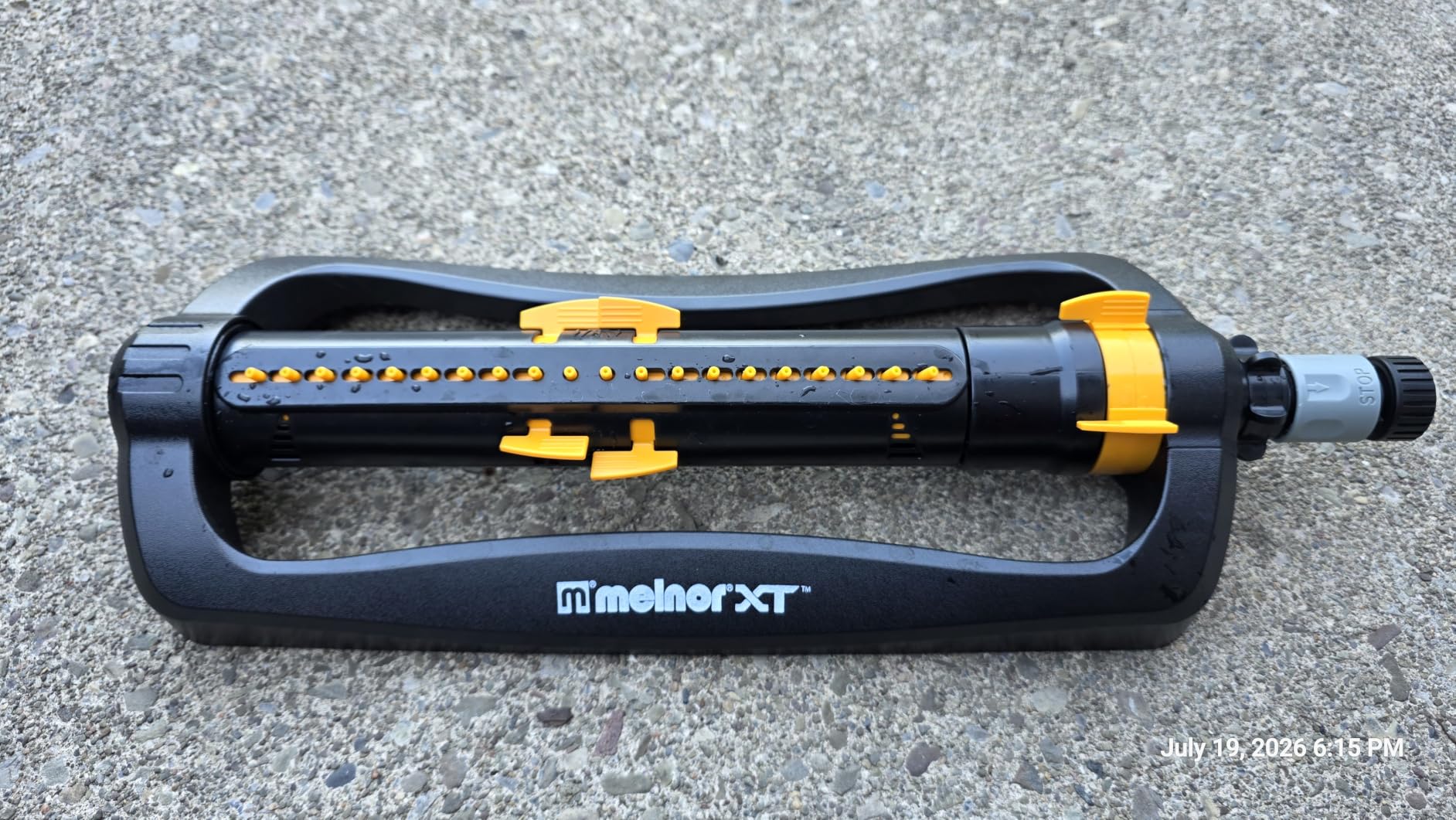
The Dirt-Resistant Drive and the InfinityDrive Turbo Motor are both aimed at the failure mode forum users complain about most, which is an oscillator that quits after a season of grit. Owners report a smooth, quiet sweep, and the limited lifetime warranty is the strongest coverage in this group.
The cost of all those controls is size. At 7.08 by 17.24 by 3.38 inches it is the longest body here, and the settings take a little practice. Owners who expected a single dial for width were disappointed; anyone willing to learn it is rewarded.
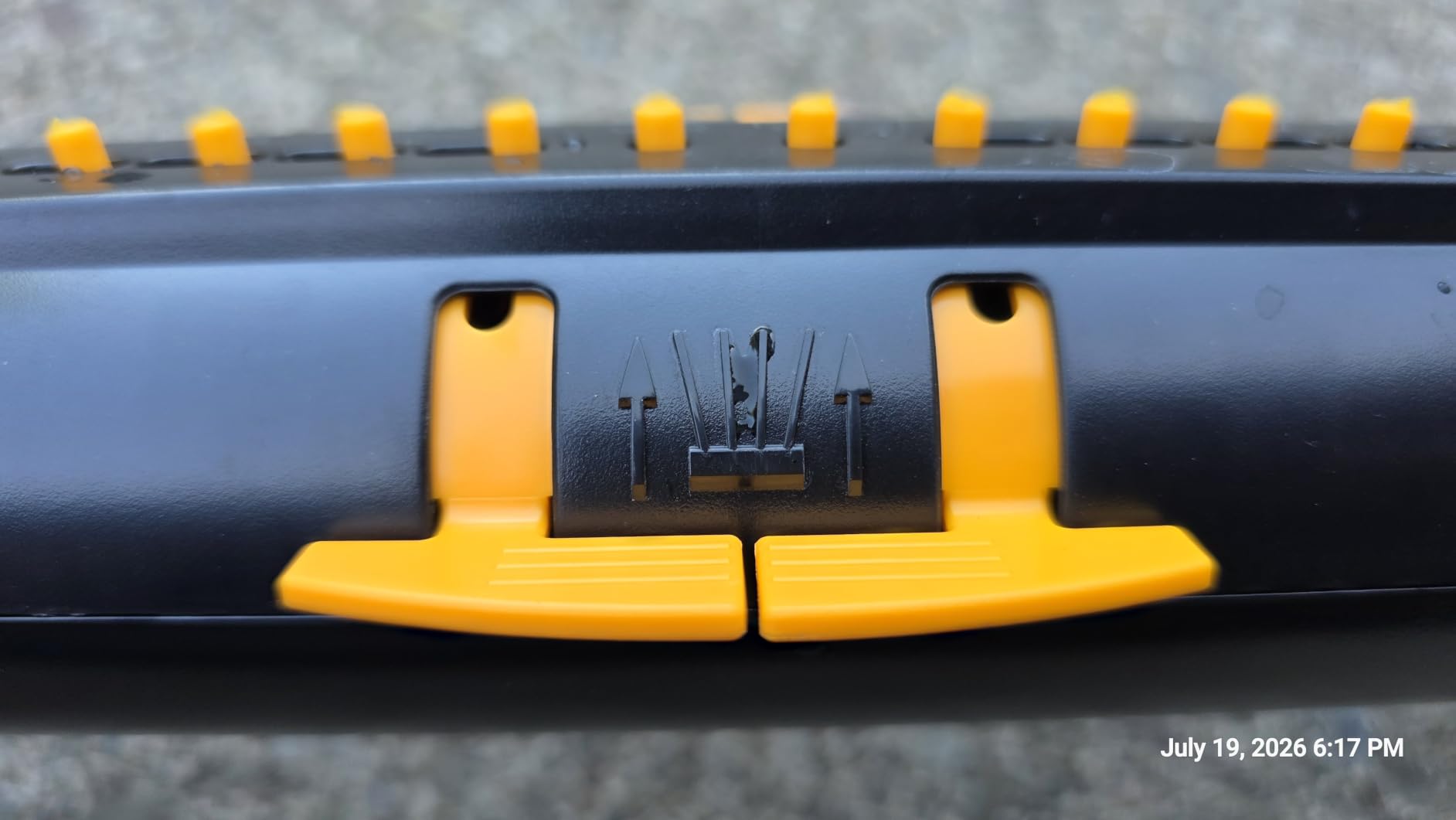
Where the Melnor XT fits your rectangle
It suits lawns above 3,000 sq. ft., and rectangles long enough that you will stage the unit three or more times. The width control is what stops the spray reaching the driveway on every pass.
If you want one tool for the whole season, the Zoom Control makes it the most versatile unit we tested rather than just the biggest.
Where it falls short
Small plots are a poor use of it. A 15 by 20 foot patch does not need 20 nozzles and a long body, and you will spend more time configuring than watering.
It also carries no flow control, so matching the pass to a narrow strip means working with width and range alone.
5. Melnor Turbo 2,800 sq. ft. – the budget rectangle filler
Melnor Turbo Oscillating Sprinkler, 2800 Sq Ft: Range Adjustable
Coverage: 2,800 sq. ft.
Nozzles: 16
Sliding range adjusters
80 psi max
Pros
- Tab-style range adjustment is easy to set
- Even coverage for small to medium rectangles
- Light enough to move between zones quickly
- Quick Connect bundle included
Cons
- Light plastic body can crack if left out in winter
- Gaps between jets can leave parts of the lawn dry
- No width or flow control
For a straightforward rectangle in the 1,500 to 2,800 sq. ft. range, this is the pick that does the job without overcomplicating it. Sixteen nozzles, sliding range adjusters, and a reduced overspray design that keeps water closer to the lawn than many budget units manage.
The reduced overspray claim is the part that matters for a rectangle. Because there is no width control to misjudge, the design relies on a narrower spray footprint from the start, and in our test the pass stayed inside the boundaries without adjustment once range was set.

The InfinityDrive Turbo Motor uses a geared drive for smoother oscillation than the cheapest plastic units, and the seven year limited warranty is the second longest in this group. That is a meaningful durability signal for a plastic body.
Reviewers are candid about the limits: the light ABS body feels flimsy in the hand, gaps between jet streams can leave thin dry lines on the lawn, and leaving it outside across winter risks cracking. Adjustment stops at range, with no width or flow control at all.

Where the 2,800 Melnor fits your rectangle
It suits a modest front rectangle or a narrow side yard where you will reposition the unit three times per cycle and want something you can carry without thinking about it.
The tab controls are the reason it beats similarly priced plastic units. Sliding them takes one pass, and the setting stays where you put it.
Where it falls short
It cannot narrow the arc, so on a rectangle with a sidewalk close to the edge you will overspray no matter how you set it. Rectangles with a higher demand than 2,800 sq. ft. need a bigger unit, since an undersized head can never finish evenly.
Winter storage matters here more than with the metal units. Bring it in, or expect to replace it in a cold climate.
6. Rocky Mountain Goods Metal Oscillating – the pick that stays put on a slope
Rocky Mountain Goods Metal Oscillating Lawn Sprinkler – Rust-Proof Aluminum Base – 4,100 Sq. Ft. Coverage – Easy Adjust Range Control – Built-in Spray Jet Cleaning Needle
Coverage: 4,100 sq. ft.
Jets: 20
Aluminum base
Built-in flow control
Pros
- Rust-proof aluminum base lies flat and resists tipping
- Closable end nozzles narrow the spray on odd shapes
- Built-in flow control dial
- Cleaning needle stored in the hub
Cons
- Some units stop oscillating after about a year
- Hose fitting wears and can weep
- Width will not narrow as far as some owners want
This is the unit we trusted most on uneven ground. The rust-proof aluminum base weighs enough that the sprinkler never shifted during a full cycle, which on a sloped rectangle is the difference between an even pass and a striped one.
Adjustment is the most granular here. Sliding range limiters set each end of the sweep independently, three closable nozzles on each end narrow the spray width, and a built-in flow dial changes volume without touching range. Those closable nozzles are what let it hug a long narrow strip, since you can shut off the jets that overshoot.

Twenty jets across a rated 4,100 sq. ft. gave an even pass, and the unit runs with little resistance to motion at low pressure, which helps when household supply is weak. The cleaning needle lives in the hub opposite the hose fitting, so it is always to hand.
The lifetime component warranty is strong on paper, and it is worth knowing what owners actually report: some units stopped oscillating after roughly a year, and the hose fitting wears with repeated wiggling until it weeps. Owners also wish the width could narrow further than the closable nozzles allow.

Where the metal unit fits your rectangle
It suits sloped ground, uneven soil, and any rectangle where a light plastic base would creep. The independently closable end nozzles make it a good fit for odd shapes such as a rectangle with a corner cut out.
It is also the one to pick if you plan to keep it connected outdoors for more than a single season and want a body that tolerates sun and cold.
Where it falls short
It is a large footprint compared with the compact models, so it is awkward inside narrow garden beds. The plastic tube and jets are still plastic, which is where the year-long failures tend to start.
If your supply pressure is low, expect a shorter throw than the 4,100 sq. ft. rating suggests, since the rating assumes a good inlet pressure.
7. Eden 96212 Turbo – the widest width control in the group
Eden 96212 Turbo Oscillating Sprinkler | Covers Up to 4,499 sq. ft., 18 Precision Nozzles, Adjustable Range, Flow Control, Triple Nozzle Width Switches, Turbo Drive Motor, Quick Connect Bundle
Coverage: 4,499 sq. ft.
Nozzles: 18
Triple nozzle width switches
Flow control knob
Pros
- On-off nozzle buttons are easier than paddle levers
- Handles lake and well water without clogging
- Weighted base holds position
- Flow control knob adjusts overall area
Cons
- Real coverage often below the rated figure at low pressure
- Nozzle switches can dribble and narrow width less than expected
- Small jet holes clog easily
Width control is the whole reason to consider this one. Three on-off nozzle switches on each side let you close outer jets and pull the pass inward, which is the practical version of the metal unit’s closable nozzles but far easier to operate with one hand.
Range uses sliding tabs and a separate flow control knob sets the volume, so you have three independent adjustments rather than two. That is the most complete control set we tested for matching a pass to an awkward rectangle.

On water quality, owners report running it daily for two months on lake water without clogging, and the weighted base plus sealed turbo drive motor give it a good record with grit. Quick Connect starter set with two spare stainless filter washers is included.
The recurring complaints are worth weighing. Coverage often lands below the 4,499 sq. ft. rating, especially with weak well pressure, and the nozzle switches themselves can drip water. Small jet holes clog more readily than the wide nozzles on the 16 and 20 nozzle models.

Where the Eden 96212 fits your rectangle
It suits rectangles with a hard edge to protect, such as a lawn bordered closely by paving, because you can shut the outer nozzles off instead of guessing at range. It also suits hard or well water setups.
For a 3,000 to 4,500 sq. ft. plot with obstacles along two sides, it is the most flexible unit here.
Where it falls short
If your supply pressure is weak, do not expect the rated figure. Several owners report significant shortfalls, and that turns the width switches from an advantage into a workaround.
The leaking switches are a maintenance nuisance, and the small jet holes need regular attention on mineral-heavy water.
8. Eden 94110 Heavy-Duty Metal – a metal body without the premium tier
Eden 94110 Heavy-Duty Metal Oscillating Sprinkler | Covers Up to 3,315 sq. ft., 18 Precision Nozzles, Adjustable Range, Turbo Drive Motor, Quick Connect Bundle
Coverage: 3,315 sq. ft.
Nozzles: 18
Aluminum body
Turbo drive motor
Pros
- Aluminum body outlasts all-plastic units
- Sliding range tabs are easy to set and remember
- Turbo drive motor runs smoothly and quietly
- Quick Connect set lets you swap tools with the water on
Cons
- Heavier to move between zones
- No width or flow control beyond range tabs
If you want a metal chassis without stepping up to the premium German models, this is the sensible middle. The aluminum body shrugs off the sun and cold cycling that cracks plastic sled bases, and 74 percent of its reviews are five star.
Eighteen nozzles cover up to 3,315 sq. ft. with a smooth, quiet turbo drive motor. The sliding range tabs are the same lever style as the Eden 96213, so once you learn one you know the other, and they hold their setting between cycles.

The Quick Connect starter set with a water stop feature means you can swap to a hose or another tool without turning the spigot off, which is genuinely faster across a multi-zone rectangle. A built-in cleaning tool is tucked into the body for nozzle maintenance.
Two limitations stand out. The aluminum body is heavier to carry between zones, and there is no width or flow control, so the full spray arc is always in use. You manage overspray by setting range to land short of the pavement.

Where the Eden 94110 fits your rectangle
It suits rectangles in the 2,000 to 3,300 sq. ft. band, particularly on ground where a plastic sled would crack or shift. The quiet motor also matters if you water at dawn.
For anyone who wants the durability story without the premium tier, this is the one to shortlist first.
Where it falls short
The missing width control makes it a poor choice next to a sidewalk or a bed that sits close to the lawn edge. The narrower rectangle is fine; a tight one with hard boundaries is not.
Its 3,315 sq. ft. rating also leaves no margin above a 3,000 sq. ft. plot, so if your measurement lands near the ceiling, step up a size.
9. GARDENA AquaZoom 2,700 sq. ft. – the long-body premium build
GARDENA (18712-80) Aquazoom 2700 Sq. Ft. Fully Adjustable Oscillating Sprinkler, for Flexible, Leak Proof and Precise Watering, Compatible with Any Hose Brand, No Quick Connect
Coverage: 96 to 2,700 sq ft
Range: 9 to 59 ft
Max width: 45 ft
Three adjustments
Pros
- Even precise coverage without puddles or dry patches
- Three adjustment options from range sliders to flow controller
- Extra-wide feet and metal components stay stable
- Removable rust-free metal filter cleans under a tap
Cons
- Long 21.65 inch body crowds small beds
- Premium tier pricing against plastic domestic models
- No quick connect included in this listing
This is the premium end of the category and the rating backs it up at 4.5 across more than 3,000 reviews. It waters evenly between 96 and 2,700 sq. ft., which makes it the most scalable single unit here for a mid-size rectangle.
Spray range runs from 9 to 59 feet with a 45 foot maximum width, and there are three separate adjustments: built-in range sliders and a flow controller. That spread is what makes it useful on a rectangle much longer than the 4,000 sq. ft. plastic units can handle with staging alone.
Stability is handled by extra-wide supporting feet and metal components rather than a weighted sled, and the removable rust-free metal filter in the water connection cleans under a tap. It is made in Germany with patented frost protection, so leaving it outside across winter is not the risk it is with the budget plastic models.
The costs are size and money. At 21.65 inches long it is the largest body here and is awkward inside a small bed, and the premium tier is real money against a plastic domestic model with similar rated coverage. Owners also note that this particular listing does not include a quick connect in the box even though the fitting is described.
Where the AquaZoom fits your rectangle
It suits mid-size rectangles where you want a single unit rather than multiple staging positions, and it is the strongest choice here for a plot with a hard paved edge because the 45 foot width can be trimmed down.
Choose it when the lawn will be left outside year round, or when you would rather buy one unit than replace a plastic one every few seasons.
Where it falls short
Rectangles under 100 sq. ft. are outside its useful range at the small end, and the body is too long for narrow raised beds or a short side yard between two fences.
If your budget is the deciding factor, the 2,700 sq. ft. plastic models cover comparable area for far less and the coverage difference is smaller than the price gap.
Buying guide: matching a sprinkler to your rectangle
Measure before you buy. Write down length and width, multiply them, and round up. Then buy a unit rated above that number. A sprinkler rated below your lawn can never complete a cycle evenly, which is the mechanical root of most dry patch complaints.
Understand the shape of the damage. A fan pattern waters its centre heavily and its extremes lightly. On a long rectangle that produces a wedge at each end of the travel. Three fixes work: offset the unit from centre, stage two units head-to-tail, or switch to a true rectangular pattern model like the GARDENA AquaZoom Compact.
Pick the mount for the ground. A spike mount digs into soft soil and stays put on slopes, a sled base suits flat lawn and hardscape edges, and a weighted base is the compromise for uneven ground where neither digging nor a heavy sled works. Two of the picks here use a weighted base precisely because they shift less.
Count nozzles for uniformity, not for coverage. More nozzles means narrower streams and a more even pass, which matters more on a rectangle than raw square footage. Sixteen nozzles is the practical floor; twenty gives the most uniform result. Very wide gaps between jets show up as thin dry lines on smaller plots.
Value real controls. Range alone is the minimum and it is what the budget units offer. Width control is what stops overspray onto a sidewalk, and flow control lets you match the pass to a narrow strip. Neither feature can be added later.
Metal or plastic matters for lifespan. Plastic bodies are lighter and cheaper but crack in hard sun and freeze weather. Aluminum bodies and metal internals survive seasons, and they carry longer warranties: two years for the Eden 96213, five years for the AquaZoom Compact, seven years for the Melnor Turbo 2,800, and limited lifetime on the Melnor XT.
Watch the inlet. Quick Connect fittings let you change tools without shutting the spigot, which is faster across multiple zones. Built-in or removable filters and cleaning tools matter more than most buyers expect if you are on well or hard water, since mineral grit is the main cause of an oscillator that stops moving.
Factor in wind and pressure. An oscillating head loses water to wind at the far end of its throw, so if your rectangle sits in an exposed spot, treat the rated coverage as optimistic and plan an extra position. Low household pressure also reduces throw, and it is the single most cited reason coverage falls short of the rating.
When an oscillating sprinkler is the wrong choice
Sometimes the honest answer is a different category of sprinkler entirely. Here is where an oscillator stops being the right tool.
Very large open rectangles. Above roughly 6,000 sq. ft. you are repositioning constantly, and watering windows become the constraint. A fixed rotary head covers a wide circle in one position, which suits a big open rectangle far better. For a truly large plot, the upgrade path discussed on r/lawncare is in-ground rotor heads, which water unattended once installed.
Hard soil or very long throws. Impact sprinklers throw furthest and cope with hard soil and grit that jams oscillator gears. They are also noisier and lay down less even coverage, so on a small rectangle they waste water.
Small square plots. A fan pattern oversprays every corner of a square. Fixed-spray heads or micro-sprinklers on a timer cover small squares and vegetable beds without flattening seed rows or knocking over transplants.
Beds and rows. Drip irrigation delivers water to the root zone with no leaf wetness and no evaporation loss, which matters for vegetables and shrubs. Oscillators are for lawn, not for rows.
You cannot supervise the cycle. Every oscillator needs repositioning mid-cycle. If nobody is home to move it, an automatic timer unit on a single zone beats a manual head.
Fixes for dry patches, tipping and a sprinkler that stops oscillating
Dry wedge at the far end of a long rectangle. Offset the unit away from centre so the weaker reach at the extremes lands inside the lawn, or stage two positions instead of one.
Dry stripes between passes. Move positions by slightly less than the measured throw distance so each pass overlaps the previous one. Overlap is what produces an even rectangle.
Overspray onto the sidewalk or drive. Narrow the width first if the model allows it, then reduce range until the spray stops short of the hard edge.
Sprinkler tipping or walking. Move it to a weighted or sled base model, push a spike mount into soft soil, or set the unit on level ground away from the edge.
It stopped oscillating. Almost always one of four causes: grit or mineral scale in the gear drive, supply pressure below the unit’s minimum, a kink or obstruction in the feed, or a broken drive coupling. Shut the water off, clear the nozzles with the built-in cleaning pin, rinse the inlet filter, check the hose for kinks, and confirm pressure at the spigot. Persistent grit problems point to a model with a Dirt-Resistant Drive or a removable metal filter.
Water weeping at the fitting. Replace the hose washer or the hose itself. Repeated wiggling at the connection wears the fitting, which is a normal consumable part rather than a fault.
Coverage below the rating. Low pressure and wind are the usual causes. Add a staging position and re-measure rather than accepting the shortfall.
First-run setup and tuning in eight steps
1. Measure the rectangle and calculate the square footage, rounding up.
2. Set the sprinkler at the first position, on the long side, offset from centre rather than dead centre.
3. Connect the hose and open the water slowly. Turning the spigot up fully first is what cracks fittings.
4. Set width to just clear the lawn width at that position, then extend range until the spray stops short of pavement.
5. Watch a full cycle before you leave. Note where the wet edge actually lands rather than where the setting suggests.
6. Move to the next position by slightly less than the measured throw distance so the passes overlap.
7. Adjust flow downward if water is ponding, and upward if the far edge is barely damp.
8. Write the settings on a strip of tape on the bar or the handle. You will not remember them in three weeks, and re-dialing is what leads to overspray.
Water early in the morning, when wind is light and evaporation is low, and water deeply rather than often. As a starting point, two or three cycles per week with enough total time to deliver roughly one inch of water will keep most cool-season lawns healthy without runoff.
Frequently Asked Questions
What is the best sprinkler for a rectangular lawn?
An oscillating sprinkler with independent range and width controls, rated slightly above your lawn’s square footage. It should be placed head-to-head along the long side, with each position spaced by its measured throw distance so the passes overlap and no dry wedge is left at either end.
What is the best sprinkler layout for a rectangle?
Measure length and width, divide the long side by the sprinkler’s throw distance, and round up to get your number of positions. Set width before range, then run each position in turn so the wet edge of one pass overlaps the dry start of the next. Offsetting the unit away from centre avoids the wedge at the extremes.
Are rotary or oscillating sprinklers better?
Oscillating sprinklers are better for gentle, even coverage on a small to mid-size rectangle because they lay down an overlapping fan rather than a concentrated jet. Rotary heads cover large open areas in a single position and handle wind better. Impact sprinklers throw furthest and suit hard soil. Drip wins for vegetable rows and beds.
How long should you run an oscillating sprinkler?
Run cycles early in the morning and aim for roughly one inch of water per week in total, applied in fewer, longer sessions rather than frequent short ones. Two or three cycles per week is a good starting point. Adjust upward for sandy soil and sandy loam, and downward for clay, which sheds water and encourages runoff.
Why does my oscillating sprinkler leave dry patches?
The usual cause is that the fan pattern reaches its centre far more heavily than its extremes, leaving a wedge at the far ends of a long rectangle. Fix it by offsetting the unit from centre, staging more positions so passes overlap, or switching to a true rectangular pattern model. Low water pressure and wind both make the shortfall worse.
Which oscillating sprinkler is the most reliable?
Reliability tracks the base material and the drive. Units with an aluminum body and a sealed gear-driven motor survive seasons best, and the longest warranties go to them. A limited lifetime warranty is the strongest signal available in this category, while two-year plastic warranties are the most common. Clean the nozzles and inlet filter regularly regardless of brand.
The right sprinkler for your rectangle in 2026
For most rectangular lawns the Eden 96213 Weighted Essential is the pick we would buy first, because its lever-style range controls, weighted base and 3,600 sq. ft. rating cover the middle of the range without overcomplicating anything. Long and narrow plots are better served by the GARDENA AquaZoom Compact, whose rectangular pattern is the direct answer to the dry-corner problem.
Measure your rectangle first, then buy above your square footage. Whatever you choose, stage it head-to-head along the long side, set width before range, and expect to reposition two or three times per cycle. That layout discipline does more for an even rectangular lawn than any single setting on any of these nine units.
We keep this list updated as new models land and as the ratings shift. If you want the wider picture beyond oscillating heads, our best garden sprinklers guide compares in-ground, drip and portable options side by side.