

The best indoor saunas for basements are the cabins that clear your finished ceiling, run on a circuit your panel can actually supply, and reach the basement floor as flat panels instead of a finished room. Our pick for most homes is the JNH Lifestyles Joyous 2-Person: a dual-wall Canadian hemlock far infrared cabin standing 75 inches tall, running on standard 120V power, and rated 4.5 stars across more than 1400 owner reviews. The traditional route, if your panel and vent path allow it, is the 3KW OUTEXER steam cabin.
We spent weeks reading the listings, the dimensions and the owner reviews on all ten cabins below, then cross-checked each one against the three constraints that actually decide whether a sauna works below grade: overhead clearance, electrical supply, and moisture. The results surprised us in a useful way. The highest star averages in this group belong to the two models with the fewest reviews, which is exactly the kind of thing a ranking should tell you rather than hide.
Basement fit is a measurement problem, not a brand problem. A sauna that needs a 240V feed your 100-amp panel cannot carry will never get used, no matter how good the wood is. If you are still deciding on heat type, our infrared sauna roundup covers the technology in depth, and this guide covers the room.
Table of Contents
Top 3 Picks for the Best Indoor Saunas for Basements (October 2026)

JNH Lifestyles Joyous 2-Person
- 7 carbon far infrared panels
- Canadian hemlock
- Chromotherapy and Bluetooth
- 120V power

OUTEXER 3KW Steam Sauna
- 3KW heater on 240V
- Volcanic rocks and bucket
- Reaches 90C in 25-30 minutes

All 10 Indoor Saunas for Basements at a Glance in 2026
Every cabin below lists a published height, a published power draw, and a published capacity. The heights are the number that matters most in a basement, because they are the figure you hold against your finished ceiling. Footprint is given in the order width by depth, so check it against your wall and your door swing before you commit.
| Product | Specifications | Action |
|---|---|---|
| JNH Lifestyles Joyous 2-Person |
|
Check Latest Price |
| OUTEXER Traditional 3KW Steam Sauna |
|
Check Latest Price |
| Homsido 1-Person Mini Sauna |
|
Check Latest Price |
 Azomabox 1-2 Person Far Infrared Azomabox 1-2 Person Far Infrared |
|
Check Latest Price |
 Blue Wave Heat Wave Coronado 2-Person Blue Wave Heat Wave Coronado 2-Person |
|
Check Latest Price |
 X-Vcak 1-2 Person with Red Light X-Vcak 1-2 Person with Red Light |
|
Check Latest Price |
 DWKWE Mini 1-Person Spruce DWKWE Mini 1-Person Spruce |
|
Check Latest Price |
 Kanlanth 1-Person 950W Kanlanth 1-Person 950W |
|
Check Latest Price |
 Albott 1-Person 110V Albott 1-Person 110V |
|
Check Latest Price |
 EASYHAWK 2-Person WiFi Sauna EASYHAWK 2-Person WiFi Sauna |
|
Check Latest Price |
1. JNH Lifestyles Joyous 2-Person – Best Overall Indoor Sauna for Basements
Joyous 2 Person Home Infrared Sauna with Chromotherapy Light
Height 75 in
7 carbon far infrared panels
Canadian hemlock
120V power
250 lb
Pros
- Premium Canadian hemlock construction
- Even heat from 7 carbon fiber panels
- Chromotherapy light and LED controls
- Built-in Bluetooth speakers
- Backed by 1437 owner reviews
Cons
- 250 pounds makes repositioning difficult
- Dual-wall footprint is wider than the mini cabins
- Larger footprint than solo models
We picked the Joyous as the best indoor sauna for basements because it clears every hard constraint with room to spare and it has the deepest review history in this group. At 47.3 inches wide by 39.5 deep by 75 high, it is the tallest cabin we ranked, which is also why it is the most demanding on ceiling height. In a basement with 7 feet 6 inches or more of finished ceiling it is a clean fit. Below that, step down to one of the 59 to 63 inch cabins further down this list.
Heat comes from seven carbon fiber far infrared panels spread around the walls, which is the layout that gives even warmth without a single hot spot. A carbon panel runs cooler to the touch than a ceramic element, so a child can put a hand on the wall. The chromotherapy light and LED control panel are the details owners mention most, and the built-in Bluetooth speakers mean you are not bolting a separate speaker to the ceiling of a room with limited headroom.
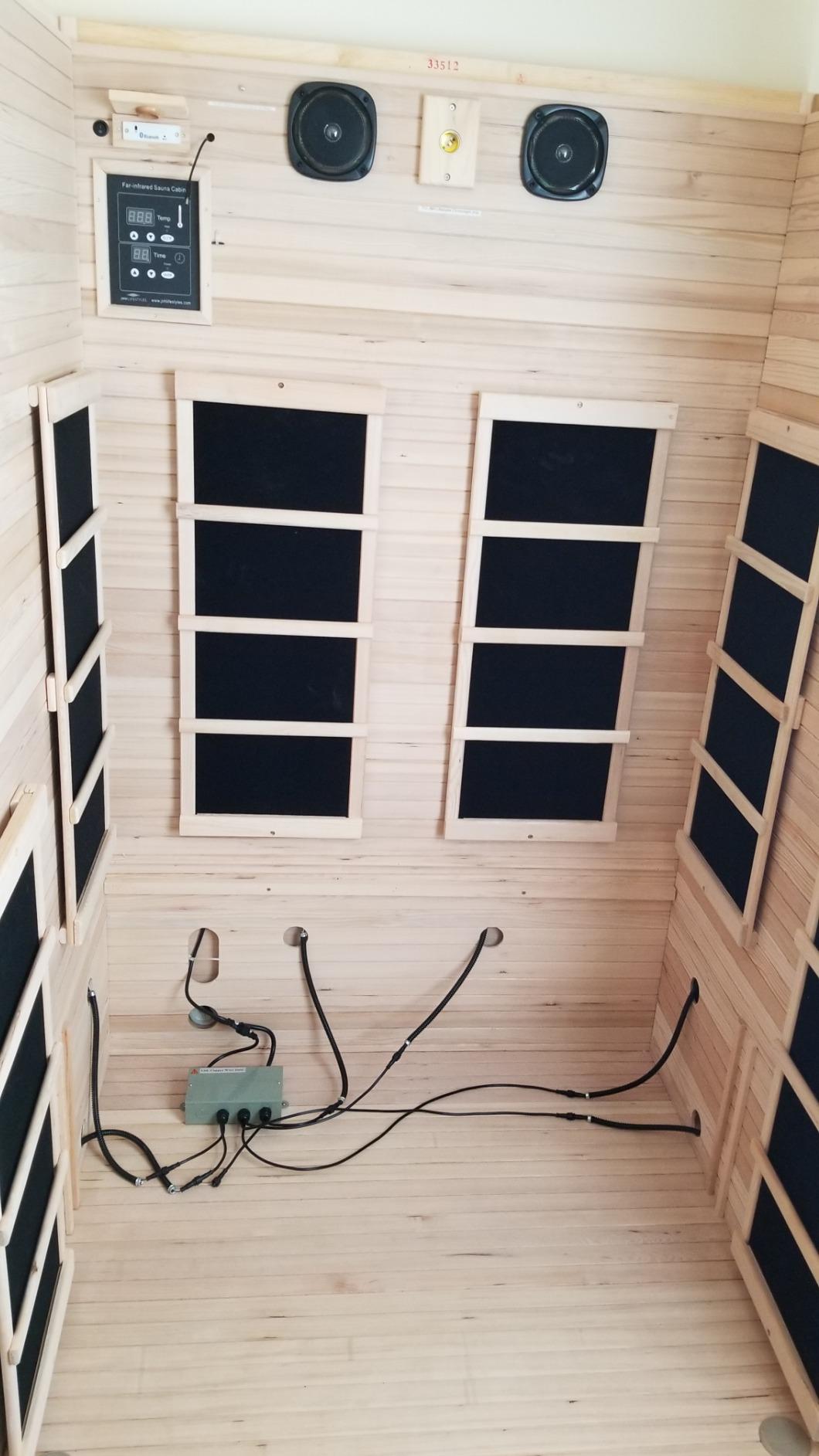
Dual-wall construction is the quiet reason this cabin holds temperature well in a below-grade room. Basements swing colder than the rest of the house, often sitting in the low 60s Fahrenheit in winter, and a thin single-wall cabin has to fight that. The 78 percent five-star share across 1437 reviews is consistent with owners reporting even, sustained heat rather than a hot-cold cycle.
The dual-wall build also widens the exterior footprint beyond the interior bench space, so plan the wall clearance before you order. Door swing matters here. In a finished basement with a tight wall run, you want a door that opens outward or toward open floor, and you need to know which way this one swings before the panels are up.
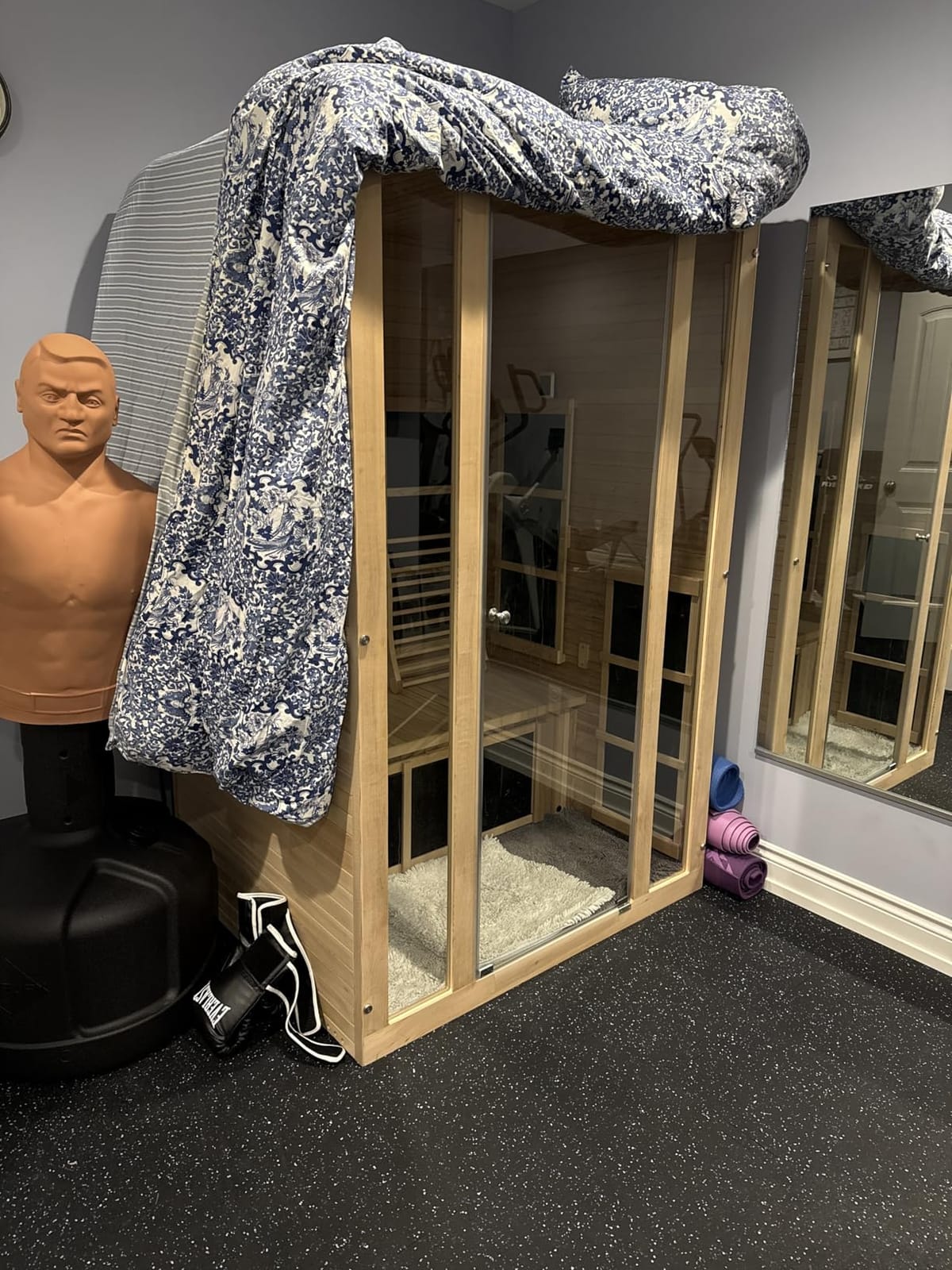
What fits a typical 7 foot basement ceiling
At 75 inches of cabin height, the Joyous needs a finished ceiling of roughly 84 to 90 inches once you add the manufacturer’s overhead clearance and account for the framing above. That puts it squarely in basements with 7 feet 6 inches of headroom and rules it out for anything shorter. We could not confirm a published overhead clearance figure on this listing, so measure your own ceiling and leave the gap rather than assuming none is needed.
If your measurement comes back under 7 feet, do not try to make this cabin work by raising the ceiling above it. The cost of reframing a basement ceiling in a finished space usually exceeds the cost of a different sauna. The Homsido, DWKWE and Albott cabins further down this list all stand under 63 inches and are designed for exactly that ceiling band.
Where it is a poor basement fit
It is the wrong pick for a small mechanical corner or a room under 8 by 8 feet, because the 250 pound assembled weight is awkward to move through a stairwell a second time. It is also the wrong pick if you want wet steam. Far infrared is dry heat, there is no stove, no stones and no löyly, so nothing here adds humidity to a basement that already runs damp in spring.
If you want a real Finnish steam session, the traditional option below is built for it, with a 3KW heater and volcanic stones. If you want a sauna you can relocate or sell with the house, the lighter 107 pound Albott cabin is easier to move and easier to price into a resale conversation.
2. OUTEXER Traditional 3KW Steam Sauna – Best Value Traditional Cabin for a Basement
OUTEXER Traditional Steam Sauna 240V 3KW Home Spa Room for 2-3 Person
Height 74.8 in
3KW heater on 240V
Canadian fir
90C in 25-30 minutes
420 lb
Pros
- Authentic steam with volcanic stones and bucket
- Reaches 194F in 25-30 minutes
- Fully accessorized out of the box
- 7-year after-sales service
Cons
- Requires a 240V dedicated circuit
- Heaviest cabin here at 420 pounds
- Wet steam means real ventilation work
This is the only true wet steam cabin in the list, and for a basement that is both its appeal and its homework. A 3KW heater on a 220V to 240V feed throws water onto volcanic stones to make löyly, and owners report reaching 90C in 25 to 30 minutes. The 4.6 average across 581 reviews comes mostly from people who wanted a real sauna session and got one.
Everything you need is in the box: bucket and spoon, thermometer and hygrometer, hourglass, volcanic stones, two teacup holders, two speakers, a warm white LED wall lamp and the stove frame. Natural Canadian fir is the wall and ceiling material, chosen for thermal insulation and water resistance, and the seats and foot grid carry a water-based paint. A tempered glass door keeps the fire and water out of the frame.
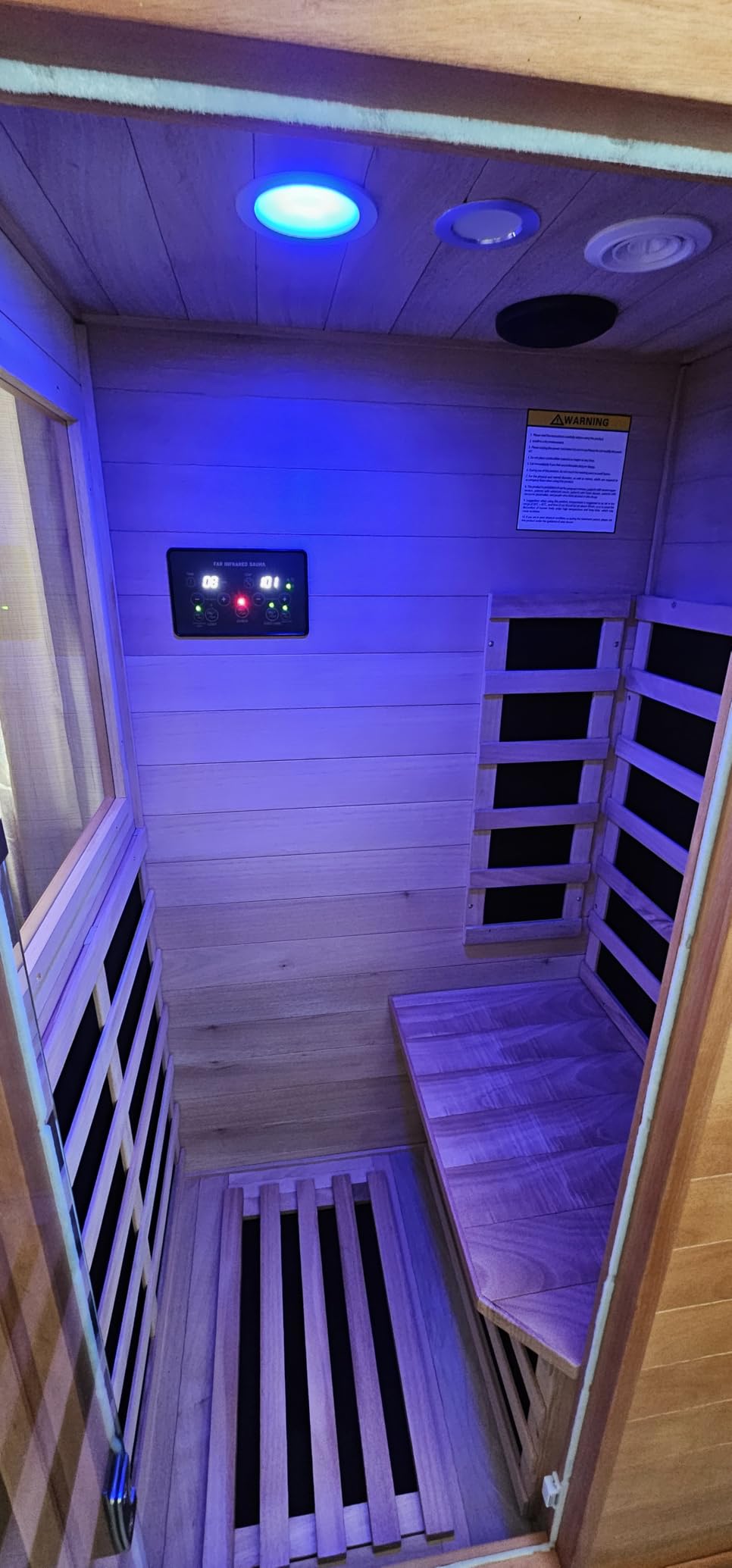
The numbers that decide this cabin are electrical. 3KW at 240V is a dedicated hardwired circuit, not a plug, and it needs a licensed electrician to run. If your panel has spare 30 amp capacity and the run to the basement is reasonable, this is a very good outcome. If your panel is a 100 amp service already loaded by a finished basement bedroom circuit, this purchase waits on an upgrade, and that changes the economics of the whole project.
Weight is the other practical limit. At 420 pounds this is the heaviest cabin we ranked, which is fine if the panels come in and get built where they sit but miserable if you have to move it. Measure the stairwell width and the turn at the bottom before ordering, and check that the crate or panel bundles clear the turn.
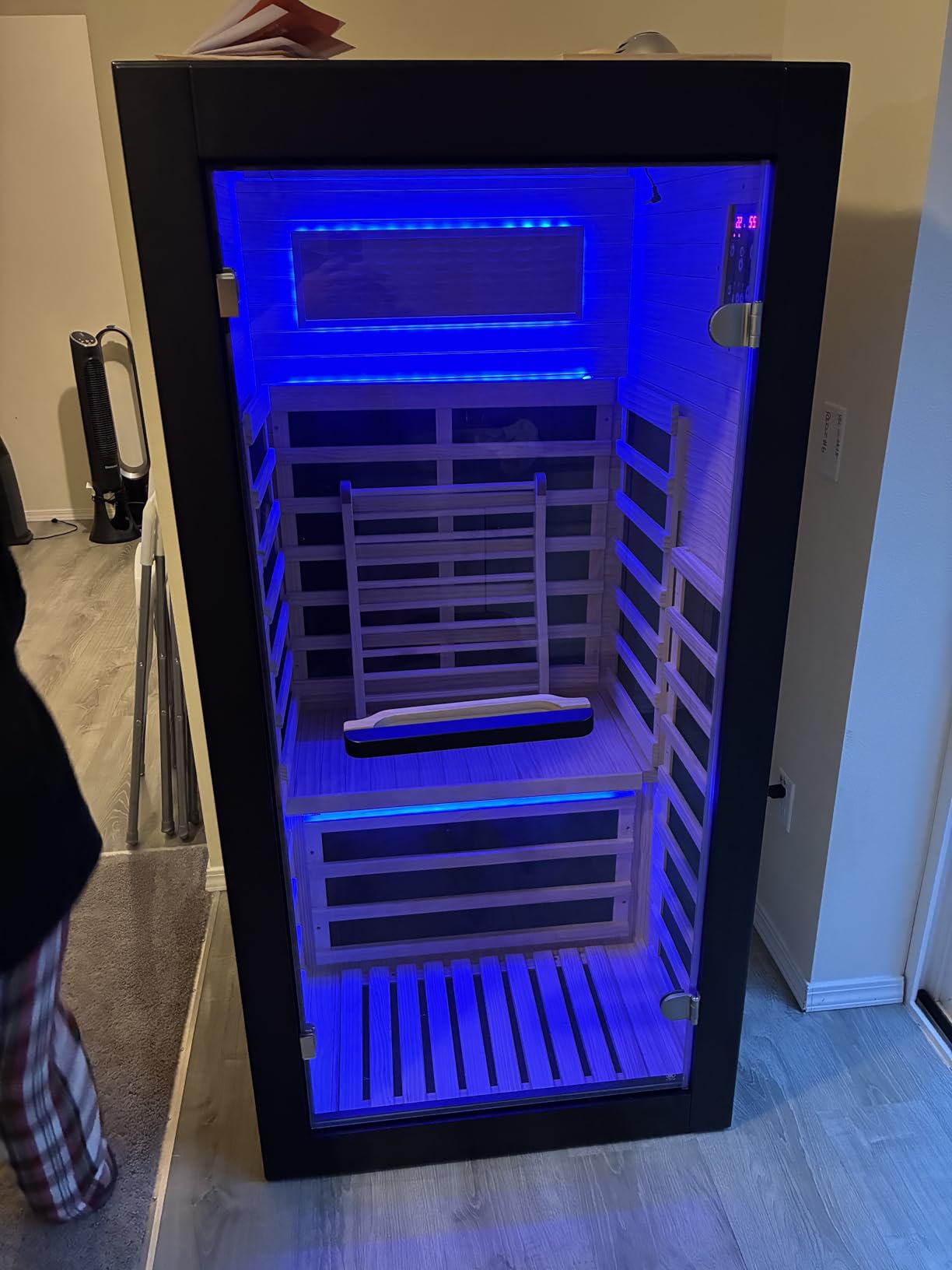
What it takes to vent a wet steam basement sauna
Wet steam puts water into the air, and below grade that water has nowhere to go on its own. You need a ducted exhaust run to the outside with a low intake near the heater and a high exhaust on the opposite wall, plus a continuous vapor barrier on the warm side of the framing. Owners on sauna forums repeatedly name venting into the basement itself as the single most expensive mistake, because it moves the humidity rather than removing it.
Before you order, confirm a real vent path exists. A basement with no exterior wall and no rim joist access above grade will push you toward infrared instead, and that is not a downgrade, it is a different product. If you do have a path, a dedicated inline duct fan moves more air than a bathroom fan at the same static pressure, and it is worth matching the duct to the moisture load rather than reusing a bath fan.
Where it is a poor basement fit
It is the wrong pick for a low ceiling, a small panel, or any basement that cannot be ventilated outdoors. A sauna that traps steam in your walls will show you the cost later in the form of mold in a cavity that never dries. It is also wrong if you want a plug-and-play weekend project, because the 240V feed is a trades job rather than an afternoon.
Owners also note that the 420 pound build is unforgiving in a finished basement where the only access is a stairwell with a landing turn. If your route is tight, the Kanlanth or Albott cabins at the bottom of this list can be carried down in sections and rebuilt in place, which is a large practical difference.
3. Homsido 1-Person Mini Sauna – Best Indoor Sauna for a Small Basement Footprint
1 Person Far Infrared Home Sauna, Mini Canadian Hemlock Wood Sauna, 110V 900W, 5 Low EMF Carbon Heaters, 140°F Max, Bluetooth Speaker, 30-Min Setup, Compact Indoor Sauna, 32.3″W x 27.2″D x 59″H
Height 59 in
900W on 110V
Canadian hemlock
140F max
3-year warranty
Pros
- Compact 32 x 27 x 59 inch footprint
- Tool-free clasp assembly in under an hour
- Standard 110V household power
- 3-year warranty
Cons
- Tight leg room for taller users
- Takes about 30 minutes to warm in a cold basement
- Some units arrive with a loose speaker wire
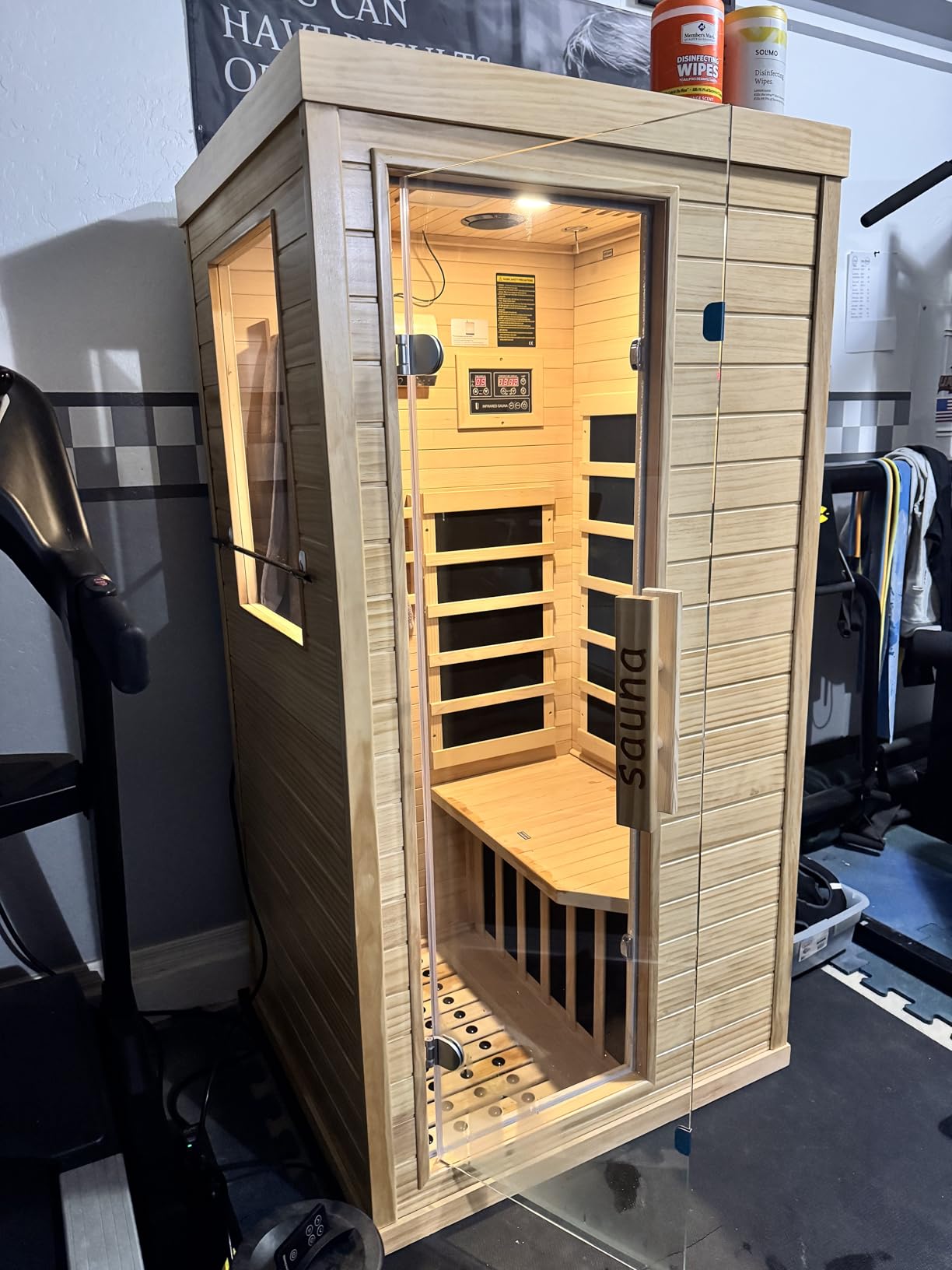
The Homsido is the model we send people to when the basement is small and the ceiling is low. At 32 by 27 by 59 inches it fits a 6 by 6 foot mechanical room, a finished corner, or the dead space beside a stairwell, and 59 inches of height clears basement ceilings that most sauna cabinets will not touch. The whole thing is a single-person cabin built around a vertical bench.
Five low EMF carbon panels at 900W reach a listed maximum of 140F, which is the standard target for a far infrared session and the reason this class of sauna suits a heat-sensitive user. Assembly is clasp-together modular panels with no tools, and two adults can finish it in under an hour, which matters when you are working in a basement with a single work light and a step ladder.
Long-term owners, some reporting daily use across a year, single out quick heat-up, straightforward assembly and solid build. The rating sits at 4.4 across 447 reviews with 76 percent five-star, and the recurring caveat is seating space rather than performance. Taller users describe the single-person bench as tight, so if you are over about six feet this is a compromise you should test before you commit.
The honest basement-specific drawback is heat-up time in a cold room. Owners report around 30 minutes to warm in a cold basement or garage, which is longer than a manufacturer suggests in a normal room. Plan your session timing around it, or run the cabin empty for a while before you get in, the same way you would preheat a car in winter.
Whether it clears a 7 foot finished ceiling
Yes, comfortably. A 59 inch cabin leaves roughly 25 inches of air above it in a 7 foot ceiling, and more than that in an 8 foot room, so the overhead clearance question basically disappears. That margin is also what makes ventilation easier in a low-ceiling space, because you can duct a high exhaust through the wall above the cabin without building a plenum.
It is worth pairing this cabin with a basement dehumidifier if your space runs above roughly 60 percent relative humidity, even though far infrared is dry heat and adds little moisture. Ambient basement humidity is the condition the cabin sits in, not the condition the cabin creates, and a dry room heats faster and holds temperature longer. Our guide to the best dehumidifiers for basements covers that side of the problem.
Where it is a poor basement fit
It is the wrong pick for couples or anyone who wants room to move, and it is wrong for anyone taller than the bench comfortably fits. It is also the wrong pick if you plan to add a steam generator later, since there is no stove recess and no drain provision in the base.
Assembly quality varies a little at this price band, with a few owners reporting a loose speaker wire that needs re-soldering before the cabin goes up. Budget ten minutes for that, and assemble it near its final position because the finished cabin is awkward to rotate through a doorway.
4. Azomabox 1-2 Person Far Infrared – Best Indoor Sauna for Adjustable Foot-Zone Heat
Far Infrared Sauna for Home, 1-2 Person Indoor Sauna, Low EMF, 7 Heaters
Height 61.4 in
1420W on 120V
7 low EMF heaters
Foot zone control
167 lb
Pros
- 7 heaters with 1420W output
- Low EMF design on standard 120V
- Foot heating control
- Compact 28.74 x 35.24 in footprint
Cons
- Listing shows multiple size variants
- Confirm the delivered size before ordering
- Small 28 inch floor area
What separates this cabin from the other small far infrared units is control. Seven heaters at 1420W is a lot of wattage for a 1 to 2 person footprint, and the listing pairs that with a dedicated foot heating control, so you can warm the lower body without pushing the whole cabin. Chromotherapy lighting, a Bluetooth speaker and a simple control panel round out a genuinely useful feature set.
At 4.7 across 345 reviews, this has the strongest rating profile among the models in this list with a substantial review count behind it, 84 percent five-star and 12 percent four-star. It runs on 120V low EMF power, which means a standard household circuit rather than a 240V feed, and that single fact is what makes it installable in a basement without an electrician.
Two things to verify before you order. The listing carries several size variants, with a 1 to 2 person size shown at 28.74 by 35.24 by 61.4 inches, so confirm the delivered dimensions against your ceiling and your corner. Second, the weight is listed at 167 pounds, which is manageable, but the listing is assembled rather than flat-packed, so plan how it enters the basement.
We also want to be straightforward about the data here. The review text retrieved for this listing appears mismatched to the product, so we are relying on the rating distribution rather than on individual quotes. That is a reason to treat the 4.7 as a promising signal rather than a settled one, and it is the kind of disclosure most roundups leave out.
Whether the panel layout suits a cold basement
Seven distributed heaters is the layout you want in a below-grade room, because a cold start in a basement is a harder heat-up than anywhere else in the house. Single-panel cabins create a hot band near the element and a cooler bench, while seven panels spread the load so you get usable warmth at seated height within about 15 minutes rather than 30.
On the footprint question, 28.74 by 35.24 inches is one of the smaller footprints here and works in a basement corner that cannot take a 40 by 36 inch cabin. The trade-off is interior space, and for a taller user the seated clearance is the constraint, not the floor area. Check the listed interior height against your seated height before ordering.
Where it is a poor basement fit
It is the wrong pick for a family, since 1 to 2 person capacity is the ceiling here. It is also the wrong pick if you want steam, if you want a 240V heater, or if you need a remote preheat app, because the control panel is a simple local panel with no wireless schedule.
The size variant issue is the real risk. A listing that shows several sizes can deliver a footprint different from the one you planned the room around, and in a basement that mistake is expensive to unwind. Ask for the exact packaged dimensions before the panels leave the warehouse, and measure the wall again after they arrive.
5. Blue Wave Heat Wave Coronado 2-Person – Best Indoor Sauna for Warranty Coverage
Heat Wave Coronado 2-Person Hemlock Deluxe Infrared Sauna for Home Use
Height 75 in exterior
6 carbon heaters
Canadian hemlock
140F max
7-year warranty
Pros
- Seven-year manufacturer warranty
- Solid Canadian hemlock with 8mm tempered glass
- Oxygen ionizer and chroma lighting
- Simple buckle connector assembly
Cons
- Heaviest 2-person cabin here at 329 pounds
- Tempered glass door needs care during assembly
- Dual-wall style exterior footprint
Warranty length is one of the top purchase factors sauna buyers report caring about, and the Coronado is the pick here on a written 7-year manufacturer warranty covering the cabin. That is a meaningful commitment on a wooden structure that will sit in a humid below-grade room for years, and it is the reason this 2-person Canadian hemlock cabin earns a place in a basement list.
Exterior dimensions are 47.75 inches wide by 39.25 deep by 75 high, with an interior of 44.5 by 35 by 69, so the 75 inch height is what you measure against your ceiling. Six carbon infrared heaters run it to a listed 140F, and the door is bronze-tinted 8mm tempered glass with chromotherapy lighting, an oxygen ionizer and an AUX input sound system behind it.
Owners rate it 4.4 across 318 reviews with 75 percent five-star, and the most cited strengths are the hemlock build and the length of the warranty. Assembly uses simple buckle connectors, which is a meaningful advantage in a basement where you are working alone on a step ladder. The interior dimensions matter more than the exterior for a 2-person cabin, and 44.5 inches of interior width is roomy enough to sit across rather than squeeze in line.
At 329 pounds this is the heaviest 2-person cabin we ranked, which is fine for a permanent install and bad for a rental. The tempered glass door is the part to handle with two people, since a dropped panel or a corner strike on 8mm glass is the kind of damage that is not covered the way a wood panel scratch is. Set the door aside on a blanket until the cabin is finished.
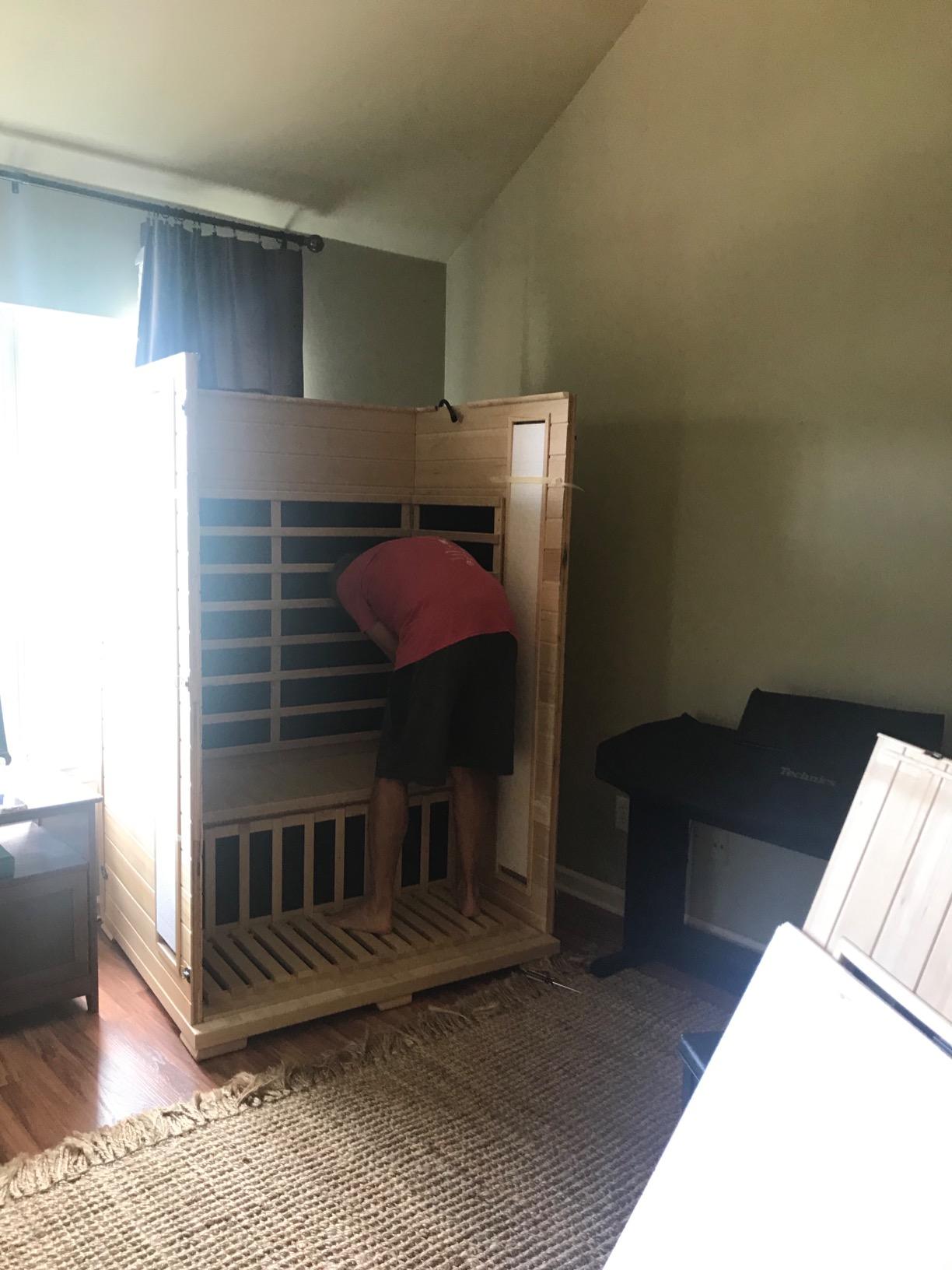
How the exterior height changes your ceiling plan
The 75 inch exterior height is identical to the Joyous, so both cabins need the same ceiling band, roughly 84 to 90 inches of finished ceiling once overhead clearance is allowed for. If your basement is under 7 feet 6 inches, neither of these two-person dual-wall cabins belongs there, and the choice narrows to the 59 to 63 inch models.
Because the interior is 69 inches against a 75 inch exterior, you lose about 3 inches of width and 4 inches of depth to the walls. That is the normal penalty of a double-wall build and it is worth knowing before you order, because the interior figure is what determines whether two people fit comfortably rather than one at a time.
Where it is a poor basement fit
It is the wrong pick for a tight corner or a low ceiling, and the wrong pick if you need a dedicated electrical conversation, since a 2-person carbon heater set is heavier on a circuit than the small plug-in cabins further down. It is also the wrong pick for a damp basement you have not fixed, because a 7-year warranty is only worth having if the wood stays dry.
Diagnose any water intrusion before the cabin goes in. Owners on sauna forums describe the pattern repeatedly: a water problem goes unaddressed, a sauna gets built over it, and the sauna is then blamed for damage that predated it. Fix the water, wait through a wet season, and only then build.
6. X-Vcak 1-2 Person with Red Light Therapy – Best Indoor Sauna for Red Light Therapy
X-Vcak 1-2 Person Infrared Sauna, Dry Heat Sauna with Red Light Therapy, Bluetooth, Radio, 7-Color Therapy Light for Home, Indoor, Gym, Wellness Center, 40″ x 36″ x 73″, Brown
Height 73 in
1450W with 6 panels
66-150F range
Red light therapy
231 lb
Pros
- Seven therapy colors including red light
- 1450W across 6 large panels
- 66-150F range with a 1-99 minute timer
- Bookshelf
- towel rack and top vent
Cons
- Only 39 reviews
- the thinnest history here
- 231 pounds is hard to relocate once assembled
Red light therapy is the reason to look at this cabin, and it is the only model in the list where that feature is a named part of the design rather than an assumption about the lighting. Seven therapy colors are built into the cabin including red, so you get a recovery session and a color session in the same enclosure. The 40 by 36 by 73 inch footprint still fits a basement corner without feeling like a small closet.
Six large heating panels at 1450W give a listed temperature range of 66 to 150F with a 1 to 99 minute timer, which is the widest upper range of the far infrared cabins here. Owners report fast, even heating and steady wood, and the film-coated tempered glass on both sides of the door reduces the shattering risk in a small enclosed space.
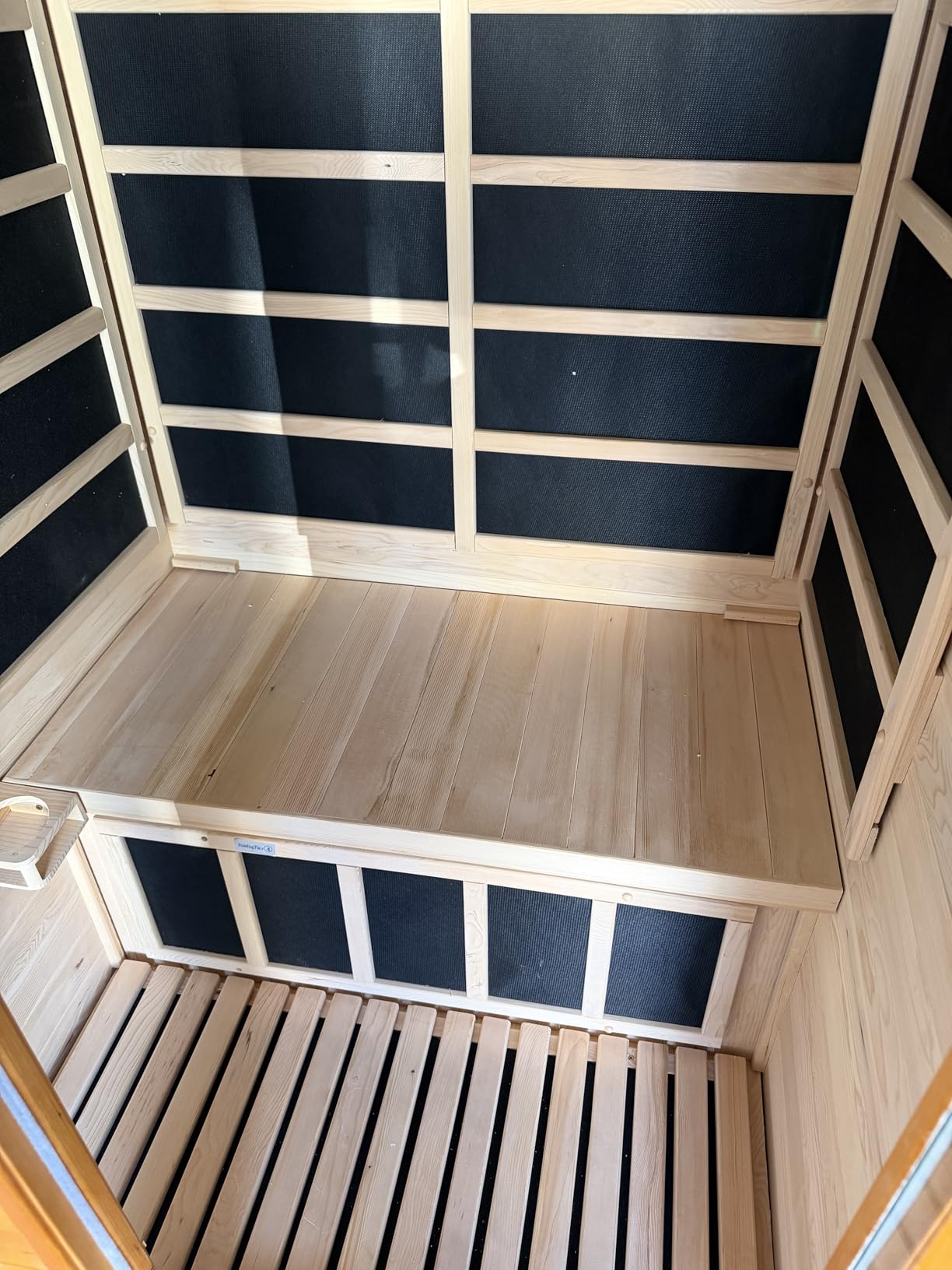
The 4.8 average comes from 39 reviews, and that is the whole caveat. Owners cite fast heat-up, sturdy construction, red light therapy and simple Bluetooth pairing, but a short history means long-term durability is less documented than for the higher-review models. Treat the rating as encouraging and the track record as unproven, because that is the honest read of the data.
Day-to-day convenience is genuinely well covered: Bluetooth, MP3 and radio, two stereo speakers, a bookshelf, a towel rack, a cup holder and a top ventilation hole. A three-prong plug with leakage protection means no electrician, and a top vent gives you a path for a duct if the basement runs damp.
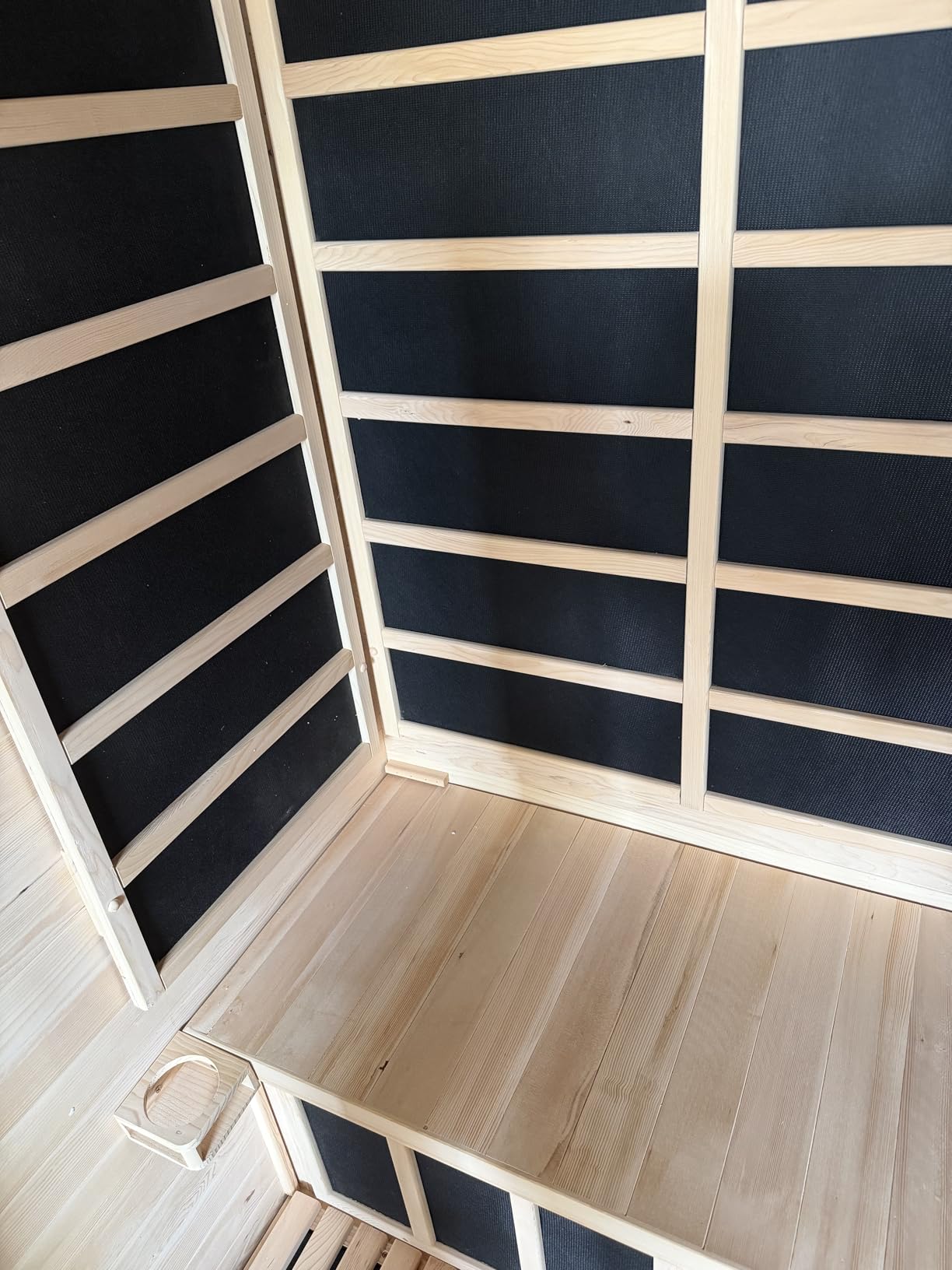
Whether 73 inches clears a basement ceiling
It clears a 7 foot ceiling, which puts it in a different band from the two 75 inch dual-wall cabins. With a finished ceiling of 7 feet you have 84 inches of height against a 73 inch cabin, leaving about 11 inches before you add the manufacturer’s overhead clearance, so it is viable but not generous. A 7 foot 6 inch finished ceiling gives it real breathing room for a high vent and a light fixture above the cabin.
What to check is the floor position. A basement slab is not always flat, and a 73 inch cabin set 2 inches proud of a finished floor changes the math. Measure from the highest point of the finished floor along the cabin footprint, not from the nominal ceiling tape measure at the wall.
Where it is a poor basement fit
It is the wrong pick for anyone who needs a long ownership record rather than a feature list, and the wrong pick for a family since capacity tops out at 1 to 2 people. It is also the wrong pick if you want a steam session, because there is no heater and no stone shelf.
At 231 pounds, the assembled cabin is difficult to relocate, so treat the install location as permanent. If you are renting, or you are not sure which corner you want, choose one of the lighter models below instead and keep the option open.
7. DWKWE Mini 1-Person Spruce – Best Indoor Sauna for the Tightest Basement Corner
Mini 1 Person Far Infrared Sauna for Home, 59″ Height Compact Space Saving Indoor Sauna with Side Glass Door & Window, Natural Spruce Wood Sauna Cabin for Apartment Gym, 900W Rapid Heating, Bluetooth
Height 59 in
900W far infrared
Solid spruce
Side glass door
Bluetooth
Pros
- Smallest listed footprint for tight corners
- Side-opening tempered glass door
- Solid spruce with no harsh adhesives
- 900W rapid heating
- Integrated side window
Cons
- Only 27 reviews
- the thinnest record here
- Very compact cabin with limited room to move
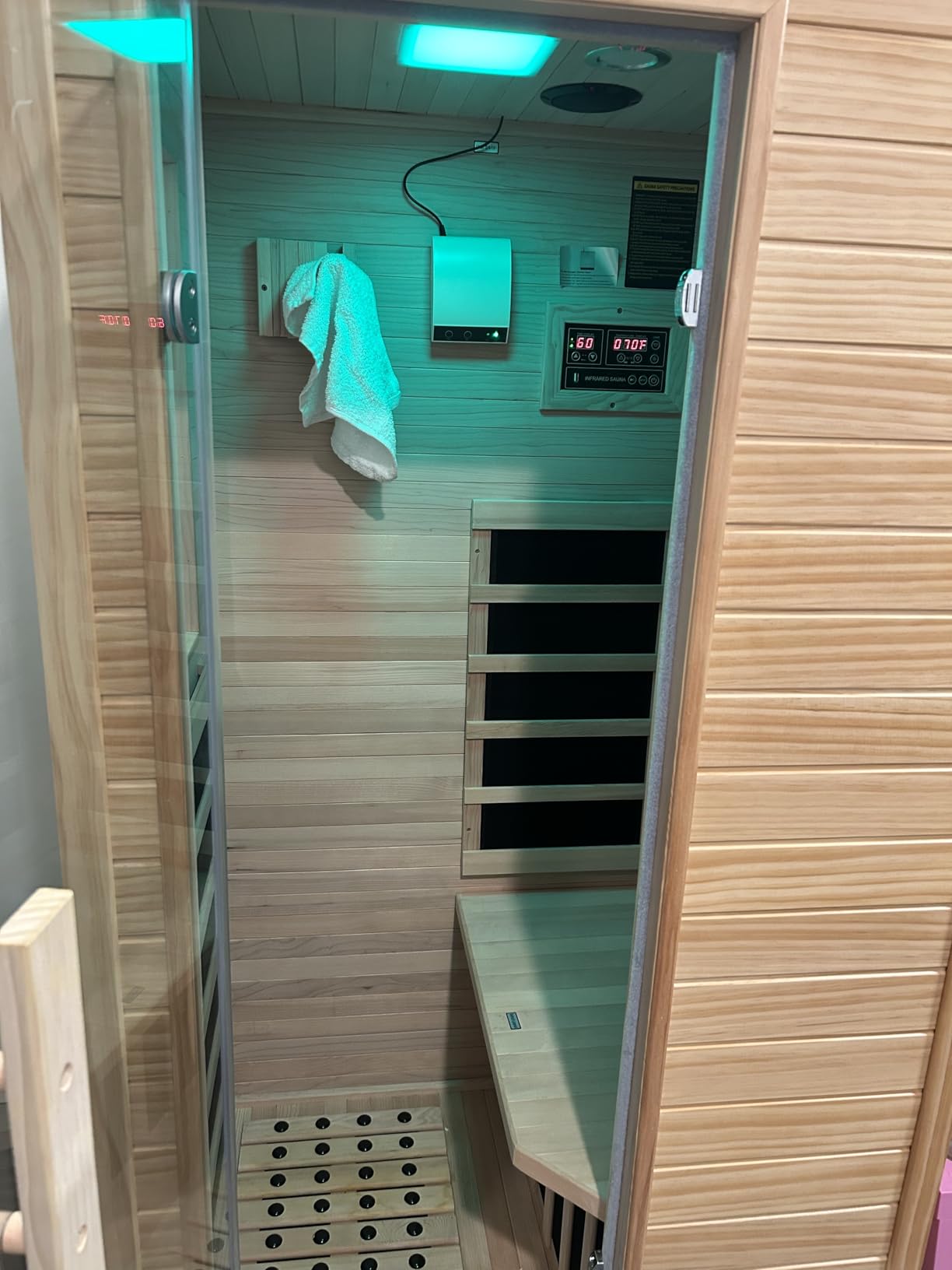
The DWKWE solves a problem the other cabins do not: a basement corner with almost no usable floor. The listed dimensions are 59 inches high by 27.6 wide by 31.5 deep, and a side-opening tempered glass door plus an integrated side window means you can enter without a door swing that eats the room. In a finished basement where every wall has a purpose, that is the difference between a sauna and a sauna with a wall removed.
Heat comes from 900W far infrared panels in 100 percent natural solid spruce, chosen for insulation and described as free from harsh chemical adhesives. Owners like the aroma and the way the cabin holds dry heat, and the 4.9 average across 27 reviews shows 94 percent five-star with no one or two star ratings at all.
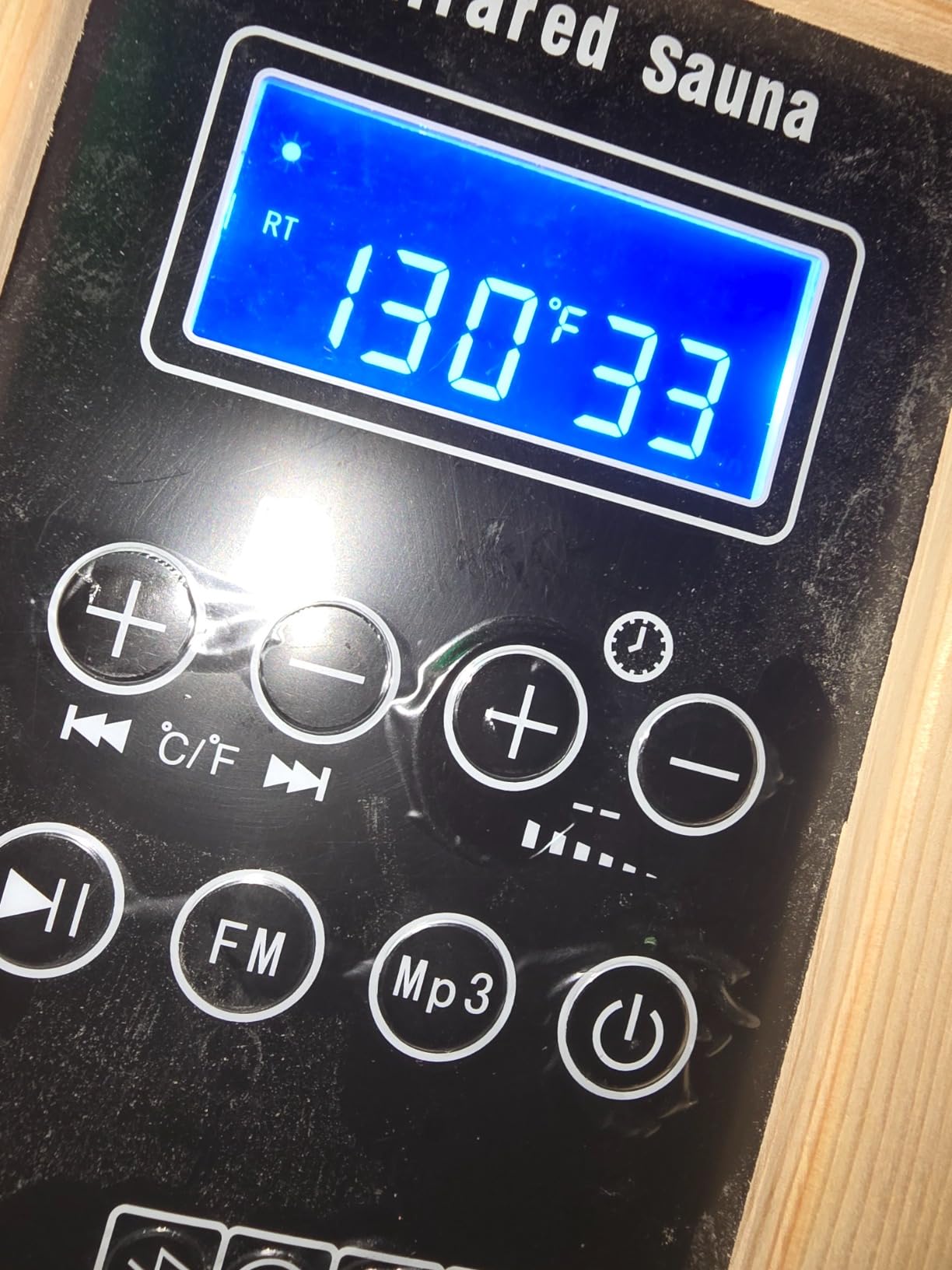
A 27 review sample is a small sample, and we will not dress it up. Early owner feedback is uniformly positive, which is encouraging, but it is not the same as a decade of service data. If you want the highest star average in the list and you also want the strongest evidence, you are choosing between those two things here, and honestly, the Joyous is the safer buy.
Bluetooth speakers, a cup holder and an ergonomic bench cover the essentials, and the target spaces are apartments, compact homes and personal gym corners, which is an exact description of a small basement. Note that the listing carries two different dimension sets, so confirm the packaged size before you plan the corner.
Why door swing decides this pick in a small basement
In a tight basement the door swing is often the binding constraint, not the footprint. Most sauna doors open outward into the room, so a 30 inch door leaf against a wall 2 feet from the nearest corner makes the cabin unusable. A side-opening door on a hinge that swings along the cabin face keeps the floor clear, and that is the practical reason this cabin fits corners the wider models do not.
Before ordering, stand in the corner with a tape measure and check three things: the width of the wall run, the distance to the nearest obstruction, and whether you can get a body sideways into a 27 inch wide cabin. The side window helps more than it sounds, because it means you are not sitting in a sealed box wondering how long the session is.
Where it is a poor basement fit
It is the wrong pick for couples and for anyone over about six feet, because a 27 inch wide single-person cabin leaves almost nothing between your knees and the wall. It is also the wrong pick if you want a warranty longer than a few years, since no long written warranty is published on this listing.
It is wrong for anyone who wants a sauna they can move later. A 900W 1-person cabin is light, but once assembled the panels are a fixed shape, so pick the corner deliberately. If you want the same footprint with a written warranty behind it, the Homsido is the more conservative version of this idea.
8. Kanlanth 1-Person 950W – Budget Pick Indoor Sauna for Basements
Kanlanth 1 Person Far Infrared Sauna, Low EMF Indoor Dry Home Sauna, 950W
Height 63 in
950W on 110-120V
Solid spruce
140F max
Heated foot stone
Pros
- Plugs into a standard 15A outlet
- Reaches roughly 130-140F in 8-15 minutes
- Lightest and simplest build here
- Heated foot stone and Bluetooth
- 4.6 average across 127 reviews
Cons
- Smallest cabin
- tight above about 6 feet
- Temperature gauge accuracy inconsistent on some
- Tops out at 140F
The Kanlanth is the reason a basement sauna does not require a construction project. It runs from a 110 to 120V US plug with a 2.2 meter cord on a standard 15A outlet, so no dedicated circuit and no electrician, and it is the only cabin here with a heated foot stone, which is a small feature that makes a real difference to a 15 minute session in a cold room. Five far infrared epoxy panels at 950W reach a listed 140F, or 60C.
Owners report reaching roughly 130 to 140F in 8 to 15 minutes, which makes it the fastest warm-up among the cabins we ranked. The build is described as the easiest and lightest in this comparison, and the 4.6 average across 127 reviews includes long-term owners using it two to four sessions a week for a year. Solid spruce holds heat well for the size.
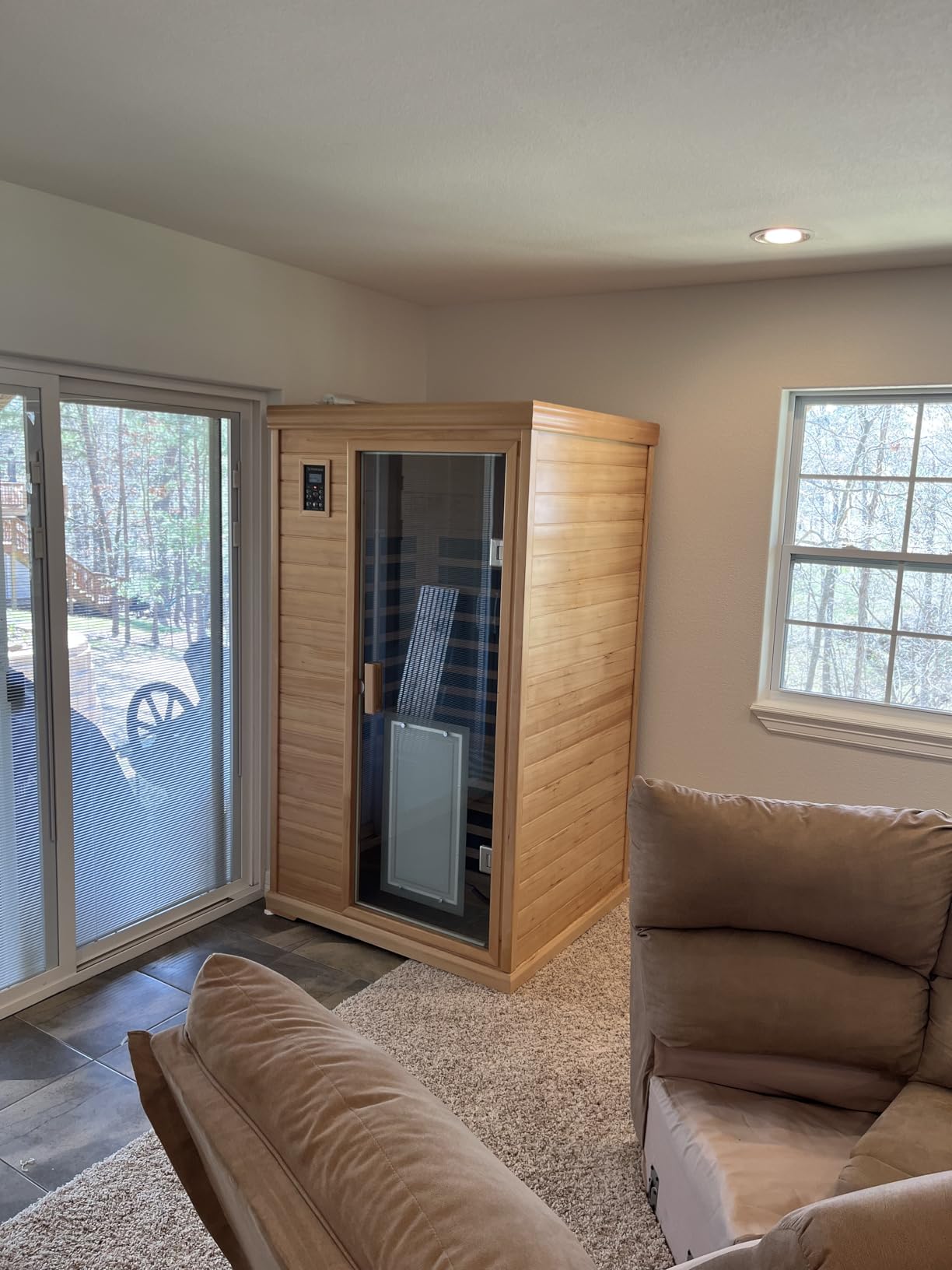
The footprint is 36.6 by 29.3 inches at 63 inches high, a genuinely compact vertical design that works in a small corner. A 110C overheat protection sensor, a built-in ventilation port with an open and close control, an LED reading light, a button control panel and Bluetooth speakers cover the basics. Owners on forums specifically value adjustable vents, since a fixed vent they cannot throttle is a recurring complaint about otherwise good cabins.
The recurring caveat is cabin size. Reviewers describe the interior as tight for anyone over about six feet or with long legs, and that is the one thing no amount of feature list fixes. A few owners also report temperature gauge accuracy problems, including one report of a non-responsive gauge and weak support response, so verify the gauge against a known thermometer when it arrives.
Whether it needs any electrical work at all
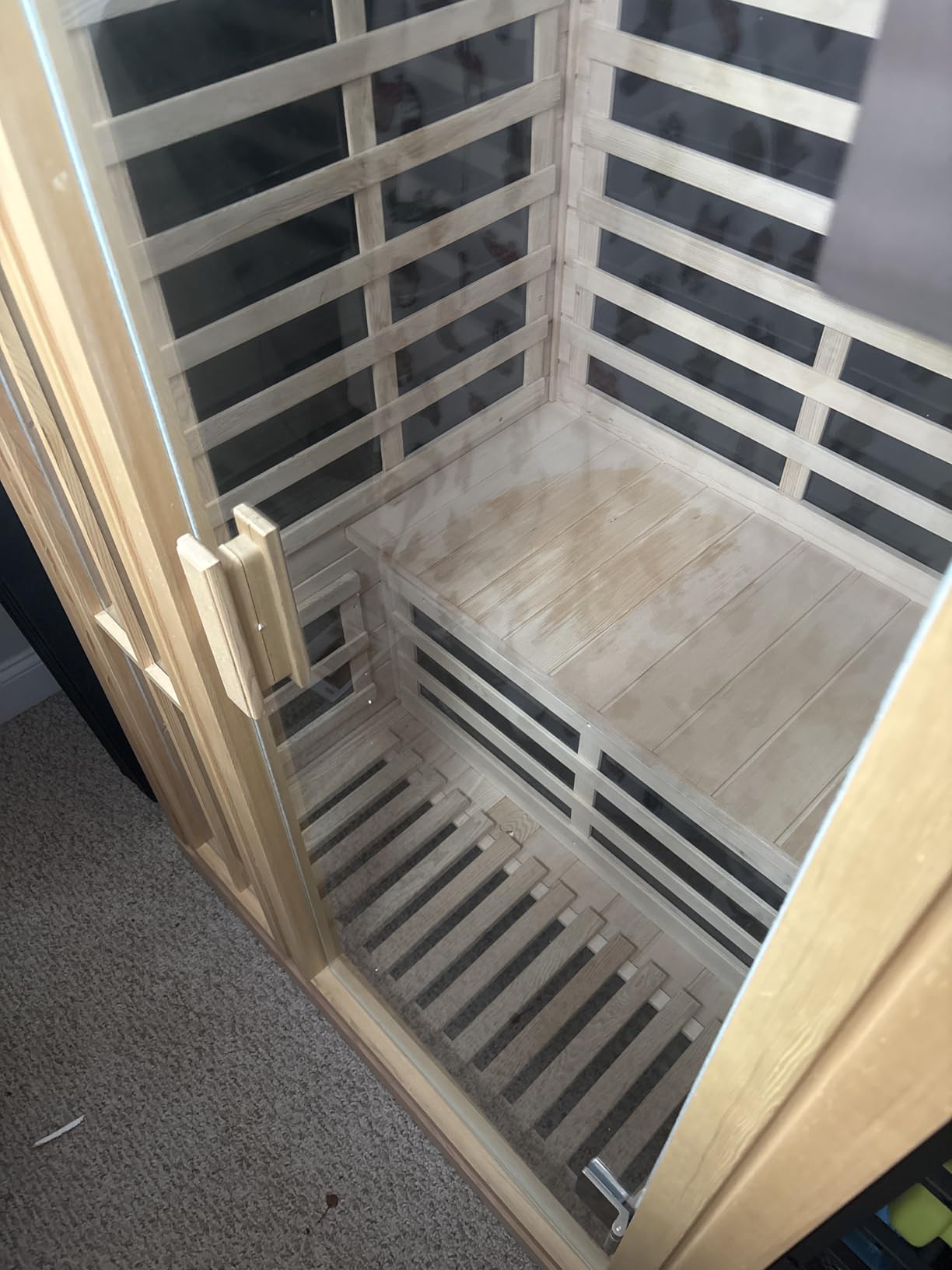
No. A standard 15A household outlet is what this cabin expects, which makes it the one product here you can carry down the stairs, plug in, and use that evening. For a basement with no spare capacity in the panel, that removes the single largest cost and schedule risk in a sauna project, and for an unfinished basement with no wiring at all it is the difference between possible and not.
It is still worth running it on a circuit that is not shared with a dehumidifier or a space heater. Infrared draws steady current for the length of a session, and a shared circuit on an older basement panel is where nuisance trips come from. If your panel has any open slots, adding a dedicated 15A outlet is a twenty minute job rather than a project.
Where it is a poor basement fit
It is the wrong pick for two people, and the wrong pick for anyone tall, because a single-person 950W cabin optimizes footprint over interior room. It is also the wrong pick if you want a higher session temperature, since 140F is the published ceiling on this one.
It is the wrong pick for a damp basement you have not addressed, because a small cabin with a sealed interior holds whatever humidity the room already has. A basement dehumidifier is the cheap insurance here, and running the cabin with a door cracked for the first few minutes also helps it dry out between sessions.
9. Albott 1-Person 110V – Best Lightweight Indoor Sauna to Move Into a Basement
Albott 1 Person Infrared Sauna, Infrared Sauna for Home & Gym, Low EMF 110V
Height 60.2 in
107 lb
4 carbon panels plus foot heat
149F max
110V
Pros
- Lightest build here at 107 pounds
- 20 minute setup with basic tools
- About 6 sq ft footprint
- Standard 110V 15A plug
- Finnish spruce with a sealed glass door
Cons
- Basement preheat often takes 45-60 minutes
- Thermostat cycles below set temperature
- Some stripped screw holes in assembly
At 107 pounds, the Albott is the practical pick when the route into the basement is the problem. A stairwell with a turn, a landing and a tight doorway will stop a 250 or 420 pound assembled cabin, and this one moves in sections and goes together in about 20 minutes with basic tools. The finished footprint is about 6 square feet at 31.8 by 27.2 inches and 60.2 inches high, so it fits an 8 by 10 basement room without taking it over.
Heating is four carbon infrared panels plus a dedicated foot zone, and the published maximum is 149F, or 65C, the highest listed ceiling among the small far infrared cabins here. Finnish spruce walls, a tempered glass door with a seal strip, and a roof vent for airflow complete the enclosure. A standard 110V plug at about 15 amps means no wiring work.
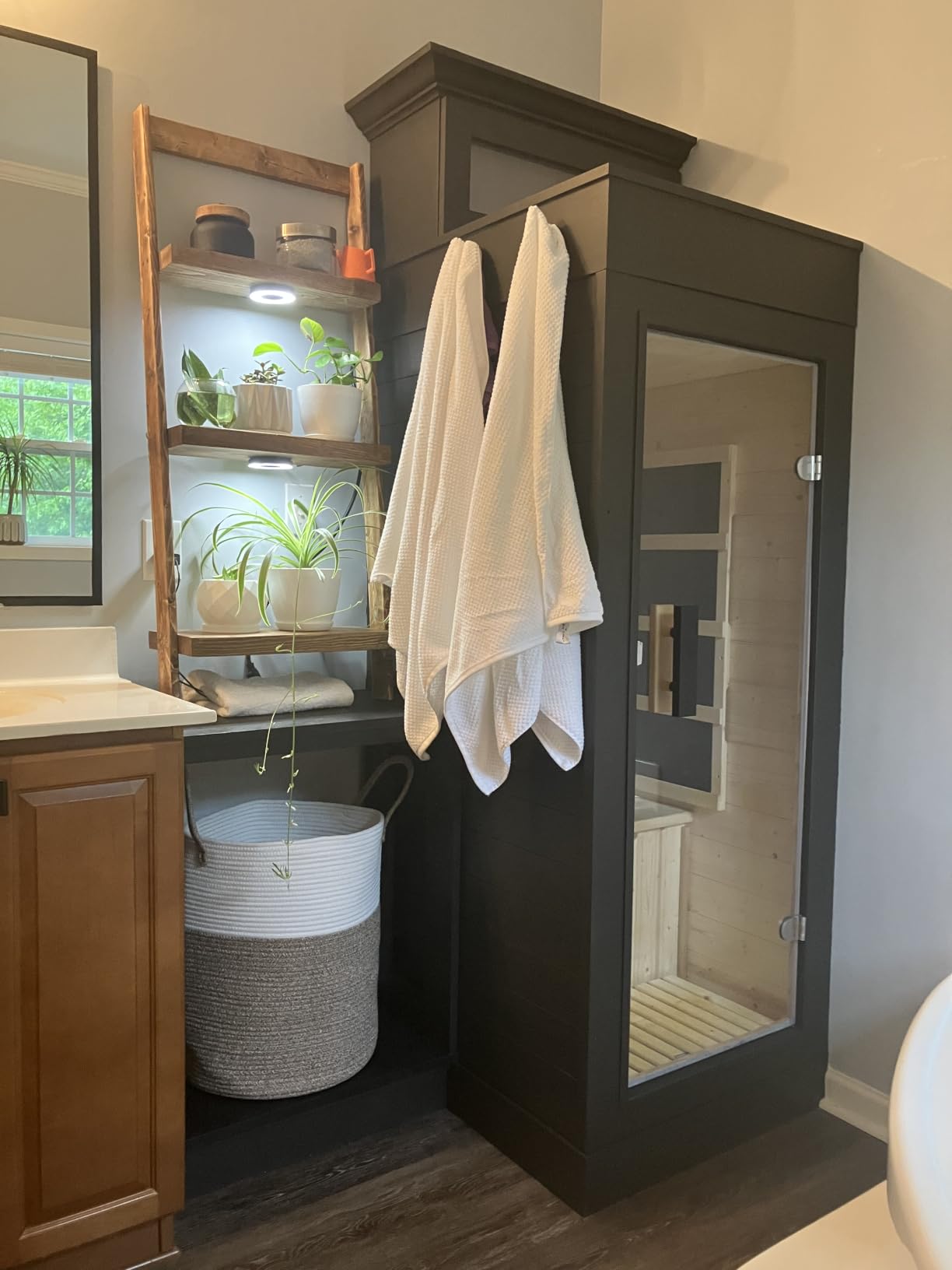
The 4.4 average across 119 reviews has 74 percent five-star, and owners consistently praise build quality, footprint and easy assembly. They also consistently report the same basement problem. Cold rooms extend warm-up to roughly 45 to 60 minutes in real use, well past what a showroom suggests, and that is a physical fact about a small 110V cabin in an unheated below-grade space rather than a defect.
Two smaller build notes come up: the thermostat cycles a few degrees below the set temperature before reheating, and some owners report stripped screw holes during assembly. Drive the panel screws by hand first rather than with a drill, and accept that this thermostat is a rough controller rather than a laboratory instrument.
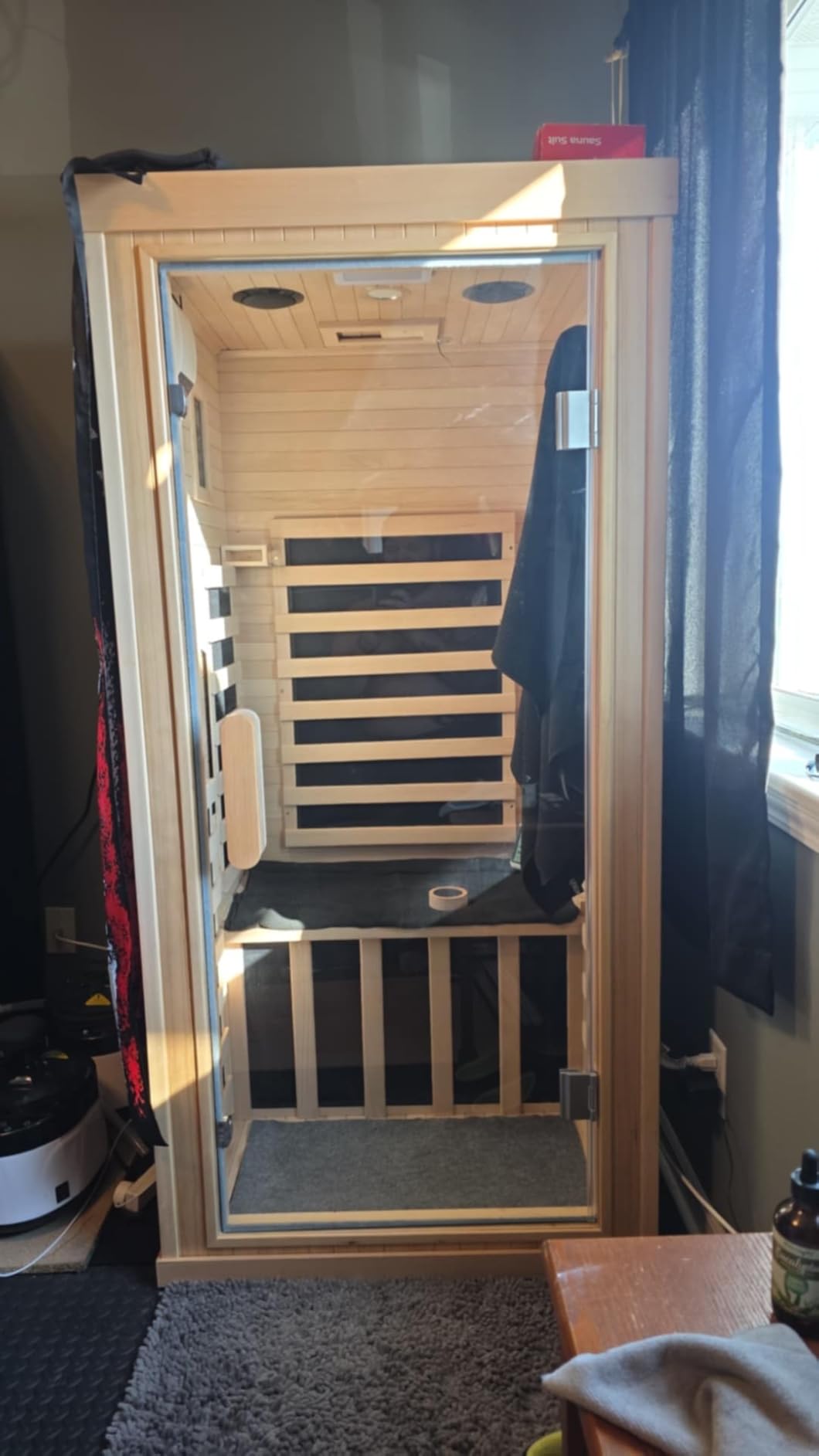
Planning around a 45 to 60 minute preheat
Plan the session around the preheat, not the other way around. Owners who get the most out of this cabin start it 45 minutes or more before they want to get in, which is a workable pattern if you run it before a workout or at the end of the day. It is also the reason the app-controlled cabin further down this list appeals to owners who want to start a preheat remotely.
The alternative is to warm the room itself. A basement that sits at 62F instead of 58F shortens the preheat noticeably, and a small heater on a thermostat for the corner where the sauna lives costs far less than the electrical work a larger cabin needs. Whatever you do, do not shorten the preheat by cranking the set temperature above the published 149F maximum.
Where it is a poor basement fit
It is the wrong pick if you want two people inside, and the wrong pick if you are impatient, because this is the slowest-heating cabin in the list in a real basement. It is also the wrong pick for a fit-and-finish project, since the screw hole and thermostat notes above suggest a build that rewards careful assembly rather than rushing it.
It cannot be moved once fully assembled, even though the components are light, so treat the first location as final. If you are still deciding between a corner and a wall, put the panels together in the middle of the floor, measure the swing, and only then push the cabin into position.
10. EASYHAWK 2-Person WiFi Sauna – Best Indoor Sauna for App Control
EASYHAWK 2 Person Infrared Sauna for Home, Low EMF FAR Indoor Wooden Dry Sauna Room with Flame-Retardant Design, WiFi App Control, Bluetooth Speakers, LCD Panel, 1500W/120V
Height 72.8 in
1500W on 120V 15A
WiFi app control
5-year warranty
Pros
- Only cabin here with WiFi app control
- 6 low EMF carbon panels at 1500W
- Bluetooth
- FM
- USB and MP3
- 7-color RGB lighting
- 5-year limited warranty
Cons
- Slowest reported heat-up at 45 minutes or more
- Some units arrived missing parts
- Side panel can fit poorly at the door
The EASYHAWK is the only cabin in this list with WiFi app control, and in a basement that is more than a gimmick. A room one floor below living space is exactly where you want to start a preheat from your phone while you are upstairs, and the Smart Life app alongside the LCD panel handles time, temperature, lighting and audio remotely. It is 47.2 inches wide by 39.3 deep by 72.8 high and rated for two people.
The heat is six low EMF carbon far infrared panels at 1500W across a 64 to 149F range, which is a genuine two-person output rather than a solo cabin stretched. Entertainment support is the widest here, with Bluetooth, FM radio, USB and MP3, plus 7-color RGB lighting, an interior reading light, a cup holder and a towel holder. Assembly is panel-style in about an hour on a standard 15A 120V plug, and a 5-year limited warranty is published.
Owners praise the app, the LCD panel and the two-person space consistently, and 71 percent of its 16 reviews are five-star. We are placing it last on the strength of that evidence rather than its features, because a 4.2 average from 16 reviews is the thinnest record in the group and several owners report units arriving with missing parts, which is a supply issue worth planning around.
What app control actually solves in a basement
It solves the preheat problem described in the previous entry. A 45 minute warm-up is not a problem if you trigger it on the way to work, and it is a genuine burden if you have to sit and wait for it. The LCD panel keeps manual control in the cabin for anyone who does not want to use the app, so nothing is lost for the person inside.
It also helps with ventilation habits. Owners who use an inline duct fan for a basement sauna can switch the fan on with the same routine as the heat, which is the pairing that keeps a below-grade room dry between sessions. Our guide to the best inline duct fans for basements covers the airflow side of that setup.
Where it is a poor basement fit
It is the wrong pick if you need a long warranty or a large review history, and the wrong pick if a supplier shipping in multiple packages is going to make you nervous, since some units arrived with parts missing. The listing notes the shipment can arrive as three separate packages on different days, so plan for storage space between deliveries.
It is also the wrong pick for someone who wants a clean entry. Several owners report the side panel next to the glass door fitting poorly enough to require lifting the door to get in, which is an assembly alignment issue rather than a defect, but it is worth having a second person on the panel alignment step. For a wider comparison of home sauna formats, our home sauna buying guide covers cabin versus portable.
What Makes an Indoor Sauna Basement-Ready
Five checks decide whether any of these ten cabins can live in your basement. Run all five before you order, because the ones that fail are rarely fixable after the panels are up. None of them have anything to do with brand quality, and all of them are cheap to check in an afternoon.
1. The ceiling math: cabin height plus overhead clearance
The number buyers miss most often is not the cabin height, it is the overhead clearance above the cabin. Manufacturers require air space above the top of the cabin for circulation and for the vent path, and the requirement is separate from the cabin’s own published height. Add the two together and that sum is your minimum finished ceiling.
Working from the published cabin heights in this list: the Homsido and DWKWE are 59 inches, the Albott is 60.2, the Azomabox is 61.4, the Kanlanth is 63, the EASYHAWK is 72.8, the X-Vcak is 73, and the OUTEXER, Blue Wave and JNH Joyous are 74.8 to 75. So a 7 foot finished ceiling of 84 inches works for everything up to the X-Vcak with a modest clearance allowance, and the 75 inch dual-wall cabins need closer to 7 feet 6 inches. None of these listings publishes a stated overhead clearance figure, so measure your own ceiling and leave the gap.
Also measure from the high point of the finished floor, not from the wall. Basement slabs are frequently 1 to 3 inches out of level, and ductwork in an older basement can drop the effective ceiling by another 2 inches over a stretch of wall.
2. The circuit, and how far it is from the panel
Sort the list into two electrical groups. Eight of the ten cabins here run on a standard 110 to 120V plug, which in most basements means an existing outlet or one new outlet. The two that do not are the OUTEXER at 3KW on 240V and, in practice, the 1500W EASYHAWK if you choose to put it on a dedicated line rather than a shared 15A.
For the 240V sauna, the question is not the outlet, it is the panel. A 100 amp service that is already loaded cannot take a 30 amp sauna circuit without a panel upgrade, and an upgrade in an older home is a separate project with its own permitting and its own schedule. Count the loads, not the free slots, and talk to a licensed electrician before you order rather than after.
Distance matters for cost, not for feasibility. A long run from the panel to the far corner of a basement is straightforward engineering with a very predictable invoice, and it is worth getting that number before you commit to a wet steam build.
3. Moisture and ventilation
Infrared is dry heat. It adds almost nothing to the humidity of a room, which is why eight of these ten cabins are low risk in a basement. Traditional steam is the opposite: it puts water into the air on purpose, and below grade that water has nowhere to go without a ducted path to the outside.
For a traditional build, the assembly that sauna owners recommend most is rockwool with a well-sealed foil-faced vapor barrier, sealed at every seam and every penetration, plus a low intake near the heater and a high exhaust on the opposite wall. Venting into the basement itself is the mistake that shows up in forum threads again and again, because it relocates the humidity rather than removing it.
For any build, measure the room before you start. Basements commonly sit between 30 and 60 percent relative humidity, well above what an above-grade room sees, and a room above roughly 60 percent benefits from a dehumidifier running alongside the sauna. A high-quality inline duct fan moves more air at the same static pressure than the bathroom fan many owners reach for first.
4. The floor and the load
Sealed concrete or tile is the right floor. Carpet in a sauna room is a bad idea regardless of the sauna, because warm air plus trapped moisture plus fibers is a combination that does not recover well. Our dehumidifier guide covers the whole-floor question, but the sauna footprint itself should sit on a hard surface with a sealed finish.
Load is rarely a problem: these cabins are a few hundred pounds of timber on a slab rated for thousands. The real floor question is a floor drain, and it only matters for a wet steam build. If you are installing a traditional sauna, plan the drain and the trap before the frame goes up, because cutting a slab for one later is a much larger job.
5. The stairs and the route in
Most of these cabins arrive as panels and go together on site, so the question is what the largest single panel measures and whether it clears the turn. Measure the stairwell width, the landing, and the headroom at the turn, then compare them against the packaged panel dimensions. Basement saunas that will not fit down the stairs are a common and entirely preventable disappointment.
Weight at the destination is a separate issue. The Albott at 107 pounds is comfortable for one person to rotate into position. The OUTEXER at 420 pounds and the Blue Wave at 329 pounds want two people, and probably a furniture dolly on a finished floor. Decide who is helping before the crate arrives, not on the day.
Infrared vs Traditional vs Wet Steam in a Basement
Choose infrared unless you have a specific reason not to. Far infrared is dry heat, runs on 120V in every case in this list, needs no vapor barrier, and can go into a finished basement room with a normal outlet. Nine of the ten cabins here are infrared, and that is not a coincidence of what is available, it is a reflection of how much lower the basement risk profile is.
Choose traditional electric when you want löyly. Water on hot stones, real humidity, a 190F room, and a 240V circuit that needs an electrician. It is a better sauna and a harder basement project, and the two go together. A basement with no vent path to the outside should rule this out entirely, and the answer is not to find a cleverer vent, it is to choose infrared.
Choose wet steam only if you have a finished bathroom-style room, a real drain, and a ducted exhaust that terminates outdoors. It is the least basement-appropriate option on this page and the most rewarding in the right room, which is why we ranked the OUTEXER second rather than lower.
One practical note on temperature. Infrared cabins here top out between 140F and 150F, while the traditional route reaches around 194F, and those are genuinely different experiences rather than a better and a worse version of the same thing. Newcomers should start lower and work up; one listing in this group explicitly recommends a first session at the lower end of its range and a session length of 10 to 15 minutes.
If you are still narrowing the field by heat type, our infrared sauna review roundup goes deeper on panel materials and temperature, and our portable sauna guide covers the option for people who are not ready to give up floor space permanently.
Basement Prep Checklist and the Mistakes That Cost Owners Money
Six steps, in order, before you order anything. Each one is cheap to do and expensive to do late. Work through them in sequence, because a later step is meaningless if an earlier one failed.
Confirm the basement is dry. Fix any water intrusion, check the sump pump, and wait through a wet season. Owners describe the same pattern repeatedly in forum threads: a water problem goes unaddressed, a sauna gets built over it, and the sauna inherits the blame for damage that was already there.
Find the vent path. If you are considering a traditional sauna, confirm a real route to the outside before you buy anything, including whether you have an exterior wall or a rim joist above grade to penetrate. If the answer is no, decide now that you are buying infrared, and stop spending time on traditional options.
Check the electrical panel. Count actual loads, not free slots. A 100 amp service already serving a finished basement may not take a 30 amp 240V sauna circuit, and a panel upgrade is its own project. For an infrared sauna, confirm there is a 15A outlet where you want the cabin, or that adding one is easy.
Assess the slab and the ceiling. Measure ceiling height at the high point of the floor along the whole wall run, and confirm the finished floor is a sealed hard surface. Note the depth of any ductwork that crosses the intended footprint.
Plan the drain if you are going wet. A floor drain and a trap, decided before the frame goes up. Retrofitting one into a slab is a completely different project from setting one during the build.
Call the building department. A new circuit, a new drain and a fixed structure can each trigger permit requirements depending on where you live. A ten minute phone call before you order is cheaper than a stop-work notice after the panels are up.
The mistakes worth naming, because each one recurs: venting into the basement instead of outside, a vapor barrier with unsealed seams, building over an undiagnosed water problem, buying a traditional sauna with no vent path, ignoring the manufacturer’s overhead clearance because the cabin itself fits, and assuming a bathroom exhaust fan can do the work of a ducted sauna vent. Every one of those is cheap to avoid before the build and expensive to fix after it.
Frequently Asked Questions
Is it okay to put a sauna in your basement?
Yes, provided the basement is dry and the sauna fits. Most basement saunas are far infrared cabins that run on a standard 120V outlet, need no venting and add almost no humidity. Traditional steam saunas also work below grade but need a 240V dedicated circuit, a continuous vapor barrier and a ducted exhaust running outdoors. Confirm a dry basement, a vent path if you want steam, and enough ceiling height before ordering.
What ceiling height do you need for a basement sauna?
Add the cabin height to the manufacturer’s required overhead clearance to get your minimum finished ceiling. In our roundup, the smallest cabins are 59 inches tall and clear a 7 foot ceiling easily, while the 75 inch dual-wall two-person cabins need roughly 7 feet 6 inches once clearance is added. Measure at the high point of your finished floor, and account for ductwork crossing the space.
Can a basement sauna run on a regular outlet?
Yes, for infrared. Eight of the ten cabins we ranked plug into a standard 110 to 120V household outlet, with some drawing 900W to 1500W. Traditional steam saunas are the exception: a 3KW heater needs a 240V hardwired circuit and a licensed electrician. For infrared, still use a circuit that is not shared with a dehumidifier or space heater to avoid nuisance trips.
Do infrared saunas cause moisture problems in a basement?
Infrared saunas are dry heat and add very little humidity, which is why they are the low-risk choice below grade. The moisture risk comes from the room itself, not the sauna. If your basement sits above roughly 60 percent relative humidity, run a dehumidifier and keep an eye on the floor and wall finishes. Direct a top vent or duct outdoors if the room has any history of dampness.
What is the 200 rule for saunas?
The 200 rule is a traditional sauna convention: between rounds, cool the room back down to roughly 200F before heating again. It exists so that each round feels fresh and your body gets a proper rest rather than accumulating heat exposure. It is most relevant to wet steam saunas, which can be run hot, and largely irrelevant to far infrared cabins capped near 140F to 150F.
Do I need a permit or an electrician for a basement sauna?
An electrician is required for any 240V hardwired sauna, and most infrared cabins need no electrical work beyond an existing outlet. Permits depend on your municipality and can be triggered by a new circuit, a new floor drain or a fixed structure. A ten minute call to the building department before you order is the cheapest step in the whole project.
The Verdict on the Best Indoor Saunas for Basements in 2026
The JNH Lifestyles Joyous 2-Person is the best indoor sauna for basements in 2026 for the simple reason that it clears the hard constraints and has the deepest owner record in the group. At 75 inches tall in dual-wall Canadian hemlock, it wants a finished ceiling near 7 feet 6 inches, runs on 120V power, and carries a 4.5 average across 1437 reviews with 78 percent five-star.
Two exceptions are worth naming. Below a 7 foot finished ceiling, step down to the 59 to 63 inch cabins, and the Homsido is the one we would pick for a small corner. If you want real löyly and your panel and vent path can carry it, the OUTEXER 3KW steam sauna is the better sauna and a bigger project. Measure your ceiling and check your panel before either.