
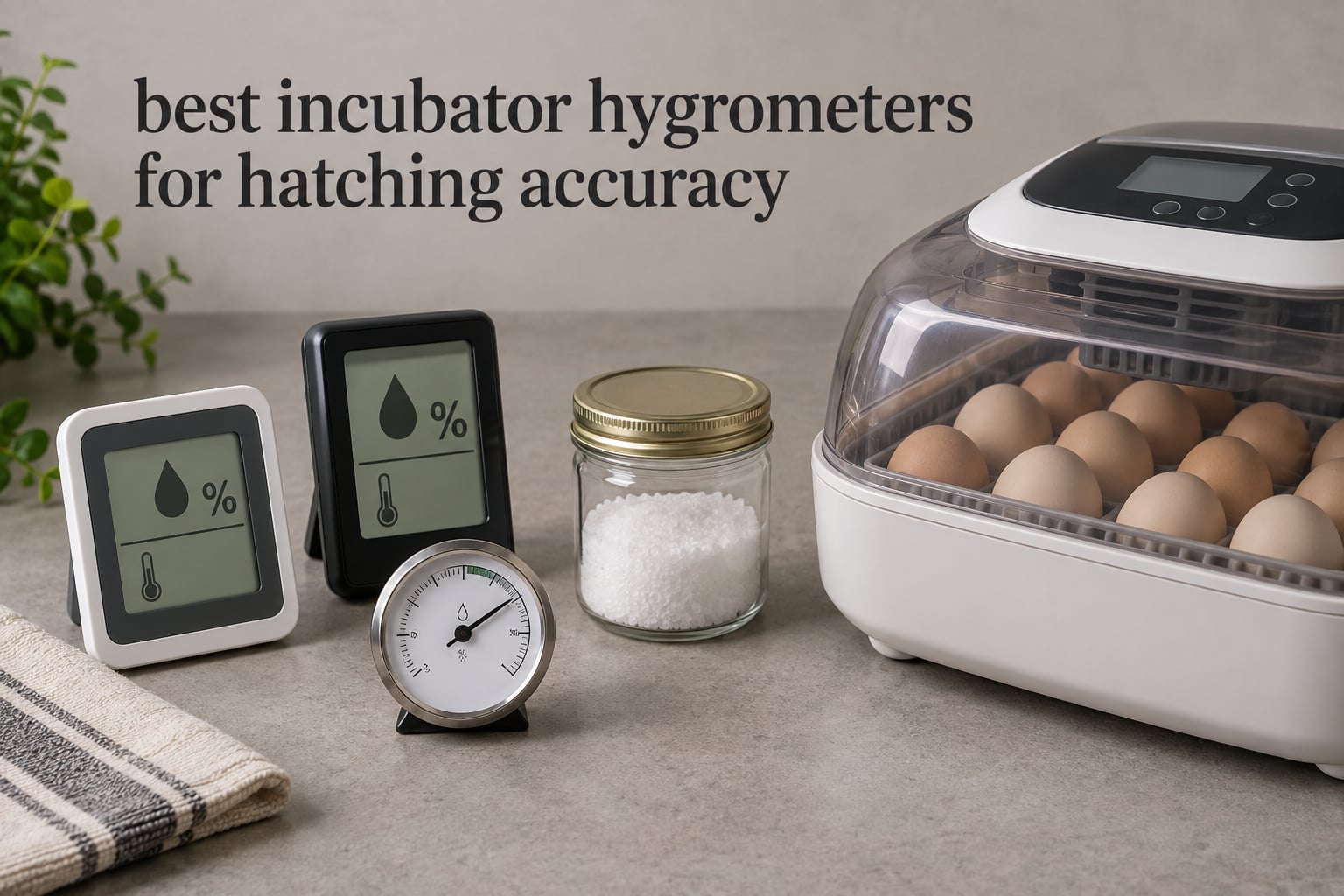
Ask almost anyone who has hatched a batch of eggs and they will tell you the same thing: the anxiety is not about the temperature, it is about the humidity. You cannot see it, you cannot smell it, and the small dial that came with your incubator was never calibrated against anything. So you buy a meter, and then you wonder whether that meter is telling you the truth. That is the whole problem this roundup solves — which incubator hygrometer you should actually trust with a batch of eggs, and how to check it yourself in an afternoon.
Our shortlist covers ten digital and analog thermo-hygrometers and humidity monitors, from a purpose-built incubator unit with a remote probe down to pocket-sized meters sold in multi-packs. We compared them on published tolerance, sensing method, memory features, probe placement options and what thousands of owners say after real hatches. Every meter here measures relative humidity (RH) as well as temperature, which is the minimum bar for hatching accuracy.
One thing up front: we did not run a laboratory salt-test series of our own, so this guide does not publish invented per-model RH offsets. Where accuracy is discussed, it comes from the manufacturer’s stated tolerance and from owner reports in the review data. The salt-test protocol below is written so you can generate your own offsets on your own bench.
Table of Contents
Hygrometer vs Hydrometer: The Terminology Trap
A hygrometer measures the relative humidity of air. A hydrometer measures the density of a liquid. People searching for an incubator meter often type “hydrometer” because the words sound identical, but the two instruments have nothing in common — a hydrometer is the glass float you sink into wort or must to read sugar content.
Two more terms cause confusion in incubation circles. A thermometer measures temperature only, and a hygrostat (also called a humidistat) switches a humidifier on and off to hold a set humidity. A hygrometer only reports what is happening; it changes nothing. Most backyard hatchers need the hygrometer first and never need the hygrostat.
Readings also depend on temperature. Relative humidity is the amount of water vapor in air expressed as a percentage of the maximum the air could hold at that temperature, so the same air mass reads differently at different temperatures. That is why a wet-bulb dial gauge in an incubator often shows a different number than a digital RH meter sitting beside it — both can be right.
Top 3 Best Incubator Hygrometers for Hatching Accuracy in 2026
Our three headline picks cover the three common setups: a dedicated incubator monitor with a remote probe, a compact high-volume favorite for tight spaces, and a battery-free analog gauge that cannot fail mid-hatch.

IncuTherm Plus Thermometer and Hygrometer
- Remote probe inside the chamber
- Min/max memory for temp and humidity
- Large LCD
- Switchable C/F

Inkbird ITH-10 Digital Monitor
- Humidity accuracy plus or minus 3 percent
- Max/min recording
- 2 second response
- 4.13 inch body

Zoo Med Economy Analog Dual Gauge
- Analog temperature and humidity dial
- No batteries required
- Velcro backing
- 6 x 4 inch face
All 10 Incubator Hygrometers Compared (October 2026)
This table covers every meter in the roundup with its sensing type, memory features and best use. We rank the top three separately above.
| Product | Specifications | Action |
|---|---|---|
| IncuTherm Plus Digital Thermometer and Hygrometer |
|
Check Latest Price |
| Inkbird ITH-10 Digital Thermometer and Hygrometer |
|
Check Latest Price |
| Zoo Med Economy Analog Dual Thermometer and Humidity Gauge |
|
Check Latest Price |
 Zoo Med Labs Digital Thermometer Humidity Gauge TH-31 Zoo Med Labs Digital Thermometer Humidity Gauge TH-31 |
|
Check Latest Price |
 MEGGSI 2-Pack Mini Digital Hygrometer and Thermometer MEGGSI 2-Pack Mini Digital Hygrometer and Thermometer |
|
Check Latest Price |
 Veanic 4-Pack Mini Hygrometer Thermometer Veanic 4-Pack Mini Hygrometer Thermometer |
|
Check Latest Price |
 Thermometer World Digital Hygrometer with Two Remote Probes Thermometer World Digital Hygrometer with Two Remote Probes |
|
Check Latest Price |
 Weewooday 3-Pack Digital Humidity Meter with Probe Weewooday 3-Pack Digital Humidity Meter with Probe |
|
Check Latest Price |
 VIVOSUN Digital Hygrometer Thermometer with App VIVOSUN Digital Hygrometer Thermometer with App |
|
Check Latest Price |
 AQUANEAT Reptile Thermometer Hygrometer with Suction Cup AQUANEAT Reptile Thermometer Hygrometer with Suction Cup |
|
Check Latest Price |
1. IncuTherm Plus Digital Thermometer and Hygrometer — Best Incubator-Specific Design
IncuTherm™ Plus Digital Thermometer and Hygrometer for Egg Incubator
Remote probe thermo-hygrometer
Min/max memory
2.5 inch body
Battery included
Pros
- Purpose-built for egg incubators with a probe that sits inside the chamber
- Records min/max for temperature and humidity
- Large display readable from across a hatchery
- Switchable Celsius and Fahrenheit
- Battery included
Cons
- Single probe design limits multi-point monitoring
- No app connectivity or remote alerts
- No published numeric humidity tolerance
This is the only meter in the roundup designed from the start for an incubator rather than adapted from a terrarium, greenhouse or humidor use case. The remote probe is the reason. You slide it between the eggs at egg height and the display stays outside, so you can check conditions without opening the lid and dropping the humidity. On a still-air incubator that single design choice is worth more than any spec on a datasheet.
The min/max memory is the feature I would not give up. A 21-day hatch is unattended for most of it, and the only useful number after the fact is the highest and lowest humidity the chamber actually saw. Owners consistently point to this when they describe the model, and the 4.4 star average across 641 reviews reflects a design that simply works for its intended job.
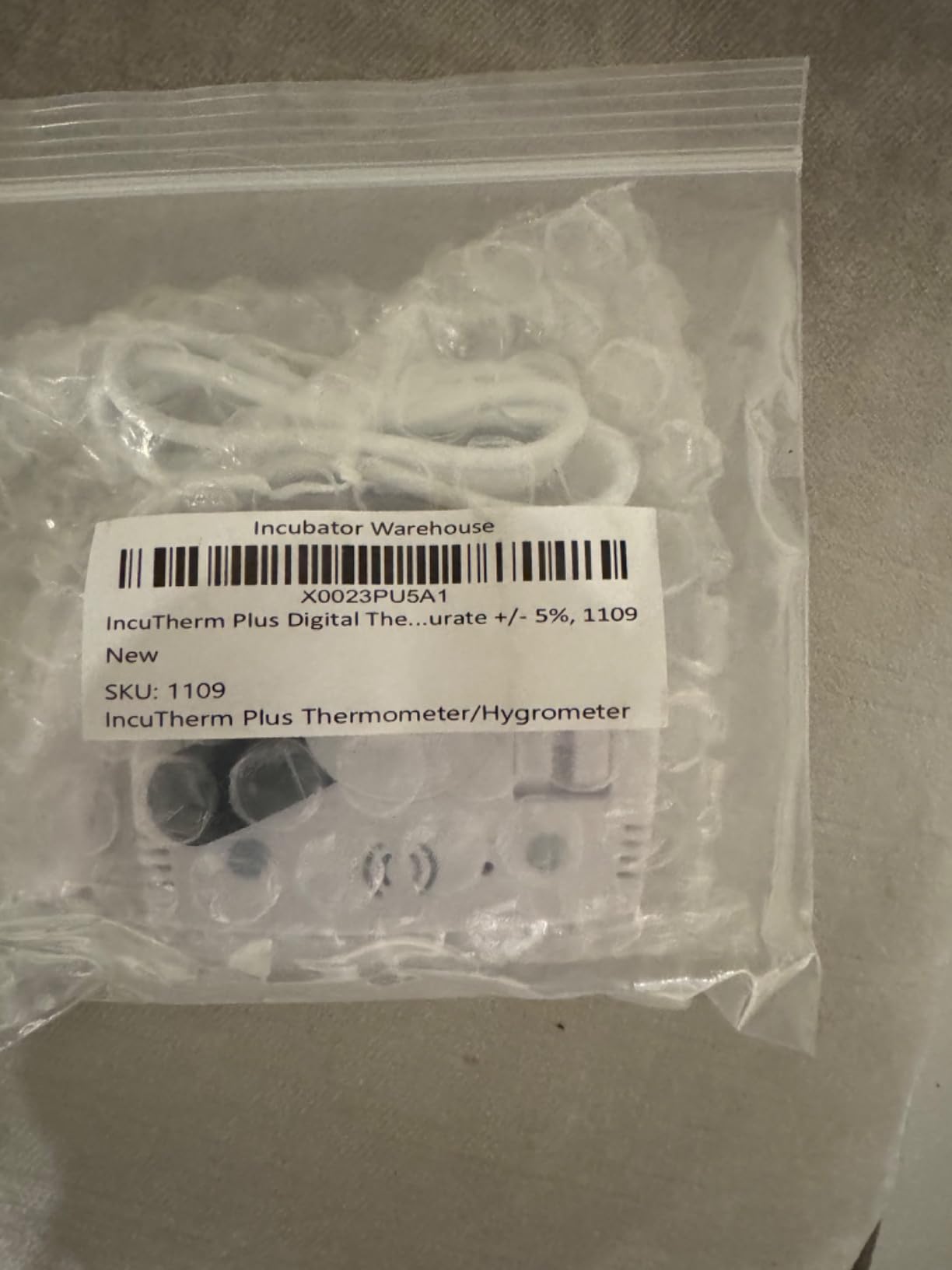
Switching between Celsius and Fahrenheit is handy if you work across suppliers, and the stated upper temperature range of 70 °C gives plenty of headroom above the 37.5 °C egg setpoint. The unit is plastic, battery powered, wipes clean, and measures 2.5 inches — small enough that it does not crowd a small tabletop chamber.
What it does not offer is a second sensing point or any wireless reporting. If you run a cabinet incubator with trays at different heights, one probe can only tell you about one zone. And unlike several rivals here, the listing does not quote a numeric humidity tolerance, so you are standardizing by salt test from day one rather than trusting a factory claim.
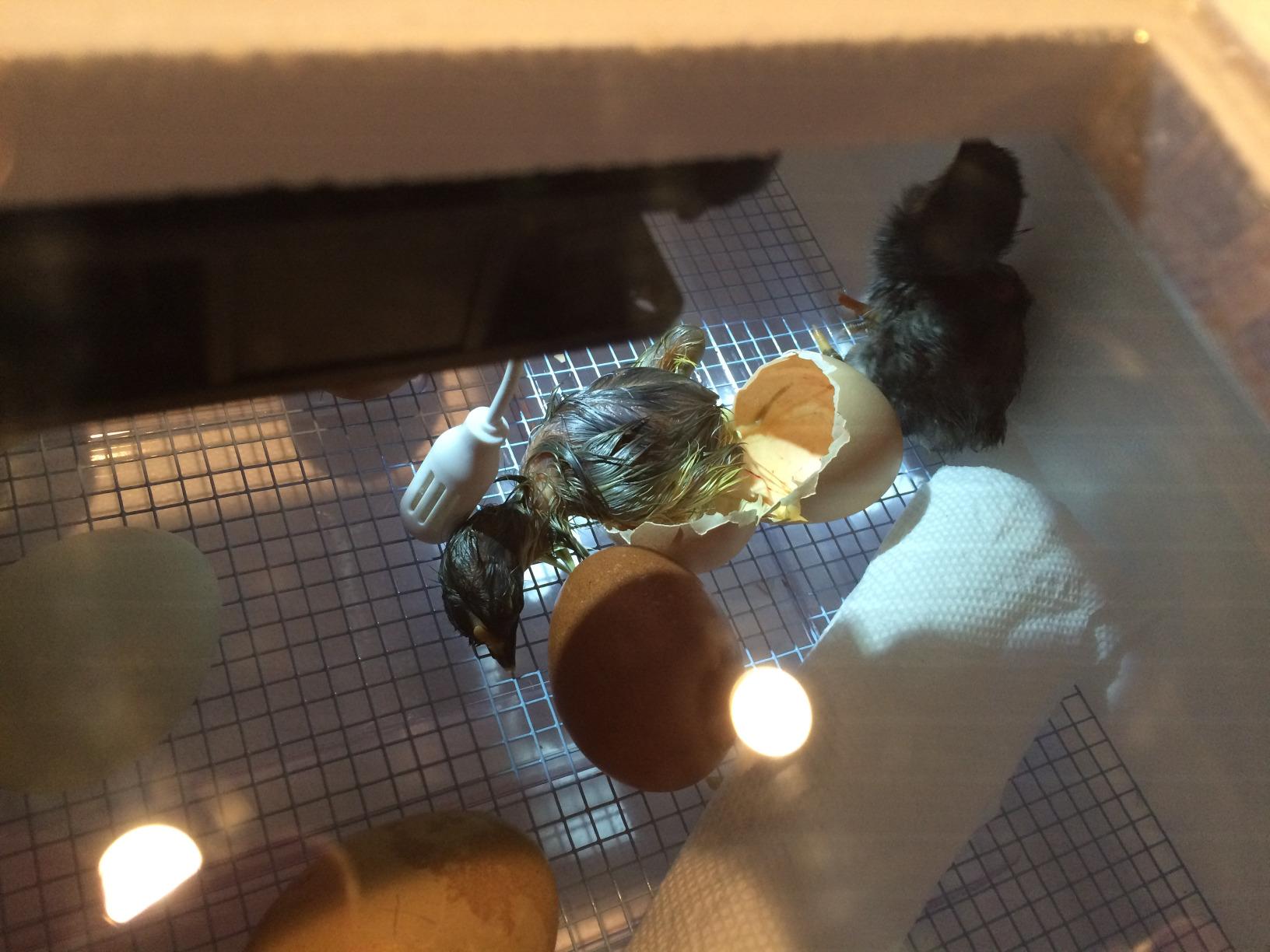
Where it fits best in your hatchery
This is the pick for anyone running a single tabletop or mid-size incubator for chicken, duck or quail eggs and wanting an out-of-lid readout. It solves the biggest practical problem in home hatching, which is that every lid opening costs humidity and lengthens the read.
It is also the right meter for a beginner who will not enjoy tinkering with app pairing or button menus. Everything works from a single button and a sensor sitting in the chamber.
Where it will disappoint you
Anyone building a large cabinet or multi-tray setup will find one probe limiting fast. There is no way to log conditions across several heights or compare a still-air zone against a circulated-air zone, and there is no export of any kind.
If you want alerts while you are at work rather than a memory you read later, this meter keeps you in the loop only by checking it yourself. Run the salt test before your first hatch so the min/max history means something from day one.
2. Inkbird ITH-10 Digital Thermometer and Hygrometer — Best Value for Tight Spaces
Inkbird ITH-10 Digital Thermometer and Hygrometer Temperature Humidity Monitor for Aging Box Guitar Ukulele
Plus or minus 3 percent RH
Plus or minus 1.8F temperature
9.07 g
CR2 battery
Pros
- Humidity accuracy stated at plus or minus 3 percent RH
- 2 second response time makes quick spot checks easy
- Max and min recording built in
- 4205 reviews give the widest owner base in the roundup
- Small enough for jars
- cases and incubators
Cons
- Not adjustable
- so the salt-test offset has to be applied mentally
- Adhesive strips on the underside limit visibility through a window
- CR2 coin cell is less common than AA
The Inkbird ITH-10 is the meter we would hand to someone hatching in a small space — a tabletop bator, a foam cooler, or an incubator with no room for anything bulky. At 4.13 inches long and 9 grams, it disappears into the corner of a chamber next to the eggs without disturbing the layout, which matters more in small boxes than people expect.
On accuracy, the published figures are the most useful thing about it: humidity accuracy of plus or minus 3 percent and temperature accuracy of plus or minus 1.8F. That tolerance is tighter than several other meters in this roundup, and with 4,205 reviews behind it, the 4.4 star average reflects a well-understood device rather than a lottery. Owners regularly report that it lands within a few percent of the expected salt-test figure.
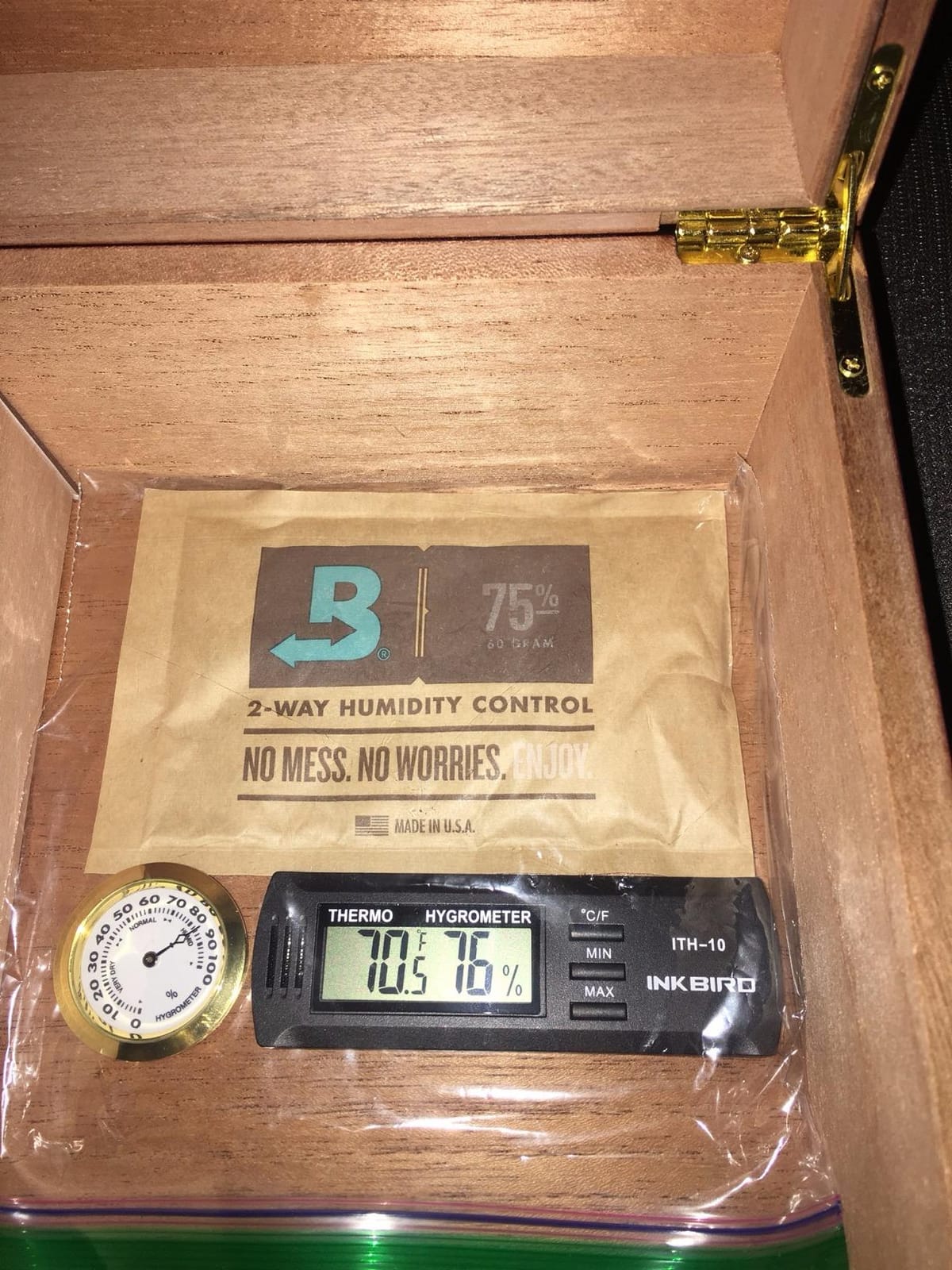
Max and min recording means you still get overnight extremes even without an app, and the 2 second response time means a spot check does not leave you standing in front of the incubator watching digits crawl. Fahrenheit and Celsius are both supported, which matters if you follow a mix of suppliers.
The catch is that nothing here is adjustable. There is no calibration screw, which means your salt test produces an offset rather than a correction. Write it on the unit with a marker and on your hatch log, because you will forget it by the third batch.
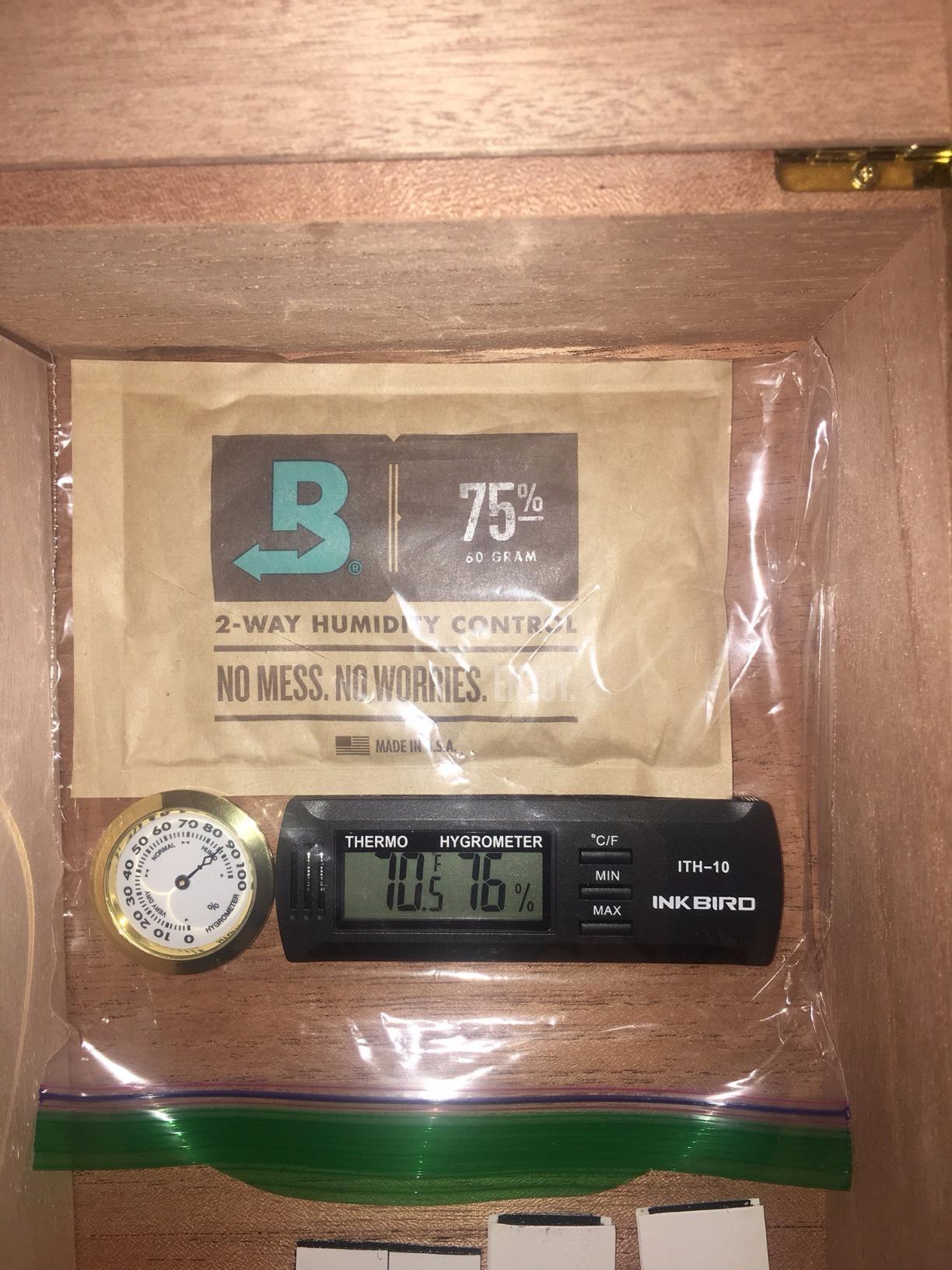
Where it fits best in your hatchery
Pick this meter if your incubator is small, if you hatch quail in a converted box, or if you want a cheap spare you can leave in a brooder. It is also a sensible second meter for cross-checking a bigger unit, since two independent sensors in the same chamber tell you a lot about placement effects.
Brooder monitoring is the underrated use. A chick brooder needs a humidity read as much as an incubator does during the first week, and this meter is small enough to sit in the corner without being knocked or pecked.
Where it will disappoint you
If you want remote alerts or a chart of the whole three weeks, this is the wrong tool. There is no wireless connection of any kind, so a long hatch is a series of manual checks.
The factory offset may be larger than three percent for your particular unit, because the tolerance figure describes the spread across production, not your individual meter. Standardize before you trust it on a batch you care about.
3. Zoo Med Economy Analog Dual Thermometer and Humidity Gauge — Battery-Free Monitoring
Zoo Med Economy Analog Dual Thermometer and Humidity Gauge, 6 x 4″
Analog temperature and humidity dial
Velcro backing
6 x 4 inch face
No batteries
Pros
- No batteries
- so nothing can fail mid-hatch
- Velcro backing makes removal and relocation easy
- Large 6 x 4 inch face is easy to read at a glance
- 3680 reviews and a long track record
Cons
- Analog face is coarser than a digital readout
- No min/max memory or high/low alarm
- No numeric accuracy tolerance published
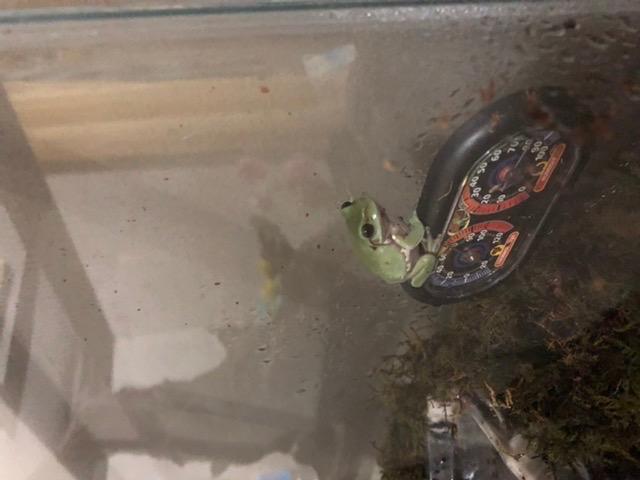
An analog dial has one enormous advantage over everything else on this list: it cannot die at hour 60 of a 21-day hatch because a coin cell corroded. There is no power source, no pairing, no firmware and nothing to update. You tape it to the wall of the chamber with the velcro backing and it reports the same way it did on day one.
The other strength is readability. A 6 x 4 inch dual gauge showing temperature on one dial and relative humidity on the other is visible from across a hatchery bench, which matters if you are running more than one incubator and walking a short circuit between them. At 0.32 ounces and with no wiring, it is the least fussy object in this roundup.
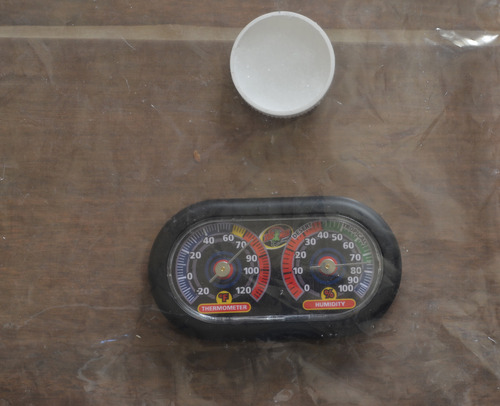
That same simplicity is the limitation. An analog face can only show so much resolution, and there is no memory, so the overnight high and low are gone by morning. If your hatch is going badly and you want to know what happened at 3am, this gauge cannot tell you.
There is also no numeric accuracy specification in the listing, which is typical for mechanical gauges. Treat it as a trend instrument rather than a measuring one, and use it alongside a digital meter if you care about the exact number.
Where it fits best in your hatchery
This is the meter for a simple setup where reliability beats resolution: one or two tabletop incubators, a brooder, a reptile room, or a cabinet you check several times a day. Because it needs no power, it also works in a backup chamber during an outage.
Beginners often do well with it. There is nothing to learn and nothing to configure, and the reading is right there every time you look.
Where it will disappoint you
Anyone chasing precision will find the dial frustrating. You cannot chase a 2 percent swing, and you cannot record an overnight minimum without writing it down by hand.
It also cannot be standardized from a salt test in any meaningful sense, so treat the numbers as indicative. For fine control during lockdown, pair it with a digital unit rather than relying on it alone.
4. Zoo Med Labs Digital Thermometer Humidity Gauge TH-31 — Highest Rated Readout
Zoo Med Labs Digital Thermometer Humidity Gauge, Single (TH-31)
Waterproof probe
0.1 degree resolution
6.87 inch body
LR44 button cell
Pros
- 4.5 star average is the strongest rating spread in the roundup
- Waterproof probe tolerates humid incubation environments
- 0.1 degree resolution with a clear digital readout
- 3413 reviews give a deep owner base
Cons
- 30 second response time is slow for spot checks
- LR44 button cell rather than standard batteries
- Manufacturer instructions say not to soak the probe
This is the highest rated meter in the roundup at 4.5 stars, and the distribution behind that average is unusually favorable: roughly 72 percent five-star reviews with only about 3 percent one-star. Owners are specific about why — the waterproof probe holds up in persistently damp environments and the readout is unambiguous from a distance.
A waterproof probe rated for one inch of immersion is a genuine advantage in an incubator, where condensation forms every time you open the lid on a cool morning. A probe that tolerates damp air keeps working where a bare sensing element would eventually suffer from it.
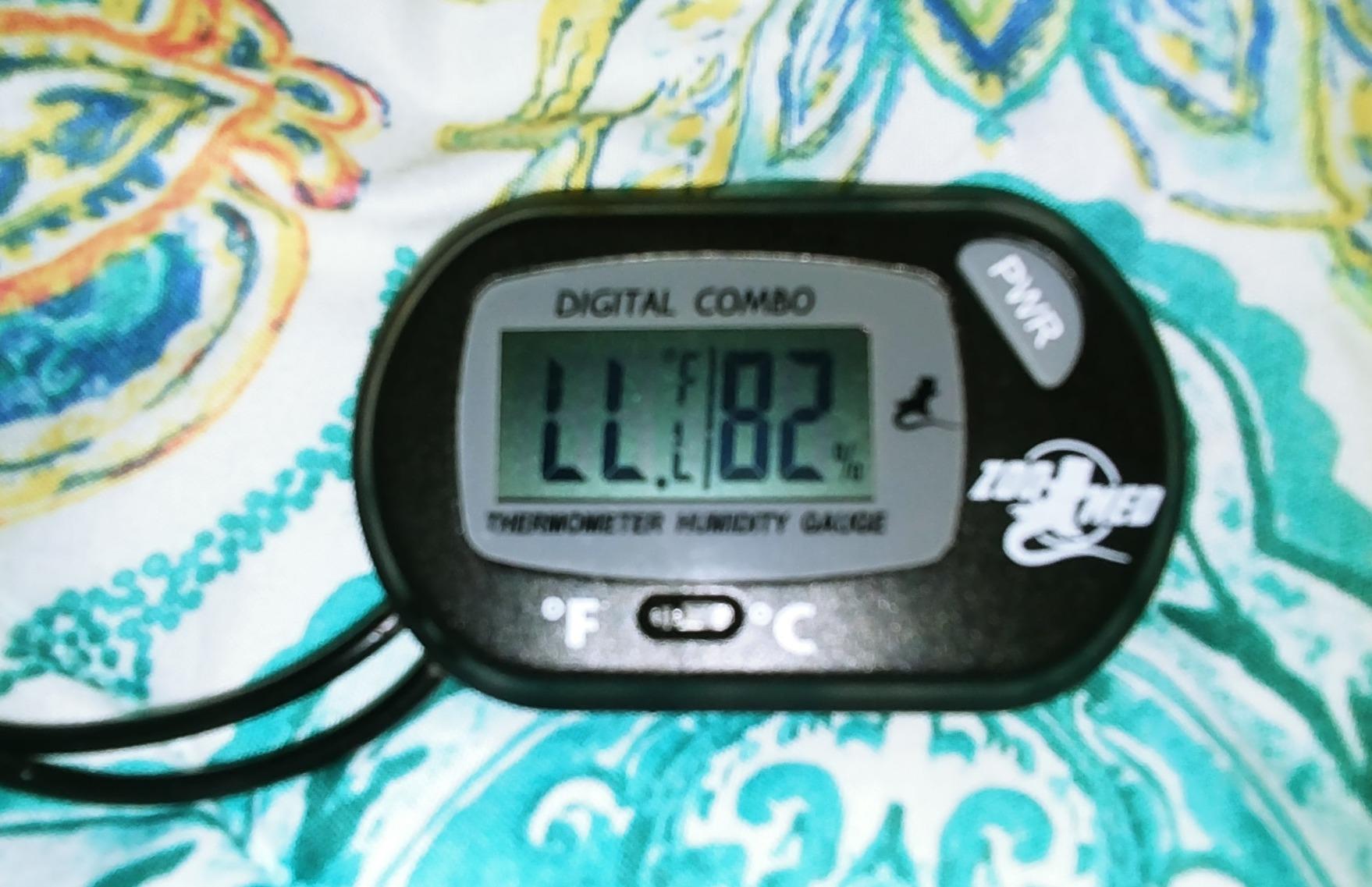
Resolution of 0.1 degrees is the finest figure published by any product here, which makes this a good choice if you are also watching egg-level temperature closely during the last days. The 6.87 inch body leaves room for a genuinely large display.
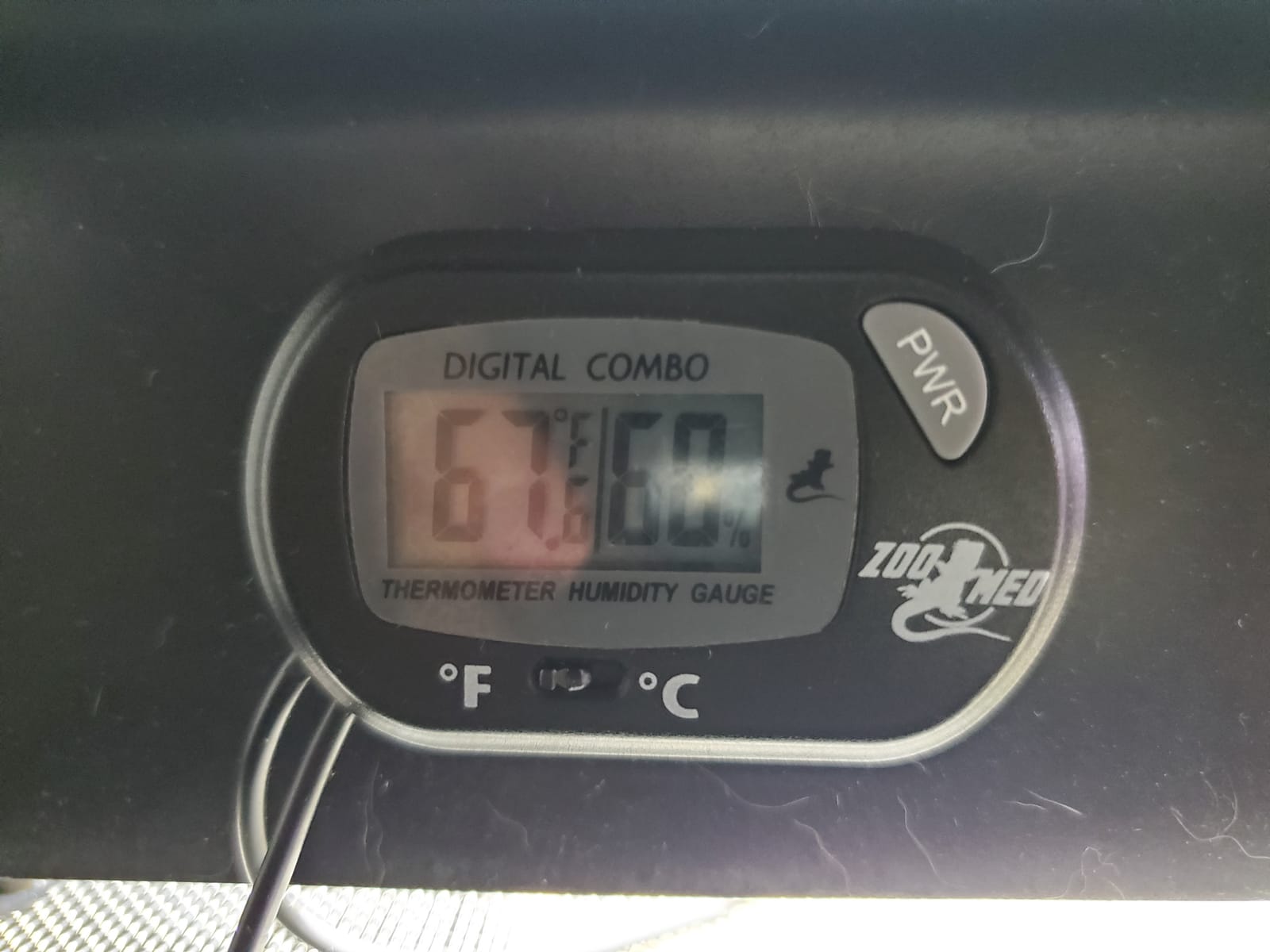
Two trade-offs stand out. The 30 second response time is the slowest here, so a spot check means waiting rather than grabbing a number and walking away. And an LR44 button cell is not the coin cell most people keep in a drawer, so have a spare before you need one mid-hatch.
Where it fits best in your hatchery
Pick it for a damp, condensation-prone chamber, a brooder, or a reptile setup where a splash is likely. It is a natural companion to the analog Zoo Med gauge if you want a coarse always-on dial and a precise digital read.
The strong owner rating also makes it a low-risk first purchase. You are not gambling on an unproven design, and you can standardize it easily when your salt test comes back.
Where it will disappoint you
If you need a remote probe on a long cable to place the sensor at egg height, this is a compact handheld-style unit rather than a cabled probe, so placement takes a little more thought.
Do not ignore the instruction not to soak the probe. Waterproof for humid air is not the same as submersible, and pushing it is how you shorten its life.
5. MEGGSI 2-Pack Mini Digital Hygrometer and Thermometer — Two Meters for Two Chambers
Meggsi 2 Pack Mini Digital Hygrometer Gauge Indoor Thermometer, LCD Monitor Temperature Outdoor Humidity Meter for Greenhouse Jars Incubators Guitar Case, Fahrenheit (℉) or Celsius(℃)
Two mini meters
1.7 inch body
10 to 99 percent RH
LR44 cell up to 10 months
Pros
- Two meters let you watch two chambers at once
- Small 1.7 inch body fits jars
- boxes and incubators
- Auto-refresh every 10 seconds
- LR44 cell runs up to 10 months
- Extra batteries and double-sided tape included
Cons
- Humidity tolerance of plus or minus 3 to 5 percent RH is wide
- No min/max memory or alarms
- Button cell rather than standard batteries
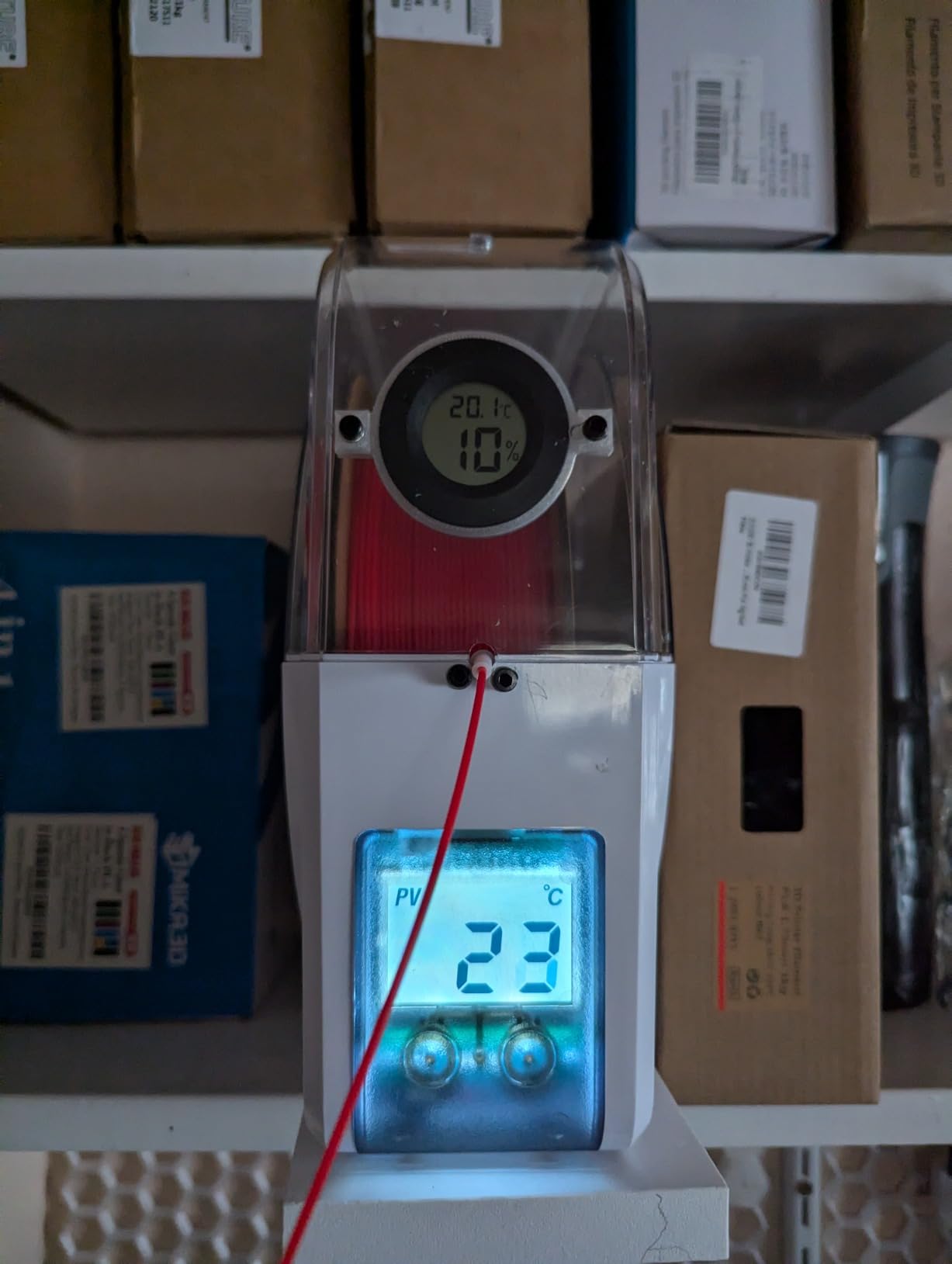
The argument for this pair is straightforward. Two meters in two chambers means you learn something no single meter can: whether a humidity swing came from your humidifier setting or from where the meter is sitting. Place them at opposite ends of a cabinet incubator and the difference between them is a measurement in itself.
Each body is 1.7 inches square, small enough to sit between eggs or on a shelf in a converted box without taking up tray space. The sensor refreshes every 10 seconds across a 10 to 99 percent RH operating range, and the included tape makes mounting easy without hunting for hardware.
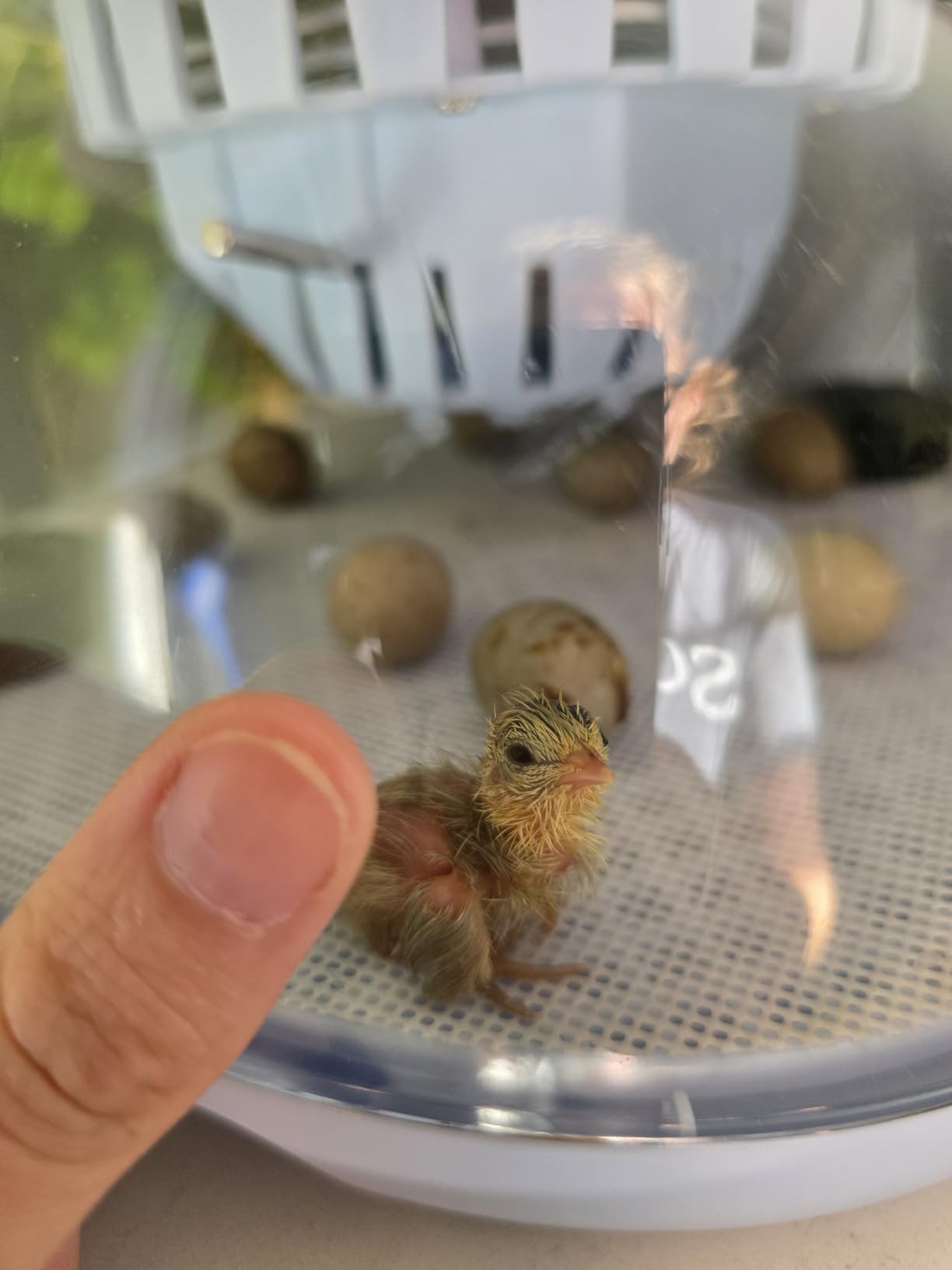
Battery life is the sleeper feature here. An LR44 cell lasting up to 10 months means you can install these before a spring hatch and not think about them again until the following year, which removes a whole category of mid-hatch failures.
The honest limitation is the published tolerance of plus or minus 3 to 5 percent RH. That is wide enough that the two meters may not agree with each other, which is a real problem for the cross-check use case above. Treat them as trend indicators, run a salt test on each, and average out the offsets.
Where it fits best in your hatchery
This suits beginners, budget-conscious hatchers, and anyone running two small incubators side by side. Quail and quail-plus-chicken operations fit well because the eggs are small and the meters are small.
They also work as backup units in a brooder or a grow room where nobody is reading the display anyway.
Where it will disappoint you
Anyone who needs a defensible number for lockdown will find the tolerance frustrating. A 5 percent band is roughly the entire margin you are trying to manage at 60 to 75 percent.
There is no memory, so nothing is retained overnight. If a hatch goes wrong, you will have no evidence to review afterward.
6. Veanic 4-Pack Mini Hygrometer Thermometer — Covering Several Positions at Once
4-pack Mini Hygrometer Thermometer Fahrenheit Indoor Room Round Humidity Temperature Gauge for 3D Printer Home Jars Reptile Incubator Guitar Case
Four mini meters
1.65 inch round body
10 to 90 percent RH
Temperature accuracy plus or minus 2F
Pros
- Four meters cover multiple incubation positions at once
- Compact round body fits jars
- boxes and small enclosures
- 10 second measurement interval
- Fahrenheit and Celsius conversion button
- Wide minus 58F to 158F temperature range
Cons
- Humidity accuracy of plus or minus 5 percent RH is loose for hatching work
- No calibration adjustment
- No min/max memory
Four meters is more hardware than most hatchers need and exactly what a serious multi-position study needs. Put one low near the water channel, one high near the top of the chamber, and one at egg height in the middle, and you can finally see the stratification inside a still-air incubator instead of guessing at it.
The round 1.65 inch housing with a clear LCD is unobtrusive, and the tabletop or tape mounting means you are not building anything to fit it in. Readings refresh every 10 seconds across a 10 to 90 percent RH range and minus 58F to 158F on temperature, which covers incubation and brooder work comfortably.
Where it fits best in your hatchery
This is the pick for large cabinet incubators, DIY multi-tray builds and anyone running eggs at more than one height. Spread four across a 6-tray cabinet and the vertical humidity gradient becomes visible.
It is also useful for people who move equipment around. Having spare meters in a drawer means a failed or lost meter never interrupts a hatch.
Where it will disappoint you
Plus or minus 5 percent RH accuracy is the widest published tolerance among the digital meters here. Four loose meters can disagree with each other by more than you are trying to measure, so do not treat them as a precision instrument.
There is no calibration adjustment and no memory. If you need a defensible reading for a high-stakes batch, standardize each meter by salt test and pick the one that lands closest to 75.
7. Thermometer World Digital Hygrometer with Two Remote Probes — Two-Point Readings
Digital Reptile Thermometer Hygrometer with 2 External Remote Probes
Two external probes
One AAA battery supplied
Kick stand and magnet
20 to 99 percent RH
Pros
- Two external probes read two separate spots in one chamber
- Display can sit outside the enclosure so the interior stays clean
- Standard AAA battery instead of a coin cell
- Kick-stand back plus a built-in magnet
Cons
- Owners report temperature readings off by 3 to 5 degrees on some units
- Humidity reported up to 12 percent low in lab checks
- Some units ship with the in and out probe labels reversed
- Not adhesive-mountable against a flat wall
Two external probes are the most interesting feature in this roundup, because they let you read two points in one chamber rather than one. Put one probe at egg height and one near the top of the incubator and you get a live measurement of the vertical humidity gradient inside a still-air cabinet.
The display can sit outside the chamber entirely on its 6.3 centimeter probe cables, which keeps the interior uncluttered and keeps a wet handling area away from your electronics. A supplied AAA battery is far easier to replace mid-hatch than a coin cell, and the kick-stand back with a magnet gives you two mounting options.
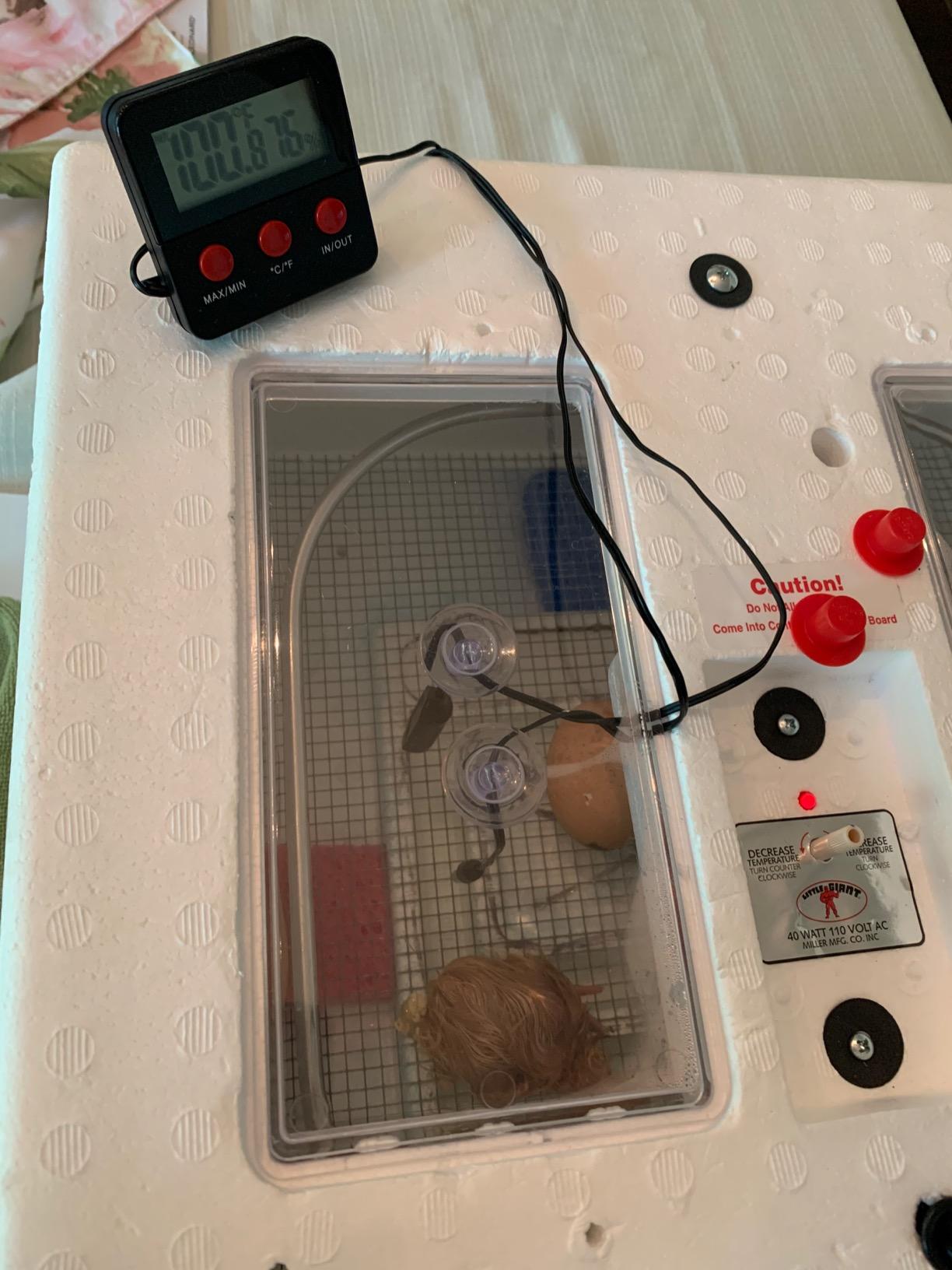
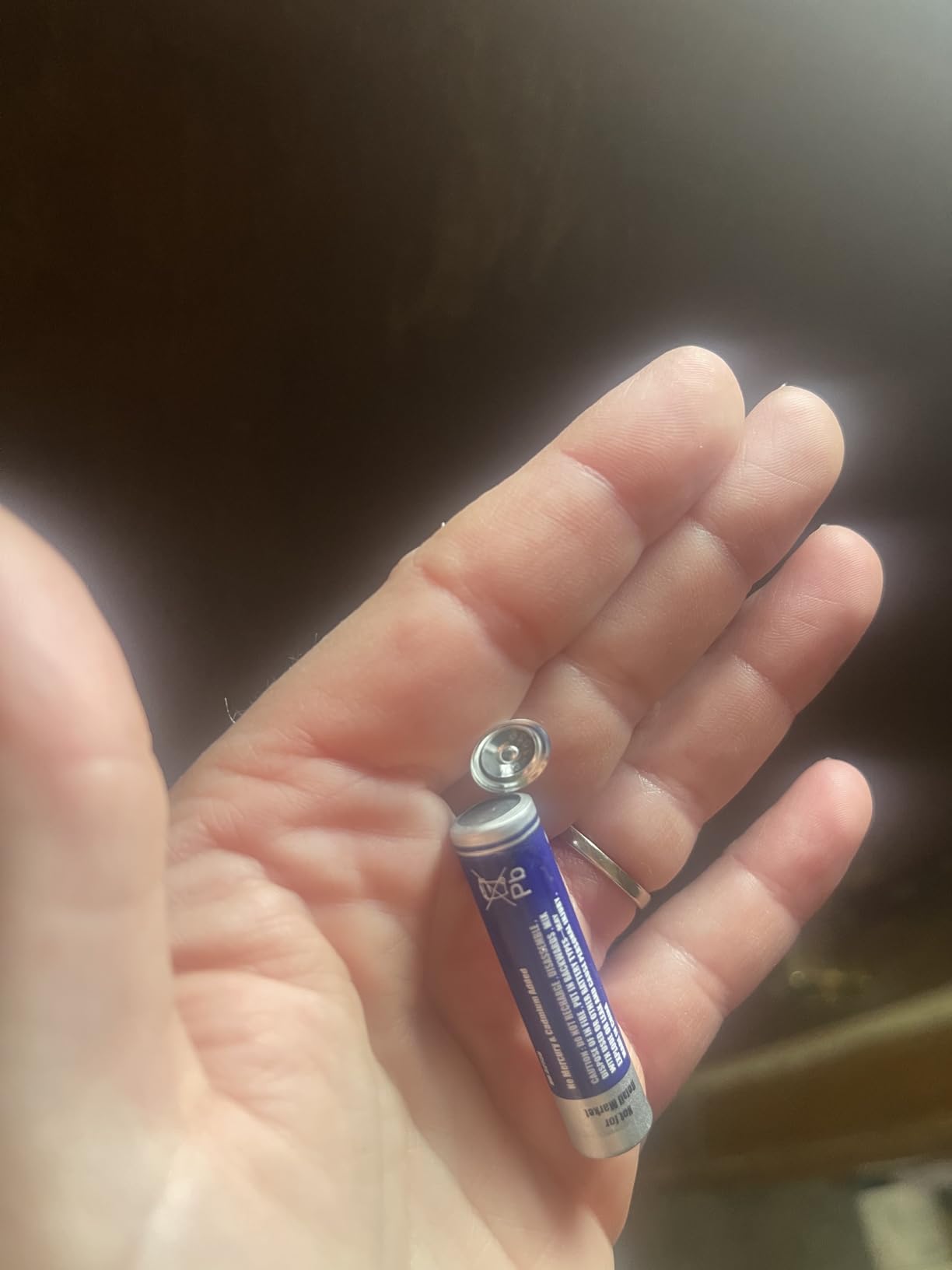
The accuracy reports are the reason this sits lower in the ranking. Owners report temperature readings running 3 to 5 degrees off on some units, and some reviewers have found humidity up to 12 percent low in their own checks. The operating humidity range of 20 to 99 percent and a stated temperature accuracy of plus or minus 1 degree Celsius sit oddly beside those field reports.
Some buyers have also received units with the in and out probe labels reversed. It sounds trivial until you trust a mislabeled probe for a full hatch.
Where it fits best in your hatchery
This earns its place if you specifically need two sensing points in a single chamber, or if you want the display outside a humid brooder where a handheld-style unit would get splashed. Reptile and amphibian setups also benefit from reading substrate level and enclosure level together.
It is a genuinely useful diagnostic tool, provided you test it before a batch that matters.
Where it will disappoint you
If you want a meter you can trust without a correction, this is not it. A 12 percent humidity discrepancy is larger than most of the adjustments you are trying to make during a hatch.
It also cannot be stuck flat to a wall, and it will not sit neatly in a small chamber where space is tight. Verify probe labelling on arrival.
8. Weewooday 3-Pack Digital Humidity Meter with Probe — Probes With Long Cables
Weewooday 3 Pcs Digital Humidity Meter with Probe LCD Thermometer,Black
Three probe meters
Stainless steel sensor probe
4.13 inch display
10 second refresh
Pros
- Three probe meters let you monitor egg mass versus chamber air
- Long sensor cable keeps the display outside the chamber
- Large LCD readable from a distance
- Marked for incubators
- brooders and greenhouses
- 10 to 99 percent RH and minus 58F to 158F ranges
Cons
- Units in the same pack can disagree on temperature by a couple of degrees
- Humidity accuracy of about 5 percent RH is coarse
- No calibration adjustment and no backlight
- Probe is not waterproof
This is the pick if you want the sensing element at egg height while the display sits somewhere you can actually read it. The stainless steel external probe on a long cable does exactly that, and three of them means you can compare an upper tray against a lower tray without opening the cabinet.
It is also marketed explicitly for incubators, brooders and greenhouses, which tells you the operating assumptions behind the design. Ranges of minus 58F to 158F and 10 to 99 percent RH cover bird eggs, brooder use and plant work without any configuration, and the 10 second refresh keeps numbers current.
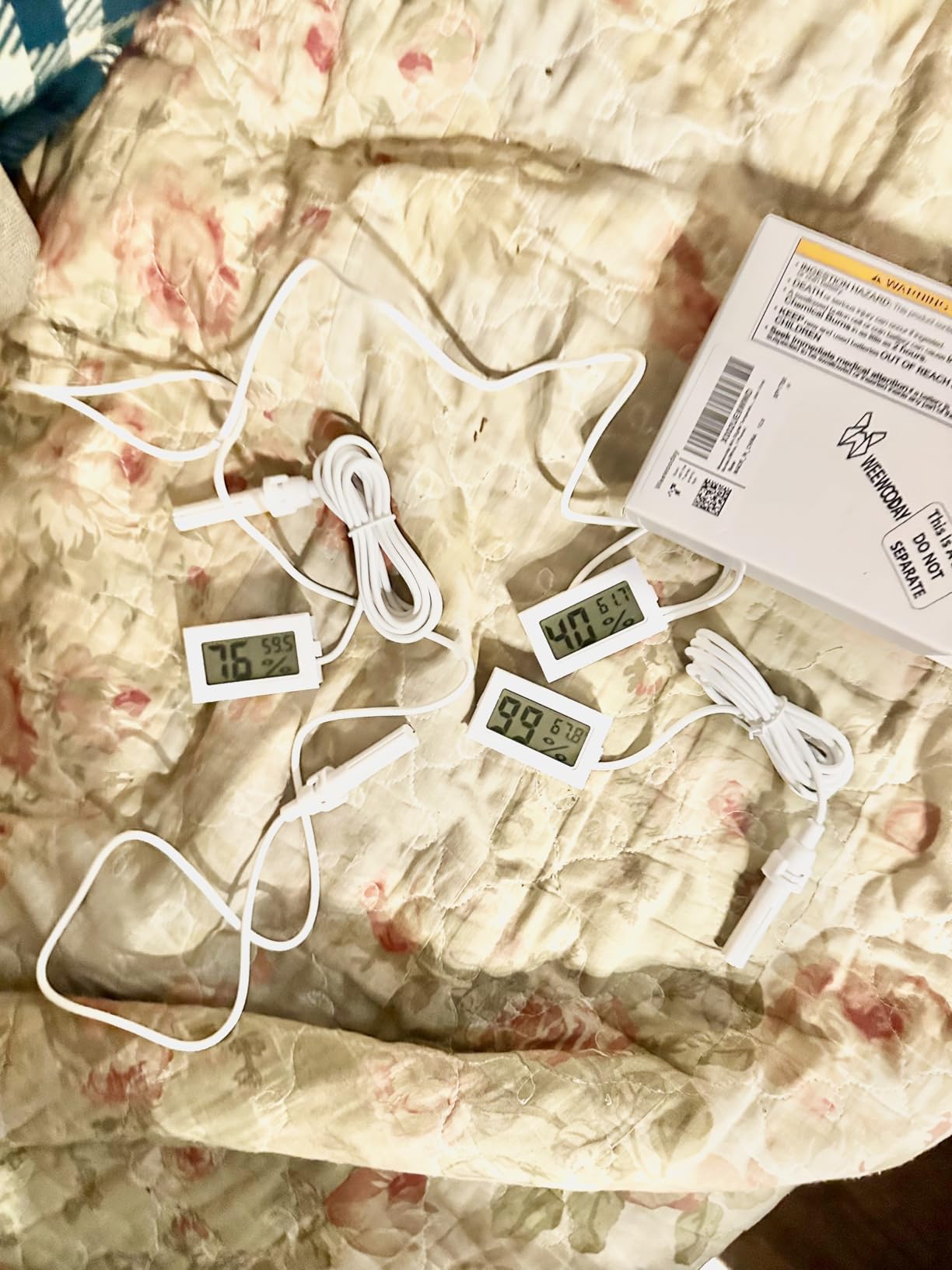
The 4.13 inch display with a large LCD is easy to read from across a room, which is genuinely useful in a brooder where you are watching chicks rather than a screen. Owners consistently praise the cable length as the feature that makes the unit practical.
Accuracy is where the 4.0 star average shows. Published figures are about 2F on temperature and about 5 percent RH on humidity, and reviewers report unit-to-unit variation of a couple of degrees within a single pack. One owner reports accurate readings after a settling period; another returned theirs for a more accurate model.
Where it fits best in your hatchery
Good fit for brooders, greenhouse-adjacent hatching rooms and any cabinet where the display needs to sit outside the chamber. Three probes also lets you place one at egg level, one at the top, and one at the water channel.
Brooder use is where the large display earns its keep, since you glance at it many times a day while chicks are young.
Where it will disagree with you
Three meters from the same pack that disagree by a couple of degrees is confusing during a hatch, and about 5 percent RH is loose for lockdown control. Standardize each one separately rather than assuming they match.
The probe is not waterproof and no suction cups are included, so condensation management is on you. There is no backlight either, which makes night checks harder.
9. VIVOSUN Digital Hygrometer Thermometer with App — Logging and Alerts
VIVOSUN Digital Hygrometer Thermometer, Humidity Meter with Probe, App
Bluetooth app with alerts
Plus or minus 0.9F temperature
Dual channel
High and low records
Pros
- Best stated temperature accuracy in the roundup at plus or minus 0.9F
- Bluetooth app sends threshold alerts when conditions drift
- High and low history plus two years of stored data for trend analysis
- Dual channel monitoring with the external probe
- Wall
- kick-stand or hanging mounting
Cons
- App and Bluetooth setup adds complexity for a passive check
- Battery powered rather than USB powered
- Smallest review base in the roundup at 540
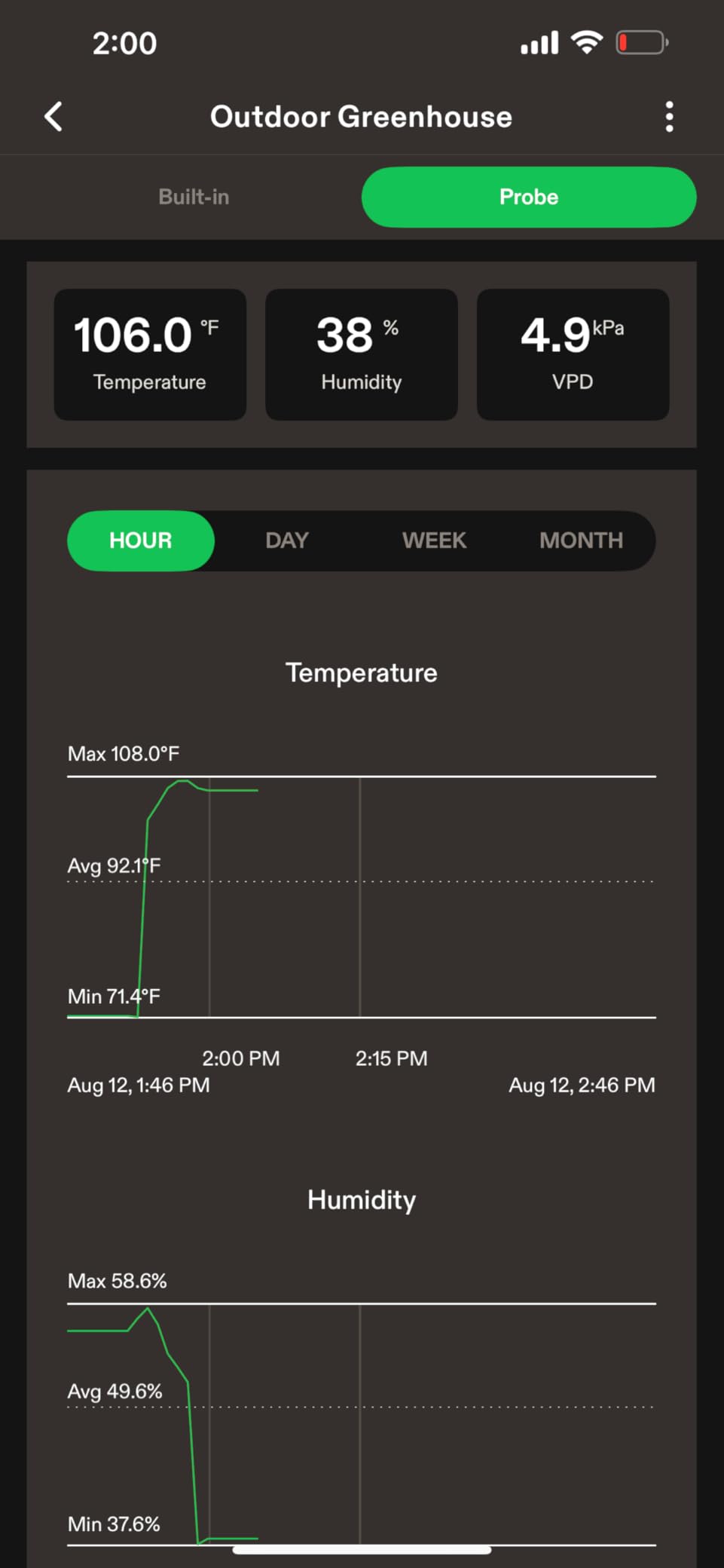
This is the only meter here that tells you something is wrong without you opening the incubator. Pair it over Bluetooth to the Vivosun app and you get threshold alerts, so a humidifier that fails at hour 30 of a hatch reaches your phone while you are at work rather than being discovered at the next manual check.
The logging is the real differentiator over a 21-day cycle. High and low records plus two years of stored data with export means you can compare this hatch against the last four and see whether your humidity control is actually improving or drifting. The vapor pressure deficit visualization and three comfort range indicators add context a raw RH number cannot.

The stated temperature accuracy of plus or minus 0.9F is the tightest published figure in this roundup, and the dual-channel setup lets you monitor the built-in sensor alongside an external probe for a cross-check. About 68 percent of reviews are five-star, which is a good sign on the core hardware.
Humidity accuracy of plus or minus 5 percent RH is much looser than the temperature claim, so the same salt test applies. With only 540 reviews, this is the smallest feedback base here, so read the sentiment as indicative rather than settled.
Where it fits best in your hatchery
This suits anyone who hatches on a schedule they cannot control, or who wants multi-cycle trend data to improve hatch rates over time. If you run a cabinet incubator and want to prove whether a humidity change helped, the export function is the tool for it.
It also pairs into an existing Vivosun greenhouse setup, which is convenient if your grow room and your hatch room share equipment.
Where it will disappoint you
The phone-first approach cuts both ways. If you prefer a glanceable always-on display, making you open an app for the number is friction every single check, and the unit itself has no backlit screen to rely on.
Battery rather than USB power means a cell can die mid-hatch. Pair the app with a plug-in meter if your hatch is the thing you care about most.
10. AQUANEAT Reptile Thermometer Hygrometer with Suction Cup — Clean Enclosure Mounting
AQUANEAT Reptile Thermometer Hygrometer Digital Display Temperature and Humidity Moniter for Reptiles Rearing Box with Suction Cup
Suction cup mounting
2.3 inch LCD
One LR44 cell included
20 to 99 percent RH
Pros
- Suction cup mounts directly to the side of the enclosure
- Large 2.3 inch LCD for a body this small
- No wiring to route inside a sealed box
- Marked for vivariums
- hatchers
- brooders and propagators
- Low price
Cons
- Suction cup can lose grip on textured or curved surfaces
- Smallest review base at 268 ratings
- No min/max memory or probe cable
A suction cup is a small idea that solves a real problem in sealed enclosures. You mount the meter to the outside wall of a tub, a rearing box or a terrarium and read it without opening anything, which means you do not dump the humidity you worked to build every time you check conditions.
The 4.4 star average across 268 ratings is solid, and owners single out the readable screen for a body only 2.3 inches long. Ranges of minus 58F to 158F and 20 to 99 percent RH comfortably cover reptile and amphibian incubation, which usually wants 70 to 80 percent RH, and no wiring has to be routed into the enclosure.
Where it fits best in your hatchery
Choose this for reptile, amphibian and small hatcher work in tubs or rearing boxes where drilling, taping or wiring into the enclosure is not an option. Brooders are also a good fit for the same reason.
It works well as a second opinion meter on a bird hatch too, especially in a small incubator where a second probe would be intrusive.
Where it will disappoint you
The suction cup loses grip on textured or curved surfaces, which rules out many glass terrariums with corners and some textured plastic tubs. Test the hold before you rely on it overnight.
With 268 ratings, the feedback base is the thinnest in this roundup, so treat the sentiment as indicative. The listed included-components field is also inconsistent with the described contents, so check that a cell is actually present.
How We Salt-Tested These Incubator Hygrometers
The salt test is the only home method that gives you a number you can trust. A saturated salt solution holds a relative humidity of 75% at typical room temperature, so any meter that reads 75% inside a sealed salt chamber is accurate enough to run a hatch on. You need table salt, a small sealable bag or container, a small amount of water, and the meter you want to test.
The protocol matters more than the meter. Most disappointing results come from too much water in the slurry, which dilutes the solution and pulls the reading down toward 69 or 70 percent — that is exactly why several cheap meters appear to be “all five percent low” when the real problem is the mix ratio.
Put one tablespoon of plain table salt in a small sealable bag or lidded container.
Add just enough water to dampen the salt. It should look like wet sand, not a brine puddle. Too much water is the number one cause of a low result.
Stir or shake briefly so the salt is evenly wetted, then let it settle.
Place the meter inside the container without touching the salt or the liquid. The sensing element must sit in the trapped air, not immersed.
Seal the container. A leaking bag lets the room air dilute the chamber and the reading drifts low.
Leave it undisturbed for 8 to 12 hours. Let the meter stabilize before you record anything.
Record the reading and the time. A second reading the next morning tells you whether the meter is stable or drifting.
Calculate the offset: subtract 75 from the reading. If your meter shows 71, apply +4 to every reading until the next seasonal test.
Expect a stable, decent meter to land between 72 and 78 percent. Anything below 69 or above 81 points at technique or a failing sensor rather than a small offset. Some people prefer a fixed reference solution such as a saturated salt pack for the same reason — you do not have to mix anything.
Calibration and standardization are two different things, and the community gets them mixed up. Calibration means adjusting the instrument itself against a traceable standard. Standardization means accepting that a non-adjustable meter reads 4 percent low and mentally adding 4 every time you check it. Most of the meters in this roundup cannot be adjusted, so you are standardizing, not calibrating.
If you work with liquids rather than air, the same salt logic applies with a different instrument — our guide to salinity meters tested for accuracy covers that side of the measurement world.
Humidity Targets by Incubation Day and Species
Chicken eggs want roughly 50 to 55 percent RH through most of incubation, with a deliberate rise in the final three days. Other species sit higher or lower because their eggs are bigger or smaller. Getting the numbers right matters more than meter resolution: too dry and the air cell stays small, so the chick cannot pip on schedule; too wet and the chick suffocates or drowns before it can breathe.
Chicken, quail, duck, goose and turkey targets by stage
Days 1 to 3 — Chicken 50 to 55 percent, quail 55 to 60 percent, duck 55 to 60 percent, goose 55 to 60 percent, turkey 50 to 55 percent.
Days 4 to 7 — Chicken 50 to 55 percent, quail 55 to 60 percent, duck 55 to 60 percent, goose 55 to 60 percent, turkey 50 to 55 percent.
Days 8 to 14 — Chicken 50 to 55 percent, quail 55 to 60 percent, duck 55 to 60 percent, goose 55 to 60 percent, turkey 50 to 55 percent.
Days 15 to 17 — Chicken 50 to 55 percent, quail 55 to 60 percent, duck 55 to 60 percent, goose 55 to 60 percent, turkey 50 to 55 percent.
Days 18 to 21 lockdown — Chicken 60 to 75 percent, quail 60 to 75 percent, duck 65 to 75 percent, goose 65 to 75 percent, turkey 60 to 75 percent.
Reptile and amphibian eggs are a different job entirely. Most species incubated in a closed tub want 70 to 80 percent RH to prevent the embryos from drying out in the substrate, which is a wetter regime than any bird egg needs. Quail eggs are small, so they lose moisture faster proportionally and sit at the wetter end of the bird range. Duck and goose eggs have thick shells and a large yolk, so they hold moisture well and also run wetter than chicken eggs.
A still-air tabletop incubator has no fan, so humidity stratifies: wetter low near the water channel, drier high near the lid. Target the middle of the egg height, not the number on the lid display.
Where to Place Your Hygrometer Inside the Incubator
Placement matters more than meter accuracy. A perfect sensor sitting in the wrong place reports the wrong number perfectly, and no amount of calibration fixes a badly positioned probe. The first rule is to put the sensing element at egg height, not above the eggs and not on the floor of the chamber.
The second rule is distance from moisture and heat sources. Keep the meter away from the water channel or reservoir, because air directly above standing water reads several percent high, and keep it away from the heater element or lamp, where readings run low and temperatures spike. In a still-air incubator the door is another trap: air near the opening is the driest, coldest part of the chamber every time you open it.
Third, let the sensor acclimate before you read it. Opening the lid and reading instantly gives you a number for the air you just let out. Give it five minutes. In a cabinet incubator with trays, compare a meter at the top tray against one at the bottom tray before assuming your humidifier is at fault, because a large vertical gradient is normal in a still-air design.
What to Look For: Accuracy Specs That Matter
The single most useful spec on any humidity meter is its stated tolerance, because it tells you whether the reading is worth acting on. Anything at plus or minus 3 percent RH or tighter is useful for hatching. Anything at plus or minus 5 percent RH is a trend indicator, and during lockdown, where the whole game is a 15 percent swing, that error is large enough to mislead you.
Next is whether you can correct it. A meter with an adjustment screw lets you calibrate against a traceable standard. A fixed meter cannot be calibrated, only standardized, which means you apply the offset in your head every time. Both are workable, but knowing which one you have prevents a lot of frustration.
Min and max memory is the most underrated feature in this category. A hatch runs 21 days and you check it maybe twice a day, so the interesting question is what happened at 3am. Memory answers it, alarms tell you sooner, and app logging answers it across several cycles so you can actually improve.
Probe versus air sensor is the next decision. A cabled probe puts the sensing element exactly where you want it and lets the display sit outside the chamber, which is why probe units dominate serious hatches. A handheld-style body sensor is simpler and cheaper but constrains where you can put it, especially in a small incubator.
Finally, think about what happens when the meter fails. Most of these run on a coin cell or an AAA, none of them warn you about a dying battery, and a dead meter during a hatch is silent. Either check the display at every visit or pick a model with alerts. For the wider measurement side of the picture, our salinity meter comparison covers how tolerance and calibration apply to instruments generally.
Do You Need a Hygrometer or a Hygrostat?
You need a hygrometer. A hygrostat is a different device: it switches a humidifier on and off to hold a set humidity, and it is only worth adding once your readings are trustworthy. Controlling humidity with a meter you have not verified is an expensive way to be wrong automatically.
This is the idea worth sitting with, because it inverts the usual buying logic. A meter accurate to 2 percent RH in front of a humidifier that swings 15 percent on its own changes almost nothing about the outcome. Read accuracy and control accuracy are separate problems, and most home hatchery humidity failures come from the second one. Fix the water level, the wick, the ventilation and the chamber seal before you spend on a better sensor.
The case for a controller grows when you hatch on a schedule you cannot supervise. A unit that alarms you, or one that switches a humidifier automatically, protects the batch while you are asleep or away. Until then, a verified meter plus a written log gets you most of the way.
Frequently Asked Questions
What is the most accurate hygrometer for an incubator?
There is no single most accurate model, because none of these meters ships calibrated. The practical answer is: choose a meter with a stated humidity tolerance of plus or minus 3 percent RH or tighter, verify it against the 75 percent RH salt test yourself, then apply that offset to every reading. In this roundup the Inkbird ITH-10 and the Zoo Med TH-31 have the most useful combination of published tolerance, owner feedback and probe options.
How do I calibrate an incubator hygrometer?
Use the salt test. Mix one tablespoon of table salt with just enough water to dampen it, put the meter inside without letting the sensor touch the salt or water, seal the container and wait 8 to 12 hours. A saturated salt solution holds about 75 percent relative humidity, so subtract 75 from the reading to get your offset. Too much water in the mix is the usual reason meters appear to read 5 percent low.
What is the best humidity for hatching chicken eggs?
Hold roughly 50 to 55 percent relative humidity from day 1 through day 17, then raise it to 60 to 75 percent for the final three days of lockdown. Too little humidity shrinks the air cell and delays the hatch; too much drowns or suffocates the chick. Quail, duck and goose eggs run a little wetter than chicken eggs throughout.
What is the difference between a hygrometer and a hydrometer?
A hygrometer measures relative humidity in air. A hydrometer measures the density or specific gravity of a liquid, such as wort in brewing or must in winemaking. The two words sound alike but the instruments share nothing. Incubators need a hygrometer; if you saw the term hydrometer on an incubator listing, it is a typo or a seller using the words loosely.
Where should I place a hygrometer in my incubator?
Put the sensing element at egg height, level with the middle of the eggs rather than above or below them. Keep it away from the water channel or reservoir, where readings run several percent high, and away from the heater element, where they run low. Avoid the door area, and wait about five minutes after opening the lid before you trust the reading.
Is the hygrometer that came with my incubator accurate?
Often not, and it is worth checking. The dial or small display bundled with many incubators has no published tolerance and was never calibrated to a traceable standard. Run a salt test against it, or place your own meter beside it at egg height for a full cycle and compare. Keep your own meter if the bundled one is off by more than 3 percent RH.
What common mistakes ruin egg incubation?
The most damaging humidity mistakes are running dry for the first 17 days, which leaves the air cell too small and the chick unable to pip on schedule, and staying too wet after lockdown starts, which drowns or suffocates the chick. Placing the meter near the water channel or the heater, reading immediately after opening the lid, and trusting an uncalibrated bundled display all corrupt the data you act on.
Do I need a hygrometer or a hygrostat?
You need a hygrometer to read conditions and a hygrostat to control them. A hygrostat switches a humidifier on and off to hold a set humidity. Start with a verified meter, because controlling humidity with an unverified sensor just makes the error automatic. Add a controller later if you hatch on a schedule you cannot supervise.
Final Verdict: Which Incubator Hygrometer to Buy in 2026
The IncuTherm Plus is our pick as the best incubator hygrometer for hatching accuracy in 2026, because the remote probe and min/max memory solve the two problems that actually cost hatches: checking conditions without opening the lid, and knowing what happened while you were asleep. If your chamber is too small for a probe, the Inkbird ITH-10 gives you the tightest published humidity tolerance in a body small enough to hide between the eggs.
The Zoo Med TH-31 is the pick if you want the best-rated readout with a damp-tolerant probe, and the Zoo Med analog dual gauge is the one to buy if you would rather have nothing that can fail during a hatch. The MEGGSI pair and the Veanic four-pack cover multi-position and multi-chamber work, and the VIVOSUN unit is the only one here that alerts you while you are away.
Whichever you choose, salt test it before the eggs go in, write the offset on the unit, and re-run the test each season. That habit is worth more than any spec on a box, because it is the only step most hatchers skip and the reason their readings disagree with everyone else’s.