
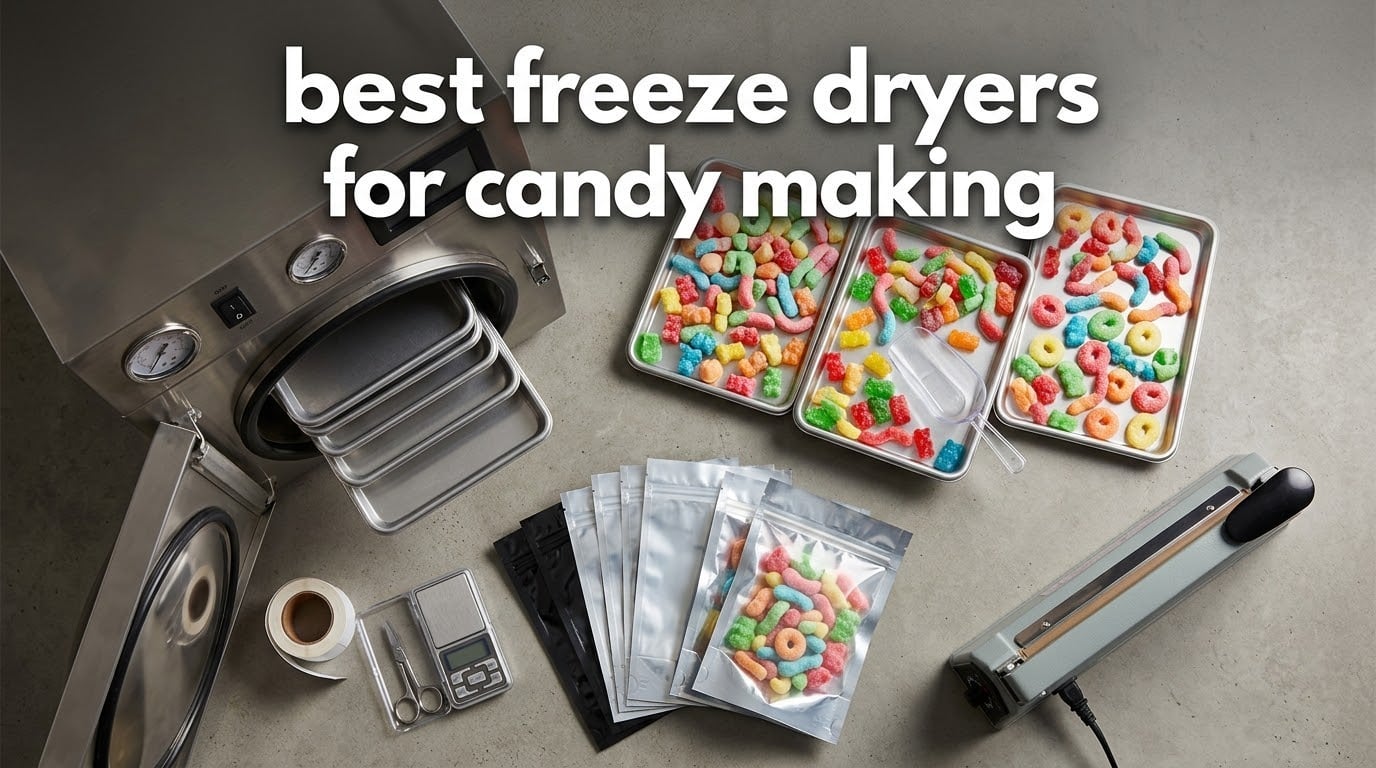
A freeze dryer for candy making is not a dehydrator with a better name on the box. It is a vacuum chamber that freezes your gummies or hard candy solid, pulls the air out, then gently reheats the trays so the ice turns straight into water vapour and gets pumped into a cold trap. That phase change is called sublimation, and it is the only reason a chewy gummy comes out of the chamber as an aerated, brittle crunch.
Warmed air cannot do this. It cooks the sugar, collapses the structure and leaves you with something leathery. Yet a large share of listings sold under this search term are exactly that, which is why so many first-time buyers end up disappointed. We looked at genuine vacuum machines only, and every machine in this roundup has a cold trap, a vacuum pump and a published vacuum figure.
Below is our short answer. For most people, the VEVOR HFD-4 is the best freeze dryer for candy making because it is the only machine here with a real review history to lean on, a programmable touchscreen and a four-tray 304 stainless steel layout. Larger operations should look at the VarmBake DGM-B01, and anyone who wants the deepest cold trap in the group should look at the ZZKD FD-05H.
We spent weeks reading owner feedback, comparing cold trap temperatures, tray areas, vacuum specs and electrical requirements across ten machines. The gaps between these listings are larger than the marketing copy suggests, so the notes below are specific rather than generic.
Table of Contents
Top 3 Picks: Best Freeze Dryers for Candy Making (October 2026)
These three earned the top slots because they combine documented specifications with the details that decide whether a candy batch actually succeeds: heated trays, a controllable drying curve, a cold trap cold enough to keep sublimation moving, and a tray area that lets you lay pieces in a single layer with air around them.

VEVOR HFD-4 4-Tray
- 4-layer 304 stainless trays
- -35C cold trap
- 8.8-13.2 lb batch
- Touchscreen with drying curves


Banfluxion CB-022799
- -40C cold trap
- 2 L/s pump speed
- 0.4 sqm tray area
- 7-inch HD touchscreen
One note on the ratings above. Only two of these machines carry more than a single review, and the roundup as a whole is dominated by listings with no owner feedback yet. We have flagged that plainly in every review below rather than presenting a spec sheet as if it were a field test.
Quick Comparison of All 10 Machines
This table covers every machine in the roundup with the specifications that matter most for candy work: tray count, cold trap temperature, batch capacity and power. Treat the batch numbers as manufacturer claims, since most of these listings have no independent verification behind them.
| Product | Specifications | Action |
|---|---|---|
| VEVOR HFD-4 Vacuum Freeze Dryer |
|
Check Latest Price |
| VarmBake DGM-B01 6-Tray |
|
Check Latest Price |
 ZZKD FD-05H -60C Cold Trap ZZKD FD-05H -60C Cold Trap |
|
Check Latest Price |
 HNZXIB FD-3 Compact 3-Tray HNZXIB FD-3 Compact 3-Tray |
|
Check Latest Price |
 EQCOTWEA 4-Tray Live Data EQCOTWEA 4-Tray Live Data |
|
Check Latest Price |
 Camellia River BA-LFD-25 5-Tray Kit Camellia River BA-LFD-25 5-Tray Kit |
|
Check Latest Price |
 HNZXIB FD-05H-40 4-Tray HNZXIB FD-05H-40 4-Tray |
|
Check Latest Price |
| Banfluxion CB-022799 4-Tray |
|
Check Latest Price |
 INTSUPERMAI SY022799 4-Tray INTSUPERMAI SY022799 4-Tray |
|
Check Latest Price |
 BDJSN 6-Tray Stainless BDJSN 6-Tray Stainless |
|
Check Latest Price |
1. VEVOR HFD-4 Vacuum Freeze Dryer – The Best Documented Candy Machine Here
VEVOR Vacuum Freeze Dryer Machine, 8.8-13.2 LBS/Batch Food Freeze Drying Machine with 4-Layer Trays, Vacuum Pump, Adjustable Timer and Temperature Control, for Fruits Vegetables Meat, White
4-layer 304 stainless trays
-35C cold trap
8.8-13.2 lb batch
1550W at 103V
Pros
- Stainless steel build owners describe as high quality
- Easy to reprogram temperature and time mid-cycle
- Quiet running during daily use
- Good airflow and even results
Cons
- Sparse instruction manual
- Inconsistent customer support responses
- Some machines arrived without compressor oil
This is the machine we recommend to most people, and the reason is straightforward: it is the only one in the roundup with a review base big enough to tell you something real. Forty-eight owner reviews averaging 3.7 stars is not a glowing score, but it is genuine evidence, and the pattern inside those reviews is consistent.
What owners consistently praise is the stainless steel construction, the quiet running and the ability to change temperature and time while a cycle is already going. That mid-cycle adjustability matters more for candy than for fruit, because hard candy and gummies finish on completely different schedules and you rarely guess the drying curve right on the first attempt.
The specification sheet is also more useful than most in this category. You get a minus 35 degree cold trap, four 304 stainless steel trays, an acrylic door for watching the batch, and a touchscreen that accepts programmable freeze-drying curves. Operating noise is listed at 60 decibels or below, and swivel casters are fitted, which matters on a machine that weighs 245.8 pounds.
The 22% one-star share among reviewers reflects setup and documentation friction more than drying failures. That is still a real cost: sparse instructions, inconsistent support responses, and at least one report of a machine turning up without the compressor oil it needs. Budget an evening with the manual and a phone call to support before you start a candy run.
What the four-tray layout means for candy batches
The HFD-4 batches 8.8 to 13.2 pounds depending on how densely you pack. For candy that range is generous, because the rule that matters is spacing, not volume. Pieces need a gap between them so vapour can move off the surface instead of pooling.
At the lower end of that capacity you can lay gummies or jellies in a single layer with clear air on every side. At the upper end you are stacking, and stacked candy dries unevenly: the middle of the pile stays tacky while the outside shells over. Most of our advice for first batches is to run the machine under capacity and accept the longer cycle.
Where the VEVOR falls short for candy work
The minus 35 degree cold trap is shallower than the minus 40 and minus 60 degree machines in this roundup. In practice that costs you cycle length rather than quality, since a warmer trap has to defrost more often during a long hard candy run.
It also runs on 103 volts at 1550 watts, so it can sit on a standard household circuit, which is genuinely convenient. If you already plan a 220 volt dedicated circuit for another machine in this group, that convenience is worth less. The documentation problem is the bigger real-world drawback, and buyers who budget time for the setup report far smoother first batches.
2. VarmBake DGM-B01 6-Tray – Best Heated-Tray Machine for Commercial Volumes
Varmbake Vacuum Freeze Dryer Machine 220V & 1800W with 6 Trays, -40°C Cold Trap & Vp≤5 Pa Commercial Food Freeze Drying Machine with Vacuum Pump,Drying for Fruit Vegetable Food Preservation
6 heated stainless trays
-40C cold trap
Vacuum to 5 Pa
13 lb batch at 1800W
Pros
- Heating mats on every tray for even candy heating
- Deep vacuum down to 5 Pa with 2.2 L/s pump
- Eight preset food programs reduce guesswork
- 3-year warranty and six alarm protections
Cons
- Single verified review leaves reliability undocumented
- 220V supply needs a dedicated circuit
The DGM-B01 is the machine in this roundup built most like production equipment rather than a home appliance. Its six trays each carry a heating mat, and that detail matters enormously for candy, because sublimation speed is driven by heat moving into the product from direct contact rather than by air blown across it.
The vacuum specification is the strongest here: from 1 kilopascal down to 5 pascals with a 2.2 litres per second pumping speed, held by a 1048 watt compressor feeding a minus 40 degree cold trap. For long hard candy runs that means fewer defrost interruptions and a flatter curve across a big chamber.
Batch capacity is listed at 13 pounds, and tray size is 8.66 by 13.78 inches with 1.6 inches of spacing between trays. That generous gap is a real advantage, because it lets you keep candy in single layers on more trays at once instead of stacking to hit a weight.
The honest limitation is that this listing has one verified review, rated five stars, describing reliable results across fruit, pet snacks and meat. No candy batch is documented by an owner, and long-term reliability over years is simply unknown. The three-year warranty and the six alarm protection functions are the main reasons we would still place it second.
Why heated trays change candy results
Warm-air machines move energy by convection, so only the surfaces facing the airflow heat quickly. Heated trays conduct energy straight into whatever sits on them, which means the base of a gummy dries at a similar rate to the top. That is what produces an even, crisp piece rather than a shell with a soft core.
It also shortens your cycle time. Since typical hard candy runs already stretch toward a full day and a half, every efficiency gain in heat transfer compounds across a week of production. Eight preset programs on the touchscreen mean a beginner is not starting from a blank curve screen on day one.
Where the VarmBake is the wrong choice
At 220 volts and 1800 watts, this machine wants a dedicated circuit. Households without that wiring face an electrician before they can run a single batch, and that cost can exceed what the machine adds over a smaller 110 volt unit.
It is also the widest machine here at 36.61 inches across and the second heaviest at 268.3 pounds. If your freeze drying happens in a converted garage with limited counter run, the six-tray footprint may be more constraint than capacity. For a cottage food seller running weekend markets, that is usually worth it. For a renter with one free shelf, it probably is not.
3. ZZKD FD-05H -60C Cold Trap – Deepest Cold Trap in the Roundup
ZZKD -60℃ Vacuum Freeze Dryer for Home, Food Lyophilizer with Vacuum Pump, Food Grade Freeze-Dried For Fruits, Candy, Fish, Milk, Pet Foods, One Freeze-Drying Area Of 0.46㎡
-60C medical-grade cold trap
4.5 CFM rotary vane pump
0.46 sqm drying area
15-minute auto-defrost
Pros
- Coldest trap here at -60C
- reaching temperature in 40 minutes
- 15-minute auto-defrost cuts cleanup
- Rated by the maker for 800+ hours of continuous running
- Seven-inch touchscreen with food presets
Cons
- No owner feedback at all
- 304 pound weight class needs real floor space
No other machine in this roundup goes below a minus 40 degree cold trap, apart from the VEVOR at minus 35. The ZZKD FD-05H reaches minus 60 and gets there in about 40 minutes, which makes it the interesting choice if your priority is finishing a large quantity of candy without stopping to defrost.
The pump is a 4.5 CFM rotary vane unit, and the maker rates the machine for more than 800 hours of continuous operation. That rating is a manufacturer claim with no reviews behind it, so treat it as a design intention rather than a verified milestone. Still, rotary vane pumps are the right architecture for repeated food cycles where oil changes become a recurring chore.
The 15-minute intelligent auto-defrost with mess-free wastewater discharge is the feature we would highlight most for candy makers specifically. Hard candy cycles run long, which means the trap loads up, and a manual defrost on a 304 pound machine is an unpleasant job that happens several times a week.
Be clear-eyed about the evidence. This listing carries zero customer reviews, so every performance claim here comes from the seller. The listing does at least name candy explicitly among its intended uses alongside milk, fish and pet food, which tells you the manufacturer has at least thought about the application.
Where a minus 60 degree trap earns its cost
A deeper cold trap holds more vapour before it needs defrosting, and for a long hard candy cycle that translates into fewer interruptions and less manual handling. Candy is also low in fat, so it is generally easier on a trap than oily or fatty foods. That makes this machine well matched to sweet work.
The drying area is 0.46 square metres across four trays, with an 8.8 to 13.2 pound batch claim, so capacity is in the same band as the VEVOR. You are buying trap depth and pump size here, not more shelf space. If your batches are small and infrequent, that depth is wasted capability.
Where the ZZKD is the wrong choice
It weighs 304.2 pounds, the second heaviest machine in the group, with a footprint of 31.89 inches deep. That needs floor space and a level surface, not a kitchen counter. If the machine will live anywhere other than a garage or utility room, look at the lighter options.
The absence of reviews is the real issue. This is a large spend on unverified performance, and the one-year warranty is the shortest coverage on any machine here. It runs on 110 volts at 1500 watts, which is friendly electrically, but buying the least-documented machine in the roundup deserves more caution than buying the best-documented one.
4. HNZXIB FD-3 – Best Compact Machine for Test Batches
HNZXIB -45℃ Freeze Dryer Home Lab Vacuum Freeze Dryer Food Dehydrator, 7-9 lbs/Batch Drying Temperature Sublimation Drying Machine for Freeze-Dried Candy Fruits And Vegetables
0.2 sqm drying area
Limit vacuum below 10 Pa
Built-in vacuum pump
800W at 110V
Pros
- Compact bench-top form factor for test batches
- Built-in vacuum pump simplifies setup
- Colour LCD with remote monitoring and alarms
- Acrylic door shows every stage of the batch
Cons
- Smallest drying area and batch in the group
- 3 kg water capture limits multi-day runs
- No reviews to confirm consistency
Before you commit several thousand dollars to production capacity, you need to know whether your candy survives freeze drying at all. The FD-3 is the smallest footprint in this roundup and the least demanding on your electricity supply, which makes it the most accessible way to find out.
It runs a limit vacuum below 10 pascals, which is deep enough for genuine sublimation, and the vacuum pump is built into the chassis rather than sitting beside it. That integrated pump means one box instead of two, which matters when your workspace is a spare room corner.
The remote intelligent control with real-time monitoring and automatic warnings is genuinely useful for test batches, because you can start a cycle, leave, and check progress from your phone. The graphene heating plate supplies the direct tray contact that candy needs, and the maker claims 30% energy saving alongside a PLC control screen.
What you give up is capacity. The 0.2 square metre drying area is the smallest here, the batch claim is 7 to 9 pounds, and water capture tops out at 3 kilograms. On a multi-day hard candy run that capture limit becomes the binding constraint, not the tray area.
Why testing small before scaling up matters
Candy behaves unpredictably under sublimation. Some batches turn airy and crunchy, others end up slightly tacky, and there is no shared recipe that works for every sugar matrix. A smaller machine lets you run several test batches in one weekend instead of one batch per weekend on a production machine.
It also lets you test properly rather than optimistically. Single-layer loading, tray spacing and a slow ramp on the drying curve are all things you need to practise. Running those experiments on a 3 tray unit means you learn the process before you learn the machine, which is the right order.
Where the FD-3 will frustrate you
Once a recipe works, this machine becomes the bottleneck. Three trays with a 0.2 square metre area is not enough to supply a market stall, and you will end up running it around the clock, which is exactly the pattern the 3 kilogram water capture limit penalises first.
The chamber is moulded and non-welded, described as anti-corrosion and aseptic, with an acrylic door for full-process viewing. It also has no reviews, so we cannot confirm the drying consistency the specification implies. Treat it as a learning tool with the smallest possible commitment, which is precisely what it is good at.
5. EQCOTWEA 4-Tray – Best Live Vacuum and Temperature Readout
EQCOTWEA 110V 4-Tray Freeze Dryer Vacuum Freeze Drying Machine with 0.4㎡ Freeze-Drying Area -25~+60℃ Temperature 11lbs/Batch Vacuum Food Dehydrator for Fruits Vegetables Meat, Used in Home Laboratory
0.4 sqm drying area
-40C cold trap
11 lb batch
Live vacuum and temperature curves
Pros
- Seven-inch LCD reports vacuum and temperatures live
- Automatic defrost and one-click operation
- Rotary vane pump with pure copper motor
- Anti-return-oil design protects the chamber
Cons
- No customer reviews to validate drying results
- Own-brand listing with no warranty detail stated
The reason this machine is interesting for candy is its display. The seven-inch LCD reports heated separator temperature, cold trap temperature, sample temperature and vacuum, and it plots them as curves while the cycle runs. Candy cycles last a day or more and change shape under heat, so watching live data is more useful than watching a countdown.
Under the panel sits a minus 40 degree cold trap from a high-quality compressor, a rotary vane vacuum pump with a pure copper motor and an anti-return-oil design, and a transparent chamber door with automatic defrost. Four stainless steel trays cover 0.4 square metres for an 11 pound batch claim.
Automatic defrost plus one-click automatic operation reduces the number of manual decisions per batch. For a first-time candy maker, fewer decisions during a long unattended overnight run is worth real money in avoided ruined batches.
Two cautions. There are no customer reviews at all, so this is a spec sheet rather than a track record. And the listing states no warranty detail, which is unusual for a machine at this level. Both are reasons to keep your expectations measured and your purchase protection intact.
Why live vacuum data matters for candy
Vacuum pressure tells you what the pump is actually achieving rather than what the machine claims to achieve. If pressure climbs during a hard candy cycle, ice is sublimating faster than the trap and pump can handle, and the usual response is to drop tray temperature or add a hold step.
Without live data you are guessing from the candy itself, and by the time you can see a problem visually the batch is often committed. Watching the curve lets you intervene an hour earlier, which is the difference between a salvageable batch and a tray of tacky candy.
Where the EQCOTWEA falls short
It weighs 254 pounds, so it is not a light machine despite the standard 110 volt supply at 1550 watts. Dimensions are given as 28.74 inches deep by 19.69 wide by 35.24 high, which needs a dedicated bay rather than a shelf.
The real limitation is the missing evidence and missing warranty. With no owner feedback and no stated coverage, this listing asks you to be an early adopter of a four-tray machine. If you want that configuration with documented reviews behind it, the VEVOR covers the same capacity band, and if you want documented warranty coverage, the VarmBake carries three years.
6. Camellia River BA-LFD-25 – Best All-Included Packaging Kit
Camellia River Freeze Dryer Machine with Vacuum Pump, Large Capacity for Home Food Preservation
5 stainless steel trays
25 lb batch claim
Standard 120V power
Bundle with sealer and mylar bags
Pros
- Bundle includes impulse sealer
- mats
- mylar bags and absorbers
- Standard 120V power simplifies installation
- Front-load design for straightforward loading
- Marketed explicitly for candy work
Cons
- No reviews to verify the 25 lb figure
- Listed dimensions look inconsistent
- Basic digital controls instead of a programmable touchscreen
This is the only machine in the roundup that ships with the packaging chain already assembled. The bundle includes an impulse sealer, silicone mats, mylar bags and oxygen absorbers, which removes the single most common early stumble for new sellers: sealing finished candy properly without a separate equipment purchase.
The capacity claim is 25 pounds per cycle across five stainless steel trays, the largest stated figure here, and it runs on standard 120 volt household power. A front-load layout with a vacuum pump and automatic cycles keeps operation straightforward. The listing names candy as a target application alongside meals and fruit.
We want to be direct about the confidence level here. There are zero reviews, and the listed dimensions show a height of 314 inches, which is almost certainly a data entry error. Ask for verified measurements before you plan where the machine goes, and treat the 25 pound figure as a marketing number until someone confirms it with a real batch.
Why the packaging bundle matters for selling candy
Freeze-dried candy reabsorbs moisture quickly once it leaves the chamber, and that is exactly the failure that turns a crisp piece into a soft one on a shop shelf. Packing it the moment it comes out, while it is still cold and dry, is the difference between a shelf-stable product and a disappointment.
An impulse sealer plus mylar bags and oxygen absorbers in the box means you can finish a batch and package it in the same session. For a market seller testing whether freeze-dried candy sells, removing that extra equipment step makes the first month considerably cheaper to start.
Where the Camellia River falls short
The control interface is the weak point. Basic digital controls with automatic cycles are fine for fruit but poor for candy, where you want to set and adjust a specific temperature ramp across a long cycle. None of the programmability that makes the machines above good at candy is present here.
It also weighs 220 pounds and has no cold trap temperature published, which leaves the single most important specification for judging sublimation performance unstated. We would want that figure confirmed before recommending it as a serious production machine rather than a starter unit with a generous bundle.
7. HNZXIB FD-05H-40 – Best for Large Candy Batches on 110V
Vacuum Freeze Dryer Machine, -40°C Cold Trap, 0.46㎡ 10-15 LBS/Batch Food Freeze Drying Machine, 4-Layer Stainless Steel Trays,110V Freeze Dryer for Meat Fruit Vegetable Food Preservation
10-15 lb batch across 4 trays
-40C cold trap
7-inch touchscreen with curve display
Electric defrost
Pros
- Largest 110V batch claim in the roundup
- Programmable temperature with curve display on touchscreen
- Electric defrost simplifies between-batch cleaning
- Swivel casters help with a heavy machine
Cons
- No reviews to confirm batch-to-batch consistency
- Specifications page lists no dimensions or weight
The FD-05H-40 answers a specific question: how do you get a large batch without rewiring to 220 volts. Its listed batch capacity of 10 to 15 pounds across four layers of 304 stainless steel trays is the biggest 110 volt claim here, and the minus 40 degree cold trap puts it level with the commercial units on the only spec that really governs cycle length.
The seven-inch touch panel supports programmable temperature control and displays freeze-drying curves. For candy that is the control you need, since hard candy and gummy recipes differ mainly in how slowly you ramp the tray temperature once sublimation starts.
Electric defrost between batches and swivel casters are both practical additions. The casters matter because these machines are genuinely heavy and you will want to move it for cleaning or to free up floor space. Operating noise is listed at 60 decibels or below with an energy-saving structure.
The honest drawback is thin documentation. There are no reviews, and the specifications page does not list dimensions or weight, which makes planning a workspace harder than it should be. There is also an input title mismatch flagged in our analysis, so verify that the listing you receive is the model you researched.
Where the 10 to 15 pound claim helps
Batch size translates directly into bags per cycle, and bags per cycle is the number that decides whether a small candy side business is worth the capital. A machine that holds two full trays of single-layer gummies roughly doubles your output per cycle against a three-tray unit without doubling the cycle time.
The 304 stainless steel trays also matter for candy because they conduct heat evenly and tolerate acidic fruit candy without staining. The acrylic viewing door lets you judge batch progress without breaking vacuum, which stops you from opening the chamber and restarting the drying curve for no reason.
Where the FD-05H-40 is the wrong tool
Without published weight or dimensions, you cannot plan the install. Machines in this class from other brands weigh between 220 and 320 pounds, so assume a floor-standing footprint and a level surface, and confirm measurements before delivery day.
It also carries no reviews at all, so the batch claim is unverified. If documentation quality matters to you, the VarmBake publishes full dimensions, weight and a three-year warranty, and the VEVOR publishes complete dimensions and has real owner feedback. This machine wins on claimed capacity and loses on evidence.
8. Banfluxion CB-022799 – Best Component-Level Specs
Banfluxion Scientific Lab Lyophilizer & Home Freeze Dryer Machine with Vacuum Pump, -40℃ Ultra-Low Temperature, 110V 1550W, 11lbs/Batch, 4 Stainless Steel Trays, for Food/Fruit/Vegetable Dehydration
-40C cold trap, 2 L/s pump
4 trays, 0.4 sqm area
11 lb batch
Tecumseh or Secop compressor
Pros
- Named Tecumseh or Secop compressor
- Anti-oil-return rotary vane pump at 1700 rpm
- Transparent chamber with automatic defrost
- One verified owner says they would buy again
Cons
- Single review leaves long-term reliability unknown
- Load capacity stated as both 11 and 13.2 pounds
Most listings in this roundup describe components with adjectives. This one names them. A Tecumseh or Secop professional compressor paired with an anti-oil-return rotary vane pump running at 1700 rpm is a component bill you would recognise from commercial equipment, and it is the strongest single argument for this machine.
The performance figures are specific too: a minus 40 degree cold trap, 2 litres per second pumping speed and an 11 pound single-batch capacity. Four layers of food-grade stainless steel trays cover 0.4 square metres of area, with a load figure quoted as high as 13.2 pounds depending on how the area is measured.
The transparent organic glass chamber door comes with automatic defrost and a deflector plate intended to distribute drying evenly across the shelves. That deflector detail is the kind of feature that shows up in machines designed for repeatable batches rather than one-off demonstrations.
The evidence base is a single verified purchase rated five stars, with the owner saying they would buy again and noting the unit works for both domestic and light commercial use. One review is not a reliability record, and the inconsistent load figure is worth confirming with the seller.
Why component names matter when you are comparing
Compressor and pump brands are where freeze dryer reliability actually lives. Tecumseh and Secop are suppliers used in commercial refrigeration, and a rotary vane pump with anti-return-oil design is the configuration you want for repeated food cycles because it resists the oil migration that contaminates chambers and candy.
When two listings both claim a minus 40 degree cold trap, the named components are often the only real difference between them. We would rather see a manufacturer name than a superlative, and that is the main reason this machine earns a place despite its thin review history.
Where the Banfluxion leaves you exposed
Weight and dimensions are not reported, which is a genuine problem when you are planning an installation. At 1550 watts on 110 volts the electrical side is straightforward, but you still need to know whether the machine fits the space before it arrives.
Two numbers for the same load also make comparison harder than it should be. Ask which figure applies to the tray area you will actually use for candy, because the honest answer determines how many bags a cycle produces. The seven-inch HD touchscreen with preset temperature curves and one-key start is a good sign for candy work; the missing physical dimensions are the bigger gap.
9. INTSUPERMAI SY022799 – Best Sensor Control for Multi-Day Curves
INTSUPERMAI Scientific Freeze Dryer Home Lab Vacuum Freeze Dryer with Vacuum Pump 11lb/batch Processing Capacity 4 Trays -25-+60℃ Drying Temperature Sublimation Drying Machine for Food
4 trays with heating and temperature sensors
11 lb batch
Cold trap at -40C or below
Colour LCD with preset curves
Pros
- Heating and temperature sensors fitted per tray
- Automatic frost-melt function on the built-in cold trap
- Colour LCD with preloaded drying curves
- Flow deflectors built into the cold trap
Cons
- No reviews to confirm drying times
- Heaviest listed weight at 320 pounds
This machine has one specification that no other product in the roundup offers: heating and temperature sensors on every tray. For candy, where you are running a multi-stage curve and pieces dry at different rates depending on thickness, per-tray measurement is a real advantage rather than a spec-sheet nicety.
The compressor is a Tecumseh or Secop unit feeding a cold trap at minus 40 degrees or below with no load, and the drying temperature range spans minus 25 to plus 60 degrees. Batch capacity is listed at 11 pounds with a 1550 watt motor and a pump speed of 2 litres per second at 1700 rpm.
Trays measure 7.87 by 16.73 inches, which is narrower and longer than the square trays on most competitors. That shape suits long rows of small pieces, which is a reasonable match for candy bars and fruit slices rather than large whole items.
There are no reviews, so treat the drying time claims as unverified. The machine also lists at 320 pounds, the heaviest here, and no dimensions are published, so the installation question comes up immediately. The built-in frost-melt function and multiple flow deflectors are thoughtful additions that reduce manual defrost interruptions.
Why per-tray sensors matter for candy
A candy batch is rarely uniform. Gummies vary in thickness, hard candy shards vary in mass, and a single tray temperature can leave one region under-dried while another over-dries. Per-tray sensors let you see that spread developing instead of averaging it away.
When the display can show which trays are running hotter, you can rotate product between trays mid-cycle or lower the ramp on the problem shelf. Very few home-class machines let you intervene at that granularity, and it is the reason we would choose this one for anyone serious about developing their own recipes.
Where the SY022799 is impractical
At 320 pounds with unspecified dimensions, this needs a planned floor space and two people to move it. Plan the location before purchase, not after, because the weight class here is well beyond countertop machines.
There is also no published warranty in the listing, and no owner feedback to describe what happens after a year of weekly candy cycles. For a first machine we would rather see documented behaviour from buyers, which is why this sits below the VEVOR and VarmBake despite the superior instrumentation. It is the right choice for recipe development, not the safest first purchase.
10. BDJSN 6-Tray – Most Tray Slots, Least Published Detail
Large Freeze Dryer Machine, 1600W Stainless Steel Food Freeze Dryer with Vacuum Pump, 6-Tray Home Freeze Drying Machine with Touchscreen Preset Modes for Fruits, Vegetables, Herbs, Pet Treats
6 tray stainless chamber
1600W rating
External vacuum pump
Digital touchscreen with presets
Pros
- Six tray chamber is the most tray slots in the group
- External vacuum pump is easier to service
- 201 stainless steel body wipes clean easily
- Preset food modes shorten setup for beginners
Cons
- Listing omits batch capacity and cold trap temperature
- No dimensions or weight published
- No reviews to verify drying quality
We are including this machine because tray count is a legitimate decision factor for candy, and six trays is the most in this roundup. If your production model depends on laying product in single layers across as many shelves as possible, tray slots translate directly into bags per cycle.
The external vacuum pump is a practical choice for a home setup, since a pump you can reach without moving the chamber is far easier to change oil or replace. The 201 stainless steel body with a smooth, easy-wipe surface suits the sticky residue that candy work inevitably produces, and the digital touchscreen includes preset food modes with adjustable settings.
Beyond that, the listing gives us very little. No batch capacity, no cold trap temperature, no dimensions, no weight, and no reviews. For a machine where the specification gap matters this much, we cannot responsibly rank it above machines that publish the numbers you need to plan a production schedule.
The rated power is 1600 watts, which implies a serious electrical draw on whatever circuit it lands on. Confirm your supply can carry it before planning an install, because a continuous load of that size is not something to share casually with other appliances.
What six trays actually give you for candy
For small uniform pieces, tray count is a reasonable proxy for usable capacity. Hard candy shards, small gummies and fruit slices all fit in single layers across a full shelf, and each extra tray is another few dozen sellable bags without extending the cycle.
That advantage disappears the moment you start stacking to hit a weight target. Single-layer loading with air between pieces is the rule that produces even drying, and stacking to fill six shelves faster reliably produces batches with a dry shell and a tacky core.
Where the BDJSN leaves you guessing
Cold trap temperature is the number that governs how long a candy cycle takes, and this listing does not publish one. Without it, there is no way to compare this machine’s efficiency against the minus 35, minus 40 and minus 60 degree units elsewhere in the roundup.
Combined with no reviews, no warranty detail and no physical measurements, this is a machine you would buy on tray count alone. If that is genuinely your priority and you have confirmed the missing figures with the seller, it may serve you well. If you want to plan batches, costs and cycle times, the seven machines above all publish the data you need.
How to Tell a Real Vacuum Freeze Dryer From a Marketplace Clone
The single biggest mistake buyers make on this search is trusting the listing title. A large cluster of very cheap machines advertise themselves as freeze dryer machines for candy and explicitly state they are not dehydrators. They are warm-air dehydrators with a stainless shell and a digital timer, and they cannot produce freeze-dried candy at any cycle setting.
Run these six checks before you buy anything.
Check one: does it publish a cold trap temperature? Every genuine vacuum machine lists one, typically minus 40 or minus 60 degrees Celsius. A dehydrator has nothing to list because it has no cold trap.
Check two: does it publish a vacuum figure in pascals? Real machines state a limit vacuum or pumping speed. Dehydrators have no vacuum circuit at all.
Check three: is there a separate vacuum pump? Either an external pump or a clearly documented built-in pump is fine. What matters is that the pump exists as a named component.
Check four: does it mention sublimation? The word is used loosely in the category, but a machine that describes ice turning to vapour and being pumped to a trap is describing the real process.
Check five: is there a batch capacity in pounds or kilograms? Genuine machines publish capacity because it comes from tray area and spacing. Dehydrator listings substitute a vague family size instead.
Check six: is the weight realistic? A machine with a compressor, a vacuum pump and a stainless chamber weighs 200 pounds or more. Anything dramatically lighter than that is not doing the work.
If a listing fails checks one and two, stop. You are looking at a dehydrator, and it will produce leathery dried candy no matter how long you run it.
Candy Cycle Settings and How Long a Batch Really Takes
The marketing on these machines implies a short cycle. A realistic hard candy cycle runs overnight, often to 24 or 36 hours, and hard candy runs that span a full extra day are normal practice among experienced home freeze-drying hobbyists rather than a sign of a fault.
Every cycle has four stages, and skipping or rushing any one of them causes the failures people complain about online.
Pre-freeze. The candy goes into a normal freezer and freezes solid before the chamber is involved, usually overnight. Candy that is only partly frozen has mobile water that migrates during the first vacuum stage, which produces sticky patches and cloudy surfaces. Freeze slabs flat and lay pieces in a single layer rather than piling them.
Primary dry, ramped slowly. Tray temperature comes up gradually rather than jumping to a set point. Ice absorbs heat to sublimate, and if you push heat in too fast the surface freezes into a shell while moisture stays trapped underneath. A slow ramp over many hours is what produces an even, crunchy piece.
Primary dry, held. Hold the temperature while the bulk of the water leaves. Vacuum pressure on the display is your best guide here. If it climbs and will not settle, the pump and trap are saturated and the temperature needs to come down.
Secondary dry. A short, warmer finish removes the last bound moisture and firms up the texture. Skipping this stage is why candy can come out tasting great but feeling slightly soft in storage.
Gummies and fruit candy generally finish faster than hard candy because their sugar matrices hold less water. Marshmallow takes longer still. As a rough guide for planning, expect hard candy to be the long pole in every schedule you build, and build your batch calendar around it rather than around the machine’s published quick cycle.
People also ask whether desiccants are needed inside the chamber. They are not. Desiccants and oxygen absorbers belong in the packaging stage after drying, not in the chamber during a cycle, and using them incorrectly inside a vacuum machine adds nothing because the environment is already dry.
Which Candies Fail in a Freeze Dryer
Some candies work beautifully and some fail every time, and the failure is physical rather than a matter of technique. Knowing which is which saves a lot of wasted sugar.
Chocolate splits and blooms. Chocolate contains cocoa butter, which is a fat that migrates and solidifies differently from sugar under sublimation. Repeated pressure cycling in the chamber drives fat to the surface, producing grey-white bloom and a dull appearance. Freeze-dried chocolate exists commercially, but it needs careful control that most home setups do not offer.
Taffy melts rather than dries. Taffy is formulated to stay pliable and has a high moisture content bound into an amorphous sugar structure. Under a long ramp it softens and fuses before the water leaves, so you get a fused block instead of an aerated piece.
Caramel fuses. Caramel is already cooked to a specific sugar concentration. A second cooking stage during the drying ramp pushes it past that point, so pieces weld together and the batch becomes a single solid mass.
Jellies and gummies are the reliable winners. These have high sugar content and an existing aerated structure, which means freeze drying inflates rather than destroys. Sour candy, gummy bears and jellies are consistently reported as the most reliable results.
Marshmallows work but need patience. They hold a lot of water and take longer than most confectionery, and they can compress if the tray spacing is tight.
Also avoid anything with high fat or oil content, since fat does not sublime and interferes with the sugar structure. If you are planning a product range, build it around gummies, jellies, sour candy and hard candy shards, and treat chocolate, taffy and caramel as out of scope.
How We Picked the Best Freeze Dryers for Candy Making
We ranked these machines on five factors, in this order, and we weighted real owner feedback above any specification.
1. Verified vacuum architecture. A published cold trap temperature, a stated vacuum figure in pascals and a named pump. This filtered out the entire dehydrator cluster before we assessed anything else.
2. Evidence of real use. Owner reviews outrank spec sheets, and we weighted review count heavily because a single five-star review tells you very little about a machine that will run weekly for years. This is why the VEVOR leads despite a middling score: 48 reviews reveal real patterns, including the documentation problems.
3. Candy-relevant heat transfer. Heated trays, graphene heating plates and deflector plates all matter because candy needs energy delivered by contact. Machines that specify these are meaningfully better suited to confectionery than machines that do not.
4. Programmable control. Candy cycles need a temperature ramp you can adjust mid-run. A touchscreen that displays curves, like the one on the INTSUPERMAI or the VEVOR, beats a basic digital timer for this work.
5. Capacity matched to your plan. Batch size only matters relative to how much you intend to sell. A 7 to 9 pound test batch on a small machine is the right call for validating a recipe; an 11 to 25 pound cycle is the right call for a market stall.
We also checked electrical requirements seriously, because these machines are not all interchangeable on power. Four of the ten run on 110 or 120 volt household supply, which means no installation work. The VarmBake DGM-B01 needs 220 volts at 1800 watts, which in practice means a dedicated circuit and possibly an electrician.
Weight and footprint came next. The machines here range from 220 to 320 pounds and the widest is 36.61 inches across. Before choosing on capacity, measure where the machine will live, because a cycle you cannot physically run is worth nothing.
Finally, warranty and support. Only the VarmBake states a three-year warranty clearly. The ZZKD lists one year. Several listings state nothing at all, which is why we flagged them individually above rather than treating the omission as a minor detail.
For readers who also shop drying appliances by type, our guides to the best filament dryers for humid climates and the best dog grooming dryers use the same evidence-first method, including published specifications rather than marketing adjectives.
Packaging, Desiccants and Oxygen Absorbers
Whether you need desiccants when freeze drying candy comes up constantly, and the advice conflicts. In one freeze-drying group thread a seller building market stock asked exactly this and described the conflicting answers they received firsthand.
The decisive answer is that candy does not need oxygen absorbers inside the chamber, and desiccants are a packaging decision rather than a drying one. Candy is already at a very low water activity once sublimation finishes, so there is little free moisture for a desiccant to pull. Fruit behaves differently because it retains more bound moisture, which is why fruit packs often carry absorbers and candy packs usually do not.
What does matter is speed and material. Get candy out of the chamber and into sealed mylar bags immediately, because freeze-dried confectionery reabsorbs atmospheric moisture fast and softens. Use an impulse sealer rather than a domestic iron, and store finished bags somewhere cool and dark.
The Camellia River bundle in this roundup is the only product that includes a sealer, mats, mylar bags and absorbers together, which makes it a practical choice if you have no packaging equipment yet. Everyone else should budget for a sealer as part of the total cost of getting to sellable product.
A flea market seller describing their stall on r/candy noted that a booth nearby freeze dries basically any candy you can think of. That is the sales opportunity, but it also underlines the packaging question, because the stall is where soft candy ruins its shelf appeal.
Frequently Asked Questions
What is the best machine for freeze drying candy?
A vacuum chamber freeze dryer with a cold trap, a vacuum pump and heated stainless steel trays. The VEVOR HFD-4 leads our roundup because it is the only machine here with a real review base and a programmable touchscreen. The VarmBake DGM-B01 suits larger operations, and the ZZKD FD-05H suits anyone who wants the deepest cold trap at minus 60 degrees.
Can I freeze dry candy at home?
Yes. All ten machines in this roundup run on 110 or 120 volt household power except the VarmBake DGM-B01, which needs a 220 volt dedicated circuit. Home freeze drying of candy is practical at roughly a few pounds per cycle, and machines in this class weigh between 220 and 320 pounds, so plan a sturdy floor space rather than a kitchen counter.
How long does it take to freeze dry candy?
Hard candy commonly runs 24 to 36 hours per cycle once pre-freezing is done, and multi-day runs are normal rather than a fault. Gummies, jellies and fruit candy finish faster because their sugar matrices hold less water. A slow ramp on tray temperature matters more than total time, because pushing heat in quickly traps moisture inside a shell.
What candy not to freeze dry?
Chocolate, taffy and caramel consistently fail. Chocolate splits and blooms because cocoa butter migrates and solidifies under pressure cycling. Taffy softens and fuses because its formulation is built to stay pliable. Caramel welds together because the drying ramp pushes it past its cooked sugar concentration. Gummies, jellies, sour candy and hard candy shards are the reliable choices.
Do I need desiccants when freeze drying candy?
Not inside the chamber, and rarely in the bag either. Once sublimation finishes, candy sits at very low water activity, so there is little free moisture for a desiccant to draw. What matters is packaging speed. Seal finished candy into mylar bags with an impulse sealer immediately after the cycle, and store the bags somewhere cool and dark.
Is a freeze dryer for candy worth it?
It is worth it if you already plan to make or sell several pounds a year, and it is not worth it for a few occasional batches. The machines in this roundup weigh 220 to 320 pounds, need floor space, and take a day or more per cycle. Starting with a smaller test machine like the HNZXIB FD-3 is a sensible way to validate a recipe before committing to production capacity.
How do I stop a marketplace clone dehydrator from being sold as a freeze dryer?
Check two things first. A real vacuum freeze dryer publishes a cold trap temperature, typically minus 40 or minus 60 degrees Celsius, and it publishes a vacuum figure in pascals or a pumping speed. If a listing shows neither, it is a warm-air dehydrator and it will produce leathery candy rather than crisp freeze-dried candy, no matter how long you run it.
Final Verdict
The VEVOR HFD-4 is the best freeze dryer for candy making in this roundup because it is the only machine we could evaluate against real owner feedback, and its programmable touchscreen and four stainless trays handle the slow ramps that candy requires. Buy the VarmBake DGM-B01 if you are running genuine volume and can wire a 220 volt circuit, and buy the ZZKD FD-05H if minimising defrost interruptions on long hard candy cycles matters most.
Whichever you choose, filter out anything that does not publish a cold trap temperature and a vacuum figure, expect the first few batches to be experiments rather than products, and plan packaging from day one. Those three habits do more for the quality of your candy than any specification on the box.