
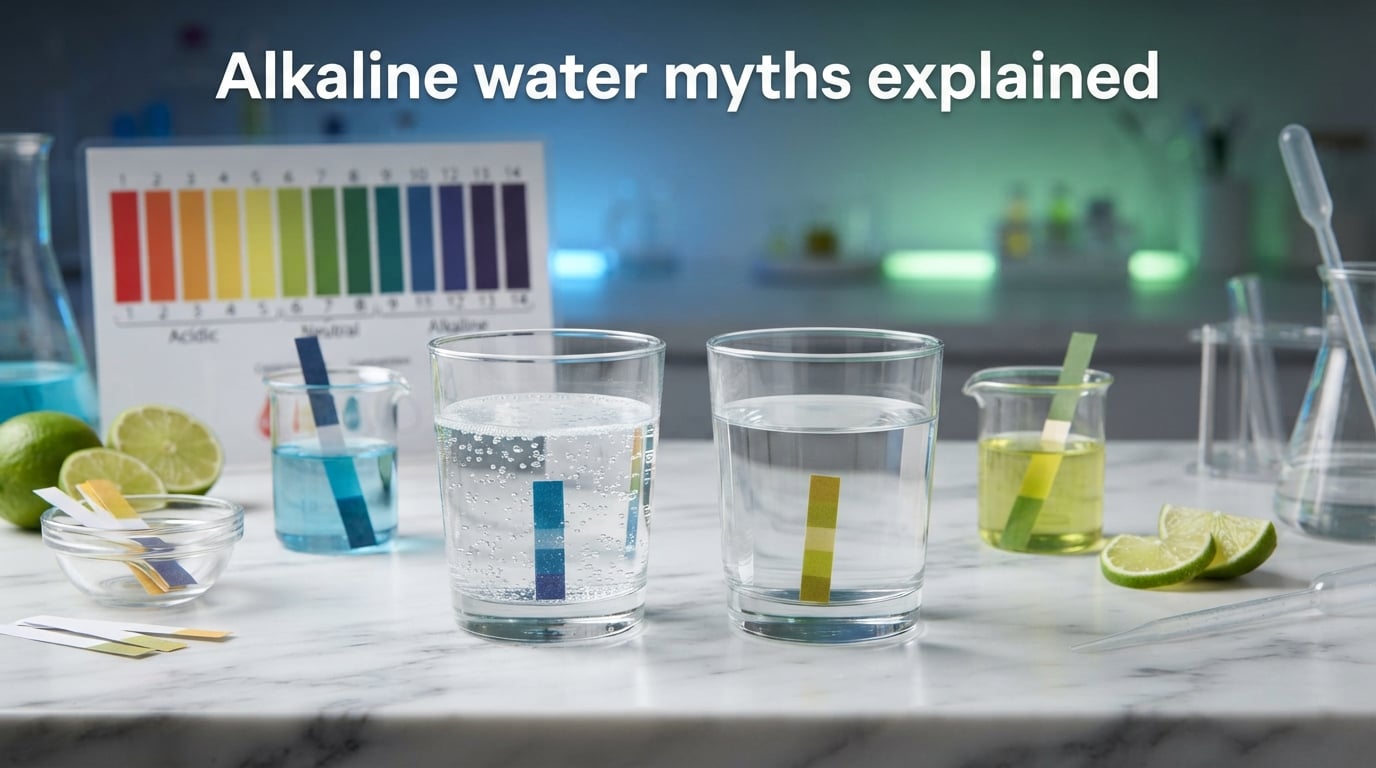
Alkaline water myths are everywhere, and most of them do not hold up to scientific scrutiny. After reviewing dozens of peer-reviewed studies and consulting major health institutions like Harvard and Mayo Clinic, our team can give you the short answer: for most healthy people, alkaline water offers no proven health advantage over regular drinking water, and some claims are actively misleading.
You have probably seen bold promises on social media and at health stores. Water with a pH of 8, 9, or even 10 is marketed as a cure for acid reflux, bone loss, aging, and cancer. The marketing is aggressive, and the price tags are real. Bottled alkaline water can cost three to five times more than standard bottled or filtered tap water.
In this guide, we explain the actual science behind the pH scale, debunk the six most common alkaline water myths, and tell you which populations should approach this trend with caution. You will walk away knowing exactly what alkaline water can and cannot do for your body, and whether it belongs in your grocery cart in 2026.
Table of Contents
What Is Alkaline Water and How Does pH Actually Work?
Alkaline water is simply water with a pH above 7, usually marketed in the 8 to 9.5 range. The pH scale runs from 0 to 14, with 7 being neutral. Anything below 7 is acidic. Anything above 7 is alkaline. Pure water sits at pH 7, but most drinking water falls between 6.5 and 8 depending on the source and what minerals it has picked up.
Your body tightly regulates blood pH between 7.35 and 7.45 through a process called homeostasis. Your kidneys and lungs work together to keep this range stable. If your blood pH drifts even slightly outside this narrow window, you get sick. This is why no food or drink you consume can meaningfully change your blood pH, including alkaline water.
There are two ways water becomes alkaline. Natural alkaline water forms when spring or mineral water picks up alkaline minerals like calcium, magnesium, and potassium while flowing through rock formations. Examples include many European natural mineral water sources like Contrex and Vichy, which are alkaline because of geology, not manufacturing.
Artificial alkaline water is made by running regular tap water through an ionizer machine or by adding alkaline compounds. Electrolysis separates water into acidic and alkaline streams, and the alkaline side gets bottled. Both end up with the same basic chemistry. The body cannot tell the difference once it hits your stomach.
The 6 Most Common Alkaline Water Myths Debunked
The alkaline water industry is built on six persistent myths. Each one sounds reasonable on the surface, but the science does not support them. Here is what the research actually shows.
Myth 1: Alkaline Water Neutralizes Body Acid and Balances Your pH
This is the single most repeated alkaline water myth, and it is wrong. Your body already regulates its pH precisely. Your kidneys filter acids, your lungs exhale carbon dioxide, and buffer systems in your blood keep everything in range. Drinking alkaline water does not change this balance in any meaningful way.
When alkaline water hits your stomach, it meets hydrochloric acid at a pH of around 1.5 to 3.5. The stomach immediately neutralizes the water’s alkalinity. By the time any nutrients or minerals reach your bloodstream, your body has already adjusted them back to the pH it needs. A 2016 review in the British Journal of Nutrition confirmed that the alkaline diet, including alkaline water, has no effect on blood pH in healthy individuals.
Myth 2: Alkaline Water Prevents or Treats Cancer
The claim that cancer thrives in acidic environments is a half-truth used to sell products. Tumors do create acidic microenvironments locally because of how they metabolize sugar, but this is a result of cancer, not a cause. You cannot change your body’s overall pH by drinking water, so you cannot starve tumors by alkalizing your blood.
The Mayo Clinic and the National Cancer Institute have found no credible evidence that alkaline water prevents or treats cancer. The FDA has issued warning letters to companies making these claims. Anyone facing a cancer diagnosis should rely on evidence-based treatment, not bottled water with a high pH label.
Myth 3: Alkaline Water Detoxifies Your Body
Your body already has a detoxification system. Your liver filters toxins from your blood. Your kidneys remove waste products through urine. Your lungs exhale gases. Your digestive system processes what you eat. You do not need alkaline water to support these functions. They are running 24 hours a day.
No peer-reviewed study has shown that alkaline water removes toxins more effectively than regular water. In fact, the only thing water needs to do for detoxification is keep you hydrated. Plain water does this just fine.
Myth 4: Higher pH Water Is Always Better
More is not better when it comes to pH. Water above pH 9 is generally considered unsafe for regular consumption. Water above pH 10 can irritate tissues, damage your throat, and upset your stomach. Drinking high-pH water can cause nausea, vomiting, and in extreme cases metabolic alkalosis.
The EPA does not regulate pH in drinking water above a minimum threshold for corrosion control. Many bottled alkaline products sit at pH 9 or 9.5, which is at the edge of safe range for daily consumption. Always check the labeled pH and remember that higher numbers are not automatically a sign of quality.
Myth 5: Alkaline Water Improves Athletic Performance and Hydration
Some small studies have suggested that alkaline water might improve hydration during intense exercise, but the evidence is thin and inconsistent. A 2018 study in the Journal of the International Society of Sports Nutrition found slight improvements in a few markers, but the sample size was small and the effect was modest.
For most athletes and casual exercisers, regular water is sufficient. Electrolyte drinks designed for sports contain sodium, potassium, and carbohydrates that actually help performance. Alkaline water does not contain these in meaningful quantities. The hydration benefit comes from the water itself, not the pH.
Myth 6: Japanese Studies Prove Alkaline Water Works
Japan is often cited as proof that alkaline water works because some Japanese water sources are naturally alkaline. However, Japan does not endorse alkaline water as a medical treatment. The Japanese Ministry of Health has not approved it for any health claims.
Japan’s drinking water culture is built on access to clean municipal water, which is consistently among the best in the world. The longevity and health outcomes frequently attributed to Japanese water have more to do with diet, lifestyle, and overall public health infrastructure than the alkalinity of any single water source.
What Science Actually Says About Alkaline Water
So if the myths are wrong, what does the science actually show? After reviewing the research, here is what we know with reasonable confidence.
Most rigorous studies have found little to no difference between alkaline water and regular water for general health. A 2020 systematic review in the Journal of Renal Nutrition concluded that evidence supporting alkaline water benefits was weak and limited to small trials with methodological concerns.
The strongest evidence is for one specific use. A few small studies have shown that alkaline water with pH 8.8 may help with acid reflux symptoms because it can deactivate pepsin, an enzyme involved in reflux. This is not a cure, and the effect is modest. If you have chronic reflux, talk to a doctor rather than self-treating with bottled water.
Bone health claims have mixed evidence. Some short-term studies suggested alkaline water might reduce calcium loss, but longer studies have not confirmed this. The Mediterranean diet and other dietary patterns have much stronger evidence for protecting bone density than any drinking water choice.
From a cost-benefit perspective, regular filtered tap water is the best value. A pitcher filter costs pennies per gallon. Bottled alkaline water costs more per liter than gasoline in some markets. Unless you have a specific medical reason to drink alkaline water, the cost is hard to justify.
Risks and Who Should Avoid Alkaline Water
For most healthy adults, drinking mildly alkaline water is unlikely to cause harm. However, certain populations should be cautious. People with kidney disease should avoid alkaline water because their kidneys may struggle to process the additional minerals and higher pH. This can lead to hyperkalemia, a dangerous buildup of potassium in the blood.
Anyone taking proton pump inhibitors, such as omeprazole or esomeprazole, should also be careful. These medications reduce stomach acid production, which means alkaline water is not neutralized as quickly in the stomach. This can disrupt digestion and nutrient absorption over time.
People with alkalosis, chronic respiratory conditions, or certain metabolic disorders should also avoid high-pH water. Even healthy individuals can experience nausea, stomach upset, or unusual fatigue if they drink too much high-pH water. If you feel strange after drinking alkaline water, switch back to regular water and see if symptoms resolve.
Children and pregnant women do not need alkaline water. Their hydration needs are the same as for regular water, and the mineral content in alkaline water is not tailored to their specific nutritional requirements.
Frequently Asked Questions About Alkaline Water Myths
Why is alkaline water not recommended for drinking?
Alkaline water is not recommended for everyone because your body already regulates blood pH through your kidneys and lungs. Drinking alkaline water does not change this balance, and it can be risky for people with kidney disease or those taking proton pump inhibitors. Water above pH 9 may also irritate your stomach and digestive system over time.
Why do I feel weird after drinking alkaline water?
If you feel nausea, bloating, or unusual fatigue after drinking alkaline water, your body may be reacting to the higher pH or extra minerals. Stomach upset is the most common symptom, especially if you drink it on an empty stomach. Try switching to regular filtered water for a week and see if your symptoms go away.
Is it safe to drink alkaline water every day?
For most healthy adults, mildly alkaline water (pH 8 to 9) is safe to drink daily in normal amounts. However, water above pH 9.5 may cause problems with long-term daily use. People with kidney problems, those on acid-reducing medications, and anyone experiencing digestive symptoms should avoid daily alkaline water consumption.
Why do Japanese drink alkaline water?
Some Japanese water sources are naturally alkaline due to local geology, but Japan does not officially endorse alkaline water as a health treatment. Japanese longevity is linked to overall diet, lifestyle, and public health infrastructure, not specifically to alkaline water consumption. Most Japanese citizens drink regular filtered municipal water as their primary source of hydration.
The Bottom Line on Alkaline Water Myths
Alkaline water myths are built on simplified science and aggressive marketing, not evidence. For most people, regular filtered water is just as good for hydration and overall health. If you enjoy the taste of alkaline water and can afford it, it is unlikely to harm you. But spending premium prices for claimed health benefits is not supported by current science.
Focus on what actually matters for your health. Drink enough water throughout the day. Eat a balanced diet rich in fruits and vegetables. Get regular exercise and sleep. These habits will do far more for your long-term wellness than any water with a high pH label, including in 2026 and beyond.