
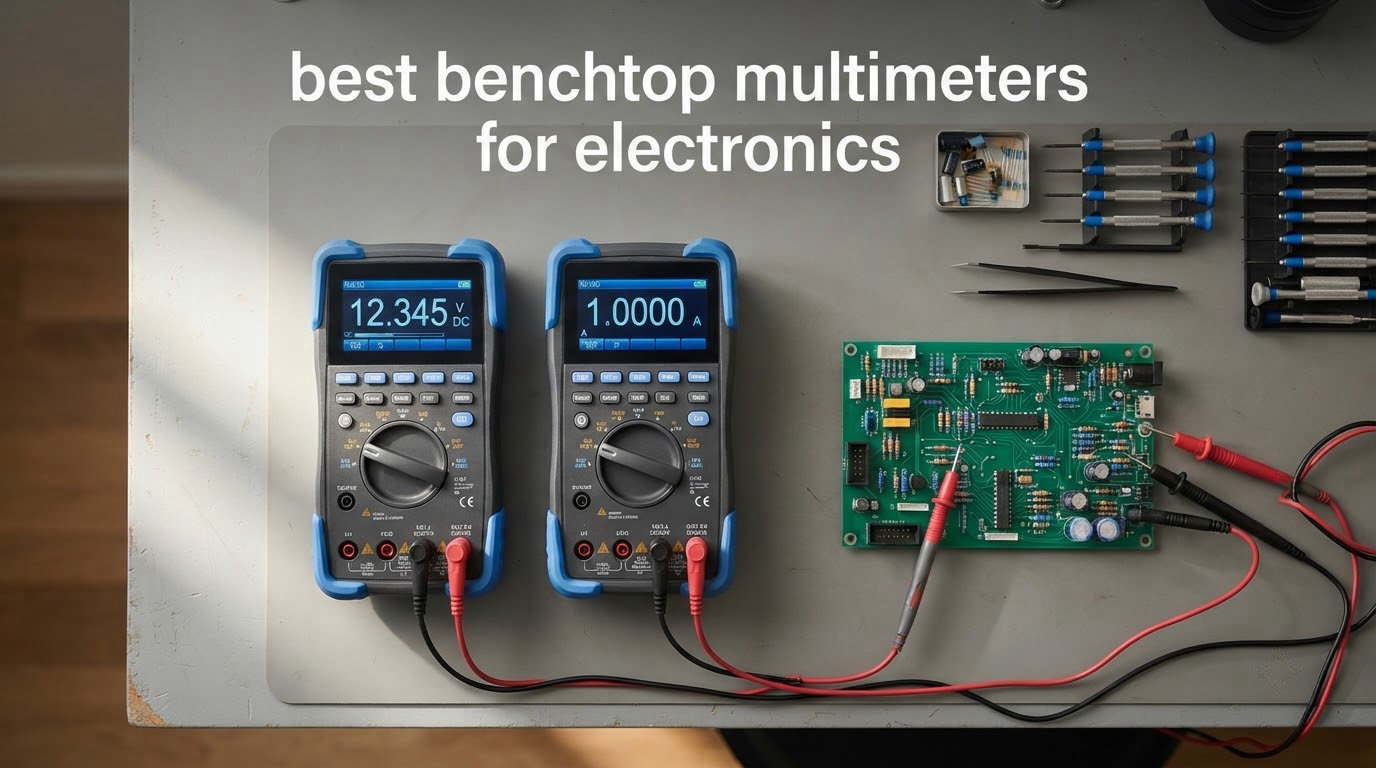
The Siglent SDM3045X is the best benchtop multimeter for electronics work for most people. It pairs a dual-line true RMS display with 0.01 percent basic DC accuracy, 150 readings per second, and both USB and LAN computer control at a price that sits in the middle of this roundup rather than at the top of it.
That matters because the search results for this question are mostly forum threads, not roundups. The most common thread title is not a model name; it is a hesitation. People who already own a decent handheld meter open the post to ask whether a benchtop is worth the money at all. Our answer, in short: for breadboard work, power supply repair, low-voltage rails and anything you want logged to a laptop, yes. For mains work and field service, no, and no benchtop meter on this list will replace a CAT-rated handheld.
We compared ten desktop multimeters spanning the entry 55000-count class through to a true 6.5-digit instrument, weighing each one on the same five criteria: DC accuracy, display resolution, true RMS AC performance, computer connectivity, and what you get for the money. Nothing here is a lab calibration reference, and we do not claim to have calibrated anything. What we did was read every specification, cross-check owner feedback, and separate the meters that are genuinely accurate from the ones that merely show a lot of digits.
If you are also building out a workbench, our guides to the best benchtop table saws and best benchtop jointers cover the woodworking side of a permanent bench setup, which pairs well with the meters below.
Table of Contents
Top 3 Picks for the Best Benchtop Multimeters for Electronics (October 2026)

Siglent SDM3045X
- Dual display with true RMS
- 0.01% basic DC accuracy
- USB host
- device and LAN

All 10 Benchtop Multimeters Side by Side in 2026
Every meter below is mains or battery powered, sits on a desk rather than in a tool bag, and offers a screen large enough to read from standing position. The columns that actually change results are resolution, DC accuracy, true RMS and connectivity.
| Product | Specifications | Action |
|---|---|---|
| Siglent SDM3045X |
|
Check Latest Price |
| Siglent SDM3055 |
|
Check Latest Price |
 OWON XDM2041 OWON XDM2041 |
|
Check Latest Price |
 OWON XDM1241 OWON XDM1241 |
|
Check Latest Price |
 Rigol DM3058E Rigol DM3058E |
|
Check Latest Price |
 Siglent SDM3065X Siglent SDM3065X |
|
Check Latest Price |
 OWON XDM1041 OWON XDM1041 |
|
Check Latest Price |
 labloot LB1041 labloot LB1041 |
|
Check Latest Price |
 Rigol DM858 Rigol DM858 |
|
Check Latest Price |
 Crenova 8045 Mini Crenova 8045 Mini |
|
Check Latest Price |
Do You Even Need a Benchtop Multimeter?
If a good handheld meter is already on your bench, a benchtop meter is not automatically an upgrade. It is a different tool, and the honest answer depends on which of four jobs you are actually doing.
Voltage resolution. A handheld typically shows three and a half digits. Measuring a 5 V rail gives you something like 4.98 V, and the last digit is largely decoration. A 55000-count desktop meter shows 4.9999 V, which is the difference between knowing your supply is at 5.00 V and knowing it droops to 4.91 V under load. This is the single biggest practical gain, and it is the reason power supply work pushes people toward a benchtop.
Speed and logging. A desktop meter can take 65 to 150 readings per second and can log thousands of points internally or over USB. A handheld takes a couple of readings a second and holds nothing. If you want to watch a rail settle, capture a power-on transient, or hand a column of numbers to a spreadsheet, that is a benchtop job.
Component work. This is where readers most often buy the wrong tool. An LCR meter measures capacitance and inductance properly. An oscilloscope shows you what a signal actually is doing. A benchtop DMM gives you a stable number, which is what you want for calibration, resistance, diode drops and supply rails, and a fairly poor substitute for either of the other instruments.
Mains and field work. None of the ten meters here carry a meaningful CAT III or CAT IV rating. Only the Crenova 8045 Mini states a CAT II 600 V and CAT I 1000 V rating, and that is the only one in the group with a stated safety category. Benchtop meters are built for low-voltage bench accuracy, so keep a CAT-rated handheld in the tool bag.
So: keep the handheld, add a desktop meter for the bench. That is the combination most of the experienced people posting on r/AskElectronics ended up with.
1. Siglent SDM3045X – Best Overall Benchtop Multimeter for Electronics
Siglent Technologies SDM3045X 4-1/2 Digit Digital Multimeter, DMM
Dual display with true RMS
0.01% basic DC accuracy
USB host, device and LAN
Up to 150 readings per second
Pros
- Dual display with true RMS
- 0.01% basic DC accuracy
- 2-wire and 4-wire resistance
- Built-in thermocouple cold junction compensation
- USB host
- USB device and LAN interfaces
Cons
- 4.5-digit resolution limits fine detail
- Rear-facing connectors add bench depth
The SDM3045X is the model that shows up over and over when experienced hobbyists ask each other which bench meter to buy, and it is our pick for the same reason: it does the four things that matter most, and it does all four at once. Dual-line true RMS display, 0.01 percent basic DC accuracy, a fast reading rate, and three communication interfaces.
Basic DC accuracy of 0.01 percent on a bench meter is genuinely good. For most electronics work that means the error is smaller than the variation between two readings taken a minute apart, so you can trust differences you would not trust in absolute terms. The 4-wire resistance mode lets you measure low resistances without probe lead error dominating the result, which is useful once you start characterising power resistors or sense resistors.
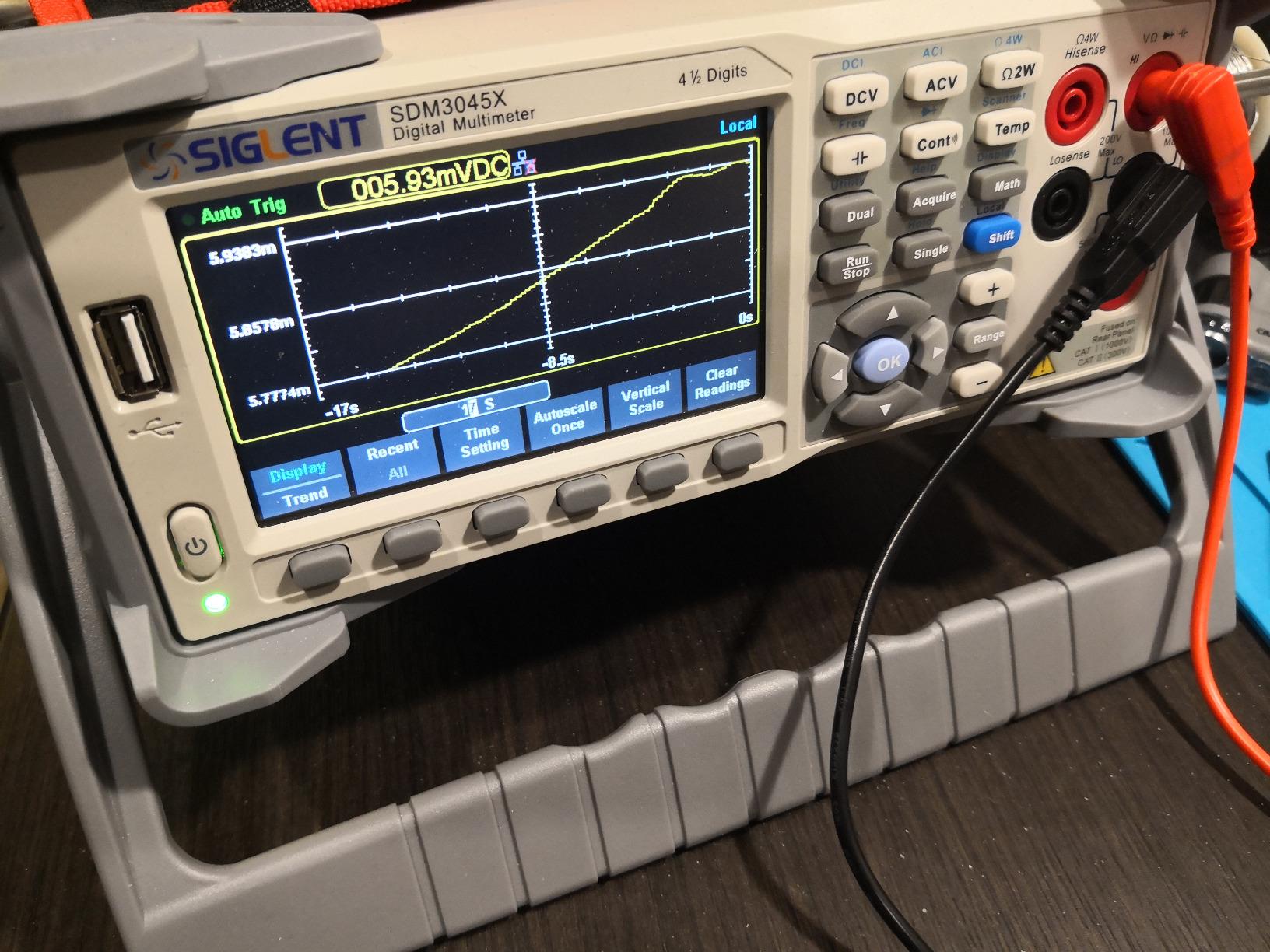
Connectivity is where this meter outruns most of its class. It has a USB host port, a USB device port and LAN, so you can log directly to a thumb drive, talk to a computer, or sit on a network. Built-in cold junction compensation means temperature readings from a thermocouple are corrected at the terminal rather than left to you.
The honest limitation is resolution. At 4.5 digits with up to 12000 counts, the smallest step on the 6 V range is 1 mV. That is fine for essentially all breadboarding and repair work, and it is the reason to step up to the SDM3065X if you are chasing the fourth decimal place on a reference supply. Another small gripe: the connectors sit on the rear panel, which pushes the depth of the unit back on your bench.
When the dual display pays off
The second line is the reason most people keep this meter out rather than back in the drawer. You can watch voltage on the main line and current on the second at the same time, which turns a supply test from a two-probe, two-procedure job into a single observation. Frequency alongside amplitude works the same way for signal checks.
Up to 150 readings per second also means limit testing and min/max capture stay useful on fast settling circuits. Graphing and statistics are built in, so you can watch a rail come up without writing any software at all.
Where it falls short
For metrology-adjacent work, 4.5 digits is the ceiling. If your work involves verifying a 2.5 V reference or characterising a low-noise linear regulator, the display cannot resolve enough and no amount of averaging will change that. The 5.5-digit SDM3055 in the same family is the step up.
There is also no documented low-range offset or 4-wire option beyond the basic pair, so it is not the meter for measuring milliohm contacts. For general bench electronics work, though, very few people push past what this one does well.
2. Siglent SDM3055 – Most Versatile for Power Supply Work
Siglent Technologies SDM3055 5.5 Digit Digital Multimeter, White/Grey
5.5-digit resolution with true RMS
Built-in trend and history charting
2-wire and 4-wire resistance
AC power, no auto-sleep
Pros
- Large bright color display
- Built-in graphing and trend charts
- 4-wire resistance works with inexpensive Kelvin probes
- Runs on AC power and never auto-sleeps
- Up to 150 readings per second
Cons
- Low-range readings can take roughly 15 seconds to stabilise
- Settings reset when power is switched off
- Carry handle is cheap and detaches too easily
The SDM3055 is what we recommend when the work is specifically about power supplies, regulators and reference voltages. The jump from 4.5 to 5.5 digits is the jump from seeing that a rail reads 4.98 V to seeing it read 4.9821 V, and that is exactly the level of detail you need when troubleshooting a switching supply or checking load regulation.
Owner feedback is unusually consistent about the display. People describe a large, bright, colour screen that is easy to read across a bench, and the built-in trend and history charting is the feature that gets singled out most often in daily use. Four-wire resistance is reported to work well even with inexpensive Kelvin probes, which is a pleasant surprise at this level.
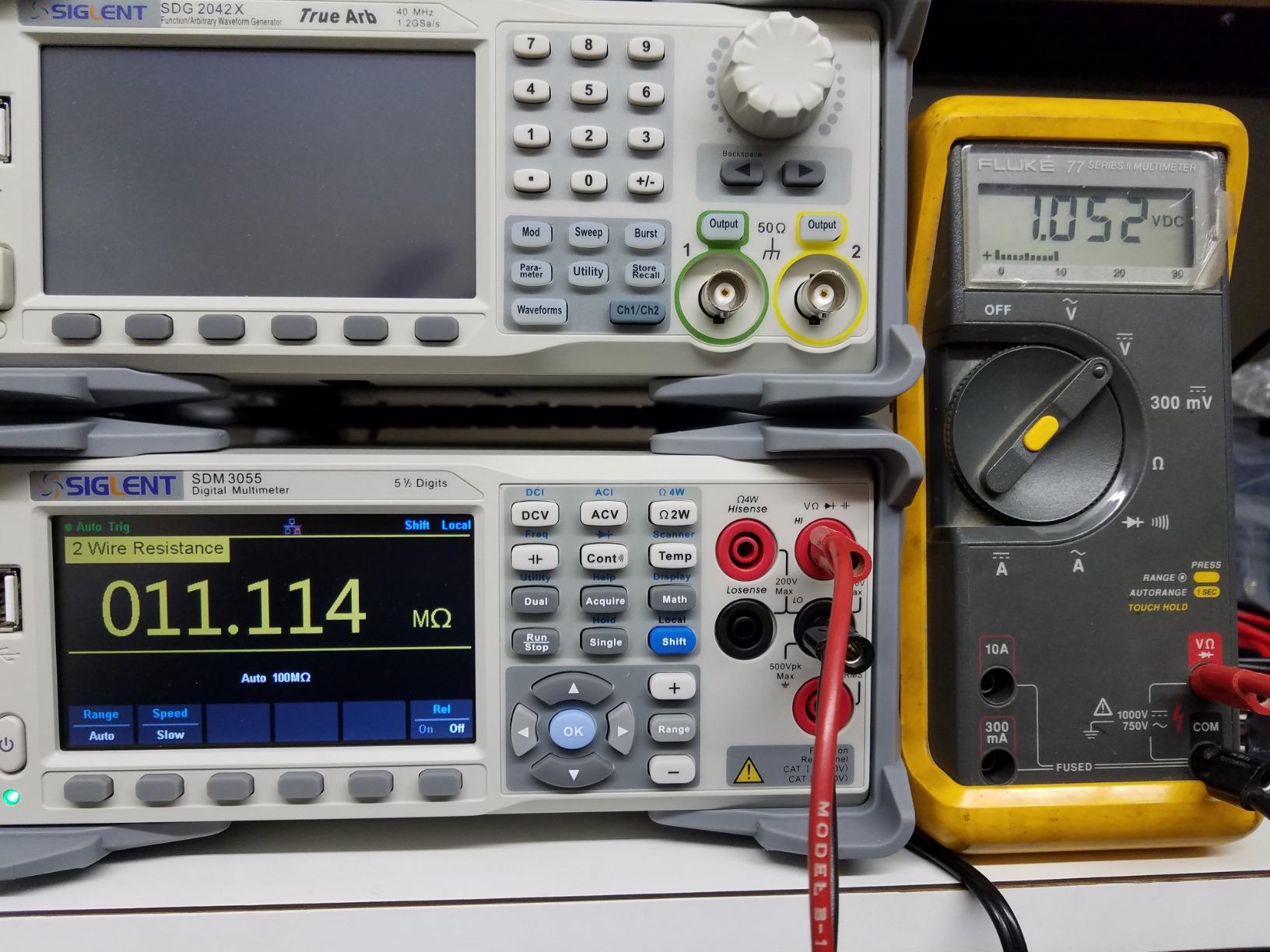
Because it runs on AC power and never auto-sleeps, it stays exactly where you left it. That sounds trivial until you have used a handheld that blanks itself mid-measurement. Reviewers also report stability confirmed over 48 hours after a 30-minute warmup, which is the kind of thing that matters when you are trusting a number over a long session.
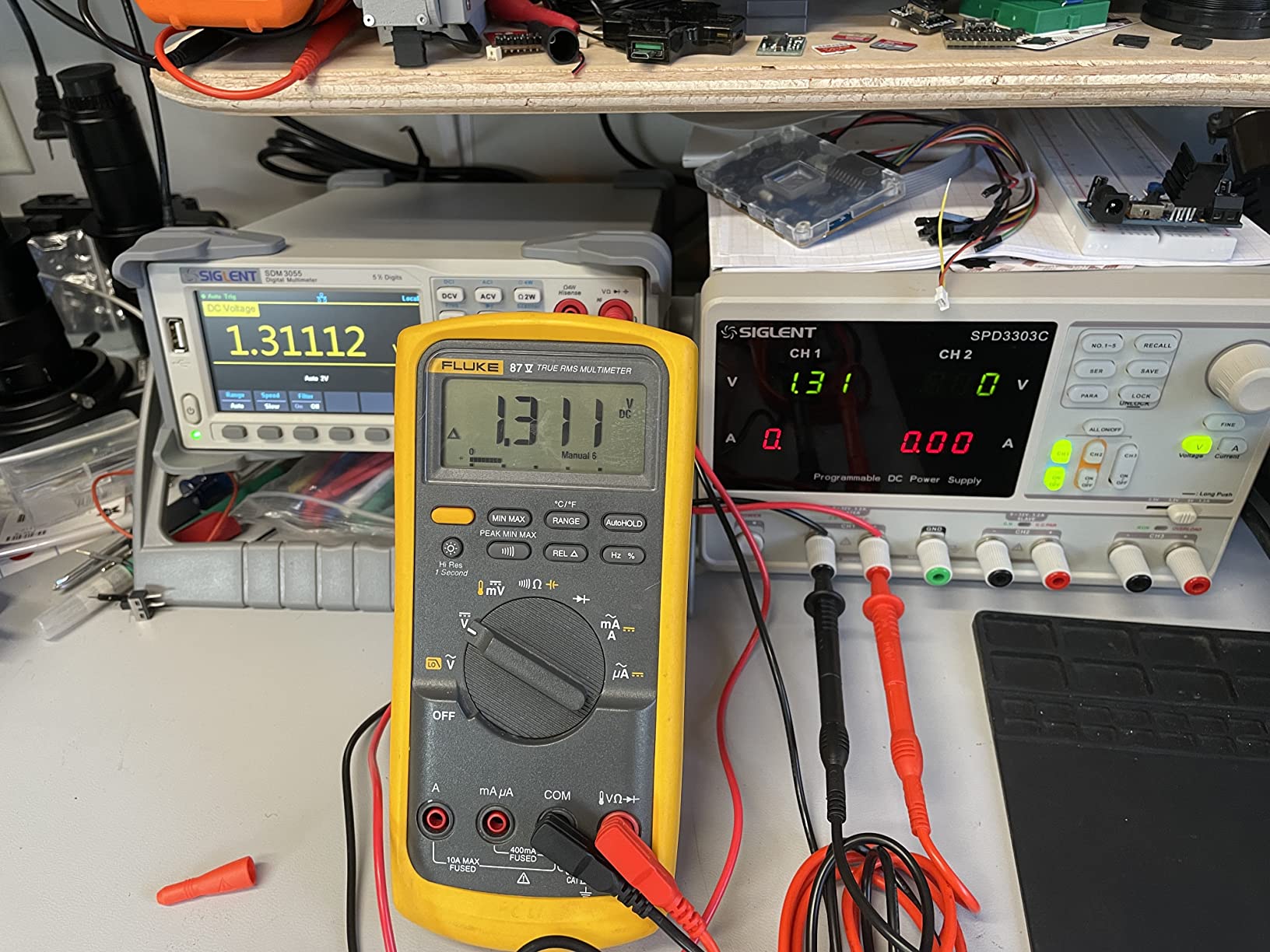
There are real quirks to know about. Low-range readings can take up to roughly 15 seconds to fully stabilise, so a 200 mV measurement is not instant. Front-panel settings reset when you switch power off, and the firmware update process has been reported to freeze the interface when saving data. The carry handle is also, in the words of one reviewer, cheap and easy to detach.
How we would actually use it
Give it 15 to 30 minutes on the bench after power-on before you trust a low-range number. Then use the charting to capture rail behaviour rather than eyeballing the display. For bring-up work on a linear or switching supply, the history and trend view turns a sequence of readings into a picture of what is happening.
The dB and dBm maths functions and the capacitor value finder are minor features, but useful when you are chasing a gain problem and do not want to do the arithmetic on paper.
Where it falls short
Six and a half digits would be needed for real reference-grade work, and this is not that. The 15-second settle time is genuinely annoying when you are scanning a board and touching points one after another. And if you intend to script it, be aware that the SCPI documentation has documented errors and no Local command, so budget time for that.
For most people the settle time and the reset-on-power-off behaviour are the deal-breakers to check, and everything else is a preference.
3. OWON XDM2041 – Best Value 55000-Count Desktop Multimeter
OWON XDM2041 Digital Multimeter with 3.7 inch (480×320) high Resolution LCD, 55000 Counts True RMS AC Voltage/Current Measurement,Support SCPI and Dual line Display Up to 65 Readings per Second
55000 counts on a 3.7 inch LCD
True RMS AC voltage and current
Dual-line display at 65 readings per second
SCPI support with PC software
Pros
- Single current port covers all ranges
- High reading speed mode gives near-instant stable readings
- Readability holds at an 80-degree viewing angle
- Function and range settings retained between functions
- Readings check out against a calibrated reference
Cons
- Auto-ranging is slow and returns intermediate values
- High reading speed is not the default and must be set after each power-up
- Bundled probes have thick insulation and blunt tips
The XDM2041 is the meter we would hand to someone who wants a genuinely capable bench DMM without stepping up a tier. It has a 3.7 inch 480×320 screen, 55000 counts, true RMS on both AC voltage and AC current, and a dual-line display running at up to 65 readings per second. That is most of what the more expensive Siglents offer, at a much lower tier.
One design decision earns it a place on this list on its own. It uses a single current port that covers all ranges, so you are not swapping leads between a milliamp terminal and a 10 A terminal every time you change function. That one detail removes more bench friction than any other feature on the entry-class meters.
There is a setting that transforms this meter, and owners say so repeatedly: switch the reading speed to high, and stabilised readings appear almost immediately. The auto-range mode, by contrast, is slow and tends to show intermediate values as it hunts for the right range. Our advice is to select the range manually on low readings and leave auto for everything else.
Function and range settings are retained when you move between functions, and readability holds even when you view the screen at an 80-degree angle, which matters if the meter sits to the left of your monitor. Users who calibrate test equipment report that readings check out against a calibrated reference across DC, AC and frequency.
What you can automate on it
SCPI support over USB with bundled PC software is the headline for anyone running measurements from a script. Alongside that, the meter records to internal memory for up to 1000 points with an interval anywhere from 15 ms to 9999 s, so a slow thermal drift can be captured without a laptop in the loop.
Measurement functions cover DC and AC voltage and current, 2-wire and 4-wire resistance, capacitance, continuity, diode, temperature and frequency, plus MAX, MIN, average and relative modes. That is a complete bench function set for electronics work.
Where it falls short
Two things to plan around. The bundled probes have thick insulation and blunt tips that suit neither tight spots nor surface-mount work, so budget for a better probe set. And the 4-wire milli-ohm mode is reported to be inaccurate and to lack a zero control, so treat 4-wire as a low-resistance convenience here rather than a precision feature.
The desktop-style IEC power cord also protrudes a long way behind the chassis, which matters if you are tight on bench depth.
4. OWON XDM1241 – Budget Pick With True RMS and SCPI
OWON XDM1241 Digital Multimeter,3.5in Desktop Multimeters, 55000 Counts LCD True RMS Temperature Tester Meter
55000 counts with 3.5 inch LCD
True RMS AC voltage and current
AC and DC current, voltage, resistance, capacitance, diode, continuity, temperature
SCPI remote control over USB
Pros
- Compact desktop footprint at a low price
- True RMS with a broad function set
- USB PC software with SCPI for data recording
- Replaceable line fuse with spare fuses included
- Reads match the pricier XDM2041 on resistance and voltage
Cons
- Lowest average rating in this group with a notable share of 1-star reviews
- Bundled test leads and accessories are basic
- ABS housing feels less substantial than metal-cased meters
The XDM1241 is the cheapest way to get true RMS, a 55000-count display and SCPI-over-USB onto a desk, and for a lot of first-time bench buyers that combination is the whole decision. Owners report readings that match the more expensive XDM2041 on resistance and voltage, which is the single most reassuring thing you can hear about an entry meter.
The function list is complete for general electronics: AC and DC voltage and current, resistance, capacitance, diode test, continuity and temperature. Manual or automatic data recording writes to internal memory and displays as a table, and SCPI remote control works through the bundled PC software over the USB port.
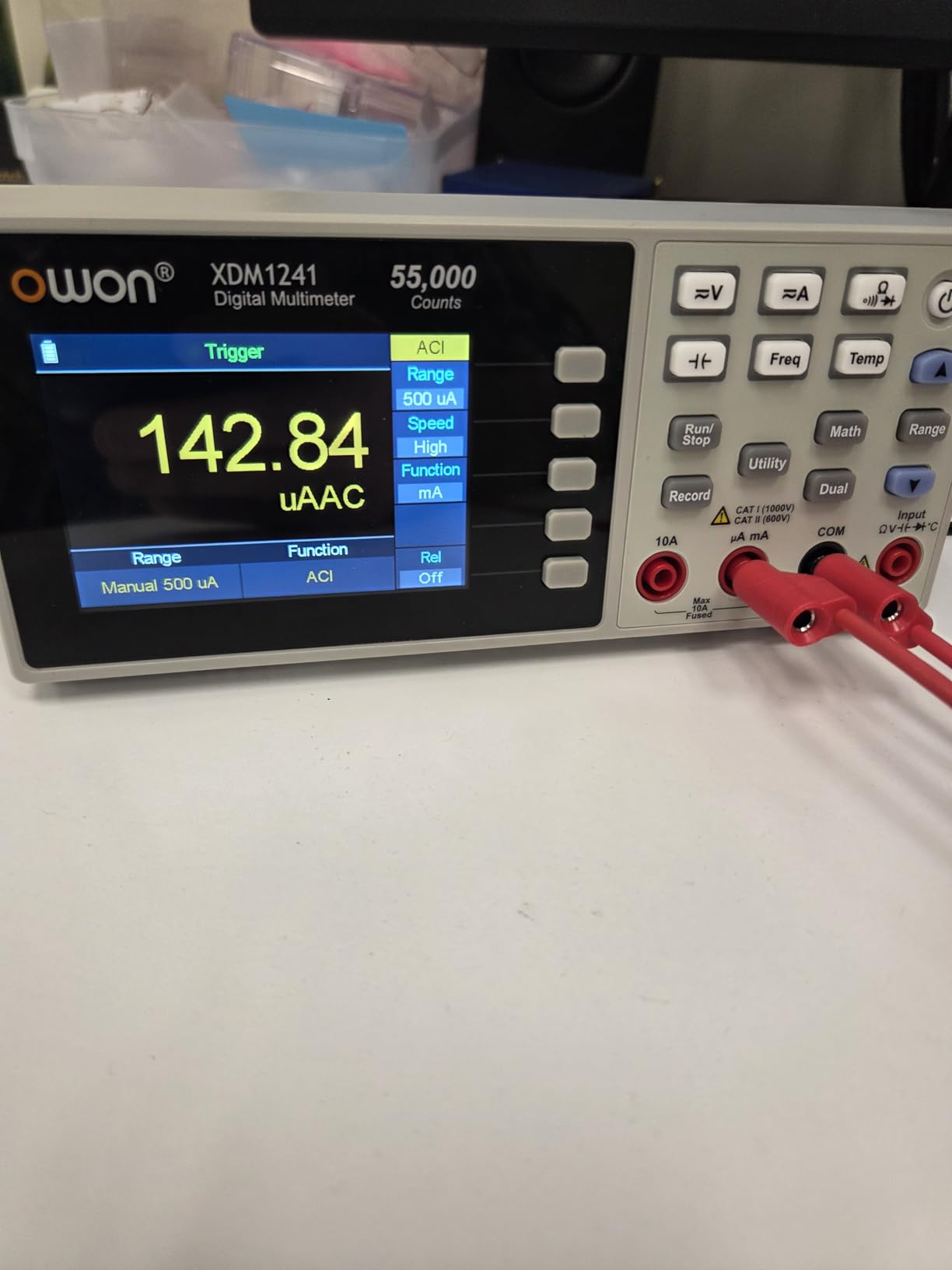
A detail worth more than it sounds: the line fuse is replaceable, housed in a plastic fuse box below the power input, and spares are included in the box. On cheaper meters the fuse is soldered, so the first time you blow it on an inrush you are finished. Owner comments repeatedly single this out.
Where the group consensus turns is build feel. The ABS plastic housing is described as less substantial than metal-cased bench meters, and the bundled test leads and accessories are basic. The 4.2 average here is the lowest of the ten, and it is pulled down by a visible share of 1-star reviews rather than by any single recurring technical fault.
When to pick this one
If you are setting up your first electronics bench and want true RMS plus the ability to log measurements without buying more equipment, this is the sensible first step. It covers everything a breadboard project needs and it can be driven from a computer when you outgrow manual readings.
It also works as a second meter. A good two-meter setup on a bench is a stable one for the reference signal and a quick one for probing, and this fills the second role well.
When to skip it
Skip it if you will move it between locations. It is a desktop meter, not a portable one, and nothing in the design suggests field use. Also skip it if you are doing fine resistance work, where 4-wire precision matters and this class of meter is at its limit.
Owners who are disappointed are mostly disappointed about feel, not function. If you can accept that, the measurement capability is genuinely there.
5. Rigol DM3058E – Best for University Labs and 0.015% Accuracy
Rigol DM3058E 5.5 Digit Bench Digital Multimeter, 123,000 Counts, True-RMS
5.5-digit resolution, 123000 counts
Up to 0.015% basic DC voltage accuracy
Dual display for two parameters
USB, LAN and RS-232 with SCPI
Pros
- 0.015% basic DC voltage accuracy for small-signal work
- Dual display shows two measurement parameters at once
- USB
- LAN and RS-232 with SCPI support
- Three-year warranty on the main unit
Cons
- Listed dimensions are unusable at 0.01 x 0.01 inches
- Three and two star ratings are more frequent than with the Siglent models
- Thin owner review base
The DM3058E is built for institutional labs rather than hobby desks, and the reason is the 0.015 percent basic DC voltage accuracy. That is a meaningfully tighter figure than the 0.01 to 0.05 percent you get from the entry and mainstream class, and it is the number a teaching lab or an engineering department actually cares about when it writes a specification.
Resolution is 5.5 digits with up to 123000 counts, and the dual display shows two measurement parameters at once, the same arrangement that makes the Siglent 4.5-digit models so useful at a lower tier. Function coverage includes DC and AC voltage, DC and AC current, resistance, capacitance, frequency, period, continuity, diode test and temperature.
Connectivity is the strongest argument here: USB, LAN and RS-232 remote communication with SCPI command compatibility, on a meter that is explicitly positioned for laboratory, classroom and production floor use. The three-year warranty on the main unit is also the longest in this group, with accessories covered for one year.
Why a lab would choose it
Accuracy and connectivity together. A bench that logs overnight measurements needs a meter that can sit on the network and be scripted, and a lab that hands a reading to a student needs a number they can defend. The 0.015 percent figure gives them that argument on paper.
For a student building a home lab, the honest version is that this is more instrument than most coursework needs, but it is the pick if your institution specifies it or if you plan to work in a lab rather than at a desk.
Where it falls short
Owner feedback is thin at 31 ratings, and that thinness is itself a risk: there is less community evidence of long-term behaviour than for the Siglents. Three and two star ratings appear more frequently here than on the SDM models, which may reflect the shipping and handling experience of a larger boxed instrument rather than measurement problems.
One practical warning: the listing dimensions are published as 0.01 by 0.01 inches, which is plainly an error. Ask for the physical dimensions before you plan the bench space, and expect to allow for the depth of a full-size bench instrument.
6. Siglent SDM3065X – Best 6.5-Digit Precision Benchtop
Siglent Technologies SDM3065X 6 ½ Digit Digital Multimeter, DMM
True 6.5-digit reading resolution, 2200000 counts
4.3 inch TFT-LCD at 480x272
True RMS AC voltage and current
Adjustable diode test voltage up to 4V
Pros
- Exceptionally stable readings once PLC filtering is understood
- DC readings matched Fluke meters in side-by-side tests
- Diode test adjustable up to 4V with adjustable continuity threshold
- Adjustable buzzer volume
- 4-wire resistance and histogram functions
Cons
- Auto mode is slow to register readings
- Poorly written SCPI remote manual with documented errors
- 4-wire Kelvin probes are not included
- Slow startup time
The SDM3065X is the only true 6.5-digit meter in this group, and 2200000 counts is a real jump in what the display can resolve. On the 6 V range the smallest step is 1 microvolt, which is the difference between measuring a reference supply and assuming it is correct.
Range coverage is broad: DC voltage from 200 mV to 1000 V, DC current from 200 microamps to 10 A, true RMS AC voltage from 200 mV to 750 V, and true RMS AC current over the same current span. The 4.3 inch TFT-LCD at 480×272 is large, and owners report the 6.5-digit numbers are readable from across a room.
Two details make it a better tool than its resolution suggests. The diode test voltage is adjustable up to 4 V, which matters when you are checking LEDs or forward drops in modern silicon. And the buzzer volume is adjustable, so you can turn the continuity beep down in a shared lab without losing the function.
Owner reports on accuracy are about as good as they get in this category. Reviewers describe DC readings that matched their Fluke meters in side-by-side comparison, and note the readings become exceptionally stable once you understand the PLC filtering behaviour. Four-wire resistance and histogram functions are reported to work well.
What 6.5 digits actually buys
It buys you the ability to see a change that a 4.5-digit meter rounds away. If you are verifying a low-noise regulator, characterising a reference voltage, or looking at drift over a long session, the extra digits show you something real. If you are checking a 12 V supply, they show you nothing you can use.
The integration time settings matter here. Longer integration averages more noise cycles and gives a steadier, more accurate reading at the cost of speed. Once you know which setting suits the measurement, the instrument feels much better.
Where it falls short
Auto mode is slow to register readings, and manual range selection is faster, which is the opposite of what you want from a meter you expect to be intuitive. Startup is also slow. The SCPI manual is poorly written with documented errors and no Local command, so budget real time if you intend to automate it. And the 4-wire Kelvin probes are not included, which you will need to use the 4-wire mode properly.
One review reports a fulfilment problem involving a refurbished, non-functional unit, so inspect the meter on arrival and confirm it powers up and reads zero sensibly before you build anything around it.
7. OWON XDM1041 – Best Compact Always-On Desktop Meter
OWON Desktop Digital Multimeter with 3.5-inch LCD Display, Measures AC/DC Current, Voltage, and Temperature with True RMS Capability,Designed for Laboratories, Instruments, and Factories XDM1041
55,000 counts with a 3.5 inch 480x320 LCD
DC voltage accuracy up to 0.05%
True RMS AC voltage and current
Frequency from 10.000 Hz to 60 MHz
Pros
- Very accurate DC
- AC and resistance readings confirmed against calibrated references
- Solid-state design needs no warmup and is ready in seconds
- Compact enough to sit permanently beside a bench power supply
- 1000-point internal logging exports over USB
- Can measure LED forward voltage while illuminating the LED
Cons
- Can take up to 3 seconds for a first reading
- True RMS accuracy holds mainly from 20 Hz to 1 kHz
- Frequency counter needs roughly 1 to 2 V input
- Diode and capacitance readings are weak
The XDM1041 is the meter to buy if you want something permanently living next to your bench power supply rather than an instrument you bring out occasionally. At 453 g and with a 3.5 inch high-resolution display it takes very little room, and because the design is solid-state there is no warmup, so it is ready in seconds.
Owners who calibrate equipment report very accurate DC, AC and resistance readings confirmed against calibrated references, which is the strongest validation we found for any meter in this class. The dual-line display supports up to 55000 counts and 65 readings per second, with 1000-point logging length, a data record function with internal storage, and chart-mode trend analysis over SCPI.
One owner report stands out: the 1000-point internal logging exports over USB and was recognised immediately by standard VISA drivers, so it drops into existing software without a custom driver. That is a real time saver for anyone logging. Another notes the meter can measure LED forward voltage while actually illuminating the LED, which is a nice practical touch.
Where its accuracy holds
True RMS accuracy holds mainly from 20 Hz to 1 kHz, which covers mains-frequency and audio-range work. It is not an audio-grade True RMS analyser, and anyone chasing amplifier output at 20 kHz should look elsewhere. The frequency counter needs roughly 1 to 2 V of input to function at all, so it is not useful for low-level signals.
Diode voltage and capacitance readings are weak, and owners correctly point out that an LCR meter is better for those. Use this for DC, AC and resistance and reach for another instrument for component characterisation.
Where it falls short
Two practical annoyances. It can take up to 3 seconds to produce a first reading, which feels slow when you are touching points one after another. And you have to hold the power button for about 3 seconds to turn it on, which is a small design choice that irritates people daily.
Logged data works over USB but is not time stamped and does not open cleanly in Excel, so plan to post-process it rather than expecting a spreadsheet to appear.
8. labloot LB1041 – Best for Recording and Trend Analysis
Labloot LB1041 Bench Digital Multimeter 55000 Counts DC/AC Voltmeter Ammeter HZ Temp Diode Continuity Tester Desktop Multimeters
55,000 counts with 3.5 inch 480x320 backlit TFT
DC voltage accuracy up to 0.05%
True RMS AC voltage and current
Manual and auto recording to 1,000 points
Pros
- High-resolution backlit TFT screen at an entry price
- True RMS measurement plus chart-mode trend analysis
- 1000-point manual and auto recording exportable to a computer
- SCPI support and anti-burn replaceable fuse design
Cons
- Thin owner review base makes long-term reliability hard to judge
- Some 1 and 2 star reviews mention underperforming units
- Documentation and support trail the branded OWON models
The LB1041 is a rebranded OWON platform, and the useful thing about that is you get the same 55000-count true RMS desktop meter with recording capability at a lower tier. For a bench where the main job is capturing a value and watching how it moves, the feature set covers the requirement.
The 3.5 inch 480×320 backlit TFT screen is the nicest display hardware in the entry group, and DC voltage accuracy is up to 0.05 percent with a dual-line display. True RMS covers AC voltage and current. Manual and automatic recording share a data table in internal storage for up to 1000 points, and those points export to a computer, with chart-mode trend analysis over SCPI.
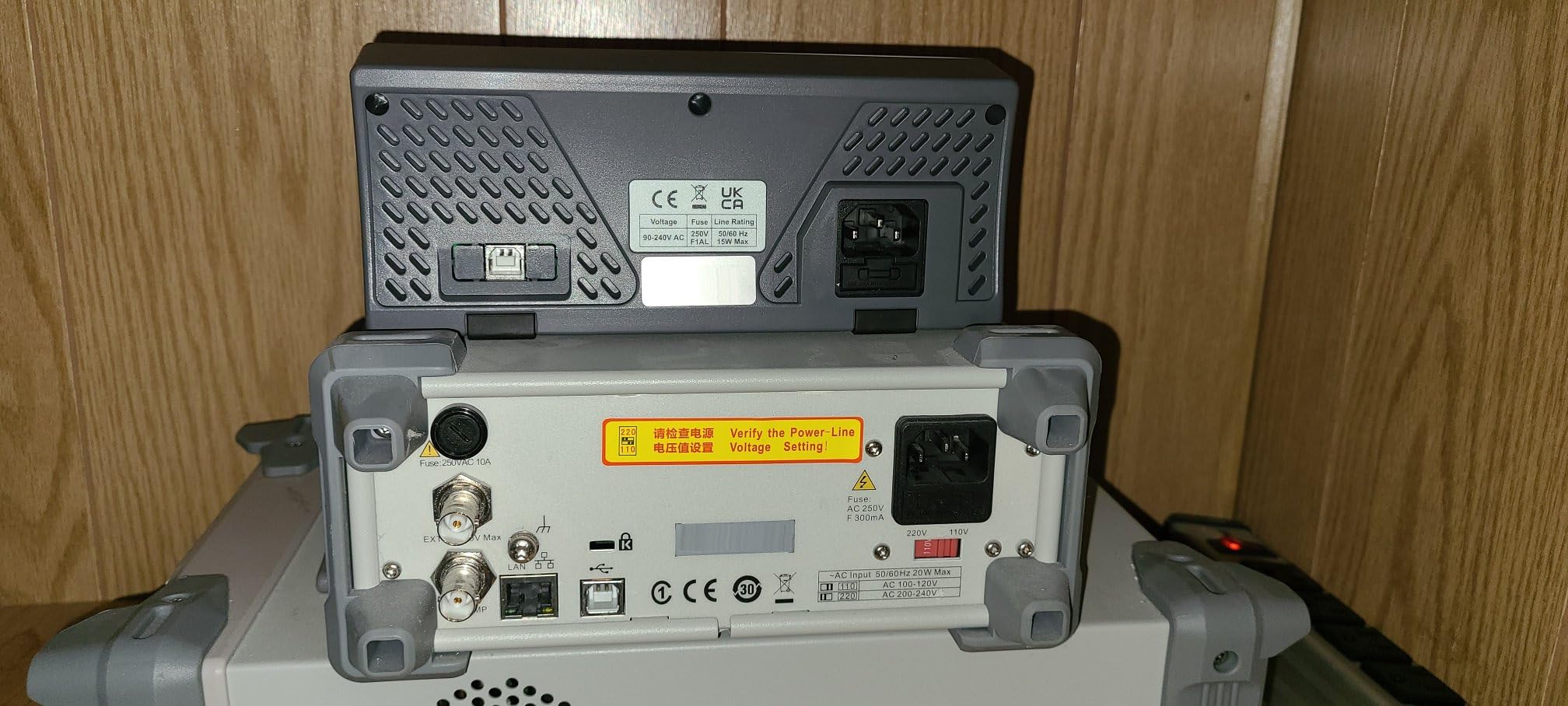
As with the OWON-branded models, the line fuse is replaceable, sits in a plastic fuse box below the rear power input, and a spare is included. Functions cover diode test, continuity, temperature, resistance and capacitance.
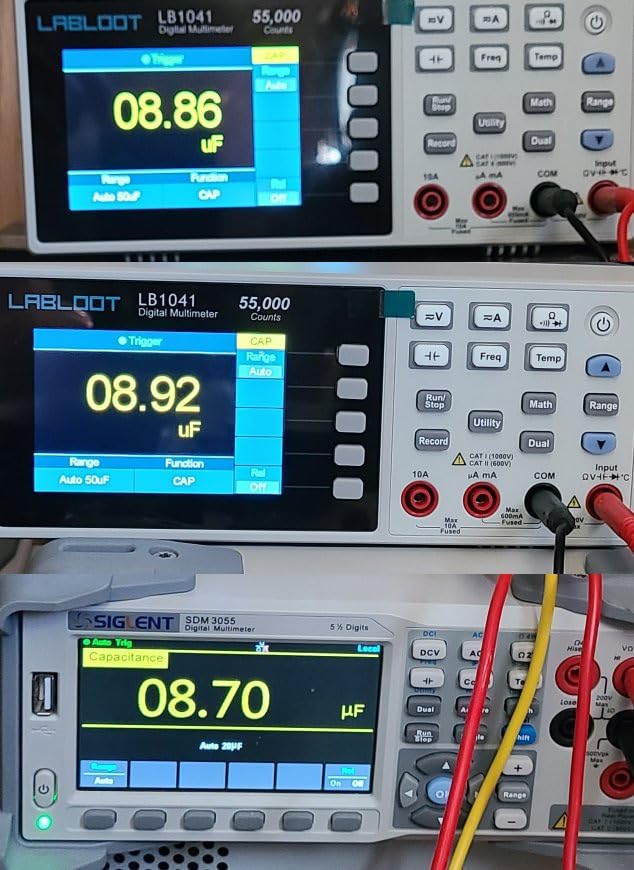
The trade-off is evidential. With 28 ratings, long-term reliability is genuinely hard to judge, and a small number of owners report units that did not perform to expectations. Documentation and support also trail the branded OWON models, which matters if you intend to script it. Buyers generally get the same platform its siblings use, and the rating spread here is wider than for the OWON-branded equivalents.
When recording is the main job
Choose this if your workflow is set a value, watch it drift, and record what happened. The 1000-point buffer with adjustable interval and chart-mode trend analysis is the reason to pick it, and it is a real advantage over meters that only export live readings.
Temperature, resistance and capacitance in the same box also make it useful as a general companion meter for prototypes where you want to log a build rather than spot-check it.
When to pick something else
Pick an OWON-branded equivalent if support and documentation matter to you, because you get the same measurement platform with a better reference trail and a larger body of owner experience. Avoid this one if you are depending on it for anything you cannot cross-check.
Given the thinner evidence base, our practical advice is to verify accuracy against a known reference in the first week rather than assuming it.
9. Rigol DM858 – Best for Touchscreen Workflows and Large Logging Memory
RIGOL DM858 5.5 Digits Digital Multimeter 125rdgs/s
5.5-digit resolution at up to 125000 counts
125 readings per second maximum rate
500000 point logging memory
7 inch touchscreen with true RMS
Pros
- Large 7 inch touchscreen makes menu-driven setup readable
- 500000 point logging memory is unusually large for the class
- 125 readings per second suits fast-changing signals
- Compact 1.23 kg Type-C powered design takes little bench space
Cons
- Smallest review base in this roundup at 18 ratings
- Very low sales rank indicates limited market presence
- Screen-based workflow suits touch users less well than hard-button meters
The DM858 takes a different route from every other meter here. Instead of a small screen with hard buttons, it puts a 7 inch touchscreen on the front and drives the interface through menus, and it is the only model in the group designed around that approach. At 1.23 kg and powered over Type-C it also takes considerably less bench space than a traditional full-size bench meter.
Resolution is 5.5 digits at 125000 counts with a maximum rate of 125 readings per second. The logging memory is 500000 points, which is the largest buffer in this roundup by a wide margin and genuinely useful for capturing long runs without a computer attached. There are 11 measurement functions, 5 maths operations and 3 graphical display types, plus true RMS.
Data and setup storage are built in, so a configuration survives a power cycle. That sounds minor until you have set up an instrument the way you like it and had to do it again after a power cut.
Where the touchscreen genuinely helps
Large-screen menu setup is the recurring highlight in owner feedback. With a 7 inch display, configuring a logging interval, a limit test or a graph view is legible without squinting or stepping through nested menus. Three graphical display types give you more choice about how to look at a captured run than the smaller screens elsewhere.
For anyone who will drive the meter from software, the built-in setup storage means the instrument can be restored to a known state quickly at the start of a test sequence.
Where it falls short
The evidence base is thin. At 18 ratings this is the smallest review base in the roundup, and the very low sales rank means it has seen limited market exposure, so long-term reliability is genuinely unproven. If you want community knowledge before committing, this is not the meter.
The screen-based workflow also suits people who prefer tactile hard buttons less well. Menus are slower for an expert who wants to change one setting without navigating, and a touchscreen is a liability if you work with gloves on or with the meter in a position you cannot reach. Consider it a modern instrument for touch-first users rather than a universal bench default.
10. Crenova 8045 Mini – Top Rated for Battery-Powered Bench Use
Crenova 30000 Counts True RMS Digital Multimeter, Desktop Bench Multimeter
30,000 counts with a 3.5 inch LCD
True RMS AC measurement
5000mAh rechargeable battery, up to 10 hours
USB for remote control and data logging
Pros
- 5000mAh rechargeable battery holds a charge for weeks under heavy use
- Can sit on the bench
- stand upright or be used handheld
- Large bright display with large readable numbers
- USB data logging captures measurements over time
- Two-year warranty available on activation
Cons
- No official programming documentation so scripting needs workarounds
- Software does not work on Linux
- Only 30000 counts
- half the resolution of the 55000-count models
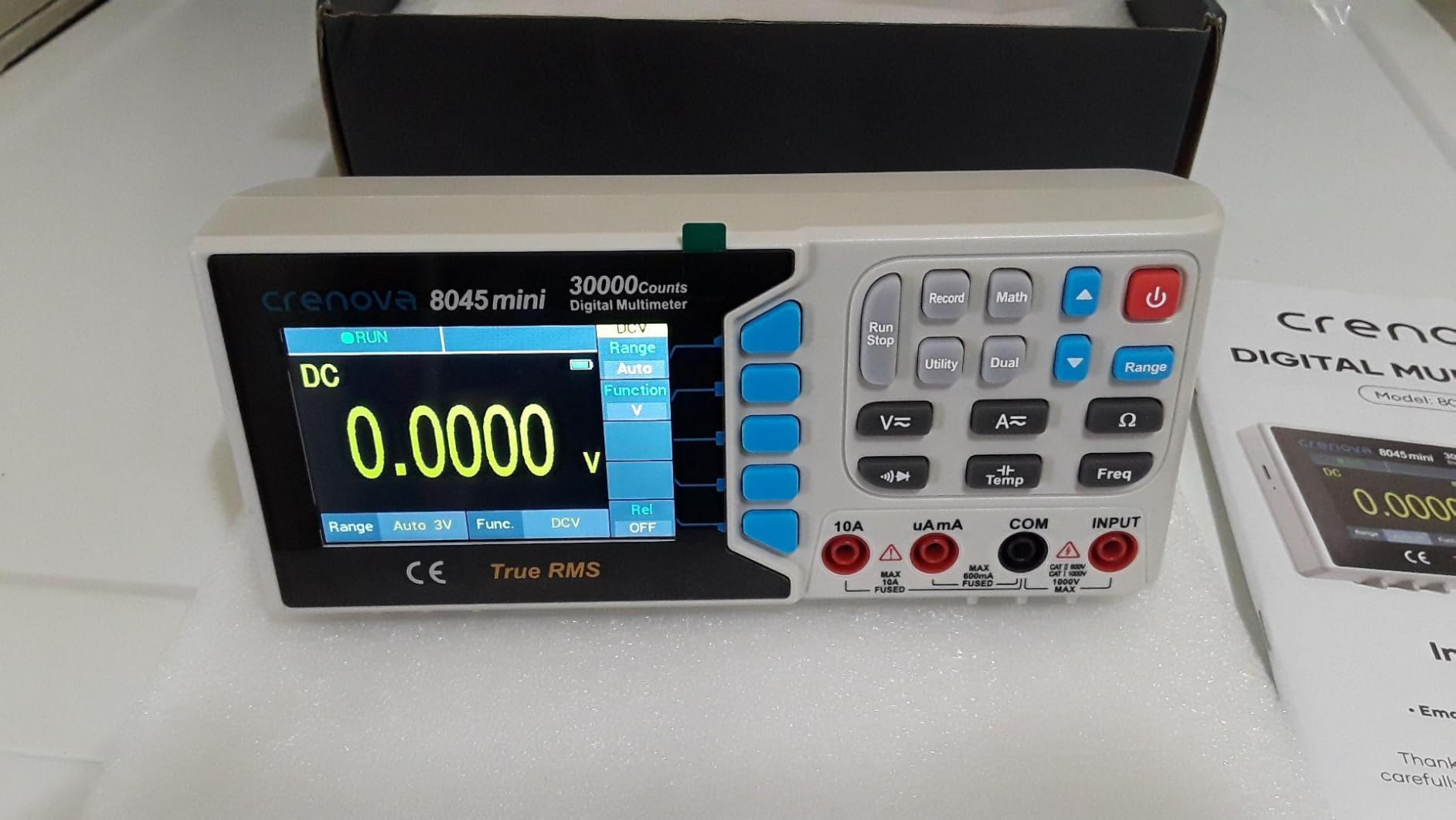
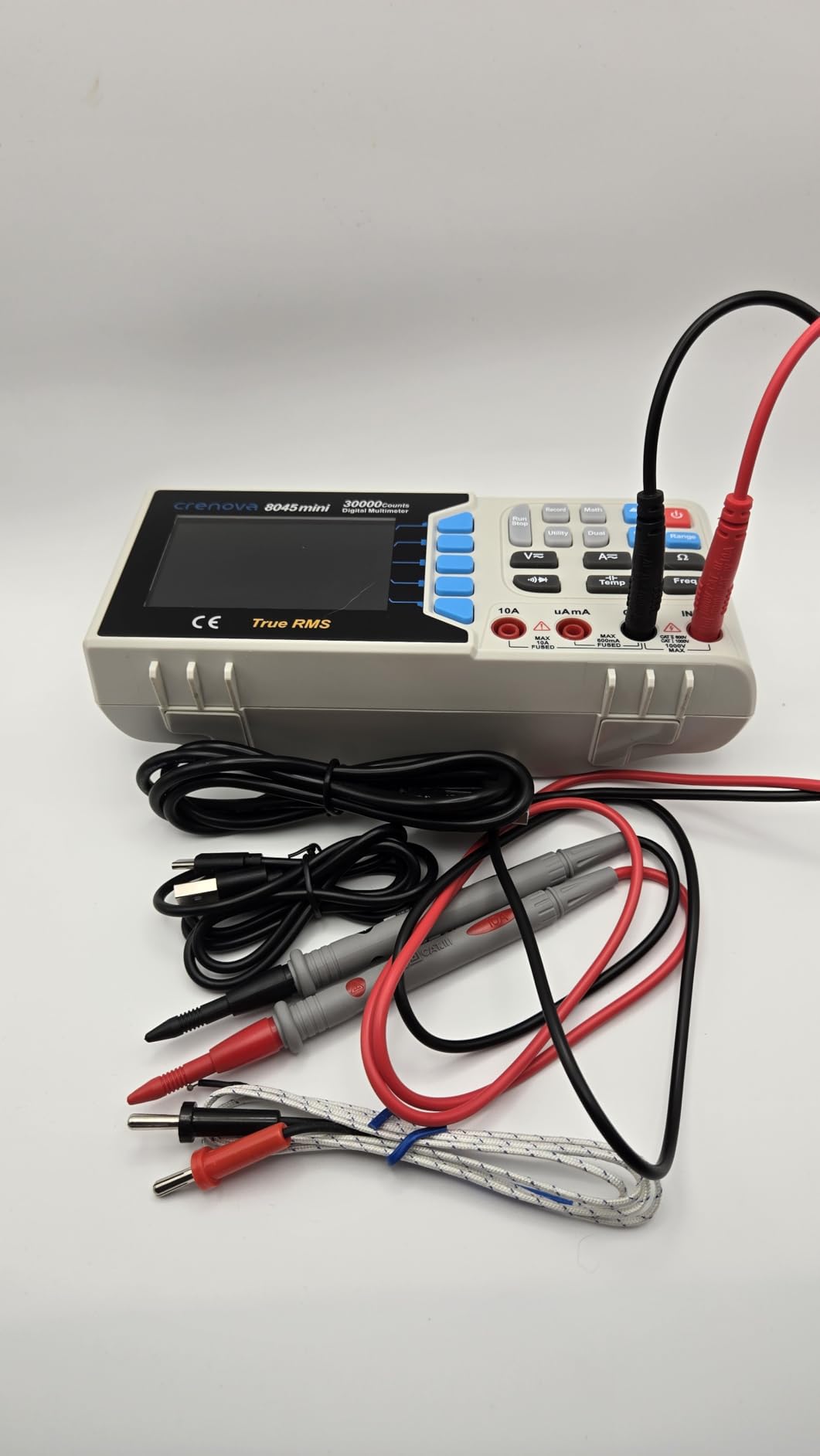
The Crenova 8045 Mini is the one meter here that is genuinely dual-purpose. It sits on the bench, stands upright on its own, and works as a handheld, and that is because of a 5000mAh rechargeable battery that owners report holds a charge for weeks under heavy use rather than the usual single-shift endurance. The complete kit includes leads, a K-type thermocouple, USB cables, a software disc and a manual.
Resolution is 30000 counts on a 3.5 inch LCD with adjustable backlight, which is about half the resolution of the 55000-count models, so it loses the last digit on a 6 V reading. What it gains is range coverage: 11 measurement functions including AC and DC voltage and current, resistance, capacitance, temperature, frequency, duty cycle, continuity and diode, with MAX, MIN, average, dBW/dBmW and relative calculations.
This is also the only meter in the group with a stated safety category, rated CAT I 1000 V and CAT II 600 V with two included fuses, and the only one with a stated operating temperature range of 0 to 40 degrees Celsius. USB handles remote control, firmware updates and data logging to a PC, and the firmware is upgradeable. A two-year warranty is available on activation.
What the battery actually changes
It removes the power cord from your workflow. You can carry the meter to a shelf, a board under a bench, or a machine room and still get true RMS readings, then bring it back and plug it in. That is the one capability none of the other nine in this roundup offers.
USB data logging captures measurements over time without a separate timer, which is the simplest way to record a long test on this list. Readings are reported as consistent and accurate against other meters for general work, and the large, bright display with large numbers is easy to read at a glance.
Where it falls short
There is no official programming documentation, so scripting requires workarounds, and the software does not work on Linux. Both matter if you plan to automate; neither matters if you intend to read the screen and log by hand. One owner returned a unit after an accuracy shortfall against a Fluke 87, so if you are measuring anything tight, check it against a known reference early.
And 30000 counts is the real limitation. On low-voltage work the missing digit is the whole point of this roundup, so treat this as a portable companion meter rather than a precision bench instrument.
How to Choose a Benchtop Multimeter in 2026
Most buyers choose on digit count and end up disappointed, because digit count tells you about resolution and tells you almost nothing about accuracy. These are the criteria that actually change the result of your measurements.
If the bench itself is still being built, our guides to the best benchtop mortisers and best benchtop sanders cover the machine side of a permanent setup, which matters more than most people expect from a bench that has to sit still while you take measurements.
Digit resolution: what 4.5, 5.5 and 6.5 digits actually mean
A digit count is the number of digits the meter can show across its full range, and a half digit is not a fraction of a digit. It is an extra leading digit that can only show 1. So a 4.5-digit meter can read 19999, a 5.5-digit meter 199999, and a 6.5-digit meter 1999999. Resolution on a range is the full-scale value divided by the count.
That is why the 55000-count meters in this roundup are called 4.5 digits. On a 6 V range with 55000 counts, the smallest step is 100 microvolts. On the SDM3065X at 2200000 counts it is 1 microvolt. On a 30000-count meter on the same range, roughly 200 microvolts. Every one of those steps tells you what the last displayed digit is worth.
What you need depends on the measurement. Checking that a 5 V rail is not 4.2 V needs three digits. Watching a 5 V rail droop under load and seeing the exact recovery needs five. Verifying a 2.048 V reference against a spec needs six or more. Paying for resolution you will not use is the most common overspend in this category.
Accuracy: how to read 0.05% plus 5 digits
Accuracy is written as a percentage of reading plus a count of the least significant digits. A spec of 0.05 percent plus 5 digits means: take 0.05 percent of whatever you are measuring, add 5 counts of the last displayed digit, and that total is your worst-case error. Both terms scale down as the reading gets smaller, so accuracy is best in the middle of a range and worse near the bottom.
Worked example: measuring 5.0000 V on a meter with 0.05 percent plus 5 digits at 55000 counts gives 0.0025 V from the percentage and 0.0005 V from the digits, so roughly plus or minus 0.003 V. That is a useful result: the meter is honest about the fourth decimal place being a partial digit.
Resolution is not accuracy. A 6.5-digit meter with 0.05 percent accuracy is not more accurate than a 4.5-digit meter with 0.01 percent accuracy. Digits are what the display can show; accuracy is how much of that you should believe. This distinction is the single most common misunderstanding we found in forum threads, and it is why we weight the printed accuracy spec above the digit count in every ranking here.
True RMS: when it matters and when averaging is fine
True RMS measures the root mean square of a waveform properly, by squaring, averaging and taking the square root. Cheaper meters calculate RMS from an averaged or calibrated reading, which is accurate for a pure sine wave and increasingly wrong as the crest factor of the waveform rises. Crest factor is peak value divided by RMS, and it is high for anything with a narrow spike on a steady body.
Matters: switch-mode power supply output with spikes, mains with distortion, variable frequency drives, audio and any rectangular digital signal. Does not matter much: a clean sine from a function generator, a steady DC rail, or slow-changing analog signals. Most hobby work is in the second group, which is why a lot of people get along fine without true RMS.
All ten meters here offer true RMS AC measurement except that the Crenova 8045 Mini and the OWON models specify it at varying frequency coverage, with the XDM1041 holding its true RMS accuracy mainly from 20 Hz to 1 kHz. Check the frequency range, not just the yes or no.
Computer control, SCPI and data logging
SCPI is a text command set, Standard Commands for Programmable Instruments, that lets software control a meter. It is the reason a benchtop meter is fundamentally different from a handheld, and it is the feature most people in this category underrate.
What it unlocks: logging measurements to a laptop at intervals, running limit tests where the meter reports pass or fail against thresholds you set, sweeping a value and capturing the curve, and integrating a reading into an automated test sequence. The XDM1041 is reported to be recognised immediately by standard VISA drivers, which is the smoothest onboarding we found.
Connectivity options in this group: USB device and USB host for direct computer connection or thumb-drive logging, RS-232 serial for older setups and simple microcontrollers, LAN for bench instruments on a network, and Wi-Fi on a few models not in this roundup. Eight of the ten here provide SCPI over USB. The DM858 has the largest internal logging memory at 500000 points, while the OWON models and the SDM3045X sit at 1000 points of internal storage.
Two cautions. The SCPI documentation quality varies badly: the SDM3065X manual has documented errors and no Local command, and the Crenova has no official programming documentation at all. Check the manual before you buy if automation is the point.
Which brand should you buy?
Brand reputation in this category is real but tier-dependent, and people anchor on it in ways that do not always pay off. Fluke and Keysight carry the most trust for a reason, but neither appears in this roundup, and the models at the top of their ranges cost several times more than everything here for resolution most electronics work never uses.
Siglent is the value leader at the mainstream and precision tiers, and the SDM3045X and SDM3055 are the models most often recommended by experienced owners. Rigol competes directly at the 5.5-digit tier and positions more toward labs and institutions, with the longest warranty here. UNI-T and OWON deliver features per dollar, particularly dual display, true RMS and SCPI at the entry level. B&K Precision is a respected bench name, and Crenova covers the portable-and-bench niche. Labloot is a rebrand of an existing platform rather than a distinct engineering brand.
Our advice is to choose the accuracy class and connectivity you need first, then pick whichever brand in that class has the better documented support in your region. Brand matters less than the accuracy spec and the manual.
Safety and CAT ratings: why most bench meters carry none
A CAT rating tells you what transient overvoltage the meter can survive in a given installation category. CAT I is protected electronics with no mains connection. CAT II is household receptacles and upstream. CAT III is distribution panels and the fixed wiring in a building. CAT IV is the service entrance, where the highest transients appear.
Only one meter in this roundup states a rating, the Crenova 8045 Mini at CAT I 1000 V and CAT II 600 V. That is not an oversight by the other manufacturers; benchtop meters are designed for low-voltage bench accuracy and are generally not rated for mains work. If your work involves opening panels or measuring at the service entrance, use a CAT-rated handheld and keep the bench meter for the bench.
Two more safety points. Never measure resistance or continuity on a live circuit; remove power first. And check your fuse rating before you blow one, because a wrong replacement is how a meter is destroyed and a benchtop is not cheap to replace.
Buying a used benchtop multimeter: what to check on arrival
Used bench meters are a genuinely good value, and community consensus puts a decent secondhand 5.5-digit benchtop at a level well under the new price of the same model. The risk is not that it will be faulty; it is that you will not know for a month. Here is the checklist we would run.
First, power it on and confirm every function responds: DC voltage on all ranges, AC voltage, resistance, continuity, diode and capacitance. A meter that is dead on one function is usually a fuse or a relay, and both are fixable, but you want to know before you commit.
Second, short the leads together and check the resistance reading. It should read very low on a low range, and open on the highest resistance range. A meter that reads high on a short is not trustworthy for resistance work.
Third, check the display for dead segments and the keypad for unresponsive buttons. Fourth, look at the connectors and the case for cracked or discoloured plastic around the mains inlet, and confirm the power cord is undamaged.
Fifth, and most important, check accuracy against something you trust. Even a cheap handheld as a cross-check will tell you if a rail reads sane. If the seller has recent calibration documentation, that is worth a great deal more than the model name.
Finally, ask when it was last used and how. A meter that has been on a production line for a decade has different wear characteristics than one that sat on a shelf, and the date of manufacture tells you whether the caps and relay contacts are likely to be tired.
Frequently Asked Questions
What is the best benchtop multimeter?
The Siglent SDM3045X is the best benchtop multimeter for most electronics work. It combines a dual-line true RMS display, 0.01 percent basic DC accuracy, up to 150 readings per second, and USB host, USB device and LAN interfaces. At the mid-range tier it gives you almost everything a more expensive meter offers.
What is the best multimeter for electronics?
For electronics work generally, the best value is the OWON XDM2041: 55000 counts, true RMS on AC voltage and current, a dual-line display at 65 readings per second, 1000-point internal logging and SCPI over USB. If you want the strongest accuracy at a mainstream price, move up to the Siglent SDM3045X or SDM3055.
What is the best multimeter for fixing electronics?
For repair work the deciding factors are continuity and diode test speed, a readable bench footprint, and enough resolution to read a rail properly. The Siglent SDM3045X covers all three with its dual display, 0.01 percent accuracy and 150 readings per second. For component-level work add an LCR meter, because no benchtop DMM measures capacitance and inductance properly.
Which multimeter brand is considered the best for high quality?
Fluke and Keysight carry the strongest reputation for build quality and metrology, at the top of the price range. Below them, Siglent and Rigol lead on accuracy per dollar, OWON leads on features per dollar, and Bu0026amp;K Precision is a respected bench name. For most electronics work the brand matters less than the printed DC accuracy spec and the quality of the manual.
Which multimeter brand is considered the best?
There is no single best, because the answer is tier-dependent. Fluke and Keysight at the reference and professional tiers, Siglent and Rigol for mainstream and lab value, OWON and UNI-T for entry-level features. Choose the accuracy class and connectivity you need first, then pick the brand with the better support in your region.
Is a cheap multimeter better than an expensive multimeter?
For most hobby work a cheap meter is perfectly adequate, and a 55000-count entry model will read a 5 V rail correctly. For power supply work, low-voltage measurement, or anything you will calibrate against, the more expensive meter is not optional. Just remember that resolution is not accuracy: digits are what the display shows, and the accuracy spec is what you should believe.
Do I need a benchtop multimeter or is a handheld enough?
A handheld is enough for field work and anything mains-related, and you should keep a CAT-rated one for that. Add a benchtop meter when you need to resolve small voltage differences, log measurements over time, or drive readings from a computer. Most electronics hobbyists end up with both, using the handheld for the bench and the benchtop for the measurements that need resolution.
What is the difference between a 4.5 digit and a 6.5 digit multimeter?
A half digit is an extra leading digit that can only display 1, so a 4.5 digit meter reads up to 19999 and a 6.5 digit meter up to 1999999. On a 6 V range that is 1 mV steps versus 1 microvolt steps. In practice the 6.5 digit class resolves changes a 4.5 digit meter rounds away, which matters for reference voltages and low-noise regulators.
Can a benchtop multimeter be controlled by a computer?
Yes, over SCPI. Eight of the ten models here support SCPI over USB, the Siglent SDM3045X and SDM3055 add USB host and LAN, and the Rigol DM3058E adds RS-232 alongside USB and LAN. You can log measurements to intervals, run limit tests, capture curves and automate sequences. Check the manual quality first, since SCPI documentation varies widely.
Are cheap Chinese benchtop multimeters accurate?
Read the printed DC accuracy spec rather than the digit count. The OWON and labloot platforms in this roundup are specified at 0.05 percent DC voltage accuracy with 55000 counts, and owners who calibrate equipment report readings matching published specs. Accuracy holds in the middle of a range and degrades near the bottom, so always verify against a known reference before trusting a new meter.
Our Final Benchtop Multimeter Picks for 2026
The Siglent SDM3045X is our pick for the best benchtop multimeters for electronics in 2026, because it is the only meter in this group that delivers dual-line true RMS, 0.01 percent basic DC accuracy, 150 readings per second and three communication interfaces in one box at a mainstream price. Owners rate it at 4.5 across 190 reviews, the largest evidence base here.
Buy the OWON XDM2041 if you want the most capability per pound, the Siglent SDM3055 if you are chasing the fourth decimal place on a power supply, and the Siglent SDM3065X if you need real reference-grade resolution. Pick the Rigol DM3058E for an institutional lab, the Rigol DM858 if you want a touchscreen and 500000 points of logging memory, and the Crenova 8045 Mini if you need one meter that works on the bench and in your hand.
Keep your CAT-rated handheld whatever you choose, and check any new or used meter against a known reference in its first week. That habit has saved more projects than any spec on this list.