
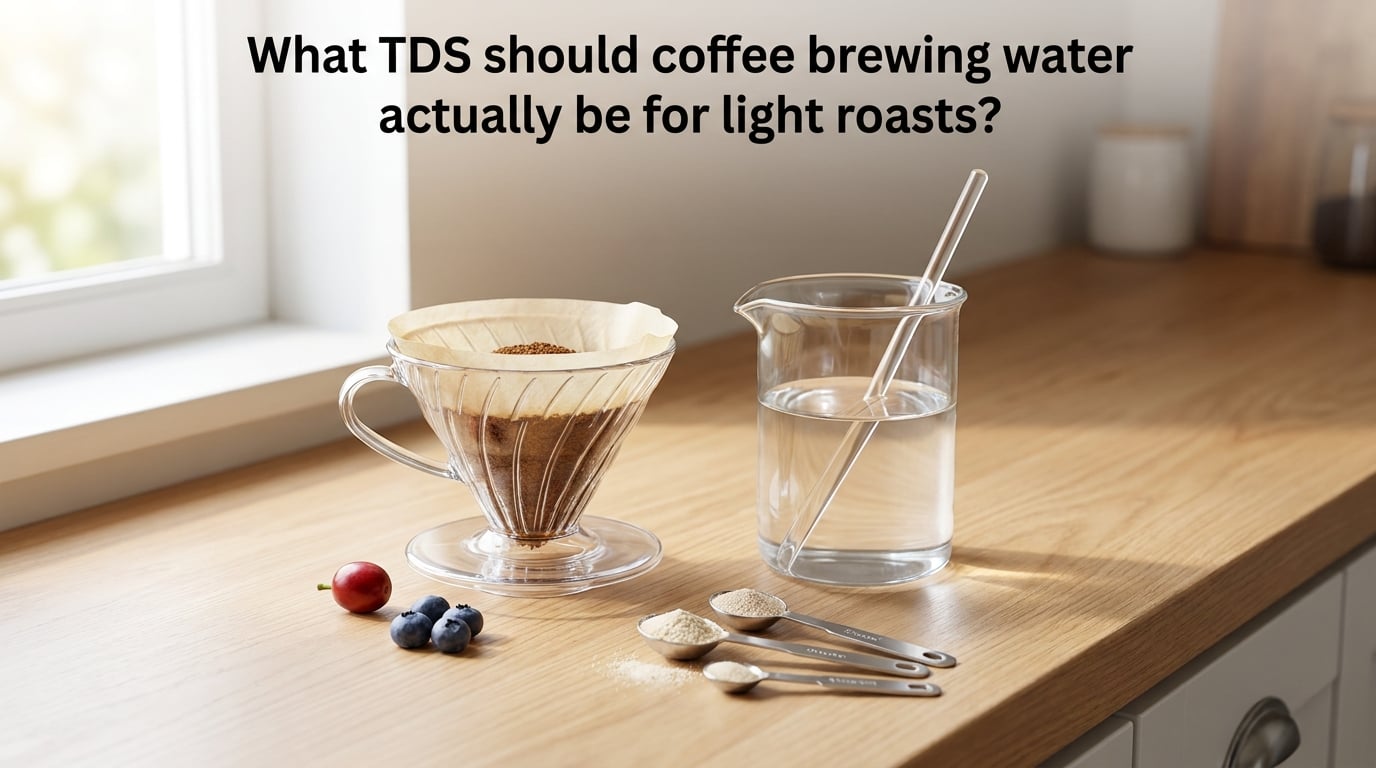
If you are dialing in a light roast, the single most overlooked variable in your brew is your water. The ideal coffee brewing water TDS for light roast coffee sits between 100 and 120 ppm (parts per million), with general hardness around 50 to 80 ppm and alkalinity kept low at 25 to 40 ppm. Get those numbers right and the same beans that tasted sharp or hollow yesterday will suddenly taste juicy, sweet, and balanced.
Our team has tested dozens of light roasts from Ethiopia, Kenya, and Colombia using different water profiles. The change in cup quality when we switched from softened tap water (around 30 ppm, almost no minerals) to a properly mineralized light-roast profile was the biggest single-variable jump we have ever measured on a refractometer. This guide breaks down the science, the numbers, and the practical recipes so you can replicate that jump at home.
You will learn what TDS actually measures, why light roasts demand harder water than dark roasts, how to read alkalinity versus hardness labels, and how to mix your own DIY coffee water using common mineral additions.
Table of Contents
Understanding TDS and What It Means for Coffee Brewing Water
TDS stands for Total Dissolved Solids, and it is simply a measurement of everything dissolved in your water, expressed in parts per million (ppm). For coffee, TDS acts as the carrier for every flavor compound extracted from your grounds. When TDS is too low, water behaves almost like a blank slate and pulls compounds unevenly, often over-extracting bitter notes while leaving sweetness behind. When TDS is too high, water cannot pull enough flavor and the cup tastes muted or flat.
The Specialty Coffee Association (SCA) recommends a brewing water TDS of 120 to 150 ppm with an alkalinity of 40 to 75 ppm. That range works well for most medium and medium-dark roasts because it gives the extraction enough mineral scaffolding without overwhelming the bean. Light roasts are different. They are denser, more soluble at certain compounds, and packed with delicate floral and fruit acids that get crushed by high-alkalinity water.
How TDS Interacts with Extraction
Calcium and magnesium ions in your water help pull flavor compounds out of coffee grounds more efficiently. Without enough of these ions, water extracts unevenly, leaving you with sour or thin cups even when your grind, dose, and time are dialed in. Most home brewers chasing sour shots and bright pourovers are actually dealing with under-mineralized water rather than bad beans.
The Ideal TDS Range for Light Roast Coffee
For light roast filter coffee, target a brewing water TDS of 100 to 120 ppm. This sits slightly below the SCA general recommendation because light roasts bring more acidity and complexity of their own. Harder water in the 130 to 150 ppm range works fine for dark roasts but tends to mute the delicate top notes in a washed Ethiopian or a fruity Kenyan.
In our testing, brews made with water at 75 ppm or below produced sharp, almost metallic cups with hollow finishes. Water at 95 ppm brought out sweetness but still left the cup feeling thin. Once we crossed 100 ppm and dialed in around 110 ppm, the same light roast showed stone fruit, jasmine, and a syrupy body that the lower-TDS profiles could not deliver.
Why This Range Works Differently for Light vs Dark Roasts
Dark roasts are less dense, more soluble, and lower in acidity. They benefit from softer water (40 to 75 ppm) because they bring most of the body and sweetness on their own and just need clean water to deliver it. Light roasts need mineral support to fully express their complexity. The contrast principle here is simple: pair bright coffees with more minerals, and pair heavy coffees with fewer minerals.
Why Light Roasts Need Harder Water: The Mineral Breakdown
Hard water for coffee is not the enemy, despite what you may have heard from kitchen appliances. Hard water means your water contains measurable calcium and magnesium, the two minerals that drive extraction in filter brewing. For light roasts, you want general hardness (GH) of 50 to 80 ppm and alkalinity (KH) held low at 25 to 40 ppm.
Calcium is the primary extraction driver. It binds to negatively charged flavor compounds in coffee and helps pull them into solution. Magnesium does the same thing but tends to highlight brighter, more acidic notes. A 2:1 calcium-to-magnesium ratio is a common starting point that works well across most light roast origins.
The Contrast Principle in Practice
Think of brewing like seasoning a dish. A delicate piece of fish needs less salt than a thick steak. A light, acidic coffee needs less alkalinity buffering than a heavy, bitter one. When you pair a light roast with high-alkalinity water, you are essentially over-seasoning it, and the brightness gets buried. Pair it with low-alkalinity, moderately hard water, and the natural acidity pops without becoming sharp.
Why Soft Water Fails with Light Roasts
Soft water (under 50 ppm total hardness) lacks the mineral scaffolding to extract evenly from dense light roast grounds. The result is a cup that tastes sharp, sometimes metallic, and almost always thin. Reverse osmosis water and many distilled waters fall into this category. They need remineralization before they are usable for specialty coffee.
Alkalinity vs Hardness: Clearing Up the Confusion
Alkalinity (often labeled KH or carbonate hardness) measures your water’s ability to neutralize acid. It is driven by bicarbonate and carbonate ions. Hardness (GH or general hardness) measures calcium and magnesium. They are related but not the same thing, and for light roasts, the difference matters a lot.
Alkalinity buffers pH changes during brewing. High alkalinity water will neutralize the bright acids in your light roast, leaving you with a flat, dull cup even if your hardness is dialed in. Low alkalinity water lets those acids shine through. For light roasts, you want enough hardness to drive extraction (50 to 80 ppm GH) but low enough alkalinity to preserve acidity (25 to 40 ppm KH).
How to Read a Water Report
Most municipal water reports list both hardness (as CaCO3) and alkalinity. Bottled mineral waters often list TDS, calcium, magnesium, and bicarbonate separately. To convert bicarbonate readings to KH, multiply by 0.82. Most home brewing apps like the Rao/Peger calculator handle these conversions automatically.
DIY Coffee Water Recipes for Light Roasts
The three most popular DIY coffee water recipes for light roasts are the Rao/Peger formula, the Barista Hustle recipe, and the Apax Lab light roast profile. Each takes a different approach but all aim for a similar balance: enough hardness to extract, low enough alkalinity to preserve brightness.
Rao/Peger Water Recipe
Scott Rao’s recipe, refined with Mark Heggers and Lance Hedrick, uses distilled water plus measured additions of magnesium sulfate (Epsom salt), calcium chloride, and a small amount of sodium bicarbonate. For a light roast profile, the target is roughly 100 ppm TDS with about 60 ppm GH and 30 ppm KH. The full recipe is published free on the Rao/Peger site and includes dilution ratios for any batch size.
Barista Hustle Recipe
Barista Hustle’s recipe focuses on magnesium chloride and calcium chloride, omitting bicarbonate entirely for very low alkalinity. This produces a clean, bright cup that works exceptionally well for Nordic-style light roasts. Target TDS is around 100 ppm with hardness near 70 ppm and alkalinity near zero.
Apax Lab Light Roast Formula
Apax Lab’s recommendation for light roasts targets 100 to 120 ppm TDS with GH of about 60 ppm and KH of about 35 ppm. Their published light roast formula uses small additions of magnesium sulfate and potassium bicarbonate to reach the target while keeping alkalinity moderate.
Simple Distilled Water Approach
If you do not want to buy multiple mineral salts, the simplest DIY coffee water starts with distilled or reverse osmosis water and adds a measured amount of Third Wave Water Classic or Light Roast packets. The Light Roast packets are specifically designed for lower alkalinity and work well with Nordic and filter light roasts. For best results, test your starting water and adjust from there.
Practical Brewing Parameters for Light Roast Coffee
Once your water is dialed in, the rest of your brew parameters matter too. For light roast filter coffee, brew with water at 93 to 96C (200 to 205F). Use a coffee-to-water ratio of 1:15 to 1:17 by weight, depending on how concentrated you want the cup. Aim for a total brew time of 2:30 to 3:30 for most V60 and pour-over setups.
Grind slightly finer than you would for a medium roast at the same dose. Light roasts are denser and need more surface contact to extract properly. We typically grind about 5 to 10 percent finer than our baseline medium roast setting when switching to a light roast at the same ratio.
Why Water Is Half the Equation
Coffee is roughly 98 percent water by weight. Every gram of dissolved coffee in your cup is suspended in 18 to 25 grams of water. That means the mineral profile of your brewing water has a larger impact on final flavor than your grinder, your kettle, or your dripper in many cases. Dialing in TDS, GH, and KH is the highest-leverage upgrade you can make to your pourover setup.
Frequently asked questions
How hot should water be for light roast coffee?
For light roast filter coffee, brew between 93 and 96 degrees Celsius (200 to 205 degrees Fahrenheit). This hotter range helps compensate for the higher density of light roast grounds and supports proper extraction without overdoing bitterness.
What is the ideal TDS for coffee brewing water?
The Specialty Coffee Association recommends 120 to 150 ppm TDS for general brewing. For light roasts specifically, target 100 to 120 ppm with general hardness of 50 to 80 ppm and alkalinity of 25 to 40 ppm. This lower alkalinity preserves acidity while the hardness drives extraction.
What is the 15 15 15 rule for coffee?
The 15 15 15 rule refers to a 1:15 coffee-to-water ratio with a 15-second bloom pour. It is a simple starting point for filter coffee that produces a balanced, approachable cup. For light roasts, many brewers adjust to 1:16 or 1:17 to highlight delicate flavors.
What is the ratio of coffee to water for light roast coffee?
For light roast filter coffee, use a 1:15 to 1:17 ratio of coffee to water by weight. Lighter ratios like 1:16 or 1:17 highlight delicate floral and fruit notes, while 1:15 gives a fuller body. Start at 1:16 and adjust based on taste.
Final Thoughts on Coffee Brewing Water TDS for Light Roast
For light roast coffee in 2026, the right coffee brewing water TDS is between 100 and 120 ppm, with general hardness around 50 to 80 ppm and alkalinity held low at 25 to 40 ppm. That combination lets the bean’s natural acidity come through while giving calcium and magnesium enough presence to drive proper extraction. Start with distilled or low-mineral bottled water and build up using a tested recipe like Rao/Peger, Barista Hustle, or Apax Lab, then adjust by taste from there.
Track your TDS with a cheap ppm meter and your KH and GH with aquarium-style drop tests. After a few batches you will start to taste what each mineral does, and dialing in new origins becomes much faster. Water is the most underrated lever in light roast brewing, and once you tune it, everything else gets easier.