
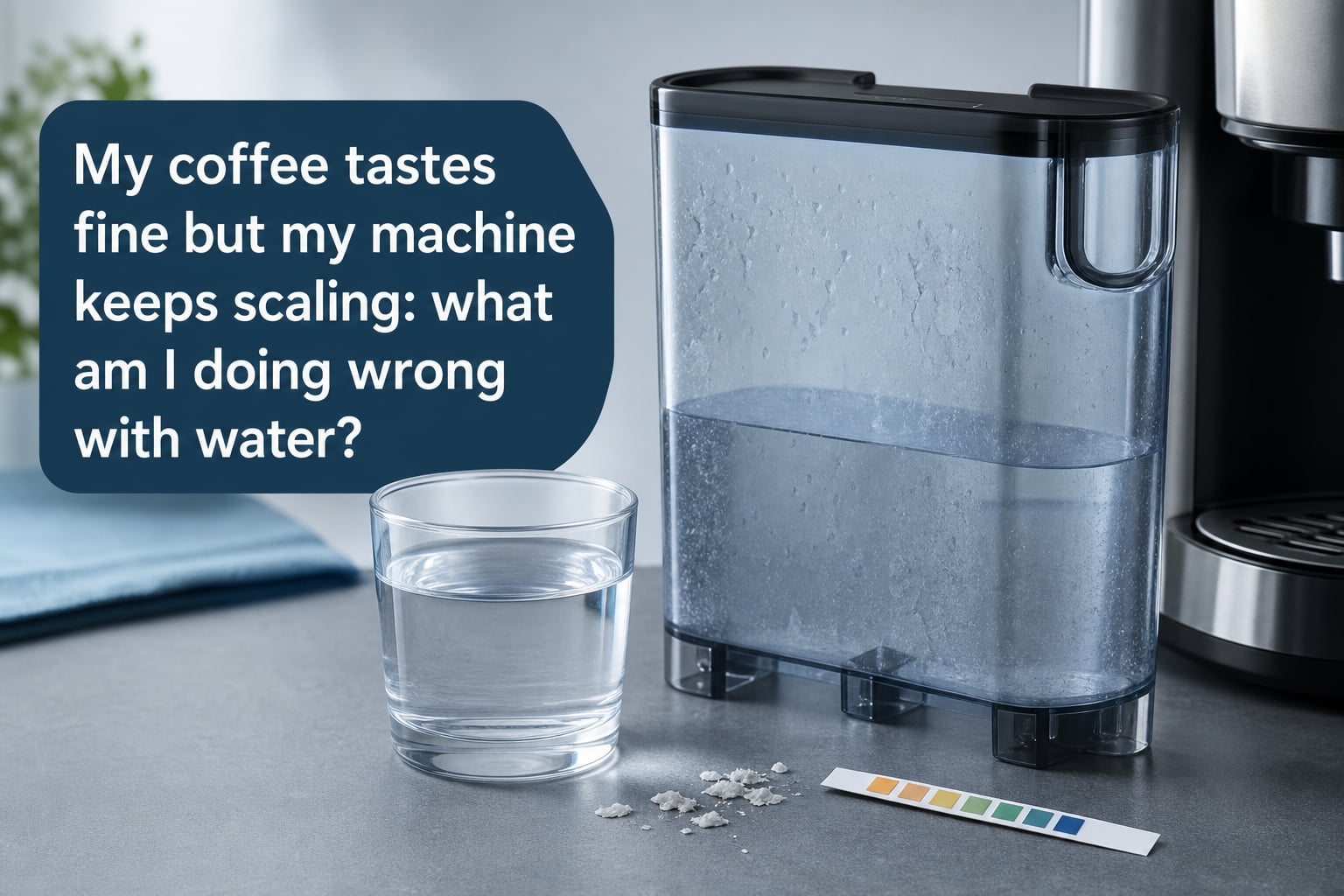
Your coffee can taste perfectly good while your machine is building scale because coffee flavor and machine safety are not the same water-quality test. Coffee machine scaling water quality comes down to what heat does to dissolved calcium, magnesium, and bicarbonates: they may support a pleasant extraction in the cup, then become mineral deposits on a hot heating element or boiler.
In practical terms, you are probably not doing anything wrong with brewing. You are using water that has enough hardness to leave limescale behind, and the taste problem may not appear until the deposits begin slowing flow, lowering brew temperature, or changing the way the machine works.
The useful first move is to measure hardness rather than judging water by taste, clarity, or a TDS meter alone. Then choose a water approach that matches both your machine manual and your test result, and descale any existing buildup using the manufacturer’s approved method.
Table of Contents
Coffee machine scaling and water quality can conflict even when coffee tastes good
Coffee tastes good with hard water when its minerals help extraction without pushing the cup into an obvious defect. Calcium and magnesium can interact with coffee compounds, while bicarbonates contribute alkalinity and can soften perceived acidity; neither effect tells you whether minerals will plate out inside a hot machine.
Scale is a physical maintenance problem that develops out of sight. Water runs through narrow passages, valves, a boiler, and the heating element, so even a thin coating can matter long before a drinker notices a flavor change.
This explains the frustrating pattern many home brewers report: the espresso or drip coffee is acceptable, but the descale alert returns early or water flow changes. The machine experiences repeated heating and evaporation cycles, while you taste only the final brewed water after a short contact time with coffee.
Taste is an immediate sensory result, while scale is a cumulative deposit
A good cup is the result of a particular brew: coffee dose, grind, contact time, temperature, and the water’s mineral balance. Scale is the accumulated result of every reservoir refill and every heating cycle, so it can advance quietly over weeks or months.
High bicarbonate alkalinity can also mute bright acids and make a coffee seem smooth or less sharp. That does not mean the water is gentle on equipment; bicarbonate-related temporary hardness is one common route to calcium carbonate precipitation when water is heated.
There is a second delayed effect. As scale insulates a heating element or constricts a path, the machine may heat less effectively or dispense less consistently, and then the cup can become sour from cooler water or under-extraction.
Limescale forms when heated hard water leaves calcium carbonate behind
Limescale is the hard, chalky deposit left when minerals dissolved in hard water come out of solution during heating. In coffee equipment, calcium carbonate is the usual concern, although magnesium and other mineral compounds can be part of the deposit.
Hardness refers mainly to dissolved calcium and magnesium. When water containing those ions and bicarbonates is heated, the chemical balance shifts, carbon dioxide can leave the water, and less-soluble carbonate material can precipitate onto the hottest available surface.
That is why a kettle, steam boiler, thermoblock, heating element, and small water passages are common trouble spots. Heat does not create minerals; it concentrates the problem by encouraging them to leave the water and stick to the machine.
Temporary hardness is the scale risk most linked to heated water
Temporary hardness is hardness associated with bicarbonates and can be reduced by boiling because heating encourages carbonate deposits to form. It is called temporary because that heating changes the chemistry, not because the resulting scale disappears on its own.
Permanent hardness comes from calcium or magnesium paired with other dissolved ions and does not simply boil away. Both categories matter when choosing water treatment, but a hardness reading alone may not reveal the whole mineral profile.
For that reason, a municipal water report can be useful alongside a home test. It may show hardness, alkalinity, calcium, magnesium, and the units used, which gives a better picture of what your machine receives.
Scale first hurts heat transfer and flow
Mineral deposits act as insulation on a heating surface. The machine has to work harder to move heat into water, and its temperature behavior can become less predictable.
Deposits can also narrow internal routes and interfere with valves. Slow dispensing, weaker steam, unusual pump noise, or a machine that struggles to reach normal output are maintenance signals, even if the coffee has not yet become bitter or bland.
Community discussions reflect this progression. Some people in notably hard-water areas describe monthly descaling, while owners of machines with accessible boilers report that heavy buildup can remain serious enough to require a teardown.
Water hardness numbers tell you how urgent the problem is
Water hardness is commonly reported as ppm, meaning parts per million, expressed as calcium carbonate, or as gpg, meaning grains per gallon. As a rough conversion, 1 gpg is about 17.1 ppm as calcium carbonate.
There is no single magic number for every coffee machine and every coffee style. Still, water around 50–70 ppm hardness is a sensible middle ground often discussed for coffee, because it leaves some minerals for extraction while keeping scale pressure lower than clearly hard water.
- Below about 35 ppm: scale risk is lower, but very low-mineral water can brew differently and may not match every manufacturer’s requirement.
- About 35–85 ppm: a commonly discussed workable zone for balancing extraction and machine care.
- Above 100 ppm: scale becomes a more immediate planning issue, especially with frequent espresso or steam use.
- 20 gpg: about 342 ppm, which is very hard water and calls for a serious prevention plan.
These bands are not a substitute for the manual. Some manufacturers specify a compatible filter, a hardness setting for the descale reminder, or a prohibited water type, and those instructions matter for both performance and warranty support.
TDS is useful context but not a hardness test
TDS means total dissolved solids, and a TDS meter estimates the overall electrical conductivity of water. It can show that water has dissolved material, but it cannot tell you which minerals are present or how much of the reading is calcium and magnesium hardness.
Two waters can have a similar TDS reading and behave very differently in a boiler. One may contain a scale-forming calcium and bicarbonate mix, while another may contain minerals that contribute to conductivity but do not indicate the same scaling risk.
Use TDS to track consistency if you like, particularly after reverse osmosis and remineralization. Use a hardness strip, drop titration, laboratory report, or water-provider data to answer the scale question.
Testing your water at home identifies the right fix
The best test is the one that gives you a usable hardness number and that you can repeat after changing filters or moving home. Start with your tap water, because that is the baseline your machine has been seeing.
Step 1: Check the local water report before buying anything
Look for a current municipal water-quality report and search for total hardness, calcium hardness, alkalinity, calcium, magnesium, and units such as ppm, mg/L, or gpg. If hardness is expressed as mg/L calcium carbonate, it is generally equivalent to ppm for this purpose.
A citywide report is an average, so it may not match every neighborhood or seasonal change. It remains a helpful first signal, particularly if it already shows water over 100 ppm or a result in the very-hard range.
Step 2: Use strips for a quick screen and drop titration for a clearer number
Hardness test strips are fast and practical for identifying whether you are in a low, moderate, or high range. Follow the timing on the strip package exactly, compare it under neutral light, and repeat the test once if the color falls between bands.
A drop-count hardness kit takes longer but often gives a more precise result. Add the reagent according to its instructions until the color changes, then convert the number of drops into the supplied ppm or gpg value.
Test cold water straight from the tap after letting it run briefly, rather than water that has sat in the machine reservoir. Reservoir water can be warmer, more concentrated, or affected by a filter already inside the machine.
Step 3: Test after the treatment point, not just at the tap
If you use a pitcher filter, an in-tank filter, a softener, or reverse osmosis, test the water after that treatment. A filter that improves taste may not reduce hardness enough to change the scaling pattern, and a depleted filter can stop performing as expected.
Write down the date, source, hardness reading, and whether the water passed through a filter. This small record makes it much easier to see whether an early descale alert followed a water change, a filter change, or unusually heavy machine use.
Step 4: Set the machine’s hardness setting honestly
Many automatic coffee machines ask for a water-hardness setting so they can estimate when descaling is due. Set it from your measured result rather than guessing from taste; choosing a softer setting than reality can delay the reminder when the machine needs attention.
If your manual gives a strip-to-setting chart, use that chart even when its terms differ from your test kit. The setting is an estimate, not a sensor that can see deposits, so watch actual flow and heating behavior as well.
Reducing scale requires treating water before it enters the machine
Descaling can remove some existing deposits, but the lasting solution is to change the water entering the reservoir. Choose the least complicated method that brings your hardness into a machine-friendly range and that you can keep using consistently.
Filtration works when the filter is designed to reduce hardness
Not every water filter is a softener. Carbon filtration can improve chlorine-related taste and odor, but it may have little effect on calcium and magnesium hardness unless the cartridge also uses a hardness-reduction medium.
Check what the filter is designed to reduce and replace it on schedule. If the system uses ion exchange, it exchanges hardness ions for other ions; it can reduce scale risk, but the resulting water chemistry still has to suit coffee and the machine maker’s directions.
Bottled water can work when its mineral analysis matches the goal
Bottled water is convenient for a small-volume routine, but the label must show more than a pleasing source name. Look for a published mineral analysis or hardness figure, because many natural mineral waters are high in dissolved minerals and may be poor choices for a scale-sensitive boiler.
Consistency is the practical advantage: the same water should give the same machine setting and a more predictable descale schedule. The limitation is that mineral content can vary by brand and source, so do not assume all bottled water is soft.
Reverse osmosis needs remineralization, not blind use
Reverse osmosis can remove a large share of dissolved minerals, including those that cause hardness. Water produced this way is often too low in minerals to treat as an automatic coffee-water solution, because coffee flavor, corrosion considerations, and manufacturer requirements still matter.
If you use RO water, follow a measured remineralization plan compatible with your equipment rather than improvising. The goal is controlled mineral content, not water with no minerals at all.
Blending gives you control when you have reliable measurements
Blending a harder source with low-mineral water can lower hardness without removing every mineral. It works only when you measure both sources and keep the ratio consistent; otherwise you may replace one guess with another.
For example, if one source tests clearly hard and the other is low in hardness, a measured blend can be retested before it reaches the machine. Record the final hardness result, not just the mixing ratio, because the source water can change.
Whole-home soft water needs a coffee-specific check
A household water softener can reduce calcium and magnesium through ion exchange, but softened water is not automatically the best brewing water. It may have a different sodium content and alkalinity profile, and the coffee can taste flat or the machine guidance may call for another option.
Test the softened supply and check the machine manual. In some homes, treating only the coffee water with a purpose-made approach is easier to control than assuming the whole-home system has solved every coffee-water issue.
A simple prevention plan beats chasing the descale alert
- Measure your current hardness and set the machine to that result.
- Pick one repeatable water source or treatment method.
- Test water after a new filter, a move, or a change in municipal supply.
- Use the manufacturer-approved descaler when the schedule or symptoms call for it.
- Recheck flow, brew temperature behavior, and steam performance after maintenance.
This approach addresses the forum frustration of descaling again and again without knowing why. A monthly descaling habit may be understandable in a very hard-water location, but ongoing scale means the water source still needs attention.
Descaling removes existing deposits but does not solve hard water
Descaling is the controlled removal of mineral deposits using the product and procedure specified by your coffee-machine manufacturer. It helps restore water flow and heat transfer, but it does not change the hardness of the next reservoir of untreated water.
Descale when the machine requests it and sooner if you see slower output, weak steam, a change in normal heating behavior, or persistent deposits in accessible water-contact areas. A descale cycle cannot repair every severe blockage, so do not wait for a major loss of flow.
Use the manual’s product and sequence
Machines vary in materials, sensors, water paths, and automatic rinse steps. Follow the manual’s dilution, contact time, rinse volume, and filter instructions, and remove or bypass a filter only when the manual says to do so.
Avoid household acids or improvised mixtures unless your machine maker specifically approves them. Strong or unsuitable acids can damage materials, leave residues, or create a false sense that a difficult scale problem has been resolved.
Frequency depends on hardness and use, not a calendar alone
A high-use espresso machine in hard water heats far more mineral-bearing water than an occasional drip brewer using moderate water. That is why a fixed schedule can be either excessive or too late; use the hardness setting, the manual, and the machine’s actual behavior together.
One useful observation from experienced users is that scale can produce cooler brewing temperatures, followed by sour espresso. If a normal recipe suddenly tastes under-extracted and output has slowed, investigate water flow and maintenance before changing every coffee variable.
Frequently asked questions
What causes scaling in espresso machines?
Scaling occurs when hard water is heated inside an espresso machine. Calcium and magnesium, especially in water with bicarbonates, can precipitate as calcium carbonate and stick to boilers, heating elements, valves, and narrow water paths. Coffee can still taste good because flavor and scale buildup are separate effects of the same water.
How often should I descale my coffee machine in a hard water area?
Follow the machine’s hardness setting and manufacturer schedule, then act sooner for slow flow, weak steam, or heating changes. In very hard-water areas, frequent descaling may be needed, but the better long-term response is to reduce hardness before the water enters the reservoir.
Will hard water ruin my coffee maker?
Hard water can shorten a coffee maker’s useful life when scale insulates heating elements, restricts water paths, and interferes with valves. Regular descaling can remove deposits, but untreated hard water keeps producing them, so testing and water treatment are the more durable protection.
How do I reduce water hardness for coffee machines?
Start by measuring hardness with a local report, strips, or a drop kit. Then use a hardness-reducing filter, appropriately analyzed bottled water, or reverse osmosis water with measured remineralization, and test the water after treatment before setting the machine’s hardness level.
Does descaling a coffee machine make coffee taste better?
It can, especially if scale has reduced brew temperature or water flow and caused under-extraction. Descaling does not automatically improve a good-tasting cup, though, and it will not prevent new deposits unless you also address the hardness of the incoming water.
Good-tasting coffee can still hide a scaling problem
If your coffee tastes fine but the machine keeps scaling, the missing step is not necessarily a different bean, recipe, or grind. It is a water-hardness measurement and a prevention plan based on that result.
Test the water at the point it enters the reservoir, use a treatment method that actually reduces scale risk without stripping water blindly, and descale by the manual. That sequence protects coffee quality and turns coffee machine scaling water quality from a recurring surprise into a manageable maintenance routine in 2026.