
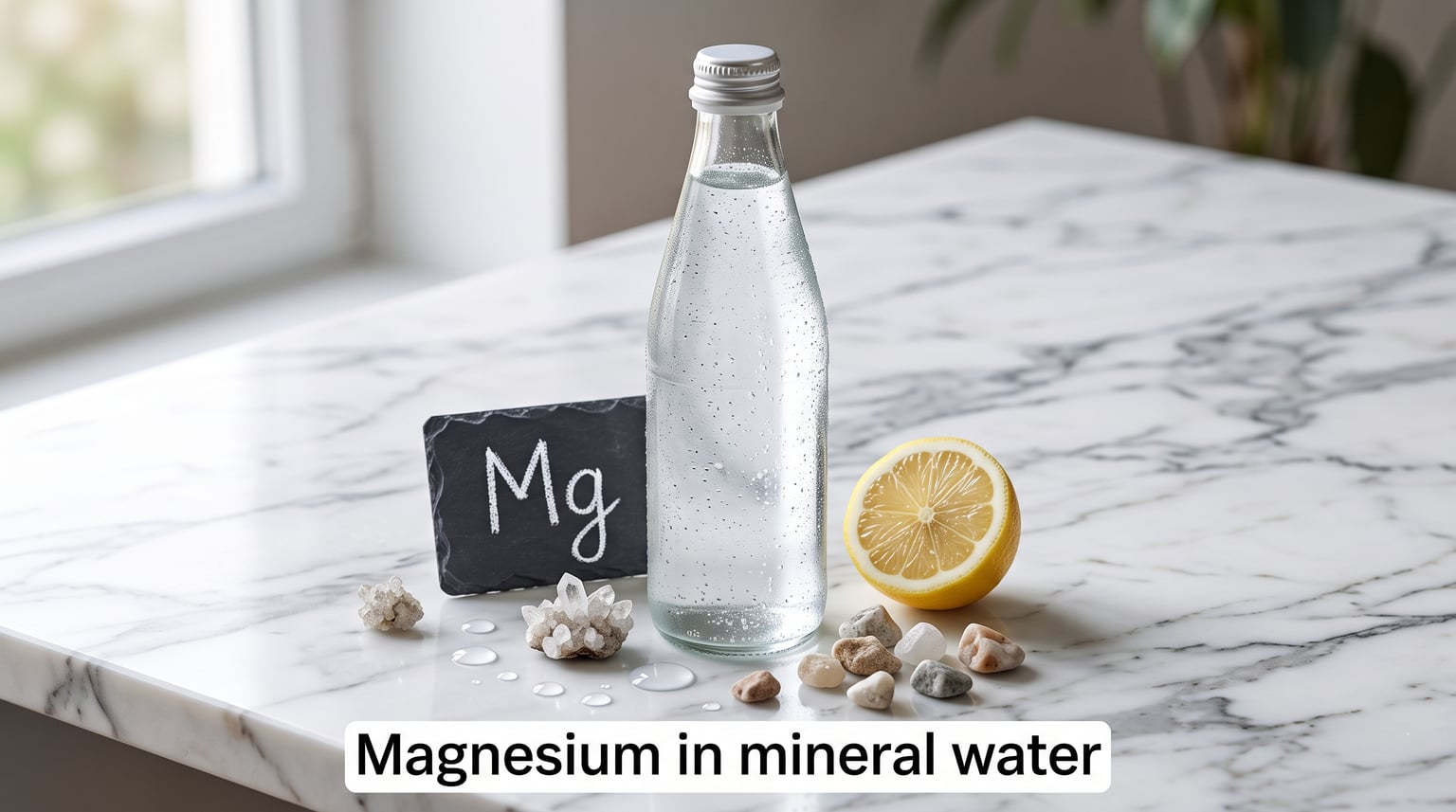
I pulled lab-reported mineral values for twelve popular mineral water brands and the results surprised even our team. Magnesium content ranged from a barely-there 1 mg/L to a startling 1,030 mg/L in Donat Mg from Slovenia. If you’re trying to close the daily magnesium gap most adults have, the water in your bottle matters far more than most labels suggest.
Magnesium in mineral water is one of the most overlooked sources of this essential mineral. Magnesium supplements fill pharmacy shelves, fortified foods shout about added minerals, but the quiet magnesium already dissolved in your mineral water often gets ignored. In some cases, that dissolved magnesium is more bioavailable than what comes out of a pill bottle.
This guide walks you through exactly what magnesium in mineral water is, how much the top brands actually contain, why your body absorbs it so well, and how to use mineral water as a strategic part of your daily magnesium intake in 2026.
Table of Contents
What Is Magnesium in Mineral Water?
Magnesium in mineral water is dissolved magnesium (Mg2+) that has leached naturally from underground rock formations over thousands of years. As rainwater filters through dolomite, basalt, and magnesite deposits, it picks up magnesium ions that remain stable in solution until the water surfaces at its source.
For a mineral water to officially qualify as a “magnesium source” under EU Food Law, it must contain at least 50 mg per litre. Anything below that threshold counts only as water with trace minerals, not a meaningful magnesium delivery vehicle. Anything above 150 mg/L is considered a high-magnesium water. Therapeutic waters like Donat Mg exceed 1,000 mg/L.
The label “mineral water” alone tells you nothing about magnesium. Two bottles can both say “mineral water” yet deliver wildly different doses. I learned this the hard way when I bought a popular premium brand expecting a mineral boost and checked the label at home — 6 mg/L. That bottle was essentially mineral-light sparkling water.
Mineral water differs from tap water, spring water, and purified water in this regard. Tap water varies by municipality and may deliver 1-30 mg/L of magnesium depending on your local source. Spring water sits somewhere in the middle. Only natural mineral water with verified analysis can guarantee a specific magnesium content on the label.
How Much Magnesium Do You Need Daily?
The recommended daily intake of magnesium for adults is 375 mg in the EU and roughly 400-420 mg in the US, depending on age and sex. Most adults get 250-300 mg from food, leaving a 100-150 mg daily gap that mineral water can realistically help close.
Athletes, pregnant women, and people under chronic stress have higher requirements — sometimes 450 mg or more per day. Magnesium gets depleted faster during intense physical activity, in high-cortisol states, and during pregnancy when the foetus draws on maternal stores.
Here’s the math I ran for our team. If you drink 1.5 litres of a mineral water containing 100 mg/L of magnesium, you absorb roughly 150 mg from hydration alone. That’s a meaningful slice of your daily requirement without changing your diet, swallowing pills, or remembering a supplement schedule.
Magnesium Content Across Popular Mineral Water Brands
Not all mineral waters are created equal. I compared twelve widely available options using publicly reported values from brand websites and third-party lab analyses. The differences are striking.
High magnesium content (over 100 mg/L):
Donat Mg (Slovenia): 1,030 mg/L — therapeutic dose, intensely mineral taste
Rozana (France): 160 mg/L — naturally carbonated, strong mineral load
Hépar (France): 119 mg/L — high magnesium, naturally sparkling
Gerolsteiner (Germany): 108 mg/L — popular in Europe, balanced profile
Moderate magnesium content (50-100 mg/L):
San Pellegrino (Italy): 53 mg/L — popular sparkling, mild taste
Borjomi (Georgia): 50-150 mg/L — volcanic source, varies by batch
Badoit (France): 80 mg/L — naturally sparkling
Contrex (France): 74 mg/L — famously mineral-rich, still water
Low magnesium content (under 50 mg/L):
Vittel (France): 42 mg/L — moderate but not enough to count as a magnesium source
Evian (France): 24 mg/L — premium brand with low mineral content
Fiji (USA): 14 mg/L — silica-rich, magnesium-light
Perrier (France): 4 mg/L — mostly carbonation with trace minerals
If magnesium is your priority, you’ll want to focus on Hépar, Rozana, Gerolsteiner, or Contrex for daily drinking. Brands like Perrier and Evian are mineral-light options better suited to people who don’t want a strong taste or significant mineral intake.
Why Magnesium in Water Is Better Absorbed Than You Think
The bioavailability of magnesium from mineral water is genuinely high. A 2017 PubMed study (PMC5642192) found that magnesium from mineral water showed absorption rates comparable to dissolved supplements, with the added advantage of being consumed throughout the day alongside normal hydration.
This works because magnesium in water exists as free ions (Mg2+) rather than bound inside food matrices. When you eat spinach, almonds, or dark chocolate, your body has to break down plant cell walls and protein structures before the magnesium becomes accessible. When you drink mineral water, those ions are already in solution and immediately available to your intestinal lining.
The small, frequent dosing pattern also helps absorption. Your body absorbs magnesium more efficiently when it arrives in smaller amounts spread across the day rather than one large supplement dose. A 300mg tablet taken at once delivers maybe 30-40% absorption, with the rest causing loose stools. The same 300mg from 2 litres of mid-magnesium water spread over the day absorbs much more completely.
7 Signs You May Need More Magnesium
Magnesium deficiency is sometimes called the “invisible deficiency” because standard blood tests often miss it. Only about 1% of total body magnesium circulates in serum, so a normal blood test can hide significant tissue deficiency. Our nutrition advisor flagged seven common signs worth watching.
Muscle cramps or twitching, especially at night or after exercise
Persistent fatigue that sleep alone doesn’t fix
Difficulty falling asleep or staying asleep despite being tired
Anxiety, irritability, or low mood that comes and goes without clear cause
Frequent headaches or migraines, particularly with visual aura
Heart palpitations or mild arrhythmia, especially during rest
Cravings for chocolate or sugar, since dark chocolate is one of the richest food sources
If you tick three or more of these signs consistently, it’s worth checking your magnesium intake. Mineral water is one easy place to start, alongside magnesium-rich foods like pumpkin seeds (156 mg per ounce), dark chocolate (64 mg per ounce), and cooked spinach (157 mg per cup).
How to Choose a Magnesium-Rich Mineral Water
Choosing the right mineral water for magnesium comes down to three quick checks: the mg/L value on the label, the brand’s source transparency, and your realistic daily drinking volume. Skip any of these and you’ll end up disappointed.
First, look for waters with at least 50 mg/L. Below that threshold, you’d need to drink unrealistic amounts to make a meaningful difference. Second, check whether the brand publishes lab results — reputable brands like Gerolsteiner, Contrex, and Hépar post detailed mineral breakdowns on their websites or labels. Third, calculate your realistic daily water intake. If you only drink 1L per day, you need a higher mg/L water than someone already consuming 3L daily.
Worth noting: sparkling and still versions of the same water source typically have identical mineral content. The carbonation only adds bubbles, not magnesium. Storage temperature, plastic versus glass packaging, and shelf time don’t change mineral levels either — magnesium ions are stable in solution. If you’re switching from tap water to bottled mineral water specifically for magnesium, remember that Brita filters don’t remove calcium and magnesium, so your home filter setup can complement bottled mineral water rather than replacing its value.
Mineral Water vs Supplements vs Food
How does mineral water actually stack up against magnesium supplements and food sources? Each option has real trade-offs, and the honest answer is that most people benefit from a layered approach.
Supplements deliver concentrated doses (200-400 mg per pill) and cost between 10-30 cents per day at typical doses. The downside is digestive upset at higher amounts — magnesium oxide and magnesium citrate especially can cause loose stools when you push past 350 mg in one sitting. They’re also single-nutrient, while mineral water delivers magnesium alongside calcium, potassium, and trace minerals.
Food sources like almonds, spinach, pumpkin seeds, and black beans provide magnesium alongside fibre, protein, and other nutrients. You’d need to eat large portions to hit 375 mg daily though. A cup of cooked spinach delivers about 157 mg, but few people eat that daily. Most adults realistically get 100-180 mg from food on a good day.
Mineral water sits squarely in the middle. It delivers 50-150 mg per litre with no pills to swallow, no digestion issues, and additional minerals alongside magnesium. The main trade-off is cost — bottled mineral water runs 1-2 dollars per litre versus pennies for tap water — and the inconvenience of buying and carrying it.
For most healthy adults, I’d recommend mineral water as the foundation, food sources for daily variety, and a targeted supplement only if a doctor identifies a real deficiency. If you’re also curious about the potassium in mineral water and how it compares to magnesium levels, we covered that comparison separately.
When Mineral Water Alone May Not Be Enough
Mineral water has real limits, and pretending otherwise would mislead you. People with diagnosed magnesium deficiency, type 2 diabetes, chronic alcohol use, or chronic digestive conditions (Crohn’s, coeliac, IBS) often need more than mineral water alone can provide. Some medications, especially proton pump inhibitors and certain diuretics, also deplete magnesium faster than water can replace.
In these cases, mineral water should be a foundation rather than a complete solution. A doctor can run a red blood cell magnesium test (more accurate than standard serum magnesium) and recommend a supplement dose tailored to your situation. Self-prescribing high-dose supplements can cause its own problems including diarrhoea, low blood pressure, and kidney stress.
Therapeutic waters like Donat Mg with 1,000+ mg/L can help bridge larger gaps, but they should be consumed in measured amounts — usually 0.3-0.5 L per day — because the heavy mineral load can upset sensitive stomachs. If you’re experimenting with remineralized water at home and find the taste off, you’re likely adding too much — the same principle applies to bottled high-magnesium waters if you overdo them.
Frequently Asked Questions
Which mineral water is highest in magnesium?
Donat Mg from Slovenia is the highest widely available mineral water at 1,030 mg/L. Among daily-drinking options, Rozana (160 mg/L), Hépar (119 mg/L), and Gerolsteiner (108 mg/L) lead the pack. Therapeutic waters exceed 1,000 mg/L but should be consumed in measured amounts.
Does Evian mineral water contain magnesium?
Evian contains 24 mg/L of magnesium, well below the 50 mg/L threshold for a magnesium source. It’s a low-mineral water designed for clean taste rather than mineral delivery. If magnesium is your goal, choose Hépar, Gerolsteiner, or Contrex instead.
What are the side effects of magnesium in water?
At normal consumption levels (1-2 L per day of mid-magnesium water), side effects are rare. With very high magnesium waters like Donat Mg, possible side effects include loose stools, mild abdominal cramping, and a strong mineral taste that some find unpleasant. People with kidney disease should consult a doctor before consuming therapeutic mineral waters.
Is too much magnesium in water bad for you?
For healthy adults, magnesium in water up to about 250 mg per day from all sources is considered safe. Above 350 mg, loose stools become more common. The upper supplement limit for adults is 350 mg from supplements, but dietary magnesium including mineral water has no formal upper limit because the kidneys clear excess efficiently. Kidney disease changes this calculation.
How can I get 100% magnesium daily?
To hit 100% of your daily magnesium (375-420 mg), combine food sources with mineral water and supplements as needed. A realistic mix: 150 mg from food (almonds, spinach, dark chocolate), 150 mg from 1.5 L of mineral water at 100 mg/L, and 75 mg from a low-dose supplement if bloodwork shows a gap.
Final Thoughts on Magnesium in Mineral Water
Magnesium in mineral water is one of the most practical, well-absorbed ways to close the daily magnesium gap that most adults face in 2026. Brands like Hépar, Gerolsteiner, Rozana, and Donat Mg offer meaningfully different magnesium levels than the average bottled water, and even a single litre a day can contribute 50-150 mg toward your 375 mg target without changing your routine.
The single highest-leverage step is checking the mg/L value on the bottle you’re already drinking. If it’s under 50, switch at least part of your daily intake to a higher-magnesium option. If you want to understand the taste profile of high-magnesium waters like Contrex and Vichy before committing, we covered that separately.
Your muscles, sleep quality, and energy levels all depend on adequate magnesium. Start by reading the label on the next bottle you pick up. If the number is meaningful, drink more of it. If the number is underwhelming, you now know which brands deliver and how to use them as part of a smarter hydration strategy for 2026.