
If you have ever grabbed a bottle labeled “artesian” and wondered what makes it different from the spring water next to it, you are not alone. Artesian water is one of the most misunderstood labels on grocery store shelves, partly because the science behind it is genuinely interesting and partly because marketers love the word.
I have spent years researching bottled water chemistry and geology, and artesian water keeps coming up as a topic people are curious about. So in this guide I will walk you through exactly what artesian water is, how it forms deep underground, where the name came from, and how it stacks up against spring, mineral, and purified water. By the end you will know how to tell real artesian water from clever packaging.
Table of Contents
How Artesian Water Is Formed Deep Underground
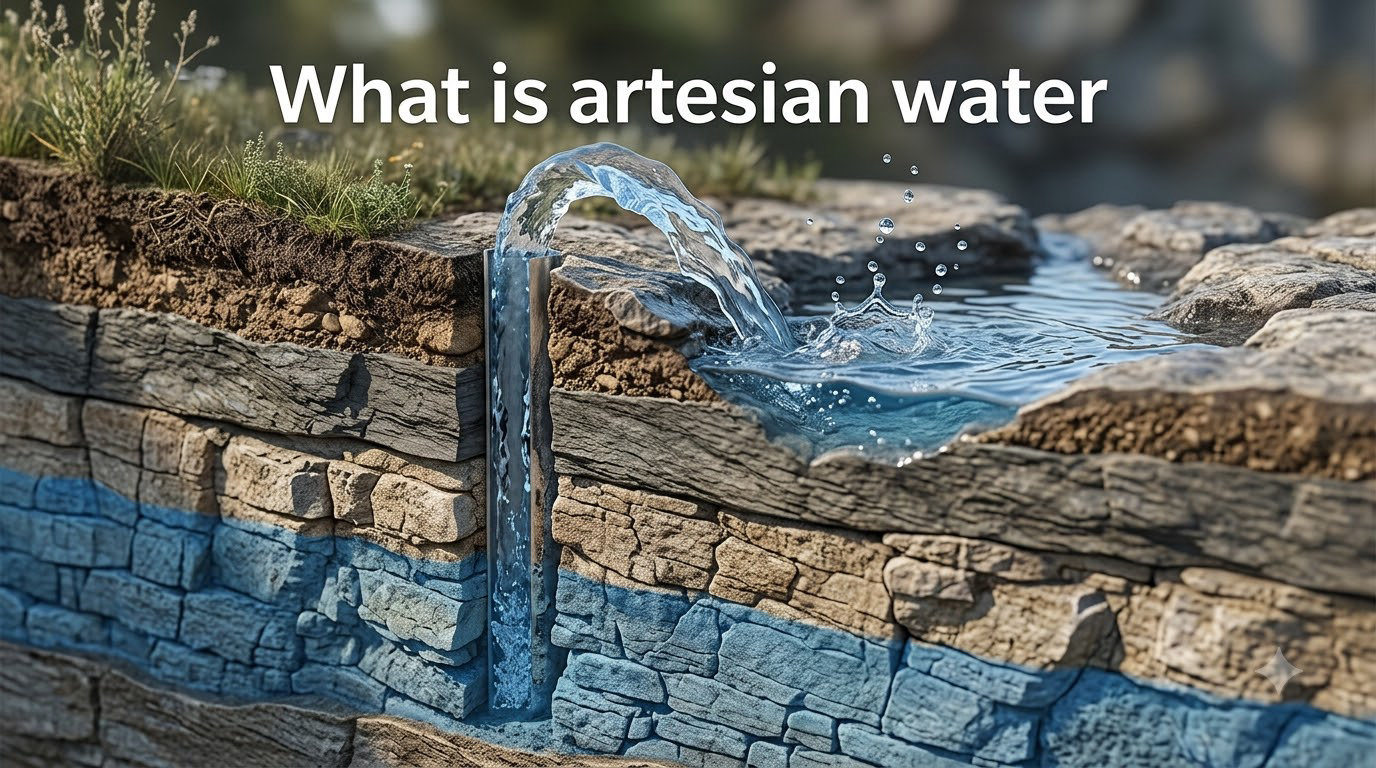
Artesian water forms when rainwater seeps into a layer of porous rock, gets trapped beneath a layer of impermeable rock, and builds up enough natural pressure to rise on its own when a well is drilled. That natural pressure is what makes artesian wells special. You do not need a pump to bring the water up. Gravity and geology do the work.
Think of it like a stuck straw in a juice box. If you squeeze the box, the juice shoots up the straw without you sucking on it. The squeeze in our case is hydrostatic pressure created by thousands of feet of rock and water pushing down from above.
The Role of a Confined Aquifer
A confined aquifer is the underground container that holds artesian water. It is a layer of permeable rock, usually sandstone, limestone, or fractured gravel, sandwiched between two layers of impermeable rock or clay. Water enters the aquifer from a recharge zone, usually where the layer pokes up at the surface, and then spreads out slowly under the cap of impermeable rock.
The pressure inside this trapped space is what matters most. Water cannot compress easily, so the more water that enters from the recharge area, the more the existing water gets squeezed. Drill a well into that sandwich and the water pushes itself up.
How Hydrostatic Pressure Builds Up
Hydrostatic pressure is the force that water exerts when it is trapped in a closed system. In an artesian system, this pressure builds up because water from higher elevations keeps flowing into a sealed underground chamber. The water level inside the aquifer, called the potentiometric surface, sits higher than the top of the well.
When the well is drilled, water rises until it reaches the level of the potentiometric surface. If that level is above the ground, you get a flowing artesian well. If it sits below the ground, you get a sub-artesian well that still does not need a pump, but the water stops short of the surface.
Where the Word Artesian Comes From
The term artesian comes from the historical region of Artois in northern France, where the locals drilled the first known artesian well in 1126. Monks at the Carthusian monastery in Lillers wanted a reliable water source, and they tapped into a pressurized aquifer that produced a free-flowing well. The technique spread across Europe over the following centuries, and the name stuck.
By the 1800s, the word artesian was used in English to describe any well that tapped a pressurized aquifer. According to Wikipedia, the Persian scholar Al-Biruni described similar flowing wells as early as the 11th century, so pressurized groundwater has been on human radar for nearly a thousand years.
Today the term is regulated in the bottled water industry. In the United States, the FDA defines artesian water as water from a well that taps a confined aquifer where the water level stands above the top of the aquifer. If a brand just calls itself “artesian” without meeting that definition, it is marketing fluff.
Artesian Water vs Spring Water vs Mineral Water vs Purified Water
The clearest way to understand artesian water is to compare it side by side with the other bottled water categories you see on store shelves. Each one has a distinct origin, regulation, and mineral profile.
| Water Type | Source | Pumping Required | Mineral Content | FDA Definition |
|---|---|---|---|---|
| Artesian | Confined aquifer under pressure | No | Varies by geology | Water from a well tapping a confined aquifer where the water level rises above the aquifer |
| Spring | Natural flow to surface from unconfined aquifer | No (gravity) | Varies by geology | Water collected at a natural spring bore |
| Mineral | Any protected underground source | Sometimes | At least 250 ppm total dissolved solids | Water with specific mineral content from a protected source |
| Purified | Any source, then treated | N/A | Mostly removed | Water processed to remove contaminants (RO, distillation, etc.) |
The table makes one thing obvious. Artesian water and spring water are both natural and pump-free. The difference is that artesian water is forced up by pressure inside a confined aquifer, while spring water simply flows out where the water table meets the surface.
Mineral water is defined by its dissolved solids, not its source mechanics. A mineral water can technically come from an artesian well if it meets the 250 ppm threshold. Purified water is the opposite extreme. It can come from anywhere, including municipal tap water, as long as the treatment process strips out contaminants.
Is Artesian Water Safe to Drink
Yes, artesian water is generally safe to drink, but the label alone does not guarantee purity. The natural filtration through rock layers can protect against many surface contaminants, yet groundwater can still pick up minerals like iron, sulfur, or arsenic depending on the local geology.
The USGS notes that chemically, artesian water is not fundamentally different from any other groundwater once it reaches the surface. The pressure is what brings it up. The chemistry depends on the rock it traveled through. If the rock contains heavy metals or the aquifer has been contaminated by surface activity, the water can carry those compounds with it.
For bottled artesian water, brands are required to test and treat their source to meet FDA bottled water standards. For home artesian wells, I always recommend annual testing for bacteria, nitrates, and any local contaminants. Reddit users with private artesian wells frequently mention high iron content, which is harmless but tastes unpleasant and stains fixtures. A simple filter solves that.
The biggest safety misconception I see is that “natural” automatically means “safe.” It does not. Natural water can contain bacteria, parasites, or naturally occurring arsenic. Treat any private well, artesian or otherwise, with the same caution you would give any untreated water source.
Famous Artesian Water Sources Around the World
Some of the most recognizable bottled water brands in the world come from artesian sources, and the largest artesian basin on the planet sits beneath one of the driest continents. Let me cover two of the most famous examples.
Fiji Water
Fiji Water is drawn from a confined artesian aquifer beneath the Yaqara Valley on the island of Viti Levu in Fiji. Rainfall filters through volcanic rock over hundreds of years, picking up minerals along the way. The aquifer sits under enough pressure that the water rises naturally to the wellhead, where it is bottled at the source.
That is why Fiji Water tastes so smooth. The volcanic rock gives it a unique silica content. If you are curious about whether that silica is worth caring about, our team has written a detailed guide on silica content in natural waters that breaks down the science.
The Great Artesian Basin in Australia
The Great Artesian Basin is the largest and deepest artesian basin in the world, covering roughly 1.7 million square kilometers across Queensland, New South Wales, South Australia, and the Northern Territory. Some of the water in the basin is estimated to be over a million years old, earning it the nickname “fossil water.”
More than 25,000 bore wells tap into the basin, supplying drinking water to remote cattle stations, Indigenous communities, and towns in the Australian outback. Without the natural pressure in this aquifer, much of inland Australia would have no reliable freshwater source at all.
What Makes Artesian Water Taste Different
Artesian water often tastes crisp, clean, and slightly mineral-rich compared to filtered tap water. The flavor comes from the dissolved minerals it picks up while passing through rock. Calcium and magnesium add a subtle hardness, silica adds smoothness, and trace amounts of bicarbonate give some brands a faintly sweet finish.
That taste difference is real but small. If you ran a blind taste test between a high-quality artesian water and a well-filtered municipal water, most people would notice a difference but few would describe it dramatically. Where artesian water really shines is consistency. Because the source is sealed and deep, the mineral profile stays steady year-round, unlike surface water that changes with the seasons.
If you are choosing water based on taste alone, artesian and spring water both offer pleasant profiles. If you want the minerals to stay intact, artesian water is a solid pick because it is bottled at the source with no treatment beyond basic filtration and disinfection.
Your Top Questions About Artesian Water Answered
What is so special about artesian water?
Artesian water is special because it rises to the surface on its own. The natural pressure inside a confined aquifer pushes the water up through the well, so no pump is needed. It also travels through rock layers that naturally filter it and add minerals, giving it a clean taste and a stable chemistry.
Is it okay to drink artesian water?
Yes, bottled artesian water that meets FDA standards is safe to drink. For private artesian wells, annual testing for bacteria, nitrates, and local contaminants is recommended. Natural does not always mean sterile, so testing is the only way to know your specific well is safe.
What is the healthiest type of water to drink?
The healthiest water is the one you drink consistently and that is free from contaminants. Artesian, spring, mineral, and properly filtered tap water are all healthy choices. The key factors are purity, mineral balance, and whether you actually like the taste enough to drink enough of it.
What is the difference between artesian water and spring water?
Both are natural and pump-free, but artesian water comes from a confined aquifer where pressure forces it upward. Spring water flows to the surface naturally where the water table meets the ground. Chemically they can be similar, but artesian sources tend to be deeper and more consistent.
How does an artesian well work?
An artesian well works by drilling into a confined aquifer where groundwater is under hydrostatic pressure. When the well penetrates the aquifer, the pressure pushes the water up through the well on its own. If the pressure is high enough to push water above ground level, the well is called a flowing artesian well.
Why is Fiji water artesian?
Fiji Water is artesian because it comes from a confined aquifer beneath volcanic rock on the island of Viti Levu. Rainfall filters through the rock over hundreds of years, and the aquifer is sealed under enough pressure that the water rises naturally to the wellhead for bottling.
The Bottom Line on Artesian Water
Artesian water is groundwater that rises to the surface under its own pressure because it sits trapped inside a confined aquifer. The label tells you something specific about how the water was sourced and brought up. It does not automatically mean the water is healthier, tastier, or safer than other options.
What it does mean is that the water has been naturally filtered through rock, sealed away from surface contaminants, and pushed up by geology rather than by a mechanical pump. That is a genuinely cool process, and the result is often a clean, mineral-balanced water with consistent quality.
Next time you see the word artesian on a bottle, you will know exactly what is going on hundreds of feet below the surface, and you will know how to compare it confidently with spring, mineral, and purified water.