
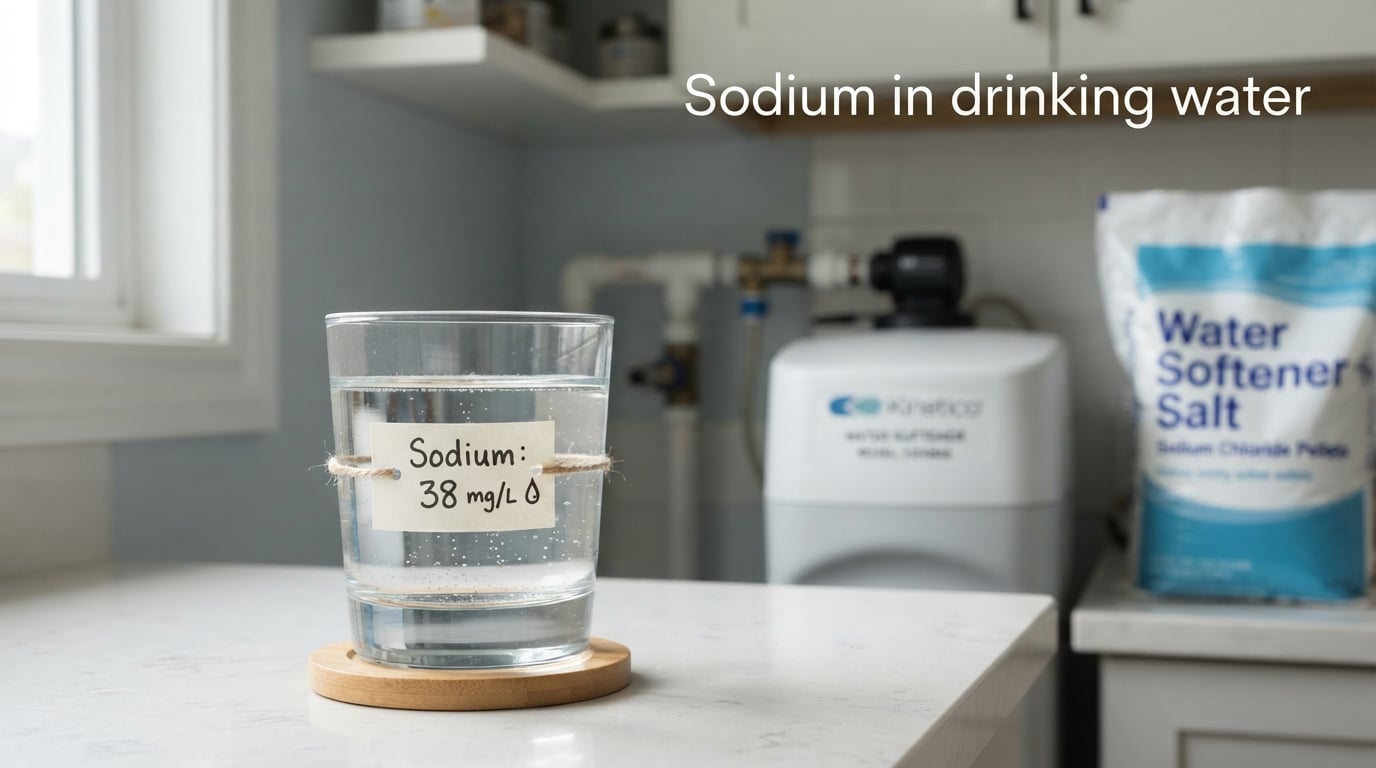
Sodium in drinking water is something most people never think about, yet the EPA recommends keeping levels below 20 mg/L for anyone on a low-sodium diet. I spent weeks digging through EPA advisories, WHO guidelines, and state health department fact sheets to put together this guide.
Whether you rely on a private well, use a municipal supply, or pick up bottled water at the store, sodium can sneak into your daily intake from sources you would never suspect. A single liter of certain mineral waters contains more sodium than a small bag of chips. By the end of this article, you will know exactly how much sodium is safe, where it comes from, and what to do about it.
This guide covers the 2026 EPA and WHO thresholds, the relationship between water softeners and sodium, and which treatment methods actually work. I will walk you through signs your water may be high in sodium, how to test it, and which bottled and mineral waters are safe for restricted diets. If you are on a sodium-restricted diet or just want to understand what is in your glass, I have you covered.
Table of Contents
What Is Sodium in Drinking Water
Sodium in drinking water refers to dissolved sodium ions (Na+) that enter water through natural geological deposits, road salt runoff, water treatment chemicals, and household water softeners. It is one of the most common dissolved minerals found in groundwater and surface water sources across the United States.
Sodium is highly soluble, which means it stays in solution rather than settling out. When salt (sodium chloride) contacts water, it separates into sodium and chloride ions that remain dissolved. This is why sodium contamination persists in water supplies even after the original source is gone. Sodium does not evaporate, biodegrade, or get filtered by soil in the same way that organic contaminants do.
Sodium concentrations in water are measured in milligrams per liter (mg/L) or parts per million (ppm). These two units are nearly identical for practical purposes, since 1 mg/L of sodium equals roughly 1 ppm. Drinking water typically contains between 5 and 50 mg/L of sodium, though levels can spike much higher near coastal areas, road salt zones, or homes with ion-exchange water softeners.
Understanding the difference between mg/L and ppm matters when you read a lab report. If your water quality report lists sodium at 45 ppm, that is essentially the same as 45 mg/L. Most consumer-facing reports now use mg/L because it is easier to translate into actual intake. One liter of water at 45 mg/L delivers 45 mg of sodium to your body.
For comparison, the sodium content in high sodium mineral waters like Vichy can exceed 1,000 mg/L. That is why some bottled waters taste noticeably saltier than tap water. You can read more about how sodium compares to other minerals in drinking water in our related content.
EPA and WHO Safe Sodium Level Guidelines
The EPA recommends keeping sodium in drinking water below 20 mg/L for people on sodium-restricted diets, and below 270 mg/L for the general population. There is no enforceable federal maximum contaminant level (MCL) for sodium, but these advisory thresholds are widely used by state agencies and water utilities.
The World Health Organization does not set a strict health-based guideline for sodium in drinking water. WHO notes that water typically contributes less than 10% of total daily sodium intake for most people, which means diet remains the primary concern. However, WHO acknowledges that people on sodium-restricted diets may need to monitor water sources carefully.
Here is a clear breakdown of the key thresholds for 2026:
- 20 mg/L: Recommended maximum for individuals on sodium-restricted diets (New York State DOH)
- 30-60 mg/L: EPA consumer acceptability advice range to avoid salty taste
- 200 mg/L: Threshold above which sodium may be noticeable to taste
- 270 mg/L: Advisory level for general population per EPA guidance
The EPA’s consumer acceptability advice stems from taste considerations as much as health ones. Above 60 mg/L, many people start detecting a faint salty flavor. Above 200 mg/L, the taste becomes hard to ignore. If your tap water tastes salty to you, that is a strong signal that sodium is above 100 mg/L.
Most municipal water supplies in the US test well below 50 mg/L. Private wells, however, can show much wider variation depending on geology, road salt exposure, and nearby land use. If your sodium level exceeds 20 mg/L and you have hypertension or kidney disease, your doctor will likely recommend either bottled water or a home treatment system.
States that adopt sodium guidelines often use stricter numbers than the federal advisory. Massachusetts, for example, recommends notifying consumers if sodium exceeds 20 mg/L in public water systems. New York uses the same threshold. If your state has published guidelines, those typically take precedence over general EPA advice.
Common Sources of Sodium in Drinking Water
Sodium enters drinking water from four main sources: natural geological deposits, road salt contamination, water treatment processes, and ion-exchange water softeners. Understanding which source affects your supply is the first step toward managing it.
Natural geological sources: Sodium leaches from rocks and soil as groundwater moves through aquifers. Areas with evaporite deposits, salty brines, or marine sedimentary rock often show naturally higher baseline sodium levels. Coastal wells frequently test above 100 mg/L even without any human activity. Inland wells near ancient seabeds or salt domes can also show elevated readings.
Road salt and de-icing chemicals: In cold-weather states, road salt (sodium chloride) runoff is a major contamination source. Wells located within 500 feet of heavily salted roads can show winter sodium spikes above 500 mg/L. Stormwater runoff also carries salt into surface water reservoirs. The Midwest and Northeast see the highest road salt contamination because of long winters and heavy de-icing use.
Water softeners: This is the hidden source most homeowners miss. Ion-exchange water softeners replace calcium and magnesium with sodium ions. A typical softener adds 7.5 to 15 mg of sodium per liter of water, and can push total sodium levels above 100 mg/L in homes with naturally hard water. If your source water has 200 mg/L of sodium and your softener adds another 100 mg/L, you are drinking water that exceeds the EPA general population guideline.
Industrial and agricultural contamination: Food processing, chemical manufacturing, and fertilizer runoff can introduce sodium into local water supplies. Wastewater treatment plant effluent also contains sodium from household detergents and human waste. If you live downstream of a major agricultural operation, sodium from fertilizers may show up in your well or surface water intake.
Sodium vs chloride: Sodium and chloride often appear together because they come from salt, but they have different effects. Chloride affects taste more aggressively and corrodes metal pipes. Sodium primarily affects health. If your test shows high chloride but low sodium, the source is likely industrial contamination rather than road salt or a water softener.
If your water comes from a private well, road salt and natural geology are usually the top contributors. If you have a water softener, the softener itself may be adding more sodium than the source water. The easiest way to identify the source is to test both the raw well water and the softened water separately.
Health Effects of Sodium in Drinking Water
Sodium in drinking water contributes to total daily sodium intake, which can affect blood pressure, cardiovascular health, and kidney function. For most healthy adults, the contribution from water is small relative to food. But for people with hypertension, heart failure, kidney disease, or liver disease, even modest amounts from drinking water can matter.
The American Heart Association recommends limiting sodium intake to under 2,300 mg per day, with an ideal target of 1,500 mg for most adults. If your drinking water contains 100 mg/L and you drink two liters daily, that adds 200 mg to your daily total. Over a month, that is 6,000 mg of sodium you might not have accounted for.
Groups who should pay particular attention to sodium in water include:
- People with hypertension: Sodium directly affects blood pressure regulation
- Heart disease patients: Excess sodium increases fluid retention and cardiac workload
- Kidney disease patients: Damaged kidneys struggle to excrete sodium efficiently
- Liver disease patients: Sodium retention contributes to ascites and edema
- Anyone on a sodium-restricted diet: Even small hidden sources matter
Signs that your drinking water may contain high sodium include a salty or metallic taste, visible scale buildup in pipes and fixtures, and appliances that wear out faster than expected. Some people also notice dry skin or mild dehydration after switching to harder or saltier water sources.
One common myth I see in forums is the idea that drinking more water can flush out excess sodium from a salty meal. Unfortunately, the kidneys regulate sodium and water balance together. Drinking extra water without reducing sodium intake simply makes you retain more fluid, which raises blood pressure temporarily. The body removes sodium through urine over 24-48 hours, but only when intake is reduced.
Long-term exposure to elevated sodium in drinking water is associated with higher rates of hypertension in observational studies, though researchers disagree about how much of this is causal versus correlational. The consensus is that for sensitive populations, every source of sodium matters.
How to Test Sodium in Your Drinking Water
You can test sodium in drinking water through a certified laboratory, a home test kit, or in some cases by requesting a water quality report from your municipal utility. Each method has tradeoffs in cost, accuracy, and turnaround time.
Certified laboratory testing: This is the most accurate option. Labs use ion chromatography to measure sodium concentration in mg/L. Most state-certified labs charge $20 to $50 for a basic mineral panel that includes sodium, calcium, magnesium, and chloride. Results typically arrive in 5-10 business days. Some labs offer rush turnaround for an additional fee.
Home test kits: Aquarium-style test strips or pool test kits can detect sodium but with less precision. They are useful for quick screening but should not replace lab testing for medical decisions. Expect accuracy within plus or minus 20%. Dedicated sodium ion test strips cost about $15 to $30 for a pack of 50.
Municipal water reports: If you are on city water, your utility publishes an annual Consumer Confidence Report (CCR) that lists sodium levels. You can usually find it on your utility website or request a copy by phone. The CCR shows the running annual average, which smooths out seasonal variation.
TDS meters: Total dissolved solids meters measure the sum of all dissolved minerals, including sodium. They cannot isolate sodium specifically, but a sudden jump in TDS often signals a change in source water or treatment system. TDS meters cost about $15 to $40 and are useful for ongoing monitoring after a baseline lab test.
I recommend testing your water at least once per year for private wells, ideally in late winter or early spring when road salt contamination peaks. If you install a new water softener or change treatment systems, retest after 30 days to confirm the new equipment is performing as expected.
When reading your results, look for the mg/L number next to sodium or Na. A reading under 20 mg/L is excellent for low-sodium diets. Between 20 and 50 mg/L is typical for municipal water. Above 100 mg/L suggests you should investigate the source and consider treatment.
Treatment Options for Removing Sodium from Water
Reverse osmosis, distillation, and some specialized filters can remove sodium from drinking water, while ion-exchange water softeners actually add sodium. Here is how the main treatment methods compare.
Reverse osmosis (RO): This is the most effective residential option. RO systems force water through a semipermeable membrane that blocks sodium ions along with most other dissolved minerals. Typical removal rates exceed 95%, taking a 200 mg/L input down to under 10 mg/L. RO also removes chloride, lead, and many other contaminants.
The downside is water waste. RO systems typically produce 3-5 gallons of wastewater for every gallon of treated water. However, if you are on a sodium-restricted diet, the trade-off is usually worth it. Under-sink RO units cost $200 to $500 installed, with annual filter replacement around $75 to $150. We have written more about remineralized reverse osmosis water if you want to add healthy minerals back after filtration.
Distillation: Boiling water and collecting the condensed steam removes nearly all sodium and other minerals. Distillers are effective but slow and energy-intensive. A countertop distiller produces about 1 gallon per 4-6 hours of operation. They work well for small-volume drinking water but are impractical for whole-house treatment.
Water softener bypass: If your high sodium comes from an ion-exchange water softener, the simplest solution is to bypass the softener for drinking water taps. Install a dedicated cold-water line that draws unsoftened water straight to the kitchen sink. This costs about $200 to $400 for a plumber to install and avoids the sodium problem entirely.
Standard carbon filters: Most pitcher filters like Brita do not meaningfully reduce sodium. They improve taste and remove chlorine but leave dissolved minerals untouched. If you are wondering about water filters and mineral content, the short answer is that basic carbon filters are not enough for sodium removal.
Potassium-based water softeners: These use potassium chloride instead of sodium chloride for regeneration. They avoid adding sodium but cost more per regeneration cycle. For someone on a sodium-restricted diet who also needs soft water, potassium softeners paired with a bypass for kitchen taps work well.
Comparison of treatment effectiveness:
- Reverse osmosis: 95-99% sodium removal
- Distillation: 99%+ sodium removal
- Ion-exchange softeners: Add 7.5-15 mg/L per grain of hardness removed
- Carbon filters: Less than 10% sodium removal
- Sediment filters: 0% sodium removal
Mineral Water Sodium Content Comparison
Bottled mineral water sodium levels vary enormously, from under 5 mg/L in low-mineral waters to over 1,000 mg/L in heavily mineralized European brands. If you are on a sodium-restricted diet, the brand you choose matters more than you might expect.
Here are the typical sodium levels for popular mineral waters:
- Vichy Celestins: Around 1,097 mg/L, highest in our comparison
- Gerolsteiner: About 118 mg/L
- Perrier: Roughly 14 mg/L
- San Pellegrino: Around 44 mg/L
- Evian: About 7 mg/L
- Contrex: Approximately 12 mg/L
- Aquafina: Less than 1 mg/L
- Dasani: Less than 1 mg/L
For people on a strict 2,000 mg sodium diet, drinking two liters of Vichy Celestins would add over 2,000 mg of sodium, exceeding the daily limit on its own. The same volume of Evian or Aquafina adds less than 15 mg. Read labels carefully and remember that bottled water sodium content is not always prominently displayed.
Distilled or purified bottled waters are the safest choice for restricted diets. Reverse osmosis treated municipal water is similarly low in sodium. Mineral waters marketed for taste or health benefits often contain much more sodium than tap water.
Frequently Asked Questions
What is a safe sodium level in drinking water?
The EPA recommends keeping sodium below 20 mg/L for people on sodium-restricted diets and below 270 mg/L for the general population. Most municipal water supplies fall between 5 and 50 mg/L, which is considered safe for healthy adults.
Is sodium in water bad for you?
For most healthy adults, sodium in drinking water contributes less than 10% of daily intake and is not a concern. However, people with hypertension, kidney disease, heart failure, or liver disease should monitor water sources carefully because even small amounts add up over time.
How much water does it take to flush out 1000 mg of sodium?
Your kidneys process sodium continuously, not in response to water volume. Drinking extra water does not speed up sodium removal. To flush 1000 mg of sodium, your kidneys need roughly 24-48 hours of reduced intake combined with normal hydration.
Which bottled water has high sodium?
Mineral waters like Vichy Celestins (1,097 mg/L) and Gerolsteiner (118 mg/L) show wide sodium variation. Perrier contains around 14 mg/L while most purified bottled waters contain under 10 mg/L. Always check the label if sodium matters to you.
Does a water softener add sodium to drinking water?
Yes. Ion-exchange water softeners replace calcium and magnesium with sodium ions. A typical softener adds 7.5 to 15 mg of sodium per liter, which can push total sodium above 100 mg/L in homes with hard water. Bypass the softener for drinking taps to avoid this.
How can I remove sodium from my well water?
Reverse osmosis systems are the most effective residential option, removing 95-99% of sodium. Distillation also works but is slower. If your sodium comes from a water softener, bypass the softener for kitchen cold water lines. Test your well annually to track changes.
How often should I test my well water for sodium?
Test private well water at least once per year, ideally in late winter or early spring when road salt contamination peaks. If you install a new treatment system or change your water softener, retest after 30 days to confirm performance.
Key Takeaways on Sodium in Drinking Water
Sodium in drinking water is usually a minor part of your diet, but it becomes critical if you have hypertension, kidney disease, or follow a sodium-restricted eating plan. The EPA threshold of 20 mg/L for low-sodium diets and 270 mg/L for the general population gives you a clear benchmark for 2026.
If you are concerned, test your water once a year, especially if you have a private well or ion-exchange softener. Reverse osmosis treatment handles sodium effectively, and you can read more about other minerals in bottled water to understand the full picture of what you are drinking.
For most healthy people, the practical takeaway is simple. Drink tap water or low-sodium bottled water, watch out for mineral waters with sodium above 50 mg/L, and consider an under-sink RO system if your tap water exceeds the EPA thresholds. Small steps like these can make a measurable difference for sensitive individuals over months and years of daily hydration.