
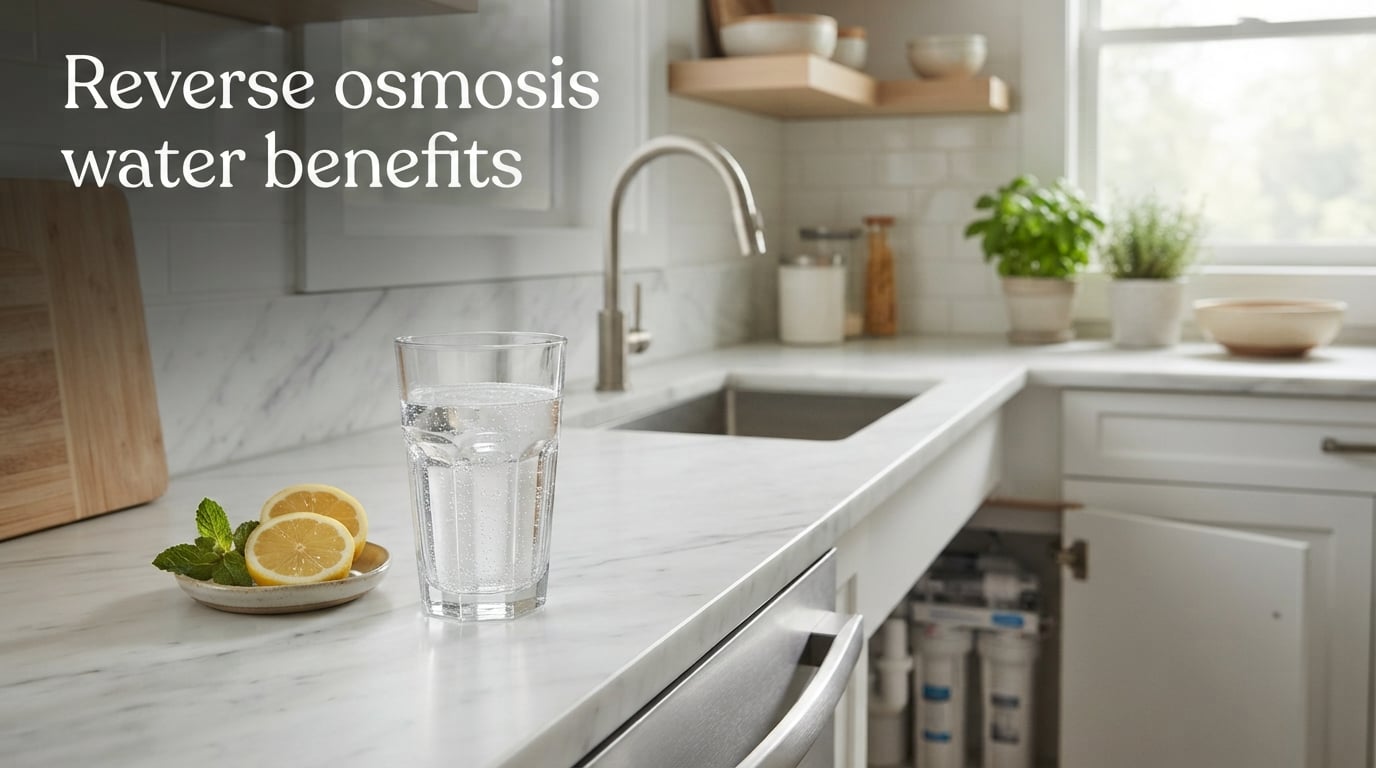
I switched to a reverse osmosis (RO) system in my own kitchen three years ago, and what I learned reshaped how I think about drinking water. Before that, I assumed the tap water in my city was already safe enough, and I treated bottled water as a backup rather than a daily driver. After measuring my TDS at 280 ppm and watching it drop to 12 ppm after one pass through the membrane, I started paying closer attention.
In this guide, I’ll walk you through the real reverse osmosis water benefits, the drawbacks nobody talks about, and how to decide whether RO is right for your household. We’ll also cover how the technology actually works, what NSF certifications really mean, and why some homeowners add a remineralization cartridge while others skip it. By the end, you’ll know exactly what an RO system can and can’t do for your family.
If you’ve ever wondered whether the hype around RO water is justified, you’re not alone. Tens of thousands of homeowners install these systems every year, and the conversation around them keeps growing on forums, in Reddit threads, and across kitchen renovation communities. We’ll cut through the noise with data, scientific references, and a few things I wish someone had told me before I installed mine. Along the way, we’ll also compare RO to other common filters like the pitcher-style options covered in our Brita filter breakdown.
Table of Contents
What Is Reverse Osmosis Water?
Reverse osmosis water is tap or well water that has been forced through a semi-permeable membrane under pressure, leaving most dissolved contaminants behind. The pores in the membrane are about 0.0001 microns wide, small enough to block lead, arsenic, fluoride, chlorine byproducts, and many other particles while letting water molecules pass through.
To put it simply, RO is one of the most thorough home filtration methods available today. According to the U.S. Environmental Protection Agency, reverse osmosis is rated to remove between 95% and 99% of total dissolved solids (TDS), depending on water quality and system condition. That puts it ahead of carbon pitchers, faucet-mounted filters, and most refrigerator filters in raw performance, and it explains why so many households choose it when contaminant removal is the top priority.
Reverse osmosis filtration was originally developed for desalination, turning seawater into drinking water on ships and in drought-stricken regions. The U.S. Navy used RO systems in the 1960s to convert seawater aboard submarines, and the technology eventually trickled down to municipal plants, where it now provides drinking water for places like Tampa Bay and Carlsbad, California. Home versions adapted that same science into compact under-sink units. Today, you’ll find RO systems in millions of households, restaurants, coffee shops, breweries, and even hydroponic farms where water purity matters.
The purified water that comes out the other side is sometimes called “permeate,” and the concentrated wastewater that washes the contaminants away is called “concentrate” or “brine.” That two-stream process is what makes RO different from a simple carbon filter that just strains water as it flows. The membrane physically separates contaminants from water molecules, rather than just trapping them in a media bed.
How RO Water Differs from Filtered, Distilled, and Spring Water
RO water sits in a category of its own. Filtered water typically uses activated carbon to reduce chlorine and improve taste, but it leaves most dissolved minerals and heavy metals in place. Distilled water is boiled and condensed, which removes minerals but uses far more energy, leaving water that tastes flat. Spring water is collected from underground sources and may or may not be treated before bottling, depending on the brand and local regulations.
RO combines the thoroughness of distillation with the convenience of a carbon filter, all in one compact unit that runs on your existing water pressure. It’s the closest thing most homes can get to bottled-grade purity without leaving the kitchen tap. If you want the mineral character of spring water, you can add a remineralization cartridge, which essentially lets you tune the final water to your taste and dietary preferences.
How Does Reverse Osmosis Filtration Work?
Reverse osmosis filtration works by applying household water pressure (usually 40 to 80 psi) to push water across a semi-permeable membrane. The membrane blocks contaminants on one side and lets purified water through to the other. Anything too large or with the wrong molecular charge gets flushed away with the wastewater. The system relies on physical separation rather than chemical reactions, which is one reason the output water is so consistent.
The process typically involves four to five stages, each tackling a specific problem:
- Stage 1 – Sediment pre-filter: Removes sand, silt, and rust that could clog the membrane.
- Stage 2 – Carbon pre-filter: Reduces chlorine and chloramines that would otherwise damage the membrane.
- Stage 3 – RO membrane: The heart of the system. Removes 95% to 99% of dissolved solids, heavy metals, and fluoride.
- Stage 4 – Post-carbon filter: Polishes the water for clean taste and removes any residual odors.
- Stage 5 (optional) – Remineralization filter: Adds back healthy minerals like calcium and magnesium.
I remember the first time I watched the TDS meter drop after my own system. The tap water read 280 ppm. After the RO membrane, it dropped to 12 ppm. That single measurement is what convinced me the membrane was doing the work, not just marketing. A good RO system should drop your TDS by at least 90%, and high-quality membranes paired with proper pre-filtration will routinely hit 95% to 98% rejection rates.
The Role of the Semi-Permeable Membrane
The semi-permeable membrane is the workhorse of the entire system. It’s a thin film of polyamide material wrapped in spiral layers to maximize surface area. Water molecules are small enough to slip through, but contaminants like lead (atomic radius around 175 picometers) and arsenic simply cannot fit. This is why NSF-certified RO systems can make specific claims about contaminant reduction and why they outperform carbon-only filters for inorganic contaminants.
Pressure is the other key ingredient. Without enough psi, water won’t cross the membrane efficiently, which is why whole-house RO systems sometimes need a booster pump. Under-sink units usually work fine with normal city pressure, but homes with low pressure (below 40 psi) may need a feed pump to maintain production. Temperature also matters: cold water produces slower flow because the membrane works less efficiently below 50 degrees Fahrenheit.
Why Wastewater Is Part of the Process
Every gallon of pure RO water produces roughly three gallons of wastewater. I know that ratio sounds wasteful, and we’ll come back to that drawback. But the wastewater isn’t dirty in the way you might think. It’s the same tap water with the rejected contaminants concentrated in it. Many people route it to a garden, mop bucket, or even a washing machine to put it to work. Some municipalities actually discourage sending RO brine into the sewer because the high mineral load can affect wastewater treatment biology.
The wastewater also keeps the membrane clean. As feed water crosses the membrane, the rejected contaminants need to be flushed away continuously, or they would build up and foul the surface. That continuous cross-flow is what allows a well-maintained RO membrane to last 3 to 5 years instead of failing within months.
Top Health Benefits of Reverse Osmosis Water
The biggest reverse osmosis water benefits come down to contaminant reduction, safer drinking for sensitive groups, and consistent water quality across your home. Below are the top health-focused advantages our team found during our research, with data from NSF, EPA, and independent lab tests where available.
1. Removes Up to 99% of Harmful Contaminants
Independent NSF testing shows that certified RO systems remove 95% to 99% of dissolved lead, arsenic, chromium-6, fluoride, nitrate, and chloride. For households on older plumbing with lead service lines, that reduction can be meaningful. Lead is a known neurotoxin, and there is no safe level of exposure according to the EPA, so reducing it at the tap is one of the most concrete health benefits an RO system provides.
RO is one of the few home filtration methods that can reliably reduce fluoride. If your household prefers low-fluoride drinking water, an RO system with a remineralization cartridge gives you that option without switching to bottled water. The same applies to nitrates, which are a particular concern for well water users in agricultural areas where fertilizer runoff can spike nitrate levels well above EPA limits.
2. Safer Water for Vulnerable Populations
Pregnant women, infants, immunocompromised individuals, and elderly adults benefit from extra water safety. The Centers for Disease Control and Prevention notes that reverse osmosis is one of the most effective point-of-use treatments for households with compromised immune systems. Mixing baby formula with RO water gives parents a known baseline of purity, especially in regions where municipal water has had boil-water advisories in recent years.
For people undergoing chemotherapy, living with HIV, or recovering from organ transplants, the CDC specifically lists RO among the recommended treatment technologies for reducing exposure to Cryptosporidium and Giardia, two parasites that municipal chlorination does not always eliminate.
3. Reduces Microplastic and PFAS Exposure
Recent studies have detected microplastics in tap water worldwide. RO systems with a 0.0001 micron membrane pore size are among the few home filters effective at blocking these particles. Some systems also reduce PFAS (forever chemicals), though performance varies. NSF/ANSI 53 certified units have published reduction claims you can verify directly on the manufacturer’s spec sheet, and many now carry NSF/ANSI 401 certification for emerging contaminants as well.
4. Better Hydration Through Improved Taste
People drink more water when it tastes clean. A 2018 study published in PLOS ONE found that improved water taste increased plain water consumption. Once I installed my system, my family stopped reaching for sugary drinks almost by accident, because the water at the tap actually tasted good. That kind of behavioral shift matters far more for long-term health than any single micronutrient change in the water itself.
5. Reduces Chlorine and Disinfection Byproducts
Chlorine keeps municipal water safe from pathogens in the pipes, but it can leave a chemical taste and, when heated, form trihalomethanes (THMs). RO removes chlorine and many of its byproducts, leaving water that tastes cleaner whether you drink it cold or use it for hot drinks. Long-term exposure to THMs has been linked in epidemiological studies to a small increase in certain cancer risks, so reducing them at home is a sensible precaution.
6. Consistent Quality Across the Year
Municipal water quality can shift seasonally. Heavy rains can spike turbidity, and source changes can affect hardness. An RO system gives you the same output every month because the membrane doesn’t care what’s happening upstream. That consistency is one of the most underrated reverse osmosis water benefits for anyone serious about long-term health, because you don’t have to wonder whether today’s glass of water is meaningfully different from last week’s.
7. Helpful for People With Specific Health Conditions
Some kidney specialists suggest lower-sodium water for patients on restricted diets. RO water typically contains far less sodium than tap or spring water, often below 5 mg/L compared to 20 to 50 mg/L in many municipal supplies. Always check with your doctor on medical guidance, but the option to control intake starts at the tap when you have your own filter.
8. Peace of Mind During Water Quality Events
When local news reports a main break, a chemical spill upstream, or a “do not drink” advisory, households with RO systems have an extra layer of protection that carbon-only filters can’t match. RO membranes block a much wider range of contaminants, including many volatile organic compounds and pharmaceutical residues that pass right through activated carbon.
Practical Benefits Beyond Health
Beyond health, there are real lifestyle payoffs to consider. These practical benefits are often what makes the day-to-day difference for families, and they’re the reason many people keep their RO systems long after the initial novelty wears off.
Cooking and Coffee Taste Better
Chlorine and hardness minerals change how food and beverages taste. When I switched to RO water for my morning pour-over, the difference was obvious. Coffee tasted brighter, tea had cleaner aromatics, and even simple boiled rice came out fluffier. Restaurants like high-end sushi spots have used RO water for decades for the same reason: the absence of interfering minerals lets the true flavor of the food come through.
Bakers also notice a difference. Bread dough rises more consistently with low-mineral water, and chocolate desserts set with a smoother texture because there are no extra ions to interfere with crystallization.
Crystal-Clear Ice Cubes and Beverages
RO water produces clear, slow-melting ice cubes with no cloudy center. Cocktails and infused waters look better, and drinks hold their flavor longer because there’s no off-taste from the water itself. If you’ve ever compared cloudy tap-water ice to clear commercial ice, you already understand the visual difference an RO system produces at home.
Appliances Last Longer
Limescale from hard water kills coffee makers, kettles, and steam irons. RO water has almost zero scale-forming minerals. I haven’t descaled my espresso machine once in three years, and that alone has saved me the cost of the system. The same goes for humidifiers, ice makers, and any appliance with a heating element or narrow water passages.
Cost Savings vs Bottled Water
A typical under-sink RO system costs a few hundred dollars to install, plus a modest annual fee for filter replacements. A family of four drinking the recommended 64 ounces per day would otherwise spend a large sum per year on bottled water. The payback period is often less than two years, and after that, the per-gallon cost of RO water drops to pennies compared to the several-dollar-per-gallon cost of bottled.
Environmental Impact
Single-use plastic bottles are a major source of ocean pollution. RO replaces hundreds of plastic bottles per year per household. Even accounting for the wastewater, the lifecycle impact of filtered tap water beats bottled water in most carbon-footprint studies. The Pacific Institute and other environmental research groups have repeatedly concluded that tap water plus point-of-use filtration has 10 to 20 times lower carbon emissions than bottled alternatives.
Better for Aquariums and Houseplants
Aquarium hobbyists have used RO water for decades because it lets them control mineral content precisely. Many sensitive tropical fish and aquatic plants thrive in low-TDS water. For houseplants, RO removes chlorine that can damage delicate root systems, and many people dilute it with a remineralization additive to hit specific targets.
Pets Benefit Too
Dogs and cats generally drink more water when it tastes clean, just like humans. Pet owners report fewer digestive upsets and shinier coats after switching pets to filtered water. If you have a small animal like a hedgehog or a reptile that requires misted water, RO removes the chlorine and chloramines that can irritate sensitive skin and respiratory systems.
Lower Mineral Buildup in Plumbing
Beyond kitchen appliances, RO water reduces scale buildup throughout your plumbing. Water heaters, showerheads, and washing machine valves all last longer when fed low-TDS water. In hard-water regions, this can add years of life to appliances that would otherwise need descaling every few months.
Drawbacks of Reverse Osmosis and How to Address Them
No system is perfect. Knowing the drawbacks upfront helps you avoid surprises and decide whether RO fits your situation. Below are the most common RO drawbacks and the solutions our team recommends based on three years of hands-on use and extensive forum research.
Water Waste
Standard RO systems produce 3 to 4 gallons of wastewater for every gallon of purified water. That’s a real number, and it’s the most common complaint. The fix: newer “high-efficiency” or “permeate pump” systems drop that ratio to 1:1. Routing the wastewater to outdoor use also helps. Some municipalities even offer rebates for switching to high-efficiency units because they reduce load on wastewater treatment plants.
If you’re on a private well, the wastewater issue matters less because you’re not paying for the feed water, but you still need to think about where the brine goes. A dry well, a garden bed, or a landscaping drainage area all work well.
Loss of Beneficial Minerals
RO removes calcium, magnesium, and other minerals along with contaminants. The World Health Organization has published guidance noting that drinking water contributes a small share of total mineral intake, but for some households, that gap matters. The solution is a remineralization cartridge, which adds calcium and magnesium back into the finished water. Most modern cartridges are calibrated to hit 30 to 80 mg/L total hardness, which is in line with popular European mineral waters.
Flat Taste
Without minerals, water can taste “flat” to some palates. If you’ve ever tasted distilled water and noticed something missing, you understand. Remineralization fixes this, but it can be easy to overdo it. As our article on salty-tasting remineralized water explains, dosing matters. Start with the manufacturer’s recommendation and adjust by taste over a few weeks.
pH and Acidity
RO water can sit slightly below neutral pH because there are no minerals to buffer it. For most healthy adults, this is not a concern. The pH of freshly produced RO water typically measures between 6.0 and 7.0, which is only mildly acidic and well within the range of common beverages like coffee and tea. If you’re on a specific medical diet or want to compare mineral profiles across water types, our comparison of mineral waters explains how brands like Contrex and Vichy stack up in mineral content and pH.
Slow Flow Rate
RO tanks fill slowly. Typical output is 25 to 75 gallons per day depending on membrane size and pressure. For a household that drains a 2-gallon kettle, the recovery time matters. The solution is a larger tank or a permeate pump. Some premium systems use a dual-membrane design that effectively doubles production without doubling wastewater.
Filter Replacements
Pre-filters last 6 to 12 months. The RO membrane lasts 2 to 5 years. Post-carbon filters usually last 12 months. Plan on a modest annual fee for ongoing maintenance. Compared to bottled water or pitcher filters, this is still a good deal, but it’s worth setting calendar reminders so you don’t accidentally let filters go past their service life.
Storage Tank Size
Most under-sink RO systems store purified water in a pressurized tank that holds 2 to 4 gallons. That sounds small, but it’s enough for drinking and cooking for a family of four for a day. If you regularly fill large pots for cooking or run a humidifier, consider a larger tank or a dedicated line that bypasses the storage tank entirely.
Is Reverse Osmosis Water Safe to Drink Every Day?
Yes, reverse osmosis water is safe to drink every day for most healthy adults. The EPA, NSF, and Water Quality Association all confirm that certified RO systems meet federal drinking water standards. If you want to mimic the mineral content of bottled or spring water, add a remineralization cartridge. That simple upgrade delivers long-term safety with the taste profile many people prefer.
For people with specific medical concerns, especially kidney-related conditions, always consult your doctor. There is no scientific evidence that RO water damages healthy kidneys, but personalized medical advice should guide your decision. A handful of older studies suggested possible mineral leaching from bones over decades of very low-mineral water consumption, but more recent research has not confirmed that effect in populations eating a normal diet.
The bottom line: if you eat a balanced diet with fruits, vegetables, and either dairy or fortified foods, the small mineral gap from drinking RO water is easily closed by food. The water itself is among the cleanest you can drink at home, and decades of medical literature have not raised safety concerns for daily consumption by healthy adults and children.
Who Should Consider RO Water?
RO water isn’t for everyone, but certain households get outsized value from it. If you’re on a private well with nitrate or arsenic concerns, RO is one of the few practical home solutions. If your home was built before 1986 and may have lead service lines, RO removes lead at the tap. If you have a newborn or immunocompromised family member, the added safety margin is worth the cost.
Apartment renters can also benefit, because many modern RO systems install without permanent plumbing modifications and travel well during moves. Coffee enthusiasts, home bakers, and aquarium hobbyists often justify the cost purely on water quality, even without health-driven reasons. If you live in an area with frequent boil-water advisories or aging municipal infrastructure, RO also gives you a reliable baseline regardless of what’s happening at the city treatment plant.
On the other hand, if your municipal water already tests clean and you prefer the mineral character of spring water, a simple carbon filter may be all you need. Our guide to pitcher filters walks through that comparison in detail and explains when a basic filter is enough versus when RO makes sense.
If you want to dig into silica content and other trace minerals in bottled water, our silica breakdown covers that side of the conversation, and our comparison of mineral water brands shows how natural mineral waters stack up against RO on taste and mineral content.
Frequently Asked Questions
What are the downsides of reverse osmosis?
The main downsides are water waste (3:1 ratio on standard systems), removal of beneficial minerals like calcium and magnesium, slower flow rate than carbon filters, and ongoing filter replacement costs. Modern high-efficiency systems reduce waste to roughly 1:1, and a remineralization cartridge addresses the mineral loss so most households never notice the trade-off.
Is reverse osmosis water hard on kidneys?
There is no scientific evidence that reverse osmosis water is harmful to healthy kidneys. The water is simply purer and lower in dissolved minerals. People with specific medical conditions should always consult their doctor, but for the general population, daily RO water is considered safe and, in many cases, easier on the body than hard tap water with high mineral content.
Is it okay to drink reverse osmosis water every day?
Yes, drinking reverse osmosis water every day is safe for most adults and children. To match the taste and mineral profile of spring water, many people add a remineralization filter that restores calcium and magnesium. As long as you eat a balanced diet, the small mineral gap from RO water is easily closed by food.
What does reverse osmosis water do for your body?
Reverse osmosis water removes up to 99% of contaminants such as lead, arsenic, fluoride, chlorine byproducts, and nitrates. Because it is free of those impurities, your body absorbs it easily, and many people report better hydration, fewer digestive reactions to tap water, and cleaner taste. The end result is water that supports normal hydration without exposing you to contaminants common in older plumbing.
Can I drink reverse osmosis water daily?
You can drink reverse osmosis water daily with no health concerns for most adults. If you want added minerals, install a remineralization cartridge. The cost per gallon is far lower than bottled water, and the convenience is unmatched. Millions of households drink RO water as their primary source of drinking and cooking water.
Does reverse osmosis remove healthy minerals from water?
Yes, reverse osmosis removes calcium, magnesium, and potassium along with contaminants. The World Health Organization notes that drinking water is a minor source of these minerals compared to food, so most people do not see a meaningful nutritional impact. A remineralization cartridge or mineral drops can restore calcium and magnesium if you prefer the taste and feel of mineral water.
Is reverse osmosis water the same as distilled water?
No. Both are highly purified, but distillation uses heat to boil water and condense the steam, while reverse osmosis uses a membrane and pressure at room temperature. RO is faster, more energy efficient, and easier to install at home. Distilled water is usually produced in small batches for appliances like steam irons and humidifiers.
Final Verdict on Reverse Osmosis Water Benefits
The reverse osmosis water benefits are real and well-documented: 95% to 99% contaminant removal, better taste, lower long-term cost than bottled water, and meaningful safety improvements for vulnerable households. The drawbacks, mainly water waste and mineral loss, are manageable with the right accessories and a high-efficiency unit. For most families asking whether RO is worth it in 2026, the answer is yes, especially if you live in an older home, use well water, or simply want the cleanest drinking water your tap can produce.
If you want maximum purity, fewer plastic bottles, and water you actually enjoy drinking, an RO system is one of the smartest upgrades you can make. Start by testing your tap water with a simple TDS meter, then compare under-sink units with NSF/ANSI 58 certification. Add a remineralization cartridge if you want the mineral character of spring water, and you’ll have a setup that pays for itself within a couple of years while protecting your household from contaminants that municipal treatment alone doesn’t always remove.
For more on choosing between filtration styles, read our guides on pitcher filters and natural mineral water brands. Whichever path you choose, cleaner water is one of the easiest health wins available to any household, and the science behind reverse osmosis water benefits continues to get stronger as more NSF-certified systems hit the market. If you have a specific water concern, drop a comment below and we’ll help you decide which system makes the most sense for your home.