
Manganese in drinking water has become one of the most overlooked water quality concerns for households in 2026. Your body needs a small amount of this naturally occurring mineral to function properly, but too much manganese in drinking water can harm the nervous system, especially in infants and young children.
I have spent the past several months researching manganese contamination alongside our water quality team, and the findings surprised me. Manganese is not federally regulated as a primary contaminant in the United States, which means many homeowners do not realize their water contains levels that could affect their family’s health. This guide explains what manganese is, where it comes from, the actual health risks, the safe levels set by agencies, and the most effective ways to test for and remove it from your water.
Table of Contents
What Is Manganese and Where Does It Come From?
Manganese is a naturally occurring metallic element found in rocks, soil, and water across the world. It is one of the most abundant metals on Earth’s crust and plays an important role in human nutrition when consumed in trace amounts.
In drinking water, manganese enters through several pathways. The most common source is the natural weathering of manganese-bearing rocks and sediments, which releases the mineral into groundwater. Manganese also leaches into surface water from soil runoff and decaying organic matter. Industrial activities, including steel production, mining, and the use of manganese-based pesticides, can add additional manganese to local water supplies.
Groundwater typically contains higher manganese concentrations than surface water because groundwater spends more time in contact with mineral-rich rock and soil. Private wells drilled into these formations often show the highest levels, especially in regions with known geological deposits.
According to the U.S. Geological Survey, manganese is present in groundwater across most U.S. states, with concentrations varying widely based on local geology. Some of the most affected areas include the Northeast, parts of the Midwest, and the Appalachian region, where the geology favors higher natural manganese levels.
Health Effects of Manganese in Drinking Water
Manganese behaves differently in the body depending on the route of exposure. When you eat manganese, your intestines absorb only about 1 to 5 percent of it. When you drink it, however, the absorption rate is much higher. This bioavailability makes drinking water a particularly concerning exposure pathway, especially for vulnerable groups.
Effects on Infants and Children
Infants and young children face the highest risk from manganese in drinking water. Babies who consume formula mixed with manganese-laden tap water can absorb up to 8 percent of the mineral, compared to just 1 to 2 percent from food. Researchers at the Harvard School of Public Health have documented this increased absorption and its consequences on early brain development.
Studies have linked elevated manganese exposure in children to reduced IQ scores, impaired motor skills, memory problems, and behavioral issues. The developing brain is especially sensitive to manganese because the mineral can cross the blood-brain barrier more easily in young children. Several peer-reviewed studies found that children exposed to high manganese levels in their drinking water scored an average of 6 to 8 points lower on IQ tests compared to children with lower exposure.
Effects on Adults
Adults exposed to high manganese levels over long periods can develop neurological symptoms similar to Parkinson’s disease. This condition, called manganism, includes tremors, muscle stiffness, difficulty walking, and facial muscle spasms. Unlike Parkinson’s disease, manganism does not respond well to standard Parkinson’s treatments.
Workers in welding and mining industries, where airborne manganese exposure is high, have shown these symptoms for decades. Now researchers are finding that long-term ingestion of manganese through drinking water can produce similar effects in the general population, though typically at a slower pace.
Other Health Considerations
Beyond neurological effects, manganese exposure has been associated with cardiovascular issues, reduced fertility, and liver problems in some studies. People with iron deficiency, liver disease, or chronic kidney conditions may be more susceptible to manganese toxicity because their bodies have a harder time regulating mineral absorption.
Safe Levels and Regulatory Guidelines for Manganese
Unlike lead or arsenic, manganese does not have a federal Maximum Contaminant Level (MCL) under the Safe Drinking Water Act. Instead, the Environmental Protection Agency (EPA) set a Secondary Maximum Contaminant Level (SMCL) of 0.05 mg/L (50 µg/L) for aesthetic reasons, primarily to prevent staining and taste issues.
However, the EPA’s health advisory goes further. In 2004, the agency published lifetime health advisory values that recognize the neurological risks of manganese:
- 300 µg/L (0.3 mg/L): Lifetime health advisory for adults and children older than one year
- 100 µg/L (0.1 mg/L): Health advisory for infants under one year old
These values are not enforceable standards. They are recommendations meant to guide public water systems and inform consumers about levels that may pose health risks over a lifetime of exposure.
International Guidelines
Other countries have set different thresholds. Health Canada established a maximum acceptable concentration of 0.12 mg/L (120 µg/L) for total manganese in drinking water. The World Health Organization (WHO) recommends 0.4 mg/L (400 µg/L) as a health-based value, though it acknowledges that lower levels may be needed to protect infants.
State-Level Standards
Several U.S. states have implemented their own stricter standards. Minnesota, which has high naturally occurring manganese in its groundwater, established a guidance value of 100 µg/L for infants and 300 µg/L for other consumers. California set a public health goal of 0.5 mg/L and requires public notification when manganese exceeds the secondary MCL.
| Organization | Guideline | Population |
|---|---|---|
| EPA Lifetime Health Advisory | 100 µg/L | Infants under 1 year |
| EPA Lifetime Health Advisory | 300 µg/L | Adults and children over 1 year |
| EPA Secondary MCL | 50 µg/L | All consumers (aesthetic) |
| Health Canada | 120 µg/L | All consumers |
| WHO | 400 µg/L | All consumers |
Signs You May Have Manganese in Your Water
You do not always need a laboratory test to suspect manganese in your water. Several visible and sensory clues can point to elevated levels.
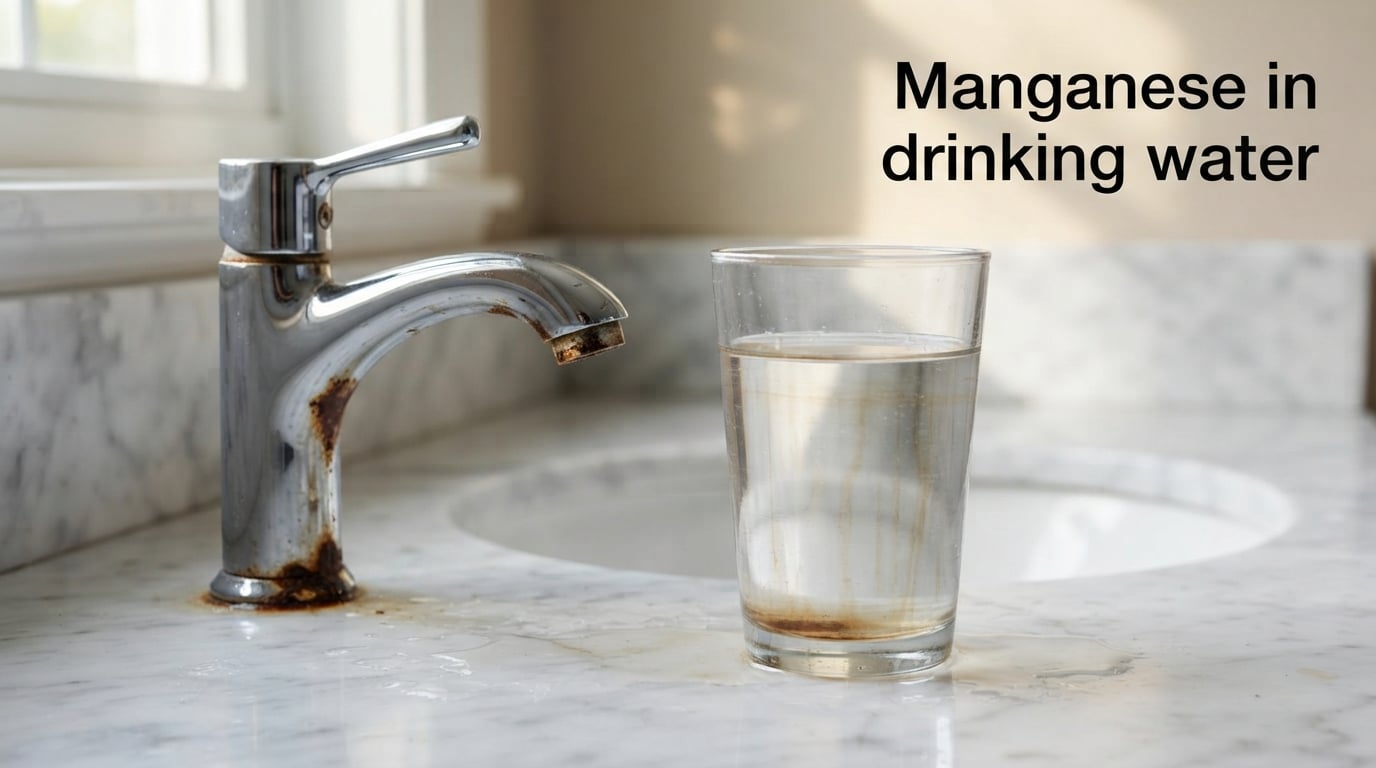
The most common sign is staining. Manganese leaves dark brown or black marks on fixtures, sinks, bathtubs, and laundry. These stains often appear as streaks or spots that are difficult to remove with regular cleaners. Unlike iron stains, which tend to be reddish-brown, manganese stains look nearly black.
High manganese levels can also affect taste and smell. Water with elevated manganese may have a metallic, bitter, or astringent taste. Some people describe it as similar to drinking tea or water that has sat in metal pipes.
You might notice black or dark brown sediment in your toilet tank or at the bottom of drinking glasses. This sediment forms when oxidized manganese particles settle out of standing water. If your water appears cloudy or has visible particles after it sits for a while, manganese could be the cause.
One telltale sign is recurring staining even after you install a basic water softener. Water softeners are designed primarily for hardness minerals like calcium and magnesium. They are not effective at removing oxidized manganese, which has already changed form in the water.
How to Test Your Water for Manganese
Testing is the only way to know your actual manganese level. Visual clues and taste can suggest the presence of manganese, but they cannot tell you whether your level exceeds health guidelines.
For Private Well Owners
If you get your water from a private well, you are responsible for testing it yourself. Unlike public water systems, private wells are not subject to EPA regulations, and well owners must arrange and pay for their own testing.
Start by contacting your state health department or county environmental office. Many states offer free or low-cost well water testing kits that include manganese analysis. You can also find accredited laboratories through your state’s certification program or the EPA’s drinking water laboratory certification database.
When you collect a sample, follow the laboratory’s instructions carefully. Most manganese tests require a first-draw sample taken after the tap has not been used for at least six hours. Use the containers provided by the lab, and ship or deliver the sample within the timeframe specified, usually 24 to 48 hours.
Costs vary, but a basic mineral panel that includes manganese, iron, hardness, and other common contaminants typically runs between $50 and $200. Some laboratories offer more comprehensive panels for higher prices. If you have never tested your well water, plan to test at least once and then retest every three to five years, or sooner if you notice changes in taste, color, or staining.
For Public Water Customers
If you receive water from a municipal system, your water utility is required to provide an annual Consumer Confidence Report (CCR). This report lists detected contaminants and their levels. However, manganese is only required to be reported if it exceeds the secondary MCL.
Many utilities do not test for manganese at all, or they test only at the source rather than at the tap. If your CCR does not include manganese data, you can request the information directly from your utility or pay for an independent tap water test through a private laboratory.
Treatment and Removal Options for Manganese
Once you know your manganese level, you can choose a treatment approach based on the concentration and your household needs. The most effective methods depend on whether the manganese is dissolved or oxidized.
Reverse Osmosis
Reverse osmosis (RO) systems are among the most effective options for removing dissolved manganese. These systems force water through a semipermeable membrane that blocks contaminants down to 0.0001 microns. RO can reduce manganese levels by 95 to 99 percent.
The downside is that RO systems produce several gallons of wastewater for every gallon of treated water, and they operate relatively slowly. A typical under-sink RO unit can treat about 50 gallons per day, which is enough for drinking and cooking but not for whole-house use. Point-of-use RO units cost between $200 and $600, plus annual filter replacements.
Oxidation and Filtration
For whole-house treatment, oxidation followed by filtration is often the best approach. This method converts dissolved manganese into solid particles that can be filtered out. Common oxidizing agents include chlorine, potassium permanganate, and ozone.
Greensand filters are a popular choice for manganese removal. They use a manganese dioxide-coated media that oxidizes and traps manganese as water passes through. Greensand systems work well for moderate manganese levels (up to about 5 mg/L) and can handle iron at the same time. Expect to pay $1,000 to $2,500 for a whole-house greensand system, including installation.
Cation Exchange Water Softeners
Standard salt-based water softeners can remove some manganese, but only when the manganese is dissolved and the level is below about 0.5 mg/L. If your manganese is higher, or if it has oxidized already, a softener alone will not solve the problem. In some cases, softeners can actually become fouled by manganese and lose effectiveness.
If you have both hard water and low-level manganese, a softener may handle both. But for moderate to high manganese, you will need a dedicated oxidation and filtration system.
Distillation
Distillation removes manganese by boiling water and condensing the steam, leaving contaminants behind. Distillers are effective but slow and energy-intensive. They are best suited for point-of-use drinking water rather than whole-house treatment.
What Does Not Work
Boiling water does not remove manganese. In fact, boiling concentrates manganese because water evaporates while the mineral stays behind. If you are concerned about manganese in your drinking water, boiling will make the problem worse.
Activated carbon filters, the kind found in many pitcher filters and basic refrigerator dispensers, do not remove manganese effectively. Carbon is designed for chlorine, volatile organic compounds, and some chemical contaminants, not dissolved minerals.
Standard faucet-mounted filters also generally do not address manganese unless they specifically include oxidation media or a membrane filter.
Frequently Asked Questions About Manganese in Drinking Water
What are the side effects of manganese in drinking water?
Long-term exposure to elevated manganese in drinking water can cause neurological problems including tremors, muscle stiffness, memory loss, and difficulty concentrating. Infants and young children may experience delayed brain development, reduced IQ, and behavioral issues. Adults exposed to very high levels over many years can develop manganism, a Parkinson’s-like condition with symptoms that do not respond well to standard treatment.
What are the symptoms of too much manganese in your body?
Early signs of excess manganese include fatigue, mood changes, and reduced reaction time. As exposure continues, more serious symptoms can develop: tremors in the hands, facial muscle spasms, difficulty walking or balancing, slurred speech, and memory problems. Children exposed to high manganese levels may show learning difficulties, attention problems, and lower academic performance compared to peers.
Do water filters remove manganese?
Most basic pitcher and faucet filters do not remove manganese. Effective options include reverse osmosis systems, oxidation filtration with greensand or catalytic media, and distillation. A standard water softener removes only small amounts of dissolved manganese and works best when levels are below 0.5 mg/L. For moderate to high manganese, a dedicated oxidation and filtration system is the most reliable choice.
Does boiling water remove manganese?
No, boiling does not remove manganese and can actually increase its concentration. When water boils away as steam, the dissolved manganese stays behind in the pot, making the remaining water more concentrated. To reduce manganese in drinking water, use reverse osmosis, distillation, or an oxidation-based filtration system rather than boiling.
What to Do If You Suspect Manganese in Your Water
If your water shows staining, metallic taste, or dark sediment, do not wait for symptoms to appear. Order a manganese test from an accredited laboratory, and ask for a full mineral panel that includes iron, hardness, and pH. These factors interact with manganese and affect your treatment choices.
For households with infants or young children, consider installing a point-of-use reverse osmosis system at the kitchen tap regardless of your test results. This protects the water used for formula and drinking during the years when children are most vulnerable.
Conclusion
Manganese in drinking water is a real and underappreciated health concern, especially for families with young children and for private well owners. The mineral occurs naturally in groundwater across much of the United States, and federal regulation has not caught up with the science on neurological risks.
Your action plan starts with testing. Confirm your manganese level with an accredited laboratory, then choose a treatment method based on your concentration and household needs. Reverse osmosis, oxidation filtration, and distillation all work. Boiling does not.
For a deeper understanding of manganese in drinking water and what it means for your family, stay informed as new research emerges in 2026 and beyond. Knowing what is in your water is the first step toward protecting your health.