
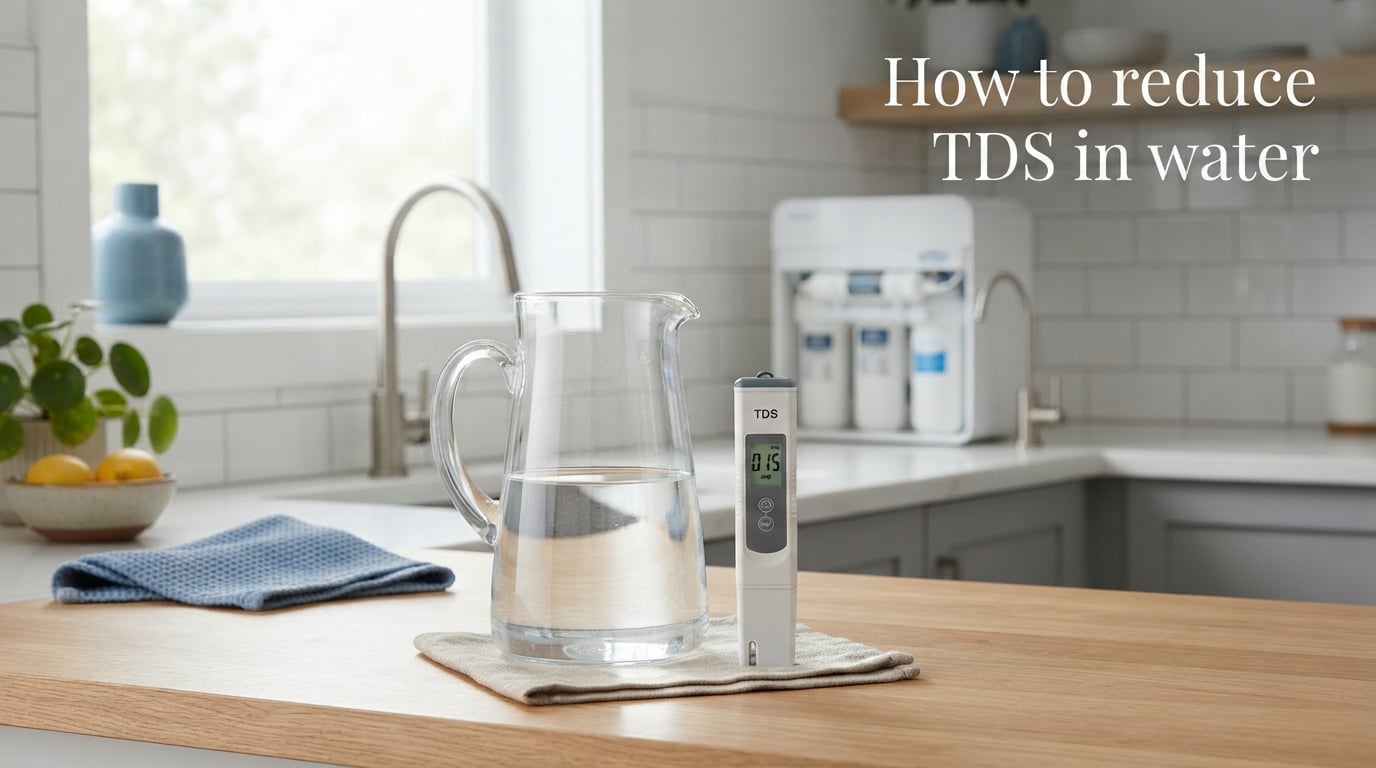
If you’ve ever poured a glass of water and noticed a faint metallic taste, white scale forming in your kettle, or chalky residue on your dishes, you’ve met TDS. TDS stands for Total Dissolved Solids, and it’s basically a measurement of everything dissolved in your water that isn’t H2O.
Some of those dissolved solids are good (calcium, magnesium, potassium are minerals your body actually uses). Others are not so good (lead, arsenic, nitrates, excess sodium). When TDS climbs above 500 ppm, most people start noticing taste issues, scale buildup, and questions about long-term health.
Our team has spent the last few months testing home water treatment setups and digging through EPA guidelines, peer-reviewed studies, and Reddit threads from aquarium hobbyists and homeowners. This guide pulls everything we found into one place so you can figure out how to reduce TDS in water without buying equipment you don’t need.
Quick spoiler: the most effective method is reverse osmosis, but it’s not always the most practical. We’ll walk through seven approaches, what each costs, and when each one makes sense.
Table of Contents
What Is TDS and Why Does It Matter?
TDS is short for Total Dissolved Solids. It’s a number, expressed in parts per million (ppm) or milligrams per liter (mg/L), that tells you the combined concentration of all inorganic and organic substances dissolved in water.
Those substances include minerals (calcium, magnesium, potassium, sodium), salts, metals, and sometimes contaminants like lead or nitrate. Anything small enough to pass through a 2-micron filter counts toward the TDS reading.
Most home TDS meters actually don’t measure TDS directly. They use electrical conductivity. Pure water doesn’t conduct electricity very well, but water with dissolved ions does. The meter runs a tiny current between two electrodes and uses the conductivity reading to estimate TDS. That’s why the readings are approximate (within about 10% accuracy).
What’s a Good TDS Level for Drinking Water?
The EPA’s secondary drinking water guideline caps TDS at 500 ppm. That’s not a health-based limit; it’s an aesthetic one. Above 500 ppm, water starts tasting salty, bitter, or metallic, and you get visible scale in plumbing.
Here’s a rough scale our team uses when looking at home test results:
- Under 300 ppm: Excellent for drinking and most appliances.
- 300–500 ppm: Acceptable but worth watching. Coffee and tea may taste slightly off.
- 500–1000 ppm: High. Consider treatment if taste or scale bothers you.
- 1000–2000 ppm: Very high. Not ideal for drinking; strong scaling.
- Above 2000 ppm: Unusual. Often indicates well water contamination or salty intrusion.
For reference, premium bottled mineral waters like Vichy Célestins or Contrex can hit 2000–3000 ppm on purpose, and people drink them for the mineral content. The contrast is intentional: in some cases high TDS is a feature, not a bug. If you’re curious, our piece on high-TDS mineral water examples explains the difference in plain English.
TDS vs Hardness: What’s the Difference?
Water hardness measures just calcium and magnesium (and a few other divalent cations). TDS measures everything. A water supply can be very hard and still have moderate TDS, or it can be soft but high in sodium from a salt-based softener.
This matters because some treatment methods reduce hardness without reducing TDS (water softeners), and some reduce TDS without distinguishing which minerals are gone (reverse osmosis). If you only care about scale prevention, hardness is your target. If you care about overall dissolved load or specific contaminants, TDS is the better marker.
Health and Appliance Implications of High and Low TDS
Most articles only tell you that high TDS is “bad.” That’s not the whole story, and our team wants to be honest about what we found.
What Happens When TDS Is Too High
High TDS water (above 500–600 ppm) has three practical effects:
Taste. Calcium and magnesium make water taste flat; sodium and chloride make it taste salty; sulfates give a bitter edge. Most people prefer water in the 50–300 ppm range.
Appliance damage. Calcium and magnesium carbonate form scale on heating elements, in pipes, and inside coffee makers. Over time, scale reduces efficiency and shortens equipment life. If you’ve ever pulled apart a kettle and seen a chalky white crust, you’ve seen TDS at work.
Possible contaminants. High TDS doesn’t automatically mean dangerous, but it’s a flag. If your water has 800 ppm TDS from agricultural runoff, some of that could be nitrate, which has a real health threshold (10 ppm for nitrate-nitrogen). Lab testing is the only way to know what’s actually in there.
What Happens When TDS Is Too Low
Yes, you can over-treat water. Reverse osmosis can push TDS to 5–20 ppm, which technically is very pure water, but most people find it tastes flat or “empty.”
There are also legitimate concerns about drinking zero-TDS water over long periods. The World Health Organization published a 2005 report noting that demineralized water (under about 100 ppm) may have adverse effects on mineral balance and may pull minerals from the body if consumed regularly. The report has been debated for 20 years, but the practical takeaway from our research is this: drinking some mineral-containing water is probably better than drinking none.
That’s why serious coffee enthusiasts and reef aquarium hobbyists “remineralize” their RO water by adding small amounts of specific salts back in. We wrote about the practical side of this in our guide to remineralizing RO filtered water. If you go the RO route, you’ll want to think about what you’re replacing.
How to Reduce TDS in Water: 7 Proven Methods
Now the practical part. Below are the seven most reliable ways to reduce TDS, ranked roughly from most effective to least. We’ll cover cost, efficiency, and trade-offs so you can pick the right one for your situation.
1. Reverse Osmosis (Most Effective)
Reverse osmosis (RO) is the gold standard for residential TDS reduction. It typically removes 95–99% of dissolved solids, including the things that other filters (carbon, sediment) leave behind.
Here’s how it works: tap water is forced through a semipermeable membrane under pressure. The membrane has pores small enough to block dissolved ions, salts, and larger molecules. Clean water passes through; the concentrated waste (brine) goes down the drain.
Pros: Highest removal efficiency on the market, available in under-sink, countertop, and whole-house configurations, relatively low operating cost (typically a membrane replacement every 2–3 years at around $50–$100).
Cons: Produces 2–4 gallons of wastewater per gallon of treated water (depends on system age and water pressure), removes beneficial minerals alongside contaminants (you may need a remineralization cartridge if you find the taste too flat), slow flow rate on smaller units (often requires a storage tank).
Our team installed a basic 4-stage under-sink RO unit in a test kitchen. Initial TDS reading from the tap was 380 ppm. After treatment: 12 ppm. Cost for the unit was about $170, plus $40 in filters per year. For most homeowners with persistently high TDS, RO is the most reliable answer.
2. Distillation
Distillation removes TDS by changing water to steam, leaving the dissolved solids behind in the boiling chamber, and then condensing the steam back into liquid.
A countertop distiller boils roughly 1 gallon at a time, runs for about 4–5 hours, and produces 1 gallon of essentially pure water (TDS typically under 5 ppm). The boiling chamber must be cleaned regularly to remove the scale that builds up from the rejected minerals.
Pros: Extremely high removal efficiency (99%+), no filter replacements (just periodic cleaning), produces zero wastewater (the minerals stay in the chamber).
Cons: Slow (4–5 hours per gallon), energy-hungry (about 3 kWh per gallon), strips all minerals leaving flat-tasting water, holding tank size limits daily output.
Distillation is best for people who want maximum purity in a small volume (lab use, baby formula, certain medical needs) or who have unreliable electricity and need a simple, no-filter approach.
3. Deionization (DI)
Deionization passes water through resin beads that exchange hydrogen and hydroxide ions for the dissolved cations and anions. The result is water so pure it can approach zero TDS.
Residential DI typically comes as a portable cartridge you hook up to a faucet or use with RO water as a polishing stage. Pharmaceutical and electronics manufacturers use much larger industrial DI systems.
Pros: Very high removal efficiency, easy to set up as a polishing stage, no electricity required.
Cons: Resin beads exhaust relatively quickly (cost depends on usage but can run $0.10–$0.50 per gallon), offers no protection against bacteria or organic contaminants (DI does not equal microbiologically pure), wasteful if used as the primary method on unfiltered tap water.
DI shines as the “polish” after RO for aquarium, lab, or specialty brewing applications. It is less practical as a whole-house solution.
4. Water Softeners and Why They Don’t Truly Reduce TDS
This one surprises people. Salt-based water softeners use ion exchange to swap calcium and magnesium for sodium (or potassium). The hardness goes down, but the TDS often stays the same or even goes up slightly, because the sodium that replaces the calcium still counts as dissolved solids.
Test data from ion exchange shows softeners reduce TDS by only about 5–15% on typical hard water. They are excellent for scale prevention in pipes and water heaters, but they will not deliver meaningful TDS reduction for drinking water.
If you’ve been told otherwise (a common sales pitch), the data doesn’t back it up. The TDS reading in your softener-treated water will look very similar to the unsoftened reading.
5. Natural Methods to Lower TDS
You asked about this on forums, and we want to give you straight answers.
Boiling does not reduce TDS. Boiling kills microorganisms and can precipitate some temporary hardness, but the dissolved solids stay in the water. If anything, TDS slightly increases because steam leaves and minerals stay.
Letting water stand does nothing for TDS. It lets chlorine off-gas, but the minerals don’t leave.
Rainwater is naturally low in TDS (typically 5–20 ppm) but is not safe to drink without treatment because of atmospheric contaminants, bird droppings on collection surfaces, and microbial growth in storage tanks. If you collect rainwater for drinking, route it through UV or a ceramic filter first.
Reverse osmosis is the only practical “natural” path to real TDS reduction at home, since the membrane separation mimics what happens in nature (water passing through soil layers into aquifers).
If your TDS is “just” 300–400 ppm and you’re on municipal water, often the cheapest solution is no treatment at all. Just drink it and enjoy the minerals.
6. Capacitive Deionization (CDI)
CDI is the emerging tech worth watching. It uses electrical fields to pull ions out of water and onto charged surfaces. When the surface is full, the polarity flips, the ions release, and the system regenerates.
It’s not yet common in homes, but a few consumer units have appeared. Removal efficiencies range from 50–90%, depending on the system and target ions.
Pros: Lower energy than RO, no consumable filters in the traditional sense.
Cons: Limited residential availability, less proven in long-term home use, more expensive upfront.
If you’re interested, keep an eye on this category, but we wouldn’t recommend it over RO for most homeowners yet.
7. Comparing All Methods Side by Side
| Method | TDS Removal | Typical Cost (USD) | Best For |
|---|---|---|---|
| Reverse Osmosis | 95–99% | $150–$600 unit + $40/yr filters | Whole-home drinking water |
| Distillation | 99%+ | $100–$300 unit + electricity | Small volumes, max purity |
| Deionization | 95%+ | $30–$100 cartridge + replacement | Aquarium, lab polishing |
| Water Softener | 5–15% | $500–$2000 installed | Scale prevention, not TDS |
| Capacitive Deionization | 50–90% | $400–$1,500 emerging units | Tech-forward homeowners |
| Carbon Filter (Brita etc.) | Minimal | $30–$200 | Taste, chlorine, not TDS |
| UV or Boiling | 0% | $50–$300 | Bacteria, not TDS |
If you skipped the table: carbon filters and UV do basically nothing for TDS. This is why water filter options that remove minerals come with a specific TDS-removal design, and not all of them.
How to Test TDS at Home
Before you spend money on treatment, test your water. A reliable handheld TDS meter costs $15–$30 and is well worth it.
Choosing and Using a TDS Meter
Look for a meter that reads in ppm, has automatic temperature compensation (without it, readings shift 2–3% per degree Celsius), and is from a brand with replaceable batteries. Popular consumer options include the HM Digital COM-100 and the TDS-EZ.
To use one: turn it on, immerse the probe in water up to the marked line, stir gently, and wait for the reading to stabilize (about 10–20 seconds). Rinse with distilled or RO water between samples to avoid cross-contamination.
Testing Procedure
- Run the tap for 30 seconds to clear standing water in the pipes.
- Fill a clean glass with the sample water.
- Test immediately or let the sample cool to room temperature first.
- Record the reading in ppm.
- Repeat weekly for a month to see if your TDS is stable or fluctuating.
Calibration Matters
Meters drift over time. Calibrate monthly using a calibration solution (usually 342 ppm NaCl, available where you bought the meter). Drop the probe in, adjust the small screw or button until the reading matches, and you’re set.
One caveat about what TDS meters don’t do: they tell you how much is dissolved, not what is dissolved. A reading of 600 ppm from calcium-rich water and a reading of 600 ppm from sodium-rich water look identical on the meter. If you need to know what is actually in your water (lead, nitrate, arsenic, etc.), you need a lab test through your state health department or a certified lab like Tap Score.
When to Call a Professional
Bring in a water treatment specialist if your TDS is over 1000 ppm, if you suspect contamination from old pipes or a septic system nearby, if lab testing turns up specific contaminants above EPA action levels, or if you want a whole-house system installed (electrician or plumber required for many setups).
If your TDS is under 500 ppm and you just want better-tasting drinking water, a countertop or under-sink RO is a manageable DIY install.
Frequently Asked Questions
How to reduce TDS in water naturally?
Truly natural TDS reduction at home is limited. Rainwater is naturally low in TDS (5–20 ppm) but needs UV or ceramic treatment before drinking due to microbial risk. Boiling, letting water stand, and charcoal filters (like Brita) do not meaningfully reduce TDS. The most reliable natural-physical method is distillation or reverse osmosis, which mimic natural water purification processes.
What is a good TDS for tap water?
A good TDS range for tap water is 50–300 ppm. The EPA’s secondary guideline is 500 ppm, meaning above that, taste and scale issues become noticeable. Excellent municipal water typically falls between 100–250 ppm. Anything under 50 ppm will taste flat to most people, and anything above 500–600 ppm usually tastes mineral-heavy or salty.
Can I bathe with 500 TDS water?
Yes, 500 TDS water is safe for bathing and showering. The EPA’s 500 ppm guideline is a taste and aesthetic limit, not a health limit for skin contact. At 500 ppm you may notice slight dryness or that soap does not lather as well, but it will not harm you. Hardness minerals (calcium and magnesium) are a bigger factor for bathing comfort than total TDS.
Can we reduce TDS without RO?
Yes. Distillation removes 99%+ of TDS by boiling water and condensing the steam. Deionization exchanges dissolved ions for hydrogen and hydroxide ions, achieving 95%+ removal. Capacitive deionization is an emerging option with 50–90% removal. Each has trade-offs: distillation is slow and energy-heavy, deionization cartridges exhaust quickly, and CDI is still emerging for residential use.
Do Brita filters reduce TDS?
Brita filters and other standard carbon pitchers do not meaningfully reduce TDS. They remove chlorine, some heavy metals, and improve taste, but they let most dissolved minerals pass through. A TDS meter reading before and after a Brita pitcher will typically be within 5–10% of each other. For real TDS reduction you need reverse osmosis, distillation, or deionization.
Can boiling water remove TDS?
No, boiling does not reduce TDS. Dissolved minerals (calcium, magnesium, sodium, etc.) do not evaporate with water at boiling temperature. Boiling removes microorganisms and can precipitate temporary hardness, but the total dissolved solid content actually rises slightly because water leaves as steam while minerals remain in the pot.
Final Thoughts on Reducing TDS in Water
Here’s the summary of what we found and what we recommend.
If your tap water comes back at 300 ppm or below and you’ve had it tested for contaminants, do nothing different. Your water is fine, and reducing TDS further will mostly remove minerals you’re better off having.
If your TDS is 400–800 ppm, start with a countertop or under-sink reverse osmosis unit and consider whether you want a remineralization cartridge. RO handles 95–99% of dissolved solids and pays for itself in a couple of years over bottled water.
If your TDS is above 1000 ppm or you’ve got specific concerns (lead, arsenic, nitrates from a well), get a lab water test first. Then choose treatment based on the result. Sometimes the answer isn’t RO. Sometimes it’s an inline filter targeted at one contaminant.
Whichever path you take, understanding your TDS reading, knowing what each method does and doesn’t do, and resisting the urge to over-treat good water will save you money and give you better-tasting, better-balanced water in your glass.
For more on mineral water, water filtration, and how dissolved solids interact with taste, explore the rest of the MineralWaters.org archive. We’ve been writing about water quality since long before it became trendy, and we have opinions on everything from Vichy Célestins to countertop RO units.