
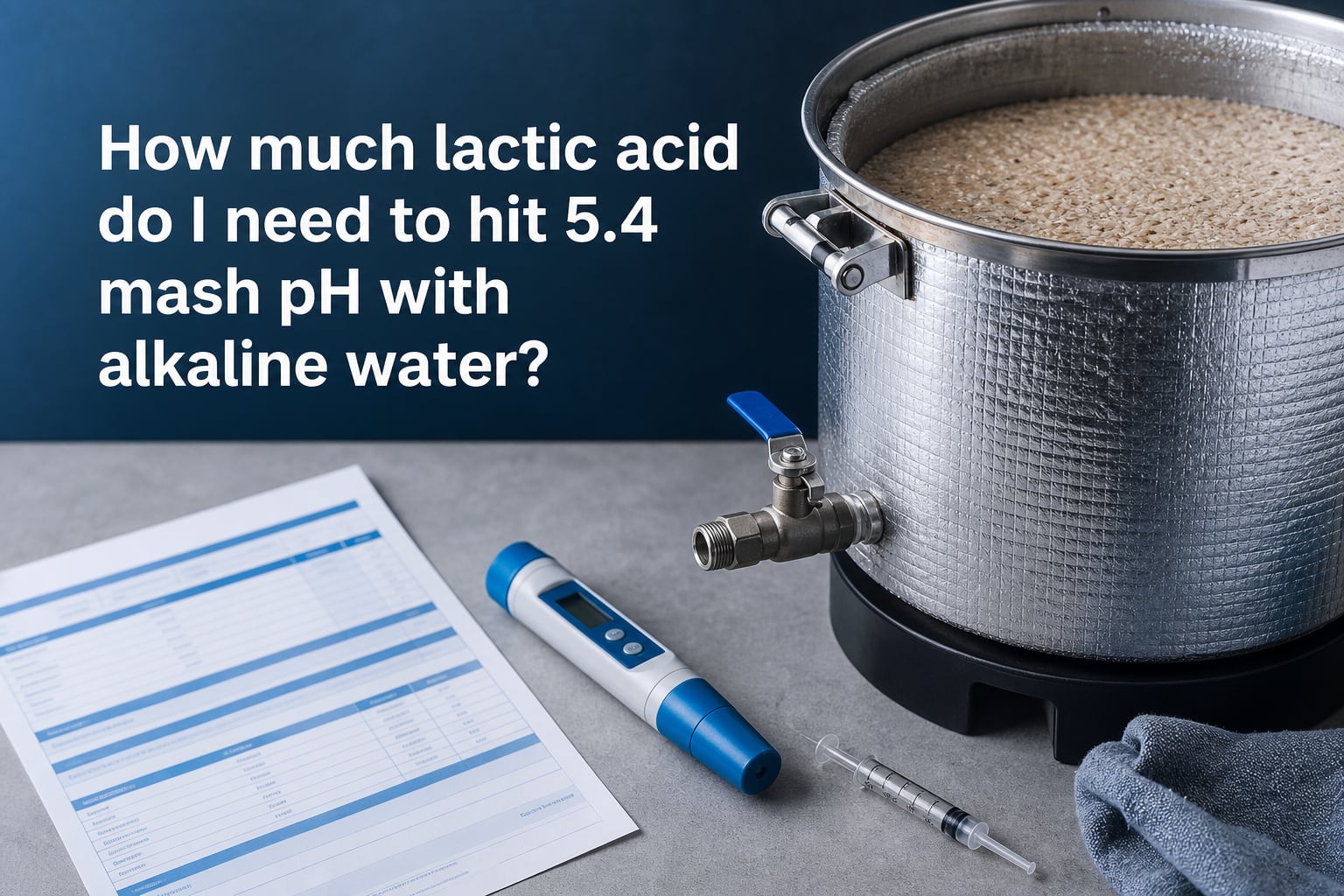
For lactic acid mash pH 5.4 alkaline water, there is no single millilitre answer. You need your water alkalinity in ppm as CaCO3, the volume of brewing water, the grain bill, and the strength of the lactic acid; water pH by itself cannot predict the dose.
A useful first estimate for 88% lactic acid is 0.1 mL per litre of water for each 50 ppm of alkalinity you want to neutralize. Treat that as a water-treatment estimate, not a promise that the mash will land at 5.4, because malt provides its own buffering and acidity.
For a five-gallon batch, forum brewers often report roughly 4–6 mL of 88% lactic acid, and one documented Brulosophy brew used 4.5 mL to target 5.4. Those figures are helpful reality checks, but they are not a recipe: water volume, alkalinity, and malt weight were part of each result.
Quick answer: Get an alkalinity number, model your actual grain bill in a brewing-water calculator, add about 70–80% of its 88% lactic-acid estimate to the strike water, then measure a cooled mash sample and make small corrections. This sequence is safer than trying to force a result from the tap-water pH printed on a report.
Table of Contents
Lactic acid mash pH 5.4 with alkaline water needs an alkalinity-based estimate
Start with the relationship below when you have 88% lactic acid and alkalinity expressed as ppm CaCO3. It approximates the acid needed to neutralize a chosen share of water alkalinity before the grain bill is considered.
Estimated 88% lactic acid in mL = water volume in litres × alkalinity reduction needed in ppm CaCO3 ÷ 500.
The same idea can be written as 0.1 mL per litre for every 50 ppm CaCO3. If your acid is not 88%, do not substitute this figure without checking its concentration; a weaker solution needs a larger volume to provide similar acid.
An example shows the arithmetic, not a guaranteed mash result
Imagine 25 litres of mash water with alkalinity of 200 ppm as CaCO3. Neutralizing all 200 ppm gives 25 × 200 ÷ 500 = 10 mL of 88% lactic acid as a water-only estimate.
That does not mean 10 mL will hit a 5.4 target mash pH. A pale malt bill, a dark-grain bill, calcium and magnesium salts, the actual mash thickness, and the fraction of alkalinity you decide to neutralize all change the final reading.
For that reason, a brewing-water calculator should receive the water report, each water volume, salts, acid type and strength, and grain bill. Bru’n Water and BeerSmith are examples mentioned by brewers as planning tools; use either output as a starting dose that a meter can check.
Important: Do not calculate from source-water pH alone. Two waters can have the same pH yet resist acid differently because their bicarbonate content, reported as alkalinity, is different.
A 5.4 mash pH supports a practical middle target for most mashes
A cooled mash pH around 5.4 sits inside the commonly cited 5.2–5.6 brewing range, with 5.3–5.5 often used as the practical centre. At this range, mash enzymes can convert starch effectively while the brewer avoids the problems associated with an unusually high mash pH.
Target selection is not a law. A recipe, malt bill, and desired beer profile can support a slightly different point within the range, so 5.4 is a sound target only when it suits the recipe and your established process.
Light beers make the water question more visible because pale malts and light specialty grains contribute less acidifying effect than a grist with substantial dark malt. That is why a pilsner-style mash made with alkaline tap water can require more attention than a darker beer brewed with the same water.
Alkalinity is the resistance that matters
Alkalinity describes the water’s capacity to neutralize acid, usually driven by bicarbonate. In brewing terms, it is the part of the water profile that can push a pale mash upward and make a pH adjustment harder to predict.
Water pH is a snapshot of how acidic or basic the water is at the moment of testing. It does not tell us how much acid the water can absorb, so it cannot replace an alkalinity result in a mash acidification calculation.
Look for alkalinity as CaCO3 on a municipal water report or have the water tested. If the report lists bicarbonate instead, enter the number in the unit requested by your calculator rather than guessing at a conversion.
The right lactic-acid dose comes from a measured, staged brew-day process
The most repeatable approach combines a calculation before dough-in with a real measurement after the grain and water have met. I would rather be slightly short of a predicted dose and correct carefully than overshoot a mash with a large addition that cannot be removed.
Get the water inputs. Record alkalinity, calcium, magnesium, sodium, chloride, sulfate, and the planned strike and sparge volumes. Alkalinity is the non-negotiable figure for alkaline-water brewing.
Enter the full grain bill. Include base malt, crystal malt, roasted grains, and acidulated malt if the recipe uses it. Grain color alone is not a precise substitute for the actual malts in a calculator.
Set water volumes and salt additions. Add planned calcium chloride or gypsum additions before asking the calculator for an acid dose, because mineral additions influence the estimated mash chemistry.
Select the exact acid. Choose lactic acid and enter its stated concentration, such as 88%, rather than assuming every bottle is identical.
Add a conservative first portion. Put roughly 70–80% of the calculated lactic acid into the strike water before dough-in. This community practice leaves room for a measured correction.
Mash, wait, and measure correctly. Pull a representative sample after the mash has mixed and settled, cool it to the temperature used for your meter and target, then take the reading.
Correct in small increments. If the cooled sample is above the target, add a small, measured amount of acid, stir thoroughly, wait for the mash to equalize, and measure again.
This order answers a frequent homebrewing concern: conversion begins before you can wait around for a pH reading. A calculation gets most of the acid in before the mash starts, while the retained portion gives you control rather than asking the pH meter to rescue an unplanned brew.
A small correction is more informative than a large one
There is no dependable universal statement that one millilitre changes every mash by the same number of pH points. One forum report described 1 mL of 88% lactic acid lowering about 5.25 gallons by roughly 0.2 pH units, but that experience belongs to one water-and-grain setup.
Record the starting reading, volume added, stirred waiting time, and new reading. After two or three batches using the same source water, those notes become far more useful than a generic rule of thumb.
Warning: Acid added to an unstirred mash can create a local low-pH pocket and an unrepresentative reading. Add the correction gradually, stir completely, and allow the sample to reflect the whole mash before deciding on another addition.
A calibrated, cooled pH reading makes the acid calculation trustworthy
Measure mash pH on a cooled sample at the meter’s reference temperature or the method you consistently use. A hot mash reading and a cooled mash reading are not interchangeable, so comparing one directly to a 5.4 target can lead to the wrong correction.
Calibrate the pH meter with the appropriate buffer solutions before the brew session and follow the meter’s instructions for rinsing, storage, and temperature handling. Automatic temperature compensation helps the instrument interpret electrode temperature; it does not make mash-temperature and room-temperature pH targets the same thing.
Use a clean cup or sample vessel and avoid trusting the first number while the reading is still drifting. If a value looks surprising, check calibration, sample temperature, and whether the mash was stirred before treating the number as a chemistry problem.
Water reports and brewing calculators reduce the first-pass error
A water report tells the calculator what the source water brings into the mash. The grain bill tells it how the mash is likely to respond, which is why neither a water-only formula nor a grain-only guess can answer the question precisely.
When municipal water changes seasonally, an older report can become a weak assumption. If your once-reliable dose starts missing the target, verify the current alkalinity before changing several other variables at once.
Reverse-osmosis or distilled water can simplify an exceptionally alkaline-water situation because it starts with very low mineral content and lets the brewer build the profile deliberately. It is an alternative process, not a requirement, and it still requires a recipe-appropriate mineral plan.
88% lactic acid requires concentration-aware dosing and flavor restraint
“88% lactic acid” states the concentration of the solution, not a preferred dose. The alkalinity estimate in this guide specifically uses the forum-supplied rule of thumb for 88% acid, so it should not be applied unchanged to a different concentration.
Lactic acid is common in brewing because it is food-grade and easy to dose with a small syringe. It also leaves lactate behind, and some brewers are more sensitive to its tang than others; research cited in competitor analysis places a reported lactate taste threshold around 300–400 ppm.
That threshold is not a target or a guarantee that a lower amount will be invisible in every beer. It is a reason to avoid casual overcorrection, especially with very alkaline water and delicate pale beer.
Phosphoric acid is an alternative when lactate contribution is a concern
Phosphoric acid can also lower mash pH and acidify sparge water. Its dose cannot be copied from a lactic-acid calculation because strength and acid behavior differ, so select the correct acid and concentration in the calculator.
A Brulosophy comparison planned 4.1 mL of 75% phosphoric acid and 4.5 mL of 88% lactic acid for a 5.4 target in its specific setup. The comparison is a useful reminder that similar target pH values can require different volumes even before your own water and malts enter the picture.
Sparge-water acidification prevents alkaline water from undoing mash control
Sparge water deserves separate treatment because it usually has a different volume and does not contain the same grain buffering as the mash. If alkaline sparge water is left untreated, it can raise runoff pH as the grain bed becomes less protective.
Plan the sparge-water acid dose with its own volume and alkalinity, not by adding it blindly to the mash figure. The mash-pH target and sparge-water treatment goal are related but not interchangeable calculations.
Keep notes for the two water portions separately. Clear records of strike water, sparge water, acid concentration, acid volume, mash pH, and runoff observations make the next batch easier to adjust.
High or low readings have a short list of likely causes
A mash pH that remains high after a reasonable calculated addition often points to higher-than-assumed alkalinity, a water-report mismatch, an incomplete grain-bill entry, or a measurement made at an inconsistent temperature. Recheck those inputs before adding several more millilitres.
A mash pH that falls below the target usually means the acid estimate was too aggressive, the water alkalinity was lower than assumed, or the grain contribution was more acidifying than the model expected. You cannot remove added acid, so the best response is to document the result and avoid repeating the same starting dose.
Very alkaline water may call for a different starting strategy
When the calculation points to a substantial acid addition, blending with reverse-osmosis water can reduce the alkalinity burden before you begin. That can make the mash adjustment smaller and reduce the amount of lactate added to a light beer.
Acidulated malt is another option mentioned in brewing discussions, but it changes the grist and must be included in the recipe calculation. It is not a generic substitute for knowing the water profile.
Our practical rule for repeatability is simple: change one input at a time. If you change water source, minerals, acid type, and grain bill at once, the next pH result cannot teach you which decision mattered.
FAQs
How much lactic acid do I need to adjust mash pH?
Use a calculator for the exact grain bill and water profile. As a first estimate for 88% lactic acid, 0.1 mL per litre neutralizes about 50 ppm of alkalinity as CaCO3; add roughly 70–80% of the estimate before dough-in, then measure a cooled sample and correct slowly.
What is the pH of a 5% lactic acid solution?
The pH of a 5% lactic acid solution is not a reliable way to calculate a mash dose because it changes with concentration, temperature, and measurement conditions. Use the solution concentration and a brewing-water calculator or alkalinity-based estimate instead of trying to dose from the acid solution’s pH.
How much lactic acid does it take to drop pH?
There is no fixed number of millilitres per pH point for every mash. Water alkalinity, water volume, malt buffering, mineral additions, and lactic-acid strength all affect the result; calculate a first dose, measure a cooled mash sample, and add only small follow-up amounts.
What is the best pH for mash?
A cooled mash pH around 5.4 is a common target and sits within the frequently recommended 5.2–5.6 range. The best point depends on the recipe and process, but 5.3–5.5 is widely used as a practical range for starch conversion and beer quality.
The reliable answer is to calculate, measure, and log every adjustment
How much lactic acid you need to hit 5.4 mash pH with alkaline water depends on alkalinity, water volume, grain bill, salts, and acid strength. Use the 88% acid estimate as a starting point, but let a calibrated meter and a cooled sample make the final decision.
For your next brew in 2026, begin with a current water report, enter the complete recipe into a calculator, reserve part of the predicted acid dose, and write down the result. That record turns mash pH adjustment from an uncertain correction into a repeatable part of your process.