
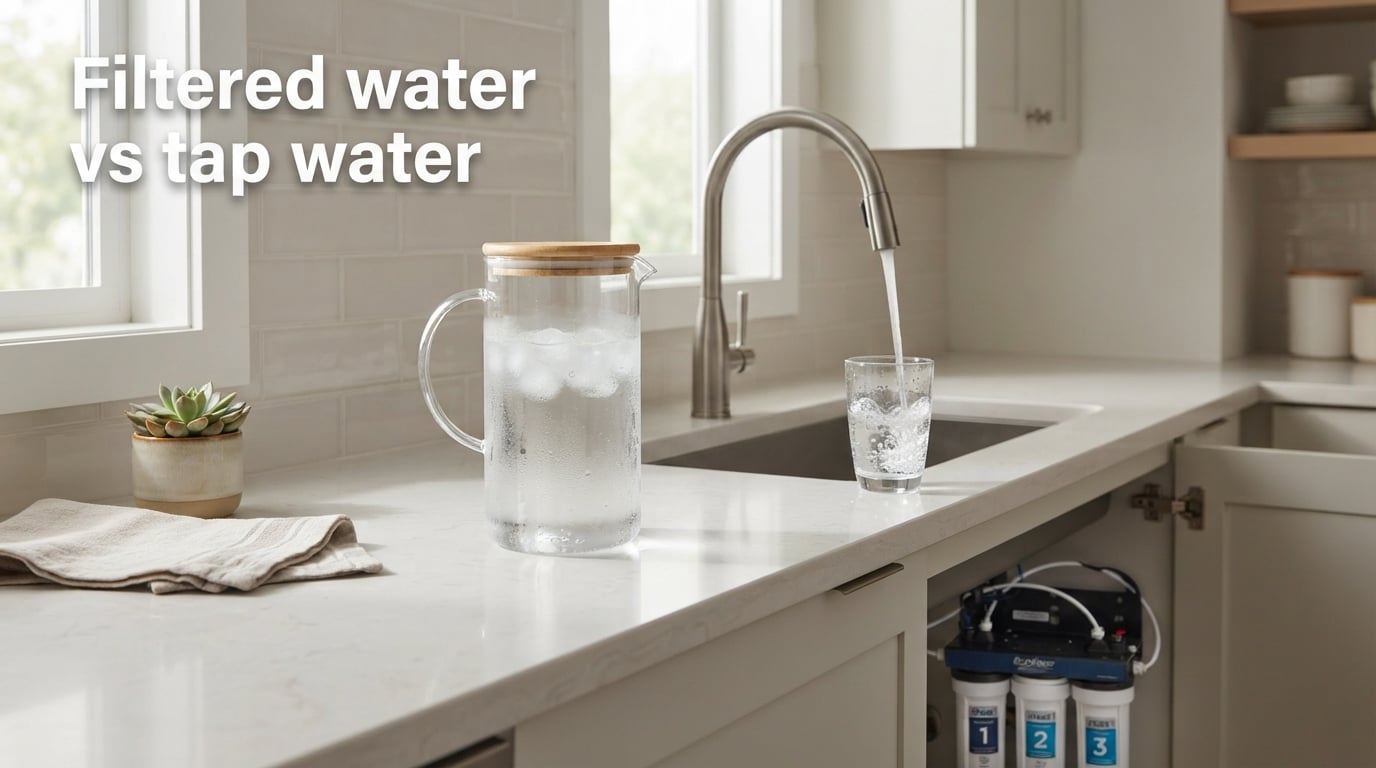
When I started researching filtered water vs tap water for our team, I expected a clean answer. What I found instead was a debate full of nuance. Both options can be perfectly safe in the right conditions, and both can fall short in the wrong ones. The real question is not which one is universally better. It is which one fits your local water quality, your plumbing, and your health priorities.
This guide breaks down the differences you actually care about. We cover what tap water and filtered water really are, the contaminants each addresses, the mineral stripping debate, the PFAS conversation, and the practical reasons people choose one over the other. By the end, you will have a clear framework for deciding what makes sense in your home.
Table of Contents
What Is Tap Water and Where Does It Come From?
Tap water is the treated water that comes out of your faucet, sourced from either a municipal supply or a private well. In cities and suburbs, it is pulled from surface water (rivers, lakes, reservoirs) or groundwater (aquifers) and sent through a treatment plant before it reaches your home. In rural areas, tap water often comes straight from a private well that the homeowner is responsible for testing.
The EPA regulates municipal tap water under the Safe Drinking Water Act. Treatment plants must remove or reduce contaminants like bacteria, viruses, lead, copper, chlorine byproducts, and dozens of other regulated substances. They also add disinfectants, usually chlorine or chloramine, to keep the water safe as it travels through miles of pipes to your tap.
One thing most people do not realize is that tap water quality varies dramatically by region. A 2025 study from the Environmental Working Group found that more than 320 contaminant compounds have been detected in US tap water supplies, though most fall below regulatory limits. If you want to know exactly what is in your water, your local utility publishes an annual Consumer Confidence Report, which is free and required by federal law.
Well water is a different story. Private wells are not regulated by the EPA. The homeowner is responsible for testing and treatment, which means the same label of tap water can mean very different things depending on whether it is municipal or private. This is one of the biggest reasons people start considering filtration.
What Is Filtered Water and How Does It Work?
Filtered water is any water, usually tap water, that has been passed through a system designed to remove specific contaminants. The definition is broad because filtration comes in many forms, and each targets different things. Some filters focus on chlorine taste. Others strip out lead, mercury, or PFAS chemicals. A few remove almost everything, including the minerals that give water its character.
The most common filtration technologies you will encounter include activated carbon, reverse osmosis, ion exchange, and mechanical filtration. Activated carbon, used in Brita pitchers and most refrigerator filters, is excellent at trapping chlorine, volatile organic compounds, and many PFAS variants. Reverse osmosis pushes water through a semipermeable membrane that removes up to 99% of dissolved solids, including heavy metals and fluoride. Ion exchange swaps hardness minerals like calcium and magnesium for sodium or potassium. Mechanical filters catch sediment and debris.
Filter systems themselves range from simple pitchers to whole-house setups. Pitcher filters like Brita are cheap and easy but slow. Faucet-mounted filters offer faster flow at moderate cost. Under-sink and reverse osmosis systems deliver the cleanest water but require installation. Whole-house filters treat everything from the shower to the kitchen tap, which matters if you are concerned about skin absorption of chlorine or hardness buildup in pipes.
If you are curious how this connects to mineral content, our team recently wrote about remineralized filtered water and why some reverse osmosis users add minerals back in. It is a useful read if you are weighing which filter type matches your taste preferences.
Filtered Water vs Tap Water: The Key Differences That Matter
The biggest difference between filtered water and tap water is control. Tap water quality depends on your utility, your pipes, and your local geology. Filtered water quality depends on the system you choose. That trade-off, public infrastructure versus personal choice, is the heart of this comparison.
On contaminants, filtration typically reduces chlorine, lead, mercury, pesticides, and certain PFAS compounds that may slip through municipal treatment. Tap water already addresses bacteria and viruses at the source, so filtration adds a second layer rather than replacing the first. A 2024 review by the Water Research Foundation found that point-of-use filters reduced lead concentrations by an average of 78% in homes with service line risk.
On minerals, tap water often contains calcium, magnesium, and trace amounts of others depending on the source. These contribute to water hardness and can affect taste. Most filters, especially activated carbon, leave minerals largely intact. Reverse osmosis and distillation strip them out almost completely. Whether that matters depends on your overall diet, since the minerals in water represent a small fraction of what most people consume from food.
On taste and odor, filtered water usually wins, especially in areas with heavy chlorination. Activated carbon removes the chemical bite that some people detect immediately. Hardness minerals do not have a strong flavor but can leave a film or scale in kettles and pipes. For tea drinkers and coffee brewers, this matters a lot. The way mineral content shapes flavor is something we explored in our piece on mineral water taste, and the same chemistry applies to filtered water.
On cost, tap water is essentially free per gallon, often under a penny. Filtered water ranges from a few cents per gallon with a pitcher filter to over 25 cents per gallon with a reverse osmosis system. Bottled water, by contrast, costs roughly $1 to $3 per gallon when you factor in the plastic. The environmental footprint follows the same pattern.
Health Benefits and Risks of Filtered and Tap Water
Both filtered and tap water can be perfectly healthy. Both can also carry risks that depend entirely on context. The key is matching your water source to your specific concerns rather than assuming one is safer than the other by default.
PFAS, sometimes called forever chemicals, are one of the most talked-about concerns right now. The EPA finalized strict limits on six PFAS compounds in 2024, but detection still varies by region. A 2023 study by the US Geological Survey found PFAS in about 45% of tested tap water samples nationwide. Reverse osmosis and granular activated carbon filters are the most effective at reducing PFAS, while basic pitcher filters often miss the smallest molecules. If PFAS is a concern in your area, NSF/ANSI 53 or 58 certified filters are worth the upgrade.
Lead is another priority. Older homes, especially those built before 1986, may have lead service lines or lead solder in plumbing. Even when the water leaving the treatment plant is clean, it can pick up lead on the way to your tap. A NSF-certified filter rated for lead reduction can cut that risk substantially. This is one scenario where filtered water clearly beats tap water for most households.
The mineral stripping debate is more nuanced. Some wellness influencers claim that filtered water is “dead” because it lacks minerals, but most nutritionists disagree. The minerals in water represent a tiny fraction of daily intake compared to food. A liter of hard tap water might contain 50 mg of calcium, while a single serving of yogurt delivers 150 mg. For most people with a balanced diet, mineral stripping is not a health risk. It is a taste and possibly an acid-base balance concern, but not a deficiency concern.
Filter maintenance carries its own risks that most people overlook. The BBC reported in 2024 that neglected pitcher filters can harbor bacteria, especially if they sit at room temperature for weeks. We have seen the same concern raised on Reddit threads, where users in older homes worry about rusty pipes and trust issues with municipal water. If you use a filter, follow the replacement schedule. A clogged or expired filter can do more harm than no filter at all.
For a deeper look at how filters affect mineral content, especially Brita systems, our team has a detailed article on Brita filters and mineral content. It is a good complement to this section if you want specifics.
Taste and Quality: What You Actually Notice
Taste is where filtered water and tap water diverge the most for everyday users. In blind tests, most people can tell the difference immediately, even when both are technically safe. Chlorine is the usual giveaway. Municipal systems add it deliberately to kill pathogens, but it leaves a sharp chemical note that some people find unpleasant.
Filtered water also tends to feel cleaner on the palate, especially when the source water is hard. Hardness minerals do not taste strong, but they leave a faint minerality and a chalky residue in tea or coffee. Reverse osmosis and distilled water can taste flat to some people precisely because those minerals are gone. It is a matter of personal preference, and there is no right answer.
On broader minerals in drinking water, the conversation gets more interesting. Silica, calcium, magnesium, and trace elements appear in different amounts depending on geology and treatment. None of these are harmful at typical levels, and some have modest health associations. But again, water is not the primary source for any of them in most diets.
Cost and Environmental Impact Over Time
The cost gap between filtered water and tap water is smaller than most people think. A basic pitcher filter runs roughly $30 to $50 for the unit plus $5 to $10 per replacement cartridge. For a household that drinks 2 liters per day, that works out to about 10 to 20 cents per gallon. Reverse osmosis systems cost more upfront, often $150 to $400, but ongoing replacement filters drop the per-gallon cost below 10 cents in many cases.
Bottled water is the most expensive option and the worst for the environment. The plastic bottles, the shipping, and the recycling rates all add up. A reusable bottle paired with a home filter saves money within a few months and dramatically cuts plastic waste. If your goal is reducing environmental impact, switching from bottled water to filtered tap water is one of the easiest wins available.
Whole-house filtration systems are the priciest option, often $1,000 to $4,000 installed, but they treat shower, bath, and laundry water too. That matters if you have hard water that damages appliances or skin sensitivities to chlorine. For most households, point-of-use filtration at the kitchen tap is enough.
When Is Filtration Actually Worth It?
Filtration makes the most sense when your tap water has a specific issue that a filter can solve. If you live in a city with excellent water quality, drink from a modern home, and do not mind the taste of chlorine, tap water is perfectly fine. If you live in an older home, are on a private well, or live in an area with known contamination, filtration addresses real risks.
My short rule of thumb after reviewing the research: if you can taste chlorine strongly, get a basic carbon filter. If your home was built before 1986, get a filter certified for lead. If you are on a well, get your water tested before choosing anything. If PFAS or specific industrial contaminants are a concern in your region, invest in reverse osmosis. Match the filter to the problem rather than buying the most expensive option.
Frequently Asked Questions
What are the disadvantages of filtered water?
The main drawbacks of filtered water are ongoing filter replacement costs, the risk of bacteria growth in neglected filters, and the loss of minerals if you use reverse osmosis or distillation. Some people also dislike the flat taste of heavily filtered water. For most households these are minor compared to the contaminant reduction benefits, but filter maintenance matters a lot.
What is the healthiest type of water to drink?
There is no single healthiest type. For most people, clean tap water from a regulated municipal source is perfectly healthy and often contains beneficial minerals. Filtered water becomes healthier when local water quality is poor, when plumbing is old, or when you are removing chlorine taste and odor. The best water is the one tested clean for your specific source.
Is bottled water just filtered water?
Often yes. Most bottled water starts as municipal tap water or natural spring water that has been filtered or treated before bottling. Some premium brands use reverse osmosis or distillation, while others add minerals back for taste. Bottled water is regulated by the FDA rather than the EPA, but the underlying source is frequently the same as your kitchen tap.
Does a Brita filter actually remove healthy minerals?
Brita and similar activated carbon filters remove very few minerals. They target chlorine, volatile organic compounds, and some heavy metals, but calcium and magnesium pass through mostly intact. Reverse osmosis and distillation are the systems that strip minerals. For most people with a balanced diet, the minerals removed by either system are not a meaningful health concern.
Final Thoughts on Filtered Water vs Tap Water
The filtered water vs tap water debate does not have a universal winner. Both can be safe, healthy, and good-tasting in the right context. The choice depends on your local source, your plumbing, your concerns about specific contaminants, and your taste preferences. I recommend starting with your free Consumer Confidence Report, then choosing a filter that targets the actual issues in your water rather than the most expensive one on the shelf.
Whichever path you pick, focus on quality, maintenance, and trust. Test your water if you have any doubt. Replace filters on schedule. And remember that filtered water vs tap water is rarely a one-size-fits-all answer, especially as we move through 2026 and water quality standards continue to evolve.