
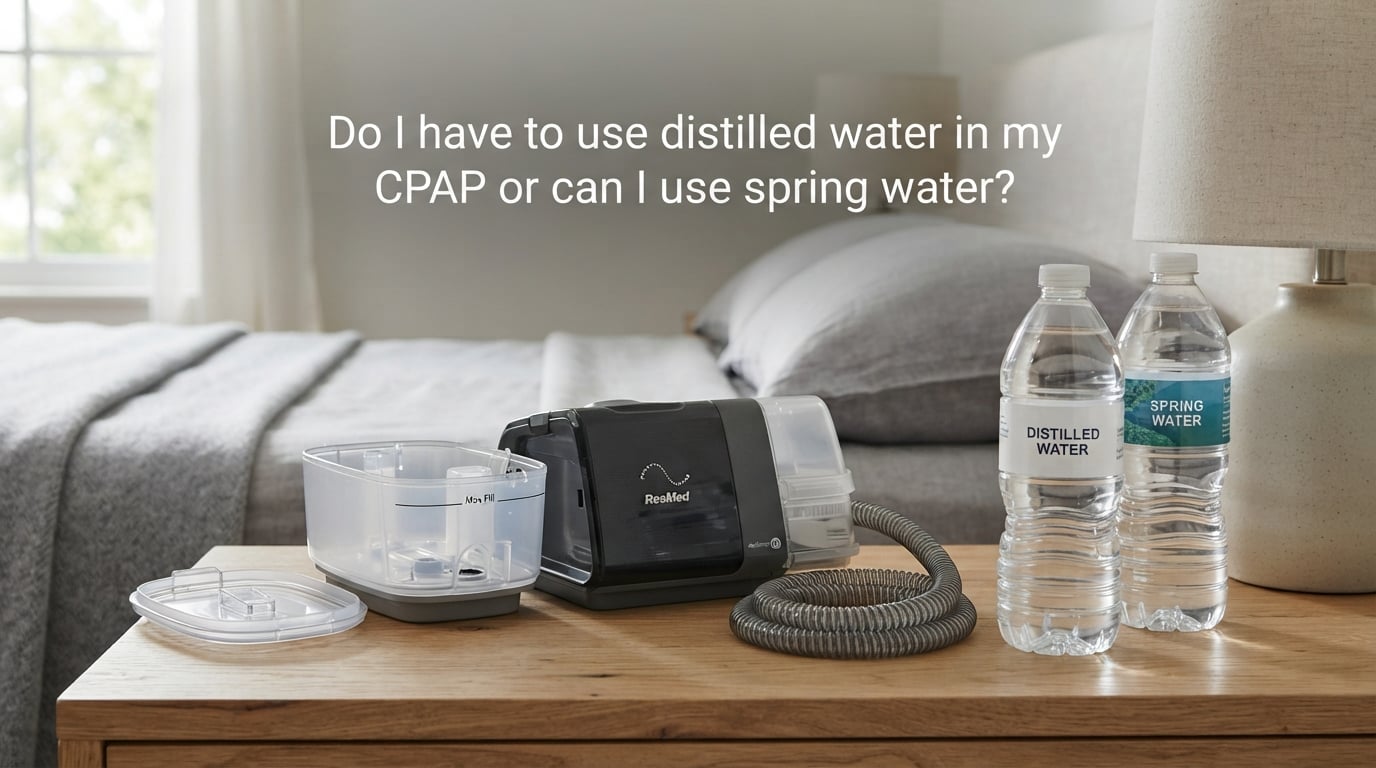
If you are asking, “Do I have to use distilled water in my CPAP or can I use spring water?”, the practical answer is to use distilled water whenever you use the humidifier. Spring water is not the preferred CPAP humidifier water because its dissolved minerals can leave deposits in the chamber; if it is your only short-term option, empty and clean the chamber afterward.
This is mainly an equipment-care issue, not a reason to skip prescribed CPAP therapy. Your device manual and sleep clinician are the right sources for instructions specific to your machine and treatment plan.
Table of Contents
Distilled water is the recommended choice for CPAP humidifiers
You do not need water for the airflow from a CPAP itself, but you do need the right water if you use its humidifier chamber. Manufacturers commonly recommend distilled water because it reduces mineral buildup CPAP users can see as white film or crust inside the tank.
Spring water comes from a natural underground source and normally contains minerals such as calcium and magnesium. Those minerals may be welcome in a drink, yet they do not belong in a humidifier chamber that repeatedly warms water and leaves the dissolved material behind.
One night with spring water is unlikely to produce an immediate machine failure. Still, it is not a green light for routine use, and it does not change what your device maker says about water type or cleaning.
Do I have to use distilled water in my CPAP or can I use spring water?
Use distilled water in the CPAP humidifier for normal nightly use; do not choose spring water as an equivalent substitute. Distilled water is made by turning water into steam and condensing that steam back into liquid, a process that leaves most dissolved minerals behind.
Spring water can carry varying amounts of dissolved solids even when its label simply says “bottled water.” The water may look perfectly clear while still leaving residue after repeated heating and evaporation.
There is an important distinction here: distilled water supports CPAP machine maintenance, but it does not make the tank self-cleaning. Emptying the chamber, letting it dry as directed, and following the manufacturer’s cleaning schedule still matter.
Mineral-free water protects the humidifier chamber from scale
Humidification adds moisture to pressurized air, which can make CPAP therapy more comfortable for people who get a dry nose or mouth. As water in the chamber warms and changes into water vapor, the water leaves but nonvolatile minerals remain in the tank.
Calcium and magnesium are common contributors to hard-water scale. With repeated fills, those minerals can collect as a cloudy film, white specks, or hard limescale buildup CPAP users may notice near the bottom, heating area, or seal of the chamber.
That residue can make thorough cleaning harder and may affect the chamber over time. It is also why “safe to drink” and “best water for a CPAP humidifier” are two different standards.
Distilled water has fewer dissolved solids
Total dissolved solids is a broad measure of minerals, salts, and other material dissolved in water. Distillation greatly lowers that material, which is the feature that matters most for the humidifier chamber.
Distilled does not mean you can leave water sitting in the tank indefinitely. Fresh water and regular cleaning are still part of infection prevention and basic respiratory equipment water care.
Mineral deposits are different from germs
A white deposit is usually a mineral issue, not proof that a tank contains a particular germ. At the same time, any standing water can support unwanted microbial growth when a chamber is neglected, so a clean chamber and fresh fill are sensible habits regardless of the water source.
Do not try to diagnose an odor, discoloration, or damaged chamber from an article. Stop using a cracked or visibly damaged water tub and contact the device supplier or manufacturer for the correct replacement and cleaning direction.
Bottled, purified, spring, and tap water are different options
Distilled water is the routine first choice. Other labels describe how water was sourced or processed, but they do not reliably mean the final water is mineral-free enough to replace distilled water for your CPAP.
- Distilled water: The standard recommendation for routine CPAP humidifier use because distillation removes most dissolved minerals.
- Spring or mineral water: Avoid for routine CPAP use because it naturally contains minerals that can become scale.
- Tap or well water: Avoid for routine filling because mineral levels and local water quality vary, and hard water can leave deposits.
- Purified or reverse-osmosis water: It may have fewer dissolved solids than tap water, but processing and remineralization differ by product. Follow your CPAP manufacturer’s guidance rather than assuming “purified” means distilled.
- Deionized or demineralized water: It removes mineral ions by a different method. It is not automatically the same as distilled water for every device, so the manual should decide.
Can you use Dasani water in a CPAP machine? It is bottled purified drinking water, not distilled water, so it is not the routine recommendation for the chamber. The same reasoning applies to many bottled water CPAP machine questions: a bottle does not make water interchangeable with distilled water.
Boiling tap water at home is also not the same as distillation. Boiling may reduce some microorganisms, but it does not remove the minerals that stay in the pot as the water cools, so it does not solve the scale-prevention issue.
A single spring-water fill calls for cleaning rather than panic
If you accidentally put spring water instead of distilled water in a CPAP device, do not panic. A single use is not the same as months of mineral exposure, and the practical next step is to empty the chamber and clean it according to the manual before returning to distilled water.
Forum users often report getting through travel nights with bottled water and seeing no immediate problem. They also report white mineral deposits after repeated use, which matches why manufacturers favor distilled water for long-term machine care.
- Turn the device off and allow the humidifier to cool if it has been running.
- Remove the water chamber as the manual directs and discard the remaining water.
- Wash and rinse the chamber using the manufacturer-approved method, then let it dry completely.
- Look for film, white residue, cracks, or a damaged seal, and contact the manufacturer if anything does not look right.
- Refill with fresh distilled water the next time you use humidification.
Daily emptying and weekly cleaning reduce residue and contamination
CPAP water tank cleaning has two parts: a simple daily empty-and-rinse routine and a more complete scheduled clean. The exact frequency and approved materials vary by model, so your manual takes priority over any general checklist.
Daily care starts with fresh water
- Empty water left in the chamber after use instead of topping it off night after night.
- Rinse the chamber with clean water if your manual calls for it.
- Place it where it can air-dry fully away from dust and direct contamination.
- Add fresh distilled water before the next use, staying below the marked maximum-fill line.
Fresh water does not replace washing, but it avoids leaving the same water in a warm, enclosed chamber for long periods. It also gives you a quick chance to spot mineral film or damage before the next night.
Weekly care follows the device instructions
Many CPAP manuals call for washing the removable water chamber with mild soap and warm water, followed by a thorough rinse and full air-dry. Use only the cleaner and method listed for your particular chamber, especially if it has a special coating or dishwasher guidance.
Never add bleach, ammonia, alcohol, hydrogen peroxide, essential oils, fragrance, or household cleaning liquid to the water chamber for humidification. These substances are not CPAP water, and residue or fumes can irritate airways or harm equipment.
Travel planning makes distilled water easier to manage
Travel is the situation behind many distilled water alternatives CPAP searches. The easiest approach is to plan for a small supply at the destination or ask a local grocery, pharmacy, or medical-equipment provider where distilled water is stocked.
For a trip, pack the CPAP according to its travel instructions and keep the empty humidifier chamber separate from any water that could spill. Rules for liquids, security screening, and medical devices can change, so check the current transportation authority and airline guidance before you leave.
- Bring enough distilled water for the first night when practical.
- Buy sealed distilled water after arrival instead of carrying a large container when that is easier.
- Ask the lodging staff or a nearby pharmacy about local availability, especially outside your home area.
- If distilled water is unavailable, ask your clinician or device provider whether temporarily using CPAP without humidification is suitable for you.
Using CPAP without water means using the therapy without added humidification; it does not mean putting another liquid in the chamber. Some people tolerate a dry setup poorly, particularly if they already experience nasal dryness, so personal guidance matters here.
Home distillation requires actual distillation
A purpose-built water distiller produces steam and collects the condensed water separately, which is different from simply boiling water. If you make water at home, keep the collection equipment clean and follow its instructions; do not treat homemade water as a substitute for cleaning the CPAP chamber.
Travelers also mention using water distillers at home to avoid last-minute store runs. That can be practical, but the CPAP manufacturer’s directions still control which water types are approved for your device.
Only plain approved water belongs in a CPAP humidifier chamber
The water chamber is for water, not for scent or medication. Adding essential oils, vapor rub, saline, perfume, hydrogen peroxide, bleach, or other substances can leave residue, affect materials, or expose you to inhaled chemicals.
If you want to address congestion, dryness, or an unpleasant smell from your equipment, speak with your sleep clinician or equipment provider. They can help identify whether the issue is humidity settings, mask fit, cleaning, a replaceable part, or something else.
Common CPAP water questions have clear answers
What can I use in my CPAP instead of distilled water?
For routine humidifier use, follow the device manual, which commonly recommends distilled water. If distilled water is temporarily unavailable, do not substitute oils, cleaners, or medication. Ask your clinician or device provider whether using CPAP without humidification for a short period is appropriate for you.
Is bottled spring water ok for CPAP?
Bottled spring water is not the preferred routine choice because it contains naturally occurring minerals that can leave deposits in the humidifier chamber. If it is used once in a pinch, empty and clean the chamber according to the manual, then return to distilled water.
What happens if accidentally put spring water instead of distilled in a CPAP device?
One accidental fill is unlikely to cause immediate failure, but minerals can remain after the water evaporates. Discard the water, clean the chamber as the manufacturer directs, inspect it for visible residue or damage, and use distilled water for future fills.
Can you use Dasani water in a CPAP machine?
Dasani is bottled purified drinking water rather than distilled water, so it is not the standard recommendation for routine CPAP humidifier use. Bottled water can still contain dissolved material, so use distilled water when available and follow the instructions for your specific machine.
Distilled water remains the routine choice for CPAP humidifiers
For the question “Do I have to use distilled water in my CPAP or can I use spring water?”, distilled water remains the clear everyday choice when you use a humidifier. Spring water may get you through an unexpected short-term gap, but it can leave mineral residue, so empty and clean the chamber and return to distilled water as soon as you can.
Keep the tank clean, use fresh water, and follow your device manual for its specific chamber and maintenance schedule. If dryness, irritation, or equipment damage is getting in the way of therapy, contact your sleep-care team for individual advice in 2026.