
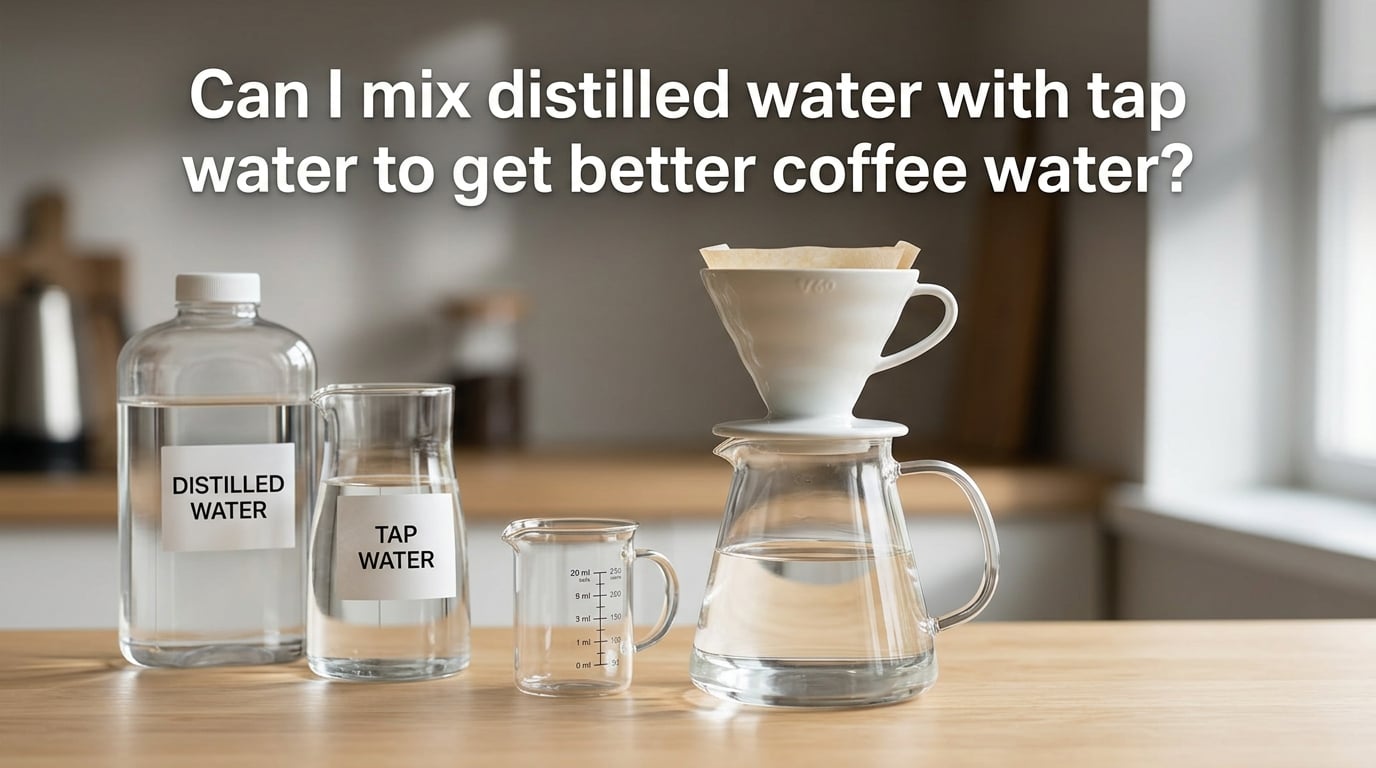
Yes, you can mix distilled water with tap water to get better coffee water when your tap water is safe to drink but too hard for good flavor or equipment health. The distilled portion dilutes the dissolved minerals in the tap water, which can bring hardness and total dissolved solids closer to a useful range for brewing.
The important limitation is that dilution is not purification. A blend still contains whatever chlorine, chloramine, metals, sodium, or other dissolved material came from the tap, just at a lower concentration.
If you want to mix distilled water with tap water for coffee, begin with a measured 1:1 blend only when the tap water is moderately hard, then taste and test from there. For very hard water, one part tap to two or three parts distilled is a more sensible first trial, provided the resulting water still has enough hardness and alkalinity for the coffee you make.
Quick answer: Mixing is a practical home-brewing method, not a universal recipe. Filter or otherwise treat chlorine or chloramine first, measure the tap water if possible, and remember that a low TDS number does not by itself prove that the mineral balance is good for coffee.
Table of Contents
Yes, you can mix distilled water with tap water for coffee
Distilled water starts with almost no dissolved minerals, while tap water supplies the calcium, magnesium, bicarbonate, and other ions that affect coffee extraction and taste. Combining the two lowers the tap water’s concentration in a predictable direction without stripping every mineral out of the final brew water.
This approach is most useful where the water tastes fine but leaves white scale in a kettle, drip brewer, or espresso machine. It is also a simple way to learn how water hardness coffee taste changes without making a detailed mineral recipe.
Use a clean food-safe jug, bottle, or pitcher and mix only enough water for a short period of brewing. Label the container with the ratio so a good cup can be repeated and a disappointing cup can be changed methodically.
Yes, a 1:1 blend is a sensible first test for moderately hard water
A 1:1 blend means equal volumes of treated tap water and distilled water. If the tap water measures about 300 ppm TDS, that blend will often read near 150 ppm, which is the Specialty Coffee Association reference value commonly used as a coffee-water starting point.
That arithmetic is helpful, but it is only a starting estimate. A TDS meter reports electrical conductivity converted to an approximate dissolved-solids value; it cannot tell you whether the remaining solids are useful magnesium and calcium, excessive sodium, or something else.
Distilled water alone makes coffee harder to extract
Distilled water coffee extraction can be weak because pure water contains almost none of the minerals that interact with coffee’s soluble compounds. Coffee brewed with it may taste thin, hollow, sharp, or strangely muted, even when the grind, dose, and brew time are otherwise sound.
Calcium and magnesium contribute to extraction. In practical terms, they give the brewing water more capacity to pull flavor from ground coffee than nearly mineral-free distilled water can provide.
Alkalinity matters too because it buffers acidity. Too little buffering can leave a cup aggressively sour; too much can flatten a coffee’s brightness and make it taste dull or chalky.
What “distilled” means here: Distillation removes nearly all dissolved minerals from the source water. It does not make distilled water dangerous to drink, but it is usually not the most useful water for coffee brewing on its own.
Yes, minerals can help extraction without making water excessively hard
More minerals are not automatically better. Hardness supports extraction, but a high mineral content coffee water can push flavors toward harshness, cause mineral deposits, and make a coffee machine harder to maintain.
The target is balance rather than a single magic reading. Coffee professionals often discuss a rough two-to-one relationship of general hardness, or GH, to carbonate hardness, or KH, but the best result also depends on the coffee, roast level, brewing method, and the minerals already in the local supply.
Minerals, TDS, GH, and KH answer different coffee-water questions
TDS for coffee means total dissolved solids, usually reported in parts per million, or ppm. It is a fast screening measurement: it tells you roughly how much dissolved material is present, not what that material is or whether it suits brewing.
For example, two waters can both read 150 ppm TDS and behave differently. One might contain hardness minerals that aid extraction, while another might be high in sodium or have alkalinity that mutes acidity.
Yes, GH describes the hardness that often drives scale and extraction
GH, or general hardness, mostly reflects calcium and magnesium expressed as an equivalent amount of calcium carbonate. These are the ions that commonly help coffee extraction and also contribute to scale when heat is involved.
A blend cuts GH in proportion to the amount of distilled water added. If a tap-water report says the water has 120 ppm hardness as CaCO3, an equal-parts blend should bring that figure close to 60 ppm, assuming the distilled water has negligible hardness.
Yes, KH describes alkalinity and the water’s buffering power
KH is often used by home brewers as shorthand for carbonate hardness, though the brewing concern is alkalinity: the ability of water to neutralize acids. Bicarbonate is a common contributor to alkalinity in tap water.
Dilution lowers alkalinity just as it lowers hardness. That can make an overly flat coffee taste livelier, but going too far can make a bright coffee taste sour or inconsistent from brew to brew.
Practical testing order: Start with your local water report if one is available, then use a TDS meter as a repeatability tool. GH and KH drop-test kits add far more useful detail when you are trying to protect an espresso machine or correct a persistent flavor problem.
The best ratio starts with your tap water measurement
The best ratio distilled water tap water coffee is the ratio that lowers an identified problem without leaving the final water nearly empty of minerals. Start with the total dissolved solids reading or a municipal report, then use the dilution calculation as a guide.
Because distilled water is close to 0 ppm TDS, the approximate formula is simple: final TDS equals tap-water TDS multiplied by the tap-water share of the blend. A 50 percent tap-water blend therefore has about half the original reading.
Yes, these three ratios give useful starting points
- 1:1 tap to distilled: Use equal parts. This halves measured TDS, hardness, and alkalinity, making it a reasonable trial for water around 250 to 350 ppm TDS.
- 1:2 tap to distilled: Use one part tap water and two parts distilled. This leaves roughly one-third of the starting dissolved material and suits water that is clearly hard or scale-forming.
- 1:3 tap to distilled: Use one part tap water and three parts distilled. This leaves roughly one-quarter of the original dissolved material and is a cautious starting point for very hard water.
As an example, tap water at 400 ppm TDS would be about 200 ppm in a 1:1 blend, around 133 ppm in a 1:2 blend, and about 100 ppm in a 1:3 blend. Those figures help choose a test batch, but they do not replace knowing the local mineral profile.
Do not automatically chase 150 ppm. The SCA reference point is useful because it gives home brewers a common place to begin, yet a water reading near that number can still taste poor if its alkalinity is high, its hardness is low, or chlorine is present.
Yes, start lower when your water leaves heavy white deposits
Visible white crust on heating elements, a kettle, or the inside of a coffee maker is a practical warning that hardness is high. Begin at 1:2 or 1:3 rather than assuming that an equal blend is enough.
After several brews, inspect the kettle or machine according to its normal cleaning schedule. A better-tasting cup is not a good trade if scale continues accumulating rapidly in equipment that uses heat and pressure.
Mix distilled water with tap water for coffee in six steps
Mixing works best when you change one variable at a time. The following method is built for a home brewer who has distilled water, access to drinkable tap water, and at least a way to compare the result in the cup.
Yes, Step 1 is to confirm that the tap water is suitable as a starting water
Use only tap water that your local authority considers safe to drink. If there is a current quality advisory, an unusual odor, a metallic taste, known contamination concern, or a private-well issue, do not treat dilution as a fix.
Read the local water-quality report when available. It can reveal hardness, alkalinity, disinfectant information, and seasonal changes that a single TDS reading cannot show.
Yes, Step 2 is to remove or reduce chlorine and chloramine first
Treat the tap portion before mixing. Activated carbon filtration can reduce chlorine, while chloramine may need a filter media and contact time rated specifically for chloramine rather than a quick pass through any pitcher.
Letting water stand can help chlorine dissipate in some cases, but it is not a dependable answer for chloramine. If the water has a pool-like smell or the coffee carries a medicinal, plastic-like, or disinfectant note, address that problem before changing the blend ratio.
Yes, Step 3 is to measure the tap water and choose one starting ratio
Measure TDS if you have a meter and record the reading, or use the reported value as a rough guide. Choose only one ratio for the first batch: 1:1 for moderately hard water, 1:2 for hard water, or 1:3 for very hard water.
For a small trial, use 500 mL of treated tap water plus 500 mL of distilled water for a 1:1 blend. For 1:2, combine 250 mL of tap water with 500 mL of distilled; for 1:3, use 250 mL tap water with 750 mL distilled.
Yes, Step 4 is to mix by volume in a clean container
Measure the water rather than pouring by eye. Stir or gently shake the sealed container so the blend is uniform before filling the brewer’s reservoir or kettle.
Keep the container clean and make a fresh batch regularly. The point is repeatable water for coffee brewing, not long-term storage of water in a container that may pick up odors or residue.
Yes, Step 5 is to brew one coffee recipe consistently
Keep the coffee dose, grinder setting, brew temperature, and brew time steady while testing water. If several variables change at once, there is no clear way to know whether the blend improved the result.
For pour over, brew the same coffee side by side with your regular water and the blend if you can. For espresso, pull the same dose and yield, then compare acidity, sweetness, bitterness, and the way the finish lingers.
Yes, Step 6 is to adjust in small, recorded changes
If the cup tastes harsh, dry, or overly bitter and the starting water is hard, add more distilled water next time. If the cup tastes thin, sharply sour, or under-developed after heavy dilution, increase the tap-water share slightly, assuming chlorine has already been handled.
Write down the ratio, the source-water reading, the coffee, and your tasting note. Forum discussions repeatedly show that successful home ratios range from 1:1 to 1:3 tap to distilled because no two local water supplies are the same.
Chlorine and chloramine still need separate treatment
Chlorine coffee flavor is a frequent source of confusion because water can seem normal in a drinking glass but become unpleasant after brewing. Heat and coffee aromatics can make a small disinfectant note much easier to notice.
Adding distilled water reduces the concentration of a chlorine-related off-flavor, but it does not reliably remove it. The same warning applies to chloramine, a more stable disinfectant used by many public systems.
Warning: Do not rely on blending to make questionable tap water suitable for drinking or brewing. Dilution does not remove every contaminant and does not turn a water-quality concern into a coffee-water solution.
Yes, carbon filtration is the usual first approach for chlorine
Activated carbon is commonly used to reduce chlorine and improve taste and odor. For chloramine, check the filter maker’s performance claims and replacement guidance, because not every carbon filter is designed for the same result.
If treatment still leaves a disinfectant aroma, use a different source water or a measured remineralization approach starting from distilled or reverse-osmosis water. The right answer is the one that gives clean flavor and predictable mineral content, not simply the lowest meter reading.
Mixing works when tap water is safe and merely too hard
Diluting hard water with distilled is a good fit when the tap water is potable, tastes reasonably clean after disinfectant treatment, and has a mineral profile that is broadly usable but too concentrated. It is a form of bypass water coffee brewing: the distilled water bypasses the hard-water load by reducing it.
It is less useful when the source water is high in sodium, has stubborn chloramine flavor, changes dramatically through the year, or produces poor coffee even after substantial dilution. In those cases, starting with low-mineral water and adding a controlled mineral recipe can be easier to repeat.
Yes, a simple decision path can prevent wasted test batches
- If tap water is unsafe or under an advisory: Do not mix it for coffee.
- If tap water smells of chlorine or chloramine: Treat the disinfectant issue, then reassess the flavor.
- If tap water is safe but causes scale: Test a 1:2 or 1:3 tap-to-distilled blend.
- If tap water is safe and only moderately hard: Test 1:1 and compare it with unblended water.
- If the blend tastes empty or sour: Increase the treated tap-water share in a small step.
- If the blend stays harsh, salty, or unpleasant: Stop diluting blindly and investigate the source-water composition.
This decision path also respects regional variation. A ratio that works in one city may be wrong in another, and a city’s source water can change seasonally without a home brewer noticing until the coffee changes.
Taste and scale tell you when to adjust the blend
Water chemistry is easier to manage when you use both measurements and taste. A meter can show that dilution happened; your cup and your equipment show whether that dilution solved the actual problem.
Yes, harshness and rapid scale usually call for more dilution
If coffee is persistently bitter, drying, or blunt and the water report shows high hardness or alkalinity, move from 1:1 toward 1:2. If white deposits are forming quickly, that is another reason to reduce the tap-water share and keep up with the brewer maker’s cleaning instructions.
Do not interpret every bitter cup as a water issue. A grind that is too fine, a high brew temperature, or overlong contact time can also increase bitterness, which is why a fixed brew recipe matters during testing.
Yes, a thin or overly sour cup can mean you diluted too far
Very low-mineral water may not extract enough sweetness and body, particularly with light roasts. If a blend at 1:3 is sour and watery while a 1:2 blend is sweeter and more complete, that comparison is more useful than forcing the lowest possible TDS.
Acidity is not automatically a flaw. Look for whether the coffee tastes lively and balanced versus sharp, empty, or unfinished.
Yes, salty or metallic notes can signal a problem dilution will not solve
Some dissolved minerals do not make appealing coffee water even at a lower concentration. If the coffee remains salty, metallic, medicinal, or otherwise off after chlorine treatment and reasonable dilution, do not keep adjusting by tiny increments.
Check a current water report and consider a different base water. A TDS meter cannot identify which ion is causing the taste, so it should not be the only diagnostic tool.
Espresso needs more caution than pour over
Espresso machines heat water repeatedly and use narrow internal passages, so scale risk is more consequential than it is for a simple pour-over kettle. A mix that tastes acceptable in filter coffee can still create deposits over time if it retains too much hardness or alkalinity.
For espresso, track both the cup and machine maintenance. If you do not know the GH and alkalinity of the final blend, stay conservative with tap-water share and follow the machine manufacturer’s water and descaling guidance.
Never use distilled water coffee machine ratio as a reason to ignore the machine’s manual. Some machines have specific water requirements, and the right blend must work with those requirements as well as your preferred flavor.
Small-batch habit: Make enough blend for several brews rather than filling a large machine reservoir for weeks. It makes ratio changes easier to track and avoids leaving water sitting in the machine longer than necessary.
Yes, the common coffee-water questions have straightforward answers
Is it good to brew coffee with distilled water?
Distilled water is safe to drink, but it is usually not ideal for coffee by itself because it contains almost no minerals to support extraction. Coffee can taste thin, sour, or muted. Mixing in a suitable treated tap-water portion or using a controlled mineral recipe gives the water more useful brewing properties.
Can you mix distilled water with tap water?
Yes. If the tap water is safe to drink, mixing it with distilled water can lower hardness, alkalinity, and TDS while retaining some minerals for coffee extraction. Treat chlorine or chloramine first, and start with a measured 1:1, 1:2, or 1:3 tap-to-distilled trial based on how hard the source water is.
What to add to distilled water for coffee?
You can add measured minerals that provide hardness and alkalinity, or blend distilled water with suitable treated tap water. Calcium and magnesium contribute to hardness and extraction, while bicarbonate contributes alkalinity. A blend is simple, but it copies the mineral profile of the tap water, including any undesirable components.
What TDS should I target for coffee brewing?
A common SCA reference value is 150 ppm TDS, and a practical starting range is often broader than one exact number. TDS is only a screening measurement: compare flavor, scale behavior, hardness, and alkalinity rather than treating one reading as proof that the water is right.
Is mixing distilled and tap water safe for espresso?
It can be safe when the tap water is potable and treated for chlorine or chloramine, but espresso machines need extra attention because hardness and alkalinity can cause scale. Test a conservative blend, monitor deposits, and follow the water guidance from your machine manufacturer.
Yes, mixing distilled water with tap water can improve coffee water
Mixing distilled water with tap water coffee is a practical way to dilute excessive hardness while keeping some minerals that support extraction. Start with potable, treated tap water, measure a 1:1, 1:2, or 1:3 ratio, and change only one step at a time as you taste.
The best result is not necessarily the blend with the lowest TDS. It is the one that gives a sweet, clear cup while keeping chlorine flavor and machine scale under control.
When a blend cannot produce that result, do not force it. Use a cleaner base water with a controlled mineral addition, and keep the same careful notes that made your first trials useful.