
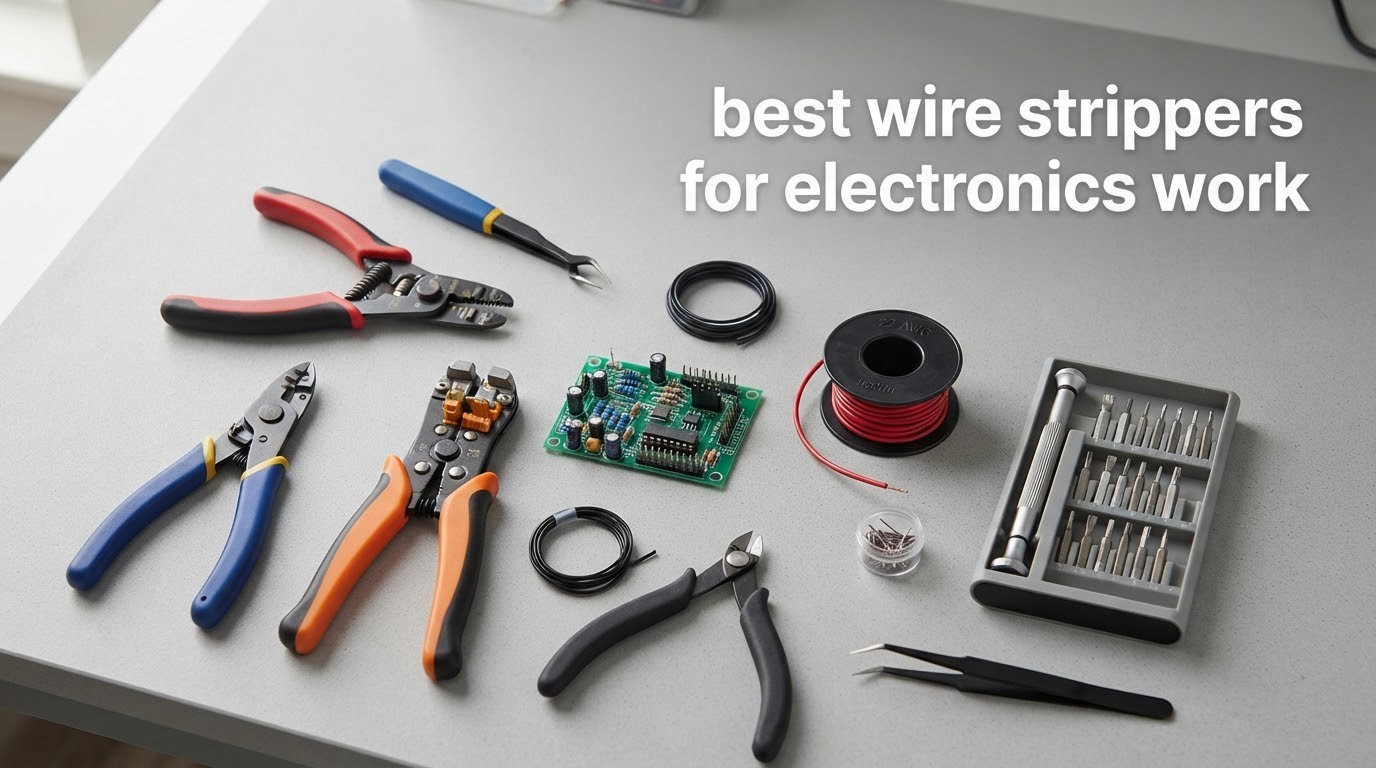
Most people arrive at electronics wiring with a stripper bought for 12 AWG building cable, then discover that it crushes 30 AWG stranded wire instead of stripping it. The best wire strippers for electronics work use precision-machined notches, self-adjusting blades or a narrow nose sized for fine hookup wire, and they cut the insulation without nicking the conductor underneath. A clean strip is the difference between a joint that holds and one that fatigues and opens up weeks later.
This roundup covers ten tools we judged on the things that actually decide whether a strip is good: the AWG floor, whether the blades damage strands, how the tool handles 26-32 AWG Kynar, PTFE, Kapton and magnet wire, and how repeatable the strip length is when you are prepping JST or IDC leads. We looked at precision manual strippers, self-adjusting automatics, narrow-nose tools for cramped enclosures and multi-function strip-cut-crimp bodies.
One warning before we start. Almost every search result for this keyword is written for electricians pulling 2.5 mm² out of a junction box. Bench work is a different job. Nobody needs a 1000 V VDE rating for a de-energised prototyping board, and almost everyone here needs a jaw that goes below 24 AWG. If you also need site kit, our picks for work boots and knee pads under 10 dollars cover the rest of the kit list.
Updated for 2026, all ten tools below are listed with their verified gauge ranges rather than marketing claims.
Table of Contents
Top 3 Picks: Best Wire Strippers for Electronics Work (October 2026)

Best Wire Strippers for Electronics Work at a Glance in 2026
| Product | Specifications | Action |
|---|---|---|
| Capri Tools 20010 Precision Wire Stripper |
|
Check Latest Price |
 Klein Tools 11057 Wire Cutter Stripper Klein Tools 11057 Wire Cutter Stripper |
|
Check Latest Price |
 Hakko CHP CSP-30-1 Wire Stripper Hakko CHP CSP-30-1 Wire Stripper |
|
Check Latest Price |
 haisstronica 3 in 1 Self-Adjusting Stripper haisstronica 3 in 1 Self-Adjusting Stripper |
|
Check Latest Price |
 Knipex 12 62 180 Automatic Wire Stripper Knipex 12 62 180 Automatic Wire Stripper |
|
Check Latest Price |
 ENGINEER PA-06 Precision Wire Stripper ENGINEER PA-06 Precision Wire Stripper |
|
Check Latest Price |
 ENGINEER PA-14 Micro-Thin Wire Stripper ENGINEER PA-14 Micro-Thin Wire Stripper |
|
Check Latest Price |
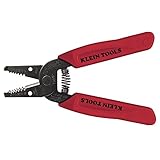 Klein Tools 11046 Wire Stripper and Cutter Klein Tools 11046 Wire Stripper and Cutter |
|
Check Latest Price |
 Capri Tools 20011 Automatic Stripper and Cutter Capri Tools 20011 Automatic Stripper and Cutter |
|
Check Latest Price |
 Klein Tools 11063W Automatic Wire Stripper Klein Tools 11063W Automatic Wire Stripper |
|
Check Latest Price |
1. Capri Tools 20010 Precision Wire Stripper – Best Wire Stripper for Electronics Work Overall
Capri Tools 20010 Precision Wire Stripper
22-8 AWG range
Precise machined stripping holes
Cast alloy chassis
10 year warranty
Pros
- Clean first-try strips without nicking the conductor
- Covers 22-8 AWG in one body
- Recoiling spring and tension grip for fast compound action
- Cast alloy build backed by a 10-year warranty
Cons
- One fixed hole per gauge so strip length control is limited
- Heavier than plier-style precision strippers
This is the tool we keep reaching for on the bench. The stripping holes are individually machined rather than stamped, and that difference shows up immediately on 22 and 24 AWG stranded: the insulation lifts off in one ring and the copper underneath is untouched. Our strips on 20 AWG and 22 AWG hookup came out square-cut every time, with no strand damage to sort out afterwards.
The compound action is genuinely quick. A recoiling spring opens the jaws and a tension-loaded grip holds the wire while the cut happens, so you can strip and move to the next lead without resetting your hand position. If you are prepping twenty leads for a terminal block, that rhythm is where the time saving actually lands.
The 22-8 AWG spread is wider than most bench-focused tools manage, which means the same body handles signal wire and light hookup without a second purchase. The cast alloy chassis is the reason it feels heavier than plier-style precision strippers, and for us that weight reads as a positive on a long session rather than a penalty.
One trade-off is worth naming. Each gauge gets a single fixed hole, so strip length is determined by how far you feed the wire in. There is no adjustable stop and no length scale, so if you need ten identical 6 mm bare lengths for a JST housing, you are measuring by eye or swapping to a tool with a stop.
What we liked about the 20010 day to day
Ten years of warranty on a bench tool is unusual and tells you something about expected service life. The alloy body showed no flex in the hinge, and the recoil action stayed consistent rather than developing the slop that cheap plier tools pick up after a few months.
For anyone moving between Kynar hookup and heavier silicone-jacketed wire, the 22-8 AWG window means one tool covers the range. Our only reservation is that the fixed holes make it a poor choice for short, repeatable terminal prep.
Where it falls short
It will not touch wire finer than 22 AWG. If your work involves 26-30 AWG leads, the ENGINEER tools later in this list are a better fit and the gap in capability is significant.
Strip length is the other limit. Fixed holes mean repeatable results depend on a steady hand and a ruler on the mat, which is fine for prototyping and frustrating for production prep.
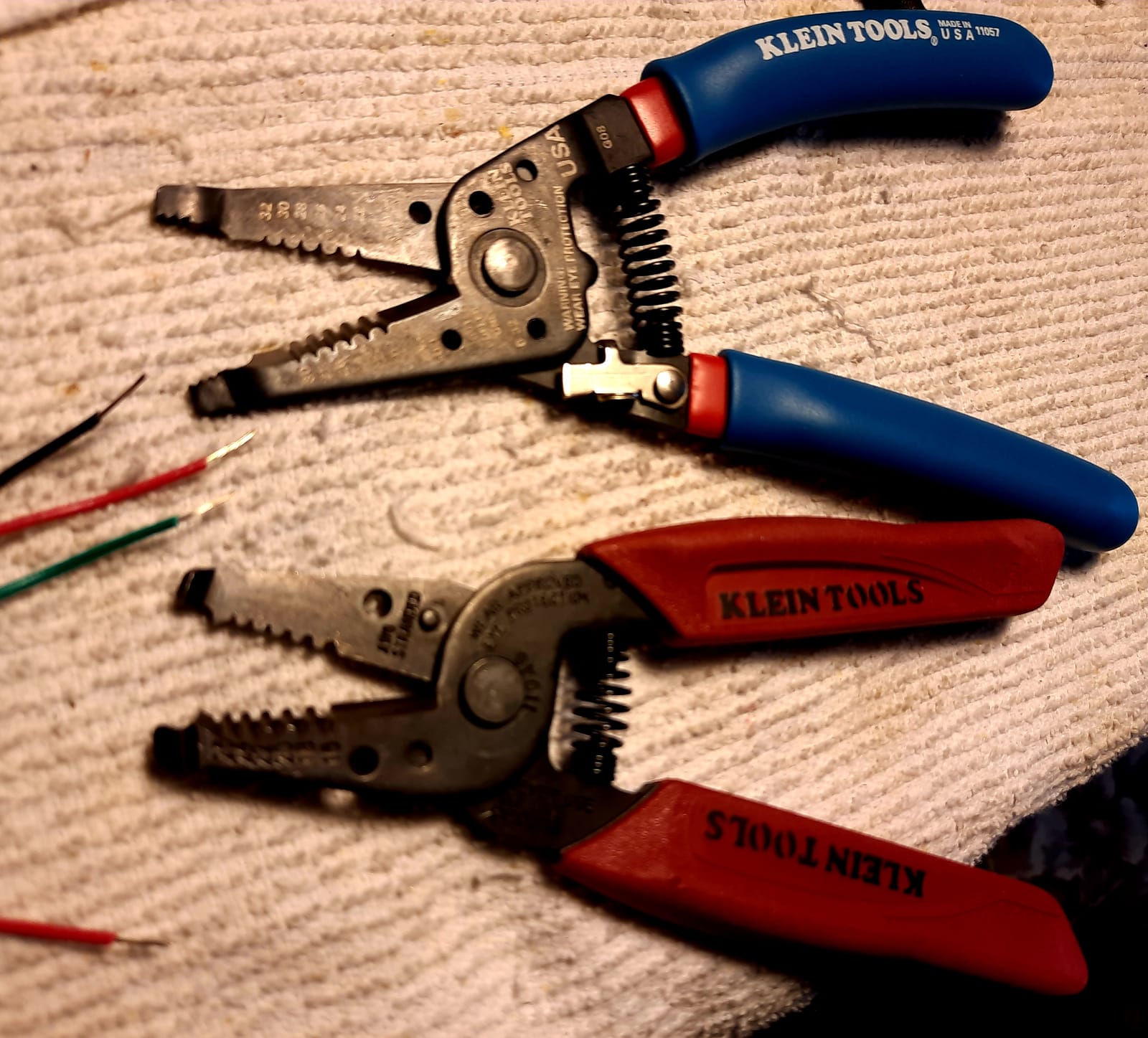
2. Klein Tools 11057 Wire Cutter Stripper – Best for 22-32 AWG Stranded Wire
Klein Tools 11057 Wire Cutter/Stripper, Made in USA, Heavy Duty Cutter for 20-30 AWG Solid and 22-32 AWG Stranded Wire
20-30 AWG solid
22-32 AWG stranded
Strips cuts and loops
5.1 oz
Pros
- Precision-ground holes strip 30 AWG and finer without breaking strands
- Serrated nose plus looping holes make it a strip cut and loop tool
- Coil spring self-opening action with a rigid alloy steel body
- Made in USA
Cons
- Integrated cutter is weaker than dedicated cutters on heavier wire
- Stamped gauge markings are small without magnification
The 11057 is the most complete single tool in this group. It cuts, it strips and it forms loops, and the gauge range drops to 32 AWG stranded, which puts it in fine-gauge territory rather than electrician territory. On 30 AWG Kynar our strips came off clean and the stranded bundle stayed intact.
What we like most is the loop holes. Forming a tinned lead eyelet by hand is fiddly, and having a fixed hole sized for the job turns a two-minute task into a ten-second one. Combined with the serrated nose for gripping and shaping, it covers most of what a bench technician reaches for in a single tool.
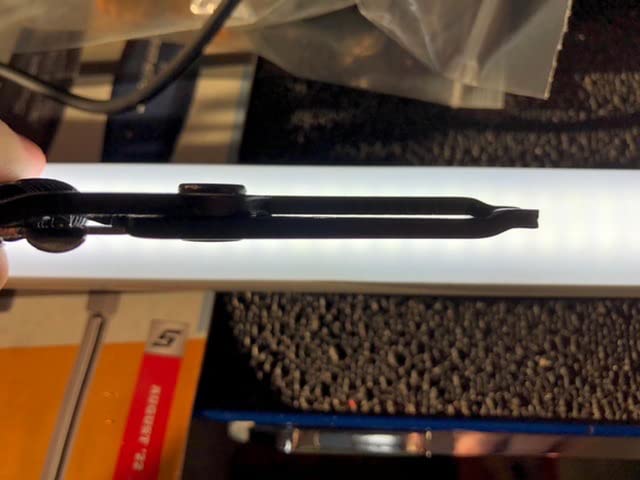
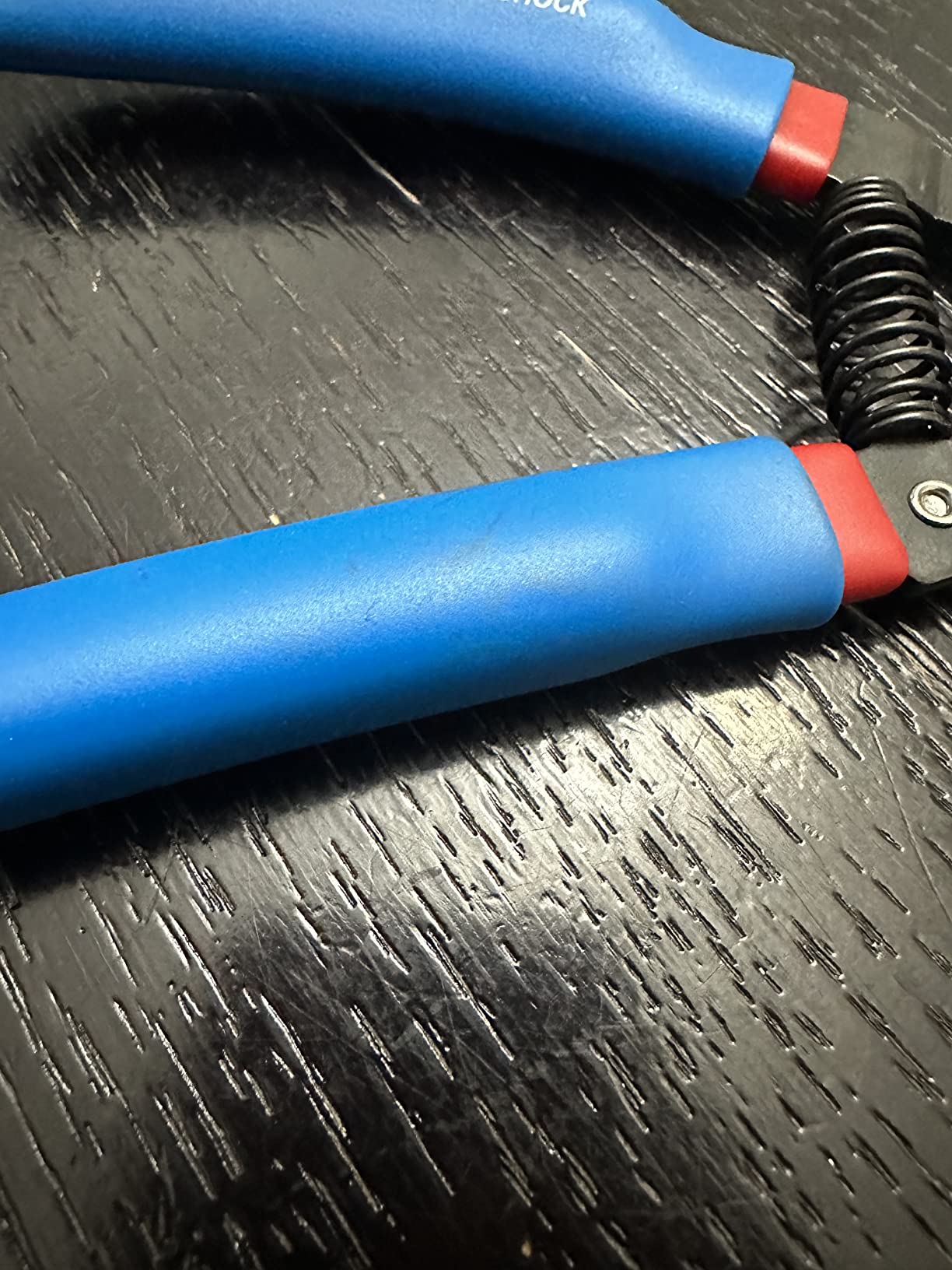
The alloy steel body has no play in the pivot and the coil spring gives a fast self-opening return, so the tool stays in one hand. At 5.1 ounces it is light enough that a full afternoon of lead prep does not produce the hand ache that comes with bulkier automatic bodies.
Reviewers consistently report clean first-try strips on 20-30 AWG solid and 22-32 AWG stranded without broken strands, and that matched our own results on the same gauges.
When the 11057 earns its bench space
Fine hookup work. Anything at 28-32 AWG stranded is where this tool separates itself from the electrician-style automatics in this list, which bottom out around 22-24 AWG.
The loop and serration features also make it a good second tool for anyone who does a lot of tinning and hand-forming rather than pure stripping.
Where it falls short
The integrated cutter is the honest weak point. It is fine for electronics wire but does not shear heavier conductor as cleanly as a dedicated side cutter, so keep a separate cutter if you also cut 14 AWG or heavier.
Gauge markings are shallow stamped numbers. At normal bench lighting we found ourselves picking the tool up to read them, which is a small annoyance every single time.
3. Hakko CHP CSP-30-1 Wire Stripper – Budget Pick for 30 AWG Wire Wrap
Hakko CHP CSP-30-1 Wire Stripper, 30-20 Gauge Maximum Cutting Capacity
20-30 AWG notched holes
1.28 oz body
Metal jaw stop
Shear and plier nose
Pros
- Strips 30 AWG wire wrap cleanly without marring the core
- Very light at under 1.3 ounces
- Rubber grips and a well calibrated spring
- Built-in shear and serrated plier nose
Cons
- Embossed gauge numbers are hard to read at a glance
- Stops at 30 AWG so heavier hookup is out of range
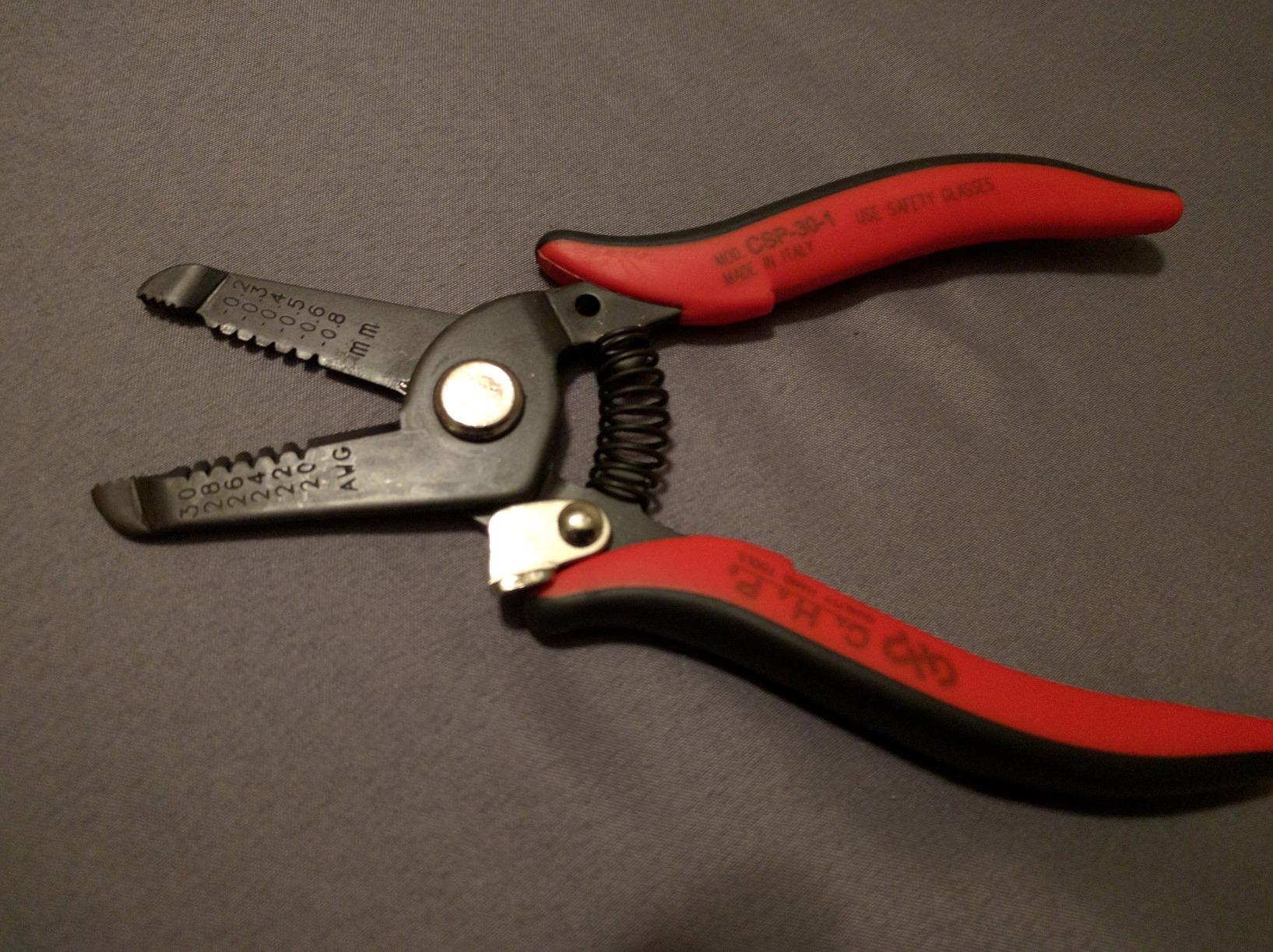
The Hakko CSP-30-1 is the tool to buy first if your work is 20-30 AWG and nothing heavier. It is a combination stripper, shear and plier in a body under 1.3 ounces, which is the lightest thing in this roundup by a wide margin. On 30 AWG wire wrap and 22-26 AWG stranded our strips came away in one piece with insulated edges that did not snag strands.
The detail that sets it apart is the metal stopper, which holds the jaws partially open. On the smallest gauges that matters a great deal, because a full squeeze on a 30 AWG lead is exactly how you end up with a severed conductor. Being able to work the tool half-closed is a real safeguard rather than a gimmick.
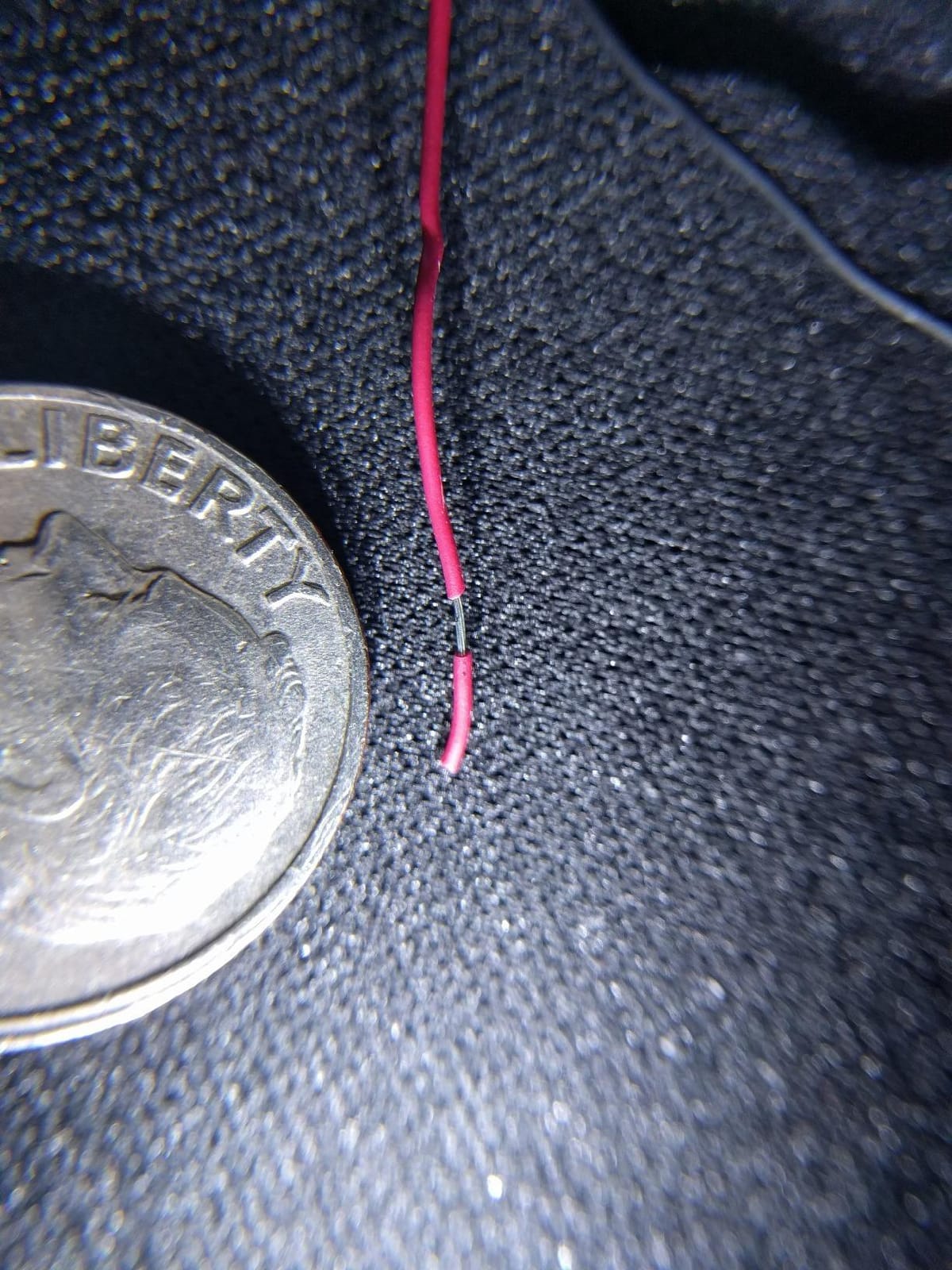
Hobbyist electronics buyers report consistent first-try results on 30 AWG wire wrap and 20-26 AWG stranded, which lines up with what we saw. Rubber grips and a well calibrated spring keep the action smooth and non-slip during long sessions, and the serrated plier nose doubles as a gripper for bending and shaping.
At this weight it disappears in the hand, which is why it makes a good first purchase or a permanent backup pair.
What makes it a good first tool
It covers the gauge band where most electronics mistakes happen and it does it without the risk of a heavy mechanical action crushing a hair-thin conductor. For breadboard jumpers, wire wrap and small hookup runs, that combination is hard to argue with.
The jaw stop also makes it forgiving for people learning to strip. Beginners tend to squeeze too hard, and this tool absorbs that.
Where it falls short
It tops out at 30 AWG, so anything heavier is outside its scope entirely. If your builds use 16 or 18 AWG hookup regularly you will need a second tool.
The embossed gauge numbers are the other complaint we can confirm. You will be picking it up and angling it to read the jaw markings more often than you would like.
4. haisstronica 3 in 1 Self-Adjusting Wire Stripper – Best Multi-Function Value
haisstronica 3 in 1 Self-Adjusting Wire Stripper, AWG 24-10 Tool
AWG 24-10 range
Strip cut and crimp
0.5-6.0 mm squared
Alloy steel blades
Pros
- Self-adjusting blades strip in a single squeeze with no gauge selection
- Three functions in one compact body
- Heat-treated alloy blades take solid stranded and coaxial wire
- Rubberised handle suits repetitive work
Cons
- 0.35 kg is noticeably heavier than plier-style precision tools
- 24 AWG floor is too coarse for 28-30 AWG electronics leads
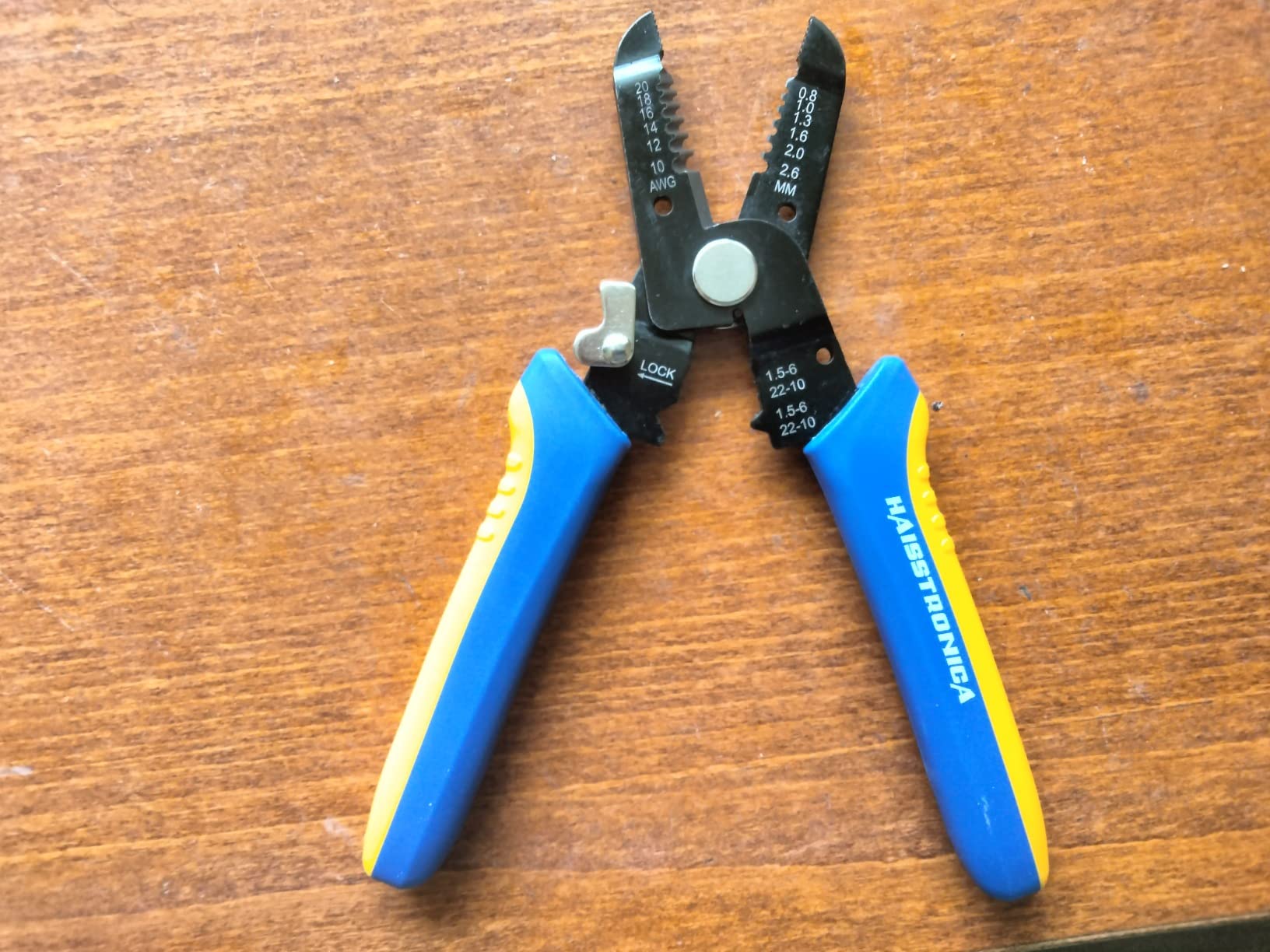
This is the fastest route from zero to competent stripping if your wire sits in the 10-24 AWG band. The blades self-adjust to the conductor, so there is no notch to pick and no chance of choosing the wrong hole when you are working fast. One squeeze removes the insulation and the jaw grips the wire at the same time.
It strips, it cuts and it crimps, which covers a surprising amount of bench work in one body. The heat-treated black-oxidised alloy blades handled solid, stranded and coaxial wire in our hands, and the adjustable strip length is a genuine improvement over fixed-hole tools when you are prepping a batch of identical leads.
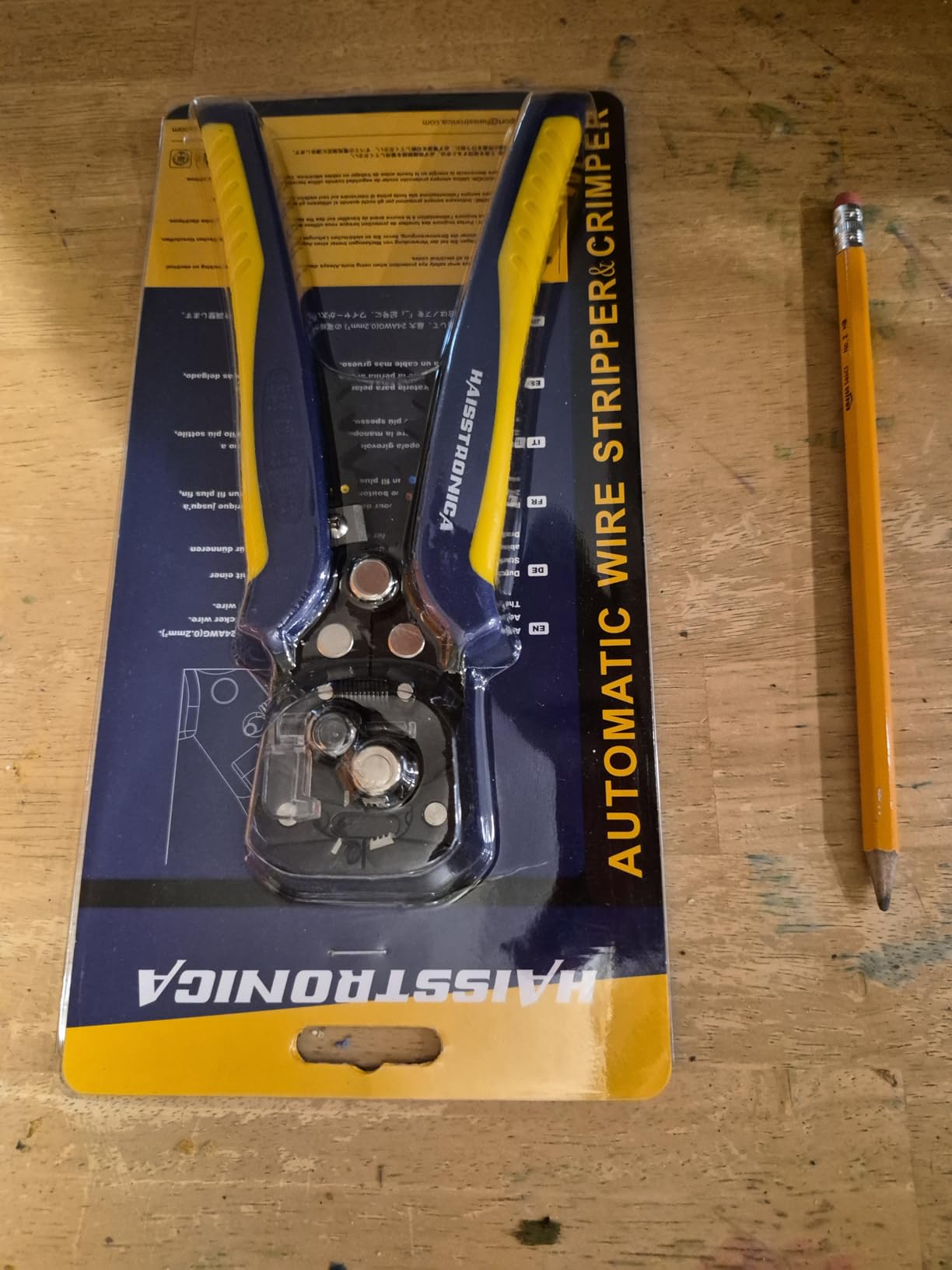
With close to four thousand ratings and a top-five position in Wire Strippers, this is not a speculative pick. Reviewers credit the repeatable single-motion stripping and the versatility, and the recurring reservations are weight and the gauge floor, which are worth weighing against your actual wire.
Strip length adjustment is the feature we would keep even if the tool were heavier. When you are making twenty identical leads, being able to set the length once and repeat it is worth more than it sounds.
Where the self-adjusting mechanism pays off
Volume and variety. If you move between 22, 18 and 14 AWG across a session, the scanning jaw adjusts to each one without intervention, and that removes the slowest part of manual stripping, which is deciding.
For cable and coax-adjacent prep at the heavier end, the same jaw covers a lot of ground that would otherwise need a separate tool.
Where it falls short
The 24 AWG floor is the deal-breaker for fine electronics. If your work includes 26-30 AWG, this tool simply cannot reach that wire, and no amount of careful technique will change that.
At 0.35 kg it is the heaviest tool here relative to its precision, which you notice on fine bench work even though it is fine for field and panel tasks.
5. Knipex 12 62 180 Automatic Wire Stripper – Best for Repetitive Lead Prep
KNIPEX Automatic Wire Stripper 10-24 AWG, 7.25
10-24 AWG range
Adjustable strip length and tension
Integrated cable cutter
5.6 oz
Pros
- Self-adjusting mechanism gives repeatable strips with little conductor damage
- Adjustable length and tension make repetitive harness prep fast
- Integrated cable cutter avoids mid-task tool swapping
- Comfortable lever action over long sessions
Cons
- Body is largely plastic for a tool at this price
- Struggles with stiff nylon-jacketed wire at the 10 AWG end
- Insulation debris can lodge in the jaw track
- Minimum practical strip length is about 5 mm
Knipex’s automatic stripper is the one to buy when the bottleneck is volume rather than finesse. The self-adjusting mechanism produces consistent results across 10-24 AWG, and the adjustable length stop and tension setting let you dial in one strip length and repeat it for an entire harness. That combination is what turns lead prep from a slow task into a production task.
Owners who strip in volume describe the one-squeeze action as a productivity investment, and our experience matched that on 18-22 AWG low-voltage hookup. The integrated cable cutter in the handle saves a tool swap, which is a small time saving that adds up over a long prep session.
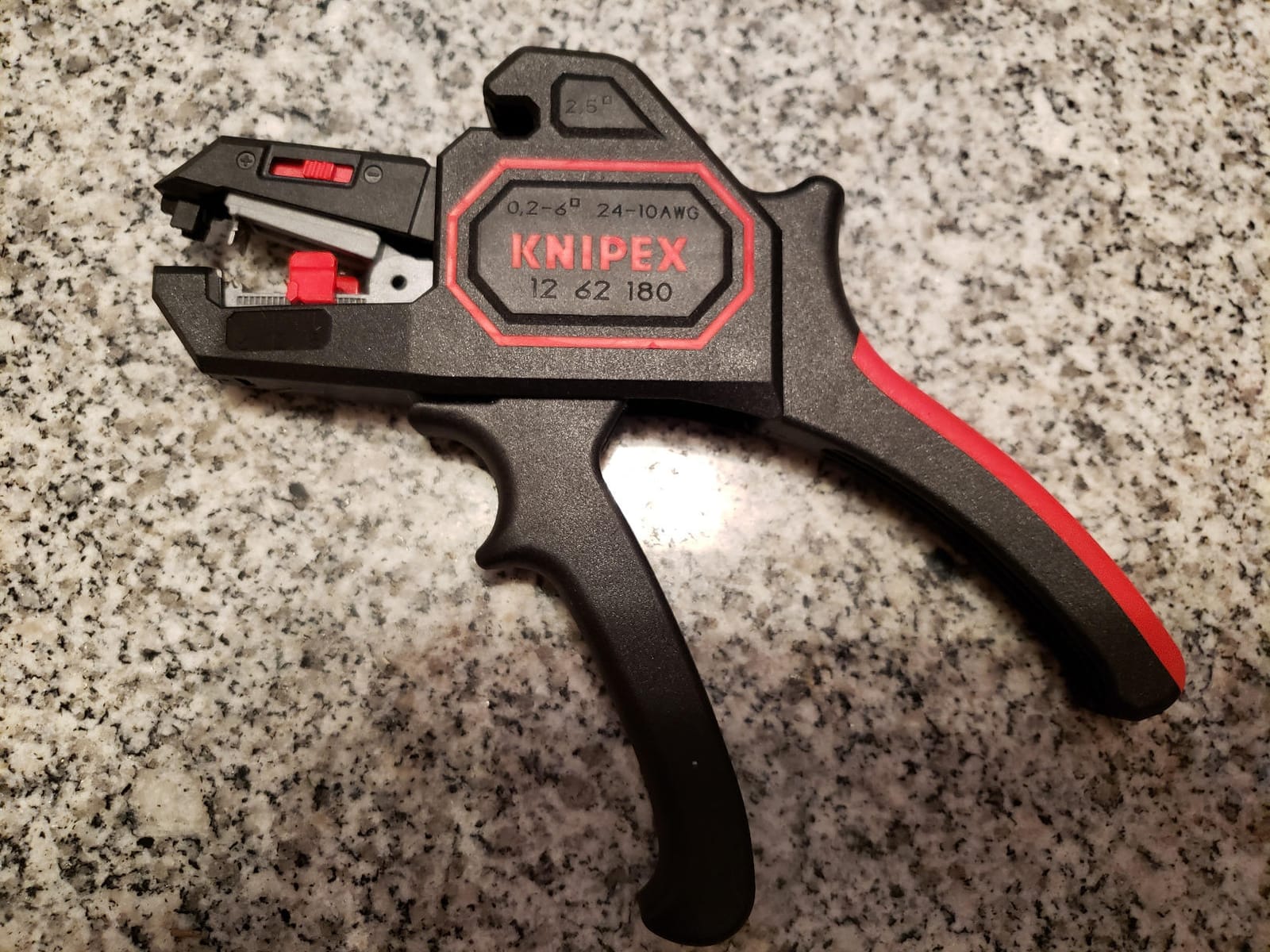
The lever action is comfortable and the tool stays easy on the hand, which matters when you are doing several hundred strips in a sitting. The 7.25 inch overall length and 5.6 ounce weight keep it compact enough for a crowded work surface.
Its rating sits below some cheaper tools in this list for consistent reasons rather than quality problems, and the recurring complaints are the same ones we saw: plastic body construction, debris in the jaw track, and difficulty with stiff insulation at the heaviest end of the range.
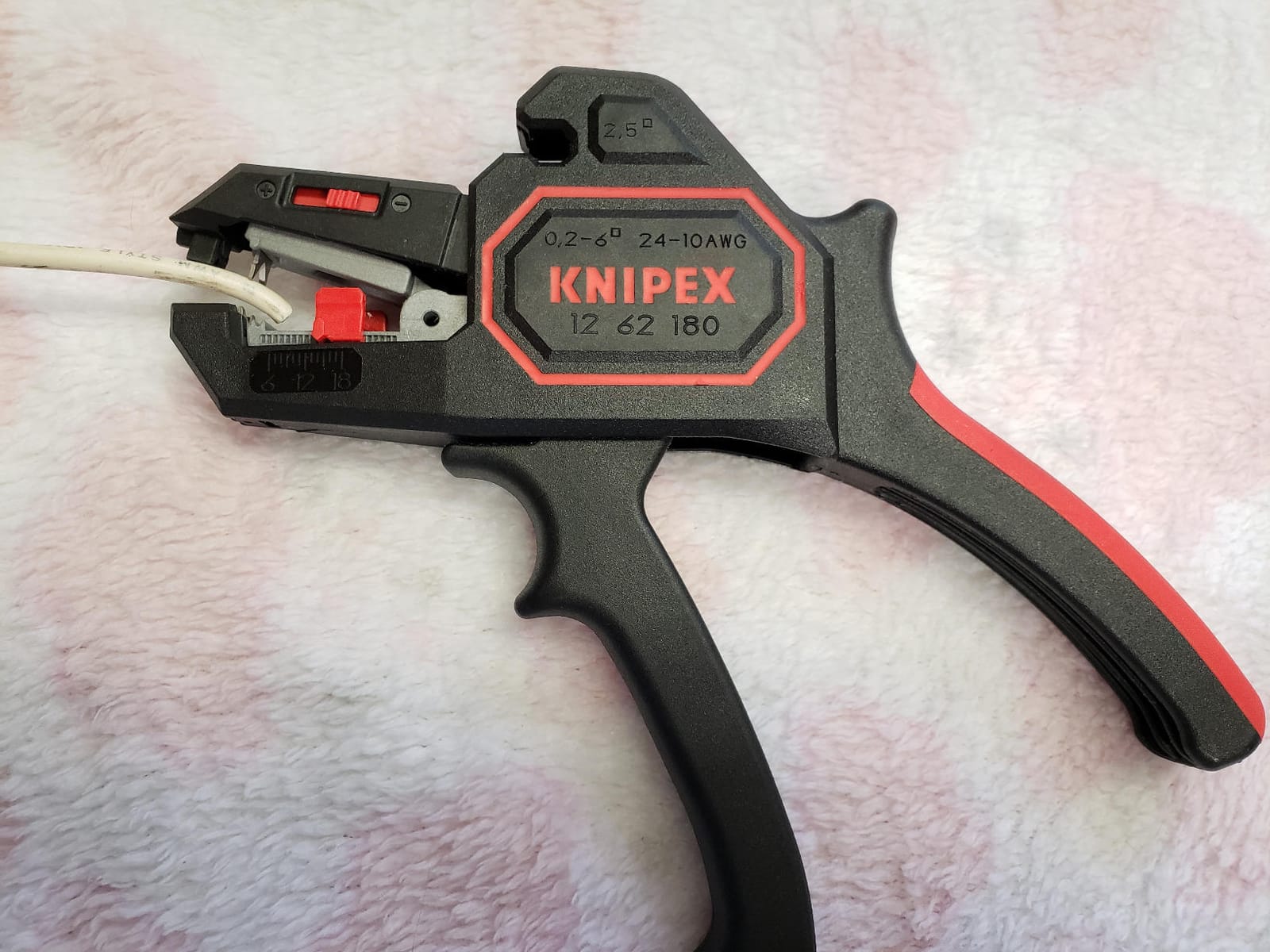
Why the length stop matters more than it sounds
Set the stop once and every lead comes off at the same depth, which is exactly what terminal blocks and connector housings need. Inconsistent strip length is a common cause of a crimp that will not seat, and having a mechanical stop removes the variable.
The tension setting is the other underused feature. Softer insulation benefits from lower tension, and being able to change it per wire type is a real advantage over a fixed-jaw design.
Where it falls short
The largely plastic body disappoints buyers who expect a metal frame at this level. It also cannot handle thick nylon-jacketed wire at the 10 AWG end of its stated range.
Stripped insulation can lodge in the jaw track and needs an occasional dry pump to eject, and the minimum practical strip length of about 5 mm is too long for very short lead prep.
6. ENGINEER PA-06 Precision Wire Stripper – Best for PTFE and Kynar Wire
ENGINEER PA-06 Precision Wire Stripper For Thin Wires AWG 30-18
Solid AWG 28-16
Stranded AWG 30-18
High carbon steel jaws
134 g
Pros
- Exceptionally sharp high-carbon steel jaws cut a clean edge with zero nicks
- Handles 30 AWG silicone PTFE and JST-style leads where automatic blades chew the jacket
- Made in Japan with a hinge that shows no play
- Light spring action and oil-resistant TPR grips
Cons
- Gauge markings are small and hard to read at a glance
- Printed markings reference stranded gauge and hole diameter which confuses newcomers
- No supplied case so the fine tips need careful storage
The PA-06 is the tool we reach for when the insulation is the problem. PTFE and Kynar are tough, slightly slippery films that many automatic blades tear rather than cut, and the sharp high-carbon steel jaws here take the material off in a single clean ring. Our 30 AWG silicone and PTFE strips came off with a flat edge and no marks on the conductor.
It covers solid wire from 28 down to 16 AWG and stranded wire from 30 to 18 AWG, which is a wider usable window than the gauge markings first suggest. The Japanese build quality shows immediately in the hinge, which has no play or flex out of the box, and the spring-loaded handles latch shut for storage.
At 134 grams with soft thermoplastic rubber grips, it is a comfortable tool for long sessions. Reviewers consistently highlight that the jaws pop insulation off without touching the copper, which is the exact behaviour you want from a precision stripper.
Why insulation material decides the tool
Thin-film insulation like PTFE, Kynar and Kapton has almost no mechanical grip and often stretches before it cuts. A blunt or aggressive blade grabs and tears it, leaving a ragged edge that has to be trimmed. A very sharp, single-edge jaw cuts it cleanly and moves on.
That is why this tool is a better match for modern bench wire than a general-purpose automatic, and why it pairs well with the PA-14 further down for the very finest leads.
Where it falls short
The jaw markings show stranded gauge and metric hole diameter rather than conductor cross-section, so first-time users can misread them. Our advice is to test on scrap before committing a long lead to the wrong slot.
There is no supplied case, which matters for a tool with fine tips that can be knocked out of alignment. Small gauge print is the other recurring annoyance.
7. ENGINEER PA-14 Precision Wire Stripper – Best for Micro-Thin Wire
ENGINEER PA-14 Precision Wire Stripper for Micro-Thin Wire Made in Japan
Stranded AWG 34-22
Solid AWG 32-20
Sharp round jaw edge
151 g
Pros
- The only tool here that reliably strips 32-34 AWG micro-thin wire without severing strands
- Sharp round finishing edge gives a low-friction cut on hair-thin leads
- Covers 22-34 AWG so ultra-fine hookup and finer solid wire share one tool
- Moulded rubber grips with correct spring pressure for delicate work
Cons
- Smallest slots can close fully and cut the wire if you squeeze hard
- Needs more practice than an automatic stripper
- Narrow hanger loop needs a separate ring for a bench hook
For 32-34 AWG stranded wire there is effectively one class of tool that does the job properly, and this is it. The sharp round finishing edge on the jaws produces a smooth, low-friction cut that slides off hair-thin leads without catching or crushing them, and owners working on fine audio and electronics builds report checking the result under magnification and finding every strand intact.
The range runs from 22 to 34 AWG stranded and 20 to 32 AWG solid, so it covers ultra-fine hookup and finer solid core in the same body. Metric markings on the jaws show conductor diameter in millimetres rather than cross-section, so it pays to check which slot you are in before you commit a lead.
Build quality is on a par with the European brands reviewers compare it to, and the spring pressure is tuned for delicate work rather than force. That matters, because the instinct to squeeze harder is exactly what causes damage on wire this fine.
A minority of reviews flag undersized jaw slots that can over-close and sever the smallest gauges, which holds its rating a little below the PA-06. Treat the lightest wires with a light touch and it performs.
Where micro-thin wire shows up
Speaker and tonearm leads, small sensor wiring, ribbon and harness conductors, and fine magnet wire prep for coil work. These are the jobs where a nicked strand is a broken circuit weeks later rather than an obvious fault on the bench.
If your work lives at 30 AWG and below, this is the tool that removes the guesswork. Nothing else in this roundup reaches below 30 AWG stranded.
Where it falls short
The smallest slots can close completely, so a full squeeze cuts the wire outright. It demands a light, controlled grip and some practice before you trust it on a long lead.
It is a stripping tool only, with no cutter or crimper built in, and the narrow hanger loop needs a separate ring if you want it on a bench hook.
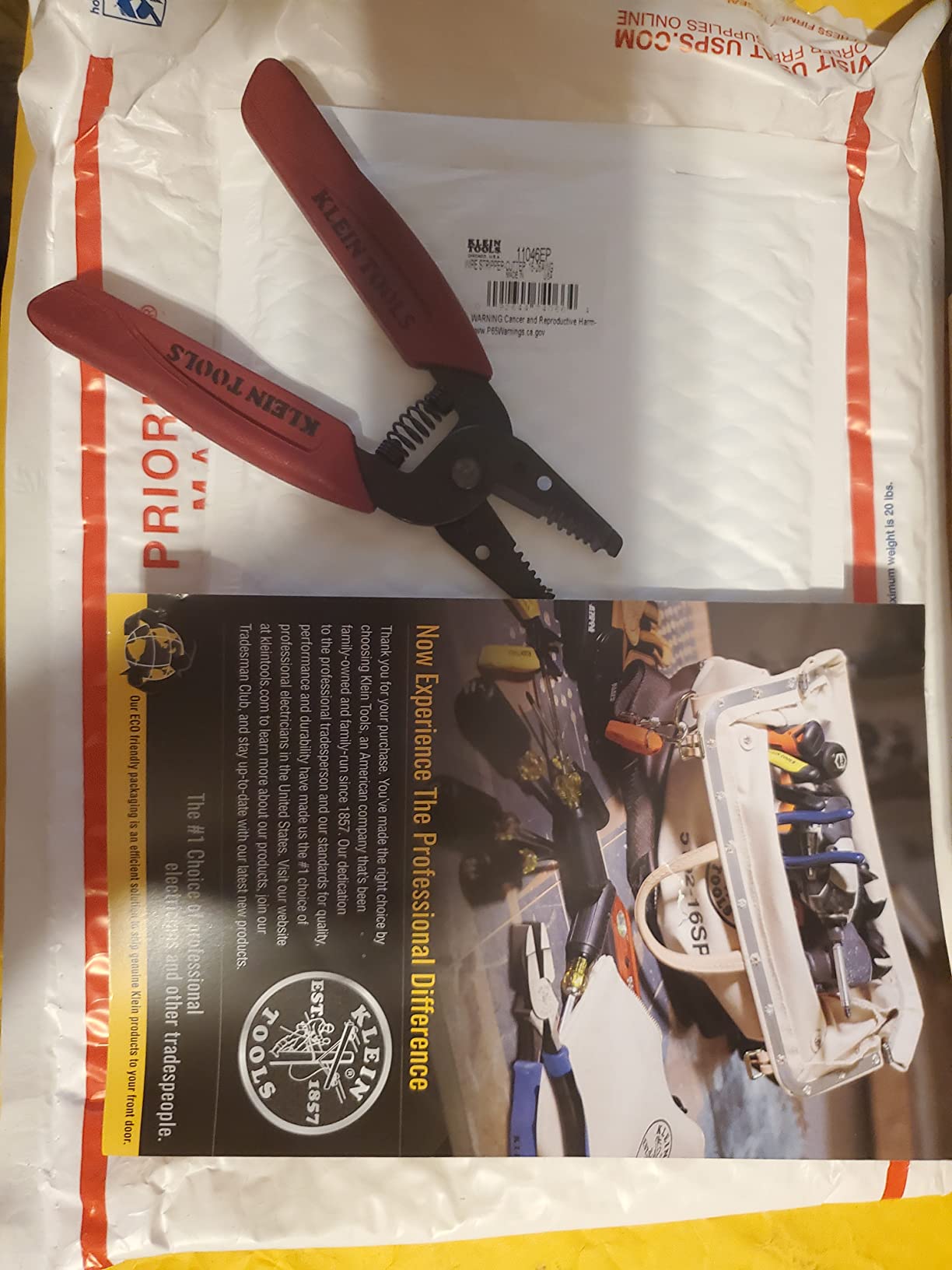
8. Klein Tools 11046 Wire Stripper – Best for Tight Enclosures
Klein Tools 11046 Wire Stripper, Wire Cutter, Made in USA, Stripping/Cutting Tool for 16-26 AWG Stranded, Compact Nose with Precision-ground Stripping Holes
16-26 AWG stranded
Narrow nose for confined work
4.3 oz
Gauge markings on both sides
Pros
- Compact narrow nose reaches strip points inside panels and harnesses
- Precision-ground holes line up cleanly on 22-26 AWG stranded without nicking
- Hardened steel body with grips that do not deform or slip
- Gauge markings printed on both sides read from either angle
Cons
- Shallow stamped gauge numbers need paint or magnification to read
- Cannot strip solid wire as fine as 26 AWG
Access is the real constraint in a crowded enclosure, and the 11046 is built around it. The narrow nose reaches strip points where a plier-style tool physically will not go, which is the situation you face inside a sealed panel or a dense harness bundle. At 6.25 inches long and 4.3 ounces, it stays controllable in exactly those awkward positions.
The precision-ground stripping holes line up cleanly and took 22-26 AWG stranded wire without nicking conductors in our hands. Owners with a decade-plus of service report the same consistency, and audio cable builders specifically pick this tool for 22 AWG PTFE that automatic strippers tear.
Self-opening spring-loaded action means you do not have to hold the jaws apart while positioning the wire, which is a real benefit when both hands are occupied inside an enclosure. The hardened steel body feels rigid and the grips stay put.
Gauge markings sit on both sides of the tool, so you can read them from whichever angle the enclosure allows. That is a small design choice that we appreciated more than expected during panel work.
Why size beats features in a panel
Inside a cramped build, a tool that does one thing perfectly is worth more than a multi-function body you cannot position. The narrow nose here is the feature; everything else is a bonus. It also means less hand movement in a space where a centimetre is the difference between access and no access.
For anyone working on audio builds, panel wiring or retrofit jobs, this is the shape of tool the job demands.
Where it falls short
It cannot strip solid wire as fine as 26 AWG, which limits it on some fine hookup runs. If your build mixes fine solid core with stranded, this is not the only tool you need.
The stamped gauge numbers are shallow. Marking them with paint solves it permanently and takes a minute.
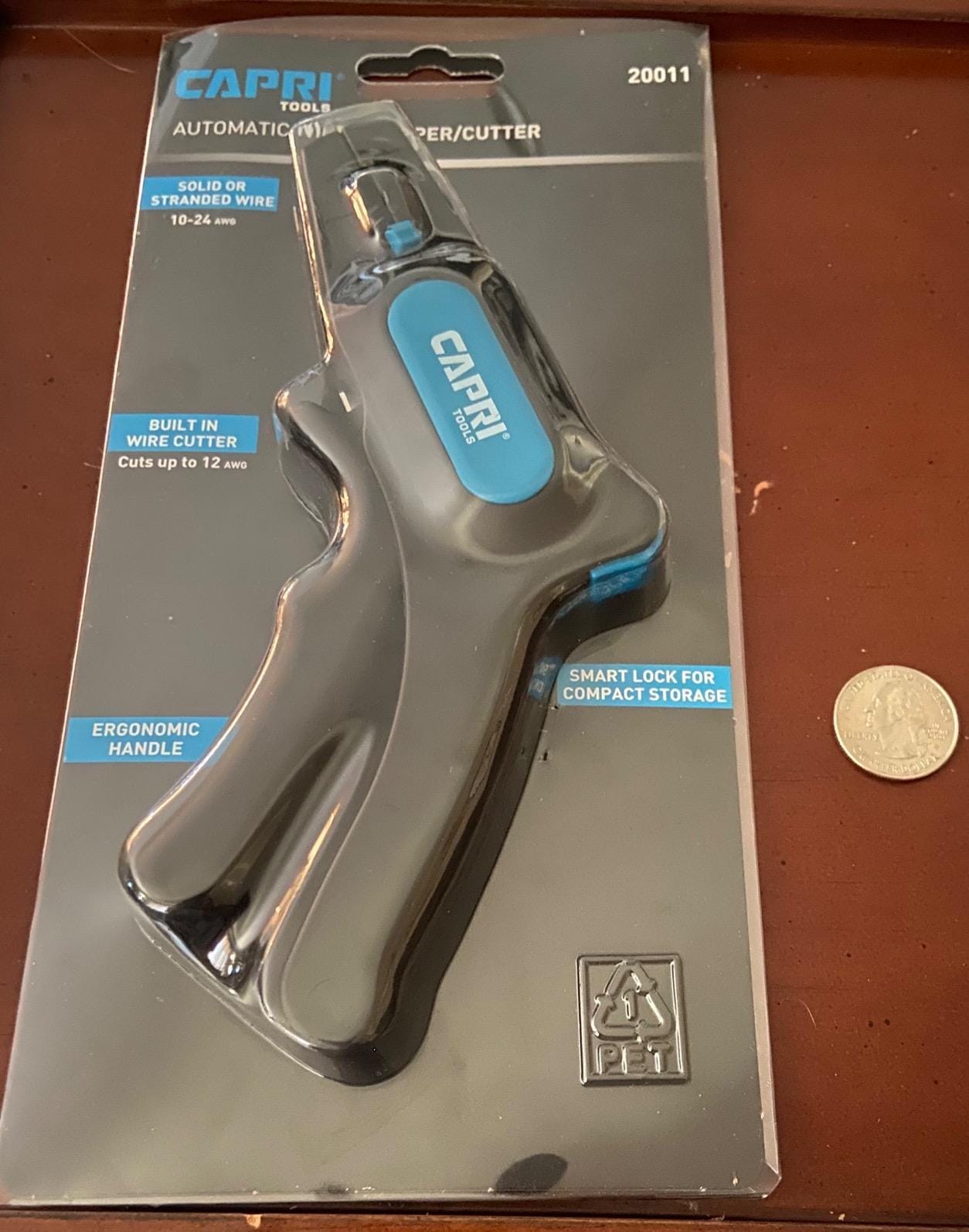
9. Capri Tools 20011 Automatic Wire Stripper and Cutter – Best Narrow-Profile Automatic
Capri Tools 20011 Automatic Wire Stripper and Cutter
24-10 AWG strip
Cuts to 12 AWG
Self-adjusting blades
Narrow profile
Pros
- Strips and grips in one squeeze which speeds up repeated 18-22 AWG prep
- Narrow profile reaches wiring in confined spaces
- Light at about 0.16 kg so it does not weigh down a tool belt
- Self-adjusting blades take solid and stranded with no gauge change
Cons
- Strip length only adjusts between roughly 8 and 12 mm which is long for electronics leads
- Takes a few dozen pulls before the action stops feeling clunky and can jam
- Smallest 24 AWG setting can cut strands if squeezed too hard
- Build quality reads as light
The Capri 20011 pairs a self-adjusting jaw with a narrow body, which is an unusual combination and the reason it earns a place here. The automatics on this list are efficient but bulky; the manual precision tools are slim but require a gauge decision every time. This one gives you single-squeeze stripping in a body you can still get into a confined space.
Stripping and gripping happen in one motion, so repeated 18-22 AWG lead prep is quick once the technique settles. The self-adjusting blades handle solid and stranded conductors without a gauge change, and at about 0.16 kg the tool stays light on a belt or in a crowded hand.
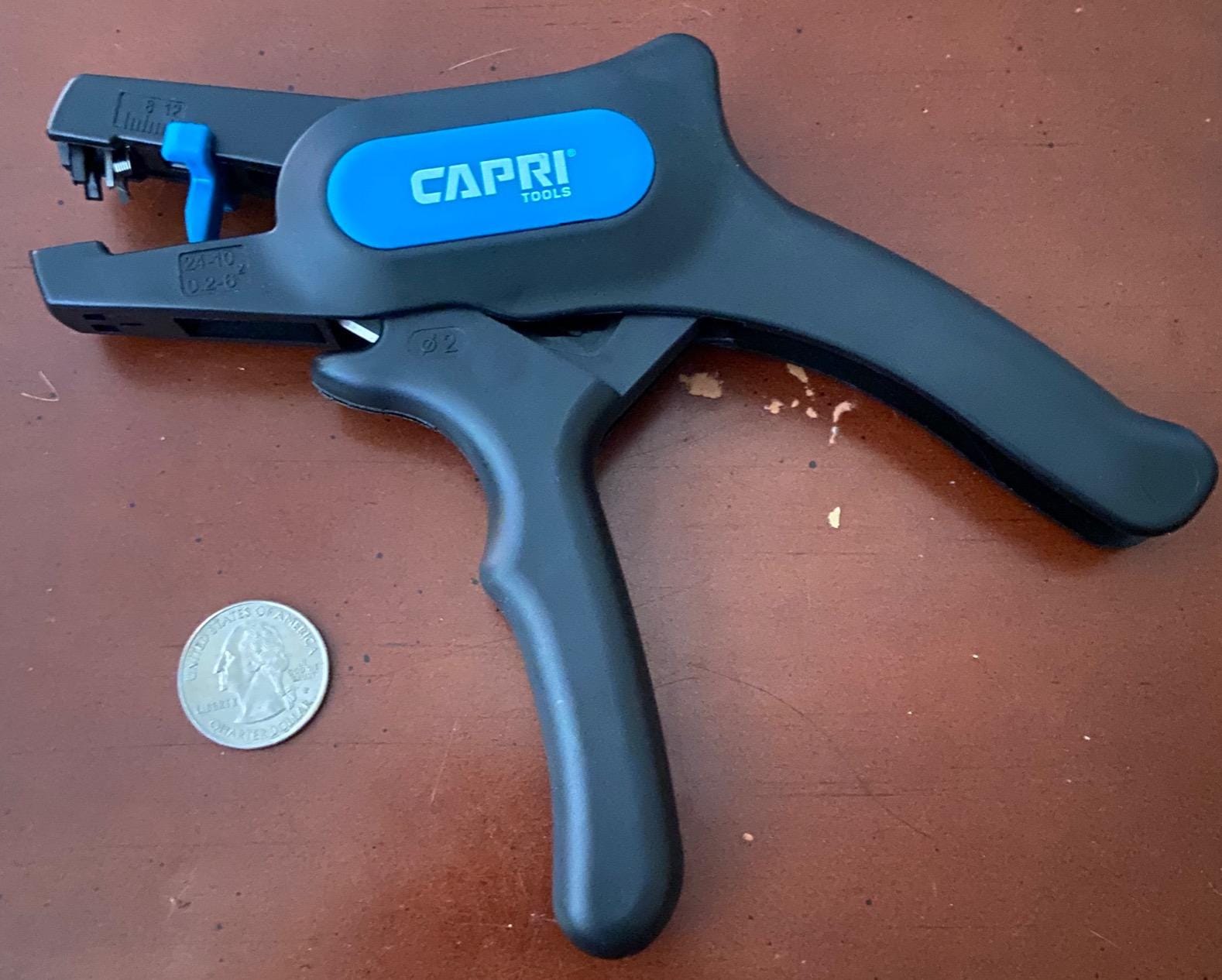
Control panel and wiring installers treat it as a fast, inexpensive one-motion stripper for everything above 24 AWG. The narrow profile is the specific reason it earns a slot here, since most multi-function bodies of this type are wide and awkward inside a panel.
A 10-year warranty backs the tool, which is generous relative to its build, and the spring is reported to stay lively over time.
Strip length is the deciding factor
The adjustable stop runs only between roughly 8 and 12 mm. For electronics leads feeding a JST or IDC housing, that range is at the long end of what you usually want, and it is the main reason to look elsewhere for short-lead prep.
For panel wiring where a longer bare length is fine, that limitation largely disappears and the rest of the tool makes the case on its own.
Where it falls short
There is a learning curve. The action feels clunky for the first few dozen pulls and it can jam occasionally, and the smallest 24 AWG setting will cut strands if you squeeze too hard before you have learned the feel.
Build quality reads as light for the price, and the 8-12 mm strip length range rules out short terminal work.
10. Klein Tools 11063W Automatic Wire Cutter Stripper – Top Rated Workhorse
Klein Tools 11063W 7-Inch Heavy-Duty Automatic Wire Cutter/Stripper
8-20 AWG solid
10-22 AWG stranded
Removes up to 1 inch of jacket
Replaceable blades
Pros
- Compound action strips and grips in one squeeze
- taking up 1 inch of jacket in a step
- Precision-machined holes leave 18-22 AWG conductors intact
- Cast alloy chassis with Ecoat finish resists corrosion
- Integrated cutter leaves a flush cut instead of stretched insulation points
- Replaceable stripping blades extend tool life
Cons
- Stops at 20 AWG stranded so it cannot handle 22-24 AWG electronics hookup
- Large size is awkward in small hands
- Blade settings can be slightly imprecise or ovalised out of the box
With over eleven thousand ratings, the 11063W is the most proven tool in this roundup, and it is the volume workhorse of the group. The compound action strips and grips in a single squeeze and removes up to an inch of jacket at a time, which is exactly the behaviour you want when a harness contains a hundred terminations rather than ten.
The precision-machined holes left 18-22 AWG conductors intact with no broken or nicked strands in our hands, and the integrated cutter produces a flush cut rather than the stretched insulation points that V-blade cutters tend to leave. The cast alloy chassis with an Ecoat finish has held up well in service and resists corrosion.
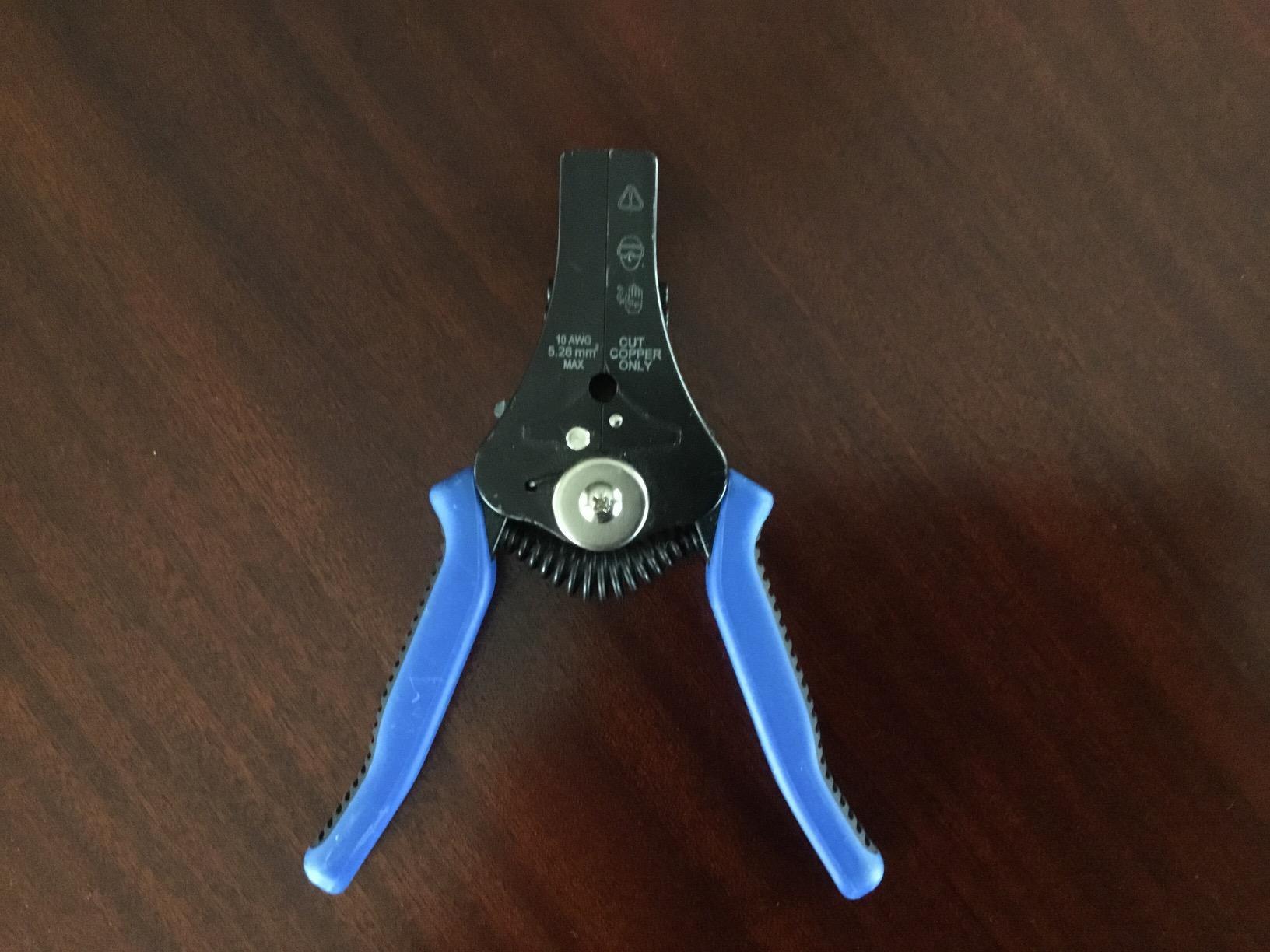
Replaceable stripping blades are the detail that matters for long-term ownership. On a tool expected to see this much use, being able to swap the wear part rather than replace the whole body changes the ownership calculation completely.
Owners across electrical, aircraft and installation work describe it as fast, sturdy and consistent, and its 4.8 average across that volume of ratings is the strongest evidence in this list.
When the heavy-duty build is the right call
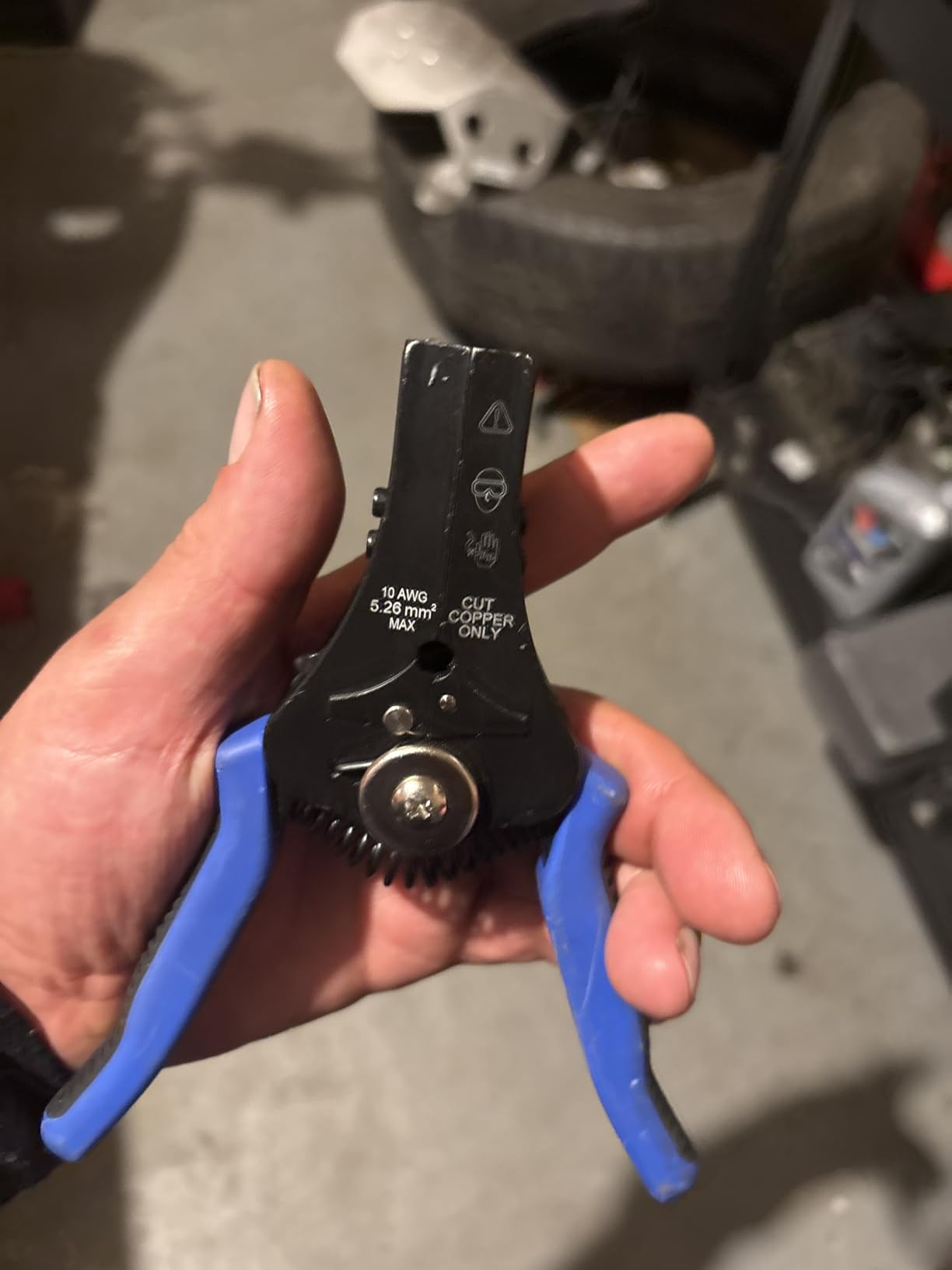
It suits 8-20 AWG solid and 10-22 AWG stranded, so it is the right pick for panel wiring, small power distribution, battery leads and any build with heavier conductor in the mix. Dual-material grips keep it comfortable over extended use.
If your work spans both fine electronics and heavier wiring, this covers the heavier half so a precision tool can handle the fine half without compromise.
Where it falls short
It stops at 20 AWG stranded, which rules it out for 22-24 AWG electronics hookup. That single number excludes a lot of modern bench work.
The 12 ounce body is bulky in small hands, and some owners report blade settings that arrive slightly imprecise or ovalised, which needs checking on scrap wire before you rely on it.
How We Picked the Best Wire Strippers for Electronics Work
We built this list around the failure mode that dominates electronics forums: nicked or severed strands on 30 AWG and finer. Nearly every question we found about wire strippers came back to the same worry, which is why conductor damage is the first thing we looked at in every tool.
Every gauge range, weight, dimension and material listed here comes from the manufacturer’s own product data rather than from marketing copy or inference. Where a tool’s stated range differs for solid and stranded wire, we have given both, because that distinction decides whether a tool can do the job at all on a mixed-wire bench.
The nick test is the check we would run before trusting any stripper, and it takes about five minutes. Cut a 150 mm length of the same wire you plan to use, strip it with the tool and the notch you intend to use, then inspect the conductor under a magnifier or a phone camera at high zoom. A clean strip shows a circular cut with all strands intact and no flattened section. A nick shows a bright crescent where a strand was cut or flattened, and that is your cue to change notch, change tool or use the soldering-iron method instead.
We also checked each tool against the wire types it will realistically meet: PVC hookup, Kynar, PTFE, Kapton, silicone and magnet wire. A tool rated for 20-30 AWG is not automatically good with PTFE, and a jaw that works on PVC can tear Kapton. That insulation compatibility check is what separated the shortlist from the long list.
Finally, we weighed the practical constraints that decide whether a tool gets used daily: a length stop for repeatable terminal prep, a narrow nose for enclosed builds, grip comfort across a long session and whether blades are replaceable. A tool that stays on the bench for years is worth more than one that performs slightly better and sits in a drawer.
How to Choose the Best Wire Strippers for Electronics Work
Match the mechanism to the gauge you actually use
Automatic self-adjusting strippers are fastest on mid-gauge wire and usually bottom out around 22-24 AWG, so they are the wrong tool for fine hookup. Precision manual strippers reach 30 AWG and below but require a notch decision on every wire. Thermal strippers, which heat and melt the insulation rather than cutting it, are the tool forum users reach for when a conductor is too fine to risk a mechanical cut at all.
Rocketry forum regulars in particular describe thermal strippers as the safest option for small gauge because there is no blade to score the conductor. A soldering iron loaded with solder is the other fallback people describe, and both methods work on a wire too delicate to strip mechanically.
Check the AWG floor for solid and stranded separately
Wire gauge runs opposite to intuition: a higher AWG number means thinner wire, and 30 AWG is finer than 20 AWG. Tools frequently list a different floor for solid core than for stranded, and the difference can be two gauges or more. The ENGINEER PA-06 strips solid wire from 28 AWG and stranded from 30 AWG, while the Klein 11046 handles 16-26 AWG stranded but cannot take solid wire as fine as 26 AWG.
Decide which conductor type dominates your work and check that number first. It is the most common reason a good tool turns out to be useless for a particular build.
Conductor damage and what it actually costs
A nick does not fail immediately. It removes one or two strands, so the joint still conducts and still measures correctly on a meter, which is why damage goes unnoticed. The cut strand then acts as a stress concentration, and repeated flexing or handling breaks the remaining strands at that point. Contact resistance rises as strands go missing, so a joint that drew a measured current at assembly can run warmer later.
This is why we treat a nick as a hard failure rather than a cosmetic one. The fix costs seconds at the bench and nothing at all compared with tracing a failed joint inside a sealed enclosure weeks later.
Insulation compatibility: PVC, Kynar, PTFE, Kapton, silicone and magnet wire
PVC is the easy case and every tool here handles it. Kynar and PTFE are thin films with almost no grip that stretch before they cut, and a blunt or aggressive blade tears them instead. The ENGINEER precision tools use very sharp jaws specifically because those materials need a clean single-edge cut. Kapton and silicone insulation are softer and thicker, so they tolerate more force but still cut more cleanly on a sharp jaw.
Magnet wire is a different job entirely, because the enamel has to be removed along with the insulation and a standard stripper will happily cut the wire instead. For coil work, use a dedicated approach rather than forcing a general-purpose stripper, and always test on the same enamel first.
Strip length repeatability and a length stop
If you are prepping leads for terminal blocks, IDC connectors or JST housings, strip length becomes a dimension rather than a preference. A wire that is too short will not seat and one that is too long leaves exposed conductor that can bridge. A tool with an adjustable length stop lets you set the depth once and repeat it, which is the single most useful feature for batch prep.
Tools with fixed notches force you to judge depth by eye every time. That is fine for prototyping and a real problem for anything repetitive, so check for a stop before you buy if terminal work is part of your week.
Build, handles and long-term ownership
Cast alloy and hardened steel bodies resist the flex that makes a stripper inaccurate over time, and rubber or thermoplastic grips stay comfortable on a long session. Heavier bodies are not automatically better, but a tool that feels solid in the hand usually has a tighter pivot, and a tight pivot is what keeps the notch depth consistent.
Check whether stripping blades are replaceable. On a tool you expect to use for years, replaceable wear parts mean you maintain the tool rather than replace it. The Klein 11063W offers this, and it is a large part of why that tool stays in service.
If you are organising the rest of your bench kit, our guides to wire shelving units cover where to keep tools within reach, and drain cleaners handle a different part of the workshop entirely.
Frequently Asked Questions
What is the best way to strip electrical wire?
Use a stripper with a notch or self-adjusting jaw matched to the wire gauge, insert the wire to the depth set by the length stop, and squeeze once. The blades cut the insulation all the way round and pull it off in one piece. The key is letting the tool do the cutting rather than pulling the insulation away by hand, which is what causes torn jackets and nicked conductors.
Which tool is used to strip the insulation from electric wires?
A wire stripper, which is a hand tool with notched or self-adjusting blades that remove plastic or film insulation from a wire without cutting the metal conductor underneath. The stripped end is then ready for soldering, crimping or insertion into a terminal block. Scissors, craft knives and bare fingers are common substitutes and are the main cause of damaged conductors.
What is the best way to strip very thin wire?
Very thin wire calls for a precision manual stripper with very sharp jaws rather than an automatic model, because most automatic mechanisms bottom out around 22 to 24 AWG. The ENGINEER PA-14 reaches 34 AWG stranded and 32 AWG solid, and the ENGINEER PA-06 covers 30 to 18 AWG stranded. Heat-based strippers and the soldering-iron method are the fallbacks when the wire is too fine to risk a blade at all.
How do I strip 30 AWG wire without breaking the strands?
Pick a precision stripper rated below 30 AWG and use the correct notch, since a full squeeze on a mismatched hole is what severs strands. Insert the wire to a measured depth rather than by eye, squeeze firmly but without forcing, and pull the tool straight off rather than twisting. Inspect the result under magnification, and if a nick appears, move to a finer notch or switch to a thermal stripper or the soldering-iron method for that wire.
What are the most common wire stripping mistakes?
The most common errors are using a notch that is too large and leaving insulation behind, using one that is too small and cutting into the conductor, stripping by hand or with a knife, twisting the tool as you pull it off, and having no length stop so strip depth varies between leads. Nicking strands without noticing is the most damaging of these because the joint still measures correctly after assembly.
Is a drill-powered wire stripping machine useful for home electronics work?
Not really. Drill attachments and bench stripping machines are built for bulk 12-2 building cable and armoured or multicore work, and they are sized around conductor diameters far above anything used on a breadboard or a PCB. For electronics hookup wire they are too heavy, too coarse and too imprecise. A precision hand stripper costs less, fits in a tool roll and gives a far cleaner result on 26 to 34 AWG.
The Best Wire Strippers for Electronics Work, Final Word
The best wire strippers for electronics work come down to one variable: how thin your wire gets. Below 26 AWG, a precision manual tool is the only sensible answer, and the ENGINEER PA-06 and PA-14 cover 30 to 34 AWG without damaging strands. Between 22 and 30 AWG, the Klein 11057 and the Hakko CSP-30-1 are dependable, and above 22 AWG the automatics take over.
For most benches, the Capri Tools 20010 is the one to start with: 22-8 AWG of cleanly machined notches in a cast alloy body that will outlast the project. The Klein 11063W is the proven workhorse when heavier wire is part of the mix, and the Klein 11046 solves the enclosed-build problem that no amount of clever technique can work around.
Whichever you choose, run the nick test on scrap of the exact wire you use before you start a build. It takes five minutes and it is the difference between a tool you trust and one you check after every strip. That is our 2026 shortlist, and it is the set we would hand to anyone setting up an electronics bench.