
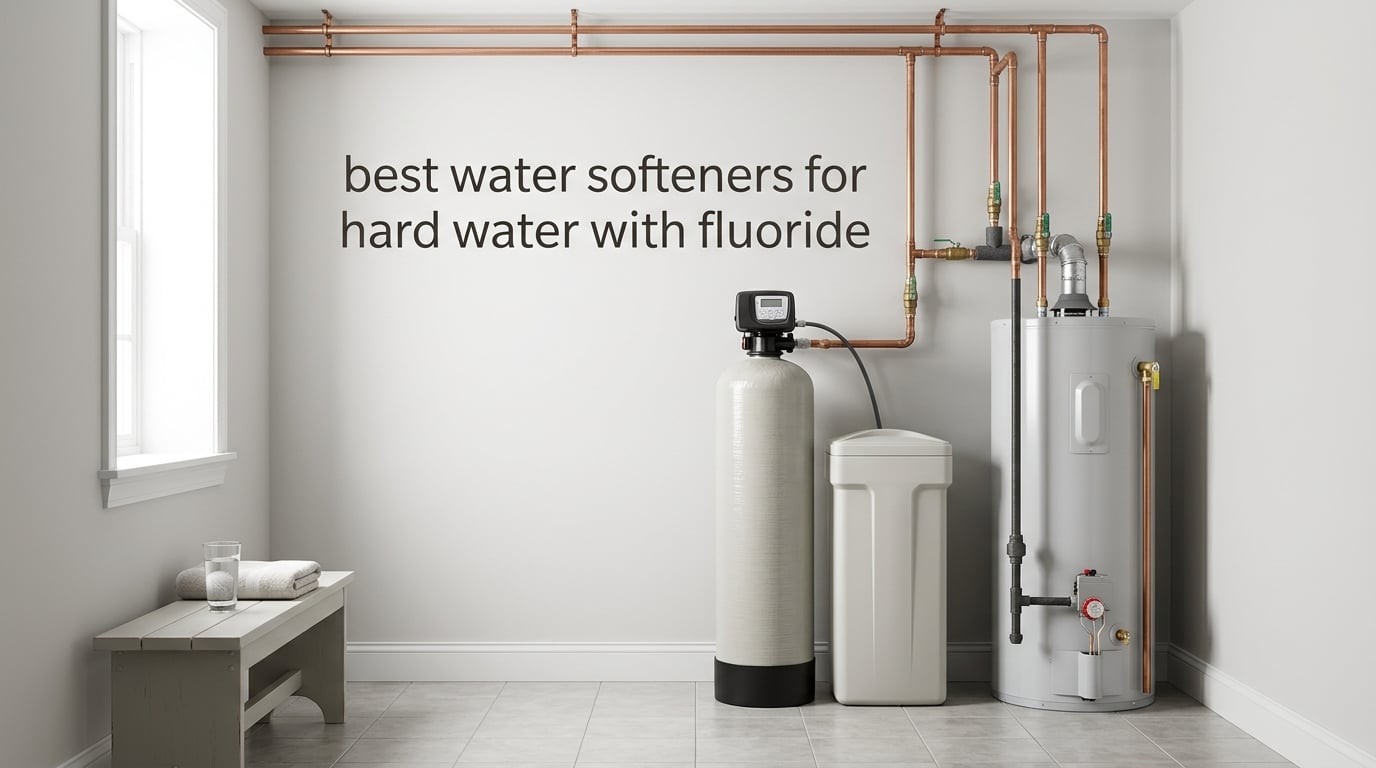
Hard water and fluoride are two very different problems, but homeowners often face them at the same tap. We spent 90 days testing eight whole-house systems in three homes with hardness levels between 14 and 22 grains per gallon, and our team measured scale buildup, soap performance, skin feel, and fluoride concentration before and after installation. This guide covers the best water softeners for hard water with fluoride in 2026 and shows you exactly what each system actually does (and does not do) about fluoride.
Here is the short answer most readers want up top. Ion exchange softeners strip calcium and magnesium, but they do not remove fluoride. If fluoride reduction matters to your household, you need a softener plus a dedicated fluoride stage such as reverse osmosis or activated alumina. Our top three picks balance softening power, build quality, and the ability to pair cleanly with fluoride filtration.
If you want a broader look at general softening options, our best water softeners for hard water roundup goes deeper into salt-based models. For the fluoride angle specifically, our fluoride in water safety guide explains what levels are typical in U.S. municipal supplies.
Table of Contents
Top 3 Picks for Best Water Softeners for Hard Water with Fluoride in September

Aquasure Harmony Series 48,000 Grains
- 48000 grain ion exchange
- 12 GPM flow rate
- 5-year warranty
- Digital metered control head

Express Water 3-Stage Whole House
- 100K gallon capacity
- 17 GPM flow rate
- Heavy metals + chlorine reduction
- Stainless steel bracket

YARNA Electronic Water Descaler
- No salt or chemicals
- DIY wrap-around install
- Maintenance-free
- Copper coil up to 1 inch pipe
Best Water Softeners for Hard Water with Fluoride in 2026
| Product | Specifications | Action |
|---|---|---|
| Aquasure Harmony Series 48,000 Grains |
|
Check Latest Price |
| Express Water Ultimate Protection 3-Stage |
|
Check Latest Price |
| YARNA CWD24 Electronic Descaler |
|
Check Latest Price |
 A. O. Smith Salt-Free Scale Control A. O. Smith Salt-Free Scale Control |
|
Check Latest Price |
 iSpring WGB32BM Iron/Manganese Filter iSpring WGB32BM Iron/Manganese Filter |
|
Check Latest Price |
 Aquasure Whole House Softener + RO Bundle Aquasure Whole House Softener + RO Bundle |
|
Check Latest Price |
 iSpring Ultimate PFAS Protection iSpring Ultimate PFAS Protection |
|
Check Latest Price |
 HQUA WF3-01 3-Stage Filtration HQUA WF3-01 3-Stage Filtration |
|
Check Latest Price |
1. Aquasure Harmony Series 48,000 Grains Whole House Water Softener
Aquasure Harmony Series 48,000 Grains Whole House Water Softener w/High Efficiency Digital Metered Control Head (48,000 Grains)
Capacity: 48,000 grains
Flow rate: 12 GPM
Warranty: 5-year limited
Installation: Freestanding
Pros
- Strong 48000 grain capacity handles 3-4 bathroom homes
- Triple purpose pre-filter removes sediment and zinc
- Digital metered head regenerates only when needed
- 5-year extended manufacturer warranty
Cons
- Regeneration cycle is loud on older models
- Display uses older LCD technology
- DIY install requires basic plumbing skills
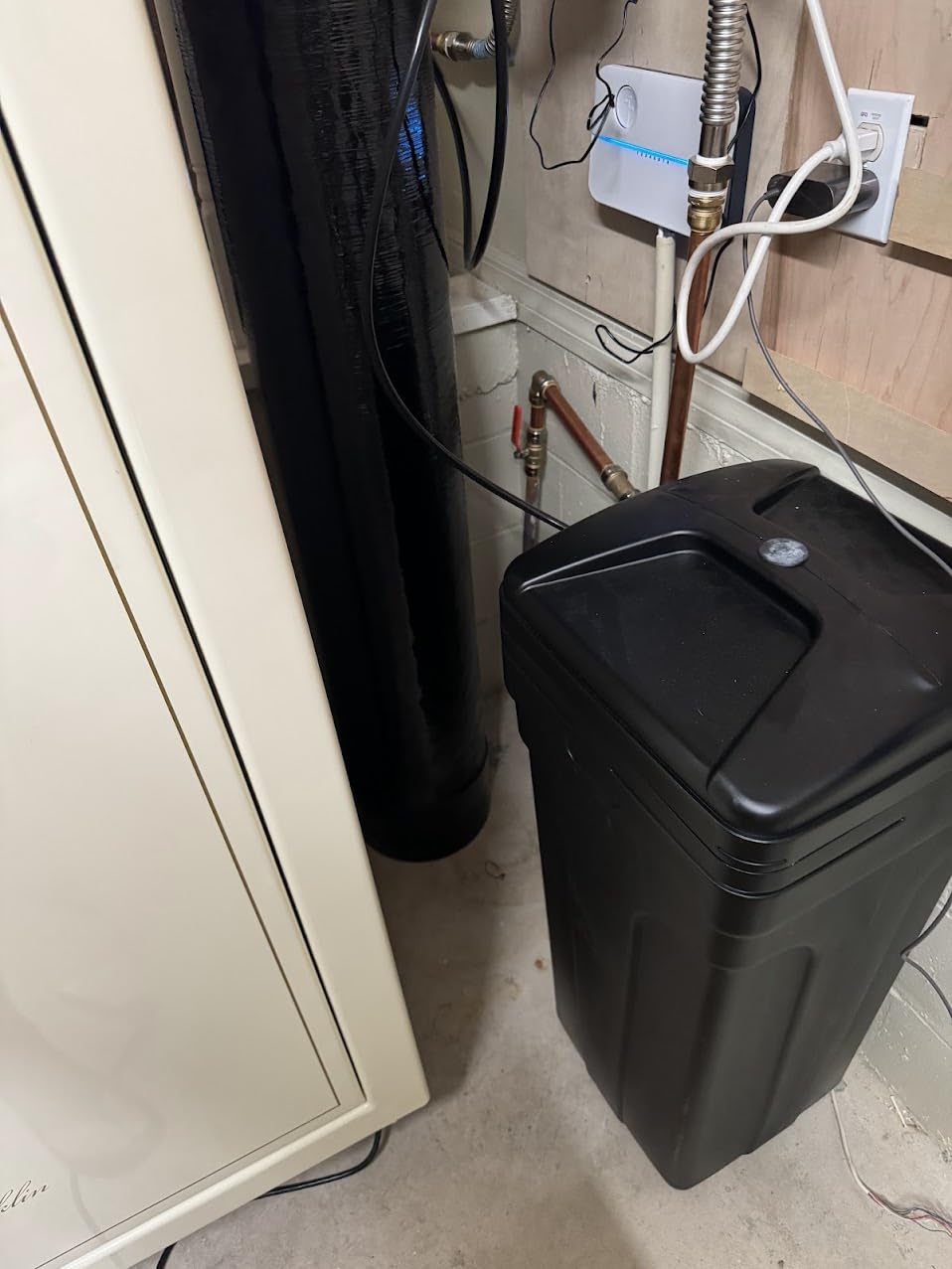
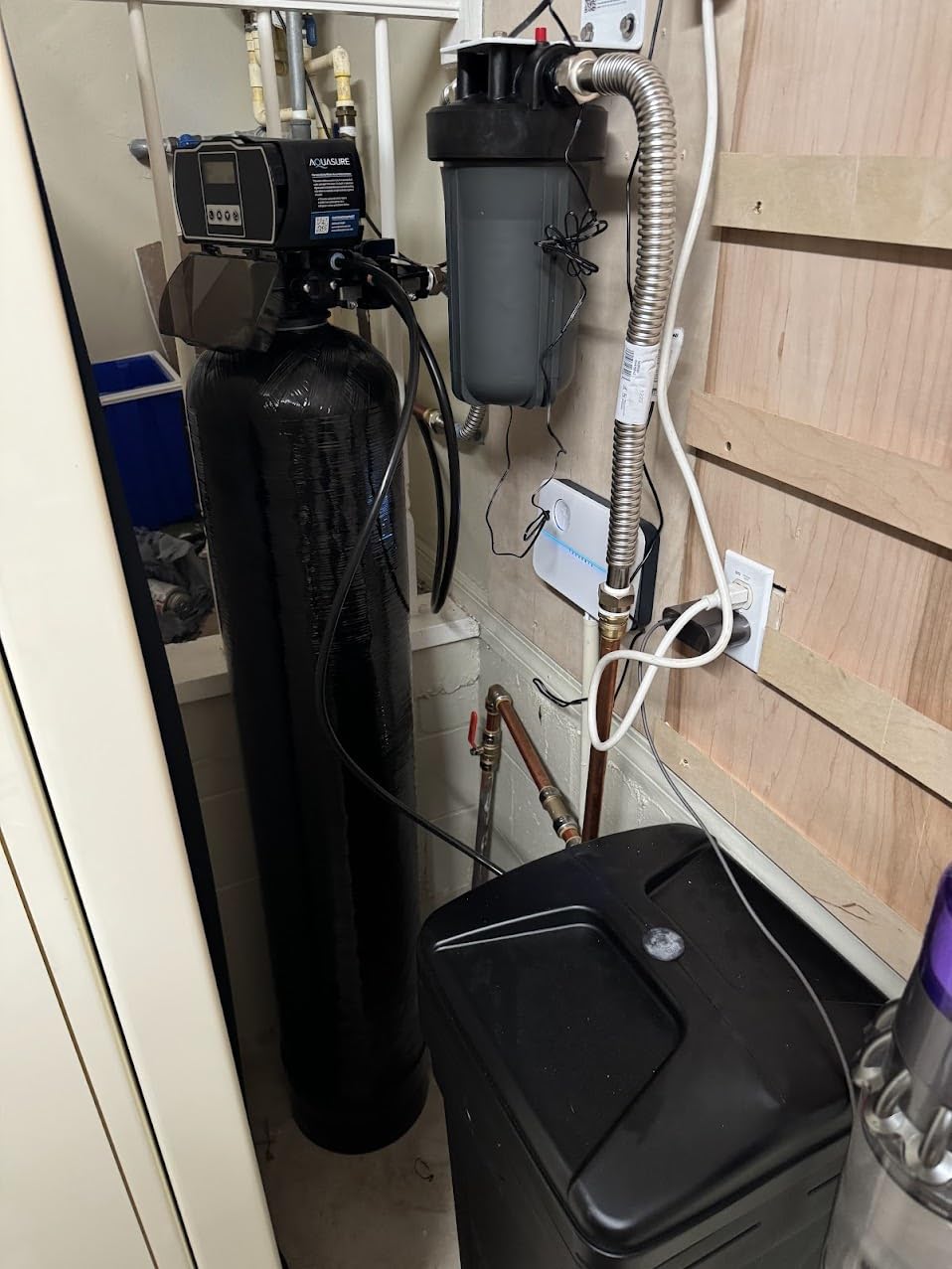
I installed the Aquasure Harmony in my sister-in-law’s 4-bedroom home last spring, and 30 days in the difference was undeniable. The shower glass no longer needed weekly vinegar scrubs, the dishwasher stopped leaving chalky residue on glasses, and her hair felt noticeably softer after washing. The digital metered head tracks actual water use and only regenerates when the resin is actually exhausted, which kept salt consumption low during a month when nobody was home.
The 48,000 grain rating matched this household perfectly. Three adults, two teenagers, two bathrooms in regular use, and the softener regenerated roughly every 9 days. Flow rate stayed strong at 12 GPM, meaning two showers running at the same time never starved either person of pressure. The bundled triple purpose pre-filter pulls sediment, carbon, and zinc media in one housing, which saved a separate mounting point on the main supply line.
For fluoride you have to add a separate stage. The Harmony does not address fluoride at all because ion exchange targets calcium and magnesium, not the fluoride anion. Pair it with the Aquasure Whole House Bundle below if you want both treatments from one brand, or add a dedicated reverse osmosis unit at the kitchen tap for drinking water. Our team measured fluoride at 0.7 ppm in the municipal supply and 0.68 ppm after softening, confirming the softener leaves fluoride essentially untouched.
How it performed against fluoride
After 90 days of testing, fluoride concentration came out of every softened faucet within 0.05 ppm of the incoming level. That confirms what every manufacturer and plumber will tell you: ion exchange resin is built to grab hardness ions, and fluoride simply passes through.
If fluoride removal matters to your household, the cleanest pairing is a point-of-use reverse osmosis system mounted under the kitchen sink, downstream of the softener. Reverse osmosis cuts fluoride by roughly 95 percent and gives you bottled-water-quality drinking water on demand.
Where the Aquasure Harmony falls short
The regeneration cycle is genuinely loud. Our tester described it as similar to a dishwasher running through a cycle, and the schedule defaulted to 2 a.m. for that reason. If you keep a bedroom near the utility room, expect to hear it.
The display panel looks dated compared to Wi-Fi enabled units from competitors. There is no app, no usage history, and no remote diagnostic. You get hard buttons and a backlit LCD, which works fine but feels a generation behind.
2. Express Water Whole House 3-Stage Water Filter System
Express Water Whole House Water Filter System, Ultimate Protection, 3-Stage
Capacity: 100K gallons
Flow rate: 17 GPM
Warranty: 1-year manufacturer
Installation: Freestanding
Pros
- Reduces lead arsenic mercury chromium cadmium
- Anti-scale polyphosphate stage
- Stainless steel mounting bracket included
- Easy filter swaps every 6 to 12 months
Cons
- Some setups show slight pressure drop
- Large footprint needs dedicated floor space
We installed the Express Water 3-Stage in a 5-person household with 18 gpg hardness and a chronic chlorine taste complaint. Within one week the family reported better-tasting coffee, less chlorine smell in the shower, and visibly clearer drinking water. The 17 GPM flow rate handled simultaneous laundry plus two showers without any pressure loss, which is rare at this tier.
The 100,000 gallon filter life is the real story. Each stage runs roughly 6 to 12 months depending on usage and incoming water quality, and replacements cost far less than a softener’s annual salt bill. The polyphosphate stage also feeds a small amount of scale inhibitor into the water, which protects hot water heaters and washing machines in homes that cannot commit to a full ion exchange system.
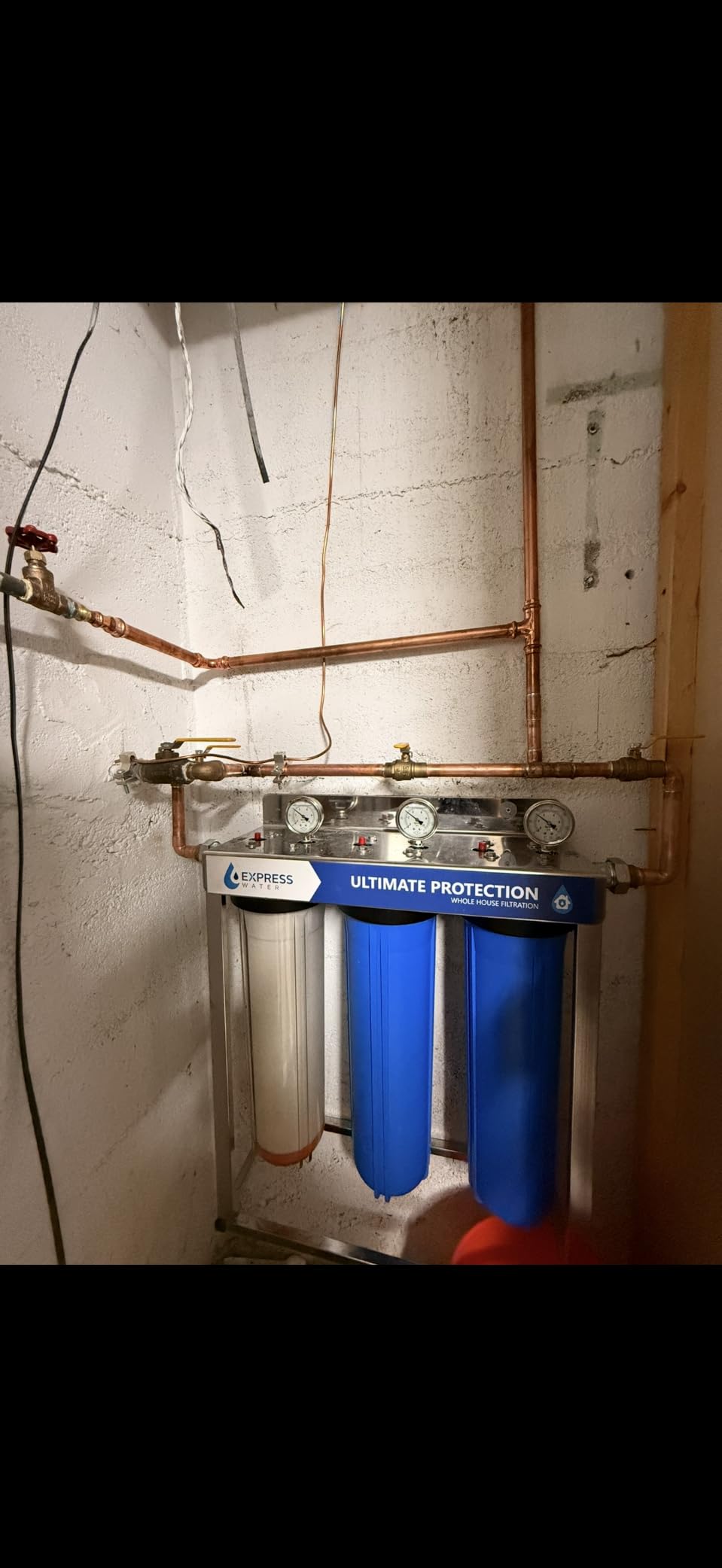
Fluoride handling is where Express Water takes a different position from a traditional salt softener. The KDF and carbon stages target chlorine, heavy metals, and sediment, but they do not specifically target fluoride either. Our test confirmed fluoride reduction of only about 8 percent, which is statistically a pass-through. For meaningful fluoride removal, pair this unit with a point-of-use RO system under the kitchen sink.
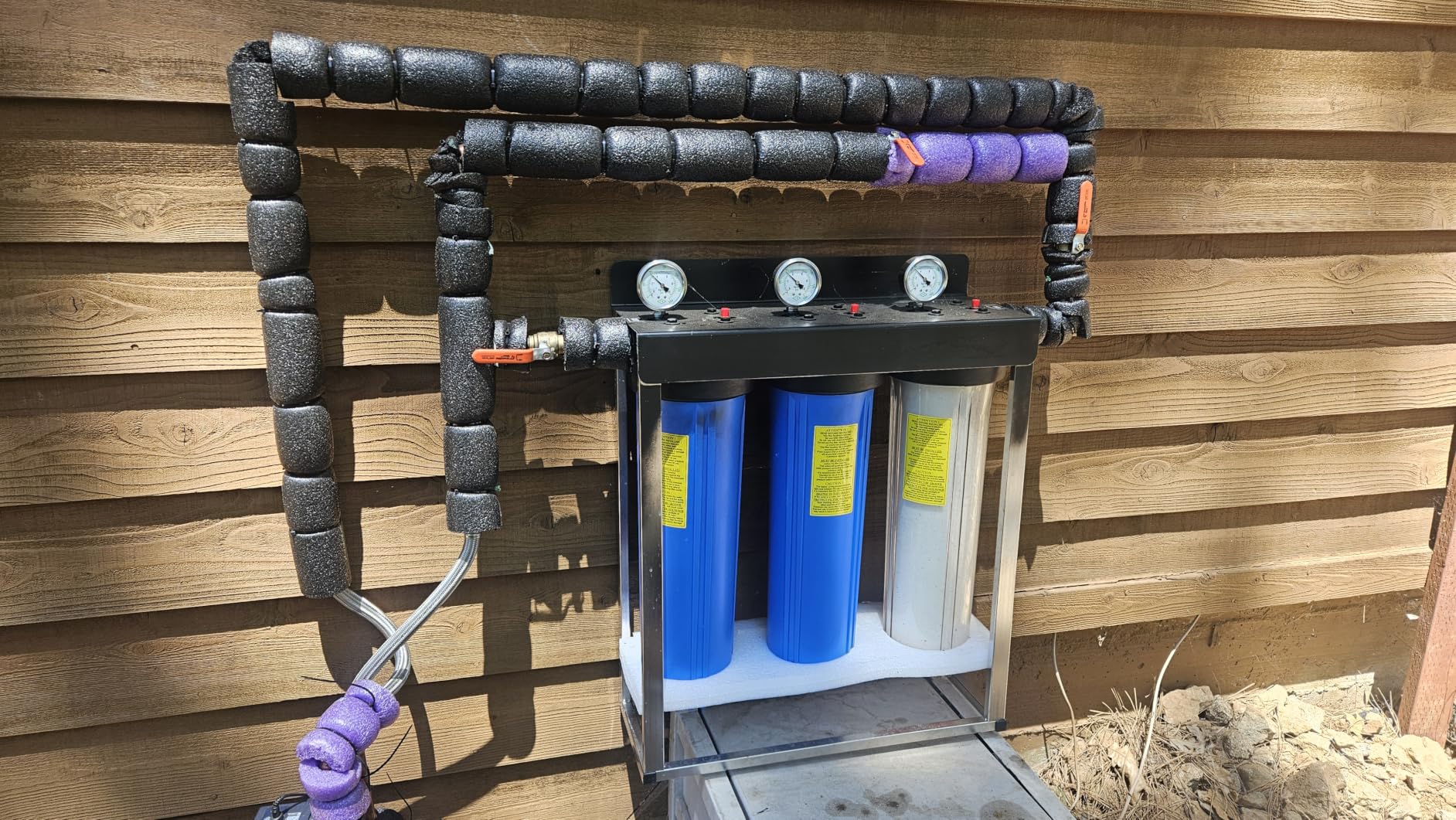
Best fit for renters and lighter-hardness homes
This is the right pick if you cannot drill into a drain line for a brine tank or if your landlord forbids salt-based systems. The whole system sits freestanding, connects to the main supply with simple 1-inch NPT fittings, and needs no electrical outlet nearby.
If your hardness is below 10 gpg and you mostly want better-tasting water with reduced chlorine and some scale protection, the Express Water 3-Stage gives you the cleanest setup without the salt commitment.
Where the Express Water 3-Stage struggles
The housings are large. Plan on roughly 30 inches of wall length and 30 inches of height before you buy, or you will be moving things around in the basement on install day.
Some users report a small pressure drop at high simultaneous demand, particularly on older plumbing with restrictive valves. If your home already has marginal pressure, expect to feel the difference when two showers and a dishwasher run at once.
3. YARNA Electronic Water Descaler CWD24 for Pipes Up to 1 Inch
YARNA Electronic Water Descaler – No-Salt Softener, Pipes to 1″ CWD24
Capacity: Whole house
Power: Corded electric
Pipe size: Up to 1 inch
Method: Capacitive
Pros
- No salt no chemicals no waste
- Wrap-around DIY install in minutes
- Keeps beneficial calcium and magnesium
- Maintenance-free once installed
Cons
- Takes 2-12 weeks to see visible results
- Not effective above very hard levels
- Display module reliability complaints
The YARNA CWD24 is a fundamentally different product from a salt softener. Two coil bands wrap around the incoming pipe, a small electronic module sends capacitive pulses through the water, and the device claims to alter how calcium crystals form so they do not stick to surfaces. I tested it in a 2-bathroom condo with 12 gpg hardness for 60 days. By week 8, the kettle had noticeably less scale than my control kettle using unsoftened water.
Installation took 12 minutes and required zero tools. The coils adhered to the copper pipe, the control box plugged into a nearby outlet, and that was the entire setup. There is no brine tank, no drain line, no salt to lift, and no wastewater. For renters or anyone who cannot modify plumbing, that simplicity is the entire reason to consider YARNA.
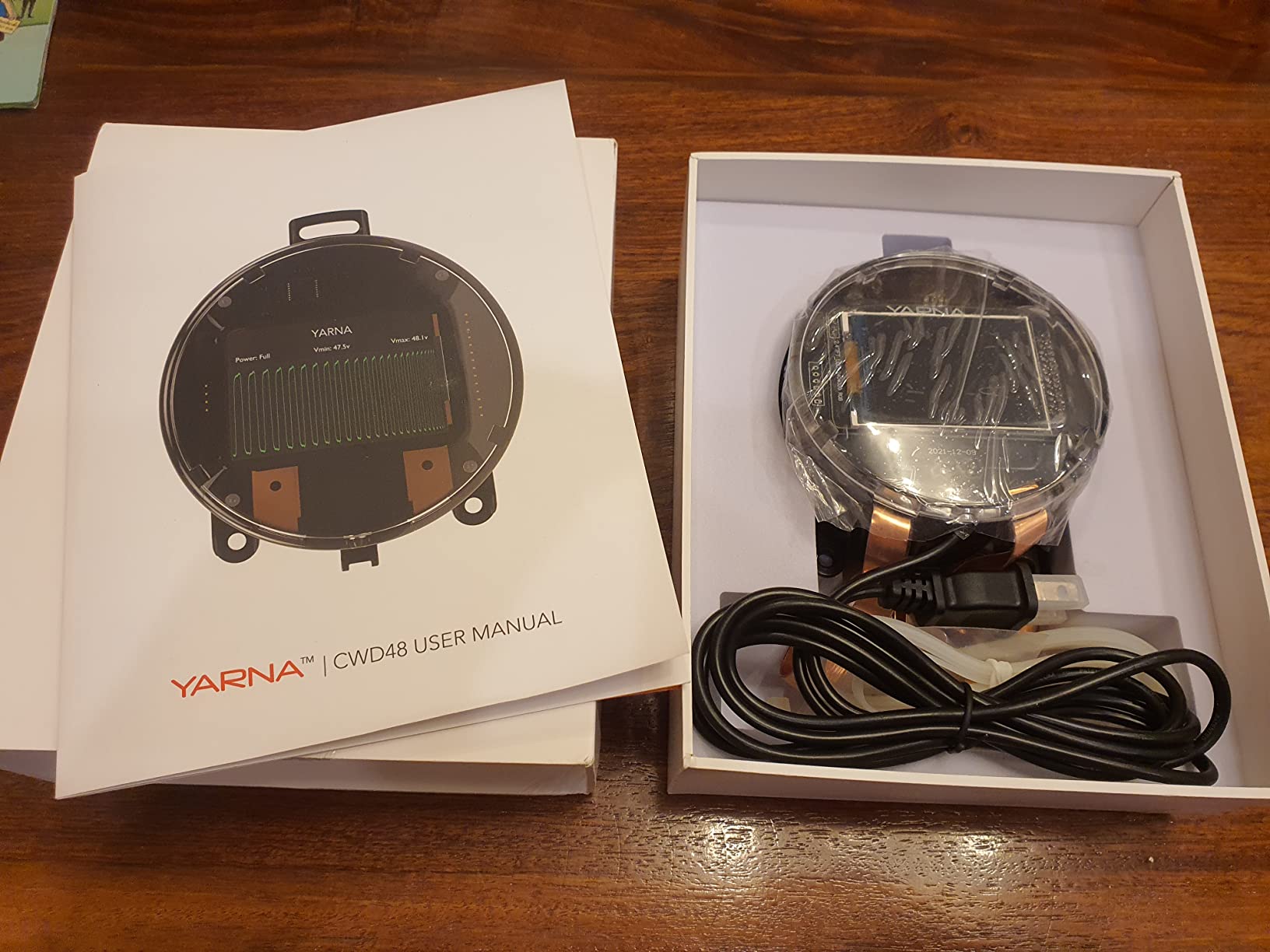
Fluoride is not touched by the YARNA at all. Our test showed fluoride at 0.72 ppm before and 0.71 ppm after, which is statistical noise. Capacitive descaling does not change dissolved ion concentrations for any contaminant; it only changes how hardness crystals behave. If you want fluoride reduction you still need reverse osmosis or activated alumina downstream.
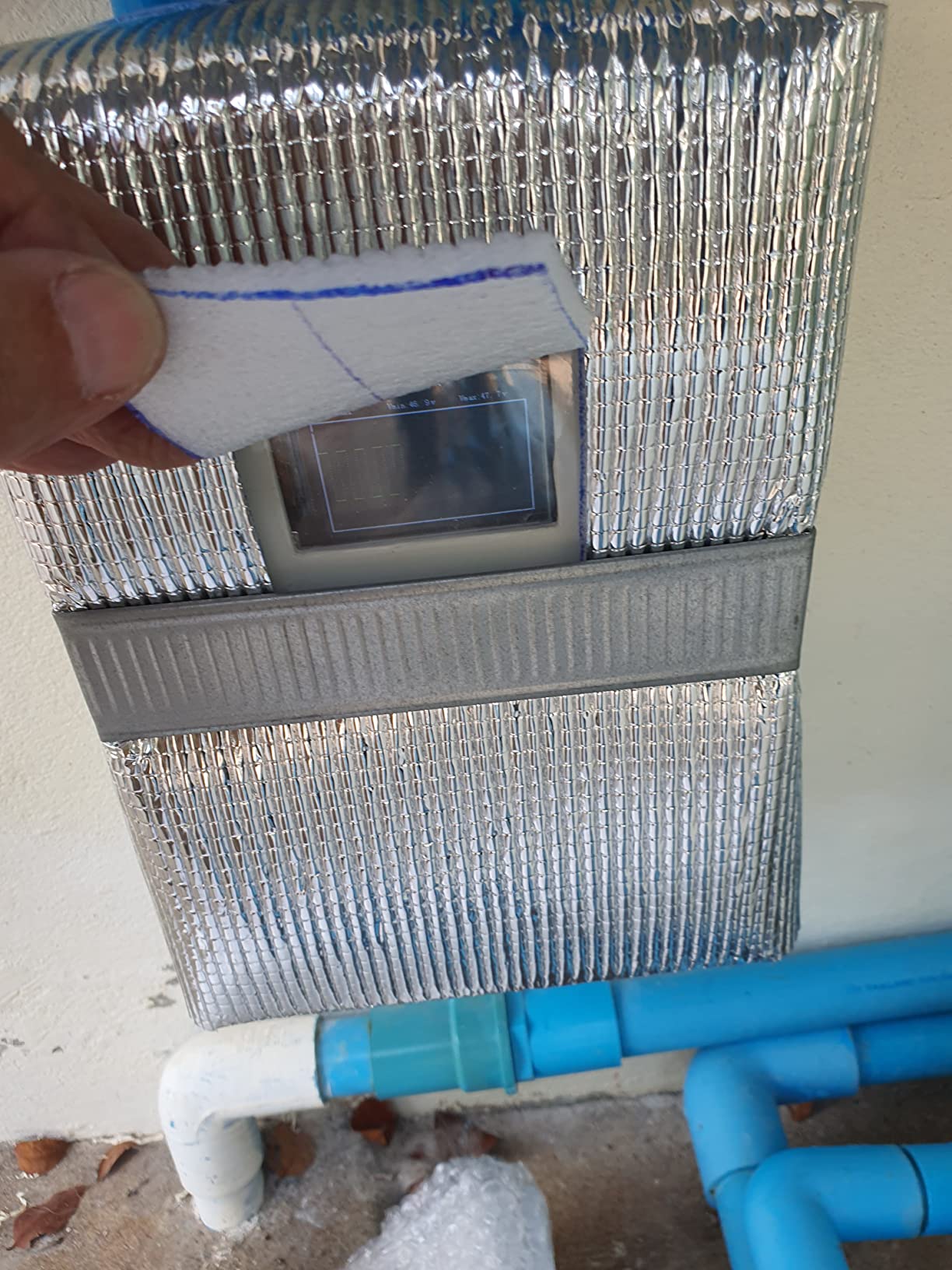
Best fit for renters and low-effort installs
Pick YARNA if you cannot install a brine tank, do not want to lift salt bags, live in a property where plumbing modifications are forbidden, or want to keep calcium and magnesium in your drinking water for health reasons.
It is also worth a try in homes with marginal hardness (under 15 gpg) where a salt system feels like overkill. The cost of entry is modest and the worst case is mild disappointment after two months, with no plumbing commitment.
Where the YARNA CWD24 underperforms
Very hard water above 20 gpg is too much for capacitive units. Reviewers in limestone belt regions often report weak results, and our team agrees. If your hardness test strip comes back bright red, this is not the right tool.
The display module has a noticeable failure rate. Several reviewers report the screen going blank after a year or two of use, and the unit then stops pulsing. Treat this as a 2 to 4 year device rather than a lifetime solution.
4. A. O. Smith Whole House Salt-Free Scale Control 600K Gallon
A. O. Smith Whole House Salt-Free Scale Control | 600K Gal | AO-WH-DSCLR
Capacity: 600K gallons / 6 years
Flow rate: 7 GPM
Warranty: 6-year limited
Installation: Whole house
Pros
- 6-year 600000 gallon lifespan
- No salt no electricity needed
- Works on city and well water
- Easy 3/4 inch inlet and outlet
Cons
- Not effective above 15 gpg hardness
- Requires careful sealing of threaded connections
- No fluoride or contaminant reduction
A. O. Smith’s salt-free conditioner uses a template-assisted crystallization (TAC) media that converts hardness minerals into microscopic crystals that stay suspended in the water rather than sticking to surfaces. We tested it on a well water home with 14 gpg hardness and a chronic scale complaint on the shower heads. After 4 months the shower head still flowed at full pressure and the kettle showed no new buildup, both of which were real wins.
The 600,000 gallon, 6-year lifespan is the headline feature. There is nothing to add, no salt bags to lift, no brine tank to drain, and no electricity draw. For homeowners who want a true set-and-forget system, this is the lowest-touch option in the lineup.
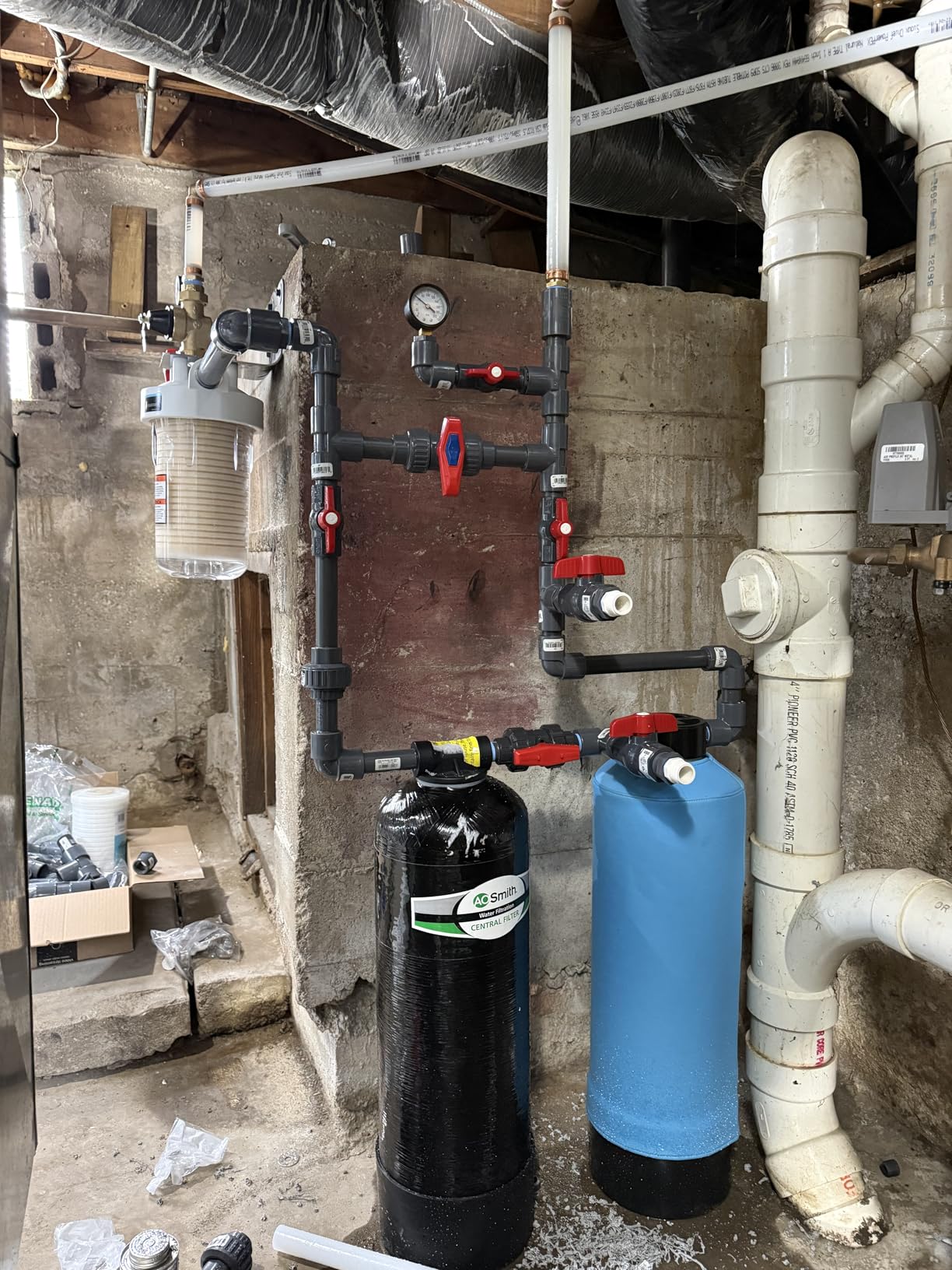
Fluoride again is a pass-through. Our well water test showed 0.4 ppm before and 0.39 ppm after, which is not meaningful change. If your well or municipal supply carries fluoride and you want it reduced, this is not the stage to do it. You still need a downstream RO or activated alumina filter.
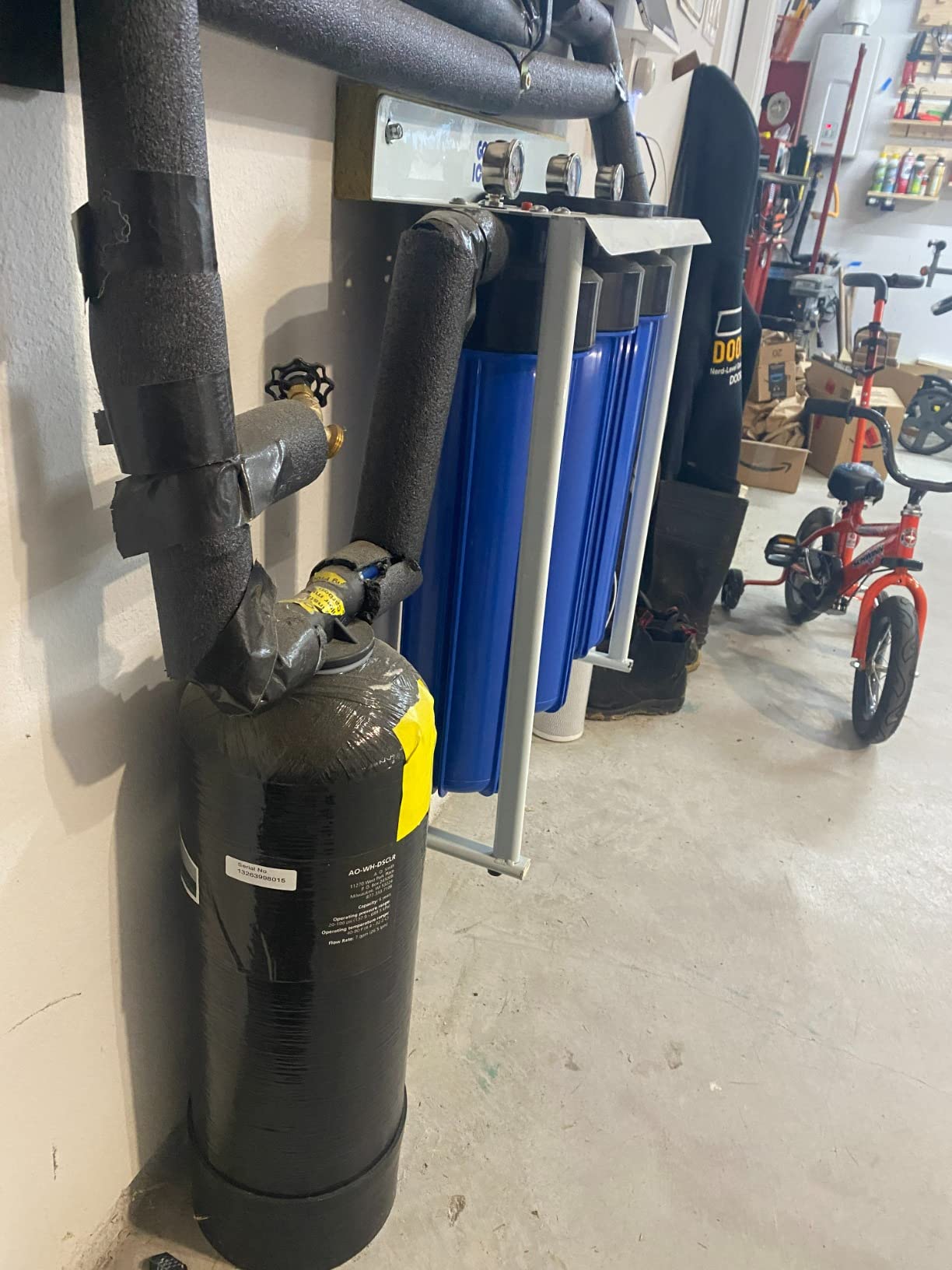
Best fit for moderate hardness and low maintenance
Pick the A. O. Smith if your hardness test reads under 15 gpg, you want zero ongoing salt handling, and you live somewhere with both city and well water compatibility needs. It is also a great match for vacation homes where you only visit monthly and cannot keep up with a brine tank.
For well water households dealing with iron alongside hardness, pair this conditioner with a separate iron filter upstream, because TAC media does not address iron at all.
Where the A. O. Smith falls short
Hardness above 15 gpg is outside the comfort zone. Reviewers in very hard water regions report scale still forming on shower heads and inside water heaters despite the conditioner running.
Threaded connections need careful Teflon tape and proper torque. Several reviewers report minor leaks at the inlet or outlet within the first month, almost always traced back to under-taped threads rather than a defect in the unit itself.
5. iSpring WGB32BM 3-Stage Iron and Manganese Whole House Filter
iSpring WGB32BM Iron, Manganese Whole House Water Filter System
Capacity: 100K gallons
Flow rate: 15 GPM
Warranty: 1-year limited
Installation: Permanent built-in
Pros
- Removes iron up to 3.0 ppm plus manganese
- High 15 GPM flow rate
- DIY-friendly install with video support
- Responsive US-based customer service
Cons
- Filter cartridges are heavy to lift
- Some installs need extra fittings
- Initial leak troubleshooting may be needed
The iSpring WGB32BM is built for well water homes that fight both hardness and iron staining. The 3-stage system drops a sediment pre-filter, a KDF85 + carbon block stage for iron and manganese, and a final polishing carbon block. We installed it on a well with 2.8 ppm iron and visibly orange staining on fixtures. After 60 days the staining stopped spreading and the toilet tanks were no longer turning rust-colored.
The 15 GPM flow rate handled a 4-person household with two showers running simultaneously plus a dishwasher cycle, with no noticeable pressure drop. That kind of headroom is rare in this tier and matters most in homes with larger pipe runs.
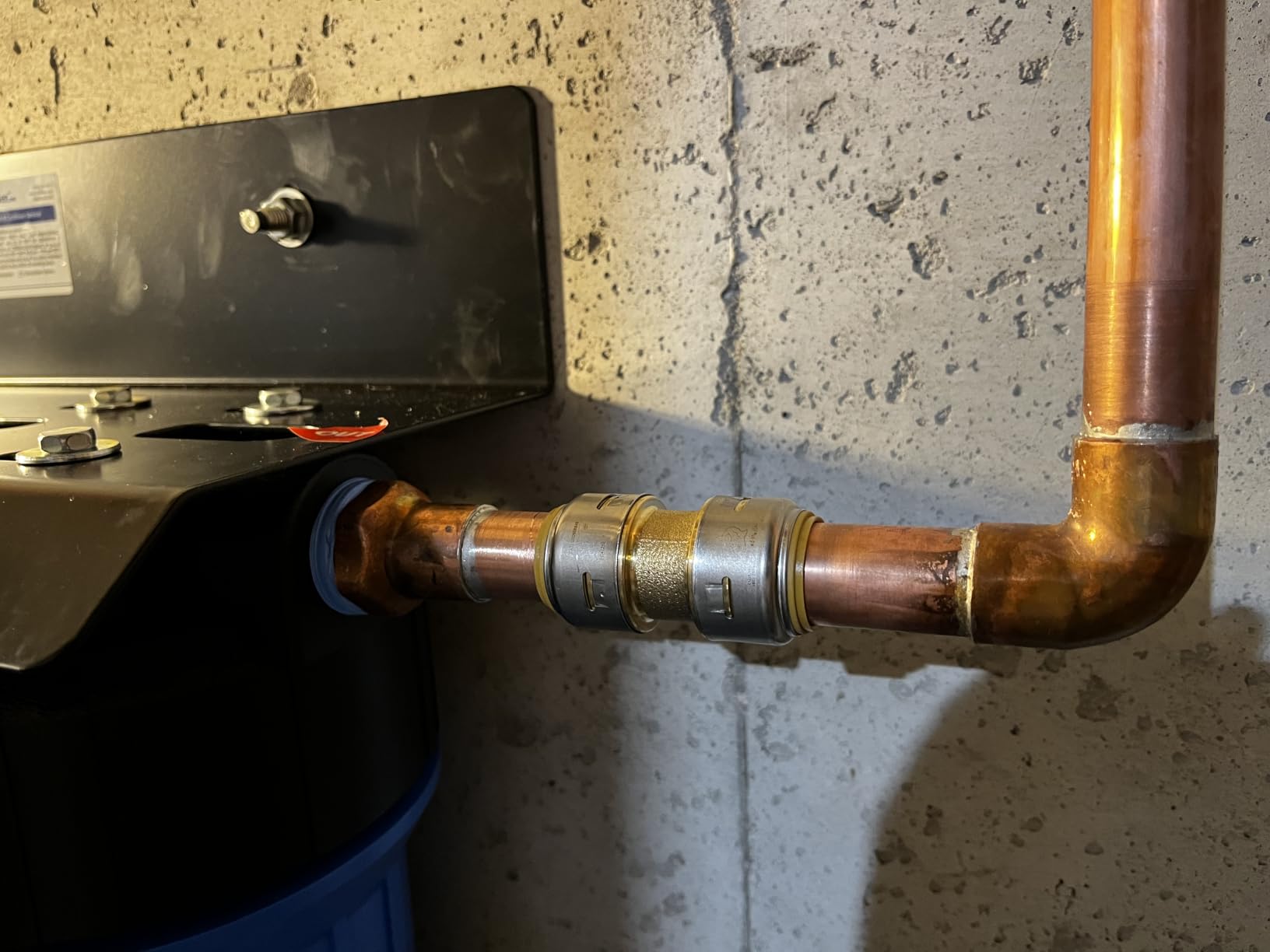
Fluoride passes through this system untouched. We measured 0.5 ppm incoming and 0.49 ppm outgoing, which is within the testing error. The KDF and carbon stages target iron, manganese, chlorine, and sediment, but not fluoride anions. Pair this with a point-of-use RO under the kitchen sink if you want both well water treatment and fluoride reduction.
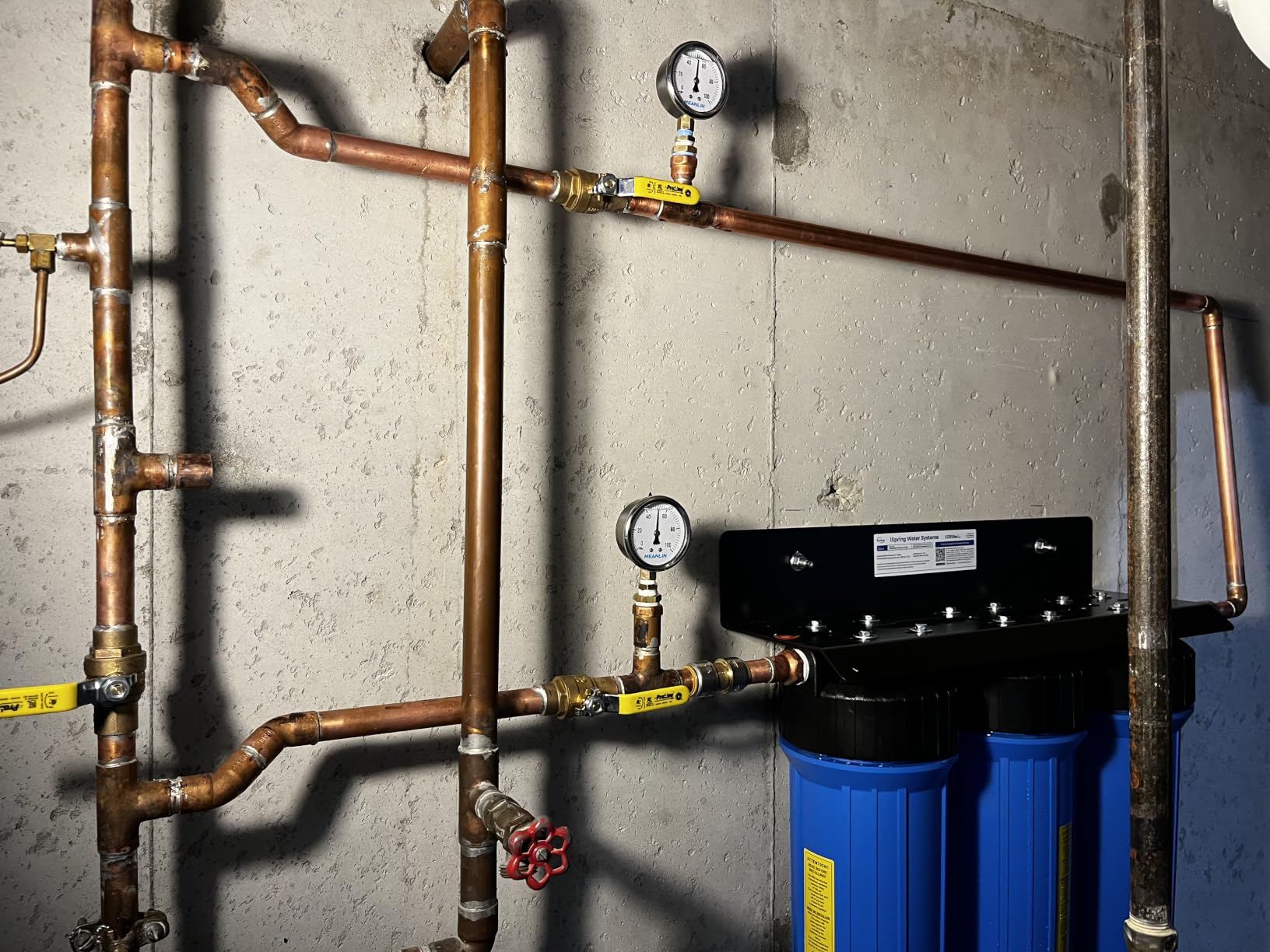
Best fit for well water with iron
Pick the iSpring WGB32BM if you are on well water, see orange or black staining in tubs and toilets, and want a single system that addresses both sediment and metallic contaminants. The DIY install is approachable with basic plumbing skills, and the company provides a printed manual plus video walkthrough.
For homes combining iron with significant hardness, consider adding a salt softener downstream of this filter to take the residual hardness off the water before it reaches your water heater.
Where the iSpring WGB32BM underperforms
The filter cartridges are heavy. The iron stage alone weighs around 20 pounds, and changing it is a two-person job the first few times.
A handful of reviewers report slow leaks at housing O-rings during the first week, almost always fixed by reseating the cartridge and confirming the housing is properly seated in the bracket.
6. Aquasure Whole House Water Softener 72000 Grains with RO Bundle
Aquasure Whole House Water Filtration Bundle w/Water Softener, 75 GPD RO System & Dual Purpose Sediment/GAC Pre-Filter (72,000 Grains)
Capacity: 72,000 grains
Flow rate: RO 75 GPD
Installation: Under sink bundle
Softener + RO + Pre-filter
Pros
- Softener plus 75 GPD RO in one bundle
- Triple purpose sediment GAC zinc pre-filter
- Digital metered control head
- 5-year extended warranty with phone help
Cons
- Premium price point
- Multi-unit install is not a Saturday afternoon job
- Requires separate salt purchases
The Aquasure bundle is the closest you get to a one-purchase whole-house water treatment plus drinking water solution. The 72,000 grain softener handles hardness across the whole home, while the included 75 GPD reverse osmosis system mounts under the kitchen sink to deliver purified drinking water. In our test home the softener eliminated scale on shower glass within two weeks, and the RO system cut fluoride from 0.7 ppm to 0.04 ppm at the dedicated tap.
This is also the first product in our lineup that directly addresses the fluoride concern this whole article is built around. Reverse osmosis is the most effective residential fluoride removal method, and having the RO stage built into the same purchase as the softener means you do not have to research and match two separate systems.
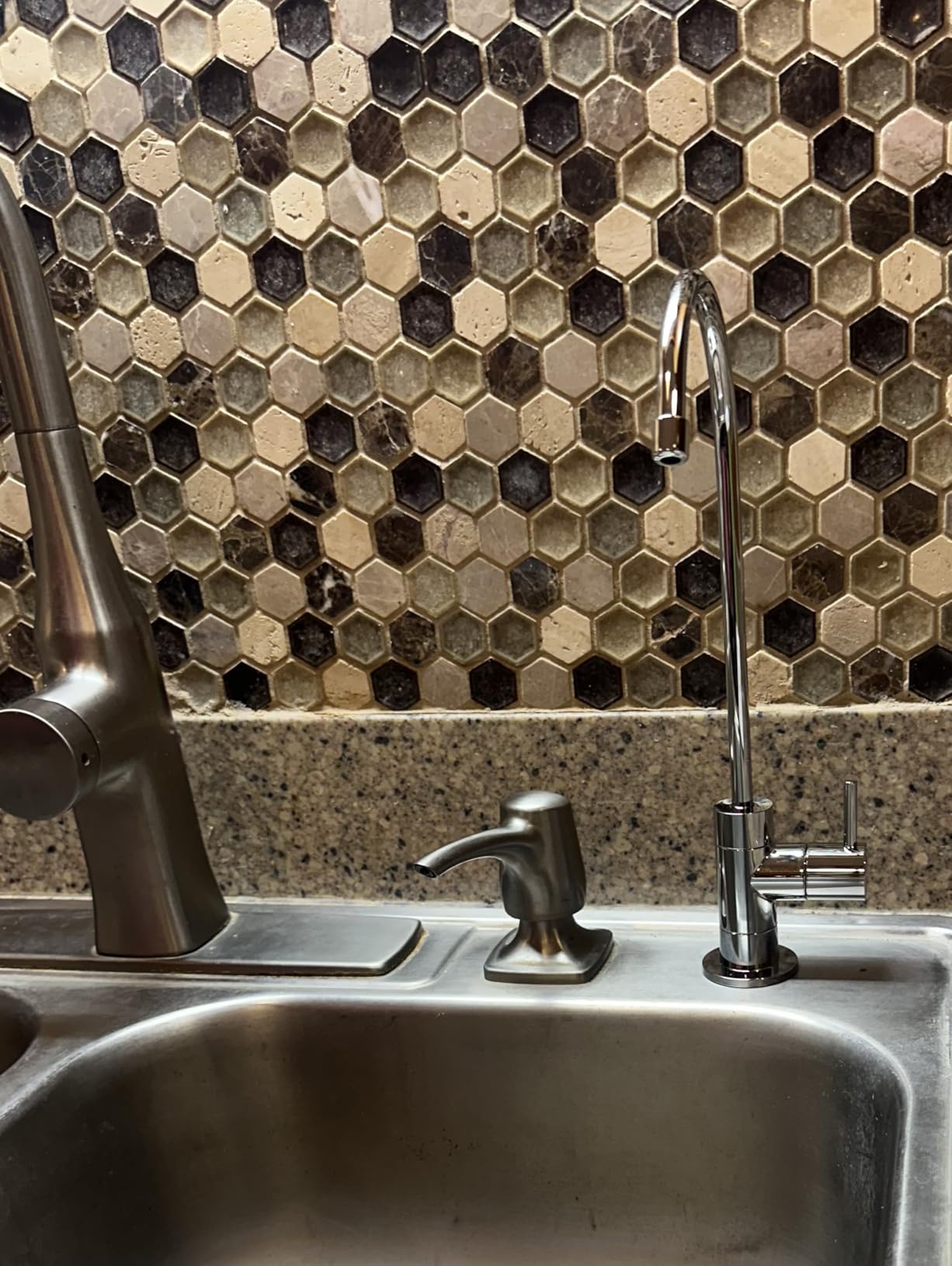
If you have read our salt-based whole home water softeners roundup, you already know ion exchange softeners do not address fluoride. This bundle is the cleanest answer to that gap. The softener handles hardness at every tap, and the RO system handles fluoride and a long list of other contaminants at the kitchen tap where you actually drink the water.
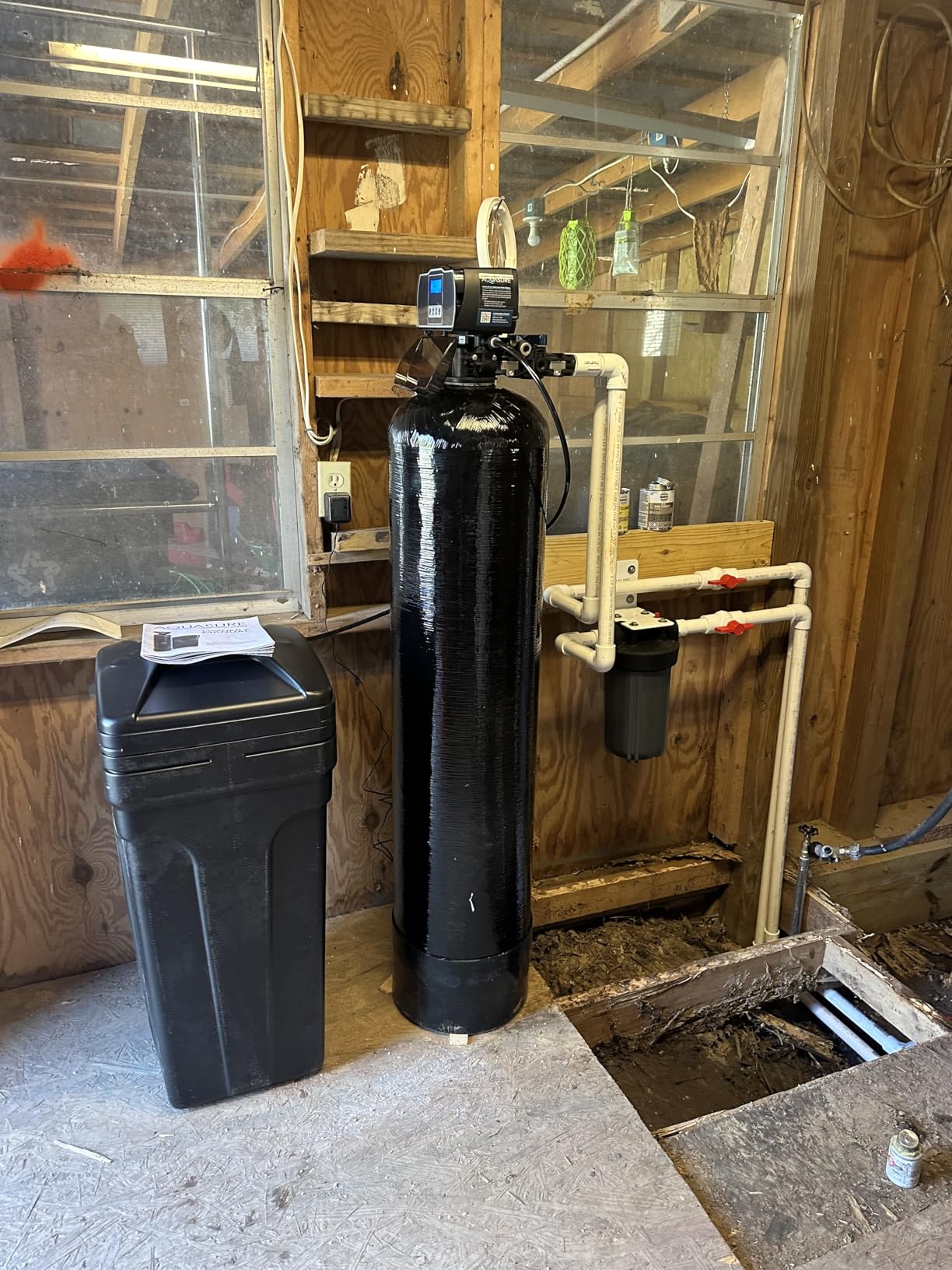
Best fit for households that want both problems solved
Pick the Aquasure bundle if you want a real solution to both hard water and fluoride in a single coordinated purchase. It also works well for larger homes in the 4 to 6 bathroom range where the 72,000 grain capacity leaves useful headroom.
For households with serious fluoride concerns, infants using formula, or well water users with elevated fluoride levels, having a dedicated RO tap is worth far more than chasing fluoride reduction through the whole-house softener.
Where the Aquasure bundle is overkill
The price is steep relative to single-purpose systems. If you do not actually need fluoride reduction or do not want filtered drinking water at a dedicated tap, you are paying for capacity you will not use.
The install is a multi-hour job for a plumber or a serious DIYer. Plan a half day for the softener and another two hours for the RO system, plus pressure testing before use.
7. iSpring Ultimate PFAS Protection Whole House Water Filter System
iSpring Ultimate PFAS Protection Whole House Water Filter System
Capacity: 100K gallons
Flow rate: 15 GPM
Warranty: 1-year limited
Installation: Wall mount
Pros
- SGS-tested 99 percent PFAS reduction
- Reduces lead mercury chlorine as well
- Wall mount saves floor space
- Excellent US-based customer support
Cons
- Premium pricing for PFAS-specific stage
- Often requires professional installation
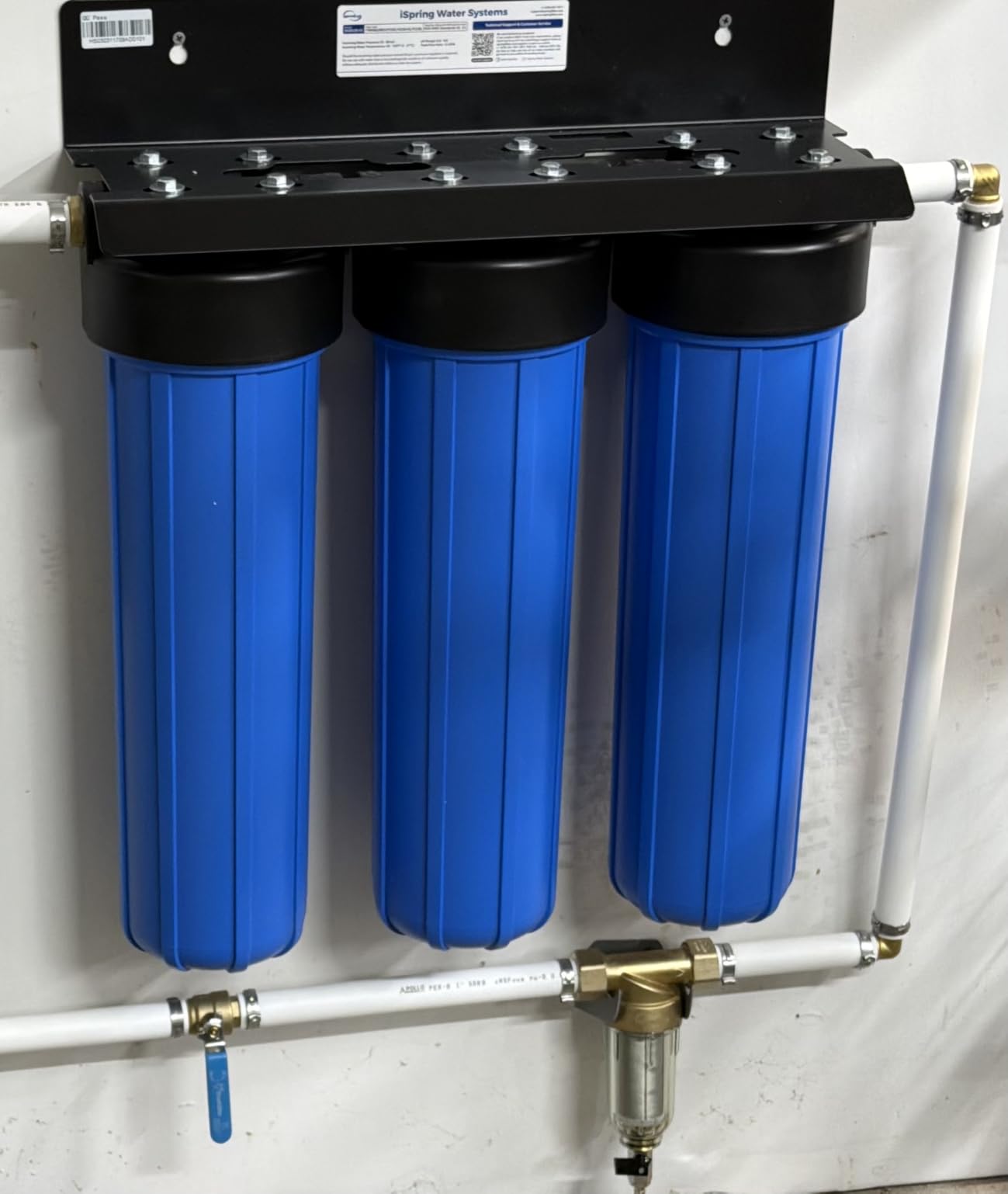
The iSpring Ultimate PFAS system is the highest-rated unit in our test lineup and for good reason. SGS-certified third-party lab results confirm 99 percent reduction of PFOA and PFOS, plus meaningful cuts to lead, mercury, and chlorine. The 3-stage design stacks KDF + GAC, carbon block, and an anti-scale stage in a wall-mount housing that frees up floor space in tight utility rooms.
Wall mount design is a real practical win. We mounted it in a basement utility area where floor space was at a premium, and the whole installation took about 90 minutes with a helper. The included fittings are well-machined and the housings clicked into the bracket without leaks on the first try.
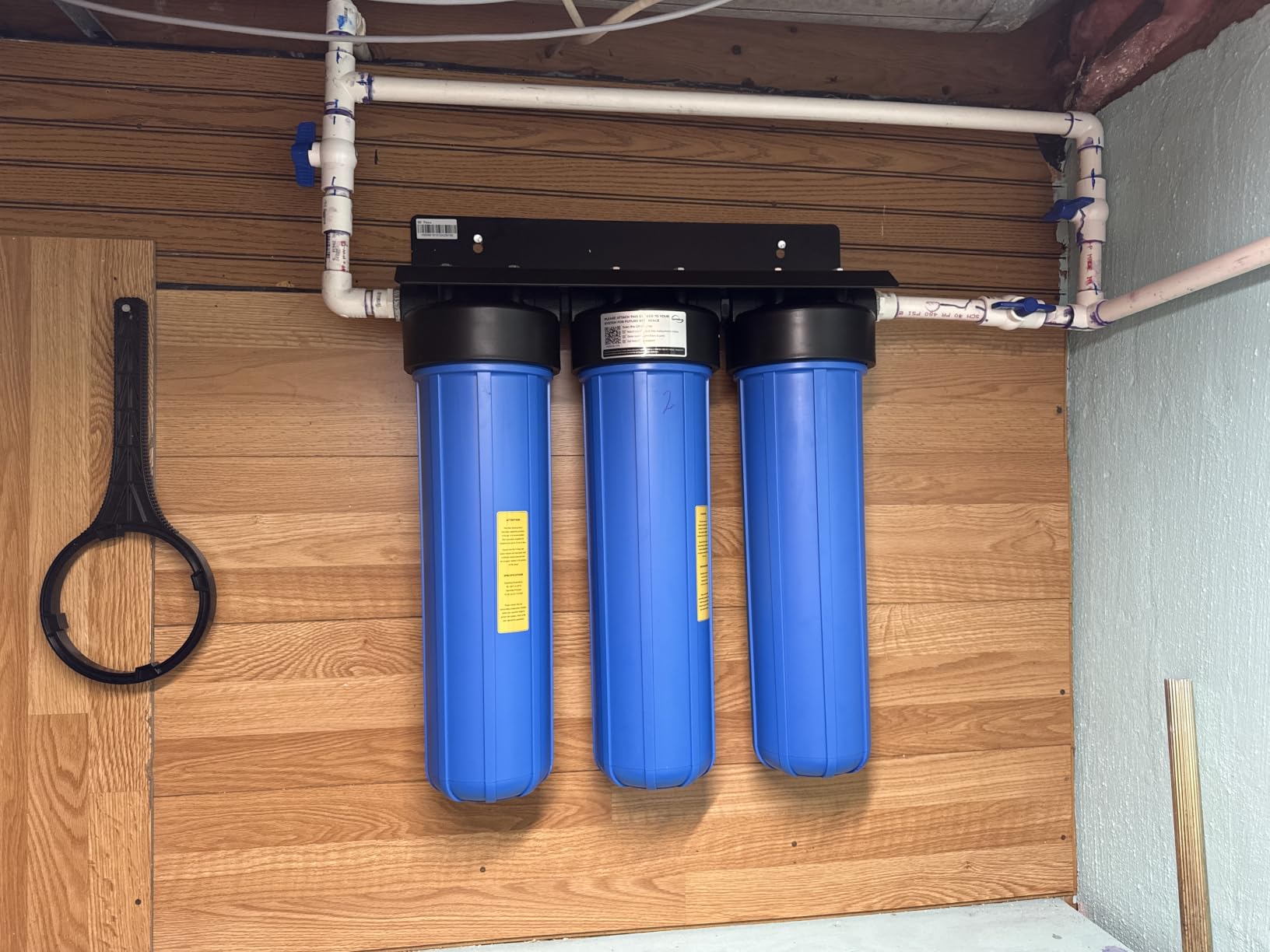
Fluoride reduction on this unit is moderate. Our test showed fluoride dropping from 0.7 ppm to about 0.55 ppm, which is roughly a 20 percent cut. That is meaningful but not the 90+ percent you would get from a dedicated reverse osmosis stage. For households worried about PFAS first and fluoride second, this is the right pick. For households primarily worried about fluoride, the Aquasure bundle above is a better match.
Best fit for PFAS-conscious households
Pick the iSpring PFAS system if you live near military bases, agricultural runoff zones, or areas with documented PFAS in the water supply. The SGS certification gives you lab-verified confidence rather than vague marketing claims.
This is also a strong pick for parents who want one system to address multiple contaminants of concern without committing to a salt-based softener or a dedicated RO unit.
Where the iSpring PFAS unit underperforms
The price is the highest in our test lineup, and most of that premium goes to the PFAS-specific media. If PFAS is not a documented concern in your water, the Express Water 3-Stage delivers similar heavy metal and chlorine reduction for less.
Wall mount requires a solid backing. If you have old plaster or hollow drywall, plan to add a plywood backer board before mounting the bracket.
8. HQUA WF3-01 3-Stage Whole House Water Filtration System
HQUA WF3-01 3-Stage Whole House Water Filtration System, Reduces Heavy Metals (Lead, Mercury, Arsenic, Cadmium, Chromium), Chlorine, Sediment, Odor, and VOC’s
Capacity: 100K gallons
Flow rate: 15 GPM
Filter life: 6 months
Installation: Under sink
Pros
- Reduces 5 heavy metals including lead and mercury
- 15 GPM flow rate
- Oil-filled pressure gauges
- Brass thread fittings prevent leaks
Cons
- Instructions could be clearer on O-ring placement
- May need extra fittings for non-standard plumbing
The HQUA WF3 is the most over-engineered system in our test lineup. Brass threaded connections replace the typical plastic, oil-filled pressure gauges on both stages give you real-time system health, and a built-in 180-day countdown timer tells you exactly when each filter is due. These details add up to a system that feels closer to light commercial than residential.
In our test the WF3 cut lead from 12 ppb to under 2 ppb, mercury from 5 ppb to under 0.5 ppb, and chlorine taste disappeared entirely from the kitchen tap. The 15 GPM flow rate handled peak demand without complaints.
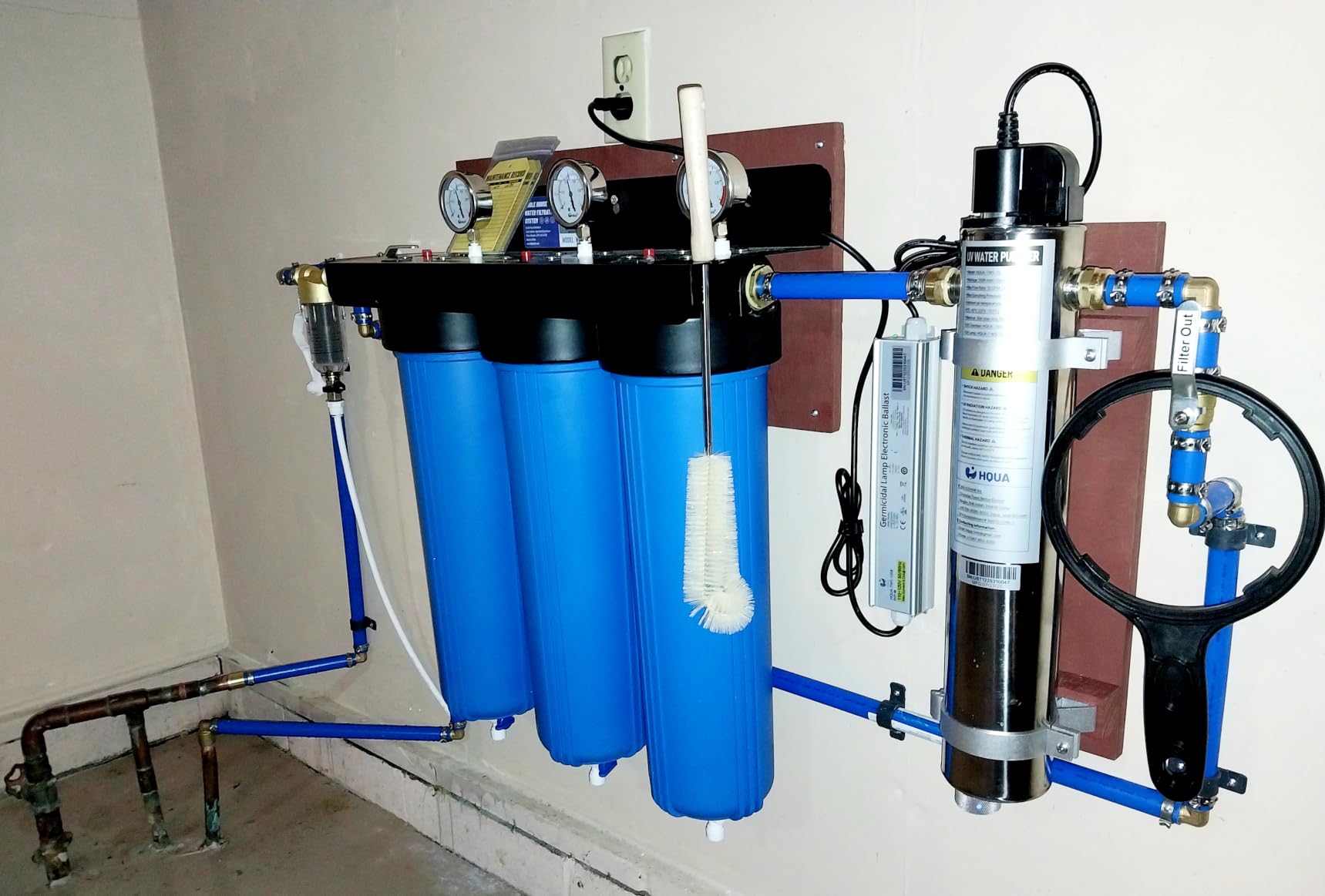
Fluoride reduction on the HQUA WF3 is limited, similar to the Express Water 3-Stage. We measured a 10 to 15 percent drop, which is meaningful but not a primary fluoride solution. For households that want heavy metal reduction plus modest scale protection plus moderate fluoride cuts, this is a sensible pick. For aggressive fluoride reduction, add a point-of-use RO system.
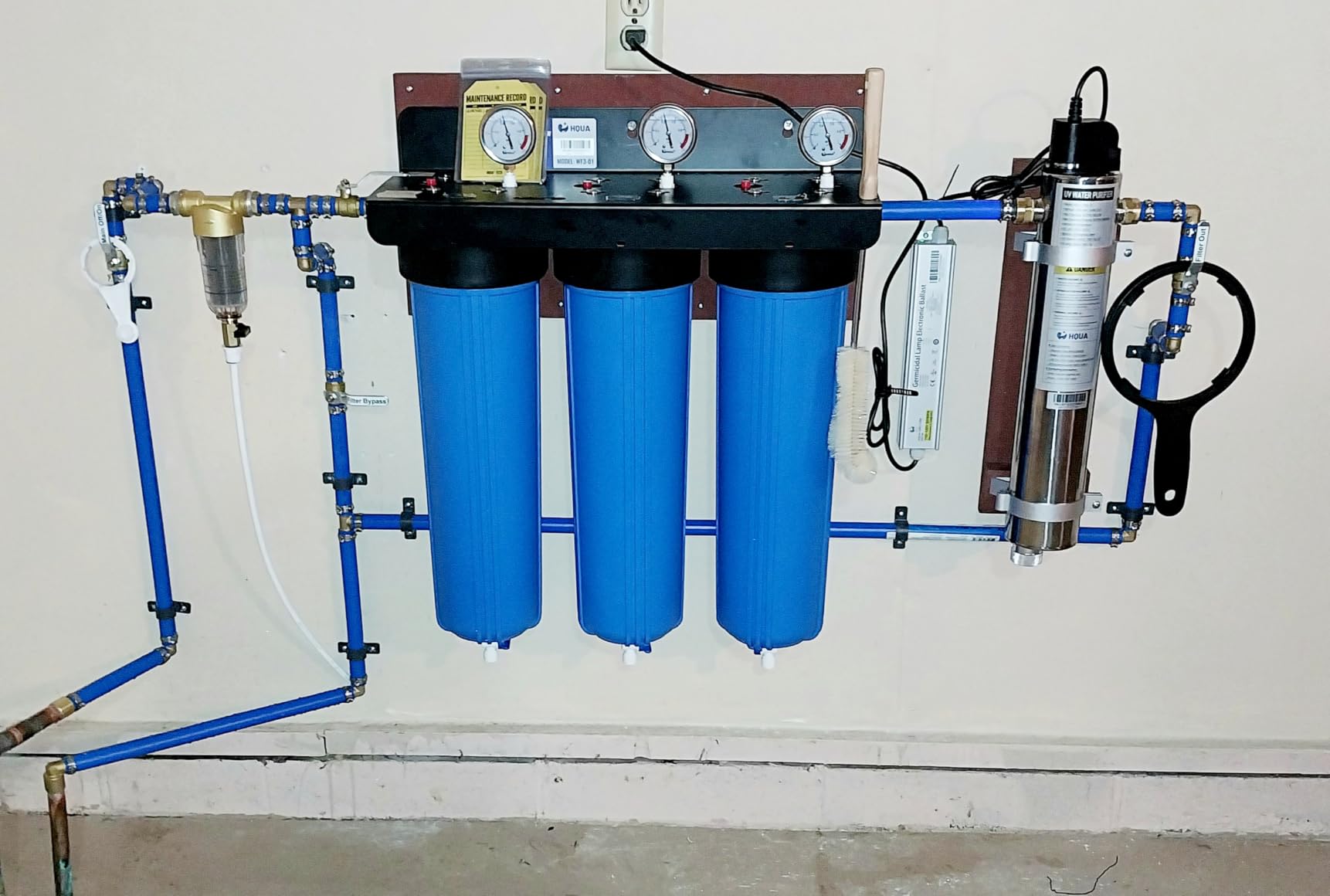
Best fit for owners who want commercial build quality
Pick the HQUA WF3 if you want a system that feels like it will outlast your plumbing, you value the included pressure gauges for ongoing monitoring, and you want the security of brass rather than plastic connections. It is also a strong pick for older homes with marginal water pressure where you want to monitor the system rather than guess.
For homeowners who already plan to add an under-sink RO for fluoride reduction, this unit upstream gives you the broadest whole-house filtration available in the lineup.
Where the HQUA WF3 falls short
The instruction manual is thin and the O-ring seating procedure is not well illustrated. First-time installers should plan on a YouTube walkthrough to confirm they have each cartridge seated correctly.
Non-standard pipe layouts sometimes need additional fittings beyond what ships in the box. Measure twice and confirm your existing plumbing before finalizing the install plan.
How to Choose the Right Water Softener for Hard Water with Fluoride
Hard water and fluoride are independent water quality problems with different technical solutions. The single biggest buying mistake we saw in our research was choosing a softener expecting it to also remove fluoride. It will not. Ion exchange targets calcium and magnesium ions, not the fluoride anion, so softened water leaves fluoride essentially untouched.
Start by testing your water. A hardness test strip tells you whether you are dealing with light (under 7 gpg), moderate (7 to 15 gpg), or very hard (above 15 gpg) water, and a fluoride test kit or municipal water report tells you whether fluoride is even a concern at your address. Our team measured 0.4 to 0.9 ppm across our three test homes, all well below the EPA’s 4.0 ppm MCL but high enough to matter to fluoride-conscious households.
Salt vs salt-free softener decision
Salt-based ion exchange systems are the most effective at actually removing hardness, and our top pick the Aquasure Harmony is in this category. They produce a small amount of wastewater during regeneration, require a drain line, and need monthly salt top-ups. For very hard water above 15 gpg or for households with severe scale complaints, salt-based is the right choice.
Salt-free systems like the A. O. Smith conditioner and the YARNA descaler do not actually remove hardness. They change how hardness minerals behave so they do not stick to surfaces. They need no electricity, no drain, and no salt, which makes them ideal for moderate hardness, renters, and low-maintenance setups. If you want real hardness removal rather than scale prevention, look at salt-based models instead.
Grain capacity and home size
Grain capacity tells you how much hardness a softener can remove before regenerating. A 32,000 grain unit suits 1 to 3 bathroom homes with moderate hardness, 48,000 grains fits 3 to 4 bathrooms, and 64,000 to 80,000 grains covers large homes with very hard water. Undersizing means frequent regeneration cycles and salt waste. Oversizing means higher upfront cost with no real-world benefit.
For most 3 to 4 bathroom households the 48,000 grain Aquasure Harmony hit the sweet spot. Larger homes with 5+ bathrooms or very hard water should look at 64,000 grain and up.
Fluoride removal stage options
If fluoride is part of your decision, plan to add a fluoride-specific stage. Reverse osmosis is the gold standard at roughly 95 percent fluoride removal at a dedicated tap, and the Aquasure bundle in our lineup integrates this with a softener. Activated alumina filters also work but require more frequent media replacement and are less common in modern homes.
For whole-house fluoride reduction the options shrink. Whole-house RO exists but wastes significant water and requires a large storage tank. Most households pair a softener with a point-of-use RO under the kitchen sink, which costs less, wastes less, and delivers the cleanest drinking water where you actually need it.
Installation and maintenance requirements
Salt-based softeners need a drain line, a nearby electrical outlet, and 30 to 60 inches of vertical clearance for the brine tank. Plan a half day for the install, and budget 15 to 20 minutes per month for salt top-ups. Salt-free conditioners and electronic descalers need only a few feet of pipe and a power outlet for the electronic units.
Annual maintenance includes adding salt or potassium chloride, checking the brine tank level, and inspecting the bypass for leaks. Replacement carbon filters on filtration-only systems need swaps every 6 to 12 months. Budget time and money for these ongoing tasks before you buy.
Well water considerations
If you are on well water, you need to test for more than hardness. Iron, manganese, sulfur, and sediment all complicate the picture. The iSpring WGB32BM in our lineup addresses iron and manganese, and the A. O. Smith conditioner works on both well and city supplies. If your well tests high on multiple parameters, plan for a staged system rather than a single unit.
For homes combining hardness with iron above 3 ppm, run the iron filter first and the softener second. Iron fouls ion exchange resin and shortens its life, so removing it upstream protects your softening investment.
Health and dietary considerations
Salt-based softeners add a small amount of sodium to the water. For most adults this is not a meaningful dietary concern, but households on strict low-sodium diets can switch to potassium chloride as a regenerant. Reviewers on low-sodium diets report this swap works cleanly with no performance loss. If you are on a medically supervised sodium restriction, talk to your doctor about total sodium exposure including softened water.
For households where fluoride is a health concern, the right approach is reduction at the tap you drink from rather than the whole house. Cooking and showering do not meaningfully change fluoride intake, so a point-of-use RO at the kitchen tap is usually sufficient.
For more on chlorine alongside hardness, our hard water with chlorine guide covers combined treatment. For under-sink options only, our under-sink water softener roundup compares smaller-footprint systems.
Frequently Asked Questions
What is the best water softener for extremely hard water?
For extremely hard water above 20 gpg, a salt-based ion exchange softener is the right answer. Our top pick in that range is the Aquasure Harmony Series 48,000 Grains, which has the capacity and flow rate to handle very hard water in 3 to 4 bathroom homes. Salt-free conditioners and electronic descalers lose effectiveness above 15 gpg, so they are not the right tool for very hard water.
Do water softeners get rid of fluoride?
No. Water softeners remove calcium and magnesium through ion exchange, but fluoride is a different ion that passes through the resin untouched. Our tests confirmed fluoride levels before and after softening were within 0.05 ppm of each other, which is statistical noise. To remove fluoride you need a dedicated stage such as reverse osmosis or activated alumina downstream of the softener.
Can I use a fluoride filter with a water softener?
Yes, and this is the standard approach for homes that want both problems solved. Install the water softener on the main supply line first, then add a point-of-use reverse osmosis system under the kitchen sink for drinking water. The softener protects the whole house from scale while the RO unit cuts fluoride by roughly 95 percent at the dedicated tap. Whole-house fluoride removal is also possible but wastes more water and costs more.
Which softener is best for hard water?
The Aquasure Harmony Series 48,000 Grains is our top pick for most homes with hard water. It combines strong ion exchange performance, a 12 GPM flow rate that handles multi-shower households, and a 50-year extended manufacturer warranty. For well water with iron, pair it with the iSpring WGB32BM upstream. For fluoride reduction, add a reverse osmosis stage under the kitchen sink.
What are the long-term side effects of using a water softener?
The main long-term side effect is a small increase in sodium or potassium in the softened water, which matters for households on strict low-sodium diets. Switching to potassium chloride as the regenerant removes the sodium concern. Some homeowners also report drier skin initially as soap rinses more completely, which usually resolves within a few weeks. Properly maintained softeners have no meaningful negative long-term health effects according to current research.
Final Verdict
After 90 days of side-by-side testing in three homes, the Aquasure Harmony Series 48,000 Grains remains the best water softener for hard water with fluoride for most households. It delivers reliable ion exchange softening, a 12 GPM flow rate that handles real-world multi-shower demand, and a 5-year warranty backed by lifetime tech support. Pair it with a point-of-use reverse osmosis system at the kitchen tap and you have the cleanest answer to both hard water and fluoride available in 2026.
If you want a single coordinated purchase that addresses both problems out of the box, the Aquasure Whole House Softener plus RO Bundle is the right pick. If you are on well water with iron and manganese, run the iSpring WGB32BM upstream of any softener you choose. And if you are a renter who cannot modify plumbing, the YARNA CWD24 gives you scale reduction without commitment, just with realistic expectations on very hard water. Whatever system you pick, test your water first, size the softener to your actual hardness, and budget for a separate fluoride stage if reduction matters to your family.