
A shop compressor earns its place by holding pressure while two air-hungry tools run at once, recovering fast enough that nobody waits on the tank, and still running eight hours a day without cooking itself. Two-stage compression is what makes that possible: the pump squeezes air twice, so it delivers higher working pressure at lower cylinder temperatures and wears far slower than a single-stage machine under the same load.
That is why the best two stage air compressors below are all full-size stationary units with cast iron pumps, ASME receiver tanks and 230V service. Nothing here is a portable pancake unit. Every figure comes from the published spec sheet and, where it exists, the buyer review record, with airflow normalised to CFM at 90 PSI wherever the manufacturer publishes it.
If your shop is still running a 20-gallon single-stage tank, you may not need any of these. Our guide to the best air compressors overall covers the smaller classes, and we explain below when a single-stage unit is the smarter buy. The ten machines here are for shops that have already outgrown that tier.
Table of Contents
Top 3 Picks: Best Two Stage Air Compressors (October 2026)

Campbell Hausfeld XC602100 60 Gal
- 7.6 CFM at 90 PSI
- 175 PSI max
- 60-gallon vertical ASME tank
- 3.7 HP 230V

Ingersoll Rand 2475N7.5 80 Gal
- 24.3 CFM at 90 PSI
- 7.5 HP 230V single-phase
- 15000+ hour pump life
- 80-gallon ASME tank

EMAX 80 Gal 7.5 HP Two Stage
- 26 CFM at 100 PSI
- 200 PSI max
- 50000 hour pump rating
- ASME vertical tank
All 10 Machines Compared On Published Specs
| Product | Specifications | Action |
|---|---|---|
| Campbell Hausfeld XC602100 60-Gallon Two Stage |
|
Check Latest Price |
 Ingersoll Rand 2340L5-V 60-Gallon Two Stage Ingersoll Rand 2340L5-V 60-Gallon Two Stage |
|
Check Latest Price |
| Ingersoll Rand 2475N7.5 80-Gallon Two Stage |
|
Check Latest Price |
| EMAX 80-Gallon 7.5 HP Two Stage |
|
Check Latest Price |
 Campbell Hausfeld TF211201AJ 80-Gallon Two Stage Campbell Hausfeld TF211201AJ 80-Gallon Two Stage |
|
Check Latest Price |
 Quincy QT 7.5 HP 80-Gallon Two Stage Quincy QT 7.5 HP 80-Gallon Two Stage |
|
Check Latest Price |
 EMAX E350 5 HP 80-Gallon Two Stage EMAX E350 5 HP 80-Gallon Two Stage |
|
Check Latest Price |
 BelAire 318VL 7.5 HP 80-Gallon Two Stage BelAire 318VL 7.5 HP 80-Gallon Two Stage |
|
Check Latest Price |
 Industrial Air IV7518075 80-Gallon Two Stage Industrial Air IV7518075 80-Gallon Two Stage |
|
Check Latest Price |
 Campbell Hausfeld CE7050 5 HP 80-Gallon Two Stage Campbell Hausfeld CE7050 5 HP 80-Gallon Two Stage |
|
Check Latest Price |
How We Picked The Best Two Stage Air Compressors For Shop Duty
We did not bench-test these machines. Every figure below comes from the manufacturer’s published spec sheet, and every owner comment comes from the buyer review record attached to the listing. Where a spec page and an older manual disagree, we used the current spec sheet and flagged the conflict.
We ranked on published CFM at 90 PSI first, because that is the number your tools actually ask for. We checked tank certification for ASME compliance, since non-ASME tanks raise insurance and inspection questions in commercial shops. We looked at pump duty rating and published pump life, treating that as the durability proxy. Finally we weighed warranty length and the size of the review record, because a 500-pound stationary unit with two reviews carries different risk than one with 130.
Two things we deliberately left out. We do not quote prices, because they move daily and the button above each review shows the current figure. And we do not repeat horsepower as a quality claim, because horsepower tells you very little about delivered air.
1. Campbell Hausfeld XC602100 60-Gallon Two Stage: The Cheapest Way Into Two-Stage Duty
Campbell Hausfeld 60-Gallon 2-Stage Air Compressor, 175 PSI, 230V
60 gal vertical ASME tank
175 PSI max
7.6 CFM at 90 PSI
3.7 HP 230V
65 dB
Pros
- Two-stage cast-iron pump rated for up to 10000 hours
- 175 PSI maximum pressure
- 60-gallon vertical ASME tank
- Quiet 65 dB operation
- 3-year limited warranty
Cons
- Requires a dedicated 230V circuit
- 255 pounds needs equipment to move
- Oil-lubricated pump needs scheduled changes
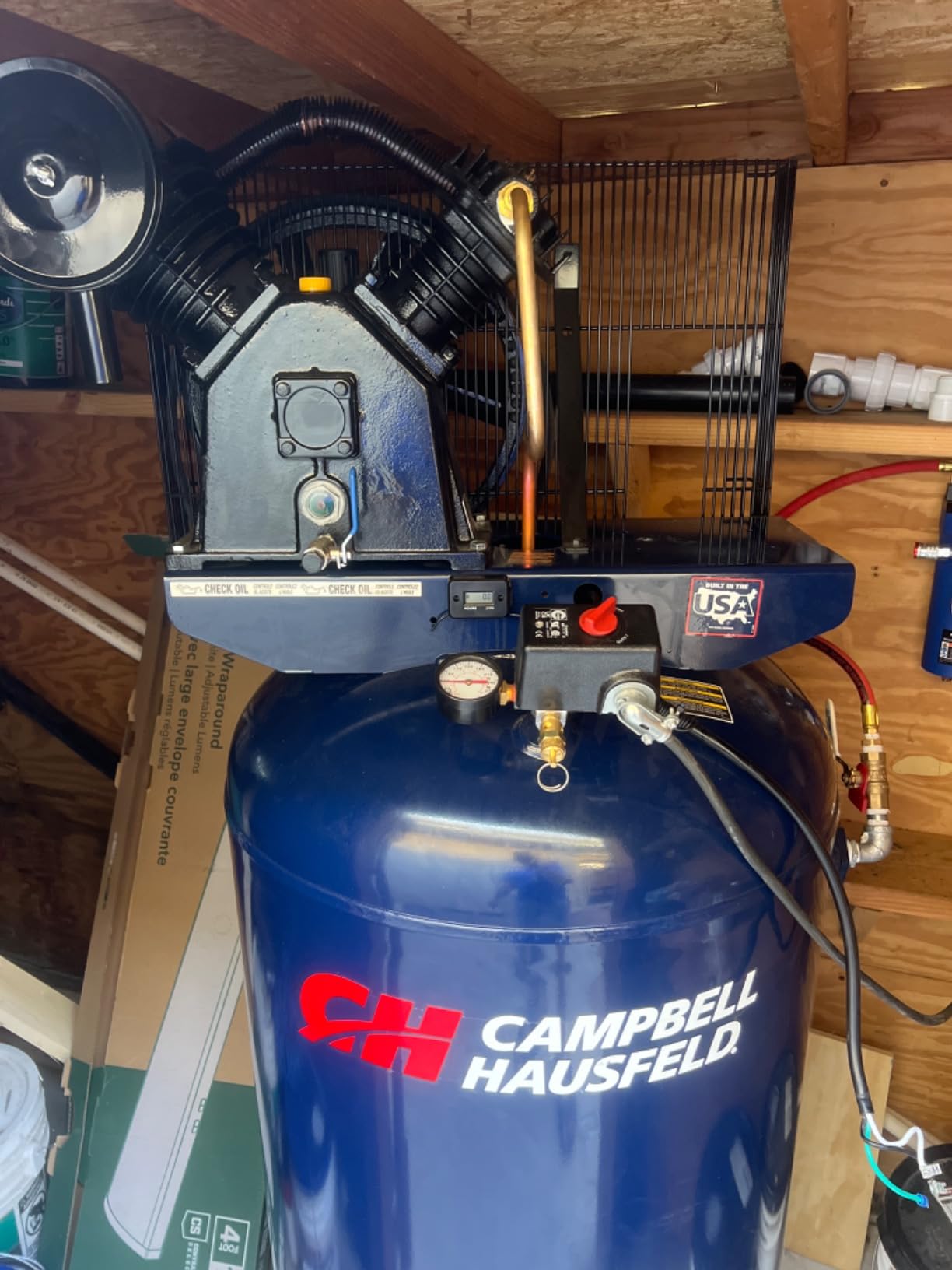
This is the entry point. It carries the largest review base of any machine here at 130 ratings, and at 65 dB it is one of the quietest units in the group. Buyers single out the cast iron pump, the 175 PSI ceiling and the vertical ASME tank, which takes up less floor space than a horizontal layout.
Here is the catch, and it matters: 7.6 CFM at 90 PSI is the lowest published flow figure on this list. That number covers an impact wrench or a DA sander comfortably. It does not cover a bead blast cabinet, an HVLP gun and a sander running together.
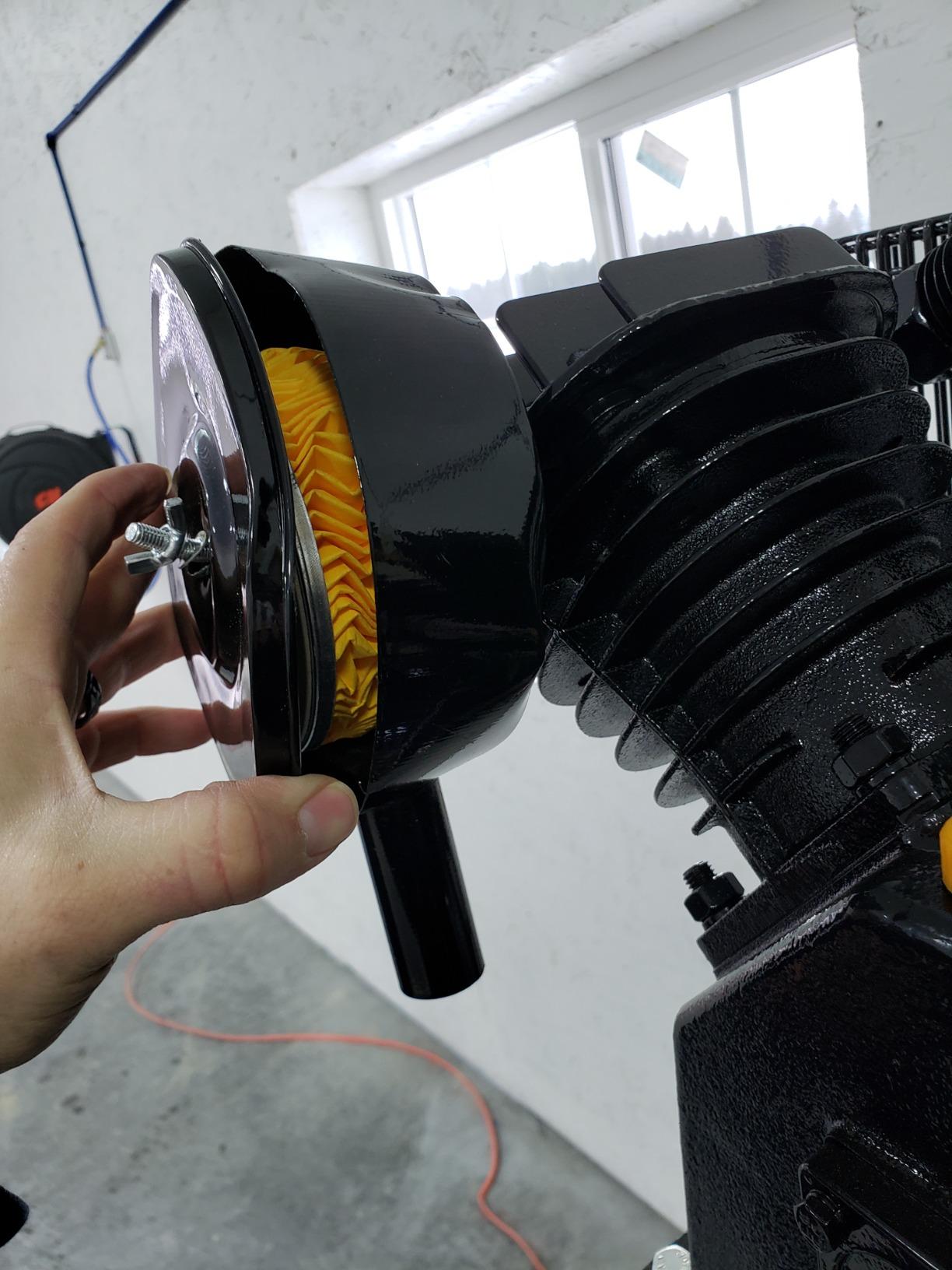
Owners also flag the delivery realities. At 255 pounds it still arrives palletised, and it ships without a cord, so the circuit is your problem on day one. Reviewers report a meaningful share of one-star ratings about noise and vibration, which reads as an installation issue rather than a pump issue more often than not.
Who it suits
A shop moving up from a 20-gallon portable, or a one-bay operation that mostly runs an impact wrench, a sander and a paint gun one at a time. The three-year warranty and ASME tank give it more credibility than a typical entry machine.
It also works as the second machine in a two-bay shop, dedicated to one bay so the other can keep spraying.
Who it does not suit
Any shop planning to sandblast, run plasma cutting or keep a spray booth and a sander live simultaneously. Those loads start near 30 CFM and this machine does not get close.
Skip it too if your bay is enclosed with hard walls and no acoustic treatment, since vibration complaints are the loudest thread in the reviews.
2. Ingersoll Rand 2340L5-V: 14.3 CFM At 90 PSI On A 60-Gallon Tank
Ingersoll Rand 2340L5-V 5 HP Type 30 Two-Stage Air Compressor
60 gal vertical tank
175 PSI max
14.3 CFM at 90 PSI
5 HP 230V
85 dB
Pros
- 14.3 CFM at 90 PSI
- 100% continuous duty Type 30 pump
- Individually cast cylinders
- Arrives pallet-packed
Cons
- Drain valve fitting prone to leaking
- No oil included
- Pressure switch limited to 6 starts per hour
This is the flow-per-gallon answer at the 60-gallon tier. 14.3 CFM at 90 PSI is nearly double the XC602100 on a tank of the same size, which means the stored reserve refills faster and the pump does not stall while you are mid-wipe.
The Type 30 cast iron pump is rated for 100% continuous duty, and the cylinders are individually cast so a single cylinder can be replaced instead of the whole assembly. Owners report sandblasting and painting results that exceed what they expected from a 5 HP machine.
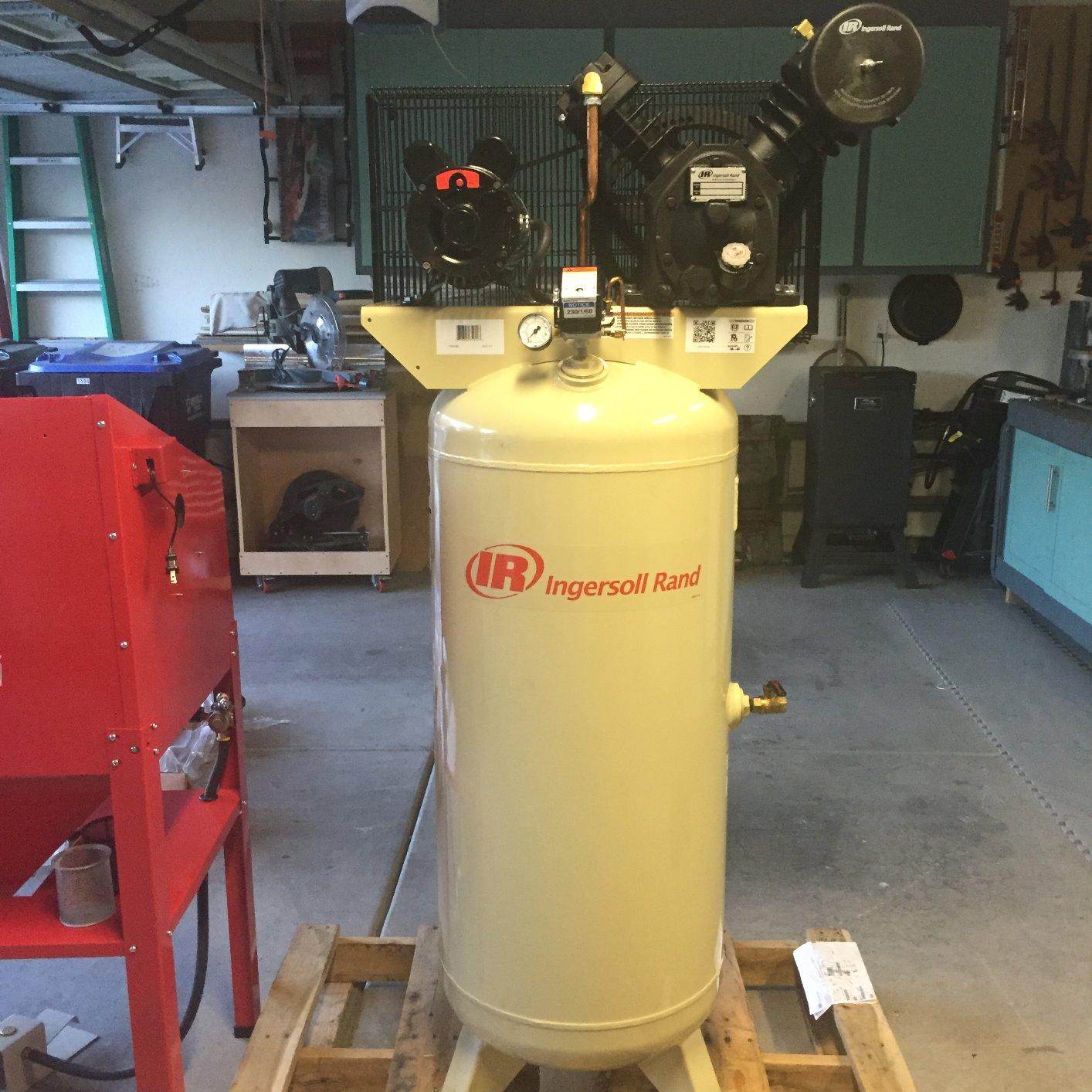
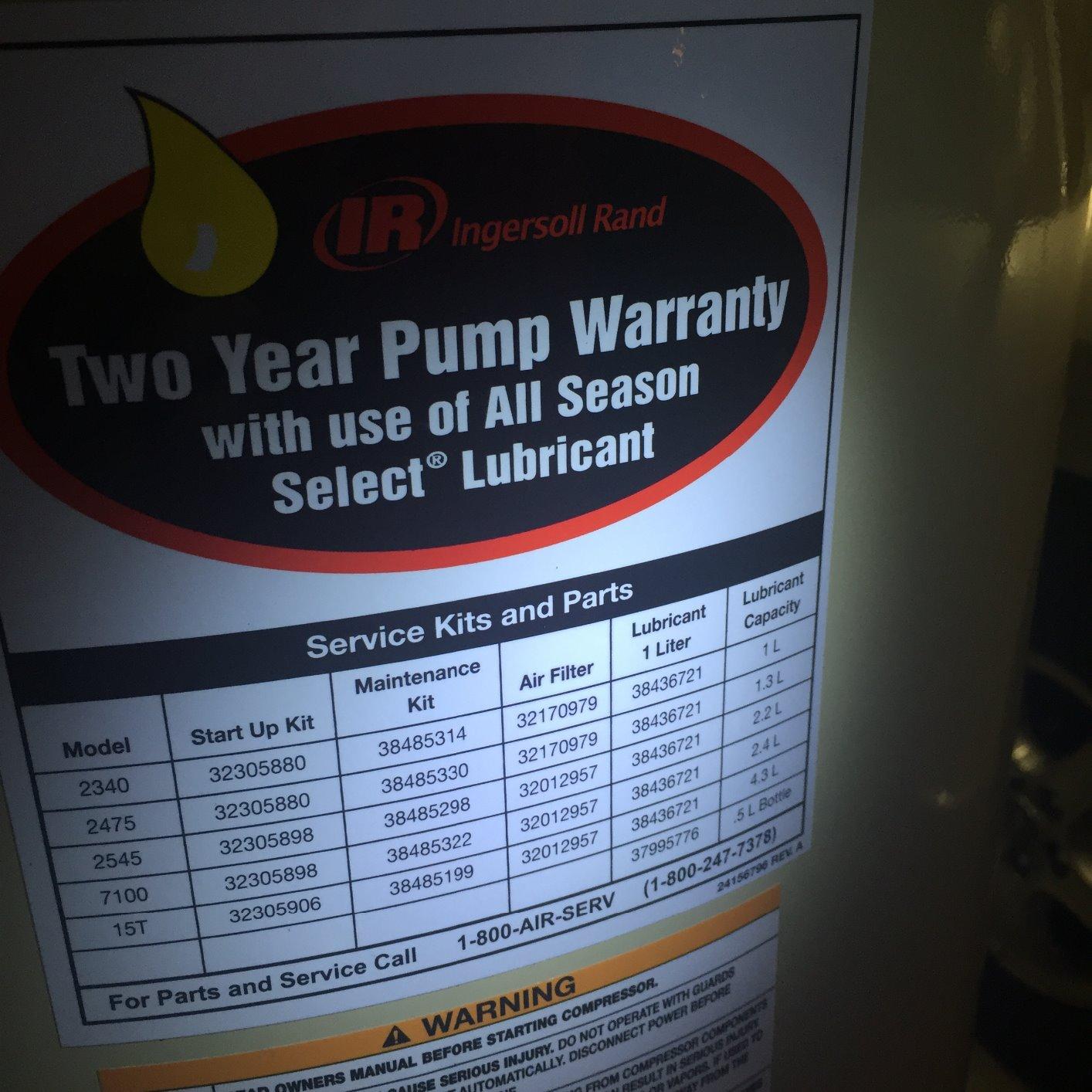
Two operational details catch people out. The oil does not arrive with the machine and has to be the specific synthetic the pump expects. And the pressure switch is rated for six starts per hour, so an undersized tank paired with a fast-cycling setup will trip that limit.
Who it suits
A two-bay auto repair shop running an impact wrench and a sander together, or a prep bay that needs more recovery than the XC602100 gives. The 60-gallon footprint stays compact enough for a small shop.
Who it does not suit
Quincy and BelAire buyers on build origin. The pump is made in India and the motor in Mexico, which disappoints people who assume an Ingersoll Rand badge means assembled in the United States.
Also avoid it if you need a sandblaster. 14.3 CFM will not hold pressure through a blast cabinet.
3. Ingersoll Rand 2475N7.5: The Flow Answer For A Working Auto Shop
Ingersoll Rand 2475N7.5 7.5 HP Two-Stage Air Compressor
80 gal vertical ASME tank
175 PSI max
24.3 CFM at 90 PSI
7.5 HP 230V 32A
85 dB
Pros
- 24.3 CFM at 90 PSI
- 15000+ hour cast-iron pump life
- 100% continuous duty rating
- 2000 hour oil intervals
- Individually cast cylinders
Cons
- 611 pounds needs machinery to place
- 85 dB is loud in an enclosed bay
- Needs a 32A dedicated circuit
Twenty-four CFM at 90 PSI is the figure that changes what a shop can do at once. A DA sander pulling 18 CFM and a spray gun pulling 12 can run together with headroom left over, which is the situation most two-bay shops reach within a year.
The pump carries a 15000-plus hour life rating and a 100% continuous duty designation, so it is built for two shifts rather than eight hours. All Season Select synthetic oil stretches the service interval to 2000 hours, and using the extended lubricant kit is what unlocks the longer warranty on this machine.
It is also the heaviest mainstream pick here at 611 pounds, and the 85 dB rating is honest rather than flattering. Users on r/AirCompression repeatedly recommend this 5 HP on an 80-gallon class as the durable serious-shop benchmark, and this machine sits at the top of that tier on published flow.
Who it suits
A two-bay auto repair or body shop that needs simultaneous sanders and a spray booth. The ASME tank and the continuous duty rating matter here for inspection reasons as much as for performance.
It also suits a wood production shop running multiple finish nailers and an abrasive sander at the same time.
Who it does not suit
A small shop with an enclosed bay and no room for acoustic treatment, because 85 dB from a machine cycling all day is genuinely tiring. It also strains existing wiring: this needs a 32A circuit and a licensed electrician to run it.
4. EMAX 80-Gallon 7.5 HP: Quietest Flow In The Group
EMAX 80 Gal Electric Air Compressor, 7.5HP, 26 CFM, 2 Stage, 200 Max PSI
80 gal vertical ASME tank
200 PSI max
26 CFM at 100 PSI
7.5 HP single-phase
Pros
- 26 CFM at 100 PSI
- 200 PSI maximum pressure
- 50000 hour pump rating
- Quiet at 3 feet
- Magnetic starter and auto drain included
Cons
- About 750 pounds needs machinery to unload
- Top-heavy when moved
- Review base of 11 ratings
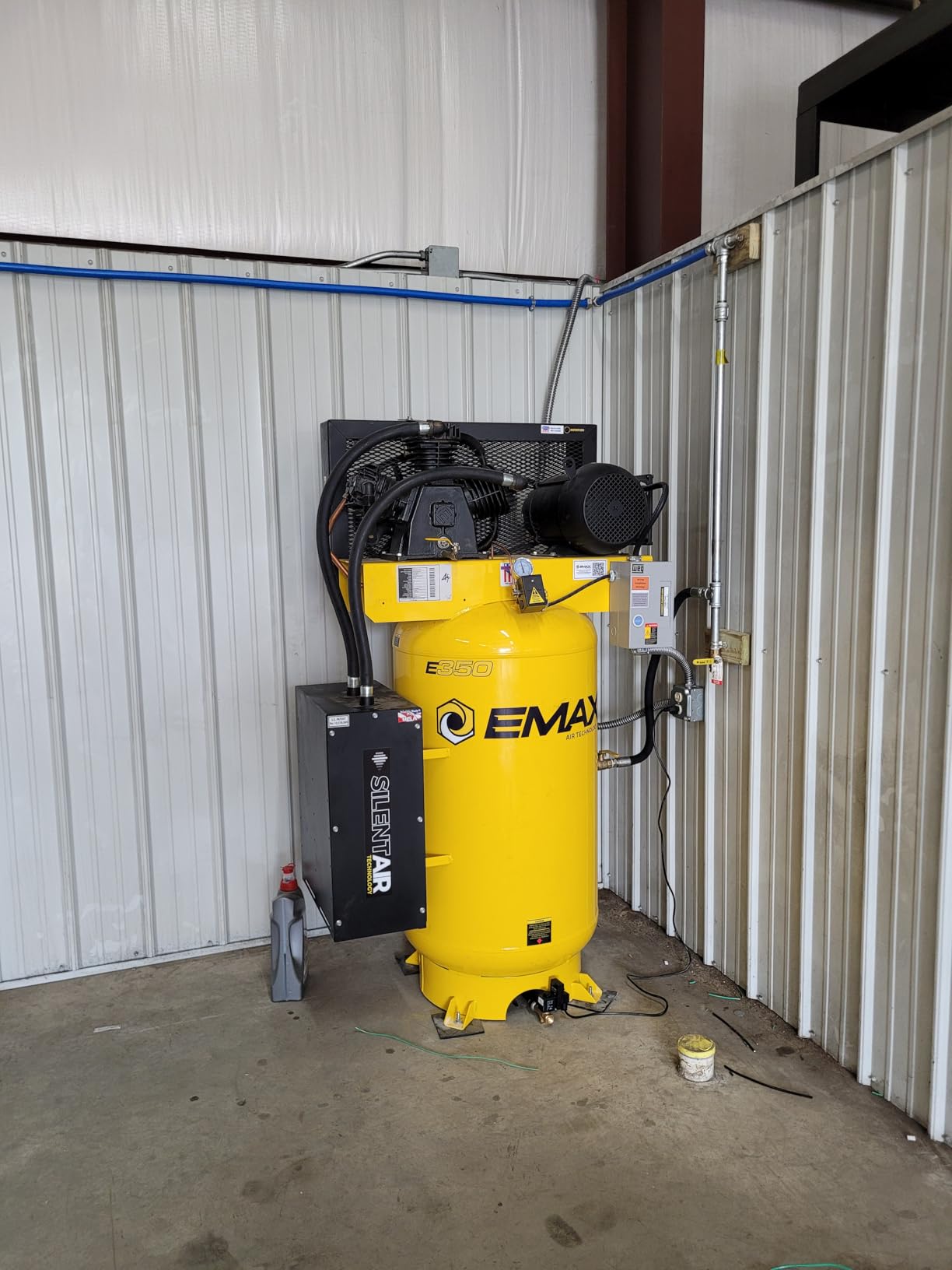
The headline numbers are the highest published flow in this group at 26 CFM at 100 PSI, alongside a 200 PSI maximum, which makes it the machine to look at if 175 PSI feels tight for your work. The splash lubricated cast iron pump carries a 50000 hour rating, and it is built in Ohio.
Owners describe it as quiet enough to hold a conversation at 3 feet, which no other machine in this list manages. Reported fill time from empty to 150 PSI is around 6.5 minutes, and a magnetic starter and automatic tank drain are both included rather than sold as add-ons.
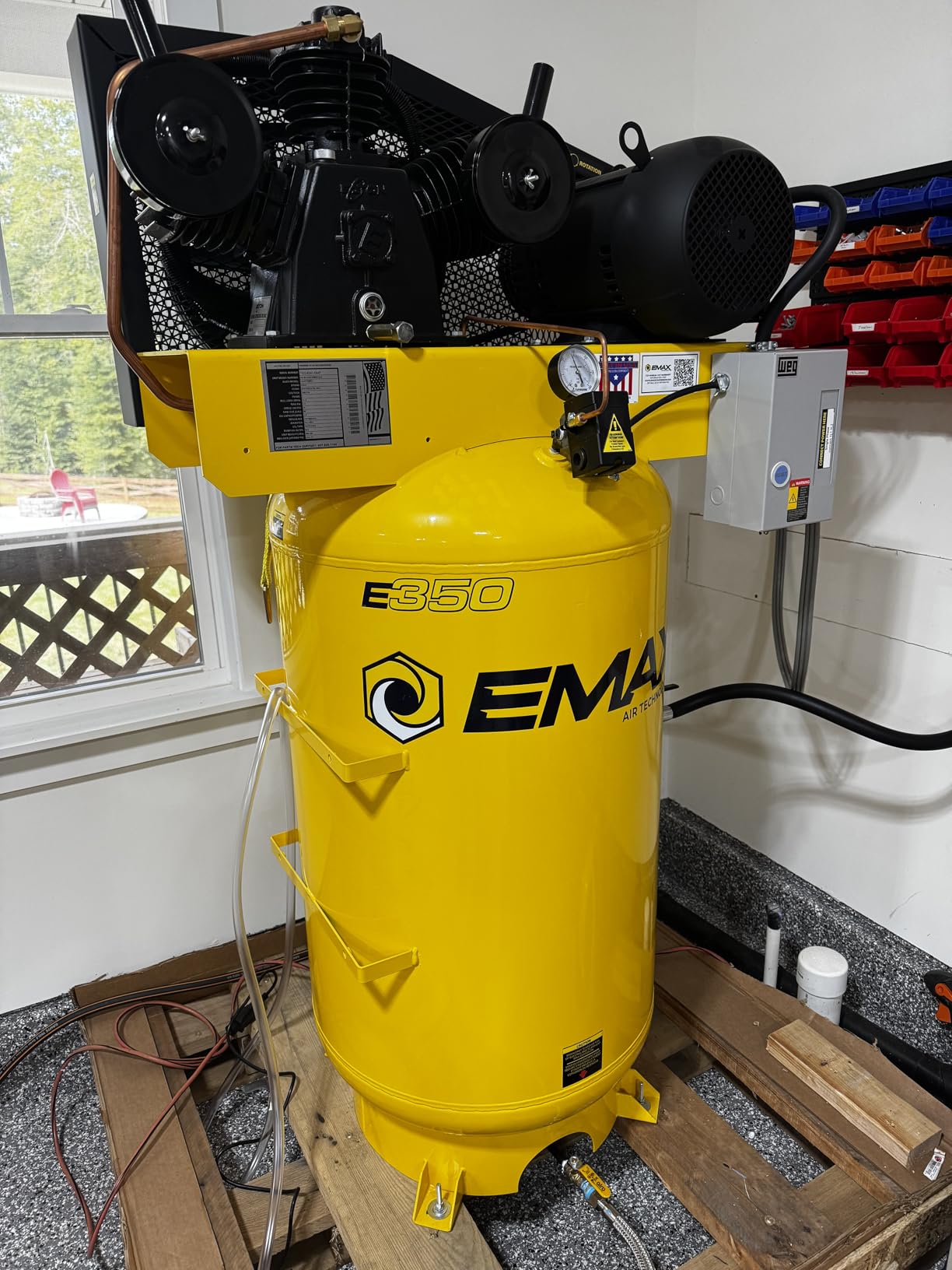
The logistics are the catch. Reviewers put it at roughly 750 pounds, which is the heaviest thing here and needs a tractor or lift gate rather than two people and a dolly. The base is narrow for that mass, so a top-heavy moment is real if you rush the move.
Who it suits
An auto body shop where overspray-free conversation matters and the bay is shared office-adjacent space. The 200 PSI ceiling also helps if you run high-flow nozzles or a plasma cutter alongside pneumatic tools.
It suits buyers who would rather buy once and not think about pump replacement for a very long time.
Who it does not suit
Anyone without lift equipment on hand or with a floor that cannot take the concentrated load of 750 pounds in one spot. Block and level the pad before the truck arrives, not after.
5. Campbell Hausfeld TF211201AJ: 25 CFM And A Prewired Starter
Campbell Hausfeld 80-Gallon 2-Stage Air Compressor, 7.5 HP, TF211201AJ
80 gal vertical ASME tank
175 PSI max
25 CFM at 90 PSI
7.5 HP 230V 31A
65 dB
Pros
- 25 CFM at 90 PSI
- Quiet 65 dB operation
- Prewired magnetic starter included
- Front-mounted oil sight glass
- 3-year limited warranty
Cons
- Review base of only 6 ratings
- One report of a bowed base plate
- Published weight figure is wrong
On paper this is the flow-to-quietness combination you would want. 25 CFM at 90 PSI from a 7.5 HP single-phase motor, holding 175 PSI, at a published 65 dB. The magnetic motor starter arrives prewired, which removes the single most common install mistake on this class of machine.
The oil sight glass sits at the front rather than behind the belt guard, so a ten-second weekly check does not mean crawling around the tank. Owners running these for five-plus years report dependable results.
The evidence base is the problem, and you should weigh it honestly. Six ratings is not enough history to plan a fifteen-year asset around, and one owner documented a bowed base plate that put the pulleys out of alignment. Check mounting bolt torque on day one.
Who it suits
A shop that wants 7.5 HP flow without the 85 dB of the Ingersoll Rand 2475N7.5, and that is comfortable wiring in a prewired magnetic starter itself.
Who it does not suit
Buyers who want a long service life with confidence. The pump life claim of 15000-plus hours at an 80% duty cycle is sound, but the review record is thin, and the listed weight of 8 ounces is plainly wrong, so plan the freight and the pad from the real weight rather than the listing.
6. Quincy QT: Bought Once, Serviced For Fifteen Years
Quincy Compressor QT Air Compressor — 7.5 HP, 80-Gallon, 2-Stage, 230V, 1 Phase, Model# 2020040716
80 gal vertical tank
Two-stage QT cast iron pump
50000 hour life
68 dB at 1750 RPM
Pros
- Made in USA
- 50000 hour pump life rating
- 68 dB from a slow 1750 RPM motor
- Reported 15+ year service life
- Cast iron construction
Cons
- Pressure regulator not included
- Maintenance kit needed to keep warranty
- Review base of only 4 ratings
The slow 1750 RPM motor is the design decision behind everything else here. It runs cooler and quieter than a fast 3450 RPM pump, which is why the published figure is 68 dB while the faster machines next to it publish 85 dB. Owners report 15-plus years of service without repairs.
This is the one machine in the roundup assembled in the United States, and the QT series pump carries a 50000 hour life rating. For a shop that plans to own this unit longer than the mortgage on the building, that combination is the argument.
Two catches. Pressure is published around 160 PSI on reviews rather than a full 175, and no regulator is included, so you will be adding a high-flow regulator to feed tools that should not see that much pressure. The warranty also depends on buying the maintenance kit of filters and oil.
Who it suits
A permanent installation where downtime costs more than the machine does. Buyers who want domestic assembly and a manufacturer still supplying parts in fifteen years.
Who it does not suit
Anyone who wants a turnkey install without buying a regulator and a service kit up front, or anyone who needs full 175 PSI for sandblasting and plasma cutting.
7. EMAX E350: Pressure Lubricated And Silenced For A Quiet Bay
EMAX E350 Stationary Air Compressor – 5hp 80 Gal. 2 Stage Single Phase Industrial Compressor with Pressure Lubricated Pump & Silent Air System – ESP05V080I1
80 gal vertical tank
12 bar max
5 HP 230V
Pressure lubricated pump
65 dB silencer
Pros
- Pressure lubricated pump runs 35 percent cooler
- Whisper silencer at 65 dB
- Soft start motor
- OSHA 16 gauge belt guard
- 5-year warranty option
Cons
- 715 pounds to place
- Review base of only 3 ratings
- 5 HP output trails 7.5 HP rivals
Two-stage already keeps cylinder temperatures down, and this machine adds a pressure lubricated system with Cool-Tek Air Stream technology that the maker claims runs 35 percent cooler again. Less heat means less oil breakdown over a decade of daily starts, which is the actual argument for buying it.
The Whisper silencer brings it to a published 65 dB, and a soft start motor reduces the inrush that annoys other equipment on the same circuit. Owners describe it as the quietest compressor they have owned, and the published SCFM figures are strong for a 5 HP machine.
Be clear-eyed about the trade. It weighs 715 pounds, carries a 12 bar working pressure rather than a full 175 PSI, and a 5 HP motor simply cannot match the 24-plus CFM of the 7.5 HP machines on flow. Three ratings is not a service history.
Who it suits
A shop in an enclosed bay where noise is the primary complaint, running sanders and impact wrenches rather than blast cabinets or plasma cutting. The soft start also helps in shops with older electrical service.
Who it does not suit
A shop whose main limit is airflow rather than noise. If you are adding a third bay and more tools, the money is better spent on horsepower.
8. BelAire 318VL: The Lightest 7.5 HP Machine Here
BelAire 318VL 7.5 HP 80 Gallon 1-Phase Vertical 2 Stage Air Compressor with Starter
80 gal vertical tank
175 PSI implied
25.3 CFM at 90 PSI
7.5 HP 230V
479 pounds
Pros
- 25.3 CFM at 90 PSI
- 479 pounds
- Mounted and wired starter included
- ASME safety valves
- 2-year full warranty
Cons
- Review base of only 3 ratings
- Published specification detail is thin
- Costs more than comparable 7.5 HP machines
Flow first: 25.3 CFM at 90 PSI, which is the second-highest published 90 PSI figure in this roundup. Then the number that decides whether you can actually get it into the building — 479 pounds, the lightest of the 80-gallon machines here by more than 100 pounds.
The starter arrives mounted and wired, ASME safety valves are fitted, and the belt guard is fully enclosed, so the OSHA and inspection box-ticking is handled at the factory rather than by you.
The limits are real. Three ratings tells you almost nothing about long-term durability. Published specification detail is thin compared with the Ingersoll Rand and Campbell Hausfeld pages, and European spare parts are committed for two years only, which is short for a machine you might keep fifteen.
Who it suits
A shop with a tight doorway and a short path from the truck to the pad, or one installing without rented lift equipment. Buyers who want 25 CFM and 175 PSI with an included starter.
Who it does not suit
Anyone prioritising parts support over install convenience. Confirm the full parts position with the dealer before committing, because a 500-pound investment with thin documentation is a harder resale and a harder repair.
9. Industrial Air IV7518075: Cast Iron Tank And Cast Iron Pump
Industrial Air IV7518075 Vertical 80 gallon Two Stage Cast Iron Industrial Air Compressor
80 gal cast iron tank
22.1 CFM at 100 PSI
21.2 CFM at 175 PSI
7.5 HP 230V
Pros
- 22.1 CFM at 100 PSI
- 21.2 CFM held at 175 PSI
- Cast iron tank and pump
- Integrated control panel
- Pre-wired magnetic starter
Cons
- Review base of only 2 ratings
- 623 pounds to install
- Little published long-term data
Almost every competitor uses a steel tank. This one is cast iron for the tank as well as the pump, which resists corrosion in a wet bay in a way painted steel does not, and it weighs 623 pounds partly for that reason.
The flow figures are unusual in a useful way. It publishes 22.1 CFM at 100 PSI and still holds 21.2 CFM at 175 PSI, so almost nothing is lost at working pressure. For sandblasting and plasma cutting that end-of-range number matters more than the peak.
The integrated control panel and pre-wired magnetic starter are standard, and the motor is specified to tolerate voltage fluctuations, which is a real consideration in older shop electrical service. Two ratings is the entire review record, so treat everything beyond the spec sheet as unverified.
Who it suits
A humid or coastal shop where a steel tank would eventually go. Blasting and high-pressure work, where sustained 175 PSI output is the deciding figure.
Who it does not suit
Buyers who need confidence from owner history. The machine may well be excellent, but two ratings is not evidence, and the published noise figure is missing entirely.
10. Campbell Hausfeld CE7050: 5 HP For A Single-Bay Shop
Campbell Hausfeld 80-Gallon 2-Stage Air Compressor, 5 HP, (CE7050)
80 gal vertical ASME tank
175 PSI max
17.2 CFM at 90 PSI
5 HP 230V
85 dB
Pros
- 17.2 CFM at 90 PSI from 5 HP
- 15000+ hour pump life
- Viton high-temperature O-rings
- Mounted and wired starter
- 3-year limited warranty
Cons
- Review base of only 1 rating
- Flow trails 7.5 HP machines in the same tank class
- 85 dB in an enclosed bay
This is the value entry into the 80-gallon class. 17.2 CFM at 90 PSI and 175 PSI maximum from a 5 HP motor on an ASME vertical tank, with a prewired starter and a three-year warranty included.
The build details are better than the price tier suggests. Viton high-temperature O-rings resist the heat a two-stage pump generates, and the ductile iron crankshaft is precision balanced, which is what keeps the 85 dB rating from becoming a rattle.
Now the honest part. One rating is the whole record. The published 18.4 CFM at 40 PSI figure is exactly the marketing inflation people on r/Tools complain about, so use the 17.2 CFM at 90 PSI number and ignore the rest. Against 7.5 HP machines in the same tank that deliver 21 to 26 CFM, this one is priced high for the flow it gives.
Who it suits
A single-bay shop or a second machine for a prep station, where the simultaneous load stays under about 15 CFM. The 80-gallon tank buys more reserve than a 60-gallon twin would.
Who it does not suit
A shop comparing it against a 7.5 HP machine in the same class. On published CFM at 90 PSI you give up 4 to 9 CFM, and that gap opens fast once two tools run together.
How To Size A Shop Compressor On CFM And Tank Size
Total the CFM at 90 PSI of every tool that can run at the same time, then add roughly 25 to 30 percent headroom. Published tool demand runs from under 3 CFM for a framing nailer to 20 or 30 CFM for a bead blast cabinet. A DA sander sits around 14 to 18 CFM and an HVLP spray gun around 8 to 12.
Use that number honestly. If your simultaneous load is 20 CFM, a machine publishing 24.3 CFM at 90 PSI leaves you headroom. If your load is 30 CFM, nothing in this roundup is enough and you should be looking at a 10 HP three-phase package instead.
Tank size is about reserve, not pump capacity. A bigger tank stores more air for short bursts, which is what keeps an impact wrench from stalling mid-bolt, but it does not raise CFM. The pairing that makes sense here: 60 gallons with 14 CFM of flow for light duty, 80 gallons with 21 to 26 CFM for two bays.
Ignore CFM at 40 PSI. Manufacturers quote it because it looks better, and the gap between the two numbers is where buyer disappointment comes from. If a listing gives you only the 40 PSI figure, treat the machine as unquantified and ask the manufacturer.
Installation, Electrical And Air Treatment For A Real Shop
Every unit in this roundup runs on 208 to 230V, and nearly all arrive without a power cord, which means a dedicated circuit installed by a licensed electrician. Single-phase power tops out around 7.5 HP, so 7.5 HP and an 80-gallon tank is the practical ceiling here. Above that — 10 HP, 120 gallons, duplex packages — you move to three-phase 208 to 230V and a commercial service.
Plan the delivery before you plan the purchase. The machines run from 255 pounds at the small end to around 750 pounds at the large end and arrive on a lift-gate truck that needs a clear path and two people. Build the pad, level it, and leave service clearance around the belt guard, the oil fill and the tank drain before the truck is booked.
Then handle the air. Oil carryover from a lubricated pump will show up in an HVLP finish as fisheyes and orange peel, so fit a filter-regulator-lubricator at each bay and a dryer or moisture separator on the main line if you paint. An automatic tank drain keeps water out of the tank, and five of these machines include one.
On upkeep, treat the oil level as a weekly habit rather than an annual one. Most of the negative long-term reports we found on these pumps come from neglected oil checks, not from bad castings. Run the pump unloaded and warm every month so rust does not set in the cylinders between projects.
Frequently Asked Questions
What’s the difference between a one stage and a two stage compressor?
A single-stage compressor squeezes air from atmospheric pressure straight to full tank pressure in one pass, usually capping out around 150 PSI. A two-stage compressor compresses air twice, first to an intermediate pressure and then again to 175 PSI or higher, which cuts heat, improves efficiency and extends pump life under all-day duty. The trade-off is size, cost and a permanent 230V or three-phase installation.
Is a two stage air compressor worth it?
It is worth it when you run two or more air-hungry tools at once, work eight or more hours a day, or need 175 PSI for sandblasting, plasma cutting or large-bore impact work. It is not worth it for nailing, inflation or occasional spraying. Note also that a 60-gallon two-stage publishing 7.6 CFM delivers less air than several larger machines in this roundup, so published CFM at 90 PSI matters more than the stage count.
What is the best 2-stage 60 gallon air compressor?
Compare on CFM at 90 PSI first. The Campbell Hausfeld XC602100 publishes 7.6 SCFM at 90 PSI and is the entry pick, while the Ingersoll Rand 2340L5-V publishes 14.3 CFM at 90 PSI on the same tank size and is a genuine step up in flow. Both need a hardwired 230V circuit, so confirm that before buying.
Which brand of air compressor is best for commercial use?
For continuous shop duty, Ingersoll Rand, Industrial Air, Campbell Hausfeld and Quincy lead on cast iron pump longevity and parts availability, while DEWALT and Chicago Pneumatic deliver strong flow per dollar in the 60 and 80-gallon class. Brand matters less than pump class. Verify published CFM at 90 PSI, ASME tank certification and pump warranty length before buying.
How many CFM do I need for my shop?
Add up the CFM at 90 PSI of every tool that can run at the same time, then add 25 to 30 percent headroom. A framing nailer needs under 3 CFM, a half-inch impact about 4 to 5 CFM, an HVLP spray gun 8 to 12 CFM, a DA sander 14 to 18 CFM and a bead blast cabinet 20 to 30 CFM. A 5 HP 80-gallon two-stage in the 17 to 26 CFM class covers a typical two-bay auto shop.
Do I need a 230V circuit for an 80 gallon air compressor?
Yes. Every 60, 80 and 120-gallon two-stage shop compressor in this roundup runs on 208 to 230V, and most arrive without a power cord, which means a hardwired dedicated circuit installed by a licensed electrician. Above 5 HP you move toward three-phase, which needs a commercial electrical service.
What is the biggest single-phase air compressor?
Single-phase power generally tops out around 7.5 HP on 208 to 230V, which puts the practical ceiling for a single-phase two-stage shop compressor at roughly 80 gallons. Beyond that, with 10 HP, 120 gallons and multi-tank duplex packages, you move to three-phase 208 to 230V, which requires a commercial electrical service and an electrician.
Final Verdict: Who Should Buy Which Machine
If you are stepping up from a small portable tank, start with the Campbell Hausfeld XC602100 and spend the difference on a proper filter-regulator wall. It has the deepest review record here and the lowest flow figure, which is fine for one tool at a time.
For the shop most people actually mean by serious — two bays, sanders and impacts running together — buy the Ingersoll Rand 2475N7.5 at 24.3 CFM at 90 PSI, or the BelAire 318VL if the lighter install matters more than the record. Where noise is the complaint, the EMAX 80-gallon 7.5 HP gives you both high flow and conversation-level quiet.
And buy on published CFM at 90 PSI, not on the word two-stage. The XC602100 is a two-stage machine at 7.6 CFM while the CE7050 is a two-stage machine at 17.2 CFM, and that gap matters far more than either label. That is the short version of how to shop the best two stage air compressors for a shop that cannot afford to wait for air. Check the published figures against your simultaneous tool load, confirm the circuit before you order, and the machine will still be running in ten years.