
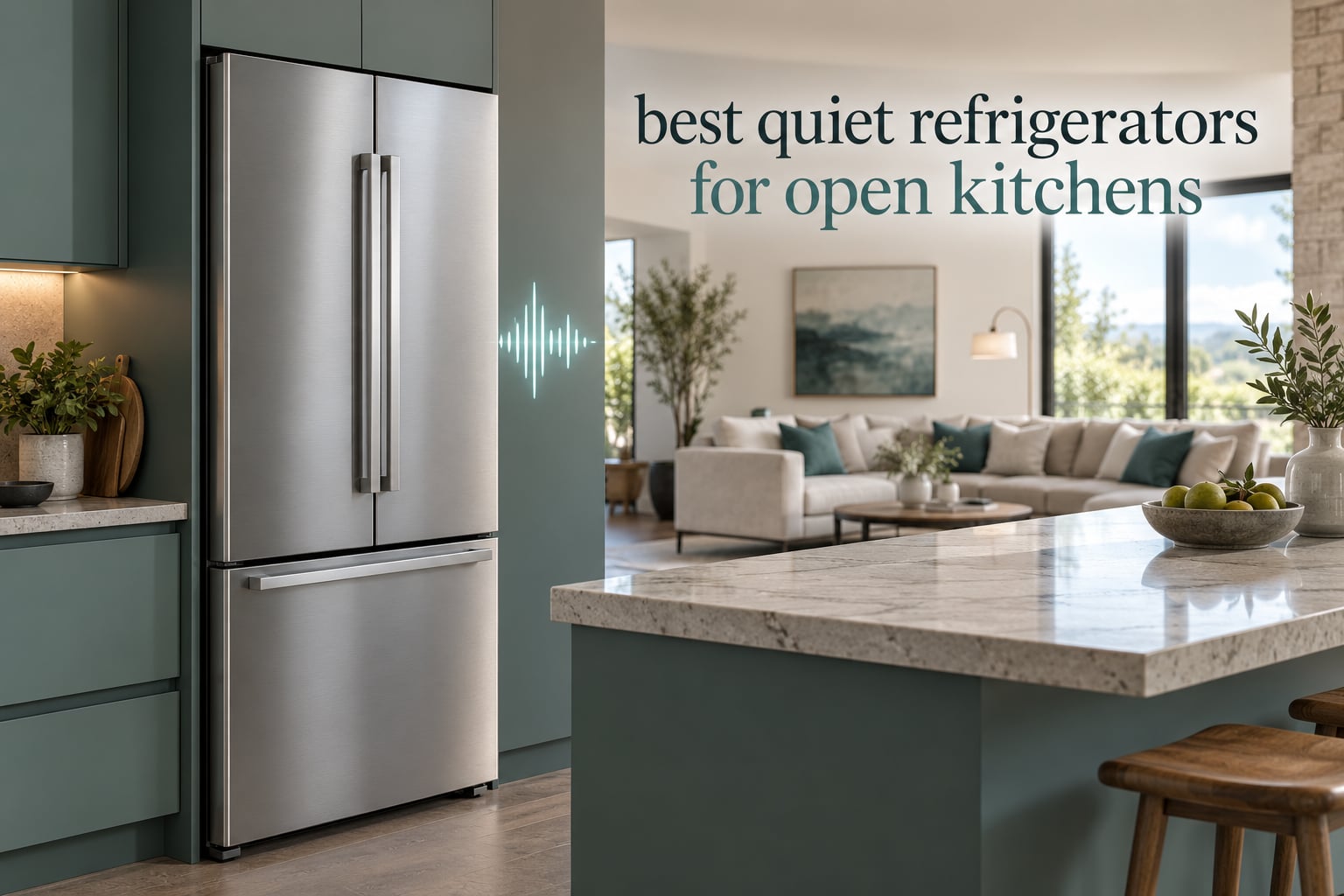
What makes a refrigerator quiet enough for an open kitchen? It publishes a sound rating of 38 dB(A) or below, and it lets you switch off the two loudest night-time parts: the ice maker and the door alarm.
That threshold is the number we used to build this list of the best quiet refrigerators for open kitchens in 2026. Below roughly 35 dB the compressor fades into the room. Between 39 and 45 dB, which is where a lot of mainstream fridges sit, the hum becomes noticeable once the television goes off.
Here is the honest part. We did not measure any of these appliances ourselves. Every sound figure we quote is a manufacturer’s published number, and only one of the ten models in this roundup publishes a decibel figure at all. The other nine are judged on owner-reported acoustics, compressor technology, and the specific night controls that decide whether a fridge stays quiet after dark.
In an open-plan room the refrigerator never stops being part of the room. There is no door between the fridge and the sofa, no wall to absorb the compressor cycle, and often a hard stone island that reflects it straight back at you. Late at night it can be the first thing you hear and the last thing you can stop noticing.
The picks below span counter-depth French doors, built-in bodies, bottom-freezer layouts and apartment-size second zones, so there is something here whether you are replacing a standard-depth unit in a remodel or adding a quiet fridge to a home office or pantry. If you are still working out the size and depth you need, our counter-depth refrigerator guide covers the fit questions in detail.
Three models rose to the top. The KoolMore counter-depth French door is the one we would put in an open kitchen first. The BLACK+DECKER 18 cu. ft. French door carries the largest body of owner evidence among the full-size units here. The Frigidaire 7.5 cu. ft. two-door is the quiet secondary-zone option for a bar, an office or a pantry.
Table of Contents
Top 3 Best Quiet Refrigerators for Open Kitchens (October 2026)

KoolMore 18.5 cu. ft. Counter-Depth…
- Inverter compressor
- Counter-depth body
- 465 kWh per year
- 18.5 cu. ft.

Frigidaire 7.5 cu. ft. Two-Door Apartment…
- Quiet by design
- 378 kWh per year
- Reversible door
- 7.5 cu. ft.
All 10 Models Compared Side by Side in 2026
Every model below appears with the acoustic evidence that exists for it. Where a maker publishes a decibel figure, that number is in the features list. Where nobody does, the entry tells you what the appliance uses instead, because that is what you can actually evaluate before delivery day.
| Product | Specifications | Action |
|---|---|---|
| KoolMore 18.5 cu. ft. Counter-Depth French Door |
|
Check Latest Price |
 Antarctic Star 18 cu. ft. Inverter French Door Antarctic Star 18 cu. ft. Inverter French Door |
|
Check Latest Price |
 LG 27 cu. ft. Counter-Depth MAX French Door LG 27 cu. ft. Counter-Depth MAX French Door |
|
Check Latest Price |
 LG 21.8 cu. ft. French Door Bottom Freezer LG 21.8 cu. ft. French Door Bottom Freezer |
|
Check Latest Price |
 GE 22.1 cu. ft. Counter-Depth French Door GE 22.1 cu. ft. Counter-Depth French Door |
|
Check Latest Price |
 Samsung 17.5 cu. ft. Counter-Depth 3-Door Samsung 17.5 cu. ft. Counter-Depth 3-Door |
|
Check Latest Price |
| BLACK+DECKER 18 cu. ft. French Door |
|
Check Latest Price |
| Frigidaire 7.5 cu. ft. Two-Door Apartment Fridge |
|
Check Latest Price |
 Upstreman 7.1 cu. ft. Bottom-Freezer Fridge Upstreman 7.1 cu. ft. Bottom-Freezer Fridge |
|
Check Latest Price |
 Hamilton Beach 20.3 cu. ft. Counter-Depth French Door Hamilton Beach 20.3 cu. ft. Counter-Depth French Door |
|
Check Latest Price |
1. KoolMore 18.5 cu. ft. Counter-Depth French Door — the Editor’s Choice combination of fit and capacity
KoolMore 30-Inch and 18.5 cu. ft. Counter Depth French Door Refrigerator with Three Doors and Deep Freezer in Stainless-Steel (KM-RERFDSS-18C)
18.5 cu. ft. counter-depth
Inverter compressor
465 kWh per year
Energy Star
Pros
- Owners report an exceptionally quiet inverter compressor
- Counter-depth body fits tight 30 inch cavities
- Even temperatures with no freezer over-freezing
- Double crisper with humidity control
- Door-open alarm included
Cons
- No dedicated cheese drawer
- Dim interior lighting
- Flat stainless front shows fingerprints
The KoolMore KM-RERFDSS-18C publishes no decibel figure, so its place at the top of this list rests on what owners actually report after living with it. The description that comes up most often is that the inverter compressor is inaudible in an open-concept space, and that buyers who swapped out a reciprocating-compressor unit heard the difference immediately.
That claim fits the physics. An inverter compressor does not snap on at full output and off again. It ramps, holds a low steady output, and ramps down, so the sound arrives as a flat hum rather than a cycle you notice starting. Over an open floor plan, the removal of that start-and-stop transient does more for perceived quietness than a small change in the base sound level.
Capacity is where it earns its keep too. At 18.5 cu. ft. with a 5.58 cu. ft. freezer and six door baskets, it holds a real household shop without the standard-depth bulk that pushes the doors past the counter line in an open room.
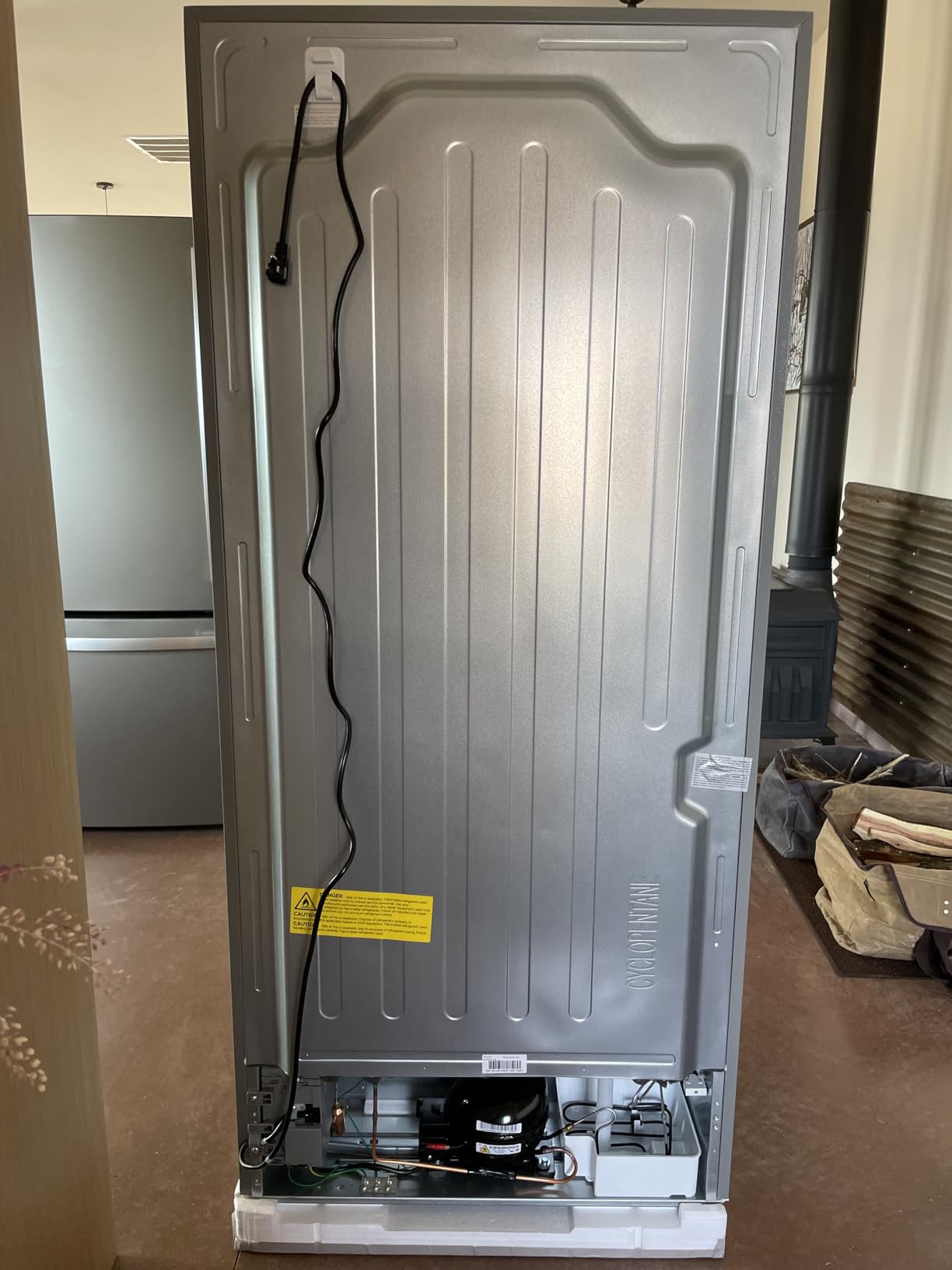
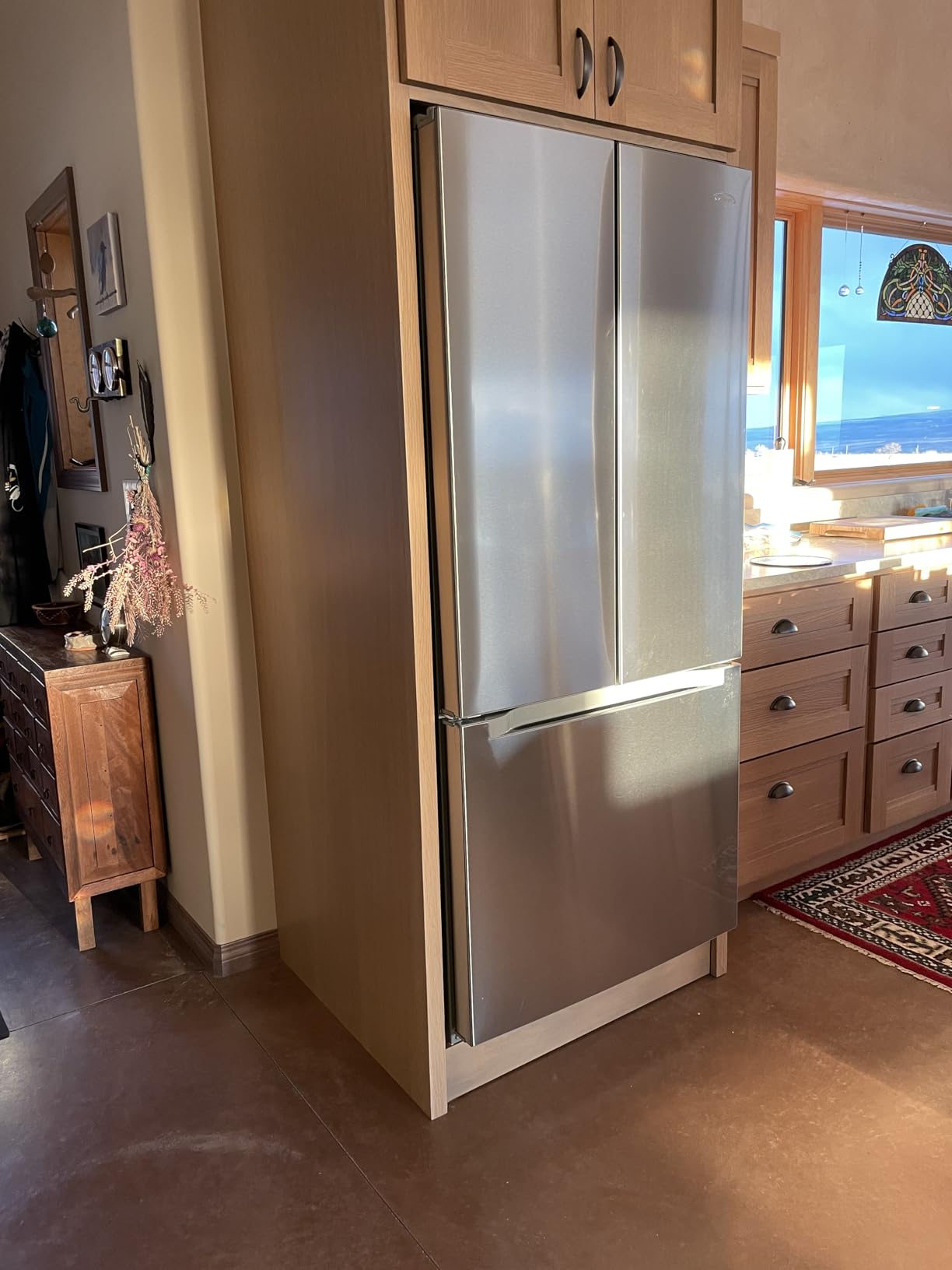
The body is 30.1 inches deep and 29.5 inches wide, which is the useful part for an open plan. It sits close to flush with a standard counter run, so it stops projecting into the room the way a full-depth French door does, and the doors do not swing out into a walkway as far.
Owners also report stable temperatures with nothing frozen solid in the vegetable drawers, which matters more than it sounds. A compressor forced to run longer to recover from a too-cold setpoint is a compressor that runs longer at night, and that is where open-plan noise complaints come from.
Two details are worth planning around. The interior lighting is dim, so if you open the fridge constantly in a dark open room, that will register. And the flat stainless front with no handles shows fingerprints, which is a cleaning preference rather than an acoustic one.
What fits this model well
It is the pick for anyone in a remodel who wants a flush counter line and a French door without dropping to apartment-size storage. The inverter compressor is the single most commonly praised acoustic feature across its reviews, and at 465 kWh per year it also runs more efficiently than most counter-depth French doors here.
Owners with narrow cavities report that the 29.5 inch width drops into tight openings that reject wider counter-depth units. If your cabinet run was designed around a 30 inch gap, this is a unit that fits rather than fights the layout.
What to know before you order
The fridge section has no dedicated cheese drawer, and the dual crispers split humidity control between produce drawers rather than offering a separate sealed compartment. If a cheese drawer is on your must-have list, keep looking.
It also ships with a one-year parts and labour warranty, which is thinner than the compressor coverage on the LG models in this list. For a refrigerator you will live with for a decade, that difference is worth asking a dealer about in writing.
2. Antarctic Star 18 cu. ft. Inverter French Door — the pick when the ice maker matters most
Antarctic Star French Door Refrigerator, Auto Ice & Water Filter, VCM Stainless, Multi-Air, Fast Cooling, Inverter, LED Alarm, Energy Star, 18 Cu Ft, Silver
18 cu. ft. French door
Inverter compressor
Built-in ice maker
Multi-air flow
Pros
- Inverter compressor with a low noise design
- Built-in ice maker needs no trays
- Multi-air flow holds even temperatures
- Fingerprint resistant VCM stainless
- Doors open to 90 degrees in tight spots
Cons
- Only 12.7 cu. ft. of fresh food space
- Small 5.27 cu. ft. freezer
- Short reliability record
The Antarctic Star BCD-513WIBMY also publishes no decibel figure. Its listing does carry a low-noise design claim alongside an inverter compressor, which puts it in the same acoustic class as the KoolMore, and it adds the feature most buyers in an open kitchen actually want: a built-in automatic ice maker that never needs a tray.
That ice maker is also the most likely source of a complaint at 11 p.m. Cube-drop sounds carry across an open room more easily than a compressor hum, because they are sharp transients rather than a steady tone. This unit gives you a mechanical ice maker, so plan to switch it off on a timer if the kitchen adjoins a bedroom wall.
Free-flow is where it is genuinely clever for open layouts. The doors open a full 90 degrees even when the unit is pushed near a wall, so you can pull the bottom drawer out completely without the door hitting the counter return.
The multi-air flow system keeps both compartments at an even temperature, which reduces the long recovery cycles that make a compressor audible. LED lighting on every shelf also helps, because you will not be standing in a dark open kitchen leaning in and waiting for a fridge interior to light up.
VCM stainless is genuinely easier to live with in an open room than a mirror finish. It resists fingerprints and smudges, and in a space where the fridge is part of the visual centre of the room, that keeps the maintenance burden low.
The trade-off is fresh-food volume. Of the 18 cu. ft. total, only 12.7 cu. ft. is refrigerator space and 5.27 cu. ft. is freezer. For a household that shops for a week at a time, that is tight, and it is the reason this sits second rather than first.
What fits this model well
This is the one to choose when ice is a daily habit rather than a special occasion. The trayless maker produces without your involvement, and the 90-degree door swing means drawers clear fully in a tight placement beside a wall or cabinet run.
Owners consistently single out the inverter drive and the low-noise design as the reasons the unit suits an open kitchen, and the fingerprint-resistant finish means it stays presentable in a room where you can see it from the sofa.
What to know before you order
The review base is short at 55 ratings, so the long-term durability picture is not yet established. Warranty coverage is one year, which is the shortest tier available here.
Because there is no independent decibel figure, you are relying on owner reports rather than a measured number. Ask the dealer in advance whether the unit can be added to an app or panel that lets you disable the ice maker on a schedule, and confirm the answer before the unit goes in the hole.
3. LG LRFLC2706S 27 cu. ft. Counter-Depth MAX French Door — most capacity in a flush body
LG LRFLC2706S 27 Cu. Ft. French Door Smart Refrigerator in Stainless Steel
27 cu. ft. counter-depth
Linear compressor
632 kWh per year
Internal dispenser
Pros
- 27 cu. ft. inside a counter-depth body
- Linear compressor with 10 year parts coverage
- Internal dispenser keeps the cabinet line flush
- Smart Cooling with Door Cooling plus
- Energy Star certified
Cons
- Only 31 ratings to judge it by
- Needs 33.75 inch width
- Stainless still shows handling marks
The LG LRFLC2706S publishes no decibel figure either, but it has the longest compressor warranty of any model in this list: 10 years on linear compressor parts, five years on the sealed system, and two years parts and labour. For an open kitchen where you plan to keep the appliance a long time, that coverage is a genuine part of the value calculation.
A linear compressor is a variation on inverter control. Rather than pulsing its output to hold a setpoint, it moves in a smoother, wider range, which is why owners commonly describe it as a lower and steadier sound. It is a quieter mechanism than a fixed-speed reciprocating compressor that slams on and off.
The headline achievement is capacity. At 27 cu. ft. inside a 31.63 inch deep body, it is the largest counter-depth French door in this group, and it splits into 18.4 cu. ft. fresh food and 8.6 cu. ft. freezer. Most counter-depth designs give away a fifth of their volume to keep the depth down. This one does not.
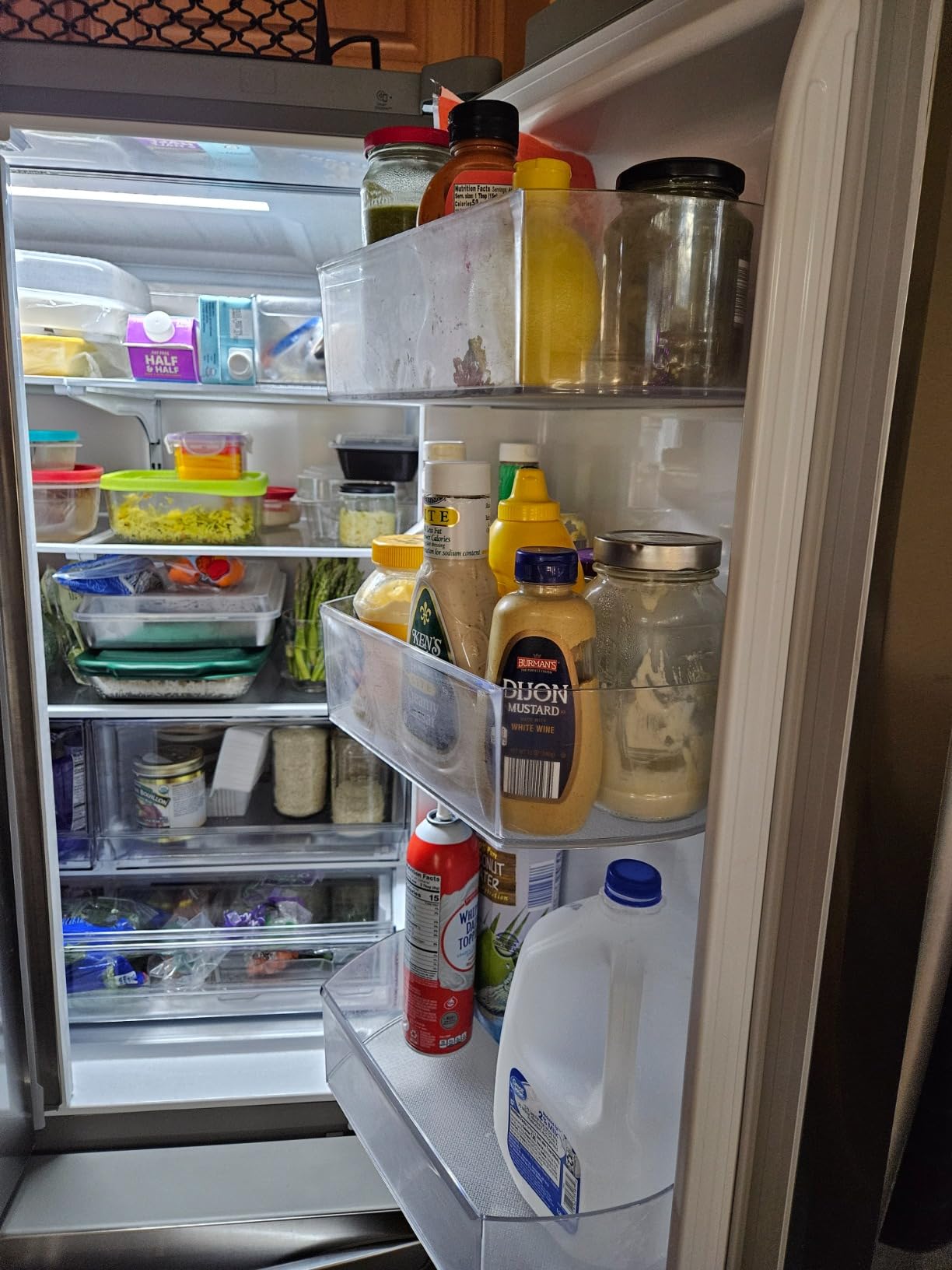
The water dispenser is internal, which is an acoustic and an aesthetic decision in one. An external dispenser puts a valve and a drip tray on the door face where sound reaches the room directly, and it breaks the flush cabinet line that makes an open kitchen look built rather than fitted.
Smart Cooling sensors and Door Cooling plus push cold air back into the cabinet when a door opens. That shortens the recovery cycle, which means the compressor settles sooner after a grocery run instead of grinding for an extra stretch.
Fit is the catch. The unit is 33.75 inches wide and 70.25 inches tall, so it will not drop into a standard 30 inch cavity. If your cabinet run is already framed at 36 inches, it is a clean install. If not, this is the model most likely to mean a cabinet change.

What fits this model well
This is the pick for a large household that refuses to give up storage volume for a counter-depth body. Twenty-seven cubic feet in a flush footprint removes the usual compromise, and the internal dispenser keeps the door face clean in a room where the appliance is on show.
Linear compressor operation plus 10 year parts coverage is the strongest long-horizon quietness package here. If you install it once and keep it for the life of the kitchen, that warranty is doing real work.
What to know before you order
Only 31 ratings exist for this listing, and 14 percent of them are one star. A small sample makes any average unstable, so treat the 4.4 as directional rather than settled.
At 632 kWh per year it is not the most efficient unit here, and at 33.75 inches wide it is wider than most counter-depth cavities. Measure the opening, including the door swing and any adjacent wall, before committing.
4. LG LFDS22520S 21.8 cu. ft. French Door Bottom Freezer — the standard-depth workhorse
LG LFDS22520S – Refrigerator/Freezer – French Door Bottom Freezer with Water Dispenser – Stainless Steel
21.8 cu. ft. French door
Linear compressor
587 kWh per year
Energy Star
Pros
- Linear compressor with Multi-Air Flow
- Built-in ice maker included
- Fits an appliance-sized opening
- Split Spill Protection glass shelves
Cons
- Door shelves crack and are not covered
- Closing one door can pop the other
- Some models needed sealed system repairs
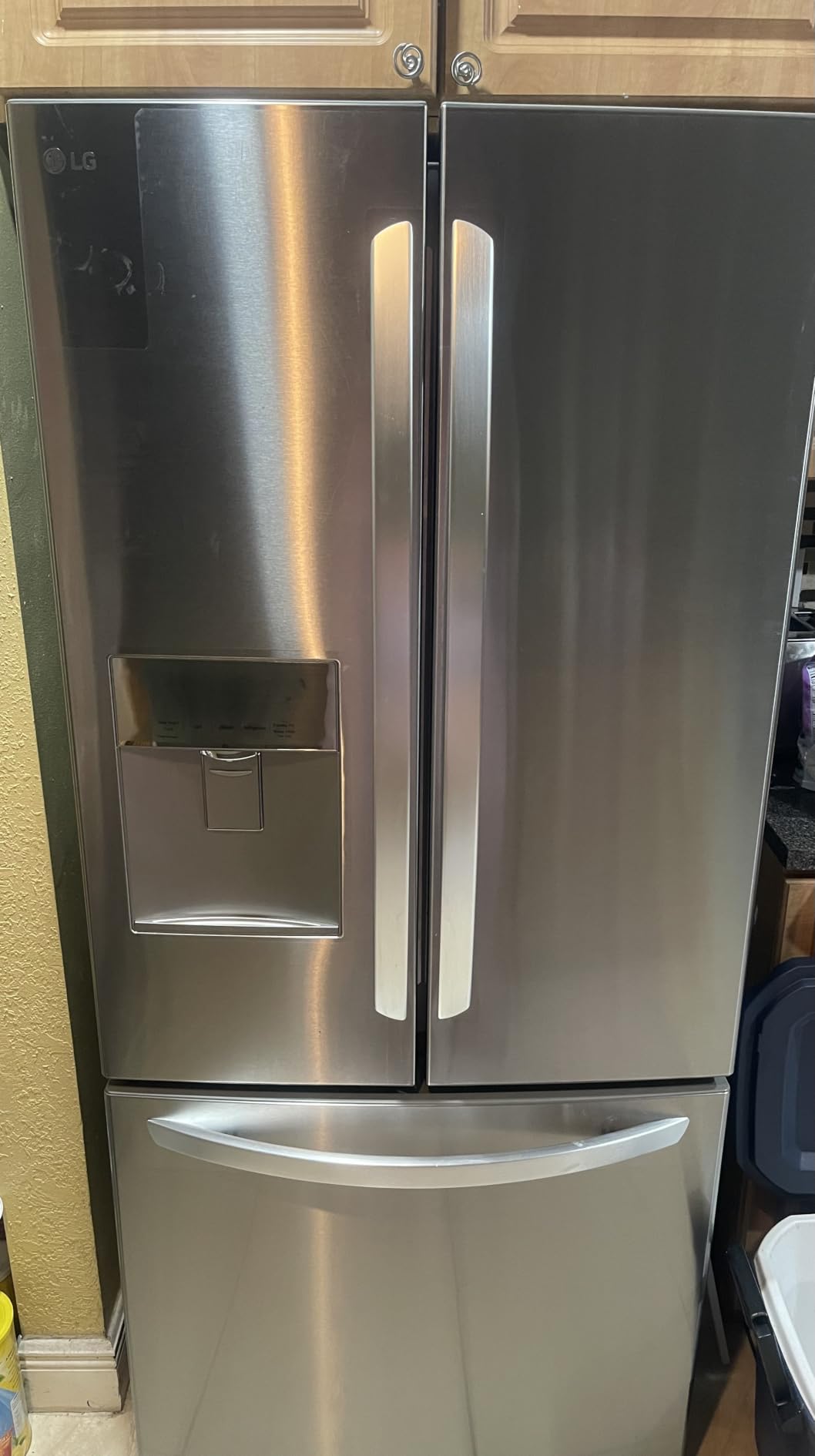
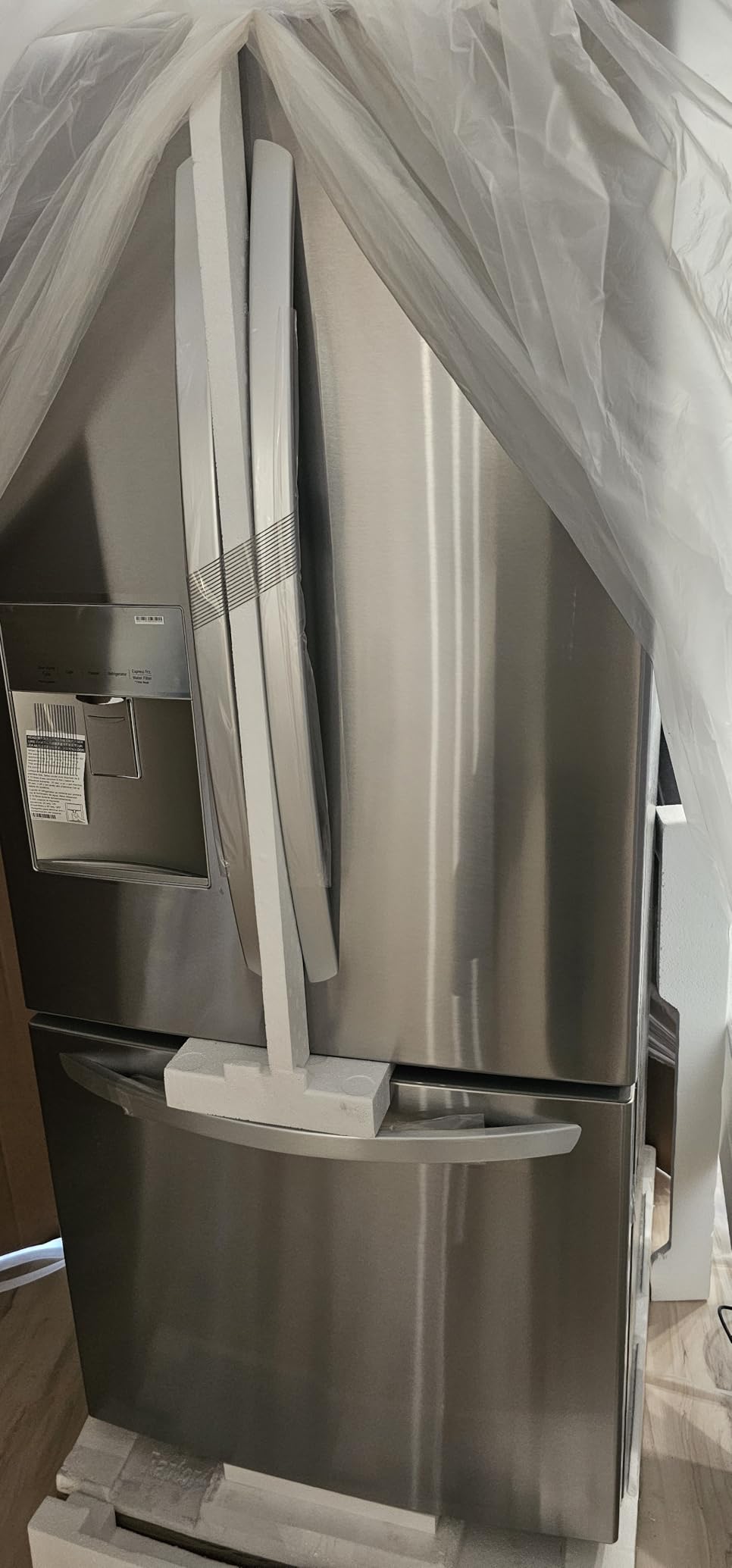
The LFDS22520S is a full-depth French door with a bottom freezer drawer, and it publishes no sound figure. What it does publish is a linear compressor inside a Smart Cooling system with Multi-Air Flow distribution, which is the same mechanical package as the LG above, at a smaller capacity.
For an open kitchen the relevant question is how the body sits in the room. At 35.5 inches deep it will project past a standard counter run, and that projection both changes the sightline across the room and puts the compressor cavity closer to where people sit.
That said, standard depth buys you storage cheaply. At 21.8 cu. ft. with 14.5 cu. ft. fresh food and 7.3 cu. ft. freezer, this holds considerably more than any of the counter-depth units here, and it does it in an appliance-sized footprint that fits a normal opening.
The four Split Spill Protection tempered glass shelves are a genuinely useful detail in an open-plan kitchen, where a knocked glass from the sofa or a bumped island is a realistic event rather than a theoretical one.
Energy Star qualification at 587 kWh per year puts it mid-pack here. That matters in a subtle way: a more efficient compressor runs for fewer hours, and hours of runtime is the raw material of background noise in an open room.
Owners also report that the linear compressor gives a smooth, low hum that is easy to live with, which matches the pattern reported across LG models generally. The sealed system is the standard place where efficiency and quietness overlap.
What fits this model well
Choose this when your cabinet run is already standard depth and you want more usable storage than a counter-depth unit can offer. The bottom freezer drawer keeps fresh food at eye level, which suits a household that shops often.
Owners rate the cooling consistency highly, and the 21.8 cu. ft. interior spreads the load across a larger cabinet so the compressor does not have to fight to hold setpoints on a warm day.
What to know before you order
Durability is the weak point here, and it is not a small one. Owners report cracked door shelves that the manufacturer declined to treat as a defect, one French door popping open when the other closes, and models needing compressor and condenser replacement within a few years.
Returns are reported as impractical because return shipping costs run high against the purchase price. If you are replacing a noisy standard-depth unit in a difficult-to-swap location, get the delivery and haul-away terms in writing first.
5. GE GYE22GYNFS 22.1 cu. ft. Counter-Depth French Door — praised for open-concept quiet
GE GYE22GYNFS 36″ French Door Counter Depth Refrigerator with 22.1 cu. ft. Total Capacity Space Saving Ice Maker Showcase LED Lighting in Stainless Steel
22.1 cu. ft. counter-depth
Hot gas defrost
665 kWh per year
ADA compliant
Pros
- Owners single out quiet running in open plans
- Counter-depth body gives a built-in look
- Bright showcase LED interior lighting
- Stainless resists fingerprints
Cons
- Dispenser display has no backlighting
- Several owners report cooling failures
- Highest energy draw here at 665 kWh per year
Quiet operation in an open-concept living space is the most frequently cited strength for the GE GYE22GYNFS, and it is unusually specific praise for a model that publishes no decibel figure. Buyers replacing louder units in open rooms single this one out by name.
The body is 31.25 inches deep and 35.75 inches wide, so it reads as a built-in from across the room without being a true integrated unit. At 22.1 cu. ft. with 14.92 cu. ft. fresh food and 7.16 cu. ft. freezer, the capacity is competitive for the depth.
Hot gas defrost is the mechanism doing quiet work here. Evaporative and hot-gas defrost cycles are the periods when a frost-free refrigerator is loudest, and a hot gas cycle uses heated refrigerant gas rather than an electric element, which tends to run more evenly.
The showcase LED lighting is bright enough that you will not be leaning into a dark cabinet at night. In an open room that is a small quality-of-life gain, because the alternative is holding a door open and letting the room’s warm air into the fresh food compartment.
Adjustable shelves that take tall items such as wine bottles and large carafes are practical in a French door layout, and the stainless finish is reported to genuinely resist fingerprints in daily use rather than only in the first month.
Energy use is the drawback and it is measurable at 665 kWh per year, the highest figure among the ten models here. In an open kitchen where the appliance runs within earshot of where you sit, more runtime means more exposed sound, so this is a real acoustic cost and not just a utility one.
What fits this model well
This is the pick when appearance and owner-reported quietness matter more than efficiency. The counter-depth body gives a built-in look at 22.1 cu. ft., and ADA compliance plus Energy Star qualification make it straightforward to specify in a project.
Owners replacing louder units in open-concept homes report the change clearly, and the hot gas defrost cycle reduces the loudest part of a frost-free fridge’s operating day.
What to know before you order
Several owners report sealed-system or cooling failures within the first few years, which is serious enough to plan around. There is also an ADA compliance claim and a one-year entire-appliance warranty, so coverage is short relative to the LG models here.
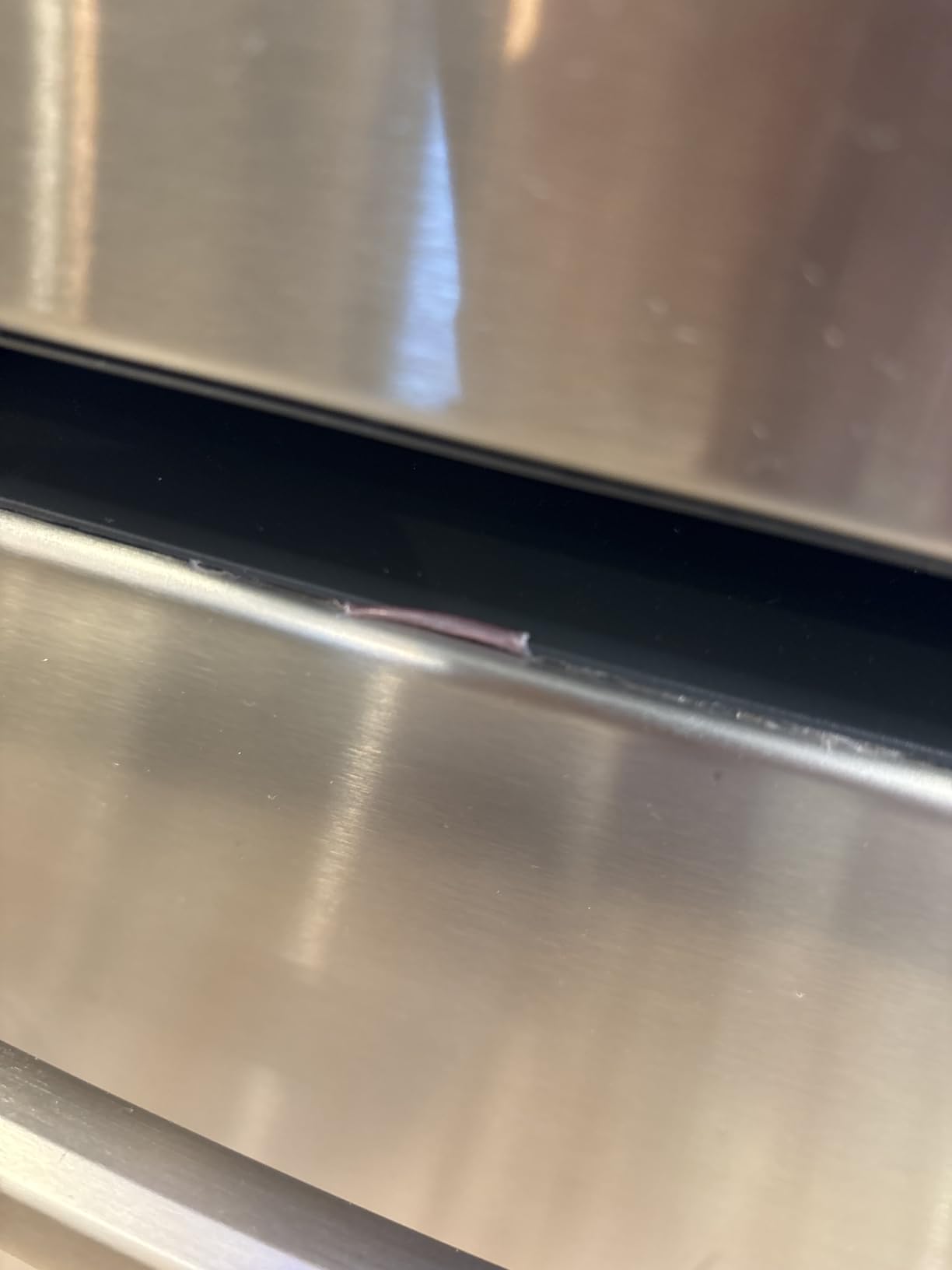
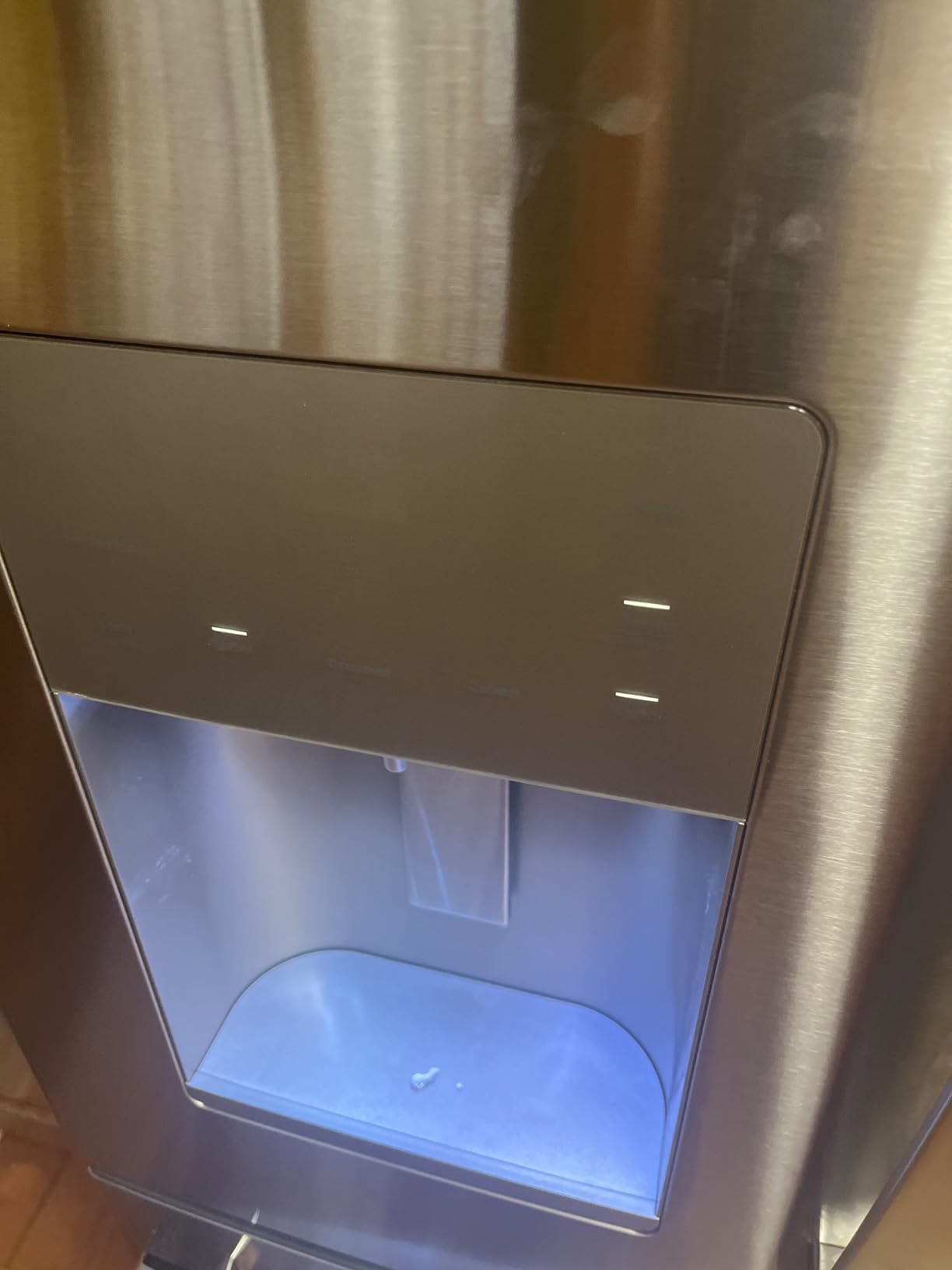
The external water dispenser display has no backlighting, which owners call unreadable. A fridge that dispenses unlit in a dark open kitchen at night is an irritation that adds a small reason to reach for a glass from another room instead.
6. Samsung RF18A5101SR 17.5 cu. ft. Counter-Depth 3-Door — alerts when something goes wrong
Samsung 17.5 cu. ft. Smart Counter Depth 3-Door French Door Refrigerator, Stainless Steel, RF18A5101SR/AA
17.5 cu. ft. counter-depth
Digital inverter
595 kWh per year
Energy Star
Pros
- Digital inverter with 10 year parts warranty
- Twin Cooling Plus runs two cooling zones
- Wi-Fi alerts on temperature and door events
- Recessed handles for a flush cabinet look
Cons
- Only 11.7 cu. ft. of fresh food space
- Needs 51.1 inch clearance with doors open
- Requires a 32.13 inch width
The Samsung RF18A5101SR publishes no sound figure, so we are again working from the compressor type and owner reports. It uses a digital inverter compressor, which is Samsung’s term for variable-speed drive, and the compressor carries a 10 year parts and 5 year labour warranty.
That warranty has an acoustic consequence worth understanding. A compressor that runs less hard, for shorter stretches, at lower output is both quieter and gentler on its own moving parts, so the coverage and the quietness point in the same direction rather than against each other.
Twin Cooling Plus runs the refrigerator and freezer as independent zones with separate humidity. Two independent circuits means each compartment has its own evaporator fan, and controlled fan speed is a meaningful part of how quiet a modern refrigerator is between compressor cycles.
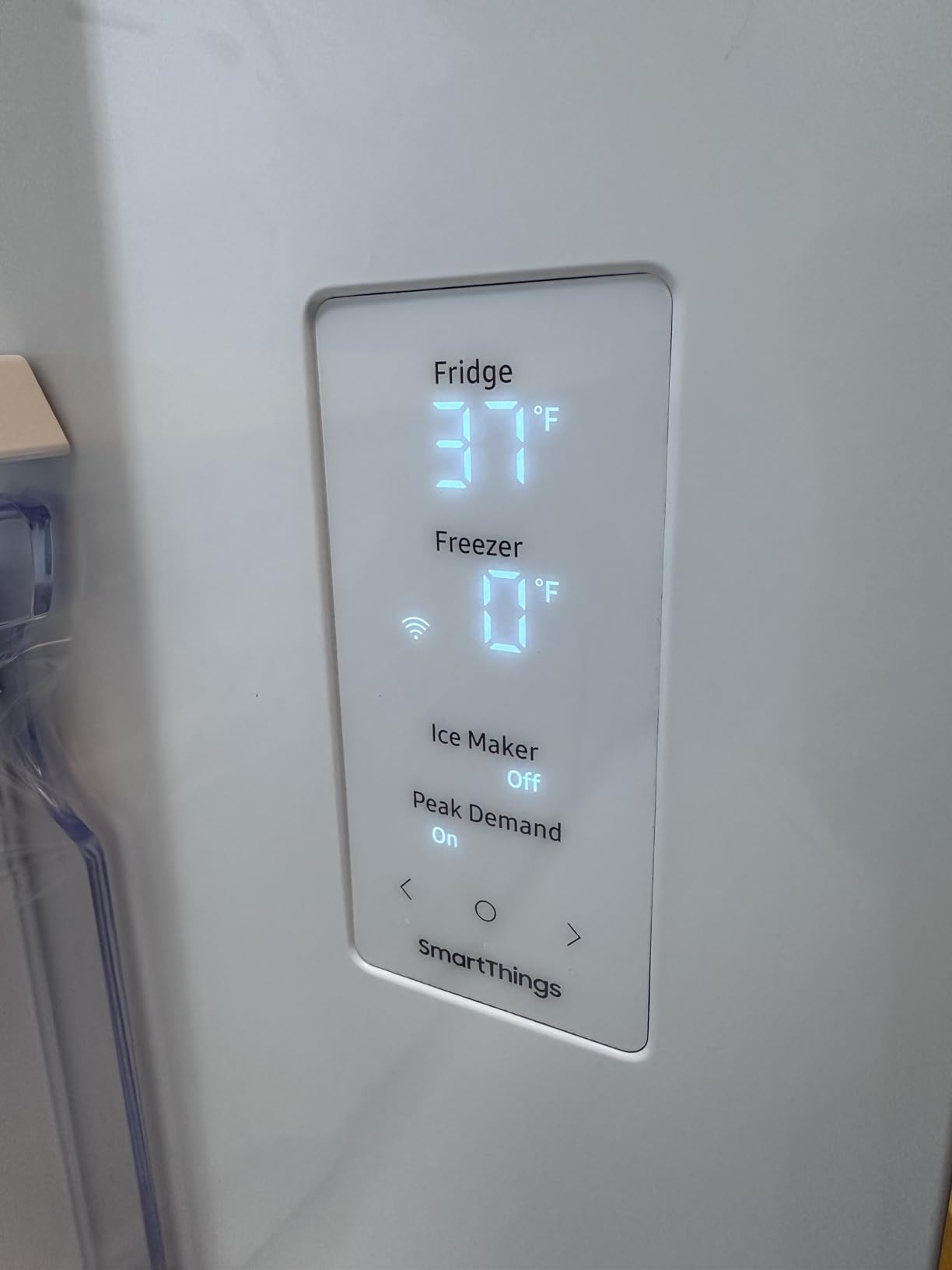
Wi-Fi connectivity is the reason this earns its slot for some buyers. Notifications for temperature drops and doors left open are useful in an open kitchen where nobody is watching the appliance, and they are genuinely useful in a second-zone unit you are not looking at.
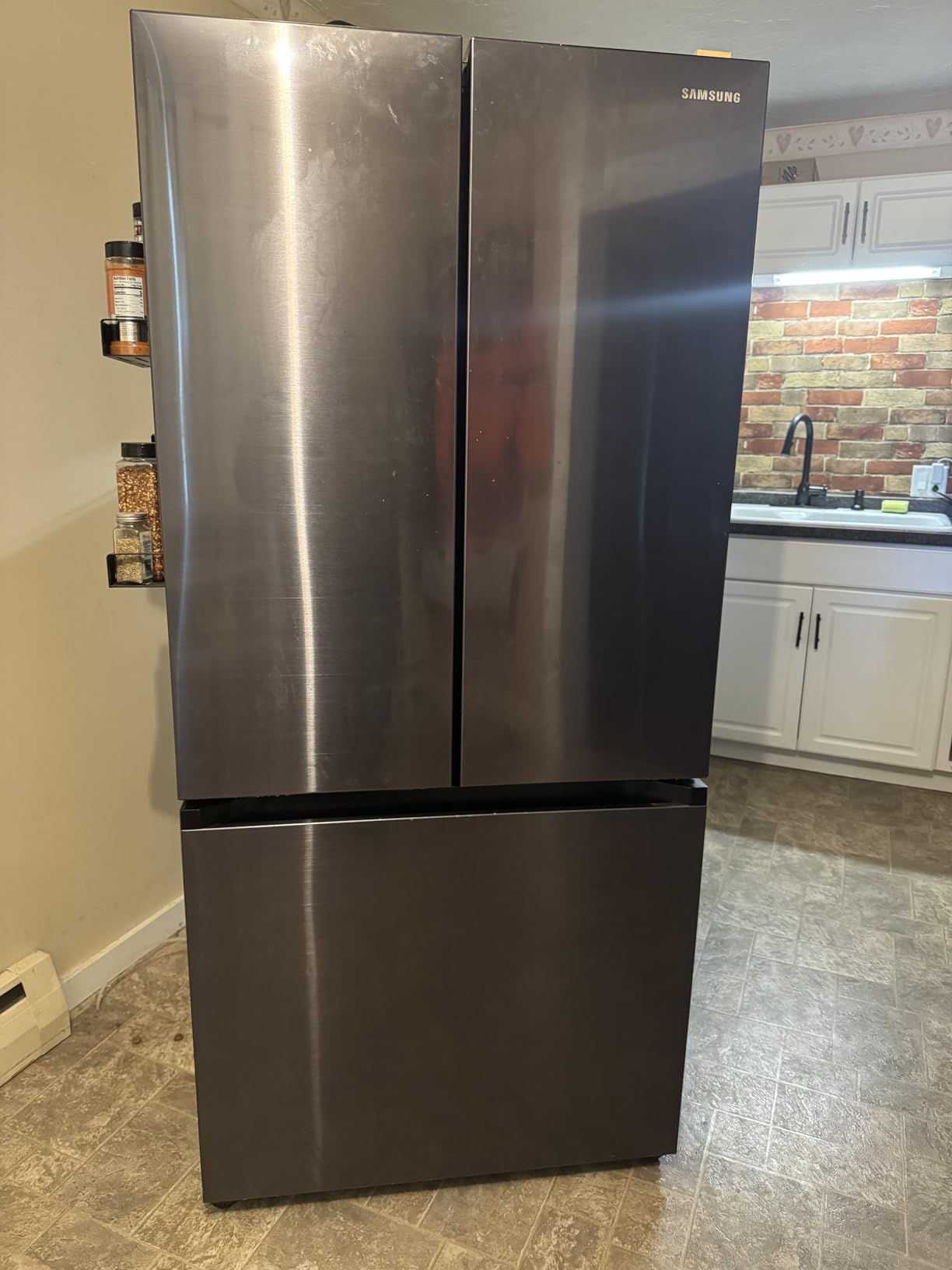
The recessed handles and flat doors let it sit against a cabinet run without the projecting grips that break a flush line. At 28.5 inches deep it is the shallowest full-size body in this group by some margin.
Capacity is the disappointment. Of the 17.5 cu. ft. body, only 11.7 cu. ft. is fresh food and 5.8 cu. ft. is freezer. You are buying a counter-depth exterior and paying for considerably less interior than the number on the door suggests.
What fits this model well
It suits anyone who wants a shallow, flush-looking unit and mainly wants to be told when something is wrong rather than discover it. Door alerts and temperature-drop notifications are the strongest feature set here for a second-zone or pantry fridge.
At 595 kWh per year it is more efficient than several larger units in this list, which means fewer hours of exposed runtime in an open room.
What to know before you order
The 51.1 inch depth needed with the doors open is genuinely tight. In an island or peninsula position, measure the full swing, not the body, or you will end up with doors that hit the opposite cabinet.
Ratings are spread, with 18 percent at three stars and 8 percent at two stars, and the width is 32.13 inches, wider than a standard 30 inch cavity. This is a design-led purchase more than a capacity-led one.
7. BLACK+DECKER BRF1800GIMB 18 cu. ft. French Door — the largest owner record in the group
BLACK+DECKER 18 Cu. Ft. French Door Refrigerator, Built-in Ice Maker, Black
18 cu. ft. French door
Sensor ice maker
Frost free auto defrost
Energy Star
Pros
- Owners report barely noticeable running
- Sensor ice maker makes up to 3.5 lb per day
- Dual thermostat with separate compartment control
- Largest evidence base at 165 ratings
Cons
- Dim interior LED lighting
- Some units lost cooling after a couple of months
- Support reported as unresponsive
The BLACK+DECKER BRF1800GIMB publishes no decibel figure, but it has something none of the other full-size models here can offer: 165 owner ratings, which makes its quietness claim the best-evidenced one in the roundup. Buyers report it running so quietly that the only sounds they notice are at startup and during ice-maker cycles.
That is exactly the acoustic profile you want in an open kitchen. A compressor you never notice, plus a defined set of short transient events you can predict, is a much better night-time proposition than a steady tone at the edge of hearing.
The 18 cu. ft. cabinet splits into 12.5 cu. ft. fresh food and a 5.4 cu. ft. freezer. At 27.4 inches deep it is the second-shallowest full-size body here, which helps it sit close to the cabinet line.
The bottom freezer has a built-in sensor ice maker producing up to 3.5 lb of ice per day. Sensor-controlled harvest is quieter than an older timed mechanism because it only runs the harvest cycle when the tray is actually ready, rather than on a fixed schedule all night.
Digital temperature control with a separate thermostat per compartment means the fresh food and freezer setpoints are genuinely independent, and owners report the thermometer reaching setpoint within a few hours of plugging in. Fast recovery matters acoustically because a fridge that recovers fast spends less of the night working hard.
The reversible door is useful in an open plan, because it lets you decide which side the swing faces relative to the island rather than accepting the manufacturer’s default.
What fits this model well
This is the pick when you want quietness you can have confidence in before delivery, because 165 ratings of mostly-same-experience owner reports carry more weight than a smaller sample of glowing reviews. The reported sound profile is the quietest we can substantiate without a published figure.
It also has a full French door layout, a bottom freezer and a sensor ice maker at a body size that suits a normal kitchen opening, which is a combination that is genuinely hard to find at this tier.
What to know before you order
Dim interior LED lighting is the single most repeated complaint across the reviews, and in a dark open kitchen it is more annoying than it would be behind a closed door. Some models also lost cooling after a couple of months.
Customer service is reported as unresponsive with little troubleshooting offered, which turns a solvable cooling fault into a total loss of food. Warranty coverage is one year, so check what the extended plan actually covers before you decide it is not worth having.
8. Frigidaire EFR751 7.5 cu. ft. Two-Door — the quiet second zone for a bar or office
Frigidaire, 2 Door Apartment Size Refrigerator/Freezer Combo, 7.5 cu ft, Platinum Series, Stainless, 23″ D x 21.5″ W x 55.5″ H
7.5 cu. ft. two-door
Manual defrost
378 kWh per year
Reversible door
Pros
- Marketed and reviewed as quiet for a living area
- Lowest energy draw here at 378 kWh per year
- Reversible door with levelling legs and castors
- Nearly 2300 ratings behind it
Cons
- Manual defrost in the freezer
- 2 cu. ft. freezer section is small
- No Energy Star rating
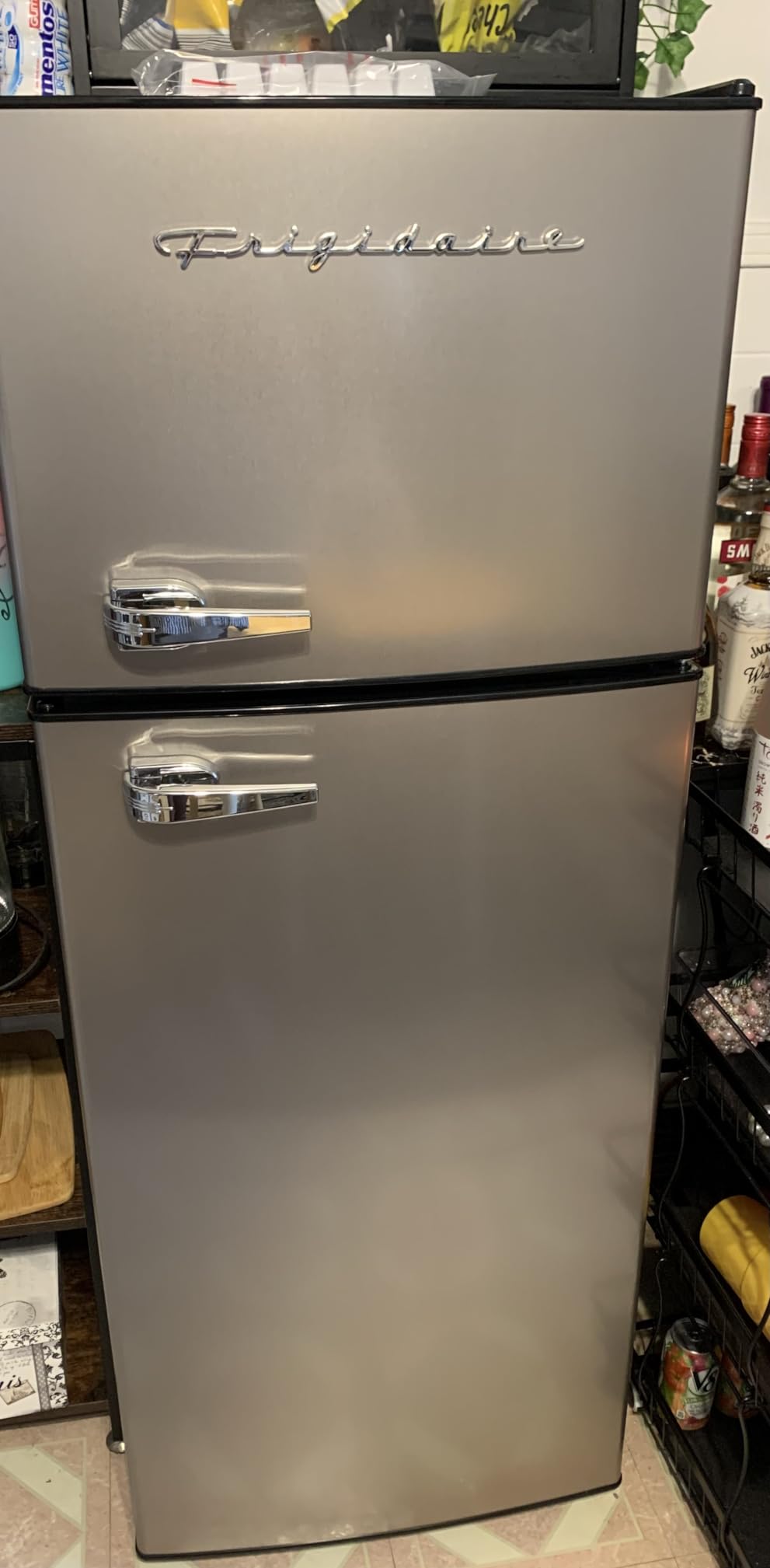
The Frigidaire EFR751 is the only product in this roundup with nearly 2,300 ratings behind it, which makes its owner consensus the most thoroughly tested on the list. It is explicitly built and marketed for quiet operation in a peaceful living area, and buyers back that up.
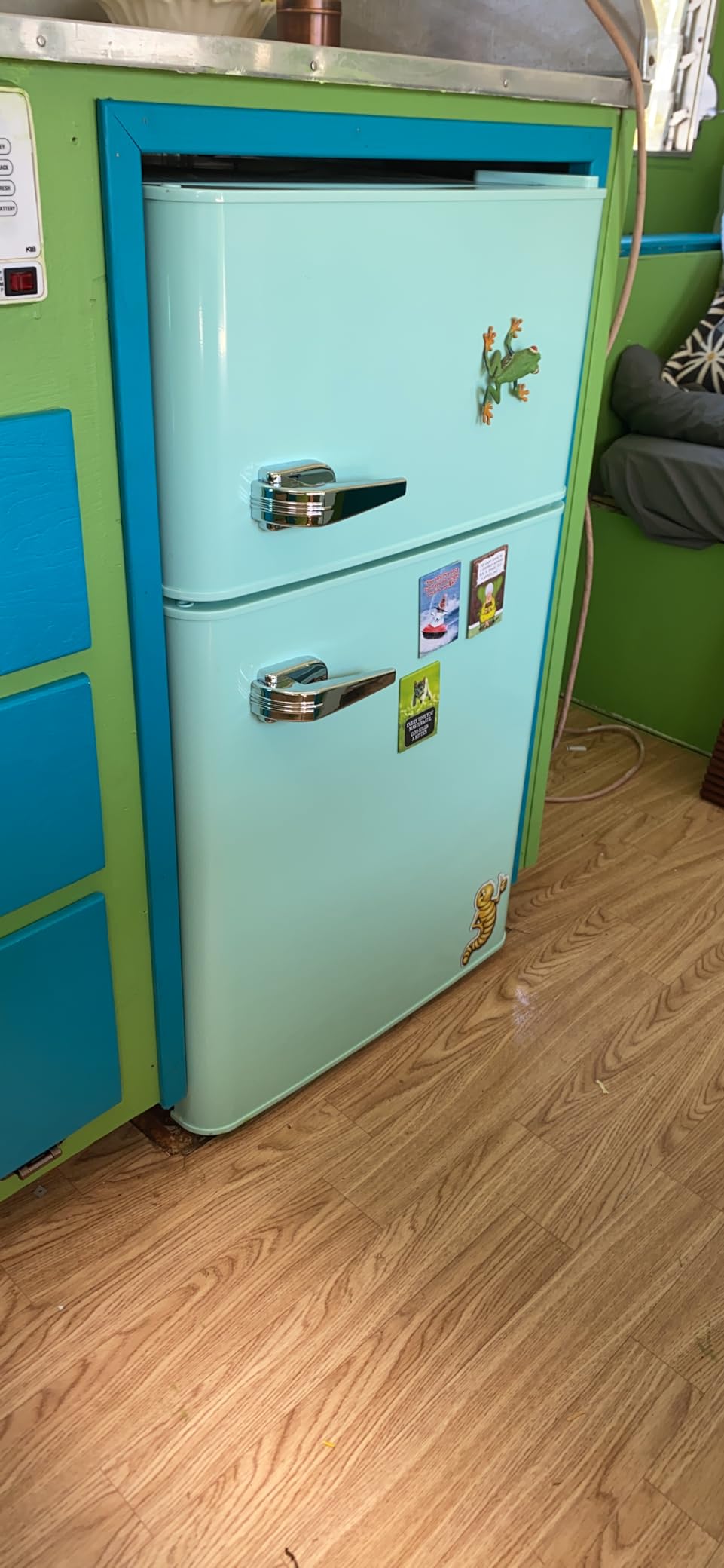
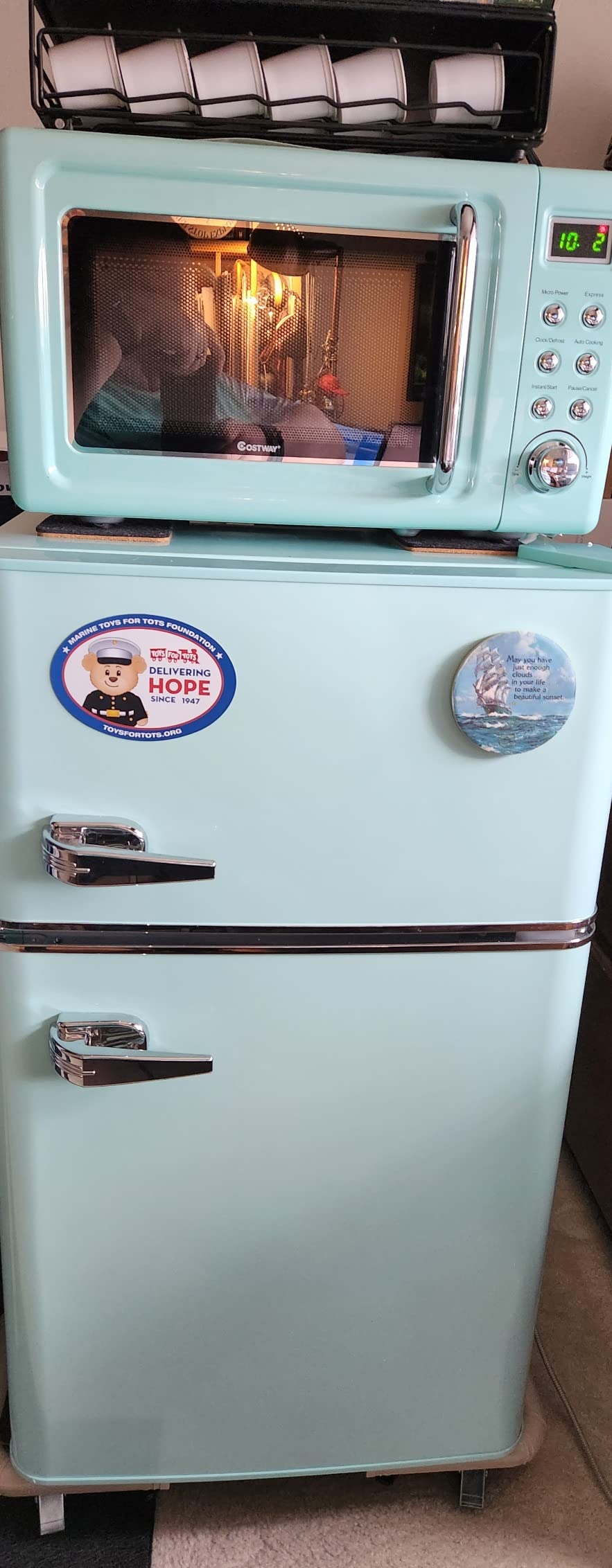
At 7.5 cu. ft. with 6 cu. ft. fresh food and 2 cu. ft. freezer, this is not a household primary refrigerator. It is a second zone, and in an open-plan home the second zone is where noise actually gets solved. A drinks fridge in a home office or pantry keeps the main refrigerator from being opened forty times an evening, which cuts the main unit’s duty cycle.
The body is 23 inches deep, 21.5 inches wide and 55.5 inches tall. At 75 pounds it is light enough to place anywhere, and front-mount adjustable levelling legs plus rear castors handle uneven floors that would make a full-size fridge rattle.
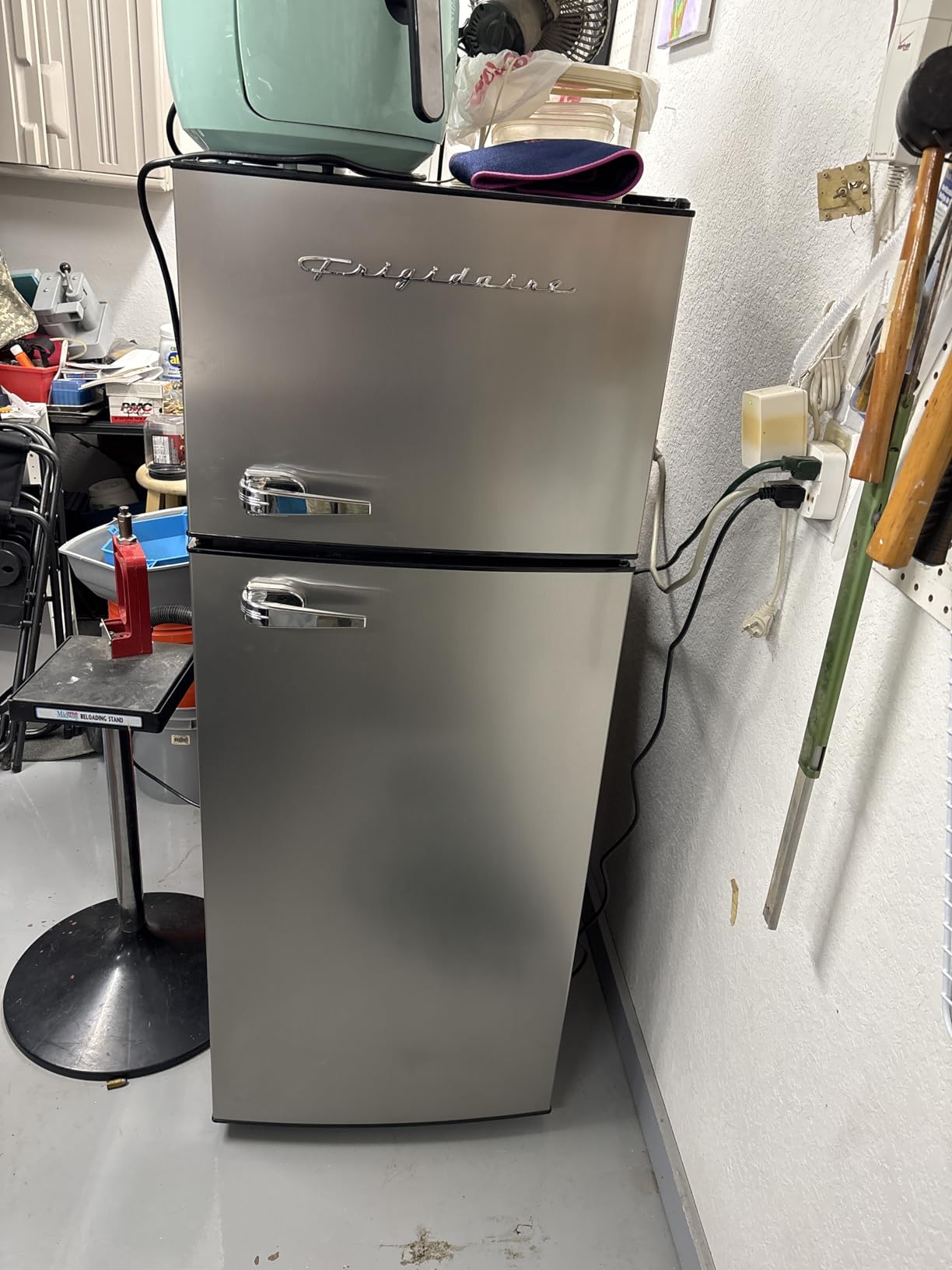
That levelling detail is not cosmetic. A fridge that is not level transmits compressor vibration straight into the floor, and an off-level small unit on an uneven surface is one of the most common sources of the rattle that people mistake for a compressor fault.
Slide-out glass shelves, a transparent crisper and a full-width door bin make better use of a small cabinet than fixed shelves would. The separate freezer compartment has its own thermostat and its own light, which is unusual at this size.
Energy use is 378 kWh per year, the lowest figure in the roundup. That is the same consumption as the much larger Hamilton Beach unit further down, and it is a direct consequence of a small cabinet with a modest compressor.
What fits this model well
It is the strongest choice for a bar cart alcove, a pantry, a home office kitchenette or a studio apartment, where a second small unit is a better answer than trying to engineer a full-size fridge into a tight space.
Owners value quiet running, flexible reversible-door placement and organised storage, and the almost 2,300 rating base means the reliability picture is genuinely well documented for a budget appliance.
What to know before you order
Manual defrost in the freezer compartment is a genuine weekly chore, and the 2 cu. ft. freezer is small. If you buy frozen food in bulk, this is not the unit for that habit.
It also carries no Energy Star rating. For a secondary unit that runs less often than a primary refrigerator, the lower annual consumption largely offsets the missing certification, but check your own usage pattern before assuming that.
9. Upstreman BM71 7.1 cu. ft. Bottom Freezer — the only model here with a stated decibel figure
Upstreman 7.1 Cu.Ft Refrigerator with Bottom Freezer, Apartment Fridge
7.1 cu. ft. double door
39 dB stated
384 kWh per year
Five temp settings
Pros
- Only model here with a stated 39 dB figure
- Owners confirm the running sound is inaudible
- About 1 kWh per day consumption
- Five temperature settings from 32F up
Cons
- Manual defrost with rear wall condensation
- 1.65 cu. ft. freezer is tight
- Not intended for heavy use
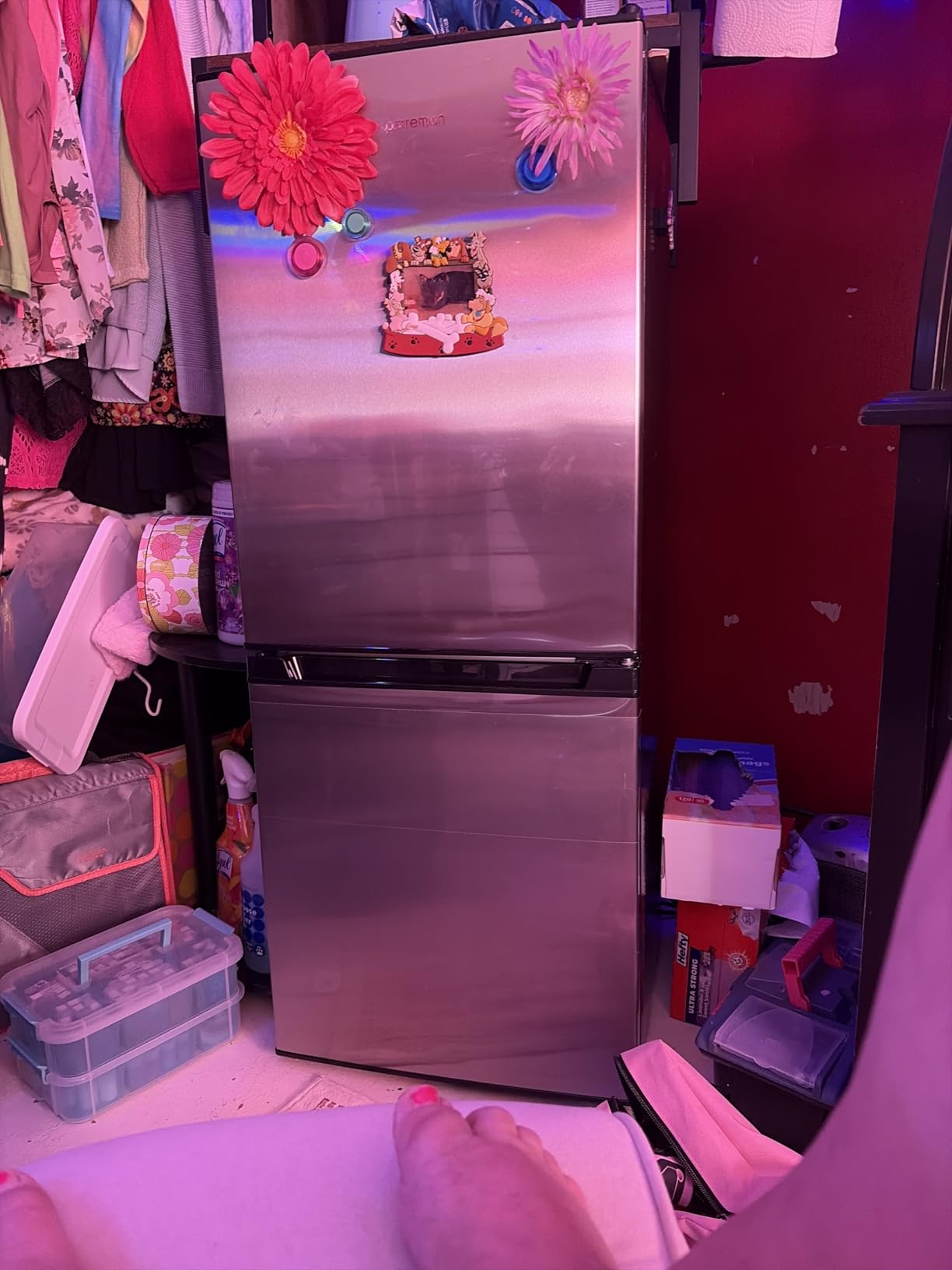
The Upstreman BM71 is the only appliance in this roundup that publishes a decibel figure, and its manufacturer rates it at 39 dB. That places it at the top of the standard band rather than in the very quiet band, and we are quoting it verbatim rather than adjusting it upward, because a published number is more useful than a flattering paraphrase.
Owners nonetheless report it as inaudible in normal use, and they back up the temperature claims with thermometer readings that match the setpoint. At 7.1 cu. ft. with 5.45 cu. ft. fresh food and 1.65 cu. ft. freezer, the balance is tilted toward refrigerated food, which is what most second-zone buyers actually need.
Five discrete temperature settings from 32F up to 53.6F on the refrigerator side give you coarse, repeatable control rather than a simulated analog dial. In an open kitchen that simplicity has acoustic value, because there is less scope for the compressor to fight a badly chosen setpoint all night.
At roughly 1 kWh per day it is one of the most efficient units here, and reviewers report it running happily on low power including solar setups and camper use. Lower draw means the compressor works less, which supports the reported quietness.
Adjustable feet handle uneven floors, and the reversible door means the hinge side is your decision rather than the manufacturer’s. Removable shelves are sized so gallon jugs stand vertically and party platters lie flat, which is thoughtful packing for a cabinet this narrow.
Note the settling period the manufacturer asks for: allow six hours upright after delivery before plugging it in. Compressing refrigerant while a unit is still tilted is how you get a fridge that hums unevenly for months.
What fits this model well
This is the pick if you want an actual number rather than a reputation. A published 39 dB gives you something to compare against, and for a home office, dorm kitchen or studio apartment that verifiability is worth more than a lower-sounding but unquantified claim.
Owners confirm both the quiet running and the temperature accuracy, and the lightweight body makes it easy to reposition when you decide where in the open room it belongs.
What to know before you order
Frost management is the weakness. Manual defrost means condensation forms on the rear interior wall, and some owners report ice buildup there that needs daily scraping. Budget for the defrost tool that ships with it, because you will use it.
The 1.65 cu. ft. freezer is tight for large frozen items, and buyer comments indicate the unit is not designed for heavy daily use. Treat it as a drinks and overflow fridge rather than a family freezer.
10. Hamilton Beach HBF2067 20.3 cu. ft. Counter-Depth French Door — the flush counter line
Hamilton Beach HBF2067 French Door Full Size Refrigerator with Freezer Drawer, 20.3 cu ft, Stainless Steel
20.3 cu. ft. counter-depth
Multi-vent cooling
378 kWh per year
Manual defrost
Pros
- True counter-depth body under 30 inches
- Owners report very quiet running
- Multi-vent distribution cools evenly
- 20.3 cu. ft. with dedicated crisper bins
Cons
- Some units would not hold cold
- Manual defrost mode required
- Thinnest evidence base at 17 ratings
The Hamilton Beach HBF2067 is under 30 inches deep at 27.79 inches, which makes it a genuine counter-depth body rather than a full-depth unit in counter-depth clothing. Owners report very quiet running, and the multi-vent distribution system is designed to keep the cabinet even so the compressor does not have to overwork.
At 20.3 cu. ft. with 14.48 cu. ft. fresh food and 6.39 cu. ft. freezer, the storage-to-depth ratio is one of the better ones here. It gives up less interior volume to its depth than most of the counter-depth French doors in this roundup.
The stainless finish and the operation are both singled out favourably in reviews, and some owners report the delivery driver calling ahead. In an open-plan kitchen, getting the appliance placed exactly where you want it, on the day you want it, is part of the install.
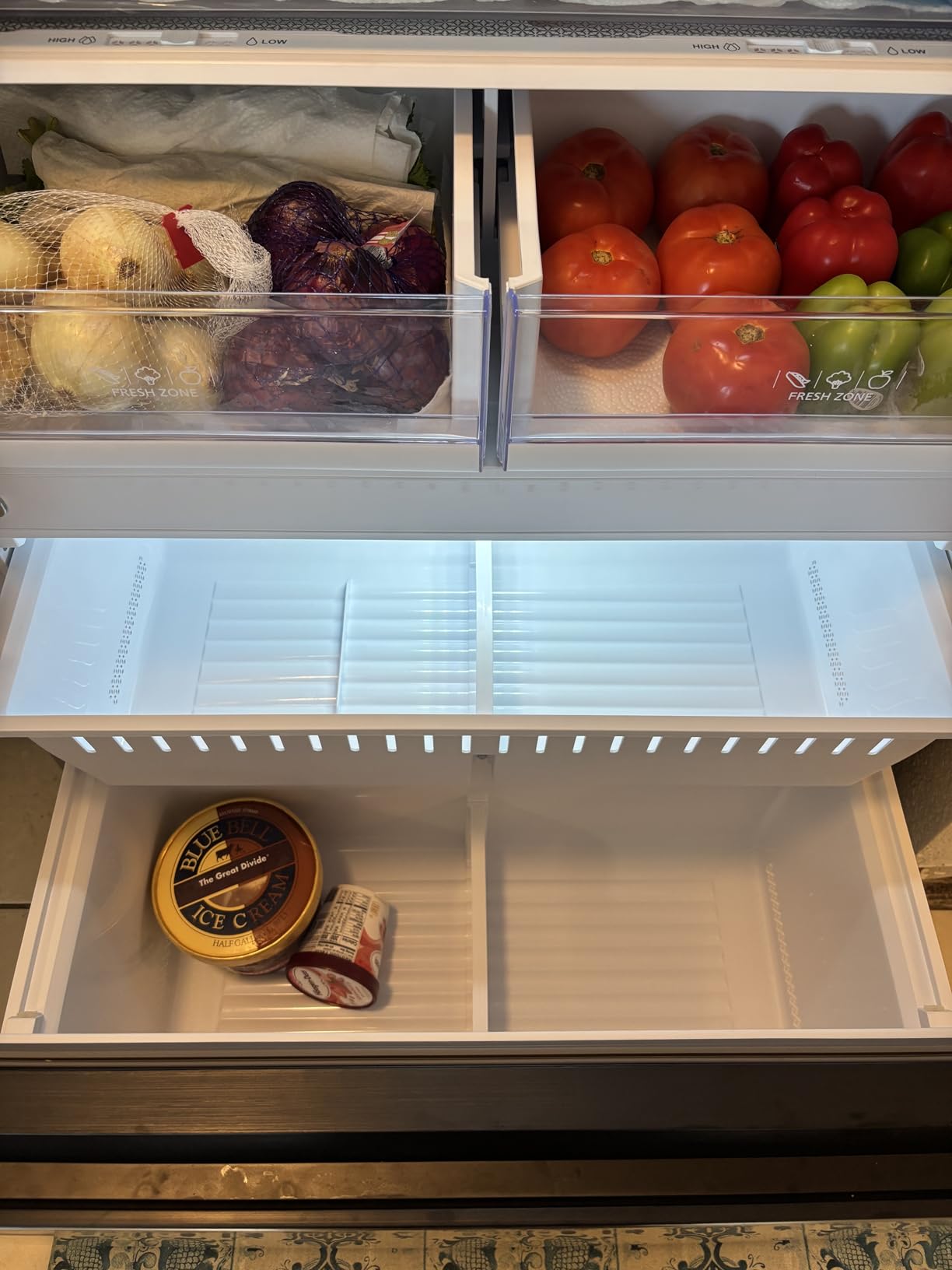
Spill-proof glass shelves and dedicated vegetable and fruit crisper bins make the interior easy to live with, and illuminated compartments matter more than they sound in an open room where there is no dimmer to reach for.
Energy use is 378 kWh per year, matching the smallest refrigerator in this list despite carrying more than twice the capacity. Low runtime is a quietness advantage in an open plan, and it is also the lowest operating cost here.
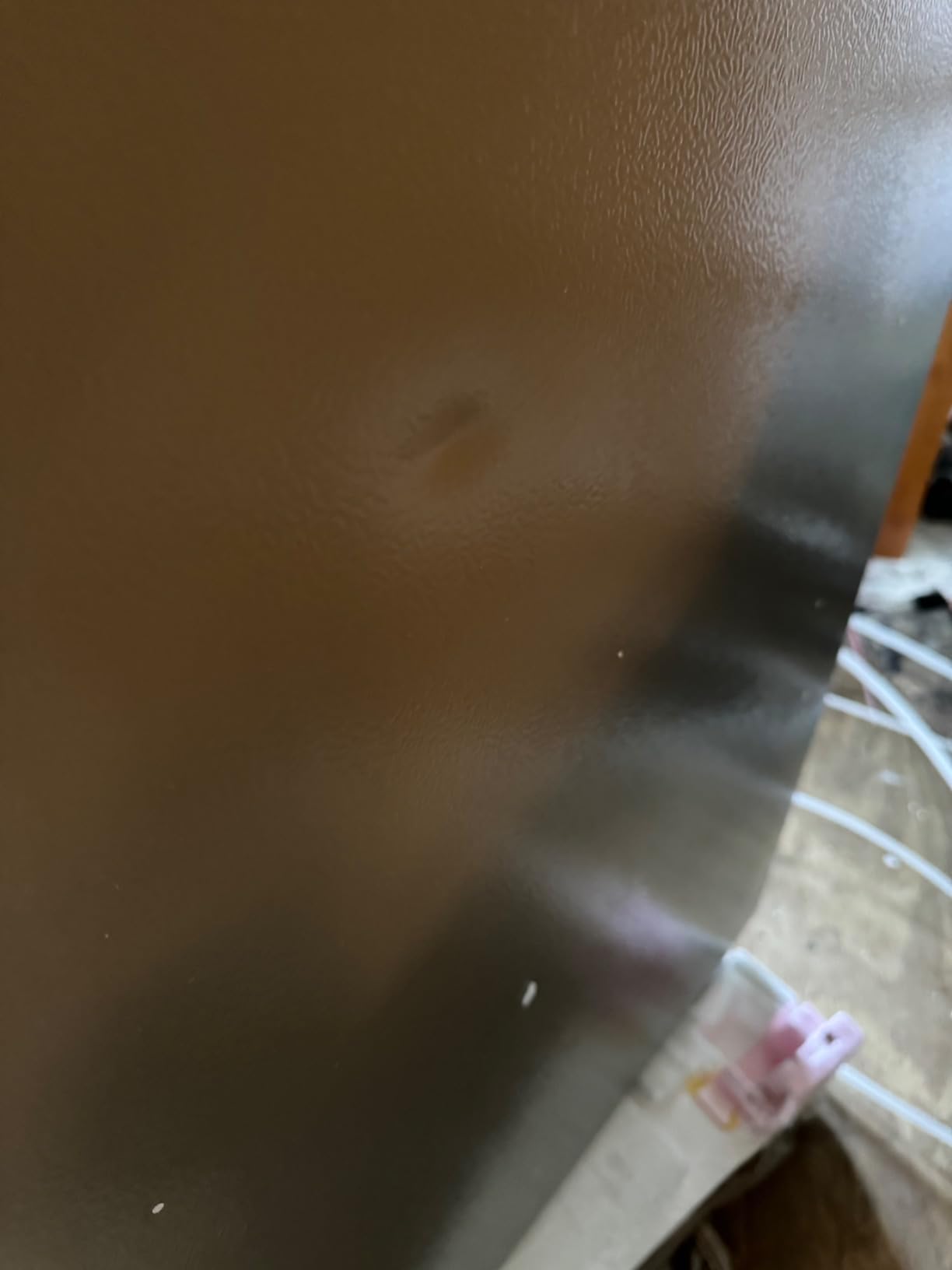
The unit does have a manual defrost mode, which is unusual on a French door of this size and worth confirming the details of with the dealer before purchase, because it affects how often the compressor runs.
What fits this model well
Pick this for a kitchen where the sightline across the room matters as much as the storage. A body under 30 inches deep stops projecting past the countertop, which is the difference between a fitted kitchen and an appliance sitting in it.
The 20.3 cu. ft. capacity is the largest here for a body this shallow, and at 378 kWh per year it combines that capacity with the lowest energy draw in the group.
What to know before you order
With only 17 ratings, this is the thinnest evidence base in the roundup and its 4.0 average should be read with that way. Cooling failures are reported, including refrigerators that would not go below 70F and would not hold cold.
Manufacturer support is described as difficult to reach when a defective unit needs resolving, and there is a one-year parts and labour warranty. If reliability history matters to you, the LG models with longer compressor coverage are the safer read.
How to Choose a Quiet Refrigerator for an Open Kitchen
What the decibel number means, and why brands cannot be compared directly
Decibels are logarithmic. Roughly every 10 dB is a doubling of perceived loudness, so a 5 dB gap between two refrigerators is not a small gap. It is the difference between something you consciously notice and something you only hear when the room goes silent.
The practical bands are straightforward. Under 35 dB is exceptionally quiet and barely perceptible from across an open room. Between 35 and 38 dB is very quiet and suits an open kitchen well. Between 39 and 45 dB, where much of the mainstream market sits, a hum becomes noticeable during quiet evening use.
Two different quantities get published under the same-looking number, and confusing them is the single biggest source of buyer error. A sound power figure describes what the appliance emits. A sound pressure figure describes what reaches a listener at a stated distance. A sound power figure in dB(A) re 1 pW is not directly comparable to a bare dB(A) figure on a retailer’s specification page.
On top of that, almost no maker states a condition. Whether the compressor was running at steady output, whether a defrost cycle was in progress, whether the ambient temperature was 20C or 32C, and at what distance the reading was taken, all change the number. Treat cross-brand decibel comparisons as indicative rather than precise, and treat them as decisive when they are within the same maker’s model range.
Finally, remember what the figure describes: a settled refrigerator. A quiet-spec fridge working hard after a large grocery shop, in a hot kitchen, at its minimum temperature setting, will be audibly louder than its specification suggests. The published number is the best case, not the average.
Fixed-speed, inverter and linear compressors
Refrigerator noise comes from three places: the compressor cycling on and off, the evaporator and condenser fans moving air, and the water valve and ice-drop cycle of an automatic ice maker. Modern designs attack all three, but the compressor is where the largest gains come from.
A fixed-speed compressor is binary. It runs at full output or it does not run at all, so you hear the start and you hear the stop. In a closed kitchen that is background noise. In an open room it is a periodic event that punctuates a conversation.
An inverter compressor varies its speed, slowing down for small temperature corrections and speeding up for recovery after a door opens. The result is a lower, steadier sound with fewer obvious transients. A linear compressor is a related design that moves through a smoother range rather than pulsing, and it is generally the quietest of the three.
Two of the models in this roundup use a digital inverter, two use a linear compressor, and two use a generic inverter drive. Where the data does not name a compressor type at all, treat the quietness claims on the listing as unverified and look for owner reports instead.
Fans matter as much as the compressor in the quiet periods between cycles. Brushless DC fan motors have no brushes to wear, which removes a squeak and a rattle source that older condenser fans developed with age. Multi-air flow systems duct air to multiple zones, which lets the fan run at a lower speed while still moving enough air.
The night-noise settings that decide how quiet the fridge is after dark
The compressor is rarely the loudest thing at night. The two loudest are the ice maker and the door alarm, and both are controllable on some models and not on others.
An automatic ice maker makes three distinct sounds: a water valve opening to fill the tray, a harvest mechanism releasing the cubes, and the cubes dropping into the bin. Each is a sharp transient that carries much further than a steady hum. On several models here the ice maker can be switched off entirely, which is the single highest-impact change you can make on delivery day.
Door alarms are the second problem. A fixed short delay means the alarm fires while you are still carrying groceries back from the car, and its tone is designed to cut through a loud kitchen. Models with an adjustable delay or a disable option solve this properly.
Three more settings are worth checking. Keypad tone on the control panel, because a fridge that beeps when you adjust the temperature is a fridge that beeps at 2 a.m. Display dimming or auto-off, which stops the control panel lighting up the wall behind an open-plan room. And Sabbath mode on the models that offer it, which suppresses lights, tones and motor movement for a defined window.
Make these changes during the first week, while you are still finding the appliance. Owners on the appliance forums described here report that the sounds they cannot silence, rather than the hum itself, are what finally decide whether a fridge lives in an open kitchen or gets replaced.
Counter-depth, built-in and fully integrated bodies
Counter-depth bodies sit close to the cabinet line. That is an appearance and a layout decision, not an automatic quietness one. A shallower cabinet usually means a smaller compressor and less insulation, which can cut both ways, and the same model number sold at two depths will not have the same acoustics.
Built-in units are set into cabinetry with a surround. Fully integrated units add matching panels so the refrigerator disappears into the run. The acoustic effect comes mainly from what happens to the ventilation: a tight cavity restricts airflow, which forces the compressor to run longer and work harder, which makes the unit louder, not quieter.
So the flush look is a visual win that can cost you acoustically if the installation does not respect the specified ventilation cross-section. Two of the models here are described as built-in or built-in-look, and in both cases the manufacturer’s clearance requirements matter more than the cabinet finish.
Distance does part of the work for you in an open plan. Sound falls off with distance, so a refrigerator tucked into a far corner of a large room is acoustically a different appliance from one standing at the end of an island. Where you place the unit is an acoustic decision as much as a work-flow one.
Reading an unrated mainstream fridge without a decibel figure
Most large US manufacturers do not publish a per-model decibel figure for their refrigerators. That is a documentation gap, not evidence that their fridges are loud. It means you have to reason from proxies.
The first proxy is compressor type. Linear and digital inverter drives are the quiet mechanism, and any model listing one is starting from a better position than a fixed-speed unit. The second is energy consumption, because annual kilowatt hours are a proxy for runtime, and runtime is the raw material of exposed sound.
The third proxy is owner consensus, and this is where review volume matters. A model with 165 ratings that consistently describe it as inaudible tells you more than a model with 20 glowing reviews. The Frigidaire in this roundup has almost 2,300 ratings and the Hamilton Beach has 17, and that difference is more informative about your risk than any specification on the listing.
Owners also tell you which component is loud, which is the information the spec sheet never will. Reports that the ice maker cycles audibly, or that the compressor hums continuously rather than cycling quietly, are far more actionable than a marketing adjective.
Energy use, warranty length and where a quiet fridge is actually sold
Energy consumption ranges from 378 to 665 kWh per year across these ten models. A quiet refrigerator is not inherently a thirsty one, and several of the quietest owner-reported units are also among the most efficient here. A compressor that runs fewer hours has fewer hours to be heard.
The efficiency figure also works as a running-cost offset against a higher purchase price, and it is the one number a buyer can calculate directly. Compare annual kilowatt hours between the shortlist and the unit you are replacing, then apply your own utility rate. Over a ten-year life, the gap between 378 and 665 kWh per year is meaningful money as well as meaningful sound.
Warranty length is the hidden cost of the premium quiet category. The two LG models here carry compressor parts coverage of 10 years, while several others carry one year on parts and labour. On an appliance expected to last a decade or more, that difference belongs in your decision.
One more practical point: full-size refrigerators are sold mainly through appliance dealers and big-box retailers rather than through general marketplaces, and the brands with the lowest published figures are mostly European-platform models with limited service networks in some regions. Check that a technician can reach your area before you commit to an imported or niche brand, because an unserviced quiet compressor eventually becomes a very loud one.
Two related guides may help with the rest of the room. Our bedroom dehumifier picks cover the other appliance that gets switched on at night, and our office humidifier guide is useful if your kitchen shares a room with a home office you work in.
Frequently Asked Questions
What is considered a quiet decibel level for a refrigerator?
Under 35 dB is exceptionally quiet and barely perceptible from across an open room. Between 35 and 38 dB is very quiet and works well in an open kitchen. Between 39 and 45 dB, where much of the mainstream market sits, a continuous hum becomes noticeable during quiet evening and night-time use. Judge a figure mainly against the condition its maker attached to it, because published numbers are not comparable across brands.
What is the quietest refrigerator on the market today?
The quietest full-size refrigerators use speed-controlled, inverter or linear compressors with brushless fans and heavy acoustic insulation, and the very quiet band starts under 35 dB. In this roundup the most substantiated quiet option is the KoolMore 18.5 cu. ft. counter-depth French door, whose owners report an inaudible inverter compressor in open-concept rooms. Only one model here publishes a decibel figure at all.
Which refrigerator is the quietest according to Consumer Reports?
Consumer Reports measures refrigerator noise in its own lab and rates it, but it does not publish per-model decibel figures publicly. So the ranking is available and the numbers are not. For a specific model, go to the manufacturer’s specification sheet first, then check whether the figure is sound power in dB(A) re 1 pW or a bare sound pressure figure, because only figures of the same type can be compared.
Are quiet refrigerators more expensive?
Generally yes, but less than most buyers expect. The lowest published figures skew toward smaller-capacity European-platform models, while several mainstream counter-depth French doors from LG, GE, Samsung and BLACK+DECKER are reported as very quiet without publishing a figure. Energy use also narrows the gap: the models here range from 378 to 665 kWh per year, so a quieter purchase does not have to mean a higher running cost.
Do inverter compressors make refrigerators quieter?
Yes, and it is the single biggest mechanical gain available. A fixed-speed compressor runs at full output or not at all, so you hear it start and stop. An inverter varies its speed, ramping down for small corrections and up for recovery, which produces a lower and steadier sound with fewer obvious transients. Linear compressors are the related and generally quietest design, and they are also the best covered by warranty.
Is there a completely silent refrigerator available?
Not a full-size one. Absorption and thermoelectric models have no conventional compressor running continuously and are genuinely the quietest cooling technology available, but they cost a great deal of capacity and, in the case of thermoelectric units, real cooling performance. For a household primary refrigerator, the realistic goal is a compressor you stop noticing, plus ice maker and door alarms you can switch off.
Which fridge makes the least noise?
Among the models reviewed here, the ones with the strongest owner-reported quietness are the KoolMore 18.5 cu. ft. counter-depth French door and the BLACK+DECKER 18 cu. ft. French door, both of which use inverter compressors and are described as inaudible in open rooms. The Upstreman BM71 is the only model in the group that publishes a figure, at 39 dB, and its owners also describe it as inaudible.
What refrigerator brand should you avoid for noise?
There is no brand to blacklist, but there is a pattern worth avoiding. Be cautious of any model whose listing makes a quietness claim without naming a compressor type, without an energy figure, and with only a handful of ratings. Also weigh appliances where the ice maker cannot be switched off or the door alarm has a fixed short delay, because those audible events, not the compressor, are what most people actually complain about.
The Quiet Refrigerator Shortlist for 2026, Final Word
If you want one default answer for an open kitchen, it is the KoolMore 18.5 cu. ft. counter-depth French door. It pairs an inverter compressor that owners describe as inaudible with a 465 kWh per year consumption figure and a body that sits nearly flush with a standard counter run.
If your evidence threshold is higher than owner reports, take the BLACK+DECKER 18 cu. ft. French door instead, where 165 ratings consistently describe the same quiet sound profile. If the fridge is a second zone rather than a primary one, the Frigidaire 7.5 cu. ft. two-door has the largest owner record in the whole roundup.
Whichever you choose, set the ice maker and door alarm on delivery day, level the unit properly, and keep it clear of cabinetry on the sides. Those four steps do more for an open-plan kitchen than a few decibels of specification difference, and they cost nothing.
We have not measured any of these refrigerators ourselves, and every sound figure quoted here is a manufacturer’s published number. Before delivery, ask the dealer two things: whether the ice maker can be disabled on a schedule, and whether the door alarm delay is adjustable.