
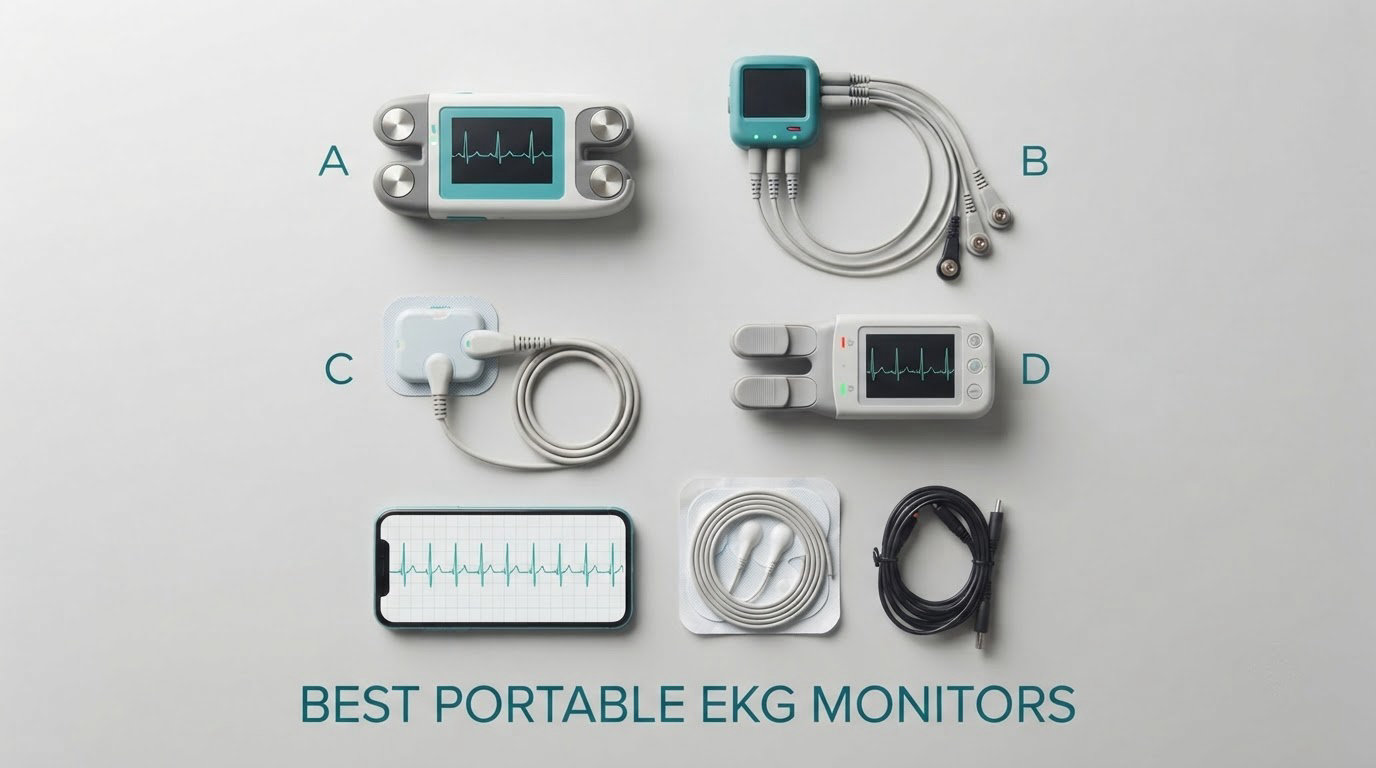
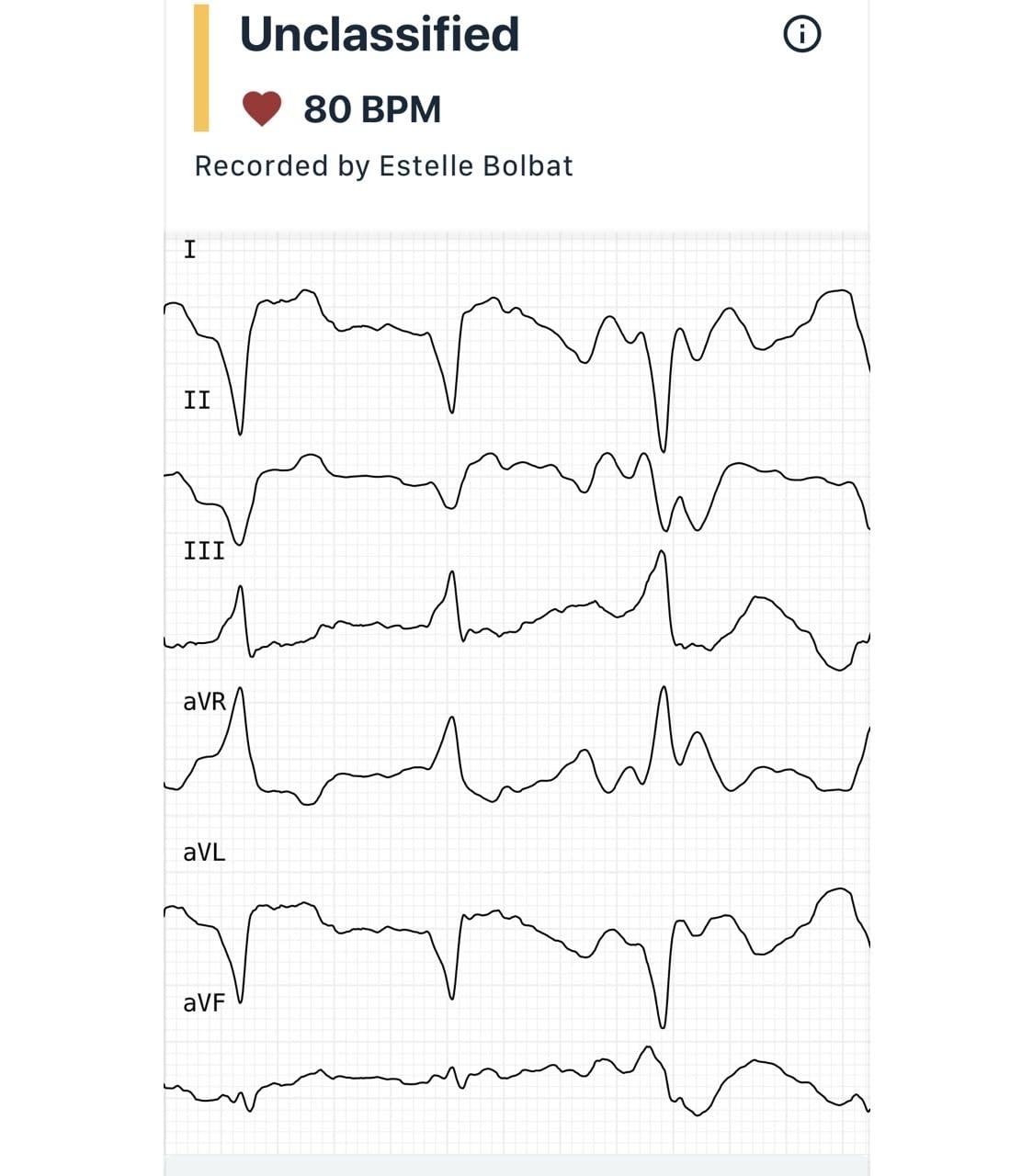
The most common complaint about portable EKG monitors is not accuracy. It is that people record a beautiful, clean trace at two in the morning, get an “AFib detected” label, and then have no way to work out what it means. One r/AFIB user told us the spot-check format is understood and accepted, yet still resented, because every reading has to be user-initiated and no clinician is awake to read it.
That gap between recording and interpretation is what shapes this roundup of the best portable EKG monitors available now. We picked seven devices that publish real rhythm detections, weighed their lead counts, recording length, battery claims and export options against each other, and flagged exactly where a subscription, a phone or a clinician is still required. A quick note on spelling: EKG and ECG are the same test, and manufacturers mix both freely.
We also kept in view the practical constraints that decide most purchases. A clinician on r/POTS described Kardia as the unit their doctor recommended, and physician endorsement is the strongest purchase trigger in this category. On the other hand, that same category of buyer has to live with the fact that no consumer device records continuously, and if your goal is overnight capture, our guide to portable monitors for travel and work covers which devices actually run unattended.
How we chose: every device below measures ECG, publishes FDA clearance or an equivalent regulatory status where one exists, and has enough owner feedback to judge. We compared published specifications, cross-checked claims against owner reviews, and prioritised units where the trace can be exported in a format a cardiology practice will actually open.
Medical disclaimer: this article is for general information and is not medical advice. A portable EKG is a screening tool, not a diagnostic device. If you have chest pain, shortness of breath, fainting or any acute symptom, call emergency services rather than taking a reading.
Table of Contents
Top 3 Picks: Best Portable EKG Monitors (October 2026)
The three devices below are the strongest starting points, whether you are buying your first home monitor or upgrading from a smartwatch. Each one is expanded later in the article.

KardiaMobile 1-Lead EKG
- 30-second 1-lead EKG
- Detects AFib
- bradycardia
- tachycardia
- No membership for core readings
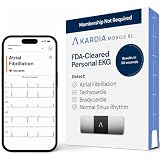
KardiaMobile 6L
- Six leads with FDA-cleared rhythm results
- No subscription required
- 24 g pocket unit

Withings BeamO
- ECG plus contactless thermometer
- Digital stethoscope
- Optional 24-hour cardiologist review
All 7 Portable EKG Monitors at a Glance in 2026
Every device in this list records real electrical rhythm data rather than optical pulse estimates, which is the single biggest quality divide in the category. The table below puts the key differences side by side before the individual reviews.
| Product | Specifications | Action |
|---|---|---|
| KardiaMobile 1-Lead EKG |
|
Check Latest Price |
| KardiaMobile 6L |
|
Check Latest Price |
| Withings BeamO |
|
Check Latest Price |
 OMRON Complete OMRON Complete |
|
Check Latest Price |
 EMAY 6L EMAY 6L |
|
Check Latest Price |
 Eko CORE 500 Eko CORE 500 |
|
Check Latest Price |
 KardiaMobile 6L Max KardiaMobile 6L Max |
|
Check Latest Price |
1. KardiaMobile 1-Lead EKG Monitor – The Default First Pick
KardiaMobile 1-Lead EKG Monitor, Medical-Grade FDA-Cleared Personal Heart Monitor, Detects Normal, AFib & Arrhythmias, 30 Second Results, Works with Most Smartphones, HSA&FSA Eligible
30-second 1-lead EKG
FDA cleared for four rhythms
CR2016 battery
0.02 kg pocket unit
Pros
- 30-second single-lead medical-grade recording
- Detects AFib and the three other common rhythms
- Core readings work with no membership at all
- Weighs 0.02 kg and measures 3.28 by 1.25 inches
- No Bluetooth or cables needed
Cons
- Single lead gives less detail than multi-lead units
- Not tested or recommended for pacemaker and ICD users
- Extra arrhythmia types and doctor reviews sit behind a membership
With 83,360 owner reviews behind it, the KardiaMobile 1-Lead is the device most people will end up holding first, and for a simple reason: it does the one thing a home screening tool should do without asking for a credit card. You sit down, hold the two electrodes, and thirty seconds later the app returns a rhythm label. Owners consistently single out three things: the speed, the pocket size, and the fact that no membership is required for basic readings.
That last point matters more than the spec sheet suggests. Several rivals in this category gate their core detections behind a membership, which means the device is close to useless on day one without a payment. This one runs its four FDA-cleared detections, atrial fibrillation, tachycardia, bradycardia and normal sinus rhythm, straight out of the box.
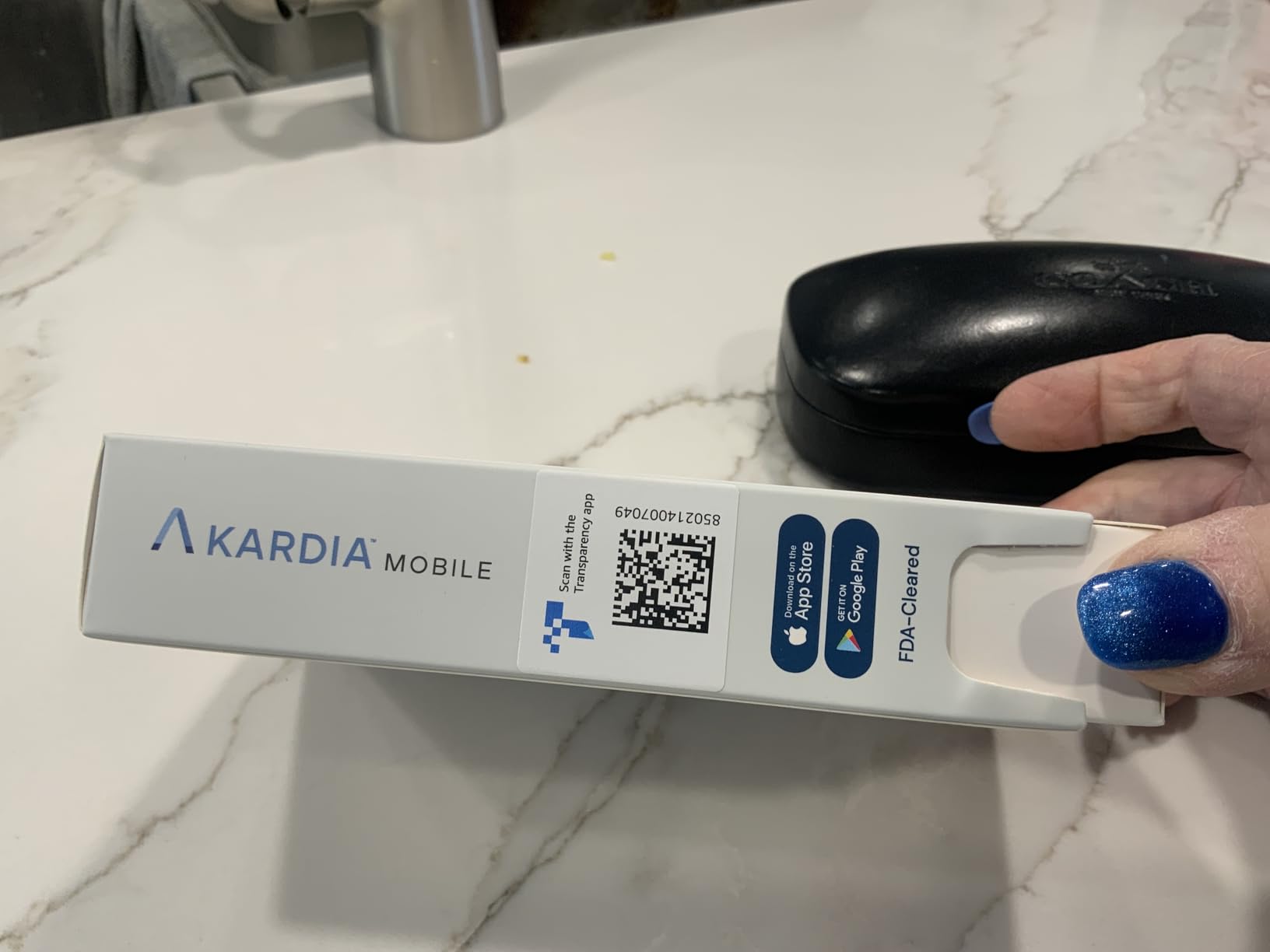
The physical design is genuinely pocketable. At 0.02 kg and 3.28 by 1.25 inches with a 0.2 inch profile, it disappears into a jeans pocket, and the CR2016 coin cell is rated to last up to two years at two to three EKGs a day. There is no charging routine to forget, which matters for anyone who travels regularly.
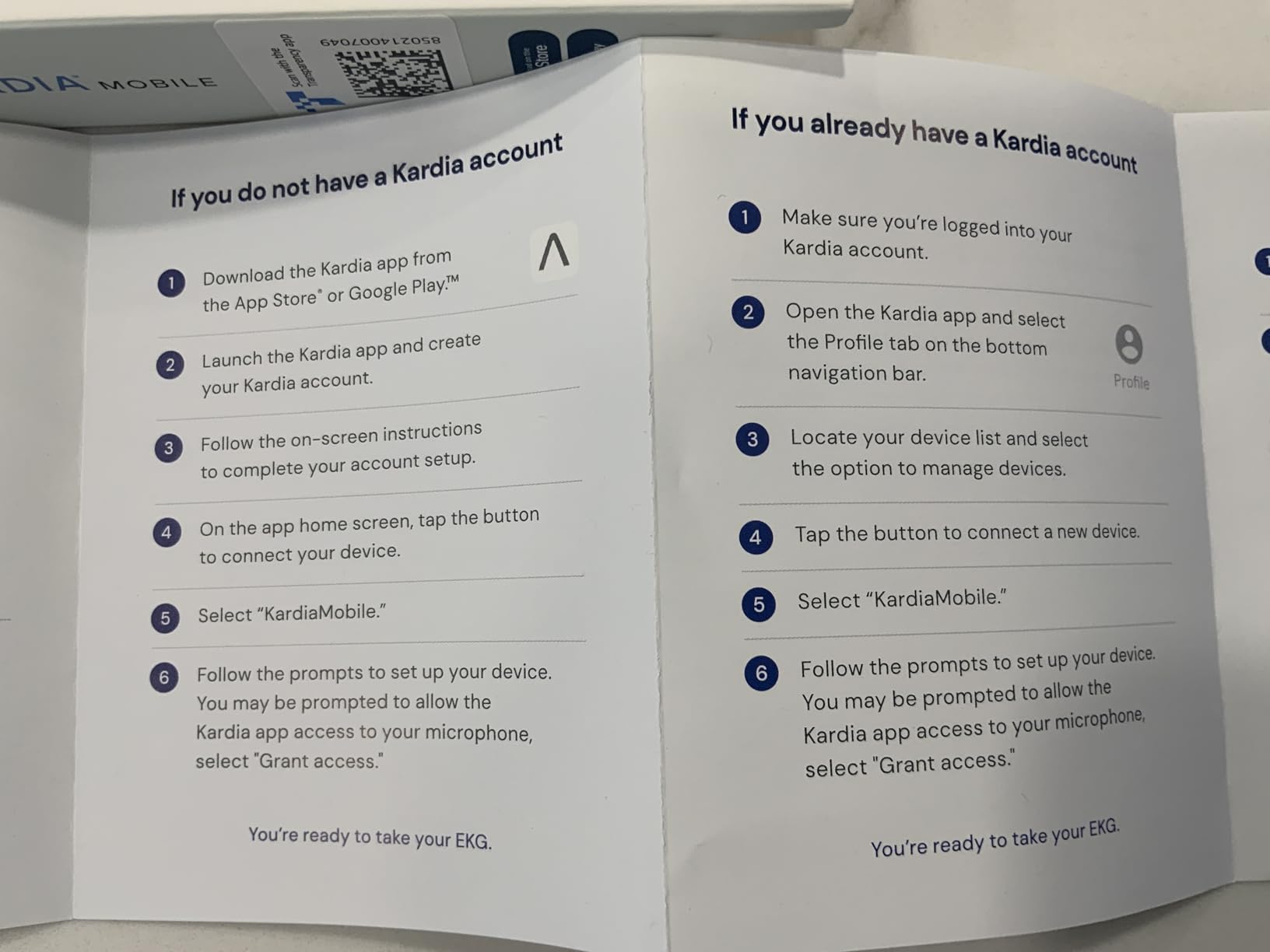
It also works without Bluetooth. The device does not pair with the phone; you start a reading in the Kardia app and hold the unit near it. Older owners with older handsets describe this as a relief, since it sidesteps pairing failures entirely.
When one lead is enough and when it is not
One lead is enough for rhythm screening, and that is genuinely the question most home users are asking. A single limb lead can tell you whether the rhythm is irregular, fast or slow, and that is what catches atrial fibrillation between appointments. For that job, reviewers report consistent results once the technique is right.
One lead is not enough for anything structural. You cannot assess axis deviation, chamber enlargement or ischaemic change from a single trace, and no manufacturer claims you can. If your doctor asked for rhythm evidence specifically, this device answers that question and stops there.
What the app does and does not give you
The free tier gives you the four rhythm determinations, a waveform you can email, and unlimited recordings. What it does not give you without a membership is the wider arrhythmia list, including premature ventricular contractions and supraventricular ectopy, or a clinician review of the trace.
Owners who paid for the membership generally describe it as worthwhile if a family member has a diagnosed rhythm condition, and as poor value for pure peace of mind. Buyers who mainly want a monthly check-in rarely report needing it, and the core device handles that job on its own.
2. KardiaMobile 6L EKG – Best Six Leads Without a Membership
KardiaMobile 6L EKG, No Membership Required, Unlimited Recordings, HSA/FSA
Six-lead EKG in 30 seconds
FDA-cleared rhythm results
CR2016, 200 hour life
24 g, 3.54 inch long
Pros
- Records a medical-grade six-lead EKG in 30 seconds
- Six leads give a far more detailed view of the heart
- No subscription required for any core rhythm result
- Works with most smartphones and tablets
- World's first FDA-cleared six-lead personal EKG
Cons
- Six-lead recording needs a leg contact as well as the fingers
- Not tested or recommended for pacemaker and ICD users
- Does not check for heart attack
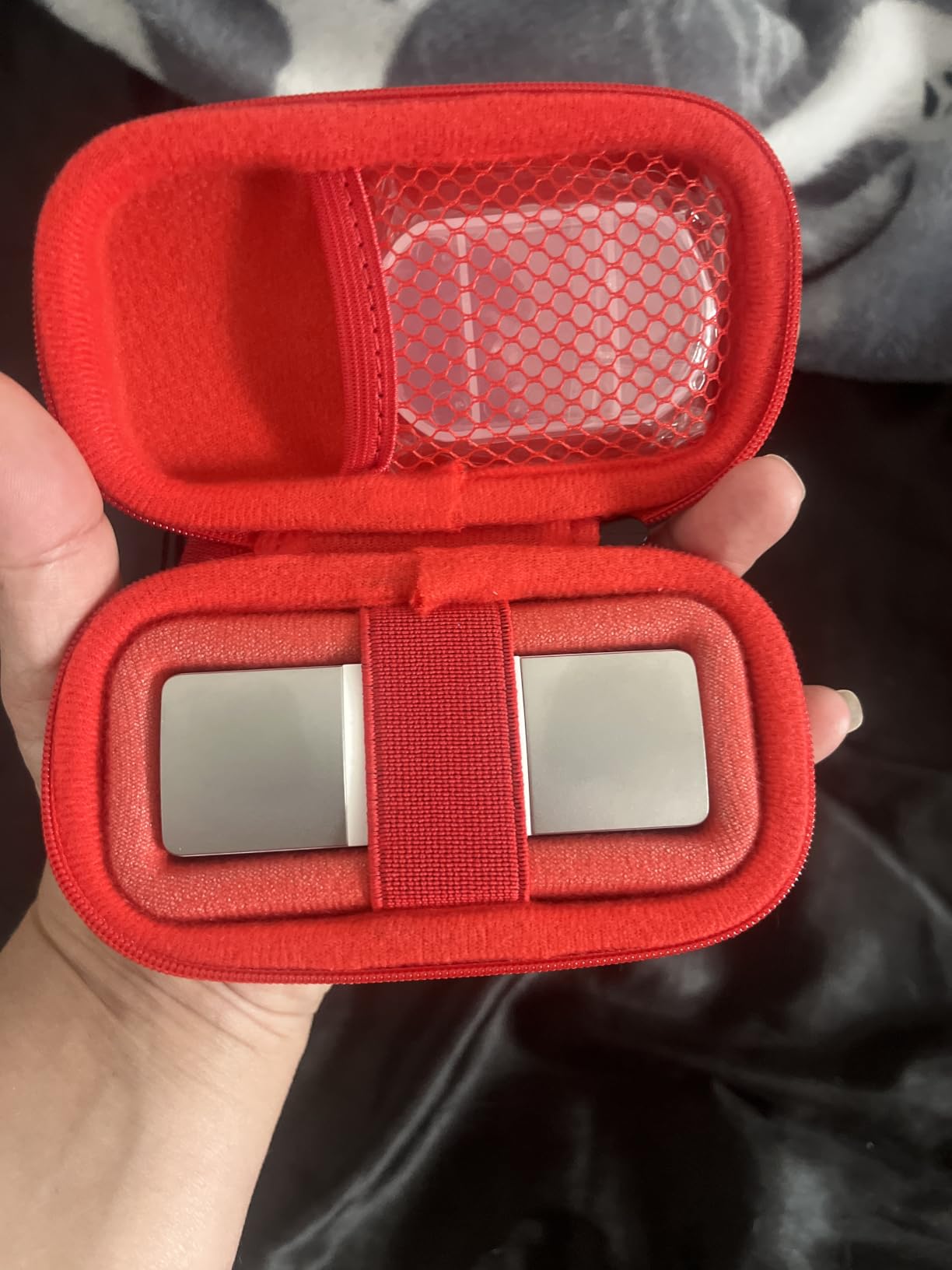
This is the pick we send people who ask whether the extra leads are worth learning a slightly awkward grip for. The KardiaMobile 6L records six limb leads in thirty seconds and returns FDA-cleared rhythm determinations without asking for a membership, which is unusual in this category. At 24 g and 3.54 by 1.18 inches it is barely larger than the single-lead unit.
Owners highlight the extra diagnostic detail first, then the ability to email a full EKG straight to a doctor. That second point is the real upgrade over the one-lead version: a six-lead trace is a more useful artefact in a cardiology inbox, where a single lead is often treated as a screening footnote.
The trade-off is technique. Recording six leads means placing the top electrodes on your fingers and the bottom contact on your leg or knee, then holding a still position for the full thirty seconds. Reviewers describe this as taking practice rather than as a dealbreaker, and most report the awkwardness fading within a few attempts.
Battery is a CR2016 coin cell rated at 200 hours of operation, so there is no charging cable to pack. The unit works with most smartphones and tablets through the Kardia app, and no Wi-Fi or computer is involved at any point.
How much extra can six leads actually see
Six limb leads view the heart from six angles around the vertical axis, which gives a clearer picture of how the four chambers are sequencing. In practice that means better visibility of axis, of extra beats and of the difference between rhythms that look identical on one lead.
It still does not make the device a hospital machine. Without a chest reference, you are not looking at the standard twelve leads a clinical ECG uses, and the manufacturer is clear that the device does not check for heart attack. It remains a rhythm tool with more information in it, not a diagnostic ECG.
Who should choose this over the single-lead model
Choose the 6L if you have a diagnosed rhythm condition, if you are preparing for a cardiology appointment where more data helps, or if your doctor has specifically asked for a multi-lead trace. Owners tracking an existing condition tend to become repeat users of this model for exactly that reason.
Stay with the single-lead version if you want the simplest possible object in your pocket and plan to take a reading occasionally. The extra detail only pays for itself if somebody is going to read the resulting trace, and for a casual user nobody may be.
3. Withings BeamO – Best for All-in-One Family Checkups
WITHINGS BeamO – Contactless Smart Thermometer, ECG Monitor, Stethoscope
1-lead ECG plus thermometer
Digital stethoscope
30-second response time
Wi-Fi, rechargeable, 0.08 kg
Pros
- Combines contactless temperature and a digital stethoscope with a 1-lead ECG
- Full ECG reading in 30 seconds with optional 24-hour cardiologist review
- Shareable respiratory and heart data through Health Link
- Compact and app-connected for home or travel
Cons
- Single-lead ECG only
- Extended interpretation and clinician review are paid upgrades
- Wider scope than a single-purpose pocket EKG monitor
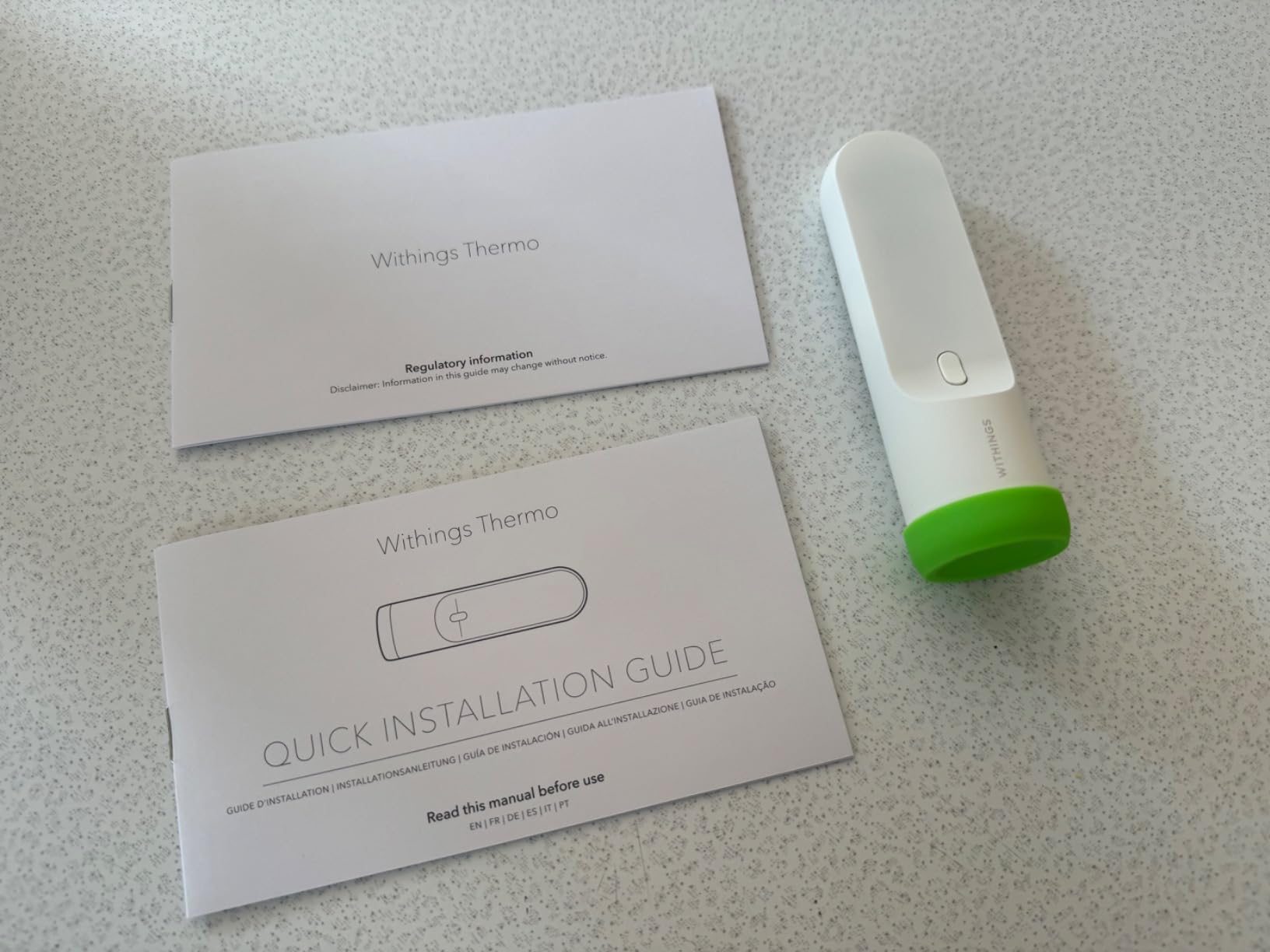
The BeamO answers a different question from the other devices here. Rather than a pocket EKG, it is a handheld check-up tool that measures contactless temperature, records heart and lung sounds digitally and captures a one-lead ECG with a 30-second response time. Buyers like the idea of one object covering a whole family check, and the respiratory recording is the feature most often mentioned in reviews.
On the heart side specifically it stays modest. One lead, thirty seconds, and the same rhythm classification job the single-lead Kardia does. If atrial fibrillation screening is your primary reason for buying, this is not where the extra spend goes.
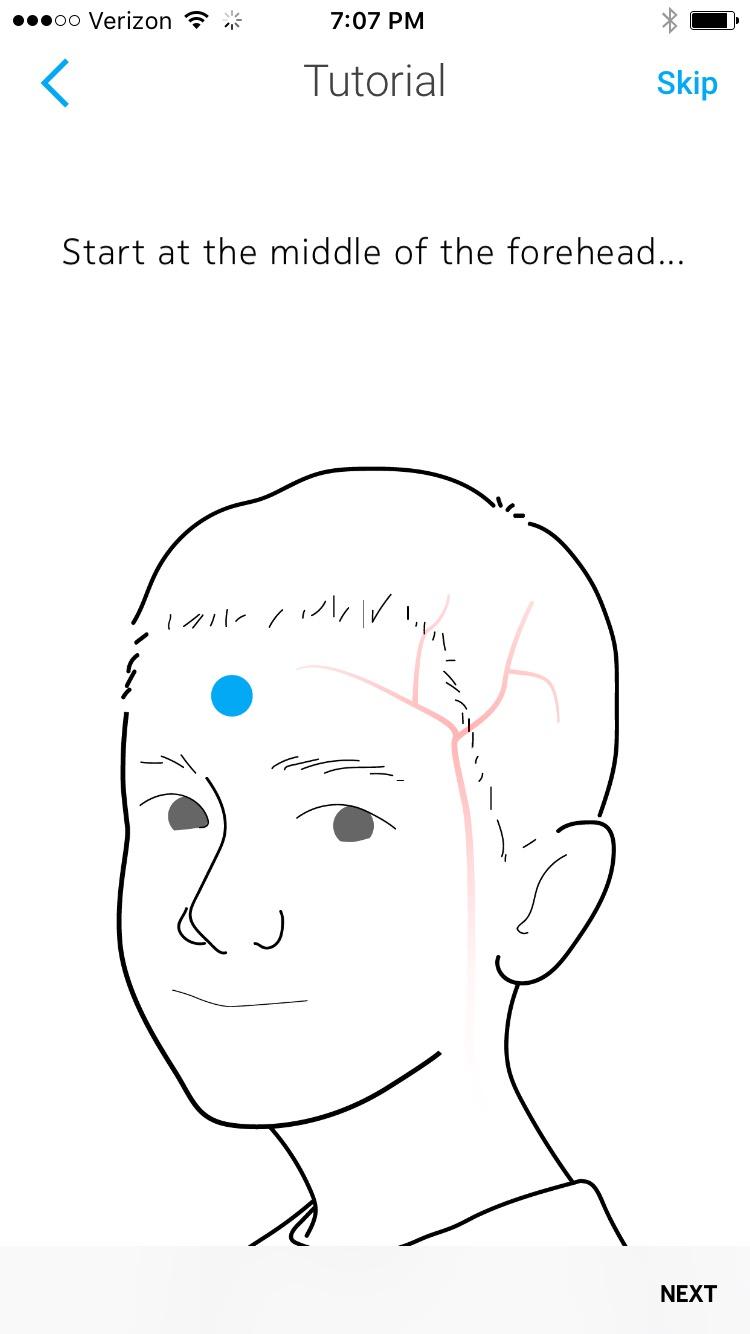
Shareability is the differentiator. Health Link packages respiratory and heart recordings into something you can hand to a clinician, and Wi-Fi connectivity means no phone pairing ritual. The 0.08 kg body and rechargeable battery suit a device that lives in a hallway drawer rather than a wallet.
The catch is tiered. The basic ECG and stethoscope functions are included, while extended interpretation and the optional cardiologist review within 24 hours sit behind a paid upgrade. Owners accept that trade because they are buying the broader kit, not the ECG alone.
When a multi-function device earns its place
A combined unit earns its place when you would otherwise buy three separate objects. Families managing fevers, chest symptoms and palpitations in the same week get real value from a single charge and a single app, and travellers who want one device instead of a bag of gadgets benefit most.
It is a poor fit for someone who only needs rhythm screening. A specialist tool at that point costs less, lasts longer on a coin cell and produces a trace that reads more cleanly. The wider feature set only helps if you will actually use it.
How the ECG compares with a dedicated monitor
Functionally the ECG sits at the entry level: one lead, thirty seconds, a rhythm label. There is no multi-lead view, so it cannot give a cardiologist the richer trace that the six-lead units produce.
Where it beats a dedicated monitor is convenience at the moment of a symptom. You can take a temperature, listen to your lungs and record a rhythm in a single minute without swapping devices, which is exactly the scenario where people abandon a dedicated unit.
4. OMRON Complete 2-in-1 – Best for Blood Pressure Alongside EKG
OMRON Complete 2-in-1 Blood Pressure Monitor + EKG for Home Use
Blood pressure plus 2-pad EKG
Stores up to 90 readings
Bluetooth app sync
1.21 lb, AA powered
Pros
- Combines upper arm blood pressure with a two-pad EKG
- Stores up to 90 readings and syncs unlimited readings to a free app
- Bluetooth syncing described as reliable after the initial pairing
- Cuff fits arms from 9 to 17 inches
- Body Movement Detection improves blood pressure accuracy
Cons
- Single user only
- so household readings can be mixed together
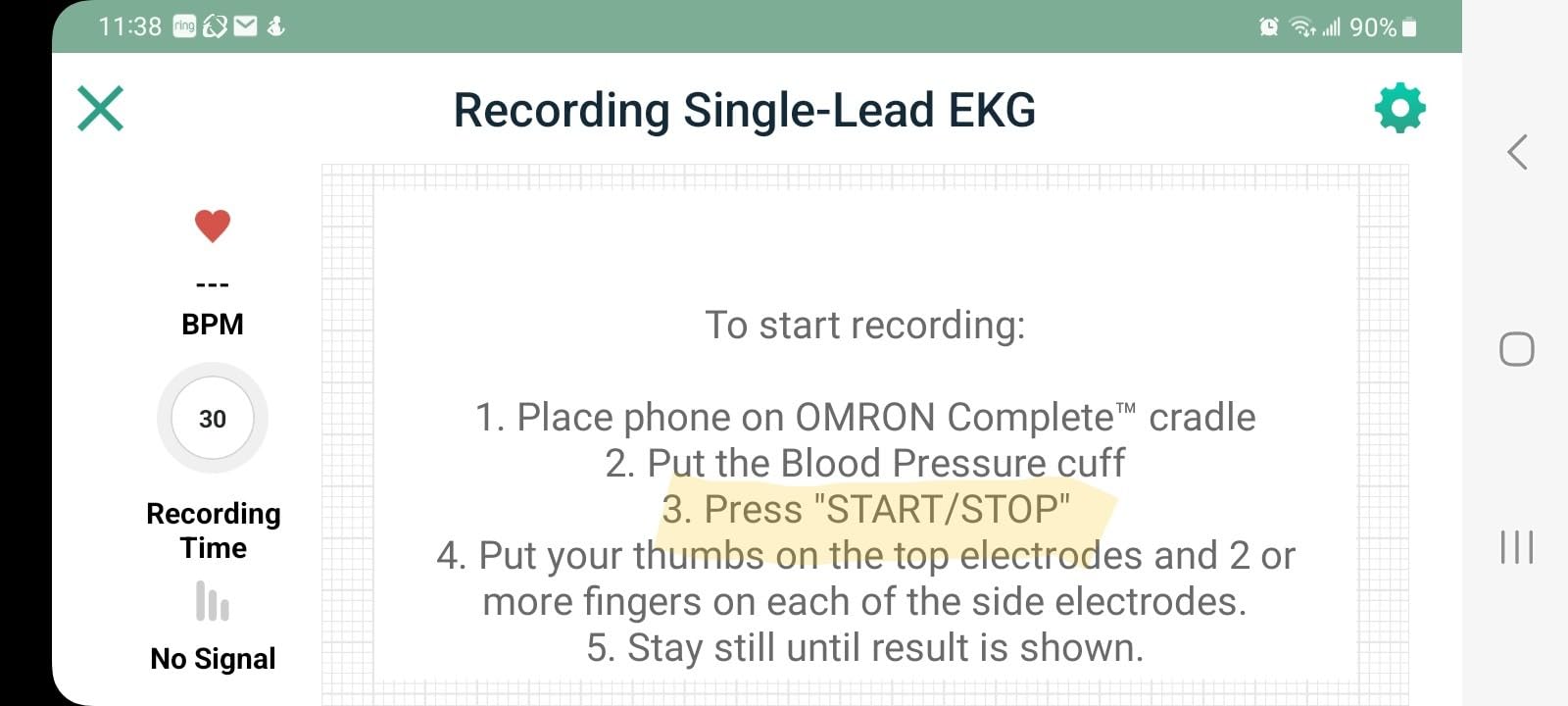
- EKG transmits by sound and needs the phone seated in the cradle
- Instructions and setup illustrations described as unclear
Hypertension is the condition most often tracked alongside a rhythm concern, and the OMRON Complete measures both in one unit. It is a full upper arm blood pressure monitor with a wide-range D-ring cuff for arms from 9 to 17 inches, and the two-pad EKG reads a rhythm in the same sitting. At 1.21 lb it is a countertop device rather than a pocket one.
Where it earns its place is data volume. It stores up to 90 readings on the device itself and syncs unlimited readings to the free OMRON connect app, with Apple Health and Google Fit compatibility. Reviewers appreciate that the app is free, which separates it from several subscription-gated devices in this roundup.
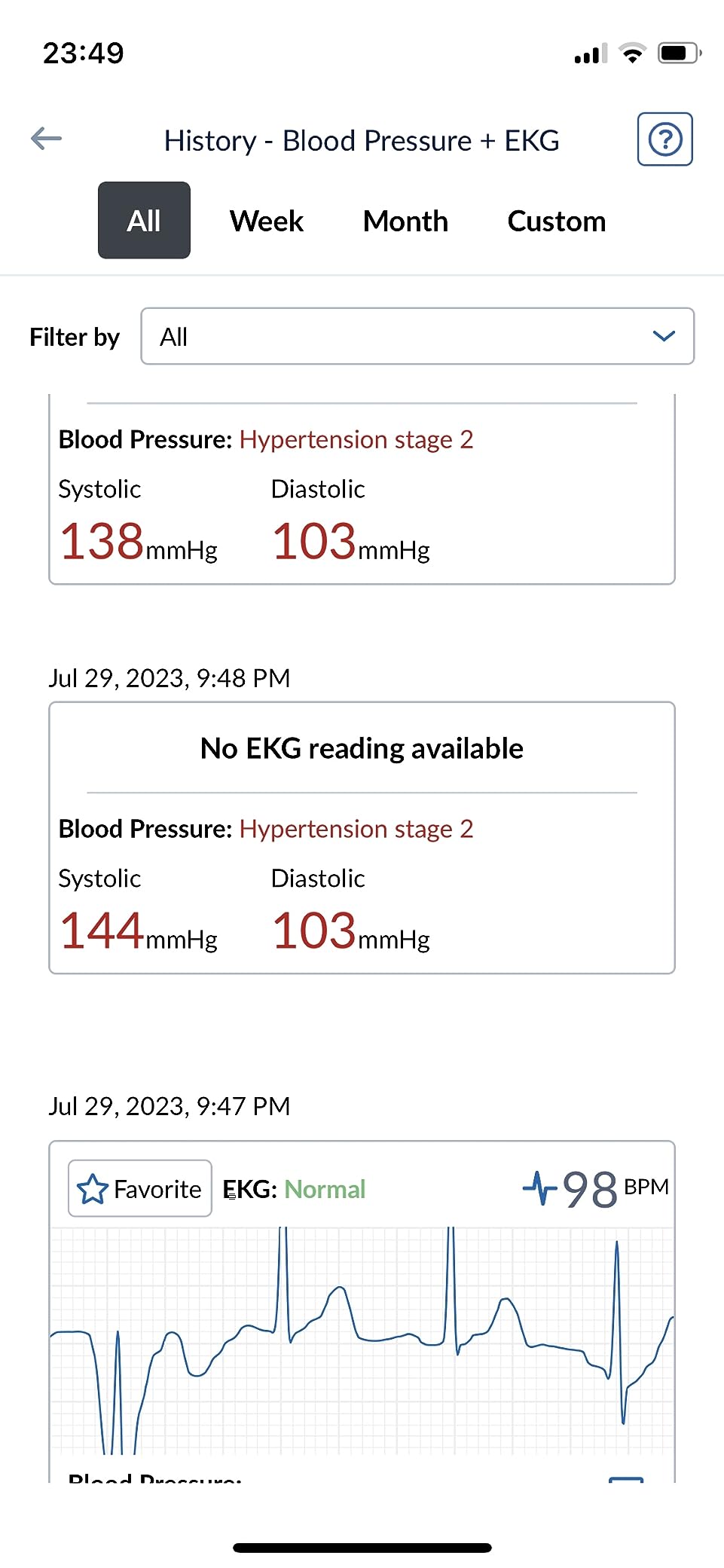
Blood pressure accuracy is the strongest part of the package. Body Movement Detection alerts you when your arm moves during a measurement, and owners consistently report dependable numbers. Four AA batteries are included, so the unit is ready to use out of the box.
The EKG side is the compromise. Signal travels by sound, so the phone has to sit in the unit’s holder with Bluetooth and microphone access, sometimes after removing the case. Reviewers also mention manually switching NFC off on the phone to run the test, which is a real friction point for less technical users.
Why a two-user household needs to think twice
The single-user limitation is the reason we place this fourth. There is no guest mode, so readings from two people in the same home land in one account, and reviewers report no clean way to separate them. For a couple or a multi-generational household that regularly checks blood pressure, that is a daily annoyance.
The phone-in-the-holder requirement compounds it. Unlike a fingertip device you can use anywhere, this one only runs the EKG test with the phone seated in the right position, so it works best at a kitchen table rather than in a queue at a pharmacy.
When combined monitoring is the right call
Combined monitoring is right when a doctor has asked you to track both numbers, particularly after a medication change. Two devices on two schedules is harder to keep up with than one, and the OMRON sync removes the manual transcription step entirely.
It is the wrong call when your interest is purely rhythm. The two-pad EKG gives a thinner trace than a dedicated multi-lead unit, and the feature that makes the device heavy, the blood pressure cuff, is one you may rarely use. Choose the cuff you need rather than the kit you can justify.
5. EMAY 6L – Best Six Leads With No Paywall
EMAY 6L Portable ECG Monitor | Record ECG and Heart Rate in 6 Channels | Compatible with Smartphone and PC | No Subscription Required
6 limb leads on device screen
2.4 inch display
No subscription
Bluetooth and USB
85 g
Pros
- Highest-rated device in the group at 4.6
- True six-lead ECG shown on the device itself
- No subscription or hidden cost for app and PC software
- Shows heart rate and PVCs on screen
- PDF reports with multi-user profiles
Cons
- Not a diagnostic-grade ECG
- with P waves and PR segments hard to read
- On-board interpretation can miss real abnormalities
- Carry case not included
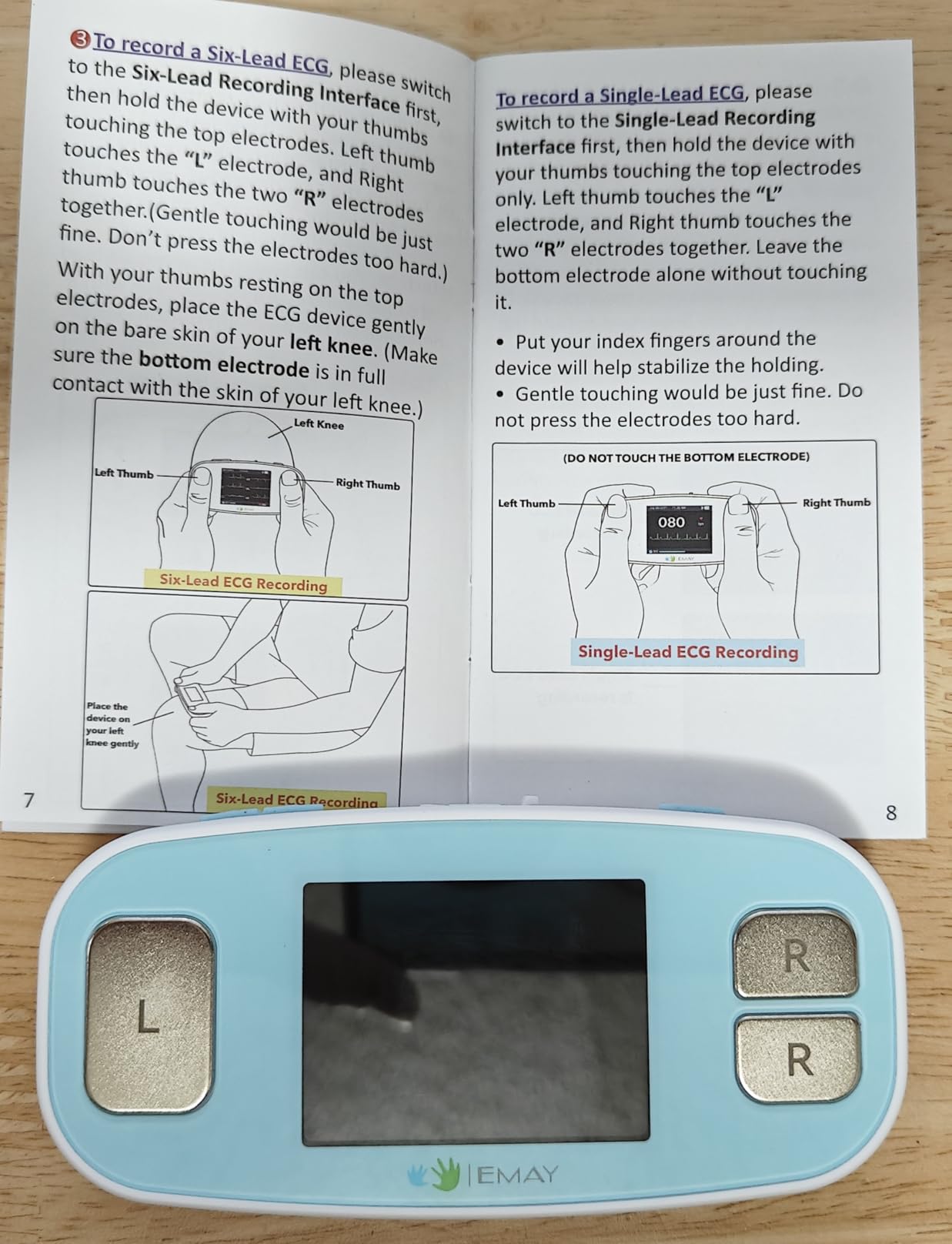
The EMAY 6L posts the highest rating in this roundup at 4.6 across 1,446 reviews, and the reason is specific rather than general. It records six limb leads, I, II, III, aVR, aVL and aVF, across three electrodes, and shows the tracing on its own 2.4 inch screen. You can take a complete six-lead reading without a phone anywhere in the room.
There is also no paywall. The full mobile and PC software, including sample mode, upload, case review and measurement, comes with the device, and owners repeatedly single out the absence of hidden cost as the reason they recommend it to family.
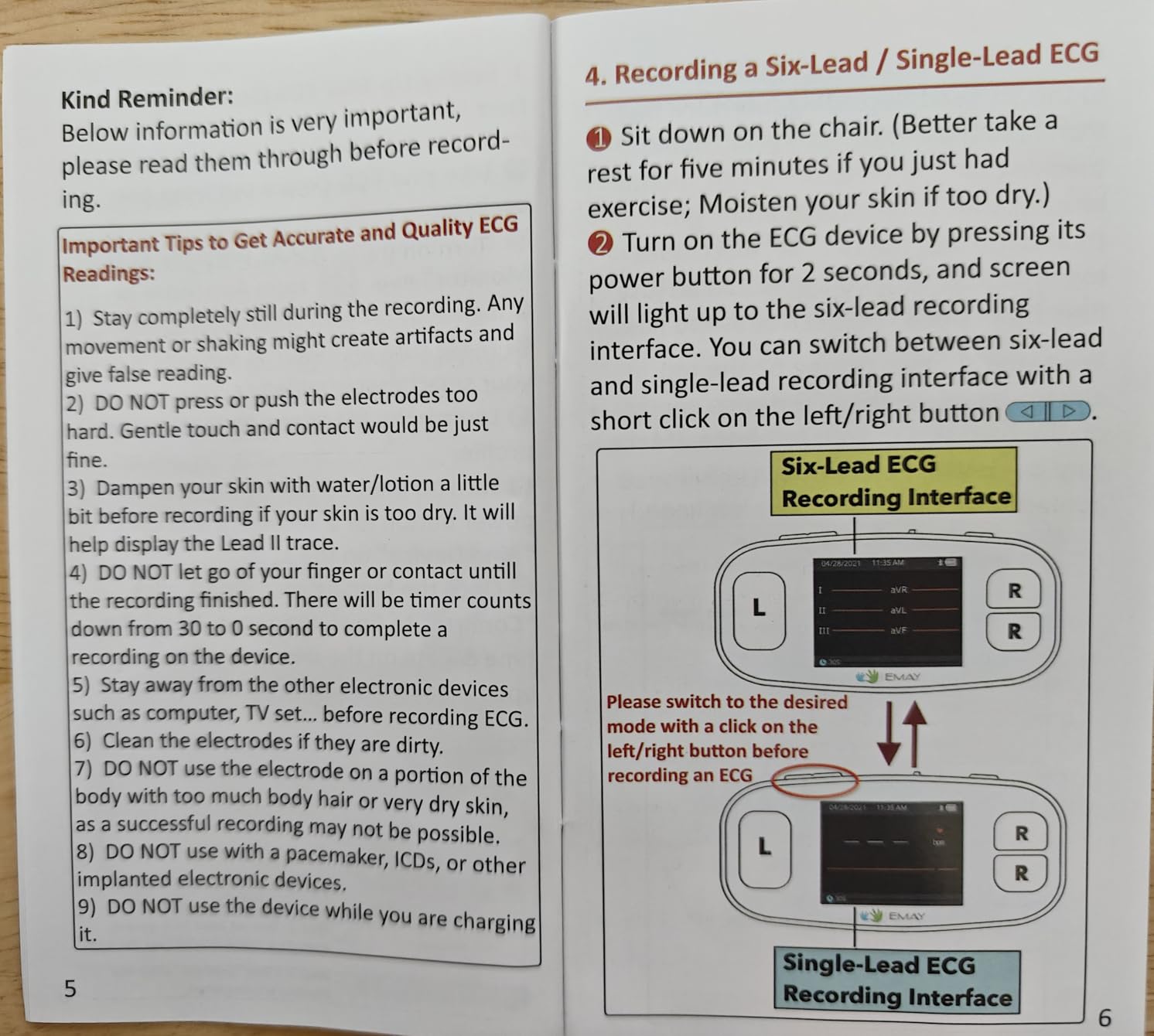
Read the caveat carefully, because it is the honest one. This is an over-the-counter home device, not a hospital diagnostic ECG, and clinical reviewers note that P waves and PR segments can be hard to read reliably on the displayed trace. The on-board interpretation can also miss real abnormalities, so readings should be confirmed by a professional.
Practical details are good. A built-in rechargeable lithium battery, Bluetooth to phone and USB to PC, PDF reports and multi-user profiles, and an 85 g body with 4.7 by 2.2 inch footprint. The manufacturer also advises against use with an implanted pacemaker.
What the on-screen trace can and cannot show
The on-screen six-lead view is genuinely useful for spotting intermittent arrhythmias and premature ventricular contractions over time, and healthcare workers reviewing this device report exactly that. Seeing the same extra beat three days running is meaningful data that a summary label alone will not give you.
What it does not do is substitute for a diagnostic read. The most detailed reviewer in the group confirms it is not hospital grade and warns that automatic interpretation can miss findings such as axis deviation or chamber enlargement criteria. Treat the screen as a long-term trend tool, not a verdict.
Why avoiding a subscription matters over time
No membership changes the maths for anyone who will use the device for years. Several rivals put their detection features behind an annual renewal, so a device that looks complete on day one quietly becomes incomplete unless you keep paying.
The EMAY sidesteps that entirely, and the transfer options are unusually flexible for a budget device: Bluetooth to iOS and Android, USB to Windows and Mac, plus multi-user profiles. If you have been put off by renewal pricing elsewhere, this is the cleanest way to own a multi-lead unit outright.
6. Eko CORE 500 Digital Stethoscope – Best for Clinicians and Caregivers
Eko CORE 500™ Digital Stethoscope — 40x Amplification, Active Noise Cancellation, 3-Lead ECG, FDA-Cleared AI with Eko+, Full-Color Display, Reimbursement Eligible — Silver, COR503-SLV
3-lead ECG in a stethoscope
40x amplification
Full-color display
Up to 60 hour battery
2.19 lb
Pros
- Genuine 3-lead ECG with FDA-cleared AI analysis
- Up to 40x amplification with active noise cancellation
- Full-color display shows heart rate and ECG data
- Waveform visualisation and exam recording in the Eko app
- Up to 60 hours of battery across regular shifts
Cons
- Murmur and AFib detection require Eko+ after the 14-day trial
- Aimed at healthcare professionals rather than general home use
- Weighs 2.19 lb so it is not a pocket device
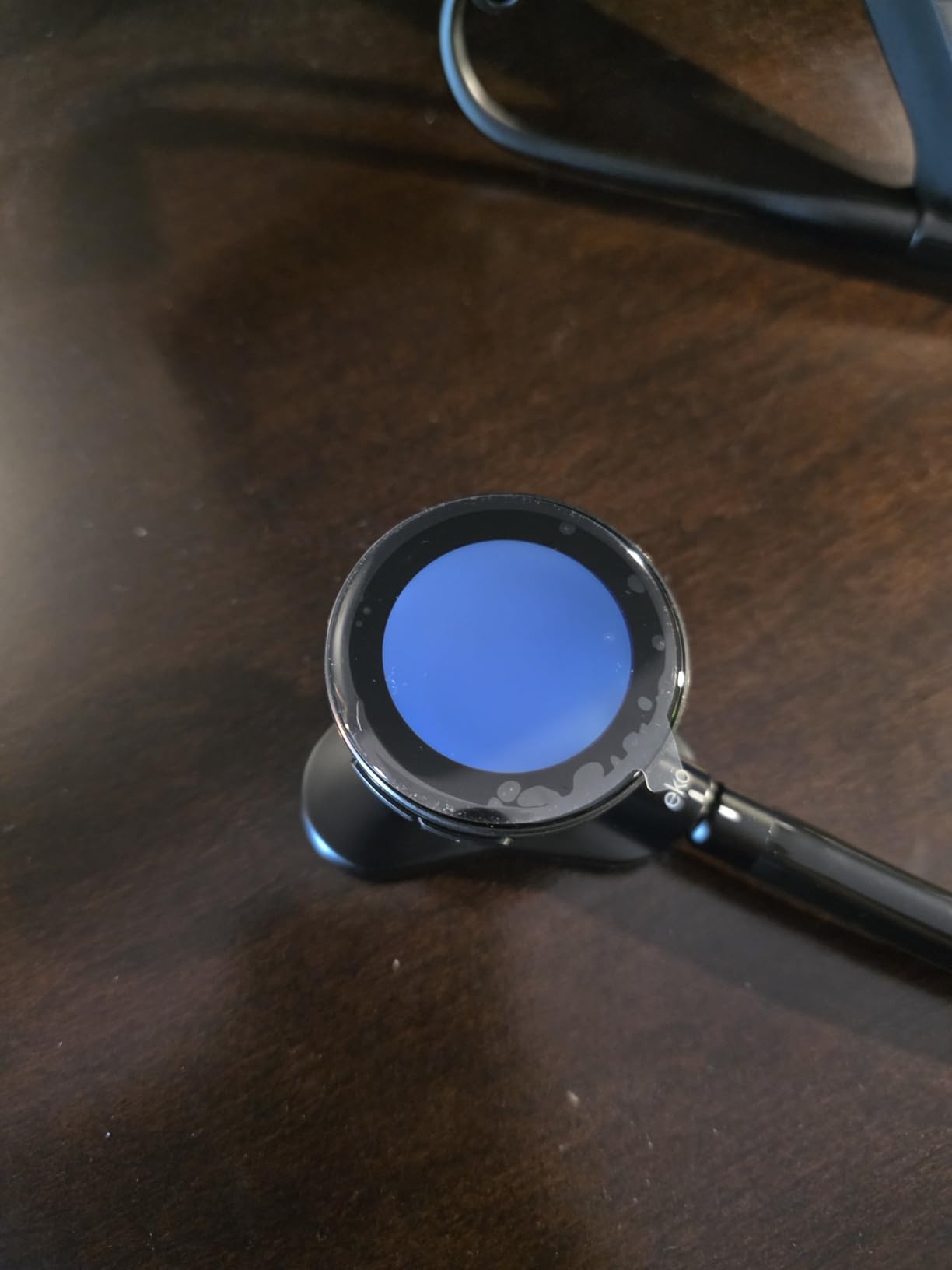
This is the odd one out in the list, and deliberately so. The Eko CORE 500 is a digital stethoscope replacement that happens to contain a genuine three-lead ECG, not a pocket EKG that also plays sounds. If you listen to lungs or hearts as part of caring for someone, that changes what the device is for.
On the heart side it delivers three leads with FDA-cleared AI analysis in the Eko app, plus waveform visualisation and single-sound recording with real-time playback. The 40x amplification with active noise cancellation and Cardio, Pulmonary and Wide audio filters is what most owners write about.
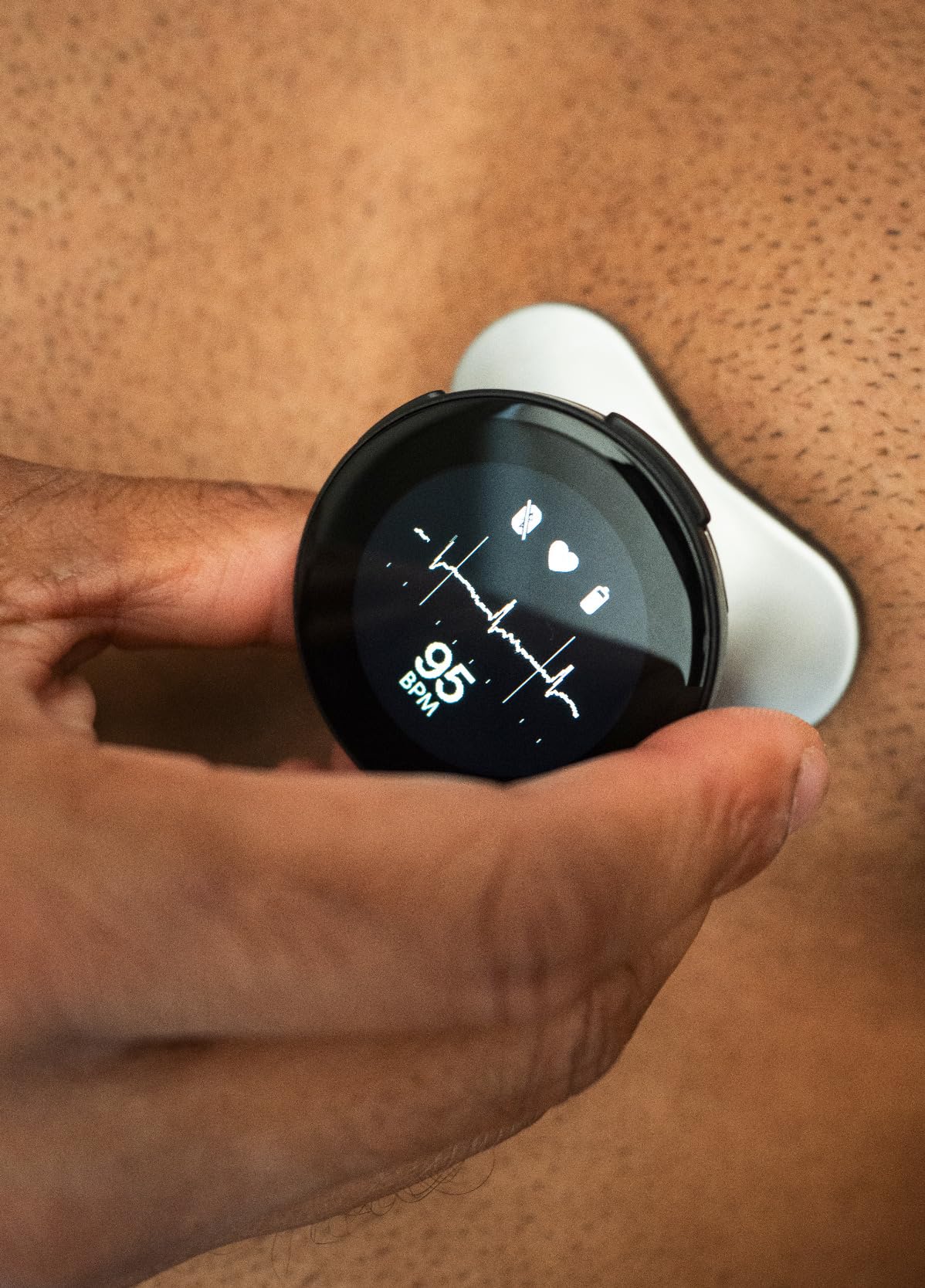
Battery life suits the intended user rather than the casual one. A rechargeable lithium-ion pack gives up to 60 hours across regular shifts, and the water- and shatter-resistant full-colour display is built to be handled. At 2.19 lb it is a piece of equipment, not an accessory.
Features do tier. A free 14-day Eko+ trial covers murmur and AFib detection plus unlimited recording, and the membership continues at an annual fee afterwards. Owners who assumed the AI detection was included report that the split rating, 73 percent five-star against 12 percent one-star, tracks this surprise closely.
When a stethoscope-shaped device is the right tool
A stethoscope-shaped device is the right tool for nurses, physician assistants, paramedics, clinicians in training and family caregivers. Anyone who already auscultates as part of their routine gets a second useful measurement from the same object instead of carrying two devices.
It is the wrong tool for someone who only wants occasional palpitations logging. Three leads plus a colour screen plus amplification solve a professional problem, and you pay for all of it, with an annual membership on top for the AI features.
How the three leads compare with a six-lead unit
Three leads sit between entry-level and full six-lead devices. They give more viewpoints of the heart than a single limb lead, which helps with rhythm classification and adds axis information that a one-lead trace cannot show.
They remain short of the six limb leads the KardiaMobile 6L and EMAY record, so a cardiologist reviewing a serious symptom would still prefer the fuller trace. For a caregiver screening a family member and escalating when something looks wrong, three leads are plenty.
7. KardiaMobile 6L Max – Best for Clinician Reviewed Results
KardiaMobile 6L Max 6-Lead EKG + One-Year Membership, Unlimited Recordings
6 leads and 6 arrhythmia types
1 year of membership included
4 cardiologist reviews
24 g, 3.53 inch long
Pros
- Detects six arrhythmias including PVCs and SVE
- One year of KardiaCare with four free cardiologist reviews within 24 hours
- Results emailed automatically to any doctor or contact
- Tags let you mark readings as exercising or feeling dizzy
Cons
- KardiaCare membership is required to use the device and auto-renews
- Lowest-rated device in the group at 3.9
- Extra reviews are sold individually and telehealth visits carry an additional fee
The 6L Max is the only device here where a human clinician reads your trace without you having to book an appointment, which is precisely the answer to the interpretation problem that defines this category. It records a six-lead EKG in 30 seconds and detects six arrhythmia types: atrial fibrillation, bradycardia, tachycardia, sinus rhythm with PVCs, sinus rhythm with SVE and sinus rhythm with wide QRS.
One year of KardiaCare is included, which brings four board-certified cardiologist reviews with results inside 24 hours. It also emails the EKG automatically to any doctor or contact, and lets you tag a recording as exercising or feeling dizzy so context reaches the reader.
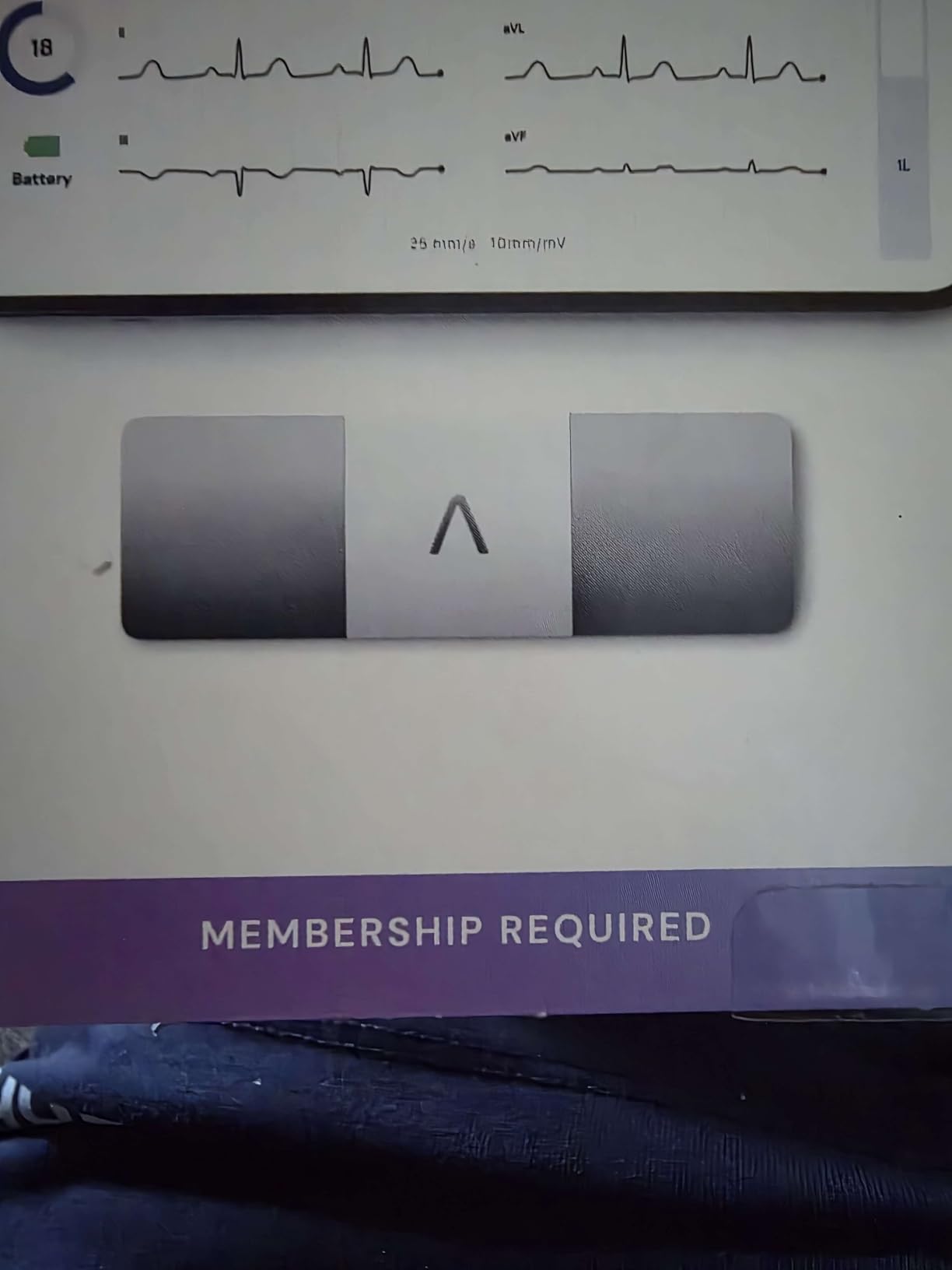
That is where the reservation sits. The membership is required to use the device at all, not just to access reviews, and it renews after the first year unless you cancel. A physician on r/FamilyMedicine described the six-lead bundle as including a first year of membership and then an annual charge, which is the framing buyers find irritating.
The rating reflects that friction. At 3.9 with 18 percent one-star ratings it is the lowest-rated device in this roundup, and reviewers repeatedly connect the split to the membership requirement and the auto-renewing subscription rather than to the hardware, which is essentially the same 24 g body as the standard 6L.
Is paid clinician review worth the renewal
Paid clinician review is worth the renewal when a rhythm condition is already diagnosed, because a board-certified cardiologist reading a six-lead trace within 24 hours is a service no other device in this list offers. For someone with a known history of atrial fibrillation, that is the whole point of the purchase.
It is not worth the renewal for peace of mind alone. Four reviews a year, plus individual extra reviews and telehealth appointments carrying their own fee, adds up quickly for a user who mainly wants a monthly sanity check. The standard 6L gives the same trace without the subscription.
When a required membership is a dealbreaker
A required membership is a dealbreaker if you dislike recurring costs or you might stop using the device. Because the 6L Max will not record without KardiaCare active, letting it lapse turns a working medical device into a paperweight, and that is the single most common complaint in its reviews.
It is manageable if you set a reminder at the end of the first year. Decide before renewal whether you used the four included reviews, because that is the cleanest measure of whether the subscription earned its place over the year you just paid for.
What a Portable EKG Monitor Can and Cannot Tell You
A portable EKG records the electrical rhythm of your heart through electrodes you touch or wear, then uses an app or an on-screen algorithm to label the result in about 30 seconds. It answers one question well: is the rhythm normal, fast, slow or irregular, right now. It cannot detect a heart attack, it cannot diagnose structural heart disease, and it does not replace a clinical 12-lead ECG.
That limitation is the source of the fear people describe on forums. An “AFib detected” result at two in the morning is a flag, not a diagnosis. False positives happen, and the correct response is to repeat the reading calmly in a warm room, then contact a clinician rather than treating the first result as proof of anything.
Two specific exclusions matter. Most devices in this category are not tested or recommended for people with a pacemaker or an implanted cardioverter defibrillator, and several manufacturers say so explicitly. Anyone with an implanted device should ask their cardiologist before using one at all.
Because the tools are also small and battery-powered, buyers often treat them like a phone accessory. Our guide to how compact, self-contained tech holds up on the move covers the same planning for people who travel with these devices regularly.
How Accurate Are Portable EKG Monitors, Really?
Portable EKG monitors are accurate for rhythm screening under good conditions and inaccurate for anything structural. Published studies of the leading single-lead devices found atrial fibrillation sensitivity ranging from about 62 to 66.7 percent and specificity from about 83 to 98.5 percent, with results reported across work in the Annals of Family Medicine, the Journal of the American College of Cardiology and the Swiss Medical Weekly. Read that spread as a screening tool, not a diagnosis.
Sensitivity below 70 percent is the number that should shape expectations. It means a clean single-lead reading does not rule atrial fibrillation out, which is exactly why a doctor who suspects an intermittent arrhythmia may still prescribe monitoring that runs for days rather than asking you to take a thirty-second reading whenever you remember.
Specificity is the friendlier figure. At up to 98.5 percent, most devices are good at telling you when a rhythm looks normal, which is why these tools work so well as reassurance between appointments. The weak spot is the false positive, the flag that appears when you are tired, cold or anxious rather than arrhythmic.
Signal quality is the variable that moves results most. Dry skin, cold hands, movement between electrodes and poor contact all add artifact, and reviewers across these products mention the same failure mode: a reading that fails for contact reasons rather than for cardiac ones. Warm hands, relaxed grip and a quiet thirty seconds fix most failed attempts.
Multi-lead devices narrow the gap but do not close it. Six leads view the heart from more angles and produce a cleaner, more readable trace, and on the sinus-rhythm accuracy comparison published for these devices the dedicated KardiaMobile unit and a smartwatch ECG finished within a couple of points of each other. Neither number is a licence to make cardiac diagnoses.
How to Choose a Portable EKG Monitor
Choose by lead count only after you have decided who will read the result. A single limb lead screens for atrial fibrillation, bradycardia and tachycardia, three leads add axis information, and six limb leads give a cardiologist a substantially more useful artefact. If nobody will ever read your trace, extra leads buy you nothing.
Decide between spot checks and continuous monitoring. Every device here is user-initiated, and r/AFIB users are clear that there really are no auto-ECG wearables on the market. If you need overnight capture, you need a Holter-class prescription service instead of a handheld.
Check the regulatory label, not the marketing. FDA-cleared means the device was reviewed for a specific intended use. Wellness-only claims mean exactly that, and an FDA registration number is not a clearance. Read which rhythms the clearance actually covers.
Confirm your phone situation. Most devices need an iOS or Android handset and Bluetooth, and reviewers regularly report that older phones are the ones that struggle. Check compatibility before you commit, especially in a two-person household with one older handset.
Price the second year, not the first. Two devices in this roundup require or encourage a membership, and the six-arrhythmia model will not record at all without one. Multiply the annual renewal by the number of years you expect to own the device.
Verify the export format. A PDF with the waveform is far more useful to a cardiology practice than a screenshot or a summary score. Several devices here also export raw data files, which is what a technician actually needs to re-read a trace.
Match battery life to your rhythm. Coin cells like the CR2016 last years and need no charging, while rechargeable units are better when you record daily. A device that runs flat is useless at three in the morning, which is when symptoms tend to appear.
Check the extras you will actually use. On-device screens matter for anyone who does not want to handle a phone mid-symptom, multi-user profiles matter for couples, and leg or knee contact matters if you plan to use multi-lead modes.
Account for who is holding it. Grip strength, tremor and a two-handed operation decide whether a reading is taken at all. Two-handed devices are a poor match for an older user with arthritis, and a caregiver-assisted setup changes which extras are worth paying for.
Work through those eight in order and the choice usually makes itself. Lead count and regulatory status narrow the field fastest, and the recurring-cost question is the one most buyers only think about in year two.
Portable EKG Monitor Vs Smartwatch ECG
A smartwatch ECG wins on convenience and loses on data depth, and the comparison is closer than most sellers admit. The watch is already on your wrist, it needs no separate object, and it records without you remembering to charge a second device. It also captures a single lead, which puts it in the same clinical category as an entry-level portable EKG.
The dedicated device wins where a doctor is involved. A KardiaMobile unit is a purpose-built medical device with FDA-cleared rhythm determinations, and its six-lead models produce a trace that a cardiology practice can actually use. r/POTS users who tested the two head to head concluded that Kardia does a better job of detection, and a clinician on r/FamilyMedicine described Kardia as pretty good.
The deciding question is what happens to the data. Smartwatch traces live in a vendor ecosystem and may be hard to hand to an outside cardiologist as a clean PDF. If the plan is to send results to a doctor, choose the device built for that. If the plan is reassurance in the moment and you dislike being asked about a rhythm at two in the morning, the watch may be the better object.
Frequently Asked Questions
Are portable EKG monitors accurate?
They are accurate for rhythm screening under good conditions and unreliable for structural or ischaemic diagnosis. Studies of leading single-lead devices found atrial fibrillation sensitivity of roughly 62 to 66.7 percent and specificity of 83 to 98.5 percent. Warm hands, relaxed grip and a still 30 seconds matter as much as the hardware.
Is a one-lead EKG accurate?
One lead is accurate for rhythm screening, which is what catches atrial fibrillation, bradycardia and tachycardia between appointments. It cannot show axis deviation, chamber enlargement or ischaemic change, so it answers a rhythm question and stops there. Clean technique, not a more expensive model, is what makes a single-lead reading trustworthy.
What is the most accurate portable EKG monitor available?
Among consumer devices, multi-lead units recording six limb leads give the most readable trace, and the KardiaMobile 6L returns FDA-cleared rhythm determinations without a membership. In published head-to-head work the dedicated KardiaMobile and a smartwatch ECG finished within a couple of points on sinus-rhythm accuracy, so no consumer device is diagnostic.
Can a portable EKG monitor detect a heart attack?
No. A portable EKG screens for rhythm, not for ischaemia, and manufacturers state plainly that the device does not check for heart attack. It also cannot diagnose structural heart disease or valve problems. If you have chest pain, pressure, shortness of breath or fainting, call emergency services instead of taking a reading.
Do portable EKG monitors need a subscription?
It depends on the model. The KardiaMobile 1-Lead and 6L, and the EMAY 6L, run their core detections with no membership at all. The KardiaMobile 6L Max requires a membership to operate and renews after the first year, and the Eko CORE 500 places AI detection behind a trial. Always check what the device does on day one.
Can I use a portable EKG monitor with a pacemaker or ICD?
Most consumer devices are not tested or recommended for people with an implanted pacemaker or ICD, and several manufacturers state this directly on their own materials. Electrical activity from the implanted device can distort a consumer trace and produce a misleading rhythm label. Ask your cardiologist before using one, and never change a device setting on their behalf.
How do I share EKG results with my doctor?
Export the recording as a PDF that includes the waveform, not a screenshot of a summary score, and add a short note on when you took it and what you felt. Some devices email a trace to any contact automatically, and multi-user models like the EMAY 6L also produce raw files. Ask your practice in advance whether it accepts patient-generated ECGs at all.
Are portable EKG monitors worth it?
They are worth it for anyone whose doctor has recommended home rhythm monitoring, or who needs to log recurring palpitations between appointments. They are less convincing as general reassurance, because a flag you cannot interpret often raises anxiety rather than lowering it. Value improves sharply when a clinician will read the traces you send.
Final Verdict
The KardiaMobile 1-Lead is the best portable EKG monitor for most people in 2026. It posts the largest review base in the category at 83,360 owner reviews, returns FDA-cleared determinations for atrial fibrillation, bradycardia, tachycardia and normal sinus rhythm in thirty seconds, and needs no membership to do it.
Move up to the KardiaMobile 6L when a doctor will read the trace, and to the EMAY 6L when you want six leads, a screen and no paywall. Save the KardiaMobile 6L Max for a diagnosed rhythm condition where four included cardiologist reviews justify the renewal, and consider the Withings BeamO or OMRON Complete only if the temperature, lung or blood pressure readings will earn their place too.
Whatever you choose, decide in advance who reads the result. That single question resolves most of the confusion buyers report afterwards.