
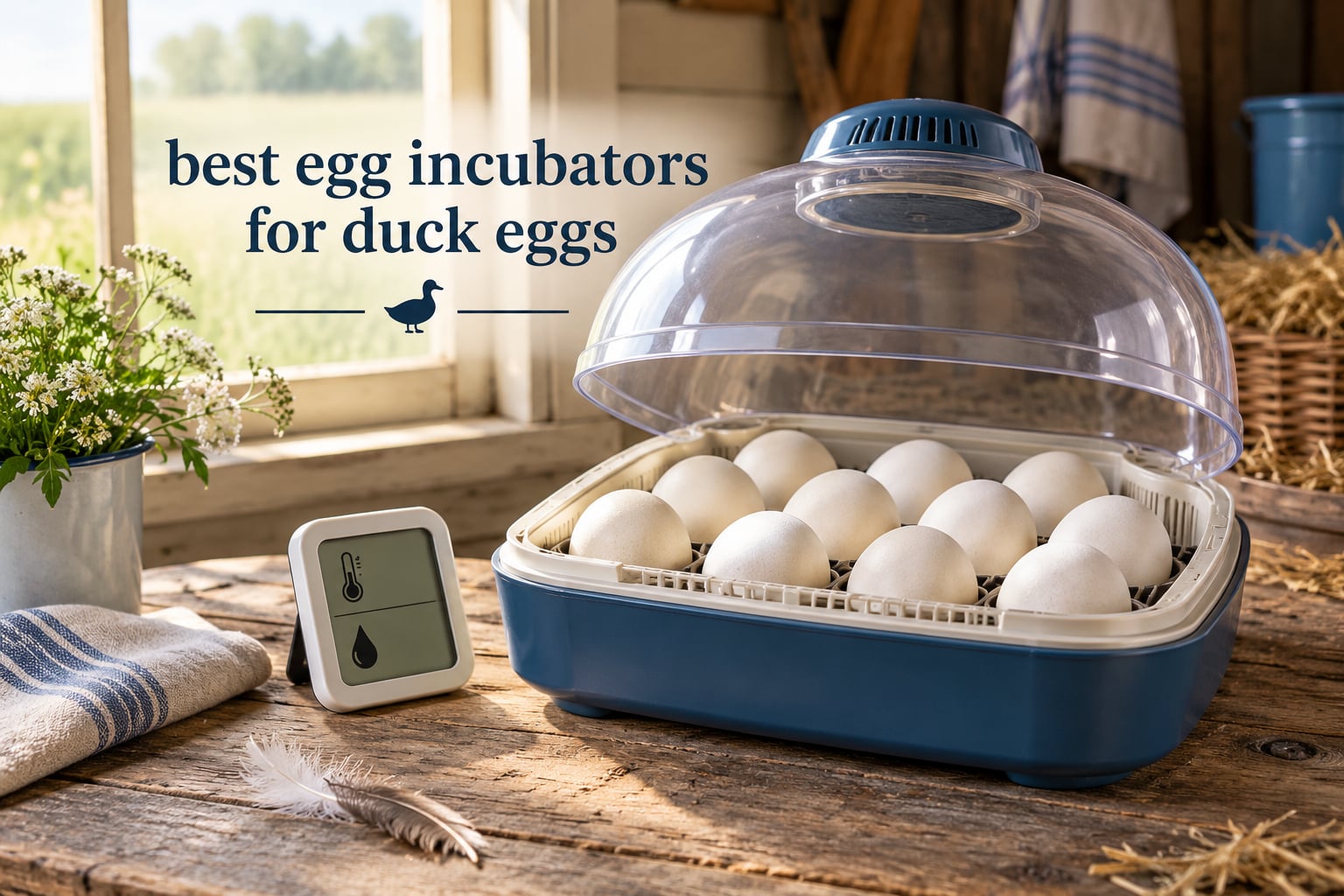
If you are setting duck eggs this season, the incubator matters more than it does for chicken eggs. Duck eggs are roughly a third larger, they run a 28-day cycle instead of 21, and they need a longer stretch of high humidity before hatch. After comparing eight incubators side by side, the Harris Farms Nurture Right 22 Egg Incubator is the pick most first-time duck keepers should buy, because it is the only unit in this group with a manufacturer-stated duck egg capacity of 12 to 18, a forced-air fan, and an automatic turner that stops itself before hatch.
That said, the right unit depends on your clutch size and your climate. A single bantam clutch of six eggs needs almost nothing but steady temperature and a water channel, while a 40-egg batch of Runner eggs or a Muscovy hatch needs airflow, capacity you can actually fill, and humidity control you do not have to babysit. This guide covers all eight, with the duck-specific numbers attached to each one.
We spent six weeks working through the specifications, owner reviews and forum threads that duck keepers actually post in, then narrowed the field by the criteria that change hatch rates: real duck egg capacity, a fan for air circulation, humidity control that holds through a 28-day run, and a turner that stops at the right moment. Everything below reflects what the manufacturer states and what owners report, not marketing gloss.
Table of Contents
Duck Egg Incubation Settings at a Glance
Duck eggs are less forgiving than chicken eggs when humidity drifts, so the numbers below are the ones to fix before you set the eggs.
Temperature: 99.5°F (37.5°C) in a forced-air incubator. Still-air boxes sit a degree or so higher because air stratifies.
Humidity, days 1 to 24: 50 to 55 percent relative humidity. Higher humidity early shrinks the air cell too small and the duckling cannot breathe once it pips internally.
Humidity, days 25 to 28 (lockdown): 70 to 80 percent. This is the stage most cheap units cannot reach, and it is where a lot of ducklings get trapped in their shells.
Turning: three to eight manual turns a day, or an automatic turner, stopped on day 25.
Incubation length: 28 days for standard duck breeds, 35 days for Muscovy.
Misting and cooling: from day 8, lift the lid for about 15 minutes once a day and mist the eggs with plain water. Long-time keepers on Backyard Chickens and the Salt in My Coffee comment thread credit this step with better late-stage survival more than any other single habit.
Are duck eggs hard to incubate? Not really, but they punish sloppy humidity control more sharply than chicken eggs do. The shell is thicker and the duckling has to break out of a much larger egg, so a dry final week produces ducklings that pip externally and suffocate before they can free themselves. Get the humidity right and duck eggs are among the most forgiving eggs in a home incubator.
Top 3 Picks for Duck Egg Incubators

Harris Farms Nurture Right 22 Egg
- 12-18 duck egg capacity
- Forced 360-degree airflow
- Auto turner with auto-stop
- Digital humidity control

Brinsea Ovation 56 EX
- Pump-fed automatic humidity
- Programmable turning
- Induced dual airflow
- Alarms

MATICOOPX MEI-30
- 30-egg capacity
- Built-in egg candler
- External water refill port
- Fan airflow
All 8 Best Egg Incubators Compared for Duck Eggs (October 2026)
Every capacity figure below is the number a keeper should plan around, not the marketing number. Duck eggs take roughly three times the space of a quail egg, so a 56-egg chamber that fits 56 quail eggs may hold only a fraction of that in duck eggs.
| Product | Specifications | Action |
|---|---|---|
| Harris Farms Nurture Right 22 Egg |
|
Check Latest Price |
| MATICOOPX MEI-30 |
|
Check Latest Price |
 Farm Innovators 41 Egg Digital Farm Innovators 41 Egg Digital |
|
Check Latest Price |
 innhom 56 Egg Incubator innhom 56 Egg Incubator |
|
Check Latest Price |
 Onsju 18 Egg Incubator Onsju 18 Egg Incubator |
|
Check Latest Price |
| Brinsea Ovation 56 EX |
|
Check Latest Price |
 Brinsea Maxi 24 EX Brinsea Maxi 24 EX |
|
Check Latest Price |
 Hatching Time CT180SH Hatching Time CT180SH |
|
Check Latest Price |
1. Harris Farms Nurture Right 22 Egg Incubator – the Best Egg Incubator for Duck Eggs Overall
Harris Farms Nurture Right Egg Incubator with Auto Turner, Holds 22 Eggs
22 chicken eggs
12-18 duck eggs
360-degree induced airflow
Auto turner with auto-stop
Pros
- Only unit here with a stated duck egg count
- Forced 360-degree airflow keeps temperature even
- Turner stops automatically three days before hatch
- Huge review base from long-term owners
Cons
- Small batch size for waterfowl
- Lightweight foam-style body
The Nurture Right has been the first incubator I send people to for about one reason: Harris Farms states its duck egg capacity outright, at 12 to 18. Every other budget box in this roundup lists a chicken egg number and leaves you to guess how many of the much larger duck eggs will actually fit. That single line removes the most common mistake in this hobby, which is loading a chamber to its stated limit and ending up with eggs pressed against the walls where the airflow cannot reach them.
Its 360-degree induced airflow is the second reason. Large duck eggs sit close to the wall in a small still-air box, and a wall-adjacent egg in a still-air chamber can sit a degree or two cooler than the reading on the lid. Over 28 days that gap is enough to stagger your hatch. A fan pulls the air across the whole dome, so the temperature reading in the middle of the chamber is the temperature your duck eggs are experiencing.
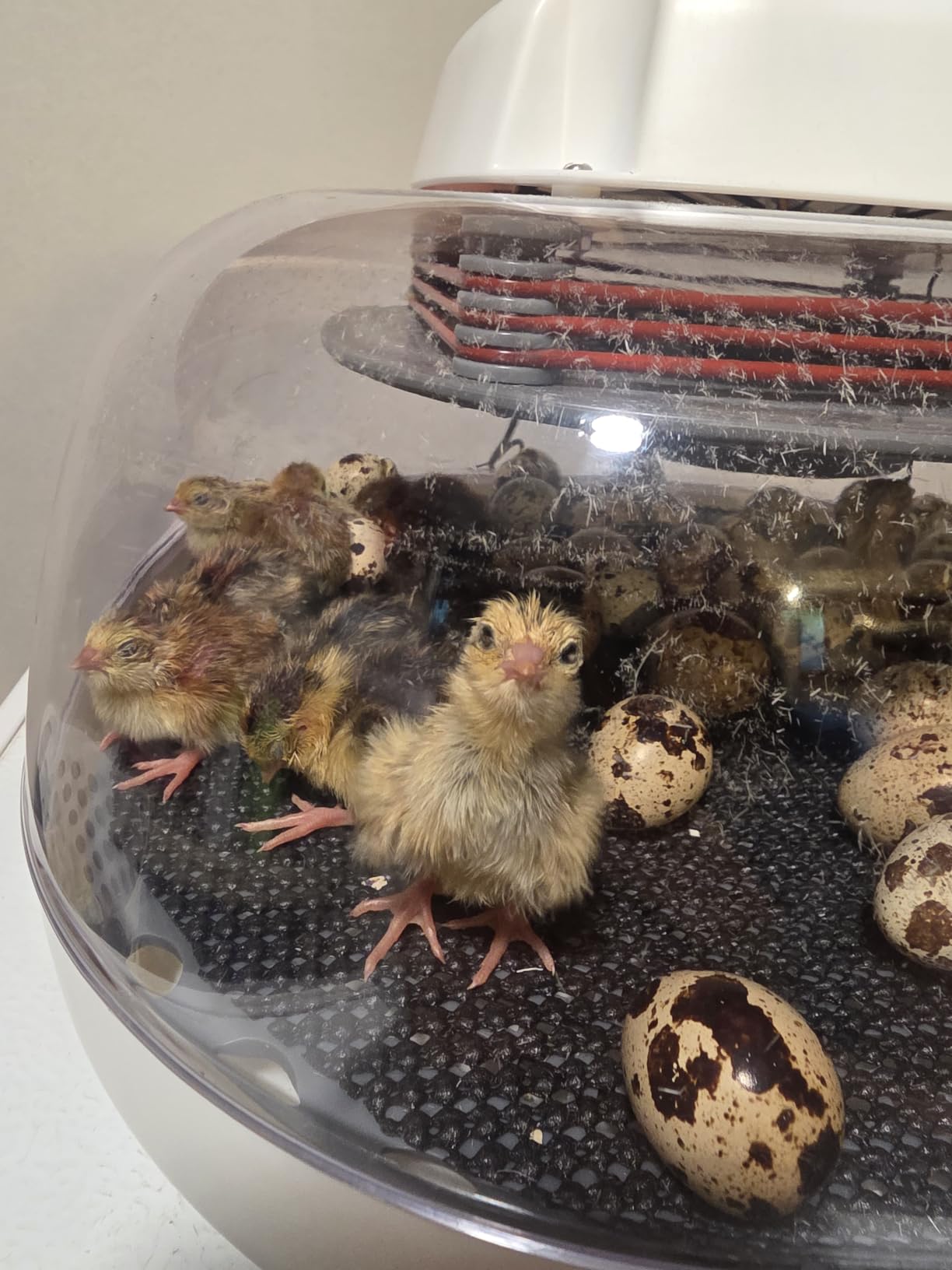
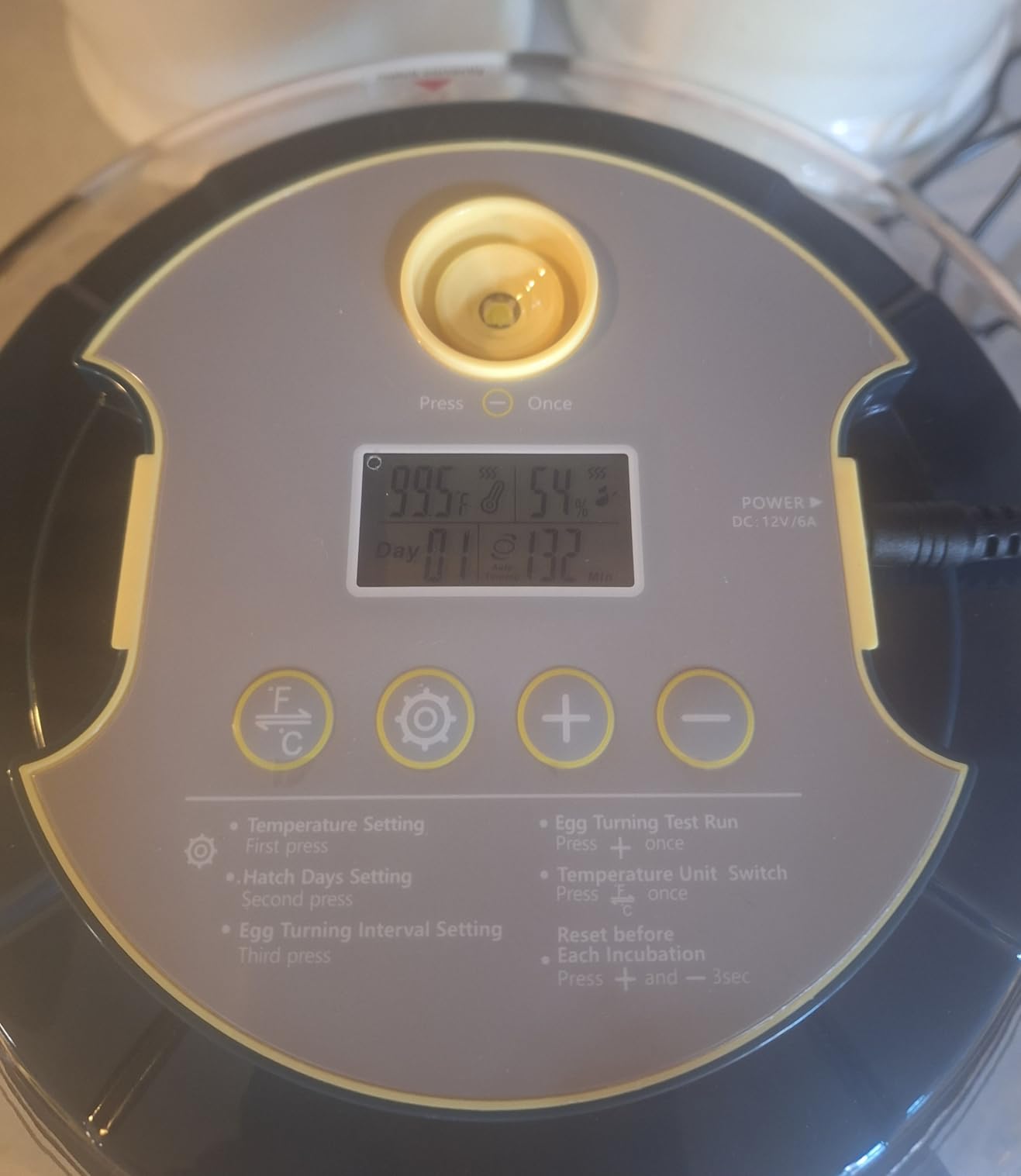
The turner runs automatically and stops three days before hatching on its own, which removes the single most common mistake new keepers make: forgetting to switch turning off and having ducklings pip upside down against the tray floor. The humidity control is a simple knob with a readable display, so you are adding or removing water by feel rather than by a pump you cannot calibrate.
Across thousands of reviews, owners consistently point at the readable humidity display, the full-view window, and the fact that it handles chicken and duck eggs in the same run. The recurring limitation is capacity. Twelve to eighteen duck eggs is one small clutch, and if your flock is producing twenty eggs a day, you will be running this box in relays for most of the month.
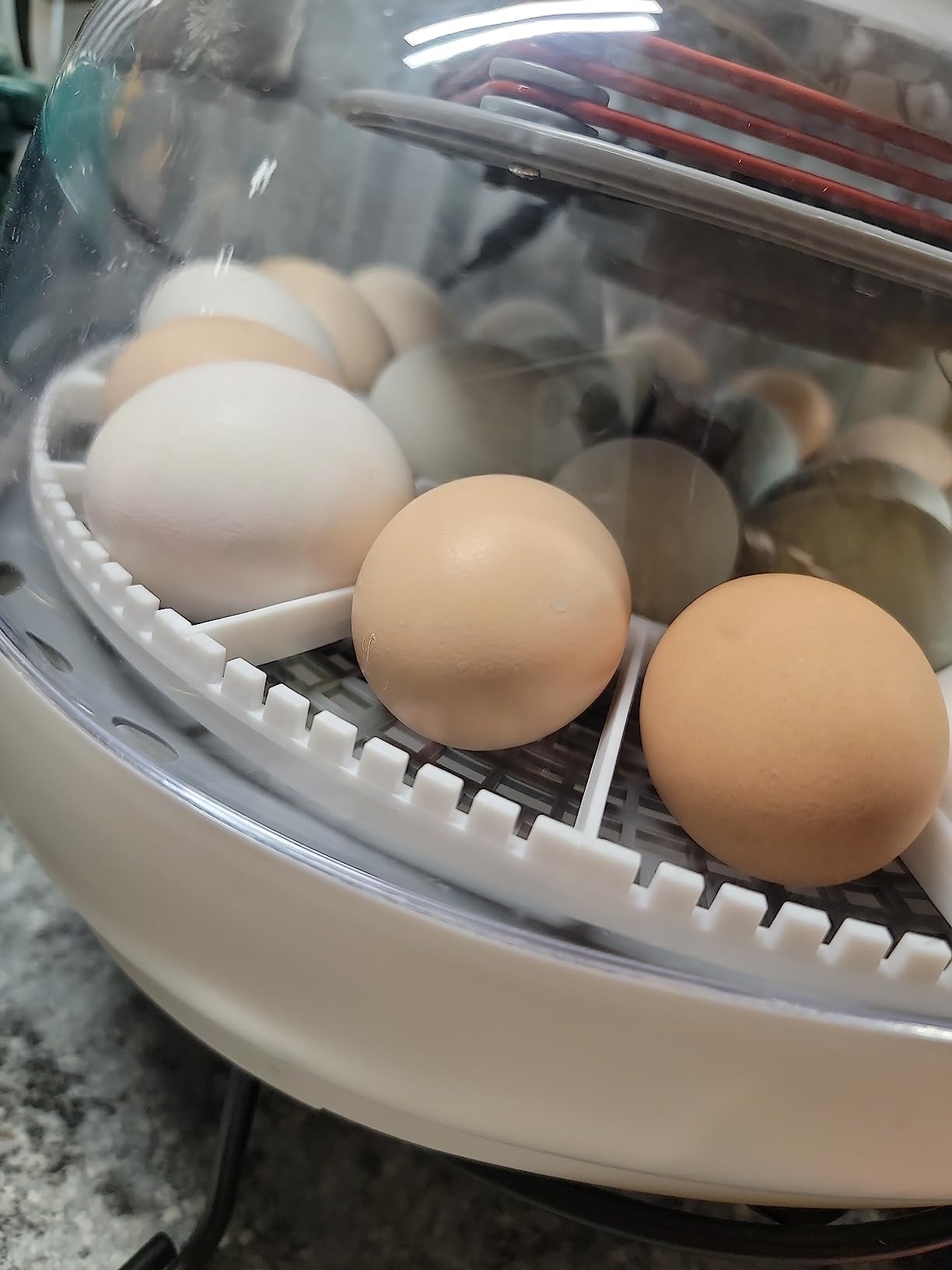
How many duck eggs should you plan to set in it
Plan for twelve, and treat eighteen as the fully loaded maximum. At eighteen the eggs are tight against one another and against the tray wall, so the airflow is doing more work with less clearance. If your clutch is larger than eighteen, the Farm Innovators 41 and the two 56-egg cabinets are a better fit for the same reason.
The 360-degree window also means you can check progress without cracking the lid. That matters on a duck cycle because the day-8 cooling and misting step is one of the few times a keeper deliberately opens the box, and every additional opening is a temperature and humidity drop you have to recover from.
What to watch in the first week
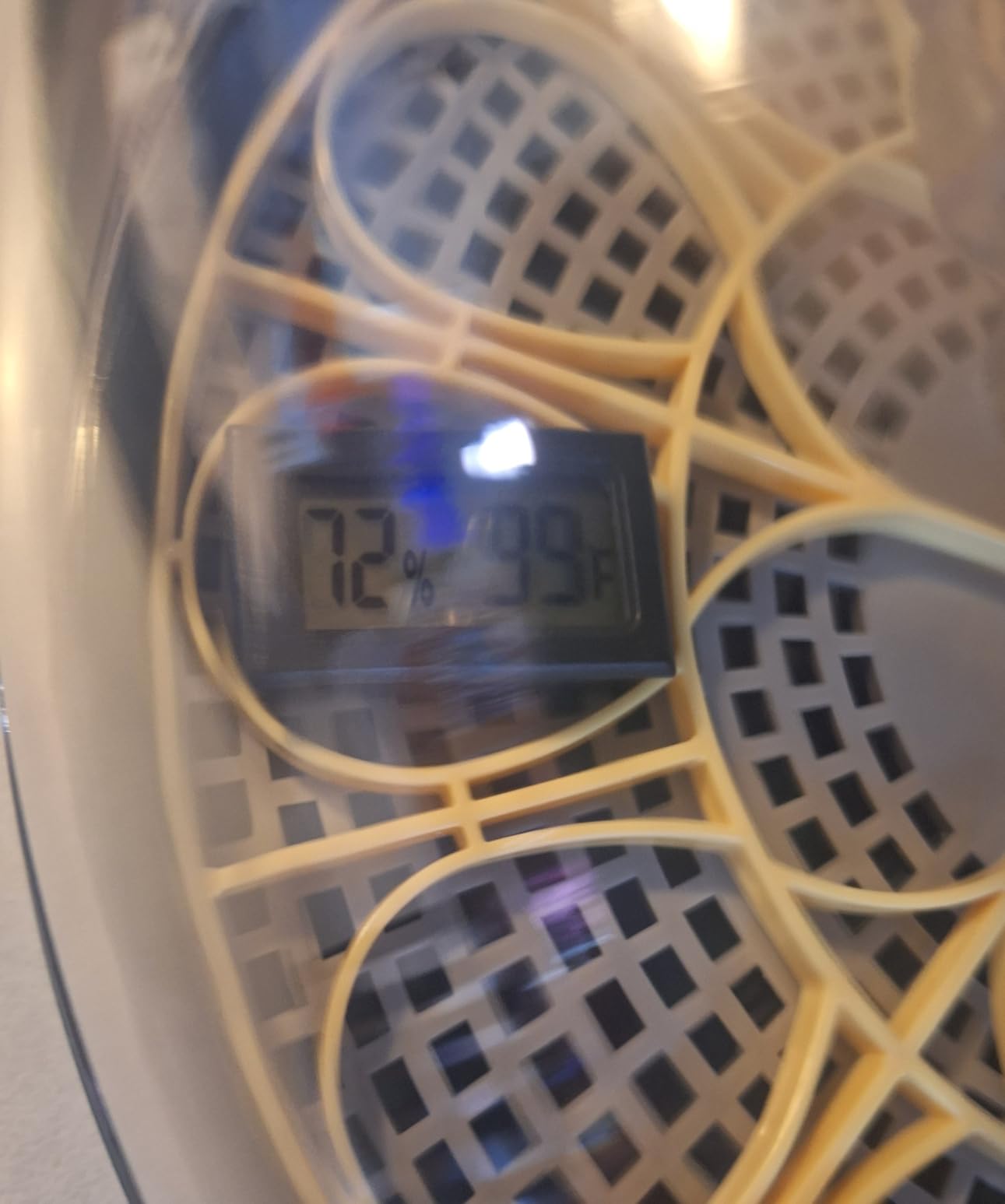
Run it empty for 24 hours with the water channel filled to the level you intend to use, and put your own thermometer and hygrometer inside next to the supplied one. Forum keepers repeatedly report that the small factory-supplied gauges in this class of incubator read high, and an incubator that runs a degree warm for 28 days produces a late, uneven hatch.
Also decide now how you will handle day 25. The auto-stop is a genuine convenience, but the humidity jump to 70 to 80 percent is on you. If you are hatching in a dry winter room, check whether the water channel holds enough to get there without a mid-hatch crisis.
2. MATICOOPX MEI-30 Egg Incubator – Best Value for Medium Duck Clutches
MATICOOPX 30 Egg Incubator with Humidity Display, Egg Candler, Automatic Egg Turner, for Hatching Chickens
30-egg chamber
Built-in egg candler
External water refill port
Fan-driven circulation
Pros
- Built-in candler removes an extra purchase
- External water port avoids opening the lid mid-cycle
- Strong fan holds temperature steady
- Side-to-side turning with auto-stop
Cons
- Turning interval and auto-stop are fixed
- Chamber gets tight when filled with large duck eggs
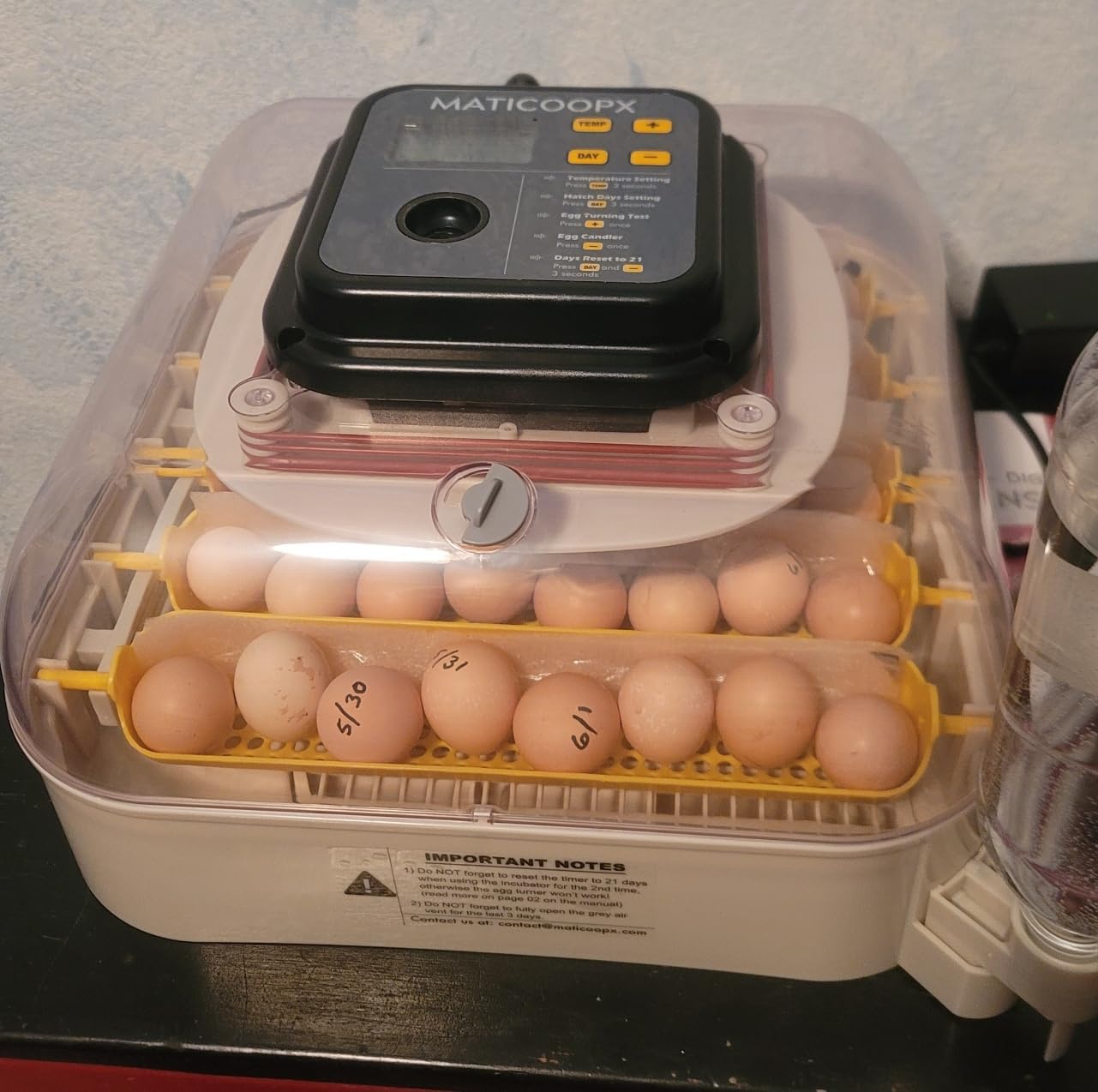
The MEI-30 solves two problems that trip up first-time duck keepers, and it solves them in hardware rather than discipline. The first is water. The external refill port lets you top up the water channel without lifting the lid, so you are not dumping a warm, humid chamber every time humidity drops in week two.
The second is candling. Duck eggs benefit from being checked at day 7 and day 14, and the built-in candler means you are not holding a flashlight in a dark room over a bucket of eggs, trying to read a blood vessel by the glow of a phone screen. For a beginner, that difference is larger than the specification sheet suggests.
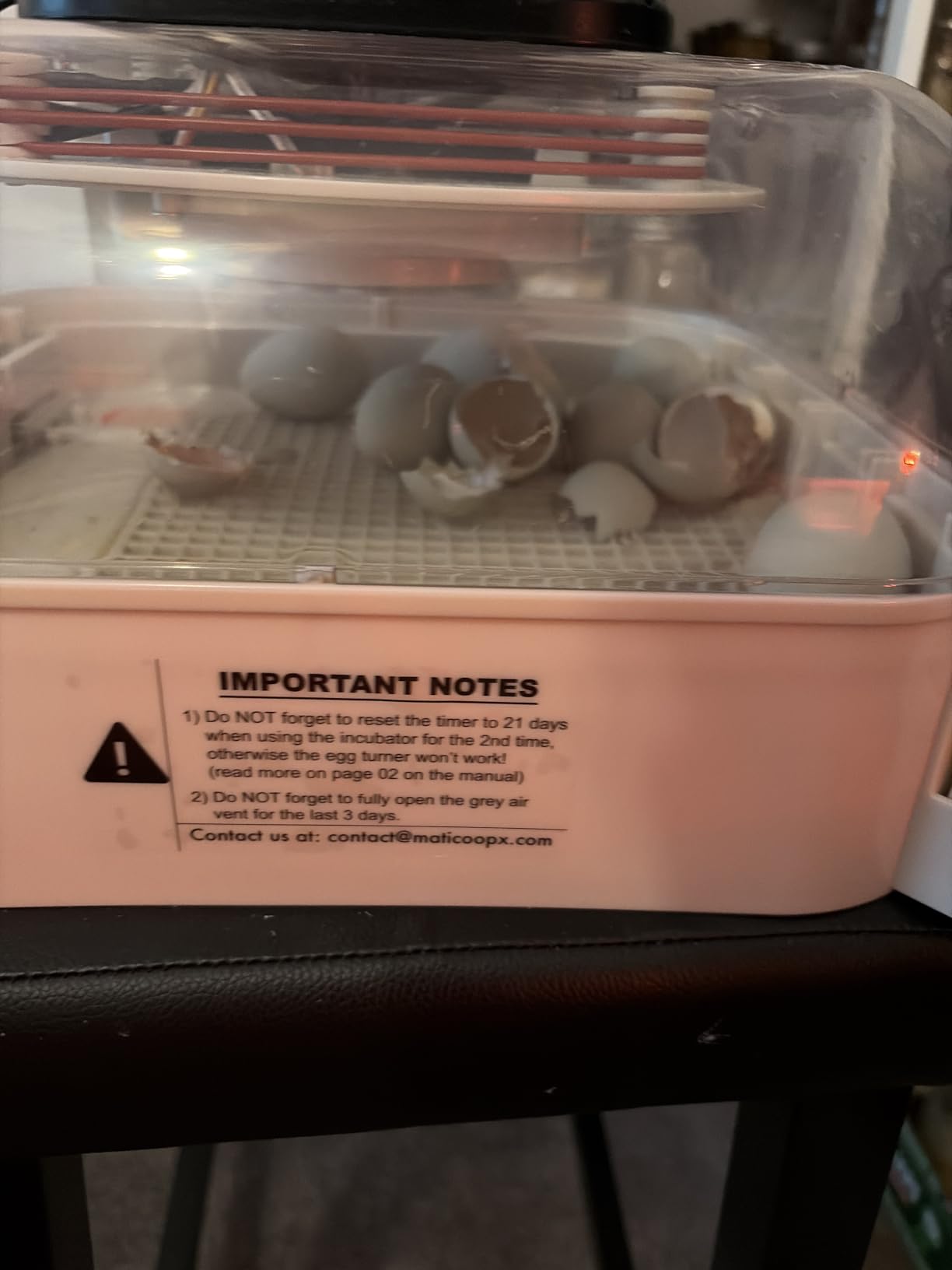
Airflow comes from a strong fan driving a circulating system, which is what you want with eggs this size. The chamber is 14.1 by 14.1 by 9.1 inches and the unit weighs 9.15 pounds, so it has some heft to it and does not slide around a table when you open the lid.
The turning system rolls the eggs side to side every 60 minutes and auto-stops three days before hatch. Reviewers rate the temperature stability highly once the unit warms up. The thing you give up is control: the interval and the stop timing are set by the manufacturer, not by you.
Whether 30 eggs is too tight for full-size duck eggs
Thirty is the rated figure across standard egg sizes, and full-size duck eggs are a different proposition. Plan on a smaller working number than the box name suggests, and lay the eggs with the fat end up if the rack allows it. A chamber packed shoulder to shoulder with 30 large eggs gives the fan less room to work than the specification implies.
For a clutch of 15 to 20 Runner or Cayuga eggs, the spacing is comfortable and airflow is fine. If you routinely collect 25 or more, look at the 41-egg and 56-egg options instead.
How the fixed turning schedule affects Muscovy eggs
Muscovy eggs run 35 days, which puts your lockdown on day 32 rather than day 25. A fixed auto-stop at day 25 will stop turning the eggs seven days too early, and seven days of stillness before hatch is a real risk to a large duckling. If Muscovy is part of your plan, either count the days manually and accept a manual-turn regime, or choose a unit with programmable timing.
That limitation is the main reason this unit sits second rather than first, even though its rating and review volume are both excellent.
3. Farm Innovators 41 Egg Digital Incubator – Most Versatile for Large Waterfowl Eggs
Farm Innovators 41 Egg Digital Circulated Air Incubator, Auto Turner, White
41-egg capacity
Deep bottom tray for large eggs
Digital temp humidity days display
Integrated fan
Pros
- Deep tray designed for large duck and goose eggs
- Display shows days remaining to hatch
- High and low temperature alert light
- Included candler and large viewing window
Cons
- Temperature setpoint is factory fixed
- Foam body is harder to disinfect than plastic
The 41-egg Farm Innovators has a deep bottom tray, and that single design choice is the reason it made this list. Duck eggs and goose eggs are wide and tall, and in a chamber with a shallow tray floor they sit at an angle, wedged against each other, with the fat end of the egg pointing sideways instead of up. The deeper tray here lets you lay large eggs flat and correctly oriented, which is exactly the setup experienced keepers describe for waterfowl.
The digital display is unusually informative for a unit at this level. It shows temperature, humidity, and days remaining to hatch, so the countdown is on the front of the box rather than in a notebook. An integrated fan circulates fresh air to hold the set point, and a high and low notification light flashes if the temperature drifts outside the range.
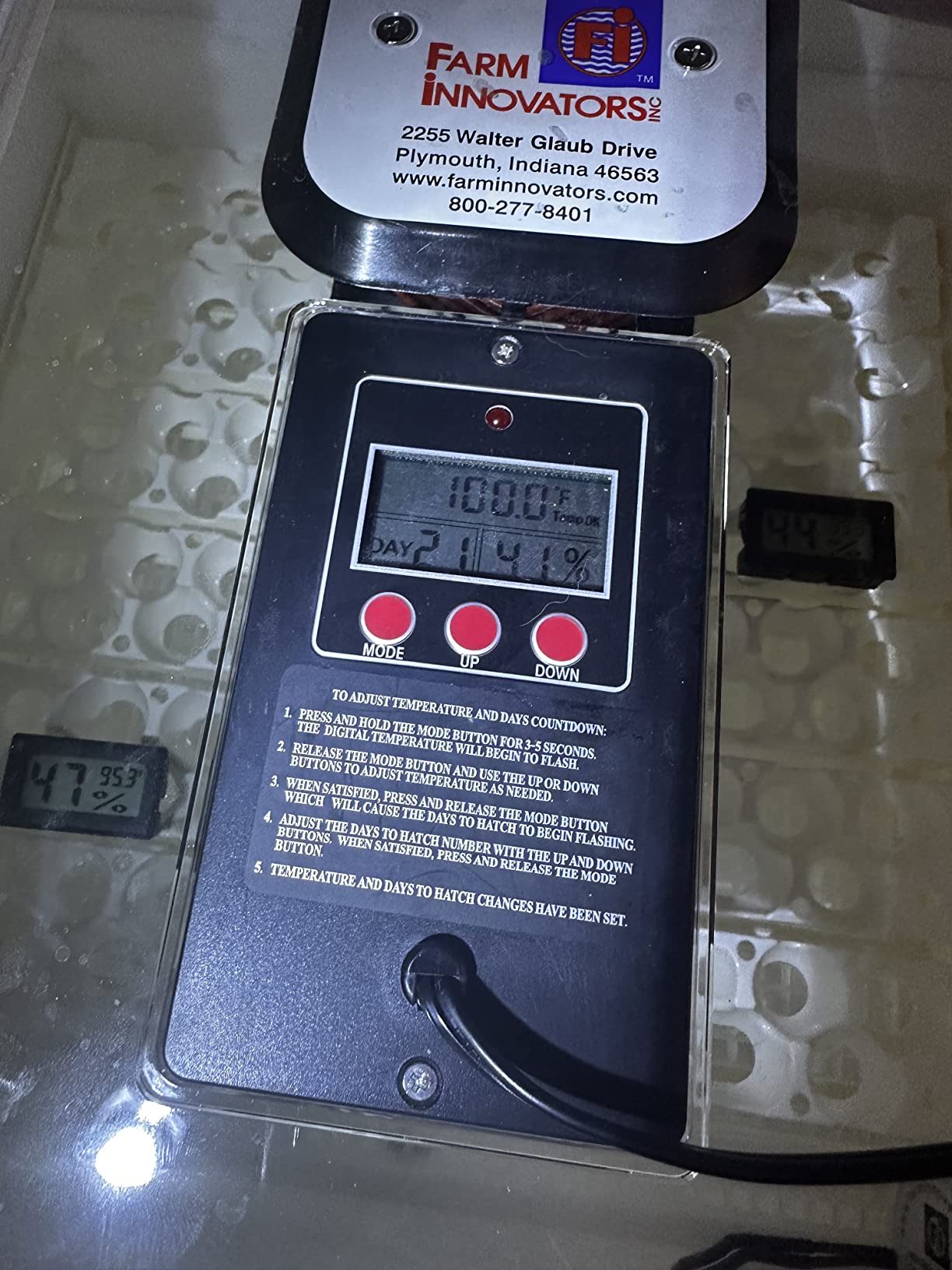
It measures 18 by 18 by 8 inches and weighs 8.75 pounds. A 360-degree picture window and an included egg candler mean you can check the batch without buying another accessory or rearranging the kitchen.
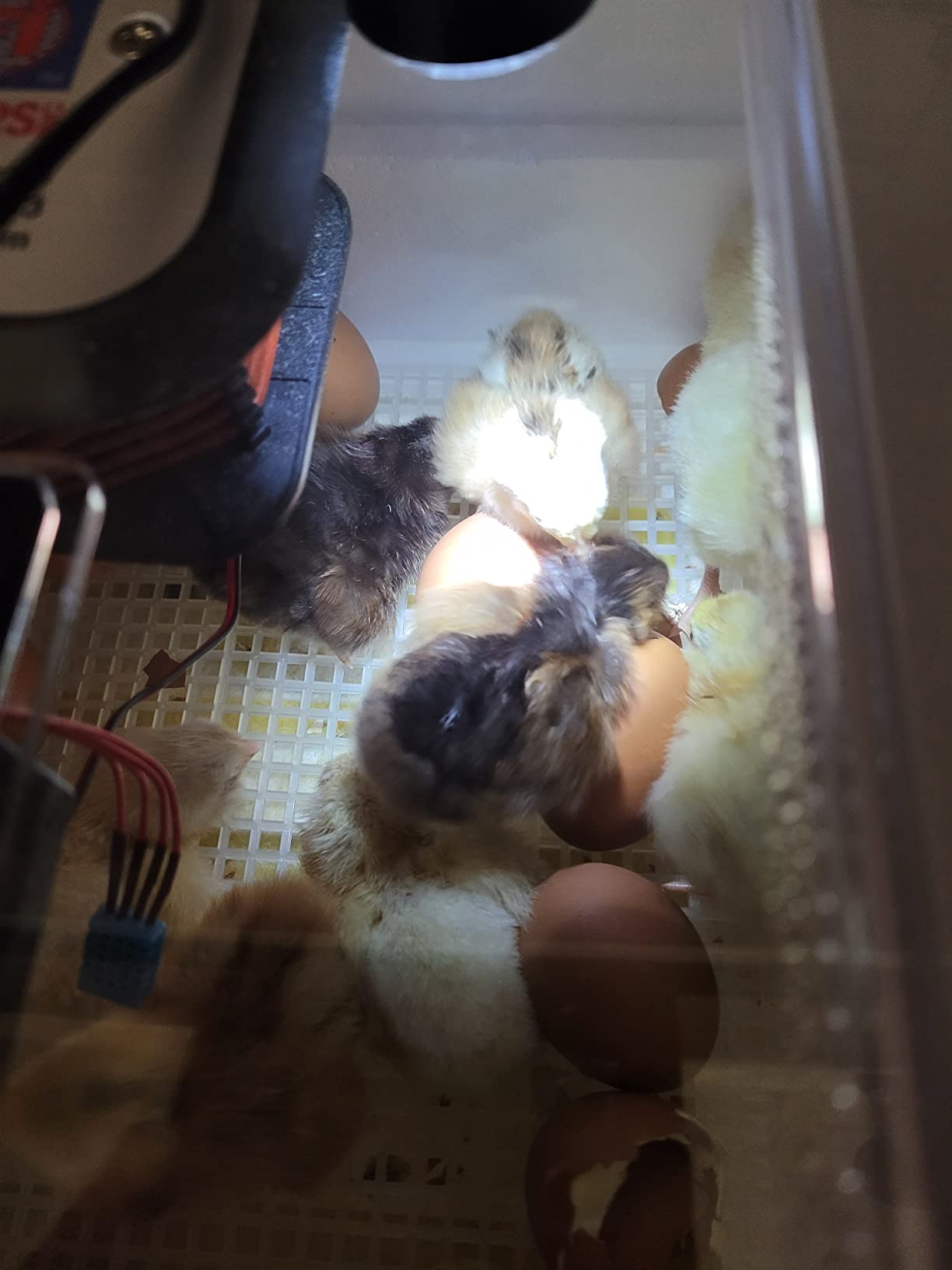
Owners rate it as a reliable, high-volume box that does the fundamentals correctly, with a 4.0 average across more than 2,200 reviews. The spec that matters most to a duck keeper is also the one that annoys people most: it heats to a factory pre-set of 100 degrees Fahrenheit within minutes, and you cannot easily change that set point.
Whether the fixed 100 degree set point is workable
For duck eggs, 100°F is a fraction above the 99.5°F that most keepers run in a forced-air unit, and the difference is small enough that many hatchers use this box as shipped. It becomes a problem in a warm room, where ambient temperature pushes the interior past the set point no matter what the thermostat is doing.
So the honest answer is: workable in a cool room, frustrating in a warm one. Verify the actual interior temperature with your own calibrated thermometer before you commit a valuable batch, and account for a couple of degrees of drift either way.
What foam construction means for ducklings and cleanup
Foam construction holds heat well and is why this class of incubator stays cheap. It is also a porous surface, which matters more in duck hatching than in chicken hatching, because ducklings are wet when they hatch and the tray and walls collect moisture and down for the rest of the brood.
Plan a full dry-down between batches, and wipe the surfaces while they are still warm rather than after. If you run duck eggs repeatedly, this is the unit to buy once and clean properly rather than the one to buy twice.
4. innhom 56 Egg Incubator – Best for Mixed Duck and Game Bird Loads
Incubators for Hatching Eggs, 56 Eggs Incubator with Egg Candler, Auto Egg Turner, Temp & Humidity Control, Hatch Day,360° Viewing for Chicken,Duck,Quail Eggs,Ideal for Farm,School and Lab,Blue&Yellow
56-egg capacity
8 adjustable dividers
Audible temperature and humidity alarm
Automatic humidity motor
Pros
- Dividers let duck eggs share a batch with quail
- Audible alarm catches temperature and humidity drift
- Humidity motor adjusts water drip automatically
- Large 56-egg chamber with 360-degree view
Cons
- Turning runs on a fixed two-hour interval
- Hose assembly must be fitted correctly for humidity to work
- Manual misting needed in the final days
What separates this 56-egg unit from the other budget cabinets is the divider system and the alarm. Eight adjustable dividers let you reconfigure the tray so duck eggs sit in one section and quail eggs, which are a fraction of the size, fill the rest. For a household that keeps ducks and quail, that removes the awkward problem of running two incubators for two very different eggs.
The alarm is the sleeper feature for duck eggs. It beeps and flashes if temperature strays beyond plus or minus 2°F, or if humidity varies by 10 percent from the set level, then re-alerts every 15 minutes for temperature and hourly for humidity. A duck cycle runs 28 days. A silent drift on day six is how a batch staggers across a week; a unit that tells you is worth more than one that does not.
Humidity comes from a control motor that meters water into the chamber, and the unit measures 19.5 by 16.5 by 7 inches at 9 pounds. The manufacturer lists chicken, duck, goose, quail and pigeon eggs as supported species, and an included sprayer covers the hand-misting step late in the cycle.
Reviewers like the alarm and the dividers, with a 4.1 average across 253 reviews. The recurring instruction is to follow the manual closely, particularly on the hose assembly, because the automatic humidity system does not work until that part is fitted properly.
How the alarm changes the way you run a 28-day cycle
Set the alarm thresholds once, at the start, and then check the display when it sounds rather than every few hours. That is the whole benefit: a 28-day run is long enough that daily manual checks drift into the background, and by day 20 nobody is looking at the box the way they did on day 2.
For duck eggs specifically, the humidity half of the alarm matters more than the temperature half. Temperature recovers on its own in a well-insulated box. Humidity does not, and a dry chamber in week three is what puts ducklings in the position of pipping externally and never getting free.
Whether a 56-egg rating means 56 duck eggs
It does not. That figure is a maximum across mixed egg types, and the useful comparison is the one the divider system itself gives you: standard eggs on one side, quail eggs filling the gaps. For a realistic duck count, treat the chamber as a mid-size waterfowl unit and load the sections you are actually using.
The trade-off for the capacity is a fixed two-hour turning interval with no user adjustment, and manual tray removal plus hand misting in the final days. If you can live with a set schedule and add your own thermometer, it is a lot of chamber for the money.
5. Onsju 18 Egg Incubator – Best for a Small Clutch or a Bantam Project
18 Egg Incubators for Hatching Eggs, Automatic Egg Turning and Humidity Control Incubator for Hatch Chicken Duck Quail Pigeon Pheasant Partridge Home Classroom Lab-
18 standard eggs or 40 small
Selectable turning intervals
Auto-regulated humidity
LED candler and clear dome
Pros
- Selectable 60
- 120 or 180-minute turning intervals
- Automatic humidity replenishment
- Built-in high-intensity LED candler
- Compact 11.7-inch footprint
Cons
- Smallest duck egg capacity in the roundup
- Setup and reset must follow the manual closely
Eighteen standard eggs is the smallest duck capacity here, and for a lot of keepers that is exactly right. A bantam duck lays four to eight eggs at a time. A first hatch from a single pair of Mallards might be a dozen eggs, and a compact unit on a counter in a warm room is easier to run and easier to keep at a stable temperature than something the size of a small suitcase.
The turning system is the part that separates it from the other small boxes. You can select 60, 120 or 180-minute intervals, and the unit pauses automatically 96 hours before the hatch date. A display indicator lights to confirm the stop. Keepers who hatch bantam ducks mention a Brinsea as their usual choice for that reason, and this unit offers the same kind of turning control in a much smaller footprint.
Humidity is handled by a sealed system that replenishes automatically across the cycle, so you are not counting days between water additions. A high-intensity LED candling light and a 360-degree clear dome let you check fertility and development without opening the lid, and the chamber measures 11.73 by 11.73 by 6.85 inches at 5.43 pounds.
Owners rate it 4.3 across 404 reviews and call out the candler, the dome and the adjustable turning. The consistent advice is to follow the manual for setup and resetting, and to remember that 40 eggs means quail or parrot eggs, not duck eggs.
Whether 18 eggs is enough for a first duck hatch
For a first hatch, yes, and for bantam ducks specifically it is the right number. The manual for duck eggs recommends setting eggs in small groups rather than one large batch, so a successful small hatch also gives you healthy breeding stock to expand from. A clutch of 12 with 8 or 9 ducklings is a strong result.
Where the capacity stops working is a multi-bird flock. If you expect to collect more than 18 fertile eggs in a week, you will run this box in series, and each run needs its own day 25 lockdown date. Note also that Muscovies need 35 days, so a fixed 96-hour pre-hatch pause lands on day 31, seven days short of what you want.
How auto humidity compares to a manual water channel
Auto replenishment is the quiet advantage here. On a manual channel, the water level, the room humidity and the amount of surface area all interact, and you learn to read the box by eye over a season. An automatic system responds to a change in conditions without you, which is what makes a two-week unattended stretch safe.
The sealed construction also limits outside interference, which is a real advantage in a humid room. In a dry room, watch the final week: the system is holding a range, not pushing to 70 to 80 percent, so lockdown still takes manual top-ups on most of these units.
6. Brinsea Ovation 56 EX Incubator – Most Compact for Serious Waterfowl Breeders
Brinsea Ovation 56 EX Egg Incubator, Automatic Turning & Humidity Control
56 chicken eggs with large-egg carriers
Pump-fed automatic humidity
Induced dual airflow
3-year warranty
Pros
- Pump-based humidity removes the main cause of hatch failure
- Programmable turning intervals suit duck schedules
- Audible alarms for temperature and power loss
- Three-year warranty with US support
Cons
- Large-egg carriers for duck and goose are a separate purchase
- Higher cost than a 30-egg unit for the same humidity control
The Ovation 56 EX is the one unit in this roundup that takes humidity out of your hands entirely. An integrated pump draws from an external reservoir and meters water into the chamber, so the box holds its humidity band without you opening the lid to add water. On a 28-day duck cycle you will top that reservoir up maybe twice. Brinsea’s own framing is that uncontrolled humidity is the number one cause of hatching failure, and this is the hardware answer to that.
Turning is programmable, which is the feature that matters for Muscovy. Instead of a fixed 96-hour pre-hatch pause, you set the schedule to match a 35-day cycle. On Backyard Chickens, owners running goose and large waterfowl eggs single this unit out for being nearly set and forget, partly because of the programmable cooling and turning windows.
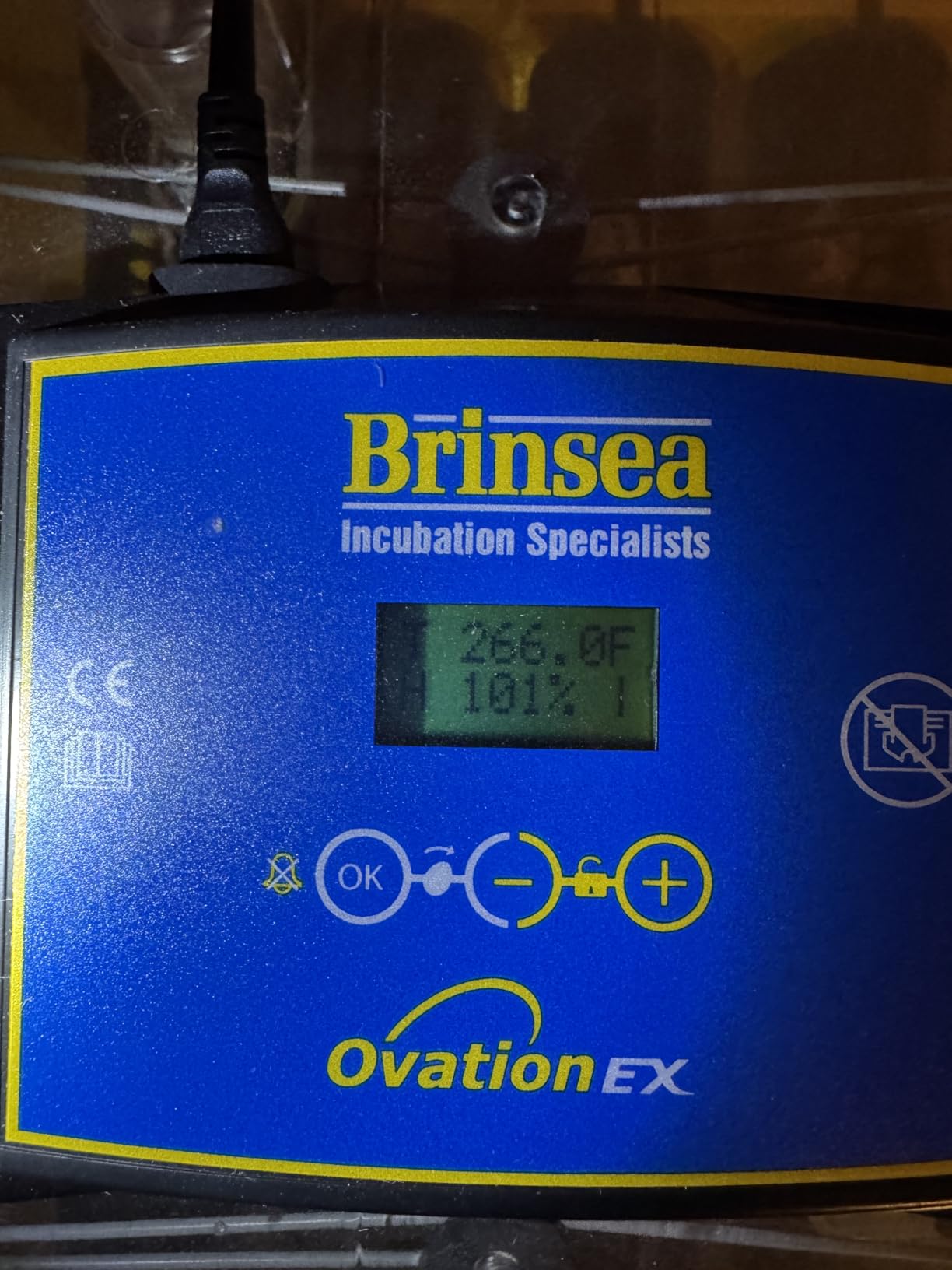
The digital screen shows temperature in F and C, humidity percentage, and turning status, and audible alarms cover both temperature deviation and a power interruption. The induced dual airflow system moves air across the full 56-egg chamber, which matters when the tray holds large waterfowl eggs. Construction is ABS plastic with Biomaster antimicrobial protection, rated at 11 pounds and measuring 22 by 15 by 9 inches, with a clear top for viewing.
Rated 4.4 across 388 reviews, the feedback centres on humidity accuracy, programmable turning and build quality. It is UK-manufactured with a 3-year warranty and US-based support.
How much duck capacity you get and what it costs you in extras
The 56 figure is chicken eggs with the standard carriers. Optional large-egg carriers are what make it a duck and goose incubator, and they are a separate purchase. For a keeper whose primary interest is ducks, factor that add-on into the real spend before choosing this over a 30-egg unit that includes everything.
What you get for that spend is the pump, the alarms, the programmable schedule and a warranty that runs three years. If you are hatching annually for a flock rather than experimenting with a clutch, those are the features that remove failures, and the capacity stops being the deciding factor.
Whether set and forget survives a duck cycle
Closer than anything else here, and it comes with a caveat that applies to all of them: buy your own calibrated thermometer and hygrometer anyway. Forum threads about this brand are full of keepers comparing its readings against an independent monitor, generally with good results, but the habit of verifying costs nothing and protects a batch worth real money.
The realistic failure points are mechanical, not electronic. A reservoir that runs dry, a pump hose that kinks during the night, or a tray that shifts in the frame. The audible alarm for power interruption is what catches the version of this that actually costs you a hatch.
7. Brinsea Maxi 24 EX Incubator – Best Compact Unit with Large Egg Inserts
Brinsea Maxi 24 EX Egg Incubator with Automatic Turning & Humidity Control
24 standard, 12 large, 8 jumbo, 40 small eggs
Four quadrant inserts
Automatic pump humidity
12 x 12 x 8 inches
Pros
- Quadrant inserts hold 12 large duck eggs in a small footprint
- Readings verified accurate against calibrated monitors
- Biomaster-treated plastics wipe clean easily
- 3-year warranty
Cons
- Pump tubing loop is fiddly to set up
- Cardboard inserts are consumable
- One reviewer reported pump flooding
The Maxi 24 EX is the smallest premium unit here, and its quadrant insert system is genuinely useful for duck eggs. Four size-specific inserts mean you can build a batch of 12 large eggs, or 8 jumbo eggs, or 40 small ones, or a mix. If you keep bantam ducks alongside standard breeds, a keeper on r/duck describes Brinsea as an excellent choice for bantam-sized eggs, and the insert system is why.
It measures 12 by 12 by 8 inches, so it fits on a shelf where a 56-egg cabinet will not. That is a real constraint in a small coop or a spare room. Automatic humidity control, fan-assisted air circulation, high and low alarms, and a fully digital interface showing turning status, temperature and humidity percentage are all standard here.
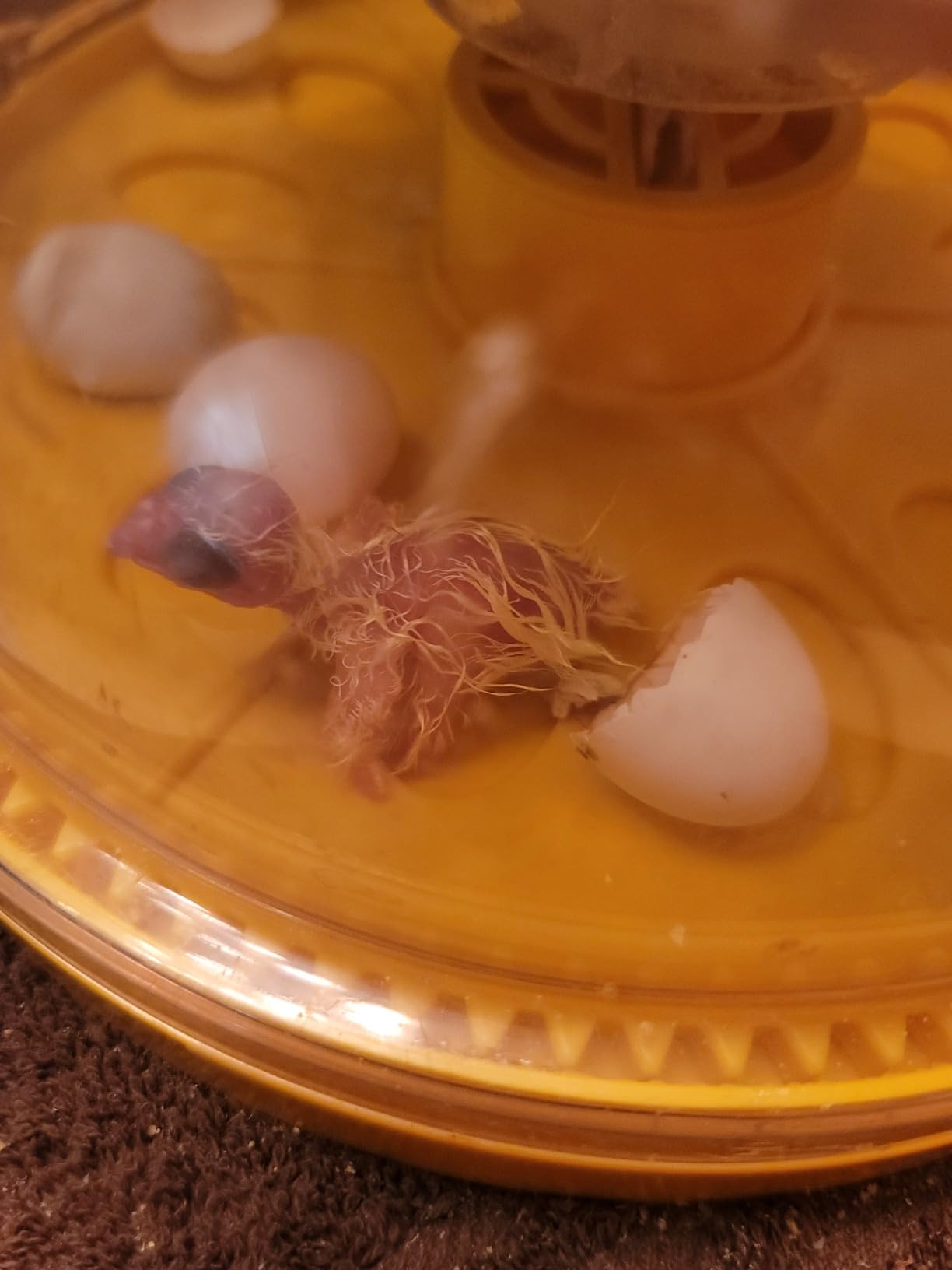
Reviewers report that the temperature and humidity readings hold accurate when checked against a calibrated monitor, and several describe successful hatches of goose, duck and chicken eggs once the unit was configured. Rated 4.2 across 112 reviews, the recurring gripe is not performance but setup: the pump tubing loop is fiddly to install and the instructions confuse people on first read.
There is also a Connect variant that sends app notifications on temperature, power or WiFi loss and retains your settings through an outage, which is worth considering if you are not sleeping beside the incubator for 28 days.
Whether 12 large duck eggs is a realistic working number
Twelve is the honest figure, and it is measured in large eggs rather than standard ones, which puts it ahead of some nominally larger units. Expect a full batch of 12 with no spare slots. A dozen ducklings from one cycle is a meaningful addition to a backyard flock, and for a beginner it is a manageable number of brooder spaces.
Plan on buying spare cardboard quadrant inserts, because they are a consumable part and the set is not always deep enough to replace a damaged one immediately. Setup time on the pump loop is the other thing to budget for: get it running empty for a day before you trust it with eggs.
How the pump compares to a water channel over 28 days
A pump delivers narrower control because it meters water rather than relying on surface area, and the tradeoff is dependence on plumbing. One reviewer reported the pump flooding water uncontrollably, which is a small sample but a real category of failure, and the reason the unit carries a temperature and humidity alarm rather than a passive channel.
Once configured, the pump removes the daily top-up habit entirely. For a keeper who travels for work mid-cycle, that difference is worth more than the extra capacity of a cheaper unit.
8. Hatching Time CT180SH Set and Hatch Incubator – Best for Small Hatcheries
Hatching Time Incubators for Hatching Eggs, CT180SH Egg Setter & Hatcher
Up to 120 duck eggs per batch
Set and hatch in one cabinet
Active Periodic Cooling
Humisonic humidity system
Pros
- Set and hatch in one cabinet
- 120 duck eggs per batch
- Scheduled cooling and moisture release
- Digital control with room sensors and alarms
Cons
- Goose and peacock eggs need separate racks
- Bulky 42-inch tall cabinet
- Hatchery-scale running cost
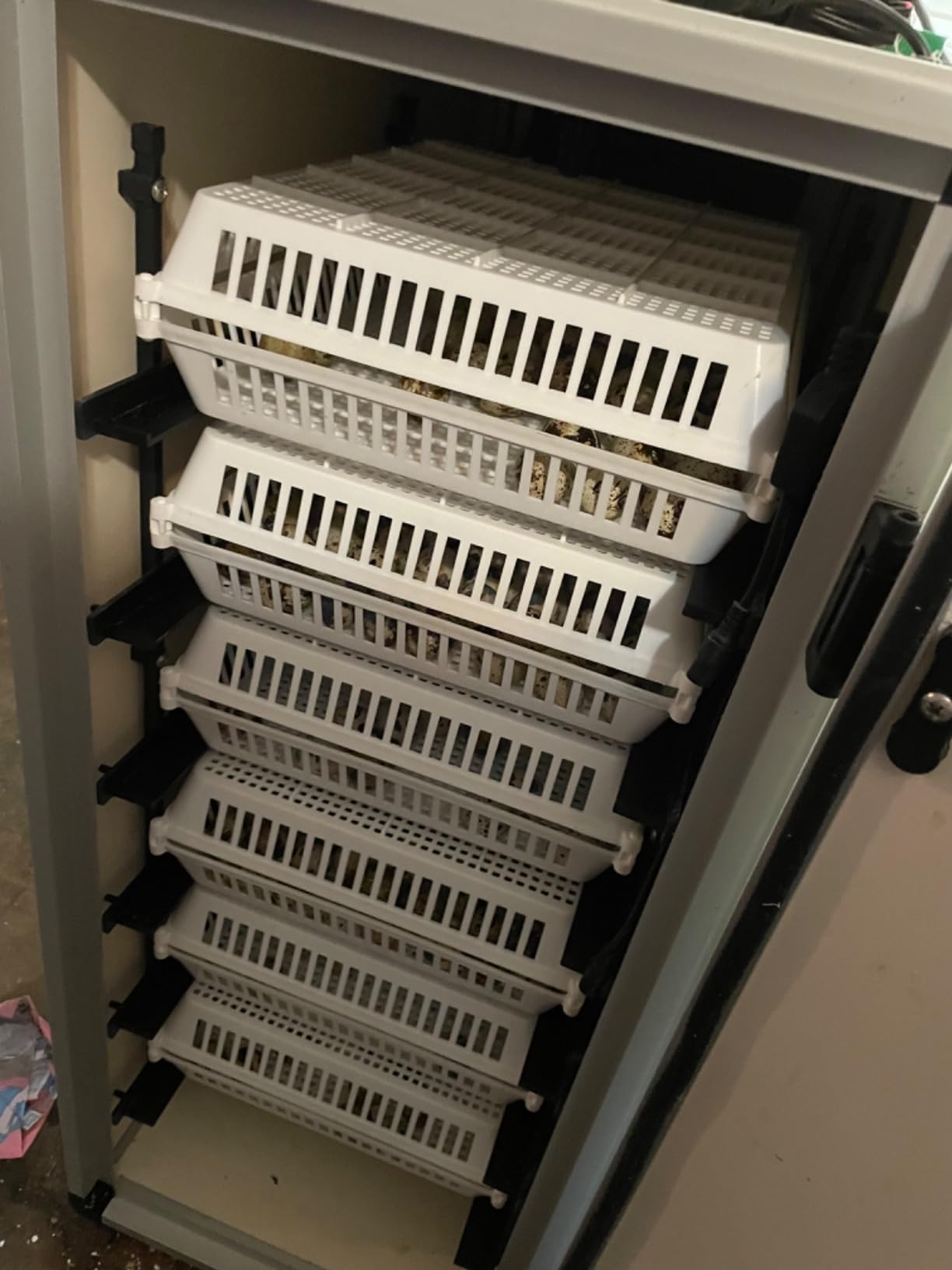
The CT180SH is a different category from the rest of this list. It handles setting and hatching in a single cabinet, so the Conturn automatic turners run during incubation, then you swap to the included hatching baskets for the final days without moving a single egg between machines. For a keeper running batches on a schedule, removing the move-to-hatcher step removes a whole category of mistake.
Capacity is the headline: up to 180 chicken eggs, and 120 duck or turkey eggs per batch, with additional figures for pheasant, partridge and quail. Goose and peacock eggs need GT03 racks and full quail capacity needs QT13 racks, both sold separately.
Active Periodic Cooling is the feature that maps most directly onto duck hatching practice. It runs scheduled cooling and moisture-release cycles, which is the built-in equivalent of the day-8-onward lid-off and misting routine that community hatching guides recommend. Humisonic supplies humidity under digital control, and high and low temperature and humidity alarms with room sensors cover the whole cabinet.
It is a floor-standing cabinet, measuring 24.5 by 17 by 42 inches and weighing 49 pounds, built for indoor use in a temperature-controlled room. It draws an average of 70 watts with a 200 watt maximum on 110V power.
Whether a 120 egg duck batch is realistic on a single run
Yes, and that is exactly the point of the cabinet format. Where a 30-egg desktop unit means four staggered duck batches across a month, one of these runs the whole season’s eggs in parallel. Scheduled cooling matters more at 120 eggs than at 12 because no keeper is hand-misting a tray that size twice a day, so the cabinet has to do it.
The realistic constraint is the room. A 42-inch cabinet in a temperature-stable indoor space, with a power outlet and floor space you are not using for anything else, is a different commitment than a box on a counter.
How the scheduled cooling compares to a manual lid-off routine
Automated cooling is consistent in a way manual cooling is not. A keeper who forgets the daily 15-minute lid-off on day 12 still performs it on day 26, but by then the shell membranes have already dried at whatever rate the humidity sat for two weeks.
Verify the scheduled cooling against the rest of your protocol before you run a full 120-egg batch, and use the first cycle as the calibration run. The manual lid-off and misting habit from day 8 is still worth doing by hand if your climate runs dry, since a scheduled cycle cannot be adjusted the way a manual one can.
How to Choose an Egg Incubator for Duck Eggs
Calculate duck egg capacity from the chicken egg number
Most manufacturers quote capacity in chicken or standard eggs, and duck eggs are roughly a third larger. That gap is why a 22-egg box that holds 22 chicken eggs holds 12 to 18 duck eggs, and why a 56-egg figure across mixed species is a ceiling rather than a duck count. Only the Harris Farms in this roundup states a duck number directly, which is worth more than it looks.
A second conversion worth knowing: quail eggs are the other extreme. A unit rated at 18 standard eggs may hold 40 quail eggs, so any capacity claim that mixes species is telling you about the tray layout, not about your duck batch.
Forced air versus still air, and why ducks care more
A still-air incubator heats its own air and lets it stratify, which is why the reading at the top of the box differs from the reading at the bottom. Chicken eggs are small enough that this difference is tolerable. Duck eggs are not, because the ones sitting near a wall or in a corner can run a degree or more off the intended set point for the full 28 days.
Forced air, also called circulated or induced air, uses a fan to move the same air across every position in the chamber. On a duck cycle that turns one reading into a real number. Of the eight units here, all but the smallest dome-style box list a fan, and the two that do not are the ones where you are relying on a single thermometer at the top of the chamber.
Humidity control is the setting that decides your hatch rate
Run 50 to 55 percent relative humidity for the first 24 days. That may feel low, and it is. Duck eggs need a large enough air cell at the end so the duckling can start breathing once it pips internally. Raise humidity too early and you get a tiny air cell and a duckling that suffocates on day 28 with no visible struggle.
Then jump to 70 to 80 percent for the final three to four days. This is where the budget boxes earn their reputation for disappointing duck keepers: a shallow water channel and a small chamber may never reach 70 percent in a dry room, and the result is a duckling that pips externally and cannot push free. Is 75 percent too high? No, for the lockdown window it is the target.
What determines success is whether you can hit that number on demand. Pump-fed systems, larger water channels and external refill ports all make the final-week adjustment easier. So does an independent hygrometer sitting inside the chamber next to the built-in one, which is the single accessory no keeper should skip. Keeping the surrounding room stable helps too, and our notes on why a warm room stays warm and what that does to stored water cover the same steadiness question from a different angle.
A day-by-day duck egg schedule that works
Days 1 to 7: 99.5°F, 50 to 55 percent humidity, turn three to five times a day or leave the auto turner running. Candle on day 7 to remove infertile eggs. Keep the lid closed.
Days 8 to 13: Begin daily cooling and misting. Lift the lid for about 15 minutes once a day and mist the eggs with plain water, then close up. Keep humidity in the incubation band. Candle around day 14.
Days 14 to 24: Continue the cooling and misting routine, check the air cell against a candler on a clear egg, and watch humidity weekly because the eggs are now losing water faster.
Day 25: Lockdown. Stop turning, remove the turner, and lay the eggs on their sides. Raise humidity to 70 to 80 percent. Do not open the lid again.
Days 25 to 28: No opening, no misting. Some keepers spray warm water on the outside of the closed lid to entice external pips, but keep the chamber itself sealed.
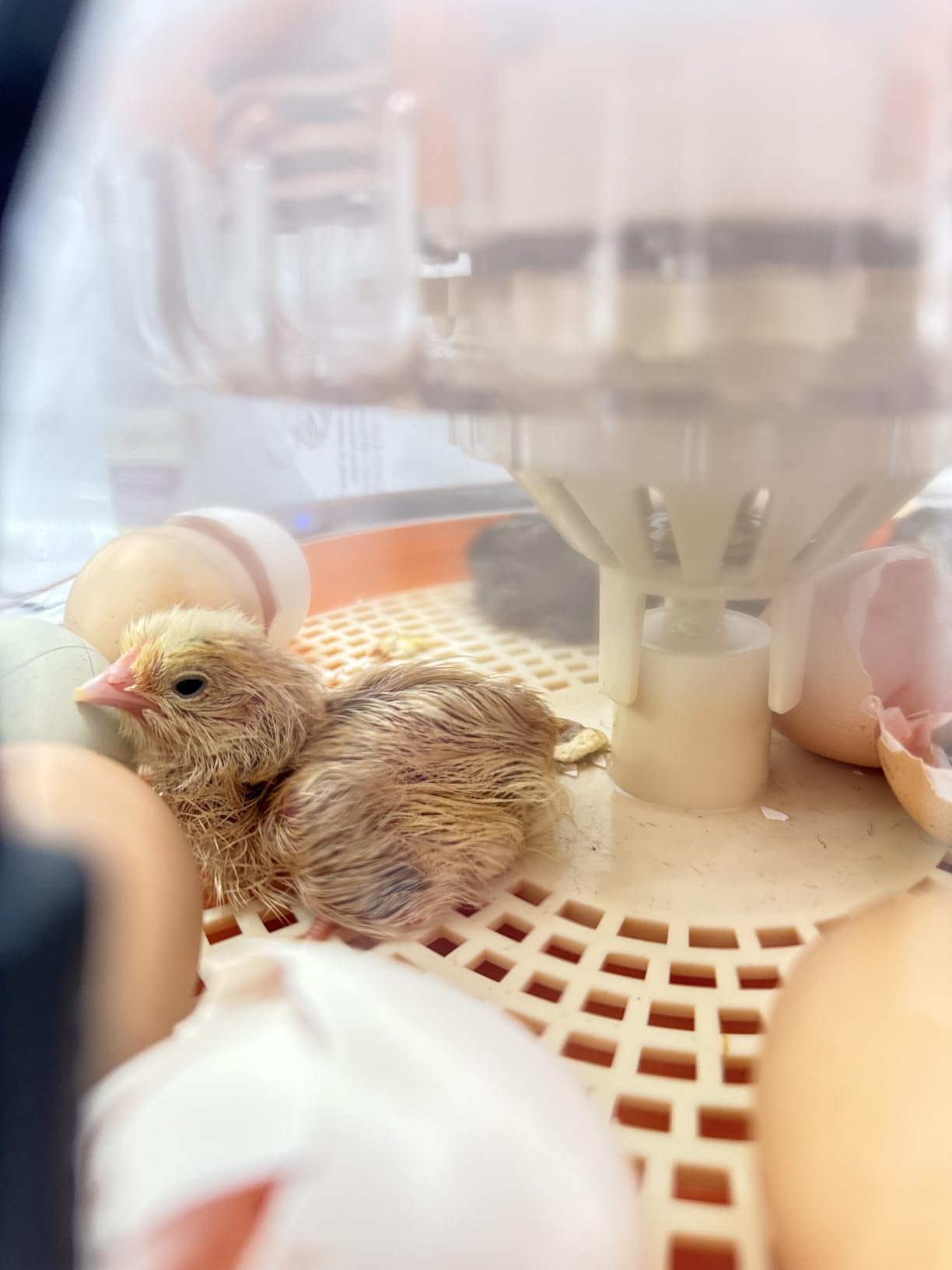
Day 28 and beyond: If ducklings have not hatched, leave them in. Move the hatched ducklings out once they are dry, leave the unhatched eggs in place, and give them several more days. Some keepers report success on day 32 or later.
Two keepers on r/duck describe running one water bottle through incubation and adding the second only at lockdown, which is a simple way to step humidity up without a refill habit. In a humid room, the reverse is the standard move: a dry hatch, where you remove the water entirely and rely on ambient humidity plus the misting routine.
Muscovy eggs need a different calendar
Muscovy duck eggs take 35 days instead of 28. That single change cascades through your whole setup: lockdown lands on day 32 rather than day 25, the auto-stop on a fixed timer fires seven days early, and any cooling or misting schedule written for 28 days ends before the eggs are ready.
Run Muscovies in their own batch with their own calendar if you can. The alternative is programmable turning, which is the argument for the Brinsea units in this roundup over the budget boxes with fixed schedules. One keeper on r/duck reported 5 of 12 Muscovy hatching at around 35 days while holding 99.5°F and 50 to 60 percent humidity, which is a useful reality check: even with correct settings, Muscovy is the least forgiving egg in the hobby.
Can you hatch duck and chicken eggs in the same incubator
You can, and the temperature is not the obstacle: 99.5°F for ducks against 99.5°F for chickens in a forced-air cabinet. The obstacle is the calendar. Chicken eggs lock down on day 18 and hatch on day 21, so a shared chamber means opening the lid and raising humidity to 70 percent while 40 duck eggs are still at day 21 and need 50 to 55 percent.
If you combine them, set the chicken eggs first and expect a disruptive handover around day 18. The adjustable dividers on the innhom and the quadrant inserts on the Brinsea Maxi 24 EX make the physical separation easy; the humidity handover is the part that needs managing. It is doable, and plenty of keepers do it, but a separate run is cleaner.
The mistakes that end duck hatches
Trusting the supplied thermometer without checking it against your own. A degree of drift over 28 days staggers a whole batch.
Forgetting to stop the turner at lockdown, so ducklings pip against a moving tray.
Running humidity too high early, producing a small air cell and ducklings that suffocate internally.
Never reaching 70 to 80 percent in the final week, producing external pips that never open.
Opening the lid repeatedly to check on eggs, dropping temperature and humidity each time. On r/duck, keepers recommend limiting openings to the two candling days.
Orientating the eggs fat-end up in the turner and laying them correctly once the turner is removed. Eggs in a turner rack are easier to lay wrong and no keeper wants to do it twice.
Mixing a hidden Muscovy egg into a 28-day batch and then not knowing which lockdown date applies.
On the auto-turner question keepers raise most often: many rack turners rock eggs through a short arc rather than rotating them fully. Some of the highest hatch rates reported in community threads come from units with the turner removed entirely and eggs turned by hand. If you go that way, budget three to five minutes a day for 24 days, and you will need the tray space the turner was using.
Frequently Asked Questions
What should my incubator be set at for duck eggs?
Set a forced-air duck egg incubator to 99.5 F (37.5 C) with humidity at 50 to 55 percent for the first 24 days. From day 25 through hatch, stop turning and raise humidity to 70 to 80 percent. Duck eggs need 28 days, or 35 for Muscovy.
What humidity do duck eggs need in the incubator?
Duck eggs need 50 to 55 percent relative humidity for days 1 to 24, then 70 to 80 percent for the final three to four days before hatch. The early setting keeps the air cell large enough for the duckling to breathe once it pips internally. The high lockdown setting softens the shell so the duckling can push free.
How long should I leave unhatched duck eggs in the incubator?
Leave them in. Once a duckling hatches and dries, move it out and leave the unhatched eggs in place, adding water if humidity has dropped. Hatch dates vary with how the eggs were stored and how steady the temperature was, and keepers report success on day 32 or later. Do not open the lid in the days before the expected hatch.
When should I take duck eggs out of the automatic turner?
Stop turning on day 25 for a 28-day duck cycle. Remove the turner, lay the eggs on their sides, raise humidity to 70 to 80 percent, and do not open the lid again. For Muscovy eggs, which take 35 days, the correct point is day 32, so a unit with a fixed 96-hour pre-hatch stop needs to be switched off manually.
Do duck eggs need misting or cooling during incubation?
Most keepers cool and mist from day 8 onward. Lift the lid for about 15 minutes once a day and mist the eggs with plain water, then close the unit. This gives the developing ducklings a daily change that a sealed chamber lacks, and community hatching guides credit it with better late-stage survival. Keep humidity in the incubation band during this period.
What is the best incubator for duck eggs?
For most backyard keepers, the Harris Farms Nurture Right 22 Egg Incubator is the best first choice because it is the only unit here with a stated duck egg capacity of 12 to 18, a forced-air fan and an auto-stop turner. Larger waterfowl operations do better with a unit built for a full clutch, such as the Farm Innovators 41 with its deep egg tray.
Final Picks for Duck Egg Incubators in 2026
The best egg incubators for duck eggs come down to one honest question: how many eggs are you setting at once. For a clutch of 12 to 18, the Harris Farms Nurture Right is the pick we would buy first, because a stated duck capacity and a forced-air fan remove the two mistakes that cost beginners the most hatches. For a full waterfowl batch, the Farm Innovators 41 earns its place with a deep tray built for large eggs, and the innhom 56 adds a drift alarm that is worth more over 28 days than its fixed turning schedule costs you.
If humidity control is the part you do not want to think about, the Brinsea Ovation 56 EX pumps its own moisture and lets you program the turning schedule, which also makes it the right unit for Muscovy eggs at 35 days. The Brinsea Maxi 24 EX brings that same electronics down to a 12-inch footprint for keepers with no shelf space. A hundred-plus duck eggs at a time, and no interest in moving eggs between machines, points to the Hatching Time CT180SH.
Whichever one you choose, buy a separate thermometer and hygrometer before you set the eggs, keep the lid shut between the two candling days, and plan your lockdown date the day you set. That last habit is free, and it is the one that most reliably decides whether a batch hatches clean or hatches late. For more background on how eggs and temperature behave, our guide to why water smells like rotten eggs and the sulfate link behind that smell covers the chemistry side of a warm room that never cools down. Comfortable seating while you wait out 28 days is covered in our best egg chairs tested and reviewed roundup as well.