
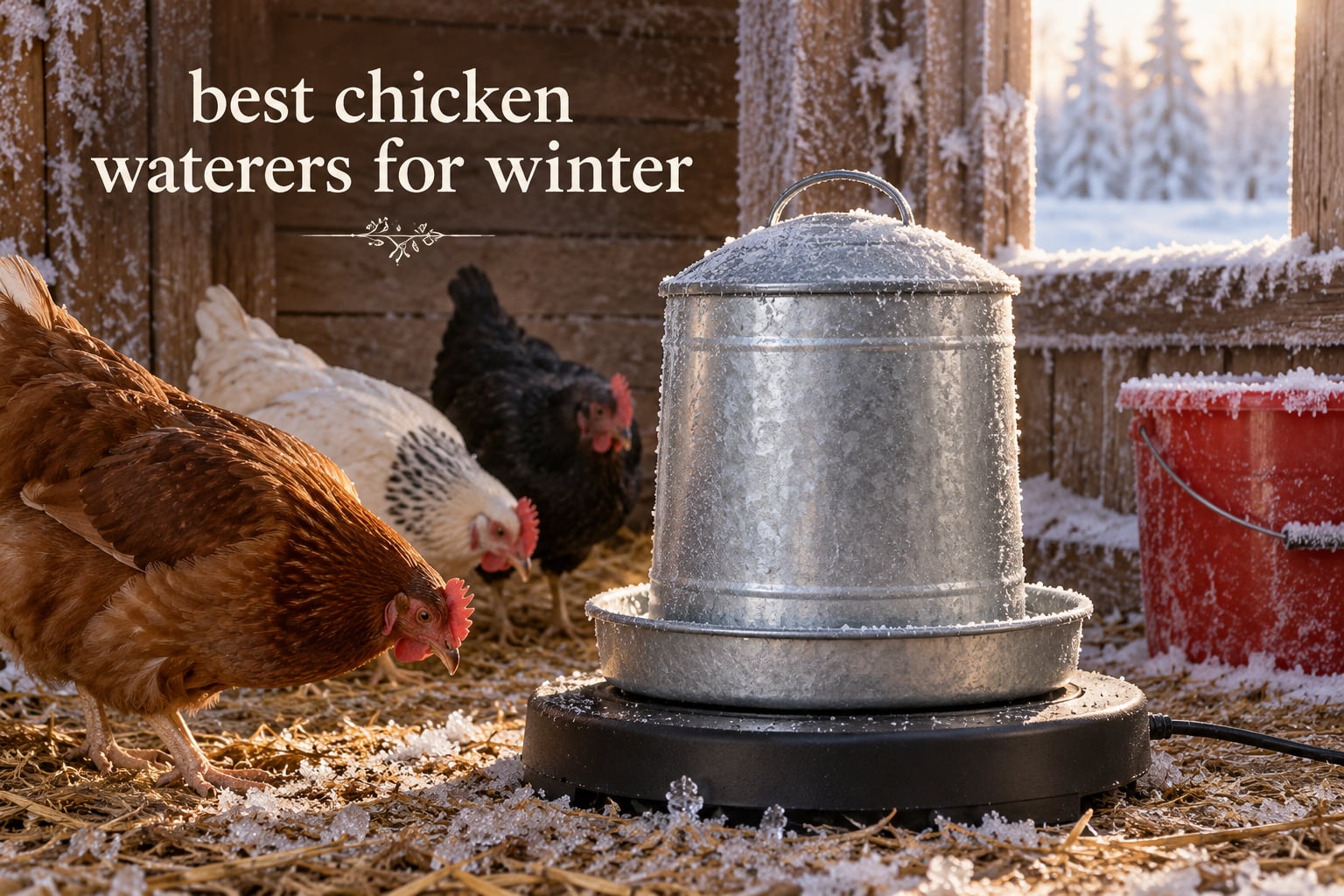
The alarm went off at 6:40 on a January morning and the water inside the coop fount was a solid block of ice. Two dozen hens were milling around a frozen bucket, and the fix was a thermos of warm water that had to be carried out in the dark before dawn. That scene repeats in backyard coops across the country every winter, and it is why searching for the best chicken waterers for winter is less about convenience and more about keeping a flock alive through a stretch of subzero nights.
Water is the one thing a chicken cannot improvise around. When birds cannot drink, feed intake drops, egg production stops, and dehydration becomes dangerous within a day or two. In cold weather the risk is worse, because a bird that stays dry and cold burns energy fast. A heated waterer removes the daily gamble of breaking ice by hand, but only if you pick the right type for your flock, your climate, and your coop electrical setup.
We spent the past season working through twelve heated chicken waterers and heated waterer bases, weighing them on published freeze ratings, thermostat behavior, cord length, energy draw, and what owners actually say after a full winter of use. Every product below carries a verified rating and review history, so you can see where the consensus holds and where it splits. Updated for 2026, this guide covers nipple drinkers, open troughs, warming plates for existing founts, and wrap-around belt heaters for standard buckets.
Table of Contents
Top 3 Best Chicken Waterers for Winter (October 2026
Our three favorite setups cover the widest range of backyard situations. The Farm Innovators HB-60P takes the overall spot for its long record and its side-mounted nipples, the Farm Innovators HP-125 base is the pick when you already own a metal fount, and the Omlet 3 gallon unit leads on owner satisfaction for mixed flocks.

Farm Innovators HB-60P 2 Gallon
- 60W thermostatically controlled
- Side-mounted drip-free nipples up to 15 chickens
- Removable top and metal handle

Farm Innovators HP-125 125W Base
- Activates below 35F
- Fits 3 and 5 gallon metal founts
- Protective bottom cover over the element

Omlet 3 Gallon Insulated Waterer
- Insulated BPA-free walls
- Cups and nipples both included
- Anti-roost locking lid
All 12 Winter Chicken Waterers Compared in 2026
Every waterer in the table below is rated for continuous cold-weather use, but they split into two families. Integrated heated waterers heat their own reservoir. Heated bases and belts warm a separate container you already own. Wattage, freeze rating, and cord length are the three numbers that separate them in practice.
| Product | Specifications | Action |
|---|---|---|
| Farm Innovators HB-60P 2 Gallon 60W |
|
Check Latest Price |
 Premier 1 All-Season 3 Gallon Premier 1 All-Season 3 Gallon |
|
Check Latest Price |
| Omlet 3 Gallon Insulated Waterer |
|
Check Latest Price |
 API 3 Gallon Heated Waterer API 3 Gallon Heated Waterer |
|
Check Latest Price |
| Farm Innovators HP-125 125W Base |
|
Check Latest Price |
 GUEOQTC 11 Inch Heated Base GUEOQTC 11 Inch Heated Base |
|
Check Latest Price |
 Zoblise 14.6 Inch 125W Base Zoblise 14.6 Inch 125W Base |
|
Check Latest Price |
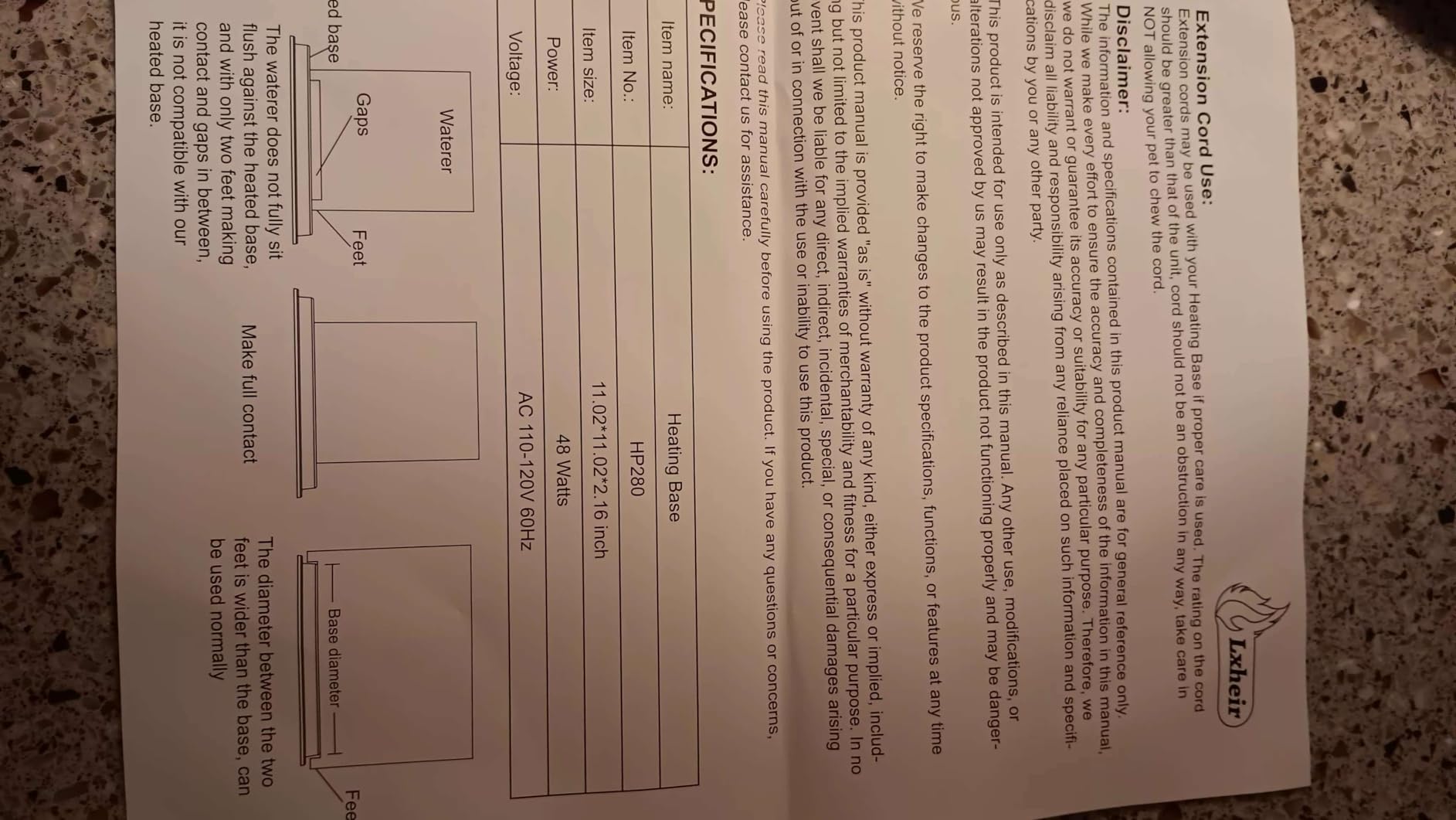
 Lxheir 13 Inch 35W Base Lxheir 13 Inch 35W Base |
|
Check Latest Price |
 My Favorite Chicken 28W Base My Favorite Chicken 28W Base |
|
Check Latest Price |
 Myodal 62W Stainless Base Myodal 62W Stainless Base |
|
Check Latest Price |
 Gsbomzap 55W Heated Base Gsbomzap 55W Heated Base |
|
Check Latest Price |
 RentACoop Thermo Bucket Belt RentACoop Thermo Bucket Belt |
|
Check Latest Price |
Two patterns jump out. Only four products publish a specific freeze temperature, which means most claims of cold-weather capability are marketing rather than measurement. And the highest wattage does not equal the best heater: a larger metal fount on a wider plate conducts heat far better than a small plastic jug, so the 35W and 40W options can hold water liquid in conditions that defeat a poorly sized 100W unit.
1. Farm Innovators HB-60P 2 Gallon 60W – Best Overall
Farm Innovators HB-60P Heated Poultry Waterer Drinker, 2-Gal, 60W
60W thermostatically controlled
2 gallon capacity
Up to 15 chickens
2.58 lb, 12 x 12 x 11 in
Pros
- Keeps water liquid through repeated hard freezes
- Thermostat runs only when water temperature drops
- Side-mounted drip-free nipples suit up to 15 chickens
- Removable lid makes refilling fast
- Metal handle for hanging or ground placement
Cons
- Birds new to nipples need training
- 2 gallons is small next to 3 gallon rivals
- Occasional reports of the plug not seating fully
This is the waterer we keep coming back to. It has been on the market since 2011 and carries 6504 reviews averaging 4.2 stars, which is the deepest owner history of any heated unit in this group. Owners consistently describe it as the one they forget about, which is the highest compliment for a piece of coop hardware.
The 60 watt element is thermostatically controlled, so it draws power only when the water actually needs warming. The side-mounted nipples are positioned low and angled outward, which reduces litter blowback compared with vertical nipples on the underside. Those nipples are rated as drip-free and freeze-free, and the manufacturer sizes the unit for up to 15 chickens.
Two gallons is the honest limitation. For a flock of eight to twelve hens that works fine on a two-day refill cycle. For a larger flock you would be topping it up daily in freezing weather, and a 3 gallon model is a better fit. The removable top and metal handle do make that refill easy even with gloved hands.
Keepers who have used it report two recurring checks worth building into your routine. First, confirm the power plug is fully seated, since a partially seated plug stops heating without any visible warning. Second, if your birds are new to nipple drinkers, plan on training time before the first cold snap rather than during it.
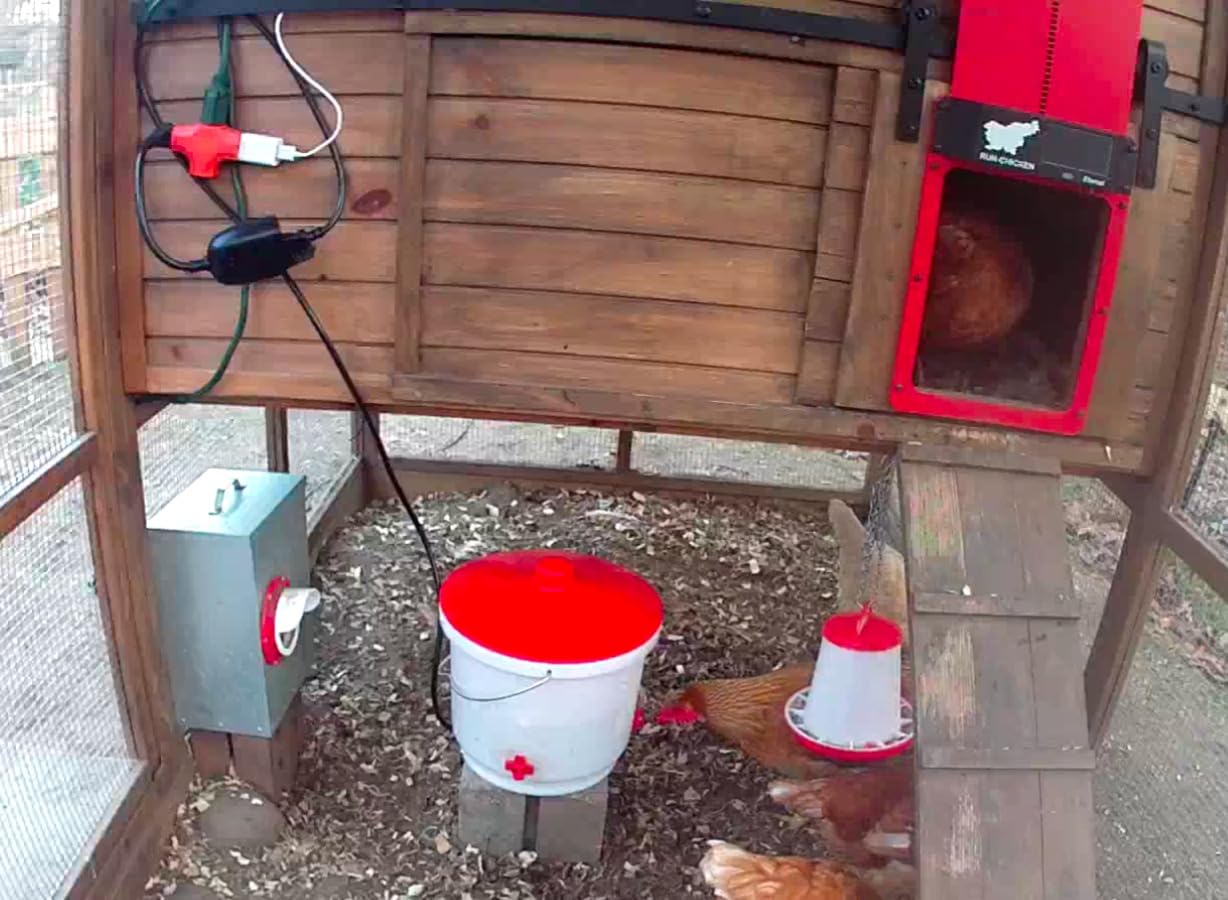
What you should know before you order
The 60 watt draw is modest enough that most runs continuously in deep cold without pushing a household circuit. At 60 watts, running 24 hours for a full month consumes about 43 kilowatt hours, which is roughly the same energy as a couple of days of a small window air conditioner.
Measure your coop first. The unit is 12 by 12 by 11 inches and weighs 2.58 pounds, so the handle will not strain a hanging hook or a wall bracket. Confirm that your run or coop has a protected outlet within reach, because this unit ships with a cord that is shorter than the 16 foot detachable cord on the Premier 1.
Where it falls short
The nipple layout is the main behavioral hurdle. Birds raised on a trough or fountain often ignore nipples for the first day or two, and cold weather is the worst possible time to introduce one. Start training in early fall and the problem disappears.
Two gallon capacity also means more trips than larger units, and the plastic construction is less insulating than a metal fount on a heated base. If your winters are consistently below 0°F, a 125 watt plate under a double-wall metal fount gives you more thermal mass.
2. Premier 1 All-Season 3 Gallon 100W – Best for Ducks and Chickens
Premier 1 All-Season Heated Poultry Waterer for Chickens & Ducks – 3 Gallon
100W thermostat, on below 40F
3 gallons, up to 35 chickens
16 ft detachable cord
6.3 lb
Pros
- Holds water unfrozen in single-digit and negative temperatures
- Recessed nipples keep water clean and remove daily scrubbing
- Hinged fill cap accepts a hose or watering can
- Heavy-duty handle for carrying and hanging
- Detachable cord allows year-round use
Cons
- Some units freeze at exposed nipples in wind chill
- Replacement cord not sold through Amazon
- Birds need nipple training
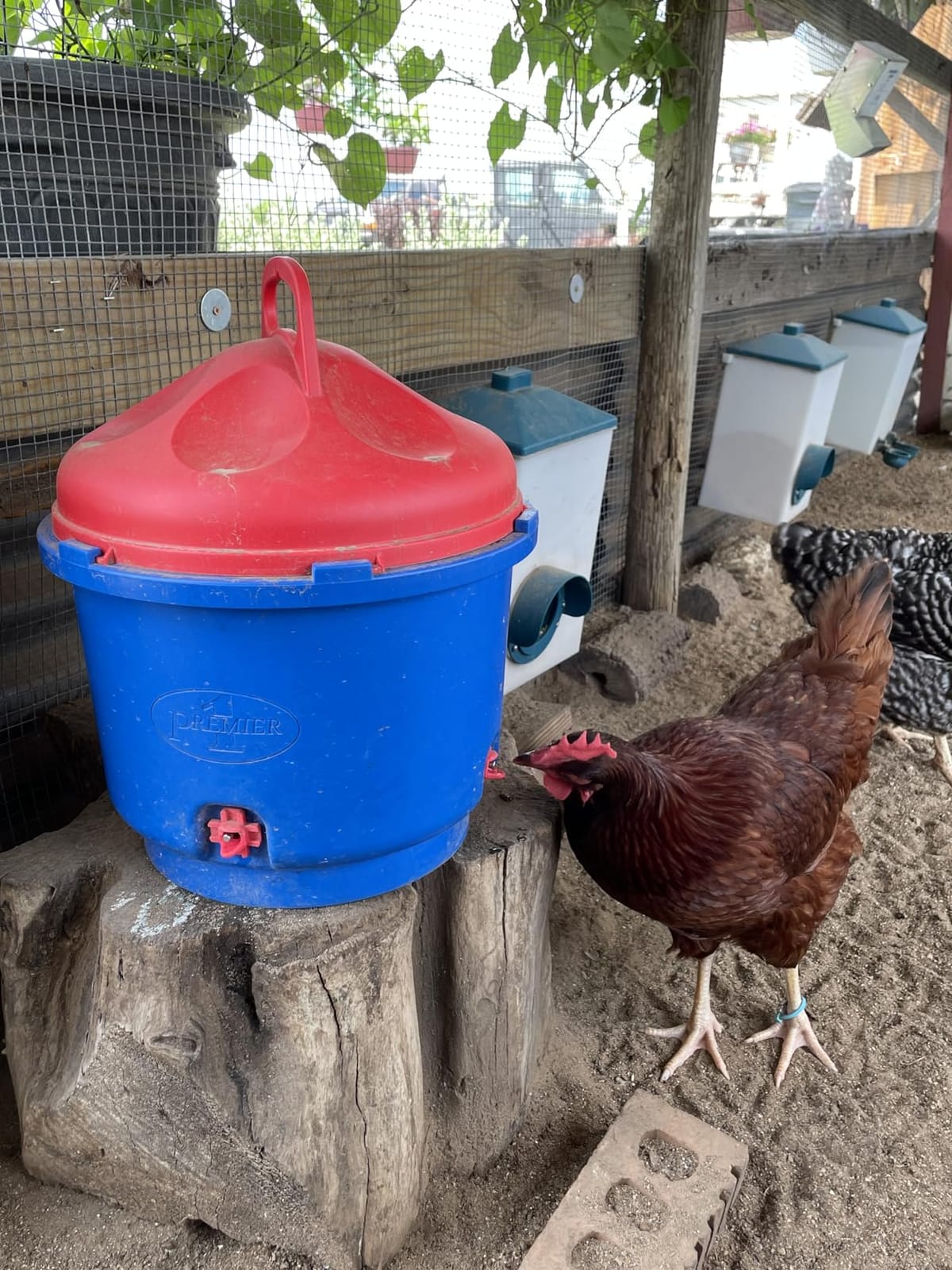
The Premier 1 All-Season is the one we recommend when the flock includes ducks. Ducks need open water to immerse their bills, so nipple-only designs force you to run a second waterer. Owners running mixed flocks in the r/chickens community report keeping one of these units in the coop and another in the run through a zone 6b winter without a frozen solid emergency.
The thermostat switches the 100 watt element on below 40°F and off at 60°F, a wider band than most competing units. Three recessed nipples plus three spares come standard, and the recessed position helps keep the drinking surface cleaner. Capacity is 3 gallons, sized for up to 35 adult chickens.
The quick-fill cap is the feature we appreciate most day to day. The hinged lid opens for a hose or watering can, so a refill takes seconds without unscrewing the whole top. The 16 foot detachable cord is the longest in this group and gives you real freedom in placing the outlet, and because it detaches you can use the same waterer as a plain cold waterer in summer.
The reported failure pattern is specific rather than random. Extreme cold combined with direct wind exposure is what owners cite, not cold alone. If you hang this in an open run, position it out of the prevailing wind, or place it inside the coop where the wind block is the wall.
What you should know before you order
The detachable cord is the quiet hero here. A 16 foot cord means you can run the waterer indoors or deep in the run without an extension cord, and detaching it in summer means you are not running an empty heating element through hot months. That single design choice saves money and removes a failure mode.
Do watch the fill opening. Overfilling can push water out around the cap, which is a common complaint. Fill to the marked line, not to the brim, and leave room for expansion.
Where it falls short
If the replacement power cord fails, you cannot buy it through the storefront. You have to source it directly from the manufacturer, which adds time. The unit is also the heaviest integrated waterer here at 6.3 pounds, so a hanging hook needs to be genuinely well anchored.
Like the HB-60P, it delivers water through nipples only. Mixed flocks need a separate open water source, and older hens that have never used nipples may need a week of training before they reliably drink from it.
3. Omlet 3 Gallon Insulated Waterer With Cups and Nipples – Top Rated
Omlet Insulated Chicken Waterer, 3 Gallon | Automatic Poultry Water Dispenser with 5 Cups & Nipples Included | BPA-Free | Anti-Roost Lid | Sage Green
3 gallon insulated BPA-free plastic
Blocks 99% of light
Cups and nipples swappable
Legs included
Pros
- Insulated walls keep water cool and resist freezing
- Cups and nipples can be mixed or swapped
- Locking anti-roost lid blocks contamination
- Legs lift it off the ground
- 81 percent five-star owner ratings
Cons
- Not electric so it is a passive cold-weather option
- 3 gallons is small for flocks over 40 birds
- Overtightened fittings leak
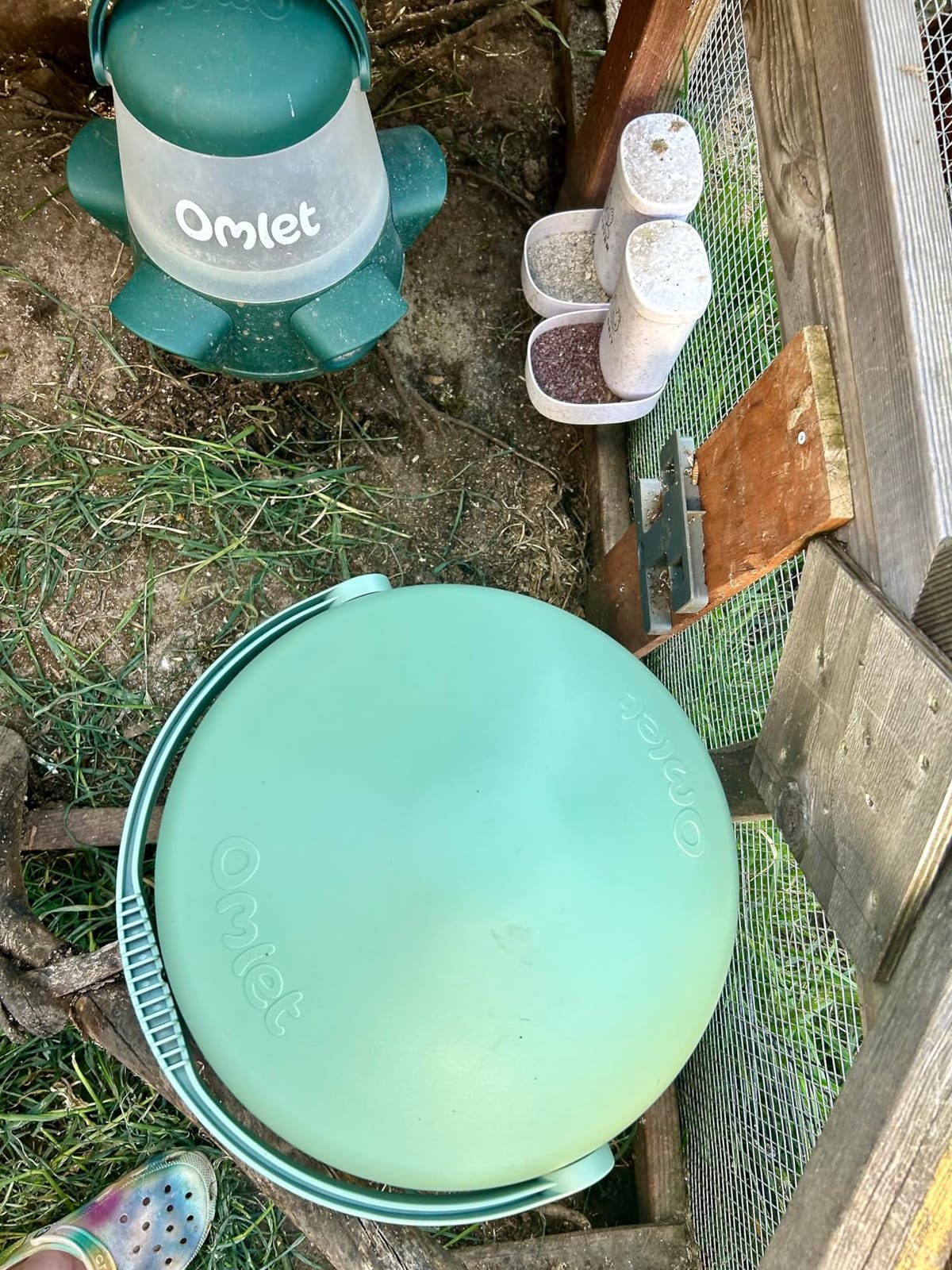
The Omlet is the highest rated product in this group at 4.6 stars across 666 reviews, with 81 percent of those reviews at five stars. It is also the only unit here with no heating element at all, which changes how you should think about it. The insulated walls and light-blocking body slow heat loss, and in moderate winters that is enough.
The real differentiator is the interchangeable drinking stations. The box includes cups and nipples plus a spare of each, and you can run both types at once. That solves the single biggest behavioral objection to nipple waterers: a nervous older hen can drink from a cup while a younger bird learns the nipple.
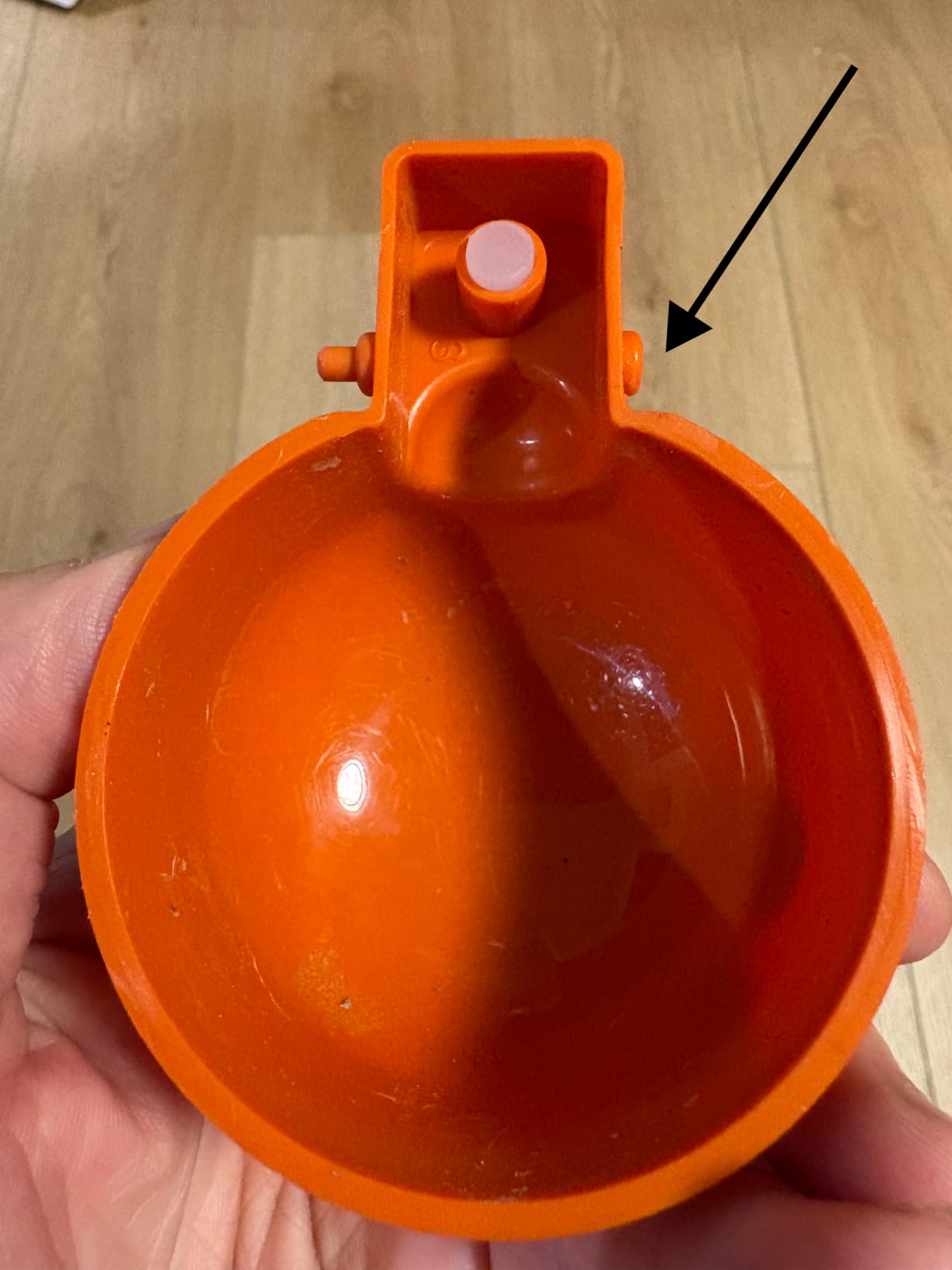
Owners report fast adaptation from birds, and water that stays visibly clean with no algae or green tint. That is a direct result of blocking 99 percent of light, since light is what drives algae growth. The locking dome lid also prevents roosting, and roosting is the fastest way to contaminate an open water source.
For winter planning, treat this as a mild climate and mild winter option. USDA zones 7 and above with occasional light freezes are a reasonable match. Zones 5 and below should pair this unit with a heated base if the container material allows it, or run a heated nipple unit as the primary and this as the open-water backup.
What you should know before you order
Dimensions matter for coop layout. The package measures 16 by 15.75 by 15 inches and the unit weighs 7.72 pounds, so it is the most substantial piece of equipment in this roundup. It includes legs to raise it off the ground, and it can also be hung.
Installation is forgiving. The fittings thread in by hand, and because cups and nipples use the same port size you can experiment freely. Do not over-tighten. Owners who overtightened the wing nuts reported leaks, and hand-tight plus a small extra turn is plenty.
Where it falls short
There is no heating element, so it does not replace a heated waterer in hard freeze. Owners also note that 3 gallons is tight for flocks of 40 birds or more and calls for multiple units. Budget accordingly rather than planning to stretch one unit across a large flock.
At the top of the price range for this category, the value argument depends on what you are replacing. If you currently run a scratched plastic jug, the insulation, light blocking, and swappable fittings do real work. If you just need ice prevention in a cold barn, one of the heated bases will serve you for less.
4. API 3 Gallon 100W Heated Waterer – Best Published Freeze Rating
API 3 Gallon Heated Chicken or Bird Waterer with Overheating Protection, Galvanized Steel Handle, and Easy to Fill Funnel Design, White
100W thermostatically controlled
Rated ice-free to -5F
3 gallon capacity
4 ft power cord
Pros
- Publishes a specific -5F freeze rating
- Thermostat cycles on and off automatically
- Rounded top blocks roosting and contamination
- Gallon funnel-style fill opening is easy to use
Cons
- 4 foot cord rarely reaches an outlet
- Plastic jug is less insulating than metal
- Lowest average rating in this group
The API unit is the only integrated waterer here with a published deep-cold figure. The manufacturer states it keeps water ice-free down to roughly -5°F, which makes it the easiest to spec against a specific forecast. Everything else in this category says it works in winter without telling you how cold that means.
At 100 watts and 120 volts, this is a standard wall-powered unit with an evenly distributing heater pad under the thermostat. Owners consistently praise the automatic cycling, which means it stops drawing once the water is warm enough and does not run all day in mild weather.
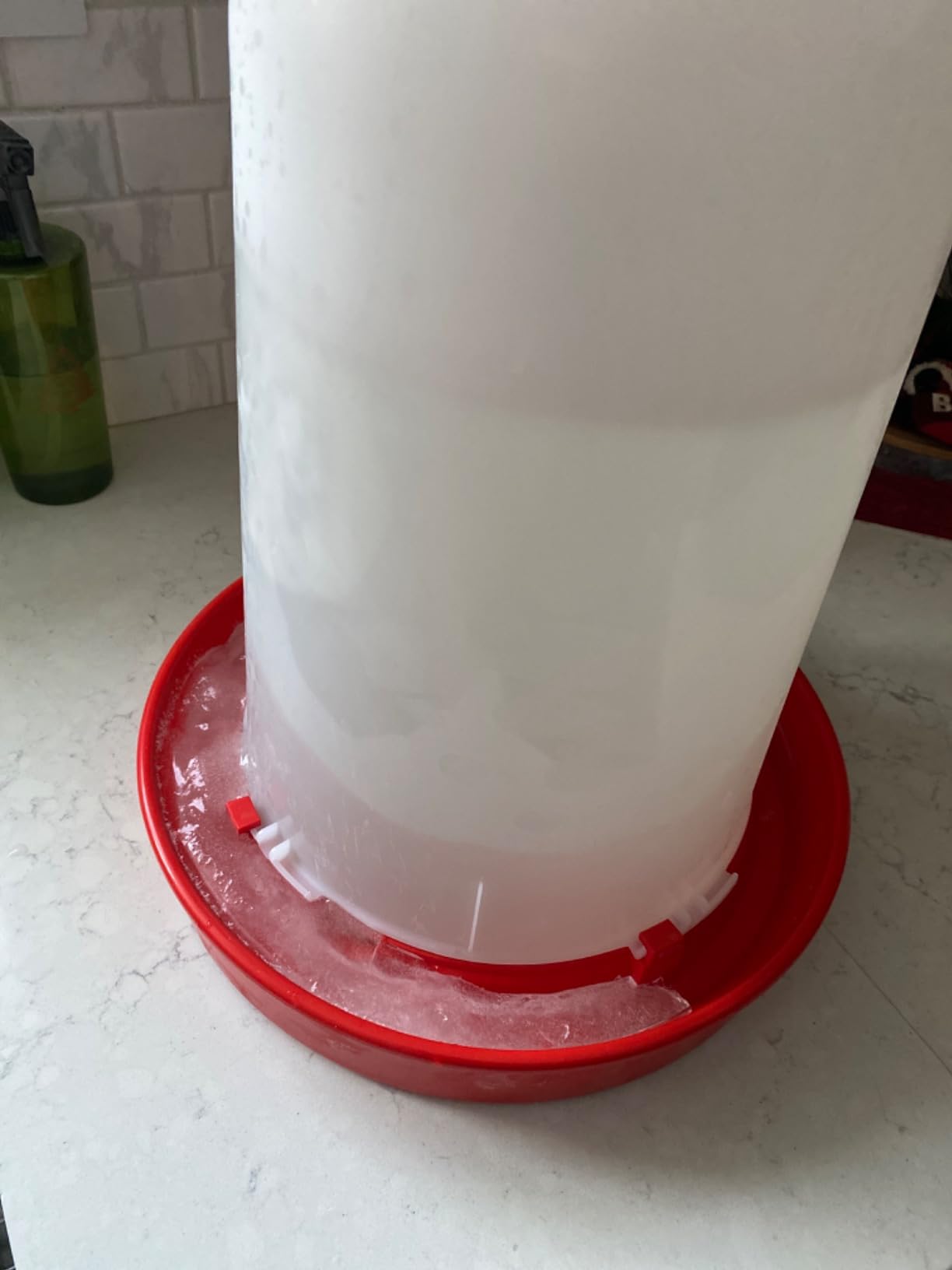
The rounded top is a quiet but effective feature. Chickens like to perch on flat surfaces, and every perch above a waterer is litter and droppings falling in. The galvanized steel handle and funnel fill opening make the daily refill straightforward from a hanging position.
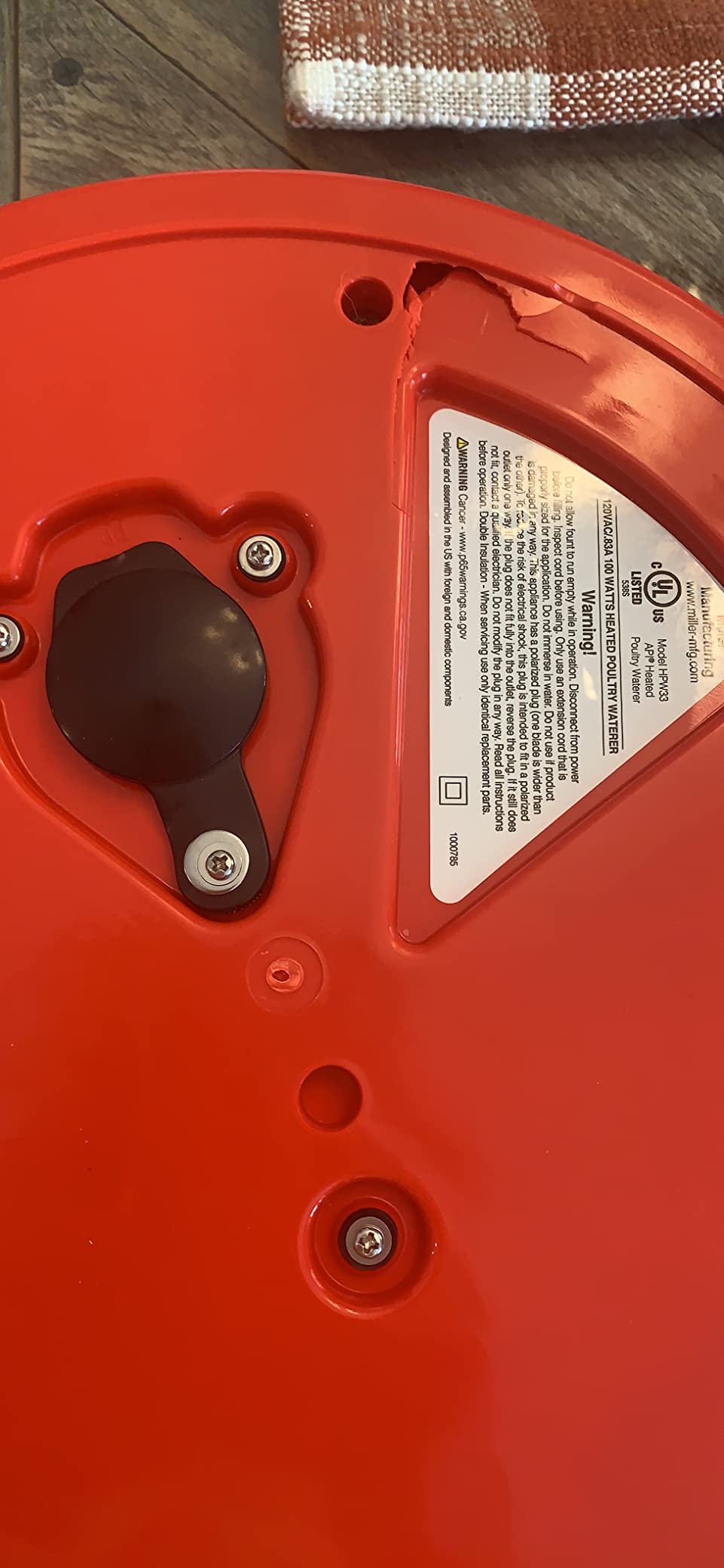
This is the pick we reach for when the priority is a documented number rather than owner consensus. Its 4.0 average rating is the lowest of the twelve, so expect more mixed feedback, and the recurring complaint is obvious from the spec sheet: the cord is only 4 feet.
What you should know before you order
Measure the distance from your outlet to where the waterer needs to sit before anything else. A 4 foot cord plus a 3 gallon jug often means you are reaching for an extension cord within the first week, and outdoor extension cords across wet ground are the least safe part of any winter setup.
The 3 gallon capacity is a genuine strength for medium flocks, roughly 10 to 20 hens on a twice-daily check. For more than that, look at the 125 watt bases under a 5 gallon fount instead.
Where it falls short
Owners report that the heater is adequate but not sufficient in extreme cold, and the plastic jug conducts heat less effectively than a metal fount. If your local record low regularly drops well below the published rating, add the unit only where wind is blocked or pair it with a supplementary base.
The short cord is the dealbreaker in some coops. If your outlet sits more than a few feet away, the 16 foot detachable cord on the Premier 1 or the 9.8 foot cord on the GUEOQTC base removes that problem entirely.
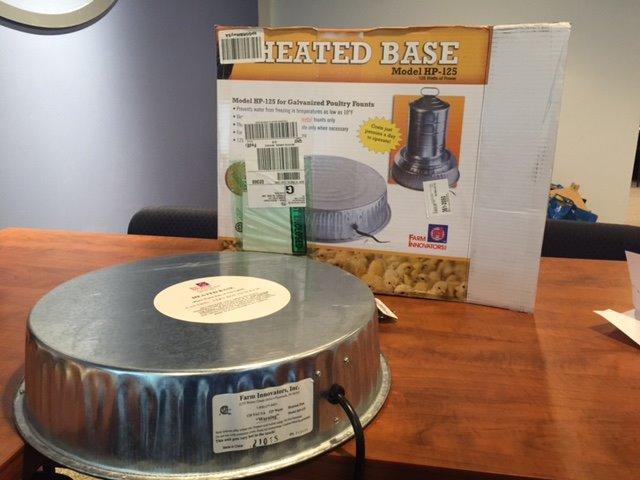
5. Farm Innovators HP-125 125W Heated Base – Best for Deep Cold
Farm Innovators HP-125 Heated Base for Metal Poultry Founts, 125W
125W base, thermostat below 35F
Fits 3 and 5 gallon metal founts
17 x 16.5 x 4.25 in
Pros
- Keeps water liquid in the most severe cold reported
- Proven across many seasons and thousands of reviews
- Wide base fits 3 and 5 gallon metal founts
- Raised base keeps litter out of the water
- Protective cover shields the element
Cons
- Runs hot enough to damage a plastic waterer
- Short cord is vulnerable to pecking
- Base is large for a small coop
This is the deep cold answer. The HP-125 has been sold since 2006, carries 2166 reviews at 4.4 stars, and its owners include people reporting water staying liquid inside an enclosed run at -35°F. No other product in this roundup has that combination of documented longevity and reported performance at extreme temperatures.
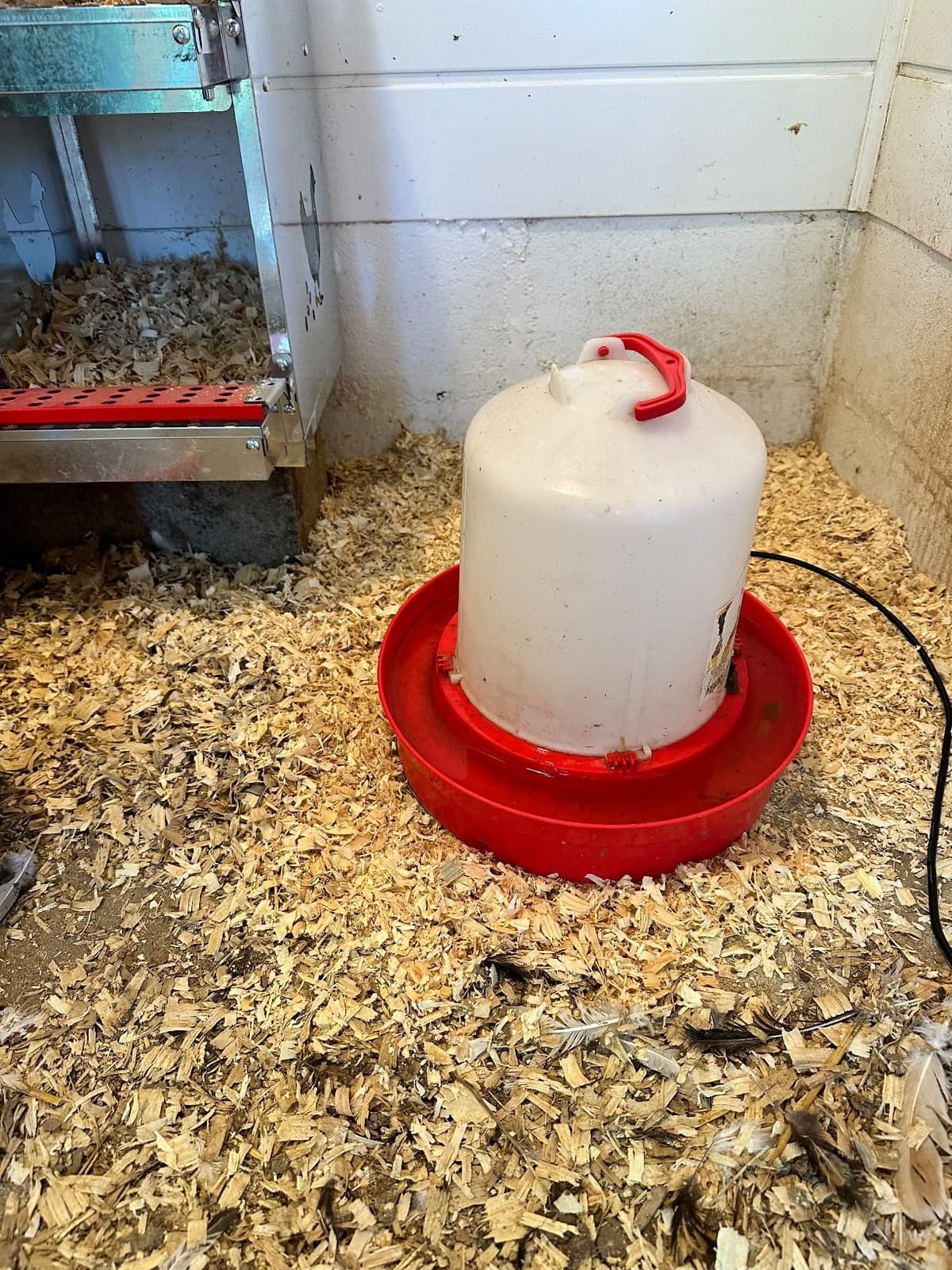
The mechanism is different from an integrated waterer. You place your own double-wall metal poultry fount on the plate, and the base heats the metal from below. Metal conducts heat far better than plastic, which is why a 125 watt plate under a steel fount can outperform a lower-wattage plate under a plastic bucket in the same weather.
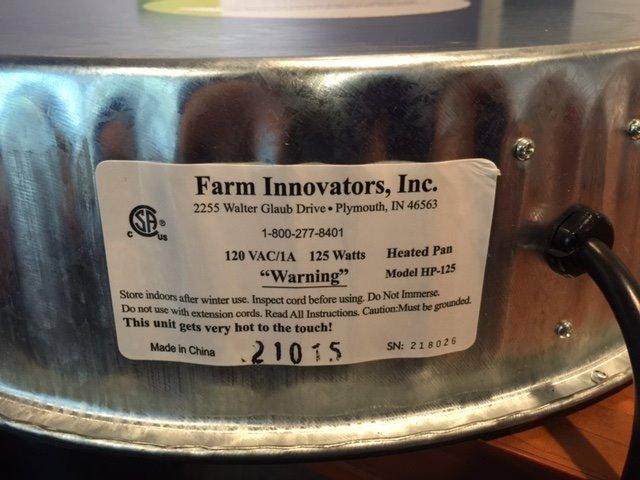
The thermostat activates below 35°F, and owners report it cycles off once the coop is warm enough. The raised profile is a bonus that no competitor mentions: it keeps bedding and droppings from washing into the drinking surface, which cuts how often you need to clean the fount.
If you already own metal founts, this is the least disruptive upgrade available. Nothing else changes, no training, no new drinking stations. You set the fount on the plate and plug it in. This is the setup we hand to anyone who asks what to buy first with a cold-weather problem and already has a steel fount in the shed.
What you should know before you order
Buy a double-wall metal fount if you do not have one. Single-wall metal conducts poorly and the plastic rim version common in hardware stores will not give you the same result. Most owners who got poor results had the wrong container.
Expect a large footprint. At 17 by 16.5 by 4.25 inches, the plate takes up real floor or wall space, and small mobile coops may not have room. Measure the interior before ordering.
Where it falls short
The base gets very hot to the touch. That is fine under a metal fount and a genuine problem under plastic, since sustained heat degrades plastic. If your only container is plastic, choose a lower-watt plate designed for it.
The cord is short and not sleeved, which invites pecking damage over a long season. Wrapping the cord in protective sleeve is a cheap fix that several owners recommend. A minority of buyers also reported units that stopped heating and needed thermostat recalibration or replacement, so check that the element warms within an hour of first plugging in.
6. GUEOQTC 11 Inch 110W Heated Base – Best for Long Cord Runs
GUEOQTC Chicken Water Heater for Winter, Heated Poultry Waterer Base,with Thermostat and 9.8ft Power Cord, Dia.11in
110W galvanized steel plate
11 inch diameter
9.8 ft cord with three-prong plug
120V AC
Pros
- 9.8 foot cord is longer than most competing plates
- Works with plastic or metal waterers up to 3 gallons
- Sealed cord entry holds up in wet coops
- No sharp edges and birds show no hesitation
- Thermostat stops above 77F and restarts below 35F
Cons
- 11 inch diameter limits it to smaller buckets
- Temperature sensor must be chilled before first test
- Isolated report of a shock when lifting a tank off
The reason we picked this base is the cord. At 9.8 feet it is nearly twice the length of most competing plates in this price bracket, and it ends in a three-prong plug. For a coop whose nearest outlet is around a corner, that is the difference between a clean installation and an extension cord draped across the doorway.
Owners report keeping water thawed through an entire winter without a freeze, and the sealed heavy-duty cord entry is a genuine advantage in a muddy or snowy coop where a loose strain would eventually take on water.
The thermostat stops heating above 77°F and resumes below 35°F, which is a wide and safe band. Birds can walk across the plate without any risk of scalding, and the smooth surface has no sharp edges that would make them hesitate.
There is one installation note that catches people out. The temperature sensor has to be chilled before it will engage on a first test, so a plate that feels dead in a warm shop is not necessarily faulty. Test it somewhere cold, or against a chilled surface, before you assume you received a dud.
What you should know before you order
Match the diameter to the base of your container. At 11 inches, this plate fits 3 gallon buckets and smaller waterers but not 5 gallon models. If you run 5 gallon buckets, the Zoblise 14.6 inch plate is the matched choice.
At 110 watts this is a mid-draw unit. Running it continuously for 30 days at 24 hours uses about 79 kilowatt hours, more than the 28W and 40W models and less than a heavy 125W plate.
Where it falls short
One reviewer reported receiving an electrical shock when lifting a water tank off the plate. A single report is not a pattern, but it is worth respecting the manufacturer instruction to avoid running a plastic waterer empty on the base, since an empty container behaves differently thermally and electrically.
Performance is reported as strong in typical winters rather than in extreme cold. Owners in consistently brutal conditions should pair this with a large double-wall metal fount for thermal mass rather than relying on the plate alone.
7. Zoblise 14.6 Inch 125W Heated Base – Best for 5 Gallon Buckets
Chicken Water Heater Base for Winter, Heated Chicken Waterer 5 Gallon 125W
125W galvanized steel plate
14.6 inch base diameter
6 ft power cord
3.09 lb, 14.6 x 14.6 x 1.65 in
Pros
- Large 14.6 inch base fits and levels 5 gallon waterers
- Holds 5 gallon drinkers liquid in single-digit cold
- Held up through months of snow and rain
- Works with plastic or metal containers
- Thermostat stops above 77F
Cons
- Deep drinkers can ice up at the top when not kept over half full
- Some units failed within a first season
- 6 foot cord is short for many coops
Capacity is where this plate earns its keep. The enlarged 14.6 inch base fits a 5 gallon waterer and stays level without tipping, which smaller plates cannot do. If your flock runs 15 to 25 birds and you would rather refill once a day than three times, that stability matters.
Owners report consistently keeping 5 gallon drinkers liquid down into single-digit temperatures, and the upgraded waterproofing survived months of outdoor use in rain and sleet. At 125 watts it has enough output to push warmth through a deep bucket, though the physics still favor metal.
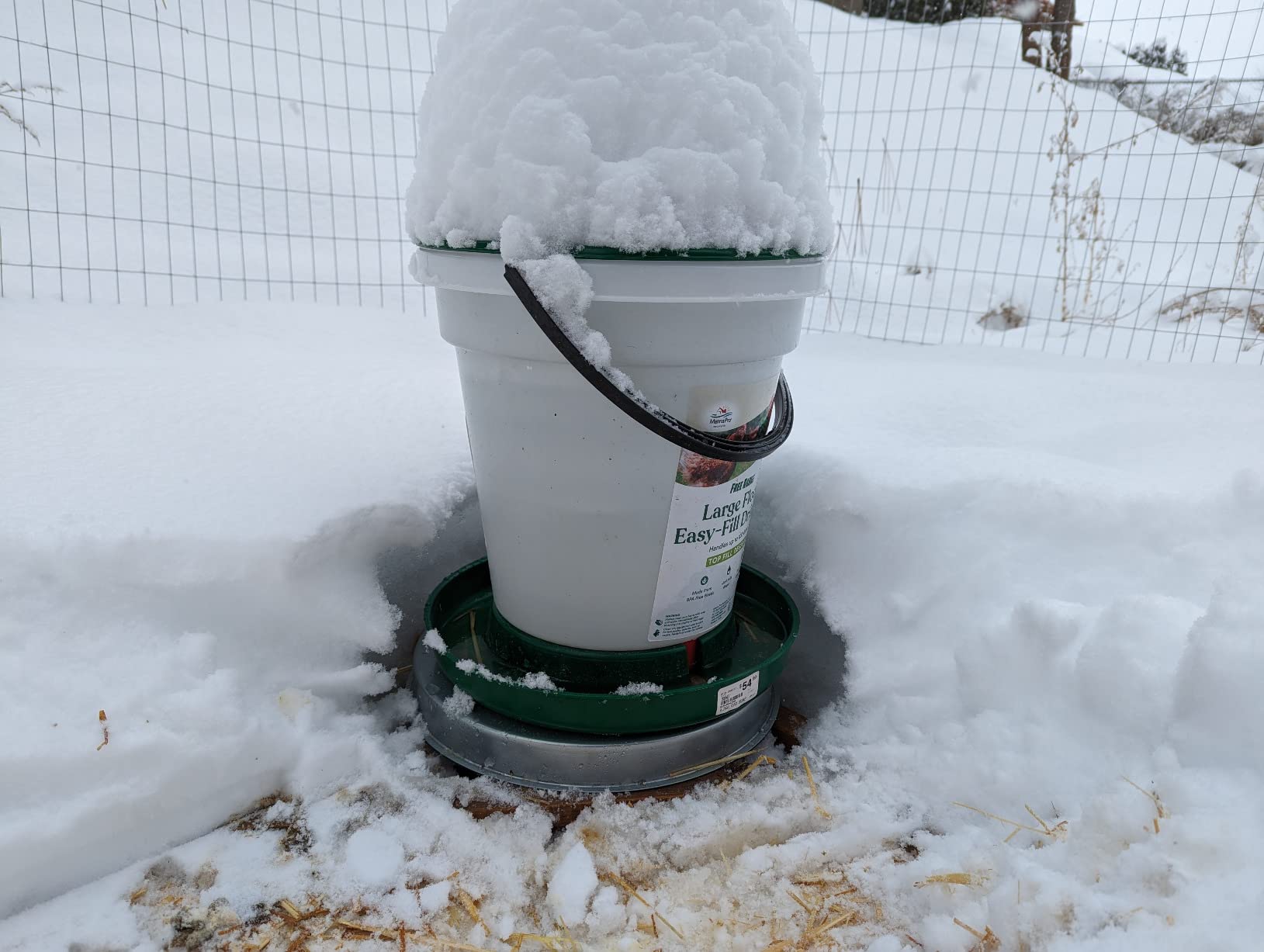
The thermostat cycles off above 77°F and restarts below 35°F, so it will not scald birds and it is not drawing power in a mild week. Like the GUEOQTC plate it works with plastic or metal, which is unusual for a unit at this output level.
The practical quirk owners report is about fill level. A tall, deep 5 gallon bucket can still ice over in the upper half on the coldest nights if it is not filled past halfway. More water means more thermal mass, so keep the bucket fuller than feels necessary in January.
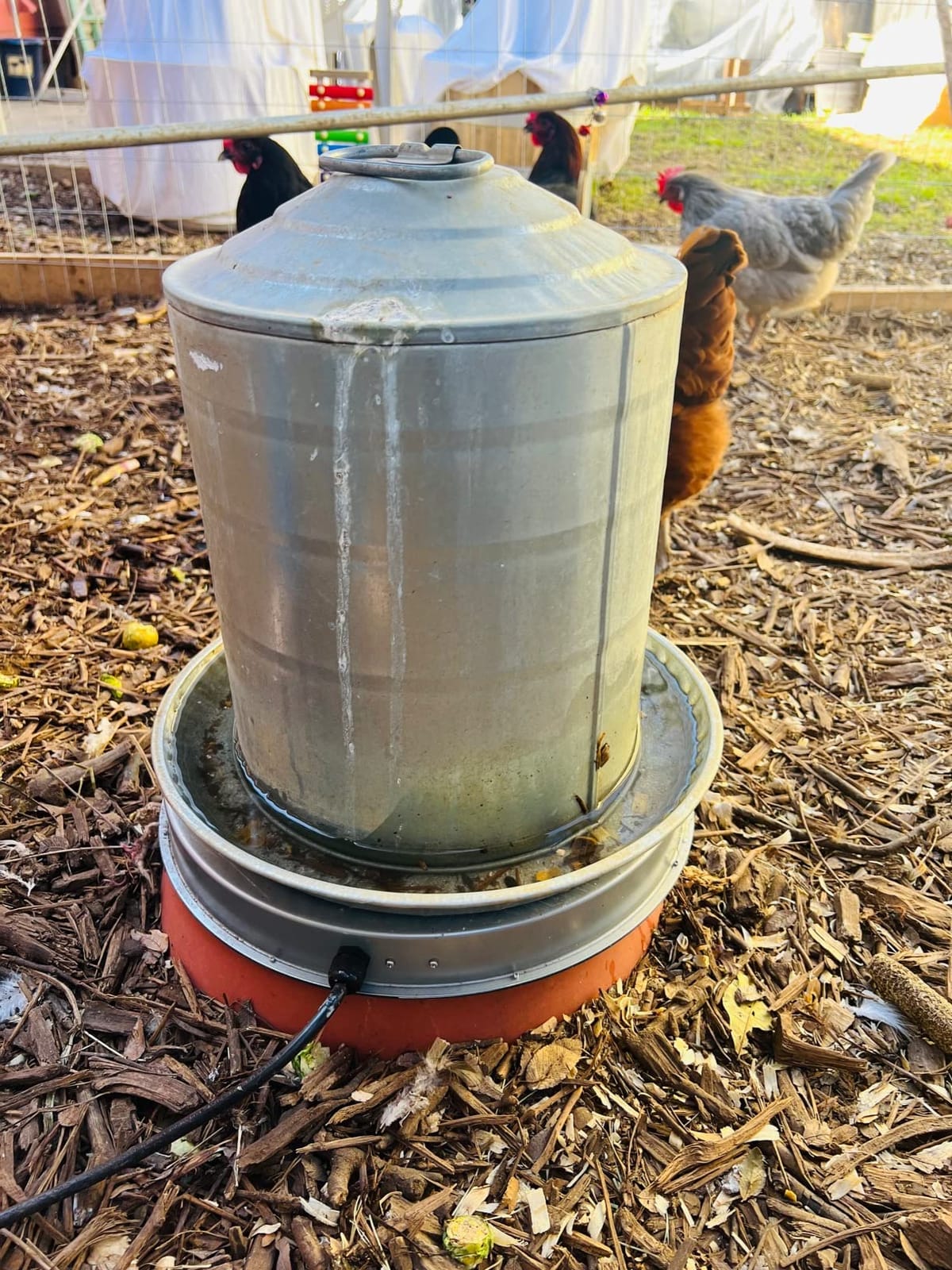
What you should know before you order
Expect more heat under the plate than you get from a 35W unit, and do not pair it with a thin plastic container you care about. The base runs hot by design and the manufacturer positions it for metal or sturdy plastic.
At 14.6 inches across you need a genuinely large waterer footprint, so check that your coop floor or wall bracket can hold it without rocking. Level placement is what keeps a large bucket stable.
Where it falls short
Durability is the weak point here. Several owners reported units failing within the first season, including melted marks on the underside, and one unit arrived not switching on. Test the plate in a cold spot the day it arrives so you have time to address a failure before the first freeze.
Extreme cold is also outside its envelope. Owners in -30°F to -40°F conditions reported the water beginning to freeze again. For those climates, we pair it with a double-wall metal fount rather than trusting the plate alone.
8. Lxheir 13 Inch 35W Heated Base – Best Low Wattage Option
Lxheir Chicken Water Heater, 13” Heated Base for Metal Plastic Poultry Founts Waterer 3-5 Gallons, Poultry Water Heater Base for Chicken Turkey Goose Duck Pigeon Drinker in Winter Grey
35W heating element
Overheat stop above 68F
Fits 3-5 gallon founts
6.5 ft steel-wrapped cord
Pros
- Lowest draw among the higher-output bases
- Works with both plastic and metal founts
- Steel-wrapped cord resists pecking damage
- Automatic cycling so it never scalds birds
- Compact and easy to store between winters
Cons
- Several reports of water freezing near 20F
- Some units stopped heating after a few months
- Tray surface can still ice over
This is the economics pick, and the one we recommend when electricity cost matters more than temperature. At 35 watts it draws less than a third of what the big 125 watt plates use, and owners running it overnight through a full winter report that the running cost is barely noticeable. If your primary constraint is electricity rather than temperature, this is the sensible choice.
Owners in cold states including Wisconsin and Pennsylvania report it reliably prevents freezing for plastic waterers through normal winters. The 6.5 foot steel-wrapped cord is a smart detail: chickens peck at cords, and a wrapped cord resists that far better than a bare one.
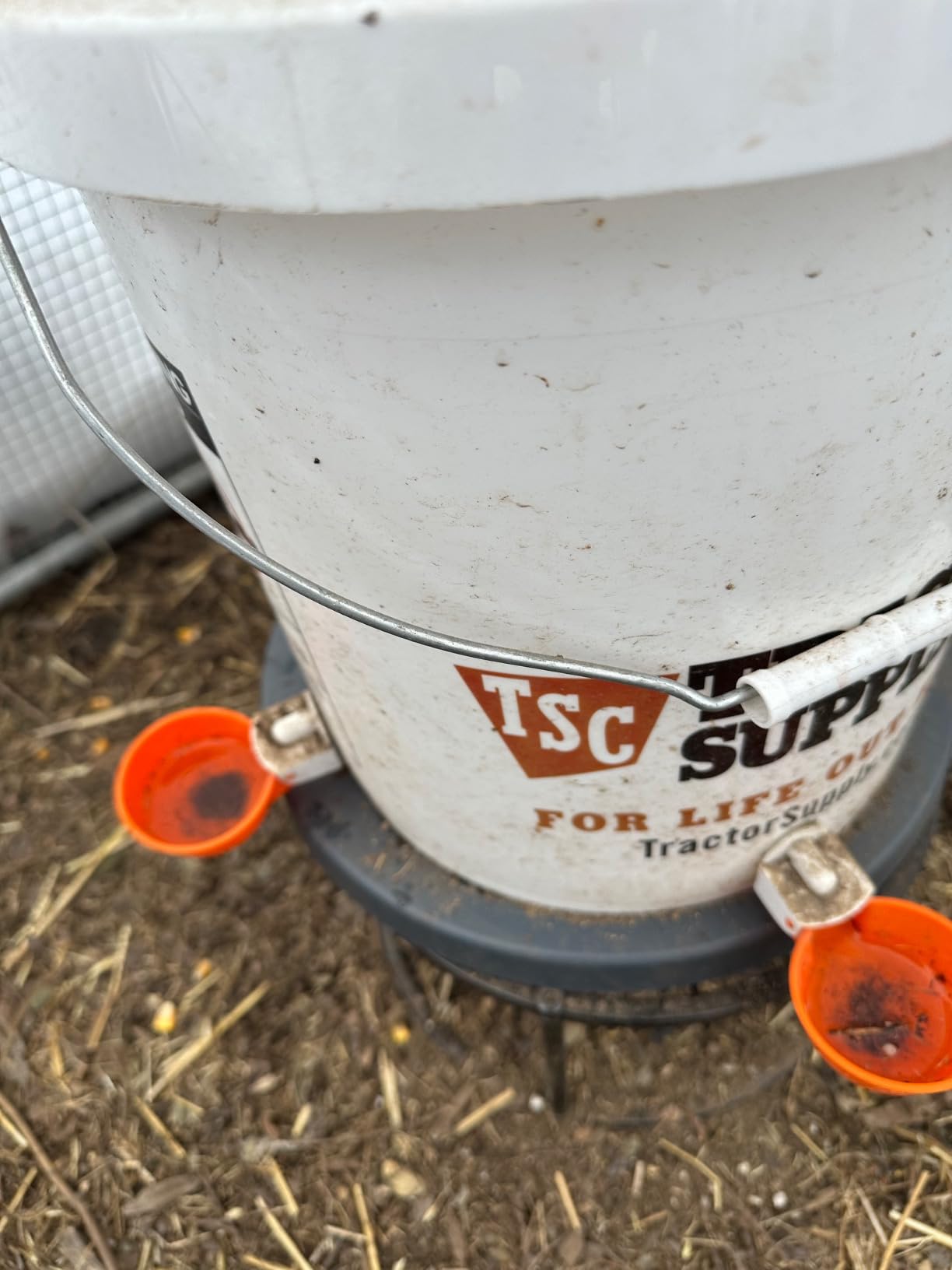
The overheat protection sensor stops heating above 68°F and restarts below 35°F, so the plate never gets hot enough to scald. Compatibility covers plastic and metal founts holding 3 to 5 gallons, which is a wider range than most metal-only bases allow.
Be clear about the envelope. This is a moderate-cold device, not a deep-freeze device. Owners report it losing the ability to keep water liquid once temperatures fall near 20°F, and the surface water in the tray can ice over even when the main reservoir is still drinkable.
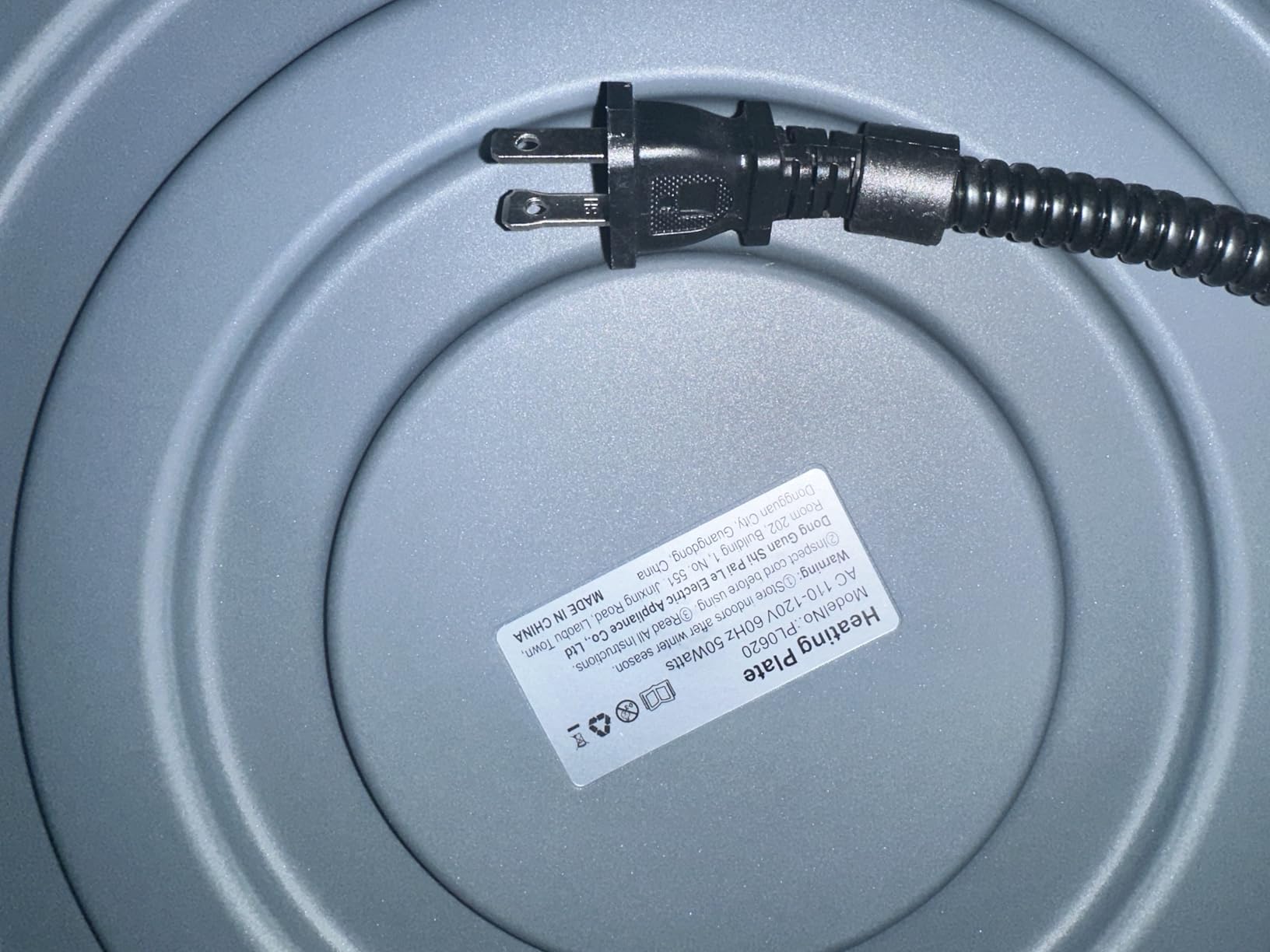
What you should know before you order
Run the numbers at 35 watts and a full month of continuous operation lands at roughly 25 kilowatt hours. That is less than a single incandescent bulb left on overnight for a month, which is why owners notice almost nothing on the bill.
The compact footprint at 13.18 by 13.18 by 2.16 inches is a real convenience. It stores between winters and lets you keep using the same waterer year round rather than swapping equipment in the fall.
Where it falls short
If your winters regularly drop toward single digits, low wattage becomes a liability rather than a saving. The manufacturer also warns against running plastic waterers empty on the base, so keep water in the container whenever the plate is powered.
A meaningful share of reviews note units that stopped heating entirely after a few months of use, and the manufacturer acknowledged model issues and issued refunds in some cases. Buy it as a moderate climate device and check it early rather than discovering the problem in January.
9. My Favorite Chicken 28W Low Voltage Base – Safest Design
My Favorite Chicken Heated Poultry Waterer Base – 28W Electric Chicken Water Heater for Winter, Freeze-Proof to -20°F, Adjustable Heated Waterer Base for Chicken Waterers & Founts
28W element rated to -20F
Runs on 24V low voltage
Fits waterers to 11.8 inches
Pros
- Low-voltage power supply keeps line voltage away from water
- Adjustable sliding tabs fit almost any waterer
- 28W is among the most economical designs here
- Sealed housing resists moisture and ammonia
- Rated freeze-proof to -20F
Cons
- Will not fit waterers wider than 11.8 inches
- Bulkier and heavier than a flat plate
- Requires a nearby outlet and the external power supply
Safety is the argument for this unit, and it is a real one. It runs on a 24 volt low-voltage supply from an external power brick, so household line voltage never reaches the plate sitting under your water. In a wet environment where condensation, splashing, and shavings are constant, removing mains voltage from the wet zone is a meaningful upgrade.
Despite drawing only 28 watts, the manufacturer rates it freeze-proof to -20°F. That combination of low draw and a deep published rating is unusual. It works because the adjustable sliding tabs hold the container close to the element instead of leaving an air gap.
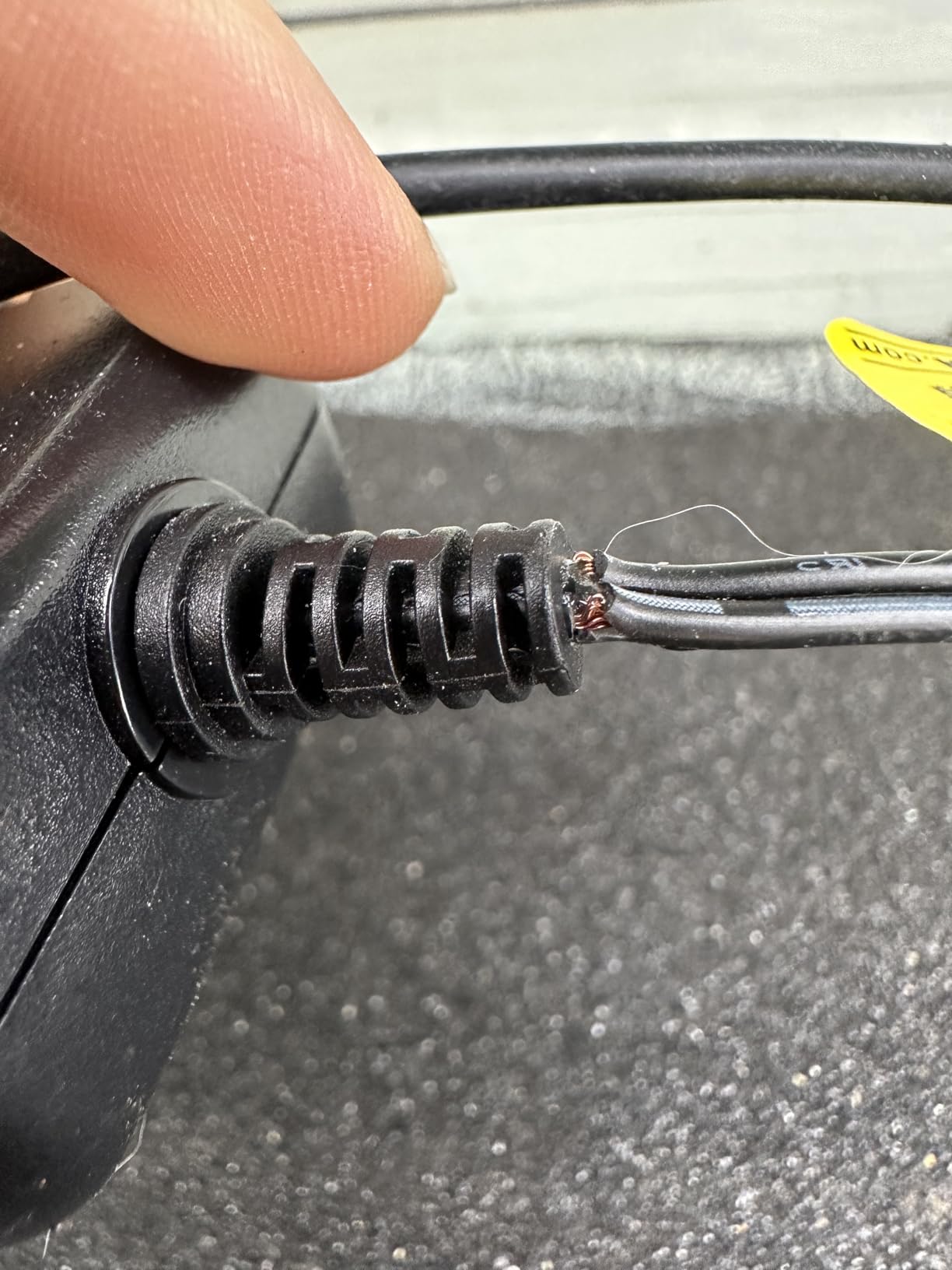
The sealed housing tolerates damp, ammonia-heavy coops without corroding, which matters more over five winters than it does in the first one. It is compatible with most plastic and galvanized metal waterers, buckets, and founts, and installation is plug and play with no maintenance schedule.
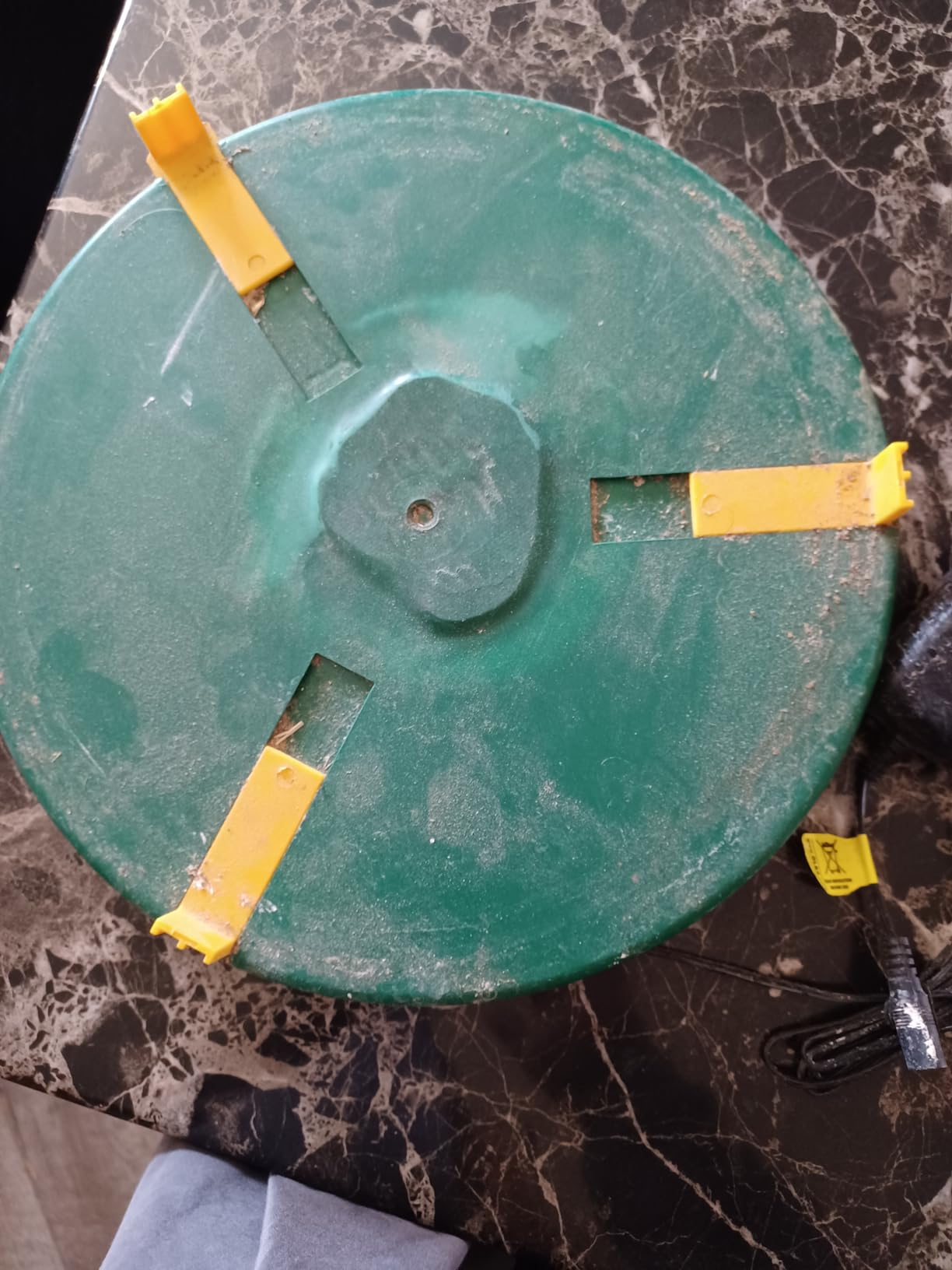
The constraint is width. Adjustable tabs fit waterers up to 11.8 inches across, so a large 5 gallon bucket with a wide base will not sit on it. Check the widest point of your container including any handle or bracket before ordering.
What you should know before you order
The included power supply is part of the system, not an accessory. You need a wall outlet within reach of the external brick as well as within reach of the plate, so plan the placement so both fit. Some owners run the brick inside the coop near the outlet with the low-voltage cable passing to the plate.
At 28 watts, a full month of continuous heating is about 20 kilowatt hours. Even running it all winter, continuously, the energy cost stays low enough that the conversation rarely comes up.
Where it falls short
It is bulkier and heavier than a simple flat plate, and some owners report having to check it daily because surface water still ices over during sustained deep cold. The housing seals against moisture but no design eliminates the thin layer at the surface.
Older waterers and wide buckets are the other common problem. Measure first. If your container exceeds 11.8 inches, the 14.6 inch plate is the better geometric match even if it costs more to run.
10. Myodal 62W Stainless Steel Base – Best for Any Vessel
62W Metal Chicken Water Heater for Winter, 13” Thermostat Chicken Waterer Heater Base for 1-5 Gallon Metal or Plastic Poultry Waterer, Outdoor Weatherproof Poultry Water Heaters for Turkey Goose Duck
62W stainless steel element
11 or 13 inch diameters
Reheats below 35F
6.56 ft cold-resistant cord
Pros
- 80 percent five-star owner satisfaction
- Users in severe climates report success from -30C to -40C nights
- Works with plastic metal glass or ceramic containers
- Stainless base supports over 120 lb
- Never hot enough to touch
Cons
- Higher 62W power draw than 28W and 35W alternatives when running continuously
- Occasional reports of units stopping heating after about two months
- Water can still freeze during extreme wind chill below roughly -20F
This is the most flexible plate in the roundup, and the one we keep in the shed as a spare. Unlike most warming bases that assume a standard poultry fount, it works with plastic, metal, glass, or ceramic containers. Owners use ceramic bowls and glass jars on it because the stainless surface is rigid, flat, and easy to clean, and it means you are not forced to buy a matching waterer.
With 252 reviews at 4.6 stars and 80 percent five-star ratings, this matches the highest satisfaction score in the roundup. Owners in Alberta, northern New England, and Minnesota report keeping water liquid through nights down to -30C and -40C, which is real-world evidence from the climates where freeze protection matters most.
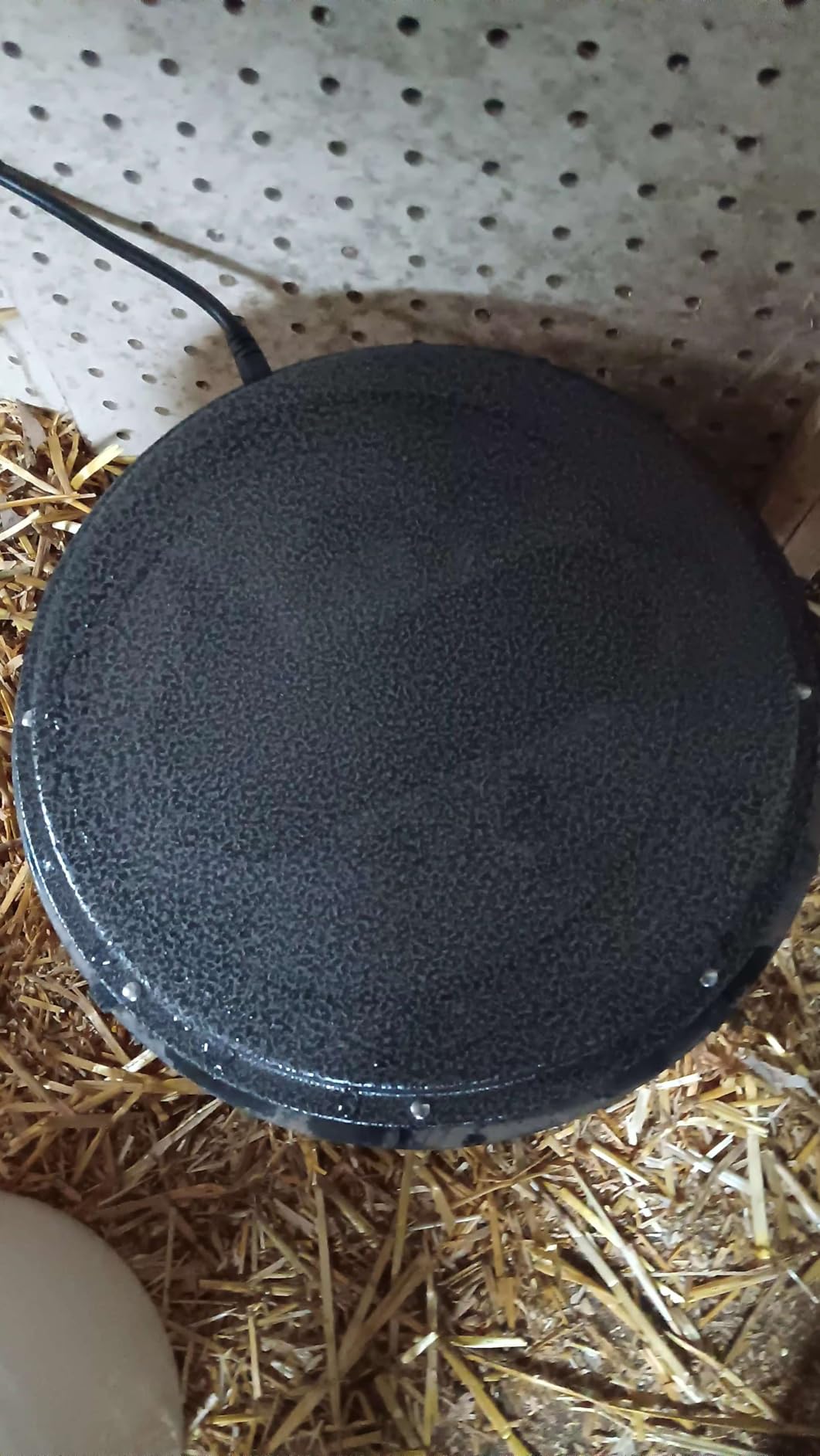
The thermostat reheats below 35°F, brings the water up to roughly 68°F, then stops cycling. That narrow band means the surface is only ever slightly warm to the touch, so birds can stand on it and there is no scald risk.
The thick stainless base is the durability story. Rated to hold over 120 pounds without cracking or rusting, it also functions as a stable feeder stand, which several owners use it for. The 6.56 foot cold-resistant cord is a middle-length option, and two diameters are offered.
What you should know before you order
Decide on diameter before you order. The plate comes in 11 inch and 13 inch versions and the packaging is what tells you which you received, so check the label when it arrives. An undersized plate on a large bucket means the container can rock and lose contact with the element.
At 62 watts it draws more than the 28W and 35W plates but less than the 125W models. Run continuously for a month and you are at about 45 kilowatt hours, which is a reasonable middle ground between cost and output.
Where it falls short
The higher wattage shows up on the bill if you run it continuously, and a few owners reported units stopping heating after about two months. That is a small but consistent durability complaint worth factoring into a multi-year purchase.
Wind chill below roughly -20°F still defeated it for some owners. Separately, a coop far from any outlet may require a heavy-gauge extension cord, which is the exact situation where a 9.8 foot cord plate is the better choice.
11. Gsbomzap 55W Thermostat Heated Base – Most Versatile
12 Inch Chicken Water Heater Base, 5 Gallons Poultry Drinker Heater Base with Thermostat and Power Cord, Automatic Electric Poultry Winter Deicer Heated Base for Plastic/Metal Chicken Waterer
55W galvanised steel element
Thermostat stops above 25C
11.8 inch base
5.8 ft cord with dial
Pros
- Adjustable temperature dial lets you tune output to your winter
- Works with 3.5 and 5 gallon plastic waterers
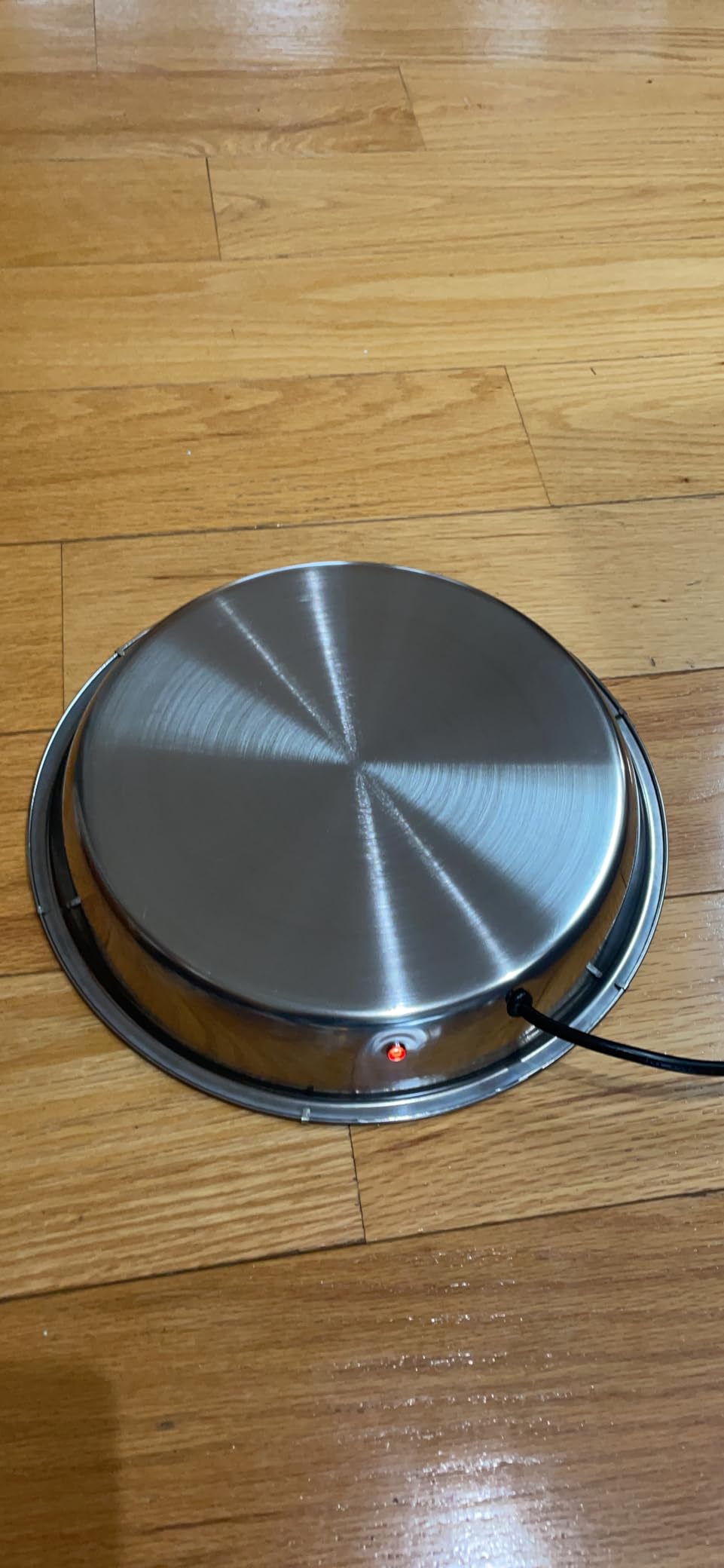
- Sealed underside keeps insects and debris off the coil
- Users in Michigan and Canada report success to -17C
- Low 55W draw with no spare parts needed
Cons
- Plate is smaller than some waterer bottoms so it must sit level
- Ice still builds in the tray below about -17C
- Lighter galvanized steel than stainless plates
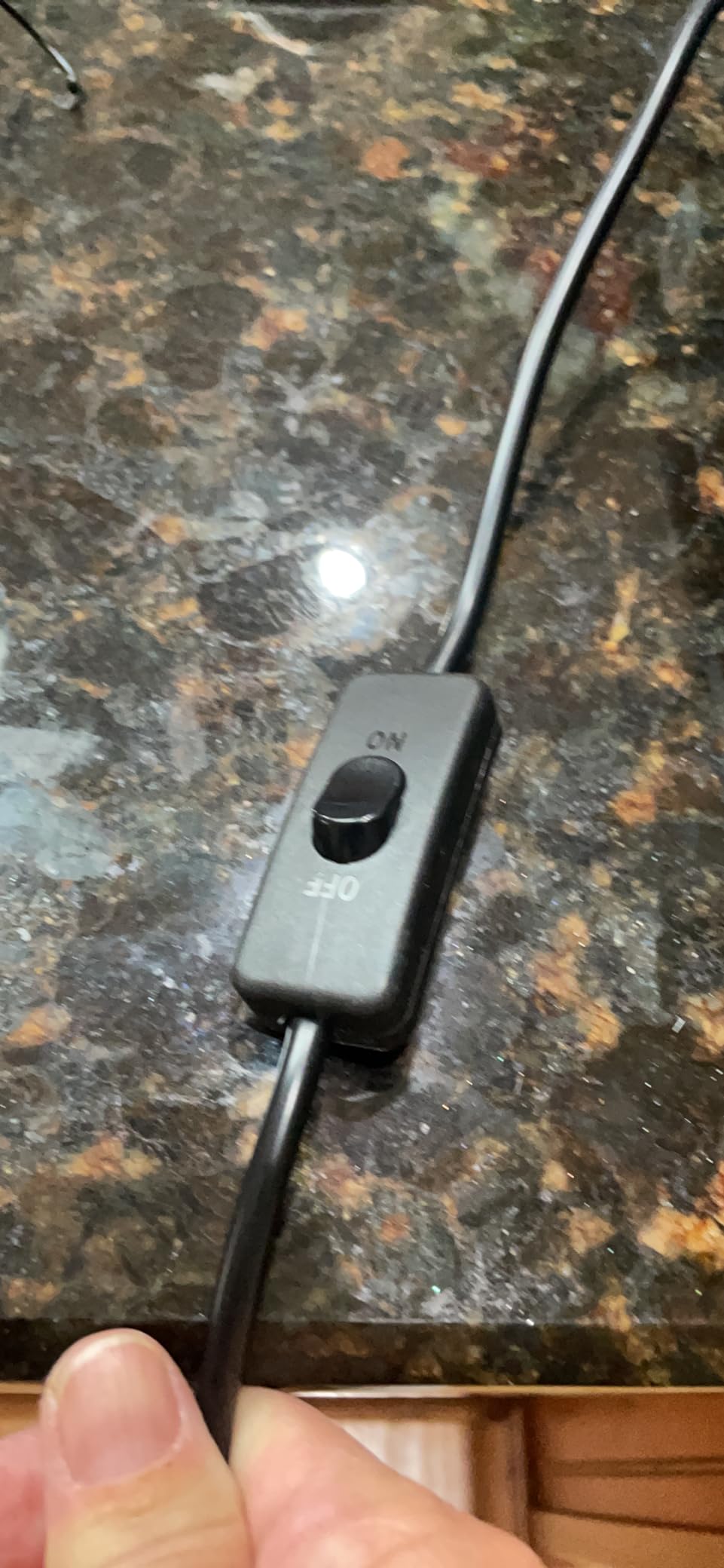
The feature that separates this base from the other budget plates is the adjustable temperature dial on the power cord. Most units give you one fixed threshold. This one lets you tune the output to how severe your local winter actually is, which is a meaningful advantage in a climate that swings between mild spells and hard freezes.
At 55 watts with a thermostat that stops heating above 25C and restarts below 0C, it delivers reliable protection without the running cost of a 125 watt plate. Owners across Michigan and Canada report it holding off freezing down to roughly -17C, with particular praise for the dial.
The sealed underside is a quiet keeper. Insects do not nest under it, debris stays out, and spilled water does not reach the heating coil. On a device that will sit outdoors for months under a dripping bucket, that sealing is what keeps it working year after year.
It works with 3.5 gallon and 5 gallon plastic waterers, which means most owners are reusing the summer containers they already own rather than replacing anything. That is the core of the budget argument.
What you should know before you order
Check plate diameter against container base before ordering. At 11.8 inches, the base is smaller than some waterer bottoms, and if it does not sit flat and level the contact with the element suffers. Owners who placed it carefully report no problems at all.
The 5.8 foot cord is the shortest meaningful run among these bases. Measure from your outlet and plan for that. For a longer reach, the GUEOQTC 11 inch plate gives you 9.8 feet.
Where it falls short
Below roughly -17C, owners still see ice building in the drinking tray even while the main reservoir stays drinkable. And the galvanized steel base is not as rigid or heavy-duty as a thick stainless plate, so a large container can rock on it.
A few durability complaints reported units failing after roughly a season. The rating distribution is otherwise strong at 78 percent five-star, so this reads as a small-sample longevity issue rather than a systemic fault.
12. RentACoop Thermo Bucket Belt – Best for Any Bucket
RentACoop LG Thermo Bucket Belt Chicken Waterer Heater with Insulated Wrap
40W silicone rubber belt
Fits 2-5 gallon buckets
Insulated wrap rated to -10F
6 ft cord included
Pros
- Wrap-around belt heats the bucket wall instead of a base plate
- 40W draw is about a quarter of a typical 150W heater
- Silicone rubber will not melt plastic and is safe to touch
- Thermostat cycles between 38F and 42F for hands-off use
- Lightest and most compact unit here
Cons
- Bucket is not included and must be bought separately
- -10F is the least extreme freeze rating in this group
- Belt range will not fit unusual or oversized containers
This one works differently from everything else in the roundup. Instead of a plate the container sits on, the RentACoop is a fiberglass-reinforced silicone rubber belt that wraps around the wall of a standard 2 to 5 gallon bucket. Heating the wall rather than the base means it works with the bucket you already own instead of requiring a particular base shape, which is the setup we point people toward when they would rather not buy a matched waterer.
At 40 watts it draws roughly a quarter of what a 150 watt heater would, and the smart thermostat activates below 38F and switches off at 42F for genuinely hands-off operation. The silicone construction will not melt a plastic bucket and is safe to touch, which removes the biggest objection to putting heat near plastic.
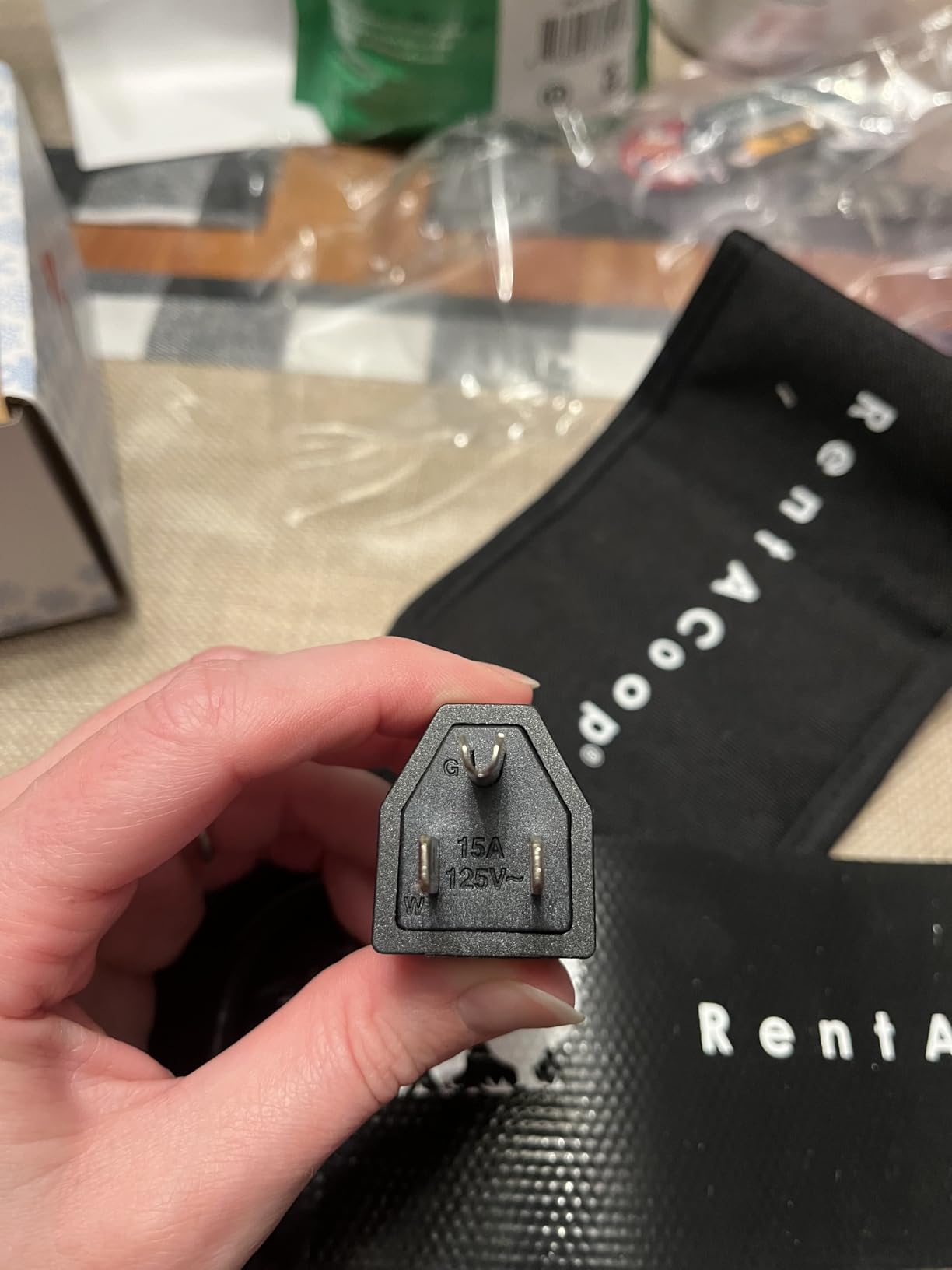
Owners like that they can keep whatever bucket they already have. The included insulated wrap extends freeze protection to -10F, and the belt fits containers 24 to 34 inches around, which covers standard 2 to 5 gallon buckets.
At 1.08 pounds this is by far the lightest and most compact unit here, which matters if you move water in and out seasonally or run several buckets in a large run.
What you should know before you order
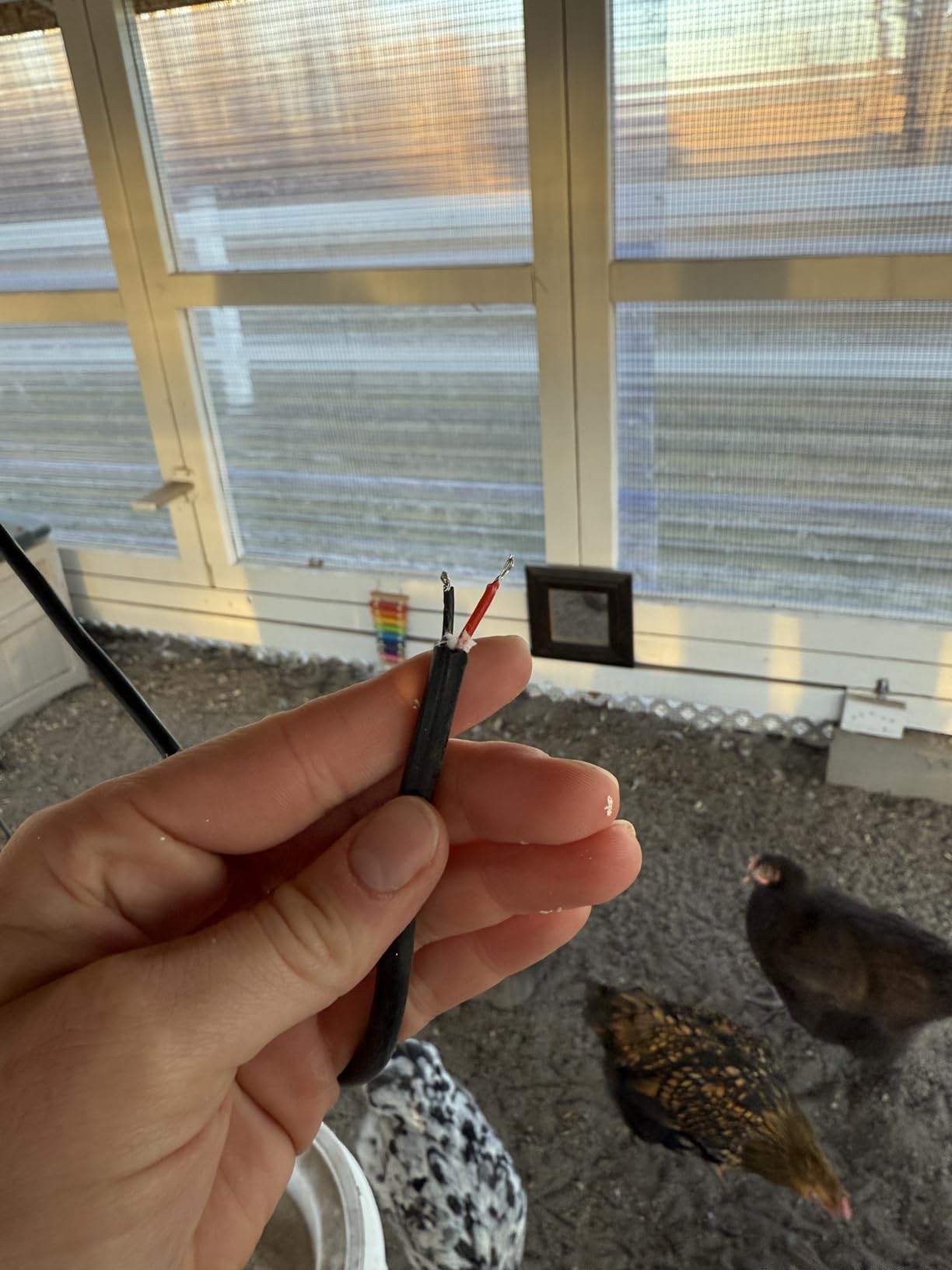
Plan for a two-part purchase. The box includes the belt, the insulated wrap, the 6 ft cold-weather cord, and instructions, but the bucket itself is sold separately. Owners consistently note this, and it is the single most common surprise.
Measure the circumference of your container before ordering. The belt covers 24 to 34 inches around and will not fit unusually shaped or oversized vessels, which rules out some wide automatic founts.
Where it falls short
The -10F rated protection is the least extreme of any product in this roundup. For climates that regularly go colder, choose a unit with a published lower figure or a plate paired with a double-wall metal fount.
The wrap has to come off for cleaning or to change buckets, which is a small friction that adds up. And you are paying more here than several higher-output plates, so the case rests on versatility and the 40W draw rather than on bang for watt.
Three Ways to Keep Chicken Water From Freezing
Everything in this roundup falls into one of three families, and choosing the right family matters more than choosing a specific model. The first is an integrated heated waterer with its own element and thermostat. The second is a heated base, plate, or belt that warms a separate container. The third is the DIY approach where you control the heat yourself.
Integrated heated waterers are self-contained. The Farm Innovators HB-60P, the Premier 1 All-Season, and the API unit all heat their own reservoir and deliver water through nipples or a fill port. They are the simplest to install, since one object does everything, and they are the right choice when you want open water, nipple water, or both without buying a separate container.
Heated bases and belts separate the container from the heat. The Farm Innovators HP-125, the Zoblise, GUEOQTC, Lxheir, Myodal, Gsbomzap, My Favorite Chicken, and the RentACoop belt all fall here. This family is usually less expensive, lets you keep a fount you already own, and gives you control over container material, which matters because metal conducts heat far better than plastic.
DIY heat sources remain popular in forum threads and can work, but they carry real caveats. A cookie tin heater built around a 40 to 60 watt incandescent bulb mounted on a cinder block under a metal fount is the best known version, and it must be paired with a GFCI protected outlet. A crock pot kept on low holds water just warm enough for some flocks. Both approaches require daily attention, and neither gives you a thermostat you can rely on, so treat them as a supplement rather than a sole water source.
One more variable deserves its own mention: insulation without electricity. A well-insulated container in an unheated but wind-blocked shed can hold water liquid through a night of moderate cold. It is the cheapest freeze protection available and the one that fails first when the temperature drops further.
What to Check Before You Buy a Winter Chicken Waterer
1. Freeze rating, and whether one is published at all. Only four products in this roundup state a specific temperature: the API at roughly -5°F, the My Favorite Chicken at -20°F, the RentACoop belt at -10F, and the Farm Innovators HP-125, whose manufacturer cites 10°F for the base itself while owner reports run far colder. Everything else asks you to trust the word winter. Check your own record low, not your average winter, and pick a unit rated below that number with margin.
2. Thermostat switch points. A thermostat that switches on below 35°F and off above 60°F uses less power and gives the water a chance to cool before reheating. Tight bands like the Myodal reheating below 35F and stopping near 68F waste less energy still. A wide cut-off band means longer run time and a warmer reservoir, which is useful in deep cold and wasteful in a mild week.
3. Nipples, cups, or open trough. Nipple drinkers keep water clean and cut cleaning to almost nothing, but birds must be trained. Cups like those on the Omlet are an easier transition. Open troughs are the only option ducks will use, since ducks need to immerse their bills. A flock with all three needs at least two waterers, and running one of each is a common, sensible setup.
4. Capacity against flock size and refill habit. Two gallons covers roughly 8 to 12 hens on a twice-daily check. Three gallons stretches to about 35 adult chickens on the Premier 1 sizing, and 5 gallon containers suit flocks above 20. In freezing weather, assume more frequent refills than in summer regardless of capacity, because a partially frozen container holds less usable water.
5. Cord length, measured before anything else. This is the most common source of frustration. The API ships with 4 feet, the Gsbomzap with 5.8 feet, and the Premier 1 with 16 feet that detach. Measure from your outlet to the waterer and buy for that distance, because outdoor extension cords are a fire and shock risk over a full winter.
6. Wattage, and what it costs to run. At continuous operation, monthly kilowatt hours equal watts multiplied by 720 and divided by 1000.
That works out to about 20 kWh for the 28W low-voltage base, 25 kWh at 35W, 29 kWh at 40W, 45 kWh at 62W, 72 kWh at 100W, and 90 kWh at 125W. In practice thermostat duty cycles cut most of these figures substantially, since plates cycle off once the water is warm. The My Favorite Chicken at 28W is the cheapest to run, and the two 125W plates are the most expensive.
7. GFCI protection and cord routing. Any heated waterer belongs on a GFCI protected outlet, and any DIY heat source absolutely must be. Route cords along the wall, not across the doorway, and wrap them where birds can peck. The HP-125 and other metal-only plates run hot enough that cord protection matters more there than on any other product in this list.
8. Climate zone, honestly assessed. In zones 3 and 4, choose on published freeze rating and use a double-wall metal fount, because thermal mass beats wattage. In zones 5 and 6, almost any thermostatically controlled unit here will do, and capacity and cord reach become the deciding factors. In zones 7 and above, a 35W or 40W low-draw unit is enough most winters.
9. When to buy. Winter equipment demand concentrates in late October and November, when selection narrows and prices climb. Buying in September or early October gives you time to install, test, and train birds before the first freeze rather than during it.
10. Nipple training, done early. The most common owner complaint is birds refusing to drink from a new nipple system. Training takes about a week, and doing it in early fall while the ground is not frozen is far easier than during a cold snap. Keep the water at a familiar height and confirm the birds are drinking before you trust the setup.
Two supporting choices round out the flock. Feed and water work together, so it is worth reviewing our guide to the best chicken feeders alongside a new waterer. If your waterer hangs from the wall or needs a mounting point, check your setup against our best chicken coops picks, and if your birds need shelter during outages, our guide to automatic chicken coop doors covers that. Larger operations may also be looking at walk-in chicken coops where several waterers can be arranged at different heights.
Frequently Asked Questions
What is the best way to water chickens in the winter?
The most reliable method is an electrically heated waterer with a built-in thermostat, either an integrated heated waterer or a heated base placed under a metal fount. A thermostat that switches on near 35F and off again above 45F to 60F keeps water drinkable while limiting electricity use. Whichever you choose, run it on a GFCI protected outlet, keep a second non-electric waterer as a backup for outages, and check the water level twice a day in deep cold.
How many days can chickens go without water in winter?
Chickens cannot survive more than about 24 to 48 hours without water, and that window shortens in cold weather when they burn energy faster. Even a single missed night of frozen water can drop feed intake and stop egg production. This is why a heated waterer with a backup source is worth the electricity, and why checking the waterer at the start and end of a cold day is a habit worth keeping.
How do you keep a chicken waterer from freezing?
The practical steps are, in order: choose a thermostatically controlled heated waterer rated below your local record low, prefer a metal fount over plastic because metal conducts heat far better, fill large deep containers past halfway so there is more thermal mass, keep the unit out of direct wind, place it where birds cannot peck the power cord, and always run it on a GFCI protected outlet. Positioning matters as much as hardware, because a wind-blocked location can be worth several degrees.
Which is better for chickens, a metal or plastic waterer?
Metal conducts heat better and resists freeze damage, which is why a double-wall metal fount on a 125 watt base outperforms a plastic jug of the same wattage in deep cold. Metal can also stretch rather than crack when ice forms. Plastic is lighter, cheaper, and never rusts, and it works well paired with a lower-wattage plate that is specifically designed not to overheat it. The tradeoff is insulation versus safety, not a simple winner.
What can you put in a chicken waterer to keep it from freezing?
Adding material to the water is a supplement, not a substitute for heat. A ball or bottle of water that freezes and expands can help slow ice formation, and a thin layer of cooking oil or grease on the surface reduces evaporation. Some keepers add apple cider vinegar or minerals for shell quality, which is unrelated to freezing. None of these replace a thermostatically controlled heater once temperatures drop below freezing overnight.
What is a good chicken waterer that does not leak?
Leaking at the drinking fittings almost always comes down to installation tightness rather than defective parts. Hand-tighten the fittings and then add only a small extra turn, since over-tightening warps the thread and causes the drip that owners report most often. Choose a sealed-underside heated base so debris and spilled water stay away from the element, and for open troughs pick a model with a roost-resistant rounded top so birds cannot perch over the water.
The Verdict on Winter Chicken Waterers in 2026
The Farm Innovators HB-60P is our pick for the best chicken waterers for winter overall, because 6504 reviews of real winter use is a record none of its competitors can match. Pair it with a double-wall metal fount and a Farm Innovators HP-125 base if your winters go well below freezing, choose the Premier 1 All-Season when ducks share the flock, and reach for the Myodal or RentACoop designs when you would rather heat a container you already own.
Whatever you pick, install it in early autumn, train birds before the cold arrives, run it on a GFCI outlet, and keep a backup water source for outages. Those four steps prevent more frozen-water emergencies than any wattage rating.