
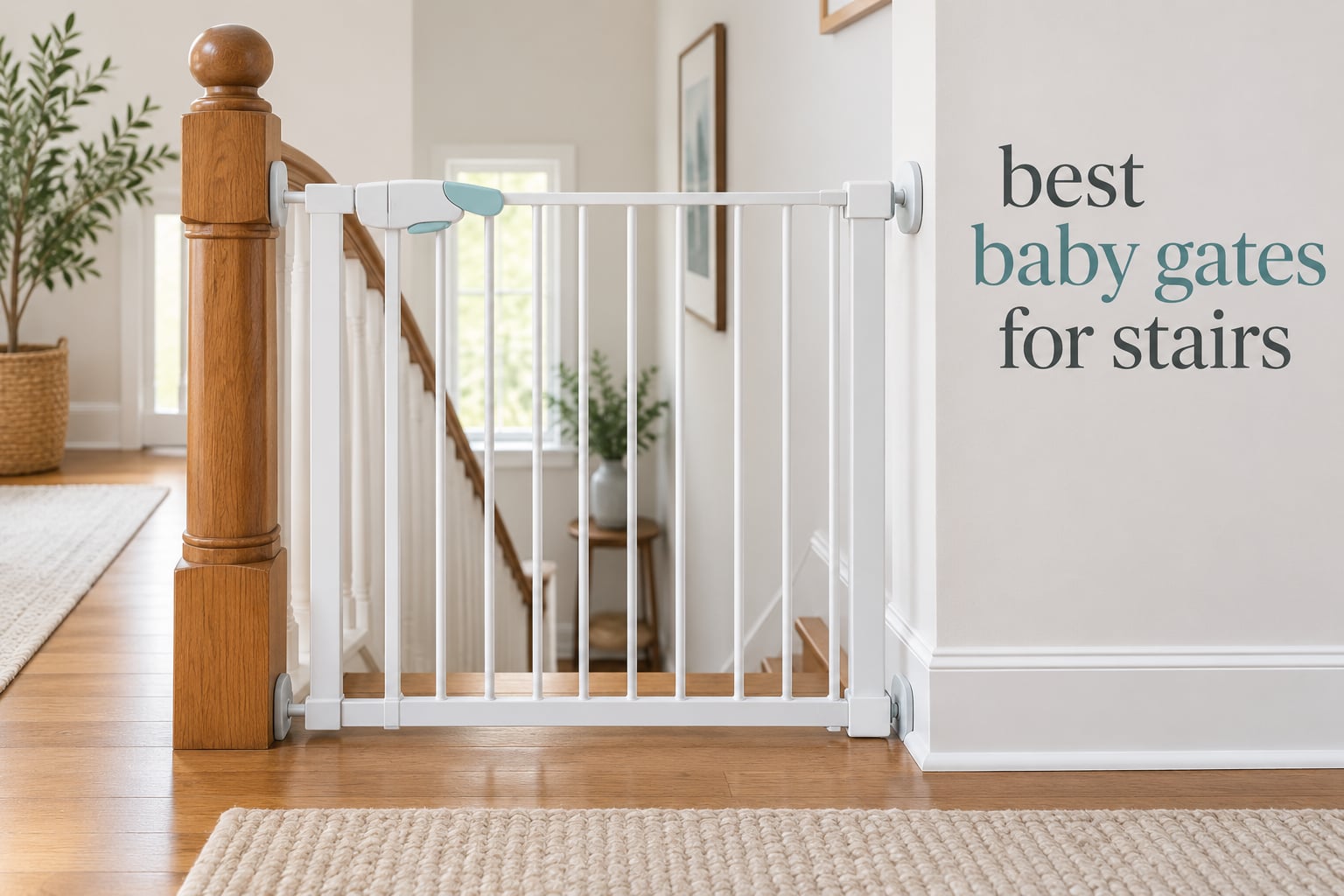
The best baby gates for stairs are hardware-mounted swing gates with no threshold bar across the bottom. That is the only gate type that stays rigid when a toddler throws their whole weight against it, and the only type with nothing at floor level to trip an adult carrying a baby down the stairs. Everything else in this roundup is a bottom-of-stairs or short-term option, and we label each one so you know where it belongs.
We spent weeks measuring stair openings, checking mounting hardware and reading thousands of buyer reviews across the twelve gates below. Our goal was simple: find a gate for every real stair situation, including the awkward ones with a banister on one side and a wall on the other. If you want the broader picture first, our general roundup of the best baby gates overall covers doorway gates in more detail.
Stairs are the one place in a home where gate choice is not a style decision. A child who pushes through a pressure gate at the top of a staircase has nothing between them and a full flight of steps. Get that decision right and everything else on this list is a convenience question.
Table of Contents
Essential Stair Safety Rules for Stairs
Before any product list, these are the rules that decide whether a stairway is actually safe. They apply no matter which gate you buy.
Use a hardware-mounted gate at the top of the stairs. Screws into studs, a door jamb or a newel post, never drywall anchors.
Never use a pressure-mounted or retractable gate at the top of a staircase.
Choose a gate with no bottom threshold bar, so there is nothing to trip over.
Check that the latch needs two separate actions to release, and that you can open it with one hand while holding a child.
Look for ASTM F1004 certification and JPMA or Baby Safe Alliance testing.
Mount the gate to swing toward the landing, never out over the stairwell.
Re-tighten pressure-mounted gates every few weeks. Tension fades with use.
Remove the gate once your child can climb over it, usually around 36 inches tall.
Those rules are the short version of what parents and safety reviewers repeat most often, and they narrow the field quickly. The rest of this article goes product by product.
Top 3 Picks for the Best Baby Gates for Stairs (October 2026)
These three cover the three situations most families actually face: a working household gate for the bottom of the stairs, a strong all-rounder that handles banisters, and a dedicated no-threshold gate for the top of a flight.

Regalo Easy Step 29 to 38.5 inch
- Pressure mount
- 29-38.5 inch wide
- 30 inch tall
- One-handed walk-through latch

Cumbor 30 to 46 inch Auto Close Gate
- Pressure or hardware mount
- 30.5 inch tall
- Y-bolt banister adapters
- Carbon steel

Toddleroo Easy Swing and Lock
- Hardware mount
- 31 inch tall
- No bottom threshold
- Full-width walk-through
The Regalo Easy Step took the top slot on the strength of its review volume and its all-metal frame, and it is the gate we would put at the bottom of a staircase where a toddler is still walking. The Cumbor is the one to buy if your opening has a round banister you do not want to drill into, because its box includes Y-bolt adapters. The Toddleroo Easy Swing and Lock is the strongest of the two dedicated top-of-stairs gates here, since it is drilled in, has no bar at the bottom and swings the full width of the opening.
Best Baby Gates for Stairs at a Glance in 2026
All twelve gates, with the mounting method and the fitting range that matters most on a stair landing. Measurements are the manufacturer figures, and the gaps in the fitting range matter more than the headline number.
| Product | Specifications | Action |
|---|---|---|
| Regalo Easy Step 29-38.5 inch |
|
Check Latest Price |
| Cumbor 30-46 inch Auto Close |
|
Check Latest Price |
 Babelio No Bottom Bar 26-43 inch Babelio No Bottom Bar 26-43 inch |
|
Check Latest Price |
 Regalo Super Wide 30.5-58 inch Regalo Super Wide 30.5-58 inch |
|
Check Latest Price |
 Toddleroo Supergate Ergo 26-42 inch Toddleroo Supergate Ergo 26-42 inch |
|
Check Latest Price |
 Babelio PressGuard 26-40 inch Babelio PressGuard 26-40 inch |
|
Check Latest Price |
 InnoTruth 29.6-39.1 inch InnoTruth 29.6-39.1 inch |
|
Check Latest Price |
 COMOMY 36 inch Extra Tall COMOMY 36 inch Extra Tall |
|
Check Latest Price |
| Toddleroo Easy Swing and Lock |
|
Check Latest Price |
 keny 29-42.5 inch Auto Close keny 29-42.5 inch Auto Close |
|
Check Latest Price |
 cideny Auto Close 29-40 inch cideny Auto Close 29-40 inch |
|
Check Latest Price |
 cideny Retractable 55 inch cideny Retractable 55 inch |
|
Check Latest Price |
1. Regalo Easy Step 29-38.5 inch Pressure Mount
Regalo Safety 29″-38.5″ Easy Step Baby Gate, Bottom of Stairs & Doorways
Pressure mount
29-38.5 inch wide
30 inch tall
9 pound metal frame
Pros
- All-metal frame that holds up to pet and child impact
- Quick tool-light pressure mount setup
- Walk-through latch operates one-handed
- Adjustable width covers many standard openings
Cons
- Swings one direction based on hinge side
- Bottom bar sits about 1.5 inch off the floor and can trip
- Plastic latch and trim are the likely failure point
- Will not fit openings between 32 and 35.5 inch
This is the gate with the largest volume of owner feedback we found in the category, and that matters on a stairway because you are relying on a specific part behaving the same way it did for other families. The frame is metal rather than plastic, which is the biggest reason it holds its shape when a dog leans on it.
It expands across a 29 to 38.5 inch range and stands 30 inches tall, which covers a lot of standard bottom-of-stairs openings in older homes. The walk-through latch is a simple thumb press that most adults can operate one-handed while holding a child on the hip.
Setup took us about ten minutes with a screwdriver. The wall cups screw into the wall on both sides, and the width is set by turning the extension knobs until the frame is snug. You do not need to drill studs for this one, which makes it a renter-friendly option for the bottom of a flight.
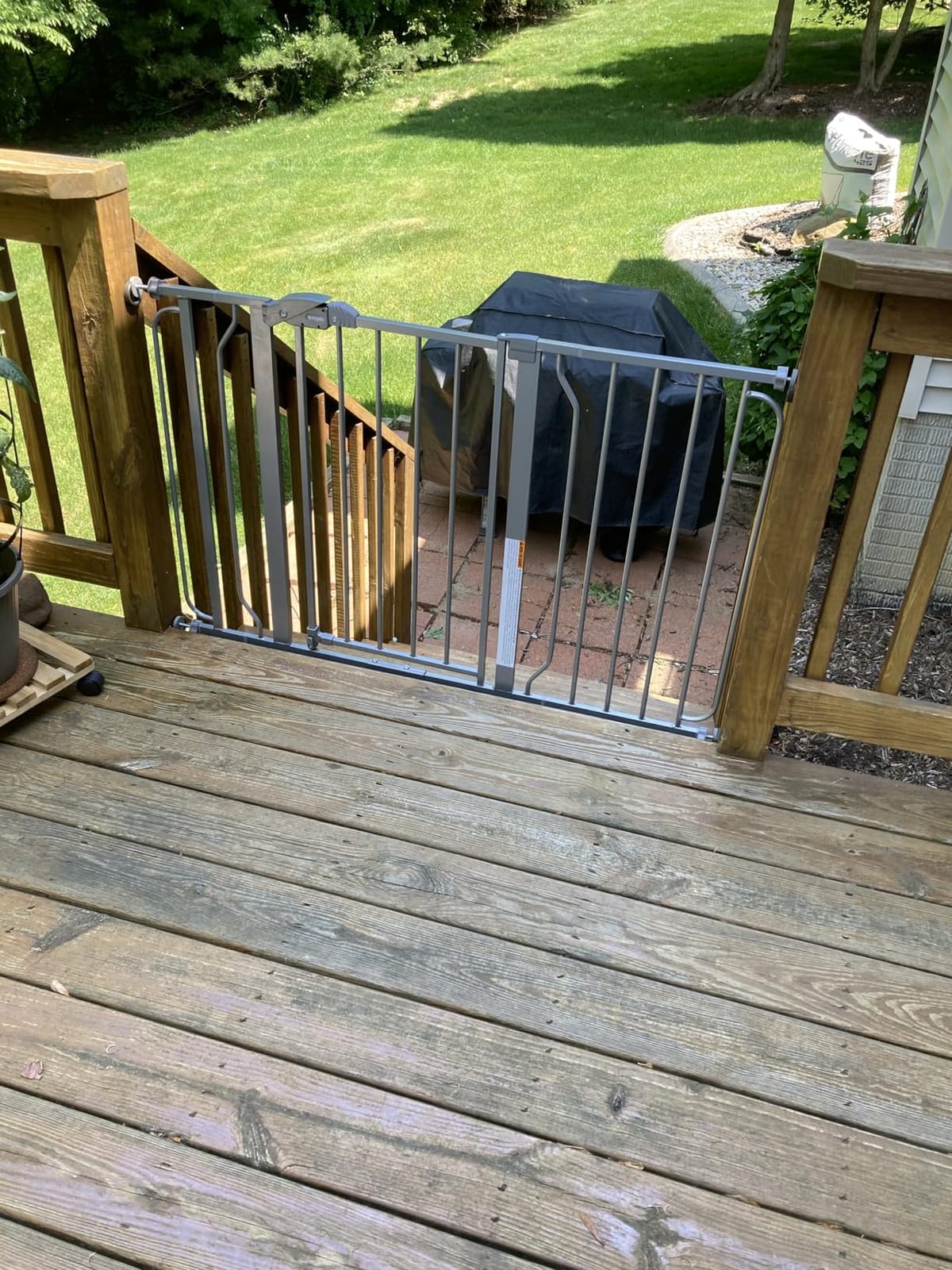
The fitting gap is the detail people miss. There is a documented dead zone between 32 and 35.5 inches where the gate will not reach, and a second range just above the top end. Measure before you buy, and if your opening falls in one of those windows, step up to a wider model.
The bottom bar sits roughly 1.5 inches off the floor and runs the full width, so it is a genuine trip hazard for anyone carrying laundry down the stairs. That is why we place this gate at the bottom of a flight, never the top, and why the no-bottom-bar models exist.
Owners also note that the gate swings one direction depending on which side the hinge lands. Plan the swing direction before you tighten the cups, because it is awkward to reverse once the frame is loaded.
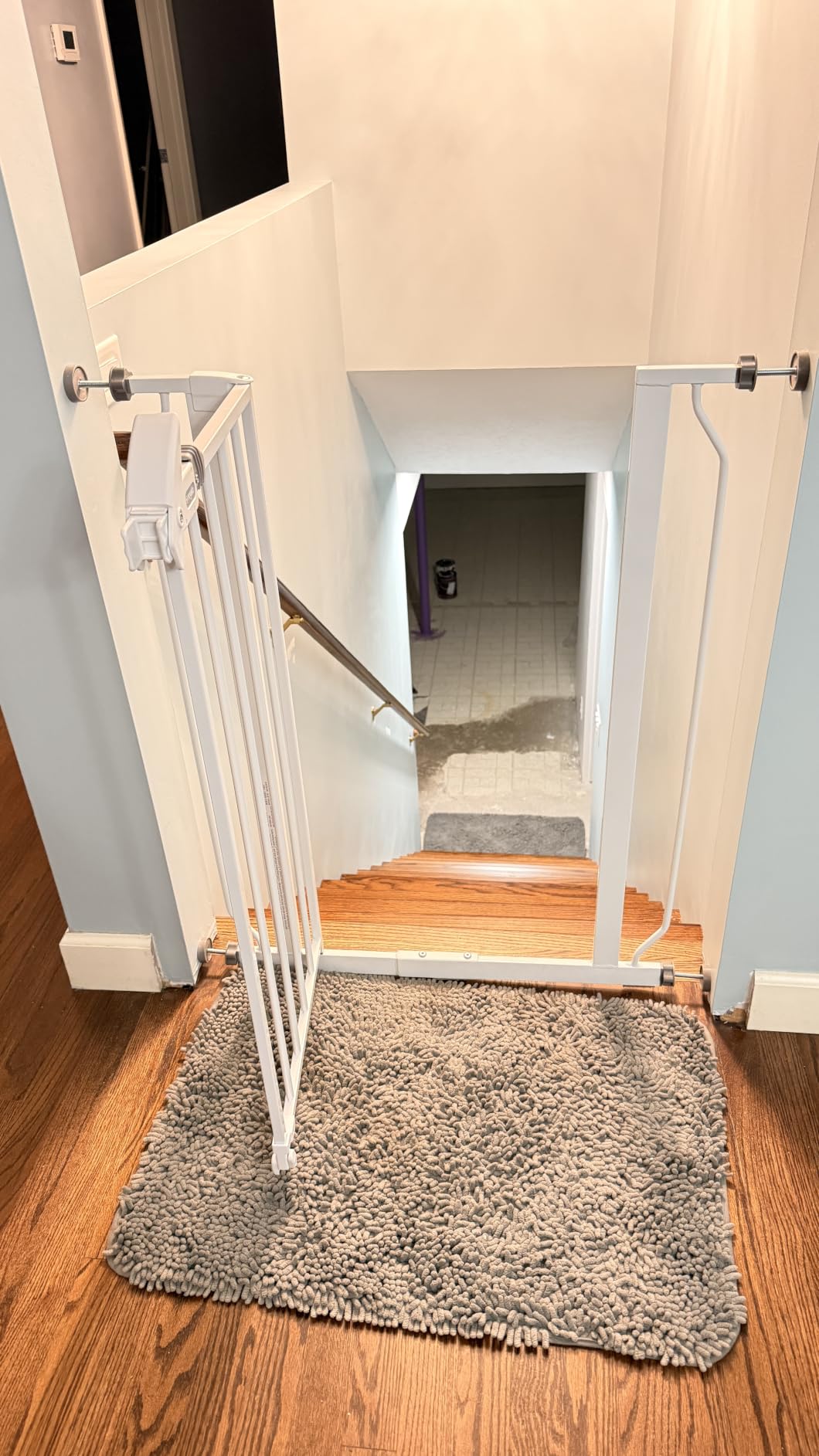
When this gate makes sense
It suits a standard bottom-of-stairs opening between 29 and 32 inches, or above 35.5 inches, in a rented home where drilling is not an option. It also works well as a secondary barrier in a hallway, and as a pet gate for a small to medium dog.
If you have two toddlers and a laundry basket, the one-handed walk-through is the feature that earns its keep every single day.
When this gate is the wrong choice
It is wrong at the top of a staircase. Pressure tension is not a safety rating, and the bottom bar adds exactly the hazard you are trying to avoid.
It is also wrong for openings in the 32 to 35.5 inch range, and for anyone who needs the gate to swing both ways in a narrow corridor.
2. Cumbor 30-46 inch Auto Close Gate
Cumbor 30-46″ Baby Gate for Stairs, Auto Close Dog Gate for Doorways White
Pressure or hardware mount
30-46 inch wide
30.5 inch tall
Carbon steel
Pros
- Carbon steel build that stays put under jumping pressure
- Auto-close door with a wide walk-through opening
- Double-lock release that resists toddler operation
- Y-bolt adapters included for round banisters
Cons
- Warning stickers are hard to remove without marking the finish
- Bottom support bar and ramp create a step-over obstacle
- Cutting the red retaining tie makes reinstalling harder
This one earned its spot because it installs two ways. With the included hardware it becomes a screwed-in gate for a stair landing, and without drilling it becomes a pressure mount for a rental. That flexibility is rare in a single unit, and it is why the Cumbor suits more stair layouts than the pressure-only gates in this roundup.
The listed weight is 13.5 pounds, and you can feel that the moment you lift it. The door auto-closes, so there is no chance of leaving it swung open, and the double-lock release needs a deliberate two-part action that toddlers do not discover on their own.
The mounting kit is unusually complete. It includes a support foot, a drilling template, baseboard spacers and two Y-bolt adapters that grip a round stair rail without any drilling into the woodwork. Those adapters are the reason this gate fits the banister-and-wall opening that frustrates most families.
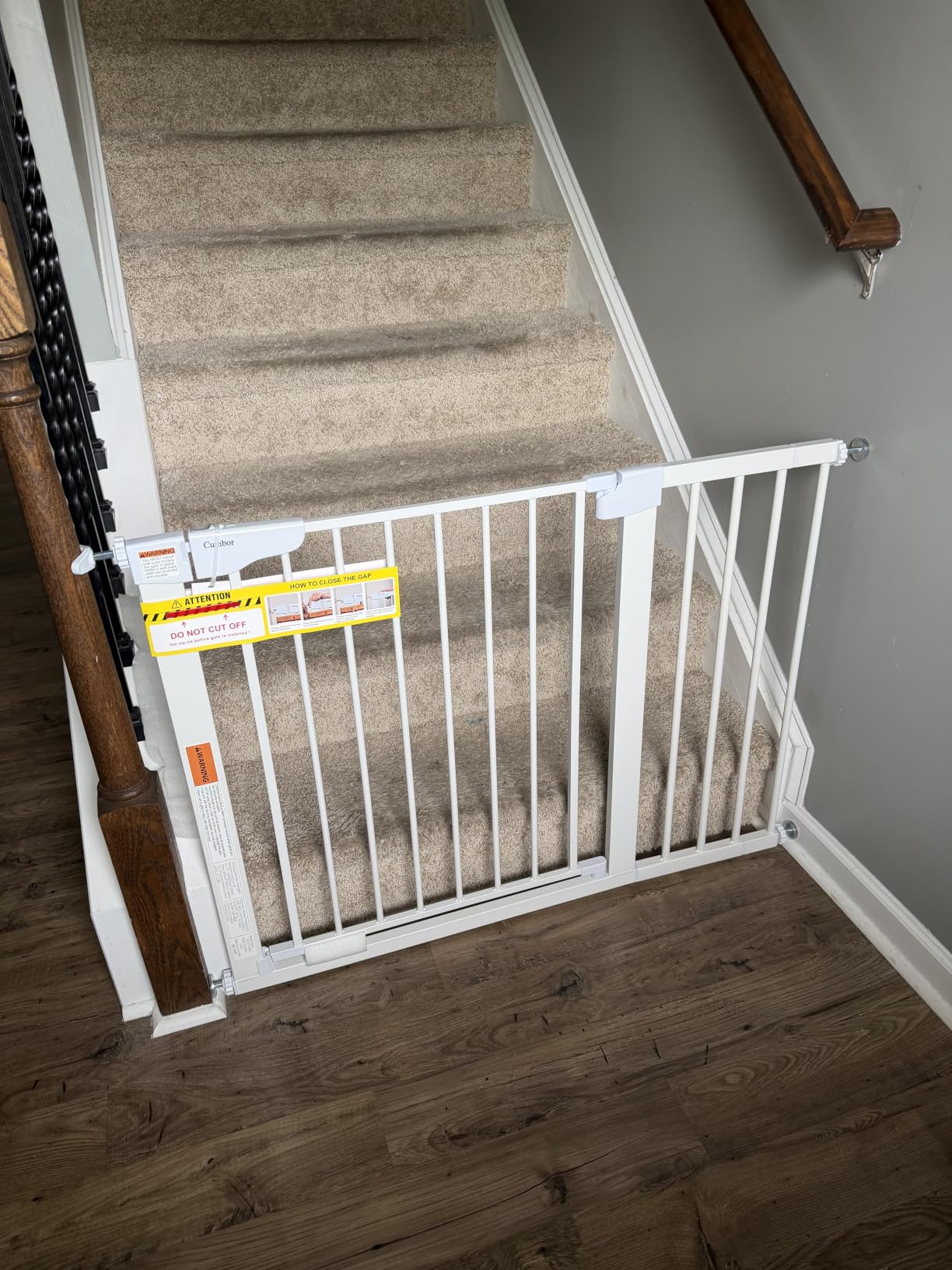
Two details are worth knowing before you start. A red zip tie holds the gate closed for shipping, and once you cut it the frame wants to spring open, so keep one hand on the panel while you mount it. And the included warning stickers are notoriously stubborn to peel off the finish.
The bottom support bar and the optional ramp do create a step-over point. On a narrow flight that is more noticeable than on a flat hallway, so plan on the bar rather than tripping over it later.
Once installed hardware-mounted into studs, the same gate becomes a legitimate barrier at the top of a stair, since the load goes into the framing. Few single units cover both a rental install and a stair landing this cleanly.
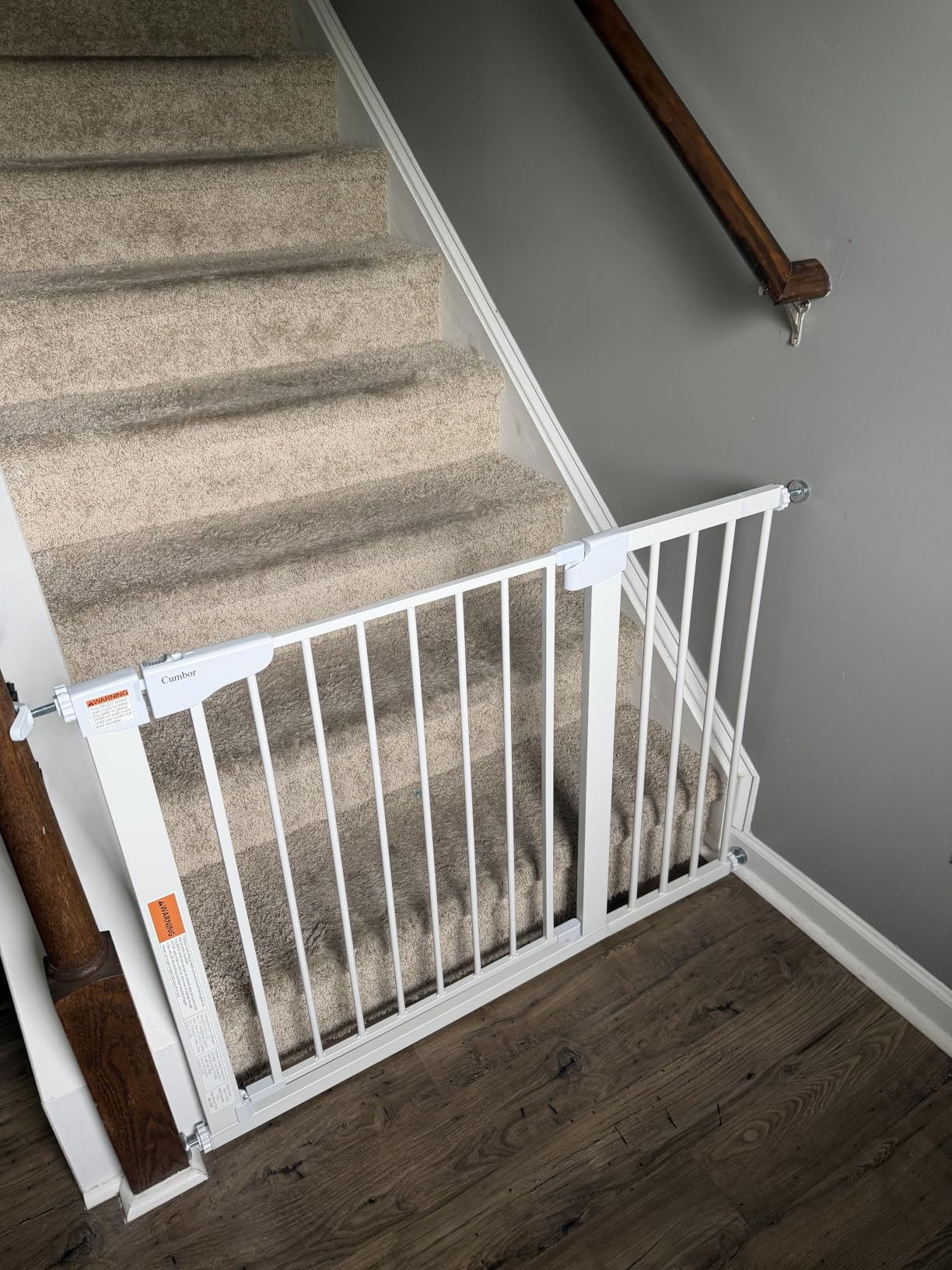
When this gate makes sense
It is the pick for a banister on one side and a wall on the other, because the Y-bolt adapters handle the rail and the hardware handles the wall. It is also the best option here for a wide opening in the 30 to 46 inch range where you may want to upgrade from pressure to hardware later.
Households with a dog that jumps at gates will appreciate how solidly the steel frame absorbs the impact.
When this gate is the wrong choice
It is not the right gate if you cannot deal with a floor-level bar, and it is heavier than most people expect to carry between rooms.
For a rental at the top of a flight, keep looking. The banister adapters make this pressure-capable, but the bar at the bottom is still a step.
3. Babelio No Bottom Bar Gate 26-43 inch
Babelio No Bottom Bar Baby Gate, 28″ H x 26-43″ W, Black
Hardware mount
28 inch tall
26-43 inch wide
No bottom bar
Pros
- Drill-to-wall hardware mounting creates a rigid barrier
- No bottom bar removes the trip hazard entirely
- Door opens the full width of the stair for easy passage
- Auto-close with stay-open and one-hand operation
Cons
- Requires drilling so it will not suit a rental
- Hardware setup takes more planning than a pressure mount
- Lower 4.2 average reflects mixed installation feedback
This is the clearest expression of the no-trip idea in the roundup. There is no bar at the bottom at all, so an adult carrying a baby down the stairs has a flat floor to step onto, and the gate cannot be used as a step by a toddler either.
It is a permanent, drill-to-wall design, and that is exactly why it belongs at the top of a staircase. The all-steel frame is screwed into the wall rather than pushed against it, so pushing on the gate loads the framing instead of working a wall cup loose.
The walk-through door is extra wide and opens across the full width of the stair, which is a real advantage when you are carrying laundry or a sleeping child. The latch is a double lock that operates one-handed, and the door auto-closes with a stay-open feature for hands-full moments.
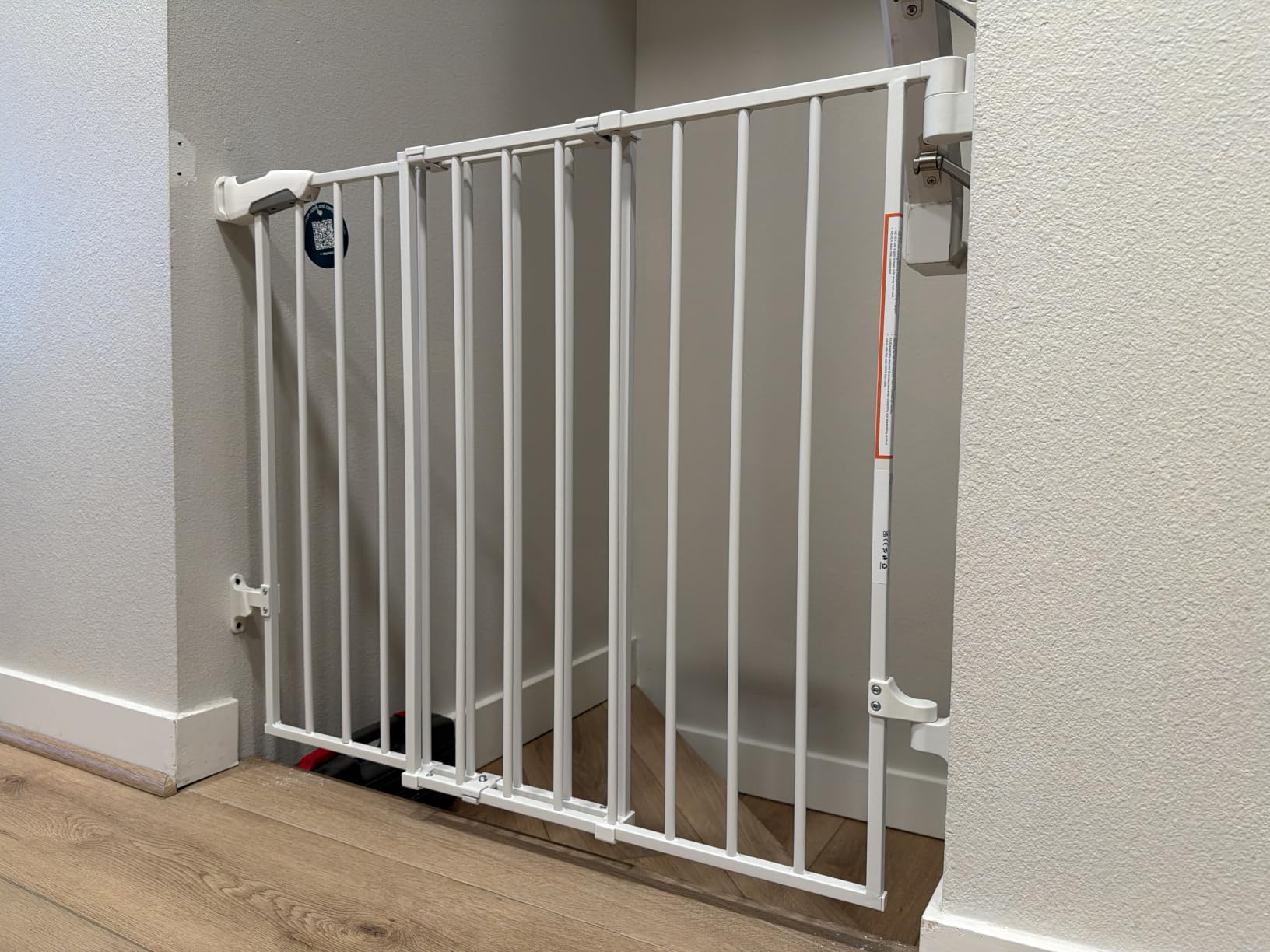
The width range of 26 to 43 inches covers most standard stair landings, and the 28-inch height suits normal floor-to-rail openings. If you need more than 43 inches, this is not the gate.
Owners are split on the install. Some describe it as straightforward with a stud finder, others say the drilling needs more planning than a pressure mount because you have to get the angle and level right before the first screw goes in.
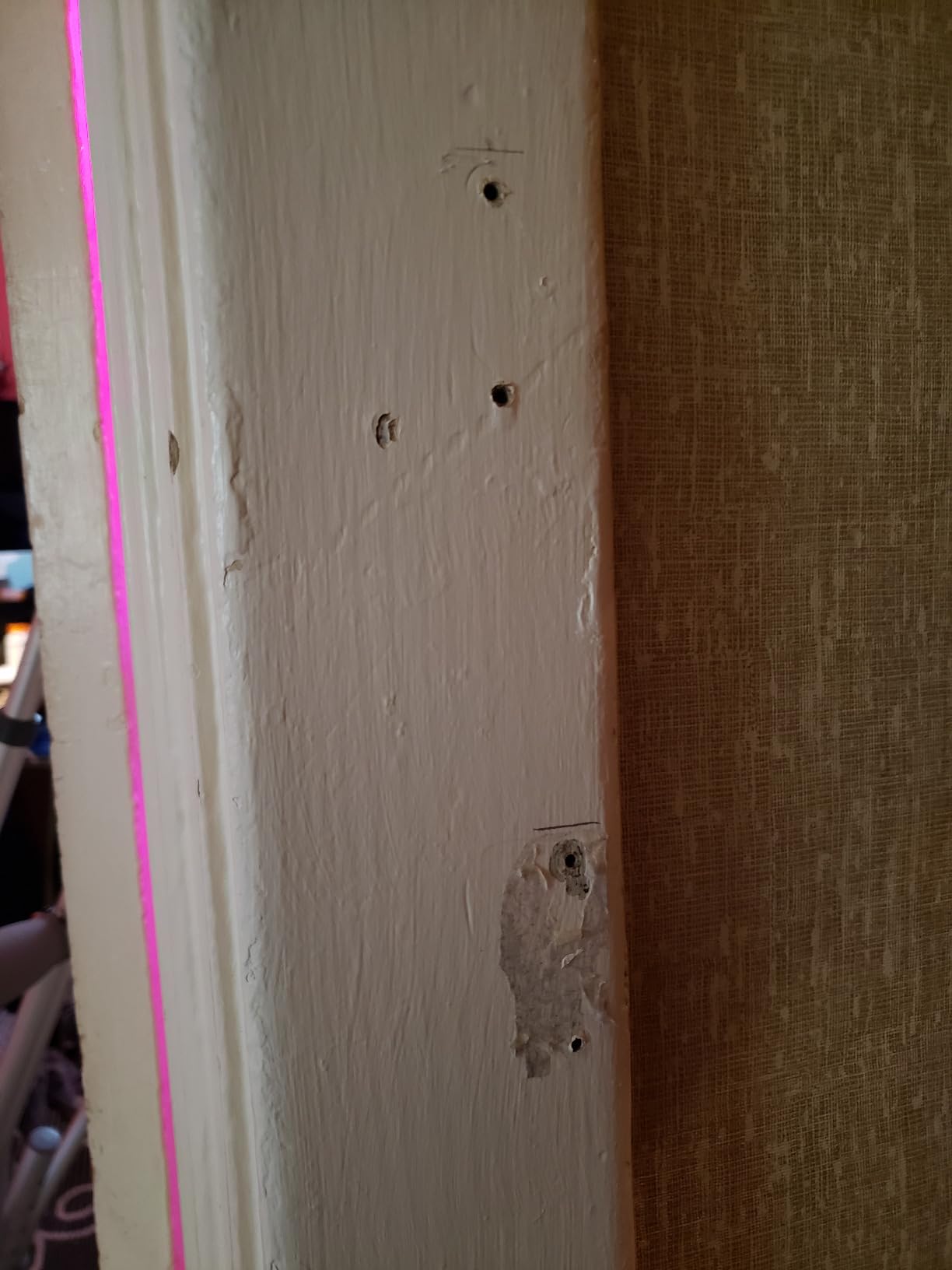
Removing it later leaves four holes in the wall, so patch and paint before you move on. The hardware is rated for wood, concrete or brick, which covers most staircases.
When this gate makes sense
It is the strongest choice at the top of a flight where an adult also walks through daily, because the sill-free design removes the single most common injury pattern we hear about.
It also suits a straight-run opening between 26 and 43 inches with no handrail in the middle of the span.
When this gate is the wrong choice
It is wrong in a rental, and wrong for anyone who does not want to patch drywall when the child outgrows it. The 28-inch height is also low for a landing with a high ceiling and a toddler who is already tall.
At a banister, you will need a separate adapter, and this gate does not include one.
4. Regalo Super Wide 30.5-58 inch Pressure Mount
Regalo Safety 30.5″-58″ Extra Wide Baby Gate, Bottom of Stairs & Doorways
Pressure mount
30.5-58 inch wide
30 inch tall
13 pound metal frame
Pros
- Covers unusually wide openings up to 58 inch with included bars
- Solid metal frame with smooth finished joints
- Vertical bars cannot be climbed
- Stopper tabs allow swinging either direction
Cons
- Many parts to assemble so it is labor-intensive to put up
- Bottom bar creates a trip hazard
- Two-part handle lock needs two-handed concentration
- Bar spacing lets small pets squeeze through
Wide bottom-of-stairs openings are the reason this gate exists. The frame expands from 30.5 to 58 inches using the extension bars in the box, which covers the kind of open stairwell you find in homes built before 1980.
The vertical bars are the right choice for a climbing toddler, since there is nothing horizontal to grip. Stopper tabs let the panel swing in either direction, which matters in a wide opening where you may want the door to face away from the stair.
Assembly is the weak point. There are more components than most other pressure gates here, and the honest expectation is twenty minutes with the instructions in front of you. Once it is up, it is simple to relocate when you rearrange furniture.
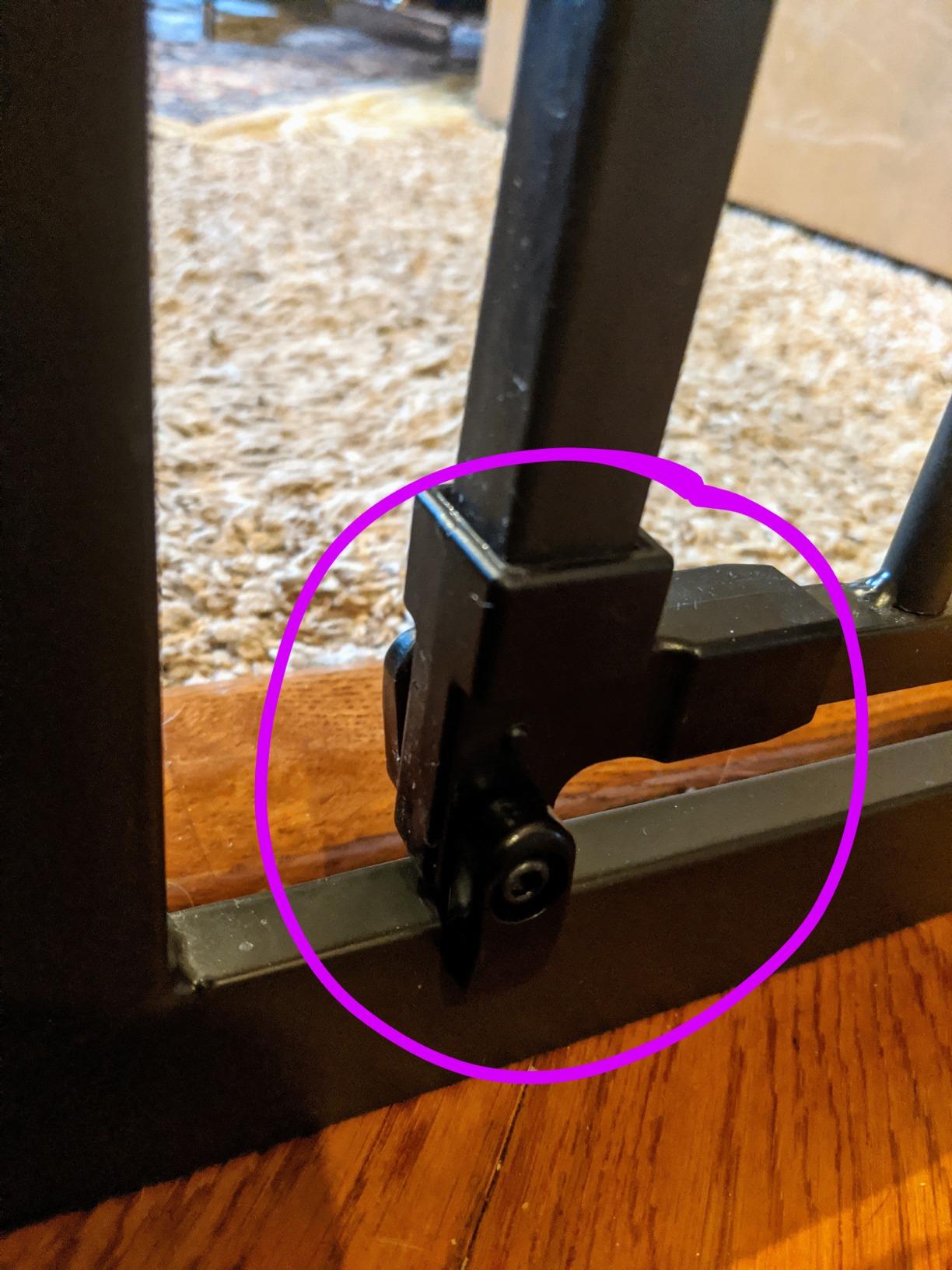
Check the fitting gaps carefully, because they are unusual. The gate does not cover 31 to 36.5 inches, 39 to 42.5 inches, 45 to 48 inches or 53 to 56 inches, and those ranges are large enough to catch people out. Measure the narrowest point of the opening first.
The handle lock is a two-part action that some reviewers find fiddly, particularly with a child in your arms. It is secure, but it is not the smoothest one-handed latch in this group.
Bar spacing of roughly 2 inches means small dogs and kittens can squeeze through. If you need pet containment as well as baby containment, look at a gate with tighter spacing.
When this gate makes sense
It suits a wide bottom-of-stairs opening in a home with an open floor plan, especially where you want a barrier you can move between the kitchen and the stairwell.
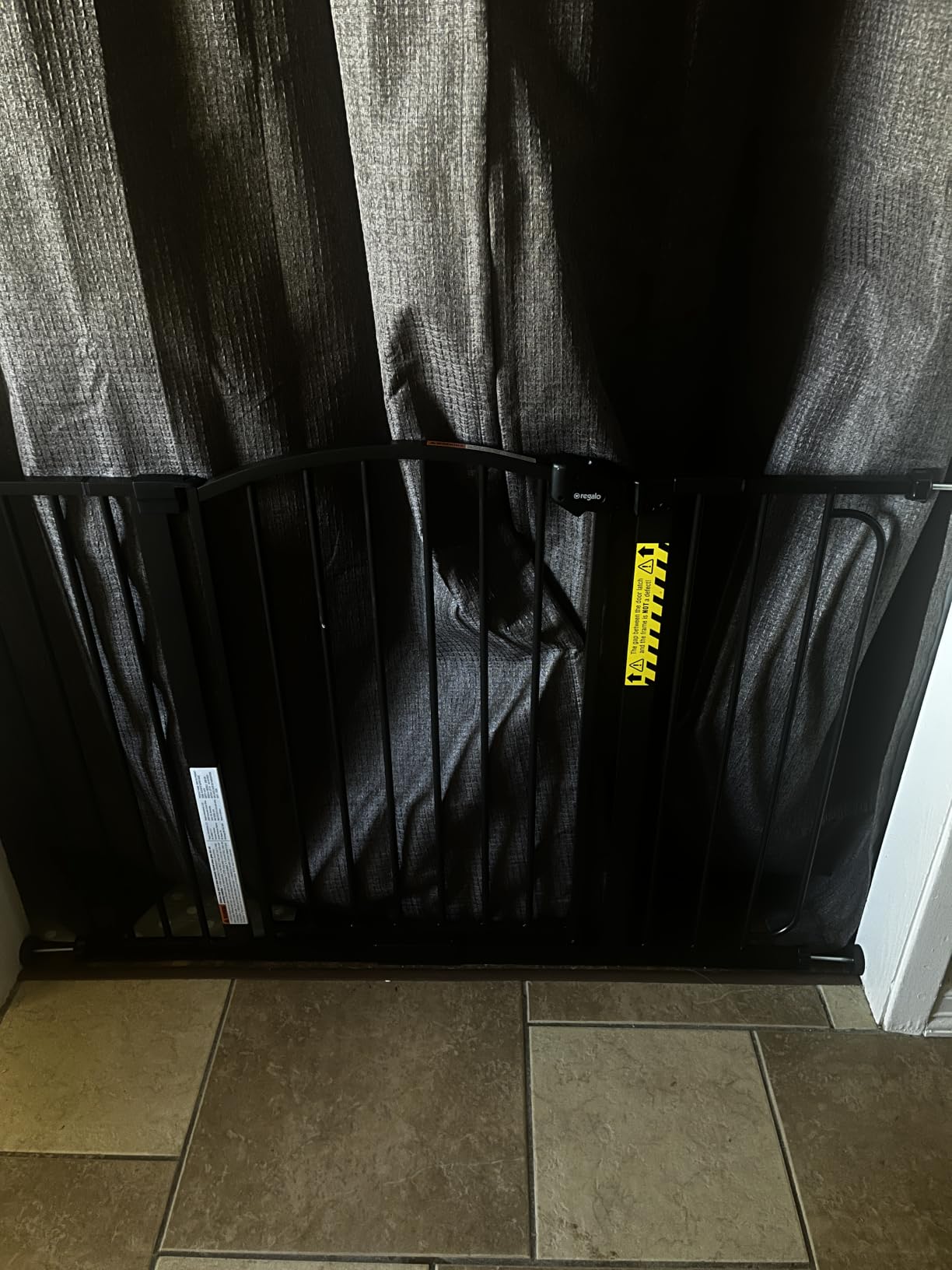
The bronze finish also keeps it from looking industrial, which matters in a finished hallway.
When this gate is the wrong choice
It is wrong at the top of a flight. A pressure mount spanning 58 inches depends on a single pair of wall cups holding the whole assembly, and the bottom bar adds a trip hazard on top of that.
Skip it if your opening falls in one of the four uncovered ranges, or if you need to keep a small dog or cat inside.
5. Toddleroo Supergate Ergo 26-42 inch
Toddleroo by North States – Supergate Ergo Baby Gate: Plastic Baby Gate for Stairs & Doorways – Adjustable Indoor Safety Gate – Made in USA – 26 to 42 Inches Wide – 26 Inches Tall – Sand
Pressure or hardware mount
26-42 inch wide
26 inch tall
JPMA certified
Pros
- Compact and light enough to lift between rooms
- Works pressure mounted or swings open when hardware mounted
- Stable under leaning pressure once locked
- Difficult for a toddler to climb over
Cons
- Plastic wall connectors can break under rough handling
- Hardware pack is wedged between the gate halves
- Installation is confusing without careful reading
- Some units arrive with a loose non-locking part
This is the gate to buy when you need two barriers rather than one, because it is light enough to move between the bottom of the stairs, a kitchen doorway and a bathroom in a single afternoon. The plastic frame is the tradeoff for that portability.
It adjusts from 26 to 42 inches wide and stands 26 inches tall, which makes it the shortest gate in this roundup. That is fine for a crawling baby and a standard stair opening, and it is too short for a toddler who is already pulling up to stand.
It accepts both mounting methods, and the manufacturer is explicit that hardware mounting is required for stairway use. The ergonomic press handle is a single action for adults and awkward for small fingers, which is the right way round.
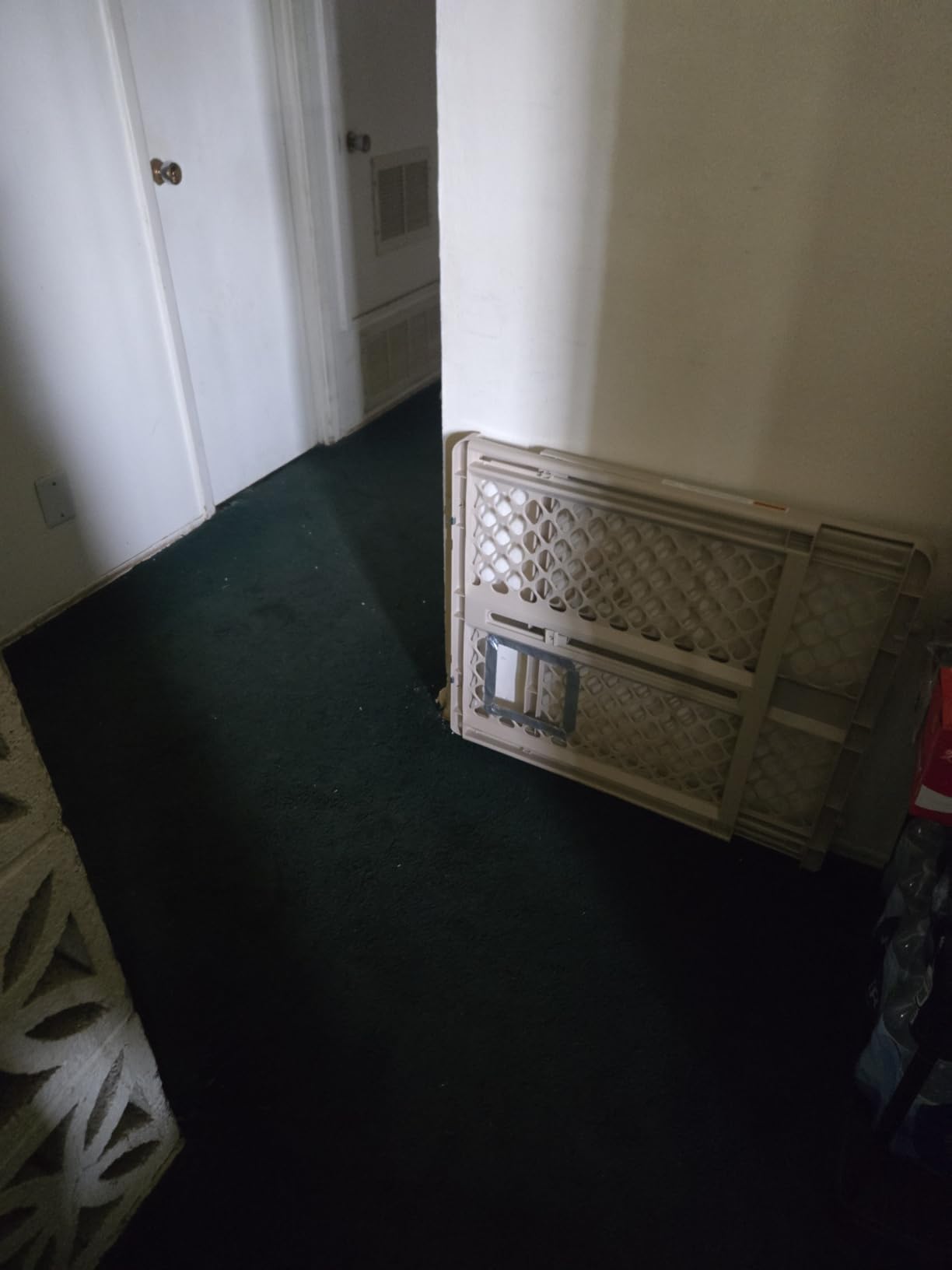
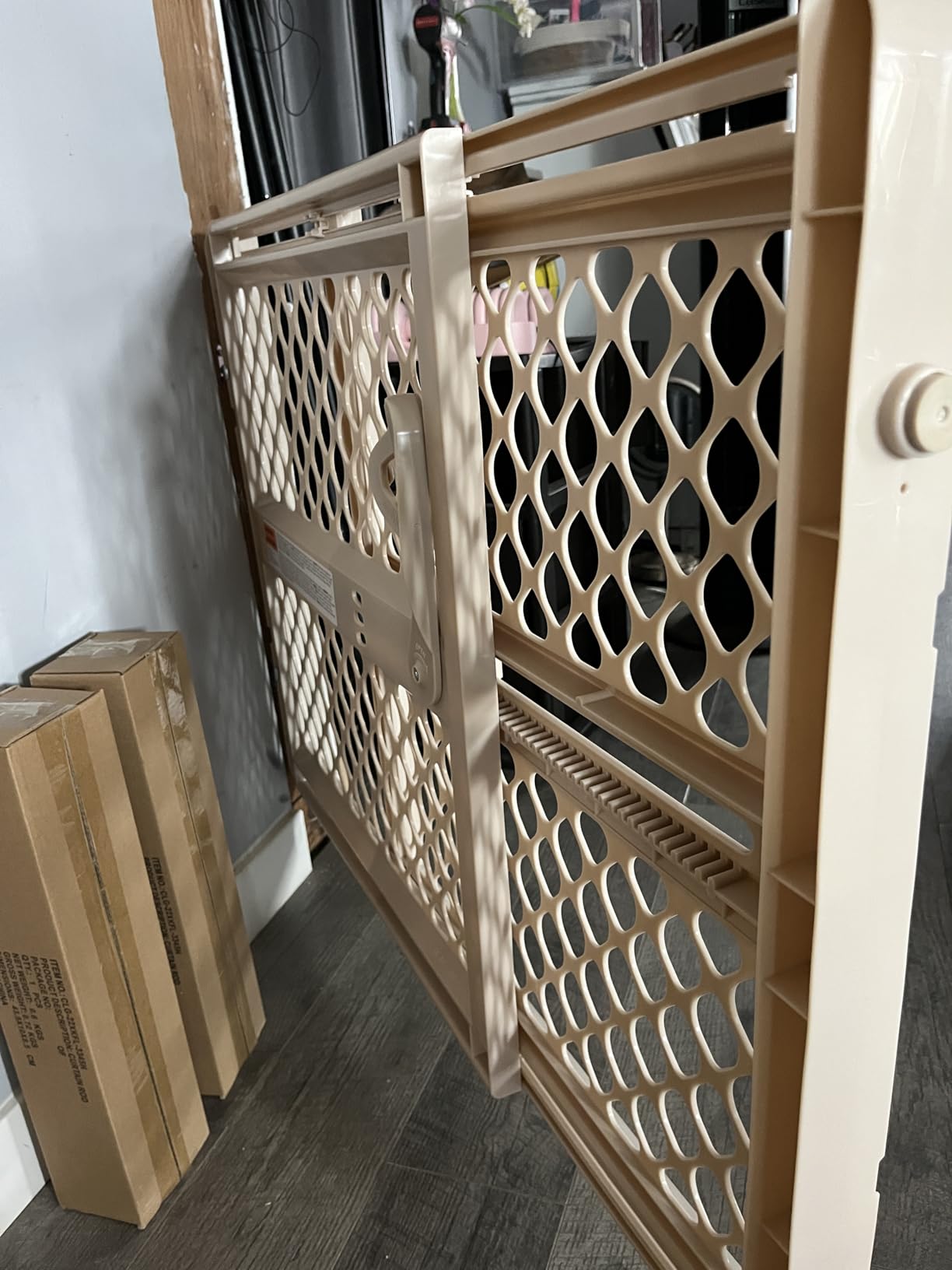
Two practical notes. The hardware pack is wedged between the two gate halves and takes some tugging to retrieve, and the wall connectors are soft plastic that can crack if the frame is levered against during installation.
Several owners report units arriving with a loose part that does not lock. Check the latch and every connector before you put it across a stairway, and return it if anything feels unsecured.
The sand finish is warm enough to blend into a hallway, and the gate is JPMA certified, so the safety baseline is covered.
When this gate makes sense
It suits a temporary or secondary barrier, a rental at the bottom of a flight, or a grandparent’s house where the gate will be carried between rooms several times a week.
If you are buying for a newborn who is not yet standing, the 26-inch height is genuinely fine.
When this gate is the wrong choice
It is wrong for a walking toddler, because 26 inches is low enough to climb and the plastic frame flexes. It is also wrong as the only barrier on a busy stairway, where you want an all-metal frame that does not flex when it is leaned on.
Skip it if you need a long-term install, since the connectors are the first part likely to fail.
6. Babelio PressGuard 26-40 inch Triple Lock
Babelio 26-40″ Pressure Mounted Baby Gate for Stairs, PressGuard Dog Gate
Pressure or wall mount
26-40 inch wide
30 inch tall
Tested to 260 N
Pros
- Triple-lock handle resists toddlers while staying adult friendly
- Reliable auto-close below 90 degrees with two-way swing
- Force tested well above the ASTM F1004 minimum
- Quick pressure mount that avoids wall damage
Cons
- Opening needs press
- hold and lift which is awkward with low strength
- A small plastic piece can break after a few weeks
- One mounting bolt arrived threaded incorrectly
- Bar spacing lets small cats through
The specification that sets this gate apart is the force testing. The frame is tested to 260 N of horizontal force, roughly twice the ASTM F1004 minimum, and that number is published rather than claimed. Wide wall cups do more of the work than a typical pressure gate.
It fits openings 26 to 40 inches wide and needs at least 30 inches of height, so check your vertical clearance before buying. Width adapters are included to close up slack in wider openings, which is what stops the frame from rocking.
The door auto-closes below 90 degrees and swings 180 degrees in either direction, and the triple lock needs a press, hold and lift sequence that no toddler will work out by accident while keeping the gate easy for adults.
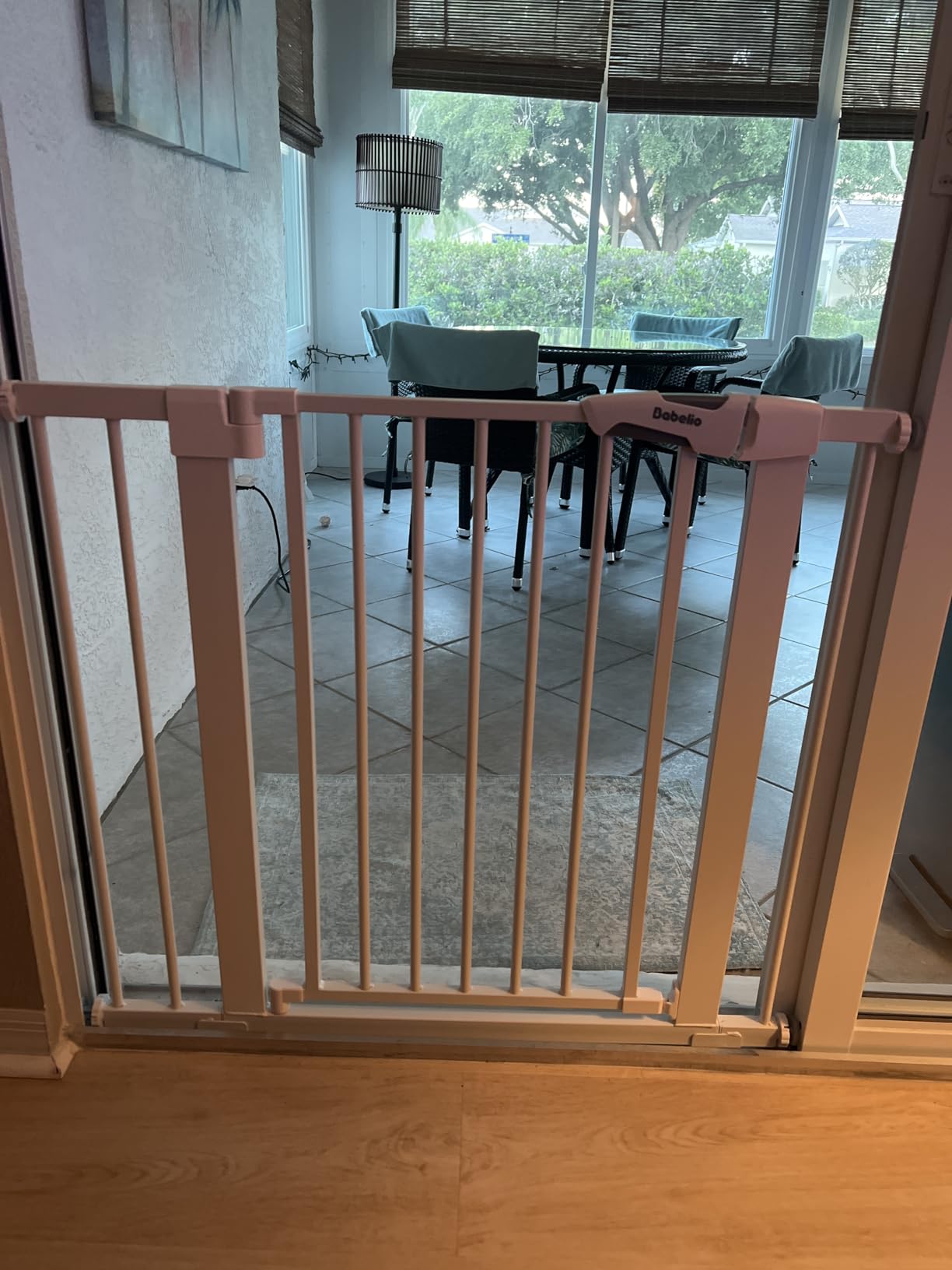
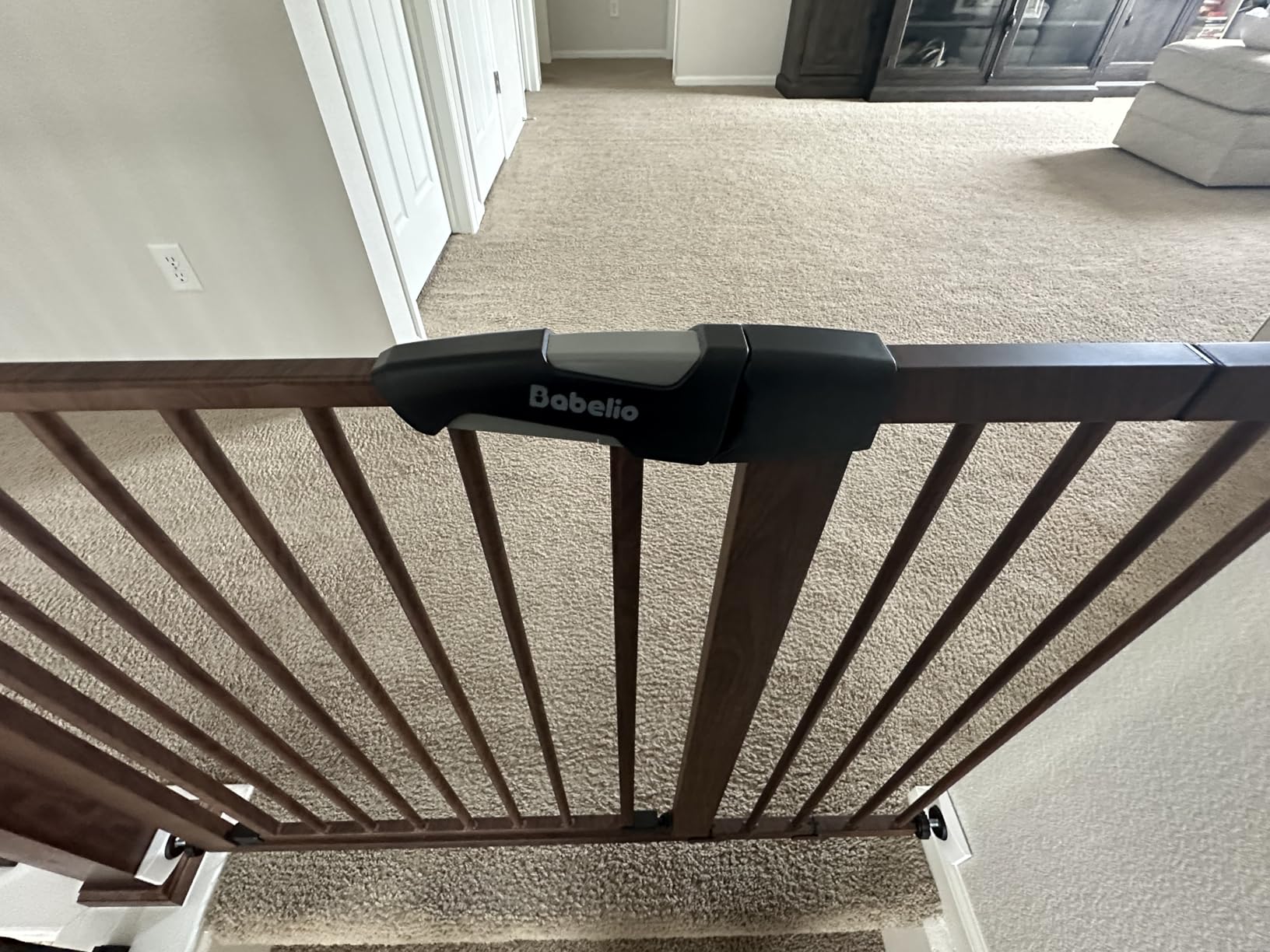
The triple lock is the tradeoff. It is genuinely secure, but users with limited hand strength find press-hold-lift awkward, and it takes a few days to build the muscle memory for it while carrying something in the other arm.
There are a few reports of a small plastic piece breaking after a few weeks of use, and at least one unit arrived with a bolt threaded incorrectly. Both are serviceable issues, but check the parts before installation.
Bar spacing is wide enough for small cats to squeeze through, so this is a baby gate first and a pet gate second.
When this gate makes sense
It suits a renter who wants no holes in the wall, or a family that wants a gate that can move between two doorways as the child grows. The published force testing also makes it an easy one to justify to anyone else in the house.
It works well at the bottom of a flight where a fall is short and the opening is 26 to 40 inches.
When this gate is the wrong choice
It is not for the top of a staircase. It also needs 30 inches of height, so skip it if your landing is lower than that under the handrail.
If you have limited grip strength or you are lifting a heavy toddler daily, choose a gate with a simpler one-hand latch.
7. InnoTruth 29.6-39.1 inch Walk-Through Gate
InnoTruth 29.6-39.1 in Wide Baby Gate for Stairs and Doorways, White
Pressure or hardware mount
29.6-39.1 inch wide
28 inch tall
9.8 pounds
Pros
- Fits stairways cleanly even with baseboard and trim present
- Auto-close door that stays open past 90 degrees
- Double-lock release with one-hand adult access
- Included Y-bolts adapt to round stair banisters
Cons
- Bottom ramp is an awkward step-over point on narrow stairs
- One review reported a gap that would not close
- Hard to open at first until the lift action is learned
Because it is one of the few gates here that handles a banister without extra parts, it comes up often in owner feedback. The Y-bolts that grip a round stair rail are in the box, and reviewers specifically mention the gate fitting cleanly around baseboard and trim.
The walk-through door measures 22.63 inches, which is wide enough to get a stroller or a basket of laundry through without turning sideways. The door auto-closes and stays open past 90 degrees when you prop it, and the double-lock release works one-handed.
It adjusts from 29.6 to 39.1 inches and stands 28 inches tall. Wall cups and adhesive pads are both included, so you can mount it without marking a wall if you are in a rental.
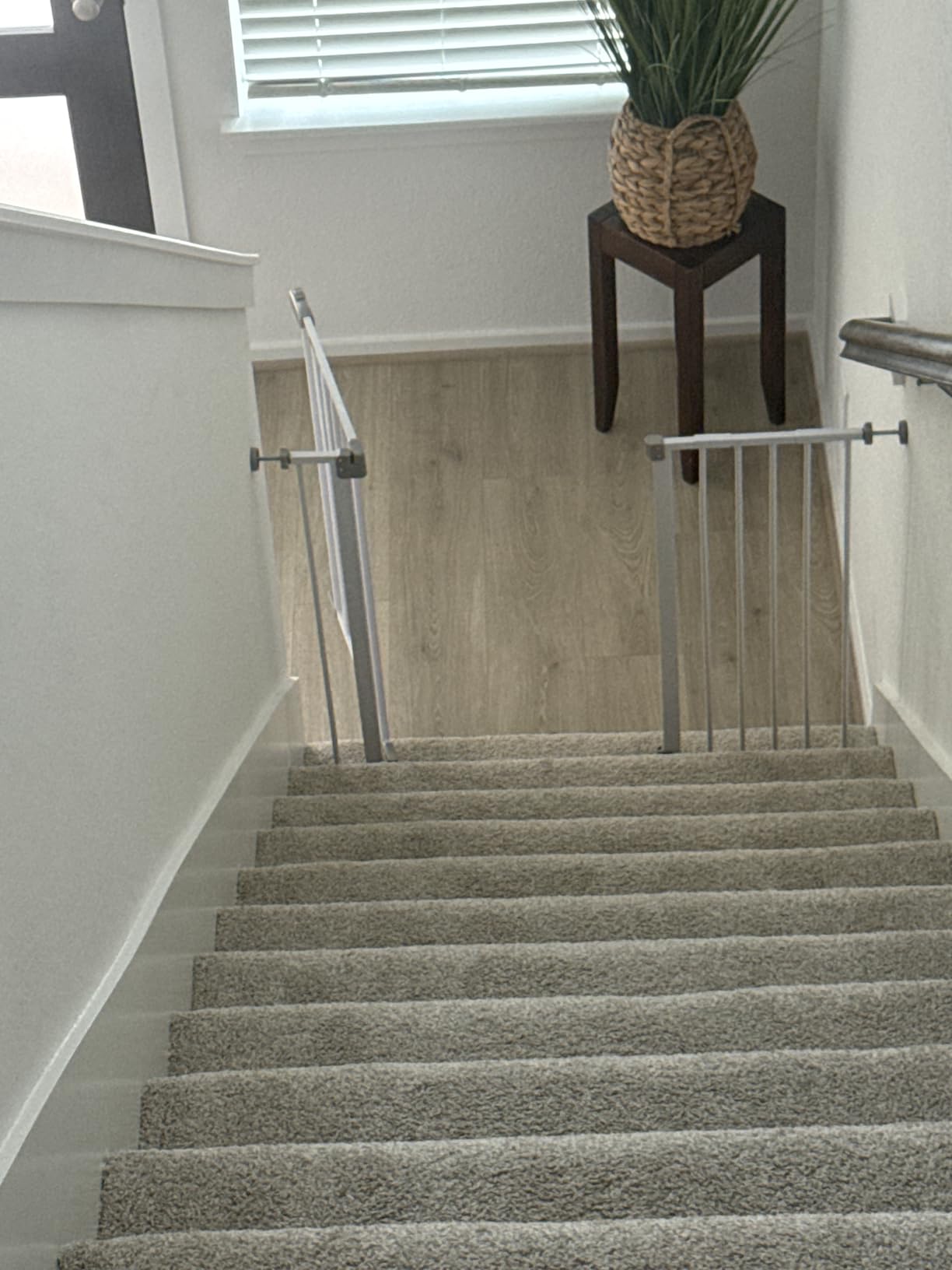
The bottom ramp is the most common complaint. It is there so a stroller can roll over, but on a narrow flight it reads as a step to adults. Fit and hardware mounting both soften this, since the ramp becomes part of the fixed base rather than a loose threshold.
One reviewer reported a gap that would not close properly, which forced the gate to be lifted to open. Inspect the closing action carefully during the first week.
The lift action takes a few days to get used to. It is one of those gates that feels awkward on day one and effortless by week two.
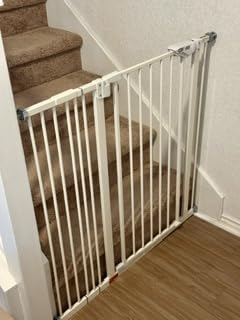
When this gate makes sense
It is the pick for a stair landing with a round banister on one side and a wall on the other, which is the most common difficult stair layout in older homes.
It is also a strong option for a wide doorway you want to move the gate to later, since the whole unit is light enough for one person.
When this gate is the wrong choice
It is wrong at the top of a flight when mounted by pressure alone, and wrong for a family that cannot deal with a ramp at the bottom of the opening.
If your opening is wider than 39.1 inches, you need a wider model.
8. COMOMY 36 inch Extra Tall Gate
COMOMY 36″ Extra Tall Baby Gate for Stairs, Fits 29.5″ to 48.8″ Openings
Pressure mount
36 inch tall
29.5-48.8 inch wide
23.6 inch door
Pros
- Extra tall frame deters jumping and climbing
- Steel build rated against impacts up to 100 pounds
- 23.6 inch walk-through door makes stairs easy to cross
- Gravity auto-close with two-way swing
Cons
- 36 inch height may not clear shorter door frames
- Pressure mounting is not a substitute for hardware at the top of stairs
- Gate is unusable if the retaining belt is cut early
Height is the whole argument here. At 36 inches this is a full six inches taller than a standard gate, and it is the one to consider when the real problem is an older toddler or a dog who tries to jump a 30-inch gate.
The steel construction is rated against impacts up to 100 pounds, and the 23.6-inch walk-through door is wide enough that stairs are easy to cross.
It adjusts from 29.5 to 48.8 inches, so the same gate covers a wide range of openings, and the gravity auto-close with a two-way swing means it works from either direction without reconfiguring anything.
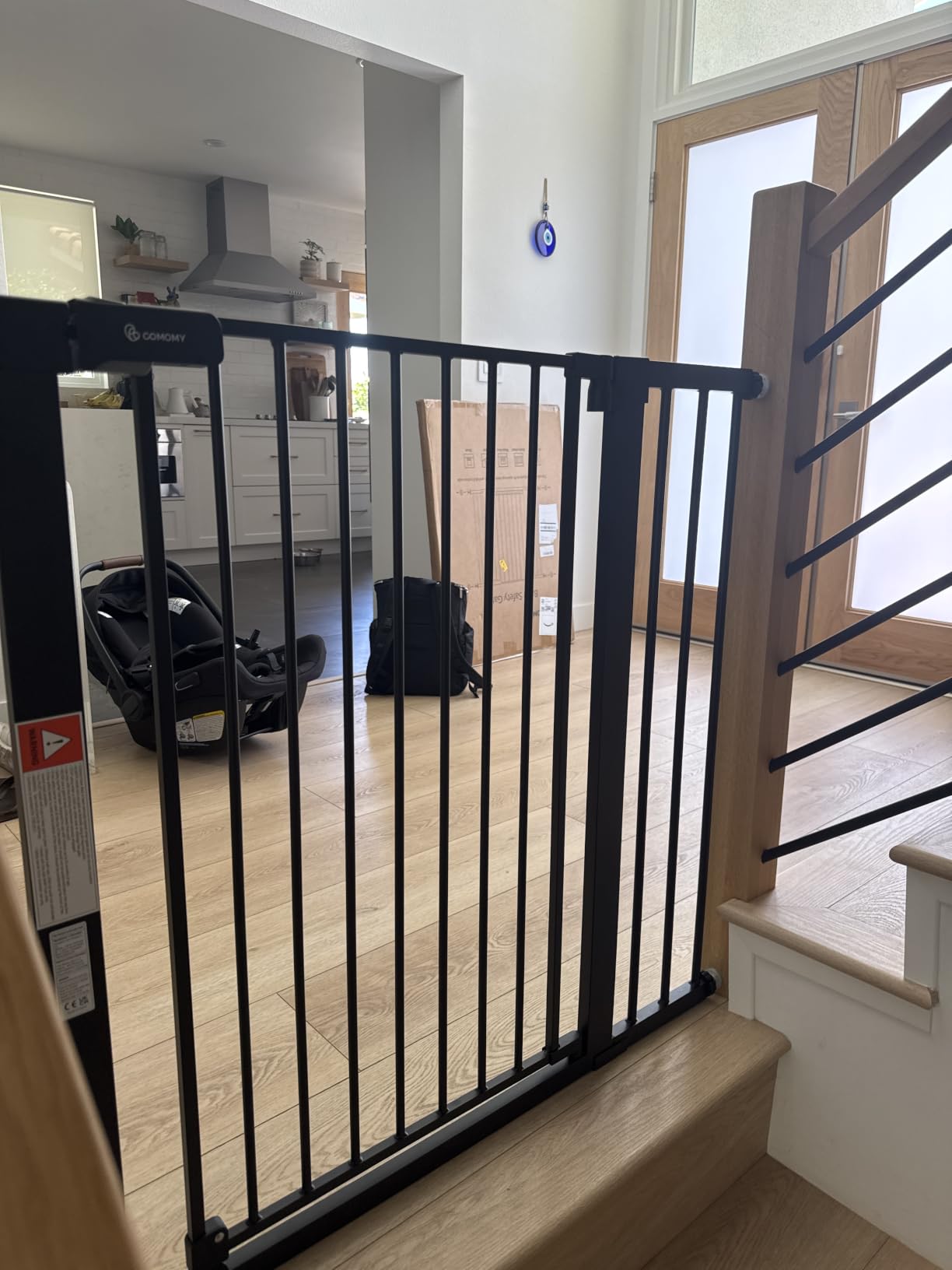
Check your clearance before you order. At 36 inches tall it will not fit under a standard door frame or a low stairwell opening, and getting it right means measuring the full height including the trim above the opening.
The gate arrives with a retaining belt. Cut it before the install is finished and the frame loses its shape, so leave it on until the gate is mounted and the width is set.
Mounting is pressure based and tool-free, which is fast but means this is a bottom-of-stairs gate. At the top of a flight you would still want to screw it into studs.
When this gate makes sense
It suits a household with a toddler close to 3 feet tall, or a large dog that treats a 30-inch gate as a hurdle rather than a wall. It is also useful at the bottom of stairs in a home with an unusually tall opening.
The 23.6-inch door means fewer turns when you are carrying something down a flight.
When this gate is the wrong choice
It is wrong where vertical clearance is tight, and wrong as a pressure-mounted gate at the top of a staircase no matter how tall it is.
At 36 inches it also looks and feels oversized in a normal-height doorway, so keep it where height is the actual problem.
9. Toddleroo Easy Swing and Lock 31 inch
Toddleroo Easy Swing & Lock Baby Gate for Top of Stairs: 31″ Tall, Bronze
Hardware mount
31 inch tall
28.68-47.85 inch wide
8.3 pounds
Pros
- Hardware mounted for a rigid barrier at the top of stairs
- No bottom threshold to trip over
- Full-width walk-through gate instead of a narrow cut-out
- One-hand thumb-press
- lift and swing that still resists toddlers
Cons
- Requires drilling and leaves holes when removed
- Drilling into banisters may need pre-drilling for long screws
- One latch spring reported to break though the gate still works
- Mounting template can be misaligned and cause binding
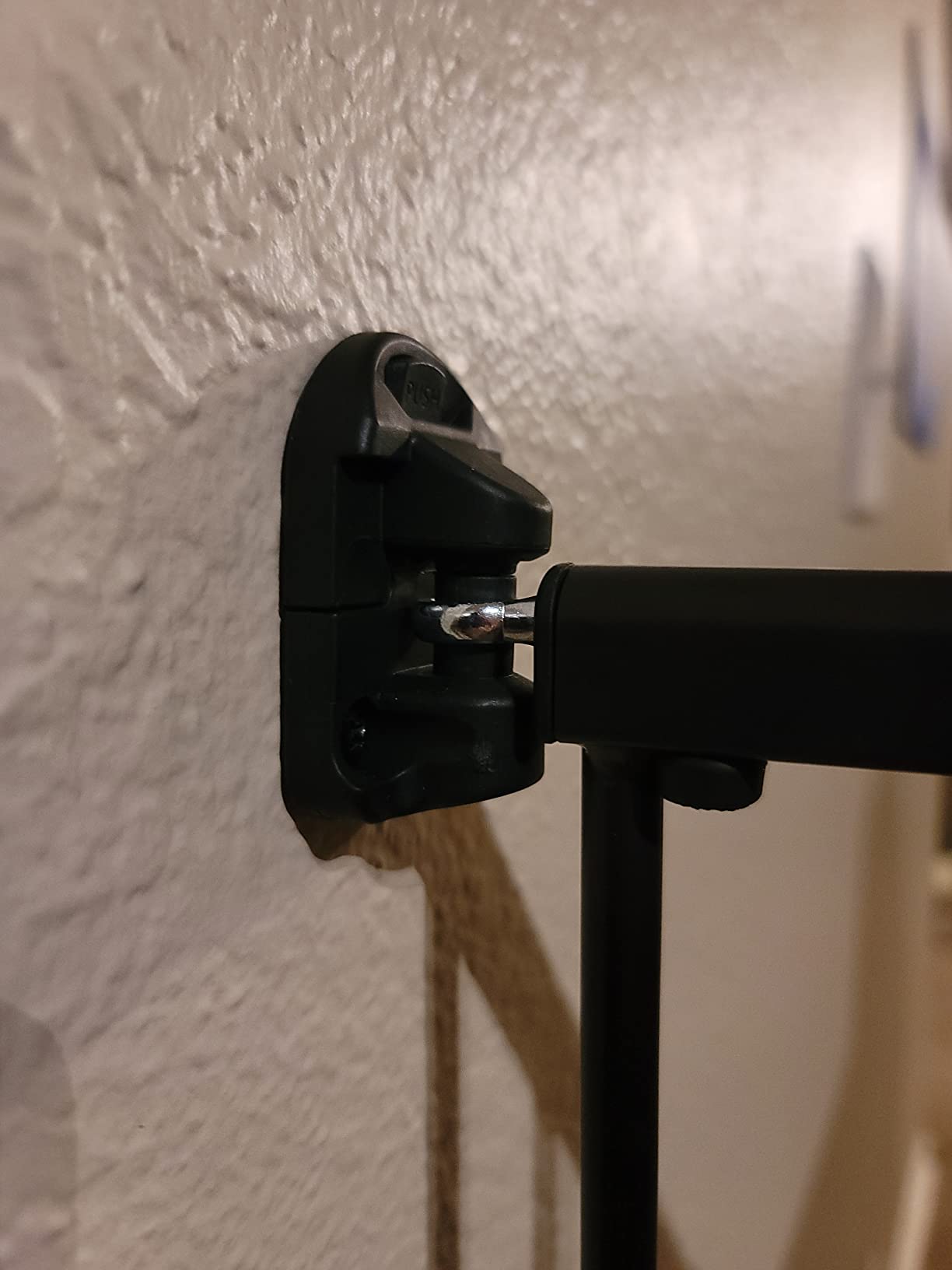
This is the gate we would put at the top of a staircase without hesitating. It is hardware-mounted into studs or a newel post, it has no threshold at the bottom, and the walk-through is the full width of the gate rather than a narrow centre cut-out.
The latch is a thumb-press that you lift and swing, one-handed for an adult and too involved for a toddler. The metal construction has no horizontal bars, so there is nothing to climb, and a swing control lets you choose which way the gate opens.
It adjusts from 28.68 to 47.85 inches at 31 inches tall, which covers most standard stair landings. At 8.3 pounds it is light enough to lift off its brackets when you need to carry laundry past.
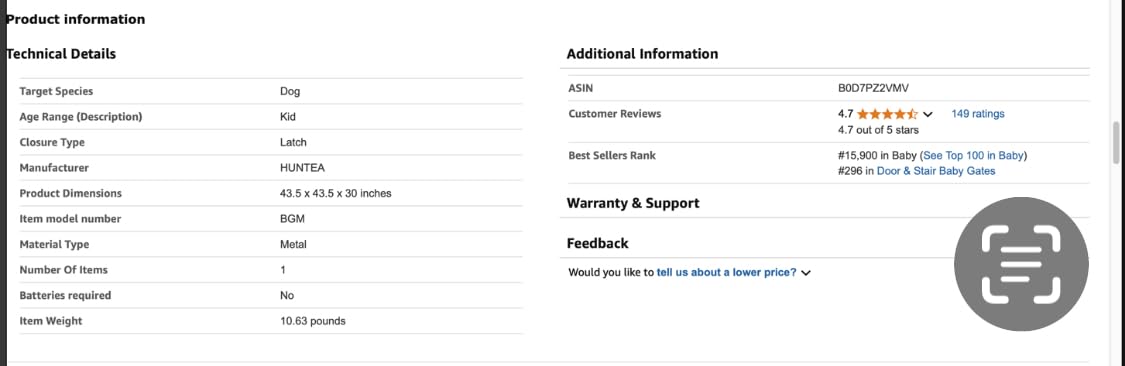
It is Baby Safety Alliance and ASTM certified, which is the certification baseline we would want at the top of a flight. The matte bronze finish also sits better in a finished hallway than white steel.
Budget time for the install. Drilling into a hardwood banister or newel post can require a pilot hole to get the long screws started, and the folding mounting template can go out of alignment, which makes the gate bind slightly when it swings.
A small number of owners have had a latch spring break after long use, though the gate continued to function. If the latch ever feels slack, replace the spring rather than working around it.
When this gate makes sense
It suits the top of a flight where adults also pass through daily, because the full-width opening means you can walk through with a laundry basket without turning sideways.
It is also right for a landing between about 29 and 48 inches where you want a permanent barrier and can patch four small holes when the child outgrows it.
When this gate is the wrong choice
It is wrong in a rental, wrong where you cannot drill into framing, and wrong for a newborn who will only need the gate for a few months.
If you need a gate you can carry to a grandparent’s house occasionally, this is the opposite of that.
10. keny 29-42.5 inch Auto Close Gate
keny 29″-42.5″ Baby Gate for Stairs, Auto Close Safety Dog Gate
Pressure or hardware mount
29-42.5 inch wide
30 inch tall
All steel frame
Pros
- All-steel frame that holds firm when bumped by a large dog
- Auto-close door that also props open past 90 degrees
- Double latch with a bottom stopper for two-way swinging
- Tool-free pressure mounting in about five to ten minutes
Cons
- Bottom bar runs across the floor and will stub toes
- Plastic adjustment cups crack if over-tightened
- Side gap is wide enough for small dogs to slip through
- Two opening-width ranges are not covered
This one gets attention for pet households because the frame is all steel and holds when a large dog runs into it. The auto-close door also props open past 90 degrees, so a dog can be let through without you holding the gate.
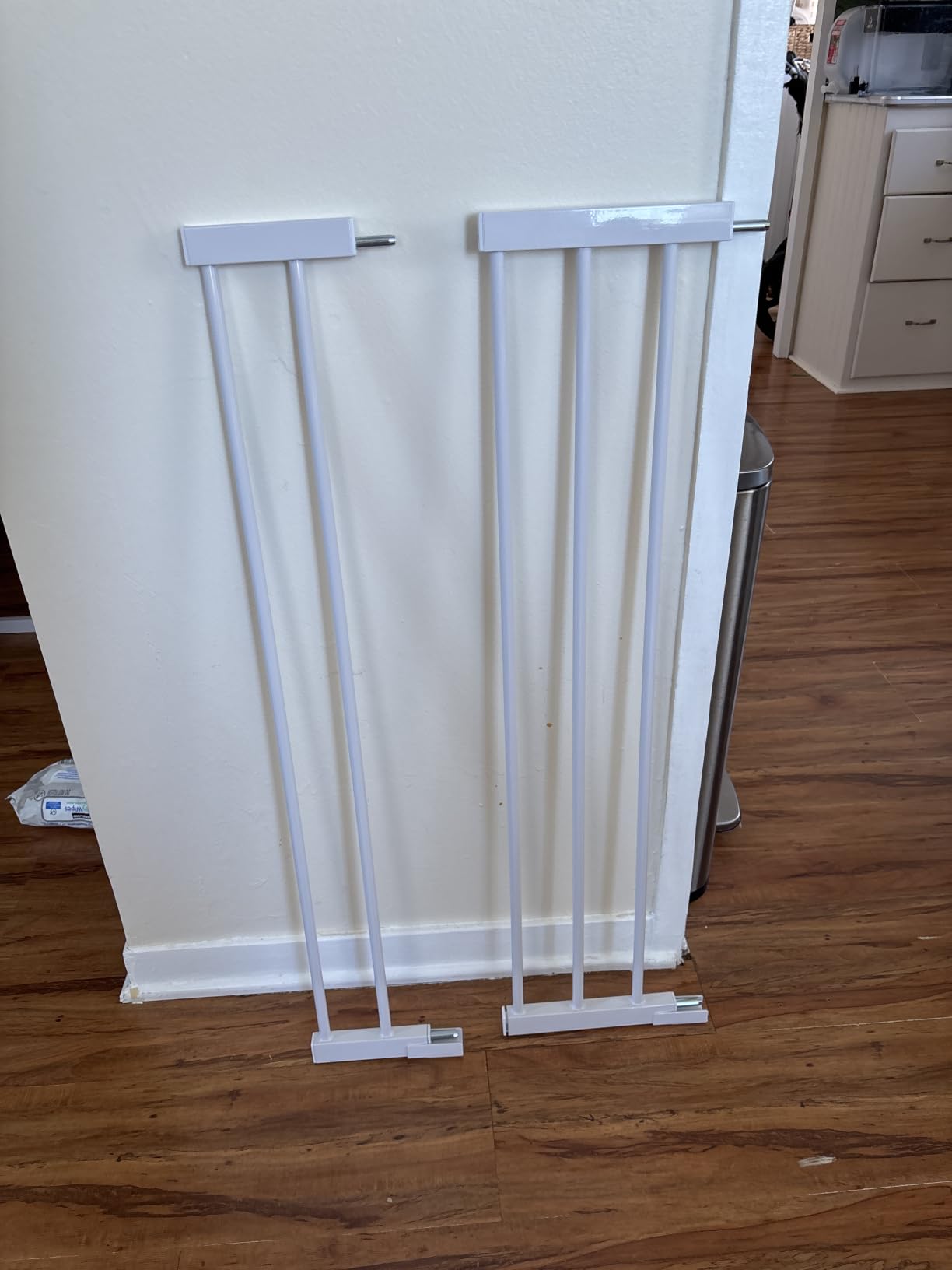
It adjusts from 29 to 42.5 inches and stands 30 inches tall, and extension kits in 4.5 and 6.9 inch lengths let you fill a wider opening without a different gate.
Installation is genuinely quick. Tool-free pressure mounting took us under ten minutes, and the same gate also accepts hardware mounting if you decide later that you want a screwed-in barrier.
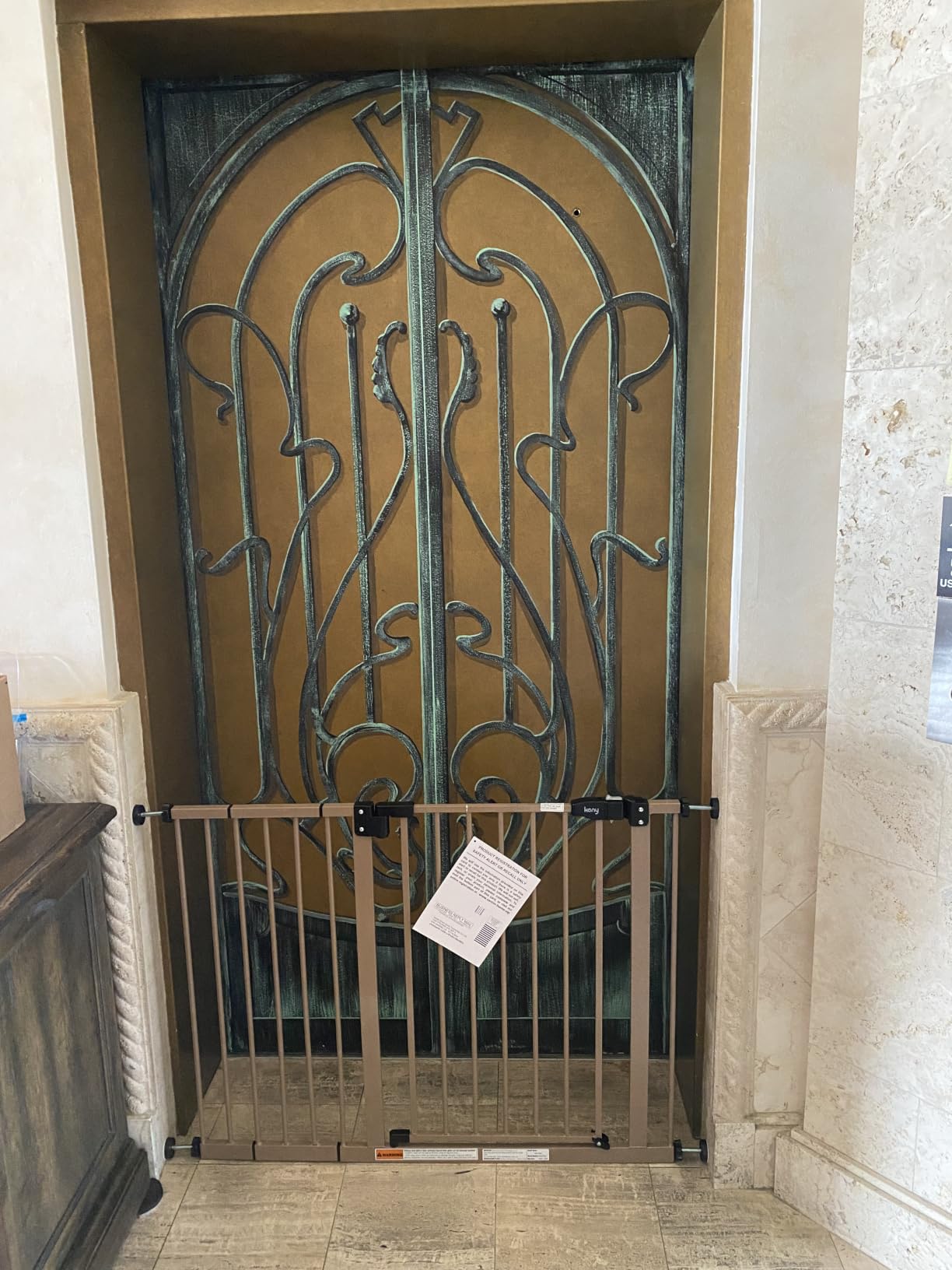
Measure carefully, because the fitting is not continuous. The gate does not cover openings between 31.8 and 33.4 inches or between 38.7 and 40.3 inches, and a lot of standard stair openings fall in one of those windows.
The bottom bar runs straight across the floor, so it will stub toes in the dark. The plastic adjustment cups are the part to watch, since over-tightening them can crack or warp and then the gate loses tension.
Side gaps are wide enough for very small dogs to slip through, so this suits a medium or large dog rather than a Chihuahua or a cat.
When this gate makes sense
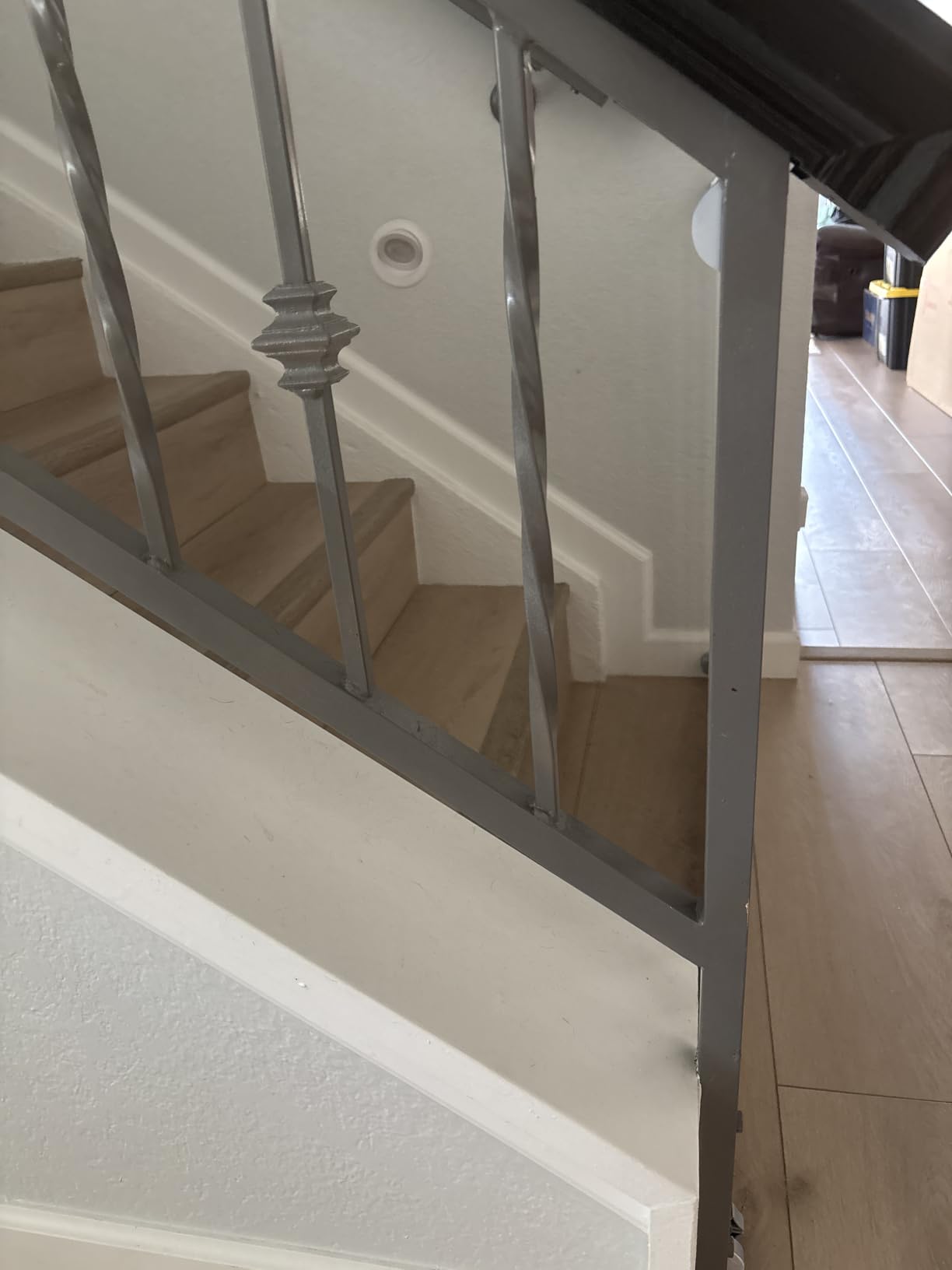
It suits a bottom-of-stairs opening between 29 and 42.5 inches in a home with a medium or large dog, particularly if you want the door to stay propped open for the pet.
The extension kits make it a reasonable single-gate solution for a wide doorway without buying a wider model.
When this gate is the wrong choice
It is wrong at the top of a flight, wrong if your opening falls in either uncovered range, and wrong for a household with kittens or very small dogs.
Skip it if anyone in the house walks that route barefoot in the dark.
11. cideny Auto Close 29-40 inch Gate
Cideny Baby Gate Auto Close, 29″-40″ Dog Gate Indoor for Stairs & Doorways
Pressure mount
29-40 inch wide
28 inch tall
10.3 pounds
Pros
- Self-closing door shuts below 90 degrees for reliable containment
- Dual-lock mechanism opens one-handed for adults
- Tool-free mounting with adhesive pads that avoid wall damage
- Anti-stumble pedal smooths the transition for strollers
Cons
- Pressure mount can still mark drywall despite the pads
- Pads shift if the frame is pushed upward
- Gate can warp if the supports are tightened too far
- Side gaps let very small dogs through
The anti-stumble pedal is the feature that sets this gate apart, and it is aimed at a specific problem: rolling a stroller over a gate without snagging a trip bar. Instead of a raised bar, the frame has a low pedal that the front wheels roll over.
It fits 29 to 40 inches wide at 28 inches tall, which covers a standard stair landing or a wide doorway. The door self-closes below 90 degrees, and the dual lock opens with one hand once you know the release.
The mounting kit is thorough. It includes a spanner, four adhesive pads and wall anchors, four threaded spindle rods, and wall cups and screws, so you have a route into a newel post if the opening has one.
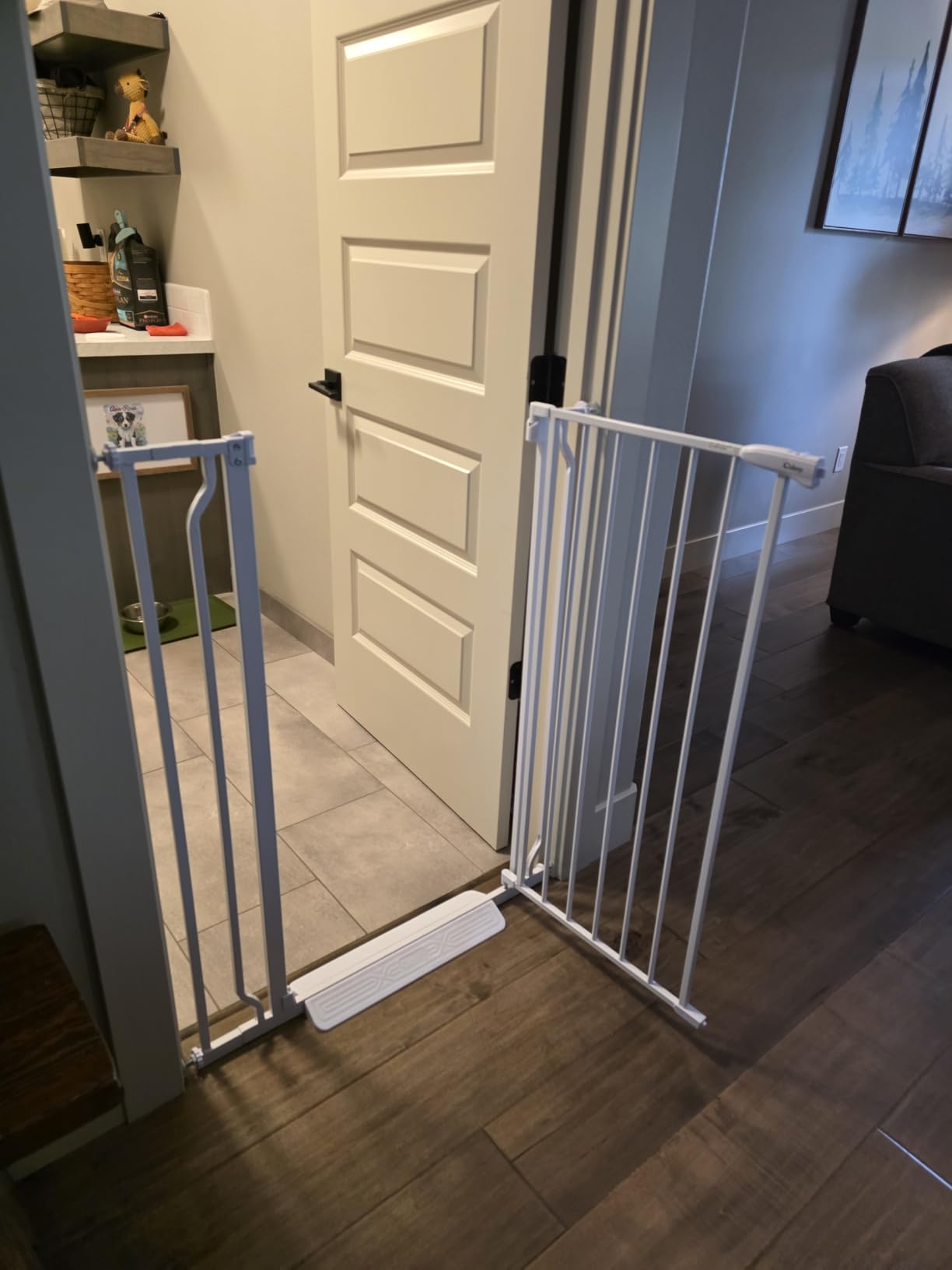
The adhesive pads reduce marking but do not eliminate it, and they can shift upward if the frame is bumped or pushed. Treat this as a no-drill option that is kind to walls, not as a damage-free one.
Do not over-tighten. Owners report the frame warping when the supports are wound too far, and a warped frame will not sit square against the opening.
The side gaps are wide enough for very small dogs to slip through, so again this is a baby gate with light pet tolerance rather than a pet gate.
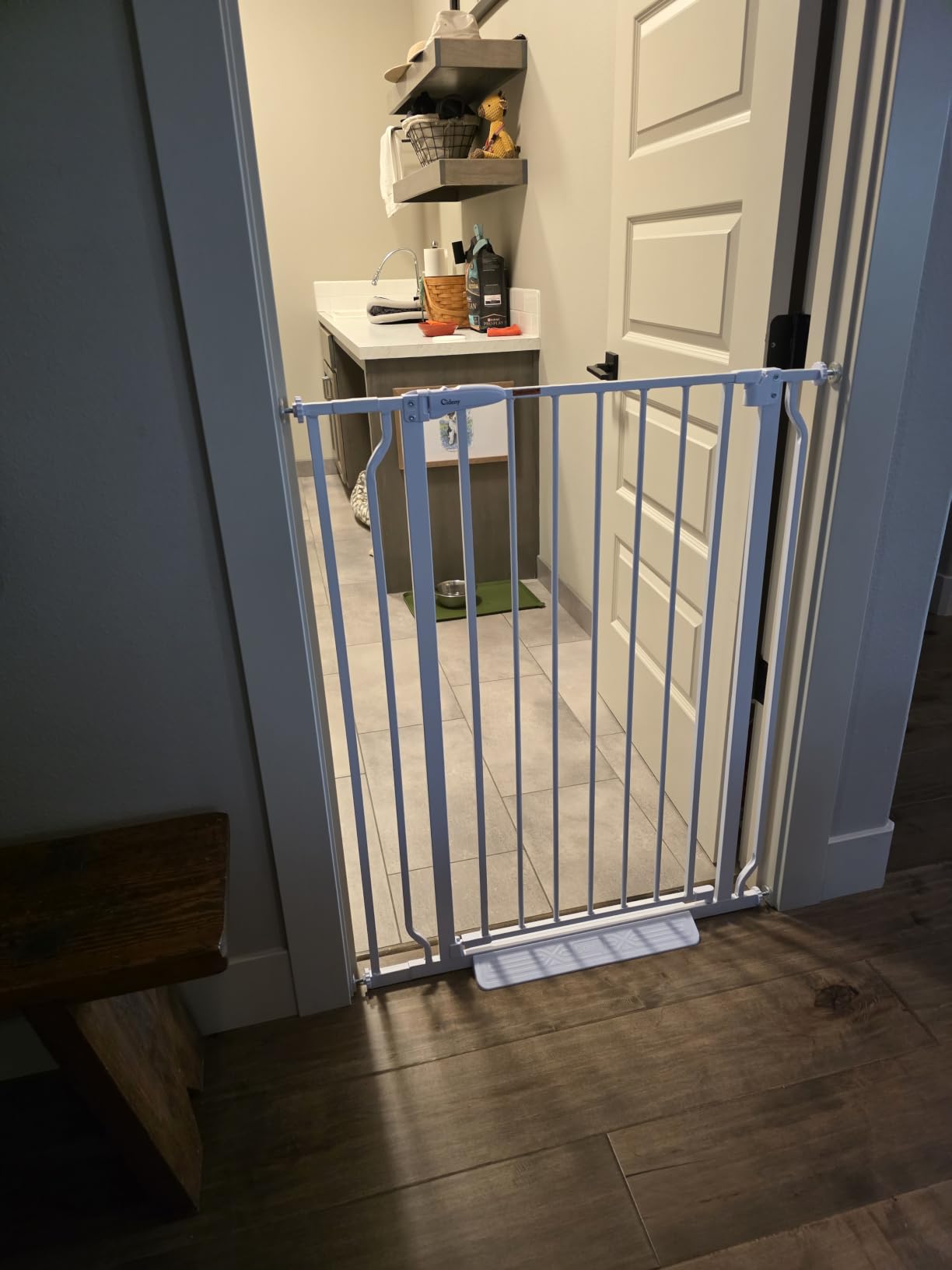
When this gate makes sense
It suits a bottom-of-stairs opening in a rental where you cannot drill, and it is the pick here if a stroller goes up and down that flight more than once a day.
The spindle rods mean it can also grip a post rather than relying on flat wall surfaces, which widens the range of openings it will take.
When this gate is the wrong choice
It is wrong at the top of a staircase and wrong where the wall is soft or freshly painted, since the pads can lift the finish.
At 28 inches it is also short for a toddler nearing 3 feet, so plan on an upgrade to a taller model if the child is already walking.
12. cideny Retractable Gate Extending to 55 inch
Cideny Retractable Baby Gate for Stairs & Doorways, Dog Gate Indoor Outdoor
Wall mount
34 inch tall
Extends to 55 inch
3.3 pounds
Pros
- Retracts fully so the walkway stays clear when not in use
- No bottom rail so it is trip-free for adults and toddlers
- Double-lock release is secure and one-handed for adults
- Brackets mount 6.5 inch above the floor to clear baseboards
Cons
- Not effective against a pushy determined dog
- Bottom mounting clip can break under pet pressure
- Mesh can bind slightly after repeated retract cycles
- Latch cannot be tightened further once locked
Retractable gates get bought for two reasons: they disappear when you are not using them, and they have no rail at floor level. This one does both, and the 3.3 pound weight means one person can install it alone.
It extends up to 55 inches wide at 34 inches tall, which is wider and taller than the framed gates in this roundup. The lower brackets sit 6.5 inches above the floor, which is unusually thoughtful because it clears a standard baseboard without any cutting.
The double-lock child safety release is secure but still one-handed for an adult, and the mesh tensions tightly once locked, which keeps it from sagging in the middle of a wide span.
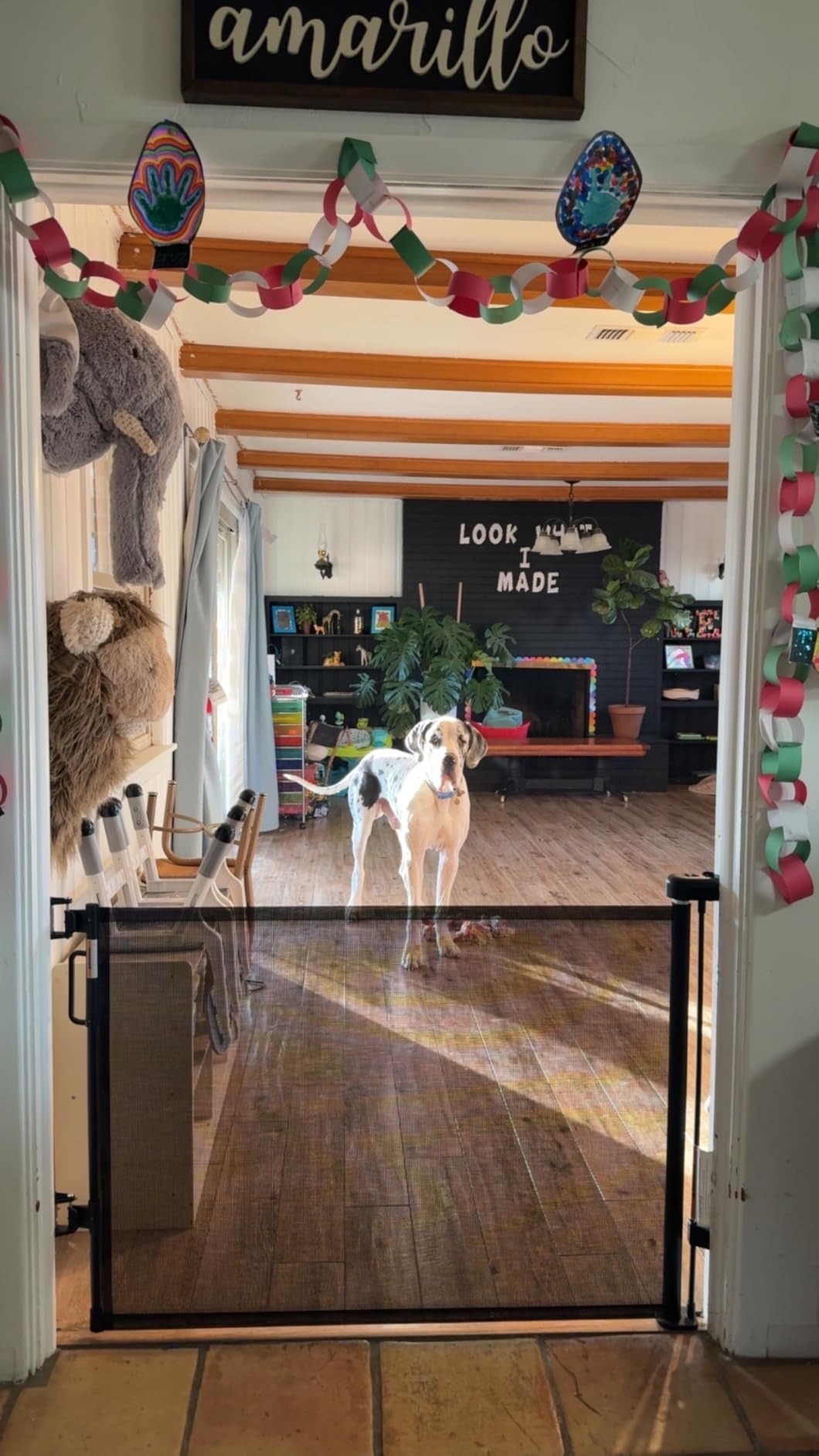
Be clear-eyed about the limits. This is a wall-mounted mesh gate, so it needs a solid surface to screw into, and it is not a top-of-stairs barrier. It belongs at the bottom of a flight, in a doorway, or across a deck opening.
Pet pressure is the main weakness. Owners report determined dogs pushing through the mesh and, in one case, breaking the bottom mounting clip. The latch also cannot be tightened further after it is locked, so if the mesh slackens over months there is no adjustment.
Repeated retract cycles can make the mesh bind slightly, and the hardware is fixed to one side, so you choose the mounting side at install rather than later.
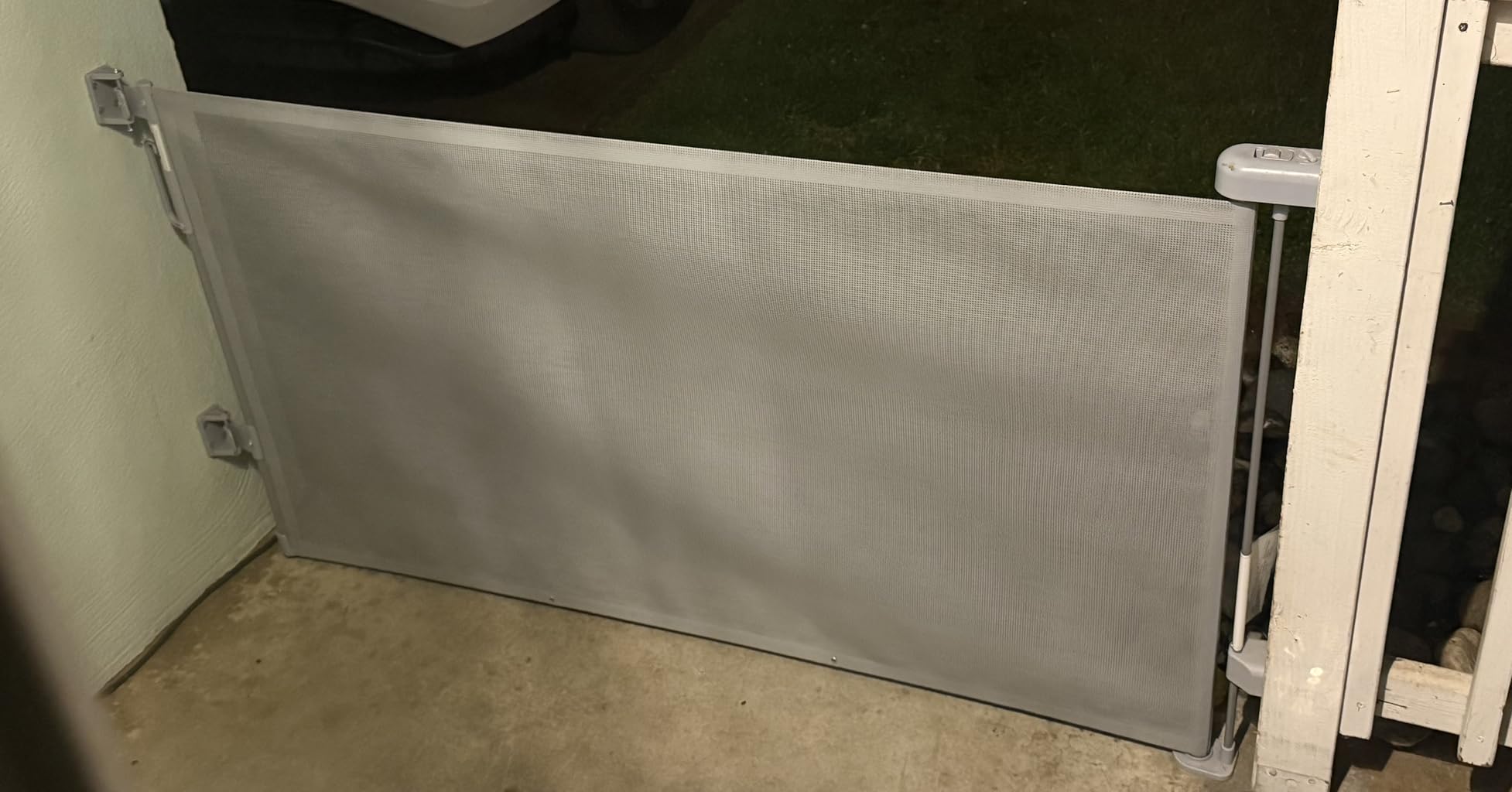
When this gate makes sense
It suits a bottom-of-stairs opening in a finished hallway where you want the opening clear most of the day, or a wide doorway between 30 and 55 inches with tall baseboards.
It is the only gate here that stores away, which makes it the practical choice for a grandparent’s house or a home that changes layout often.
When this gate is the wrong choice
It is wrong at the top of a staircase, wrong for a household with a large dog, and wrong for an opening with no solid wall or post to mount into.
It also cannot be tightened as the mesh wears, so expect to replace it sooner than an all-metal gate.
Gate Types Explained: Hardware, Pressure, Retractable and Freestanding
Hardware-mounted means the gate is screwed into studs, a door jamb, or a newel post, and it does not move under pressure. It is the only category we would trust at the top of a staircase, because the whole load path goes into framing rather than into a wall cup.
Pressure-mounted gates push outward against wall cups that screw into the wall or stick to it with adhesive pads. They are fast, they need no drilling, and they work well at the bottom of stairs where a fall is a short one. Their weakness is that tension decays, and a determined toddler or a swinging door can create a gap.
Retractable gates roll a mesh or fabric panel into a cassette mounted high on the wall. They are trip-free and nearly invisible when open, which is why we cover them in a separate retractable baby gate roundup. They belong at the bottom of stairs and in doorways, not at the top, and they are the weakest option against a determined pet.
Freestanding play yards enclose an area rather than block a gap. They solve a different problem, so we have not included one here, and none of the twelve gates below is a play yard.
How to Measure Your Stair Opening and Install a Gate
Measure the opening at the narrowest point, usually at the baseboard or the handrail, not at the top of the stair. Measure the height from the finished floor to the underside of the handrail or the trim you are mounting to. Most gates here are 28 to 31 inches tall, and if your ceiling clearance above the landing is tight, a 36-inch gate will not fit.
Baseboards are the most common reason an install fails. If the baseboard is taller than the gate frame can clear, either use a gate with adjustable baseboard spacers or wall cups that mount above the trim. Several gates in this roundup include baseboard spacers or brackets that sit well above floor level for exactly this reason.
Banisters need an adapter, not a screw. A Y-spindle or spindle rod grips a rounded rail or a square newel post without drilling into finished woodwork. The Cumbor and the InnoTruth both ship with Y-bolt adapters, and the cideny auto-close includes threaded spindle rods. If your handrail sits in the middle of the opening, the practical fix is to mount one side to the wall and one side to the rail with the adapter.
For mounting, find studs with a detector and screw into them. If you hit drywall only, use a rated anchor, not a plastic plug. Mount the gate so it swings toward the landing, and if you use a pressure mount at the bottom of the stairs, re-tighten the cups every few weeks because the tension walks off over time.
Wide landings need a different approach. Our extra wide baby gate guide covers the fittings that reach past 58 inches, including extension combinations for open-plan homes.
How to Choose a Baby Gate for Stairs
Start with the location, because it removes most options instantly. At the top of a staircase, the choice is a hardware-mounted swing gate with no bottom bar, and the two dedicated picks for that job in this roundup are the Toddleroo Easy Swing and Lock and the Babelio No Bottom Bar. The Cumbor becomes a third option once it is screwed into studs.
At the bottom of a flight, a pressure mount is a reasonable choice because a fall there is shorter. Keep the auto-close on, re-tighten the cups every few weeks, and check the fitting range twice because most pressure gates have at least one gap in their coverage.
Next, identify what is on each side of the opening. Wall on one side and a round banister on the other is the hardest case, and the fix is an adapter rather than a different gate. The Cumbor and the InnoTruth both include Y-bolts for exactly this, and the cideny auto-close includes threaded spindle rods for square posts.
Then measure twice in three places: width at the narrowest point, width at the widest point, and height from the floor to the underside of the trim. Note the uncovered ranges for any gate you are considering, because three gates in this roundup skip several inches in the middle of their stated range.
Latch design is a daily-use decision more than a safety one, but it matters. A thumb press that lifts and swings is the smoothest for adults carrying a child. A triple lock is the most secure against a determined toddler and the most annoying for a tired parent at 6am. Pick based on who actually uses the gate.
Certification is the minimum filter, not a differentiator. Look for ASTM F1004 and JPMA or Baby Safe Alliance testing on every gate you consider, and reject anything that does not state it. Also check the small print for height and age limits, since most of these are made for children between 6 and 24 months.
Renters have a narrower path. Of the gates here, the pressure-mounted options install without holes, and the adhesive pads on the cideny auto-close reduce wall marking further. Just accept that a pressure gate belongs at the bottom of the stairs and that the pads can still lift fresh paint.
If you are buying secondhand, check the model against recall listings before anything else, and skip any gate with a bent frame, a latch that does not engage cleanly, or hardware that has been painted over. A gate that has taken a fall down a staircase is not a gate you want to reuse.
Finally, think about lifespan. An all-steel hardware-mounted gate can stay up for years and then come down with four holes to patch. A plastic pressure gate may be discarded in eighteen months. Patch filler and a small tin of paint are cheap, which is the main argument for drilling rather than avoiding it.
Safety Standards and When to Retire a Gate
ASTM F1004 is the US standard covering baby gate strength, latch integrity and opening sizes. JPMA, now known as Baby Safe Alliance, independently tests gates against that standard. If a listing does not mention either, treat the claim as unverified.
The outgrow point is usually the moment a child can climb over the top of the gate, which for most standard 30 and 31 inch gates lands around 36 inches of child height. Take the gate down at that point, even if they are still within the stated age range, because a climbing toddler defeats the barrier without any force.
Pressure gates need maintenance on a schedule rather than a date. Check the tension every two to four weeks, look for wall marking where the cups press, and tighten before the frame starts to rock. A pressure gate that rocks at the top of a stair is not doing its job at all.
Hardware-mounted gates need far less attention, but check the latch spring and the hinges twice a year, and confirm the screws are still biting into studs rather than backing out of drywall.
Frequently Asked Questions
What is the best safety gate for babies on stairs?
A hardware-mounted swing gate with no threshold bar is the best safety gate for babies on stairs. It screws into studs, a door jamb or a newel post, and its sill-free base removes the trip hazard that catches adults carrying a child. The Toddleroo Easy Swing and Lock and the Babelio No Bottom Bar are the two dedicated top-of-stairs picks in this roundup.
What is the safest type of baby gate for use on stairs?
Hardware-mounted is the safest type on stairs because the load goes into the framing rather than into a wall cup under tension. At the top of a flight, choose a swing gate with a full-width walk-through, a two-action latch, no horizontal bars to climb and no bottom bar to trip on. Pressure-mounted and retractable gates are not safe at the top of stairs.
Can you use a pressure mounted gate at the top of stairs?
No. Pressure-mounted gates rely on tension from wall cups, and that tension walks off over time or is broken by a hard push. A child who gets through a pressure gate at the top of a staircase has a full flight of steps with nothing between them and the floor. Use a pressure gate at the bottom of a flight only, and re-tighten it every few weeks.
How do you install a baby gate on stairs with a banister?
Do not screw into a finished banister. Use a Y-spindle or spindle adapter that grips the round rail or a square newel post, then mount the other side to a stud. The Cumbor and the InnoTruth both include Y-bolt adapters, and the cideny auto-close includes threaded spindle rods. Measure the opening at the narrowest point first, since the rail usually sets that dimension.
When can you stop using a baby gate on stairs?
Stop when your child can climb over the top of the gate, which is usually around 36 inches of child height even though many gates are rated to a higher age. Also stop if the latch no longer engages cleanly, the frame is bent, or a pressure gate has stopped holding tension. Remove the gate rather than raising the height, because climbing ability does not plateau.
Final Verdict: Choosing the Best Baby Gates for Stairs in 2026
The best baby gates for stairs split cleanly by position. At the top of a flight, buy hardware-mounted and buy nothing else: the Toddleroo Easy Swing and Lock is our top pick there, with the Babelio No Bottom Bar as the alternative if your opening is under 43 inches. Both are rated to 31 and 28 inches tall respectively, both have no bar at the bottom, and both swing toward the landing.
At the bottom of a flight, the Regalo Easy Step is our overall choice. It has the deepest owner feedback in the category, an all-metal frame, a one-handed walk-through latch and a 29 to 38.5 inch range that fits most older homes. If your landing has a banister, move up to the Cumbor, which includes the Y-bolt adapters that solve the hardest stair layout.
For wide openings above 43 inches, the Regalo Super Wide covers up to 58 inches, and the cideny retractable gate stores away entirely when you are not using it. For a tall toddler or a large dog, the 36-inch COMOMY adds the extra height that the 30-inch gates cannot give you.
One last reminder: patch and paint the holes before you move on, vacuum the stairs on a schedule rather than once, and if you also want the rest of the house handled, our cordless vacuum picks for stairs cover the treads these gates are protecting. Every gate on this list is one tool in a larger stair-safety plan, and the right combination in 2026 is a permanent gate at the top, a well-fitted one at the bottom, and a monthly check on the tension.