
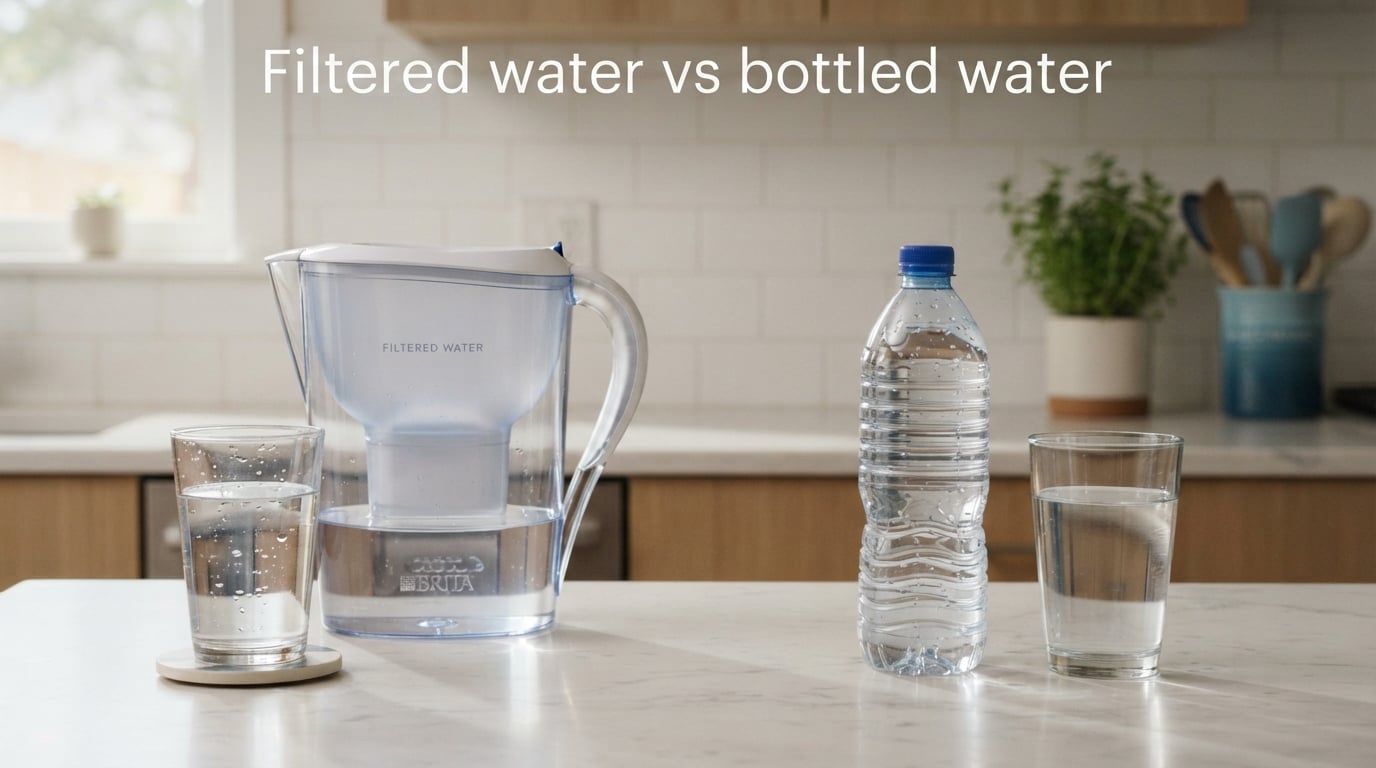
I did the math for my own household last year and the result was eye-opening. I was spending about $1,200 a year on bottled water for a family of three. After switching to a simple under-sink filter, my annual cost dropped to roughly $140. That is $1,060 back in my pocket, less plastic waste heading to the landfill, and water that actually tested cleaner than the bottles I had been buying.
This is exactly the comparison I want to walk you through. We will look at filtered water vs bottled water across the factors that actually matter: cost per gallon, microplastic exposure, environmental footprint, mineral content, taste, and long-term maintenance. By the end, you will know which option makes more sense for your home, your health, and your wallet.
Table of Contents
Filtered vs Bottled vs Tap: At-a-Glance Comparison
Before diving into the details, here is the side-by-side comparison most readers want to see first. I built this table using current pricing data and contaminant research from the EPA, WHO, and peer-reviewed studies published through 2026.
| Factor | Filtered Tap Water | Bottled Water | Unfiltered Tap Water |
|---|---|---|---|
| Cost per gallon | $0.02 – $0.10 | $1.20 – $4.00 | $0.002 |
| Annual cost (family of 3) | $50 – $200 | $800 – $2,400 | $5 – $15 |
| Microplastic exposure | Very low to none | High (200k+ particles/L) | Low to moderate |
| Environmental impact | Minimal | High (70% to landfill) | Very low |
| Mineral content | Mostly preserved | Variable by brand | Fully preserved |
| Regulatory oversight | EPA | FDA | EPA |
| Convenience | High at home | Highest on-the-go | Highest at home |
The verdict from this table is already clear. Filtered water wins on cost, contamination, and environment while keeping convenience at home. Bottled water only leads in portability. Let us unpack each comparison in detail.
How Much Does Filtered Water Cost vs Bottled Water?
Filtered water costs roughly 95% less than bottled water over the long term. That single sentence captures the strongest argument for switching, and it holds up when you run the actual numbers.
Start with tap water. The EPA reports the average U.S. household pays about $0.00295 per gallon through municipal supply. Bottled water runs $1.20 to $4.00 per gallon at retail. A typical activated carbon pitcher filter costs about $0.10 to $0.15 per gallon after you factor in replacement cartridges. Reverse osmosis systems drop that to under $0.05 per gallon once installed.
Here is what that looks like for a family of three drinking about one gallon per person per day:
- Bottled water annual cost: $1,300 to $4,400 per year
- Brita pitcher filter annual cost: $80 to $180 per year (cartridges + minimal water bill)
- Under-sink activated carbon filter: $100 to $200 per year
- Reverse osmosis system annual cost: $60 to $120 per year after installation
- Tap water only (no filter): $5 to $15 per year
A Reddit user in r/Frugal shared this exact calculation when they made the switch. Their filter cost around $100 upfront and $50 annually for cartridges. They saved $1,100 the first year by dropping bottled water entirely. I have seen similar numbers from other readers who have written to our team.
The break-even point depends on which filter you choose. A $40 pitcher pays for itself in roughly 30 days if you currently spend $30 per month on bottled water. A whole-home reverse osmosis system that costs $1,500 installed takes about 4 to 8 months to recover the investment, depending on your prior bottled water spending.
Is Filtered Water Healthier Than Bottled Water?
Filtered water is generally healthier than bottled water because it removes more contaminants and avoids microplastic exposure from the bottle itself. This is the most important comparison for long-term wellness, and the research has shifted clearly in favor of filtration in the past five years.
Bottled water contains microplastics. A 2024 Columbia University study analyzed three major bottled water brands and found an average of 240,000 nanoplastic particles per liter. The particles come from the PET plastic containers and from filtration processes inside bottling plants. Previous Orb Media research had already shown that 93% of bottled water samples contained microplastic fibers.
The health concern is real. Microplastics can carry endocrine-disrupting chemicals like DEHP, BPA, and phthalates into your body. Cardiologists have raised flags about microplastic accumulation in arterial tissue, with a 2024 New England Journal of Medicine study linking microplastics in carotid plaque to higher cardiovascular event rates. This is one reason why how Brita filters work and similar filtration research has become so important to consumers tracking this issue.
Filtered water, on the other hand, has zero contact with plastic containers. You fill a reusable glass or stainless steel bottle directly from the tap or filter spout. The only plastic exposure is the filter housing itself, which is contained and never mixes with your drinking water.
On contaminant removal, the comparison favors the right filter:
- Activated carbon filters remove chlorine, chloramine, lead, mercury, and many organic compounds. They reduce some PFAS but not all.
- Reverse osmosis systems remove 95% to 99% of dissolved solids, including lead, arsenic, fluoride, nitrates, and most PFAS compounds.
- Bottled water must meet FDA standards, but a 2022 study of 35 bottled water brands by Consumer Reports found that some contained arsenic, lead, or PFAS above safety thresholds. The FDA also allows bottled water labeled “purified” to come from any source, including municipal tap water.
If your home filter is properly maintained, the water coming out is consistently cleaner than most bottled brands. The key word here is “properly maintained,” which I will address in the filter types section.
Environmental Impact: Bottled vs Filtered Water
Bottled water produces roughly 2,000 times more carbon emissions than filtered tap water. This is the largest gap in the entire comparison, and it has nothing to do with taste or convenience.
Americans buy about 46 gallons of bottled water per person every year. Most of those bottles end up in landfills. Only about 30% of PET plastic gets recycled, and the recycling rate for water bottles specifically hovers around 30%. The remaining 70% goes to landfill or, worse, into oceans and waterways where it breaks down into the microplastics we discussed above.
Producing those bottles takes energy. A Pacific Institute analysis found that manufacturing one liter of bottled water requires roughly 2,000 times more energy than treating the same amount of tap water. That includes extracting oil, manufacturing the PET plastic, transporting empty bottles, filling them, shipping filled bottles to retailers, and cooling them in stores.
Filtered tap water reverses this equation almost entirely. The largest environmental cost of filtered water is the filter cartridge itself, which most manufacturers now recycle. A single carbon block cartridge filters about 40 to 120 gallons before needing replacement. The plastic footprint of one cartridge replacing thousands of single-use bottles is minimal by comparison.
Here is a rough environmental accounting for one person drinking one gallon of water per day for a year:
- Bottled water: ~365 plastic bottles, 40+ pounds of plastic waste, and roughly 250 kg of CO2 equivalent emissions
- Filtered tap water: 3 to 9 filter cartridges, less than 2 pounds of plastic waste, and roughly 1 to 3 kg of CO2 equivalent emissions
If you care about plastic pollution, climate impact, or both, the environmental case for filtered water is overwhelming.
Mineral Content: What Gets Removed During Filtration?
Filtered water preserves most beneficial minerals, and only reverse osmosis removes minerals significantly. This is the area where bottled mineral water still has a real edge, depending on which filter you use.
Tap water in most U.S. municipalities contains calcium, magnesium, potassium, and small amounts of other trace minerals. The World Health Organization published research in 2015 noting that drinking water contributes up to 20% of daily calcium and magnesium intake in some populations. A deficiency in either is linked to cardiovascular disease, weak bones, and muscle cramps.
Activated carbon filters do not remove these minerals. They only trap larger molecules like chlorine and organic compounds. If you start with mineral-rich tap water, you keep those minerals after filtering.
Reverse osmosis strips out everything, including the good stuff. RO water typically tests at 10 to 50 parts per million total dissolved solids, compared to 100 to 300 ppm in regular tap water. Some RO systems include a remineralization stage that adds calcium and magnesium back. If you want mineral content without bottled water, this is the option to look for.
Bottled mineral water like Perrier, San Pellegrino, Gerolsteiner, or high-mineral water profiles such as Contrex and Vichy provides 200 to 1,500 ppm of dissolved minerals. That is genuinely useful for people on low-mineral diets, athletes who lose electrolytes through sweat, or anyone seeking the specific taste and mineral profile these waters offer. The bottled water industry has done a good job marketing these health claims, and they are partly true.
However, regular bottled water is not the same as mineral water. Most “purified” bottled water has been stripped of minerals and may have minerals re-added artificially. Check the label: if it says “spring water” or “mineral water” with a specific TDS value, you are getting genuine mineral content. If it just says “purified,” it is filtered municipal water in a plastic bottle.
For a deeper look at how silica and other minerals behave in bottled water, our guide on silica content in bottled water breaks down what these numbers actually mean for daily consumption.
Types of Water Filters and What Each One Removes
Pitcher filters and faucet-mounted filters are best for casual users, while reverse osmosis is the most thorough option for households with poor tap water or known contamination. The right filter depends on what you want to remove and how much maintenance you are willing to do.
Activated Carbon Pitcher Filters (Brita, PUR, ZeroWater)
These are the most popular and affordable entry point. A typical pitcher costs $25 to $50 and replacement cartridges run $5 to $15 each, lasting 40 to 120 gallons. They use activated carbon to adsorb chlorine, lead, mercury, and some organic compounds. ZeroWater adds a five-stage ion exchange system that reduces total dissolved solids closer to zero.
Pitcher filters are slow. Filtering one pitcher takes 5 to 15 minutes. They are also easy to neglect, which leads to bacterial growth inside the cartridge if you leave old water sitting for weeks. The CDC and several independent labs have flagged this as a real risk. Replace cartridges on schedule, every 2 to 6 months depending on usage.
Faucet-Mounted and Under-Sink Filters
Faucet-mounted filters attach directly to your tap and typically filter 100 gallons between cartridge changes. They are faster than pitchers and cost $20 to $60 upfront plus $15 to $30 per cartridge.
Under-sink systems install in your cold water line and connect to a dedicated faucet. They filter 500 to 1,000 gallons per cartridge and provide filtered water on demand without any waiting. Installation takes 30 to 60 minutes for most homeowners comfortable with basic plumbing.
Reverse Osmosis Systems
RO systems force water through a semipermeable membrane under pressure, removing 95% to 99% of dissolved contaminants. A typical under-sink RO unit costs $150 to $500 installed, plus $50 to $100 per year in filter and membrane replacements.
RO systems waste 3 to 4 gallons of water per gallon of filtered water, which is a real environmental consideration. Modern systems with permeate pumps reduce this to about 1:1. RO is the best choice if you have known lead, arsenic, or PFAS contamination in your water supply.
UV and Specialty Filters
Ultraviolet filters kill bacteria and viruses but do not remove chemical contaminants. They work best as a secondary stage after a carbon or RO filter.
Alkaline and remineralizing filters add minerals back to the water after filtration. These are a good choice for RO users who want mineral content without buying bottled mineral water.
For most households, an under-sink activated carbon filter with a dedicated faucet offers the best balance of contaminant removal, cost, and convenience. RO makes sense if you have specific contamination concerns or want the most thorough filtration possible.
Taste Comparison: Does Filtered Water Taste Better Than Bottled?
Filtered water tastes better than chlorinated tap water and matches or exceeds most bottled water in blind taste tests. The taste improvement comes primarily from chlorine removal and, depending on the filter, reduction of metallic or earthy compounds.
When EWG tested municipal water samples, they found chlorine, chloramine, and disinfection byproducts in nearly all of them. Chlorine is the primary taste complaint about tap water. Activated carbon filters remove chlorine almost completely, and the water tastes cleaner within seconds.
Bottled water tastes consistent because it has been heavily processed. Spring water has a slightly mineral taste that some people love and others find flat. Purified bottled water has very little taste at all, which can feel boring to people used to spring or mineral water.
Filtered tap water sits in the middle. It has more character than purified bottled water but less mineral intensity than true mineral water. For most people, this is the most pleasant balance. If you want stronger mineral taste, you can add a remineralization cartridge to your filter or keep a few bottles of Gerolsteiner or San Pellegrino for variety.
FDA vs EPA: How Bottled and Tap Water Are Regulated Differently
Tap water is regulated by the EPA under the Safe Drinking Water Act, while bottled water is regulated by the FDA as a packaged food product. Both agencies set safety limits for contaminants, but their testing frequencies, public disclosure requirements, and scope of oversight differ significantly.
EPA-regulated tap water requires daily to monthly testing depending on the contaminant. Water utilities must publish annual consumer confidence reports listing every detected contaminant and its level. The public can request this data, and violations are reported publicly.
FDA-regulated bottled water requires less frequent testing. Bottlers are expected to test their source water and finished product, but they are not required to publish results. There is no equivalent of the consumer confidence report for bottled water. This means you often know more about your tap water quality than your bottled water quality.
The EPA also regulates more contaminants than the FDA. As of 2026, the EPA has enforceable limits on around 90 contaminants. The FDA has enforceable limits on roughly 70 contaminants in bottled water, with several loopholes for “purified” water that allow certain treatment processes.
For consumers, this means tap water is actually more rigorously tested and disclosed than most bottled water. The perception that bottled water is safer is largely a marketing effect, not a regulatory reality.
How to Choose the Right Water Filter for Your Home
Start with your water quality, then match the filter to the contaminants you actually need to remove. A simple activated carbon pitcher handles most municipal water concerns, but households with specific issues should consider more robust systems.
Step 1: Test your tap water. You can request a free consumer confidence report from your water utility, which lists detected contaminants over the past year. For a more thorough analysis, the EPA recommends independent labs certified by your state. Test kits cost $20 to $150 depending on how many contaminants you check for.
Step 2: Identify your priorities. If your main concern is taste and chlorine removal, a $30 pitcher filter works. If you want lead and PFAS reduction, an under-sink activated carbon filter with NSF/ANSI 53 and 401 certifications is the minimum. If you have hard water, well water, or known contamination, RO is the safest choice.
Step 3: Consider maintenance honestly. RO and multi-stage systems work great when maintained. They become bacterial hazards when neglected. If you do not want to track filter changes, a simple pitcher forces the issue because the filter visibly slows down when it needs replacing.
Step 4: Match capacity to usage. A family of four drinking filtered water for cooking and drinking will go through 4 to 6 gallons per day. A pitcher handles 1 to 2 gallons per fill cycle. Plan accordingly, or skip straight to an under-sink unit.
Step 5: Budget realistically. Include the filter cost, annual cartridge replacements, and any installation fees. A $40 pitcher is cheaper upfront than a $200 under-sink unit, but the under-sink unit pays for itself faster for heavy users.
Frequently Asked Questions
What are the disadvantages of filtered water?
Filtered water has a few real drawbacks. Filters require regular replacement, and neglected cartridges can harbor bacteria. Reverse osmosis systems waste 3 to 4 gallons of water per gallon of filtered output. Most filters also do not remove every contaminant, particularly some PFAS compounds and dissolved minerals in the case of RO. Finally, filtered water depends on your home plumbing. If you have lead pipes or corroded fixtures, those can leach contaminants back into the water after filtration.
Why do cardiologists say don’t drink bottled water?
Cardiologists have raised concerns about bottled water because of microplastic exposure. A 2024 New England Journal of Medicine study found that people with microplastics in their carotid plaque had a higher risk of heart attack, stroke, and death. Bottled water contains hundreds of thousands of nanoplastic particles per liter, which come from the PET plastic containers. Cardiologists generally recommend filtered tap water in glass or stainless steel containers as the safer option.
What is the #1 healthiest water to drink?
The healthiest water to drink is clean, filtered tap water stored in glass or stainless steel. It avoids microplastic exposure, retains beneficial minerals, costs almost nothing, and is rigorously tested by the EPA. Spring and mineral waters are healthy choices too, especially for their mineral content, but they are expensive and still carry some microplastic risk from the bottle itself.
Which brands of bottled water are filtered?
Most bottled water brands are filtered to some degree. Aquafina, Dasani, Nestle Pure Life, and many store brands are purified municipal tap water. Brands like Fiji, Evian, Voss, and Perrier are sourced from springs or underground sources and receive minimal filtration. Smartwater uses vapor-distilled municipal water. The label tells you everything: ‘spring water’ means natural source, ‘purified’ means filtered municipal water, ‘mineral water’ means specific mineral content from natural source.
Final Verdict: Filtered Water vs Bottled Water
Filtered water wins the filtered water vs bottled water comparison on every important metric except portability. It costs 90% to 95% less. It removes more contaminants. It generates a tiny fraction of the plastic waste. It avoids microplastic exposure from bottles. It preserves beneficial minerals when you choose activated carbon filtration. And it is regulated and tested more rigorously than bottled water.
If you drink water mostly at home, an under-sink activated carbon filter pays for itself in a few months and delivers cleaner water than anything you can buy in a bottle. Add a remineralization cartridge if you want the mineral benefits of bottled mineral water without the cost or plastic.
Bottled water still has a legitimate role for travel, emergencies, and convenience when you cannot bring a refillable bottle. Stock a few cases for those situations, but make filtered tap water your daily default.
The numbers speak for themselves. Save $1,000 a year, eliminate hundreds of plastic bottles, and drink water that is independently tested and microplastic-free. That is what filtered water vs bottled water looks like in 2026, and the case has only gotten stronger as microplastic research has advanced.