
If your tap water tastes bitter, smells like rotten eggs, or leaves blue-green stains on your fixtures, sulfate may be the reason. Sulfate in water is one of the most common dissolved minerals in groundwater across the United States, and it sits on the EPA’s Secondary Maximum Contaminant Level list at 250 mg/L for a good reason.
I have spent the past several weeks reviewing EPA documents, state health department fact sheets, and forum threads from well owners who discovered sulfate the hard way. In this guide, I will walk you through what sulfate is, where it comes from, how it affects your health, and the most reliable ways to test and treat it.
By the end, you will know the exact thresholds that matter, why a water softener will not solve your problem, and which treatment actually works.
Table of Contents
What Is Sulfate in Water and Where Does It Come From?
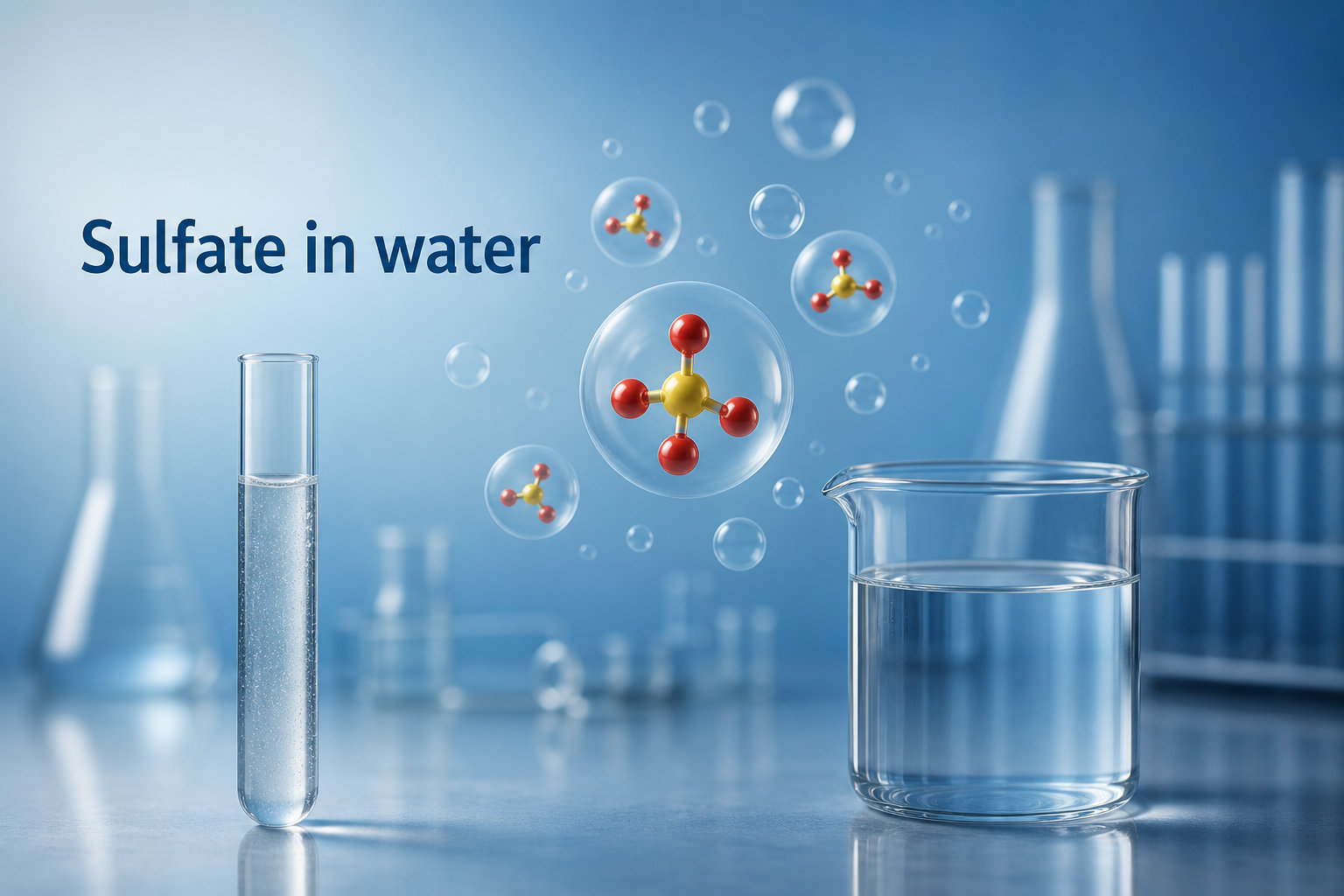
Sulfate is the common name for the SO4 ion, a negatively charged sulfur-oxygen compound that dissolves easily in water. Chemists call it an anion because of its negative charge, and it pairs with positively charged minerals to form salts like magnesium sulfate, sodium sulfate, and calcium sulfate.
These compounds occur naturally in soil and rock. When rain or irrigation water moves through the ground, it picks up sulfate and carries it into aquifers and private wells. Three natural minerals account for most of the sulfate you will ever encounter:
- Gypsum (calcium sulfate) – the white chalky deposits you sometimes see on plumbing fixtures.
- Epsom salt (magnesium sulfate) – the same mineral sold in pharmacies for bath soaks.
- Glauber salt (sodium sulfate) – a common evaporite mineral in arid regions.
Human activity can also add sulfate to water supplies. Mining operations, coal-fired power plants, and industrial wastewater release sulfate through runoff. Agricultural fertilizer use contributes smaller amounts, especially in farming regions.
Sulfate is not the same as sulfur or hydrogen sulfide, even though people often confuse the three. Sulfur is a pure element, hydrogen sulfide is a foul-smelling gas, and sulfate is the stable dissolved form you will see on a water test report. If you are curious about how these minerals interact in bottled and sparkling water, our piece on water minerals and composition breaks down the broader picture.
How Does Sulfate in Water Affect Human Health?
The EPA sets a Secondary Maximum Contaminant Level (SMCL) of 250 mg/L for sulfate in drinking water. This is not a health-based mandate, but a guideline for taste, odor, and cosmetic effects. Above 250 mg/L, most people notice a bitter or medicinal taste, and many begin to experience mild laxative effects.
Health concerns grow significantly above 500 mg/L. This is the threshold that matters most for parents and caregivers, because infants and young children face the highest risk. Their digestive systems absorb water faster, so the osmotic load hits harder and can lead to diarrhea and dehydration.
The World Health Organization has reviewed the science and concluded that most adults tolerate up to 500 mg/L without symptoms, but the organization recommends lower levels for infant formula preparation. State health departments echo this guidance. The Minnesota Department of Health, for example, warns that sulfate above 500 mg/L can be especially problematic for newborns.
Here are the key thresholds to remember:
- Below 250 mg/L: Safe and palatable for most adults.
- 250 to 500 mg/L: Bitter taste possible; some adults experience mild laxative effects.
- Above 500 mg/L: Infants and travelers face higher risk of diarrhea and dehydration.
- Above 1000 mg/L: Strong laxative effect common in most users.
I have read well owner reports on Reddit where people tested at 1200 ppm and described their water as cloudy with a faint smell. That experience matches the research – very high sulfate usually means visible particles and an off-putting taste.
If you have a sensitive stomach, are recovering from illness, or are preparing baby formula, aim for the lower end of the safe range. A reverse osmosis system or distilled water handles this best, and I will cover those options in detail below.
Sulfate in Water and Animal Health
Livestock are far more sensitive to sulfate than humans. The same minerals that mildly upset an adult stomach can reduce feed intake in cattle, pigs, and poultry, leading to slower weight gain and lower productivity on farms.
Pigs are the most sensitive species. Studies referenced by the National Academies show that pigs fed water with sulfate above 1500 mg/L experience loose stools and reduced growth rates. Cattle tolerate more, but levels above 2500 mg/L can still cause diarrhea, especially in calves.
Poultry fall in the middle. Layers and broilers begin showing reduced water consumption around 1000 mg/L, which directly affects egg production and feed conversion. The takeaway for homesteaders and small farmers: testing water before expanding your herd or flock can prevent costly losses.
If your animals share a well with your home, the same treatment system can often protect both. Reverse osmosis works for household drinking and cooking, while livestock tanks can use aeration plus ion exchange to bring sulfate down to acceptable levels.
Taste, Odor, and Plumbing Problems Caused by Sulfate
Even when sulfate levels are technically safe, they can make water unpleasant. The bitter or medicinal taste hits around 250 mg/L, and many people detect it sooner. Hydrogen sulfide gas can also form when sulfate-reducing bacteria colonize a well or plumbing system, producing the rotten egg smell that drives homeowners to call plumbers every year.
High sulfate accelerates corrosion in metal pipes, especially copper. Over time, dissolved sulfate reacts with copper to form soluble compounds that leach into drinking water and leave blue-green stains on sinks and tubs. Water heaters take a particular beating because heat speeds up the reaction.
Common signs that suggest high sulfate in your plumbing system include:
- Bitter, salty, or medicine-like taste in tap water.
- Rotten egg odor, especially from hot water taps.
- Blue-green staining on porcelain fixtures.
- Premature failure of water heaters or copper pipes.
- White, chalky scale around faucets.
Many homeowners blame hard water for these symptoms and install a softener, then wonder why the problems persist. The next section explains exactly why.
How to Remove Sulfate from Drinking Water
Not every treatment method removes sulfate, and picking the wrong one wastes money. Here are the four options that actually work, ranked by effectiveness and cost.
1. Reverse Osmosis (Best Overall)
Reverse osmosis pushes water through a semi-permeable membrane that blocks the SO4 ion along with most other dissolved solids. A quality under-sink RO system typically reduces sulfate by 95 to 99 percent, bringing a 500 mg/L reading down to 5 mg/L or less.
RO units are affordable, widely available, and easy to maintain. Annual filter changes cost around $50 to $100, and the membranes last three to five years. If you want a single solution for drinking and cooking water, this is the answer I recommend most often.
2. Distillation
Distillation boils water and condenses the steam, leaving sulfate and other minerals behind. Effectiveness is similar to RO at over 99 percent removal, but distillers are slower, use more electricity, and produce hot water that needs cooling before drinking.
Countertop distillers work well for low-volume needs, like mixing baby formula. Whole-house distillation exists but is rare due to cost and energy use.
3. Anion Exchange
Anion exchange resin swaps sulfate ions for chloride ions, much like a water softener swaps calcium for sodium. Specialized sulfate-selective resins can reduce levels by 90 percent or more, and they handle the whole-house flow rate.
The trade-off is higher upfront cost ($1500 to $3000 installed) and the need for periodic brine regeneration. This option makes sense for very hard or high-sulfate wells where point-of-use RO is not enough.
4. Combination Systems
Some homes benefit from a two-stage approach: an anion exchange unit for general household water and an RO system for the kitchen tap. This protects plumbing while delivering pure drinking water.
What does not work is a standard sodium water softener. Softeners only target calcium and magnesium, the hardness minerals. Worse, a softener can actually convert calcium sulfate into sodium sulfate, which is more laxative and leaves the same taste problems behind. If you are researching water filtration systems that don’t remove sulfate, filter pitchers and standard faucet attachments fall into the same category – they improve taste by absorbing chlorine but leave sulfate untouched.
| Method | Sulfate Removal | Best For | Approximate Cost |
|---|---|---|---|
| Reverse Osmosis | 95 to 99% | Drinking and cooking water | $200 to $600 plus $75 per year |
| Distillation | Over 99% | Small volume, baby formula | $300 to $1000 plus electricity |
| Anion Exchange | 90%+ | Whole-house treatment | $1500 to $3000 installed |
| Water Softener | None | Not effective for sulfate | Avoid for this purpose |
How to Test Sulfate Levels in Your Water
If you are on a public water system, your utility already publishes an annual water quality report. Search your zip code plus “consumer confidence report” and you will find your sulfate reading in seconds.
Private well owners need to test independently. The most reliable option is a certified laboratory through your state health department, which typically charges $20 to $50 for a sulfate panel. Results take about a week and include context for your region.
Home test strips are faster and cheaper, around $15 for a pack of 50. They read in parts per million and are accurate enough for a quick screening, but a lab confirmation is worth the extra step before you invest in treatment equipment.
You should test if any of the following apply to you:
- You own a private well, especially in agricultural, mining, or shale regions.
- Your water tastes bitter or smells like rotten eggs.
- You see white scale or blue-green staining on fixtures.
- You prepare infant formula with tap water.
- You raise livestock and notice changes in feed consumption.
While you are at it, ask the lab to run a complete panel. High sulfate often travels with high total dissolved solids, hardness, and occasionally manganese or iron. Treating the full picture prevents one fix from masking another.
Frequently Asked Questions About Sulfate in Water
Is sulfate in your water bad for you?
Sulfate in your water is not directly toxic, but levels above 250 mg/L can cause a bitter or medicinal taste and mild laxative effects. Above 500 mg/L, infants and sensitive adults face a higher risk of diarrhea and dehydration. The EPA sets a Secondary Maximum Contaminant Level of 250 mg/L to keep water palatable and reduce these effects.
Do water filters remove sulfate?
Most standard pitcher and faucet filters do not remove sulfate because the SO4 ion is too small and stable for carbon absorption. Effective options include reverse osmosis, distillation, and anion exchange systems. If you want a true reduction, look for a system that specifically targets dissolved minerals rather than chlorine and sediment.
Is it okay to drink water with sulfur in it?
Sulfur is a pure element and rarely appears in drinking water on its own. What people smell as sulfur is usually hydrogen sulfide gas, which forms when sulfate-reducing bacteria break down sulfate in low-oxygen wells. The water is generally safe but unpleasant. Aeration, chlorination, or oxidation filters remove the gas, though the underlying sulfate remains.
What causes high sulfate in water?
High sulfate in water usually comes from natural sources: groundwater moving through gypsum, Epsom salt, or shale deposits. Human sources include mining runoff, coal ash, and industrial wastewater. In agricultural regions, fertilizer use can add smaller amounts. Deep private wells in sedimentary rock are the most likely setting for elevated sulfate readings.
Final Thoughts on Sulfate in Water
Sulfate is one of those quiet water quality issues that stays invisible until it crosses a threshold and changes how your water tastes, smells, or feels in your gut. Knowing the numbers gives you the upper hand: 250 mg/L is the EPA’s comfort line, 500 mg/L is the infant safety line, and anything above 1000 mg/L almost always needs treatment.
If you are a well owner, start with a certified lab test. If you are on a municipal system, your annual consumer confidence report already tells you the answer. From there, reverse osmosis remains the most cost-effective way to bring sulfate down to a level that protects your family, your pipes, and your peace of mind.
When in doubt, consult a state-certified water treatment professional. They can interpret your test results in the context of your local geology and recommend a system sized for your home or farm. The right equipment pays for itself in better-tasting water, longer-lasting plumbing, and fewer worries about what is in your glass.