
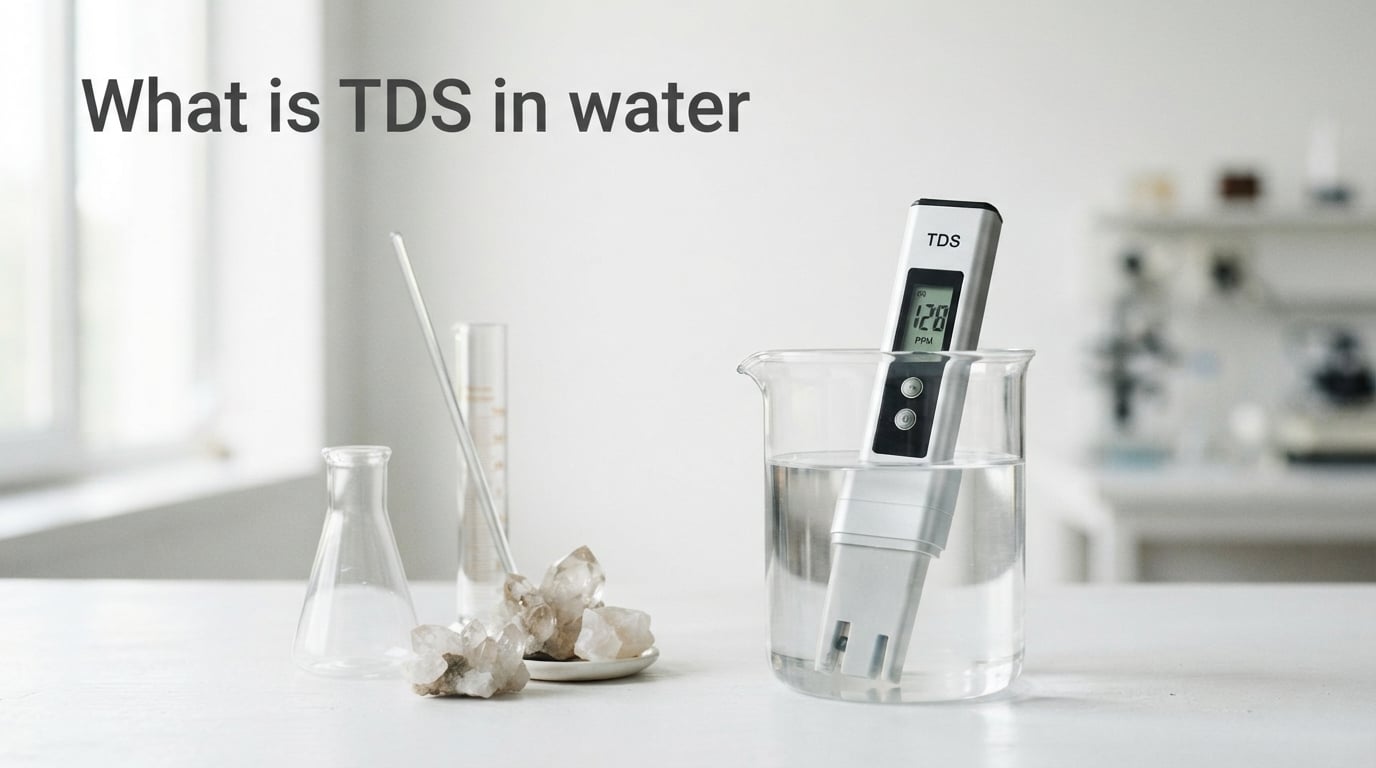
If you’ve ever glanced at the side of a water filter pitcher or the spec sheet of a reverse osmosis system, you’ve probably seen the term “TDS” followed by a number. I get asked about it constantly, so let me walk you through exactly what is TDS in water, why the number matters, and how to use it to make better choices about what you drink.
TDS shows up in everything from municipal water reports to bottled mineral water labels to aquarium kits. Once you understand what it means, every one of those numbers becomes easier to interpret.
This guide covers the definition, the substances TDS actually measures, where those substances come from, and how to read EPA and WHO guidelines. I’ll also explain how TDS meters work, what they miss, and how to think about TDS when picking between bottled, filtered, and tap water.
By the end, you’ll be able to glance at any water report, filter spec sheet, or mineral water bottle and know exactly what those numbers mean for your health, your appliances, and your taste buds.
Table of Contents
What Is TDS in Water?
TDS stands for Total Dissolved Solids. It is the combined concentration of every inorganic and organic substance dissolved in a sample of water, measured in parts per million (ppm) or milligrams per liter (mg/L). Both units describe the same thing: how many milligrams of dissolved material sit in every liter of water.
Think of it as a single number that captures all the invisible stuff dissolved in your glass. Minerals, salts, metals, and trace organic compounds all contribute to TDS, even though they cannot be seen with the naked eye.
The EPA defines TDS as a secondary drinking water standard with a recommended upper limit of 500 ppm. This isn’t a health-based limit the way lead or arsenic limits are. It exists because high TDS affects taste, can stain fixtures, and can leave scale in pipes and appliances.
Most tap water in the United States falls between 100 and 400 ppm. Bottled water varies even more widely, from around 10 ppm for steam-distilled brands to over 2,000 ppm for premium European mineral waters.
The terms “TDS,” “ppm,” and “mg/L” are sometimes used interchangeably in marketing materials. While 1 ppm is approximately equal to 1 mg/L for dilute water samples, TDS meters usually apply a conversion factor (0.5 to 0.7) to translate conductivity into a “ppm” number that approximates the gravimetric measurement.
What TDS Actually Includes
TDS is a catch-all measurement, which is both its strength and its biggest limitation. The number rolls up many different substances into one reading, without telling you which ones are present.
The main contributors to TDS fall into four categories:
- Beneficial minerals: calcium, magnesium, potassium, sodium, and bicarbonate ions.
- Dissolved salts: sodium chloride, sulfates, carbonates, and chlorides.
- Trace metals: iron, manganese, copper, and sometimes lead or arsenic.
- Organic matter: small amounts of decomposing plant material and other carbon-based compounds.
Calcium and magnesium are usually the biggest contributors in tap water. They come from limestone and chalk in the ground, which is why high-mineral waters like Contrex and Vichy have TDS readings well above 1,000 ppm.
Sodium and chloride often come from road salt, water softeners, or coastal aquifers. Trace metals typically appear in very low concentrations, but they’re the ones to watch for health reasons, which is why TDS alone never tells the whole story.
Here’s a quick breakdown of how common substances contribute to a typical TDS reading in tap water:
| Substance | Typical Contribution | Common Source |
|---|---|---|
| Calcium | 30-60% of TDS | Limestone, chalk aquifers |
| Magnesium | 15-30% | Dolomite, magnesium-rich rock |
| Sodium | 5-20% | Road salt, water softeners |
| Chloride | 5-15% | Saline intrusion, runoff |
| Sulfates | 5-15% | Gypsum, industrial discharge |
| Bicarbonates | 10-30% | Soil CO2, carbonate rock |
| Trace metals | Less than 1% | Pipes, natural deposits |
The exact percentages depend on your local geology and water source. A well drilled into granite bedrock will look very different from a well in coastal Florida, even if both report similar TDS totals.
Where TDS Comes From
Most TDS in drinking water originates from natural sources. As rainwater travels through soil and rock, it picks up dissolved minerals along the way. Hard water regions with lots of limestone tend to have higher TDS than areas with granite or sandy aquifers.
Human activity adds TDS in several ways:
- Agricultural runoff carries fertilizers, manure, and soil into groundwater and rivers.
- Road salt and de-icers wash into reservoirs and wells each winter.
- Industrial discharge can introduce salts, metals, and processing chemicals.
- Sewage and septic systems contribute chloride, nitrate, and organic matter.
- Urban runoff picks up pollutants from pavement, lawns, and vehicle fluids.
Water treatment plants can lower or raise TDS depending on the process. Reverse osmosis strips out most dissolved solids, while some utilities add fluoride or use chloramine disinfection, both of which contribute a small amount to the final reading.
In coastal areas, saltwater intrusion into freshwater aquifers can dramatically raise TDS levels. Wells near the coast often show TDS climbing over time as the freshwater lens shrinks.
TDS Levels and Standards: What Counts as Good or Bad
TDS isn’t a “one number fits all” measurement. Different ranges tell different stories about your water source, treatment, and taste.
| TDS Range (ppm) | Classification | Typical Source or Notes |
|---|---|---|
| 0-50 | Very low | Reverse osmosis, distilled, some ultra-filtered waters |
| 50-150 | Low | Filtered tap water, some bottled waters |
| 150-300 | Moderate | Typical municipal tap water in many regions |
| 300-600 | High | Hard tap water, some natural spring waters |
| 600-1,000 | Very high | Mineral water, well water in mineral-rich zones |
| 1,000+ | Brackish / mineral-rich | Premium mineral waters, saline aquifers |
The EPA’s secondary drinking water guideline sets 500 ppm as the upper threshold for aesthetic concerns. Above that level, water may taste bitter or salty, and scale can build up in kettles, water heaters, and coffee machines.
The World Health Organization reviewed TDS in 2003 and concluded that palatability drops noticeably above about 600 ppm. Waters below 300 ppm generally taste “fresh,” while water above 1,000 ppm tends to taste increasingly mineral or salty.
For drinking water specifically, a TDS between 50 and 150 ppm often strikes a nice balance. It tastes clean, has very few contaminants, and still carries a small amount of beneficial minerals. Some people prefer slightly higher readings (up to 300 ppm) for the taste and mineral content.
Very low TDS (under 50 ppm) isn’t dangerous, but the water can taste flat. That’s why some RO users remineralize their RO water with a small mineral cartridge to bring TDS back up to a more flavorful 80-120 ppm.
How TDS Is Measured
Two main methods are used to measure TDS. The first is the gravimetric method, which is the gold standard in laboratories. Water is filtered through a 2-micron filter, evaporated in a controlled oven, and the leftover residue is weighed on a precision scale. This produces the most accurate reading but takes hours and requires specialized equipment.
The second method uses electrical conductivity. Pure water barely conducts electricity, but dissolved ions do. A TDS meter passes a small electric current through the water and estimates the total dissolved solids based on how easily the current flows. The meter then converts the conductivity reading to ppm using a conversion factor, usually around 0.5 to 0.7 depending on the type of dissolved solids expected.
Most consumer TDS meters are handheld conductivity probes that cost under $25. They’re fast, easy to use, and surprisingly accurate for general guidance. Our team has tested several models against laboratory results, and the readings usually fall within 5-10% of a full lab analysis.
That said, TDS meters have an important blind spot: they only measure charged ions. Uncharged contaminants like some organic compounds, pesticides, or bacteria won’t show up in a TDS reading. This is why how water filters handle mineral retention matters as much as the raw TDS number.
If you have specific concerns (lead, arsenic, nitrates), you need a targeted lab test, not a TDS meter. The TDS reading is a useful starting point, but it isn’t a complete water quality report.
For aquarium keepers, TDS is especially important. Freshwater fish thrive in specific ranges, and many sensitive species need TDS between 100 and 250 ppm. Planted tanks often do better with slightly higher TDS to supply trace minerals.
To use a typical TDS meter, you simply dip the probe into a sample of water and wait a few seconds for the reading to stabilize. Most meters also report temperature, since conductivity varies with temperature. Always rinse the probe with distilled water between samples to avoid cross-contamination.
Effects of TDS on Taste, Health, and Appliances
TDS affects three practical things you notice every day: how water tastes, how your appliances hold up, and what kind of minerals you’re consuming.
Taste. Very low TDS (under 50 ppm) often tastes flat or empty. Mid-range TDS (150-300 ppm) usually tastes crisp and refreshing. High TDS (above 600 ppm) can taste bitter, metallic, or salty depending on which minerals dominate. Carbonation changes perception too, so two waters with identical TDS can taste completely different when one is sparkling.
Appliances. High TDS water leaves scale on heating elements, showerheads, and glassware. This is especially true when calcium and magnesium are the main contributors. Low TDS water won’t scale, which is why espresso machines and steam irons often specify low-TDS feed water. I’ve personally measured TDS above 350 ppm in a kettle that scaled up within three months of use.
Health. TDS itself isn’t a health hazard at typical levels. The minerals in moderate TDS water contribute a small amount to your daily intake of calcium and magnesium. The concern at high TDS levels isn’t the total number; it’s whether any of those dissolved solids are harmful contaminants like lead, arsenic, or nitrate. A TDS reading of 200 ppm from clean groundwater is very different from 200 ppm in a home with lead pipes.
One common question is whether zero TDS water (like distilled or pure RO water) is safe to drink. Short term, yes. Long term, some people notice the water tastes flat and may not enjoy drinking it. It also pulls a small amount of minerals from the body through osmotic action, though the effect is minimal for healthy adults.
The World Health Organization notes that extremely low TDS water can be aggressive toward metal pipes, slowly leaching copper or lead from plumbing. This is another reason many households pair RO treatment with a remineralization cartridge or a different material for their plumbing.
Frequently Asked Questions
What is a good TDS value for drinking water?
A TDS value between 50 and 150 ppm is generally considered good for drinking water. It tastes clean, contains minimal contaminants, and still provides a small amount of beneficial minerals. The EPA’s secondary guideline sets 500 ppm as the upper limit for aesthetic reasons, while the WHO notes that palatability drops noticeably above about 600 ppm.
Is TDS in water good for you?
TDS itself is neither good nor bad. It is a measurement of everything dissolved in water, including beneficial minerals like calcium and magnesium as well as potentially harmful contaminants like lead or nitrate. Moderate TDS from a clean source contributes useful minerals, while high TDS from a contaminated source may signal health concerns. Always pair a TDS reading with a full water quality report.
Do water filters reduce TDS?
Standard pitcher and faucet filters like carbon or activated charcoal do very little to reduce TDS. They improve taste by removing chlorine and some organic compounds, but leave most minerals in the water. Reverse osmosis, distillation, and deionization systems are the methods that actually reduce TDS by removing dissolved ions.
How do I reduce TDS in my water?
The most effective ways to reduce TDS are reverse osmosis, distillation, and deionization. Reverse osmosis systems push water through a semi-permeable membrane that blocks most dissolved ions, typically cutting TDS by 90-99%. Distillation boils water and condenses the steam, leaving minerals behind. Water softeners reduce hardness but actually raise TDS by swapping calcium and magnesium for sodium.
Key Takeaways
TDS in water measures every dissolved substance in a single number, expressed in ppm or mg/L. A reading between 50 and 150 ppm suits most people, though preferences vary. Use TDS as a starting point for understanding your water, and pair it with targeted tests whenever you have specific concerns. Now that you know what is TDS in water, you can read any water report or bottle label with more confidence.