
Hard water is one of the most common water quality issues homeowners face, affecting roughly 85% of homes in the United States. If you have ever wondered what causes hard water and why your shower leaves scale, your soap won’t lather properly, or your dishes come out spotted, you are in the right place.
Our team has researched the geological, chemical, and environmental factors behind hard water formation. In this guide, we explain exactly what causes hard water, the rock types that contribute to it, and how to identify hard water problems in your home.
Table of Contents
What Is Hard Water and Why Does It Form?
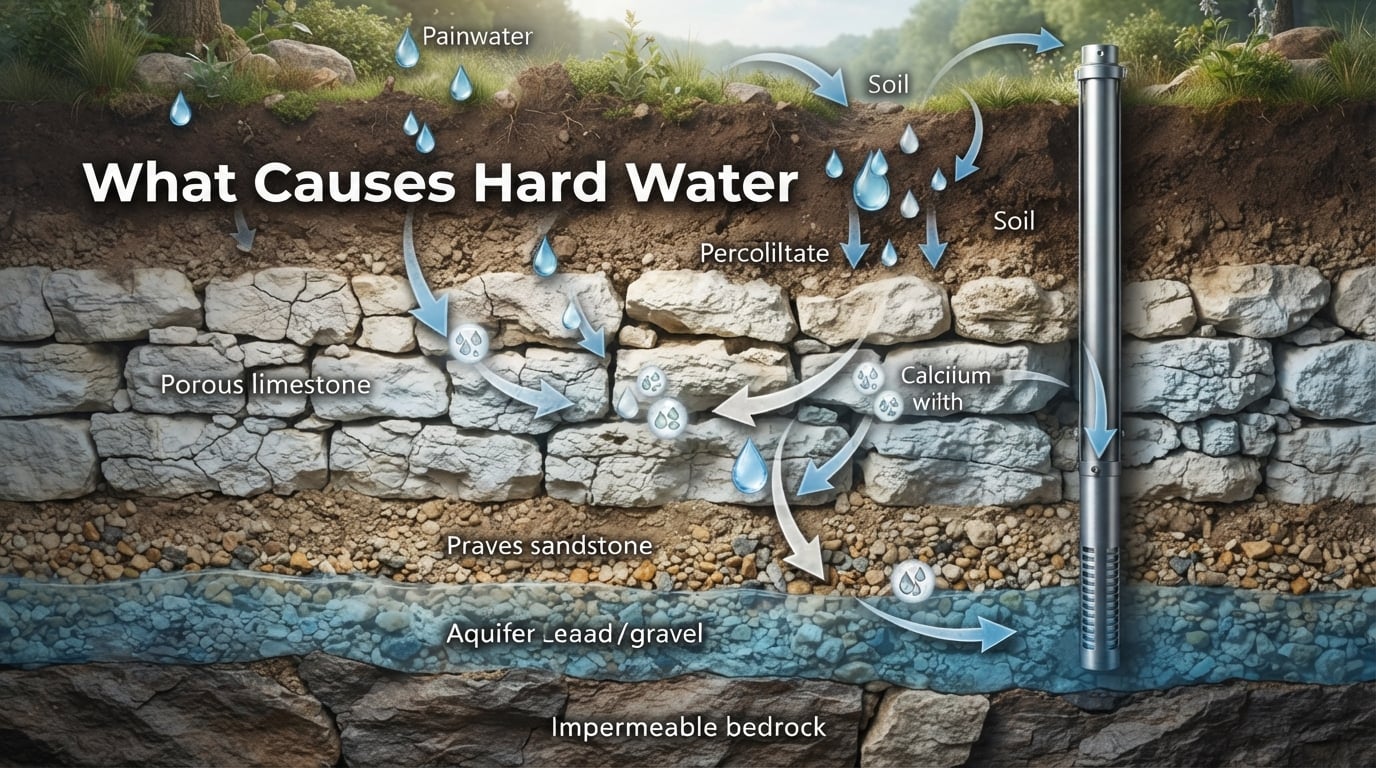
Hard water is caused by high concentrations of dissolved minerals, primarily calcium and magnesium, picked up as water travels through sedimentary rock formations. When rainwater seeps into the ground and moves through limestone, chalk, dolomite, and gypsum deposits, it dissolves small amounts of these minerals and carries them into your tap water supply.
The U.S. Geological Survey defines water hardness as “the amount of dissolved calcium and magnesium in the water.” Water with more than 61 mg/L of calcium carbonate is generally classified as hard, though regional standards vary.
This mineral-rich water causes visible problems in homes, including soap scum, white scale on faucets, and reduced appliance efficiency. Understanding the causes helps you decide whether to install a water softener or use other treatment methods.
The Three Main Causes of Hard Water
Looking at the geology and water systems that produce hard water, three primary causes stand out. Here are the main reasons hard water forms:
Local geology and rock composition — Areas with limestone, chalk, gypsum, or dolomite bedrock release calcium and magnesium into groundwater as it flows through these formations.
Water contact time with minerals — The longer water sits in contact with mineral-rich rock, the more dissolved minerals it picks up. Deep wells and slow-moving aquifers tend to produce harder water.
Water source type — Groundwater from wells is typically harder than surface water from lakes and rivers because it has more contact with mineral-rich rock formations.
These three causes often work together. A home built over a limestone aquifer with a deep well will almost certainly have hard water, while a home drawing from a mountain reservoir may have naturally soft water.
The Chemistry Behind Hard Water Formation
The process that creates hard water begins in the atmosphere and ends at your kitchen faucet. Here is the step-by-step chemistry that explains how rainwater becomes hard water:
Step 1: Rainwater absorbs carbon dioxide. As rain falls through the air, it picks up carbon dioxide (CO2). When this CO2 dissolves in water, it forms a weak acid called carbonic acid (H2CO3).
Step 2: Slightly acidic water enters the ground. Rainwater, now slightly acidic with a pH around 5.6, seeps into the soil and continues absorbing additional CO2 from decaying organic matter, becoming even more acidic.
Step 3: Acidic water dissolves rock minerals. This acidic groundwater reacts with limestone (calcium carbonate) and other carbonate rocks, dissolving them through a chemical reaction that releases calcium and magnesium ions into the water.
Step 4: Mineral-rich water fills aquifers. The water carries these dissolved minerals through underground aquifers and eventually into wells, springs, and municipal water systems.
The key chemical reaction is simple: calcium carbonate plus carbonic acid equals dissolved calcium bicarbonate. This dissolved form is what makes water “hard” and causes the chalky deposits on your fixtures.
Common Rock Types That Cause Hard Water
Not all rocks contribute equally to water hardness. The specific rock formations in your region determine which minerals end up in your water and how hard it becomes.
Limestone
Limestone is the most common cause of hard water worldwide. This sedimentary rock is composed primarily of calcium carbonate, which dissolves easily in slightly acidic groundwater. Regions with extensive limestone bedrock, like the Midwest and parts of Texas, often have very hard water exceeding 180 mg/L of calcium carbonate.
Chalk
Chalk is a softer, porous form of limestone made of tiny marine organism shells. Areas built over chalk formations, such as parts of England and the southeastern United States, frequently experience hard water because chalk releases calcium quickly when groundwater passes through it.
Dolomite
Dolomite contains both calcium carbonate and magnesium carbonate. Water flowing through dolomite tends to be high in magnesium as well as calcium, producing water that is especially hard. Magnesium-rich water often causes more soap scum than calcium alone.
Gypsum
Gypsum (calcium sulfate) is highly soluble in water and contributes significantly to permanent hardness. Unlike limestone, gypsum does not require acidic conditions to dissolve. Water that passes through gypsum deposits can become extremely hard very quickly.
Marble and Other Carbonate Rocks
Marble, travertine, and similar carbonate rocks all release calcium when exposed to slightly acidic groundwater. Areas with these formations have elevated mineral content in their water supply.
Temporary vs Permanent Hard Water
Water hardness comes in two distinct forms, each caused by different minerals and removable by different methods.
Temporary Hardness (Carbonate Hardness)
Temporary hardness is caused by dissolved calcium and magnesium bicarbonates. The “temporary” label refers to the fact that boiling the water will cause these minerals to precipitate out as scale. If you have ever noticed a chalky ring inside your kettle, that is temporary hardness at work. Boiling breaks down the bicarbonates and leaves calcium carbonate deposits behind.
Permanent Hardness (Non-Carbonate Hardness)
Permanent hardness is caused by calcium and magnesium sulfates, chlorides, and nitrates. These minerals stay dissolved even when water is boiled, which is why they are called “permanent.” Gypsum-rich regions typically produce water with high permanent hardness. Treating permanent hardness requires ion exchange, reverse osmosis, or other chemical methods beyond simple boiling.
Most hard water contains a mix of both temporary and permanent hardness. The ratio depends on local geology, with limestone areas producing more temporary hardness and gypsum-rich areas producing more permanent hardness.
Signs Hard Water Is in Your Home
If you are unsure whether your water is hard, look for these common signs. Our team has compiled the most frequently reported symptoms from homeowners dealing with hard water:
Soap scum on showers and tubs — A white, filmy residue that soap leaves behind when it reacts with calcium and magnesium.
Scale buildup on faucets and showerheads — White or greenish mineral deposits that clog fixtures and reduce water flow over time.
Dingy, stiff laundry — Clothes washed in hard water often look faded and feel scratchy because minerals prevent detergent from working properly.
Spotty dishes and glassware — Mineral deposits leave visible spots on clean dishes, even after rinsing.
Dry skin and brittle hair — Hard water leaves a mineral film on skin and hair, causing irritation and dryness that many people notice after moving to a hard water area.
Reduced appliance lifespan — Water heaters, dishwashers, and washing machines work harder and wear out faster when scale builds up inside them.
Several of these signs overlap with issues discussed in our article about water filtration and mineral content, since mineral levels affect both taste and appliance performance.
How Water Hardness Is Measured
Water hardness is typically measured in grains per gallon (gpg) or milligrams per liter (mg/L) of calcium carbonate. Here is how the standard classification system works:
Soft water — 0 to 3.5 gpg or 0 to 60 mg/L. Rainwater and surface water from low-mineral regions typically falls into this category.
Slightly hard water — 3.5 to 7 gpg or 61 to 120 mg/L. Many municipal water systems deliver water in this range.
Moderately hard water — 7 to 10.5 gpg or 121 to 180 mg/L. Common in areas with sedimentary bedrock.
Very hard water — Over 10.5 gpg or over 180 mg/L. Typical of well water drawn from limestone aquifers.
You can test your water hardness with home test strips, a hardness test kit, or by sending a sample to a certified laboratory. Many local water utilities also publish annual water quality reports that include hardness data for your service area.
FAQs
What causes hard water?
Hard water is caused by dissolved calcium and magnesium minerals that water picks up as it flows through limestone, chalk, dolomite, and gypsum rock formations. Rainwater becomes slightly acidic as it absorbs carbon dioxide from the air and soil, which allows it to dissolve these minerals from underground rock layers before the water reaches wells and municipal supplies.
Is hard water safe to drink?
Yes, hard water is generally safe to drink and may even contribute small amounts of beneficial calcium and magnesium to your diet. Most health organizations, including the World Health Organization, consider hard water acceptable for consumption. However, very hard water can affect the taste of tea and coffee, and some studies suggest it may worsen certain skin conditions.
What are the three main causes of hard water?
The three main causes of hard water are local geology (areas with limestone, chalk, dolomite, or gypsum bedrock), water contact time with mineral-rich rock (longer contact produces harder water), and water source type (groundwater from wells is typically harder than surface water). These factors work together to determine the mineral content of your tap water.
Why is my water suddenly hard?
Your water may suddenly seem harder for several reasons, including a change in your local water source, seasonal variations in groundwater levels, a malfunctioning water softener, or recent construction that disturbed underground mineral deposits. If your water hardness has changed noticeably, contact your water utility or test your well water to identify the cause.
How do you fix having hard water?
The most common fix for hard water is installing a water softener that uses ion exchange to replace calcium and magnesium with sodium or potassium ions. Other treatment options include reverse osmosis systems, which filter out minerals, and showerhead filters that reduce hardness at specific fixtures. The best solution depends on your water hardness level and household needs.
What state has the worst hard water?
States with the hardest water in the U.S. include Arizona, New Mexico, Texas, Utah, and parts of the Midwest. These regions have high concentrations of limestone and other mineral-rich geological formations. Some cities in Arizona report water hardness exceeding 400 mg/L, which is considered extremely hard.
Final Thoughts on What Causes Hard Water
Understanding what causes hard water comes down to three things: the geology beneath your feet, the chemistry of rainwater, and the length of time water spends underground. Calcium and magnesium dissolved from limestone, chalk, dolomite, and gypsum are the minerals responsible, and they affect nearly every home in hard water regions.
If you are dealing with the signs of hard water, start by testing your water to confirm the hardness level. From there, you can choose between water softeners, reverse osmosis systems, and point-of-use filters based on your budget and needs. For more on water mineral content and how it affects taste, check out our related guides on mineral balance and filtration.
3 thoughts on “What Causes Hard Water? Complete Guide to Hard Water Formation (September 2026)”