
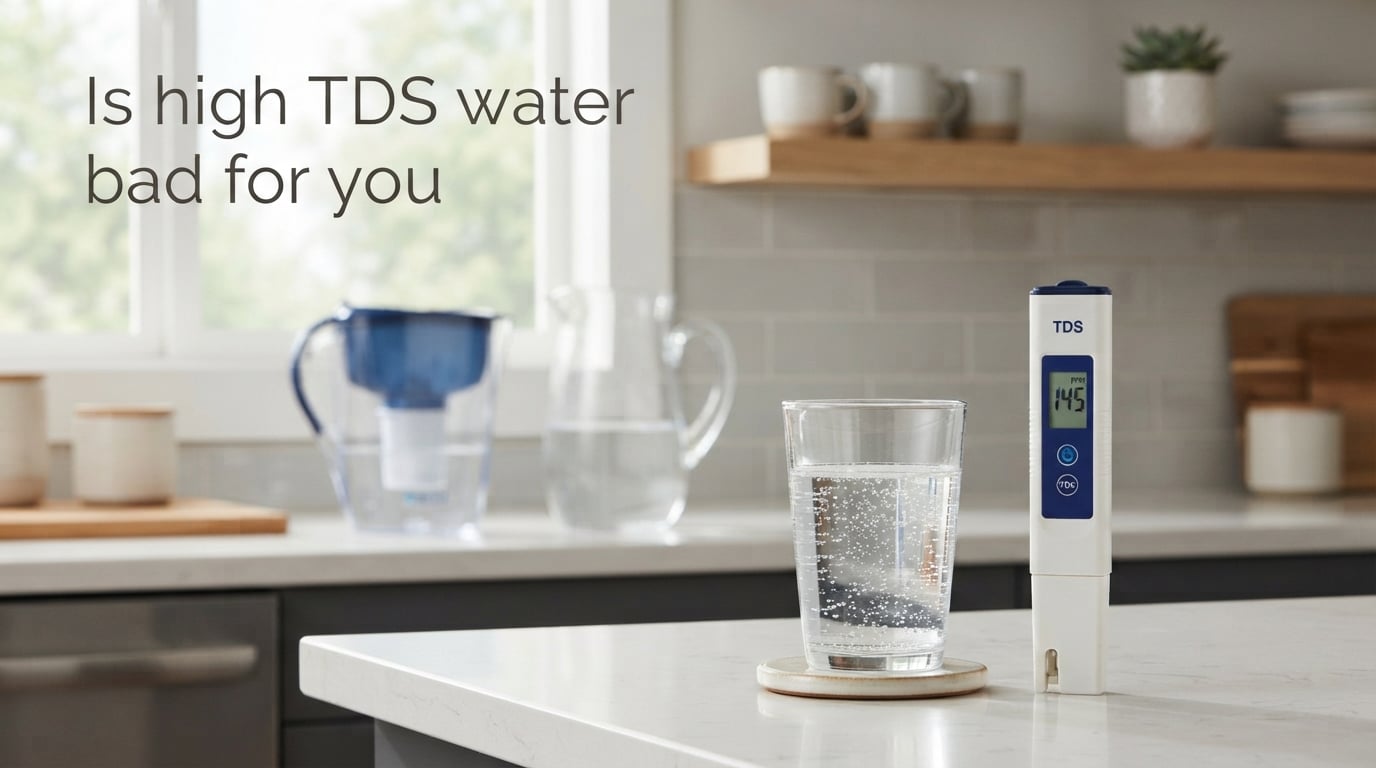
Is high TDS water bad for you? In most cases, the honest answer is no. TDS (Total Dissolved Solids) below 1000 ppm is generally not a health concern, and the U.S. EPA sets a non-enforceable secondary limit of 500 ppm purely for taste reasons. The catch is that TDS only measures how much is dissolved, not what is dissolved. A reading of 800 ppm could be premium mineral water full of healthy calcium and magnesium, or it could be water laced with lead and arsenic. That’s why TDS alone can’t tell you if your water is bad for you.
I’ve spent weeks reading through EPA documents, WHO guidelines, and Reddit threads on r/water and r/WaterTreatment to put together this complete guide. If you’ve ever stared at a TDS meter wondering whether that number matters, this article will give you the clarity you need.
Table of Contents
What Is TDS? Total Dissolved Solids Explained
TDS stands for Total Dissolved Solids, and it’s a measurement of every substance dissolved in water that won’t evaporate. That includes inorganic salts like calcium, magnesium, sodium, and potassium, plus small amounts of organic matter. The reading is expressed in parts per million (ppm) or milligrams per liter (mg/L) — these two units are effectively interchangeable for water.
Here’s what TDS actually captures: any dissolved particle smaller than 2 microns passes through the filter used during measurement. So your reading sums up everything from beneficial minerals to potentially harmful contaminants into one single number.
TDS meters work using electrical conductivity. Pure water doesn’t conduct electricity well, but dissolved ions do. The meter sends a small current through the water and calculates TDS based on how easily that current flows. More ions means higher conductivity means higher TDS reading. The alternative lab method is gravimetric analysis: you evaporate a water sample and weigh what remains.
And here’s the critical limitation. A TDS meter cannot tell you what’s actually in your water. Multipure demonstrated this with a simple test: drop some acetone (nail polish remover) into a TDS meter, and the reading barely changes because acetone isn’t ionic. Drop in table salt, and the reading jumps because salt ions conduct electricity. Yet acetone is something you absolutely don’t want to drink. The same blind spot applies to many organic contaminants, certain pesticides, and some volatile compounds. Your TDS meter simply cannot see them.
Where Does TDS in Water Come From?
TDS enters water from two broad categories: natural geology and human activity. Understanding the source matters because it changes whether the dissolved solids are likely to be healthy minerals or harmful pollutants.
Natural Sources of TDS
As rainwater seeps through soil and rock, it picks up minerals along the way. Limestone and dolomite bedrock release calcium and magnesium carbonates. Gypsum layers contribute calcium sulfate. Volcanic rock adds silica and potassium. Mountain springs and deep aquifers often produce water with naturally high TDS levels — sometimes 1000 ppm or more — yet this water has been consumed for centuries and forms the basis of famous mineral water brands.
Premium bottled waters prove that high TDS isn’t inherently bad. San Pellegrino sits around 1100 ppm, Contrex around 1900 ppm, and Vichy Célestins around 3300 ppm. People pay premium prices for these waters precisely because of their mineral content. If high TDS automatically meant dangerous water, these brands wouldn’t exist.
If you’re curious about why some mineral waters taste so intensely mineral, our piece on high-TDS mineral waters like Contrex and Vichy breaks down the chemistry behind that signature flavor.
Human-Made Sources of TDS
Human activity can also raise TDS, sometimes with harmful consequences. Agricultural runoff adds nitrates and phosphates. Road salt washes sodium and chloride into groundwater during winter. Industrial discharge can introduce heavy metals like lead, arsenic, cadmium, and mercury. Aging plumbing contributes copper, lead, and zinc directly to your tap water.
This is where TDS becomes a warning sign rather than a verdict. A high reading from agricultural runoff or industrial contamination suggests real risk. A high reading from limestone bedrock usually means healthy minerals.
Is High TDS Water Bad for You? The Health Truth
So is high TDS water bad for you? Generally, no — at least when we’re talking about health rather than taste. The EPA’s secondary drinking water regulation of 500 ppm exists because of aesthetic concerns (taste, color, odor), not because of documented health risks. The World Health Organization has reviewed the science and concluded that TDS levels below 1000 ppm pose no meaningful health hazard.
But there are real exceptions, and this is where most articles fall short.
When High TDS Is Not a Health Problem
If your TDS comes from calcium, magnesium, and other beneficial minerals, drinking that water is typically fine. Mineral-rich water can contribute meaningfully to your daily intake of these electrolytes. Studies on hard water regions have even shown cardiovascular benefits, though the evidence is mixed.
High TDS from bicarbonate, silica, or potassium is also generally safe. The body regulates mineral levels efficiently, and any excess gets excreted through urine.
When High TDS Is a Real Concern
High TDS becomes dangerous when the dissolved substances are toxic. TDS meters can’t distinguish these scenarios, which is the problem. A reading of 700 ppm could mean healthy mineral water or water contaminated with lead from old pipes. You cannot know from the TDS number alone.
Specific contaminants that can ride along with elevated TDS readings include:
- Lead from lead service lines or solder in plumbing predating 1986.
- Arsenic from certain geological formations, particularly in the Southwestern U.S., Bangladesh, and parts of South America.
- Nitrates from agricultural fertilizer runoff, dangerous for infants.
- Fluoride above the EPA limit of 4.0 mg/L.
- Copper from aggressive water attacking copper pipes.
This is why the EPA runs separate regulations for specific contaminants with enforceable Maximum Contaminant Levels (MCLs). TDS gets a non-binding secondary standard, but lead gets a hard legal limit of 0 because of its toxicity.
TDS vs Hardness: They’re Not the Same
One of the most common misconceptions is treating TDS and water hardness as identical. They’re related but distinct. Hardness specifically measures calcium and magnesium carbonate equivalents, while TDS measures everything dissolved. Hard water can have low TDS if other minerals are absent, and high-TDS water from sodium chloride would be considered “soft” by hardness standards despite high TDS readings.
If you have a hard water problem with scale on your faucets, a water softener will help. But if your concern is total dissolved solids, a softener alone won’t cut it.
TDS Levels and Drinking Water Standards
Let’s look at the actual numbers that matter. Two authoritative frameworks exist: the U.S. EPA’s secondary regulations and the World Health Organization’s guidelines based on taste palatability.
EPA Secondary Drinking Water Standard
The EPA sets a Secondary Maximum Contaminant Level (SMCL) for TDS at 500 mg/L. This is non-enforceable guidance for state authorities. Water systems are encouraged to stay below it, but exceeding 500 ppm isn’t a violation. The reason the EPA set this level is purely aesthetic — high TDS can cause salty, bitter, or metallic taste; cause scaling in pipes; and reduce the effectiveness of soaps and detergents.
WHO TDS Flavor Classification
The World Health Organization published a more nuanced breakdown based on palatability research. This chart is widely cited and is what most TDS meter manufacturers reference when rating their readings.
- Excellent: Less than 300 mg/L — crisp, clean taste.
- Good: 300 to 600 mg/L — pleasant, slightly mineral character.
- Fair: 600 to 900 mg/L — noticeable mineral taste, less refreshing.
- Poor: 900 to 1200 mg/L — bitter or salty taste, increasingly unpleasant.
- Unacceptable: Above 1200 mg/L — strong, unpleasant taste.
Notice something important? This chart is about taste, not safety. Water at 1000 ppm can be perfectly safe to drink if the dissolved solids are healthy minerals. Water at 100 ppm can be dangerous if those few dissolved solids are arsenic.
Comparison Table: TDS Levels and What They Mean
Here’s a quick reference for common TDS levels and what they typically indicate.
- 0 to 50 ppm: Very pure water, often from reverse osmosis or distillation. May taste flat.
- 50 to 300 ppm: Common range for filtered municipal water. Generally well-received.
- 300 to 600 ppm: Mineral-rich tap water. Many premium bottled waters fall here.
- 600 to 900 ppm: Heavily mineralized water. Noticeable taste change.
- 900 to 1200 ppm: High mineral content. Common in some well water regions.
- Above 1200 ppm: Very high TDS. Usually indicates brackish water, heavy mineralization, or possible contamination.
Keep in mind that these ranges describe quantity, not quality. A lab test is the only way to know exactly what’s in your water.
How High TDS Water Affects Daily Life
Even when high TDS isn’t a health threat, it can affect your day-to-day experience. Here’s where the practical annoyances show up.
Taste and Drinking Experience
Most people can taste the difference between 100 ppm and 800 ppm water. Low TDS water tastes clean and neutral. As TDS climbs, the water develops mineral notes. At 600+ ppm, many people notice a bitter or chalky taste. Sodium-rich water at high TDS tastes distinctly salty, which is why some remineralized water with elevated TDS ends up undrinkable.
Skin and Hair from Bathing
Hard water and high-TDS water affect more than what you drink. Showers and baths expose your skin and hair to the same minerals. Calcium and magnesium can leave a film on your skin that reduces moisture retention, leading to dryness and irritation, especially for people with eczema or sensitive skin.
Hair suffers too. Mineral buildup from hard water makes hair feel rough, brittle, and harder to manage. Curly hair is particularly affected because the coating disrupts curl definition. Many people in hard water regions install shower filters specifically to address this.
Laundry, Dishes, and Cleaning
High TDS water reduces the lathering power of soap. You’ll need more detergent for the same cleaning result. White clothes turn gray or yellow over time as minerals embed in the fabric. Dishes come out of the dishwasher with white spots and a hazy film — that’s mineral residue evaporating on the surface.
Glassware looks cloudy after washing. Fixtures and faucets develop crusty white scale buildup. Sinks and tubs get the same treatment. None of this is harmful, but it’s annoying.
Appliances and Plumbing
Scale buildup is the big practical issue. Water heaters, washing machines, dishwashers, and coffee makers all accumulate mineral deposits when fed high-TDS water. This reduces efficiency, shortens lifespan, and increases energy consumption. A tankless water heater scaled up with calcium can lose 25% of its heating efficiency within a few years.
Pipes narrow as scale builds inside them, reducing water pressure over time. Showerheads clog. Ice makers in refrigerators fail. Humidifiers crust over. None of these are health emergencies, but they’re expensive headaches.
Pets and Plants
Pets generally tolerate high-TDS water fine, though some animals are sensitive to specific minerals. Cats on a kidney diet often need low-mineral water, and aquarium fish need carefully controlled TDS. Plants vary widely — most houseplants do well with municipal water in the 100 to 400 ppm range, but very high TDS can cause leaf burn and mineral toxicity over time.
How to Measure TDS in Your Water
Testing your water is straightforward, but how you test depends on what you want to know.
Home TDS Meters
A TDS meter costs anywhere from $10 to $50 and gives you an instant reading. To use one: fill a clean glass with your water sample, turn on the meter, submerge the probe up to the marked line, wait for the reading to stabilize, and record the number in ppm. Most meters also display temperature since conductivity varies with heat.
Home meters are useful for tracking trends and screening out obvious issues. They give you a snapshot of total dissolved content, which helps if you’re comparing filtration methods, checking well water after events, or testing bottled water. For more on what these meters do and don’t catch, our guide to water filters and mineral content is a good resource.
When TDS Isn’t Enough: Lab Testing
TDS alone can’t tell you what you actually need to know about water safety. If you have a well, live in an older home with lead plumbing, or notice anything unusual about your water, get a full lab panel. Look for tests that cover lead, arsenic, nitrates, fluoride, bacteria, and the specific contaminants common in your region.
Lab tests cost $20 to $200 depending on the panel and lab. The results are definitive in a way TDS can never be. State-certified labs in the U.S. follow EPA testing protocols, so you can trust the numbers. Your local health department may offer free or discounted testing for well owners.
How to Reduce TDS in Water
If your TDS is high and you want to bring it down, several methods work. Each has tradeoffs.
Reverse Osmosis
Reverse osmosis pushes water through a semipermeable membrane that removes 95% to 99% of dissolved solids. RO systems are the gold standard for residential TDS reduction. They produce very pure water, sometimes too pure — many people find RO water flat-tasting and remineralize it to add back some beneficial minerals.
Distillation
Distillation boils water and captures the steam, leaving dissolved solids behind in the boiling chamber. The result is essentially pure water with TDS near zero. Distillers are slower than RO and use more energy, but they’re reliable and require minimal maintenance.
Deionization
Deionization uses ion exchange resins to swap hydrogen and hydroxide ions for dissolved minerals. The result is very pure water, though the resins need regular replacement. DI is more common in labs and aquariums than in homes.
Water Softeners: A Common Misconception
Here’s something many homeowners get wrong. A traditional salt-based water softener doesn’t significantly reduce TDS. It swaps calcium and magnesium ions for sodium ions, which means the total dissolved solid count stays roughly the same. Soft water still has high TDS — it’s just soft TDS instead of hard TDS.
If your goal is to lower TDS specifically, you need RO, distillation, or DI. If your goal is to prevent scale and improve soap performance, a softener is the right tool.
Frequently Asked Questions About TDS
How much TDS is too much in water?
According to EPA secondary standards, water above 500 ppm exceeds the recommended aesthetic threshold. The WHO considers anything above 1000 ppm poor or unacceptable for taste. However, TDS above 1000 ppm is generally not a health hazard if the dissolved solids are beneficial minerals. The TDS number alone doesn’t tell you if water is dangerous — lab testing for specific contaminants is required to know that.
How can I reduce TDS in my water?
Reverse osmosis is the most effective home method, removing 95% to 99% of dissolved solids. Distillation and deionization also work well. Standard carbon filters like Brita pitchers do not meaningfully reduce TDS — they improve taste and remove some chlorine but leave most minerals intact. Water softeners reduce hardness but don’t lower TDS significantly.
Is it harmful to drink high TDS water?
Generally no, if the dissolved solids are healthy minerals like calcium and magnesium. The EPA set its 500 ppm secondary standard for taste reasons, not health. The WHO has concluded that TDS below 1000 ppm poses no health hazard. The exception is when high TDS comes from contaminants like lead, arsenic, or nitrates — which is why TDS alone isn’t sufficient to judge safety. Get a lab test if you suspect contamination.
Does bottled water have high TDS?
Yes, often higher than tap water. San Pellegrino sits around 1100 ppm, Contrex around 1900 ppm, and Vichy Célestins around 3300 ppm. These premium mineral waters are sought out specifically for their mineral content. Standard bottled waters like Evian, Fiji, and Poland Spring range from 100 to 400 ppm. The TDS in bottled mineral water comes from healthy minerals, not contaminants.
Do water filters remove TDS?
Standard carbon filters (Brita, Pur, pitcher-style) do not meaningfully reduce TDS — they improve taste by removing chlorine and some organic compounds but leave minerals intact. Reverse osmosis, distillation, and deionization systems are the only home filtration methods that significantly lower TDS readings. Check the manufacturer’s spec sheet: if it doesn’t claim TDS reduction, it won’t reduce TDS.
Is it okay to drink 10 TDS water?
Yes, 10 ppm is very pure water and perfectly safe to drink. Water at this TDS level typically comes from reverse osmosis or distillation systems. Some people find ultra-pure water tastes flat or bland because of the lack of minerals, which is why RO systems often include a remineralization stage. Drinking 10 TDS water is not harmful — the body gets minerals from food.
The Bottom Line on High TDS Water
So, is high TDS water bad for you? In the vast majority of cases, no. TDS is a measurement of quantity, not quality. Water with 800 ppm of calcium and magnesium is essentially a free mineral supplement. Water with 50 ppm of lead is poison.
Here’s what I’d actually do if I were worried about my water. First, buy a $20 TDS meter and get a baseline reading. If it’s below 500 ppm, you’re within EPA aesthetic guidelines and likely fine. If it’s above 1000 ppm, your water is heavily mineralized — get a lab test to find out whether those minerals are healthy or harmful. Use a TDS meter to track trends, but never use it as the final word on water safety.
The EPA and WHO have both concluded that high TDS water is generally not a health hazard below 1000 ppm. That’s the science. The practical annoyances (taste, scale, dry skin) are real but cosmetic. Spend your money on a lab test if you have specific concerns, not on a fancy filter for a number that doesn’t actually tell you what’s in your water.