
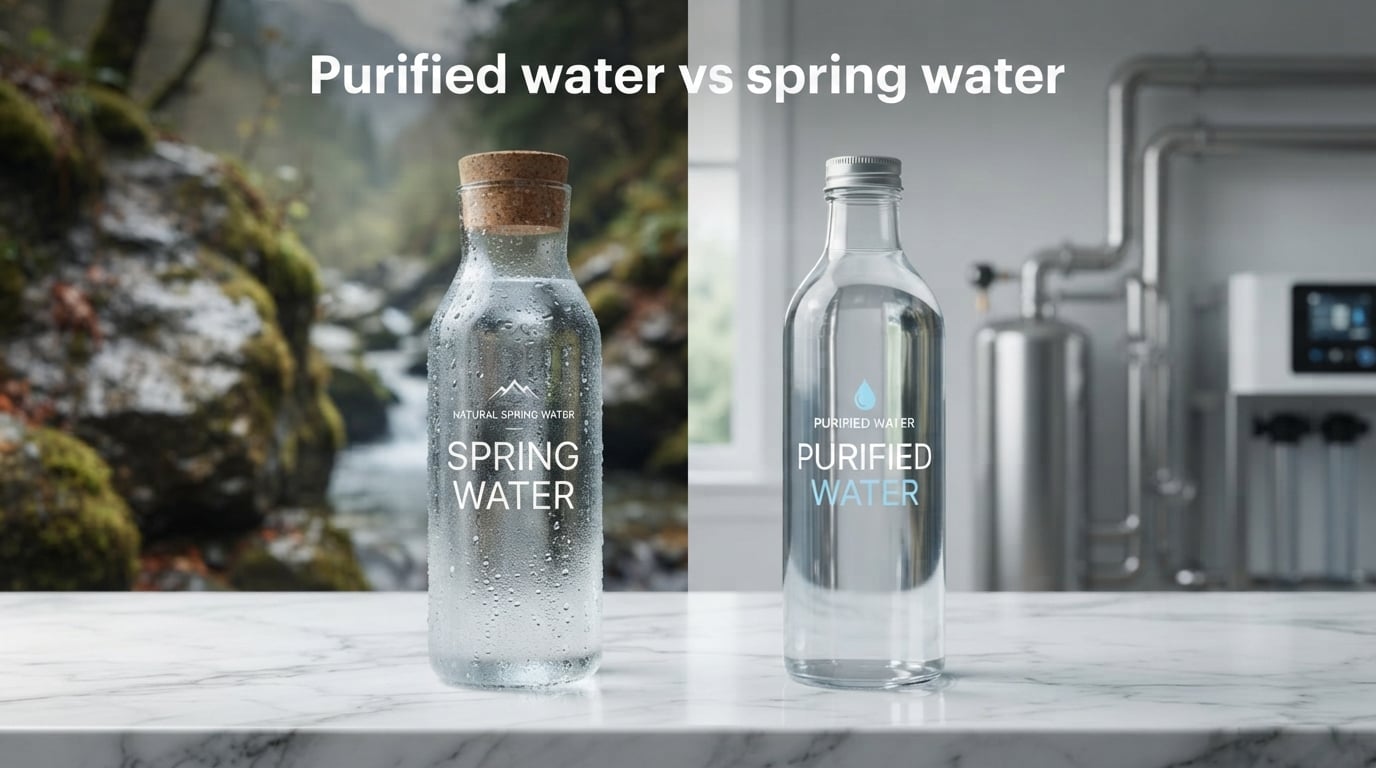
Choosing between purified water and spring water feels harder than it should be. Both bottles sit on the same grocery shelf. Both claim to be safe. Both promise hydration.
I dug into the science, the FDA rules, and what real users say on Reddit to settle the purified water vs spring water debate once and for all. In this guide, you’ll learn where each type comes from, how it gets processed, what minerals it keeps or loses, how it tastes, and which one fits your daily routine. By the end, you’ll have a clear answer for your water needs in 2026.
This is the kind of comparison I’ve wanted to write for a long time. The labels on bottled water are confusing on purpose. “Purified” sounds cleaner than “spring” to many shoppers, even though that perception doesn’t match the science. I’ll walk through what each term really means under FDA definitions, then give you a practical framework to pick the right bottle for your kitchen, your coffee maker, and your body.
Table of Contents
What Is Spring Water?
Spring water comes from a natural underground source that flows to the earth’s surface. According to the FDA, spring water must be collected at the spring or through a borehole that taps the same underground formation. That definition matters because it prevents bottlers from drawing water anywhere they want and slapping a “spring” label on it.
As rainwater seeps through rock and soil, it picks up minerals naturally. That geological journey is what gives spring water its signature mineral profile, including calcium, magnesium, potassium, and trace elements like silica and zinc.
How Spring Water Gets Filtered Naturally
Spring water doesn’t need a factory to clean it. Layers of rock, sand, and clay act as natural filters. This process, sometimes called geological filtration, removes most surface contaminants before the water reaches the aquifer. By the time the water surfaces at a natural spring or is pumped through a borehole, it has spent years moving through mineral-rich rock.
Companies still test every batch for safety. The FDA sets strict limits on contaminants, and bottled spring water must meet the same standards as municipal tap water. Bottlers publish water quality reports, often called “mineral analyses,” that list the exact mineral content of every batch.
Minerals Found in Spring Water
Spring water typically contains 50 to 500 parts per million (PPM) of total dissolved solids (TDS). The exact mineral mix depends on the geology of the source region. Water from volcanic rock tends to carry more silica. Water from limestone aquifers delivers more calcium and bicarbonates.
Common minerals and what they do for you:
- Calcium: supports bone health and muscle function
- Magnesium: helps regulate blood pressure and nerve signaling
- Potassium: balances fluids and supports heart rhythm
- Bicarbonates: give spring water its slightly alkaline taste
If you want to understand the full mineral picture, our guide on silica content in bottled water explains how trace minerals interact with your body and why some regions produce silica-rich water that other sources don’t.
What Is Purified Water?
Purified water is any water (tap, groundwater, or spring) that has been mechanically processed to remove impurities. The FDA doesn’t dictate the source. It only requires that purified water meets strict limits on contaminants. This is one of the most misunderstood labels in the bottled water industry.
Purified water must contain no more than 10 PPM of total dissolved solids. That’s far stricter than the EPA’s tap water standard of 500 PPM. To hit that benchmark, bottlers use one or more of these methods. Most brands combine several steps and market the result as a “multi-step purification process.”
Reverse Osmosis
Reverse osmosis forces water through a semipermeable membrane at high pressure. The membrane blocks contaminants, heavy metals, bacteria, and most dissolved minerals. RO systems can remove up to 99% of impurities, including sodium, lead, and fluoride. The water that comes out the other side is essentially pure H2O.
This is the most common purification method for bottled purified water. It is reliable, scalable, and produces consistent results across batches.
Distillation
Distillation boils water into steam, then condenses the steam back into liquid. The process leaves contaminants behind because they don’t evaporate at the same temperature as water. Heavy metals, minerals, and most bacteria stay in the boiling chamber.
Distilled water is essentially mineral-free and used in laboratories, medical settings, and some premium bottled water products.
Carbon Filtration
Carbon filters trap organic compounds, chlorine, and some chemicals through adsorption. As water passes through activated carbon, contaminants bond to the carbon surface. Carbon filtration alone isn’t enough to meet the FDA’s purified standard, so brands usually pair it with reverse osmosis or distillation.
Carbon filtration is what removes the chlorine taste from municipal water and gives purified water its clean, neutral flavor.
Deionization
Deionization swaps hydrogen and hydroxide ions for mineral ions in the water. This strips salts and minerals completely, leaving highly pure H2O. Deionization is typically used in industrial and pharmaceutical settings, but some premium bottled water brands include it in their process chain.
Most bottled purified water uses a combination of these methods. The exact sequence varies by brand, but the goal is the same: produce water with under 10 PPM total dissolved solids.
Key Differences Between Purified Water and Spring Water
The purified water vs spring water comparison comes down to six factors: source, mineral content, taste, pH, safety standards, and consistency. Here’s a direct comparison you can use the next time you stand in the bottled water aisle.
Source
- Spring water: drawn from a natural underground aquifer or spring, collected at the source or through a borehole
- Purified water: can come from any source, often municipal tap water that has been processed
This surprises many people. “Purified” doesn’t mean “from a special place.” It only means the water was mechanically cleaned. A bottle of purified water could legally start as ordinary tap water from your city.
Mineral Content
- Spring water: retains natural minerals (50-500 PPM TDS)
- Purified water: stripped of minerals (under 10 PPM TDS)
If mineral intake matters to you, spring water delivers trace minerals every glass. Purified water provides essentially none. The FDA requires purified water to remove minerals, while spring water is regulated to preserve its natural profile.
Taste
- Spring water: distinct flavor with subtle mineral notes, often described as “crisp” or “smooth”
- Purified water: neutral, clean, sometimes described as “flat” or “empty”
Many users report spring water tastes crisper because of bicarbonates and calcium. Purified water tastes neutral because the minerals that create flavor are gone. Reddit threads in r/HydroHomies frequently mention spring water’s “mouthfeel” as a reason to choose it over purified.
pH Levels
- Spring water: typically pH 7.0 to 8.0 (slightly alkaline)
- Purified water: typically pH 6.5 to 7.5 (closer to neutral or slightly acidic)
Spring water tends to be more alkaline due to dissolved minerals. Some people with acid sensitivity prefer this. Others notice purified water feels “drying” on the throat because it lacks buffering minerals. The pH difference is small but noticeable if you pay attention.
Safety and Regulation
Both spring and purified water fall under FDA bottled water rules. Both must meet EPA standards for contaminants. The difference is in labeling and processing claims.
Spring water must come from a verifiable underground source. The bottler has to prove the source is naturally flowing and protected from surface contamination. Purified water only needs to prove its TDS count and absence of specific contaminants.
Consistency
Purified water offers batch-to-batch consistency because the process is controlled. Spring water can vary by season, rainfall, and source region. Some drinkers love this variation and treat different springs like different vintages of wine. Others find it unpredictable.
If you want the same flavor in every bottle regardless of when it was produced, purified water delivers that stability. If you want character and uniqueness, spring water has it.
Health Benefits and Considerations
Both purified and spring water are safe. The question is which one matches your body’s needs and lifestyle. I dug into clinical research, FDA guidelines, and what health professionals actually recommend.
Mineral Absorption
The minerals in spring water contribute small amounts to your daily intake. A liter of mineral-rich spring water might deliver 5-15% of your daily calcium and 10-20% of magnesium. That may not sound like much, but if you drink two to three liters a day, the cumulative effect adds up.
These numbers are small compared to food, but they matter if you follow a restricted diet, avoid dairy, or eat few leafy greens. For people who need every mineral source they can get, spring water is a meaningful contributor.
Hydration Efficiency
Some research suggests water with electrolytes and minerals hydrates slightly faster than pure water. The dissolved minerals help your body absorb water through the intestinal wall more efficiently. The difference is minor for most healthy adults who eat balanced diets.
Athletes, endurance runners, and people who sweat heavily during work may notice more impact. For them, mineral-rich water can replace a small portion of what they lose through sweat.
If you eat a balanced diet and drink water primarily for hydration, the mineral gap between spring and purified water is unlikely to affect your health.
Sensitive Stomachs and Acid Issues
Forum users with GERD, acid reflux, or chronic stomach sensitivity often report spring water feels gentler on the stomach. The reasoning is the slightly alkaline pH and the presence of bicarbonates, which may help buffer stomach acid.
This isn’t a cure for GERD, but several long-time sufferers have shared that switching from purified to spring water reduced their discomfort. If you experience stomach issues with purified water, switching to spring water is a low-risk experiment worth trying for two to four weeks.
When Purified Water Wins
Purified water shines in situations where consistency and zero mineral content matter most. Medical devices like CPAP machines and humidifiers scale up faster with mineral-rich water. The mineral deposits clog filters and reduce performance over time.
Coffee brewers, espresso machines, and electric kettles also perform better with low-TDS water. Mineral buildup affects heating elements and alters the taste of coffee and tea. If you’re serious about pour-over coffee or espresso, purified water produces more predictable results.
Aquarium owners, lab technicians, and people with specific medical conditions may also need the ultra-low mineral content of purified water.
Which Water Should You Choose?
There’s no universal winner in the purified water vs spring water matchup. The best choice depends on what you value most, your health needs, and how you use water throughout the day. Here’s how I would decide based on personal priorities.
Choose Spring Water If You:
- Prefer water with character and mineral taste over neutral flavor
- Want trace minerals from your daily hydration routine
- Have acid sensitivity, GERD, or chronic stomach discomfort
- Value natural sourcing and geological filtration over industrial processing
- Live in an area with strict source protection and verified spring quality
Choose Purified Water If You:
- Want batch-to-batch consistency and predictable flavor
- Use water in coffee machines, humidifiers, CPAP devices, or aquariums
- Live in an area with questionable tap water and need reliable removal of contaminants
- Prefer a neutral, clean taste with no mineral aftertaste
- Want the lowest possible TDS for medical or technical reasons
Here’s what I do at home: I keep both. Spring water is my daily drinker because I enjoy the taste and the trace minerals. Purified water goes into the coffee maker, electric kettle, and CPAP machine. That setup covers taste, function, and reliability without compromise. You don’t have to choose one type for every use. The best water strategy uses both strategically.
Frequently Asked Questions
What is the healthiest type of water to drink?
The healthiest water is the one you drink consistently and enjoy. Both purified and spring water meet FDA safety standards and effectively hydrate you. Spring water adds trace minerals like calcium, magnesium, and potassium that contribute small amounts to your daily intake. Purified water offers the cleanest, most consistent profile and is ideal for appliances. For most healthy adults, the best choice depends on your taste preference and how you plan to use it.
What are the disadvantages of purified water?
Purified water is stripped of minerals during processing, which gives it a flat or neutral taste that some people find unsatisfying. It can also feel slightly drying on the throat because it lacks buffering minerals like calcium and bicarbonates. Purified water doesn’t contribute trace minerals to your diet, which may matter if you have a restricted eating pattern. For sensitive uses like CPAP machines, espresso makers, and humidifiers, however, the lack of minerals is actually a benefit.
Is it healthy to drink purified water every day?
Yes. Drinking purified water daily is safe and effective for hydration according to FDA and medical guidelines. The lack of minerals is not a health concern for people who eat a balanced diet with fruits, vegetables, and dairy or supplements. If you rely mostly on water for minerals or follow a restricted diet, consider alternating with spring water or mineral water for trace nutrient intake. Daily purified water consumption is endorsed by most registered dietitians.
Is it better to drink purified water or spring water?
Neither is objectively better for everyone. Spring water provides natural minerals and a distinct taste that many people prefer. It also offers small amounts of calcium, magnesium, and potassium that contribute to daily mineral intake. Purified water delivers consistent purity, neutral flavor, and is ideal for appliances like coffee machines and CPAP devices. Choose based on whether you value mineral content and flavor character (spring) or predictability and neutral taste (purified).
Does spring water have more minerals than purified water?
Yes, by a wide margin. Spring water typically contains 50 to 500 parts per million of total dissolved solids, depending on the source geology. Purified water must contain less than 10 PPM to meet FDA standards for the purified label. Spring water delivers trace calcium, magnesium, potassium, bicarbonates, and sometimes silica naturally. Purified water has most of these removed through reverse osmosis, distillation, or deionization, leaving essentially pure H2O with no mineral content.
Final Thoughts
The purified water vs spring water debate comes down to what you value most. Spring water offers natural minerals, regional character, and a taste profile shaped by geology. Purified water delivers predictable purity, neutral flavor, and the lowest mineral content possible. Both meet strict FDA standards. Both hydrate you effectively. Pick the one that fits your taste buds and your daily routine, and drink up.