
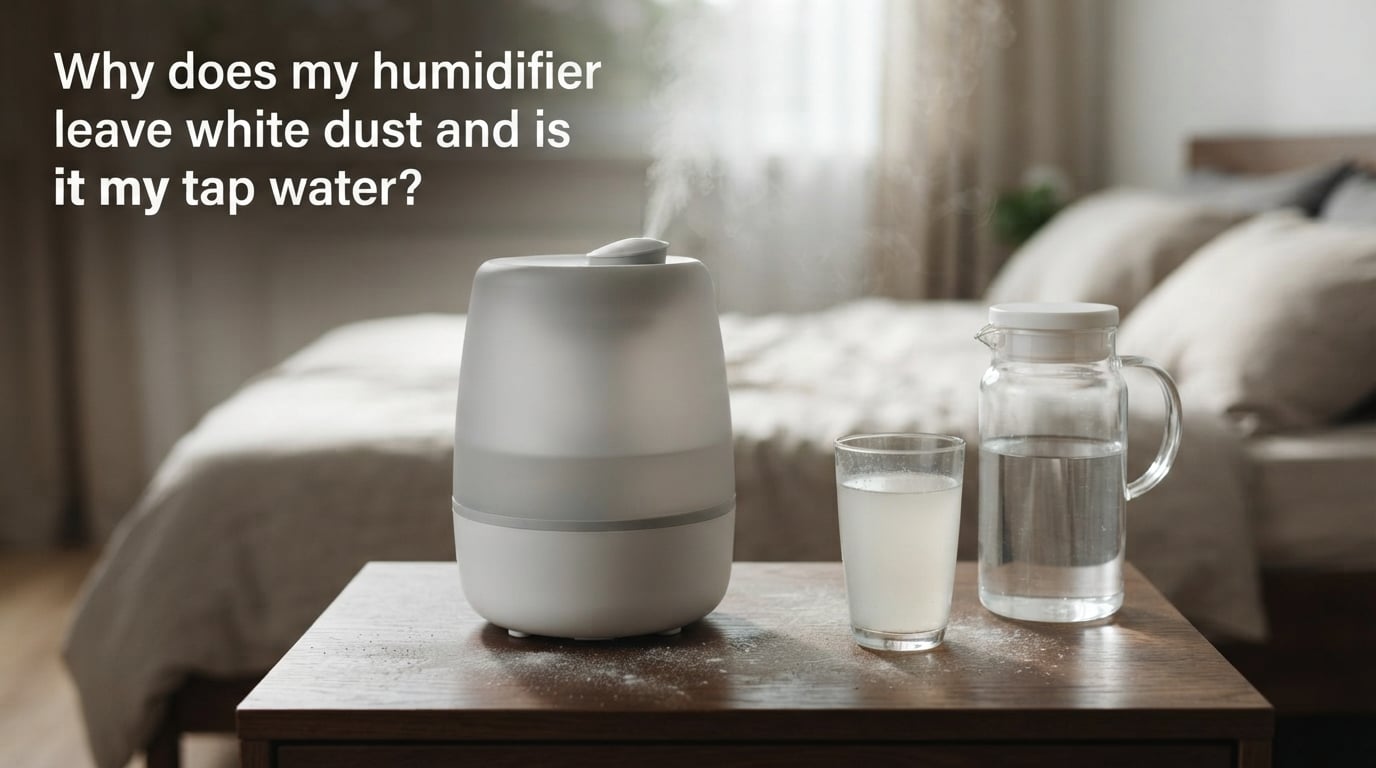
Yes, the white dust your humidifier leaves on furniture, electronics, and windowsills is almost always coming from your tap water. The fine powder is mineral residue, mostly calcium and magnesium, that was dissolved in your water before the humidifier turned it into mist. Once the water droplets evaporate in the air, those minerals have nowhere to go, so they settle on every nearby surface as a chalky white film.
Our team has tested humidifiers in homes with water hardness ranging from 50 ppm to over 400 ppm, and the pattern is unmistakable: harder water means more dust. The good news is that the problem is one of the easiest household nuisances to fix once you understand what’s actually happening. In this guide, I’ll walk you through the science, which humidifier types make it worse, whether the dust is harmful, and the practical fixes that actually work.
Table of Contents
What Is the White Dust From a Humidifier, Exactly?
Humidifier white dust is mineral residue. Specifically, it is the calcium and magnesium that were dissolved in your tap water, released into the air as a fine powder when the water evaporates.
Those two minerals, calcium and magnesium, are what make water “hard.” According to the U.S. Geological Survey, roughly 85% of American homes have hard water, which is why white dust is such a common complaint. The harder your water, the more minerals it carries, and the more visible the dust will be after even a few hours of humidifier use.
The dust itself is typically a mix of calcium carbonate and magnesium salts. It looks white because the particles are so small they scatter light the same way sugar or salt does. You’ll spot it first on dark wood furniture, TV screens, and the area immediately around the humidifier’s mist outlet. Run a finger across it and it feels dry and slightly chalky, very different from dust from skin, fabric, or outdoor air.
Is It Really Your Tap Water Doing This?
In almost every case, yes, your tap water is the source of the white dust. The minerals in your municipal or well water did not appear out of nowhere. They came from the limestone, chalk, and dolomite deposits your water passed through before reaching your tap.
Hard water is measured in grains per gallon (gpg) or parts per million (ppm). Water under 60 ppm (about 3.5 gpg) is considered soft. Water above 180 ppm (10.5 gpg) is very hard, and that’s where you will see the worst dust. If your area has very hard water and you use an ultrasonic humidifier, you can expect visible white residue within hours of turning the unit on.
If you’ve recently moved and suddenly see white dust where you didn’t before, it’s almost certainly a change in local water hardness, not a humidifier malfunction. Different cities, even neighboring suburbs, can have wildly different mineral content in their supply. The only real variable is how much calcium and magnesium your specific tap carries.
How the Science Actually Works
Here’s the part most articles skip. The reason minerals become airborne is that your humidifier breaks water into extremely tiny droplets, and those droplets evaporate before they can fall back down. Whatever was dissolved in the water is left behind as a particle small enough to stay suspended in air for minutes or hours.
Ultrasonic humidifiers use a vibrating metal diaphragm at roughly 1.6 million cycles per second to shatter water into a fog. Each droplet is around 1 to 5 microns across. Evaporative humidifiers use a fan to blow air through a wet wick filter. Steam vaporizers boil water first, which leaves minerals behind as scale inside the unit instead of releasing them into your room. Impeller units use a spinning disk to fling water into the air, similar to ultrasonic but usually with larger droplets.
The key physics is simple: water evaporates, minerals do not. Once the water is gone, the calcium and magnesium have no choice but to either fall as dust or get breathed in. The size of the droplets determines how far they travel, how long they linger, and how easily the minerals end up on your furniture versus in your lungs.
Which Humidifier Types Produce the Most White Dust
Ultrasonic cool mist humidifiers produce the most white dust, by a wide margin. They aerosolize water without boiling it, so every mineral in the tank ends up airborne. If your humidifier is ultrasonic and your water is hard, you will see dust.
Evaporative humidifiers produce little to no white dust. The wick filter traps minerals before air passes through, and the minerals stay behind in the wick. You replace the filter regularly instead of breathing the residue. This is why many long-term humidifier users on forums report switching to evaporative models specifically to solve the dust problem.
Steam vaporizers produce no white dust at all because the minerals stay behind as scale inside the boiling chamber. The trade-off is higher electricity use and a hot steam plume that is not ideal around children.
Impeller humidifiers fall somewhere between ultrasonic and evaporative. They release minerals into the air, but the droplets are larger and heavier, so much of the residue falls quickly rather than lingering.
Quick comparison of humidifier types and white dust
- Ultrasonic cool mist: High dust output. Worst offender with hard water.
- Evaporative (wick): Minimal dust. Minerals trapped in filter.
- Steam vaporizer (warm mist): Zero dust. Minerals stay as scale in unit.
- Impeller: Moderate dust. Larger droplets fall faster.
Is Humidifier White Dust Harmful to Breathe?
For most healthy adults, humidifier white dust is more of a cleaning nuisance than a health hazard. The minerals themselves are not toxic. You’re not inhaling chemicals, just calcium and magnesium salts, the same compounds found in antacids and dietary supplements.
That said, the dust does add to your indoor particulate matter levels, which matters if you have asthma, COPD, or other respiratory sensitivities. People in this category may notice increased coughing or throat irritation, especially if the humidifier runs for many hours in a small, poorly ventilated room.
For households with infants, elderly residents, or anyone with a chronic lung condition, switching to distilled water or an evaporative humidifier is worth the small extra effort. The dust is not the same threat as wildfire smoke or PM2.5 pollution from traffic, but reducing any avoidable airborne particulates is reasonable if you have the option.
How to Stop White Dust: 7 Practical Solutions
The fix that eliminates white dust completely is using water with no dissolved minerals. Here are the options ranked from most effective to most practical for everyday use.
- Use distilled water. Distilled water has had its minerals removed, so there is nothing left to become dust. It’s the gold standard fix.
- Install a demineralization cartridge. These cartridges attach to your humidifier and trap calcium and magnesium before water reaches the misting element. Cheaper long-term than buying distilled water.
- Switch to an evaporative humidifier. The wick filter catches minerals so dust never forms in the air.
- Switch to a steam vaporizer. Minerals stay as scale inside the boiling chamber instead of becoming airborne.
- Use a reverse osmosis filter at home. RO water is close to distilled in purity and far cheaper per gallon once installed.
- Install a whole-home water softener. This addresses the root cause across your entire plumbing, not just the humidifier.
- Use filtered tap water with a TDS of under 50 ppm. Not perfect, but it dramatically reduces visible dust compared to untreated hard water.
For most readers, distilled water plus a demineralization cartridge is the easiest combination. You get clean, mineral-free mist without committing to a whole-home water treatment system.
Cleaning and Maintenance to Reduce White Dust
Even with the right water, scale will build up inside any humidifier over time. Regular cleaning keeps the unit efficient and prevents mineral flakes from breaking loose and adding to your dust problem.
Descale your humidifier every one to two weeks if you use tap water, or every three to four weeks if you use distilled. Empty the tank, fill it with a mixture of one part white vinegar to two parts water, and let it sit for 20 to 30 minutes. Swirl, drain, and rinse thoroughly with clean water before refilling.
Replace wick filters on evaporative humidifiers according to the manufacturer’s schedule, usually every 30 to 60 days. A clogged wick reduces output and forces the unit to work harder. For demineralization cartridges, most last one to two months before needing replacement, depending on how hard your water is.
Where You Live Changes How Much Dust You’ll See
Water hardness varies enormously by geography. Cities in the Midwest, Southwest, and parts of the Mountain West tend to have very hard water, sometimes over 300 ppm. Cities in the Pacific Northwest, New England, and parts of the South often have softer water under 100 ppm.
If you’ve ever wondered why your friend in another state never sees white dust while your furniture is coated, this is why. You can look up your local water hardness through your municipal water utility’s annual consumer confidence report, or by using a simple at-home TDS meter that costs around $15.
A TDS reading above 180 ppm means you should expect visible dust from an ultrasonic humidifier within hours. A reading under 60 ppm means you may never see it, even without changing your habits.
What to Look for if You’re Shopping for a No-Dust Humidifier
If you are shopping for a new humidifier specifically to avoid white dust, focus on these features.
First, choose an evaporative model with a replaceable wick filter if you want a low-maintenance, no-dust solution for a bedroom or living space. Look for units with humidity control settings, a built-in hygrometer, and a tank capacity appropriate for your room size.
Second, if you prefer cool mist, look for an ultrasonic humidifier with a built-in demineralization cartridge. Many newer units include these as standard, and they dramatically reduce dust without forcing you to buy distilled water constantly.
Third, check for auto-shutoff when the tank is empty. Running a humidifier dry can damage the diaphragm or wick and shorten the unit’s life, which is a more expensive consequence than the dust itself.
Finally, consider room size. A humidifier rated for 500 square feet in a 200 square foot room will overshoot humidity quickly, which can cause condensation on walls and windows. Aim for 40 to 50 percent relative humidity, the range most health agencies recommend for indoor comfort.
Frequently Asked Questions
Why is my humidifier leaving white dust?
Yes, your humidifier is leaving white dust because of your tap water. The dust is mineral residue, primarily calcium and magnesium from hard water. When the humidifier turns water into a fine mist, the water evaporates in the air but the dissolved minerals have nowhere to go, so they settle on nearby surfaces as a chalky white powder.
Is it bad to use tap water for a humidifier?
Tap water is not bad for a humidifier in the sense that it will harm the machine, but it will produce visible white dust in your home if you have hard water. Using distilled or demineralized water eliminates the dust. About 85% of U.S. homes have hard water, which is why the issue is so widespread.
Which humidifiers don’t leave white dust?
Evaporative humidifiers and steam vaporizers do not produce white dust. Evaporative units trap minerals in a wick filter, and steam vaporizers leave minerals behind as scale inside the boiling chamber. Ultrasonic humidifiers produce the most white dust because they aerosolize water without removing the minerals first.
How do I stop white dust from my humidifier without buying distilled water?
You can stop white dust without buying distilled water by installing a demineralization cartridge on your ultrasonic humidifier, switching to an evaporative humidifier with a wick filter, or installing a reverse osmosis filter at your kitchen tap. Each option removes or traps minerals before the water becomes airborne.
The Bottom Line
The white dust from your humidifier is, in nearly every case, calcium and magnesium from your tap water. It is not a defect in the humidifier, and it is not something dangerous in normal use. The fix is straightforward: switch to distilled water, add a demineralization cartridge, or move to an evaporative model. Once you do, the dust disappears and your humidifier does exactly what it should, add clean moisture to your indoor air.