

That white crust on your showerhead, the soap that never quite lathers, the spots on your glassware that refuse to budge. If you have noticed any of these, you are probably dealing with hard water, and you need one of the best hard water test kits to find out exactly how bad the problem is.
I spent the last several months testing water hardness kits in my own home, comparing strip-based options against titration kits, and running the same tap water through every product on this list. Some kits impressed me with pinpoint accuracy. Others delivered inconsistent readings that left me guessing.
Hard water contains elevated levels of dissolved calcium and magnesium minerals. These minerals build up in your pipes, reduce the lifespan of appliances like dishwashers and water heaters, and make your soap and detergent far less effective. Testing your water hardness is the first step toward deciding whether you need a water softener or a filtration system. In this guide, I break down the 10 best hard water test kits available in 2026, covering everything from budget-friendly strips to professional-grade titration kits.
Table of Contents
Top 3 Picks for Best Hard Water Test Kits (October 2026)
Not everyone has time to read through all 10 reviews, so here are our three standout picks based on accuracy, value, and overall reliability after months of hands-on testing.

Hach Total Hardness Test Kit Model 5-B
- Drop-count titration
- 1-30 gpg range
- 100 tests
- Professional accuracy

Varify Water Hardness Test Kit
- 150 test strips
- 0-425 ppm range
- FreshSeal technology
- Easy color chart

Pawfly Water Hardness Test Kit
- 100 test strips
- 0-425 ppm range
- 15-second results
- Lowest price
The Hach kit wins our top spot for its laboratory-grade titration method that gives you an exact grains-per-gallon reading instead of a vague color estimate. Varify takes the value crown with 150 strips, an oversized color chart, and a charitable mission. And Pawfly is our budget pick for anyone who wants a quick hardness check without spending more than a few dollars.
Best Hard Water Test Kits in 2026
Here is a quick comparison of all 10 kits I tested. Use this table to scan features, ratings, and key specs before diving into the full reviews below.
| Product | Specifications | Action |
|---|---|---|
| Varify Water Hardness Test Kit |
|
Check Latest Price |
 JNW Direct Water Hardness Test Strips |
|
Check Latest Price |
| Hach Total Hardness Test Kit Model 5-B |
|
Check Latest Price |
 WeAQUA DoubleCheck Water Hardness Test Kit |
|
Check Latest Price |
 WaterWorks 481108 Total Hardness Strips |
|
Check Latest Price |
 Merydi Water Hardness Test Kit |
|
Check Latest Price |
 ColorKiM Total Water Hardness Test |
|
Check Latest Price |
| Pawfly Water Hardness Test Kit |
|
Check Latest Price |
 Bestprod 21-in-1 Drinking Water Test Kit |
|
Check Latest Price |
 HOVIRAN Water Hardness Test Strips |
|
Check Latest Price |
1. Varify Water Hardness Test Kit – Best Overall Strips for Home Use
Varify Water Hardness Test Kit – Hard Water Test Strips for Well & Home
150 strips
0-425 ppm range
0-25 GPG
FreshSeal technology
Pros
- Easy dip-and-read approach
- Oversized color chart
- FreshSeal extended shelf life
- Supports clean water initiatives
Cons
- Color chart may vary between orders
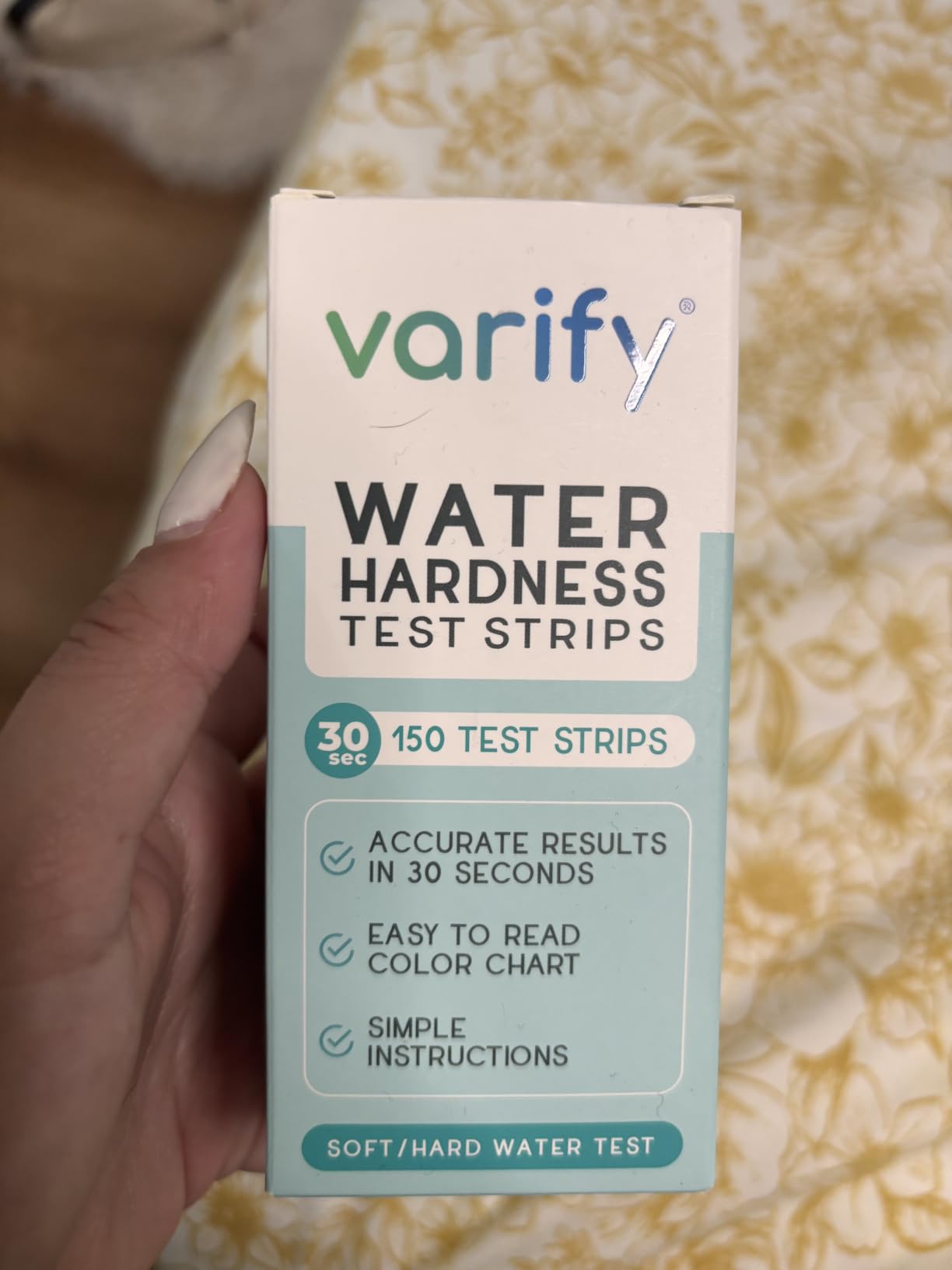
The Varify kit was the first product I reached for when I started this comparison, and it set a high bar for every strip-based kit that followed. With 150 test strips packed in a sturdy bottle plus two separately sealed pouches, I had more than enough to test every faucet in my house and still share some with a neighbor.
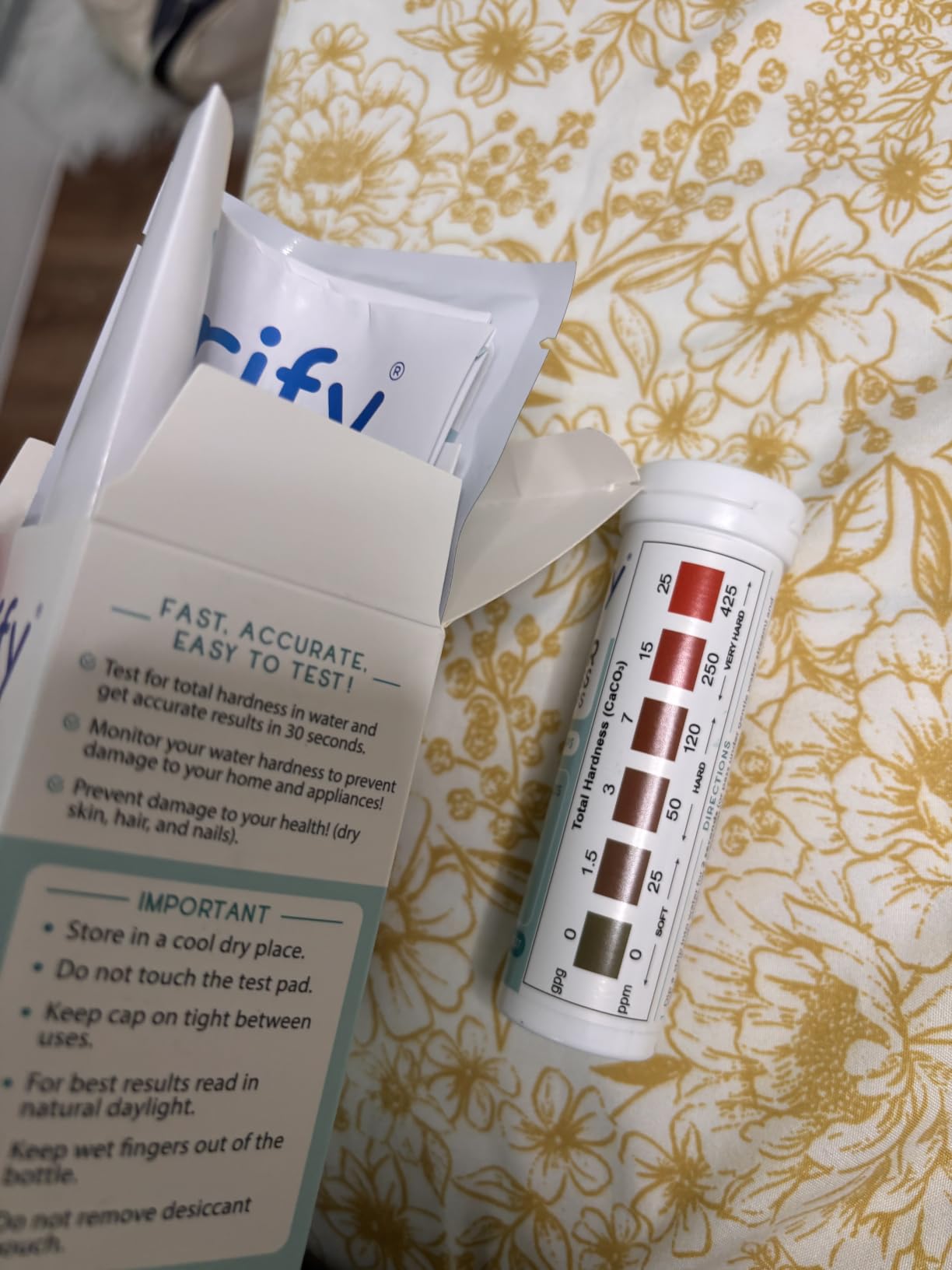
The dip-and-read approach takes about 3 seconds underwater and another 15 seconds to compare against the color chart. The oversized chart ranges from red to green across a 0-425 ppm and 0-25 gpg scale, which I found easier to read than the tiny charts printed on competing bottles.
What sets Varify apart is the FreshSeal technology. Instead of all 150 strips sitting in one bottle exposed to humidity every time you open it, you get 100 in the main bottle and two sealed pouches of 25 each. This keeps the reagents fresh longer, which matters because expired strips give false readings.
I also appreciate that Varify donates a portion of every sale to provide clean water access in the Central African Republic. It is a nice touch that makes the purchase feel more meaningful than a generic Amazon listing. The 7,000-plus reviews back up the quality, with 70 percent of buyers giving it five stars.
Shelf Life and Storage Considerations
The FreshSeal pouches extend the usable life of these strips well beyond what you get from a single-bottle kit. I recommend keeping the main bottle sealed tightly and storing it in a cool, dry place away from direct sunlight. Use the pouches for travel or intermittent testing so you are not constantly exposing the full supply to moisture.
Best Applications for This Kit
Varify works well for testing home faucets, well water, spa and pool water, dishwasher inlet water, and water softener output. If you need a quick yes-or-no answer about whether your water is hard, this kit delivers reliably. For programming a water softener with exact settings, you may want to cross-check with a titration kit.
2. JNW Direct Water Hardness Test Strips – Most Reviewed Option Online
JNW Direct Water Hardness Test Strips for Home Water – 150 Strips Kit
150 strips
0-425 ppm
Lifetime money-back guarantee
Includes eBook
Pros
- 44k+ reviews confirm reliability
- Works for multiple water sources
- Includes helpful eBook
- Lifetime money-back guarantee
Cons
- Color chart on bottle not always clear
- Strips can fall apart
- May not match liquid kits exactly
With over 44,000 reviews, JNW Direct is the most purchased water hardness test kit on Amazon, and that kind of volume tells you something about consumer trust. I picked up a bottle to see if the popularity was justified or just marketing momentum.
The kit includes 150 strips and covers the standard 0-425 ppm range. Each strip dips for a few seconds and changes color to indicate your hardness level. JNW also includes a downloadable eBook that explains how to track water hardness over time, which I found genuinely useful as a first-time tester.
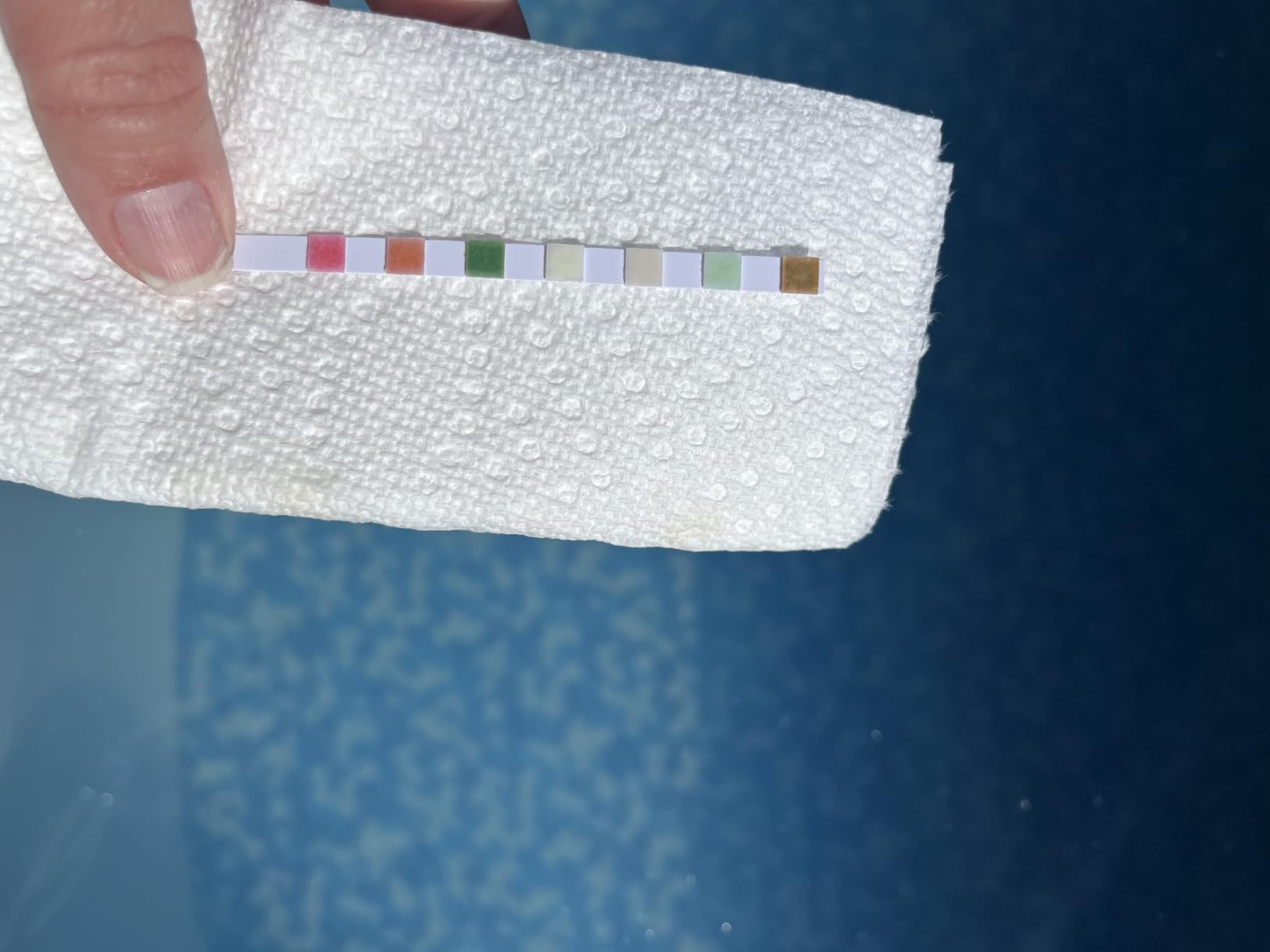
In my testing, the JNW strips produced results consistent with the Varify kit on the same water sample. The main difference came down to the color chart. The chart printed on the JNW bottle is smaller and harder to read in dim lighting compared to the Varify oversized chart. I had to squint and tilt the bottle under a lamp to distinguish between adjacent shades.
A few users report that the strips can tear or fall apart if handled roughly, and I noticed this too when pulling strips out of a tightly packed bottle. The lifetime money-back guarantee offsets this concern, since you can get a replacement if you get a bad batch.
Reading the Color Chart Accurately
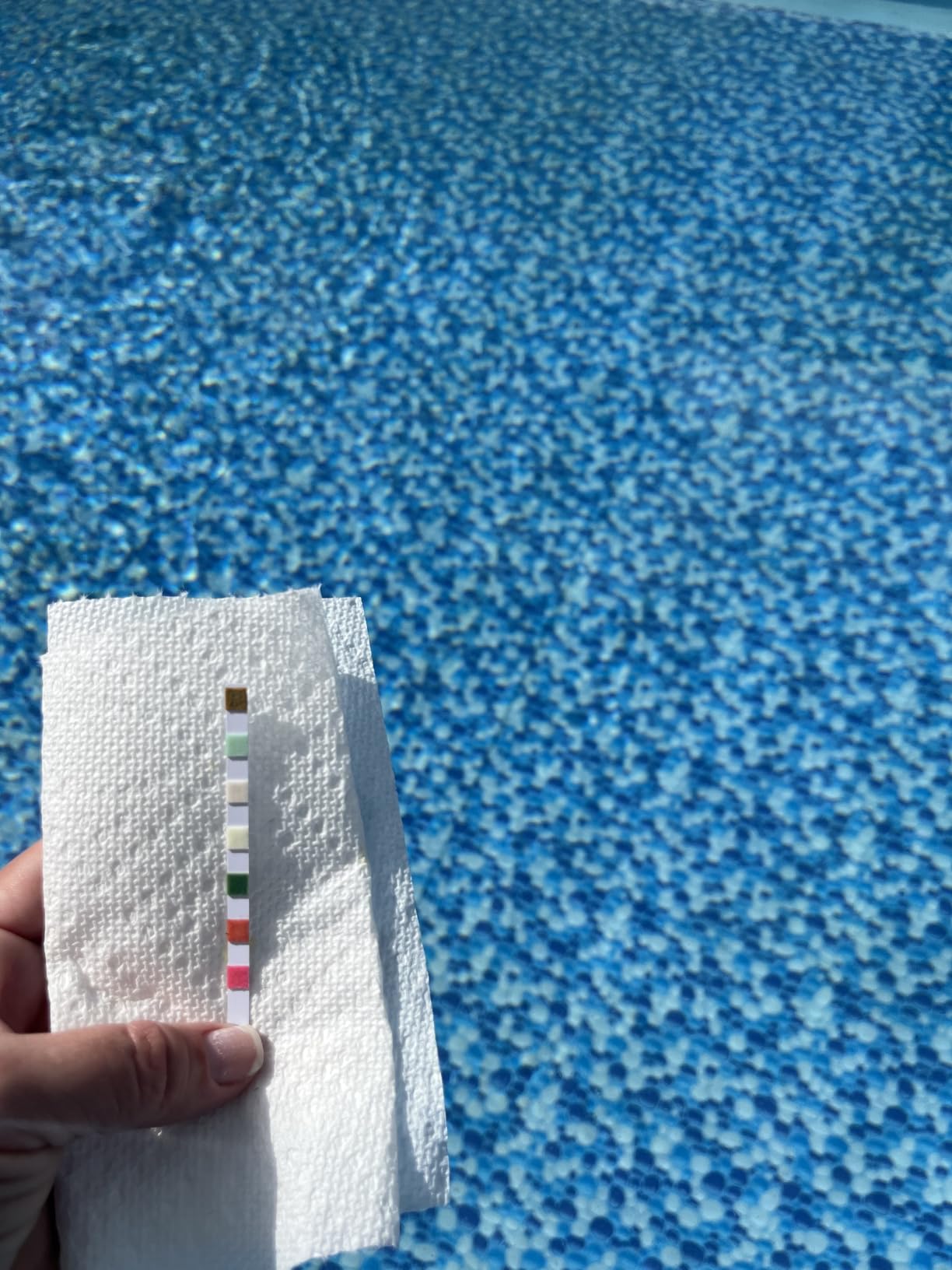
The key to getting good results with JNW strips is lighting. Read your results in natural daylight near a window whenever possible. Indoor LED lighting can distort color perception and make it harder to distinguish between hardness levels. Hold the strip next to the chart and compare immediately, as colors continue to develop after the recommended reading window.
Long-Term Value and Cost Per Test
At 150 strips per bottle, JNW gives you a low cost per test that makes frequent monitoring affordable. If you are checking your water softener output weekly or testing multiple water sources around your property, this kit provides enough strips to last months without reordering. The eBook adds educational value that most competitors skip entirely.
3. Hach Total Hardness Test Kit Model 5-B – Most Accurate Kit Available
Hach Total Hardness Test Kit, Model 5-B, Drop Count Titration, 145300
Drop-count titration
1-30 gpg range
~100 tests
Professional-grade
Pros
- Highly accurate titration method
- Professional-grade results
- Clear repeatable readings
- Trusted by water treatment pros
Cons
- Barcode covers English instructions
- Not Prime eligible
- Documentation issues
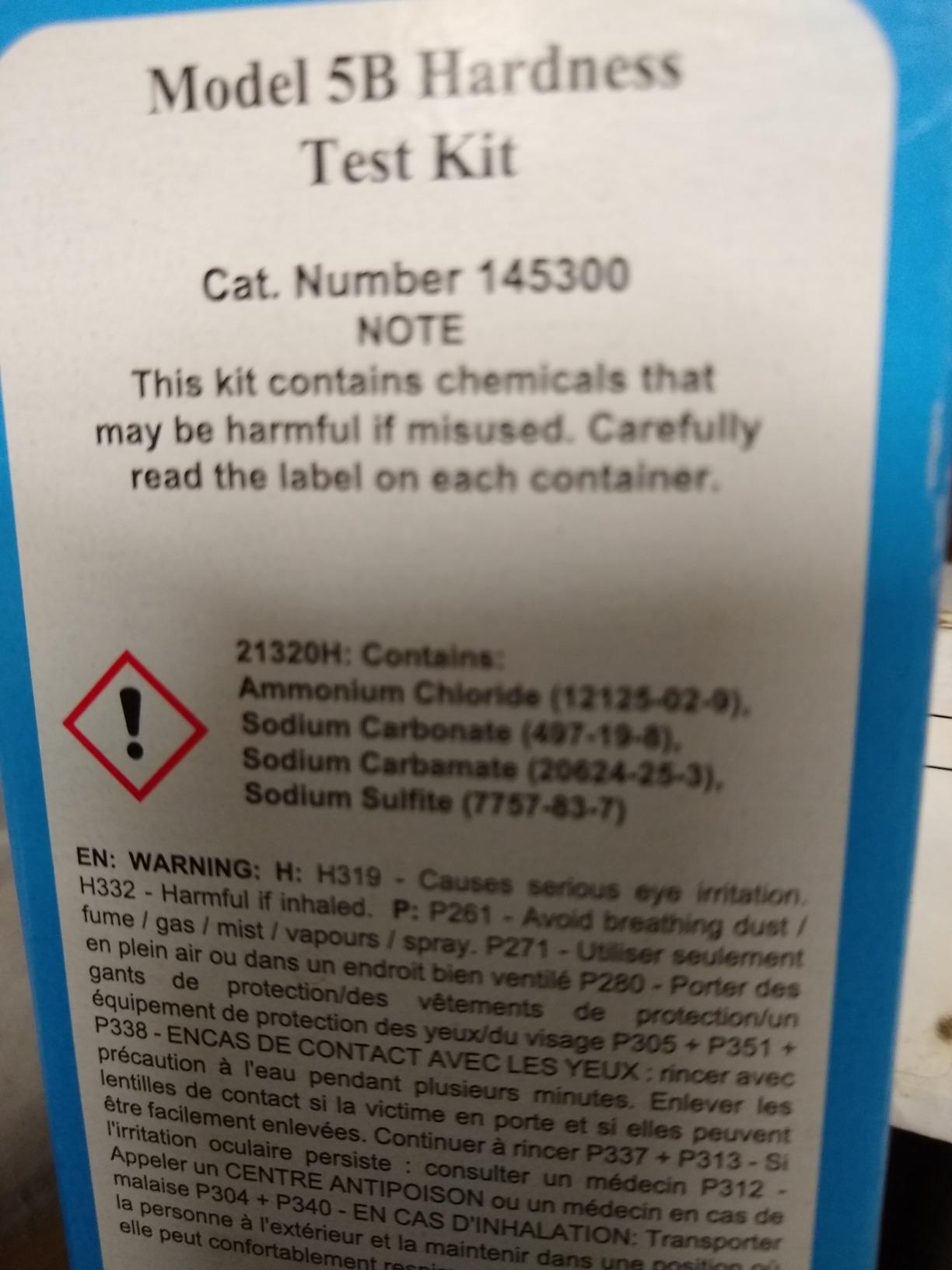
If you want the most accurate hard water test short of sending a sample to a certified laboratory, the Hach Model 5-B is the gold standard. This kit uses drop-count titration, the same method that water treatment professionals rely on, and it gave me results I trusted enough to actually program my water softener.
The process is different from strips. You fill the included measuring tube with your water sample, add a buffer powder, add an indicator powder, and then count drops of titrant until the solution changes color. Each drop equals one grain per gallon of hardness. It takes about two minutes per test, and the precision is in a completely different league from color-chart strips.
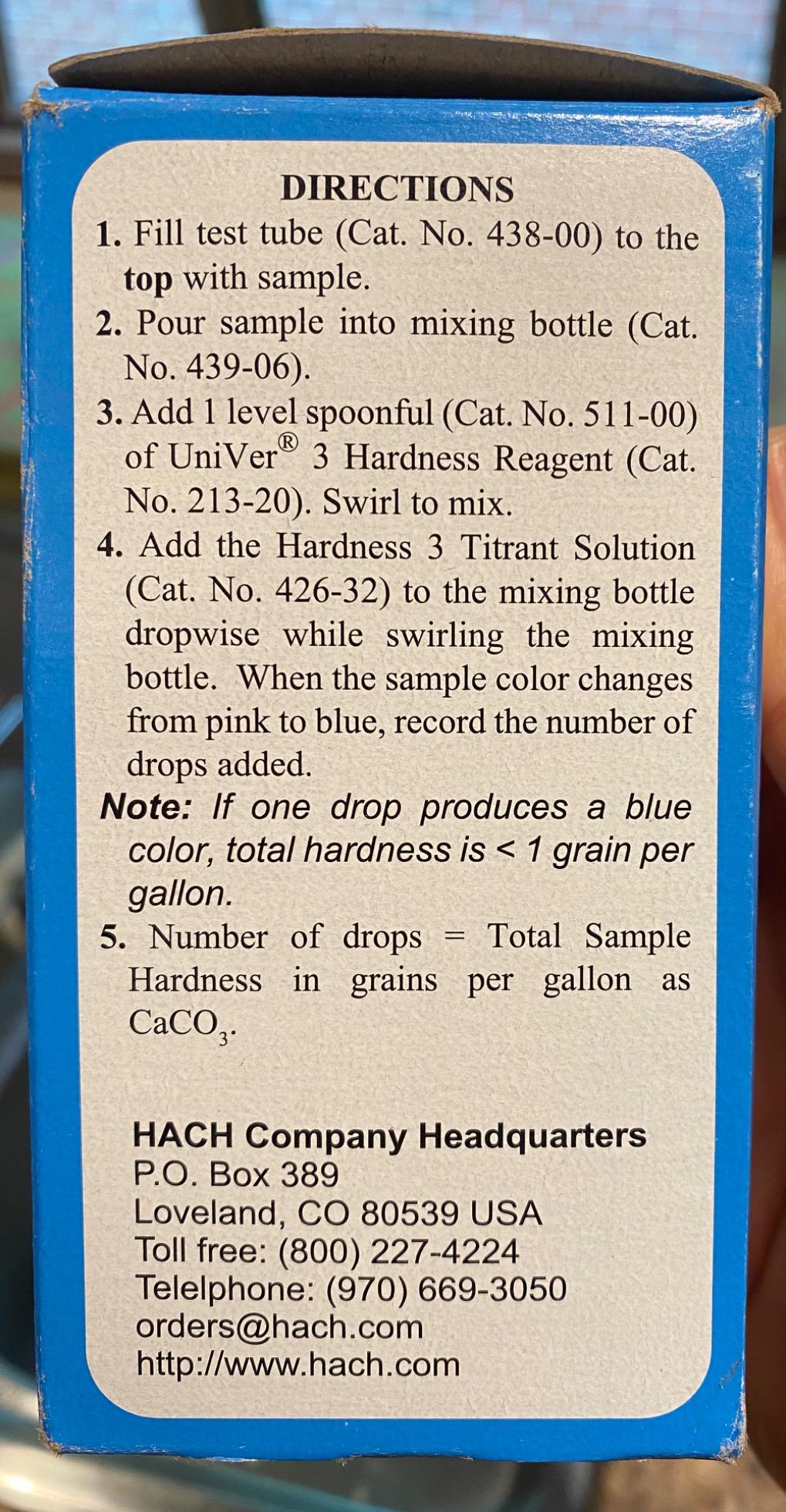
Hach has been making water analysis equipment since 1947, and the Model 5-B has been a staple in the industry for over a decade. The kit includes two reagents, a measuring tube, a square mixing bottle, and a measuring scoop. Everything is compact enough to store in a kitchen drawer.
The one real frustration is the documentation. A barcode covers part of the English instructions on the box, and the insert inside the box is only in Spanish, French, and Portuguese. I had to look up the instructions online to get started. Once I had the procedure down, the tests ran smoothly every time.
Understanding Titration Results
Each drop of reagent that changes the solution color represents one grain per gallon of hardness. If it takes 12 drops, your water is 12 gpg, which equals about 205 ppm (multiply gpg by 17.1 to convert to ppm). This direct count method eliminates the guesswork of matching colors to a printed chart and gives you a number you can use with confidence.
Reagent Refills and Long-Term Availability
The kit provides approximately 100 tests, and Hach reagent refills are widely available from water treatment supply stores. Because the reagents are liquid-based rather than paper strips, they have a longer shelf life and do not degrade from humidity exposure the way strips do. This makes the Hach kit a better long-term investment if you test regularly.
4. WeAQUA DoubleCheck Water Hardness Test Kit – Best Value Per Strip
WeAQUA DoubleCheck Water Hardness Test Kit 200 Strips with Sample Cup
200 strips
DoubleCheck dual pads
0-425 ppm
Sample cup included
Pros
- 200 strips lowest cost per test
- DoubleCheck dual pads for reliability
- Sample cup included
- Foil-wrapped for freshness
Cons
- Color matching difficult in low light
- Not Prime eligible
- Subtle differences hard to distinguish
The WeAQUA DoubleCheck kit caught my attention for one simple reason: 200 strips at a price that works out to roughly four cents per test. That is the lowest cost per test of any kit on this list, and the DoubleCheck feature adds a clever accuracy safeguard that most strip kits lack.
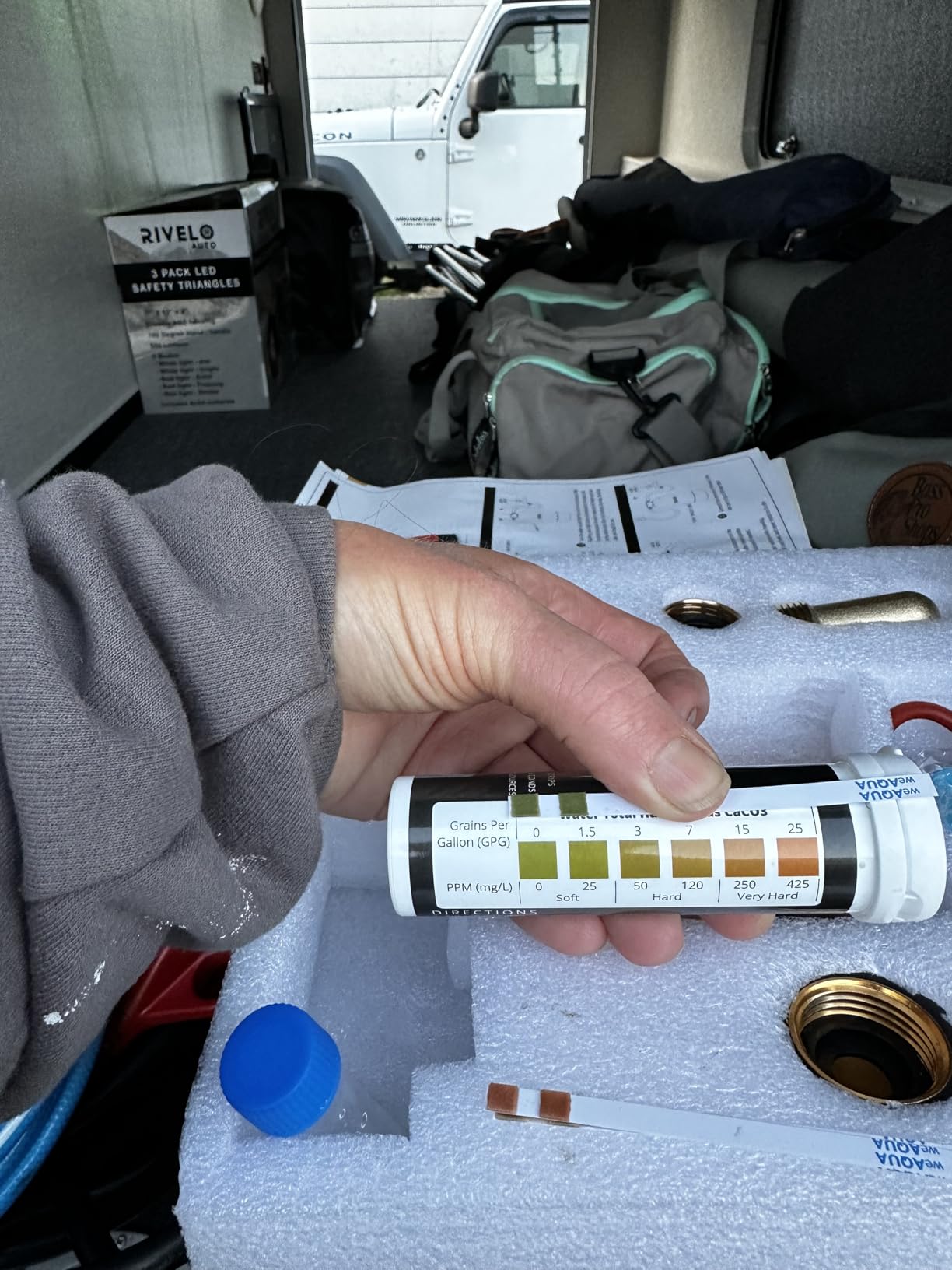
Each strip has two identical color pads instead of one. After dipping, you compare both pads to the color chart. If both pads match the same color block, you can trust the result. If they differ, the strip may be defective and you should retest. This built-in verification step addresses one of the biggest complaints about test strips, which is inconsistent readings.
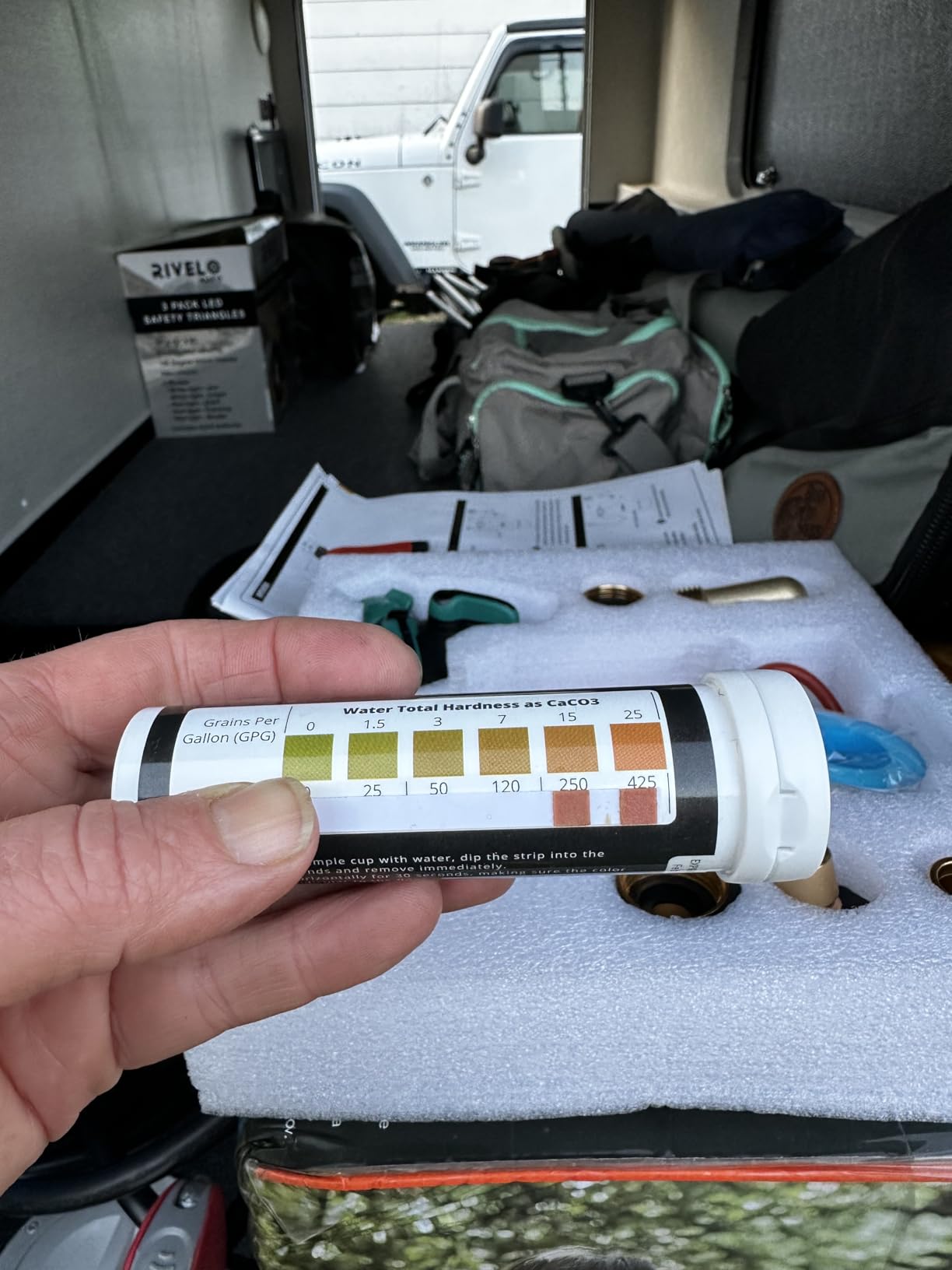
WeAQUA also includes a small sample cup, which I found surprisingly helpful. Instead of holding a strip under a running faucet, you collect a water sample and dip the strip into it. This gives you a more controlled test and reduces contamination from your fingers.
The strips come packed in foils of 50 with dual desiccants at the top and bottom of each package. This moisture protection is thoughtful engineering that extends shelf life. My only complaint is that the subtle differences between hardness levels can be tricky to read in anything less than bright natural light.
The DoubleCheck Advantage in Practice
I tested the dual-pad system against a known hard water sample, and both pads consistently matched. When I intentionally contaminated one pad by touching it, the mismatch was immediately obvious. This feature gives you confidence that your reading is genuine rather than a fluke caused by a manufacturing defect in a single pad.
Cost Per Test Analysis
At 200 strips for under ten dollars, WeAQUA delivers the best value per test of any kit I reviewed. If you test your water weekly or manage multiple water sources across a property, the savings add up quickly. Even compared to the 150-strip kits, you get 50 additional tests for about the same price.
5. WaterWorks 481108 Total Hardness Test Strips – Best for Wide Range Detection
Industrial Test Systems WaterWorks 481108 Total Hardness Test Strip, 3 Second Test, 0-1000ppm Range, Our #1 Test Strip for Total Hardness, Bottle of 50 Tests, Tan
50 strips
0-1000 ppm range
3-second test
Made in USA
Pros
- Wide range up to 1000 ppm
- Fast 3-second results
- Made in USA with quality control
- Ideal for technical and non-technical users
Cons
- Only 50 strips per bottle
- Higher cost per test
- Strips expire over time
Most test strips on this list top out at 425 ppm, but the WaterWorks 481108 goes all the way to 1,000 ppm. That extended range matters if you live in an area with extremely hard water or if you are testing industrial sources, well water with high mineral content, or spa water after chemical treatment.
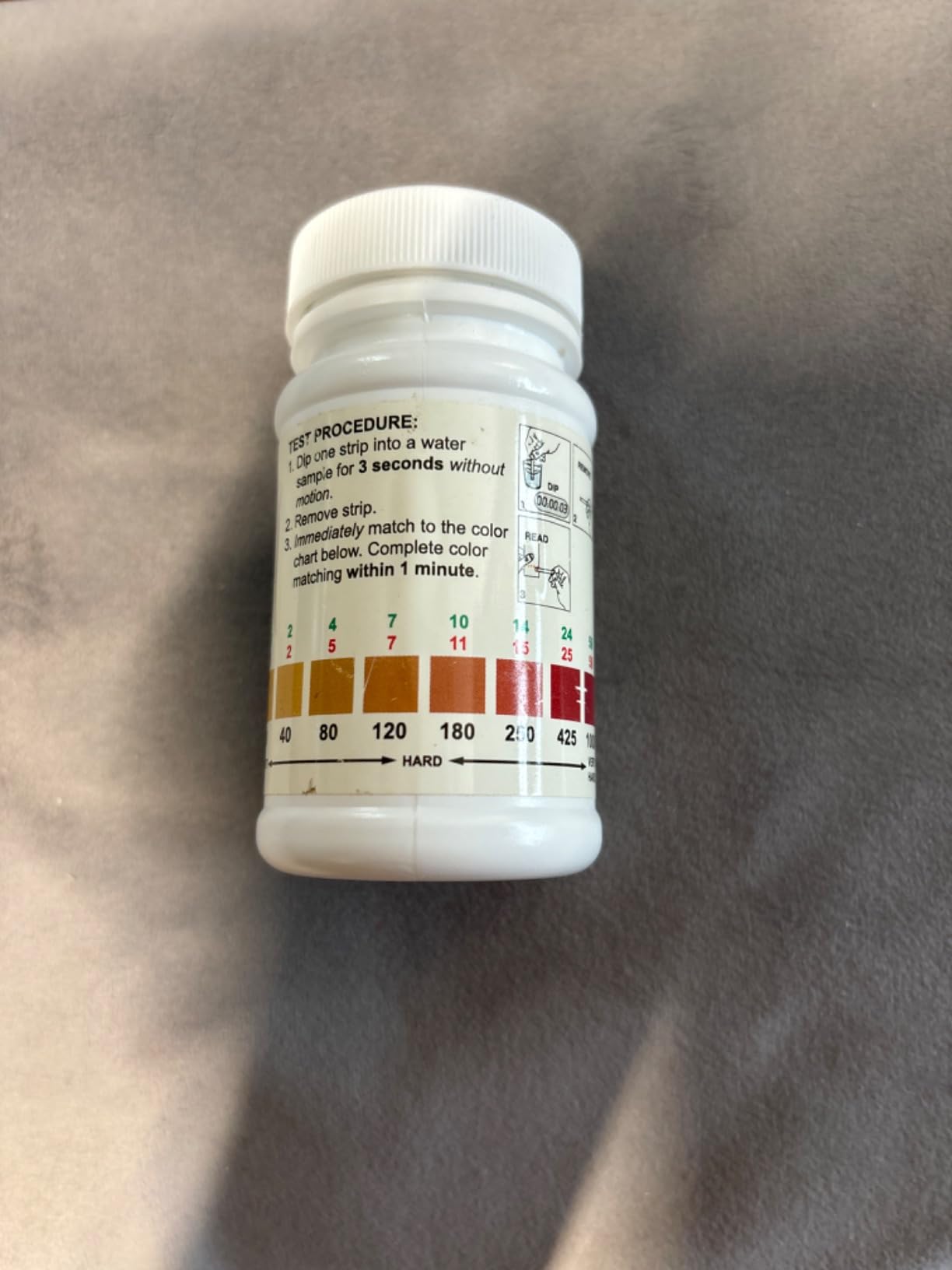
Manufactured by Industrial Test Systems in the United States, this kit is the only one on my list with a made-in-USA pedigree and Good Manufacturing Practices certification. The detection levels are clearly specified at 0, 40, 80, 120, 180, 250, 425, and 1,000 ppm, giving you eight distinct reference points instead of a continuous gradient.
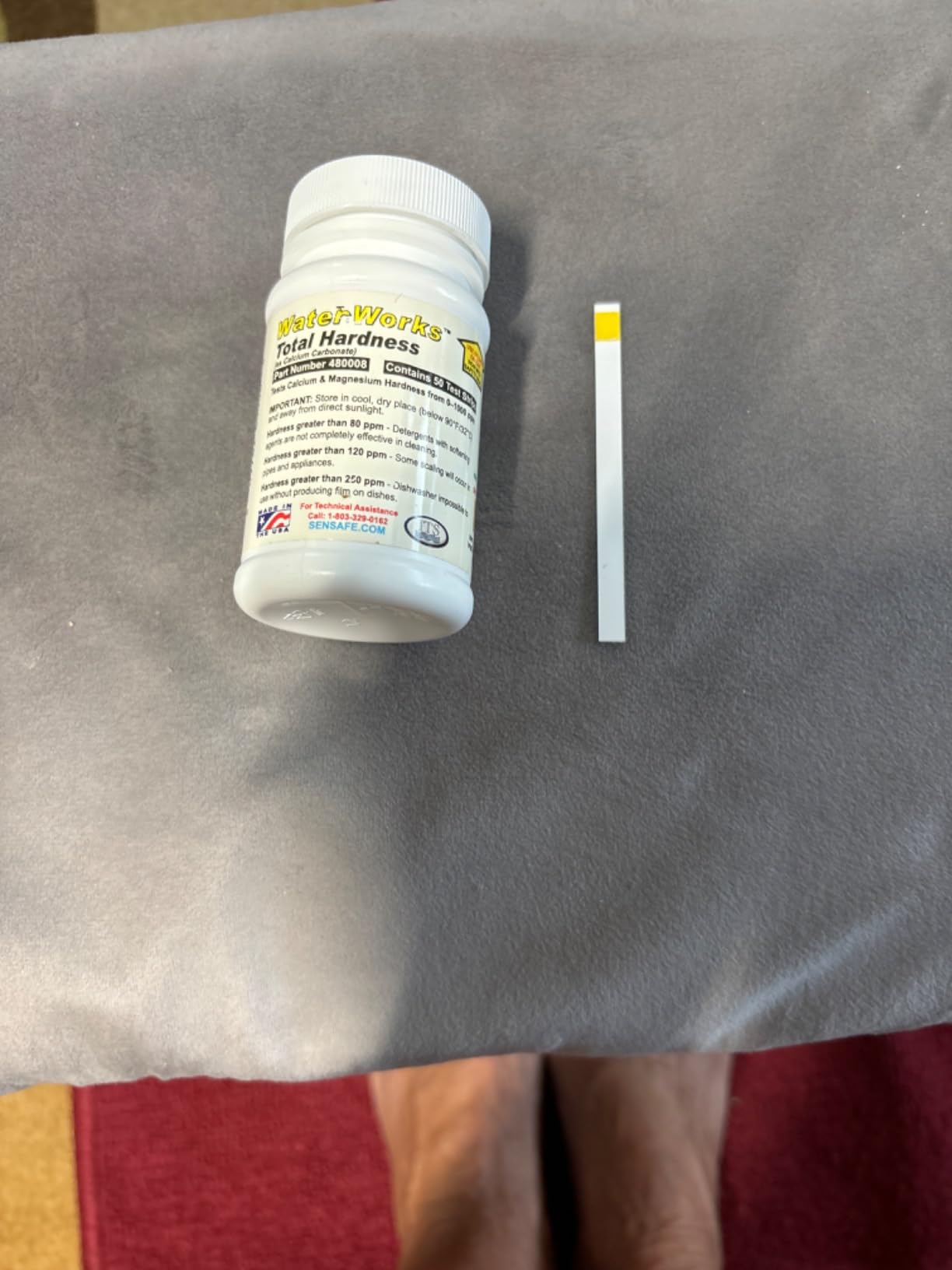
In practice, the 3-second test time is accurate. You dip, pull the strip out, and read the color almost instantly. The bottle includes a verified color chart printed on the label, and the quality control testing at each manufacturing step shows in the consistency of results.
The trade-off is that you only get 50 strips per bottle, which makes this one of the more expensive options on a cost-per-test basis. For users who need precision and the extended range, the higher price is justified. For casual home testing, you might prefer a higher-volume strip kit.
Detection Levels and When They Matter
The eight specific detection levels let you pinpoint your hardness more precisely than strips with fewer reference points. If your water falls between 425 and 1,000 ppm, most other kits max out and cannot tell you how hard your water actually is. The WaterWorks strip will show you exactly where you land on that upper scale.
Professional and Technical Use Cases
This kit is popular with HVAC technicians, aquarium hobbyists, and laboratory professionals who need reliable, traceable results. The made-in-USA manufacturing and quality control documentation make it suitable for applications where you need to defend your testing methodology. Home users benefit from the same accuracy without needing technical expertise.
6. Merydi Water Hardness Test Kit – Best Dual-Pad Strips with Test Tube
Water Hardness Test Kit,150 Strips-Double Color Pads with Sample Tube
150 strips
Dual color pads
0-425 ppm
Test tube included
Pros
- Double color pads for verification
- 150 strips plus test tube
- Quick and easy to use
- High accuracy fiber paper
Cons
- Colors may not match chart perfectly
- Strips not reusable
Merydi takes the dual-pad concept and pairs it with a generous 150-strip count and an included test tube, all for under seven dollars. When I tested this kit, the value proposition was immediately clear: you get professional-style verification features at a budget-friendly price point.
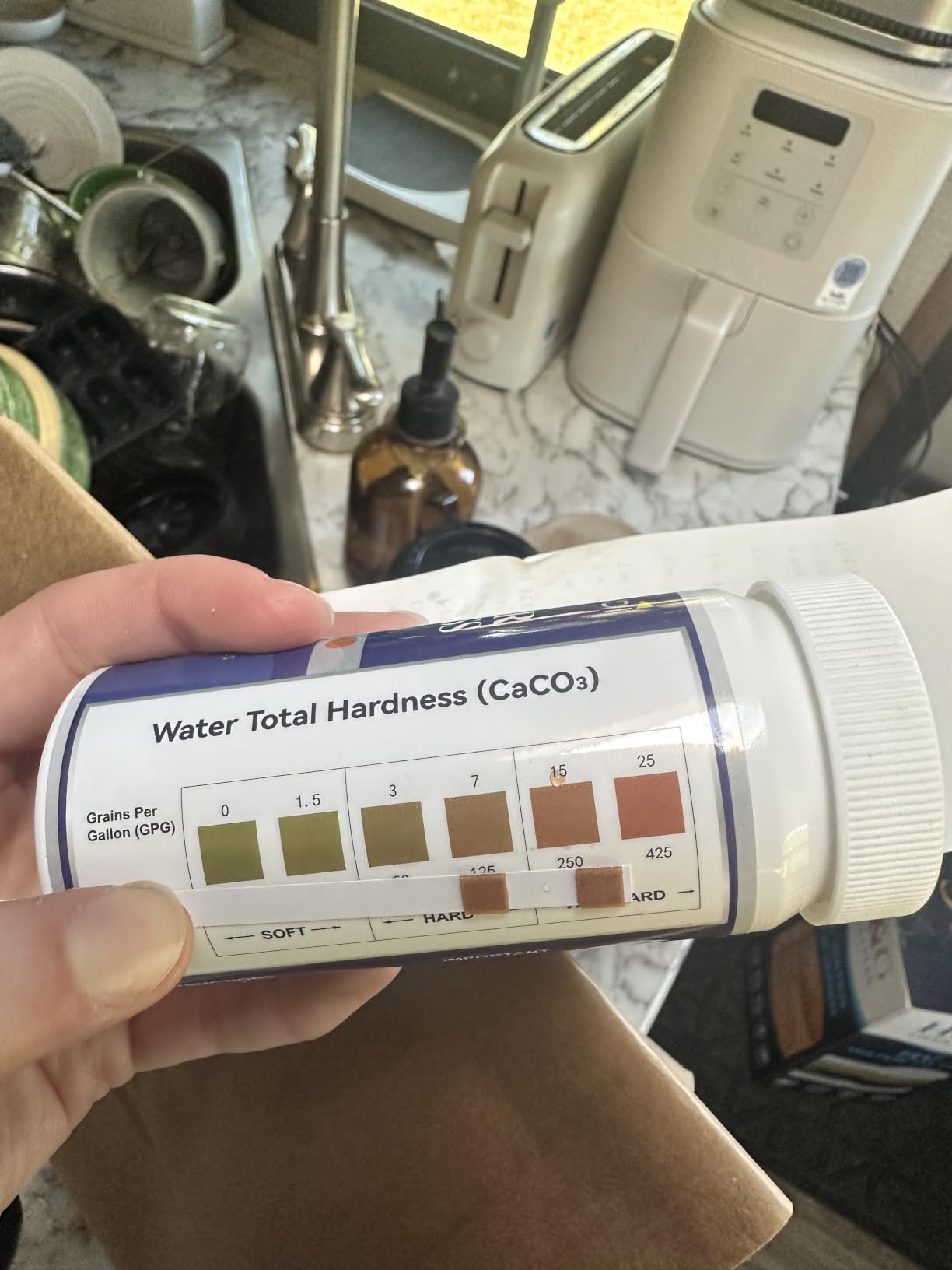
The double color pads work the same way as the WeAQUA DoubleCheck system. Each strip has two identical pads, and if they match after testing, you can trust the result. If they differ, you know to retest. This built-in quality check is something I now look for in every strip kit I evaluate.
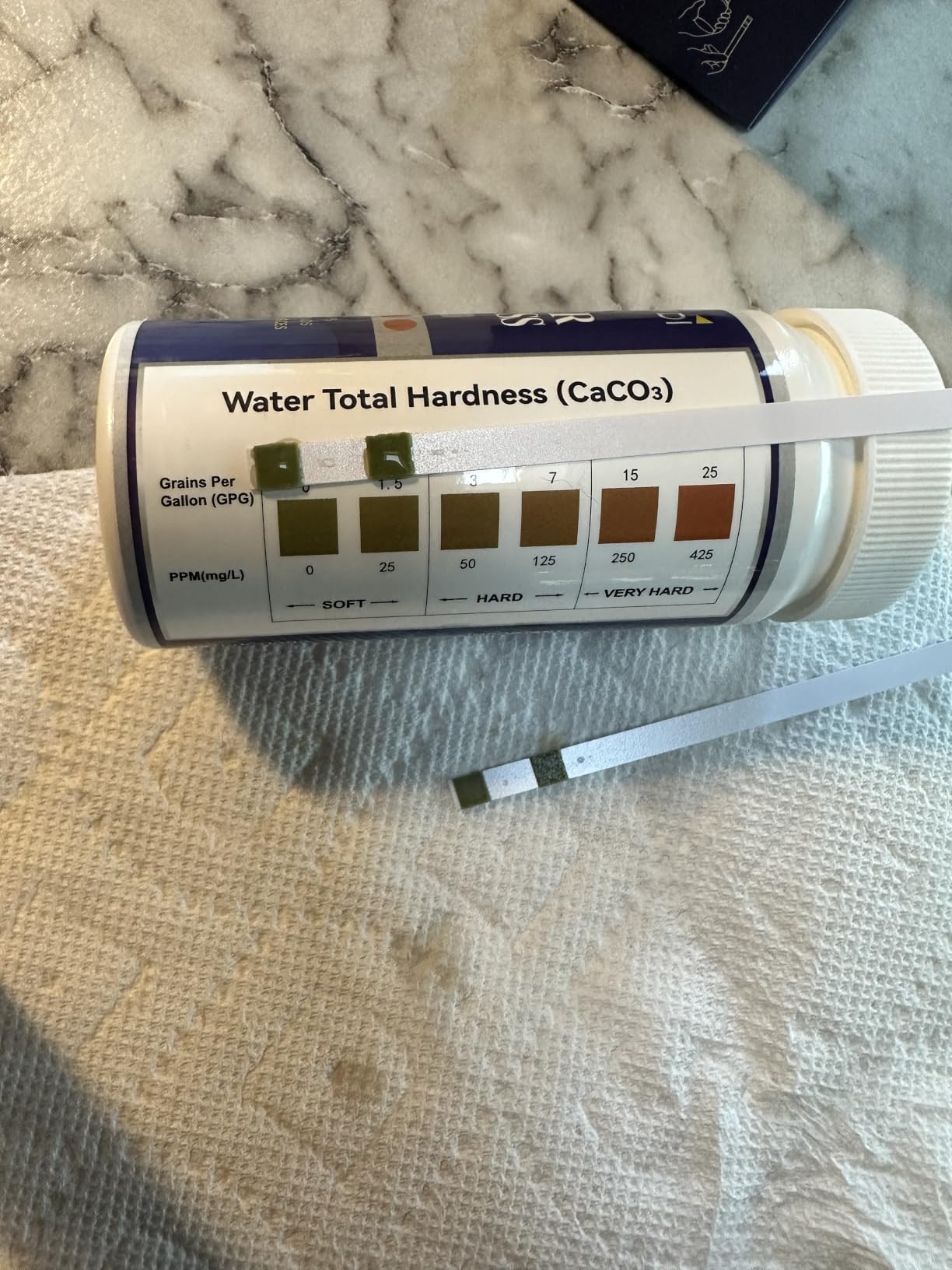
The included test tube is a small but meaningful inclusion. Collecting a water sample in the tube and dipping the strip gives you more consistent results than holding a strip under a faucet where water flow and temperature can vary. The fiber paper construction resists color bleeding, which keeps the pads sharp and readable.
Merydi recommends reading results in natural daylight, and I second that advice. The color differences between adjacent hardness levels are subtle enough that indoor lighting can throw off your interpretation. In good light, the strips performed well and produced readings consistent with my Hach titration results.
Verifying Results with Dual Pads
The dual-pad design is particularly useful when you are testing borderline water that falls between two hardness categories. If one pad reads 120 ppm and the other reads 180 ppm, you know the strip had a defect and should retest. If both pads agree, you can be confident in the reading and move on to your next decision.
Ideal Testing Frequency for Home Monitoring
Merydi suggests testing at least twice per week for ongoing monitoring, which is practical if you are tracking changes after installing a water softener or adjusting its settings. With 150 strips, you can test daily for nearly five months or twice weekly for over a year. This makes the kit well-suited for long-term water quality tracking.
7. ColorKiM Total Water Hardness Test – Best Liquid Drop Test for Pools and Spas
Total Water Hardness Test for Pool, Aquarium, and Drinking Water, and Improving Water Softener Efficiency, Hard Water Test Kit
Titration drop method
100 drops per kit
dH to GPG conversion
Pool and spa focus
Pros
- Drop-and-see titration method
- 100 drops for multiple tests
- More accurate than strips
- Easy dH to GPG conversion
Cons
- Instructions unclear for some users
- German and French units confusing
- Packaging may arrive damaged
ColorKiM offers a liquid-based titration test that bridges the gap between cheap strips and the professional Hach kit. Instead of paper strips, you add drops of indicator solution to a water sample and count the drops needed to trigger a color change. This drop-and-see method is more repeatable than color-chart matching.
Each container holds enough solution for 100 drops, which translates to roughly 50 to 100 tests depending on your water hardness. Harder water requires more drops per test, so the actual number of tests varies. The kit is specifically designed for pool, spa, and aquarium water testing where consistency matters.
I found the titration approach more satisfying than strip testing because you get a direct count instead of squinting at a color gradient. The color change is dramatic and unmistakable, going from one distinct color to another at the endpoint. This eliminates the subjective interpretation that plagues strip readers.
The main drawback is the documentation. The instructions reference German hardness (dH) and French hardness units alongside grains per gallon, which confused several users in the reviews. The conversion formula is provided (1 dH equals 1.04 GPG), but clearer instructions would make this kit more accessible to first-time buyers.
Converting Between Hardness Units
ColorKiM uses German degrees (dH) as its primary measurement. To convert to grains per gallon, multiply dH by 1.04. To convert to parts per million, multiply gpg by 17.1. Having these formulas handy when you test saves time and prevents the unit confusion that trips up many users switching between systems.
Drop Count Titration vs Strip Testing
The drop-count method eliminates the color-matching subjectivity that makes strips unreliable. You count actual drops, which is a discrete number rather than a best-guess color match. For pool and spa owners who need consistent readings to balance chemicals, this precision advantage justifies the higher price compared to basic strip kits.
8. Pawfly Water Hardness Test Kit – Most Affordable Option Available
Pawfly Water Hardness Test Kits, 100 Strips Hard Water Test Kit
100 strips
0-425 ppm
15-second results
2-year shelf life
Pros
- Lowest price on the market
- Fast 15-second results
- Highly sensitive detection
- Dependable fiber paper
Cons
- Strips lose accuracy over time
- Color matching subjective
- Some strips fail before expiration
At under six dollars for 100 strips, Pawfly is the cheapest hard water test kit on this list by a comfortable margin. I included it because budget constraints are real, and sometimes you just need a quick check without investing in a premium product. For that purpose, Pawfly delivers.
The strips work with a simple 2-second dip and 15-second wait before reading. The color chart is printed on the ziplock bag rather than a bottle label, which I found actually easier to handle since you can lay it flat on a table for comparison. The range covers the standard 0-425 ppm scale.
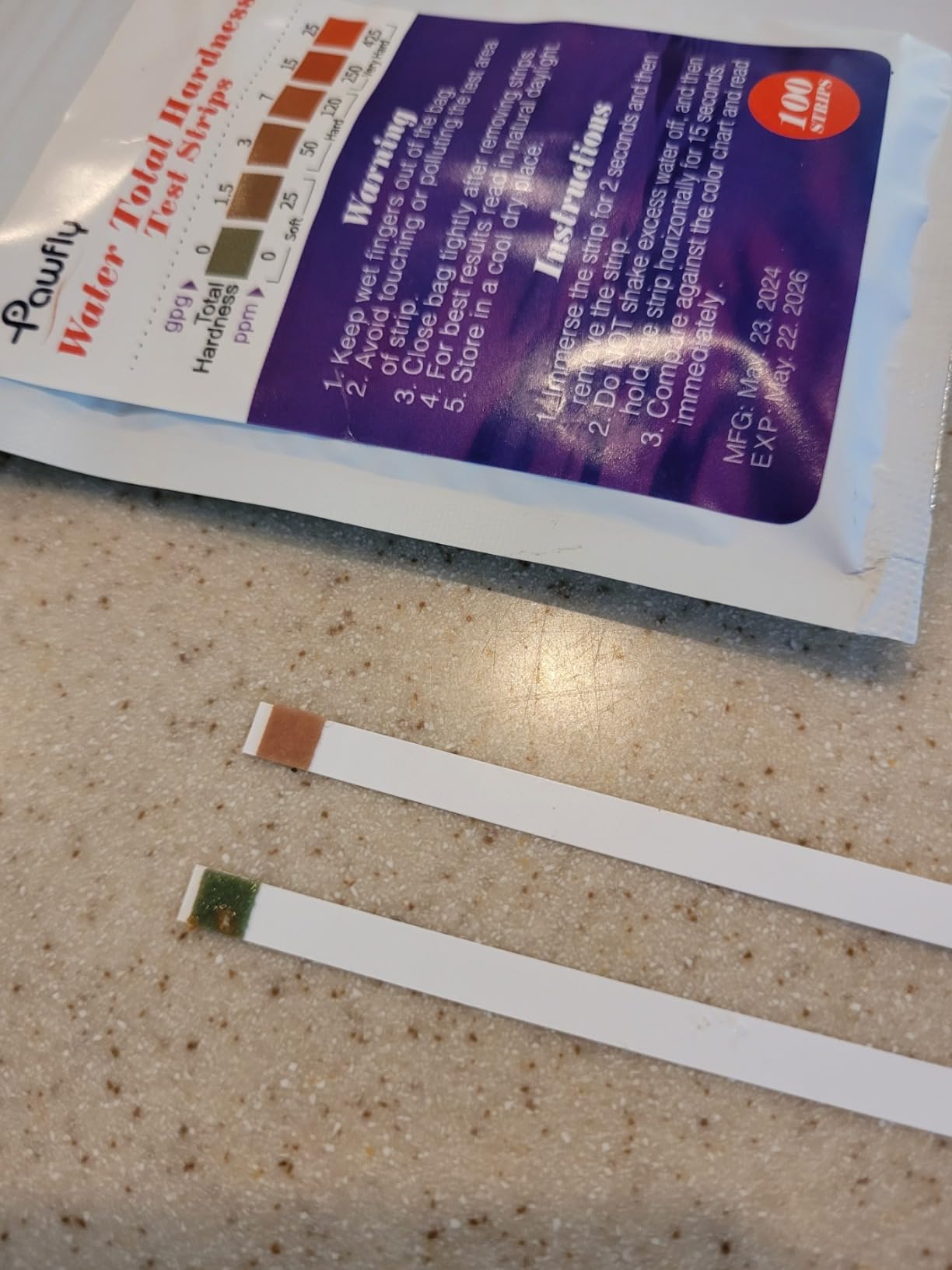
In my testing, the Pawfly strips correctly identified my water as moderately hard, matching the readings from the Varify and JNW kits within one color block. For a yes-or-no hardness check, they do the job. The fiber paper construction is decent quality for the price, though not as refined as the WaterWorks or WeAQUA strips.
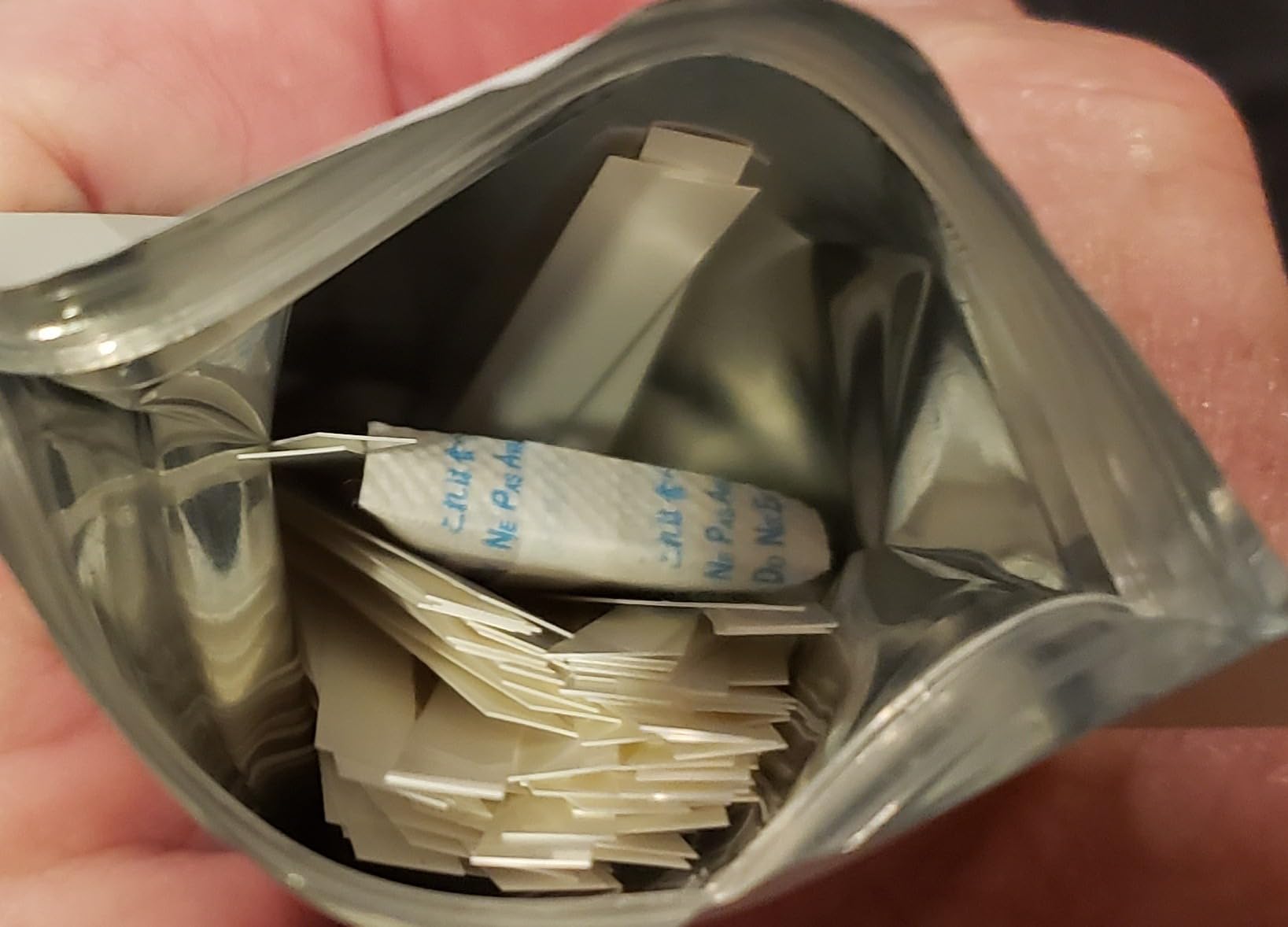
The main concern flagged by users is shelf life. While Pawfly claims a 2-year shelf life before opening and 100 days after, some users report strips becoming inaccurate well before the expiration date if stored improperly. Keep them sealed, dry, and away from heat to maximize reliability.
Storage and Shelf Life Best Practices
To get the most from Pawfly strips, squeeze excess air from the ziplock bag after each use and store it in a cool, dry cabinet. Avoid bathroom cabinets where humidity fluctuates with showers. If you notice strips giving inconsistent readings, replace the batch rather than trusting questionable results for important decisions.
Best Suited for Quick Confirmation Checks
Pawfly shines when you need a fast, cheap confirmation that your water softener is working or that a new water source is safe. It is not the kit I would choose for precise water softener programming or professional reporting, but for everyday household monitoring, the price-to-performance ratio is hard to beat.
9. Bestprod 21-in-1 Drinking Water Test Kit – Best for Comprehensive Water Testing
Bestprod All-New 21 in 1 Drinking Water Testing Kit Strips, Home Tap and Well Water Test Kit for Hardness, Lead, Iron, Copper, Chlorine, Fluoride
21 parameters
120 strips
2 bacteria tests
Data sheet included
Pros
- Tests 21 water parameters
- Includes bacteria tests for coliform and E coli
- Clear acceptable range guide
- Data sheet for tracking
Cons
- Higher price than single-parameter kits
- More complex to interpret
The Bestprod 21-in-1 kit goes far beyond water hardness testing. It checks 21 different water quality parameters including lead, iron, copper, chlorine, fluoride, pH, and bacteria. If you want a single purchase that tells you everything about your water quality rather than just hardness, this is the kit to get.
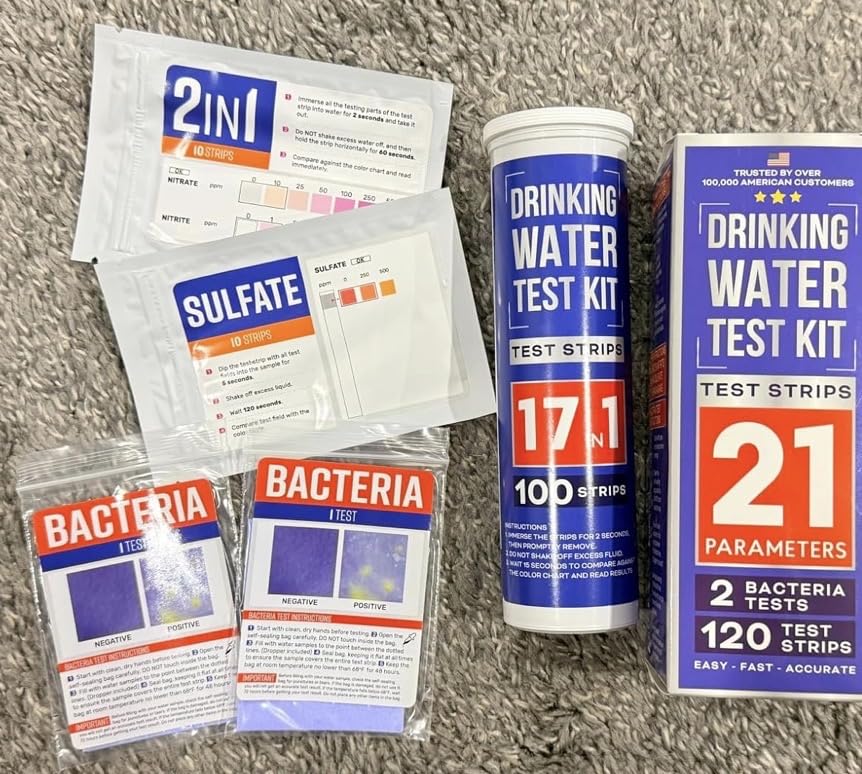
Each strip tests multiple parameters simultaneously, and the bottle label includes a clear guide that aligns with each pad on the strip. The kit also includes two separate bacteria tests for coliform and E. coli, which no other product on this list offers. For well water owners concerned about contamination, this is a significant advantage.
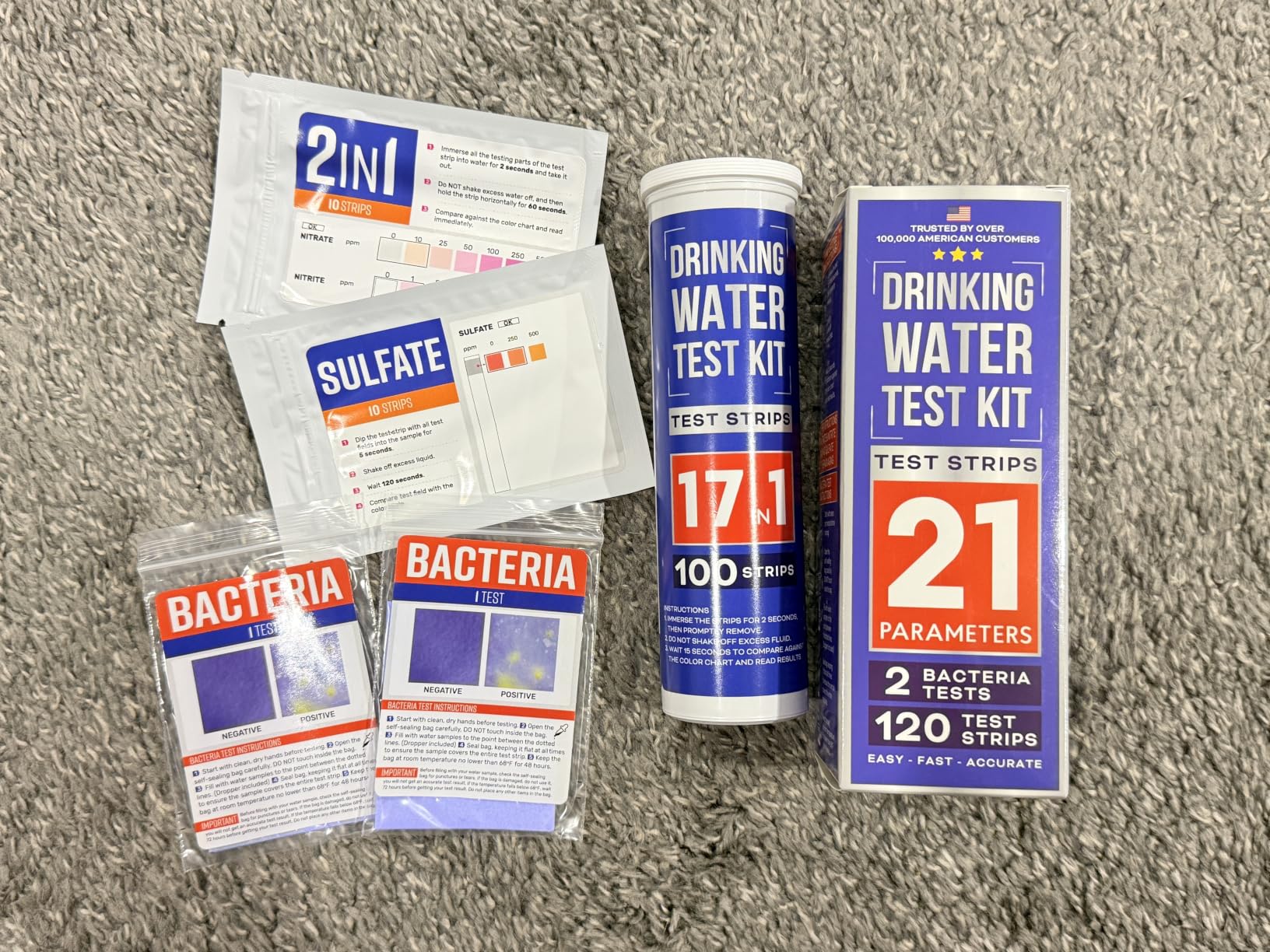
I tested this kit on both my city tap water and a friend’s well water, and the difference in results was eye-opening. The well water showed elevated iron and hardness levels that the city water did not, and the bacteria test came back clean for both sources. Having all parameters on one strip makes it easy to see the complete picture.
The included data sheet lets you record readings over time, which is valuable if you are monitoring changes after installing a filtration system. With 120 strips, you can test regularly for months. The clear acceptable-range guide on the bottle tells you immediately if any parameter falls outside safe levels.
Beyond Hardness: Understanding the Full Contaminant Panel
Testing only for hardness misses potential issues like lead contamination, chlorine spikes, or bacterial presence. The 21-in-1 panel catches these problems in a single test. If your hardness reading is normal but you still experience water quality issues, the other parameters on the strip may reveal the actual culprit.
When to Choose Multi-Parameter Testing Over Hardness-Only Kits
Choose the Bestprod kit if you are on well water, moving into a new home, or concerned about aging pipes that may leach contaminants. If you already know your only issue is hardness and you just need to program a softener, a dedicated hardness kit will serve you better at a lower cost.
10. HOVIRAN Water Hardness Test Strips – Best Compact Multi-Purpose Kit
Water Hardness Test Strips, Fast & Reliable Results (0-425 ppm)
150 strips
0-425 ppm
15-second results
Compact resealable packaging
Pros
- 150 strips per bottle
- Wide 0-425 ppm range
- Compact resealable packaging
- Multi-use for brewing and aquariums
Cons
- Difficulty distinguishing soft water shades
- Some strips show false zero readings
- Color readability issues
HOVIRAN rounds out our list as a compact, affordable option with 150 strips and a wide measurement range. I tested this kit alongside the other budget options to see where it fits in the competitive landscape, and it landed as a solid middle-of-the-road choice for general household use.
The strips cover the standard 0-425 ppm range with a 15-second read time. The compact resealable packaging keeps strips organized and dry, and the 150-strip count provides plenty of testing capacity for the price. HOVIRAN specifically mentions brewing, aquarium, and gardening applications alongside standard household uses.

For moderately hard to very hard water, the HOVIRAN strips performed adequately and produced readings consistent with other kits in the same range. The colors on the higher end of the scale were distinct and easy to match against the included chart.
The weakness showed up in the soft water range. Some users report difficulty distinguishing between the lightest color shades, and one user noted strips showed zero hardness for water that was confirmed hard by other methods. This suggests the reagent sensitivity may be insufficient at the lower end of the range. If your water is soft or only slightly hard, consider a kit with better low-end sensitivity.

Reading Soft Water Results Accurately
If you suspect your water is soft (under 60 ppm), compare the strip to the chart under bright natural light and look for the faintest hint of color change. The difference between zero hardness and slight hardness can be nearly imperceptible. For critical soft water measurements, cross-check with a titration kit for confirmation.
Multi-Purpose Applications Beyond Home Testing
HOVIRAN markets this kit for aquarium hobbyists, home brewers, and gardeners in addition to standard household use. Brewers need to know water hardness to adjust their mash chemistry, and aquarium owners must monitor hardness for fish health. The 150-strip count makes frequent testing across multiple applications affordable.
How to Choose the Right Hard Water Test Kit?
Choosing from the best hard water test kits comes down to three main factors: the testing method, your accuracy needs, and your budget. Understanding the differences between strips, titration, and lab testing will help you pick the right tool for your situation.
Test Strips vs Titration vs Lab Testing
Test strips are the fastest and cheapest option. You dip, wait 3 to 15 seconds, and match the color to a chart. They work well for quick checks and general monitoring but give you a range rather than a precise number. Expect accuracy within one or two color blocks of the actual value.
Titration kits like the Hach Model 5-B and ColorKiM use chemical reagents that change color at a specific endpoint. You count drops or observe a single dramatic color change, which gives you a discrete number rather than a best-guess color match. This method is more accurate and repeatable than strips.
Laboratory testing involves sending a water sample to a certified lab. This is the most accurate option and tests for contaminants beyond hardness, but it costs $100 to $400 per test and takes days or weeks for results. Use lab testing for one-time comprehensive baseline testing of well water or new homes.
Understanding ppm and gpg Measurements
Water hardness is measured in two common units. Parts per million (ppm), also written as mg/L, is the scientific standard. Grains per gallon (gpg) is the traditional unit used by water softener manufacturers in the United States. The conversion is simple: 1 gpg equals 17.1 ppm.
Most strip kits display results in ppm, while titration kits often use gpg. Water softener settings typically require gpg input, so you may need to convert. To go from ppm to gpg, divide ppm by 17.1. For example, 200 ppm equals about 11.7 gpg.
The EPA classifies water hardness as follows: 0-60 ppm is soft, 61-120 ppm is moderately hard, 121-180 ppm is hard, and anything above 180 ppm is very hard. Most water softeners activate when hardness exceeds 60 ppm, so knowing your exact level helps you program the right regeneration cycle.
Cost Per Test Comparison
Looking at cost per test helps you compare value across kits with different strip counts. The WeAQUA DoubleCheck at 200 strips offers the lowest cost per test at roughly four cents. Budget kits like Pawfly and Merydi come in around five to seven cents per test. The WaterWorks kit costs more per test due to its 50-strip count, but the extended range and made-in-USA quality justify the premium for users who need those features.
Well Water vs City Water Considerations
City water supplies are regulated and tested by municipalities, but hardness levels vary widely by region. If you are on city water, a basic strip kit is usually sufficient to check hardness for softener programming. However, aging pipes between the treatment plant and your home can introduce contaminants that municipal testing does not catch.
Well water requires more comprehensive testing because it is unregulated and can contain bacteria, heavy metals, and agricultural runoff in addition to hardness minerals. For well water, I recommend starting with a multi-parameter kit like the Bestprod 21-in-1 and following up with periodic certified lab testing to establish a baseline and catch any changes over time.
Accuracy Factors to Consider
Several factors affect test accuracy regardless of which kit you choose. Storage conditions matter enormously for strips, which degrade when exposed to heat, humidity, or light. Read results in natural daylight whenever possible, as artificial lighting distorts color perception. Always follow the manufacturer’s dip time and reading window exactly, because colors continue to develop beyond the recommended reading time.
Dual-pad strips like the WeAQUA DoubleCheck and Merydi kits offer a built-in accuracy check by showing two identical color pads that should match. If you want maximum accuracy, titration kits eliminate color-matching subjectivity entirely by giving you a drop count or endpoint color change that is unmistakable.
FAQs
What is the most accurate water hardness test?
The most accurate water hardness test is a drop-count titration kit like the Hach Total Hardness Test Kit Model 5-B. Titration measures hardness by counting drops of reagent needed to trigger a color change, giving you an exact grains-per-gallon reading rather than a color-chart estimate. For ultimate accuracy, certified laboratory testing is the gold standard, but titration kits come closest at a fraction of the cost.
Are home hard water test kits accurate?
Home hard water test kits are generally accurate within one color block for strips and nearly exact for titration kits. Test strips like Varify and JNW Direct reliably identify whether your water is soft, moderately hard, or very hard. Titration kits like the Hach Model 5-B provide professional-grade precision suitable for programming water softeners. For the most reliable results, read strip colors in natural daylight and store strips in cool, dry conditions.
Which state has the hardest water?
States with the hardest water include Texas, Florida, Arizona, New Mexico, Kansas, Utah, and Nevada. These states frequently report water hardness above 200 ppm (over 11 gpg) due to high concentrations of dissolved calcium and magnesium in groundwater. The hardest water in the country is typically found in Texas and the Southwest, where some areas exceed 300 ppm.
Can I test for hard water myself?
Yes, you can easily test for hard water yourself using a home test kit. Test strips require a 2-second dip and 15-second wait before reading results against a color chart. Titration kits take about 2 minutes per test and involve counting reagent drops. You can also do a simple soap test at home by shaking water and dish soap in a bottle: if it produces few suds and leaves a cloudy film, your water is likely hard.
Final Thoughts on the Best Hard Water Test Kits
After months of testing, the Hach Total Hardness Test Kit Model 5-B remains my top recommendation for anyone who needs precise, repeatable hardness measurements. Its drop-count titration method delivers professional-grade accuracy that strip kits simply cannot match, making it the best choice for programming water softeners or monitoring water quality over time.
For everyday home testing, the Varify kit offers the best balance of value, ease of use, and reliability. And if you just need a quick, cheap check, the Pawfly kit gets the job done for under six dollars. Whatever your situation, the best hard water test kits in 2026 give you the information you need to protect your appliances, improve your water quality, and make confident decisions about treatment systems.