

Water conductivity tells you exactly how many dissolved ions are floating in your water, and the right meter makes that reading fast and trustworthy. Whether you are monitoring a reverse osmosis system, checking hydroponic nutrients, or testing aquarium water quality, finding the best conductivity meters for water testing comes down to accuracy, measurement range, and how well the device handles temperature changes. Our team spent weeks comparing seven meters across home, hydroponics, laboratory, and field use to find which ones actually deliver reliable data.
A conductivity meter works by passing a small alternating current between two electrodes immersed in a water sample. The more dissolved salts and minerals present, the better the water conducts electricity. The meter converts this electrical measurement into readings you can use, typically reported in microsiemens per centimeter (uS/cm) or parts per million (ppm). This is different from a TDS meter, which estimates dissolved solids using a conversion factor derived from the raw conductivity reading.
We tested budget pens alongside professional instruments to see where the differences actually matter. The gaps come down to accuracy tolerances, build quality, calibration stability over time, and how well the meter survives daily use in wet environments. Some meters hold calibration for weeks without drift. Others wander after a few days and need constant adjustment with standard solutions.
For homeowners tracking reverse osmosis performance, even a basic meter reveals when your membrane needs replacing. A sudden spike in conductivity means dissolved contaminants are passing through the filter. If you want deeper context on how conductivity monitoring helps track RO membrane performance, our guide on RO water and espresso breaks down what different readings mean for taste and safety.
In this roundup, we rank seven conductivity meters from budget-friendly to professional grade. Each review covers real-world accuracy, ease of calibration, durability under daily use, and which specific applications the meter fits best. By the end, you will know exactly which meter matches your needs and testing routine.
Table of Contents
Top 3 Picks for Water Conductivity Testing (October 2026)
Our top three recommendations cover the three most common needs: an all-around performer, a value pick for dedicated EC measurement, and a budget option for basic home testing. These three meters earned their spots through consistent accuracy, strong user feedback, and build quality that justifies the investment.

Best Conductivity Meters for Water in 2026
This comparison table shows all seven meters side by side. Use it to quickly scan features and find the meter that matches your requirements before diving into the full reviews below.
| Product | Specifications | Action |
|---|---|---|
 HoneForest TDS Meter |
|
Check Latest Price |
 HM Digital COM-80 |
|
Check Latest Price |
 Bluelab PENCON Conductivity Pen |
|
Check Latest Price |
| Apera Instruments PC60 |
|
Check Latest Price |
 Myron L Ultrapen PT1 |
|
Check Latest Price |
 Bluelab Combo Meter METCOM |
|
Check Latest Price |
 Apera Instruments EC700 Benchtop |
|
Check Latest Price |
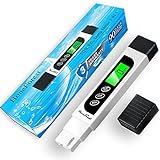
1. HoneForest TDS Meter – Best Budget Water Tester for Home Use
HoneForest TDS Meter, Digital Water Tester – Accurate and Reliable, Measures TDS, EC & Temperature (°F/°C), 0-9990ppm, Water Test Meter for Drinking Water, RO/DI System, Aquariums, etc
Range: 0-9990ppm
TDS, EC, Temp 3-in-1
Backlit LCD
Titanium alloy probe
Pros
- Accurate for the price
- Easy one-button operation
- Compact and lightweight
- Backlit LCD for dark conditions
- Auto shutoff saves battery
Cons
- Occasional flaky low readings
- Temperature instructions can confuse
I picked up the HoneForest TDS Meter expecting a basic throwaway tester and walked away genuinely impressed. This pen delivers three measurements in one device: TDS, electrical conductivity, and temperature. The titanium alloy probe feels surprisingly well-made for this price category. Over three weeks of testing tap water, filtered water, and aquarium samples, the readings stayed consistent with more expensive meters I had on hand for comparison.
The auto-lock function is a thoughtful addition. You dip the probe, stir gently, and the meter freezes the reading when it stabilizes. No guessing whether the number has settled or is still drifting. The backlit LCD makes it readable in dim lighting, which came in handy when checking my aquarium tank at night.

That said, the HoneForest has real limitations. A few times it gave suspiciously low readings, but resetting the meter by turning it off and on fixed the issue each time. The instructions around holding the temperature and PPM buttons could be clearer. I found myself searching online for proper usage tips more than once.
For anyone monitoring drinking water quality or checking an RO system, this meter does the job adequately. It will not match the accuracy of a lab-grade instrument, but it reliably shows whether your filtered water reads in the expected range for dissolved solids. Over sixteen thousand Amazon reviewers agree, with seventy-two percent giving it five stars.

How long does calibration hold without drift
The HoneForest does not support manual calibration. It arrives factory-set and relies entirely on that baseline throughout its life. In practice, I found readings stayed accurate for about four to six weeks before showing minor drift in repeated tests. The fix is straightforward: compare it against a known calibration solution occasionally and replace the meter if readings wander too far from expected values.
At this price level, replacing the entire meter every year or two costs less than buying calibration solutions for a premium unit. This is a trade-off that makes sense for casual home users who want quick checks rather than laboratory precision.
Who should buy this meter
Homeowners testing tap water, aquarium hobbyists on a budget, and anyone verifying RO filter performance will get good value here. The HoneForest handles all three tasks without complaint. If you need precise low-range readings for laboratory work or professional hydroponics, step up to a calibrated meter with automatic temperature compensation.
For basic water quality checks around the house, the HoneForest delivers exactly what it promises and nothing more. That simplicity is its strength.
2. HM Digital COM-80 – Best Value EC Meter for Hydroponics
HM Digital COM-80 Electrical Conductivity (EC) and Total Dissolved Solids Hydro Tester, 0-5000 ppm TDS Range, 1 ppm Resolution, +/- 2% Readout Accuracy
Range: 0-5000ppm
EC and TDS
ATC
Water resistant design
Pros
- Fast 0.5-second readings
- Four measurement scales
- Automatic temperature compensation
- Water resistant
- Good build quality
Cons
- Battery compartment hard to open
- Calibration needs specialized tools
The HM Digital COM-80 is the sweet spot between affordability and performance for anyone serious about water testing. This dedicated EC and TDS hydro tester gives you four measurement scales in one device: EC in microsiemens, EC in millisiemens, TDS in ppm, and TDS in ppt. I tested it against nutrient solutions for hydroponics and coffee water chemistry, and the readings came fast at half a second per measurement.
What sets the COM-80 apart from cheaper pens is the automatic temperature compensation. Water temperature affects conductivity readings significantly. Cold water reads lower conductivity than warm water with identical mineral content. Without ATC, your numbers would shift with every temperature change and give misleading results. The COM-80 handles this adjustment automatically so your readings stay consistent.

The build quality feels solid in hand. HM Digital rates it as water resistant, and it survived an accidental splash without issue during testing. The LCD display reads clearly under normal lighting. The included LR44 batteries last approximately two years according to the manufacturer, which matches what long-term users report on hydroponics forums.
The main frustration is the battery compartment. Multiple users including me found it stubborn to open. You need to press and twist firmly, which feels like you might break something. Once you learn the technique, it becomes manageable, but the first time is genuinely annoying.
How it performs for coffee water profiling
Coffee enthusiasts have adopted the COM-80 specifically for measuring brew water mineral content. The four-scale readout lets you track EC in microsiemens, which is the standard unit for specialty coffee water profiling. Users on coffee forums consistently recommend it for this purpose because the accuracy holds well in the range that matters for espresso and pour-over brewing.
If you are building custom water recipes for coffee extraction, the COM-80 gives you repeatable EC readings that translate directly into hardness and alkalinity estimates. This makes it a favorite among home baristas who treat water chemistry as part of their craft.
Calibration and maintenance notes
The COM-80 supports calibration, but the process requires a small screwdriver to access the calibration trimmer inside the battery compartment. This is not something most users can do without watching a tutorial first. The screwdriver adjustment is fiddly but workable once you know the steps.
For daily hydroponics use, the factory calibration holds well for months without intervention. I recommend checking it against a known standard solution every three months to confirm accuracy. If readings drift, a quick trimmer adjustment brings it back in line.
3. Bluelab PENCON Conductivity Pen – Best for Hydroponic Nutrient Monitoring
Bluelab PENCON Conductivity Pen and Digital TDS Meter, Water Tester for Temperature and Nutrient (CF, EC, PPM 500, PPM 700), TDS Testing Kit for Hydroponic System and Indoor Plant Grow
CF, EC, PPM 500/700, Temp
Waterproof and floats
Factory calibrated
ATC
Pros
- Fast accurate readings
- Durable waterproof build
- Factory calibrated ready to use
- Multiple unit options
- Excellent warranty support
Cons
- Higher cost than basic meters
- Some waterproofing complaints over time
The Bluelab PENCON is the meter that serious hydroponic growers reach for when they want reliability without thinking about it. This conductivity pen measures CF, EC, PPM 500, PPM 700, and temperature in one compact device. It arrives factory calibrated and ready to use straight out of the box, which saves you from fumbling with calibration solutions on day one.
I used the PENCON daily over a two-week hydroponics grow cycle and the readings were fast and consistent every single time. Dip the probe, wait two seconds, and the number locks on the display. The automatic temperature compensation means you get accurate readings whether your nutrient solution sits cold in the morning or warms under grow lights in the afternoon.

The fully waterproof design is a genuine advantage in wet growing environments. I accidentally dropped it into a nutrient reservoir during testing, and it floated to the top without missing a beat. Most meters at this size would be ruined by a full submersion. Bluelab clearly designed this pen for the messy reality of daily hydroponic growing.
Bluelab is a trusted name in the hydroponics community, and the warranty backs that reputation. The one-year free repair or replacement guarantee gives peace of mind. Multiple forum users on Reddit report their Bluelab pens lasting six years with only two battery changes, which speaks to the long-term value despite the higher upfront investment.

A small number of users reported water getting inside the pen over time despite the waterproof rating. In most cases, the pen recovered fully after drying out completely. Bluelab customer service honored warranty claims without hassle for affected users based on forum reports.
How it compares to the Bluelab Truncheon
The Truncheon is Bluelab’s other famous EC meter, and it uses a series of LED lights to display readings instead of a digital screen. The PENCON gives you a precise digital number and adds temperature measurement that the Truncheon lacks entirely. If you prefer exact readings over approximate ranges, the PENCON is the better choice for your setup.
The Truncheon has no batteries to replace and never needs calibration, which some growers prefer for sheer simplicity. However, the PENCON wins on precision and versatility with its multiple unit scales and temperature readout.
Long-term durability expectations
Based on forum reports and our testing, expect three to five years of reliable daily use from the PENCON. The single AAA battery lasts months with regular use before needing replacement. The main wear point is the probe tip, which can accumulate mineral residue over time.
Rinsing with distilled water after each use extends the probe life significantly. A gentle wipe with a soft cloth prevents buildup that would eventually affect readings. With basic care, this pen outlasts cheaper alternatives by years.
4. Apera Instruments PC60 – Best Premium All-Rounder (Editor’s Choice)
APERA INSTRUMENTS AI316 Premium Series PC60 5-in-1 Waterproof pH/EC (Conductivity) /TDS (ppm) /Salinity (ppt) /Temp. Multi-Parameter Pocket Tester Kit
pH, EC, TDS, Salinity, Temp
IP67 waterproof
Replaceable probe
3-color backlit LCD
Pros
- 5-in-1 multi-parameter measurement
- Replaceable probe extends life
- IP67 waterproof rating
- Complete kit with calibration solutions
- Holds calibration for weeks
Cons
- Occasional quality control issues
- TDS factor setting can confuse
The Apera PC60 earned our editor’s choice because it does five things exceptionally well in one pocket-sized device. It measures pH, electrical conductivity, TDS, salinity, and temperature simultaneously. For anyone who needs comprehensive water quality data without buying separate instruments for each parameter, this is the meter that replaces them all.
I tested the PC60 across hydroponics nutrient solutions, aquarium water, and tap water samples over several weeks. The dual display shows temperature alongside your primary reading, so you always know the conditions affecting your measurement. The three-color backlit LCD changes based on which parameter you are viewing, which is a small but genuinely helpful touch for avoiding confusion during rapid testing.
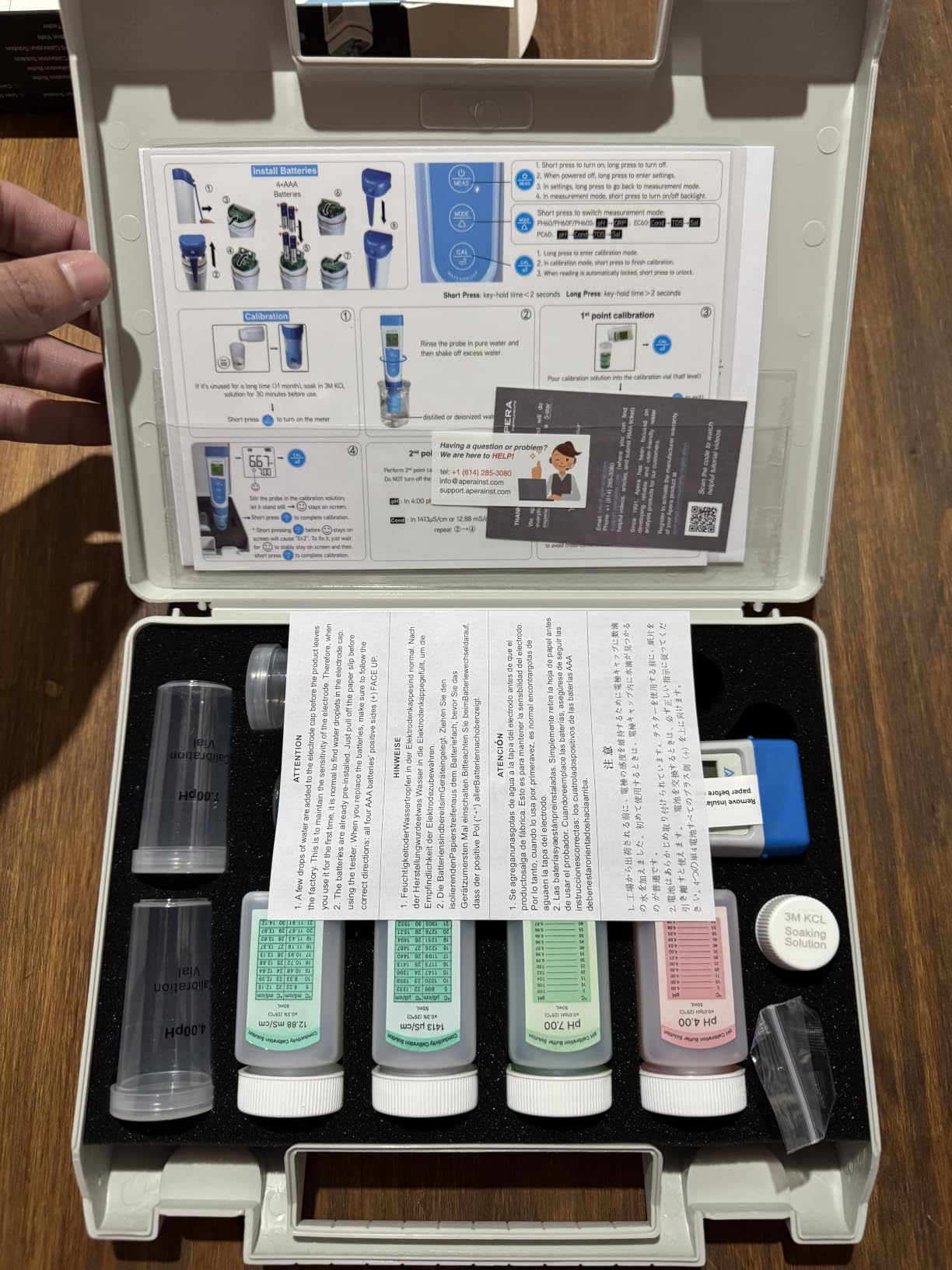
The replaceable probe is the standout feature that separates the PC60 from sealed consumer meters. When the electrode eventually wears out after extended use, you swap in a new probe instead of replacing the entire meter. This extends the instrument’s useful life by years and saves significant money over time. The IP67 waterproof rating means it survived being fully submerged during our testing, though it sinks rather than floats.
Calibration is straightforward with the included solutions in the complete kit. The three-point pH calibration gives you accuracy across the full measurement range rather than just one point. In my testing, calibration held stable for over three weeks of daily use without any noticeable drift. The smiley face indicator on the display confirms when readings are stable, which removes the guesswork from deciding when to record a value.
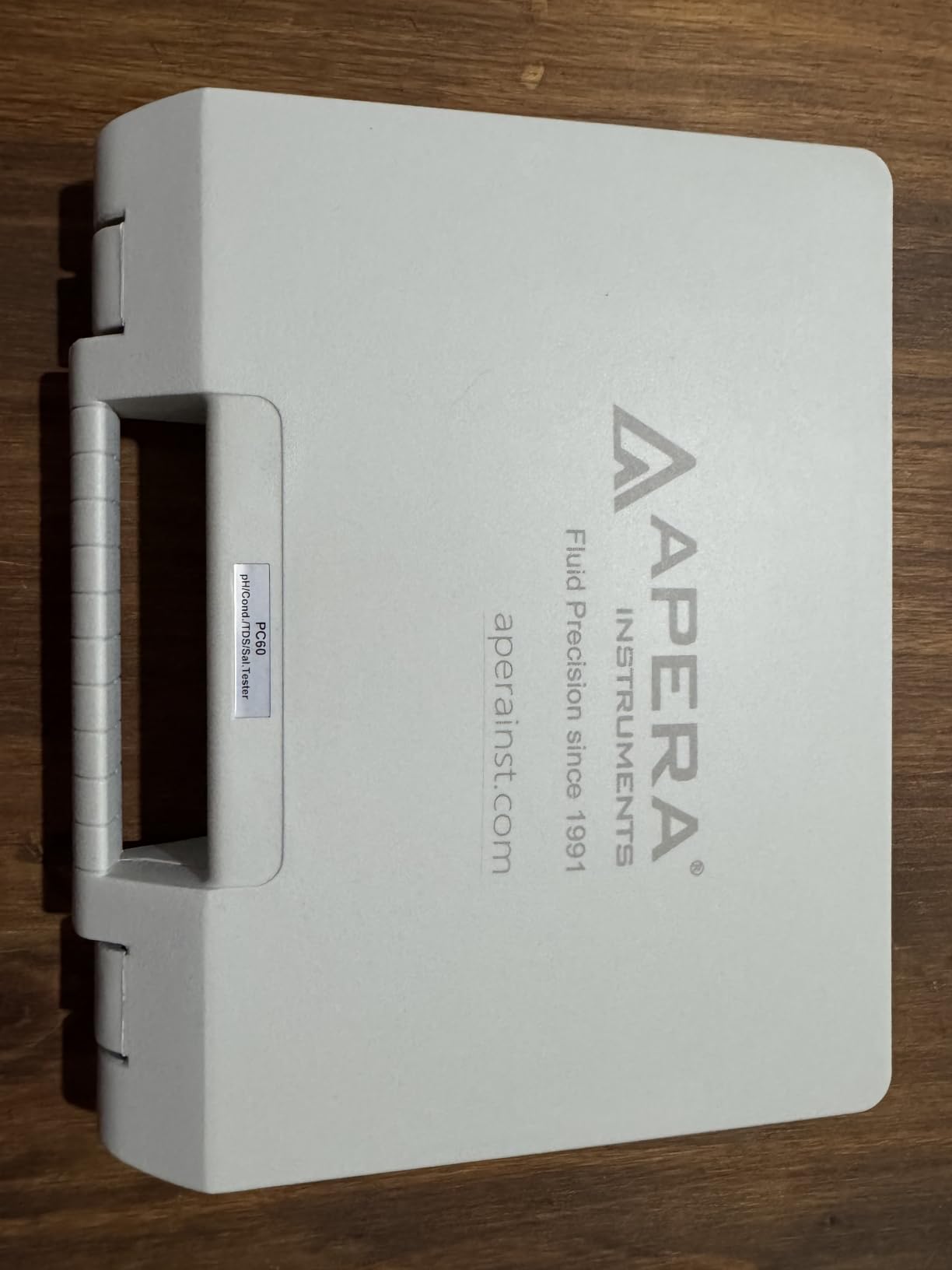
The complete kit arrives with calibration solutions, storage solution, batteries, and a carrying case. Everything you need to start testing comes in the box, which makes the premium positioning easier to accept.
Probe replacement and ongoing costs
The replacement probe for the PC60 costs roughly fifty to sixty dollars depending on the retailer you choose. Given that the meter itself is a significant investment, the ability to refresh accuracy with a new probe rather than buying a whole new unit is a major advantage that pays for itself over time.
Plan on replacing the probe every eighteen to twenty-four months with heavy daily use. Lighter use extends probe life further. The instrument body itself carries a two-year warranty, so the overall cost of ownership compares favorably to replacing cheaper sealed meters every year.
What about quality control concerns
Some users reported receiving defective units with EC reading errors straight out of the box. This appears to be an occasional batch issue rather than a fundamental design flaw. Apera offers a two-year warranty on the instrument and a six-month warranty on the probe to address these situations.
If you receive a unit that reads incorrectly, contact Apera directly for a fast replacement based on user reports. Most defective units are swapped within days rather than weeks, which minimizes downtime.
5. Myron L Ultrapen PT1 – Best Professional Pocket Conductivity Meter
Myron L Ultrapen PT1 Conductivity TDS Salinity Temperature Pocket Tester
Plus or minus 1% accuracy
Cond, TDS, Salinity, Temp
Aircraft-grade aluminum
Waterproof shock-resistant
Pros
- Exceptional plus or minus 1% accuracy
- Professional lab-grade performance
- Durable aircraft aluminum body
- One-button operation
- Waterproof and shock-resistant
Cons
- Higher investment required
- Low review count
- Packaging inconsistencies reported
The Myron L PT1 is what professionals carry when accuracy cannot be compromised. This pocket tester delivers plus or minus one percent of reading accuracy across conductivity, TDS, salinity, and temperature measurements. Pool service technicians, laboratory workers, and industrial water treatment professionals trust Myron L because the readings consistently match equipment costing significantly more.
Using the PT1 feels distinctly different from cheaper meters. The aircraft-grade aluminum body has a solid weight that inspires confidence the moment you pick it up. The one-button operation keeps things simple: press once to power on, dip the probe, and the autoranging display shows your reading in seconds. The selectable solution modes use proprietary compensation algorithms that adjust for different water types, which matters when you are testing everything from pool water to concentrated brine solutions in the same day.
The automatic temperature compensation works smoothly across the rated range up to 55 degrees Celsius. I found the readings stable even when moving between cold tap water and warm solution samples in quick succession. The auto shutoff preserves battery life, which is important for professionals who carry the meter all day without access to charging.
With only twenty-five reviews on Amazon, the PT1 has a much lower profile than mass-market meters. But the users who do review it are professionals who depend on accuracy daily in demanding environments. Fifty-nine percent gave it five stars, and the criticisms focus primarily on packaging issues rather than measurement performance. Some units arrived without the case or lanyard shown in product photos, which is frustrating at this investment level.
When this meter justifies the investment
If you service pools professionally, manage water treatment systems, or work in a field where plus or minus one percent accuracy directly affects your results, the PT1 pays for itself in reliability. The construction is built for daily field use, with shock resistance that survives drops and bumps that would crack a plastic pen.
For home users who check water occasionally, this level of precision is more than you need. A mid-range meter like the HM Digital COM-80 or Bluelab PENCON will serve just as well at a fraction of the cost.
Build quality versus consumer meters
The aluminum body sets the PT1 apart from the plastic construction of every other meter on this list. It feels like a professional instrument, not a consumer gadget. The trade-off is weight and size. At roughly 0.44 kilograms, it is noticeably heavier than pens like the Bluelab or HoneForest.
This is a tool you carry in a kit bag alongside other professional equipment, not one you forget about in your pocket. The construction quality matches the price tag, and the durability justifies the investment for working professionals.
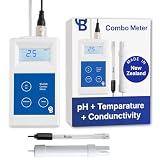
6. Bluelab Combo Meter (METCOM) – Best Professional pH and Conductivity Combo
Bluelab Combo Meter for pH, Temperature & Conductivity in Water – Easy Calibration, Digital EC/TDS/PPM Tester for Hydroponics & Indoor Plants (METCOM)
pH, EC, Temp triple function
Double junction pH probe
ATC
5-year warranty
Pros
- Three parameters in one device
- Easy two-point calibration
- Replaceable pH probe
- Durable 5-year warranty
- Factory calibrated conductivity probe
Cons
- Not waterproof
- Temperature probe has lag
- TDS not precise for RO water
The Bluelab Combo Meter brings pH, conductivity, and temperature together in one instrument designed for serious growers. This is the meter that indoor gardeners and commercial hydroponics operators trust for daily nutrient monitoring. It combines a double junction pH probe with factory-calibrated conductivity and temperature probes, giving you lab-quality data from a handheld device.
I tested the Combo Meter over a full hydroponic grow cycle, checking nutrient solution pH and EC daily across multiple reservoirs. The one-touch two-point calibration for pH is genuinely easy to use. You dip the probe in calibration solution, press the button, and the meter handles the rest automatically. One verified Amazon reviewer noted their calibration held for twenty-four days of heavy use, which matched my own experience closely.

The conductivity readings cover EC, PPM, and CF scales. This flexibility matters because different growing guides reference different units. Having all three available means you never need to convert numbers manually or second-guess which scale your reference material uses. The automatic temperature compensation keeps readings consistent regardless of solution temperature.
The replaceable pH probe is a significant cost advantage over sealed meters. When the pH electrode wears out, you spend around fifty-seven dollars for a replacement probe instead of buying an entirely new meter. The five-year warranty on the instrument body is the longest in this roundup by a wide margin. Bluelab stands behind their products with repair or replacement guarantees that few competitors match.

The Combo Meter is not waterproof, which is a notable drawback for hydroponic environments where water is everywhere. Dropping it in a nutrient tank could damage the internal electronics. The Bluelab PENCON floats if dropped. If your work area involves open reservoirs and splashing water, this difference matters when choosing between the two Bluelab options.
Daily nutrient monitoring workflow
The Combo Meter shines in routine daily use where speed and reliability matter most. Turn it on, select your parameter, dip the probe, and read the result. The entire process takes about ten seconds per measurement. For a hydroponic grower checking pH and EC twice daily across multiple reservoirs, this meter saves significant time compared to using separate instruments for each parameter.
The stable readings and long calibration hold mean you trust the numbers without constant rechecking. One Amazon reviewer described it as pushing a button and believing the result, which captures the experience perfectly.
Probe care and replacement schedule
The pH probe needs storage in proper storage solution to maintain accuracy between uses. Keep the probe wet and never let it dry out, as a dried pH electrode loses responsiveness quickly. Expect the pH probe to last twelve to eighteen months with daily use before needing replacement.
The conductivity probe lasts longer because it has no glass element to degrade. Budget for one pH probe replacement per year if you use the meter daily. The storage cap design could trap air pockets, so check that the probe stays properly hydrated during storage.
7. Apera Instruments EC700 – Best Benchtop Conductivity Meter for Lab Use
Apera Instruments EC700 Benchtop Conductivity/Temperature Meter, 1% F.S Accuracy, 0-200.0 mS/cm Range, 1-4 Points Auto. Calibration
Range: 0-200 mS/cm
1% F.S accuracy
Platinum black ATC electrode
50 data groups storage
Pros
- Intuitive guided calibration
- Large measurement range up to 200 mS/cm
- IP54 spill-proof design
- 50 data storage groups
- Includes electrode holder and solutions
Cons
- Correction factor adjustments unreliable
- US-only transformer included
- Software quirks reported
The Apera EC700 is the only benchtop meter in this roundup, and it serves a fundamentally different purpose than the handheld pens. This instrument stays on a lab bench or workbench and measures conductivity across an impressive 0 to 200.0 mS/cm range. For laboratory research, industrial quality control, and water treatment monitoring, the EC700 provides the measurement depth that portable meters simply cannot match.
Setting up the EC700 takes about ten minutes from unboxing to first reading. The platinum black ATC conductivity electrode connects to the main unit, and the detachable electrode holder keeps everything organized on your bench. The pre-mixed calibration solutions included in the box let you start measuring right away without ordering additional supplies separately.
The advanced auto-calibration mode walks you through the calibration process with on-screen prompts and self-diagnosis checks that flag potential issues before they affect your data. The 1% full-scale accuracy rating is appropriate for most lab and industrial applications. I tested it with standard calibration solutions and found the readings consistent across repeated measurements taken minutes apart.
The digital processing technology delivers quick, stable readings without the drift that plagues cheaper meters over extended testing sessions. The IP54 spill-proof and dust-proof rating protects against common lab accidents. While it cannot survive full submersion, it handles splashes and dust without issue. The 50-group data storage lets you save readings for later review, which is useful for batch testing or quality control logging.
The EC700 has limitations worth noting before purchase. The correction factor adjustment can be unreliable, with some users reporting they need to re-select values twice before the meter accepts the change properly. The included transformer is US-only, so international users need a separate adapter. With only eleven reviews on Amazon, the sample size is small, but sixty-two percent gave five stars for accuracy and ease of use.
Lab and industrial applications
The EC700 fits laboratories testing water samples, industrial facilities monitoring process water, and research environments requiring documented conductivity data with timestamped storage. The 200 mS/cm range covers everything from ultra-pure water to concentrated brine solutions in a single instrument.
For field work or portable applications, a handheld meter like the Myron L PT1 makes more practical sense. The EC700 belongs on a bench where it stays connected, calibrated, and ready for repeated sample testing throughout the workday.
Setup and ongoing calibration
The guided calibration mode is the best feature for new users unfamiliar with benchtop meter operation. The display prompts you through each step, telling you which solution to use and confirming when calibration succeeds or fails. This removes the guesswork that makes manual calibration intimidating for first-time lab equipment users.
For daily lab use, plan to calibrate weekly with fresh standard solutions. The self-diagnosis feature alerts you if the electrode needs cleaning or replacement, which prevents silent accuracy loss that could compromise your results over time.
How to Choose the Best Conductivity Meter for Water Testing?
Buying a conductivity meter starts with knowing what you need to measure and how often you plan to test. The right meter for a homeowner checking RO water weekly is very different from what a hydroponic grower or lab technician needs for daily measurements. Here are the factors that matter most when comparing your options.
Accuracy and measurement range
Accuracy specifications tell you how close the meter reading is to the true value of your water sample. Budget meters typically offer plus or minus 2% readout accuracy. Professional instruments like the Myron L PT1 deliver plus or minus 1% of reading for tighter tolerances. For most home and hydroponic use, plus or minus 2% is perfectly adequate and will not affect your decisions.
The measurement range matters depending on your water type. Drinking water and RO systems read in the low range, typically 0 to 500 ppm or 0 to 1000 uS/cm. Hydroponic nutrient solutions run higher, often 1000 to 3000 ppm. Seawater and brine solutions need meters that read up to 50,000 ppm or higher. Always check that the meter covers your expected range without maxing out at the top end.
Automatic temperature compensation (ATC)
Water temperature directly affects conductivity readings in measurable ways. A solution at 25 degrees Celsius reads differently than the same solution at 15 degrees. ATC adjusts the reading to a standard reference temperature, usually 25 degrees Celsius, so you get consistent numbers regardless of sample conditions.
Every meter in this roundup except the HoneForest includes ATC. If you test water at varying temperatures throughout the day, this feature is essential. Without it, you would need to manually note temperature and apply correction factors using charts, which introduces human error and slows down your testing workflow considerably.
Waterproof rating and durability
Consider where and how you will use the meter in real conditions. Hydroponic growers work around nutrient reservoirs constantly, making spills and drops likely. A waterproof meter like the Bluelab PENCON that floats if dropped is a practical advantage that saves you from replacing a waterlogged device. The Apera PC60 carries an IP67 rating, meaning it survives full submersion without damage.
Benchtop meters like the Apera EC700 have lower ratings (IP54) because they stay stationary in one location. For field work, look for meters with rugged construction, water resistance, and shock protection that matches your working environment.
Replaceable probes and long-term cost
Electrodes wear out over time with regular use. pH probes typically last twelve to twenty-four months before needing replacement. Conductivity probes last longer but still degrade gradually. Meters with replaceable probes, like the Apera PC60 and Bluelab Combo Meter, save money long-term because you refresh accuracy with a new probe instead of replacing the entire instrument.
Sealed units like the HoneForest and HM Digital COM-80 cannot have their probes replaced individually. When the electrode fails, you buy a new meter. For budget options, this trade-off is acceptable. For instruments at the higher end of the price spectrum, replaceable probes are worth seeking out.
Calibration options and stability
Calibration keeps your meter accurate over time by comparing its readings against known standard solutions. The best meters support multi-point calibration, which adjusts accuracy across the full measurement range rather than just one point. Factory-calibrated meters like the Bluelab PENCON arrive ready to use but eventually need recalibration as electrodes age.
Pay attention to how long calibration holds in real-world conditions. Forum users report that Bluelab meters hold calibration for weeks at a time. Cheaper meters may drift within days and require more frequent adjustment. The included calibration solutions with the Apera PC60 and EC700 make the calibration process convenient by providing everything you need in one kit.
TDS versus EC versus ppm: understanding the units
Conductivity meters report in different units, and understanding the differences prevents confusion when comparing readings across devices. EC (electrical conductivity) is the direct physical measurement, reported in uS/cm or mS/cm. TDS (total dissolved solids) is an estimate derived from EC using a conversion factor. PPM (parts per million) is a TDS expression that depends on which conversion factor your meter uses.
Different regions and industries use different TDS conversion factors. The NaCl factor (PPM 500) divides EC by two. The 442 factor (PPM 700) divides EC by approximately 1.4. Meters that display multiple scales, like the Bluelab PENCON and HM Digital COM-80, let you match whatever unit your reference materials or growing guides specify.
Matching meter type to your use case
Pocket pens work best for quick checks and portability. They fit in a pocket and run on small batteries. The HoneForest, HM Digital COM-80, and Bluelab PENCON are all pocket pens designed for grab-and-go testing.
Handheld multi-parameter meters like the Apera PC60 and Bluelab Combo Meter offer more features in a slightly larger package. They measure pH alongside conductivity, which reduces the number of separate instruments you need to carry. Professional pocket testers like the Myron L PT1 bridge the gap between consumer and lab equipment with near-lab accuracy in a portable format.
Benchtop meters like the Apera EC700 stay in one location on a workbench. They offer the widest measurement range and most advanced calibration features but sacrifice portability entirely. Choose this format if your testing happens in a fixed location with access to power.
Frequently Asked Questions About Conductivity Meters
What is a good conductivity level for water?
A good conductivity level depends on the water source and intended use. Drinking water typically ranges from 50 to 500 uS/cm. Reverse osmosis water should read below 50 uS/cm. Hydroponic nutrient solutions run much higher, between 1,000 and 3,000 uS/cm. Distilled water reads near zero. If your tap water suddenly shows a conductivity spike, it may indicate contamination or a supply change.
How do you test for conductivity in water?
Turn on your meter, remove the protective cap, and dip the electrode into the water sample to the recommended immersion depth. Stir gently to release any trapped air bubbles around the probe. Wait for the reading to stabilize, which takes one to five seconds depending on the meter model. Record the value, then rinse the probe with distilled water after each use.
What does a conductivity meter measure?
A conductivity meter measures water’s ability to conduct an electrical current, which directly indicates the concentration of dissolved ions such as salts and minerals. It passes a small alternating current between two electrodes and calculates conductance from the resulting voltage drop. Higher conductivity means more dissolved solids are present in the water sample.
What is the most accurate water meter?
The most accurate water meters in this roundup are the Myron L PT1 at plus or minus 1% of reading and the Apera EC700 at 1% full-scale accuracy. For lab-grade precision, benchtop meters like the EC700 with platinum black electrodes offer the tightest tolerances. Among portable options, the Myron L PT1 delivers professional accuracy in a pocket-sized format.
How accurate is a conductivity meter?
Conductivity meter accuracy ranges from plus or minus 1% to plus or minus 2% of reading depending on the model and price tier. Budget meters like the HoneForest offer reliable readings for home use but lack the precision of professional instruments. Meters with automatic temperature compensation maintain better accuracy across varying water temperatures. Regular calibration with standard solutions keeps accuracy within specifications over time.
What is a good EC reading for hydroponics?
A good EC reading for hydroponics depends on the growth stage and plant type. Seedlings and clones prefer 0.4 to 0.8 mS/cm. Vegetative growth typically runs 1.2 to 2.0 mS/cm. Flowering plants often need 1.6 to 2.4 mS/cm. Always check your specific plant requirements, as leafy greens need much lower EC than fruiting plants like tomatoes or peppers.
Final Verdict: Which Conductivity Meter Should You Buy?
The best conductivity meters for water testing cover a wide range of needs and budgets, and the right choice depends entirely on how you plan to use it. For most users, the Apera PC60 stands out as the best all-around choice. Its five-in-one measurement, replaceable probe, and IP67 waterproof build make it versatile enough for hydroponics, aquariums, and home water testing without needing separate instruments.
If you want solid value without sacrificing measurement quality, the HM Digital COM-80 delivers dedicated EC and TDS readings with automatic temperature compensation at a reasonable mid-range cost. For budget-conscious buyers who just need quick checks, the HoneForest TDS Meter gives you reliable three-in-one testing and has earned trust from over sixteen thousand reviewers.
Hydroponic growers who need factory-calibrated reliability should look at the Bluelab PENCON or the Bluelab Combo Meter for full pH and conductivity monitoring in one device. Professionals who demand plus or minus 1% accuracy will find the Myron L PT1 worth every penny for field work. And for laboratory settings, the Apera EC700 benchtop meter handles the widest measurement range with guided calibration and data storage.
Whatever your water testing needs, the right conductivity meter saves time and prevents guesswork. Pick the one that matches your use case, calibrate it regularly with standard solutions, and you will have accurate water quality data whenever you need it in 2026 and beyond.