
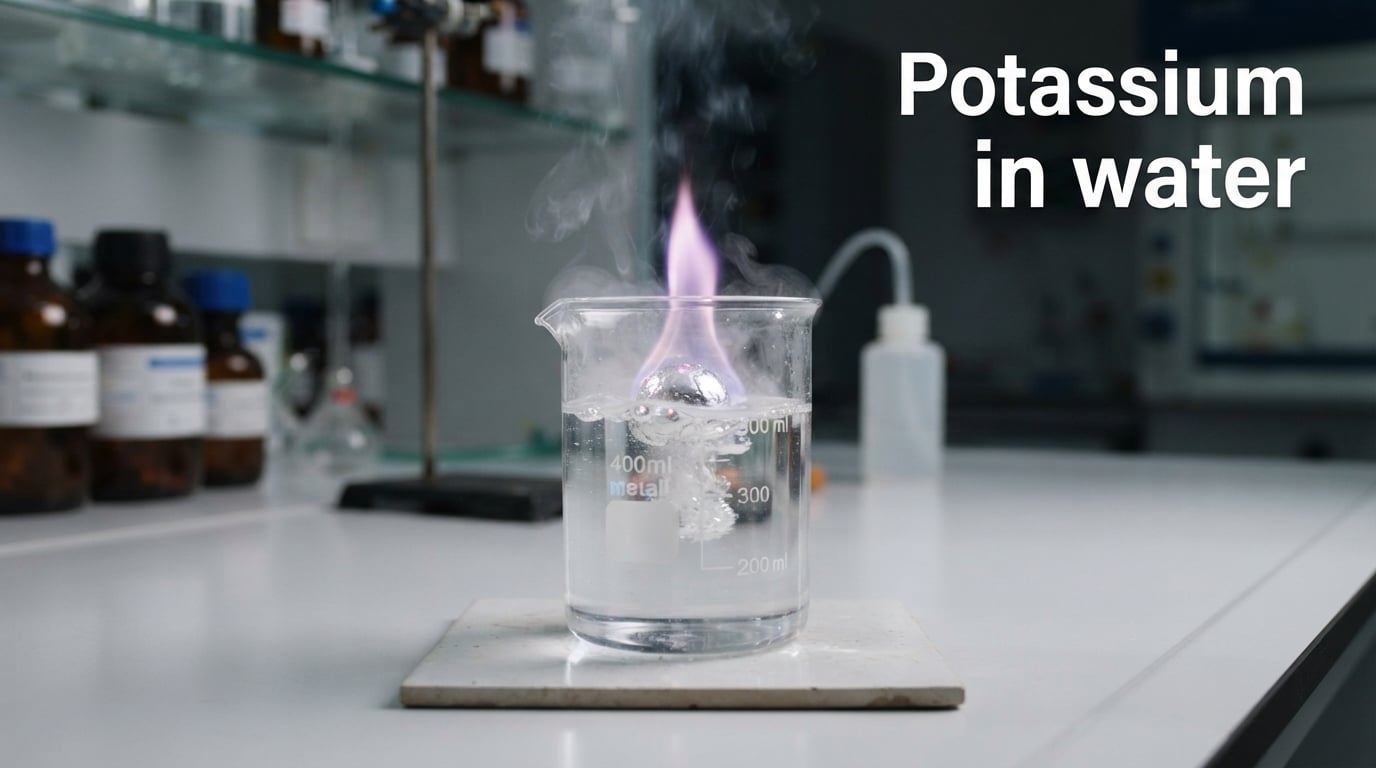
Drop a small piece of potassium metal into water and you’ll get one of chemistry’s most dramatic reactions. The metal skitters across the surface, melts into a silvery ball, bursts into a lilac flame, and disappears in a cloud of heat and fizz. It’s the kind of demonstration that makes students gasp from the back row.
But “potassium in water” means something completely different at your kitchen table. The same element that explodes on contact with liquid water is also one of the most common dissolved minerals in the mineral water you drink every day. Both forms are real potassium, just packaged differently.
In this guide, I’ll walk you through both worlds. We’ll start with the chemistry of elemental potassium reacting with water, including the balanced equation and why the reaction is so violent. Then we’ll shift to the drinking water side, covering potassium content in mineral water, health effects, and safety considerations. By the end, you’ll understand why bananas don’t explode and what your tap water actually contains.
Table of Contents
What Is Potassium? A Quick Definition
Potassium is a soft, silvery-white alkali metal with the symbol K and atomic number 19. It sits in group 1 of the periodic table, directly below sodium, and has an electron configuration of 2-8-8-1. That single outer electron is the reason this element behaves the way it does.
Sir Humphry Davy first isolated potassium in 1807 through electrolysis of molten potash, which is where the element’s English name originates. The chemical symbol K comes from the Latin “kalium.” Today, potassium ranks as the seventh most abundant element in Earth’s crust and the second most abundant metal after sodium.
Physical Properties of Potassium
Pure potassium metal is so soft you can cut it with a butter knife. The freshly cut surface shines like polished silver but tarnishes quickly when exposed to air, forming a grayish oxide layer.
- Melting point: 63.5 degrees C (146 F)
- Boiling point: 759 degrees C (1,398 F)
- Density: 0.862 g/cm³, lighter than water
- Atomic mass: 39.098 g/mol
- Appearance: soft, silvery metal
Because its density is less than water, potassium floats. That floating behavior is critical to what happens next when it meets liquid water.
The Chemical Reaction: What Happens When Potassium Meets Water
When elemental potassium contacts water, it undergoes a violent, exothermic reaction that produces potassium hydroxide and hydrogen gas. The balanced equation is:
2K(s) + 2H₂O(l) → 2KOH(aq) + H₂(g) + heat
That’s the equation you’ll find on every chemistry textbook page, and it’s the one featured snippets pull for “potassium in water formula” queries. The shorthand reveals four key things: solid potassium reacts with liquid water to form aqueous potassium hydroxide and hydrogen gas, releasing substantial heat.
Step-by-Step Breakdown of the Reaction
- The potassium atom’s single outer electron transfers to a water molecule.
- This produces a potassium cation (K⁺) and a hydroxide ion (OH⁻).
- Hydrogen atoms released from water pair up to form hydrogen gas (H₂).
- The heat generated ignites the hydrogen gas.
- The burning hydrogen produces the characteristic lilac or pale violet flame.
The reaction happens so fast that the metal melts from the heat, skitters across the water surface on a cushion of hydrogen gas, and burns with that unmistakable purple flame. Larger pieces can explode from the rapid gas expansion.
Why Potassium Reacts Violently With Water
The violence comes down to that lone outer electron. Potassium wants to lose it badly because doing so produces the stable electron configuration of argon. Water, meanwhile, has hydrogen and oxygen atoms willing to accept electrons.
When potassium meets water, the electron transfers almost instantly. The energy released as the new bonds form is more than enough to break the hydrogen-oxygen bonds holding the water molecule together. The released hydrogen gas then ignites from the heat, which is what you see as the lilac flame.
Comparing Potassium and Sodium Reactions
Potassium sits directly below sodium in the periodic table, and both react with water. But potassium reacts more violently because its outer electron is held less tightly. The further an electron sits from the nucleus, the easier it leaves, and potassium’s valence electron is in a higher energy shell than sodium’s.
Sodium reacts vigorously but typically melts into a ball that skitters without exploding in small amounts. Potassium skips straight to flame and small pops. Cesium, sitting below potassium, reacts explosively even in tiny quantities.
Safety Warning: Never Handle Elemental Potassium at Home
Elemental potassium metal is dangerous. It reacts violently with water, including the moisture in your skin or eyes. It must be stored under mineral oil or in an inert atmosphere to prevent contact with air or moisture. Reactions with larger pieces can launch flaming hydrogen several feet, and the resulting potassium hydroxide solution is caustic.
If you want to witness the reaction, watch a controlled demonstration in a laboratory or on a reputable science video. Do not attempt this at home.
Potassium in Drinking Water and Mineral Water
Now for the completely different side of “potassium in water.” The element that explodes on contact with water is the same one that dissolves peacefully in the mineral water you drink. The difference is the form.
Elemental potassium is a pure metal. The potassium in drinking water exists as dissolved ions, mostly potassium chloride (KCl) and potassium bicarbonate (KHCO₃). These ionic compounds are highly soluble and stable in water. They don’t react the way pure metal does because the electrons have already been transferred.
How Much Potassium Is in Natural Water?
Potassium is a common dissolved mineral in natural water sources. According to environmental data, seawater contains roughly 400 ppm potassium, while rivers typically carry about 2-3 ppm. Groundwater levels depend heavily on the surrounding geology and can range from less than 1 ppm to over 100 ppm in mineral-rich regions.
Mineral water brands often highlight their potassium content in mineral water as a selling point. A typical mineral water might contain 1-15 mg/L of potassium, with some European brands reaching higher levels due to underground mineral deposits.
Regulatory Standards for Potassium in Water
Most countries don’t regulate potassium in drinking water as a contaminant because low levels are considered beneficial rather than harmful. The U.S. EPA has no maximum contaminant level for potassium. The WHO doesn’t set a formal guideline either, though it acknowledges potassium’s role in cardiovascular health.
Some treatment processes, including standard filtration systems, can affect mineral content. If you’re remineralizing reverse osmosis water at home, getting the potassium in remineralized water balance right takes some trial and error.
Health Effects of Potassium in Water
Here’s where the apparent paradox resolves: elemental potassium and dietary potassium behave nothing alike. Potassium ions (K⁺) in water are the same form your body absorbs from bananas, potatoes, and electrolyte drinks. They’re essential for nerve function, muscle contraction, and fluid balance.
Why Foods With Potassium Don’t Explode
Bananas contain roughly 400 mg of potassium per 100 g, but none of it is elemental metal. The potassium exists as ionic compounds bound to organic molecules and other ions. Your body absorbs the K⁺ ions and uses them for cellular function. There’s no free electron to transfer, no violent reaction possible.
Your digestive system never encounters elemental potassium because it doesn’t exist in nature in that form. Even the potassium in supplements like potassium chloride tablets is the ionic compound, fully oxidized and stable in water.
How Much Potassium You Need
Adults need about 2,600-3,400 mg of potassium daily according to current dietary guidelines. Most people get plenty from food. A medium banana has about 420 mg, a cup of cooked spinach delivers 840 mg, and a potato can exceed 900 mg.
Drinking water contributes some, but typically a small fraction. If your water contains 5 mg/L of potassium and you drink 2 liters daily, that’s 10 mg, less than 1 percent of your daily need. Mineral water with higher potassium content can contribute more, but it’s still a secondary source compared to food.
When Potassium Levels Become a Concern
Hyperkalemia, or high blood potassium, usually results from kidney problems rather than drinking water. Healthy kidneys excrete excess potassium efficiently. People on certain medications, including some blood pressure drugs, may need to monitor potassium intake from all sources.
Drinking too much water won’t raise potassium levels significantly unless the water itself contains high mineral content. The bigger concern with excessive water intake is hyponatremia, low sodium, not potassium overload.
The Environmental Role of Potassium in Water
Potassium cycles continuously through water, soil, and living organisms. Rainwater picks up trace amounts as it passes through the atmosphere. Rivers carry dissolved potassium from weathering rocks and agricultural runoff to the oceans.
Agricultural fertilizer use has increased potassium concentrations in some watersheds over recent decades. While not directly toxic to aquatic life at typical environmental levels, elevated potassium can affect plant communities in sensitive ecosystems. Water treatment plants generally don’t remove potassium because it’s not considered a contaminant at natural levels.
In drinking water treatment, potassium permanganate is actually used as an oxidizing agent to remove iron, manganese, and certain organic compounds. The permanganate ion (MnO₄⁻) reacts with impurities and leaves behind trace manganese, not excess potassium.
Frequently Asked Questions About Potassium in Water
What happens if potassium is in water?
If elemental potassium contacts water, it reacts violently in an exothermic reaction that produces potassium hydroxide and hydrogen gas. The heat ignites the hydrogen, creating a lilac flame. In contrast, ionic potassium compounds (like potassium chloride) simply dissolve in water without any reaction.
Is there potassium in drinking water?
Yes. Most natural water sources contain small amounts of dissolved potassium, typically 1-10 mg/L in freshwater and around 400 mg/L in seawater. Mineral water often has higher levels due to underground mineral deposits.
Why does potassium react violently with water?
Potassium has a single outer electron that it readily gives up. When it contacts water, the electron transfers almost instantly, releasing enough energy to break water molecules apart and ignite the resulting hydrogen gas. The reaction is more violent than sodium’s because potassium’s outer electron is held less tightly.
Can drinking too much water raise potassium levels?
Drinking large amounts of typical tap or bottled water won’t significantly raise potassium levels because the concentration is usually low. However, potassium levels are primarily regulated by your kidneys. People with kidney problems or on certain medications should monitor total potassium intake.
What happens when you put pure potassium in water?
Pure potassium metal floats on water, melts from the heat of reaction, skitters across the surface, and bursts into a pale violet (lilac) flame as the released hydrogen gas ignites. The reaction produces potassium hydroxide and hydrogen gas. Small pieces react quickly; larger pieces can explode.
Key Takeaways on Potassium in Water
Potassium in water spans two completely different realities. As an elemental metal, potassium reacts violently with water in a classic chemistry demonstration, producing potassium hydroxide, hydrogen gas, and a lilac flame. As dissolved ions in drinking water and mineral water, potassium is a beneficial mineral that contributes to your daily intake.
Understanding the difference between elemental potassium and ionic potassium compounds clears up the apparent paradox of why bananas are safe but the metal explodes. If you’re interested in the practical side, check our guide on how much potassium in mineral water actually matters for your hydration and health.