
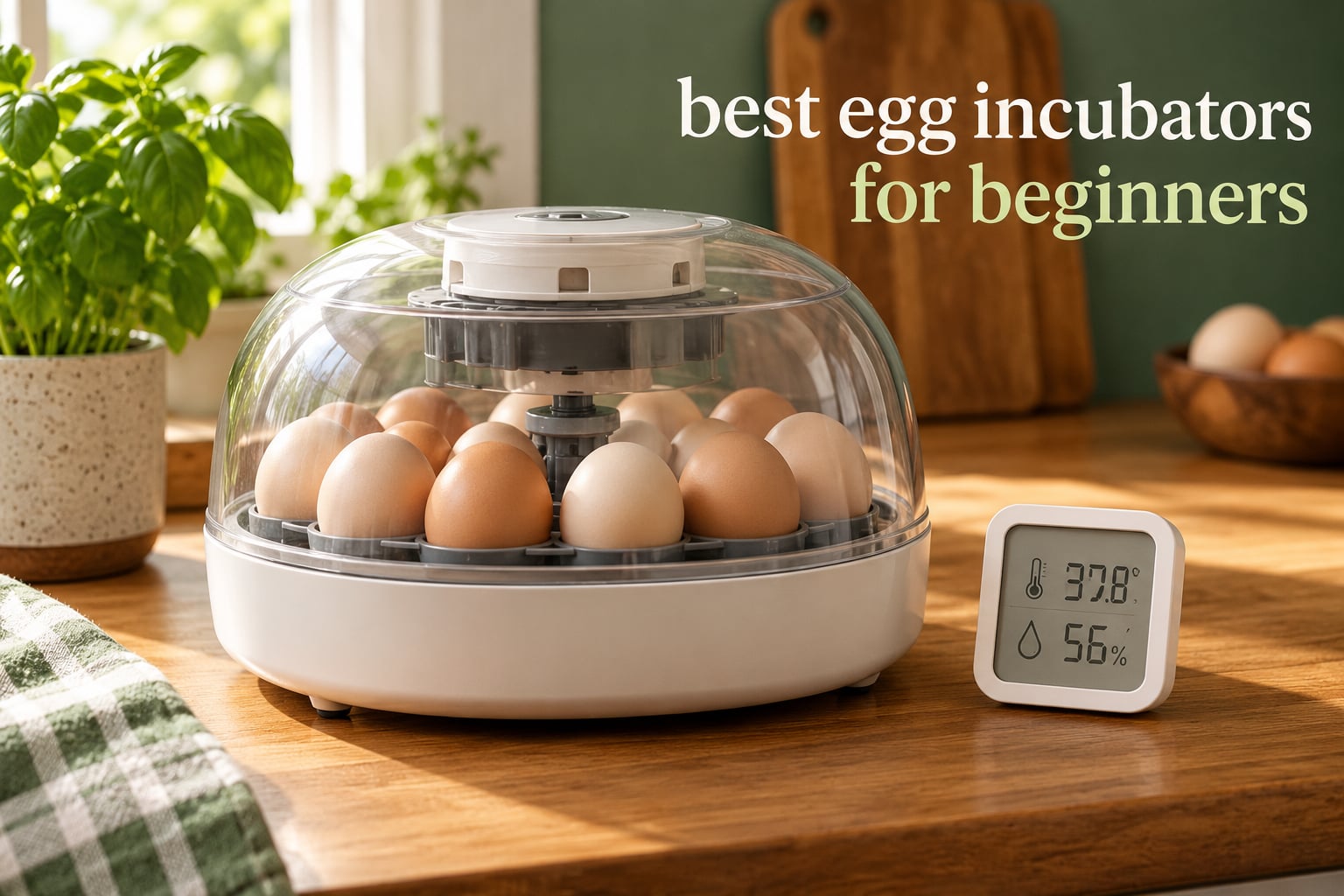
If you are hatching for the first time, the best egg incubators for beginners are the ones that hold temperature steady, keep humidity predictable and turn the eggs without you remembering to do it. Our top pick is the Harris Farms Nurture Right, a 22-egg unit with 360-degree visibility and an auto-turner that stops on its own before hatch day. The MATICOOPX 20-egg incubator is the value pick because it bundles a built-in egg candler and an external water refill into one box. If you would rather buy once, the Brinsea Mini II Advance runs the most complete program of any incubator we covered, with room temperature alarms and a 3-year warranty.
We spent weeks reading owner reviews, comparing published specifications and working through the failure patterns that show up again and again on backyard poultry forums. Ten incubators made the cut, from 7-egg dome units to 56-egg cabinets. Every one of them is a real, currently sold model with a meaningful review history.
A word on what this article cannot promise. Hatch rate is not a spec sheet number. It depends on the eggs you start with, how fertile the parent flock is, whether someone stored those eggs correctly before they went in, and how faithfully you tracked temperature and humidity. What an incubator can do is hold a stable environment for 21 days so the eggs have the best possible chance. That is what separates a good beginner incubator from a bad one, and that is what we judged on.
Before the reviews, three quick framing questions. How many eggs do you actually need? Most first-timers should start with 6 to 12 eggs so a failed batch stings less. What species are you hatching? Chicken, duck, quail and goose eggs all need different trays, temperatures and humidity. And where will the incubator live? A bedroom, a garage and a damp basement will each stress a different part of the machine. Answer all three honestly and the right model becomes obvious fast.
We also broke down the buying criteria in depth further down, including the features that genuinely change outcomes and the ones that are just marketing. If you want to see how we test and compare other beginner gear, our 3D printer guide for beginners uses the same structure of matching specs to real use cases.
Table of Contents
Top 3 Best Egg Incubators for Beginners in 2026
These three cover the realistic range of a first hatch. The Nurture Right is the most-reviewed incubator in this group by a wide margin, the MATICOOPX gives you the most feature per unit of money, and the Brinsea is the one to buy if you intend to be doing this for years.


MATICOOPX 20 Egg Incubator
- Built-in egg candler
- external water refill
- auto turn every 60 minutes
All 10 Egg Incubators at a Glance (October 2026)
Use this table to narrow the field quickly. Capacity, airflow style and how water gets into the machine are the three differences that actually change day-to-day results.
| Product | Specifications | Action |
|---|---|---|
| Harris Farms Nurture Right 22 Egg |
|
Check Latest Price |
| MATICOOPX 20 Egg Incubator |
|
Check Latest Price |
 Farm Innovators 41 Egg Farm Innovators 41 Egg |
|
Check Latest Price |
 APDOE 12 Egg Incubator APDOE 12 Egg Incubator |
|
Check Latest Price |
| Brinsea Mini II Advance |
|
Check Latest Price |
 IBKINXX 12 Egg Incubator IBKINXX 12 Egg Incubator |
|
Check Latest Price |
 TRIOCOTTAGE 18 Egg Incubator TRIOCOTTAGE 18 Egg Incubator |
|
Check Latest Price |
 Onsju 18 Egg Incubator Onsju 18 Egg Incubator |
|
Check Latest Price |
 Sailnovo 56 Egg Incubator Sailnovo 56 Egg Incubator |
|
Check Latest Price |
 TRIOCOTTAGE 12 Egg M12H TRIOCOTTAGE 12 Egg M12H |
|
Check Latest Price |
1. Harris Farms Nurture Right 22 Egg Incubator: Best Overall for Beginners
Harris Farms Nurture Right Egg Incubator with Auto Turner, Holds 22 Eggs
22 chicken eggs or 12-18 duck eggs
360-degree induced airflow
2.2 pounds
Viewing from any angle
Pros
- Holds 22 chicken eggs plus 12-18 duck and 22-24 pheasant eggs
- 360-degree viewing for monitoring from any angle
- Automatic egg turning with auto-stop three days before hatch
- Clear humidity control display and knob
- Even 360-degree airflow for uniform heat distribution
Cons
- Egg capacity is fixed at 22 chicken eggs
- Advanced features assume some familiarity with incubation settings
This is the incubator we recommend to most first-time hatchers, and the reason is volume of evidence. More than 5000 reviews sit behind this listing, which means the failure modes are already documented. You will not be the first person to ask about the humidity knob or the turner noise. Somebody asked last year, and somebody answered.
The capacity is 22 chicken eggs, and the same tray takes 12 to 18 duck eggs or 22 to 24 pheasant eggs. That flexibility matters more than raw count, because a lot of beginners who order 24 eggs end up with 8 unfertilized ones and are suddenly grateful to have room for a second attempt.
The viewing experience is the standout feature for a beginner. Instead of a small porthole in the lid, you can look at the eggs from any angle, which means you can watch for internal pipping without disturbing the whole batch. For a first hatch, being able to see what normal development looks like is worth more than any other single feature on the list.
Airflow is described as 360-degree induced circulation, and owners consistently report even heat with no cold corner. That matters because a still-air design in a dome-shaped cabinet can hold a couple of degrees of difference between the top eggs and the bottom eggs, and embryos notice that difference.
The turner runs automatically and stops three days before the expected hatch date. You do not have to remember to switch it off, which removes the single most common mistake new hatchers make right at the end of a cycle. There is a clear humidity control display and knob on the front, and the readout is large enough to check at a glance from a standing position.
Why this one works for a first hatch
The learning curve is almost zero because the machine makes most decisions for you. Turn on the unit the day before your eggs arrive, watch the display settle, and you have a baseline. A large review base also means the manuals, spare parts and troubleshooting advice already exist online, which matters when you are stuck at day 14 wondering whether the reading is normal.
It weighs 2.2 pounds, so moving it to a warm room is easy. The 360-degree transparency also makes it a good choice for a classroom setting where a group of kids needs to watch the process without crowding around a window.
Where it falls short
Capacity is fixed at 22 chicken eggs. If you plan to hatch 40 or more birds a year, you will outgrow it within a season and be shopping again. The controls also lean toward someone who has read about incubation settings before, so pair it with a settings guide rather than assuming the defaults are right for your altitude and season.
Long-term owners also flag the turner as less reliable with heavy eggs such as large duck eggs, where the roller can slip. If your plan is mostly ducks or geese, look at a unit with a gentler rotating mechanism instead.
2. MATICOOPX 20 Egg Incubator: Best Value With a Built-In Egg Candler
MATICOOPX 20 Egg Incubator with Humidity Display, Egg Candler, Automatic Egg Turner, for Hatching Chickens
20 egg capacity
Fan-driven circulating airflow
External water refill port
One year warranty
Pros
- Circulating fan system holds temperature steady
- External water refill avoids temperature and humidity drops from opening the lid
- Built-in egg candler means no extra accessory purchase
- Automatic turning every 60 minutes with auto-stop before hatch
- One-year warranty
Cons
- Small 20-egg capacity limits batch sizes
- Humidity control requires manual monitoring in changing room conditions
The MATICOOPX is the one we would hand to a beginner with a strict accessory budget. Most people buying an incubator also need an egg candler, and many also buy a separate humidity aid on their first run. This one has the candler built into the lid, so there is nothing extra to buy.
Its 4.5 average rating across more than 900 reviews is the second-highest figure in this group, and the category ranking sits near the top of poultry egg incubators. That combination of rating and volume is unusual for a value-tier machine, and it is why this lands at number two rather than further down the list.
The temperature system uses a strong circulating fan rather than a still-air chamber. In practice that means the display reading is a fair description of the whole cabinet, not just the area near the sensor. Stable temperature is the variable that has the biggest effect on hatch rate, so this single design choice carries a lot of weight.
The external water refill port is the feature owners mention most often. Adding water through the port means you never lift the lid, and lifting the lid is what knocks humidity down and temperature up in most plastic cabinets. On a machine without the port you end up opening it several times a day, and each opening is a small environmental shock to developing embryos.
Turning runs side to side every 60 minutes and stops automatically three days before hatching. Sixty minutes is a short interval, which is fine because over-turning is less of a risk than under-turning, and the automatic stop means the eggs stay settled when pipping starts.
What makes it a good first incubator
Everything a beginner needs is in the box. The candler, the auto-turner and the refill port are the three things that separate a smooth first hatch from a frustrating one, and this machine has all three while staying lighter on the wallet than most of the list. It is 6.8 pounds, so it is portable but not flimsy.
The one-year warranty is shorter than the three years offered on the premium pick, so it is a reasonable trade for the lower entry point. If you are the type who keeps equipment for a decade, factor that into the decision.
Where it falls short
Twenty eggs is a modest batch. It also means that when fertility is below expectations, you have less room to make up the difference. Owners with larger flocks generally move up after a season.
Humidity still needs your attention. The display reports the reading, but in a room with very dry or very damp air the incubator follows that room rather than fighting it. A simple independent hygrometer placed next to the machine is worth the small extra cost.
3. Farm Innovators 41 Egg Incubator: Best for Large Beginner Batches
Farm Innovators 41 Egg Digital Circulated Air Incubator, Auto Turner, White
41 egg capacity
Digital display with days to hatch
18 x 18 x 8 inches
8.75 pounds
Pros
- Largest capacity in this roundup at 41 eggs
- Digital display reports temperature humidity and days remaining
- Integrated fan circulates fresh air to stabilise temperature
- Deep bottom tray suits larger duck and goose eggs
- Includes an egg candler and easy-fill water channels
Cons
- Factory pre-set temperature is not user adjustable
- Foam construction is less durable than plastic-bodied units
- Only a 4.0 average rating with a 14% one-star share
Forty-one eggs in one tray makes this the sensible pick if your goal is to grow your own replacement flock rather than watch a process once. Nobody needs 41 chicks from a first attempt, but a strong hatch rate and a few infertile eggs means you still end up with a realistic number.
The display is the part we like. It reports temperature, humidity and days remaining, so you are not doing mental math from the day you set the eggs. A high and low temperature notification light gives you a visible warning when something drifts, which is more useful during a nap or a work shift than a number you have to interpret.
Air comes from an integrated fan that circulates fresh air through the cabinet. Combined with the large 360-degree picture window, you get a view of the whole batch at once. The included egg candler means monitoring costs nothing extra, and the deep bottom tray is shaped to accept large duck and goose eggs rather than only chicken eggs.
Water goes in through easy-fill channels in the foam base, which is simple to refill. The unit measures 18 by 18 by 8 inches and weighs 8.75 pounds, so it occupies real counter or table space. Plan where it lives before you buy, because moving it after eggs are in means handling a large warm box full of water.
Reviewers like the capacity and the informative display. They also rate it lower than anything else here, at a 4.0 average with a one-star share in the mid teens. That is not a failure rate for the machine, it is a spread of expectations, and the most common complaints point at the same feature.
Why it earns a place on the list
Few incubators at this capacity show days-to-hatch on the display, and fewer still include a candler. For a beginner running 30-odd eggs, checking 41 individual eggs by hand against a water jug is a lot of evening work. This removes most of it.
The information density of the readout is what separates it from bare-bones foam cabinets. You can glance at one screen each morning and know whether anything needs attention.
Where it falls short
The temperature is factory pre-set to 100 degrees Fahrenheit and is not user adjustable. If your room runs cool or your eggs need a slightly higher setting, you cannot make that change. That is a genuine limitation and the single biggest reason we cannot recommend it as the top pick.
Foam construction is also lighter on durability than a plastic-bodied cabinet, and it is harder to disinfect thoroughly between hatches. The water channels are convenient, but they leave more crevices to scrub.
4. APDOE 12 Egg Incubator: Best Budget Pick for Learning the Process
APDOE Egg Incubators for Hatching Eggs, Temperature and Humidity Control, Automatic Egg Turning, Egg Candler, External Water Bottle, Air Vent, for Chicken, Duck & Quail Eggs, 12 Eggs
12 egg capacity
Dual external water bottles
10 x 10 x 5.5 inches
3.5 pounds
Pros
- Bright easy-to-read control panel and clear instructions
- Automatic turner removes one manual step from the 21-day process
- Water bottles let you see and control remaining water at a glance
- Quiet operation and easy disassembly for cleaning
- Reviewers report strong hatch results even with questionable eggs
Cons
- Humidity reading is strongly influenced by ambient room humidity
- Built-in candler light is dim
- Fan housing hangs into the hatch space so newly hatched chicks have little room
The APDOE has become something of a first incubator in a lot of beginner circles, and the review set is unusually honest about where it struggles. Roughly 1400 reviews give a 4.3 average, and the recurring theme is that it works if you manage humidity yourself.
What you get for a first run is genuinely useful. Turning happens automatically every 2 hours, the tray removes for the final 3 days so chicks are not rolled, and the 360-degree transparent dome means you can watch pipping without opening anything.
The dual external water bottles are the clever part. You fill two bottles outside the machine and watch the level through the plastic, so topping up does not require lifting the dome. An adjustable air vent on the top gives you a second humidity control, and a built-in candler covers embryo checks. There is also a removable washable tray, though the manufacturer specifies hand washing rather than dishwasher.
Owners frequently praise the readable control panel and the clear instructions, both of which matter more than they sound. Confidence comes from knowing what the machine is doing, and a well-labelled panel removes a lot of early stress.
Size is 10 by 10 by 5.5 inches at 3.5 pounds, so it fits a kitchen counter and moves easily between rooms. For a first batch of 6 to 12 eggs this is close to an ideal size, because a smaller batch lets you learn the settings without a large downside if something goes wrong.
Why beginners end up recommending it
Owners report good to excellent results, including first attempts from people who had never incubated before. The automatic turner removes the single most time-consuming daily task, and the removable tray for the last 3 days shows the manufacturer thought about the actual hatch rather than just the incubation.
The warranty is also better than the category average, with a 30-day money-back guarantee, a 3-year limited warranty and lifetime expert support. That is a meaningful comfort on a first purchase where you are not sure whether you will continue hatching.
Where it falls short
Humidity is the honest weakness. The reading tracks the room closely, so in dry air or a humid basement you will need to compensate, commonly with a foam insert or a towel draped over part of the unit. The built-in candler light is dim enough that some owners add their own brighter light.
The fan housing hangs into the hatch space, so newly hatched chicks have very little floor to stand on. A small non-slip mat helps. A small number of reviews also report a hardware failure partway through incubation, which is why owners in the same threads recommend keeping a backup plan for the final week.
5. Brinsea Mini II Advance: Best Premium Incubator for Long-Term Hatchers
Brinsea Mini II Advance Incubator with Automatic Turner for Hatching 7 Eggs
7 chicken eggs with insert
12 small eggs with optional insert
Menu-driven controls
3-year warranty
Pros
- Set-and-forget operation with temperature humidity and turning handled automatically
- External water top-up avoids opening the incubator
- High low temperature and room temperature alarms add safety
- Clear dome makes pipping and hatching easy to watch
- Backed by a 3-year warranty
Cons
- Very small capacity compared with other picks in this roundup
- Turner struggles to roll large eggs such as turkey eggs
- Tight space for newly hatched chicks
The Brinsea Mini II Advance is the most complete machine here per egg, and the reviews read like long-term ownership reports rather than first impressions. Owners describe buying it once, running many batches and still using it years later. At 4.5 across 566 reviews, that is a rare level of consistency for a small appliance.
Capacity is 7 standard chicken eggs with the included insert, or 12 small eggs if you buy the optional insert. That is a small number, and for most people it is a real limit. It is also the right size if you are hatching for a specific rare breed rather than building a flock.
The control system is the standout. Menu-driven settings handle temperature, automatic turning with auto-stop and a countdown to hatch, so you set the start date once and the machine tracks the rest. There is a room temperature alarm in addition to the usual high and low temperature alarms, which is the feature that saves eggs when a room gets cold overnight and nobody notices for eight hours.
Humidity is handled through an external water top-up, so the dome stays closed. The clear dome gives a very good view of pipping, and the plastics are treated with antimicrobial protection, which helps a little between batches. Fan-assisted air circulation keeps the small chamber even, which is not a given in a dome this size.
The unit measures 8.5 by 8.5 by 7 inches and weighs 3 pounds. That footprint is genuinely small, which makes it easy to run several batches in different rooms or to bring it to a classroom. Multiple small incubators is a common strategy among people who want to test settings without risking a whole batch.
Why experienced hatchers keep recommending it
It is one of the few incubators here that handles the whole cycle without a manual decision, and it does that with a level of feedback the others cannot match. Owners credit the alarms specifically for catching problems early, and the external water port for eliminating the temperature dip that comes from opening the unit.
Build quality and customer support come up repeatedly, and the 3-year warranty is the longest in this group. If you plan to hatch for many years, the durability argument matters as much as any spec.
Where it falls short
Seven eggs is very few, and the hatching space is tight once chicks are inside. Many owners cut their own non-slip mat to lay over the included cardboard hatching disk, which makes the space more usable. There is also no built-in humidity sensor, so humidity is managed by following the water instructions rather than by a displayed number.
The turner cannot move very large eggs, so turkey eggs are effectively ruled out, and the auto-turn beep is loud enough to notice in a bedroom. If you are hatching chickens and can live with a small batch, none of that is disqualifying.
6. IBKINXX 12 Egg Incubator: Best Compact Starter With Selectable Turning
Incubator for Hatching Eggs – 12 Egg Capacity, 360° Viewing for Chicken
12 egg capacity
LED Fahrenheit display
10.4 x 10.4 x 6.4 inches
Two-year warranty
Pros
- Turn frequency is user-selectable at 60 120 or 180 minutes
- External water filling keeps humidity stable without lid openings
- Built-in candler lets you identify infertile eggs
- Fully transparent 360-degree body for undisturbed monitoring
- Disassembles easily for cleaning and a two-year warranty is included
Cons
- Small 12-egg capacity
- ABS plastic body is lighter-duty than premium units
- 10% one-star share suggests occasional unit or component issues
The IBKINXX is a straightforward entry-level machine whose strongest argument is the adjustable turn interval. Most budget incubators give you one fixed schedule. This one lets you choose 60, 120 or 180 minutes, which is more control than a beginner needs but more than most competitors at this level offer.
It holds 12 eggs, has an LED display showing Fahrenheit, and uses an external water filling system so you do not open the lid to refill. A built-in candling feature lets you identify infertile eggs partway through, and the entire body is transparent for 360-degree viewing.
Cleaning is straightforward. The unit disassembles, the lower tray is washable and the upper vent cover opens for access to the parts that need scrubbing. That matters more than it sounds, because an incubator you cannot clean cleanly is an incubator that gives you problems in your second and third batch.
Two years of manufacturer warranty coverage is a slight edge over the one-year terms common in this category, and the box includes a top cover, base, grid, egg frame, card strips, tube assembly and water bottle. Dimensions are 10.4 by 10.4 by 6.4 inches, so it fits a normal counter.
The 4.2 average across 470 reviews reflects a generally positive experience with a modest ceiling. Seventy-one percent of ratings sit at the top, and the roughly 10% one-star share suggests occasional component problems rather than a consistent design flaw.
Why it suits a small first batch
Twelve eggs is a sensible learning size. It is big enough that you learn how to manage humidity over three weeks, and small enough that a total loss is a disappointing afternoon rather than a ruined season. The transparent body is also a genuine advantage if children or a classroom group will be following the process.
The external water filling system means the most common daily chore, refilling humidity, does not require opening the lid and dropping the internal temperature.
Where it falls short
The ABS plastic body is lighter-duty than the plastic-bodied units on this list, and a top-three category rank paired with 470 reviews suggests high demand with a shorter support history than the established brands. The 12-egg ceiling is also the limit; there is no larger tray available.
If your eggs are large duck or goose eggs, a 12-egg domestic tray is a poor fit. This machine is built for standard chicken and quail eggs.
7. TRIOCOTTAGE 18 Egg Incubator: Best for Faster Humidity Response
Triocottage Egg Incubators for Hatching Eggs, Temperature&Humidity Control
18 egg capacity
External bottle plus atomizer mist
Built-in LED candler
Two interchangeable egg trays
Pros
- Atomizer-based humidity control responds faster than plain water trays
- Quiet fan and even heat distribution
- Adjustable turning interval and duration with automatic stop before hatch
- Built-in LED candler saves buying a separate tool
- Two egg trays cover goose chicken duck and quail sizes in one unit
Cons
- Lowest average rating in this roundup at 4.0 with a 14% one-star share
- Only one egg type should be incubated at a time for best results
- Newer listing with a shorter review history
Most small incubators raise humidity with a shallow water tray and wait for evaporation. This one adds a built-in atomizer that turns water into a fine mist, so the reading responds noticeably faster after you make an adjustment. If your previous attempts ended in dry shells or stuck chicks, humidity response speed is the thing to look at.
Capacity is 18 eggs, and the unit is 4.8 pounds with package dimensions of 13.43 by 12.99 by 7.72 inches. The listing is a recent one, so treat its 510 reviews as a shorter history than the older models on this list.
The turning system runs for 10 seconds every 90 minutes, and both the interval and the duration are adjustable. It stops automatically during the final 3 days. A real-time monitoring system includes abnormal-condition alerts, so a temperature excursion produces a notification rather than a silent drift.
What stands out is the tray system. Tray A holds up to 6 goose eggs, 18 chicken eggs or 30 quail eggs. Tray B supports up to 12 chicken or duck eggs on the outer ring, or 24 smaller eggs in total. One machine covering goose, chicken, duck and quail sizes is unusual at this size and useful if you are not sure which species you will end up hatching.
The transparent 360-degree cover makes it a good observation unit for classrooms and lab settings, and the built-in LED candler removes another accessory purchase. The quiet fan is a real plus if the incubator lives in a workspace.
When the atomizer matters
Humidity changes you make in the last week, when you go from around 50 percent during incubation to roughly 65 percent for hatching, need to take effect within hours rather than overnight. An atomizer shortens that response time, which is exactly the window where chicks are most vulnerable to drying out inside the shell.
Real-time alerts and adjustable turn timing are also valuable for someone running a batch away from home. The machine is essentially reporting to you so you do not have to visit it twice a day.
Where it falls short
This has the lowest average rating in the group at 4.0, with a one-star share in the mid teens, so set expectations accordingly. A 62 percent five-star share is well below what the better-reviewed models achieve.
Owners note that only one egg type should be incubated at a time for the best results, and the review history is shorter than the established brands. If you want the fastest humidity response, this delivers it. If you want the longest support history, look elsewhere.
8. Onsju 18 Egg Incubator: Best for Classrooms and Lab Settings
18 Egg Incubators for Hatching Eggs, Automatic Egg Turning and Humidity Control Incubator for Hatch Chicken Duck Quail Pigeon Pheasant Partridge Home Classroom Lab-
18 standard eggs or 40 small eggs
Sealed humidity system
Silent fan
11.73 x 11.73 x 6.85 inches
Pros
- Number one ranked in Lab General Purpose Incubators
- Sealed auto-regulated humidity system reduces manual refills
- Silent fan technology keeps noise down
- Clear STOP indicator confirms when auto-turning has paused
- High-intensity LED candler is brighter than most built-in lights
Cons
- Auto-turn stops 4 days before the hatch date which is longer than the standard 3
- Only 404 reviews so the long-term track record is short
The Onsju holds 18 standard eggs for chicken or duck, or up to 40 smaller eggs for quail or parrot. That flexibility makes it the pick here if you are setting up a classroom or 4H project rather than a home flock, and its number-one ranking in lab general purpose incubators is consistent with that positioning.
The most interesting component is the sealed, auto-regulated humidity system. Unlike an open water tray that slowly evaporates, this replenishes moisture across development stages, which cuts down on refills and lid openings. For a group setting where someone has to check the machine on a schedule, fewer interventions is a genuine advantage.
Airflow comes from a silent fan, and the digital temperature control produces both audible and visual alerts if conditions drift. The 360-degree crystal-clear dome pairs with a high-intensity LED candling light, which is noticeably brighter than the built-in lights on most budget incubators. Better candling means you can actually clear infertile eggs instead of guessing.
Turning is customizable at 60, 120 or 180 minute intervals. It pauses automatically 96 hours before the set hatch day and shows a STOP light on the display, so you can confirm the turner has switched off without guessing.
The unit measures 11.73 by 11.73 by 6.85 inches and weighs 5.43 pounds. The orange colour and dome design are aimed at visibility, which fits an educational context where a group of students watches the progress together.
Why it suits teaching and lab use
A silent fan and a sealed humidity system are the two features that matter most when an incubator sits in a room full of people. The machine asks less of the person supervising it, which means fewer missed adjustments during a school week.
Handling up to 40 quail eggs at once also means a group project produces a visible result in a reasonable time, since smaller eggs incubate in less than three weeks.
Where it falls short
The auto-turn stops 96 hours before the hatch date rather than the more common 72 hours, so the eggs sit undisturbed for four days instead of three. This tripped up at least one buyer until the manufacturer issued a clarification telling users to check the STOP indicator on the display. Know it in advance and it is not a problem.
With 404 reviews the long-term record is shorter than the established brands on this list, so there is less history to lean on if something goes wrong in future batches.
9. Sailnovo 56 Egg Incubator: Best for High-Volume Hatching
Sailnovo 56 Egg Incubator for Hatching Eggs with Automatic Egg Turning Gray
56 egg capacity
Automatic humidification
18.7 x 16.1 x 6.3 inches
Works as a brooder after hatch
Pros
- Largest capacity in this roundup at 56 eggs with adjustable trays and a brooding area
- Reported display readings closely match independent thermometers and hygrometers
- Automatic humidification means filling the bottle and largely forgetting it
- Bottom half is fully immersible and easy to clean
- Can double as a brooder for hatched chicks
Cons
- Side-rolling design keeps eggs in one zone risking temperature discrepancies
- Side-roller is unsuitable for mailed eggs with detached air cells
- Water suction bottle lacks a lid so it draws air and needs a syringe for top-ups
Fifty-six eggs makes this the largest incubator in the roundup, and it is the one to consider if you are selling chicks, supplying a school group or building a flock in a single season. The 4.4 average across 380 reviews is strong, and several owners report hatch rates in the 80 percent range across batches of more than 50 eggs.
Those owners also cross-checked the LED display with independent thermometers and hygrometers and found the readings tracked closely. That is the single most useful piece of trust data in this group, because most factory gauges need correcting and you cannot correct what you do not check.
Humidity is handled by external water addition plus automatic humidification, so the routine is filling the bottle rather than monitoring a tray. The display shows temperature, humidity, incubation days and a turn countdown on one screen, and the turner runs every 2 hours and stops three days before hatch.
The alarm system is adjustable and can be silenced for 30 minutes with the menu key or disabled entirely for dry incubation. Built-in LED candling, a transparent ABS cover and a sealed design round out the electronics. The package also includes a record-keeping calendar card, which sounds trivial and is genuinely useful for tracking incubation days and batch results.
After hatching, the same unit works as a warm room for newly hatched chicks, and the bottom half is fully immersible for cleaning. The styrofoam shell can stay on as extra insulation, which helps with edge cold spots in a large cabinet.
Why large-batch hatchers like it
At 56 eggs you amortize the setup work across a real batch. Candling 56 eggs is manageable with the built-in light, and the record-keeping card helps you log outcomes so you can tell whether a weak batch came from the eggs or the machine.
The dual purpose as a brooder removes the most common piece of extra equipment a new hatcher has to buy within 48 hours of a hatch. That convenience alone justifies the footprint for many people.
Where it falls short
The side-rolling turn design keeps eggs circulating in one zone, which can leave temperature discrepancies across a chamber this wide, and it is the wrong mechanism for mailed eggs whose air cells have detached in transit. If you buy eggs by mail, cross this one off your list.
The water suction bottle has no lid, so it draws air and needs a syringe for manual top-ups. Chicks can also push open the lower bay doors after hatching and shed humidity during the critical final days.
10. TRIOCOTTAGE 12 Egg M12H Incubator: Best for Small Batches and Cold Rooms
Incubators for Hatching Eggs 12 Egg Incubator with Automatic Egg Turning and Humidity Control,Egg Candler,Auto Water Replenishment,for Chicken Eggs and Quail Egg M12H
12 egg capacity
Auto water replenishment
7.5 x 7.5 x 6.6 inches
3.65 pounds
Pros
- Automatic water replenishment lets you adjust humidity without opening the lid
- Built-in candling light is brighter than most and has an auto shut-off
- Thick heavy-duty base survives knocks
- Compact footprint fits a kitchen counter and is easy to assemble and clean
- Owners report 100% hatch rates with both turkey and duck eggs
Cons
- Humidity display reads about 10% higher than actual according to owners using external hygrometers
- Large eggs obstruct the auto-turn mechanism limiting turkey eggs to about 6
This compact 12-egg unit is the one experienced owners in the review data come back to for repeat batches. At 4.4 across 374 reviews, it holds a high average despite being small, and the reasons owners give are unusually practical.
Automatic water replenishment is the headline. You adjust water and humidity without lifting the lid, and the base has two separate water zones plus a ventilation knob, so you have finer control than a single tray gives you. An independent hygrometer is still worth adding, for the reason below.
The LED temperature display includes an external insulation layer designed for low-temperature environments, which makes this a sensible pick for a garage, basement or unheated shed in winter. The 360-degree transparent curved cover gives chicks more room to move once they are in, and the built-in egg candling light has an auto shut-off so you are not holding a light on for no reason.
At 7.5 by 7.5 by 6.6 inches and 3.65 pounds, it is small enough to sit on a counter and light enough to move between rooms. Owners mention that the thick base survives knocks, including one report of a cat knocking the lid to the floor, and the fan is quiet.
Several owners report complete hatches with both turkey and duck eggs. That is worth noting, but it comes with a caveat, and the caveat is the reason this unit is number ten rather than higher.
Why repeat owners keep it
The auto replenishment plus zone control is the most refined humidity setup in a unit this small. When humidity is managed well the whole batch benefits, and owners who use it report results that match what they would expect from a much larger machine.
It is also the easiest to clean and store of the small units here, with a curved cover that lifts off and a base that wipes down. For someone hatching 6 to 12 eggs a few times a year, that is the correct size.
Where it falls short
Owners cross-checking with external hygrometers found the humidity display reads roughly 10 percent high, and their consistent advice is to add 10 percent to whatever target you are aiming for. Verify this on your own machine rather than taking it on faith, because sensor offsets vary.
Large eggs obstruct the auto-turn mechanism, which limits turkey eggs to about 6 and rules out Jumbo Pekin entirely. The 12-egg capacity also means big eggs crowd the tray, so this is a chicken and quail machine in practice rather than a large-bird machine.
How to Choose an Egg Incubator: 8 Features That Matter
Price is not on this list, and that is deliberate. The features below change your hatch rate far more than any tier does, and every model here can produce good results if it is set up correctly. Work through these in order and you will land on the right size and feature set for your situation.
1. Forced air versus still air
A forced air incubator moves air with a fan, so every egg sits in the same conditions. A still air incubator relies on natural convection, which is cheaper and quieter but creates warmer and cooler zones inside the chamber. For chicken eggs at small batch sizes, still air can work, and the temperature setting differs between the two styles. For anything above a dozen eggs, or for duck and goose eggs, a fan meaningfully reduces the chance of uneven development.
Five of the ten incubators here use fan-driven circulation, including our top pick, the value pick and both large-batch models. The pure still-air designs sit in the smaller budget tier.
2. Automatic turning with a pre-hatch stop
Eggs need to be moved so embryos do not settle against the shell and stick to it. Automatic turning removes a daily task and, more importantly, removes human error on the days you forget. The important detail is the auto-stop: turning must cease in the final three days so chicks can orient themselves before pipping. Every automatic model here stops, though the exact lead time varies, so check the setting.
Manual turning works, but forum discussion is consistent that it is the most common reason beginners quit. If you buy a manual model, set a recurring alarm.
3. Temperature control and calibration
Chicken eggs incubate at roughly 99.5 degrees Fahrenheit, and many manufacturers pre-set close to that. Still air runs a degree or so higher. A digital thermostat with high and low alarms is worth paying for, and a room temperature alarm is the feature that protects a batch overnight in a cold house.
Calibrate before you trust it. Run the incubator empty for 24 hours, place an independent thermometer in the egg position rather than beside the sensor, and compare. A separate thermometer and hygrometer pair is the cheapest accuracy upgrade available, and we covered a similar habit in our beginner filament guide, where verifying a spec against real conditions was the whole point.
4. Humidity control and refill method
Humidity sits around 45 to 50 percent during incubation and rises to roughly 65 percent for the final three days. If it is too dry, chicks can dry out inside the shell. If it is too wet, they can drown. Getting this wrong is the single most common cause of a failed batch that people blame on the eggs.
How water enters the chamber matters as much as whether a hygrometer is included. An external refill port or water bottle means you never open the lid. An automatic replenishment system means you fill less often. Open trays are simplest to clean but need the most attention. A built-in atomizer responds fastest when you make a change at the end of the run.
5. Capacity and chicken math
Buy for the flock you will have in two years, not the one you have now, because the arithmetic is unforgiving. Start with six to twelve eggs for a first attempt. Expect a hatch rate well below 100 percent, and expect to cull or rehome extra roosters, since the ratio of roughly half cockerels in a typical hatch is a fact of nature rather than a defect.
Going one tier up in capacity costs little compared with the frustration of a machine you have outgrown. Twelve to 20 eggs covers a learning batch. Forty plus covers a season.
6. Visibility, candling and cleaning
A viewing window or transparent dome is how you watch for internal pipping without disturbing the batch. A built-in egg candler saves a purchase, but check how bright it is, because a dim light makes early embryo checks guesswork. Several owners of the smallest machines in this roundup ended up buying a separate candler anyway.
Cleaning matters because incubators are warm, wet and porous. Plastic-bodied machines with removable trays wipe down easily. Foam cabinets are harder to disinfect between batches. If you are hatching more than once a year, treat cleanability as a requirement rather than a nicety.
7. Alarm and notification features
An incubator runs unattended for three weeks. Alarms are what make that safe. High and low temperature alarms are standard on anything digital, and they are worth more than a fan upgrade if you are not checking the machine several times a day. Adjustable silencing prevents nuisance alarms; disableable alarms are useful for dry incubation setups.
8. Warranty and support
Warranty length in this group ranges from one year on the value pick to three years on the budget pick and the premium model. Long warranties on inexpensive electronics are worth reading carefully, since a manufacturer can replace a unit without refunding anything. Solid build quality and responsive support generally matter more over a decade of use than the printed length.
8 Beginner Mistakes That Ruin Hatches
Almost every failed first hatch comes down to one of these. They are drawn from the problems experienced hatchers keep describing, and avoiding them will do more for your results than any product in this roundup.
Trusting the built-in gauge without checking it. Factory thermometers and hygrometers drift. Run the machine empty for 24 hours and compare with an independent meter in the egg position.
Opening the lid to refill water. Each opening drops humidity and raises temperature. Use an external refill port or bottle, or refill on a schedule and accept one opening rather than five.
Forgetting to stop the turner. Eggs must stay still in the final three days. Every automatic incubator here stops automatically, but manual models need a reminder.
Setting humidity once and never adjusting. Indoor humidity shifts with the weather and the season. Check it daily, and raise it for the final three days.
Incubating eggs that were stored badly. Eggs held at room temperature for more than a few hours before incubation often do not start. Freshly laid eggs, or eggs stored cool and turned, behave far better.
Choosing a machine that is too large for the batch. Small chambers are easier to hold at one temperature and one humidity. A big chamber with six eggs in it is harder to control than a small one with six eggs in it.
Not candling at all. Without candling at days 7 to 10 you cannot remove infertile eggs, so you find out at the end what you could have known at the midpoint.
Having no plan for power interruption. A short outage is survivable; a long one is not. Know where your nearest outlet is and how quickly you can move the machine, or keep a second incubator ready for the final week.
Two of these deserve emphasis. The lid-opening habit is the most widespread, and it is the easiest to fix with the right model. The storage mistake is the one you cannot fix once the eggs are in the machine, which makes egg selection the highest-leverage decision you make.
Egg Selection, Candling and Hatch Day Settings
Fertile eggs hatch better than infertile ones, and nothing in an incubator changes that. Eggs from a rooster-present flock typically show a majority of fertility, while eggs from a store carton usually contain none. Store-bought quail eggs occasionally hatch, but treat it as a novelty rather than a plan.
Storage before incubation matters more than most beginners expect. If you cannot incubate within a few hours, hold the eggs cool, around 55 to 60 degrees Fahrenheit, and turn them a few times a day. Room temperature storage starts embryo development slowly, and eggs that have been started and then chilled tend to stall.
Candle at days 7 to 10. You want to see a network of blood vessels and a dark embryo, and you want to see clear veins but no movement. Eggs with no development at day 10 are not going to hatch, and removing them frees space and stops them from sitting next to developing eggs for another eleven days.
Species changes the numbers. Chicken eggs run 21 days at about 99.5 degrees Fahrenheit in forced air. Duck eggs run about 28 days at a slightly lower temperature, and they need a humidity boost. Quail eggs run roughly 17 to 18 days and need more turning than chicken eggs because of their small size. Goose eggs run around 28 to 30 days and need a large tray. If the machine’s tray does not physically fit your egg type, the settings do not matter.
On hatch day, raise humidity to around 65 percent, stop turning, and resist the urge to help. Chicks usually pip and then rest for several hours before pushing out. Opening the machine during that rest costs humidity that the chick needs. Leave them alone and let them work.
If eggs have not hatched after 21 days, do not assume the incubator was at fault. Confirm temperature stability from your records, check whether the eggs were fertile at all, and consider that a small batch of 6 eggs has a wide range of normal outcomes. One chick from six eggs is not a machine failure, it is arithmetic.
What Happens After Hatch: A Brooder Checklist
The incubator does not raise chicks. You need somewhere warm, dry and safe for 48 hours to several weeks after the hatch, and new hatchers often discover this too late. The most common home brooder is a plastic storage tote with pine shavings and a heat source positioned to one side, so chicks can move away from the heat when they want to.
Chicks also need chick starter feed, clean water with a shallow dish they cannot drown in, and a non-slip surface for their first days, since their legs are not yet strong. Set the brooder up before hatch day, not after. Brooders are not where you want to be improvising at midnight with a pipping egg and a flashlight.
Two of the incubators in this roundup help here. The Sailnovo 56 doubles as a warm room for newly hatched chicks, and the Brinsea’s hatching space works for a very small number of birds if you add a non-slip mat. For anything more than a handful of chicks, plan a separate brooder.
Frequently Asked Questions
What is the best egg incubator for home use?
The best egg incubator for home use is the Harris Farms Nurture Right, which holds 22 chicken eggs, circulates air in all directions, and has an auto-turner that stops three days before hatch. For a smaller budget, the MATICOOPX 20-egg model adds a built-in egg candler and external water refill. Pick a capacity slightly above what you need for your first batch.
Do cheap egg incubators work?
Cheap incubators can work, but the differences show up in temperature stability and humidity control rather than in the heating element itself. Budget models that use a circulating fan, have an external water refill port and stop turning automatically before hatch are the most reliable at the low end. Add an independent thermometer and hygrometer to any budget machine, because factory gauges often need correcting.
Is 102 degrees too hot for an incubator?
102 degrees Fahrenheit is too warm for chicken eggs in a forced air incubator, where roughly 99.5 degrees is the target. In a still air incubator a slightly higher reading is normal because warm air rises and the sensor sits above the eggs. Sustained temperatures above 100.5 in forced air can produce chick deformities, so check the reading with a separate thermometer in the egg position.
What are the most common mistakes when incubating eggs?
The most common mistakes are trusting the built-in thermometer without checking it, opening the lid to refill water, forgetting to stop the auto-turner three days before hatch, and failing to raise humidity in the final three days. Storing eggs at room temperature for hours before incubation is the mistake you cannot correct later, because embryo development may already have started and stalled.
What is the average success rate for hatching eggs?
A healthy fertile batch from a flock with a rooster commonly produces a hatch rate in the 70 to 85 percent range, and owner reports on larger incubators in this roundup fall in that band. Rates drop sharply with infertile eggs, poor storage, temperature swings or low humidity in the final days. Very small batches vary widely, so one chick from six eggs is a normal outcome rather than a failure.
How long should eggs stay in the incubator if they have not hatched?
Chicken eggs normally hatch on day 21, and you can reasonably wait up to day 23 before assuming the batch has failed. Duck and goose eggs need considerably longer, around 28 to 30 days, so a delay there is normal. Before removing anything, confirm your temperature records were stable and check whether the eggs were fertile, because storage problems rather than incubator problems cause most early failures.
Final Verdict: Which Egg Incubator Should You Buy?
The Harris Farms Nurture Right is our choice as the best egg incubator for beginners in 2026. It combines 22 eggs of capacity, 360-degree visibility, 360-degree induced airflow and an auto-turner that stops itself, and it carries the largest review base in the category, which means better support and better troubleshooting advice than anything else here.
Buy the MATICOOPX 20 instead if you want the most complete package at the lowest sensible level and a built-in egg candler included. Buy the Brinsea Mini II Advance if you intend to keep hatching for years and can work with a 7-egg batch. For large batches, the Farm Innovators 41 or the Sailnovo 56 cover a season; for classrooms, the Onsju 18 is the pick.
Whichever you choose, buy an independent thermometer and hygrometer, run the machine empty for 24 hours before your eggs arrive, start with a small batch and set up your brooder before hatch day. Those four steps do more for your first hatch than any feature on the list.