
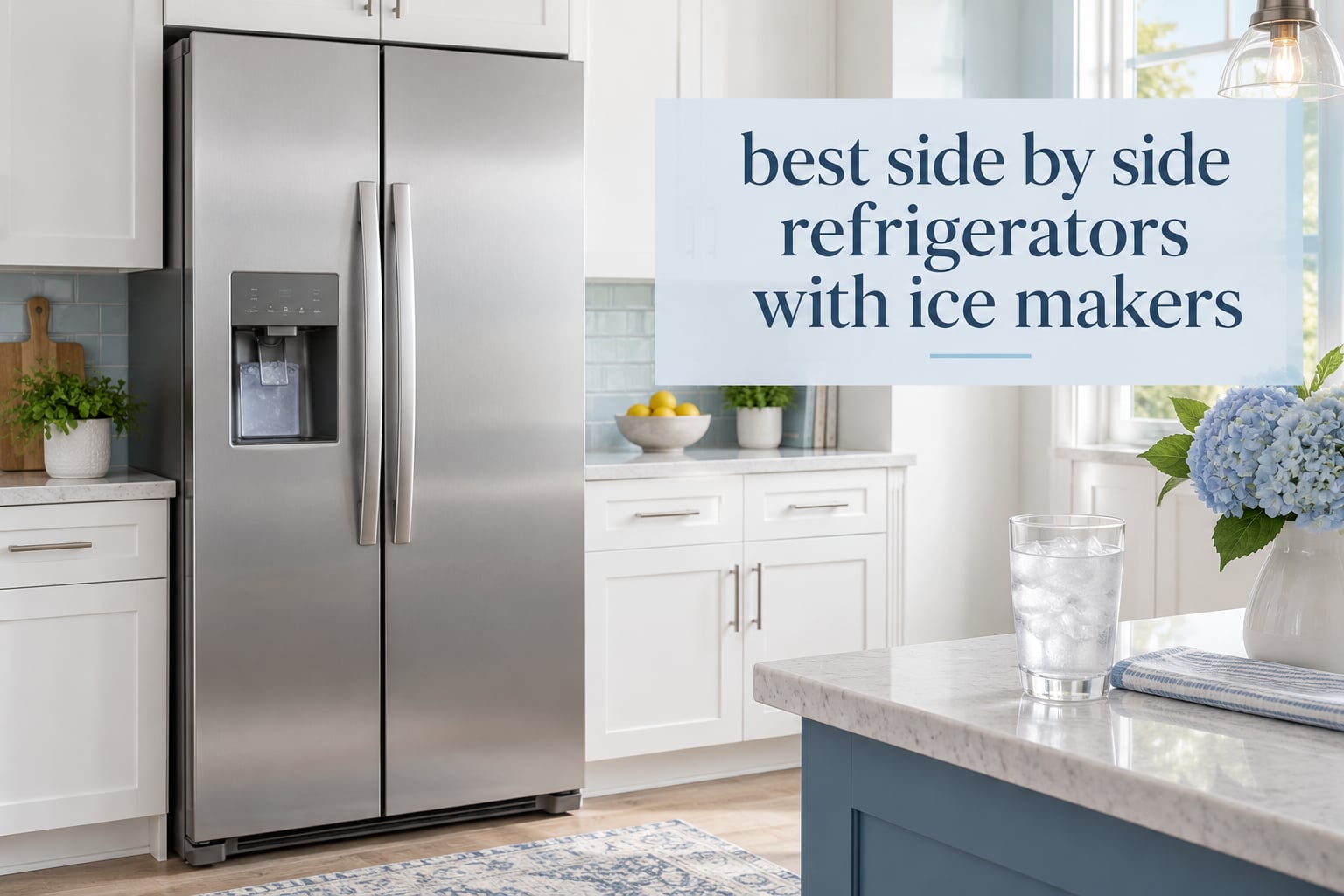
The best side by side refrigerator with an ice maker for most people is the LG LS27T3230S, a 27 cu. ft. standard-depth model whose ice maker lives in the freezer door, freeing shelf space that a conventional in-freezer bin would swallow. It is one of only a handful of units in this roundup with more than a handful of owner reviews behind it, which matters more in this category than almost any other spec.
We spent weeks going through side-by-side listings, spec sheets and owner reviews to build this list, and the ice maker was the filter we applied first. Every refrigerator here makes ice automatically and dispenses it with water, but they do it in very different ways: some dump cubes into a bin that eats a whole freezer shelf, some hide the mechanism in the door itself, and some offer cubed and crushed ice from a touchscreen panel on the outside of the door.
That distinction matters more than finish color, Wi-Fi or door bins, and it is the one most roundups treat as a footnote. We picked these six because each one solves the ice problem differently, and because the width, depth and capacity choices span narrow kitchens through standard full-size installs.
One caveat up front. Genuine side-by-sides with ice makers are a thin slice of the market. Many search results that look like matches are actually French-door refrigerators, replacement ice makers, water filters or countertop units. We left those out rather than pad the list, which is why you will see six picks and not ten.
Table of Contents
Top 3 Picks for Best Side by Side Refrigerators With Ice Makers In 2026


Forno Salerno FFRBI1844-36SB
- 20 cu. ft.
- Cubed and crushed ice
- Inverter compressor
- 2-year warranty
The LG takes the overall slot because it puts the ice maker in the door, runs a 27 cu. ft. cabinet and has the strongest review base of any unit we could verify. The Samsung is the pick if you want the largest fresh-food compartment and a screen you can actually use. The Forno Salerno is the value route into cubed and crushed ice from an external touchscreen.
All Six Picks at a Glance (October 2026)
| Product | Specifications | Action |
|---|---|---|
| LG LS27T3230S 27 cu. ft. |
|
Check Latest Price |
| Samsung RS27T5561SR/AA 26.7 cu. ft. |
|
Check Latest Price |
| Forno Salerno FFRBI1844-36SB |
|
Check Latest Price |
 Amana ASI2575GRS 24.6 cu. ft. Amana ASI2575GRS 24.6 cu. ft. |
|
Check Latest Price |
 Midea MRS25I7BST 24.5 cu. ft. Midea MRS25I7BST 24.5 cu. ft. |
|
Check Latest Price |
 Electactic FF2-695 18.1 cu. ft. Electactic FF2-695 18.1 cu. ft. |
|
Check Latest Price |
Two of the six above carry published annual energy figures. The Samsung uses 691 kWh per year and the Forno 560, a gap of more than 130 kWh a year that compounds over a decade. The Electactic lists 624 kWh per year, while the LG, Amana and Midea listings do not publish a figure at all, which is itself worth knowing before you buy.
In-Door vs In-Freezer vs Dual Ice Makers Explained
An in-freezer ice maker sits in the freezer compartment and pours finished cubes into a bin. It is the traditional layout and the least expensive to build. The cost is shelf space, and in a side-by-side the freezer is already the narrow half of the cabinet, so a bin can eat a full shelf of real frozen food storage.
An in-door ice maker moves the whole mechanism into the freezer door. Shelves stay full-width and unobstructed, which is the single biggest practical advantage in a narrow freezer. The tradeoff is that the door gasket and the door wiring become part of the ice system, so a failure that would have been a simple bin swap can become a door service call.
A dual or multi-type ice maker adds a second mode on top of the basic layout, typically crushed ice alongside cubed. The Forno and the Electactic both dispense cubed and crushed ice from an external panel. That convenience costs storage: an internal ice bin and a crushing mechanism take space that a plain cubed-ice bin would not.
None of the units in this roundup publishes a rated daily ice output in pounds per day, and we will not invent one. What we can compare is ice type, ice location and the ice storage configuration, which is the honest version of the same comparison.
How ice location changes your usable freezer space
On a conventional in-freezer layout, budget one full shelf width for the bin and another for the harvest tray. On an in-door layout like the LG and the Samsung, you reclaim that entire area. If you buy frozen food in bulk, that reclaimed shelf is often worth more than any feature on the outside of the door.
1. LG LS27T3230S – Best Overall Side by Side Refrigerator With an Ice Maker
LG 27 cu. ft. Side-by-Side Standard Depth Slim in Door Ice and Water Dispenser in PrintProof Stainless Steel Wi-Fi Enabled LS27T3230S
27 cu. ft. total
16.2 cu. ft. fresh food
In-door ice maker
267 lb, freestanding
Pros
- Ice maker in the door frees freezer shelf space
- 27 cu. ft. cabinet in a slim standard-depth body
- Spacious interior
- Simple design with no learning curve
- Fast delivery and well packed
Cons
- Ice maker can be slow and loud
- Small touch pad for water and ice selection
- Ice maker entry can freeze up overnight and need a defrost
The LS27T3230S is the one I kept coming back to while working through this list. LG moved the ice maker into the freezer door, and on a side-by-side that single decision does more for daily usability than any screen or smart feature. The freezer stays a straight run of shelves instead of a shelf-plus-bin arrangement.
It is a 27 cu. ft. cabinet with 16.2 cu. ft. of fresh food space, automatic defrost, three door shelves and touch control at the exterior. The published dimension string puts it at a 38 inch depth with a 35 inch nominal width and a height in the low 70s, so it clears a standard 36 inch alcove. At 267 pounds it is a two-person lift with the doors off, not a solo move.
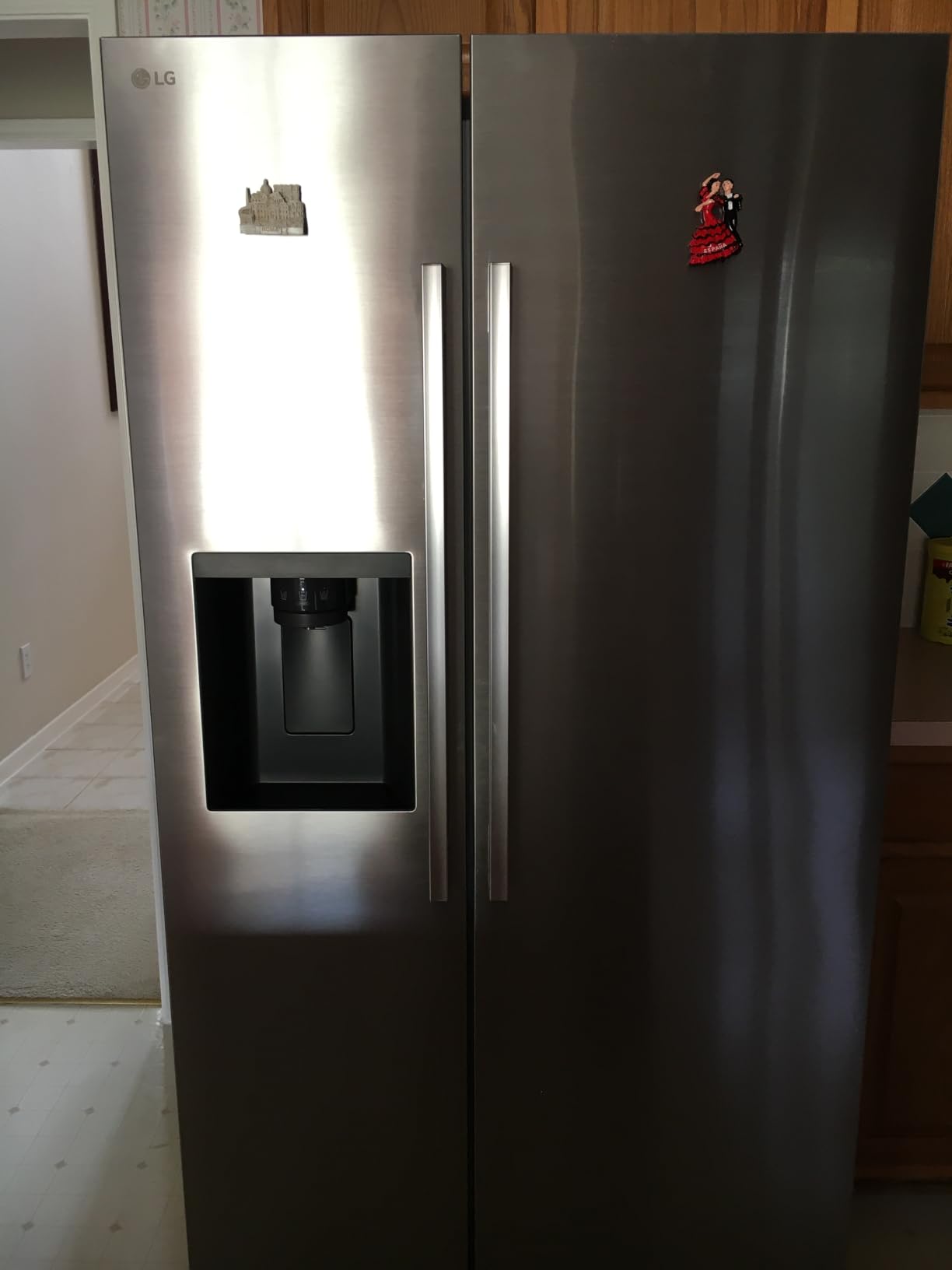
Wi-Fi is included, which is unusual on this format, and the PrintProof stainless finish is treated rather than bare steel. There is no screen, no Family Hub panel and no app that demands a login. Buyers who do not want a fridge with a display will find that refreshing.
The honest weakness is the ice maker itself. Owners praise the controlled way it dispenses, but several report it running slow, running loud, and freezing up at the entry point so the unit needs a manual defrost overnight. A few also say the volume stays modest even at maximum. This is the most common failure theme in the reviews, and it is exactly the pattern that shows up across brands in this category.
What we liked about the in-door layout
Shelves run the full depth of the freezer with nothing above them, which means a tray of frozen pizzas or a stack of tubs sits flat instead of sliding into a bin. For a household that buys frozen food in bulk, that is the whole argument.
The exterior is minimal in a good way. Touch control for water and ice, a recessed handle, no screen to swipe through while your hands are wet. The interior came in well packed and set up quickly for owners who reported their units.
Where the LG falls short
The water and ice selection pad is small, and you will hit it with wet fingers more often than you would like. Repair cost is the other warning: owners report service visits carrying steep flat fees, and one mentions coverage problems around an evaporator motor after the warranty period expired.
Warranty coverage is one year manufacturer, which is the shortest tier you will see here. If you want a longer safety net on the sealed system, the Samsung and the Forno both go further.
2. Samsung RS27T5561SR/AA – Best for Large Fresh Food Storage
Samsung 26.7 Cu. Ft. Large Capacity Side-By-Side Refrigerator with Family Hub, Stainless Steel, RS27T5561SR/AA
26.7 cu. ft. total
17.2 cu. ft. fresh food
Rotary scroll compressor
306 lb
Pros
- Largest fresh food compartment here at 17.2 cu. ft.
- High-capacity indoor ice maker preserves shelf space
- Fingerprint-resistant flat panel finish
- Family Hub touch screen with Alexa built in
- ENERGY STAR certified with a 10-year compressor warranty
Cons
- Ten reviews is a thin base for a long-term call
- Rotary scroll compressor uses 691 kWh per year
- Smart features cost real money for features some buyers never open
This Samsung is the fresh food champion of the group. Its 17.2 cu. ft. refrigerator compartment is larger than every other unit here, including the LG, and it pairs that with a high-capacity indoor ice maker that reviewers specifically call out for saving freezer shelf space.
The Family Hub touch screen is the reason to look here if you want a connected fridge. Alexa is built in, the app controls the temperature, and the finish is fingerprint-resistant flat panel stainless with recessed handles. It runs a rotary scroll compressor on R-600A refrigerant and meets the ENERGY STAR 2020 Emerging Technology standard.
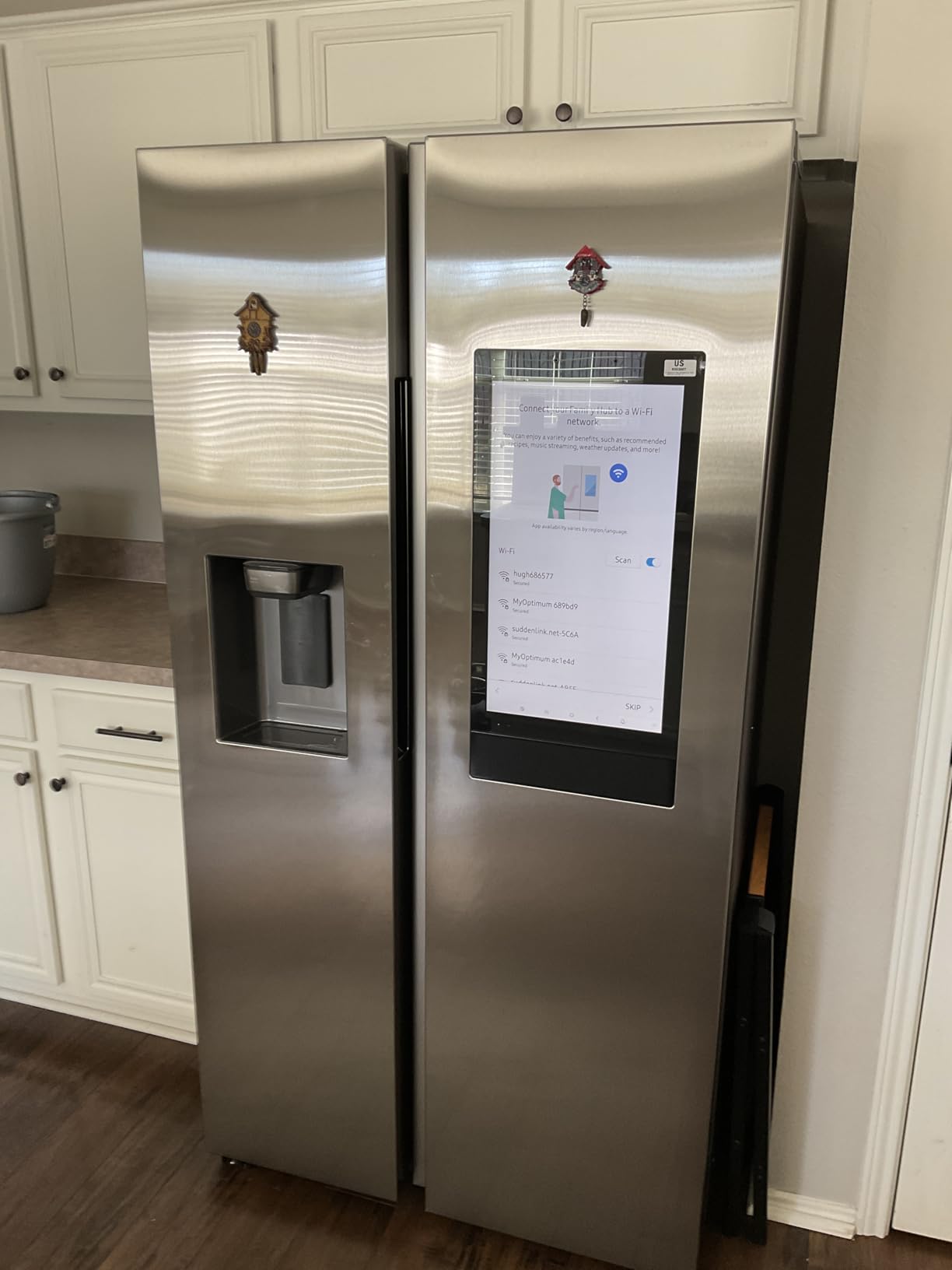
Dimensions are 35.88 inches wide by 70.06 inches tall by 33.5 inches deep, and at 306 pounds it is the heaviest fridge in this roundup. The published depth with the door open maximum is 51.31 inches, so measure your alcove depth carefully before this one goes down the hallway.
The warranty is the best on this list: five years parts and labor on the sealed refrigeration system, plus ten years parts and five years labor on the digital inverter compressor. Energy use is listed at 691 kWh per year, the highest published figure here.
Who should spend for the Family Hub screen
If your household actually uses a shared grocery list, wants temperature alerts away from home, or has someone who will not stop asking what is in the fridge, the screen earns its place. It is a genuine convenience for a shared kitchen.
From an access standpoint, the external filtered water and ice dispenser means no bending and no reaching into a cold compartment. With a 69.25 inch tall body on competitors and this one at 70.06, the dispenser height is comparable across the category.
Where the Samsung falls short
Ten reviews is a very thin evidence base, and the 4.1 average tells you that not every owner is delighted. Feature complexity is the other risk: this is a smart fridge with a panel, a lock and an app, and any of those can be a support call when the refrigerator itself is fine.
Energy use is the highest published number in the set, and if you run the compressor in a warm kitchen that cost shows up every month. There is also no dual evaporator claim here, so humidity control in the fresh food compartment depends on the single-evaporator layout.
3. Forno Salerno FFRBI1844-36SB – Best Value for Cubed and Crushed Ice
Forno Salerno 36-inch Side-by-Side 20 cu.ft Refrigerator in Stainless Steel with Ice & Water Dispenser
20 cu. ft. total
13.48 cu. ft. fresh food
Inverter compressor
560 kWh per year
Pros
- External touchscreen dispenses water
- cubed and crushed ice
- Inverter compressor runs quiet and holds steady temperatures
- Lowest published energy use at 560 kWh per year
- Four spill-proof adjustable glass shelves
- Two-year parts and labor warranty
Cons
- Smallest fresh food compartment here at 13.48 cu. ft.
- Seven reviews with a polarized rating spread
- Form factor is listed as both French door and side by side
The Forno Salerno is the only unit in this roundup that gives you a real choice at the dispenser: an external touchscreen panel serves water, cubed ice and crushed ice. On a side-by-side that is a genuine convenience feature, and it is why this fridge exists.
Underneath it is an inverter compressor on R-600A, a frost-free multi-air flow system and E-star certification with a listed 560 kWh per year, the lowest published figure here. The fresh food side carries four spill-proof adjustable glass shelves, LED lighting with no dark corners, Sabbath mode and a temperature memory function.
Total capacity is 20 cu. ft., split 13.48 cu. ft. fresh and 6.53 cu. ft. freezer. That is the smallest fresh food compartment of the six, and it is the tradeoff you make for the crushed ice hardware. At 213 pounds it is also the lightest fridge here, which makes delivery and door removal simpler.
Who benefits most from a two-mode dispenser
Households that take drinks seriously get the most from this one. Crushed ice in a tumbler matters more than most people expect, and having it on demand removes the last trip to the freezer.
The child lock, reversible doors and the water filter included in the box round out a package that feels more considered than the price suggests. Two years of parts and labor is the second-best warranty in this set.
Where the Forno falls short
Seven reviews is not enough to trust a durability claim, and the rating spread is wide, with roughly 59 percent five-star and 24 percent one-star in the available sample. A polarized distribution means you will like it or you will not, and we cannot tell you which from this data.
Capacity is the practical limit. If you cook for more than three or four people, 13.48 cu. ft. of fresh food space and a 6.53 cu. ft. freezer will feel tight quickly. The listing also tags the form factor as both French door and side by side, so check the dimensions yourself rather than trusting the category tag.
4. Amana ASI2575GRS – Best for a Dual Pad External Dispenser
Amana 24.6 CU. FT. Side BY Side Refrigerator with Dual PAD External ICE and Water Dispenser in Stainless Steel ASI2575GRS
24.57 cu. ft. total
15.46 cu. ft. fresh food
Dual pad external dispenser
Touch control
Pros
- Dual pad external ice and water dispenser
- 24.57 cu. ft. cabinet with 15.46 cu. ft. fresh food
- Touch control interface
- Electronic lock
- Reversible door swing
Cons
- Wire shelves instead of glass
- Not ENERGY STAR certified
- Hot gas defrost is older technology
- One review offers no reliability signal
The Amana is here for one reason: the dual pad external ice and water dispenser, which gives you separate paddles for each. On a 24.57 cu. ft. cabinet that is a well-balanced combination of fresh food space and dispensing hardware.
Fresh food capacity is 15.46 cu. ft., which sits between the LG and the Samsung, and the control interface is a simple touch panel rather than a screen. An electronic lock adds a layer you do not get on the budget units. Doors reverse for left or right hinge, and the body is 35.87 inches wide by 69.25 inches tall by 34.12 inches deep at 270 pounds.
There is a real caveat here. This model carries a single review, the listing places it in the outdoor refrigerator category, and it runs R-600A on a hot gas defrost system rather than a frost-free inverter cycle. We are including it because the dispenser layout is a legitimate option for the right buyer, not because the reliability evidence supports a recommendation.
When a dual pad dispenser is the right call
If more than one person uses the dispenser regularly, separate pads mean fewer misfires and less accidental dispensing. It also suits anyone who wants ice and cold water at two different temperatures from one dispenser.
The touch controls and electronic lock keep the daily operation simple. There is no app to sign up for and no screen that lights up your kitchen at midnight.
Where the Amana falls short
Wire shelves instead of glass is the most consequential weakness in a fridge you will use for a decade. Glass shelves survive a dropped bottle; wire shelves survive most of them. The unit also does not meet ENERGY STAR certification, so expect a higher energy bill than the Forno or the Samsung.
Hot gas defrost is the older approach to frost removal and generally cycles more often than frost-free inverter systems. And with one review behind it, we cannot tell you how this ice maker behaves after year two.
5. Midea MRS25I7BST – Best Counter-Depth Fit
Midea MRS25I7BST 24.5 Cu. Ft. Stainless Counter-Depth Side-by-Side Refrigerator with AutoFill Water Pitcher
24.5 cu. ft. total
Counter-depth at 29 inch width
Built-in icemaker
229 lb
Pros
- Counter-depth body at 29 inches wide
- 24.5 cu. ft. in a shallow footprint
- AutoFill water pitcher feature
- Built-in icemaker and water dispenser
- Fingerprint-resistant stainless finish
Cons
- One review means no reliability data
- Warranty is one year only
- Fewer published specs than the other units here
Counter-depth side-by-sides are genuinely hard to find, and this is the narrowest unit in the roundup at 29 inches wide. If your kitchen has a tight nook or you are replacing a shallow European-style cabinet run, this is the fridge that will actually fit where the 36-inch models will not.
Capacity is 24.5 cu. ft. on a freestanding side-by-side configuration, with a built-in icemaker and a water dispenser on the door. The AutoFill water pitcher feature lets the refrigerator fill a pitcher for you, which is the detail most people notice first in a demo.
The finish is fingerprint-resistant stainless with an electronic control panel, and the body weighs 229 pounds, making it the second lightest unit here. Published dimensions are 29 inches wide by 70 inches tall by 36 inches deep.
Who should go counter-depth
Narrow galley kitchens, older homes with shallow alcoves and anyone remodeling around existing cabinetry are the clear fits. A 24.5 cu. ft. capacity still handles a household of three or four without feeling cramped.
If you want the look of a built-in appliance line without custom cabinetry work, a counter-depth body in a fingerprint-resistant finish gets you most of that appearance. The AutoFill pitcher also reduces how often you have to carry a jug from the sink.
Where the Midea falls short
One review and a five-star average is not evidence of quality. It is a single data point, and we will not present it as more than that.
The warranty is one year manufacturer, the shortest meaningful coverage you can buy. The listing also publishes fewer specifications than the others, with no energy consumption figure and limited shelf detail, so you are buying with less information than you would with the Samsung or the Forno.
6. Electactic FF2-695 – Best for Smaller Kitchens and Utility Spaces
Electactic 18.1 Cu. Ft. Side by Side Refrigerator with Freezer, 2-Door Refrigerator with Built-in Ice Maker, Water Dispenser, Garage Ready Freezer with Digital Temperature Control, White
18.1 cu. ft. total
Cubed and crushed ice
Inverter compressor at 45dB
624 kWh per year
Pros
- Dispenses cubed and crushed ice automatically
- Inverter compressor rated at 45dB
- Garage ready freezer with digital temperature control
- Door open alarm after 60 seconds with child lock
- Sliding glass shelves and LED lighting
Cons
- Smallest capacity here at 18.1 cu. ft.
- One review offers no reliability history
- Warranty is one year
- Brand has a smaller service footprint
The Electactic is the compact entry point. At 18.1 cu. ft. it is the smallest fridge here, split 12.1 cu. ft. fresh and 6 cu. ft. freezer, which makes it a better fit for an apartment, a rental unit, a garage or a secondary kitchen than a primary family kitchen.
It punches above its weight on features. The external dispenser serves cubed and crushed ice automatically, the freezer is garage ready with digital temperature control, and the inverter compressor is rated at 45dB, which is quiet enough for an open-plan living space. Frost-free total no frost technology, LED lighting, sliding shelves, a child lock and a door open alarm after 60 seconds round out the list.
Dimensions are 35.83 inches wide by 69.69 inches tall by 26.38 inches deep at 202.8 pounds, making it the lightest unit here and the easiest to maneuver. Listed energy use is 624 kWh per year, and a one-year warranty applies.
Where this fridge earns its place
A basement kitchen, a garage bar or an apartment where a full-size unit will not fit is exactly what this is built for. The 26 inch depth is unusually shallow for a side-by-side and it is the reason this one fits where others do not.
The garage ready freezer matters if the unit sits in a space that gets hot, because digital temperature control keeps the freezer compartment steady when an ambient-rated residential fridge would not. Cubed and crushed ice on a unit this size is a genuine bonus.
Where the Electactic falls short
18.1 cu. ft. is genuinely small. A family of four shopping weekly will run out of room, particularly in the 6 cu. ft. freezer once the ice storage box takes its share.
One review is no reliability history at all, and a lesser-known brand means a smaller local service network and potentially longer parts waits when something does fail. The one-year warranty leaves you exposed for everything except the first year.
Is a Fridge Ice Maker Worth It? Failure Modes, Lifespan and the Countertop Alternative
A fridge ice maker is the most failure-prone component on any refrigerator, and that is true of every brand in this roundup. The ice maker and the dispenser together account for the majority of reported problems on side-by-side units, which is why we organized this entire roundup around ice rather than around capacity.
The forum pattern is remarkably consistent. Owners on appliance boards describe going through three or four ice makers across a decade, with units that keep running after the bin fills and overproduce ice. Others report drippy or leaking pans that leave puddles inside the freezer and water pooling under the crisper drawers. A recurring complaint is noise, with ice makers and dispensers that clatter during the harvest cycle.
Across this specific lineup the reported failure modes are: slow or low-volume ice production, an ice maker entry point that freezes up and requires a manual defrost, mechanisms that do not shut off when the bin is full, and drip or puddle problems under the ice storage area. The LG accounts for most of the specific freeze-up reports in our review data, and the general pattern shows up with every brand that ships an automatic ice maker.
Five failure modes worth knowing before you buy
First, a harvest motor or drive failure, which stops ice production entirely. Second, a water valve or fill control failure, which starves the ice maker of water. Third, a sensor that fails so the cycle never stops and the bin overfills. Fourth, a frozen or clogged fill line, which is the issue the LG owners describe. Fifth, dispenser faults, including a motor that grinds or a paddle that stops moving.
Lifespan is the harder question, because manufacturers do not publish it. The honest read from owner reports is that a well-made ice maker on a lightly used fridge can last a decade, while a heavily used one on a busy kitchen may need attention sooner. The through-the-door dispensers are worked harder because someone presses a button every time they walk past.
The countertop alternative, honestly compared
A dedicated countertop machine gives you faster ice and a much larger bin than any of these refrigerators, and you can add or remove it without touching the appliance budget. We looked at our clear ice maker picks if you want spheres or bullet ice, and our undercounter ice maker guide if you want more volume than a fridge bin holds.
What you give up is the through-the-door water dispenser, which most households actually use more often than the ice. If your real goal is cold water on demand, a fridge with a water dispenser and a countertop ice machine is often the more durable pairing. For larger volumes, an commercial ice maker covers the serious end.
Our read: a fridge ice maker is worth it for convenience and for anyone who does not want a second appliance on the counter. It is worth less if you already dislike the freezer space the ice bin takes and you want large batches for parties.
How to Choose a Side by Side Refrigerator With an Ice Maker
Width is the first filter, and in this category it is really an ice bin decision. Most side-by-sides are either 33 inches or 36 inches wide, and the measured bodies here run from 29 to nearly 36 inches once handles and door thickness are counted. Owners of 33-inch models frequently report that it does not feel small inside, which counters the assumption that you need 36 inches for ice maker space.
Depth decides whether it fits your alcove. Standard depth here runs from 33.5 to 38 inches on the published dimensions, and counter depth starts around 29 inches wide. Measure depth with the doors open as well as closed, because the Samsung lists a depth with the door open maximum of 51.31 inches, and that is the number that matters in a tight hallway.
Counter depth is the answer for narrow kitchens, mobility-limited buyers and anyone matching existing cabinetry. Standard depth buys you capacity per dollar. If you plan to store sheet pans, pizza boxes or party platters, counter depth is the wrong choice.
Capacity: what you lose with a side-by-side
Total capacity across this group runs from 18.1 to 27 cu. ft. Within that, the fresh food compartment matters more than the total. The Samsung gives you 17.2 cu. ft. of fresh food, the LG 16.2, and the Forno only 13.48 despite a 20 cu. ft. total.
That gap is why the Forno is not the value pick for everybody. A smaller cabinet with a two-mode dispenser is a good deal only if crushed ice matters more to you than shelf space.
Energy use and ten-year running cost
Only three of these six publish a kWh per year figure: 560 for the Forno, 624 for the Electactic and 691 for the Samsung. At a residential electricity rate that adds up to a meaningful spread over ten years, and it is the reason we weight Energy Star and inverter compressors heavily.
Frost-free inverter systems run longer and at lower output than hot gas defrost models. The Amana, which uses hot gas defrost and is not Energy Star certified, sits at the wrong end of that spectrum on running cost even though its dispenser hardware is attractive.
The pre-purchase water line checklist
A through-the-door dispenser needs a plumbed water line, and that is where a lot of owner regret starts. Confirm a water supply exists behind the install location before you order, not on delivery day. Check whether the retailer includes hookup or charges separately, and whether they haul away the old refrigerator.
Ask about the water filter replacement cost and cadence at the same time, because a filter you forget to change reduces both water quality and ice production. If no water line is practical, an internal dispenser model or a countertop ice machine is the realistic path, and internal dispenser side-by-sides exist as a separate sub-category we did not have verified examples of here.
Ice type and storage tradeoffs
Cubed ice only is the simplest and most reliable. Cubed and crushed adds a mechanism and more internal space, which is why the Forno and the Electactic give up capacity for it. Spherical Craft Ice style output is a separate sub-category that is not represented in this roundup, so treat claims about it as worth verifying model by model.
Who should not buy a side by side
If you cook for a large family and regularly store sheet pans, pizza boxes or casseroles, a side-by-side will frustrate you. Narrow compartments do not accept flat oversized items, and glass shelves and drawer supports crack when people cram them. A French-door refrigerator gives you wide shelves where a full sheet pan lies flat, at the cost of some internal width at the top.
Also consider a different format if you store a lot of fresh produce. Produce drawers sit at the bottom of the refrigerator compartment in most side-by-sides, so you stoop for the items you reach for most. And if nobody in the household drinks cold water on demand, a dispenser is dead weight and a liability you are paying to maintain.
How We Picked
We started with a single question: does this refrigerator make ice automatically, and where does that ice go. Everything that failed that test was removed, which is why this list is six models long rather than ten.
From there we compared ice maker location and type, dispenser options, fresh food and freezer capacity, published dimensions, energy figures, compressor type, warranty length and finish. Where a manufacturer publishes an annual kWh figure or a warranty term, we used it and named it. Where they do not, we said so rather than filling the gap.
Review volume mattered. Three of the six models here have fewer than ten owner reviews, and we flag that on each one. A five-star average from a single review tells you nothing about how an ice maker performs in year three, and we would rather tell you that plainly than present a thin sample as a verdict. We also pulled patterns from appliance forum discussions to inform the failure-mode section, since those threads are where long-term ice maker behavior actually gets reported.
We earn a commission when you buy through links on this page, at no additional cost to you. That relationship does not change the ranking, the thin-sample warnings or the flaws we list for each model.
Frequently Asked Questions
What are the common problems with refrigerator ice makers?
The most common complaints are slow or low-volume ice production, an ice maker entry point that freezes up and needs a manual defrost, harvest cycles that do not stop when the bin is full, drippy pans that leave puddles in the freezer, and noise during the harvest cycle. Dispenser motors and paddles fail separately from the ice maker itself, and through-the-door dispensers wear faster because people press them every day.
What is the difference between an in-door and an in-freezer ice maker?
An in-freezer ice maker sits inside the freezer compartment and drops finished cubes into a bin, which usually costs one or two shelves of real storage space. An in-door ice maker moves the whole mechanism into the freezer door, so shelves stay unobstructed. The in-door layout adds a door gasket and door wiring to the failure surface, so the space saving comes with a slightly more complicated service picture.
What brand of refrigerator has the most reliable ice maker?
No brand publishes ice maker failure rates, so the honest answer comes from owner reports. Whirlpool and GE Appliances are frequently cited for proven components across the wider side-by-side category, while older Samsung refrigerators draw a disproportionate share of ice maker complaints relative to other brands even though most Samsung owners like the refrigerators overall. Judge each model on its own review history rather than the badge on the door.
What is the standard width of a side-by-side refrigerator?
Standard side-by-side refrigerators are either 33 inches or 36 inches wide as a category name, but the measured cabinet width is often narrower than the label. In this roundup the published widths run from 29 inches on the counter-depth Midea to nearly 36 inches on the Samsung and Amana. Measure the actual body width plus the door thickness before you order.
Which has more room, a side-by-side or a French door refrigerator?
A French door refrigerator has wider shelves where a full sheet pan lies flat, so it wins for large flat items and big families. A side-by-side wins for eye-level and waist-level access because the freezer shelves sit at chest height instead of at the bottom, and it usually offers more total capacity in a narrower footprint. Choose the side-by-side if you want visibility and vertical reach, the French door if you store sheet pans and pizza boxes.
Should I buy a side by side refrigerator with an ice maker?
Buy one if you want ice and cold water without a second appliance, and if you value reaching into the freezer at eye level. Hold off if nobody in the household uses cold water often, if you store sheet pans or oversized flat items, or if you have no way to plumb a water line to the install location. In every case, budget for water filter replacements and accept that the ice maker is the component most likely to need service.
Conclusion
The best side by side refrigerators with ice makers depend on which tradeoff you refuse to make. Take the LG LS27T3230S if you want the ice maker out of your freezer compartment and the strongest review base in this group. Take the Samsung RS27T5561SR/AA if fresh food space and a long compressor warranty matter more to you than a quiet compressor and lower energy use.
Take the Forno Salerno if cubed and crushed ice from a touchscreen dispenser is the feature you will actually use daily, and the Midea MRS25I7BST if your kitchen is too narrow for anything wider than 29 inches. Weigh the Amana for its dual pad dispenser, and the Electactic for a garage, rental or secondary kitchen where 18.1 cu. ft. is plenty.
Whatever you choose, measure the alcove depth with the doors open, confirm a water line reaches the install location, and remember that the ice maker is the part most likely to need attention. That framing has not changed in 2026, and we would not buy any of these without it.