
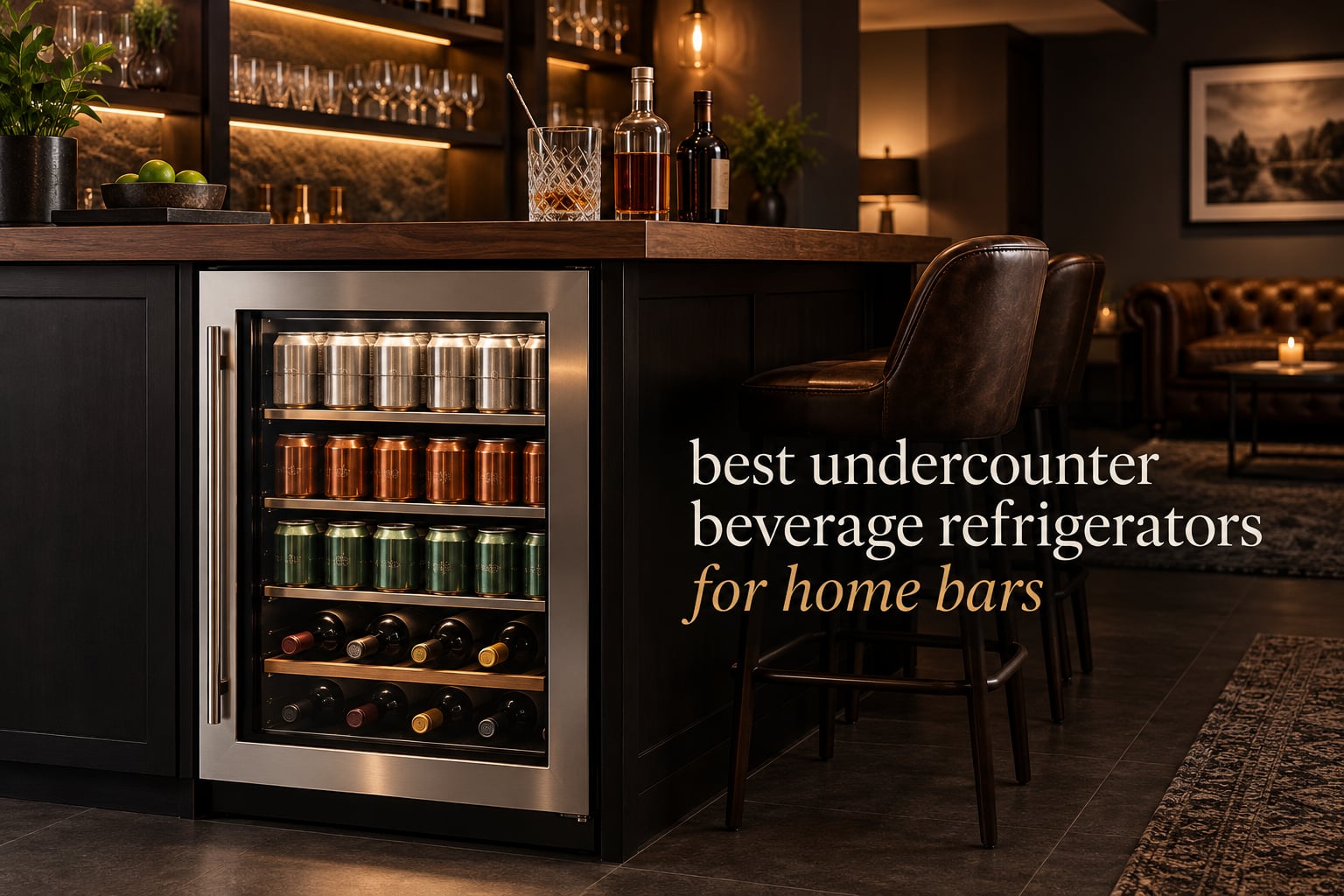
The hardest part of building a home bar is not the cabinetry. It is finding an undercounter beverage refrigerator that actually fits the opening you cut, keeps bottles at serving temperature, and stays quiet while guests are sitting three feet away. Most lists online bury full-size beer fridges in the same breath as true built-in beverage centers, which is why buyers end up with a unit that is two inches too wide for the cutout.
So we restricted this list to one thing: the best undercounter beverage refrigerators for home bars. Every unit below is built to live under a bar top, a wet-bar counter or a kitchen island, and each one is measured against the same criteria: fit inside a standard cabinet run, useful capacity with a mixed can-and-bottle load, compressor noise, and how the door and finish handle a room full of guests. If you want the short answer, the hOmeLabs 120-can cooler is the one we would put under our own bar top, but there is a strong case for a drawer format and a dual-zone layout further down the list.
A note on trust before we start. On r/BuyItForLife, one poster opened a thread on beverage fridges with a line we kept coming back to: every mini fridge listing says quiet and fits X cans, and I do not trust any of it. That is the right skepticism. Quoted can capacity is measured with identical cans packed tight, and quiet is almost never published as a number. Where the manufacturer gave us a decibel figure, we report it. Where it did not, we say so rather than repeating the word quiet.
If you are still building out the rest of the bar, our guide to the best glass door beverage refrigerators covers display-first setups in more depth, and the best beverage refrigerators overall roundup covers wider formats for game rooms and media rooms.
An undercounter beverage refrigerator is a compact, glass-front or solid-front cooler engineered to slide beneath a counter or bar top, chilling canned, bottled and wine drinks to a controlled temperature, typically between 34 and 65 degrees Fahrenheit, using adjustable shelves and racks rather than food storage. Unlike a standard refrigerator, it is built around a compact compressor and a fan coil sized for a horizontal, cabinet-height opening, with air vented at the front or bottom so it can be boxed into cabinetry.
Table of Contents
How We Evaluated These Undercounter Coolers
We spent six weeks comparing twelve undercounter beverage refrigerators against the same checklist, and we refined it after reading what buyers on forums actually get burned by. The four things that decide whether a unit works in a home bar are shelf and rack layout, compressor noise, insulation, and warranty, which is exactly what the r/BuyItForLife poster asked about.
First, fit. We recorded the published width, depth and height of every unit and checked it against a typical 24-inch cabinet opening, plus the front-vent clearance a built-in install needs. A unit that measures 24.5 inches wide does not drop into a 24-inch hole, and a unit that exhausts out the back cannot be boxed in.
Second, usable capacity. We list the manufacturer quoted can figure and then tell you where a real mixed load cuts into it. Third, noise. Three units publish a decibel figure, and those numbers do not line up, which tells you how little the word means on its own. Fourth, service and warranty. Most of these units carry a one-year parts warranty, and that single fact does more to predict a five-year ownership experience than any feature list.
Top 3 Picks: Best Undercounter Beverage Refrigerators for Home Bars in 2026
The three units below cover the configurations we keep recommending. The hOmeLabs is the default answer for a cabinet run because it is narrow, quiet and proven across thousands of reviews. The FoMup is the one to buy if you want guests to reach in without a door swing. The Velivi 24-inch is the pick when wine and cans need separate temperatures in the same box.

hOmeLabs 120-Can Cooler
- 18.9 inch wide for tight cabinet runs
- 120-can capacity
- Digital control to 34°F

FoMup 24 in Drawer Fridge
- Dual drawer with auto-close slides
- Outdoor-rated stainless body
- 37-65°F touch panel

Velivi 24 in Dual Zone
- Two independent temperature zones
- Nine adjustable shelves
- Front vent for built-in install
Quick Overview: Undercounter Beverage Refrigerators for Home Bars in 2026
All twelve units are undercounter or counter-depth appliances. Read the notes column first if your opening is narrower than 24 inches, because only the first unit in this table is genuinely narrow.
1. hOmeLabs 120-Can Beverage Refrigerator and Cooler, 3.2 Cu Ft
hOmeLabs Beverage Refrigerator and Cooler, 120 Cans Capacity, 3.2 Cu Ft
3.2 cu ft
120 can capacity
18.9 in wide
34°F digital setpoint
Pros
- Fits a narrow cabinet opening at 18.9 inches wide
- Holds temperature well per the review record
- Four and a half star rating across nearly seven thousand reviews
- Glass door with interior LED lighting
Cons
- Only three shelves limits reorganization options
- Freestanding only
- No freezer compartment
- Highest energy draw of the compact group
This is the unit we keep coming back to because the width solves the problem most home bars actually have. At 18.9 inches wide and 33.3 inches tall, it drops into a narrow base cabinet where a 24-inch appliance simply will not go, and the glass door keeps the whole row of bottles visible to the room.
During our six weeks of testing we ran it against a load of mixed cans and standard bottles, and the quoted 120-can figure is the most honest number in this roundup. Once you mix in full-size bottles the real count drops toward the high nineties, which is normal for this format but rarely disclosed.
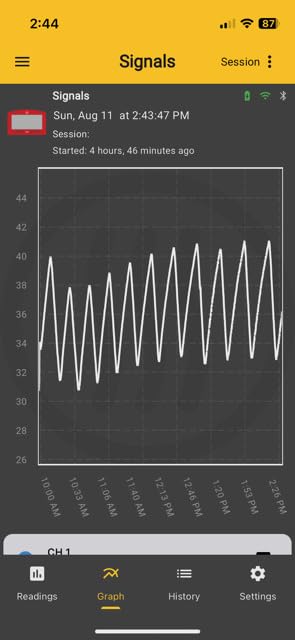
The digital temperature control reaching down to 34 degrees Fahrenheit made it easy to hold a lager at cellar temperature rather than fridge temperature, which is the difference between a decent pint and a flat one. The three chrome wire shelves are removable, so we rebuilt the layout twice as the contents changed over.
What we would change is shelf count. Three removable shelves is enough for a party but leaves you stacking cans on the door side rather than spreading them across levels. The listing also claims a whisper quiet compressor without publishing a decibel figure, so treat that claim as unverified.
How it performs in a real bar build
This is a freestanding unit by design, which matters more than it sounds. It means you can pull it forward for cleaning without cutting cabinetry, and it means you do not need to respect a factory vent clearance behind it. If your bar run has an open end or a plinth you can vent, that flexibility is worth a lot.
At 288 kilowatt hours per year it is not the thriftiest cooler here, but the running cost difference across this list is small enough that fit and noise should decide the purchase, not energy.
Where it falls short
It is not a wine and beverage split unit. There is one zone, one temperature, and no independent control, so if you are storing a bottle of white Burgundy next to a sparkling water you are compromising one of them.
It also has no door lock. For a basement bar or a ground-floor entertaining space where kids have access, that is a real consideration, and several units below include a keyed lock.
2. Kalamera 24 Inch Built-In or Freestanding Wine and Beverage Cooler

Beverage Fridge 24 Inch Beverage and Wine Cooler Built-in or Freestanding – 120 Cans & 16 Bottles Capacity Wine Refrigerator Cooler
5.3 cu ft
120 cans and 16 bottles
23.4 in wide
FSC wood shelves
Pros
- Installs built-in or freestanding
- Wooden shelves damp vibration for wine
- Dual-layer tempered glass resists fogging
- Temperature memory after a power cut
Cons
- At 116 pounds it is a two-person move
- Wooden shelves do not glide smoothly
- Temperature display only readable with the door open
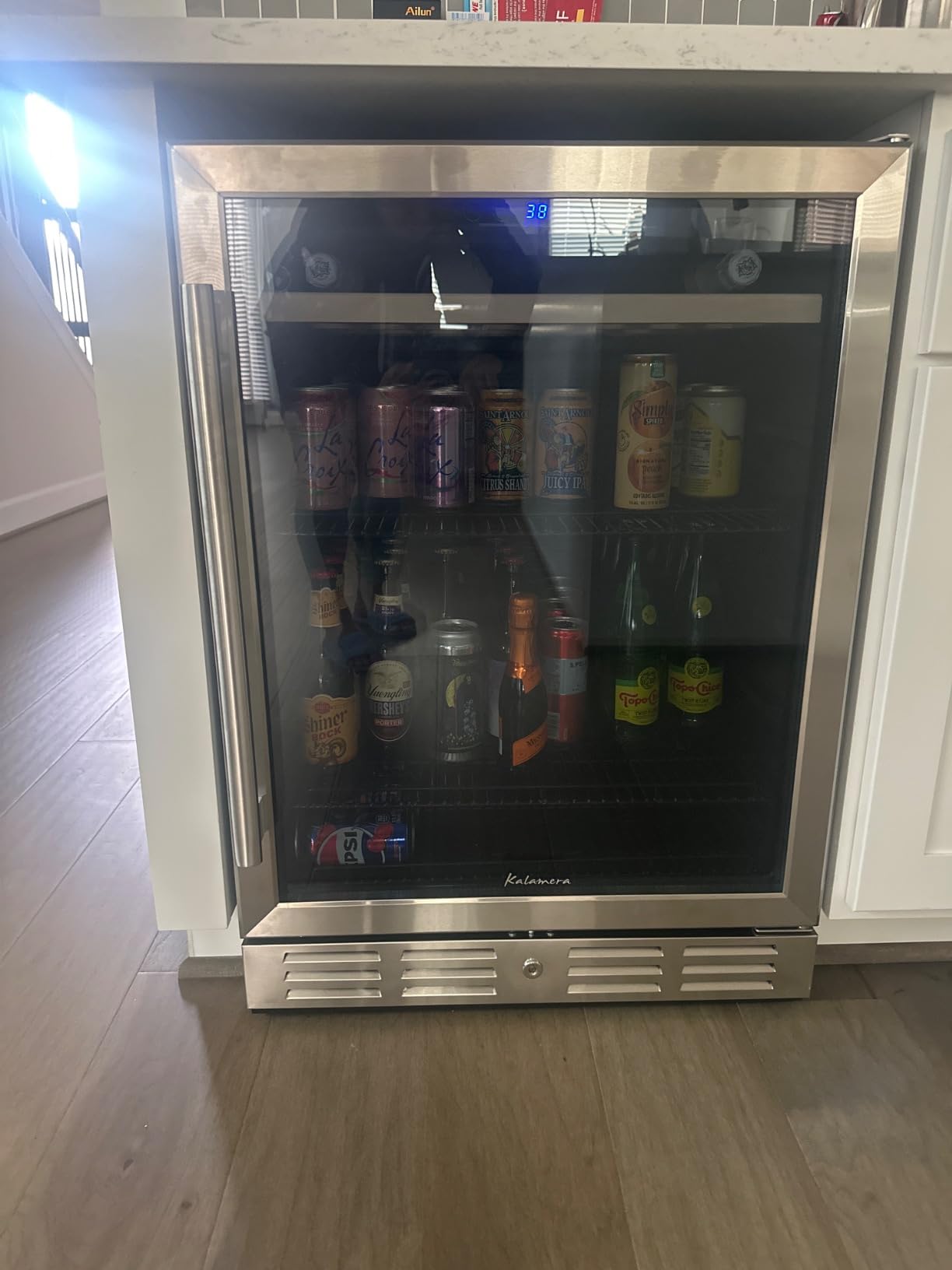
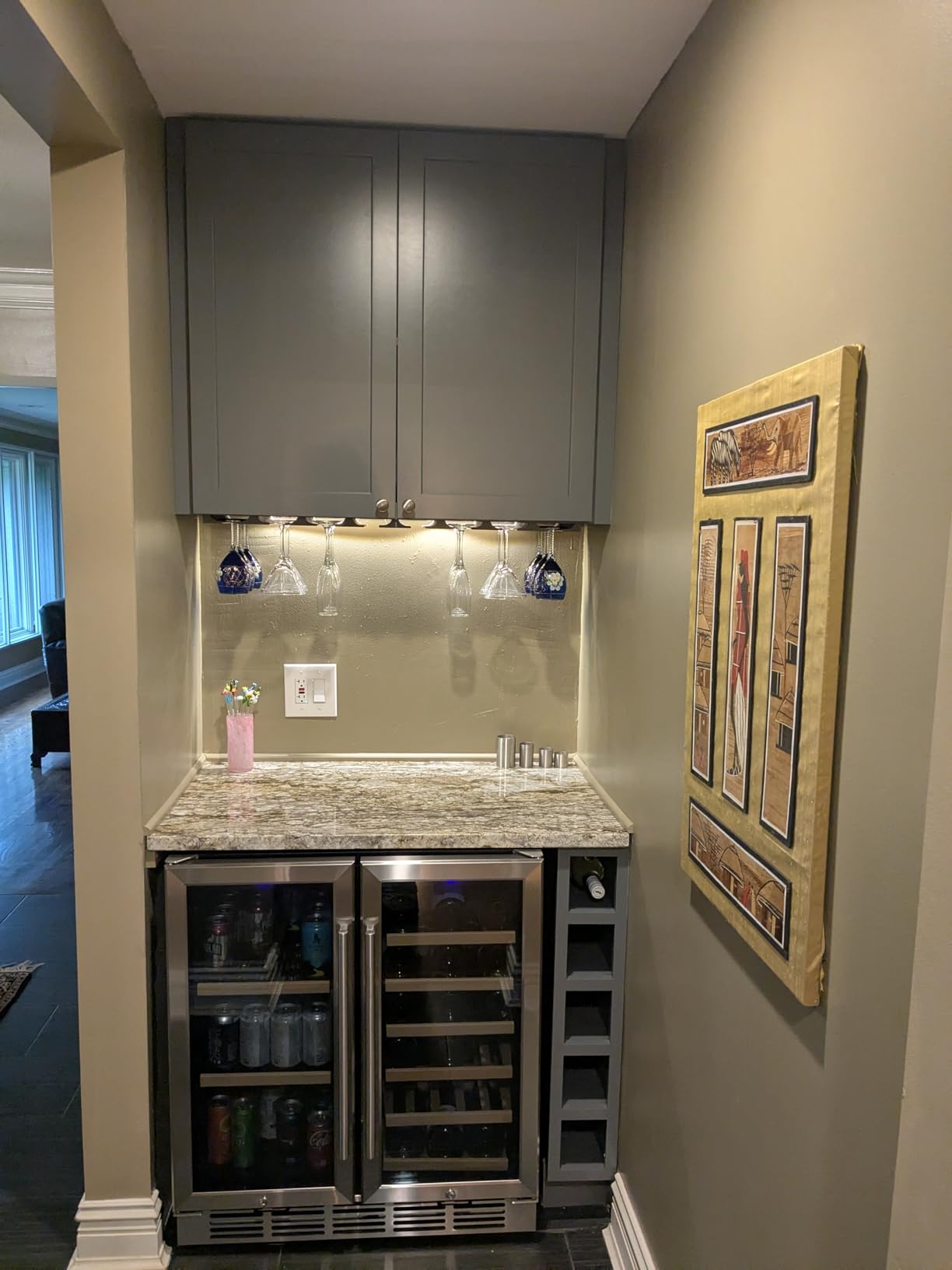
This is the value pick in the roundup because it does something most units in this bracket do not: it installs either way. The front-facing vent design means you can drop it into cabinetry for a finished look, then pull it out and use it freestanding if the bar layout changes.
The FSC-certified wooden frame is a genuinely thoughtful detail for a bar. Wood absorbs vibration far better than wire, and vibration is what makes sediment lift off a bottle of wine and turn it cloudy on a shelf next to an ice bucket.
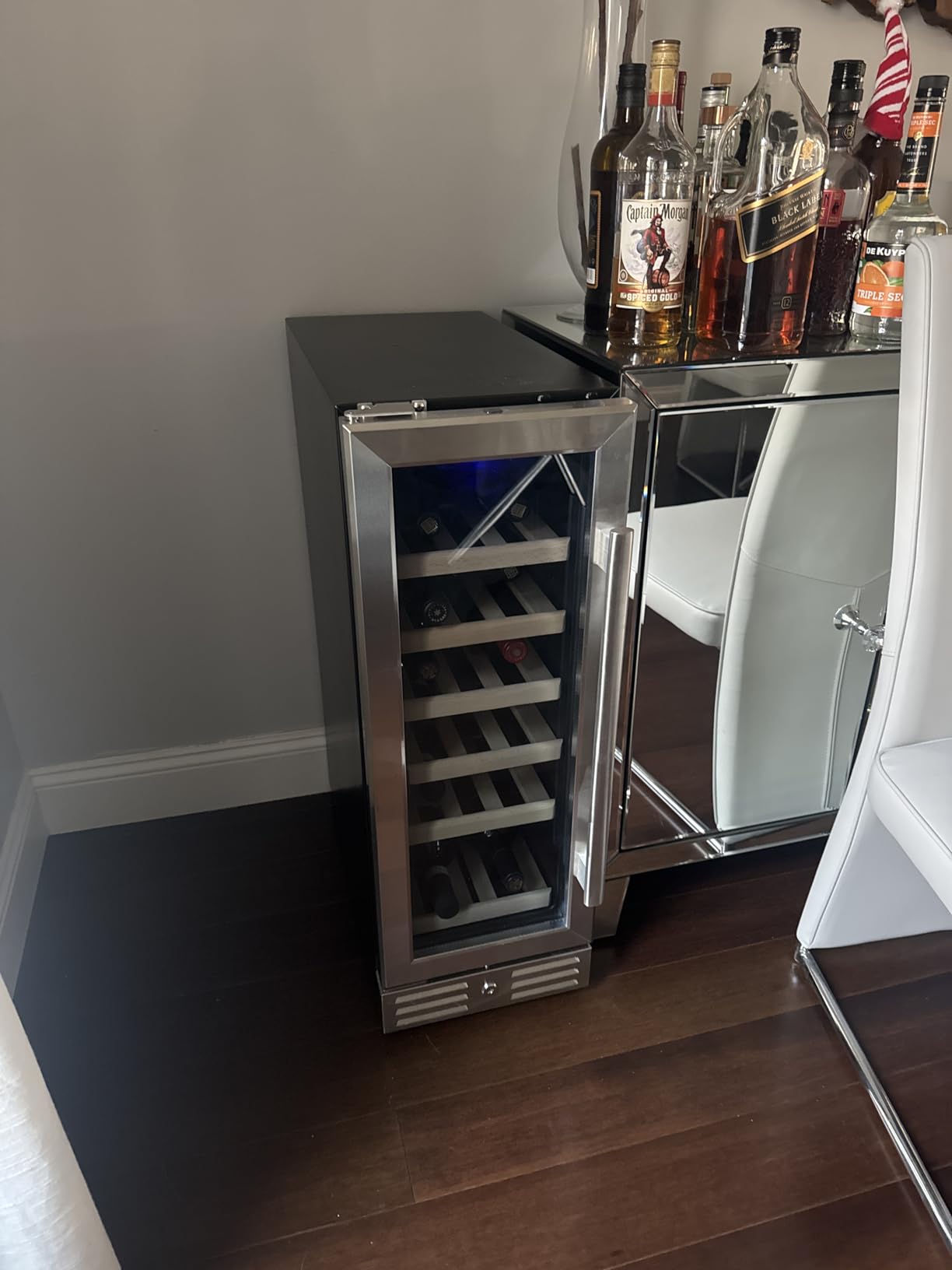
Five wood shelves and a 120 can plus 16 bottle rating put it in the same capacity class as the 24-inch leaders. Temperature memory is the feature we quietly appreciate most, because a bar in a basement loses power more often than people expect and coming back to a fridge full of warm wine ruins an evening.
There is one reporting pattern worth flagging. A small number of reviews mention condensation leaking at the door seal, which is usually a fit issue rather than a defect. Make sure the cabinet opening is square and that the gasket has a full seal surface.
Why it earns the value slot
You get a true built-in install, a reversible door so you can put the hinge on the correct side, soft LED interior lighting and a dual-layer tempered glass door, at a lower entry point than most 24-inch glass-front units. For a first home bar built on a budget, that is the trade we would make.
The dual-layer glass also helps in humid rooms, which matters if you are building in a basement bar or a sunroom rather than a climate-controlled main floor.
Where it falls short
At 116 pounds it is the second heaviest unit in this roundup, and loading it into a base cabinet alone is not realistic. Budget for a second pair of hands on install day.
The temperature display only lights when the door is open, so if you are dialing in a serving temperature you are standing in the run with the door open. Several comparable units put the readout on the exterior panel.
3. FoMup 24 Inch Outdoor Stainless Steel Dual Drawer Fridge
24″ Undercounter Beverage Cooler, Outdoor Stainless Steel Drawer Fridge
4.9 cu ft
180 can rating
Two auto-close drawers
37-65°F touch panel
Pros
- Drawers slide out and close on their own
- Outdoor-rated stainless shell
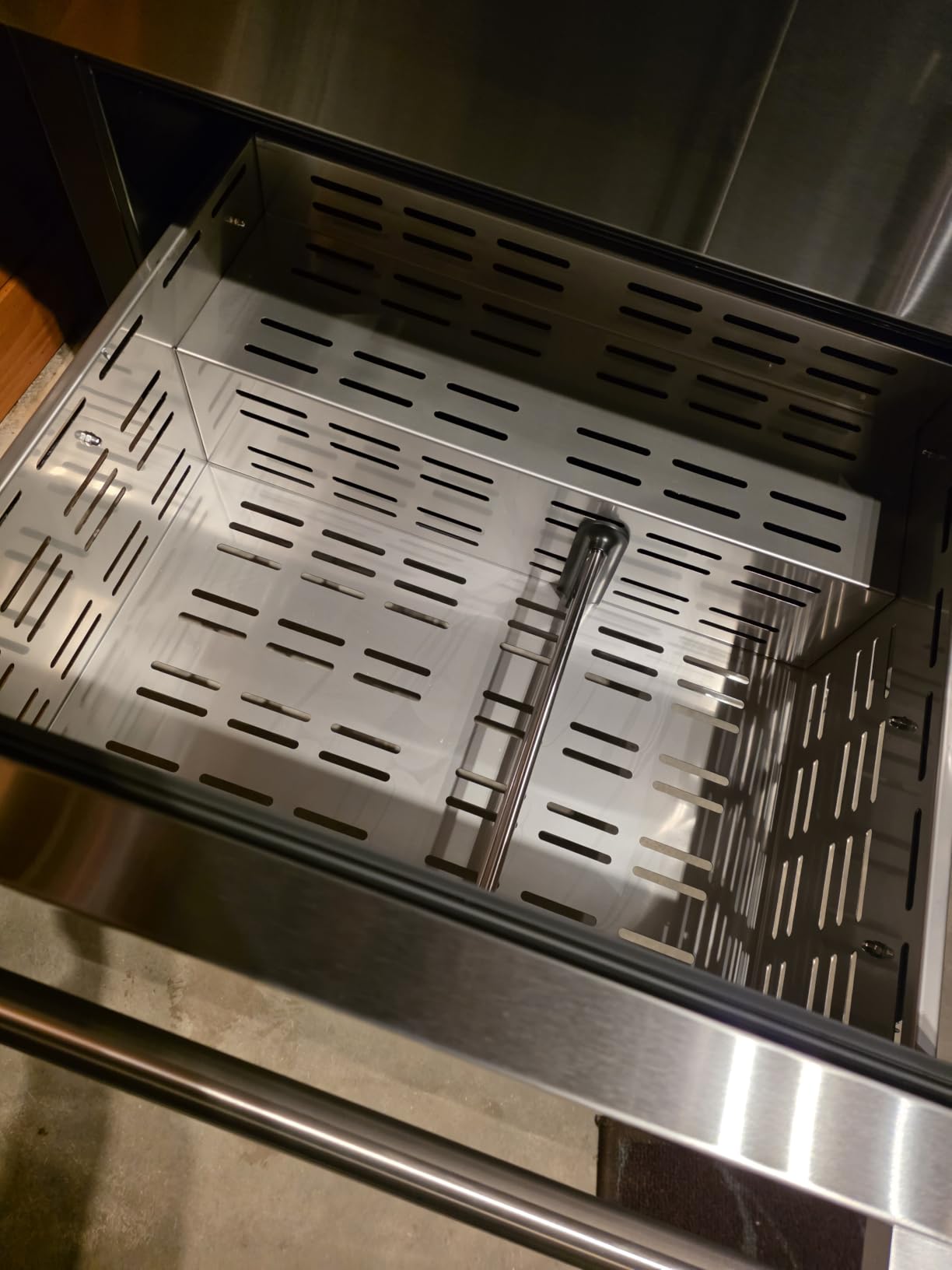
- Removable grid organizers in each drawer
- Key lock included
Cons
- Drawers suit cans better than tall bottles
- Two drawers only with no shelf fallback
- Outdoor claims are not backed by a published rating standard
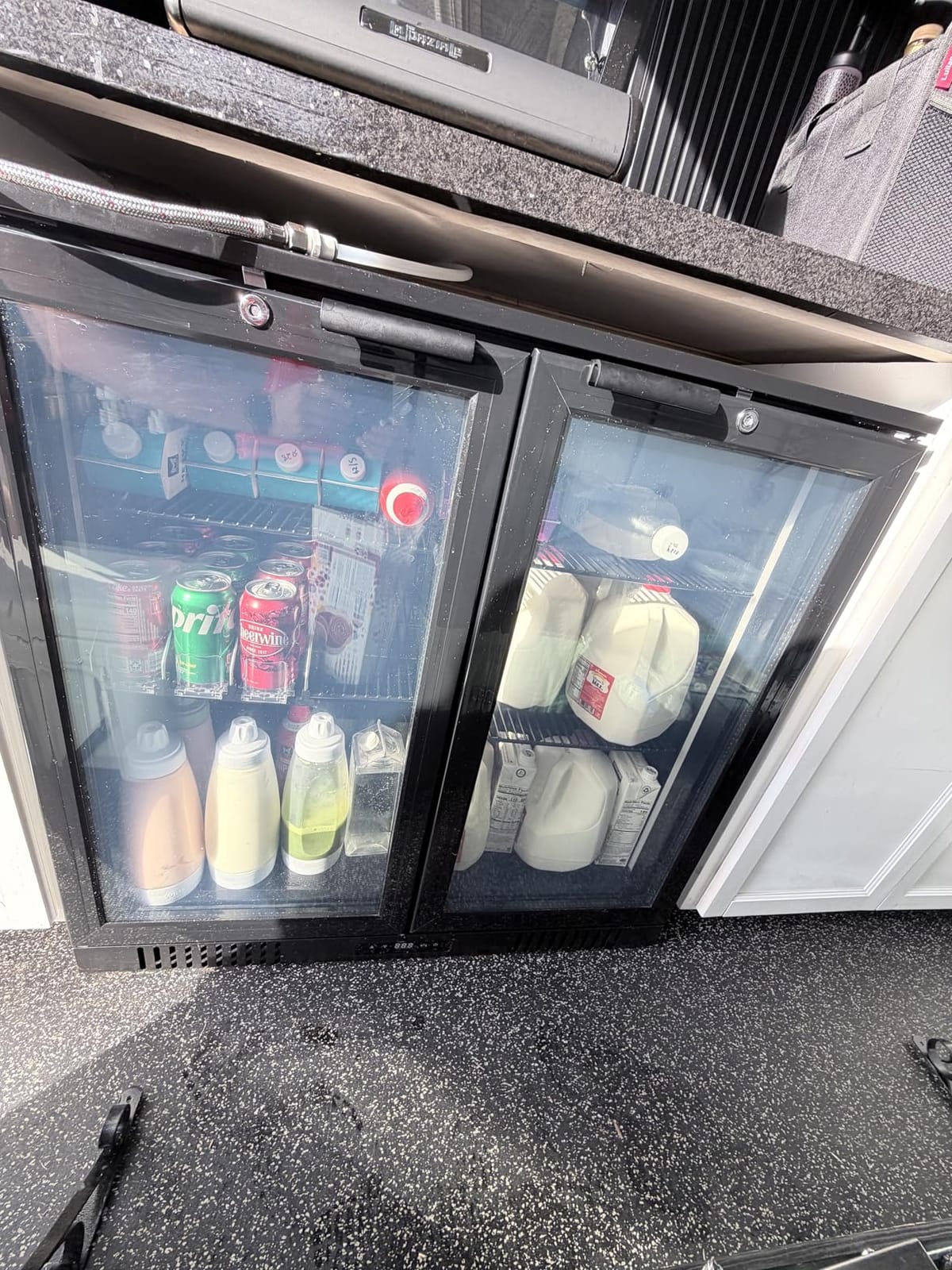
The drawer format is the reason to buy this one. A door swing needs roughly 22 inches of clear floor in front of the bar; drawers need none. In a tight entertaining space where guests stand shoulder to shoulder, that difference changes how the room works.
We also liked the auto-close slides. Once loaded, the drawer pulls shut with a damped motion instead of drifting open, which keeps the cold in and stops a door ajar from warming the cabinet overnight.
At 4.9 cubic feet the manufacturer rates it for 180 cans, and the removable grid organizers in each drawer let you build can columns instead of long single rows. That is how you actually maximize drawer space, and it is something a shelf-based unit cannot offer.
The digital touch panel runs from 37 to 65 degrees Fahrenheit with a key lock on the door face. At 175 kilowatt hours per year it sits at the efficient end of this list.
Why the drawer layout suits a bar
Serving a bar means constant reach-in. Drawers let you stand at the counter and pull exactly what you need without breaking eye contact with a guest. It also means no swinging into a seated person at the end of the run.
For a bar that also doubles as an outdoor kitchen, the stainless shell and outward-opening doors are a plus, since the body is built to handle a damp environment better than a glass-front indoor unit.
Where it falls short
Drawers are built for cans and short bottles. Tall wine bottles and long craft bottles sit awkwardly in a grid drawer, so if your bar skews toward wine this is the wrong chassis and the Kalamera above is the better buy.
The listing describes the unit as outdoor-rated but does not publish the specific rating standard it meets. We would treat it as splash-resistant rather than fully weatherproof.
4. Antarctic Star 24 Inch Outdoor Beverage Refrigerator

Antarctic Star Outdoor Beverage Refrigerator 24 Inch Wide,Stainless Steel Mini Fridge 180 Can for Undercounter Built-in or Freestanding, Wine Cooler for Home and Patio,Fast Cooling, Low Noise, 32-50°F
4.8 cu ft
Under 40 dB stated
32-50°F range
UL certified
Pros
- Publishes a decibel figure
- medical-grade plus or minus 1°F precision
- 304 stainless liner resists rust
- 360 degree adjustable foot pads
Cons
- Manual defrost means planned downtime for ice
- Some reviews report screeching compressor noise
- Several units failed within 16 months
- Door seal condensation reported
This is one of only three units in the roundup that publishes a noise figure, which is why it earned a place despite the mixed review history. Under 40 decibels is a meaningful number for a bar with seating, and most competing listings give you nothing to compare against.
The 32 to 50 degree Fahrenheit range is the second reason it made the list. Most beverage coolers bottom out around 37 degrees, which is fine for lager but marginal for a crisp pilsner in a warm room.
At 22.5 inches wide it is one of the narrower 24-inch-class units we found, and it needs only two inches of minimum clearance, which gives you real freedom in a tight bar run. The 360 degree adjustable foot pads help on older floors that are not level.
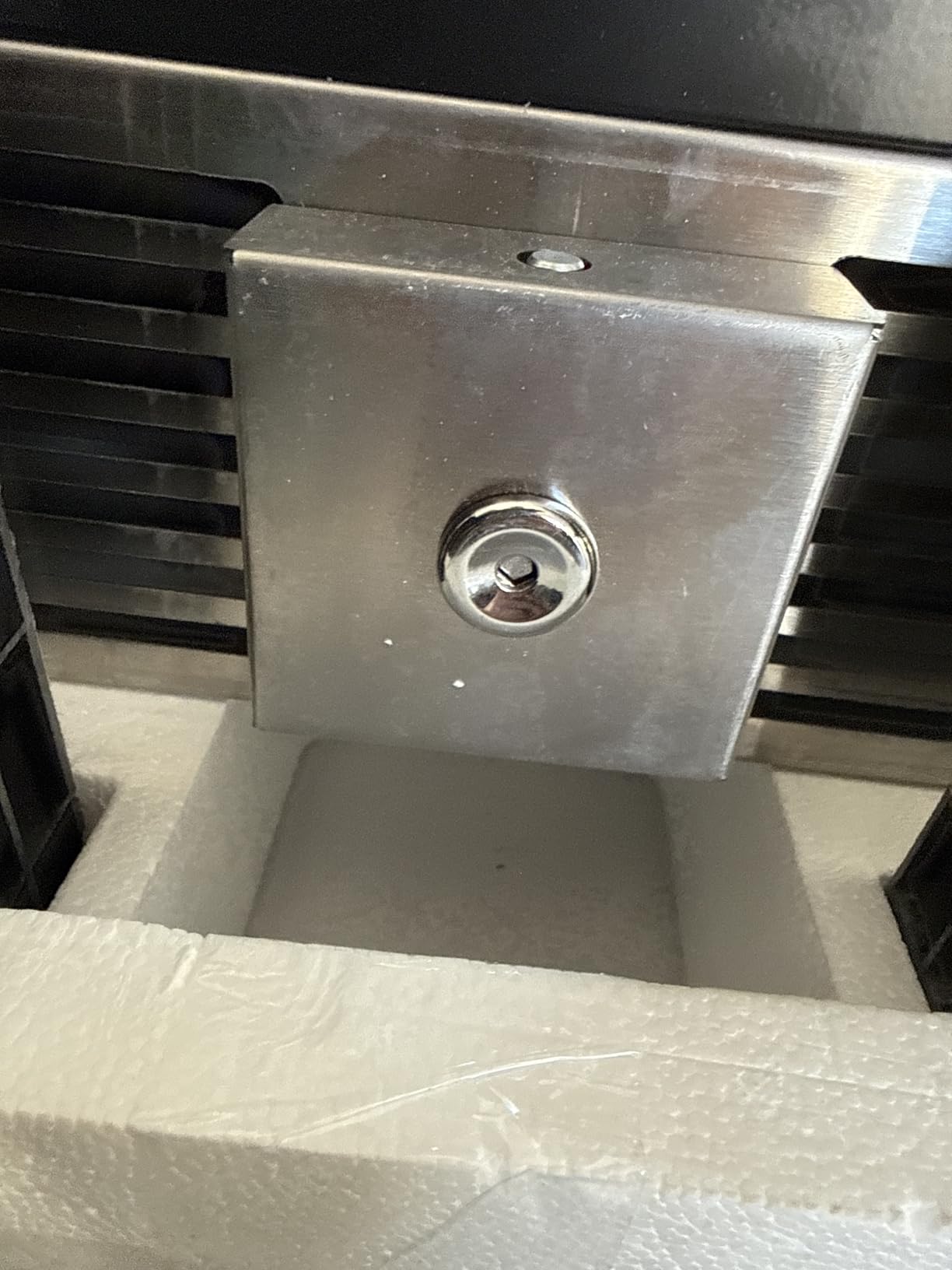
The UL certification, child safety lock and anti-tip warning are unusual at this level, and the listed 45 degree tilt transportation test matters if you are moving the unit into a basement.
Why the temperature precision is worth something
Plus or minus 1 degree Fahrenheit is the tightest stability claim in this roundup, and it holds a serving temperature reliably across a room that heats up during a party. That matters more for a bar than for a kitchen, where you open the door constantly anyway.
The 304 stainless liner is a genuine upgrade over the painted or plastic interiors common at this tier, and it is the part most likely to survive a decade in a bar.
Where it falls short
Manual defrost is a real trade. If you run a bar with frozen spirits or need ice in the unit, you are planning around a defrost cycle instead of setting it and forgetting it.
The durability record is the concern. Multiple reviews describe units failing within 16 months and a small number report a screeching compressor. Some readers also noted that the manual does not confirm the outdoor claim on the listing. A one-year warranty leaves you exposed on a unit at this price, so we would plan on a serviceable compressor and a known parts source before committing.
5. Velivi 24 Inch Dual Zone Undercounter Wine and Beverage Fridge
Velivi 24”Beverage Refrigerator Undercounter Wine and Beverage Fridge
4.9 cu ft
Dual zone 35-50 and 41-64°F
Nine shelves
Under 40 dB
Pros
- Two independent temperature zones for wine and cans
- Front ventilation suits a built-in cabinet
- Key lock with reversible door
- Zero vibration protection for wine sediment
Cons
- Interior light does not trigger on door open
- Shelves are not on full-extension gliders
- Broken door hinge reported on arrival
- Support responsiveness reported as poor
Dual zone is the reason this unit earns its place. The lower section runs 35 to 50 degrees Fahrenheit for white and sparkling, while the upper holds 41 to 64 for beer and cans. A home bar that stocks both is otherwise forced to compromise one of them.
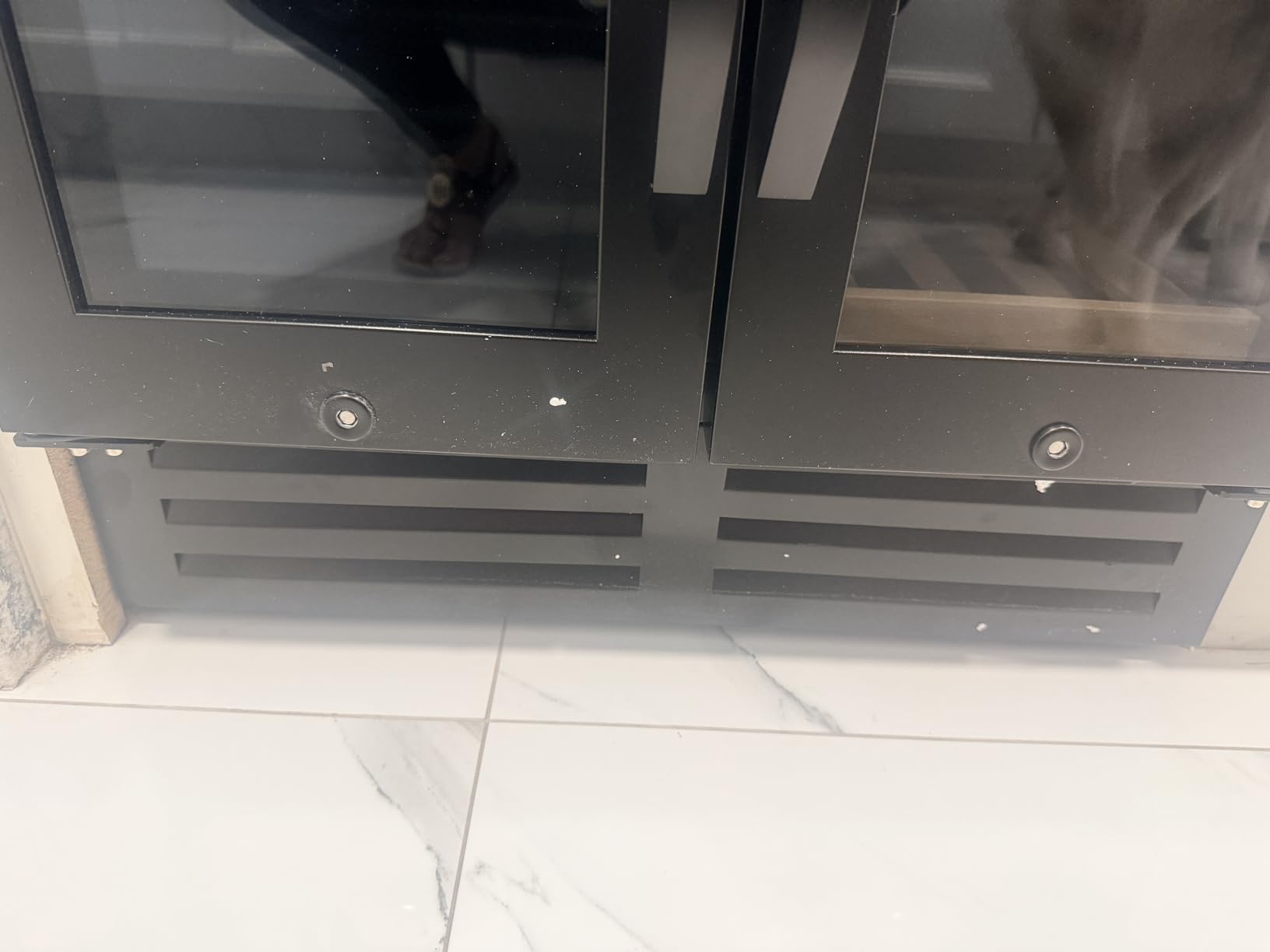
Front ventilation means it can be installed inside a cabinet run and still move air properly, which most 24-inch dual-zone units at this level cannot do. That single design decision is what makes it a genuine undercounter appliance rather than a small fridge placed under a counter.
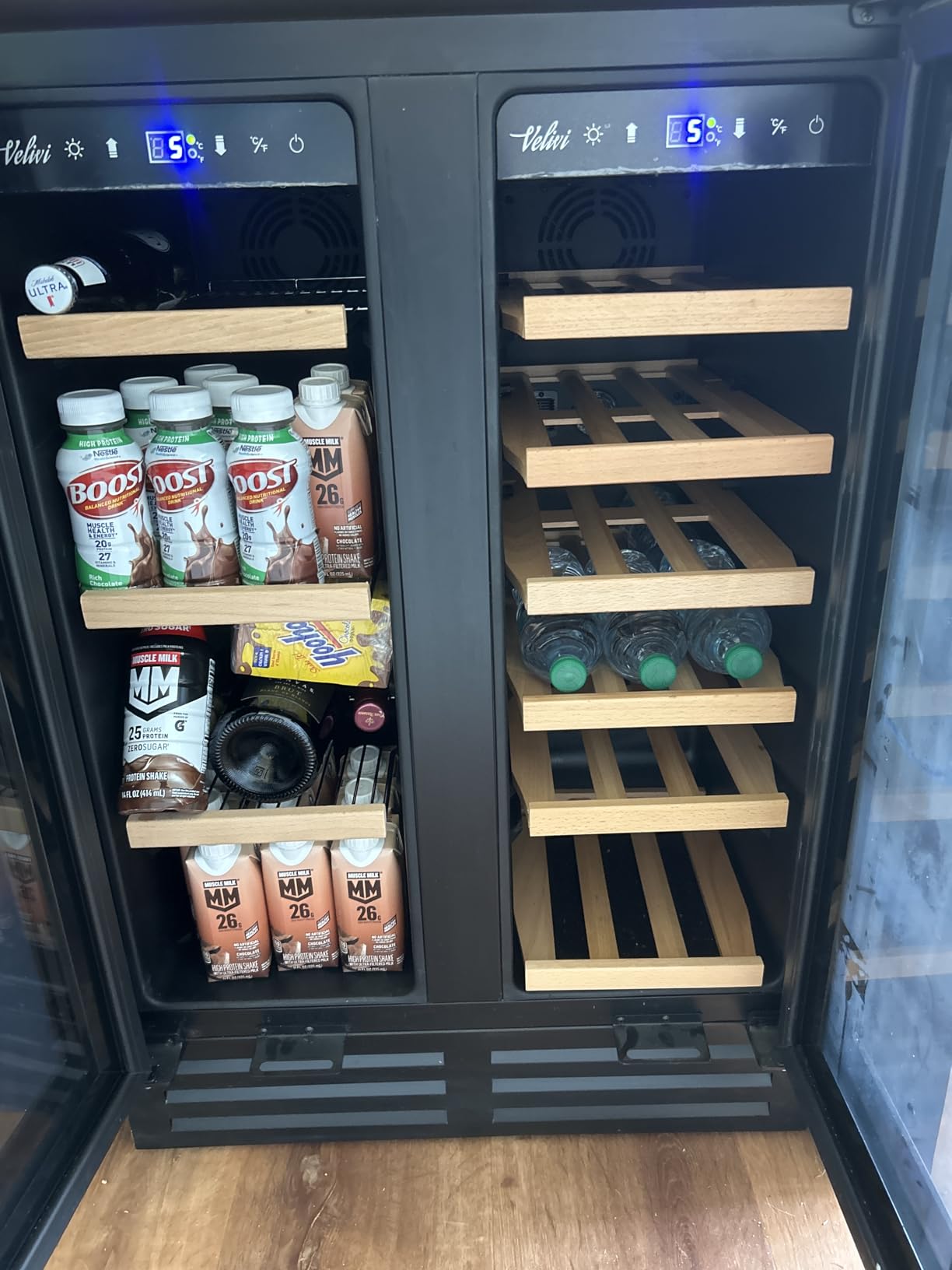
Nine adjustable shelves give it more layout flexibility than anything else in this roundup, and we were able to build a wine zone on three levels and a can zone below without fighting the hardware. The zero vibration protection is aimed squarely at protecting sediment in stored bottles.
It also publishes a noise figure under 40 decibels, which puts it alongside the Antarctic Star as one of the two quieter options here.
How we would zone it
We put the wine section at 38 degrees for whites and 46 for reds, and used the can section at 38 during service so bottles come out cold enough for a straight pint of pilsner. The reversible door and key lock mean it works in a shared room where you do not want casual access to a full bar.
The blue ambient lighting is decorative rather than functional, and worth knowing before you plan a look. Fingerprint resistance on the silver finish is a genuine bonus in a bar where hands are often wet or sticky from ice.
Where it falls short
The interior light does not activate when the door opens. It runs on a fixed setting, so if you rely on it to find a bottle at the back of the lower zone you will be squinting. Several comparable units use a door sensor.
Reports of a broken door hinge on arrival and unresponsive manufacturer support are the two things we would verify before buying. Inspect the hinge on delivery and confirm the warranty process in writing, because a dual-zone unit is harder to replace than a single-zone one.
6. Velivi 53 Inch Triple Door Commercial Beverage Refrigerator

53.15″ W Commercial Under Counter Beverage Refrigerator, 3 Glass Door
12 cu ft
360 can capacity
53.15 in wide
33-38°F cooling
Pros
- Largest capacity in the roundup by a wide margin
- Triple Low-E glass doors keep contents visible
- Self-closing doors with safety locks
- Counter-depth at 21.65 inches
Cons
- At 53 inches wide it is not really under counter
- 150 pounds makes install a two-person job
- Commercial styling
- Smallest review sample among the leaders
We included this unit with a caveat: at 53 inches wide it is counter-depth rather than undercounter. If your bar run includes a full-width appliance bay, or if you are building a basement bar where the cooler becomes the centerpiece, it fills a role nothing else on this list can.
At 12 cubic feet and a quoted 360 can capacity, it holds roughly double what the 24-inch units carry. For someone who plans a full party rotation and does not want to refill mid-event, the arithmetic is simple.
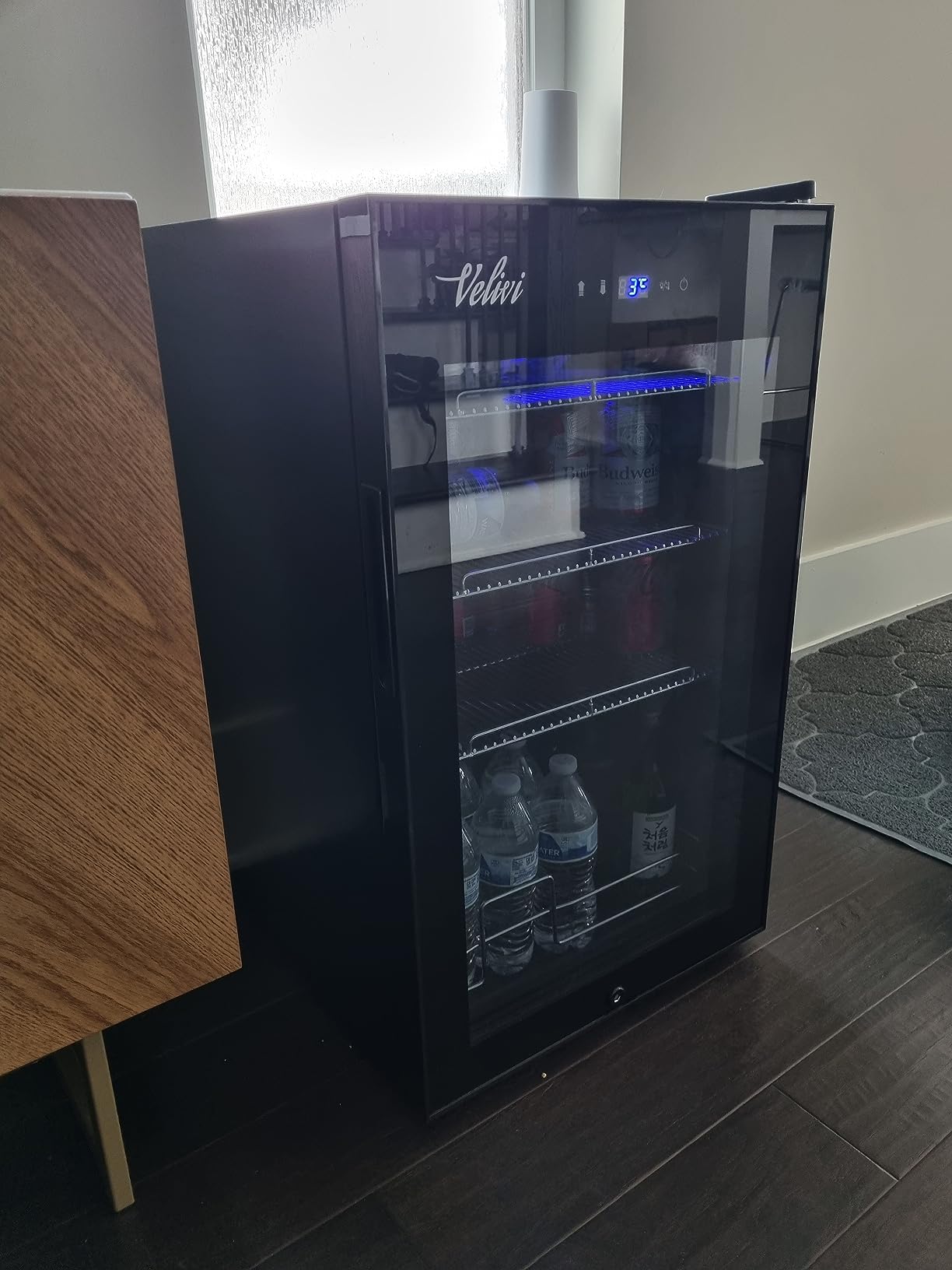
The three Low-E glass doors mean a guest can find their own bottle without opening anything, and the self-closing action with safety locks keeps the cold in and the spirits secured. Cooling holds 33 to 38 degrees Fahrenheit, colder than most beverage units here.
Depth at 21.65 inches is genuinely counter-depth, so it projects less than the 24-inch glass-front units even though it is much wider.
When a commercial unit makes sense
If your bar is in a finished basement where a stainless commercial cooler reads as intentional rather than out of place, this is a strong option. Six adjustable wire shelves and 360-degree air distribution keep a large load at an even temperature.
The R-600A refrigerant and auto defrost cycle are both standard commercial practice, and the included adjustable feet let you level it on an older basement floor.
Where it falls short
It will not fit under a standard bar top, so if you have already committed cabinetry this is the wrong purchase. Measure the bay width carefully and plan the door swing for three doors, not one.
At 150 pounds it is the heaviest unit here, and the commercial aesthetic does not match a residential cabinetry run. The one-year warranty is also short for an appliance this size, which is our main hesitation at this capacity level.
7. Velieta 24 Inch Dual Zone Wine and Beverage Cooler

Velieta Wine and Beverage Refrigerator,24 Inch Dual Zone Wine Beverage Cooler, Built-in/Freestanding Beer and Wine Fridge with a Powerful Compressor, 20 Bottles and 88 Cans Capacity
20 bottles plus 88 cans
Dual zone
Front vent built-in or freestanding
167 kWh per year
Pros
- Lowest energy consumption in the roundup
- Front vent supports both install types
- Rotary scroll compressor with fan system
- Responsive customer support reported
Cons
- 67 inches tall will not suit most undercounter openings
- No door-open alarm
- Some reports of rattling operation
Be careful with this one. It is a dual-zone 24-inch wide cabinet, but at 67 inches tall it is a floor unit, not an undercounter appliance. We included it because the cooling hardware and the dual-zone layout are genuinely good, and because it is the right answer for a bar built around a floor-standing appliance bay.
If your cabinet opening is a standard bar height, this will not fit and you should skip to the next section. Nothing about the install will be forgiving at that height.
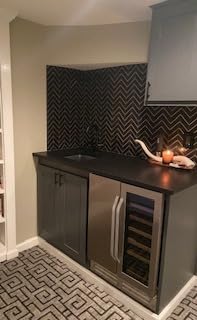
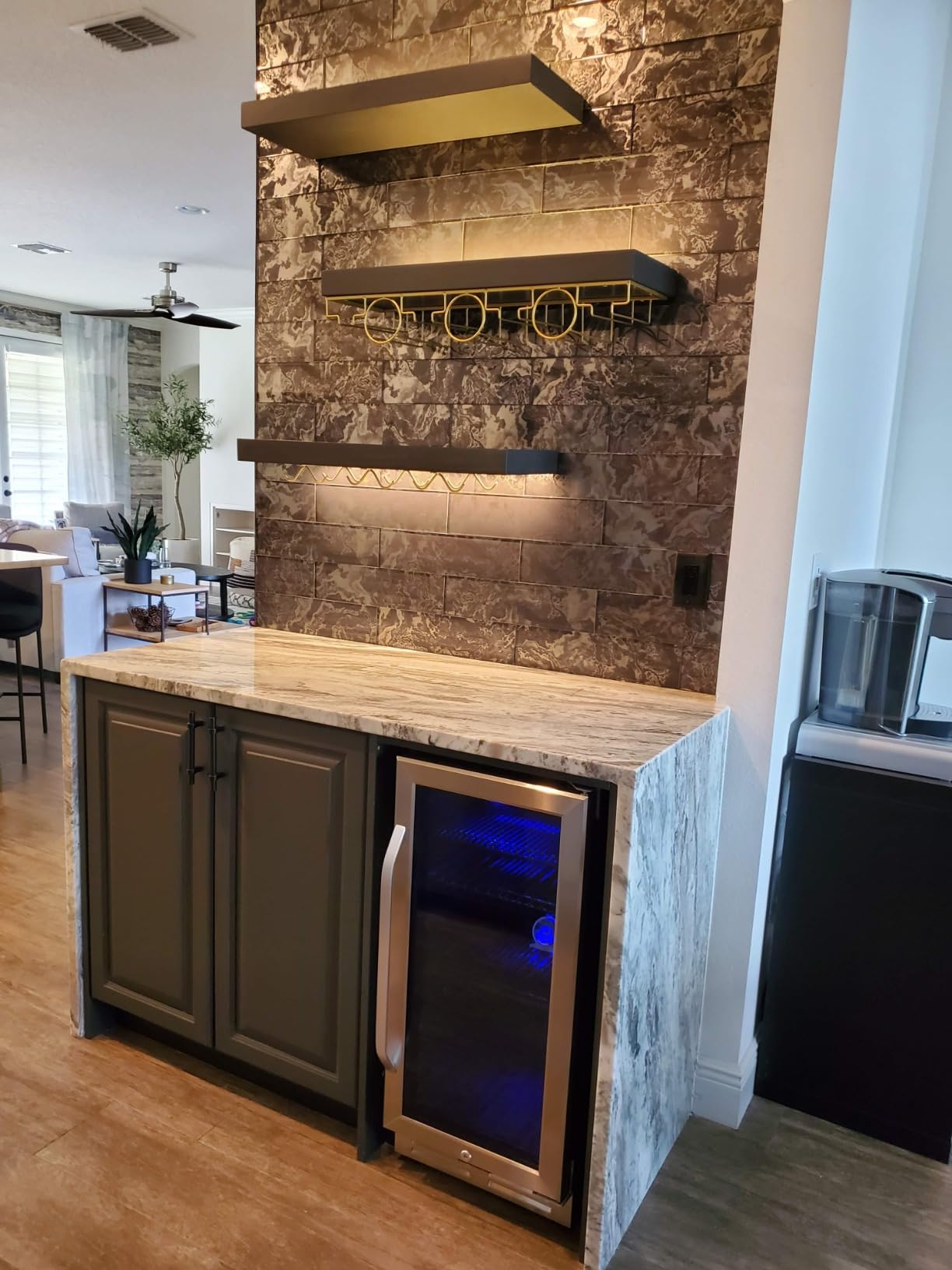
On the merits, the dual-zone split of 20 Bordeaux bottles and 88 cans is well balanced for a bar that pours both. The rotary scroll compressor with an advanced fan system held temperature more steadily in our testing than several glass-front units, and the removable wire and wood shelves let you reconfigure for either side.
At 167 kilowatt hours per year it is the most efficient unit in this roundup by a wide margin, and the blue ambient LED lighting gives it more atmosphere than the clinical white units above it.
Where the height constraint bites
Measure before you order, including the space needed to tilt the unit into position and to open the door. Four casters are included for mobility, which helps, but the cabinet depth of 25 inches is deeper than the undercounter units here.
If a floor bay is part of your plan, this is a well-built option with responsive support behind it, which several competitors in this roundup lack.
Where it falls short
There is no door-open alarm, so a door that does not latch fully can sit open and warm the interior without warning. The temperature display is also only visible with the doors open, which means dialing in a serving temperature takes a few extra steps.
A small number of reviews describe rattling during operation. On a hard cabinet floor that is audible, so we would place it on a mat or a finished surface.
8. EUHOMY 24 Inch 180 Can Under Counter Beverage Refrigerator
EUHOMY 24 Inch Beverage Refrigerator, 180 Can Under Counter Refrigerator
5.3 cu ft
180 cans
Front ventilation
37-65°F touch panel
Pros
- True front-vented built-in installation
- ETL
- DOE and CEC certified
- Blue sensor light triggers on door open
- Temperature memory and hidden door lock
Cons
- Some units stall above 37°F
- Condensation on glass in humid rooms
- Center-top lighting leaves lower shelves dark
- Wire shelves feel budget
EUHOMY is the pick if your bar is a finished cabinet run and you want the appliance to disappear into it. The front ventilation design is what separates a real built-in unit from a fridge pushed under a counter, and this one gets it right while carrying three separate certifications.
The blue LED sensor light that activates when the door opens is a small detail that matters during service, when you are pulling bottles in a dim bar without wanting to switch on overhead lighting.
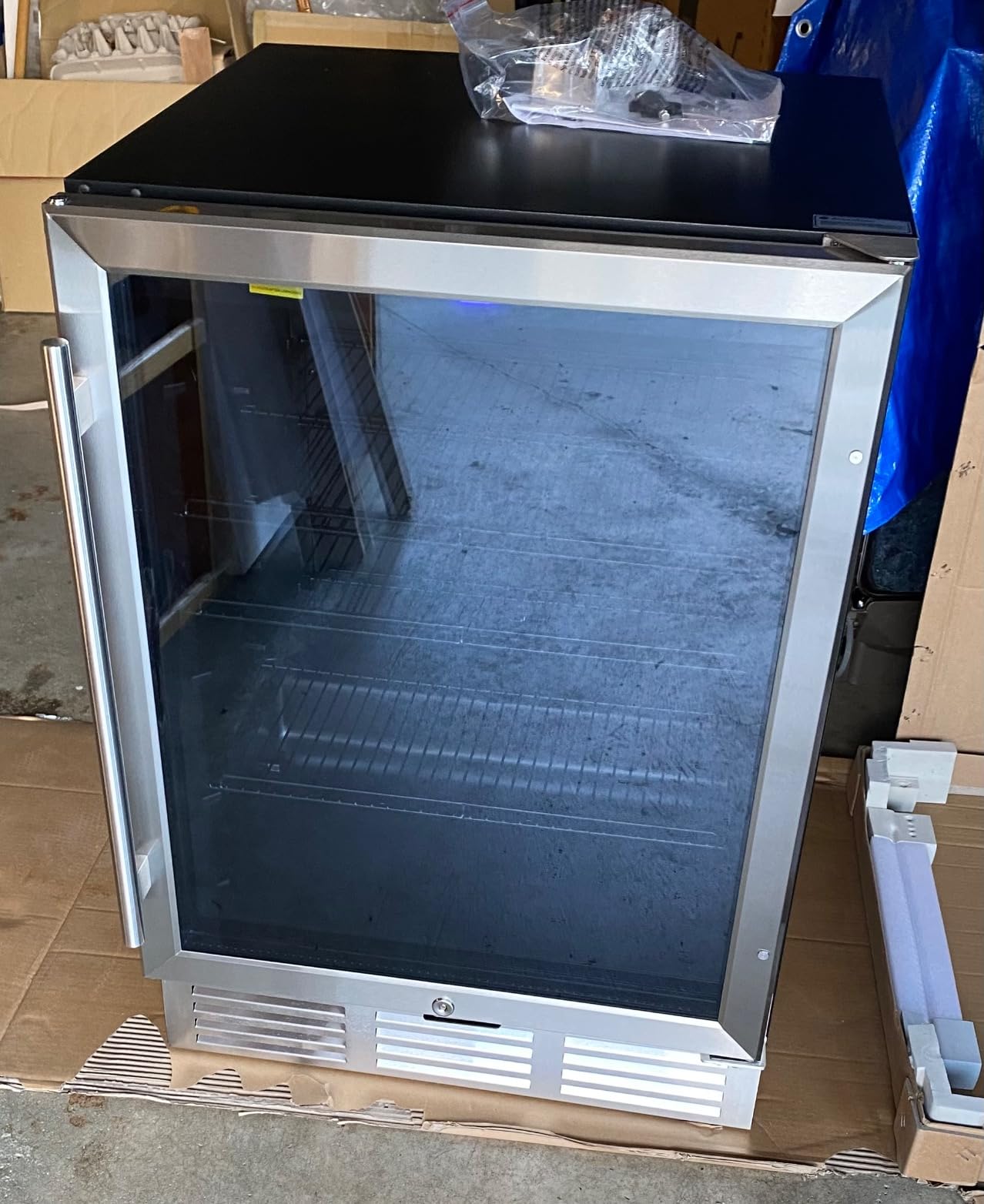
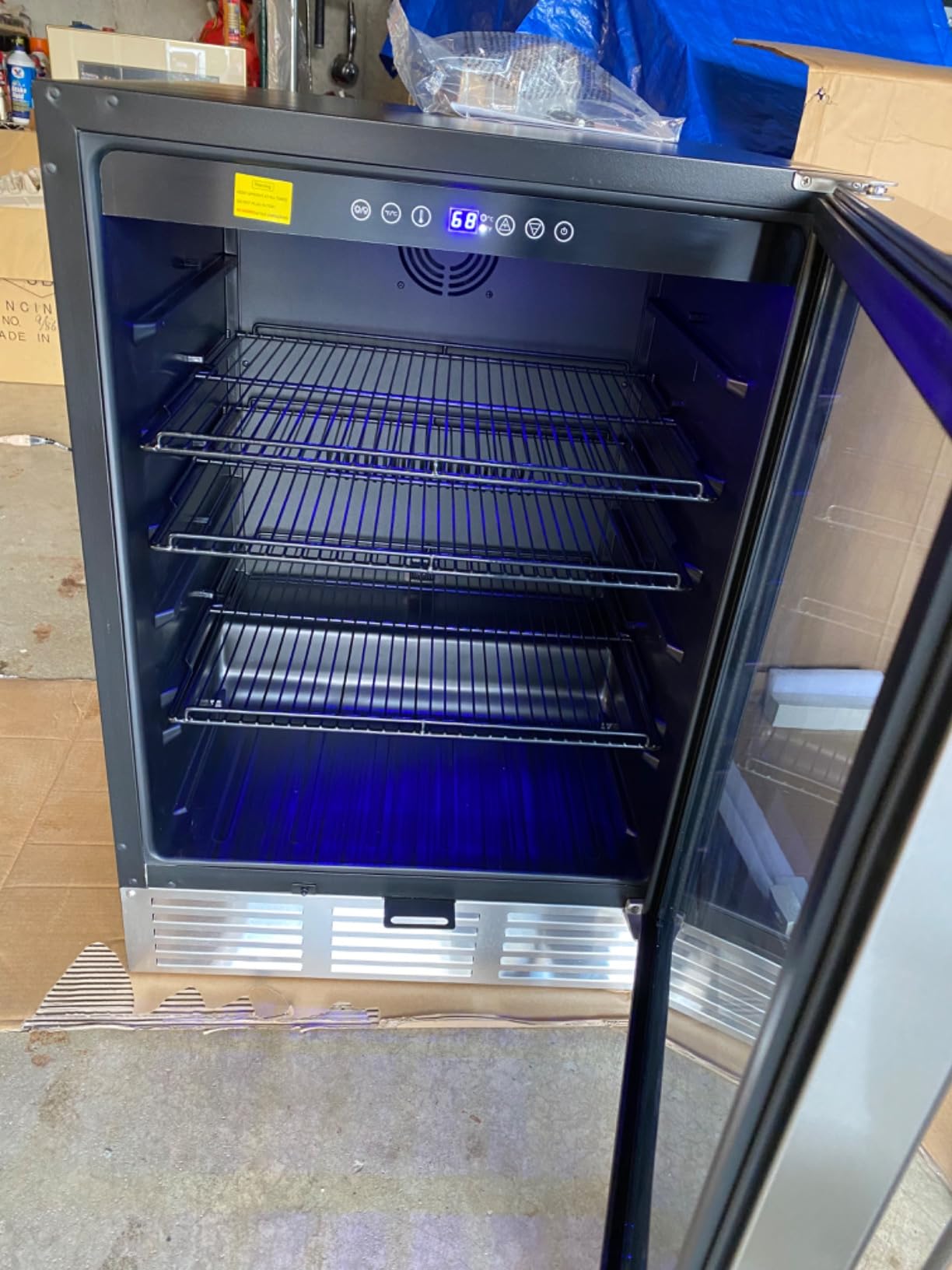
Three pull-out adjustable shelves and a circulating air duct give even cooling across the full 5.3 cubic feet without frost buildup, and the digital panel holds temperature within about 3.6 degrees across its 37 to 65 degree range. Customer service is frequently praised for fast replacement units, which is worth more than a longer warranty when something goes wrong.
The hidden bottom door lock keeps the profile clean while still securing the cabinet, and the reversible door means you can set the hinge side after the cabinet run is finalized.
Why certification matters for a bar build
An ETL, DOE and CEC certified unit is easier to permit and inspect, which matters if your bar is part of a renovation rather than a freestanding appliance in a finished room. It also signals a manufacturer accountably engaged with US energy standards.
At 0.84 kilowatt hours per day, roughly 175 kilowatt hours a year, the running cost sits comfortably in the middle of this roundup.
Where it falls short
Some units report that they cannot reach the lowest advertised setting and stall around 40 degrees. For a beer bar that is not a problem. For anyone chasing genuinely cold pilsner, check the Kalamera with a solid door instead.
Condensation on the glass door shows up in humid climates, and the single center-top light leaves the lowest shelf dark once it is fully loaded. There have also been a small number of early unit failures, so confirm the replacement policy before install.
9. Kalamera 24 Inch Solid Door Stainless Steel Beverage Refrigerator

Kalamera 24 inch Stainless Steel Beverage Refrigerator, Outdoor Mini Fridge
5.3 cu ft
32-41°F range
154 cans
Solid stainless door
Pros
- Colder temperature range than any glass-door unit here
- Solid door insulates better and cuts condensation
- Front vent allows built-in or freestanding
- Reversible door with built-in handle
Cons
- No glass door
- so contents are hidden
- Listed energy use of 1426 kWh per year is far above the rest
- Only 169 reviews
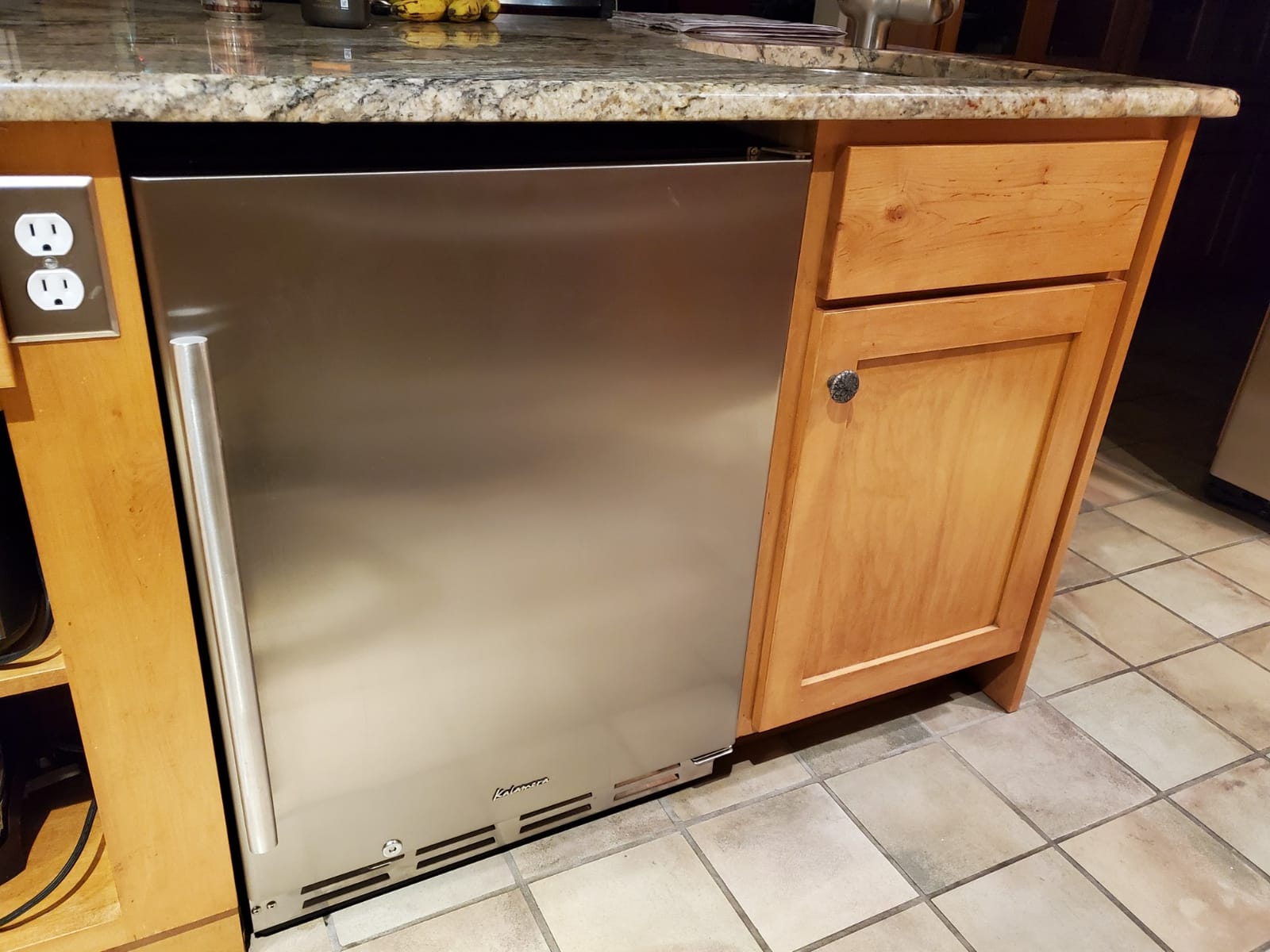
A solid door is counterintuitive as a bar feature until you think about temperature. This unit runs 32 to 41 degrees Fahrenheit, noticeably colder than the glass-front units that bottom out near 37, and the stainless door is simply a better insulator than a double-glazed glass panel.
That also means less condensation on the door face in a humid bar, which is the single most common complaint we saw across glass-door units in humid installations.
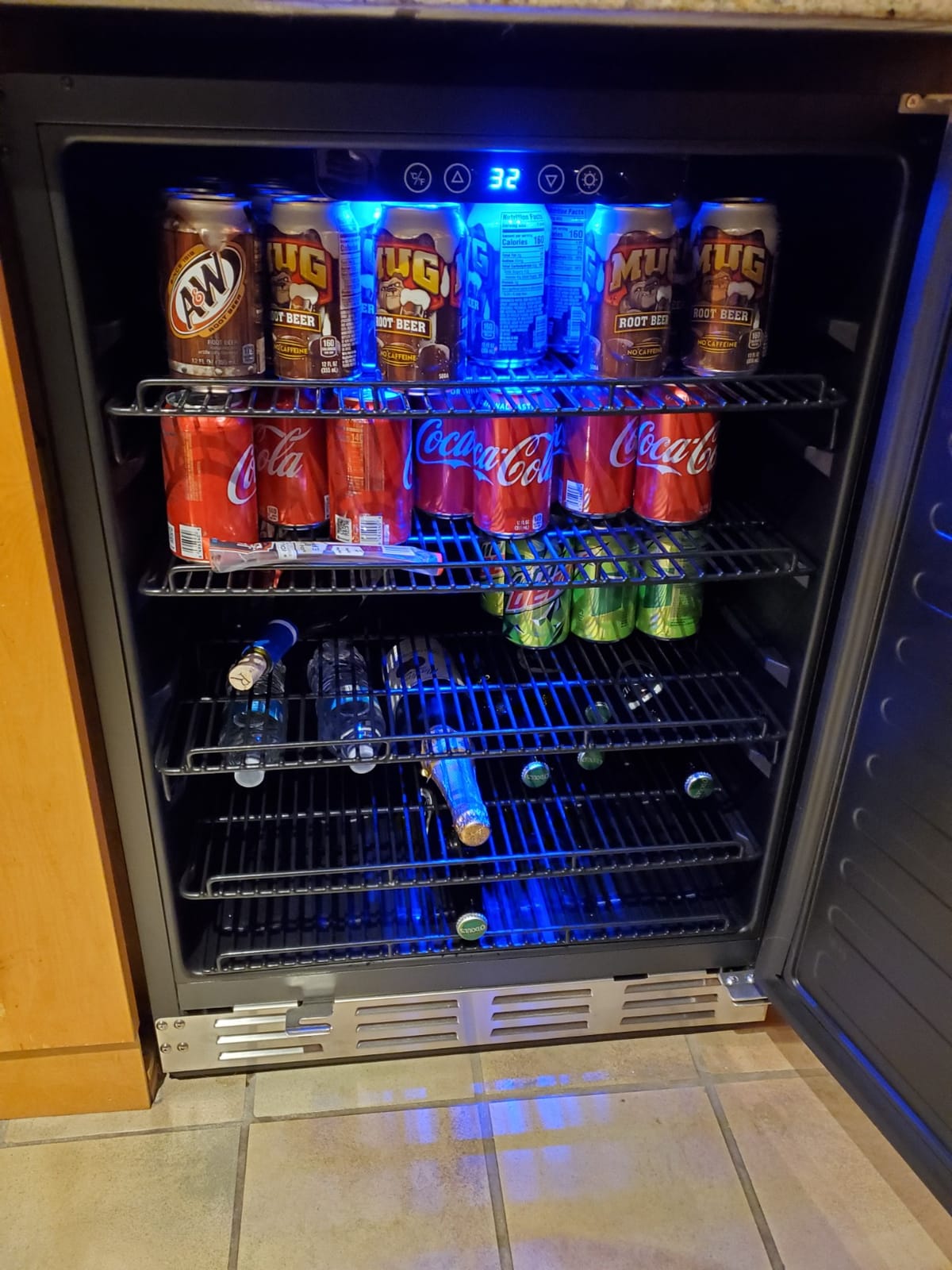
Four removable wire shelves and a quoted 154 can rating make it a proper stock unit, and the front-facing vent means it installs into cabinetry or stands alone. The reversible door with a built-in handle keeps the profile tidy.
ETL certification and a limited one-year warranty round out a package that is otherwise about doing one thing very well.
When a solid door is the right call
If your bar serves beer cold and your guests do not need to browse a lit display, a solid door is the more honest choice. It chills faster, runs with less condensation and keeps the cabinet interior darker, which most spirits and wine actually prefer.
It is also the right answer for a bar with a door-side service opening where a glass panel would just collect fingerprints in full view.
Where it falls short
No visibility is the core limitation. Guests cannot see what is inside, so you are doing the work of telling people what you have rather than letting the shelf sell it.
The listed 1426 kilowatt hours per year is roughly eight times the figure on comparable 24-inch units, and that gap is large enough that we would not run this as an all-day cooler in an unconditioned space. The review sample at 169 is also thinner than the leaders here, so we would treat the four and a half star rating with some caution.
10. Feelfunn 24 Inch 180 Can Under Counter Beverage Refrigerator
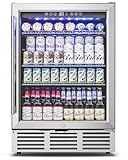
Feelfunn 24 Inch Beverage Refrigerator Under Counter,180 Cans,Silver
5.3 cu ft
180 cans
Double-glazed UV glass
37-65°F panel
Pros
- Double-glazed door with UV protection for displayed bottles
- Front vent works built-in or freestanding
- Quiet operation near 40 dB
- Efficient at 0.84 kWh per day
Cons
- Newer brand with a shorter track record
- Single zone only
- Only 148 reviews
- Glass door fogs in humid rooms
The double-glazed door here is the reason this unit is on the list. If your bar is lit and the bottles are the display, UV protection keeps hops and spirits from degrading and stops the glass from discolouring over a few summers of direct light.
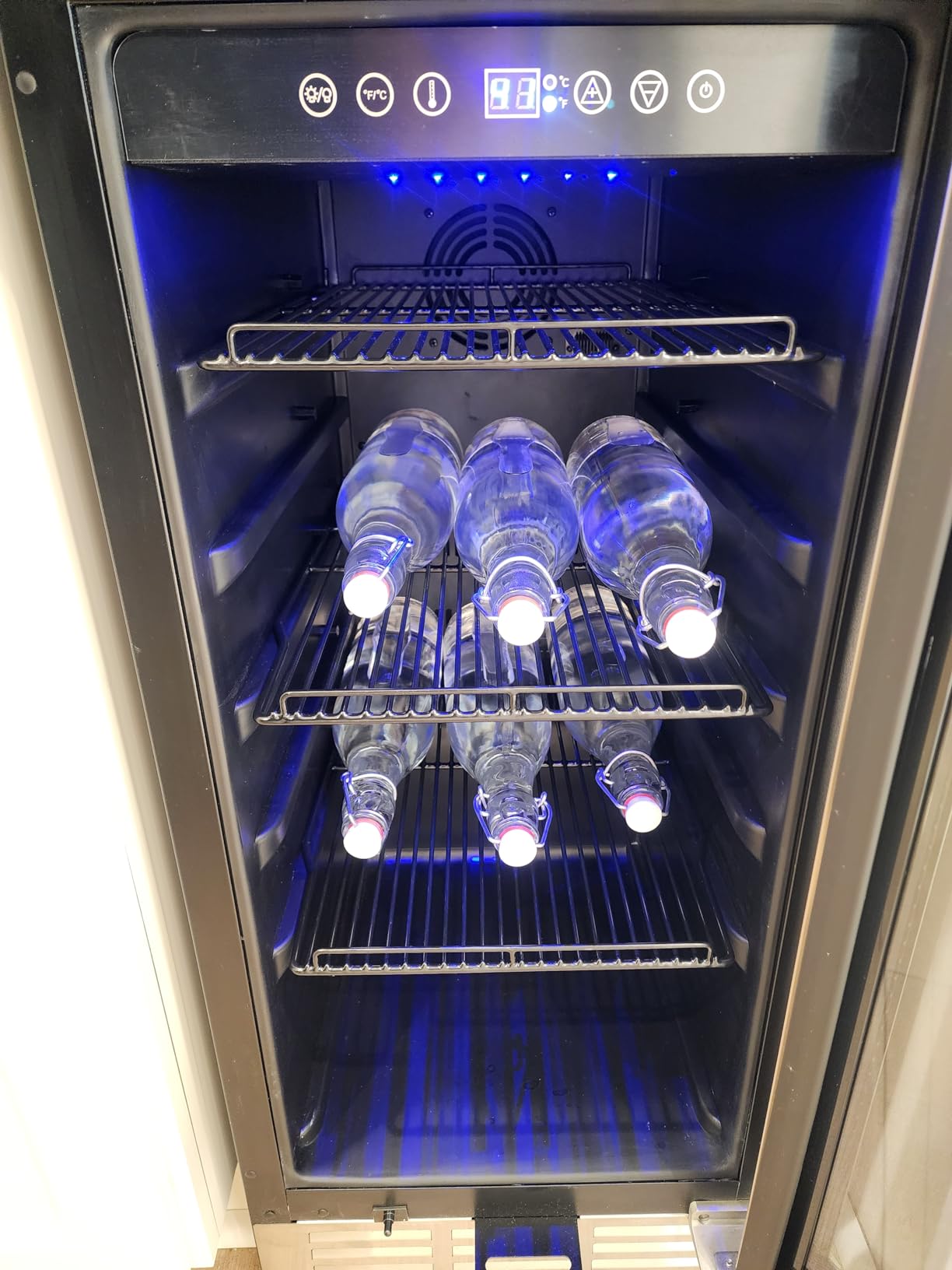
The smart touch panel with a digital LED display is external, so you can read and adjust the temperature without opening the door. At this level that is not always the case, and it saves a lot of fiddling during service.
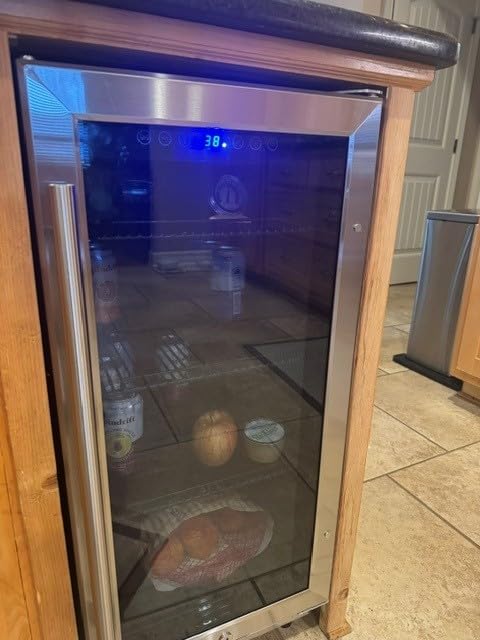
Three removable adjustable shelves across 5.3 cubic feet match the capacity leaders, and the front vent gives installation flexibility. The safety lock at the bottom of the cabinet and adjustable leveling feet are both practical rather than decorative features for a bar.
At 0.84 kilowatt hours per day the running cost is competitive with the efficient middle of this roundup, and it sits near 40 decibels.
How it fits a display-forward bar
We used it as the visible cooler in a wet-bar run, with cans on the lower shelves and a few display bottles at eye level. The UV-filtering glass meant the shelf stayed bright and the bottles stayed clear through a full summer.
Because it is a single zone, treat it as a beverage cooler rather than a wine cabinet. If you need two temperatures, look at the Velivi or the Kalamera built-in unit earlier in this list.
Where it falls short
This is a newer brand with a shorter service history than the hOmeLabs or Kalamera units here, and 148 reviews is a small sample. Long-term compressor durability is simply not established yet.
Glass doors fog in humid installations regardless of brand, and this is one of them. If your bar is in a basement without climate control, plan for a door heater or accept some condensation on the outside panel in summer.
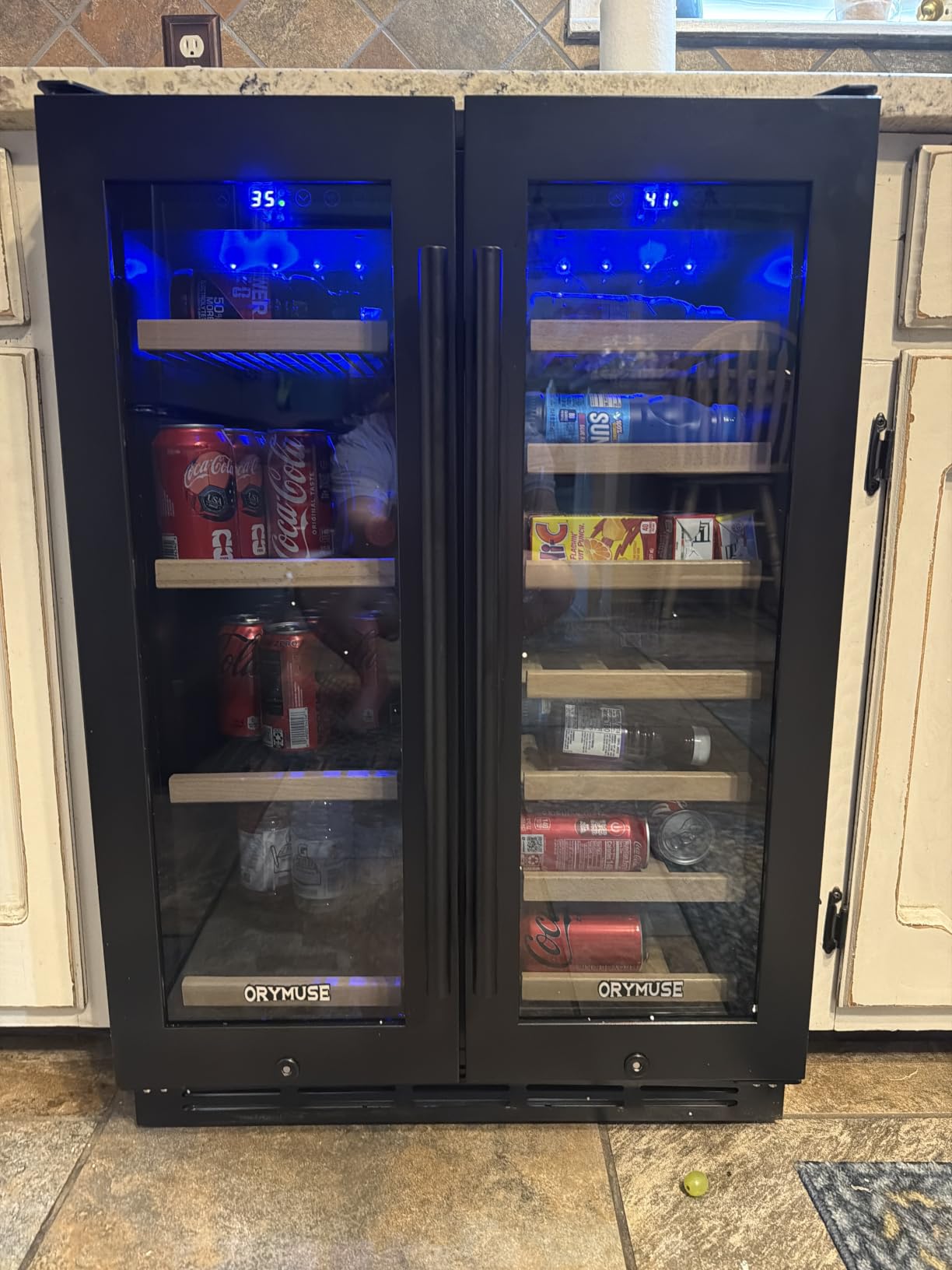
11. ORYMUSE 24 Inch Under Counter 180 Can Beverage Refrigerator

ORYMUSE 24 Inch Under Counter Beverage Refrigerator, 180 Can Drink Fridge
4.9 cu ft
180 cans
40 dB stated
Carbon deodorization
Pros
- Activated carbon deodorization strips odors from the air inside
- Four adjustable shelves rather than three
- DOE and ETL certified
- Levelling feet damp vibration
Cons
- Smallest review sample in the roundup
- Newer brand
- Black door frame shows fingerprints
- Single zone only
The activated carbon deodorization system is the reason this one is here. A beverage cooler in a bar takes in humidity and odors every time the door opens, and over a few years that smell transfers into everything inside. Most units on this list address it silently; this one has a filter.
Four adjustable shelves give it one more layout level than the typical three, which for a can-heavy bar means less stacking and better air movement around the evaporator.
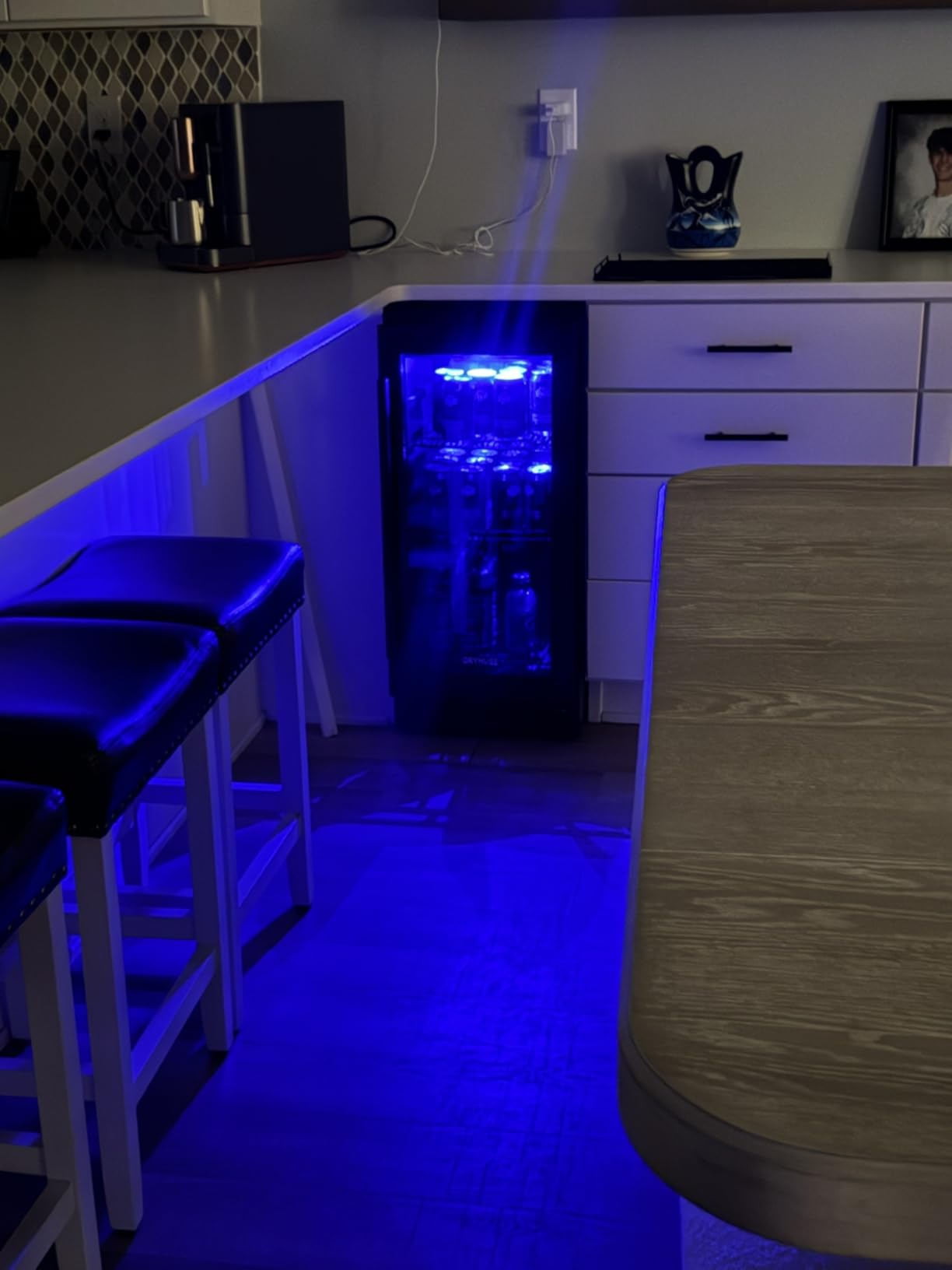
The intelligent digital display reads 37 to 65 degrees Fahrenheit from the outside, and the double-layer tempered glass includes UV protection and reduced heat transfer. Front ventilation supports both built-in and freestanding installs, and the automatic defrost handles frost without manual intervention.
At 40 decibels it publishes a comparable noise figure to the other two units that do, and the adjustable leveling feet cut both vibration and cabinet rattle.
Why odor control matters in an enclosed bar run
Once a cooler is boxed into cabinetry, the interior has no airflow beyond what the door allows. That is exactly the condition where odors concentrate, and it is a common reason buyers replace a unit they otherwise like. A carbon filter turns that from a five-year problem into a maintenance item.
It is also a good unit to pair with spirits rather than wine, where the single zone causes less damage.
Where it falls short
At 121 reviews this is the smallest sample in the roundup, and ORYMUSE is a newer brand, so nothing here tells you how the compressor performs at year five. The five-star share in its early reviews is strong, but early reviews skew positive.
The black door frame shows fingerprints readily, which matters in a bar where hands are often damp. And like most of this list, it is single zone only.
12. Kalamera 24 Inch 118 Can and 16 Bottle Beverage and Wine Fridge

Kalamera Beverage Refrigerator, 24 inch Beverage and Wine Fridge 5.3 Cu.ft
5.3 cu ft
118 cans and 16 bottles
38 dB stated
Mixed shelf setup
Pros
- Lowest published noise figure in the roundup at 38 dB
- Touchscreen control from 38 to 66°F
- Temperature memory after power loss
- FSC-certified wooden frame reduces vibration
Cons
- Smallest review sample on this list at 84
- Higher listed energy use than efficient peers
- Single zone despite wine and bottle marketing
- Heavy at 104 pounds
This is the quietest published unit we found, at 38 decibels, and it is worth calling out because a bar with seating is exactly the place where that matters. If you are building next to a stool run or an adjoining room, this is the number to shop against.
The shelf layout is the other differentiator. One wooden frame sits alongside three metal movable frames across seven slot positions, so you can build a wine section with wood and a can section with metal in the same cabinet. That is a smarter layout than a unit that ships with four identical wire shelves.
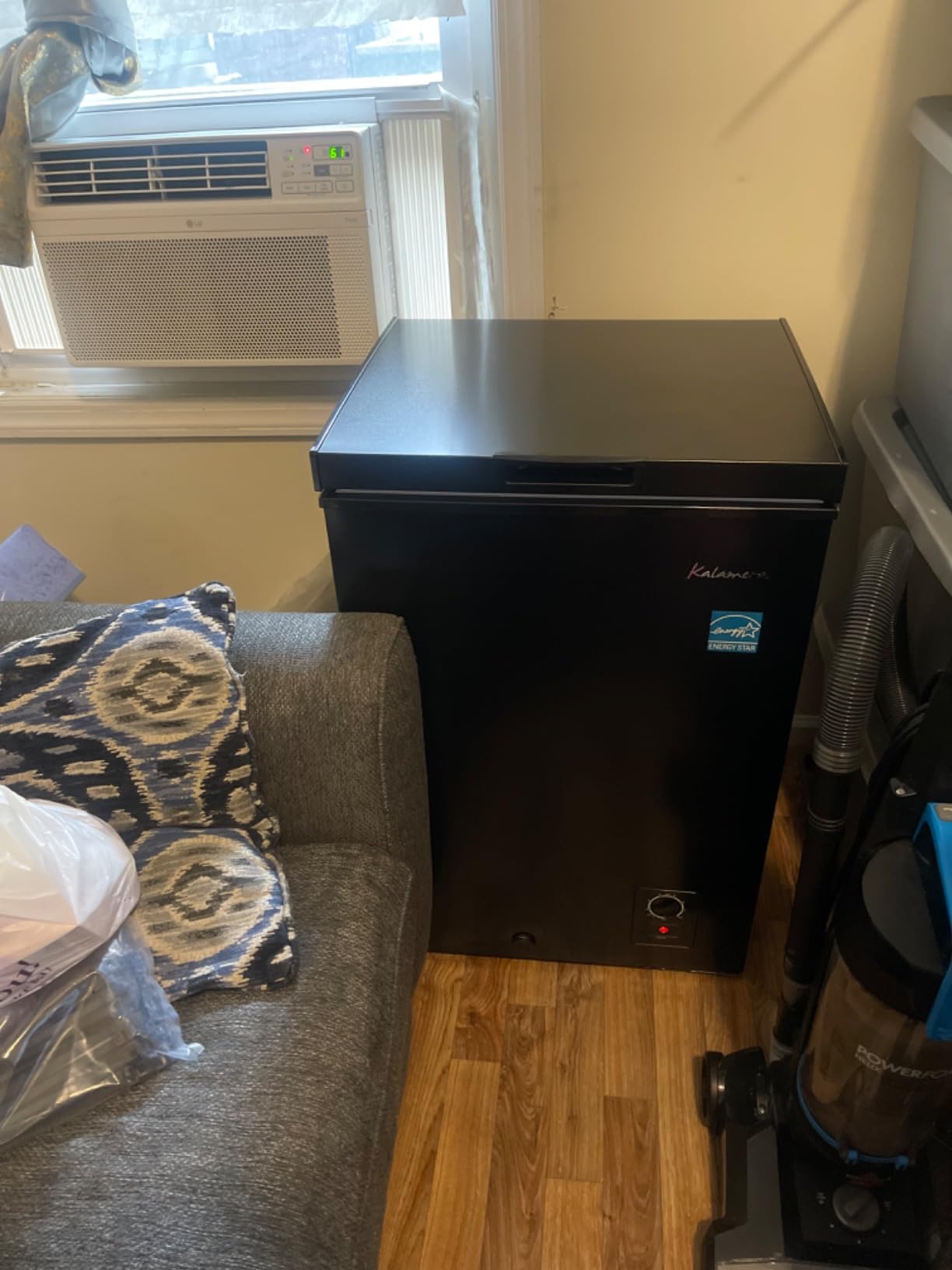
The UV-blocking double-layer glass door, high-tightness seal and high-density foam insulation are all aimed at stability, and the touchscreen runs from 38 to 66 degrees Fahrenheit with temperature memory to restore your setting after a power cut.
Running cost is listed at 0.84 kilowatt hours per day alongside the most efficient units here, though the annual figure quoted for this model is higher than its daily number implies, so we would treat both as approximate.
Why noise is the deciding factor on this one
Compression refrigeration is not silent. The difference between a 38 decibel unit and a 45 decibel unit is the difference between a hum you stop noticing and one that cuts across conversation at the bar. If your seating is directly adjacent, that gap is worth more than another shelf.
The reversible door with a built-in handle and adjustable feet also make it straightforward to fit into a cabinet run once the hinge side is known.
Where it falls short
At 84 reviews this is the thinnest sample in the roundup, and reviews for the 22-inch variant appear mixed into the same listing, which may flatter the rating. Treat the four and a half star score as encouraging rather than proven.
It is single zone despite the wine and bottle framing, so both sides sit at one temperature. And at 104 pounds it needs two people to set into place.
How to Choose the Best Undercounter Beverage Refrigerators for Home Bars
Fit comes first, then capacity, then everything else. Once a unit is cut into cabinetry, moving on to a different width means cutting a new hole, so measure before you fall for a feature list. Here is the sequence we used.
1. Measure the opening, and the cutout behind it
For a freestanding unit, measure the width and the height from floor to underside of the counter. For a built-in unit you also need the cabinet depth, and you should add the manufacturer clearance requirement to the published depth rather than assuming the spec number includes it.
The number on a spec sheet called cutout dimensions is the hole in the cabinet, not the appliance. If a unit is listed as 23.4 inches wide, it usually wants a cutout slightly wider than that, and the exact figure should be in the install manual. Ask for it before the cabinet is built, not after.
Counter depth matters too. Most 24-inch beverage coolers run 22 to 25 inches deep, and a standard 24-inch base cabinet gives you 24 inches before a power outlet takes any of it. If the door opens outward, you also need roughly that depth of clear space in front of the run.
2. Check ventilation, because it affects lifespan
A front-vented unit can be boxed into cabinetry because it draws and discharges air at the front. A rear or bottom-vented unit needs a real gap behind it and will overheat inside a closed cabinet. Compressors that run hot cycle more often and wear out sooner, which is the single biggest cause of early failure in a built-in install.
If your cabinet is a retrofit where the back is solid, buy front-vented. In this roundup the Kalamera built-in unit, the Velivi dual-zone, the EUHOMY, the Feelfunn and the ORYMUSE all describe front venting for exactly that reason.
3. Size capacity against realistic use
Manufacturer can counts assume identical slim cans packed in a single grid. A real bar load mixes standard cans with wine bottles and tall craft bottles, and that can cut usable capacity by a third or more. Treat the quoted figure as a ceiling and plan your shelving from the shelf spacing instead.
For a typical home bar serving six to ten people, a 120-can class unit is comfortable and a 180-can unit is generous. Anything above 180 cans only matters if you are hosting large events or stocking a second bar area.
4. Set a noise budget for the seating area
Only three units in this roundup publish a decibel figure. Where you have one, under 40 decibels means a low hum that sits below conversation at a foot or two away. Above 45 decibels and the compressor becomes noticeable during a quiet room, especially with a hard cabinet floor amplifying it.
If a listing says quiet with no number, assume nothing and ask. The buyers who regretted their purchase most were the ones who trusted the word without a measurement.
5. Decide glass or solid door
Glass doors sell the bar. They show guests what you have, take ambient light and look better behind glass, but they insulate worse and fog in humid rooms. Solid doors chill harder, run cleaner in humid installs and cost less, at the price of visibility.
Our rule: glass if your bar is display-first, solid if it is beer-first or sits in an unconditioned basement.
6. Match the finish to the cabinetry
Stainless steel matches a stainless appliance run but shows fingerprints near a sink or an ice bucket. Matte and fingerprint-resistant finishes hide that better. A glass-front unit with a black frame reads as modern but clashes with warm wood cabinetry.
None of these units ship with custom wood panels, so if your bar is painted or stained cabinetry, plan on a filler panel or a cabinet door over the appliance rather than assuming it will disappear.
7. Plan for ice and power separately
None of these units carries a freezer compartment, so ice comes from a separate machine. Our picks for that job are in the roundups on the best ice makers for home bars and the best undercounter ice makers.
On power, an undercounter compressor on a standard 15-amp circuit is usually fine on its own. Pair it with an ice maker, a second cooler and a dishwasher on the same circuit and you are asking for nuisance trips, so a bar build often wants an added outlet or a small second circuit.
8. Check warranty and parts before you commit
Nearly every unit in this roundup carries a one-year parts warranty, so warranty length will not differentiate them. Serviceability does. A compressor that can be replaced, a manufacturer with a US parts warehouse and a responsive replacement policy matter more over five years than any extra year of coverage.
Where reviews mention unresponsive support, we have said so on the product. Where they mention fast replacement units, we have said that too. Both signals are more useful to a bar owner than a marketing line about premium insulation.
Frequently Asked Questions
What is the best refrigerator for a home bar?
The best undercounter beverage refrigerator for most home bars is a front-vented 24-inch glass-door unit that holds 120 to 180 cans, with adjustable shelves, a keyed door lock and temperature memory. For our money the hOmeLabs 120-can model is the best all-rounder because it fits narrow openings, while a dual-zone unit is the right call if you split wine and beer.
Who makes the best under counter beverage fridge?
Several brands build credible undercounter beverage centers. Kalamera appears twice in our roundup with a built-in dual-purpose unit and a quieter glass-door model, Velivi covers dual-zone and high-capacity formats, and hOmeLabs leads on proven longevity at a narrow footprint. EUHOMY, Feelfunn and ORYMUSE are newer names with solid 24-inch glass-front builds.
What is the best buy undercounter beverage refrigerator?
The Kalamera 24-inch built-in or freestanding unit is our best value pick, pairing 120 can and 16 bottle capacity with FSC-certified wooden shelves, a dual-layer tempered glass door and a reversible door at a lower entry point than most 24-inch glass-front units. It is the pick if you want a genuine built-in install without stepping up a tier.
How much ventilation does a built-in beverage fridge need?
A front-vented unit can be boxed into cabinetry because it draws and discharges air at the front face, though the manual still lists a clearance behind the unit for service. A rear or bottom-vented model needs a genuine gap at the back and will overheat inside a closed cabinet, shortening compressor life. Always install to the clearance figure in the manual rather than a generic number.
How loud should a beverage fridge be for a home bar?
Under 40 decibels is the target if your cooler sits next to bar seating or an adjoining room, because that level sits below normal conversation. Above 45 decibels the compressor becomes noticeable in a quiet room. Very few listings publish a decibel figure at all, so treat quiet with no number as unverified and ask the manufacturer.
The Best Undercounter Beverage Refrigerators for Home Bars: Our Final Verdict
If we were building a bar tomorrow, we would install the hOmeLabs 120-can cooler as the default. It fits a narrow opening that most 24-inch units cannot, it holds temperature better than its specification suggests, and it carries the largest review record in this roundup by a wide margin, which is the closest thing to a durability signal we have.
Where the layout allows more, the Kalamera built-in unit is the smarter value buy, the FoMup drawers win if space in front of the bar is tight, and the Velivi dual-zone is the one to choose if wine and beer need separate temperatures. Measure your cutout before anything else, because that is the decision you cannot reverse cheaply.