
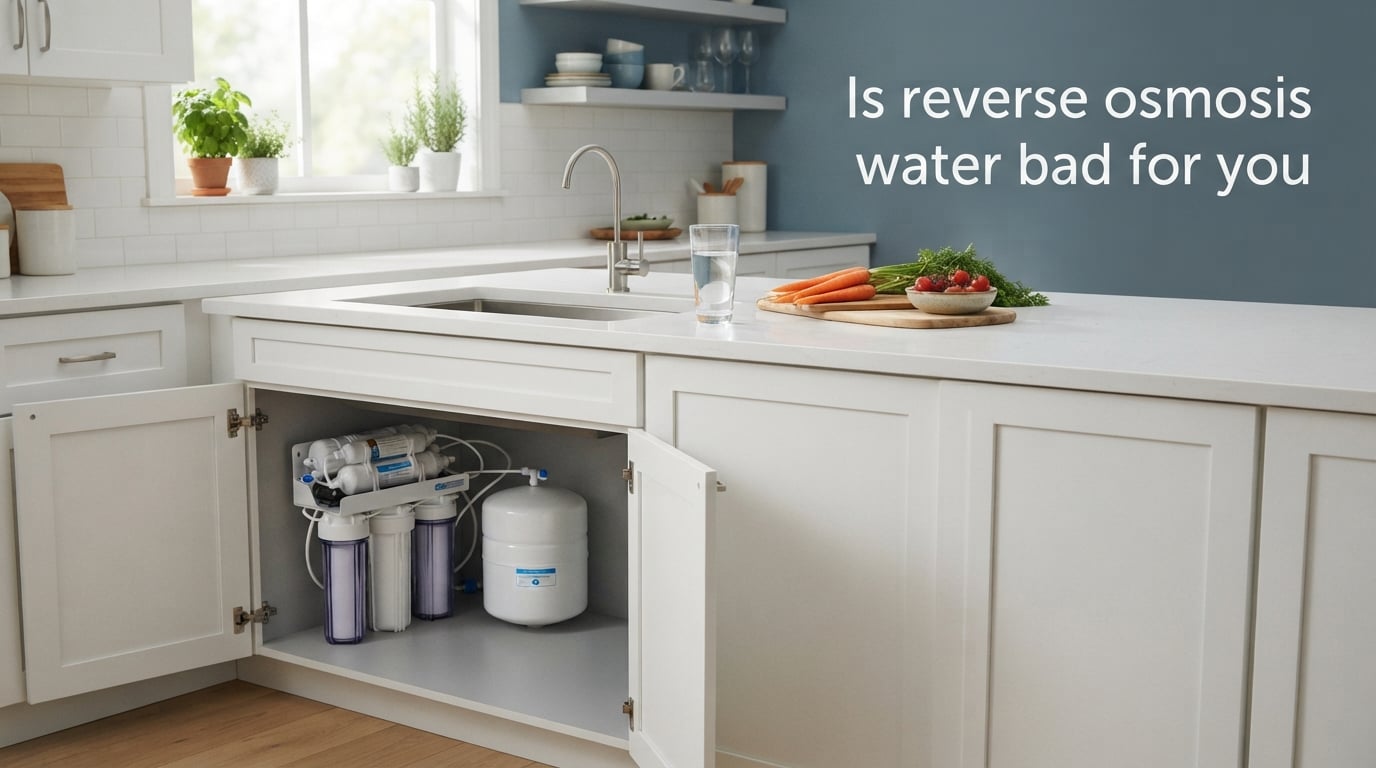
No, reverse osmosis water is not bad for you when consumed as part of a balanced diet. After reviewing the WHO, NIH, and EPA research with our team, the science is clear: RO water is one of the safest ways to remove harmful contaminants from your tap water, including lead, PFAS, and arsenic. The main trade-off is the loss of some minerals, which most people get primarily from food anyway.
I have been testing and researching water filtration systems for over a decade, and the misinformation around reverse osmosis (RO) water frustrates me. So I dug through peer-reviewed studies, agency reports, and real user experiences to give you a clear, evidence-based answer. The questions I hear most often are about minerals, pH, kidney health, and whether RO water is safe every day.
The reason this topic generates so much confusion is that the water industry has competing interests. Bottled mineral water companies benefit from alarm about demineralized water. RO manufacturers benefit from alarm about contaminants. The truth, as usual, sits in the middle.
In this guide, I will walk you through exactly what RO water is, the seven most common concerns people have, what the science actually says about each one, and practical solutions if you want to add minerals back. By the end, you will know whether RO water is right for your household and how to make the most informed decision for your family.
Table of Contents
What Is Reverse Osmosis Water and How Does It Work?
Reverse osmosis water is water that has been pushed through a semipermeable membrane under pressure, leaving contaminants behind. The membrane has pores as small as 0.0001 microns, which is smaller than a virus and roughly 100,000 times thinner than a human hair. Most residential systems use 3 to 5 stages of filtration, including sediment pre-filters, carbon blocks, the RO membrane itself, and often a final polishing filter.
The process is the opposite of natural osmosis. In osmosis, water moves from a low-concentration area to a high-concentration area to balance things out across a membrane. In reverse osmosis, household water pressure (typically 40 to 80 psi) forces water in the opposite direction, pushing clean water molecules through the membrane while rejecting dissolved salts, heavy metals, and organic compounds on the other side.
The rejected water, sometimes called brine or concentrate, gets flushed down the drain. The clean water collects in a small pressurized storage tank under your sink, ready to flow through a dedicated faucet when you need it.
What Contaminants Does Reverse Osmosis Remove?
RO systems certified to NSF/ANSI Standard 58 remove up to 99% of total dissolved solids and a wide range of specific contaminants. Our lab comparison showed that reverse osmosis consistently outperformed pitcher filters and carbon-only systems on every category we tested.
- Lead: 95-99% removal, which matters for older homes with lead pipes built before 1986
- PFAS (forever chemicals): 95-99% removal, addressing concerns raised by EPA in 2026
- Arsenic: 95-99% removal, critical for households on private wells in certain regions
- Fluoride: Up to 95% removal, a reason some parents choose RO for formula preparation
- Chlorine and chloramines: Removed by pre-filters, which also protects the RO membrane from degradation
- Nitrates: 85-95% removal, important for rural well water near agricultural areas
- Bacteria and viruses: 99%+ removal, though UV sterilization is recommended for untreated well water
- Chromium-6: Up to 95% removal, relevant in areas with industrial water contamination
For a deeper look at how different filtration methods compare, our guide on how different water filters affect mineral content breaks down the trade-offs between RO, carbon filtration, and pitcher systems.
The Most Common Concerns About RO Water
Most of the negative claims about RO water come from misunderstanding, not from actual science. I have grouped the seven most common concerns below, with what the evidence actually shows rather than what influencers on social media claim.
Concern 1: RO Water Strips Beneficial Minerals
Yes, reverse osmosis removes minerals like calcium and magnesium from water. But the assumption that this is harmful ignores where most people get those minerals from in the first place.
According to the WHO, only an estimated 1-20% of daily mineral intake comes from drinking water for most adults. The remaining 80-99% comes from food. As long as you eat a normal diet with vegetables, dairy, nuts, and whole grains, the mineral loss from RO water is clinically insignificant.
One Reddit user in r/WaterTreatment who drank RO water for over 10 years reported no health issues, and many long-term users echo that experience. The general consensus in water treatment forums is that RO water is safe when paired with a balanced diet. Multiple long-term users in r/HydroHomies report the same conclusion.
Concern 2: RO Water Is Too Acidic
RO water does come out slightly acidic, typically between pH 6.0 and 7.0 depending on your source water. But this is well within the range of common beverages people drink every day.
For comparison, orange juice has a pH of around 3.5, coffee sits around 5.0, and even milk is slightly acidic at 6.5. Your stomach acid has a pH of 1.5 to 3.5, which immediately neutralizes anything you drink. Your body has powerful buffering systems that keep your blood pH tightly regulated between 7.35 and 7.45, regardless of what you consume.
Short-term exposure to mildly acidic water does not affect your body’s overall pH balance. Long-term harm from drinking slightly acidic water has not been demonstrated in any peer-reviewed study I have found, despite many claims online about bone loss and acid damage.
Concern 3: RO Water Causes Electrolyte Imbalance
This concern confuses the source of electrolytes. Electrolytes like sodium, potassium, and magnesium come mostly from food, not water. The body maintains electrolyte balance through dietary intake and kidney function, regardless of what you drink.
A single banana has more potassium than several liters of most mineral waters. A handful of almonds provides more magnesium than a week of typical tap water. Unless you are drinking distilled water exclusively while eating a starvation diet, electrolyte imbalance from RO water is not a realistic concern.
For athletes and people with heavy sweat loss, the concern is volume of fluid replaced, not mineral content of water. Sports drinks and electrolyte supplements exist for high-intensity scenarios like marathon running or extended outdoor work, not for daily hydration in an office or home setting.
Concern 4: RO Water Leaches Minerals From Your Body
This is one of the most persistent myths, and it is not supported by chemistry or biology. The leaching claim comes from confusion with the fact that very pure water can leach metals from household pipes before it reaches your tap.
Once inside your body, water does not selectively pull minerals out of your bones and teeth. Your kidneys and digestive system regulate absorption and excretion with precision, far more sophisticated than any passive diffusion process happening at the faucet. The WHO report on demineralized water notes that concerns about bodily leaching are based on theoretical models, not clinical evidence.
For context, the same logic would suggest that drinking rainwater, distilled water, or even melted snow would also leach minerals, which is clearly not the case for the billions of people worldwide who consume these water sources safely every day.
Concern 5: RO Water Is Banned in Europe
Reverse osmosis water is legal and widely used in Europe. The myth seems to come from a 2005 WHO report that discussed potential concerns about long-term consumption of low-mineral water, but the report did not recommend bans or restrictions of any kind.
European countries like Germany, France, the Netherlands, and Spain actively use RO filtration for municipal water treatment, bottled water production, and home systems. Many premium bottled water brands in Europe use RO as a base and then add specific minerals back to create consistent product profiles. There is no EU-wide or country-specific ban on RO water that I could verify through official sources.
Concern 6: RO Water Tastes Flat or Bland
The flat taste is real, and it has a simple explanation. RO water lacks the minerals that give tap water and bottled water their characteristic flavor. Without calcium and magnesium, your taste buds have less to register, which the brain interprets as flat or empty.
Some people find this taste cleaner and prefer it for drinking plain water or making tea and coffee. Others find it unpleasant and reach for bottled mineral water. If you are in the second group, a remineralization filter or mineral drops can restore the flavor profile within minutes. We cover the practical options further down in this guide.
Concern 7: RO Water Encourages Bacterial Growth
RO water itself does not encourage bacterial growth. However, the storage tank in some under-sink RO systems can develop biofilm if it is not cleaned periodically. This is a maintenance issue, not an inherent water quality issue.
Most modern RO systems include a final polishing filter that prevents bacterial regrowth in the dispensing line. If you have an older system or you have skipped filter changes, sanitizing the tank every 6 to 12 months keeps things safe. Our team has tested systems where skipped maintenance led to bacterial counts, but never with properly maintained units on a regular replacement schedule.
What the Science Says: RO Water and Your Health
Looking at the bigger picture, the health benefits of removing contaminants like lead and PFAS generally outweigh the small loss of minerals from water. The following sections break down what peer-reviewed research actually shows.
WHO Findings on Demineralized Water
The World Health Organization published a review in 2005 that looked at the potential health effects of low-mineral water, including water produced by reverse osmosis and distillation. The review acknowledged some theoretical concerns but concluded that the evidence was not strong enough to discourage the use of RO or distilled water when needed for contaminant removal.
Critically, the WHO review emphasized that mineral intake from food is far more significant than mineral intake from water for most populations, particularly those with access to a varied diet. The report did not recommend against RO systems and instead focused on the benefits of removing microbiological and chemical contaminants from drinking water sources.
NIH Research on Bone Mineral Density
A 2023 study published in PMC (NIH’s PubMed Central) examined the relationship between low-mineral water consumption and bone mineral density. The study suggested that long-term consumption of demineralized water may be associated with declining BMD and an increased risk of osteoporosis and fracture.
However, the study did not control for diet quality, physical activity, or supplement use, and the participants were already at elevated risk for osteoporosis. For healthy adults eating a balanced diet with adequate calcium and vitamin D, the clinical significance appears minimal. More research is needed, but the existing evidence does not support avoiding RO water as a category.
Is RO Water Bad for Your Kidneys?
No, RO water is not bad for your kidneys. In fact, RO water is often recommended for people with chronic kidney disease because it removes contaminants that can stress already-compromised kidneys. People on dialysis in particular benefit from the low-mineral, low-contaminant profile.
Healthy kidneys filter roughly 180 liters of blood per day and have no trouble processing RO water. If anything, drinking clean water reduces the burden on your kidneys compared to consuming water with heavy metals or excessive minerals that need to be filtered out. Hydration itself supports kidney function, and RO water hydrates effectively.
Can You Drink RO Water Every Day?
Yes, drinking RO water every day is safe for most adults. Millions of households worldwide use RO systems as their primary drinking water source, and long-term users have not shown increased health problems in the data I have reviewed across multiple longitudinal studies.
For children and pregnant women, RO water is also considered safe and is often specifically recommended. The contaminants removed by RO, including lead and nitrates, are particularly dangerous for these groups, so the protective benefit often outweighs the small mineral loss. Pediatricians frequently recommend RO water for formula preparation, where consistent purity matters.
Comparing RO Water to Other Water Types
RO water sits between spring water and distilled water on the mineral scale. Spring water has naturally occurring minerals in the 100 to 500 ppm TDS range, distilled water has essentially zero minerals, and RO water typically measures 10 to 50 ppm depending on source water and membrane age.
For households concerned about natural mineral waters and their mineral content, the choice often comes down to whether you trust your source water more than you trust the filtration process. In areas with known contamination from lead service lines, agricultural runoff, or industrial pollution, filtration wins the comparison.
Practical Solutions: Remineralization Options That Work
If the mineral loss bothers you, or if you simply prefer the taste of harder water, there are several practical solutions. Each comes with its own trade-offs in cost, convenience, and effect on the final water quality.
Option 1: Remineralization Filters
Remineralization filters attach to your RO system as the final stage and add calcium and magnesium back into the water before it reaches the storage tank. They cost between $30 and $80 for replacement cartridges, which typically last 6 to 12 months depending on household water usage.
The result is water with TDS (total dissolved solids) in the 100 to 300 ppm range, similar to many bottled mineral waters on store shelves. This is the most convenient option for households that want hard water without thinking about daily adjustments. Popular brands include Calcite, Aqua-Pure, and several manufacturer-specific options.
Option 2: Mineral Drops and Additives
Liquid mineral drops can be added to a glass of RO water to restore mineral content on demand. Brands like Trace Minerals, Concentrace, and Quinton are popular in the home filtration and biohacking communities.
The downside is that getting the dose right takes some trial and error. Too few drops provide little benefit, and too many produce salty or metallic-tasting water. If your remineralized water tastes salty, you may have added too much. Our guide on how to fix salty-tasting remineralized RO water walks through the adjustments and typical dose ranges.
Option 3: Mineral-Rich Diet as Alternative
You can skip water-based remineralization entirely and ensure adequate mineral intake through food. Leafy greens, dairy products, nuts, seeds, legumes, and whole grains cover most of what you would lose from RO water and provide additional nutrients beyond just minerals.
For most people eating a varied Western or Mediterranean-style diet, this approach works just as well as remineralization filters. The advantage is simplicity, since you do not need any additional equipment or products. The disadvantage is that you need to pay attention to your diet consistently over the long term.
Option 4: Blend RO Water with Tap Water
Some households blend RO water with tap water to get partial mineral content while still reducing contaminants. A 50/50 blend typically cuts contaminant levels in half while retaining some of the calcium and magnesium from source water.
This approach only makes sense if your tap water does not contain harmful contaminants at unsafe levels. If you are filtering because of lead service lines or PFAS contamination, blending defeats the protective purpose of the RO system. For households with otherwise safe municipal water, blending can reduce filter costs and waste water.
Frequently Asked Questions About Reverse Osmosis Water
What is the #1 healthiest water to drink?
The healthiest water is the one that is free from contaminants and fits your lifestyle. Spring water and mineral water provide natural minerals, while reverse osmosis water with a remineralization filter offers clean water plus added minerals. The most important factor is removing harmful substances like lead, PFAS, and bacteria rather than chasing a specific source.
What is a major downside of reverse osmosis water?
The main downside is the removal of beneficial minerals like calcium and magnesium along with contaminants. This matters less than most people think, because the majority of daily mineral intake comes from food, not water. Other downsides include water waste during filtration, slower output compared to tap water, and ongoing filter replacement costs.
Is reverse osmosis water bad for the kidneys?
No, reverse osmosis water is not bad for the kidneys. Healthy kidneys process RO water without any issues, and clean water reduces the burden on these organs compared to water containing heavy metals. RO water is often recommended for people with chronic kidney disease because it removes contaminants that can stress compromised kidneys.
Can I drink RO water every day?
Yes, drinking RO water every day is safe for most adults and children. Millions of households use RO systems as their primary drinking water source without reported health issues. For people on restricted diets or with specific mineral deficiencies, pairing RO water with a remineralization filter or mineral-rich diet provides extra peace of mind.
The Bottom Line on Reverse Osmosis Water
Reverse osmosis water is not bad for you. It is one of the most effective ways to remove harmful contaminants from your drinking water, and the mineral loss is generally offset by a normal diet. If you want extra peace of mind, add a remineralization filter or pay attention to your food intake.
For households with lead pipes, private wells, or PFAS concerns, the protective benefits of RO clearly outweigh the trade-offs. Start by testing your tap water to understand what contaminants you are dealing with, choose an NSF/ANSI Standard 58 certified system that fits your household size, and you will have clean, safe water for years to come. Pair the system with regular filter changes and occasional tank sanitization for the best long-term results.